04
PMBOK Core Concepts Project Management Body of Knowledge (PMBoK) covered in this chapter includes:
Develop Project Charter (PMBoK 4.1)
Plan Scope Management (PMBoK 5.1)
Collect Requirements (PMBoK 5.2)
Define Scope (PMBoK 5.3)
Create WBS (PMBoK 5.4)
Validate Scope (PMBoK 5.5)
Control Scope (PMBoK 5.6) 4 Copyright ©2016 Pearson Education, Ltd.<br>
05
Gambaran umum tentang lingkup proyek<br>
06
Project Scope Project scope is everything about a project – work content as well as expected outcomes. Scope management is the function of controlling a project in terms of its goals and objectives and consists of:
1) Conceptual development 4) Scope reporting
2) Scope statement 5) Control systems
3) Work authorization 6) Project closeout Copyright ©2016 Pearson Education, Ltd. 6<br>
07
Conceptual Development The process that addresses project objectives by finding the best ways to meet them
Key steps in information development:
Problem or need statement
Requirements gathering
Information gathering
Constraints
Alternative analysis
Project objectives
Business case Copyright ©2016 Pearson Education, Ltd. 7<br>
08
Statement of Work (SOW) A SOW is a detailed narrative description of the work required for a project.
Effective SOWs contain:
Introduction and background
Technical description of the project
Timeline and milestones Copyright ©2016 Pearson Education, Ltd. 8<br>
09
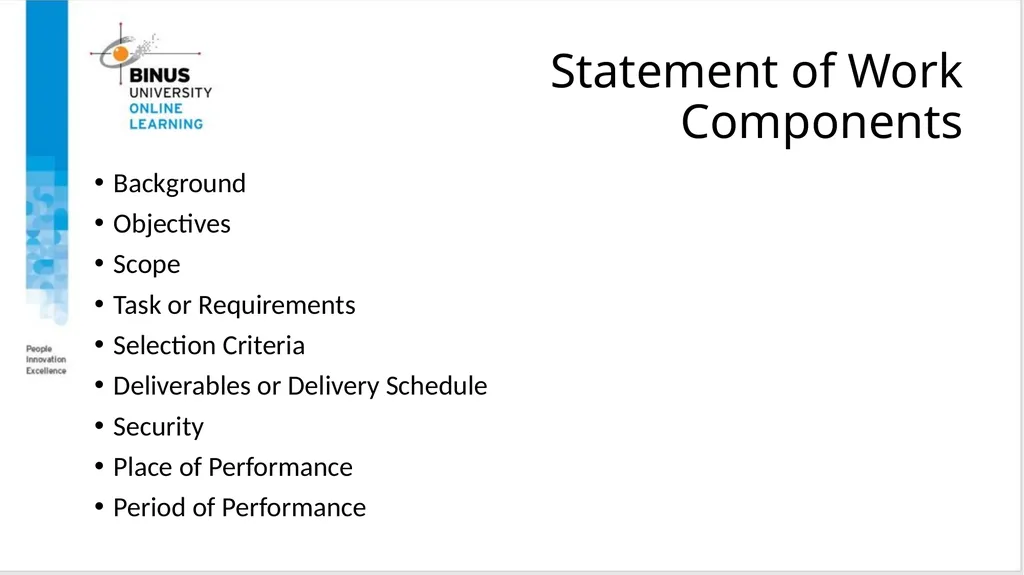
Statement of Work Components Background
Objectives
Scope
Task or Requirements
Selection Criteria
Deliverables or Delivery Schedule
Security
Place of Performance
Period of Performance Copyright ©2016 Pearson Education, Ltd. 9<br>
10
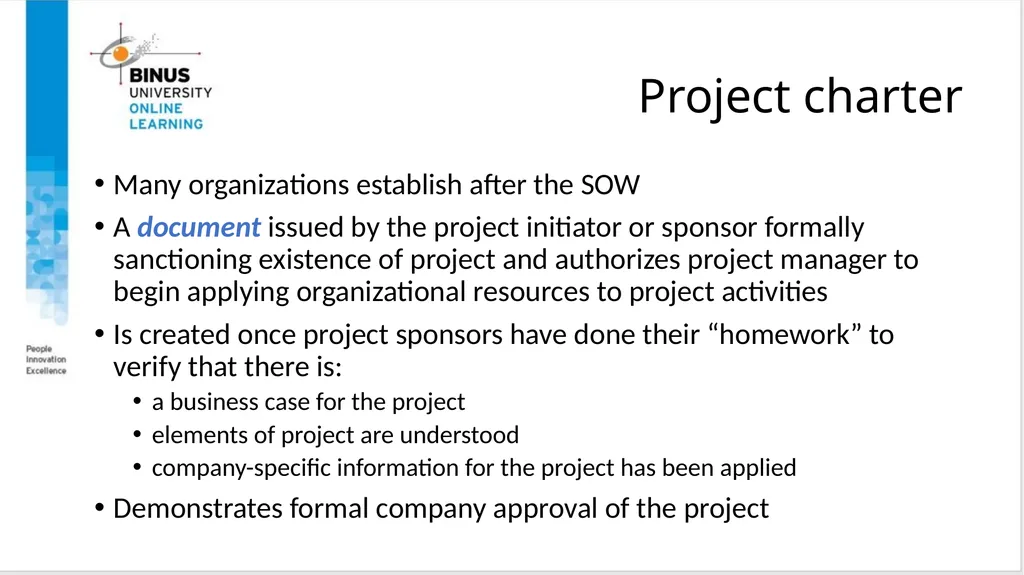
Project charter Many organizations establish after the SOW
A document issued by the project initiator or sponsor formally sanctioning existence of project and authorizes project manager to begin applying organizational resources to project activities
Is created once project sponsors have done their “homework” to verify that there is:
a business case for the project
elements of project are understood
company-specific information for the project has been applied
Demonstrates formal company approval of the project 10 Copyright ©2016 Pearson Education, Ltd.<br>
11
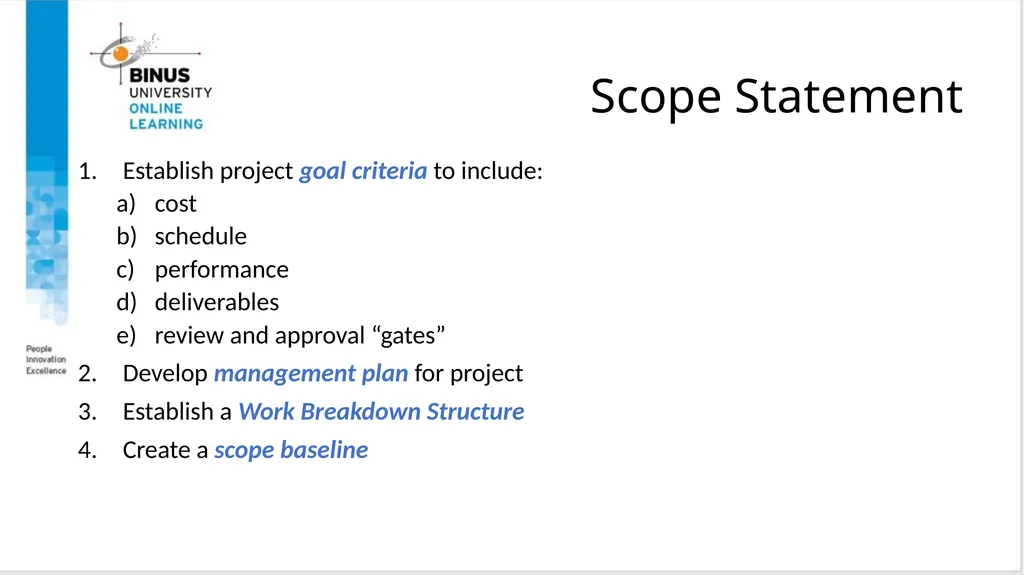
Scope Statement Establish project goal criteria to include:
cost
schedule
performance
deliverables
review and approval “gates”
Develop management plan for project
Establish a Work Breakdown Structure
Create a scope baseline Copyright ©2016 Pearson Education, Ltd. 11<br>
12
Work Breakdown Structure (WBS): Konsep dan Aplikasi<br>
13
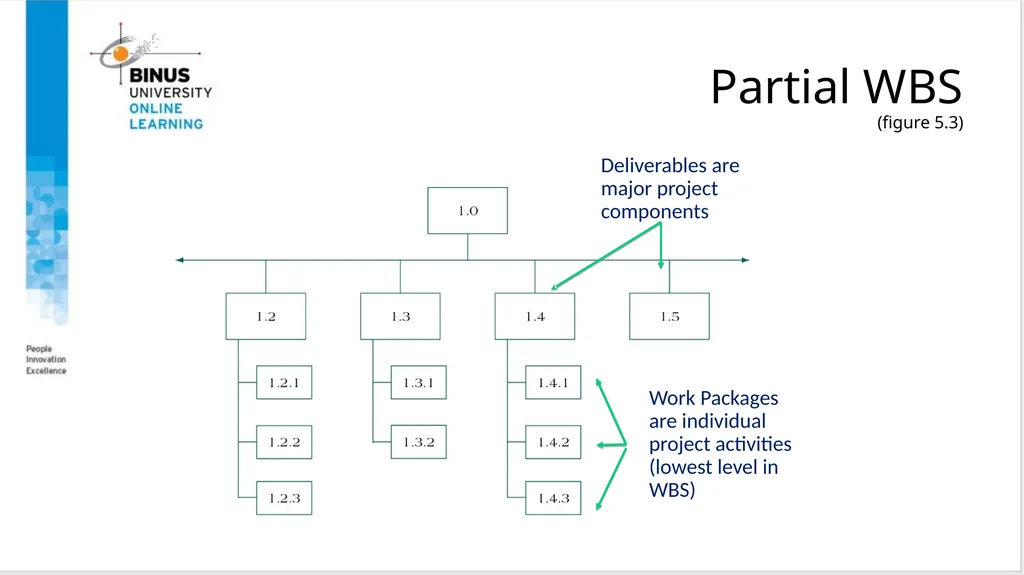
Work Breakdown Structure (WBS) A deliverable-oriented grouping of project elements which organizes and defines the total scope of the project. Each descending level represents an increasingly detailed definition of a project component. Project component may be products or services. Copyright ©2016 Pearson Education, Ltd. 13<br>
14
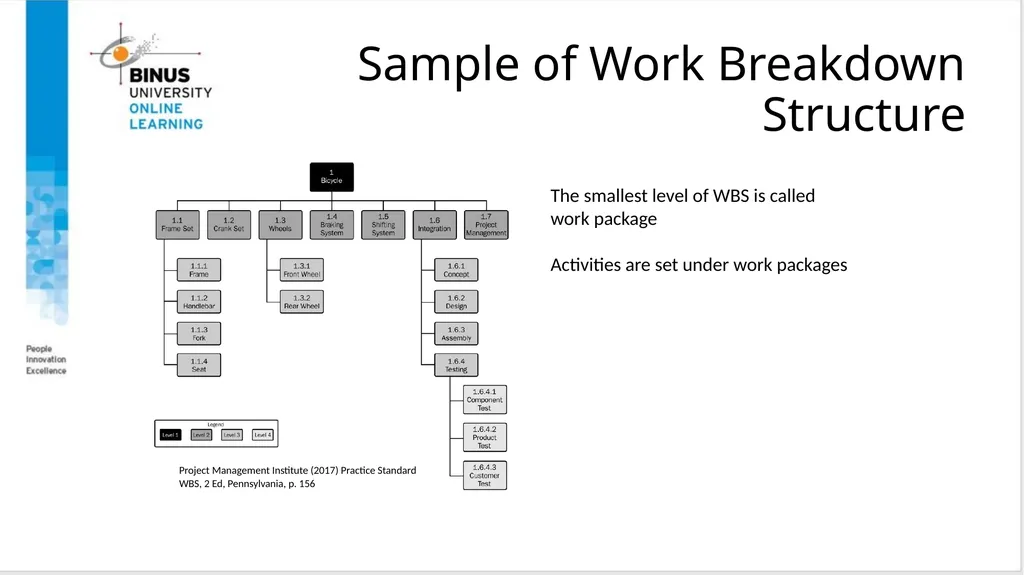
Sample of Work Breakdown Structure The smallest level of WBS is called work package
Activities are set under work packages Project Management Institute (2017) Practice Standard WBS, 2 Ed, Pennsylvania, p. 156<br>
15
Work Breakdown Structure purpose WBS serves six main purposes:
Echoes project objectives
Organization chart for the project
Creates logic for tracking costs, schedule, and performance specifications
Communicates project status
Improves project communication
Demonstrates control structure 15 Copyright ©2016 Pearson Education, Ltd.<br>
16
Defining a Work Package Lowest level in WBS
Deliverable result
One owner
Miniature projects
Milestones
Fits organization
Trackable Copyright ©2016 Pearson Education, Ltd. 16<br>
17
Partial WBS�(figure 5.3) Deliverables are major project components Work Packages are individual project activities (lowest level in WBS)<br>
18
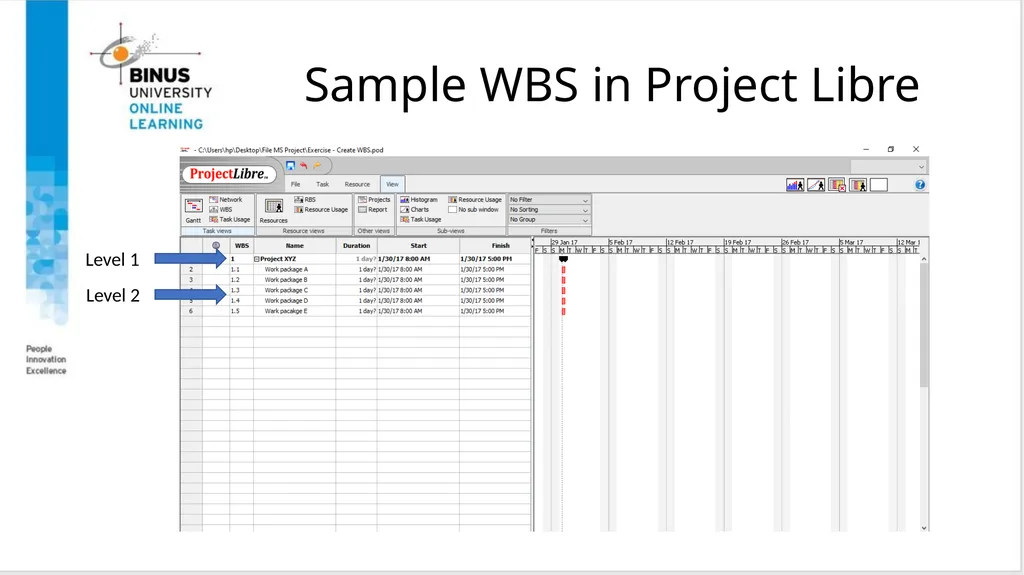
Sample WBS in Project Libre Copyright ©2016 Pearson Education, Ltd. 18 Level 1 Level 2<br>
19
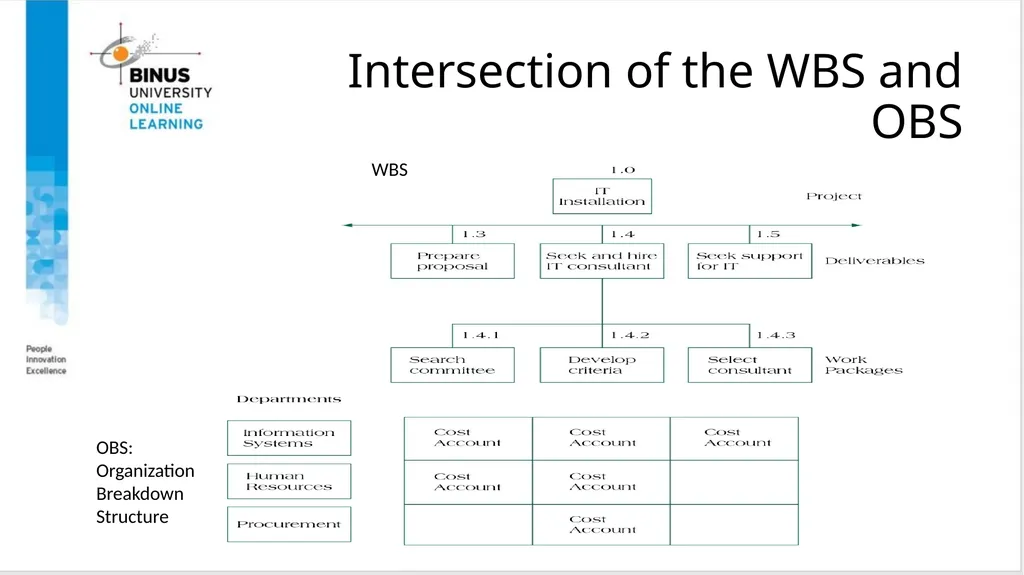
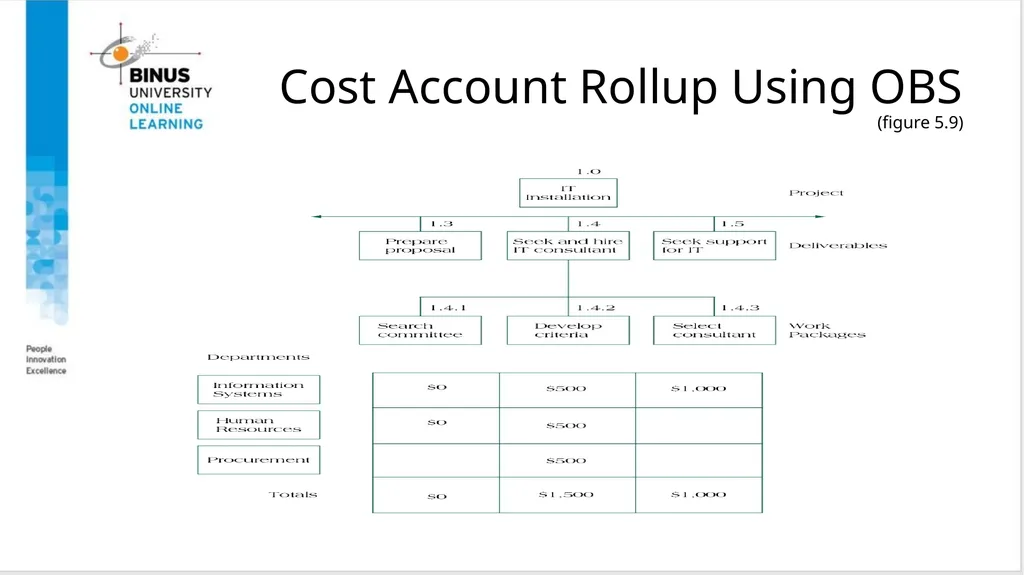
Organizational Breakdown Structure Organizational Breakdown Structure (OBS) allows
Work definition
Owner assignment of work packages
Budget assignment to departments
OBS links cost, activity & responsibility Copyright ©2016 Pearson Education, Ltd. 19<br>
20
Intersection of the WBS and OBS WBS OBS: Organization Breakdown Structure<br>
21
Cost Account Rollup Using OBS�(figure 5.9)<br>
22
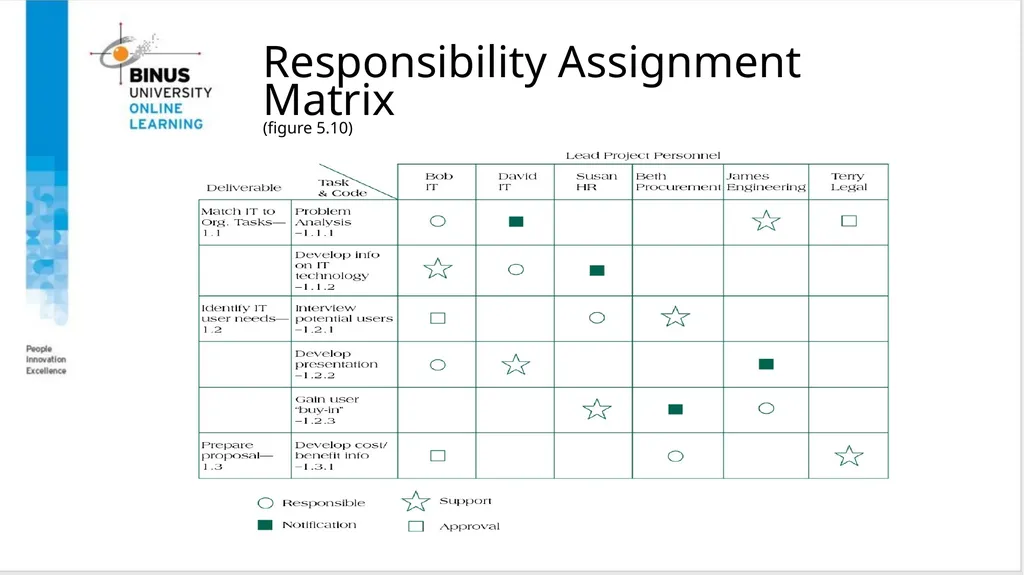
Responsibility Assignment Matrix�(figure 5.10) Copyright ©2016 Pearson Education, Ltd. 22<br>
23
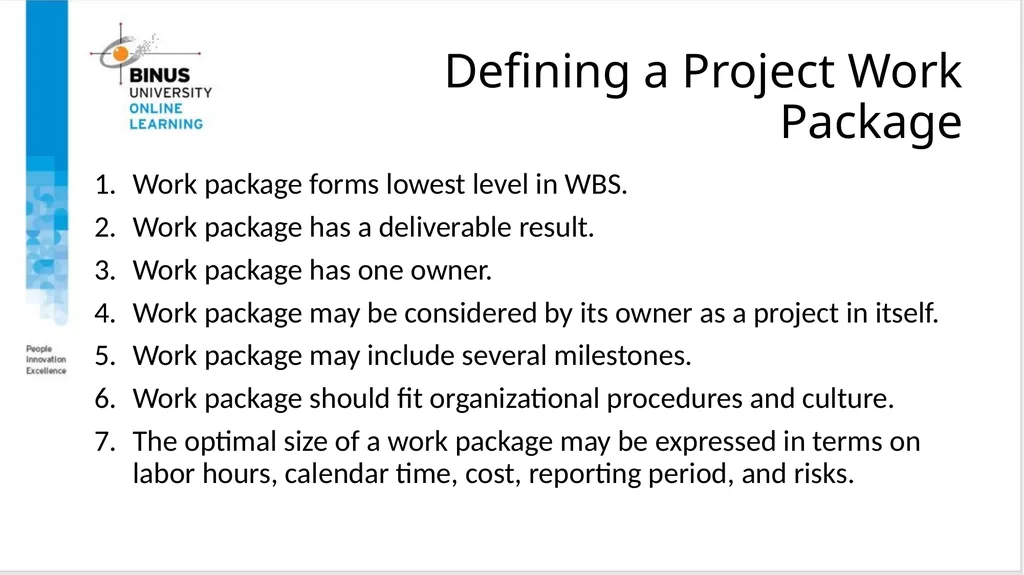
Defining a Project Work Package Work package forms lowest level in WBS.
Work package has a deliverable result.
Work package has one owner.
Work package may be considered by its owner as a project in itself.
Work package may include several milestones.
Work package should fit organizational procedures and culture.
The optimal size of a work package may be expressed in terms on labor hours, calendar time, cost, reporting period, and risks. Copyright ©2016 Pearson Education, Ltd. 23<br>
24
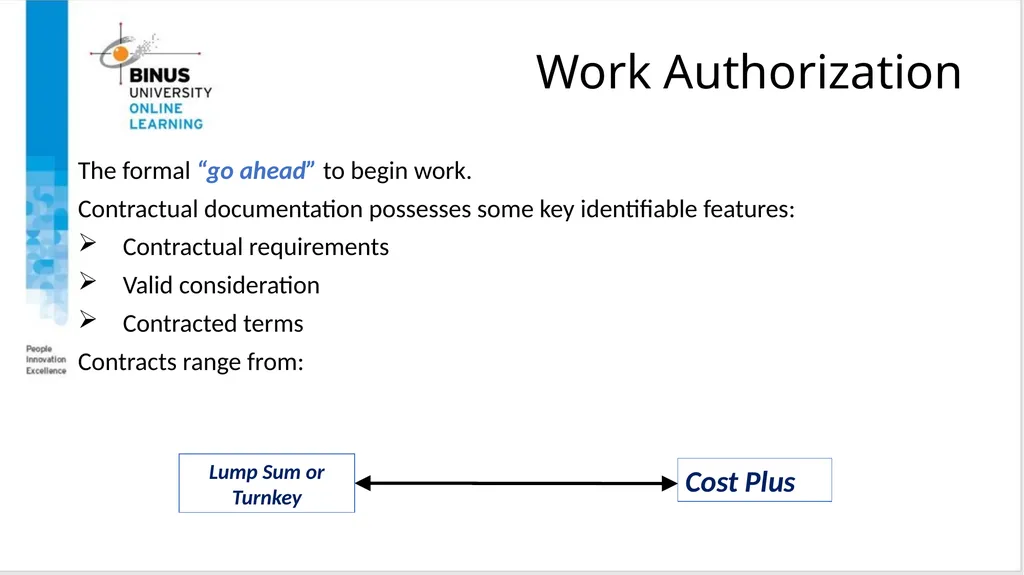
Work Authorization The formal “go ahead” to begin work.
Contractual documentation possesses some key identifiable features:
Contractual requirements
Valid consideration
Contracted terms
Contracts range from: Copyright ©2016 Pearson Education, Ltd. Lump Sum or
Turnkey Cost Plus 24<br>
25
Scope Reporting Determines what types of information reported, who receives copies, and when and how information is acquired and disseminated.
Typical project reports contain:
Cost status
Schedule status
Technical performance status Copyright ©2016 Pearson Education, Ltd. 25<br>
26
Pentingnya pengelolaan lingkup di dalam proyek<br>
27
Reasons Why Projects Fail Politics
Naïve promises
Naïve optimism of youth
Startup mentality of fledgling entrepreneurial companies
“Marine Corps” mentality
Intense competition caused by globalization
Intense competition caused by appearance of new technologies
Intense pressure caused by unexpected government regulations
Unexpected and/or unplanned crises Copyright ©2016 Pearson Education, Ltd. 27<br>
28
Types of Control Systems Configuration control
Design control
Trend monitoring
Document control
Acquisition control
Specification control Copyright ©2016 Pearson Education, Ltd. 28<br>
29
Configuration management A system of procedures that monitors emerging project scope against the baseline. It requires documentation and management approval on any change to the baseline. 29 Copyright ©2016 Pearson Education, Ltd. Configuration Management is defined as: Baseline is defined as: The project’s scope fixed at a specific point in time – for example, the project’s scheduled start date.<br>
30
Project changes Occur for one of several reasons:
Initial planning errors, either technological or human
Additional knowledge of project or environmental conditions
Uncontrollable mandates
Client requests 30 Copyright ©2016 Pearson Education, Ltd.<br>
31
Project Closeout The job is not over until the paperwork is done…
Closeout documentation is used to:
Resolve disputes
Train project managers
Facilitate auditing
Closeout documentation includes:
Historical records
Post project analysis
Financial closeout Copyright ©2016 Pearson Education, Ltd. 31<br>
32
Summary Understand the importance of scope management for project success.
Understand the significance of developing a scope statement.
Construct a Work Breakdown Structure for a project.
Develop a Responsibility Assignment Matrix for a project.
Describe the roles of changes and configuration management in assessing project scope. Copyright ©2016 Pearson Education, Ltd. 32<br>
33
REFERENCES Pinto. J.K. (2016). Project Management: Achieving Competitive Advantage. Pearson Education Limited. London. ISBN:978-1-292-09479-3, Chapter 5<br>