
Promoting Egg Donor Payment to Enhance Stem Cell
LD
Published · 1 slides · 0 views
1 / 1
Description
Promoting Egg Donor Payment to Enhance Stem Cell Research Authored by Justin S. Olson, Facilitated by Dr. Elizabeth Buchanan and Dr. Timothy Shiell Department of Biology, Applied Ethics Program, The University of Wisconsin at Stout
Related Topics
Share
Embed code
Download this presentation From Below
"Promoting Egg Donor Payment to Enhance Stem Cell" is the property of its rightful owner. Permission is granted to download and print the materials on this website for personal, non-commercial use only, and to display it on your personal computer provided you do not modify the materials and that you retain all copyright notices contained in the materials. By downloading content from our website, you accept the terms of this agreement.
Presentation Transcript
01
Promoting Egg Donor Payment to Enhance Stem Cell Research Authored by Justin S. Olson, Facilitated by Dr. Elizabeth Buchanan and Dr. Timothy Shiell
Department of Biology, Applied Ethics Program, The University of Wisconsin at Stout
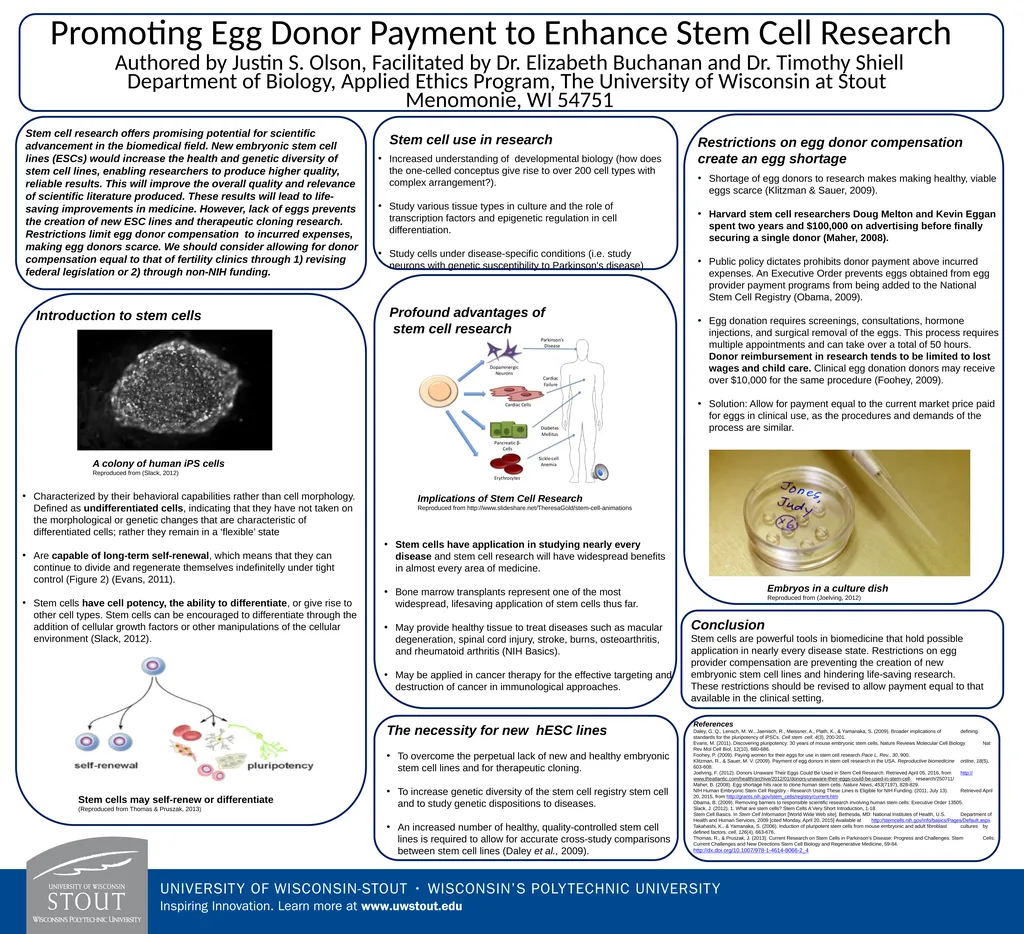
Menomonie, WI 54751 Stem cell research offers promising potential for scientific advancement in the biomedical field. New embryonic stem cell lines (ESCs) would increase the health and genetic diversity of stem cell lines, enabling researchers to produce higher quality, reliable results. This will improve the overall quality and relevance of scientific literature produced. These results will lead to life-saving improvements in medicine. However, lack of eggs prevents the creation of new ESC lines and therapeutic cloning research. Restrictions limit egg donor compensation to incurred expenses, making egg donors scarce. We should consider allowing for donor compensation equal to that of fertility clinics through 1) revising federal legislation or 2) through non-NIH funding. Implications of Stem Cell Research
Reproduced from http://www.slideshare.net/TheresaGold/stem-cell-animations A colony of human iPS cells
Reproduced from (Slack, 2012) Characterized by their behavioral capabilities rather than cell morphology. Defined as undifferentiated cells, indicating that they have not taken on the morphological or genetic changes that are characteristic of differentiated cells; rather they remain in a ‘flexible’ state
Are capable of long-term self-renewal, which means that they can continue to divide and regenerate themselves indefinitelly under tight control (Figure 2) (Evans, 2011).
Stem cells have cell potency, the ability to differentiate, or give rise to other cell types. Stem cells can be encouraged to differentiate through the addition of cellular growth factors or other manipulations of the cellular environment (Slack, 2012). Introduction to stem cells Stem cell use in research
Increased understanding of developmental biology (how does the one-celled conceptus give rise to over 200 cell types with complex arrangement?).
Study various tissue types in culture and the role of transcription factors and epigenetic regulation in cell differentiation.
Study cells under disease-specific conditions (i.e. study neurons with genetic susceptibility to Parkinson's disease)
Profound advantages of
stem cell research Stem cells have application in studying nearly every disease and stem cell research will have widespread benefits in almost every area of medicine.
Bone marrow transplants represent one of the most widespread, lifesaving application of stem cells thus far.
May provide healthy tissue to treat diseases such as macular degeneration, spinal cord injury, stroke, burns, osteoarthritis, and rheumatoid arthritis (NIH Basics).
May be applied in cancer therapy for the effective targeting and destruction of cancer in immunological approaches. Restrictions on egg donor compensation create an egg shortage
Shortage of egg donors to research makes making healthy, viable eggs scarce (Klitzman & Sauer, 2009).
Harvard stem cell researchers Doug Melton and Kevin Eggan spent two years and $100,000 on advertising before finally securing a single donor (Maher, 2008).
Public policy dictates prohibits donor payment above incurred expenses. An Executive Order prevents eggs obtained from egg provider payment programs from being added to the National Stem Cell Registry (Obama, 2009).
Egg donation requires screenings, consultations, hormone injections, and surgical removal of the eggs. This process requires multiple appointments and can take over a total of 50 hours. Donor reimbursement in research tends to be limited to lost wages and child care. Clinical egg donation donors may receive over $10,000 for the same procedure (Foohey, 2009).
Solution: Allow for payment equal to the current market price paid for eggs in clinical use, as the procedures and demands of the process are similar. Conclusion
Stem cells are powerful tools in biomedicine that hold possible application in nearly every disease state. Restrictions on egg provider compensation are preventing the creation of new embryonic stem cell lines and hindering life-saving research. These restrictions should be revised to allow payment equal to that available in the clinical setting. Stem cells may self-renew or differentiate
(Reproduced from Thomas & Pruszak, 2013) The necessity for new hESC lines
To overcome the perpetual lack of new and healthy embryonic stem cell lines and for therapeutic cloning.
To increase genetic diversity of the stem cell registry stem cell and to study genetic dispositions to diseases.
An increased number of healthy, quality-controlled stem cell lines is required to allow for accurate cross-study comparisons between stem cell lines (Daley et al., 2009). References
Daley, G. Q., Lensch, M. W., Jaenisch, R., Meissner, A., Plath, K., & Yamanaka, S. (2009). Broader implications of defining standards for the pluripotency of iPSCs. Cell stem cell, 4(3), 200-201.
Evans, M. (2011). Discovering pluripotency: 30 years of mouse embryonic stem cells. Nature Reviews Molecular Cell Biology Nat Rev Mol Cell Biol, 12(10), 680-686.
Foohey, P. (2009). Paying women for their eggs for use in stem cell research.Pace L. Rev., 30, 900.
Klitzman, R., & Sauer, M. V. (2009). Payment of egg donors in stem cell research in the USA. Reproductive biomedicine online, 18(5), 603-608.
Joelving, F. (2012). Donors Unaware Their Eggs Could Be Used in Stem Cell Research. Retrieved April 05, 2016, from http://www.theatlantic.com/health/archive/2012/01/donors-unaware-their-eggs-could-be-used-in-stem-cell- research/250711/
Maher, B. (2008). Egg shortage hits race to clone human stem cells. Nature News, 453(7197), 828-829.
NIH Human Embryonic Stem Cell Registry - Research Using These Lines is Eligible for NIH Funding. (2011, July 13). Retrieved April 20, 2015, from http://grants.nih.gov/stem_cells/registry/current.htm
Obama, B. (2009). Removing barriers to responsible scientific research involving human stem cells: Executive Order 13505.
Slack, J. (2012). 1. What are stem cells? Stem Cells A Very Short Introduction, 1-18.
Stem Cell Basics. In Stem Cell Information [World Wide Web site]. Bethesda, MD: National Institutes of Health, U.S. Department of Health and Human Services, 2009 [cited Monday, April 20, 2015] Available at http://stemcells.nih.gov/info/basics/Pages/Default.aspx
Takahashi, K., & Yamanaka, S. (2006). Induction of pluripotent stem cells from mouse embryonic and adult fibroblast cultures by defined factors. cell, 126(4), 663-676.
Thomas, R., & Pruszak, J. (2013). Current Research on Stem Cells in Parkinson’s Disease: Progress and Challenges. Stem Cells: Current Challenges and New Directions Stem Cell Biology and Regenerative Medicine, 59-84. http://dx.doi.org/10.1007/978-1-4614-8066- 2_4 Embryos in a culture dish
Reproduced from (Joelving, 2012)<br>
Department of Biology, Applied Ethics Program, The University of Wisconsin at Stout
Menomonie, WI 54751 Stem cell research offers promising potential for scientific advancement in the biomedical field. New embryonic stem cell lines (ESCs) would increase the health and genetic diversity of stem cell lines, enabling researchers to produce higher quality, reliable results. This will improve the overall quality and relevance of scientific literature produced. These results will lead to life-saving improvements in medicine. However, lack of eggs prevents the creation of new ESC lines and therapeutic cloning research. Restrictions limit egg donor compensation to incurred expenses, making egg donors scarce. We should consider allowing for donor compensation equal to that of fertility clinics through 1) revising federal legislation or 2) through non-NIH funding. Implications of Stem Cell Research
Reproduced from http://www.slideshare.net/TheresaGold/stem-cell-animations A colony of human iPS cells
Reproduced from (Slack, 2012) Characterized by their behavioral capabilities rather than cell morphology. Defined as undifferentiated cells, indicating that they have not taken on the morphological or genetic changes that are characteristic of differentiated cells; rather they remain in a ‘flexible’ state
Are capable of long-term self-renewal, which means that they can continue to divide and regenerate themselves indefinitelly under tight control (Figure 2) (Evans, 2011).
Stem cells have cell potency, the ability to differentiate, or give rise to other cell types. Stem cells can be encouraged to differentiate through the addition of cellular growth factors or other manipulations of the cellular environment (Slack, 2012). Introduction to stem cells Stem cell use in research
Increased understanding of developmental biology (how does the one-celled conceptus give rise to over 200 cell types with complex arrangement?).
Study various tissue types in culture and the role of transcription factors and epigenetic regulation in cell differentiation.
Study cells under disease-specific conditions (i.e. study neurons with genetic susceptibility to Parkinson's disease)
Profound advantages of
stem cell research Stem cells have application in studying nearly every disease and stem cell research will have widespread benefits in almost every area of medicine.
Bone marrow transplants represent one of the most widespread, lifesaving application of stem cells thus far.
May provide healthy tissue to treat diseases such as macular degeneration, spinal cord injury, stroke, burns, osteoarthritis, and rheumatoid arthritis (NIH Basics).
May be applied in cancer therapy for the effective targeting and destruction of cancer in immunological approaches. Restrictions on egg donor compensation create an egg shortage
Shortage of egg donors to research makes making healthy, viable eggs scarce (Klitzman & Sauer, 2009).
Harvard stem cell researchers Doug Melton and Kevin Eggan spent two years and $100,000 on advertising before finally securing a single donor (Maher, 2008).
Public policy dictates prohibits donor payment above incurred expenses. An Executive Order prevents eggs obtained from egg provider payment programs from being added to the National Stem Cell Registry (Obama, 2009).
Egg donation requires screenings, consultations, hormone injections, and surgical removal of the eggs. This process requires multiple appointments and can take over a total of 50 hours. Donor reimbursement in research tends to be limited to lost wages and child care. Clinical egg donation donors may receive over $10,000 for the same procedure (Foohey, 2009).
Solution: Allow for payment equal to the current market price paid for eggs in clinical use, as the procedures and demands of the process are similar. Conclusion
Stem cells are powerful tools in biomedicine that hold possible application in nearly every disease state. Restrictions on egg provider compensation are preventing the creation of new embryonic stem cell lines and hindering life-saving research. These restrictions should be revised to allow payment equal to that available in the clinical setting. Stem cells may self-renew or differentiate
(Reproduced from Thomas & Pruszak, 2013) The necessity for new hESC lines
To overcome the perpetual lack of new and healthy embryonic stem cell lines and for therapeutic cloning.
To increase genetic diversity of the stem cell registry stem cell and to study genetic dispositions to diseases.
An increased number of healthy, quality-controlled stem cell lines is required to allow for accurate cross-study comparisons between stem cell lines (Daley et al., 2009). References
Daley, G. Q., Lensch, M. W., Jaenisch, R., Meissner, A., Plath, K., & Yamanaka, S. (2009). Broader implications of defining standards for the pluripotency of iPSCs. Cell stem cell, 4(3), 200-201.
Evans, M. (2011). Discovering pluripotency: 30 years of mouse embryonic stem cells. Nature Reviews Molecular Cell Biology Nat Rev Mol Cell Biol, 12(10), 680-686.
Foohey, P. (2009). Paying women for their eggs for use in stem cell research.Pace L. Rev., 30, 900.
Klitzman, R., & Sauer, M. V. (2009). Payment of egg donors in stem cell research in the USA. Reproductive biomedicine online, 18(5), 603-608.
Joelving, F. (2012). Donors Unaware Their Eggs Could Be Used in Stem Cell Research. Retrieved April 05, 2016, from http://www.theatlantic.com/health/archive/2012/01/donors-unaware-their-eggs-could-be-used-in-stem-cell- research/250711/
Maher, B. (2008). Egg shortage hits race to clone human stem cells. Nature News, 453(7197), 828-829.
NIH Human Embryonic Stem Cell Registry - Research Using These Lines is Eligible for NIH Funding. (2011, July 13). Retrieved April 20, 2015, from http://grants.nih.gov/stem_cells/registry/current.htm
Obama, B. (2009). Removing barriers to responsible scientific research involving human stem cells: Executive Order 13505.
Slack, J. (2012). 1. What are stem cells? Stem Cells A Very Short Introduction, 1-18.
Stem Cell Basics. In Stem Cell Information [World Wide Web site]. Bethesda, MD: National Institutes of Health, U.S. Department of Health and Human Services, 2009 [cited Monday, April 20, 2015] Available at http://stemcells.nih.gov/info/basics/Pages/Default.aspx
Takahashi, K., & Yamanaka, S. (2006). Induction of pluripotent stem cells from mouse embryonic and adult fibroblast cultures by defined factors. cell, 126(4), 663-676.
Thomas, R., & Pruszak, J. (2013). Current Research on Stem Cells in Parkinson’s Disease: Progress and Challenges. Stem Cells: Current Challenges and New Directions Stem Cell Biology and Regenerative Medicine, 59-84. http://dx.doi.org/10.1007/978-1-4614-8066- 2_4 Embryos in a culture dish
Reproduced from (Joelving, 2012)<br>