
Providing Restorative supervision through Peer
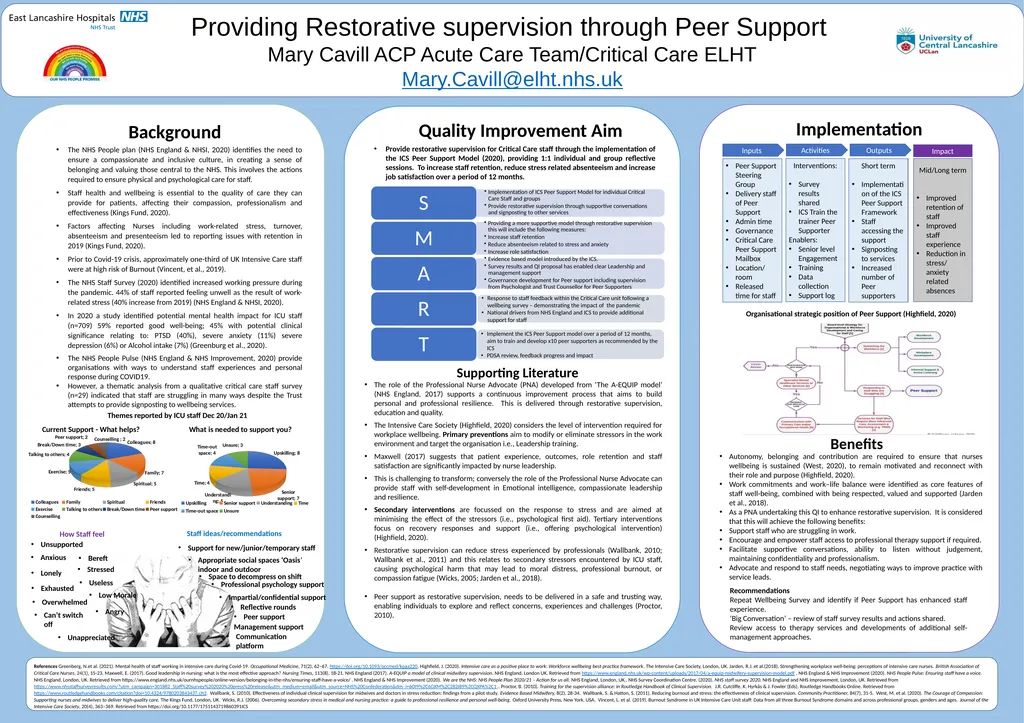
Description: Providing Restorative supervision through Peer Support Mary Cavill ACP Acute Care TeamCritical Care ELHT Mary.Cavillelht.nhs.uk Background Implementation Benefits References Greenberg, N.et al. (2021). Mental health of staff working in
Related Topics
Download Presentation
"Providing Restorative supervision through Peer" is the property of its rightful owner. Permission is granted to download and print the materials on this website for personal, non-commercial use only, and to display it on your personal computer provided you do not modify the materials and that you retain all copyright notices contained in the materials. By downloading content from our website, you accept the terms of this agreement.
Presentation Transcript
slide1. Providing Restorative supervision through Peer Support
Mary Cavill ACP Acute Care Team/Critical Care ELHT
Mary.Cavill@elht.nhs.uk Background Implementation Benefits References Greenberg, N.et al. (2021). Mental health of staff working in intensive care during Covid-19. Occupational Medicine, 71(2), 62–67. https://doi.org/10.1093/occmed/kqaa220. Highfield, J. (2020). Intensive care as a positive place to work: Workforce wellbeing best practice framework. The Intensive Care Society, London, UK. Jarden, R.J. et al.(2018). Strengthening workplace well-being: perceptions of intensive care nurses. British Association of Critical Care Nurses, 24(1), 15-23. Maxwell, E. (2017). Good leadership in nursing: what is the most effective approach? Nursing Times, 113(8), 18-21. NHS England (2017). A-EQUIP a model of clinical midwifery supervision. NHS England, London UK. Retrieved from https://www.england.nhs.uk/wp-content/uploads/2017/04/a-equip-midwifery-supervision-model.pdf . NHS England & NHS Improvement (2020). NHS People Pulse: Ensuring staff have a voice. NHS England, London, UK. Retrieved from https://www.england.nhs.uk/ournhspeople/online-version/belonging-in-the-nhs/ensuring-staff-have-a-voice/ . NHS England & NHS Improvement (2020). We are the NHS: NHS People Plan 2020/21 – Action for us all. NHS England, London, UK.. NHS Survey Coordination Centre. (2020). NHS staff survey 2020. NHS England and NHS Improvement, London, UK. Retrieved from https://www.nhsstaffsurveyresults.com/?utm_campaign=301882_Staff%20survey%202020%20press%20release&utm_medium=email&utm_source=NHS%20Confederation&dm_i=6OI9%2C6GXM%2C282I89%2CQXPA%2C1.. Proctor, B. (2010). Training for the supervision alliance: in Routledge Handbook of Clinical Supervision. J.R. Cutcliffe, K. Hyrkäs & J. Fowler (Eds). Routledge Handbooks Online. Retrieved from https://www.routledgehandbooks.com/citation?doi=10.4324/9780203843437.ch3. Wallbank, S. (2010). Effectiveness of individual clinical supervision for midwives and doctors in stress reduction: findings from a pilot study. Evidence Based Midwifery, 8(2), 28-34. Wallbank, S. & Hatton, S. (2011). Reducing burnout and stress: the effectiveness of clinical supervision. Community Practitioner, 84(7), 31-5. West, M. et al. (2020). The Courage of Compassion: Supporting nurses and midwives to deliver high-quality care. The Kings Fund, London, UK. Wicks, R.J. (2006). Overcoming secondary stress in medical and nursing practice: a guide to professional resilience and personal well-being. Oxford University Press, New York, USA. Vincent, L. et al. (2019). Burnout Syndrome in UK Intensive Care Unit staff: Data from all three Burnout Syndrome domains and across professional groups, genders and ages. Journal of the Intensive Care Society, 20(4), 363–369. Retrieved from https://doi.org/10.1177/1751143719860391ICS The NHS People plan (NHS England & NHSI, 2020) identifies the need to ensure a compassionate and inclusive culture, in creating a sense of belonging and valuing those central to the NHS. This involves the actions required to ensure physical and psychological care for staff.
Staff health and wellbeing is essential to the quality of care they can provide for patients, affecting their compassion, professionalism and effectiveness (Kings Fund, 2020).
Factors affecting Nurses including work-related stress, turnover, absenteeism and presenteeism led to reporting issues with retention in 2019 (Kings Fund, 2020).
Prior to Covid-19 crisis, approximately one-third of UK Intensive Care staff were at high risk of Burnout (Vincent, et al., 2019).
The NHS Staff Survey (2020) identified increased working pressure during the pandemic. 44% of staff reported feeling unwell as the result of work-related stress (40% increase from 2019) (NHS England & NHSI, 2020).
In 2020 a study identified potential mental health impact for ICU staff (n=709) 59% reported good well-being; 45% with potential clinical significance relating to: PTSD (40%), severe anxiety (11%) severe depression (6%) or Alcohol intake (7%) (Greenburg et al., 2020).
The NHS People Pulse (NHS England & NHS Improvement, 2020) provide organisations with ways to understand staff experiences and personal response during COVID19.
However, a thematic analysis from a qualitative critical care staff survey (n=29) indicated that staff are struggling in many ways despite the Trust attempts to provide signposting to wellbeing services. Quality Improvement Aim Provide restorative supervision for Critical Care staff through the implementation of the ICS Peer Support Model (2020), providing 1:1 individual and group reflective sessions. To increase staff retention, reduce stress related absenteeism and increase job satisfaction over a period of 12 months. Bereft Lonely Anxious Stressed Exhausted Useless Unsupported Themes reported by ICU staff Dec 20/Jan 21 Low Morale Overwhelmed Angry Can’t switch off Unappreciated How Staff feel Staff ideas/recommendations Support for new/junior/temporary staff Appropriate social spaces ‘Oasis’ indoor and outdoor Professional psychology support Management support Reflective rounds Peer support Space to decompress on shift Impartial/confidential support Communication platform Response to staff feedback within the Critical Care unit following a wellbeing survey – demonstrating the impact of the pandemic
National drivers from NHS England and ICS to provide additional support for staff Implement the ICS Peer Support model over a period of 12 months, aim to train and develop x10 peer supporters as recommended by the ICS
PDSA review, feedback progress and impact Supporting Literature The role of the Professional Nurse Advocate (PNA) developed from ‘The A-EQUIP model’ (NHS England, 2017) supports a continuous improvement process that aims to build personal and professional resilience. This is delivered through restorative supervision, education and quality.
The Intensive Care Society (Highfield, 2020) considers the level of intervention required for workplace wellbeing. Primary preventions aim to modify or eliminate stressors in the work environment and target the organisation i.e., Leadership training.
Maxwell (2017) suggests that patient experience, outcomes, role retention and staff satisfaction are significantly impacted by nurse leadership.
This is challenging to transform; conversely the role of the Professional Nurse Advocate can provide staff with self-development in Emotional intelligence, compassionate leadership and resilience.
Secondary interventions are focussed on the response to stress and are aimed at minimising the effect of the stressors (i.e., psychological first aid). Tertiary interventions focus on recovery responses and support (i.e., offering psychological intervention) (Highfield, 2020).
Restorative supervision can reduce stress experienced by professionals (Wallbank, 2010; Wallbank et al., 2011) and this relates to secondary stressors encountered by ICU staff, causing psychological harm that may lead to moral distress, professional burnout, or compassion fatigue (Wicks, 2005; Jarden et al., 2018).
Peer support as restorative supervision, needs to be delivered in a safe and trusting way, enabling individuals to explore and reflect concerns, experiences and challenges (Proctor, 2010). Organisational strategic position of Peer Support (Highfield, 2020) Recommendations
Repeat Wellbeing Survey and identify if Peer Support has enhanced staff experience.
‘Big Conversation’ – review of staff survey results and actions shared.
Review access to therapy services and developments of additional self-management approaches. Autonomy, belonging and contribution are required to ensure that nurses wellbeing is sustained (West, 2020), to remain motivated and reconnect with their role and purpose (Highfield, 2020).
Work commitments and work–life balance were identified as core features of staff well-being, combined with being respected, valued and supported (Jarden et al., 2018).
As a PNA undertaking this QI to enhance restorative supervision. It is considered that this will achieve the following benefits:
Support staff who are struggling in work.
Encourage and empower staff access to professional therapy support if required.
Facilitate supportive conversations, ability to listen without judgement, maintaining confidentiality and professionalism.
Advocate and respond to staff needs, negotiating ways to improve practice with service leads. Inputs Activities Outputs Impact Peer Support Steering Group
Delivery staff of Peer Support
Admin time
Governance
Critical Care Peer Support Mailbox
Location/room
Released time for staff Interventions:
Survey results shared
ICS Train the trainer Peer Supporter
Enablers:
Senior level Engagement
Training
Data collection
Support log Short term
Implementation of the ICS Peer Support Framework
Staff accessing the support
Signposting to services
Increased number of Peer supporters Mid/Long term
Improved retention of staff
Improved staff experience
Reduction in stress/ anxiety related absences<br>
Mary Cavill ACP Acute Care Team/Critical Care ELHT
Mary.Cavill@elht.nhs.uk Background Implementation Benefits References Greenberg, N.et al. (2021). Mental health of staff working in intensive care during Covid-19. Occupational Medicine, 71(2), 62–67. https://doi.org/10.1093/occmed/kqaa220. Highfield, J. (2020). Intensive care as a positive place to work: Workforce wellbeing best practice framework. The Intensive Care Society, London, UK. Jarden, R.J. et al.(2018). Strengthening workplace well-being: perceptions of intensive care nurses. British Association of Critical Care Nurses, 24(1), 15-23. Maxwell, E. (2017). Good leadership in nursing: what is the most effective approach? Nursing Times, 113(8), 18-21. NHS England (2017). A-EQUIP a model of clinical midwifery supervision. NHS England, London UK. Retrieved from https://www.england.nhs.uk/wp-content/uploads/2017/04/a-equip-midwifery-supervision-model.pdf . NHS England & NHS Improvement (2020). NHS People Pulse: Ensuring staff have a voice. NHS England, London, UK. Retrieved from https://www.england.nhs.uk/ournhspeople/online-version/belonging-in-the-nhs/ensuring-staff-have-a-voice/ . NHS England & NHS Improvement (2020). We are the NHS: NHS People Plan 2020/21 – Action for us all. NHS England, London, UK.. NHS Survey Coordination Centre. (2020). NHS staff survey 2020. NHS England and NHS Improvement, London, UK. Retrieved from https://www.nhsstaffsurveyresults.com/?utm_campaign=301882_Staff%20survey%202020%20press%20release&utm_medium=email&utm_source=NHS%20Confederation&dm_i=6OI9%2C6GXM%2C282I89%2CQXPA%2C1.. Proctor, B. (2010). Training for the supervision alliance: in Routledge Handbook of Clinical Supervision. J.R. Cutcliffe, K. Hyrkäs & J. Fowler (Eds). Routledge Handbooks Online. Retrieved from https://www.routledgehandbooks.com/citation?doi=10.4324/9780203843437.ch3. Wallbank, S. (2010). Effectiveness of individual clinical supervision for midwives and doctors in stress reduction: findings from a pilot study. Evidence Based Midwifery, 8(2), 28-34. Wallbank, S. & Hatton, S. (2011). Reducing burnout and stress: the effectiveness of clinical supervision. Community Practitioner, 84(7), 31-5. West, M. et al. (2020). The Courage of Compassion: Supporting nurses and midwives to deliver high-quality care. The Kings Fund, London, UK. Wicks, R.J. (2006). Overcoming secondary stress in medical and nursing practice: a guide to professional resilience and personal well-being. Oxford University Press, New York, USA. Vincent, L. et al. (2019). Burnout Syndrome in UK Intensive Care Unit staff: Data from all three Burnout Syndrome domains and across professional groups, genders and ages. Journal of the Intensive Care Society, 20(4), 363–369. Retrieved from https://doi.org/10.1177/1751143719860391ICS The NHS People plan (NHS England & NHSI, 2020) identifies the need to ensure a compassionate and inclusive culture, in creating a sense of belonging and valuing those central to the NHS. This involves the actions required to ensure physical and psychological care for staff.
Staff health and wellbeing is essential to the quality of care they can provide for patients, affecting their compassion, professionalism and effectiveness (Kings Fund, 2020).
Factors affecting Nurses including work-related stress, turnover, absenteeism and presenteeism led to reporting issues with retention in 2019 (Kings Fund, 2020).
Prior to Covid-19 crisis, approximately one-third of UK Intensive Care staff were at high risk of Burnout (Vincent, et al., 2019).
The NHS Staff Survey (2020) identified increased working pressure during the pandemic. 44% of staff reported feeling unwell as the result of work-related stress (40% increase from 2019) (NHS England & NHSI, 2020).
In 2020 a study identified potential mental health impact for ICU staff (n=709) 59% reported good well-being; 45% with potential clinical significance relating to: PTSD (40%), severe anxiety (11%) severe depression (6%) or Alcohol intake (7%) (Greenburg et al., 2020).
The NHS People Pulse (NHS England & NHS Improvement, 2020) provide organisations with ways to understand staff experiences and personal response during COVID19.
However, a thematic analysis from a qualitative critical care staff survey (n=29) indicated that staff are struggling in many ways despite the Trust attempts to provide signposting to wellbeing services. Quality Improvement Aim Provide restorative supervision for Critical Care staff through the implementation of the ICS Peer Support Model (2020), providing 1:1 individual and group reflective sessions. To increase staff retention, reduce stress related absenteeism and increase job satisfaction over a period of 12 months. Bereft Lonely Anxious Stressed Exhausted Useless Unsupported Themes reported by ICU staff Dec 20/Jan 21 Low Morale Overwhelmed Angry Can’t switch off Unappreciated How Staff feel Staff ideas/recommendations Support for new/junior/temporary staff Appropriate social spaces ‘Oasis’ indoor and outdoor Professional psychology support Management support Reflective rounds Peer support Space to decompress on shift Impartial/confidential support Communication platform Response to staff feedback within the Critical Care unit following a wellbeing survey – demonstrating the impact of the pandemic
National drivers from NHS England and ICS to provide additional support for staff Implement the ICS Peer Support model over a period of 12 months, aim to train and develop x10 peer supporters as recommended by the ICS
PDSA review, feedback progress and impact Supporting Literature The role of the Professional Nurse Advocate (PNA) developed from ‘The A-EQUIP model’ (NHS England, 2017) supports a continuous improvement process that aims to build personal and professional resilience. This is delivered through restorative supervision, education and quality.
The Intensive Care Society (Highfield, 2020) considers the level of intervention required for workplace wellbeing. Primary preventions aim to modify or eliminate stressors in the work environment and target the organisation i.e., Leadership training.
Maxwell (2017) suggests that patient experience, outcomes, role retention and staff satisfaction are significantly impacted by nurse leadership.
This is challenging to transform; conversely the role of the Professional Nurse Advocate can provide staff with self-development in Emotional intelligence, compassionate leadership and resilience.
Secondary interventions are focussed on the response to stress and are aimed at minimising the effect of the stressors (i.e., psychological first aid). Tertiary interventions focus on recovery responses and support (i.e., offering psychological intervention) (Highfield, 2020).
Restorative supervision can reduce stress experienced by professionals (Wallbank, 2010; Wallbank et al., 2011) and this relates to secondary stressors encountered by ICU staff, causing psychological harm that may lead to moral distress, professional burnout, or compassion fatigue (Wicks, 2005; Jarden et al., 2018).
Peer support as restorative supervision, needs to be delivered in a safe and trusting way, enabling individuals to explore and reflect concerns, experiences and challenges (Proctor, 2010). Organisational strategic position of Peer Support (Highfield, 2020) Recommendations
Repeat Wellbeing Survey and identify if Peer Support has enhanced staff experience.
‘Big Conversation’ – review of staff survey results and actions shared.
Review access to therapy services and developments of additional self-management approaches. Autonomy, belonging and contribution are required to ensure that nurses wellbeing is sustained (West, 2020), to remain motivated and reconnect with their role and purpose (Highfield, 2020).
Work commitments and work–life balance were identified as core features of staff well-being, combined with being respected, valued and supported (Jarden et al., 2018).
As a PNA undertaking this QI to enhance restorative supervision. It is considered that this will achieve the following benefits:
Support staff who are struggling in work.
Encourage and empower staff access to professional therapy support if required.
Facilitate supportive conversations, ability to listen without judgement, maintaining confidentiality and professionalism.
Advocate and respond to staff needs, negotiating ways to improve practice with service leads. Inputs Activities Outputs Impact Peer Support Steering Group
Delivery staff of Peer Support
Admin time
Governance
Critical Care Peer Support Mailbox
Location/room
Released time for staff Interventions:
Survey results shared
ICS Train the trainer Peer Supporter
Enablers:
Senior level Engagement
Training
Data collection
Support log Short term
Implementation of the ICS Peer Support Framework
Staff accessing the support
Signposting to services
Increased number of Peer supporters Mid/Long term
Improved retention of staff
Improved staff experience
Reduction in stress/ anxiety related absences<br>