Psychological Perspectives 1. Biology 2. Psychoanalysis 3. Behaviourism 4. Cognitivism Biological Perspective The biological perspective states that our behaviour comes from the interaction between our brain and nervous system. Abnormal
"Psychological Perspectives 1. Biology 2." is the property of its rightful owner. Permission is granted to
download and print the materials on this website for personal, non-commercial use only, and to display it
on your personal computer provided you do not modify the materials and that you retain all copyright
notices contained in the materials. By downloading content from our website, you accept the terms of this
agreement.
Biological Perspective The biological perspective states that our behaviour comes from the interaction between our brain and nervous system.
Abnormal behaviour therefore comes from a faulty interaction between these systems.
In many cases faulty interaction may come from an injury (mechanical dysfunction), or a congenital birth defect (organic disorder).<br>
03
Organic dysfunction Organic dysfunction may show up as a genetic disorder, something that is unavoidable (Down’s Syndrome).
Organic disorders may also show up as congenital defects. These defects are a result of expose to some toxic substance while in utero. (Fetal Alcohol Syndrome).<br>
04
Mechanical dysfunction Mechanical dysfunctions are generally due to some kind of injury or accident: car crash causing head injury, sports accident damaging some critical nerve area.<br>
05
Psychoanalysis Sigmund Freud originated this idea after seeing faults with the biological perspective. He felt that a person was more than the “sum of his parts.” Our personality and our “hang ups” cannot be explained by
biology alone.
Freud believed in two main things: A large part of our mind is unknown to us and that we are driven by libidinal “life” drives that are impulsive and not altogether controllable.<br>
06
Personality There are three parts to the personality.
The Id: This is the child like part of the personality that is impulsive and “wants.” Desires gratification immediately.
The SuperEgo: This part of us is all about rules and playing by the rules. This part demands that we act appropriately and restrains us.
The Ego: This is the personality’s moderator between the above.<br>
07
The Mind There are three levels to the mind
The Conscious: This is the part of your mind that you are aware of.
The PreConscious: This is a part of the mind that you are not entirely aware of. Things pop into your mind.
The Unconscious: This is the largest part. In this area is where conflicts occur between your Id and Ego. Things that you desire that society may not tolerate, or that are taboo to you personally.<br>
08
Psychoanalysis in Action So the main idea with Freud is that the behaviours or ideas that “bother” you in life are due to conflicts that you are unaware of (since awareness of these secret desires would be too much for you to bear).
Freud pioneered the “Talking Cure” as a way to release this pent up psychological tension (Catharsis). As feelings are released your actions are modified and you get better.<br>
09
Behaviourism John Watson (and later B.F. Skinner), believed that Freud’s view was unnecessarily complicated. Watson wanted psychology to be accepted as a science. He wanted psychological experiments to be accepted in the same way that other natural sciences were accepted.
Behaviourism is all about conditioning. The behaviours that you display are not the ones you chose but are the ones that you have been programmed to perform. There is therefore, no internal life. Humans are just mushy robots.<br>
10
Classical conditioning In Classical conditioning you are pairing a behaviour that the organism already does (a reflex really) with a neutral stimuli that the organism would not normally react to. Now, every time that
you present this new stimuli, the organism reacts (on command).
For example: You are angry when you come home. You kick the dog. Eventually the dog will become afraid of you when it wasn’t before. The kick is the stimuli and fear is the response.<br>
11
Operant Conditioning Operant conditioning is almost the same as classical conditioning with a couple of exceptions. The behaviour elicited by the stimuli does not have to be a reflexive behaviour and in this case, the teacher can be the environment itself.
For example: An animal eats a berry from a plant. It gets sick. The animal is not likely to eat that berry again. A researcher put chemicals in sheep meat. This make wolves sick. Night time attacks on sheep in the area significantly fell afterwards.<br>
12
The Cognitive Approach Some researchers were not happy with the behavioural approach in that it denied any kind of internal – individual – thinking. This denied human creativity and was a very deterministic kind of view of people. Very limiting.
The cognitive approach states that people behave in the ways that they do due to their perception of events and the way that they mentally process information. For example what may frighten one person, may excite another (for example: roller coasters, scary movies, or sky diving perhaps)<br>
13
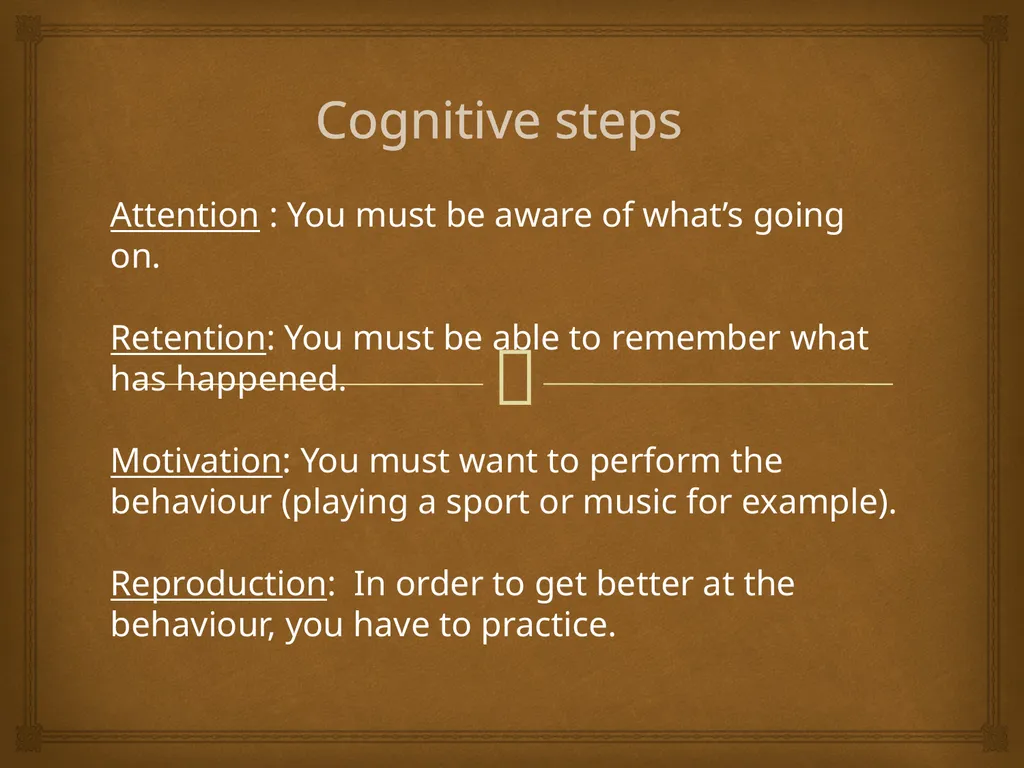
Cognitive steps Attention : You must be aware of what’s going on.
Retention: You must be able to remember what has happened.
Motivation: You must want to perform the behaviour (playing a sport or music for example).
Reproduction: In order to get better at the behaviour, you have to practice.<br>
14
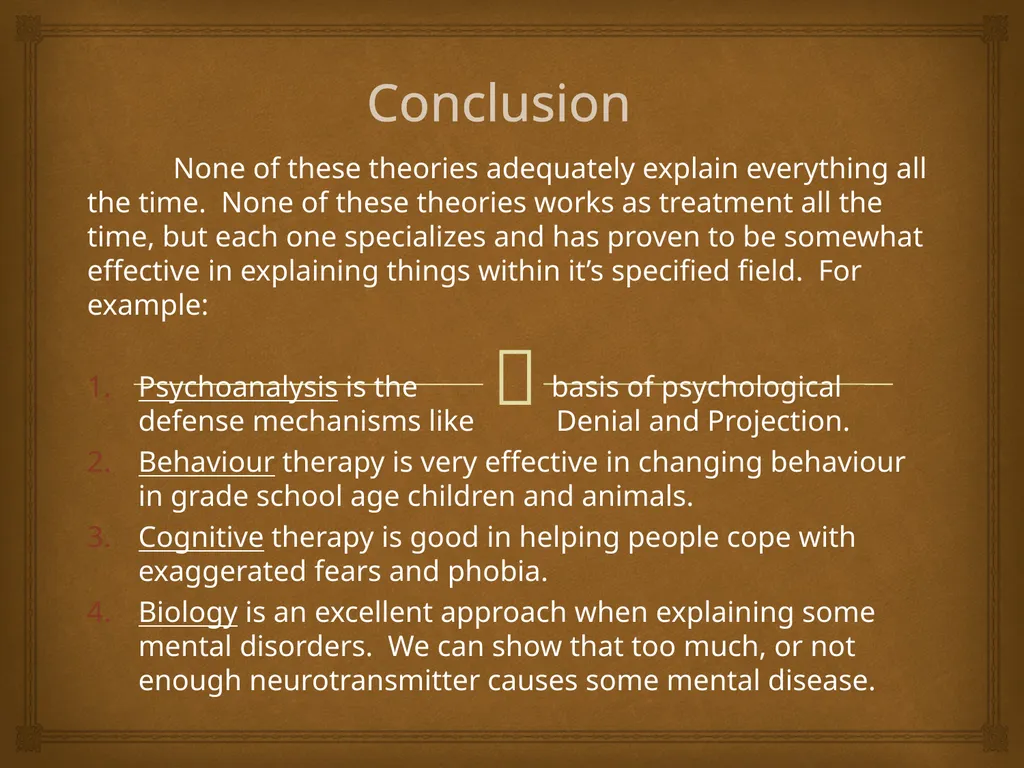
Conclusion None of these theories adequately explain everything all the time. None of these theories works as treatment all the time, but each one specializes and has proven to be somewhat effective in explaining things within it’s specified field. For example:
Psychoanalysis is the basis of psychological defense mechanisms like Denial and Projection.
Behaviour therapy is very effective in changing behaviour in grade school age children and animals.
Cognitive therapy is good in helping people cope with exaggerated fears and phobia.
Biology is an excellent approach when explaining some mental disorders. We can show that too much, or not enough neurotransmitter causes some mental disease.<br>