04
Reflexes in Infants Startle
Tonic
Rooting
Stepping
Grasp
Parachute
Plantar<br>
05
Critical Period Is a stage or point in development during which a person or animal is best suited to learn a particular skill or behavior
Language development, young children learn more easily then older children and adults
Influences of nurture are found in factors such as nutrition, family background, culture, and learning experiences in the home, community, and school<br>
06
Cognitive Development the construction of thought processes, such as thinking, recalling, and analyzing
Understanding the world involves the construction of schemas, or mental representations of the world
We try to understand a new or different object or concept by applying it to one of our preexisting schemas, or by changing one of our schemas to fit the object<br>
07
two different processes when using existing schemas or developing new ones
Assimilation: we try to fit the new object into this schema
Accommodation: we reverse this process and change our schema to fit the characteristics of the new object<br>
08
Object Permanence: Things continue to exist even though they cannot be seen or touched, hiding toys from infants (18-24 m)
Representational Thought : children can picture (or represent) things in their minds (12-14 m)
The Principle of Conservation: the principle, or rule, that a given quantity does not change even when its appearance is changed in some way (5-7 y)<br>
09
Jean Piaget Stages of Cognitive Development
Stage 1 Sensor motor birth - 2 yrs, learning is done through movements and the sensations that result from them
Stage 2 Preoperational 2yrs – 7yrs, child begins to use mental images or symbols to understand things
concrete concepts such as counting or classifying objects<br>
10
Stage 3 Concrete operations 7yrs – 11yrs, begin to be able to see things from another person’s viewpoint and imagining things or events that can happen outside of their own lives
Stage 4 Formal operations 11yrs and on, the person is able to solve abstract problems and think about ideological or abstract issues<br>
11
Lev Vygotsky Piaget’s emphasis on the internal origin of schemas
Vygotsky emphasized an external origin of cognitive development
Culture, social relationships and interactions
a child’s surroundings are a critical aspect of his or her development
zone of proximal development: children learn from watching and working with others<br>
12
guidance and encouragement provides a scaffold, or support, for that child to perform a task (riding a bike, learning to read and write)
Vygotsky argued that social learning tends to precede cognitive development<br>
13
Social Development Children typically cling to their mothers
By the age of 8 months some infants develop a fear of strangers
Stranger anxiety
Separation anxiety
Contact Comfort
Harry Harlow: observed the behavior of monkeys, cloth vs. steel mothers
Imprinting
Konrad Lorenz: geese/ducks become attached to the first moving objects they see<br>
14
Secure vs. Insecure Attachment Mary Ainsworth, technique called the Strange Situation to measure attachment
secure attachment, avoidant attachment, and resistant attachment
Infants with secure attachment are very bonded to their caregivers
Secure children are happier, friendlier, more cooperative, less likely to misbehave and more likely to do well in school<br>
15
Styles of Parenting Warm parents show a great deal of affection to their children, research suggests that children fare better when parents are warm
Strict: parents impose rules and supervise their children closely
Permissive: parents impose fewer rules and watch their children less closely
Authoritative: parents combine warmth with positive kinds of strictness
Authoritarian: parents believe in obedience for its own sake
Children may become either resistant or dependent on others<br>
16
Self-Esteem Is the value or worth that people attach to themselves, helps protect people against stresses
Carl Rogers: noted that there are two types of parental support
Unconditional Positive Regard: parents love and accept their children for who they are
Conditional Positive Regard: parents show love only when their children behave in certain acceptable ways<br>
17
Freud’s stages of Development Oral stage: 0-1
Infants receive their main source of pleasure-food-with their mouths
When needs are not met in childhood persons may become fixated
Anal stage1.5-2.5
Children learn they can control their bodies
Anal-retentive: excessive use of self-control
Anal-expulsive: less restrained, careless and messy<br>
18
Phallic stage: 3
May develop strong attachments to opposite sex parent
Oedipus / Electra Complex
Complex emotions can lead to psychological disorders later in life
Latency stage: 5-6
Children retreat from conflict
impulses and emotions remain hidden<br>
19
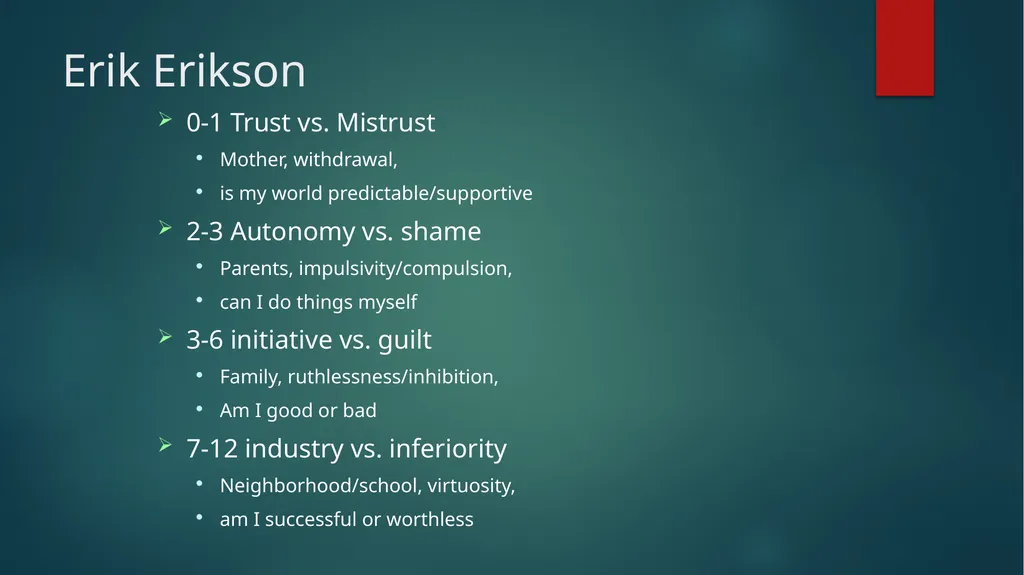
Erik Erikson 0-1 Trust vs. Mistrust
Mother, withdrawal,
is my world predictable/supportive
2-3 Autonomy vs. shame
Parents, impulsivity/compulsion,
can I do things myself
3-6 initiative vs. guilt
Family, ruthlessness/inhibition,
Am I good or bad
7-12 industry vs. inferiority
Neighborhood/school, virtuosity,
am I successful or worthless<br>
20
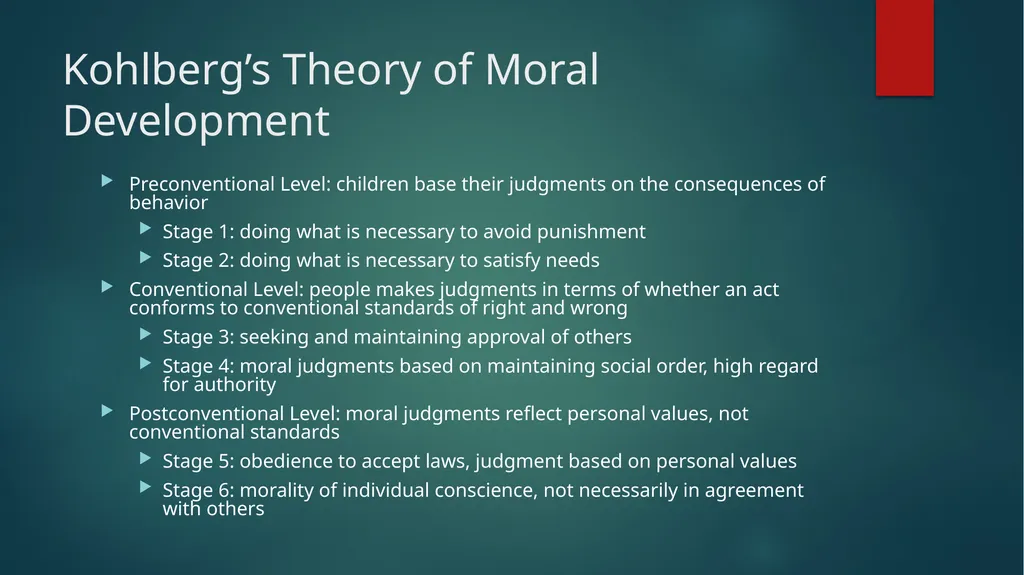
Kohlberg’s Theory of Moral Development Preconventional Level: children base their judgments on the consequences of behavior
Stage 1: doing what is necessary to avoid punishment
Stage 2: doing what is necessary to satisfy needs
Conventional Level: people makes judgments in terms of whether an act conforms to conventional standards of right and wrong
Stage 3: seeking and maintaining approval of others
Stage 4: moral judgments based on maintaining social order, high regard for authority
Postconventional Level: moral judgments reflect personal values, not conventional standards
Stage 5: obedience to accept laws, judgment based on personal values
Stage 6: morality of individual conscience, not necessarily in agreement with others<br>