
Public Speaking Module 8: Delivering Your Speech
AM
Published · 30 slides · 0 views

1 / 1



Description
Public Speaking Module 8: Delivering Your Speech Module Learning Outcomes Identify strategies for delivering a speech effectively 8.1: Explain the elements of effective vocal delivery 8.2: Explain the nonverbal aspects of effective speech
Related Topics
Share
Embed code
Download this presentation From Below
"Public Speaking Module 8: Delivering Your Speech" is the property of its rightful owner. Permission is granted to download and print the materials on this website for personal, non-commercial use only, and to display it on your personal computer provided you do not modify the materials and that you retain all copyright notices contained in the materials. By downloading content from our website, you accept the terms of this agreement.
Presentation Transcript
01
Public Speaking Module 8: Delivering Your Speech<br>
02
Module Learning Outcomes Identify strategies for delivering a speech effectively
8.1: Explain the elements of effective vocal delivery
8.2: Explain the nonverbal aspects of effective speech
8.3: Explain the importance of practice and preparation<br>
8.1: Explain the elements of effective vocal delivery
8.2: Explain the nonverbal aspects of effective speech
8.3: Explain the importance of practice and preparation<br>
03
Vocal Delivery<br>
04
Learning Outcomes: Vocal Delivery 8.1: Explain the elements of effective vocal delivery
8.1.1: Explain the importance of breath for effective vocal delivery
8.1.2: Identify techniques to use effective articulation
8.1.3: Identify effective rates of speaking
8.1.4: Identify effective uses of emphasis in your speech
8.1.5: Explain how to achieve an effective volume when speaking
8.1.6: Identify appropriate use of pauses in your speech
8.1.7: Identify speech challenges<br>
8.1.1: Explain the importance of breath for effective vocal delivery
8.1.2: Identify techniques to use effective articulation
8.1.3: Identify effective rates of speaking
8.1.4: Identify effective uses of emphasis in your speech
8.1.5: Explain how to achieve an effective volume when speaking
8.1.6: Identify appropriate use of pauses in your speech
8.1.7: Identify speech challenges<br>
05
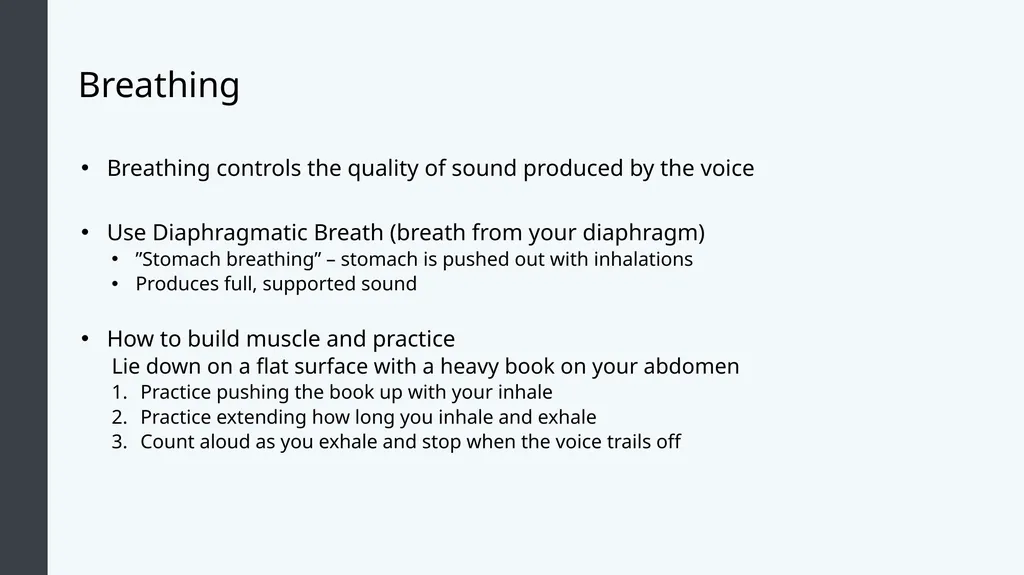
Breathing Breathing controls the quality of sound produced by the voice
Use Diaphragmatic Breath (breath from your diaphragm)
”Stomach breathing” – stomach is pushed out with inhalations
Produces full, supported sound
How to build muscle and practice
Lie down on a flat surface with a heavy book on your abdomen
Practice pushing the book up with your inhale
Practice extending how long you inhale and exhale
Count aloud as you exhale and stop when the voice trails off<br>
Use Diaphragmatic Breath (breath from your diaphragm)
”Stomach breathing” – stomach is pushed out with inhalations
Produces full, supported sound
How to build muscle and practice
Lie down on a flat surface with a heavy book on your abdomen
Practice pushing the book up with your inhale
Practice extending how long you inhale and exhale
Count aloud as you exhale and stop when the voice trails off<br>
06
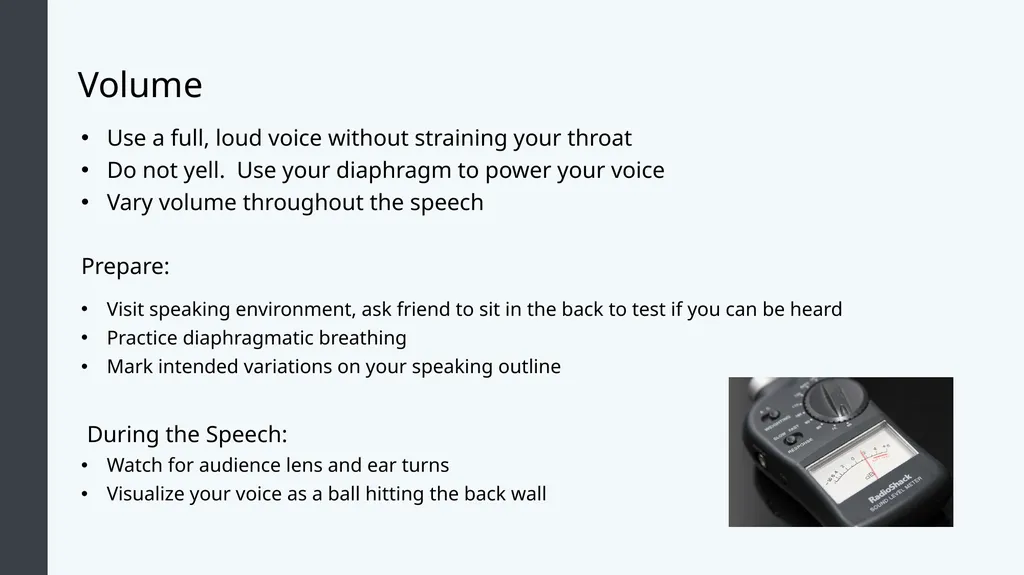
Volume Use a full, loud voice without straining your throat
Do not yell. Use your diaphragm to power your voice
Vary volume throughout the speech Prepare:
Visit speaking environment, ask friend to sit in the back to test if you can be heard
Practice diaphragmatic breathing
Mark intended variations on your speaking outline
During the Speech:
Watch for audience lens and ear turns
Visualize your voice as a ball hitting the back wall<br>
Do not yell. Use your diaphragm to power your voice
Vary volume throughout the speech Prepare:
Visit speaking environment, ask friend to sit in the back to test if you can be heard
Practice diaphragmatic breathing
Mark intended variations on your speaking outline
During the Speech:
Watch for audience lens and ear turns
Visualize your voice as a ball hitting the back wall<br>
07
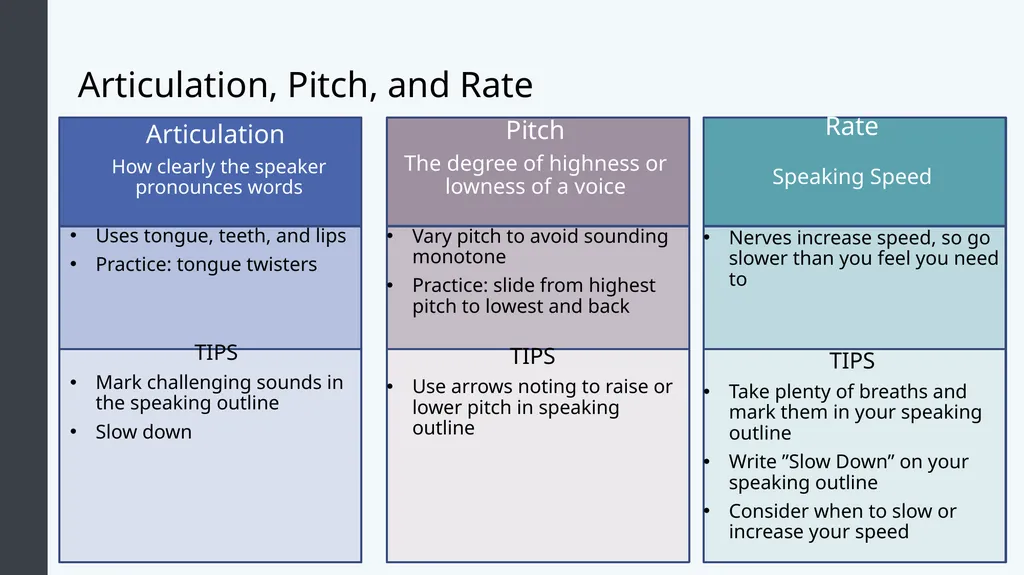
Articulation, Pitch, and Rate Articulation
How clearly the speaker pronounces words
Uses tongue, teeth, and lips
Practice: tongue twisters
TIPS
Mark challenging sounds in the speaking outline
Slow down Pitch
The degree of highness or lowness of a voice
Vary pitch to avoid sounding monotone
Practice: slide from highest pitch to lowest and back
TIPS
Use arrows noting to raise or lower pitch in speaking outline Rate
Speaking Speed
Nerves increase speed, so go slower than you feel you need to
TIPS
Take plenty of breaths and mark them in your speaking outline
Write ”Slow Down” on your speaking outline
Consider when to slow or increase your speed<br>
How clearly the speaker pronounces words
Uses tongue, teeth, and lips
Practice: tongue twisters
TIPS
Mark challenging sounds in the speaking outline
Slow down Pitch
The degree of highness or lowness of a voice
Vary pitch to avoid sounding monotone
Practice: slide from highest pitch to lowest and back
TIPS
Use arrows noting to raise or lower pitch in speaking outline Rate
Speaking Speed
Nerves increase speed, so go slower than you feel you need to
TIPS
Take plenty of breaths and mark them in your speaking outline
Write ”Slow Down” on your speaking outline
Consider when to slow or increase your speed<br>
08
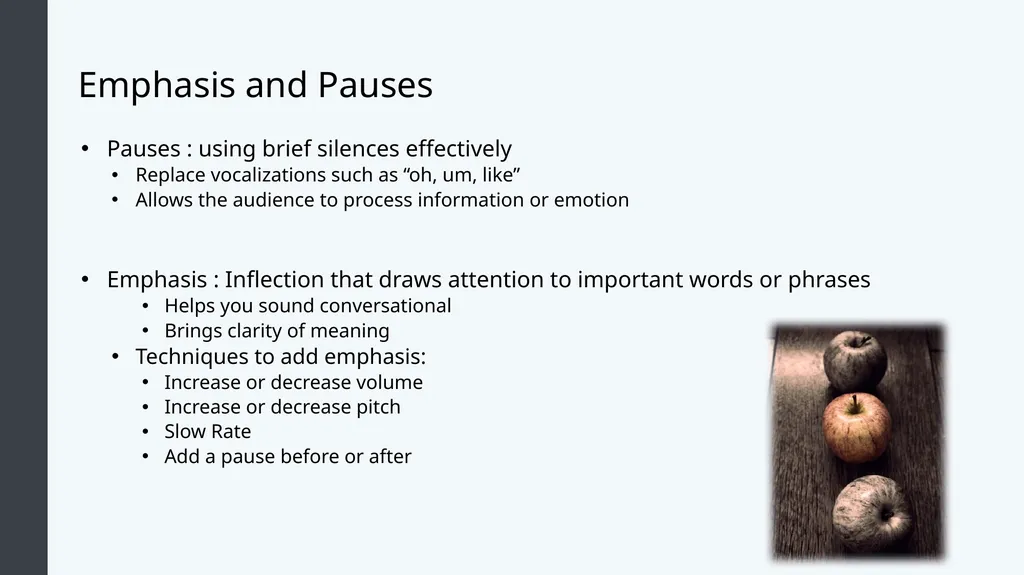
Emphasis and Pauses Pauses : using brief silences effectively
Replace vocalizations such as “oh, um, like”
Allows the audience to process information or emotion
Emphasis : Inflection that draws attention to important words or phrases
Helps you sound conversational
Brings clarity of meaning
Techniques to add emphasis:
Increase or decrease volume
Increase or decrease pitch
Slow Rate
Add a pause before or after<br>
Replace vocalizations such as “oh, um, like”
Allows the audience to process information or emotion
Emphasis : Inflection that draws attention to important words or phrases
Helps you sound conversational
Brings clarity of meaning
Techniques to add emphasis:
Increase or decrease volume
Increase or decrease pitch
Slow Rate
Add a pause before or after<br>
09
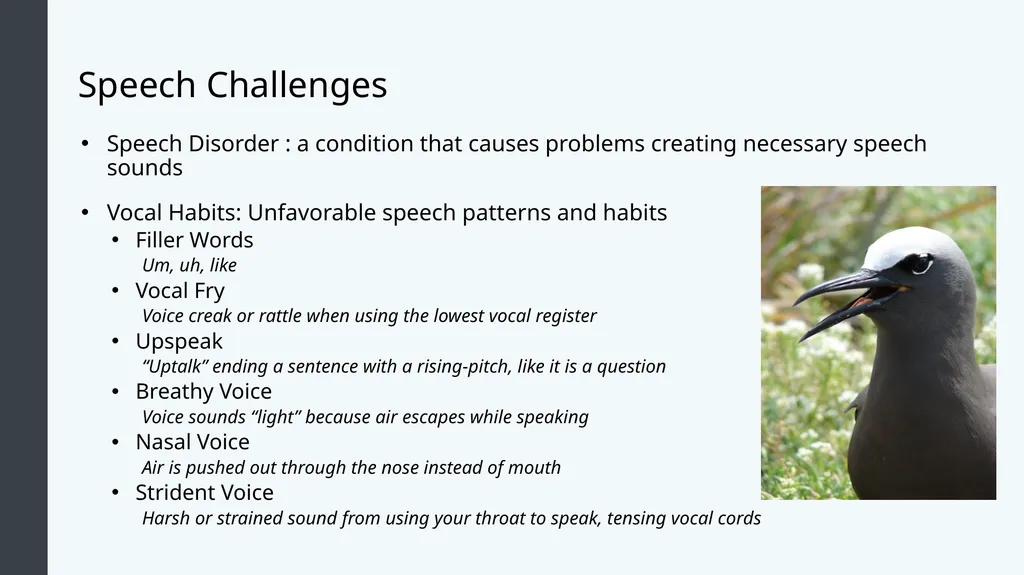
Speech Challenges Speech Disorder : a condition that causes problems creating necessary speech sounds
Vocal Habits: Unfavorable speech patterns and habits
Filler Words
Um, uh, like
Vocal Fry
Voice creak or rattle when using the lowest vocal register
Upspeak
“Uptalk” ending a sentence with a rising-pitch, like it is a question
Breathy Voice
Voice sounds “light” because air escapes while speaking
Nasal Voice
Air is pushed out through the nose instead of mouth
Strident Voice
Harsh or strained sound from using your throat to speak, tensing vocal cords<br>
Vocal Habits: Unfavorable speech patterns and habits
Filler Words
Um, uh, like
Vocal Fry
Voice creak or rattle when using the lowest vocal register
Upspeak
“Uptalk” ending a sentence with a rising-pitch, like it is a question
Breathy Voice
Voice sounds “light” because air escapes while speaking
Nasal Voice
Air is pushed out through the nose instead of mouth
Strident Voice
Harsh or strained sound from using your throat to speak, tensing vocal cords<br>
10
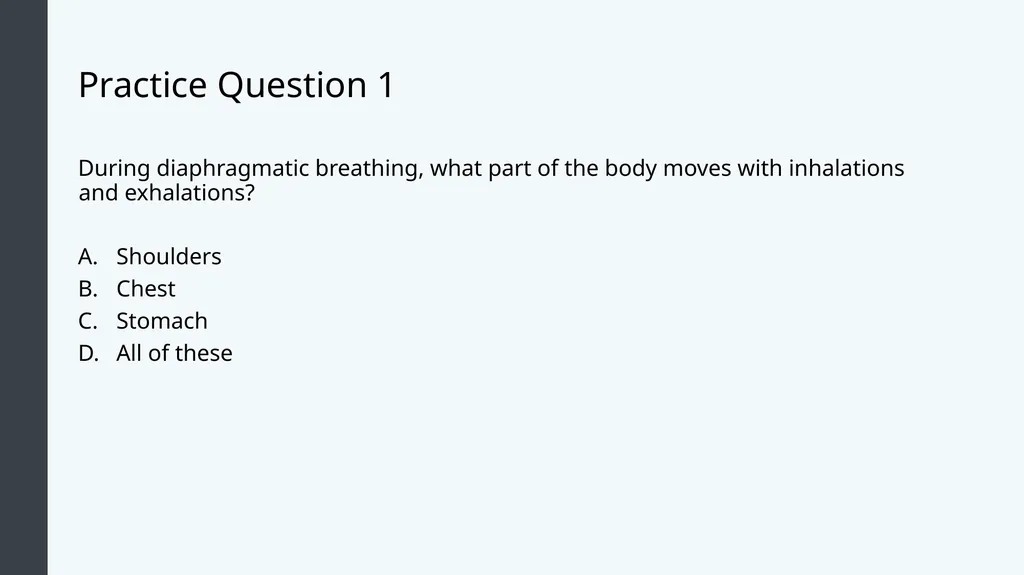
Practice Question 1 During diaphragmatic breathing, what part of the body moves with inhalations and exhalations?
Shoulders
Chest
Stomach
All of these<br>
Shoulders
Chest
Stomach
All of these<br>
11
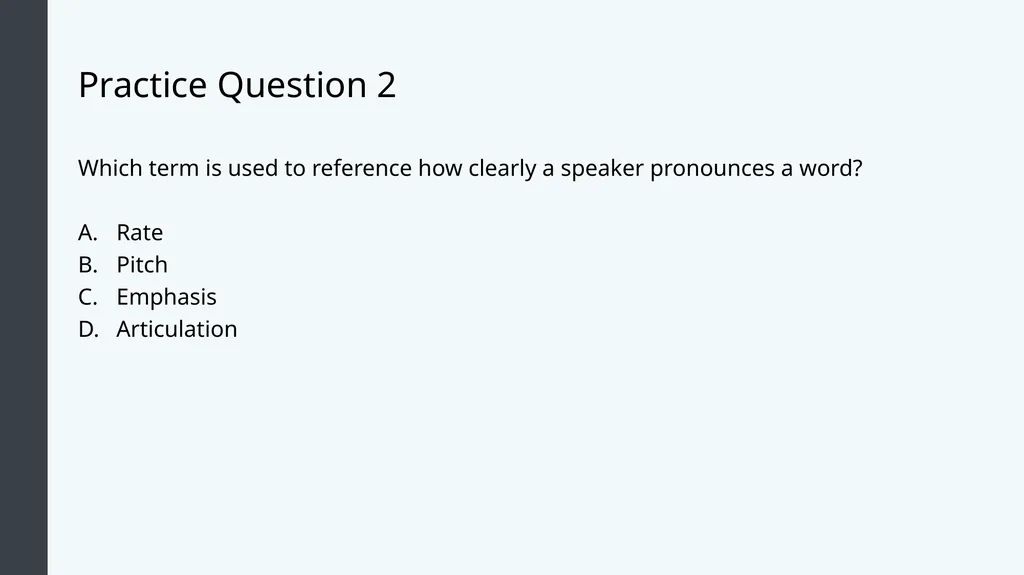
Practice Question 2 Which term is used to reference how clearly a speaker pronounces a word?
Rate
Pitch
Emphasis
Articulation<br>
Rate
Pitch
Emphasis
Articulation<br>
12
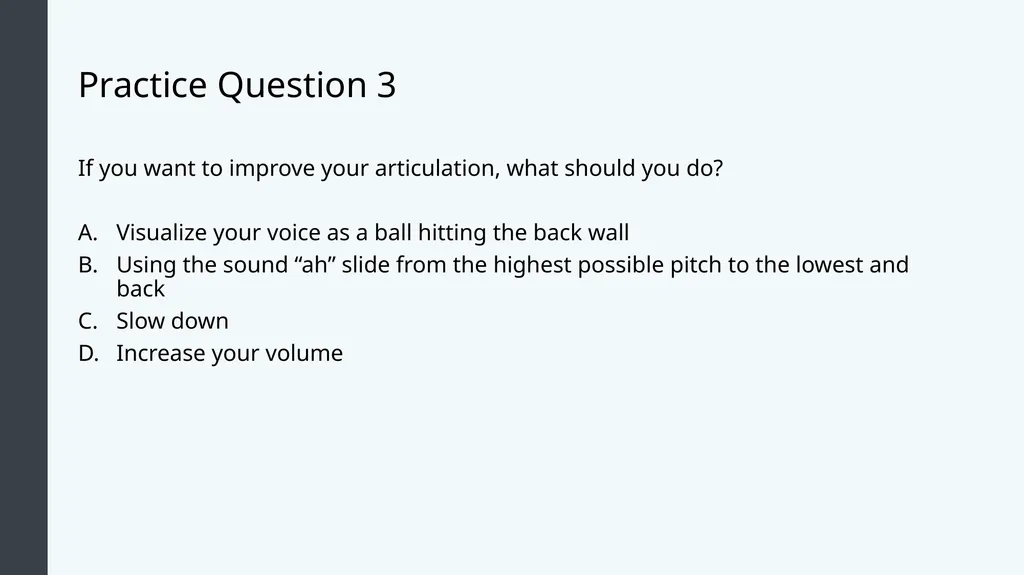
Practice Question 3 If you want to improve your articulation, what should you do?
Visualize your voice as a ball hitting the back wall
Using the sound “ah” slide from the highest possible pitch to the lowest and back
Slow down
Increase your volume<br>
Visualize your voice as a ball hitting the back wall
Using the sound “ah” slide from the highest possible pitch to the lowest and back
Slow down
Increase your volume<br>
13
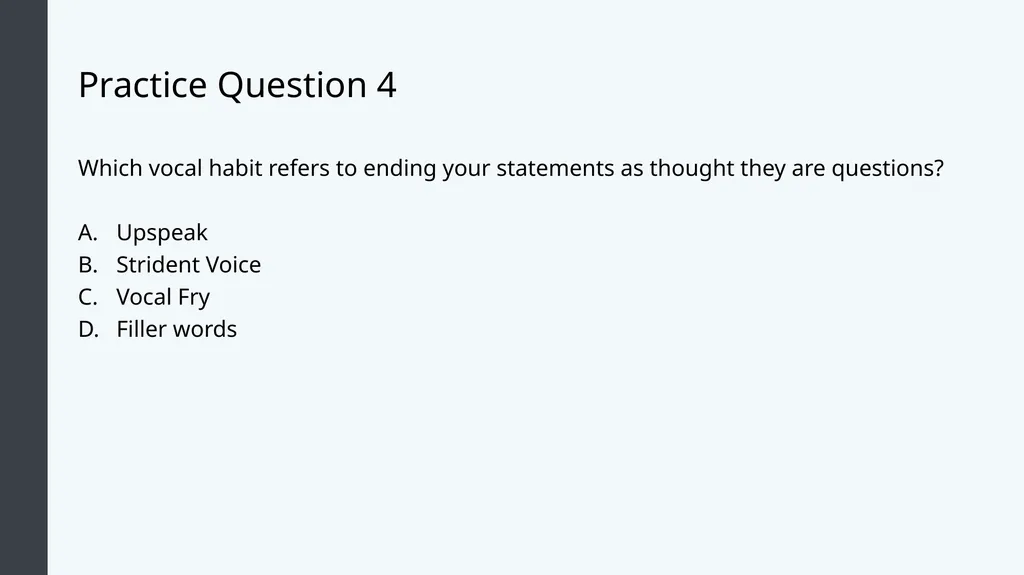
Practice Question 4 Which vocal habit refers to ending your statements as thought they are questions?
Upspeak
Strident Voice
Vocal Fry
Filler words<br>
Upspeak
Strident Voice
Vocal Fry
Filler words<br>
14
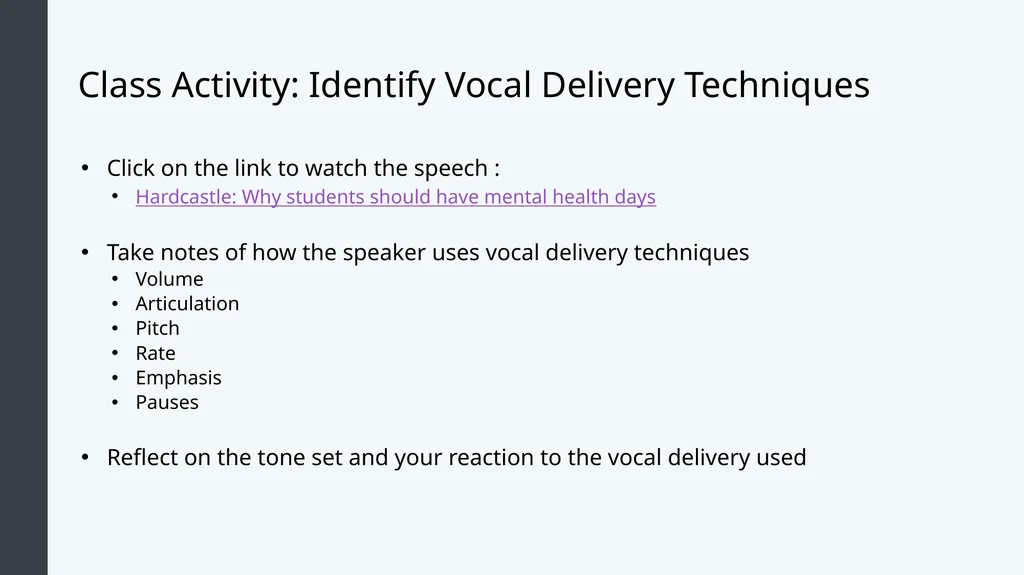
Class Activity: Identify Vocal Delivery Techniques Click on the link to watch the speech :
Hardcastle: Why students should have mental health days
Take notes of how the speaker uses vocal delivery techniques
Volume
Articulation
Pitch
Rate
Emphasis
Pauses
Reflect on the tone set and your reaction to the vocal delivery used<br>
Hardcastle: Why students should have mental health days
Take notes of how the speaker uses vocal delivery techniques
Volume
Articulation
Pitch
Rate
Emphasis
Pauses
Reflect on the tone set and your reaction to the vocal delivery used<br>
15
Nonverbal Delivery<br>
16
Learning Outcomes: Nonverbal Delivery 8.2: Explain the nonverbal aspects of effective speech delivery
8.2.1: Reflect of the role of personal appearance in public speaking
8.2.2: Reflect on the significance of gestures in public speaking
8.2.3: Reflect on the significance of movement in public speaking
8.2.4: Identify the importance of eye contact in public speaking<br>
8.2.1: Reflect of the role of personal appearance in public speaking
8.2.2: Reflect on the significance of gestures in public speaking
8.2.3: Reflect on the significance of movement in public speaking
8.2.4: Identify the importance of eye contact in public speaking<br>
17
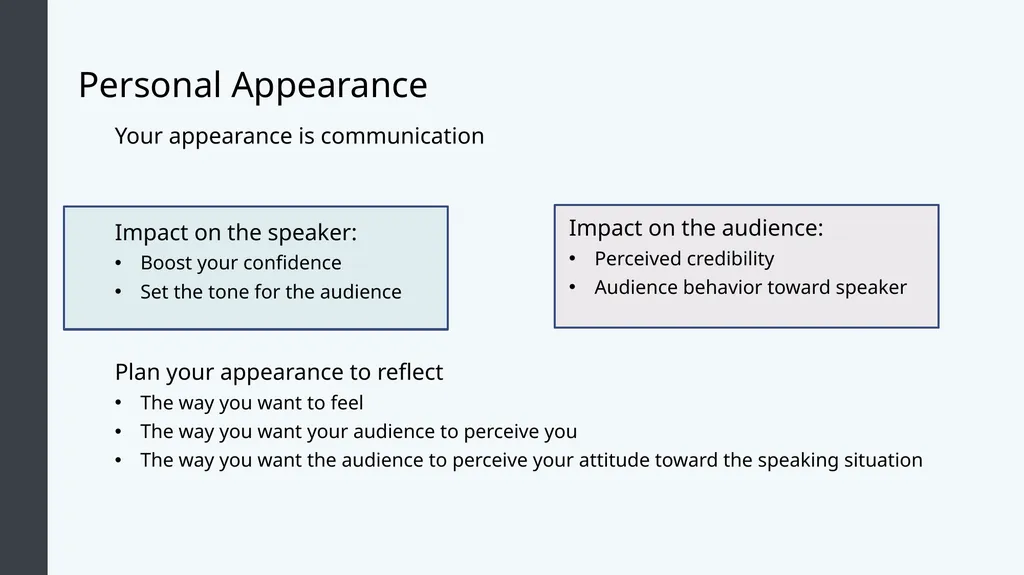
Personal Appearance Your appearance is communication
Impact on the speaker:
Boost your confidence
Set the tone for the audience Impact on the audience:
Perceived credibility
Audience behavior toward speaker Plan your appearance to reflect
The way you want to feel
The way you want your audience to perceive you
The way you want the audience to perceive your attitude toward the speaking situation<br>
Impact on the speaker:
Boost your confidence
Set the tone for the audience Impact on the audience:
Perceived credibility
Audience behavior toward speaker Plan your appearance to reflect
The way you want to feel
The way you want your audience to perceive you
The way you want the audience to perceive your attitude toward the speaking situation<br>
18
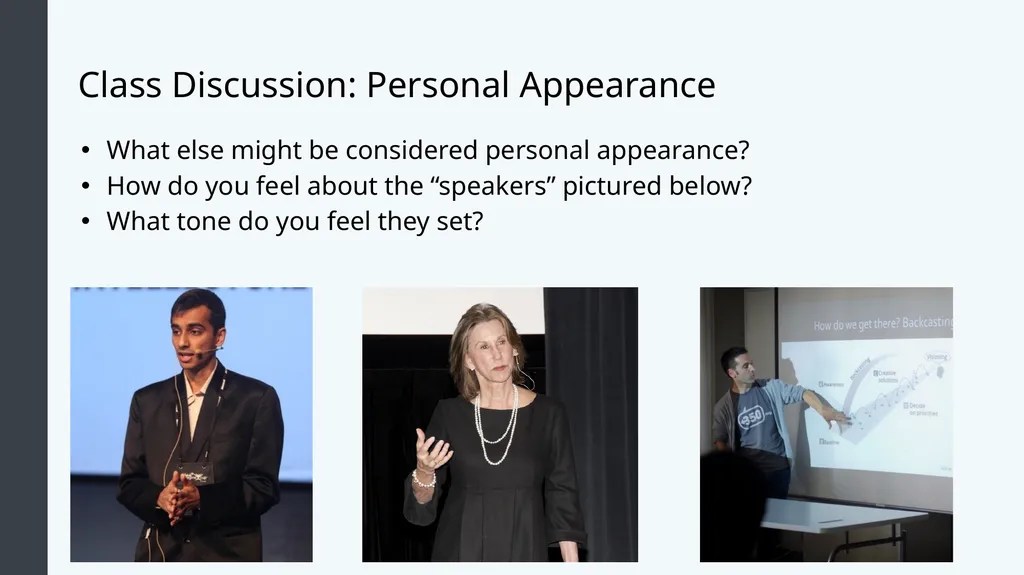
Class Discussion: Personal Appearance What else might be considered personal appearance?
How do you feel about the “speakers” pictured below?
What tone do you feel they set?<br>
How do you feel about the “speakers” pictured below?
What tone do you feel they set?<br>
19
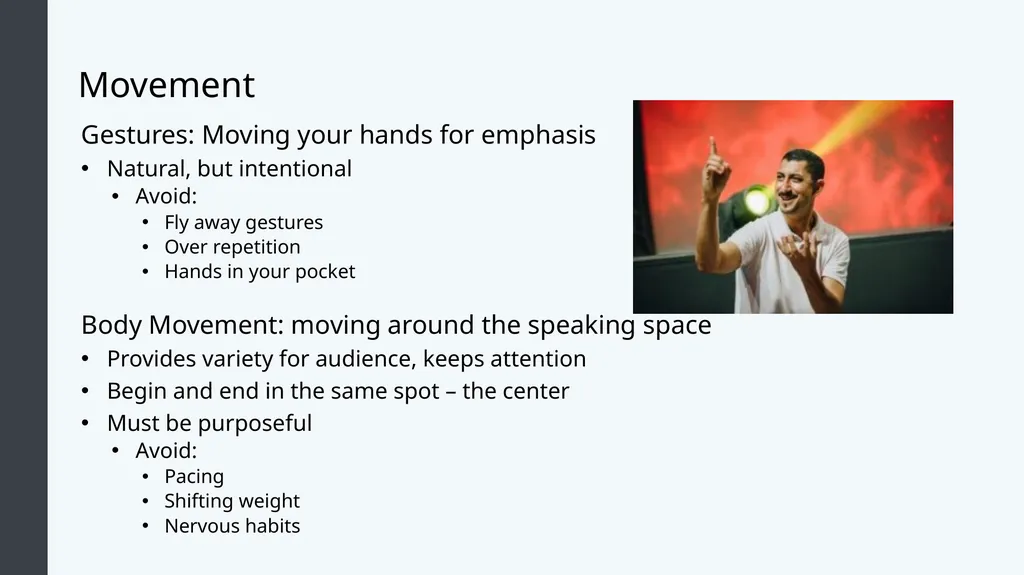
Movement Gestures: Moving your hands for emphasis
Natural, but intentional
Avoid:
Fly away gestures
Over repetition
Hands in your pocket
Body Movement: moving around the speaking space
Provides variety for audience, keeps attention
Begin and end in the same spot – the center
Must be purposeful
Avoid:
Pacing
Shifting weight
Nervous habits<br>
Natural, but intentional
Avoid:
Fly away gestures
Over repetition
Hands in your pocket
Body Movement: moving around the speaking space
Provides variety for audience, keeps attention
Begin and end in the same spot – the center
Must be purposeful
Avoid:
Pacing
Shifting weight
Nervous habits<br>
20
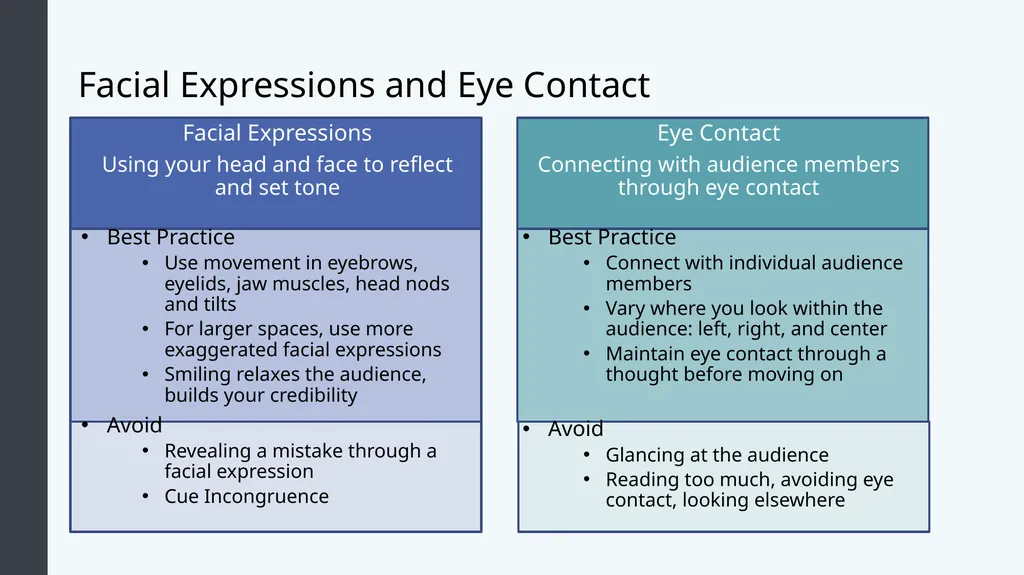
Facial Expressions and Eye Contact Facial Expressions
Using your head and face to reflect and set tone
Best Practice
Use movement in eyebrows, eyelids, jaw muscles, head nods and tilts
For larger spaces, use more exaggerated facial expressions
Smiling relaxes the audience, builds your credibility
Avoid
Revealing a mistake through a facial expression
Cue Incongruence Eye Contact
Connecting with audience members through eye contact
Best Practice
Connect with individual audience members
Vary where you look within the audience: left, right, and center
Maintain eye contact through a thought before moving on
Avoid
Glancing at the audience
Reading too much, avoiding eye contact, looking elsewhere<br>
Using your head and face to reflect and set tone
Best Practice
Use movement in eyebrows, eyelids, jaw muscles, head nods and tilts
For larger spaces, use more exaggerated facial expressions
Smiling relaxes the audience, builds your credibility
Avoid
Revealing a mistake through a facial expression
Cue Incongruence Eye Contact
Connecting with audience members through eye contact
Best Practice
Connect with individual audience members
Vary where you look within the audience: left, right, and center
Maintain eye contact through a thought before moving on
Avoid
Glancing at the audience
Reading too much, avoiding eye contact, looking elsewhere<br>
21
Practice Question 5 What should NOT be a consideration when preparing your appearance for your presentation?
The way you want to feel
The way you want to look
The way you want your audience to perceive you
The way you want the audience to perceive your attitude toward the speaking situation<br>
The way you want to feel
The way you want to look
The way you want your audience to perceive you
The way you want the audience to perceive your attitude toward the speaking situation<br>
22
Practice Question 6 Effectively practicing nonverbal delivery helps to make ___________ nonverbal cues ___________.
Natural, unnatural
Unplanned, intentional
Weak, strong
Your own, like everyone else’s<br>
Natural, unnatural
Unplanned, intentional
Weak, strong
Your own, like everyone else’s<br>
23
Practice and Preparation<br>
24
Learning Outcomes: Practice and Preparation 8.3: Explain the importance of practice and preparation
8.3.1: Describe techniques for adapting to the physical location of a speech
8.3.2: Identify techniques for effective use of equipment
8.3.3: Discuss the benefits of rehearsing your speech<br>
8.3.1: Describe techniques for adapting to the physical location of a speech
8.3.2: Identify techniques for effective use of equipment
8.3.3: Discuss the benefits of rehearsing your speech<br>
25
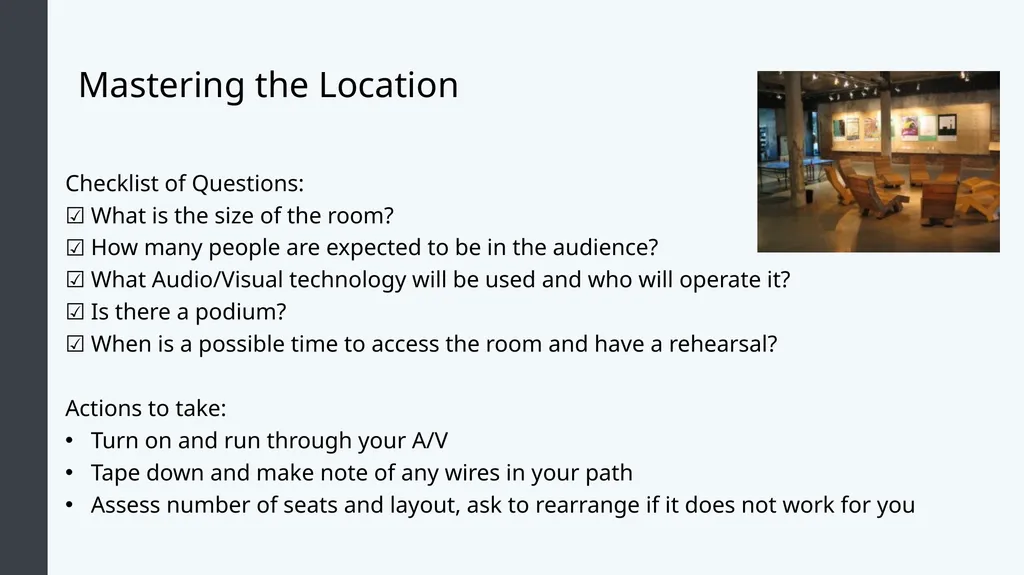
Mastering the Location Checklist of Questions:
What is the size of the room?
How many people are expected to be in the audience?
What Audio/Visual technology will be used and who will operate it?
Is there a podium?
When is a possible time to access the room and have a rehearsal?
Actions to take:
Turn on and run through your A/V
Tape down and make note of any wires in your path
Assess number of seats and layout, ask to rearrange if it does not work for you<br>
What is the size of the room?
How many people are expected to be in the audience?
What Audio/Visual technology will be used and who will operate it?
Is there a podium?
When is a possible time to access the room and have a rehearsal?
Actions to take:
Turn on and run through your A/V
Tape down and make note of any wires in your path
Assess number of seats and layout, ask to rearrange if it does not work for you<br>
26
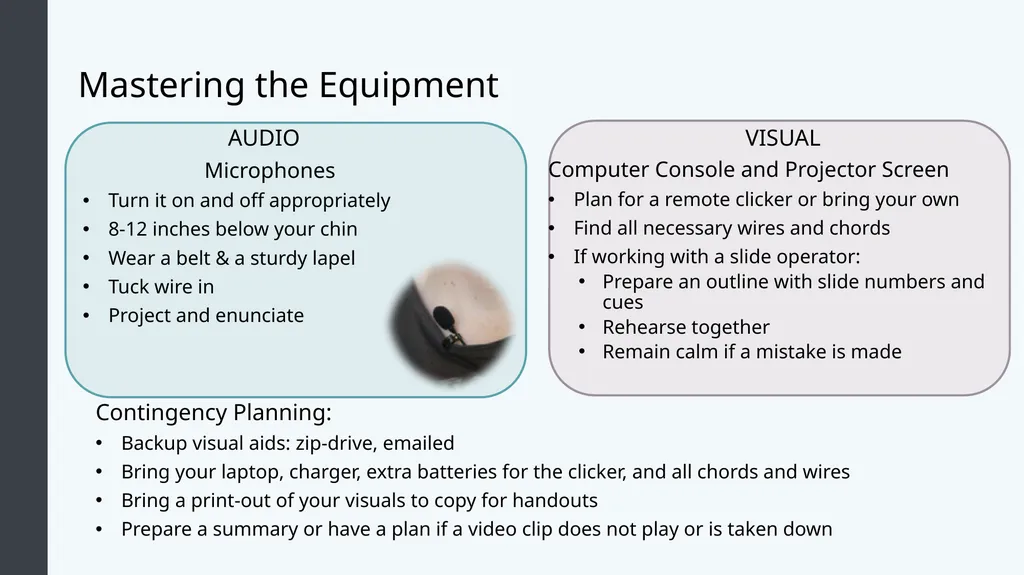
Mastering the Equipment AUDIO
Microphones
Turn it on and off appropriately
8-12 inches below your chin
Wear a belt & a sturdy lapel
Tuck wire in
Project and enunciate VISUAL
Computer Console and Projector Screen
Plan for a remote clicker or bring your own
Find all necessary wires and chords
If working with a slide operator:
Prepare an outline with slide numbers and cues
Rehearse together
Remain calm if a mistake is made Contingency Planning:
Backup visual aids: zip-drive, emailed
Bring your laptop, charger, extra batteries for the clicker, and all chords and wires
Bring a print-out of your visuals to copy for handouts
Prepare a summary or have a plan if a video clip does not play or is taken down<br>
Microphones
Turn it on and off appropriately
8-12 inches below your chin
Wear a belt & a sturdy lapel
Tuck wire in
Project and enunciate VISUAL
Computer Console and Projector Screen
Plan for a remote clicker or bring your own
Find all necessary wires and chords
If working with a slide operator:
Prepare an outline with slide numbers and cues
Rehearse together
Remain calm if a mistake is made Contingency Planning:
Backup visual aids: zip-drive, emailed
Bring your laptop, charger, extra batteries for the clicker, and all chords and wires
Bring a print-out of your visuals to copy for handouts
Prepare a summary or have a plan if a video clip does not play or is taken down<br>
27
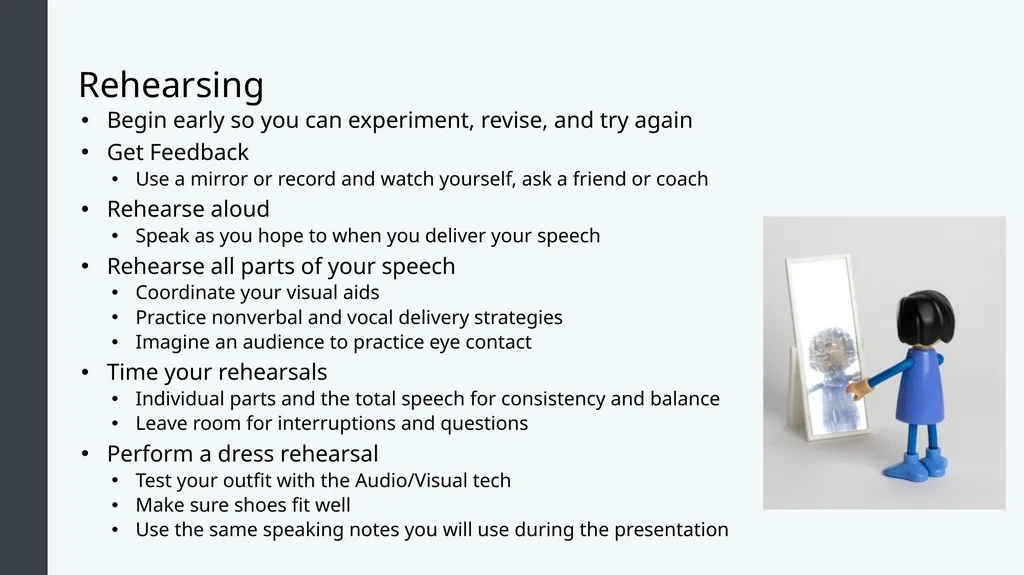
Rehearsing Begin early so you can experiment, revise, and try again
Get Feedback
Use a mirror or record and watch yourself, ask a friend or coach
Rehearse aloud
Speak as you hope to when you deliver your speech
Rehearse all parts of your speech
Coordinate your visual aids
Practice nonverbal and vocal delivery strategies
Imagine an audience to practice eye contact
Time your rehearsals
Individual parts and the total speech for consistency and balance
Leave room for interruptions and questions
Perform a dress rehearsal
Test your outfit with the Audio/Visual tech
Make sure shoes fit well
Use the same speaking notes you will use during the presentation<br>
Get Feedback
Use a mirror or record and watch yourself, ask a friend or coach
Rehearse aloud
Speak as you hope to when you deliver your speech
Rehearse all parts of your speech
Coordinate your visual aids
Practice nonverbal and vocal delivery strategies
Imagine an audience to practice eye contact
Time your rehearsals
Individual parts and the total speech for consistency and balance
Leave room for interruptions and questions
Perform a dress rehearsal
Test your outfit with the Audio/Visual tech
Make sure shoes fit well
Use the same speaking notes you will use during the presentation<br>
28
Practice Question 7 You run through your speech every time you perform chore and are in your car. You time yourself for consistency and you are right where you want to be. What might explain why you ran far overtime on the day of your presentation?
Since you were not practicing the way you were going to present, your rate, pauses, and visual aids were not factored into the time when you practiced.
You were nervous and had too many fillers and pauses during your presentation.
You got questions that you weren’t anticipating during the presentation
The stopwatch must have been off.<br>
Since you were not practicing the way you were going to present, your rate, pauses, and visual aids were not factored into the time when you practiced.
You were nervous and had too many fillers and pauses during your presentation.
You got questions that you weren’t anticipating during the presentation
The stopwatch must have been off.<br>
29
Class Activity: Rehearsal Partner Find 2 other classmates who will sign on to watch you practice your speech
Exchange contact information
Set appointments for each of the below. Remember to space them out to provide time to revise and advance to the next stage of your presentation:
Talk through the outline of your speech and get feedback (30 minutes per speech)
Watch a recording of your presentation and provide feedback (15 minute feedback discussion)
Watch the dress rehearsal or live rehearsal of your full run-through and provide feedback (30 minutes)<br>
Exchange contact information
Set appointments for each of the below. Remember to space them out to provide time to revise and advance to the next stage of your presentation:
Talk through the outline of your speech and get feedback (30 minutes per speech)
Watch a recording of your presentation and provide feedback (15 minute feedback discussion)
Watch the dress rehearsal or live rehearsal of your full run-through and provide feedback (30 minutes)<br>
30
Quick Review Preparing the delivery of your speech includes rehearsing vocal and nonverbal elements individually to ensure that they are natural and intentional.
Planning for the presentation includes:
Choosing appropriate and effective attire and appearance
Becoming familiar with the location and logistics
Ensuring you are prepared for the A/V in the room
Preparing contingency materials and plans
Begin rehearsing your speech early on and in a variety of ways by speaking it aloud, watching yourself, getting feedback, timing for consistency, using your speaking notes and visual aids, and wearing the full outfit you will use to present<br>
Planning for the presentation includes:
Choosing appropriate and effective attire and appearance
Becoming familiar with the location and logistics
Ensuring you are prepared for the A/V in the room
Preparing contingency materials and plans
Begin rehearsing your speech early on and in a variety of ways by speaking it aloud, watching yourself, getting feedback, timing for consistency, using your speaking notes and visual aids, and wearing the full outfit you will use to present<br>