Public support to PGS development Political justification for supporting Participatory Guarantee Systems (PGS) Why supporting PGS? 3 PGS offers numerous benefits, including: improved access to organic markets through a guarantee system for
"Public support to PGS development Political" is the property of its rightful owner. Permission is granted to
download and print the materials on this website for personal, non-commercial use only, and to display it
on your personal computer provided you do not modify the materials and that you retain all copyright
notices contained in the materials. By downloading content from our website, you accept the terms of this
agreement.
Presentation Transcript
01
Public support to PGS development<br>
02
Political justification for supporting Participatory Guarantee Systems (PGS)<br>
03
Why supporting PGS? 3 PGS offers numerous benefits, including:
improved access to organic markets through a guarantee system for small-scale producers (more affordable than third party certification),
increased education and awareness among consumers (by involving them in the guarantee process),
promotion of short supply chains and local market development,
farmer capacity building and empowerment.
Public support in the initial stage of PGS development is necessary to provide resources for investment in capacity building and organizational development.<br>
04
Possible ways to support PGS development<br>
05
Forms of support to PGS The right regulatory framework is very important: accommodate PGS in the organic regulation (See IFOAM-OI policy brief “How Governments Can Support PGS”).
Finance projects that set-up PGS initiatives (must be at least 3-years long).
Ongoing support: partial funding of existing PGS initiatives for expenses such as farmer training, committee meetings, development of standards and operating manuals, communication and networking.<br>
06
Country examples<br>
07
India 7 NGO sector pioneered PGS in India, reaching 6,000 certified farmers in 2015 and consolidating into a single national PGS program: the PGS Organic Council.
But demand from farmers is too big for NGO capacities. NCOF stepped in to support PGS growth, launching its own PGS program in 2011.
NCOF PGS program aims to complement the NGO PGS program, with the advantage that the government bears the cost of institutional networking, surveillance & monitoring and data management. NGOs can participate and receive financial support to cover the work of data collection and upload on the central PGS website.
Due to increased resources, PGS India network reached >130,000 farmers at the end of 2016.
Government also opened PGS shops & cafés.<br>
08
Other examples 8 In Peru, several local governments support PGS through local official recognition and supporting their implementation.
The municipality of Bella Vista in Argentina is an active stakeholder in the set-up of their local PGS.
The government of Mexico, in 2010 gave support of around EUR 82,000 to the national PGS network to form 20 PGS initiatives.
In Costa Rica the government provided technical and financial support for the establishment of PGS initiatives.
Brazil : In 2016, EUR 91,000 for support to family farmers and technicians involved in PGS initiatives.
Central and local government in the Philippines support PGS through funding initial operation, including training, committee meetings, and development of standards and manual of operations.<br>
09
Pitfalls and challenges of this form of support<br>
10
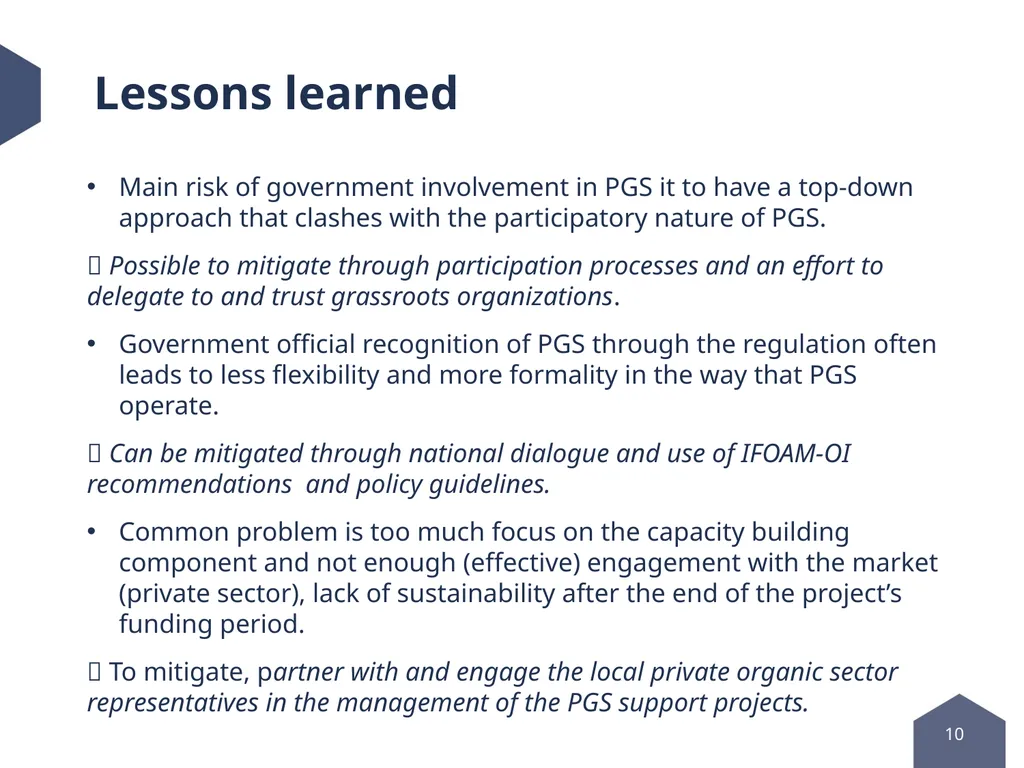
Lessons learned 10 Main risk of government involvement in PGS it to have a top-down approach that clashes with the participatory nature of PGS.
Possible to mitigate through participation processes and an effort to delegate to and trust grassroots organizations.
Government official recognition of PGS through the regulation often leads to less flexibility and more formality in the way that PGS operate.
Can be mitigated through national dialogue and use of IFOAM-OI recommendations and policy guidelines.
Common problem is too much focus on the capacity building component and not enough (effective) engagement with the market (private sector), lack of sustainability after the end of the project’s funding period.
To mitigate, partner with and engage the local private organic sector representatives in the management of the PGS support projects.<br>
11
Thank you for your attention! Complete policy toolkit available at www.ifoam.bio<br>