
Purification of rare earth elements for
LD
Published · 34 slides · 0 views

1 / 1


Description
Purification of rare earth elements for low-background experiments Roman Boiko National University of Life and Environmental Sciences of Ukraine, Institute for Nuclear Research, Kyiv, Ukraine outline Introduction Rare earth elements What
Related Topics
Share
Embed code
Download this presentation From Below
"Purification of rare earth elements for" is the property of its rightful owner. Permission is granted to download and print the materials on this website for personal, non-commercial use only, and to display it on your personal computer provided you do not modify the materials and that you retain all copyright notices contained in the materials. By downloading content from our website, you accept the terms of this agreement.
Presentation Transcript
01
Purification of rare earth
elements for low-background experiments Roman Boiko
National University of Life and Environmental Sciences of Ukraine,
Institute for Nuclear Research,
Kyiv, Ukraine<br>
National University of Life and Environmental Sciences of Ukraine,
Institute for Nuclear Research,
Kyiv, Ukraine<br>
02
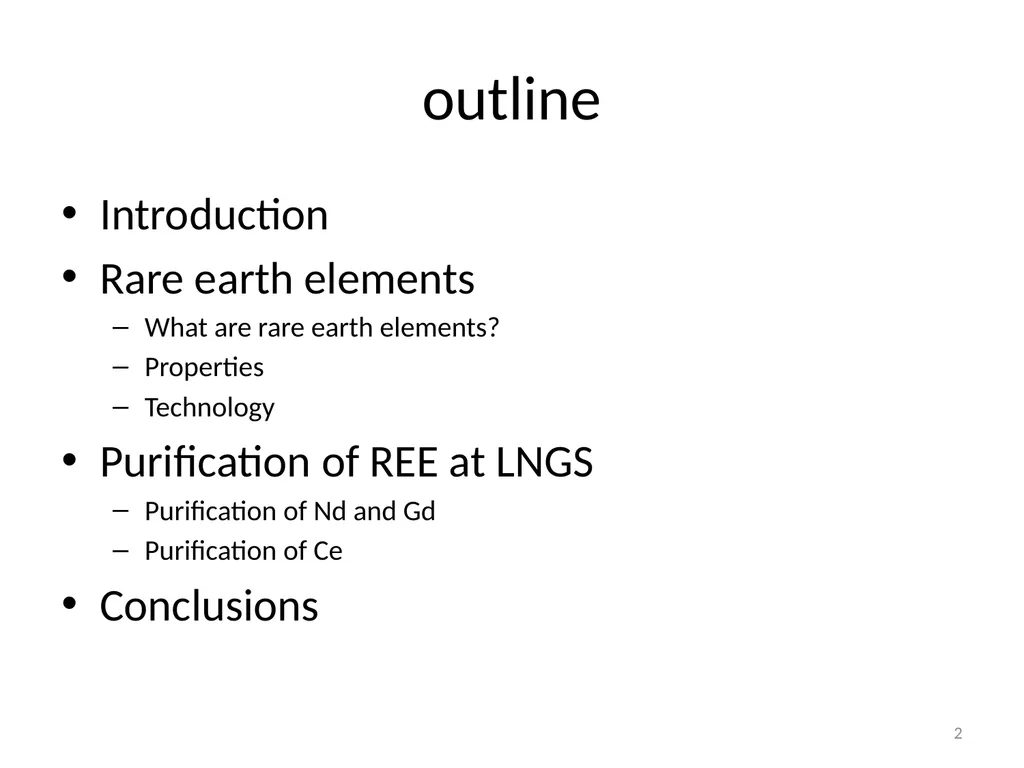
outline Introduction
Rare earth elements
What are rare earth elements?
Properties
Technology
Purification of REE at LNGS
Purification of Nd and Gd
Purification of Ce
Conclusions 2<br>
Rare earth elements
What are rare earth elements?
Properties
Technology
Purification of REE at LNGS
Purification of Nd and Gd
Purification of Ce
Conclusions 2<br>
03
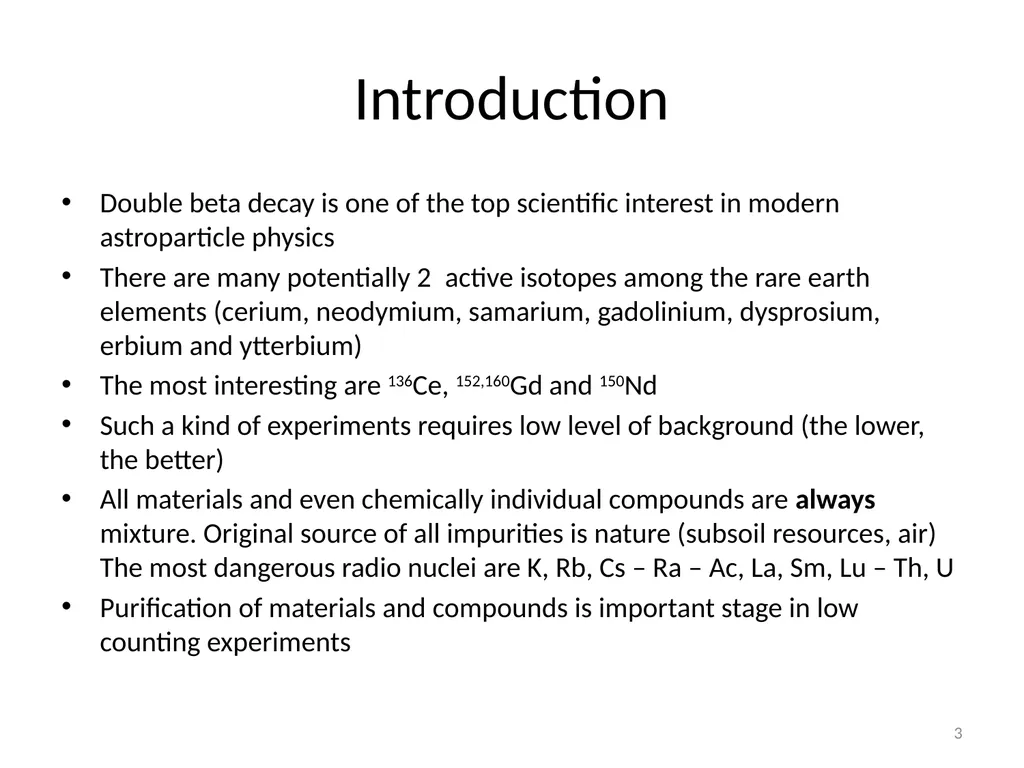
Introduction Double beta decay is one of the top scientific interest in modern astroparticle physics
There are many potentially 2 active isotopes among the rare earth elements (cerium, neodymium, samarium, gadolinium, dysprosium, erbium and ytterbium)
The most interesting are 136Ce, 152,160Gd and 150Nd
Such a kind of experiments requires low level of background (the lower, the better)
All materials and even chemically individual compounds are always mixture. Original source of all impurities is nature (subsoil resources, air) The most dangerous radio nuclei are K, Rb, Cs – Ra – Ac, La, Sm, Lu – Th, U
Purification of materials and compounds is important stage in low counting experiments 3<br>
There are many potentially 2 active isotopes among the rare earth elements (cerium, neodymium, samarium, gadolinium, dysprosium, erbium and ytterbium)
The most interesting are 136Ce, 152,160Gd and 150Nd
Such a kind of experiments requires low level of background (the lower, the better)
All materials and even chemically individual compounds are always mixture. Original source of all impurities is nature (subsoil resources, air) The most dangerous radio nuclei are K, Rb, Cs – Ra – Ac, La, Sm, Lu – Th, U
Purification of materials and compounds is important stage in low counting experiments 3<br>
04
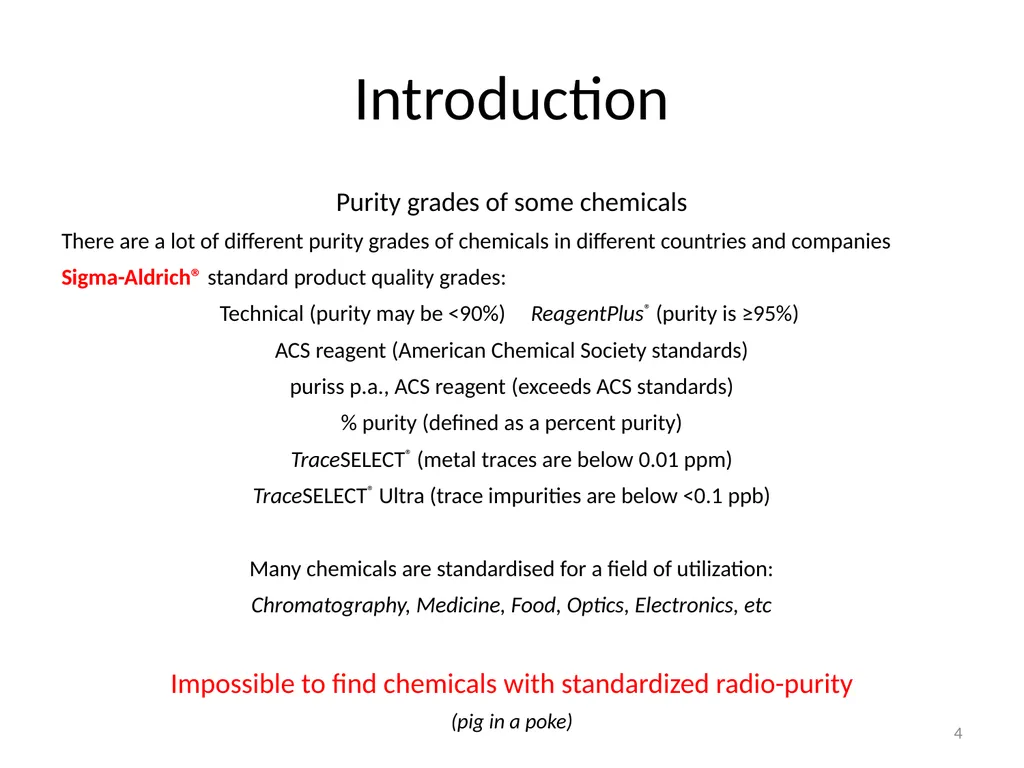
Purity grades of some chemicals
There are a lot of different purity grades of chemicals in different countries and companies
Sigma-Aldrich® standard product quality grades:
Technical (purity may be <90%) ReagentPlus® (purity is ≥95%)
ACS reagent (American Chemical Society standards)
puriss p.a., ACS reagent (exceeds ACS standards)
% purity (defined as a percent purity)
TraceSELECT® (metal traces are below 0.01 ppm)
TraceSELECT® Ultra (trace impurities are below <0.1 ppb)
Many chemicals are standardised for a field of utilization:
Chromatography, Medicine, Food, Optics, Electronics, etc
Impossible to find chemicals with standardized radio-purity
(pig in a poke) Introduction 4<br>
There are a lot of different purity grades of chemicals in different countries and companies
Sigma-Aldrich® standard product quality grades:
Technical (purity may be <90%) ReagentPlus® (purity is ≥95%)
ACS reagent (American Chemical Society standards)
puriss p.a., ACS reagent (exceeds ACS standards)
% purity (defined as a percent purity)
TraceSELECT® (metal traces are below 0.01 ppm)
TraceSELECT® Ultra (trace impurities are below <0.1 ppb)
Many chemicals are standardised for a field of utilization:
Chromatography, Medicine, Food, Optics, Electronics, etc
Impossible to find chemicals with standardized radio-purity
(pig in a poke) Introduction 4<br>
05
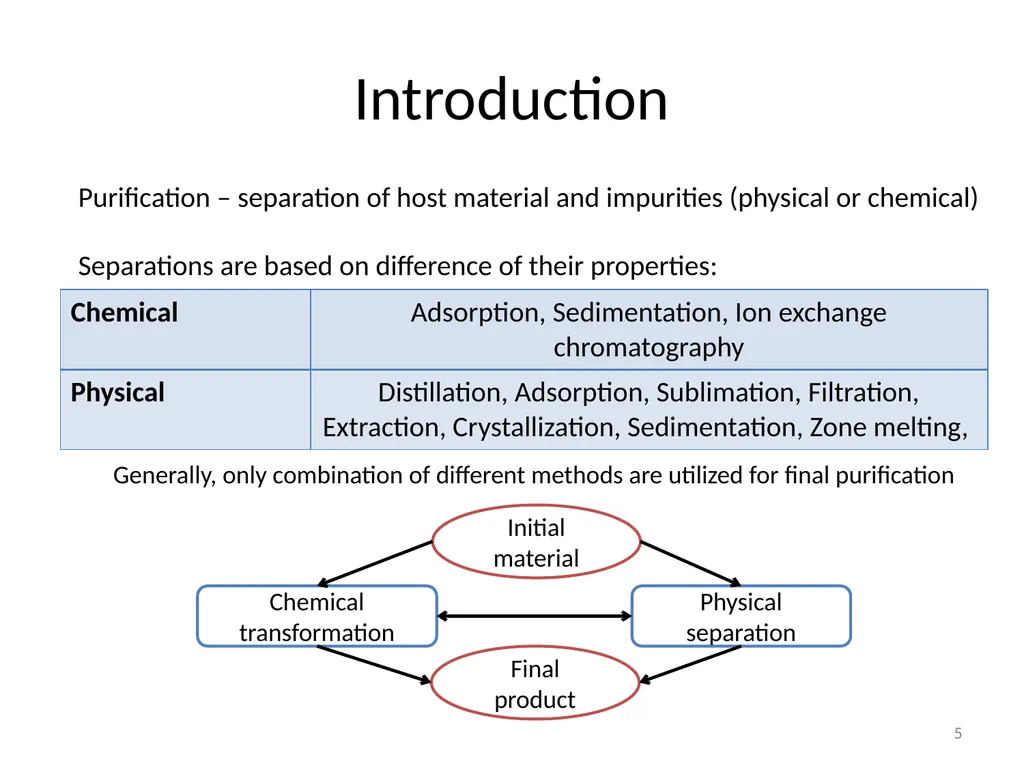
Purification – separation of host material and impurities (physical or chemical)
Separations are based on difference of their properties: Introduction Generally, only combination of different methods are utilized for final purification 5<br>
Separations are based on difference of their properties: Introduction Generally, only combination of different methods are utilized for final purification 5<br>
06
What are rare earths? Definition
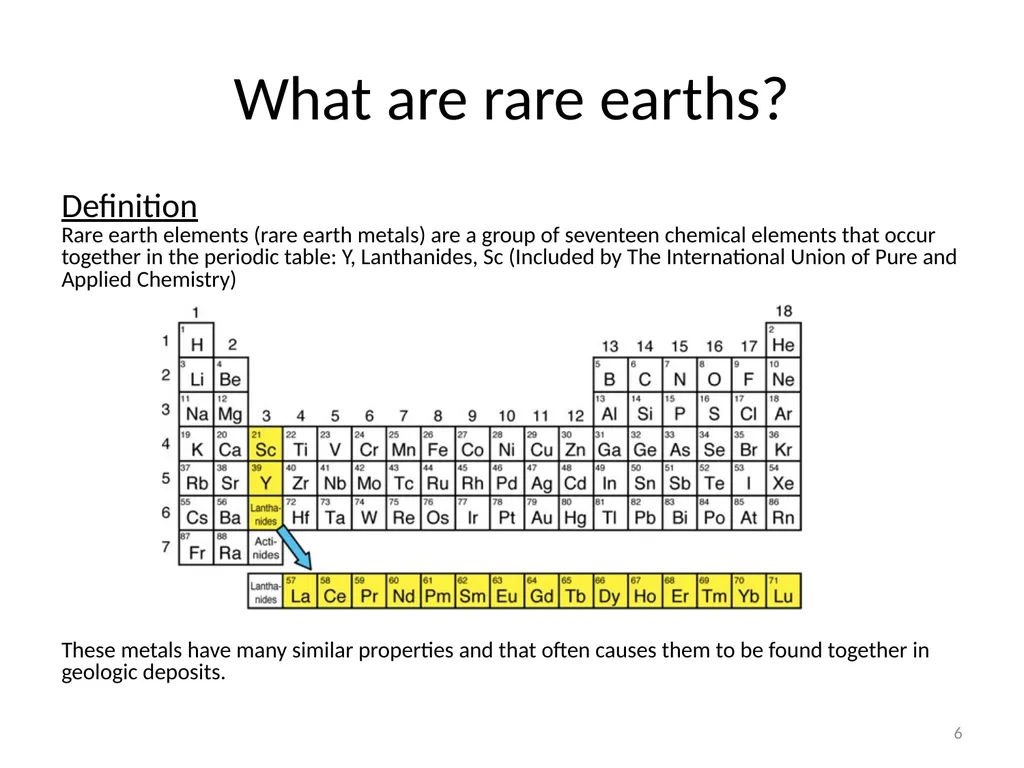
Rare earth elements (rare earth metals) are a group of seventeen chemical elements that occur together in the periodic table: Y, Lanthanides, Sc (Included by The International Union of Pure and Applied Chemistry)
These metals have many similar properties and that often causes them to be found together in geologic deposits. 6<br>
Rare earth elements (rare earth metals) are a group of seventeen chemical elements that occur together in the periodic table: Y, Lanthanides, Sc (Included by The International Union of Pure and Applied Chemistry)
These metals have many similar properties and that often causes them to be found together in geologic deposits. 6<br>
07
What are rare earths? Abundance
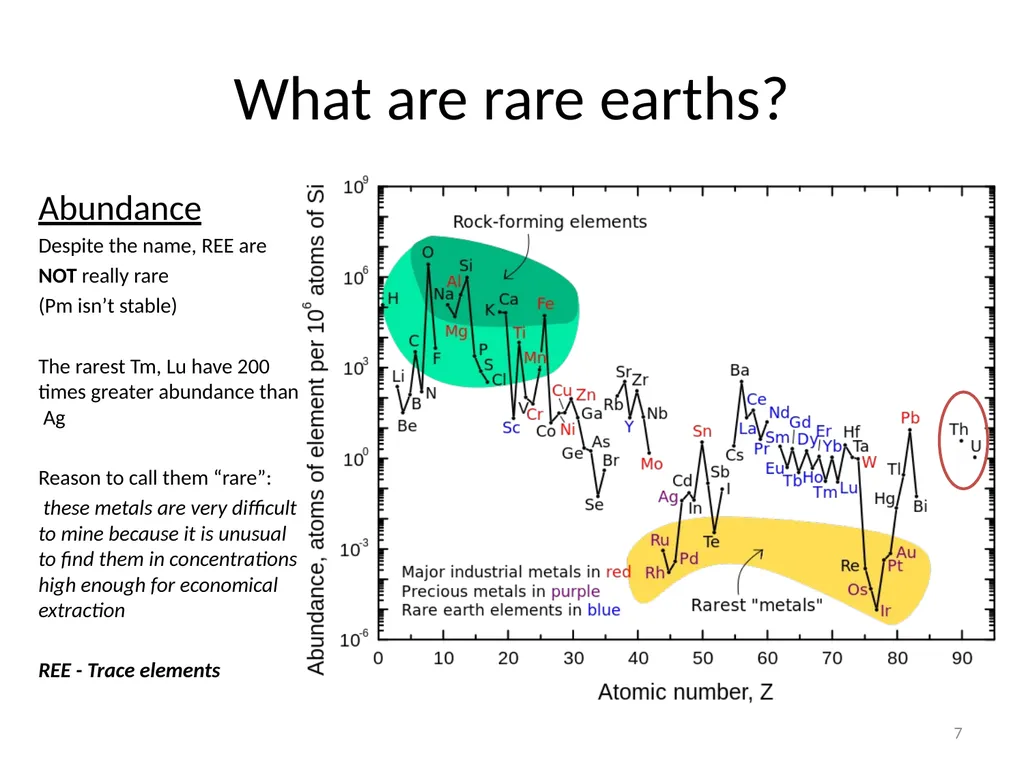
Despite the name, REE are
NOT really rare
(Pm isn’t stable)
The rarest Tm, Lu have 200 times greater abundance than Ag
Reason to call them “rare”:
these metals are very difficult to mine because it is unusual to find them in concentrations high enough for economical extraction
REE - Trace elements 7<br>
Despite the name, REE are
NOT really rare
(Pm isn’t stable)
The rarest Tm, Lu have 200 times greater abundance than Ag
Reason to call them “rare”:
these metals are very difficult to mine because it is unusual to find them in concentrations high enough for economical extraction
REE - Trace elements 7<br>
08
What are rare earths? Mineral Resources
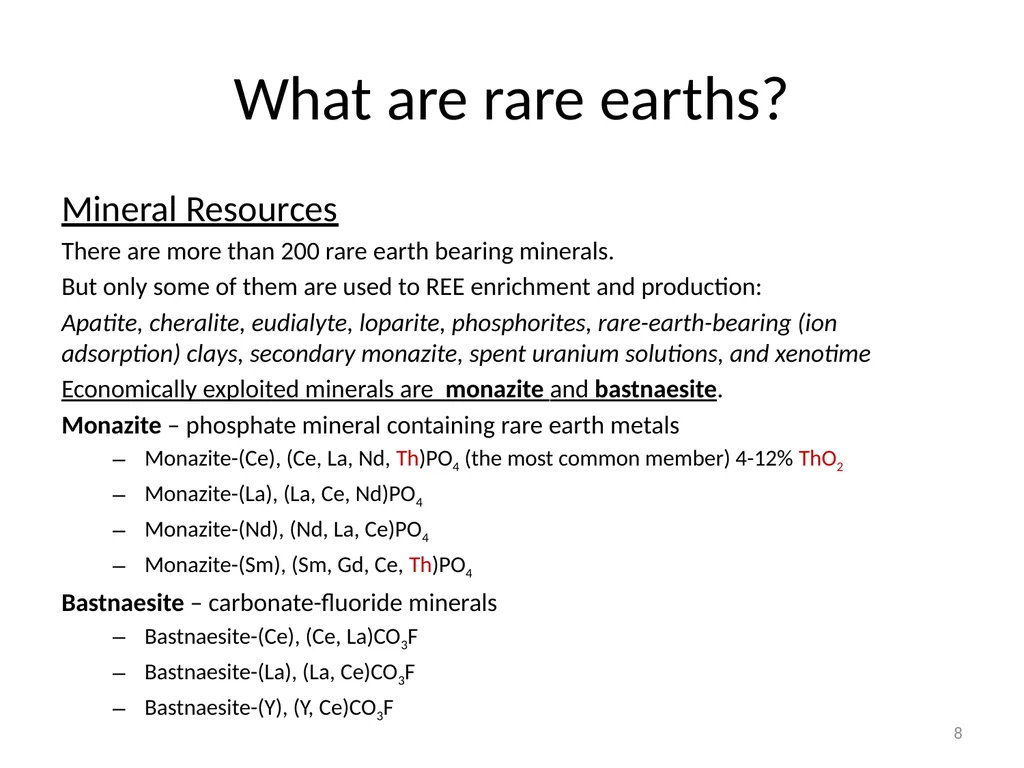
There are more than 200 rare earth bearing minerals.
But only some of them are used to REE enrichment and production:
Apatite, cheralite, eudialyte, loparite, phosphorites, rare-earth-bearing (ion adsorption) clays, secondary monazite, spent uranium solutions, and xenotime
Economically exploited minerals are monazite and bastnaesite.
Monazite – phosphate mineral containing rare earth metals
Monazite-(Ce), (Ce, La, Nd, Th)PO4 (the most common member) 4-12% ThO2
Monazite-(La), (La, Ce, Nd)PO4
Monazite-(Nd), (Nd, La, Ce)PO4
Monazite-(Sm), (Sm, Gd, Ce, Th)PO4
Bastnaesite – carbonate-fluoride minerals
Bastnaesite-(Ce), (Ce, La)CO3F
Bastnaesite-(La), (La, Ce)CO3F
Bastnaesite-(Y), (Y, Ce)CO3F 8<br>
There are more than 200 rare earth bearing minerals.
But only some of them are used to REE enrichment and production:
Apatite, cheralite, eudialyte, loparite, phosphorites, rare-earth-bearing (ion adsorption) clays, secondary monazite, spent uranium solutions, and xenotime
Economically exploited minerals are monazite and bastnaesite.
Monazite – phosphate mineral containing rare earth metals
Monazite-(Ce), (Ce, La, Nd, Th)PO4 (the most common member) 4-12% ThO2
Monazite-(La), (La, Ce, Nd)PO4
Monazite-(Nd), (Nd, La, Ce)PO4
Monazite-(Sm), (Sm, Gd, Ce, Th)PO4
Bastnaesite – carbonate-fluoride minerals
Bastnaesite-(Ce), (Ce, La)CO3F
Bastnaesite-(La), (La, Ce)CO3F
Bastnaesite-(Y), (Y, Ce)CO3F 8<br>
09
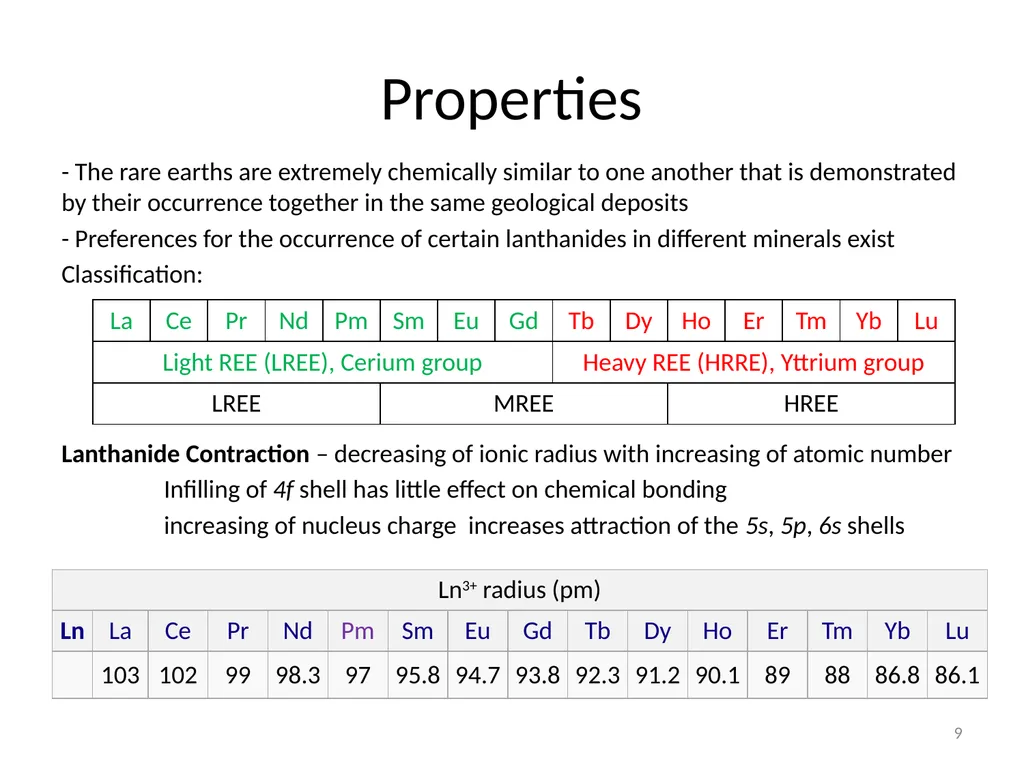
Properties - The rare earths are extremely chemically similar to one another that is demonstrated by their occurrence together in the same geological deposits
- Preferences for the occurrence of certain lanthanides in different minerals exist
Classification:
Lanthanide Contraction – decreasing of ionic radius with increasing of atomic number
Infilling of 4f shell has little effect on chemical bonding
increasing of nucleus charge increases attraction of the 5s, 5p, 6s shells 9<br>
- Preferences for the occurrence of certain lanthanides in different minerals exist
Classification:
Lanthanide Contraction – decreasing of ionic radius with increasing of atomic number
Infilling of 4f shell has little effect on chemical bonding
increasing of nucleus charge increases attraction of the 5s, 5p, 6s shells 9<br>
10
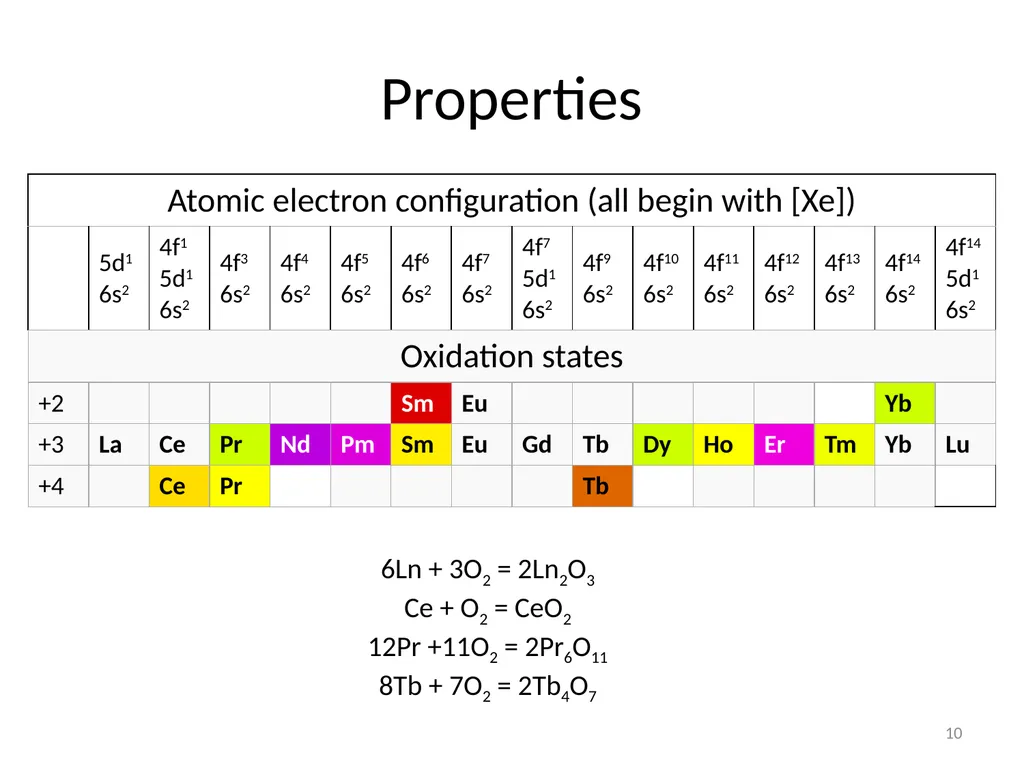
Properties 6Ln + 3O2 = 2Ln2O3
Ce + O2 = CeO2
12Pr +11O2 = 2Pr6O11
8Tb + 7O2 = 2Tb4O7 10<br>
Ce + O2 = CeO2
12Pr +11O2 = 2Pr6O11
8Tb + 7O2 = 2Tb4O7 10<br>
11
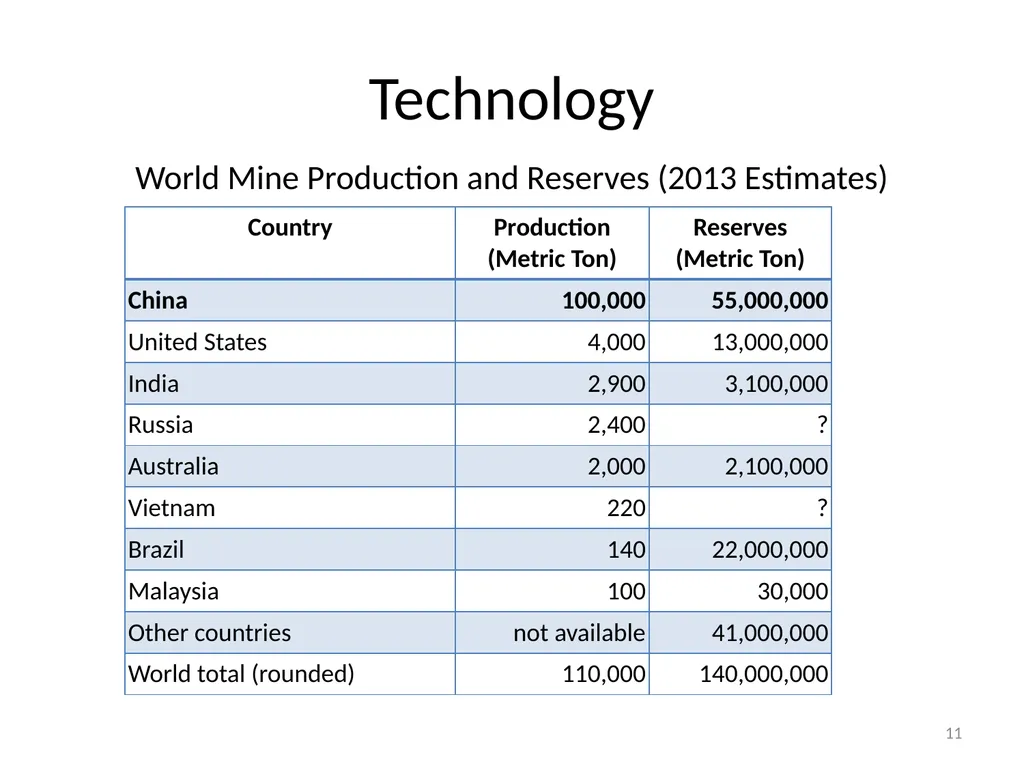
World Mine Production and Reserves (2013 Estimates) 11 Technology<br>
12
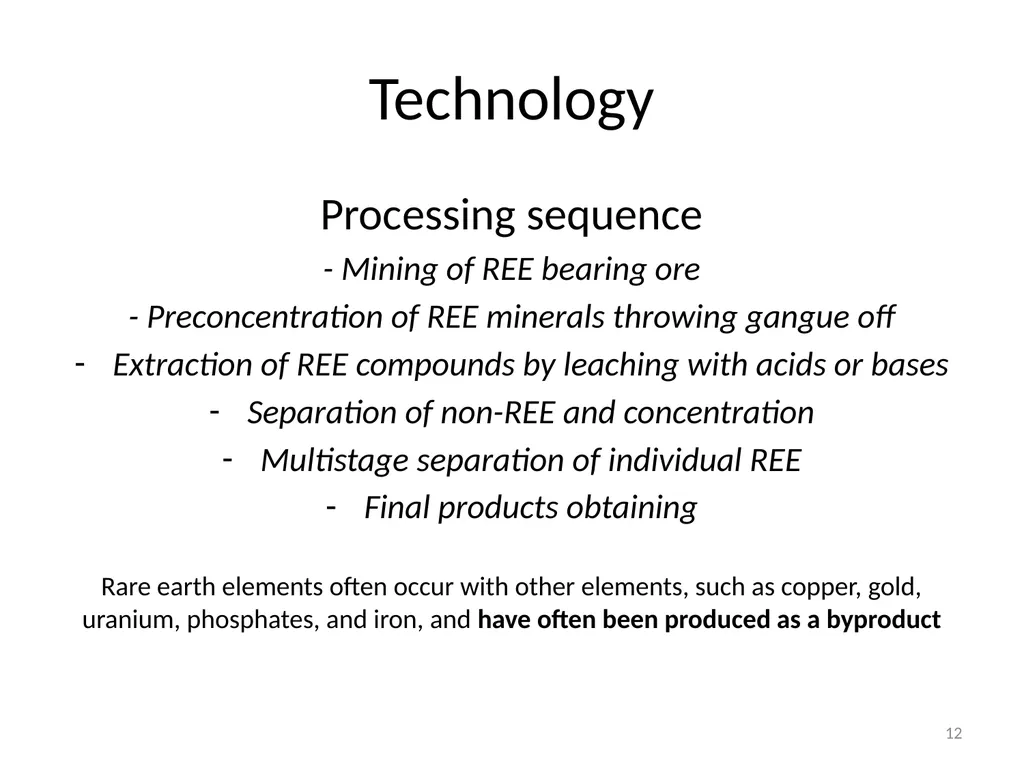
Technology Processing sequence
- Mining of REE bearing ore
- Preconcentration of REE minerals throwing gangue off
Extraction of REE compounds by leaching with acids or bases
Separation of non-REE and concentration
Multistage separation of individual REE
Final products obtaining
Rare earth elements often occur with other elements, such as copper, gold, uranium, phosphates, and iron, and have often been produced as a byproduct 12<br>
- Mining of REE bearing ore
- Preconcentration of REE minerals throwing gangue off
Extraction of REE compounds by leaching with acids or bases
Separation of non-REE and concentration
Multistage separation of individual REE
Final products obtaining
Rare earth elements often occur with other elements, such as copper, gold, uranium, phosphates, and iron, and have often been produced as a byproduct 12<br>
13
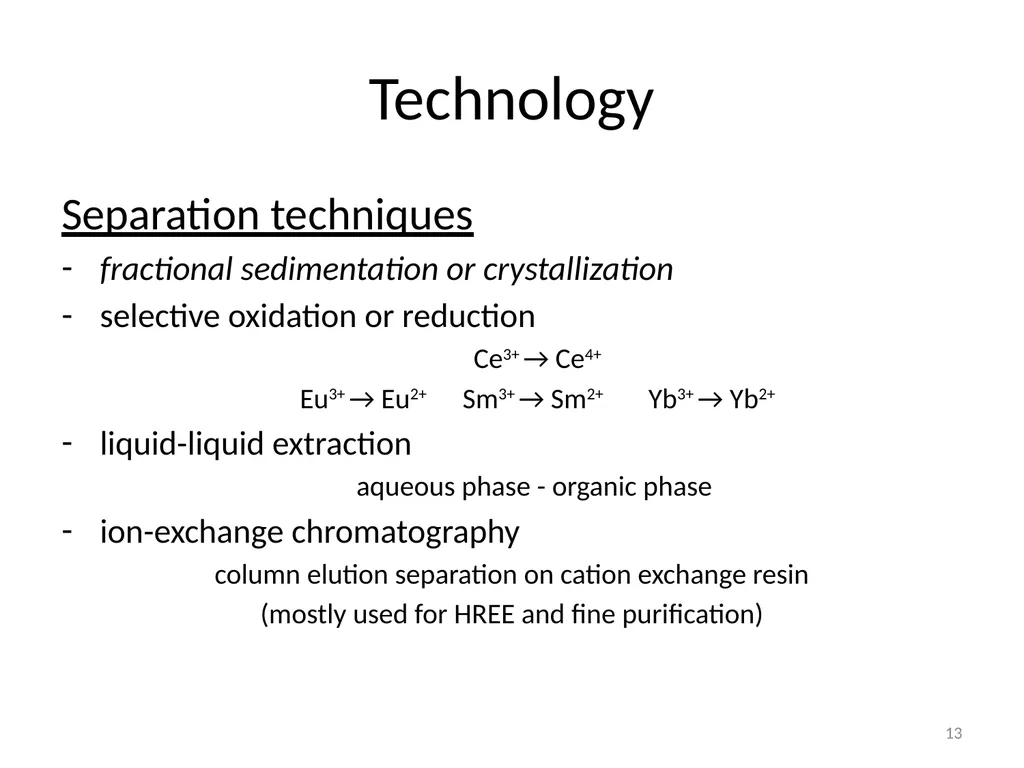
Technology Separation techniques
fractional sedimentation or crystallization
selective oxidation or reduction
Ce3+ → Ce4+
Eu3+ → Eu2+ Sm3+ → Sm2+ Yb3+ → Yb2+
liquid-liquid extraction
aqueous phase - organic phase
ion-exchange chromatography
column elution separation on cation exchange resin
(mostly used for HREE and fine purification) 13<br>
fractional sedimentation or crystallization
selective oxidation or reduction
Ce3+ → Ce4+
Eu3+ → Eu2+ Sm3+ → Sm2+ Yb3+ → Yb2+
liquid-liquid extraction
aqueous phase - organic phase
ion-exchange chromatography
column elution separation on cation exchange resin
(mostly used for HREE and fine purification) 13<br>
14
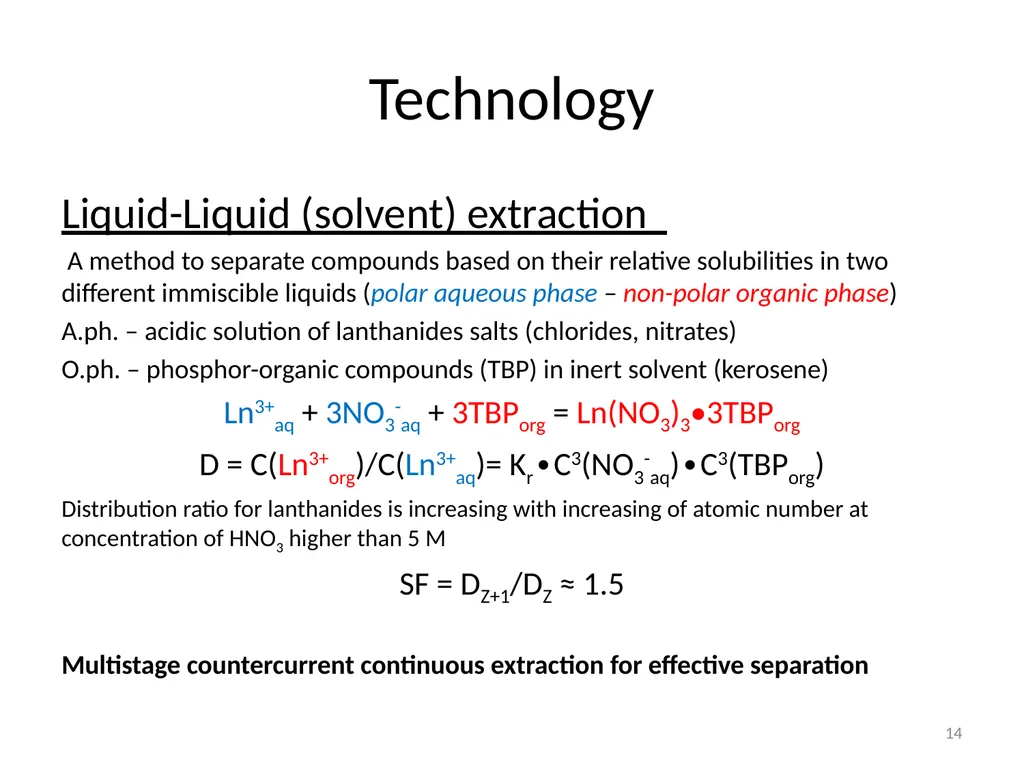
Technology Liquid-Liquid (solvent) extraction
A method to separate compounds based on their relative solubilities in two different immiscible liquids (polar aqueous phase – non-polar organic phase)
A.ph. – acidic solution of lanthanides salts (chlorides, nitrates)
O.ph. – phosphor-organic compounds (TBP) in inert solvent (kerosene)
Ln3+aq + 3NO3-aq + 3TBPorg = Ln(NO3)3•3TBPorg
D = C(Ln3+org)/C(Ln3+aq)= Kr∙C3(NO3-aq)∙C3(TBPorg)
Distribution ratio for lanthanides is increasing with increasing of atomic number at concentration of HNO3 higher than 5 M
SF = DZ+1/DZ ≈ 1.5
Multistage countercurrent continuous extraction for effective separation 14<br>
A method to separate compounds based on their relative solubilities in two different immiscible liquids (polar aqueous phase – non-polar organic phase)
A.ph. – acidic solution of lanthanides salts (chlorides, nitrates)
O.ph. – phosphor-organic compounds (TBP) in inert solvent (kerosene)
Ln3+aq + 3NO3-aq + 3TBPorg = Ln(NO3)3•3TBPorg
D = C(Ln3+org)/C(Ln3+aq)= Kr∙C3(NO3-aq)∙C3(TBPorg)
Distribution ratio for lanthanides is increasing with increasing of atomic number at concentration of HNO3 higher than 5 M
SF = DZ+1/DZ ≈ 1.5
Multistage countercurrent continuous extraction for effective separation 14<br>
15
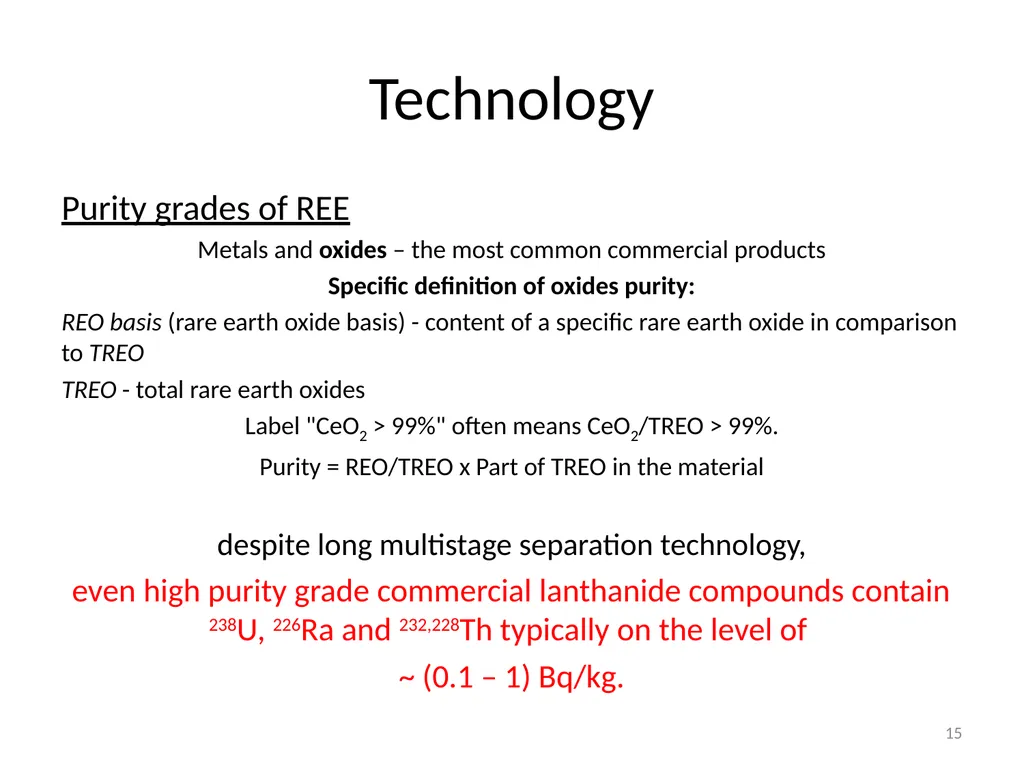
Technology Purity grades of REE
Metals and oxides – the most common commercial products
Specific definition of oxides purity:
REO basis (rare earth oxide basis) - content of a specific rare earth oxide in comparison to TREO
TREO - total rare earth oxides
Label "CeO2 > 99%" often means CeO2/TREO > 99%.
Purity = REO/TREO x Part of TREO in the material
despite long multistage separation technology,
even high purity grade commercial lanthanide compounds contain 238U, 226Ra and 232,228Th typically on the level of
~ (0.1 – 1) Bq/kg. 15<br>
Metals and oxides – the most common commercial products
Specific definition of oxides purity:
REO basis (rare earth oxide basis) - content of a specific rare earth oxide in comparison to TREO
TREO - total rare earth oxides
Label "CeO2 > 99%" often means CeO2/TREO > 99%.
Purity = REO/TREO x Part of TREO in the material
despite long multistage separation technology,
even high purity grade commercial lanthanide compounds contain 238U, 226Ra and 232,228Th typically on the level of
~ (0.1 – 1) Bq/kg. 15<br>
16
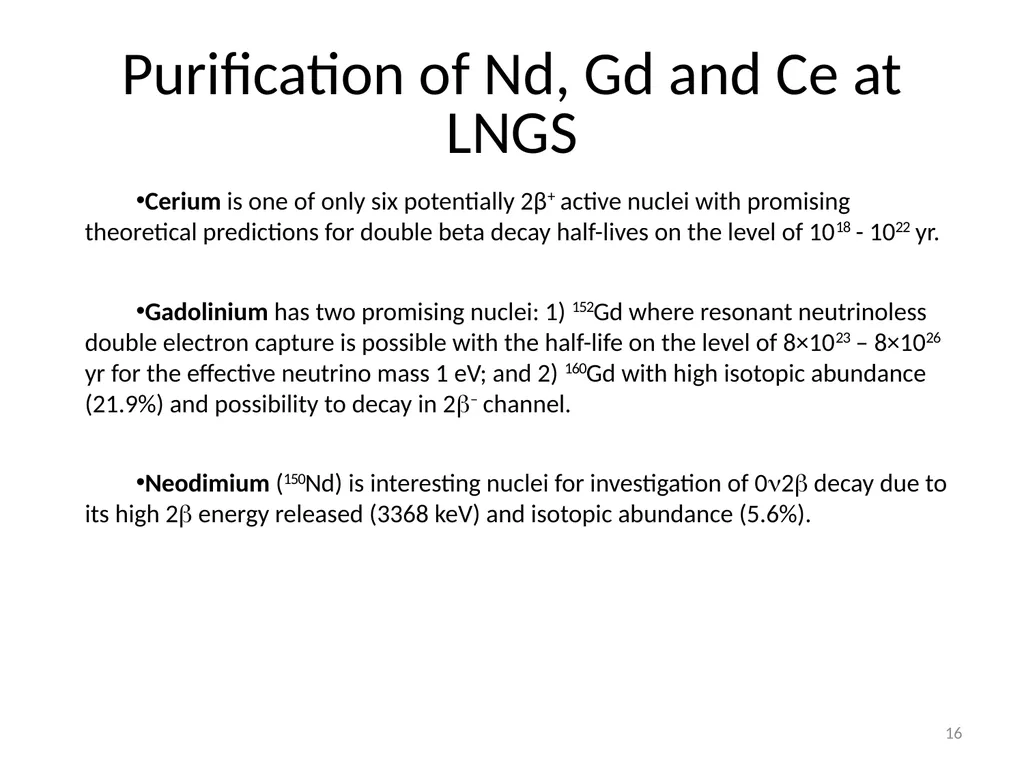
Purification of Nd, Gd and Ce at LNGS Cerium is one of only six potentially 2β+ active nuclei with promising theoretical predictions for double beta decay half-lives on the level of 1018 - 1022 yr.
Gadolinium has two promising nuclei: 1) 152Gd where resonant neutrinoless double electron capture is possible with the half-life on the level of 8×10²³ – 8×1026 yr for the effective neutrino mass 1 eV; and 2) 160Gd with high isotopic abundance (21.9%) and possibility to decay in 2– channel.
Neodimium (150Nd) is interesting nuclei for investigation of 02 decay due to its high 2 energy released (3368 keV) and isotopic abundance (5.6%). 16<br>
Gadolinium has two promising nuclei: 1) 152Gd where resonant neutrinoless double electron capture is possible with the half-life on the level of 8×10²³ – 8×1026 yr for the effective neutrino mass 1 eV; and 2) 160Gd with high isotopic abundance (21.9%) and possibility to decay in 2– channel.
Neodimium (150Nd) is interesting nuclei for investigation of 02 decay due to its high 2 energy released (3368 keV) and isotopic abundance (5.6%). 16<br>
17
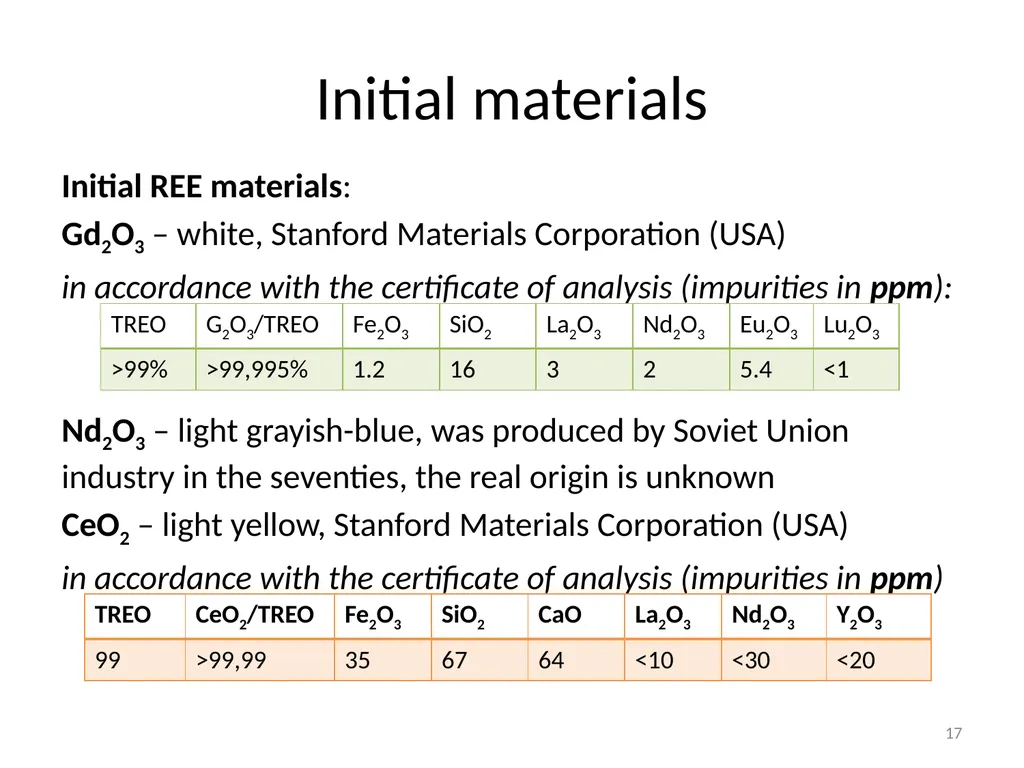
Initial materials Initial REE materials:
Gd2O3 – white, Stanford Materials Corporation (USA)
in accordance with the certificate of analysis (impurities in ppm):
Nd2O3 – light grayish-blue, was produced by Soviet Union industry in the seventies, the real origin is unknown
CeO2 – light yellow, Stanford Materials Corporation (USA)
in accordance with the certificate of analysis (impurities in ppm) 17<br>
Gd2O3 – white, Stanford Materials Corporation (USA)
in accordance with the certificate of analysis (impurities in ppm):
Nd2O3 – light grayish-blue, was produced by Soviet Union industry in the seventies, the real origin is unknown
CeO2 – light yellow, Stanford Materials Corporation (USA)
in accordance with the certificate of analysis (impurities in ppm) 17<br>
18
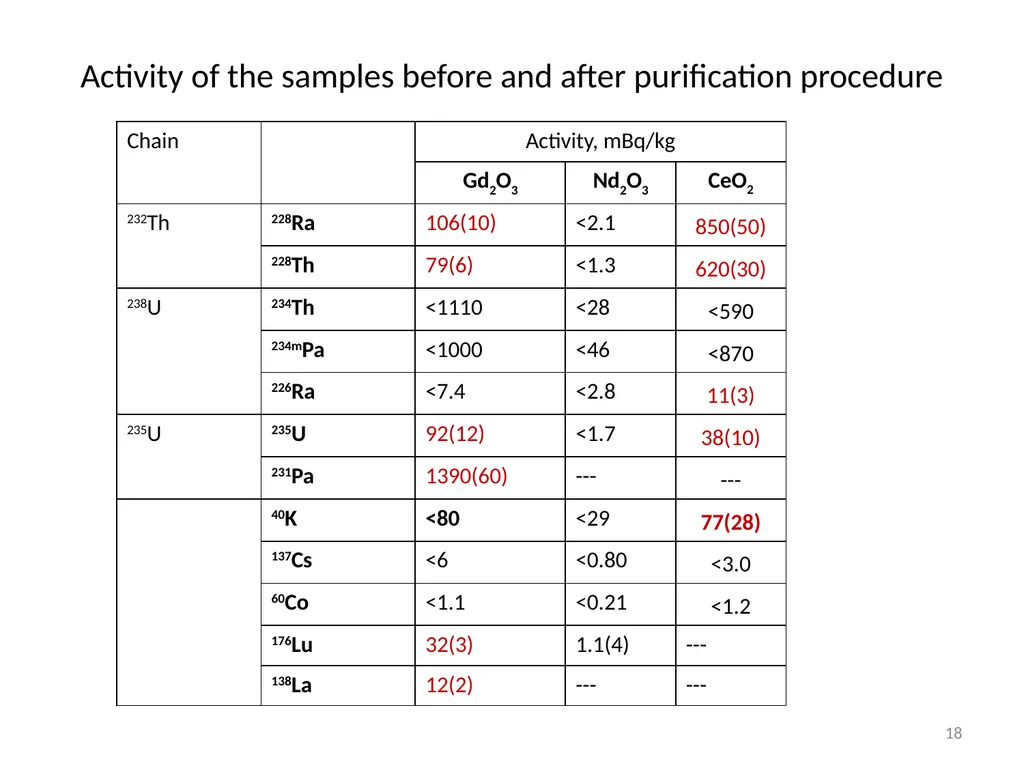
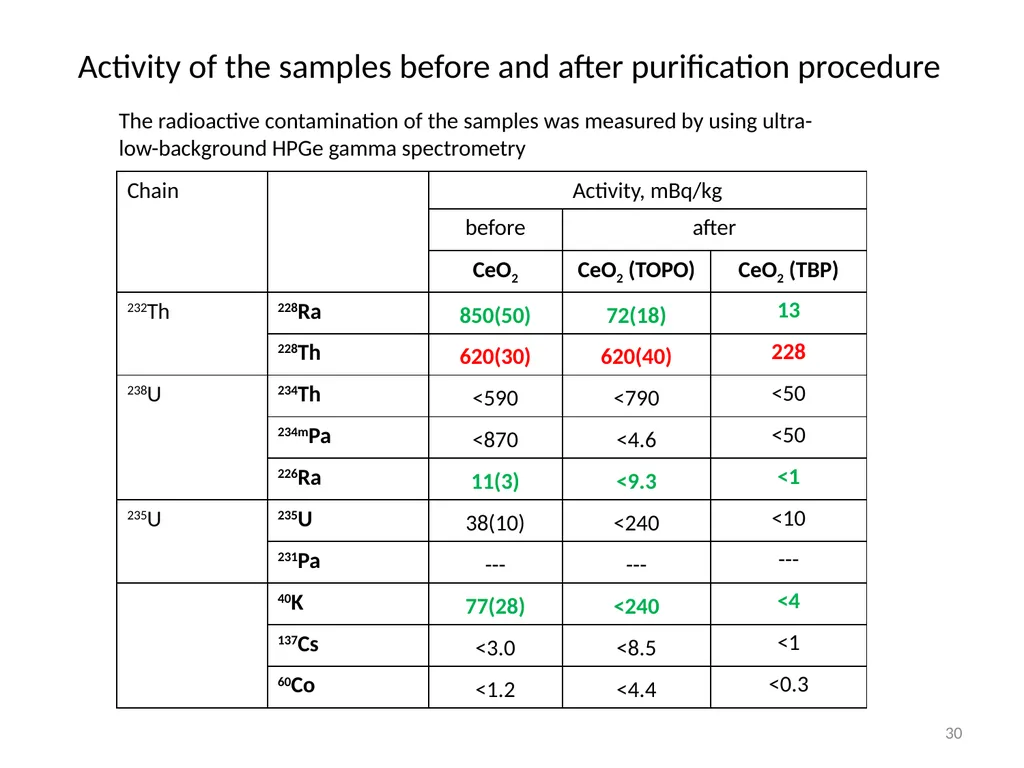
Activity of the samples before and after purification procedure 18<br>
19
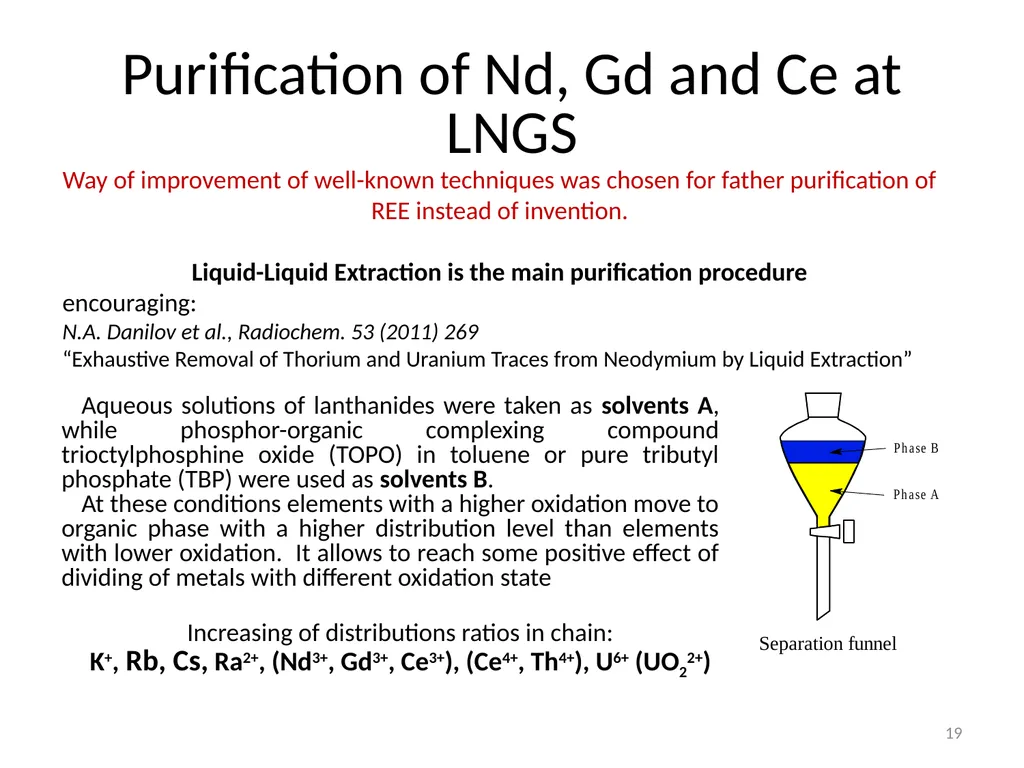
Purification of Nd, Gd and Ce at LNGS Aqueous solutions of lanthanides were taken as solvents A, while phosphor-organic complexing compound trioctylphosphine oxide (TOPO) in toluene or pure tributyl phosphate (TBP) were used as solvents B.
At these conditions elements with a higher oxidation move to organic phase with a higher distribution level than elements with lower oxidation. It allows to reach some positive effect of dividing of metals with different oxidation state
Increasing of distributions ratios in chain:
K+, Rb, Cs, Ra2+, (Nd3+, Gd3+, Ce3+), (Ce4+, Th4+), U6+ (UO22+) Way of improvement of well-known techniques was chosen for father purification of REE instead of invention.
Liquid-Liquid Extraction is the main purification procedure
encouraging:
N.A. Danilov et al., Radiochem. 53 (2011) 269
“Exhaustive Removal of Thorium and Uranium Traces from Neodymium by Liquid Extraction” 19<br>
At these conditions elements with a higher oxidation move to organic phase with a higher distribution level than elements with lower oxidation. It allows to reach some positive effect of dividing of metals with different oxidation state
Increasing of distributions ratios in chain:
K+, Rb, Cs, Ra2+, (Nd3+, Gd3+, Ce3+), (Ce4+, Th4+), U6+ (UO22+) Way of improvement of well-known techniques was chosen for father purification of REE instead of invention.
Liquid-Liquid Extraction is the main purification procedure
encouraging:
N.A. Danilov et al., Radiochem. 53 (2011) 269
“Exhaustive Removal of Thorium and Uranium Traces from Neodymium by Liquid Extraction” 19<br>
20
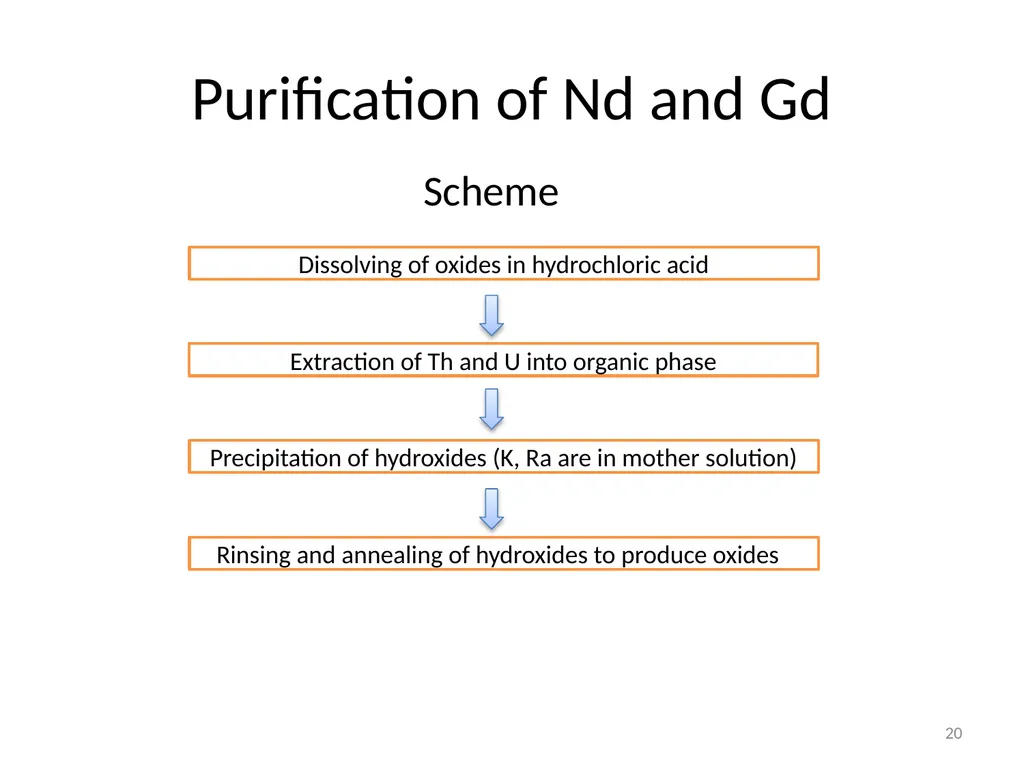
Purification of Nd and Gd Scheme Dissolving of oxides in hydrochloric acid Extraction of Th and U into organic phase Precipitation of hydroxides (K, Ra are in mother solution) Rinsing and annealing of hydroxides to produce oxides 20<br>
21
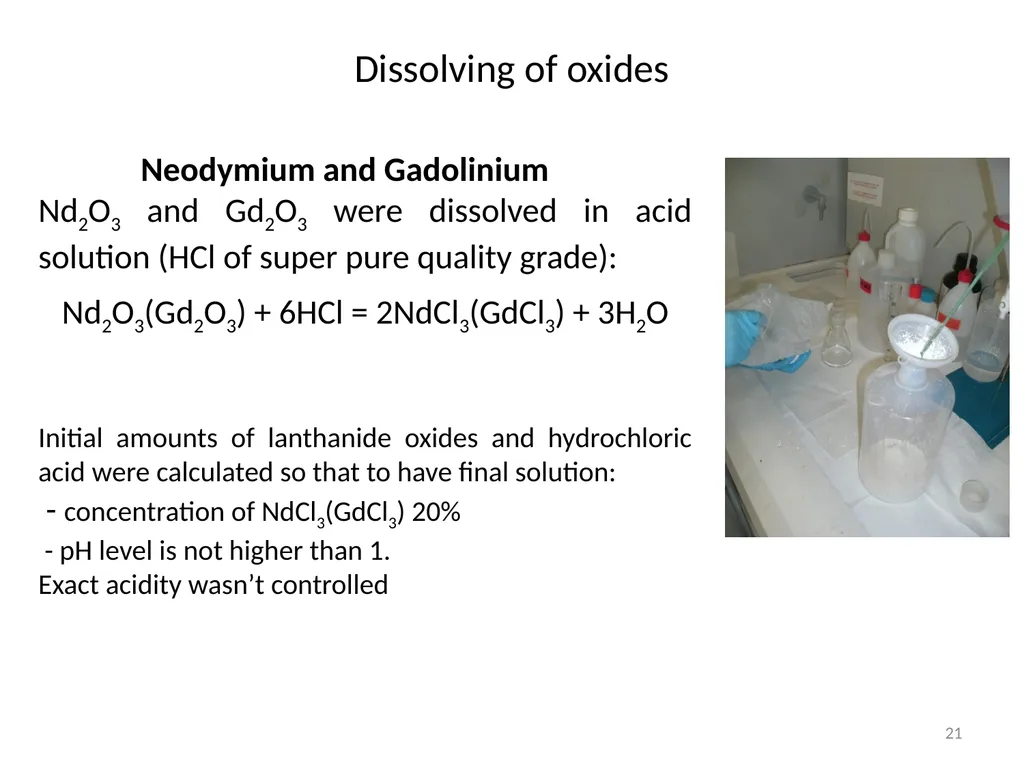
Neodymium and Gadolinium
Nd2O3 and Gd2O3 were dissolved in acid solution (HCl of super pure quality grade):
Nd2O3(Gd2O3) + 6HCl = 2NdCl3(GdCl3) + 3H2O
Initial amounts of lanthanide oxides and hydrochloric acid were calculated so that to have final solution:
- concentration of NdCl3(GdCl3) 20%
- pH level is not higher than 1.
Exact acidity wasn’t controlled Dissolving of oxides 21<br>
Nd2O3 and Gd2O3 were dissolved in acid solution (HCl of super pure quality grade):
Nd2O3(Gd2O3) + 6HCl = 2NdCl3(GdCl3) + 3H2O
Initial amounts of lanthanide oxides and hydrochloric acid were calculated so that to have final solution:
- concentration of NdCl3(GdCl3) 20%
- pH level is not higher than 1.
Exact acidity wasn’t controlled Dissolving of oxides 21<br>
22
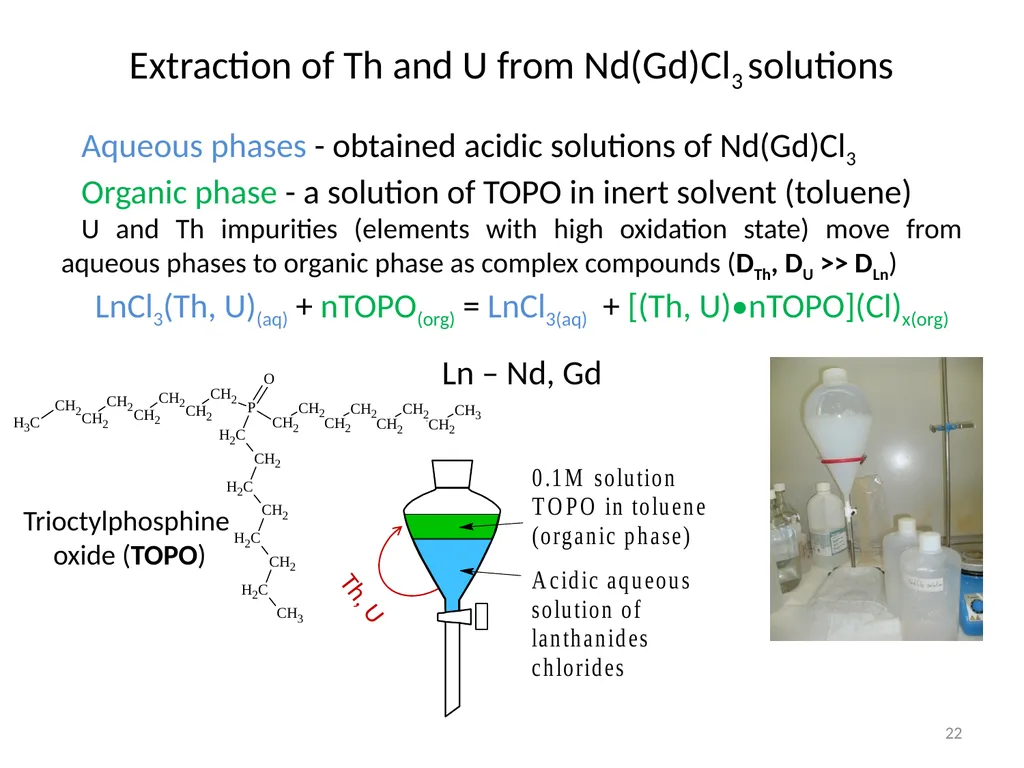
Extraction of Th and U from Nd(Gd)Cl3 solutions Aqueous phases - obtained acidic solutions of Nd(Gd)Cl3
Organic phase - a solution of TOPO in inert solvent (toluene)
U and Th impurities (elements with high oxidation state) move from aqueous phases to organic phase as complex compounds (DTh, DU >> DLn)
LnCl3(Th, U)(aq) + nTOPO(org) = LnCl3(aq) + [(Th, U)•nTOPO](Cl)x(org)
Ln – Nd, Gd Trioctylphosphine
oxide (TOPO) Th, U 22<br>
Organic phase - a solution of TOPO in inert solvent (toluene)
U and Th impurities (elements with high oxidation state) move from aqueous phases to organic phase as complex compounds (DTh, DU >> DLn)
LnCl3(Th, U)(aq) + nTOPO(org) = LnCl3(aq) + [(Th, U)•nTOPO](Cl)x(org)
Ln – Nd, Gd Trioctylphosphine
oxide (TOPO) Th, U 22<br>
23
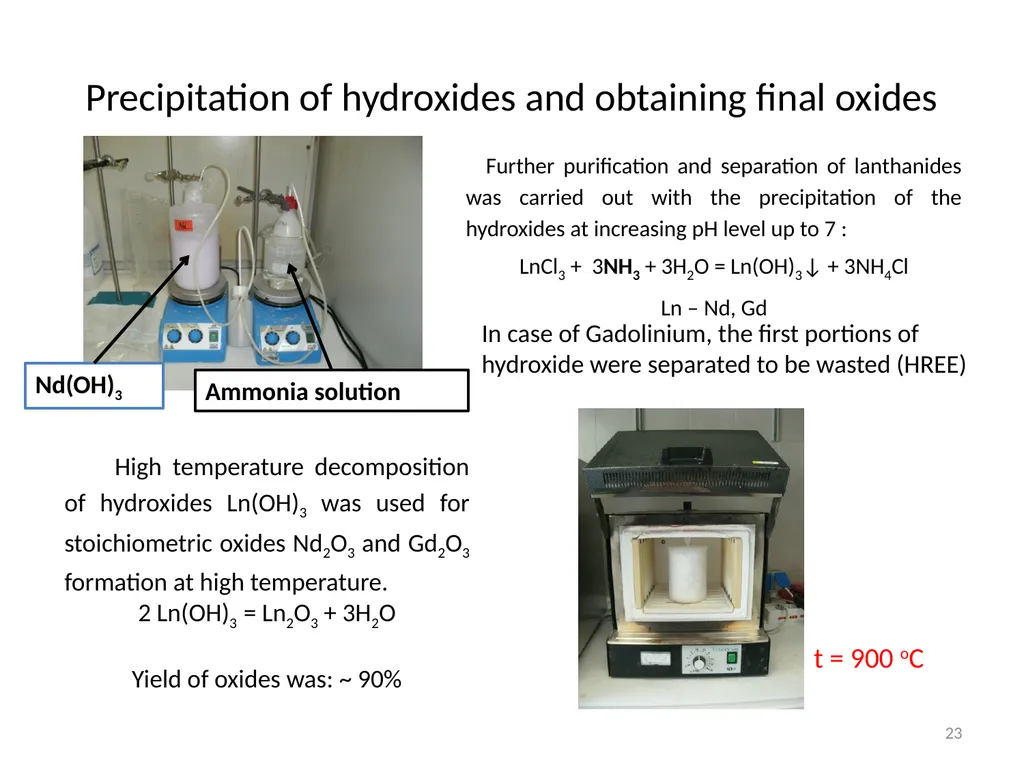
Precipitation of hydroxides and obtaining final oxides Further purification and separation of lanthanides was carried out with the precipitation of the hydroxides at increasing pH level up to 7 :
LnCl3 + 3NH3 + 3H2O = Ln(OH)3↓ + 3NH4Cl
Ln – Nd, Gd Nd(OH)3 Ammonia solution In case of Gadolinium, the first portions of hydroxide were separated to be wasted (HREE) High temperature decomposition of hydroxides Ln(OH)3 was used for stoichiometric oxides Nd2O3 and Gd2O3 formation at high temperature.
2 Ln(OH)3 = Ln2O3 + 3H2O
Yield of oxides was: ~ 90% t = 900 oC 23<br>
LnCl3 + 3NH3 + 3H2O = Ln(OH)3↓ + 3NH4Cl
Ln – Nd, Gd Nd(OH)3 Ammonia solution In case of Gadolinium, the first portions of hydroxide were separated to be wasted (HREE) High temperature decomposition of hydroxides Ln(OH)3 was used for stoichiometric oxides Nd2O3 and Gd2O3 formation at high temperature.
2 Ln(OH)3 = Ln2O3 + 3H2O
Yield of oxides was: ~ 90% t = 900 oC 23<br>
24
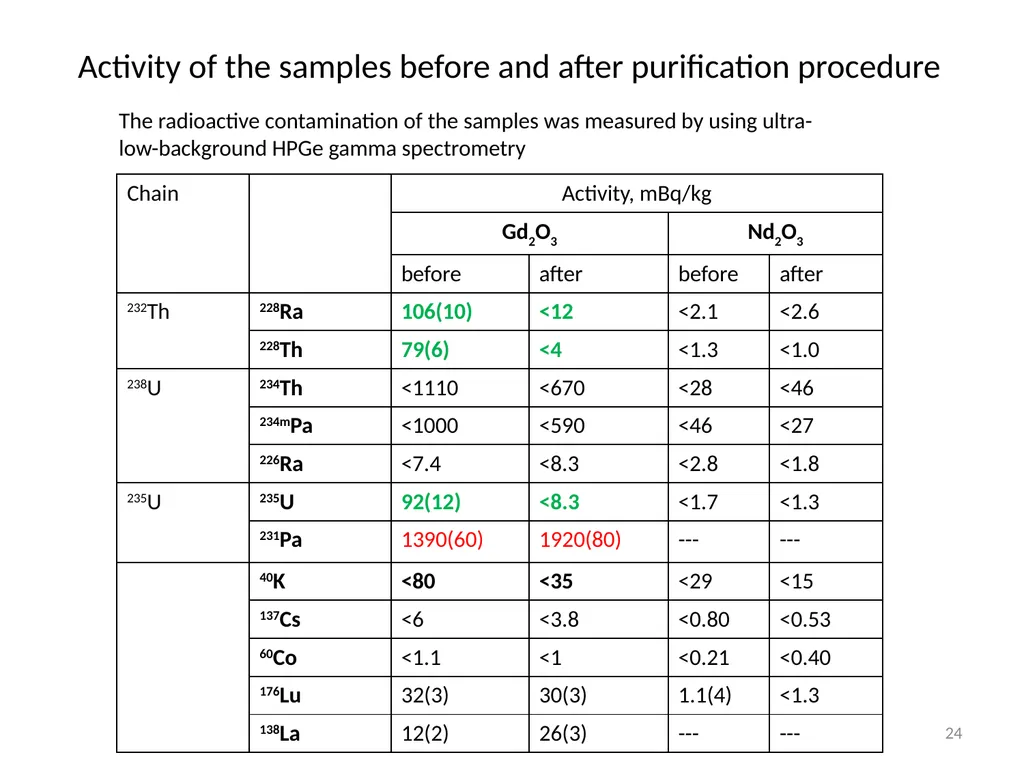
Activity of the samples before and after purification procedure 24 The radioactive contamination of the samples was measured by using ultra-low-background HPGe gamma spectrometry<br>
25
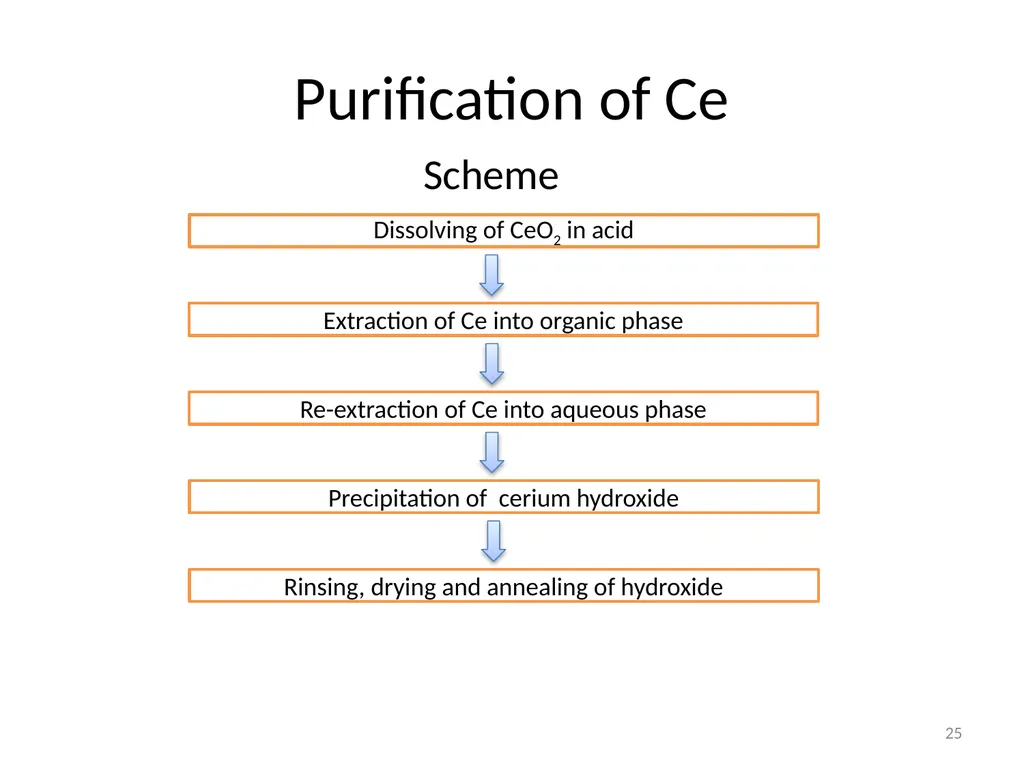
Purification of Ce Scheme Dissolving of CeO2 in acid Precipitation of cerium hydroxide Rinsing, drying and annealing of hydroxide Extraction of Ce into organic phase Re-extraction of Ce into aqueous phase 25<br>
26
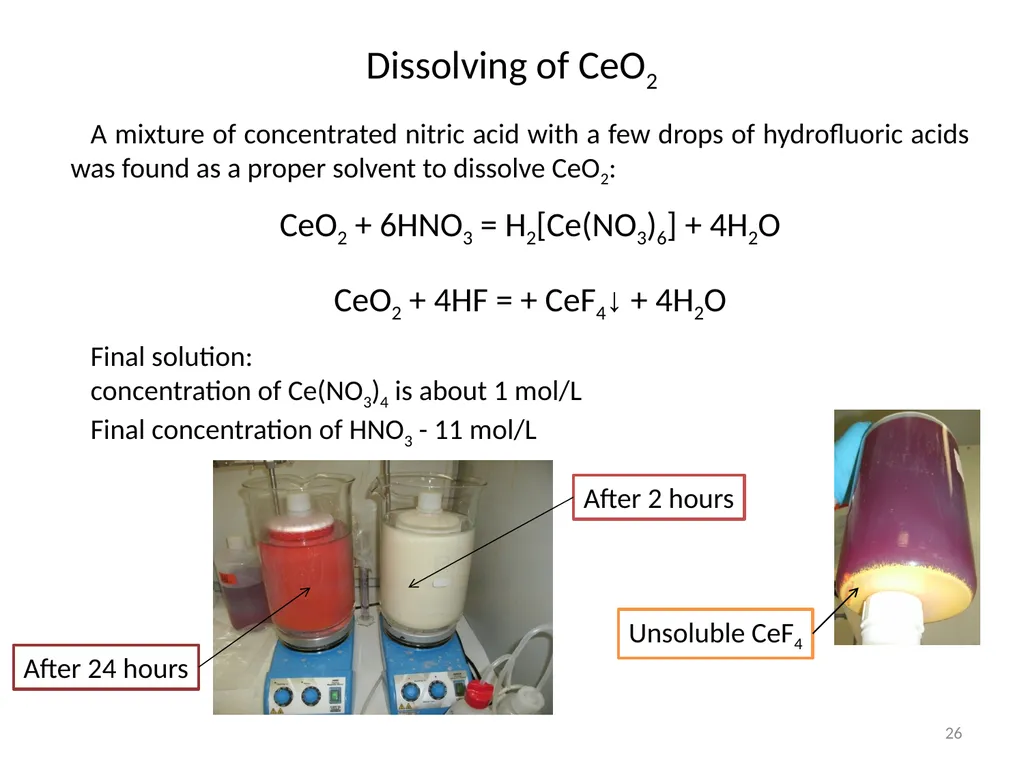
Dissolving of CeO2 A mixture of concentrated nitric acid with a few drops of hydrofluoric acids was found as a proper solvent to dissolve CeO2:
CeO2 + 6HNO3 = H2[Ce(NO3)6] + 4H2O
CeO2 + 4HF = + CeF4↓ + 4H2O
Final solution:
concentration of Ce(NO3)4 is about 1 mol/L
Final concentration of HNO3 - 11 mol/L After 2 hours After 24 hours Unsoluble CeF4 26<br>
CeO2 + 6HNO3 = H2[Ce(NO3)6] + 4H2O
CeO2 + 4HF = + CeF4↓ + 4H2O
Final solution:
concentration of Ce(NO3)4 is about 1 mol/L
Final concentration of HNO3 - 11 mol/L After 2 hours After 24 hours Unsoluble CeF4 26<br>
27
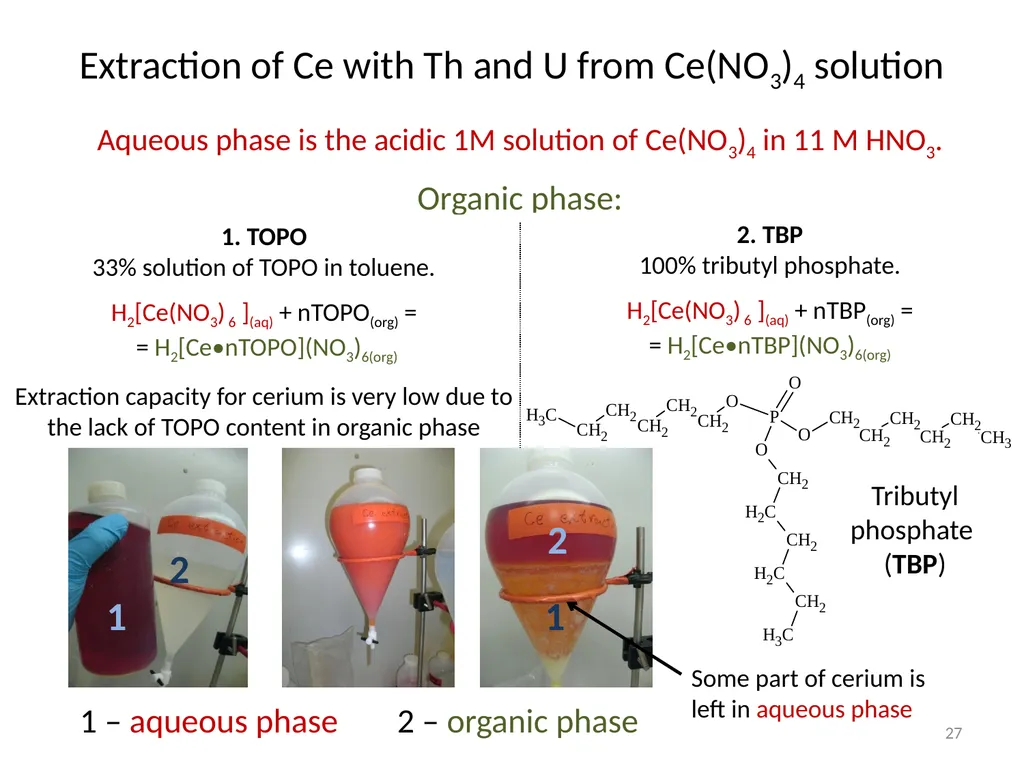
Extraction of Ce with Th and U from Ce(NO3)4 solution Aqueous phase is the acidic 1M solution of Ce(NO3)4 in 11 M HNO3. Organic phase: 1. TOPO
33% solution of TOPO in toluene.
H2[Ce(NO3) 6 ](aq) + nTOPO(org) =
= H2[Ce•nTOPO](NO3)6(org)
Extraction capacity for cerium is very low due to the lack of TOPO content in organic phase 2. TBP
100% tributyl phosphate.
H2[Ce(NO3) 6 ](aq) + nTBP(org) =
= H2[Ce•nTBP](NO3)6(org) Tributyl
phosphate
(TBP) 1 2 1 2 1 – aqueous phase 2 – organic phase 27 Some part of cerium is left in aqueous phase<br>
33% solution of TOPO in toluene.
H2[Ce(NO3) 6 ](aq) + nTOPO(org) =
= H2[Ce•nTOPO](NO3)6(org)
Extraction capacity for cerium is very low due to the lack of TOPO content in organic phase 2. TBP
100% tributyl phosphate.
H2[Ce(NO3) 6 ](aq) + nTBP(org) =
= H2[Ce•nTBP](NO3)6(org) Tributyl
phosphate
(TBP) 1 2 1 2 1 – aqueous phase 2 – organic phase 27 Some part of cerium is left in aqueous phase<br>
28
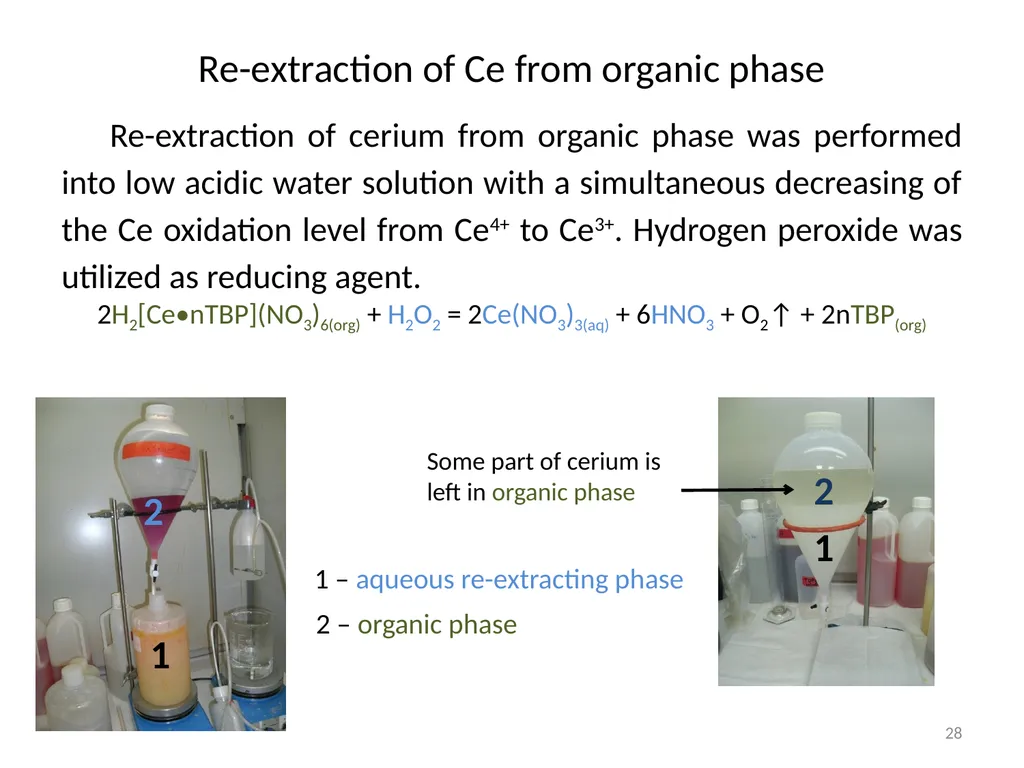
Re-extraction of cerium from organic phase was performed into low acidic water solution with a simultaneous decreasing of the Ce oxidation level from Ce4+ to Ce3+. Hydrogen peroxide was utilized as reducing agent.
2H2[Ce•nTBP](NO3)6(org) + H2O2 = 2Ce(NO3)3(aq) + 6HNO3 + O2↑ + 2nTBP(org) Re-extraction of Ce from organic phase 28 1 – aqueous re-extracting phase 2 – organic phase 1 1 2 2 Some part of cerium is left in organic phase<br>
2H2[Ce•nTBP](NO3)6(org) + H2O2 = 2Ce(NO3)3(aq) + 6HNO3 + O2↑ + 2nTBP(org) Re-extraction of Ce from organic phase 28 1 – aqueous re-extracting phase 2 – organic phase 1 1 2 2 Some part of cerium is left in organic phase<br>
29
Ammonia gas was applied increasing pH level of Ce contaning aqueous re-extracting phase higher than 7 and to precipitate cerium hydroxide
At the same time the oxidation level of cerium is increased due to the excess of hydrogen peroxide:
2Ce(NO3)3 + 6NH3 + H2O2 + 6H2O = 2Ce(OH)4↓ + 6NH4NO3 Precipitation of Ce(OH)4and obtaining final oxide Ce(OOH)(OH)3 Ammonia solution 29 Decomposing of cerium hydroxyperoxide at 100 oC
2Ce(OOH)(OH)3 = 2CeO(OH)2 + 2H2O + O2↑
Whashing, drying and annealing at 900 oC
CeO(OH)2 = CeO2 + H2O
Yield of oxides was: ~ 20% for CeO2 (TOPO)
~ 65% for CeO2 (TBP)<br>
At the same time the oxidation level of cerium is increased due to the excess of hydrogen peroxide:
2Ce(NO3)3 + 6NH3 + H2O2 + 6H2O = 2Ce(OH)4↓ + 6NH4NO3 Precipitation of Ce(OH)4and obtaining final oxide Ce(OOH)(OH)3 Ammonia solution 29 Decomposing of cerium hydroxyperoxide at 100 oC
2Ce(OOH)(OH)3 = 2CeO(OH)2 + 2H2O + O2↑
Whashing, drying and annealing at 900 oC
CeO(OH)2 = CeO2 + H2O
Yield of oxides was: ~ 20% for CeO2 (TOPO)
~ 65% for CeO2 (TBP)<br>
30
Activity of the samples before and after purification procedure 30 The radioactive contamination of the samples was measured by using ultra-low-background HPGe gamma spectrometry<br>
31
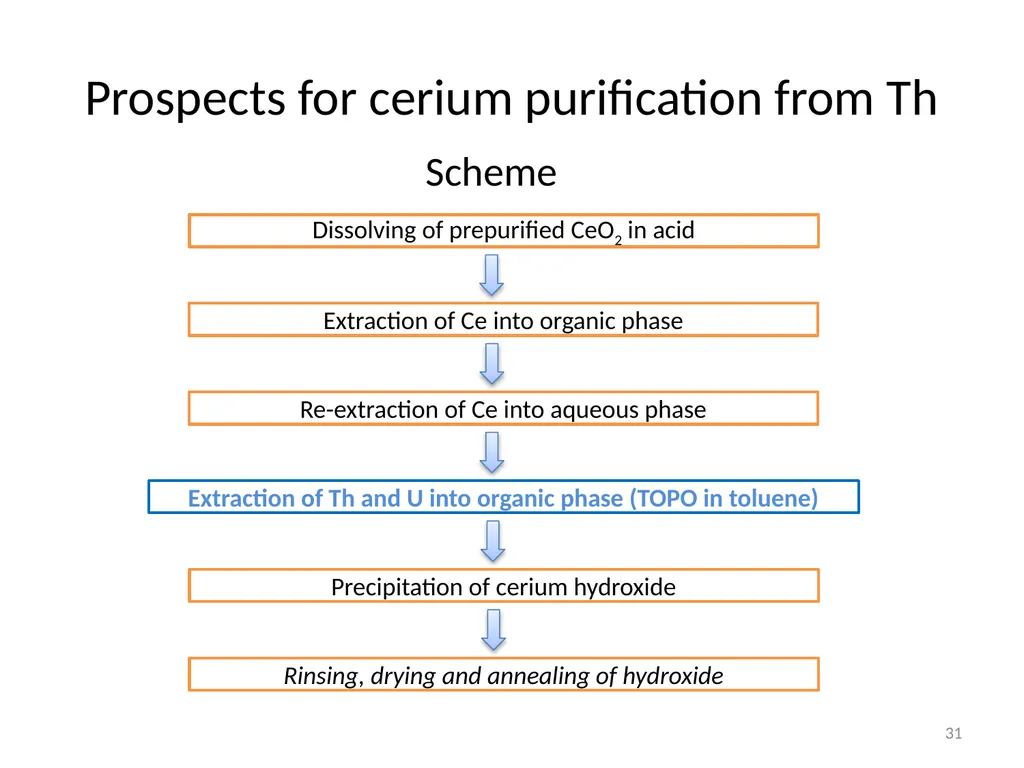
Scheme Dissolving of prepurified CeO2 in acid Extraction of Th and U into organic phase (TOPO in toluene) Precipitation of cerium hydroxide Rinsing, drying and annealing of hydroxide Extraction of Ce into organic phase Re-extraction of Ce into aqueous phase Prospects for cerium purification from Th 31<br>
32
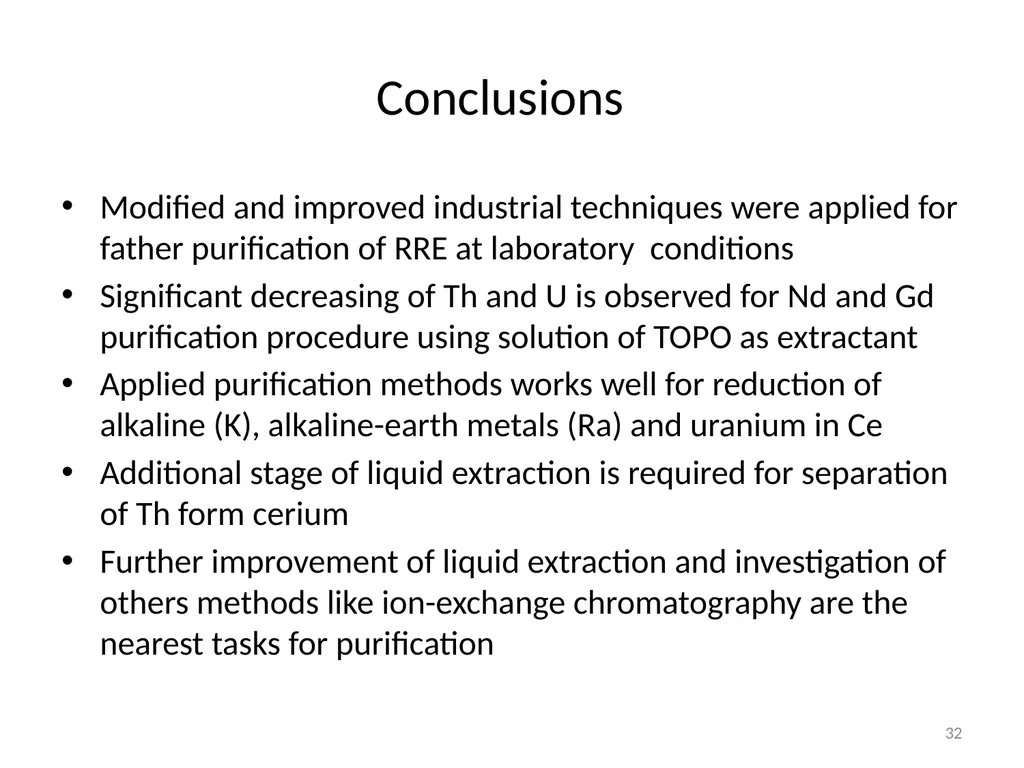
Conclusions Modified and improved industrial techniques were applied for father purification of RRE at laboratory conditions
Significant decreasing of Th and U is observed for Nd and Gd purification procedure using solution of TOPO as extractant
Applied purification methods works well for reduction of alkaline (K), alkaline-earth metals (Ra) and uranium in Ce
Additional stage of liquid extraction is required for separation of Th form cerium
Further improvement of liquid extraction and investigation of others methods like ion-exchange chromatography are the nearest tasks for purification 32<br>
Significant decreasing of Th and U is observed for Nd and Gd purification procedure using solution of TOPO as extractant
Applied purification methods works well for reduction of alkaline (K), alkaline-earth metals (Ra) and uranium in Ce
Additional stage of liquid extraction is required for separation of Th form cerium
Further improvement of liquid extraction and investigation of others methods like ion-exchange chromatography are the nearest tasks for purification 32<br>
33
33 Thank you for attention<br>
34
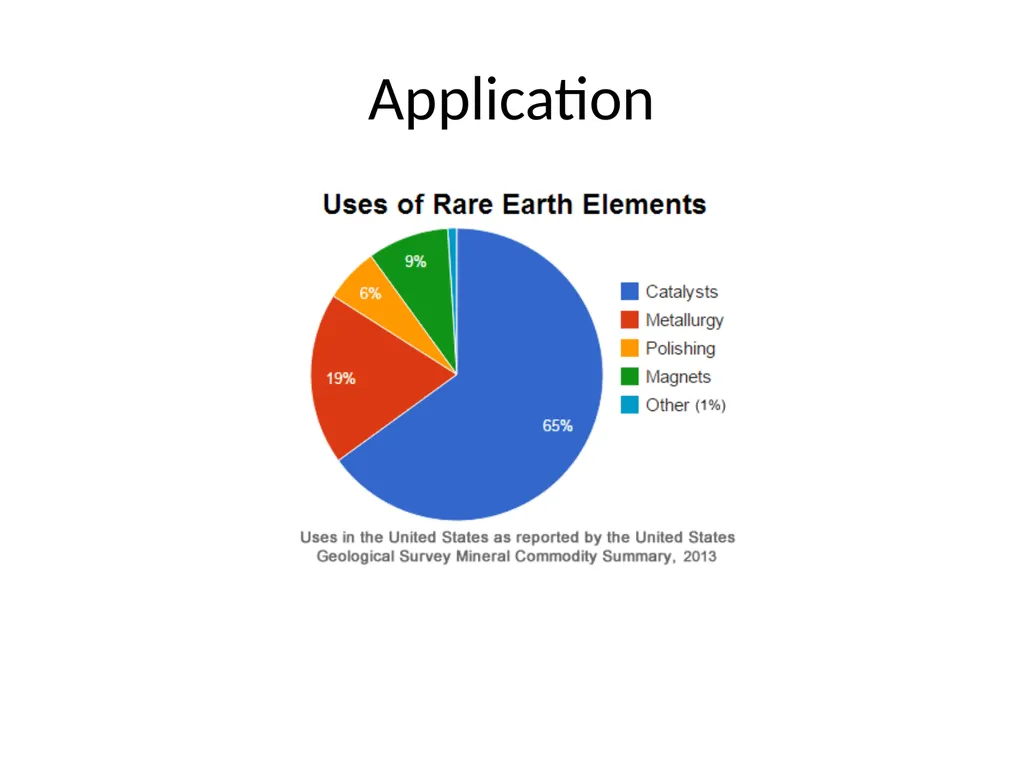
Application<br>