04
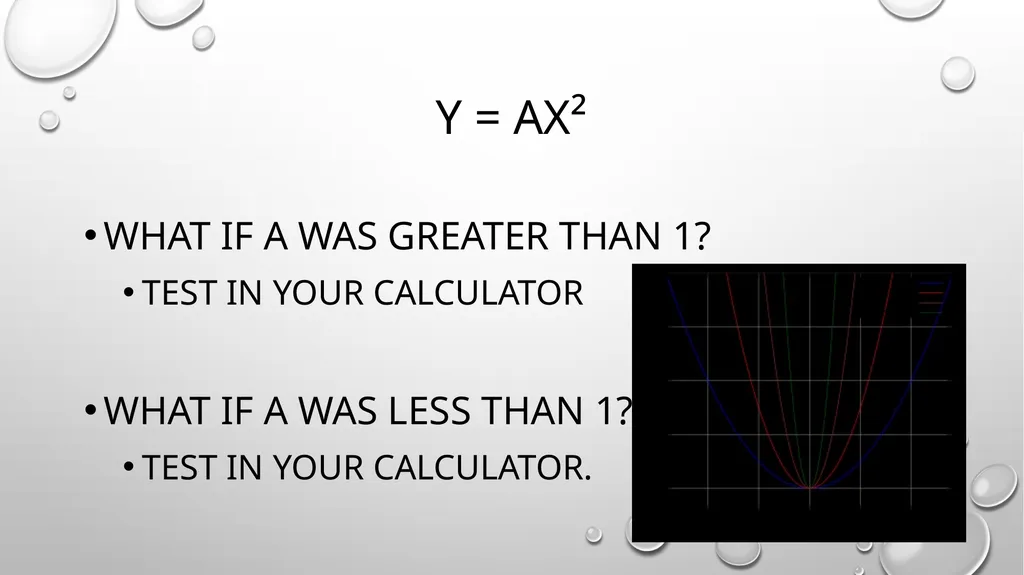
Y = ax² What if A was greater than 1?
Test in your calculator
What if A Was less than 1?
Test in your calculator.<br>
05
General graph of the equation<br>
06
Domain and Range Domain: Set of all x values of a function
Usually will be all real numbers
Range: Set of all y values of a function
Depends on your maximum or minimum value<br>
07
X-Intercept and Y-Intercept X-Intercept: Where the function touches or intersects the x- axis
Y-intercept: Where the function touches or intersects the y- axis<br>
08
Intervals of Increasing or Decreasing Increasing: Where the functions slope is increasing
Decreasing: Where the functions slope is decreasing
Labeled as [x,x]– increasing/decreasing from what x value to what x value<br>
09
Maximum or Minimum values Maximum: The highest point of the function
Minimum: The lowest point of the function
*Both labeled as a point (x, Y)<br>
10
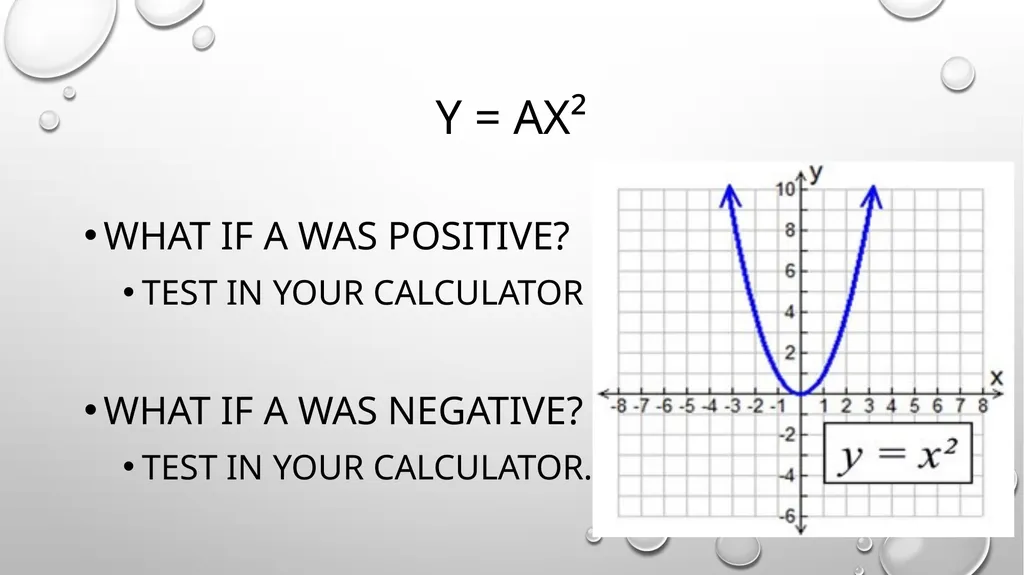
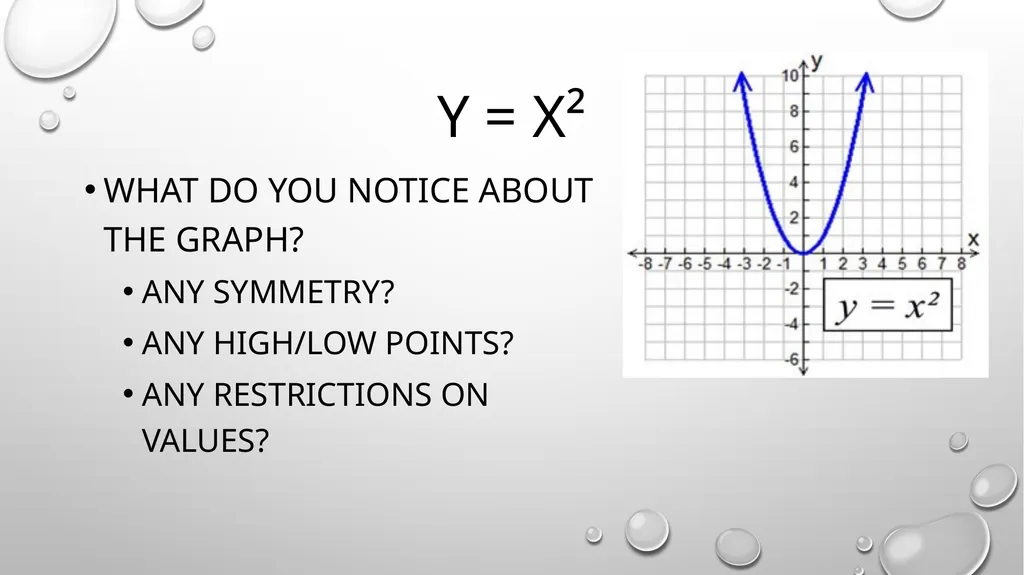
Y = x² What do you notice about the graph?
Any symmetry?
Any high/Low Points?
Any restrictions on values?<br>
11
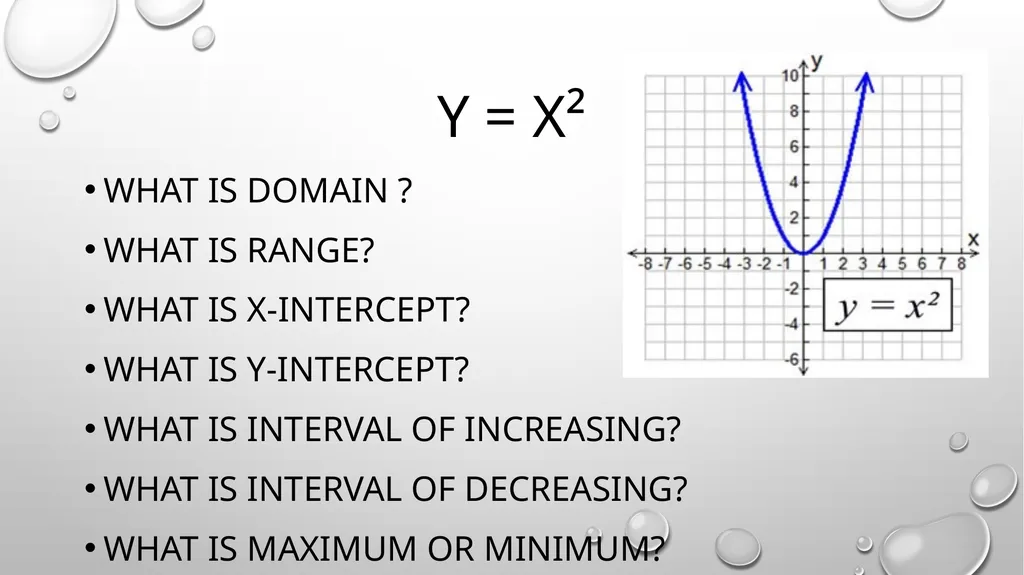
Y = x² What is Domain ?
What is Range?
What is x-intercept?
What is y-intercept?
What is interval of Increasing?
What is interval of Decreasing?
What is Maximum or Minimum?<br>
12
Real-life importance What is the importance of each of these in real-life?
Domain and Range?
X- and Y-Intercepts?
Intervals of Increasing and decreasing?
Maximum or Minimum Values?<br>
13
Quadratic equations in standard form<br>
14
Standard Form Y = ax² + bx + c
A, B, and C are constants and can be negative or positive<br>
15
Standard Form Graphs Try graphing these equations:
Y = x² - 6x + 8
Y = -x² +8x + 15
Find Domain, range, x-intercepts, y-intercepts, intervals of increasing and decreasing, and maximum or minimum values.<br>
16
Standard Form graphs Can find the values in your calculator.<br>
17
Quadratic Equations in Intercept form<br>
18
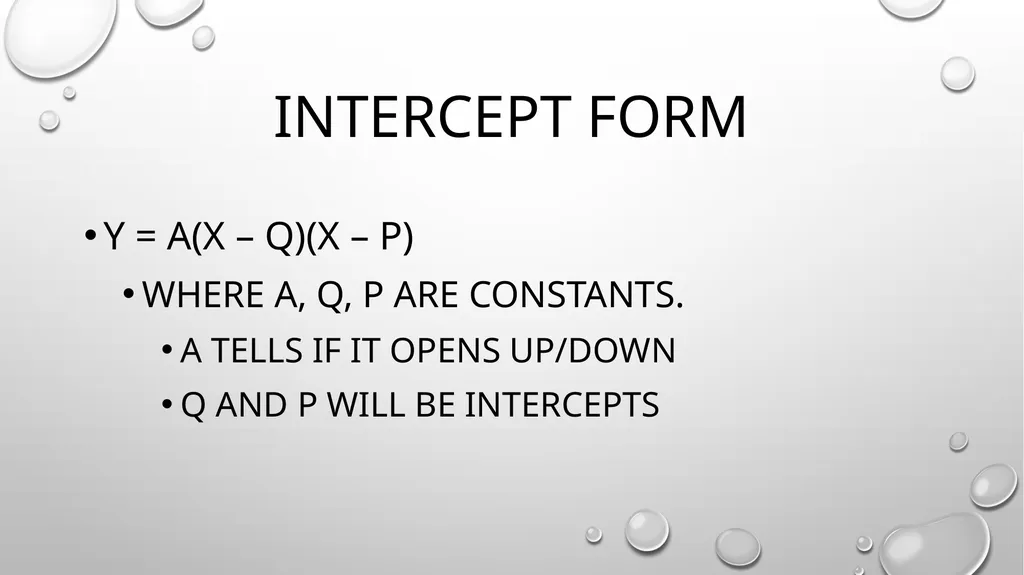
Intercept form Y = A(x – Q)(X – p)
Where A, Q, P are constants.
A tells if it opens up/down
Q and P will be intercepts<br>
19
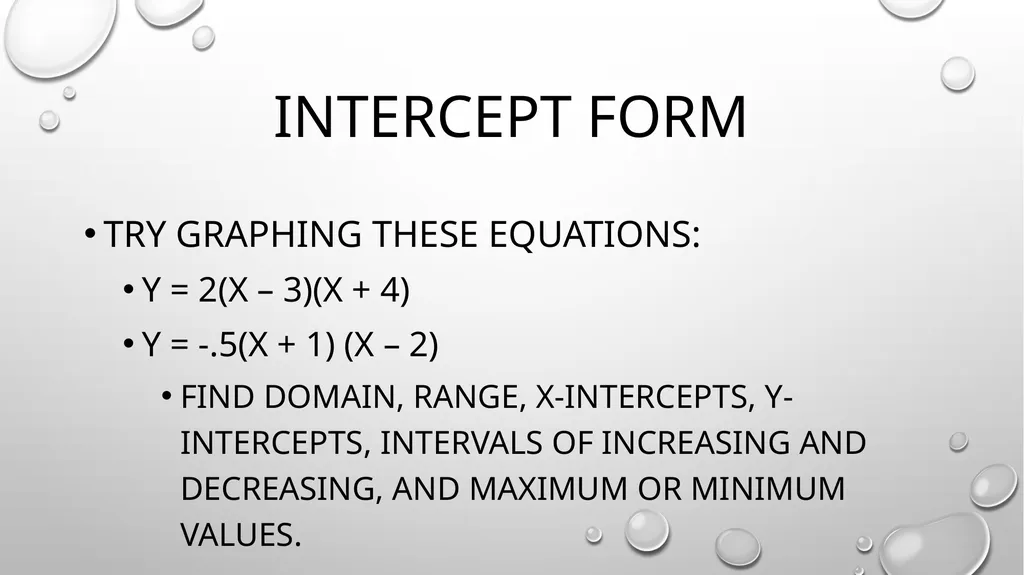
Intercept Form Try graphing these equations:
Y = 2(x – 3)(x + 4)
Y = -.5(x + 1) (x – 2)
Find Domain, range, x-intercepts, y-intercepts, intervals of increasing and decreasing, and maximum or minimum values.<br>
20
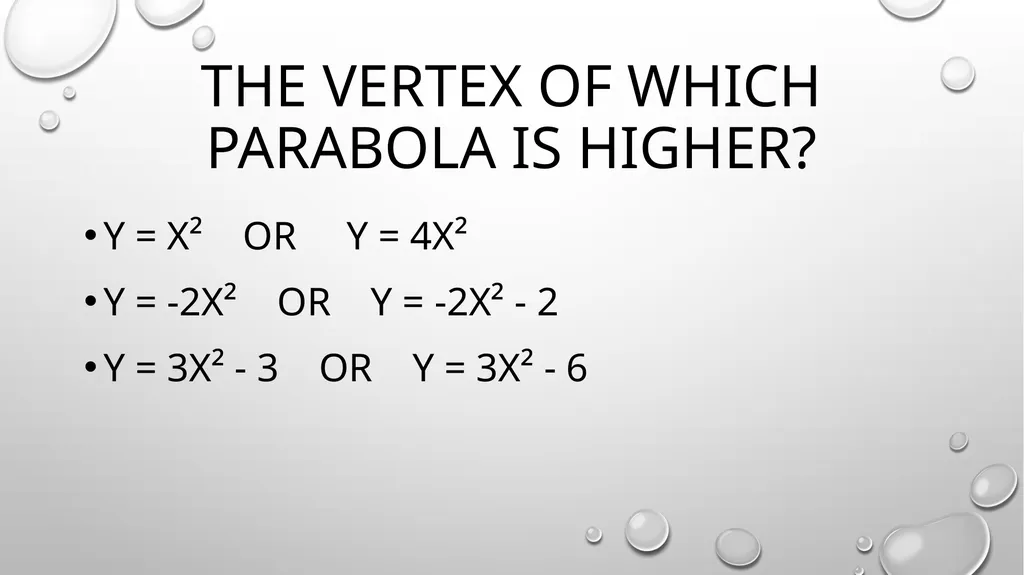
The vertex of which parabola is higher? Y = x² Or y = 4x²
Y = -2x² Or y = -2x² - 2
Y = 3x² - 3 or Y = 3x² - 6<br>
21
Solve quadratics in standard form�(Without calculator)<br>
22
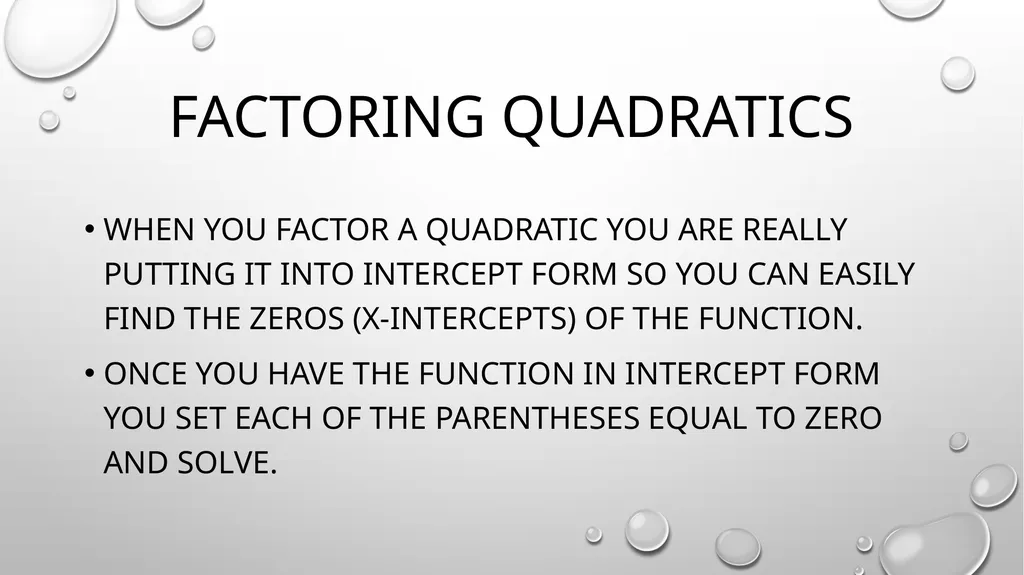
Factoring quadratics When you factor a quadratic you are really putting it into intercept form so you can easily find the zeros (x-intercepts) of the function.
Once you have the function in intercept form you set each of the parentheses equal to zero and solve.<br>
23
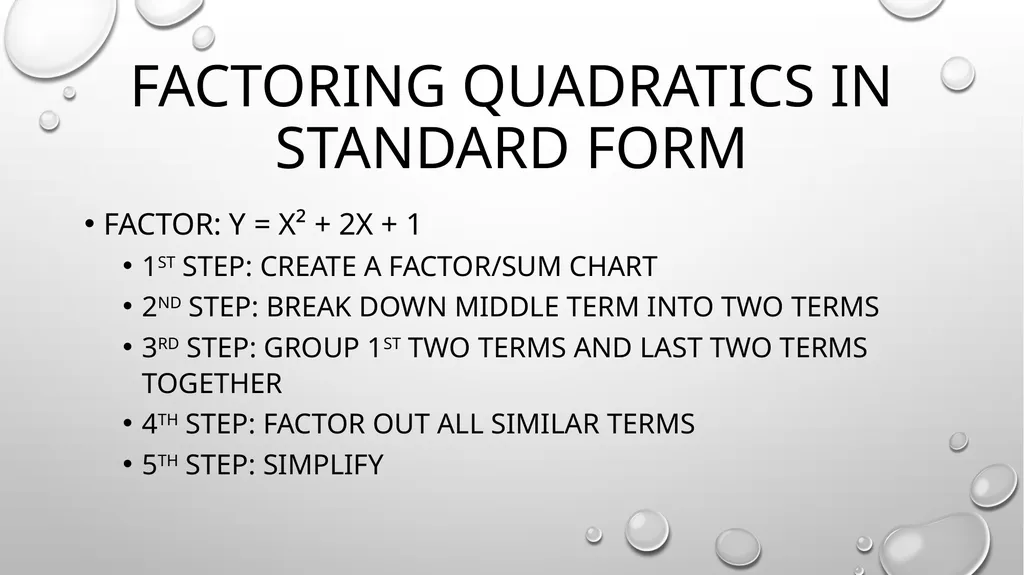
Factoring Quadratics in standard form Factor: y = x² + 2x + 1
1st step: Create a Factor/Sum chart
2nd Step: Break down middle term into two terms
3rd step: Group 1st two terms and last two terms together
4th step: Factor out all similar terms
5th step: sImplify<br>
24
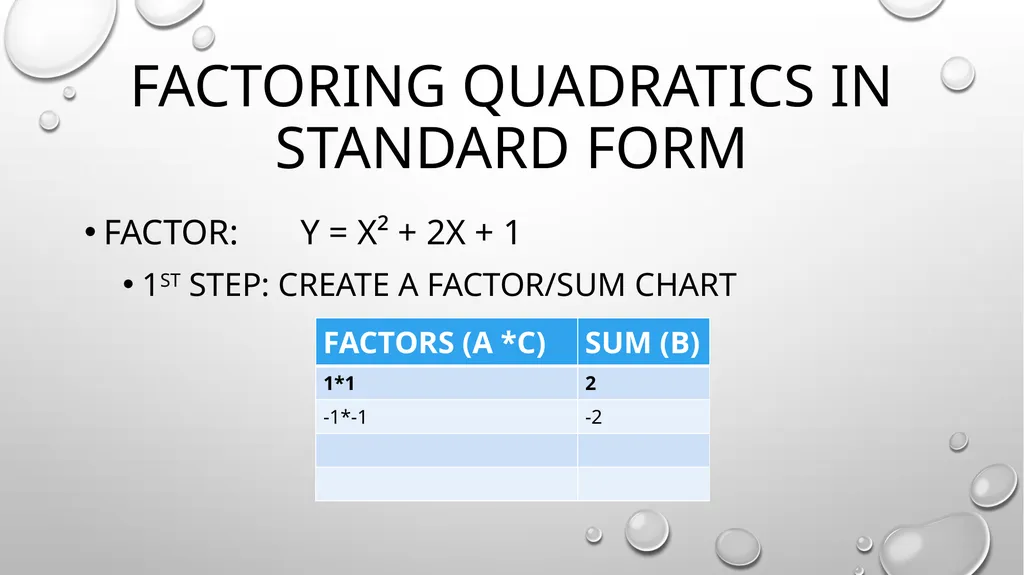
Factoring Quadratics in standard form Factor: y = x² + 2x + 1
1st step: Create a Factor/Sum chart<br>
25
Factoring Quadratics in standard form Factor: y = x² + 2x + 1
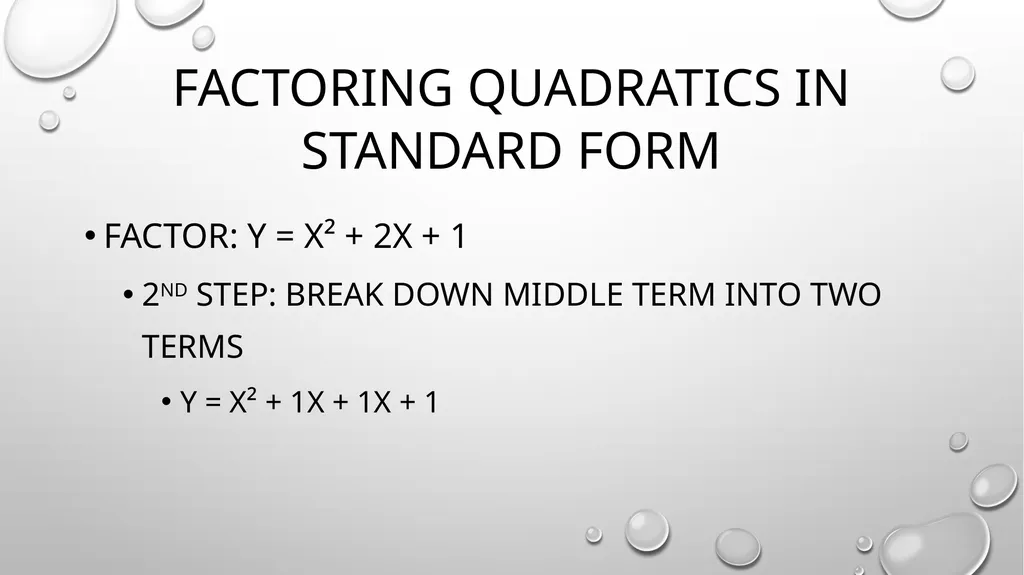
2nd Step: Break down middle term into two terms
Y = x² + 1x + 1x + 1<br>
26
Factoring Quadratics in standard form Factor: y = x² + 2x + 1
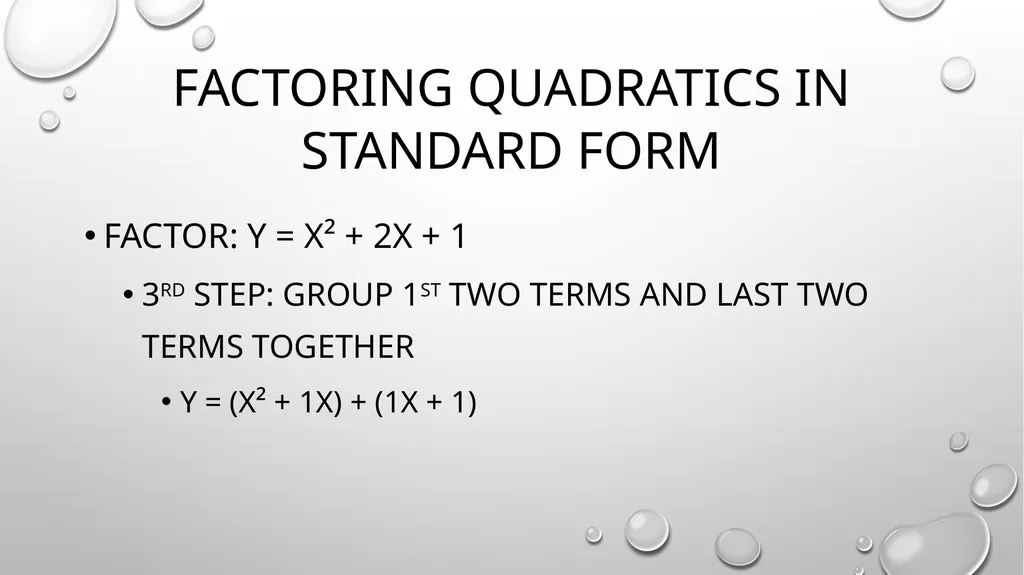
3rd step: Group 1st two terms and last two terms together
Y = (x² + 1x) + (1x + 1)<br>
27
Factoring Quadratics in standard form Factor: y = x² + 2x + 1
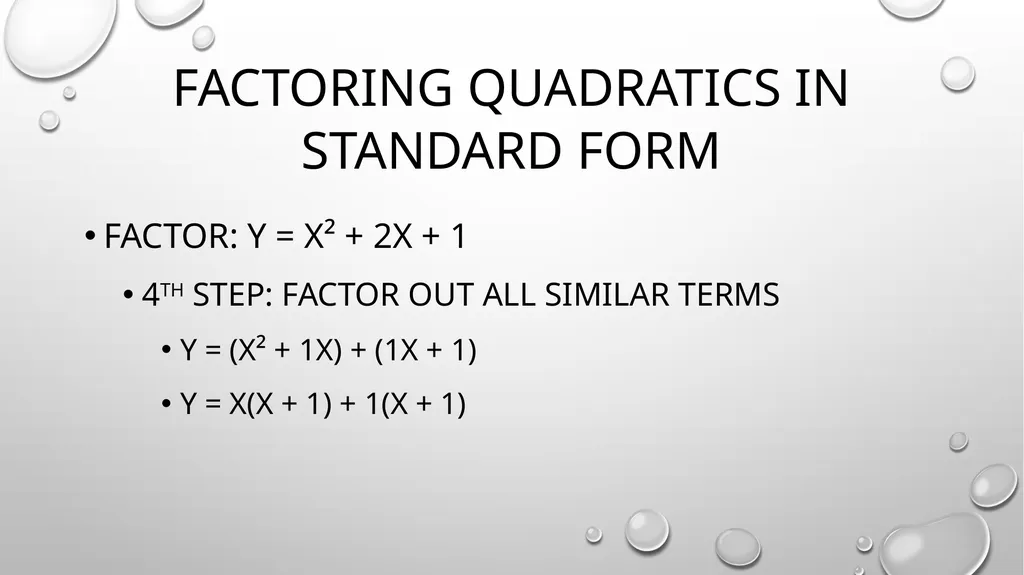
4th step: Factor out all similar terms
Y = (x² + 1x) + (1x + 1)
Y = x(x + 1) + 1(x + 1)<br>
28
Factoring Quadratics in standard form Factor: y = x² + 2x + 1
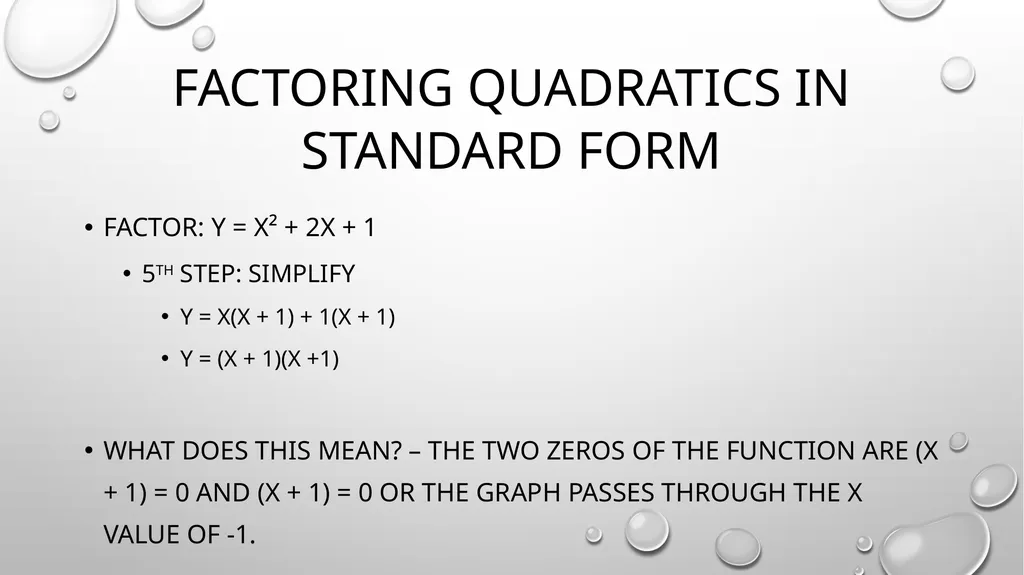
5th step: Simplify
Y = x(x + 1) + 1(x + 1)
Y = (X + 1)(x +1)
What does this mean? – the two zeros of the function are (x + 1) = 0 and (x + 1) = 0 or the graph passes through the x value of -1.<br>
29
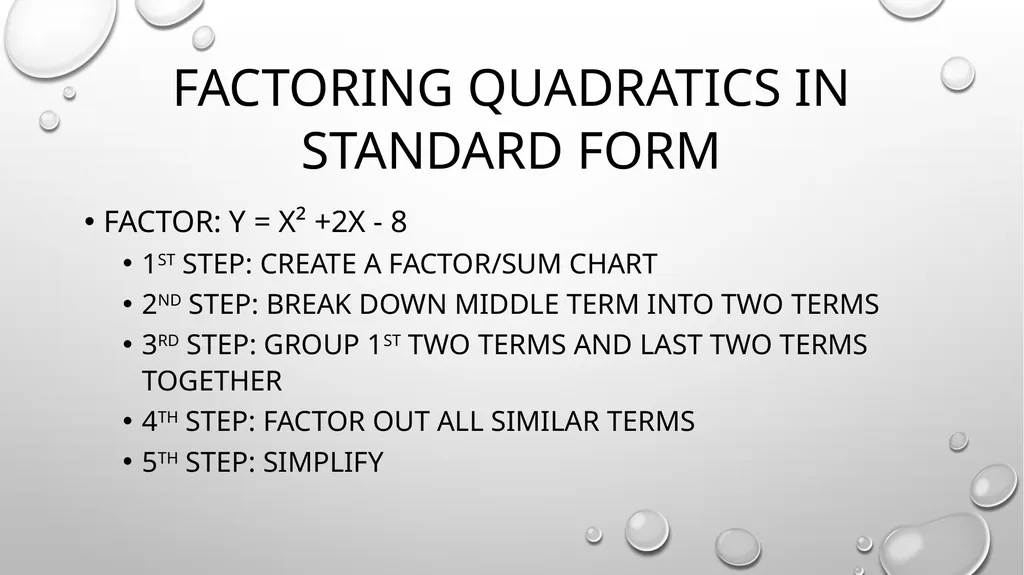
Factoring Quadratics in standard form Factor: y = x² +2x - 8
1st step: Create a Factor/Sum chart
2nd Step: Break down middle term into two terms
3rd step: Group 1st two terms and last two terms together
4th step: Factor out all similar terms
5th step: sImplify<br>
30
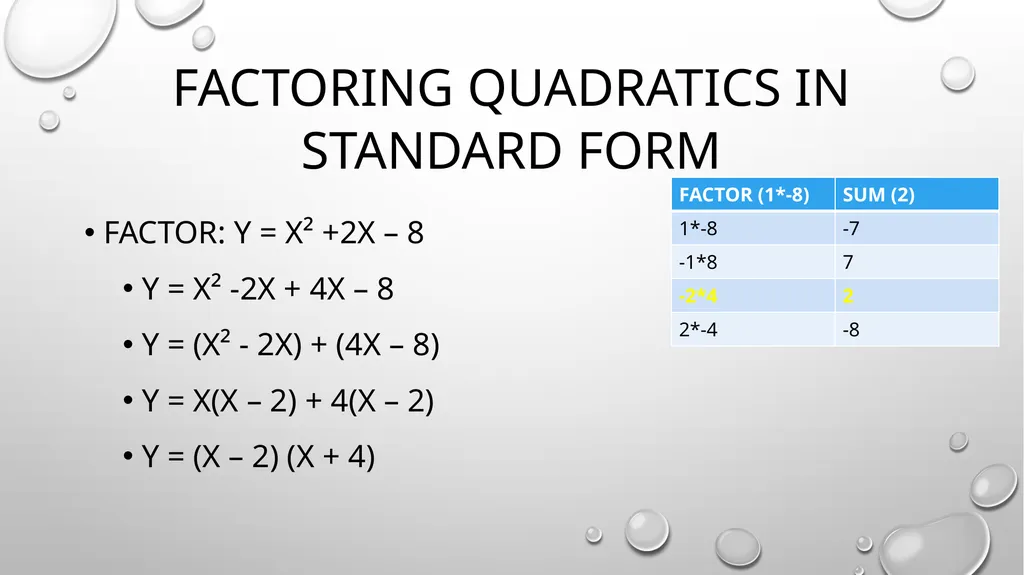
Factoring Quadratics in standard form Factor: y = x² +2x – 8
Y = x² -2x + 4x – 8
Y = (x² - 2x) + (4x – 8)
Y = x(x – 2) + 4(x – 2)
Y = (x – 2) (x + 4)<br>
31
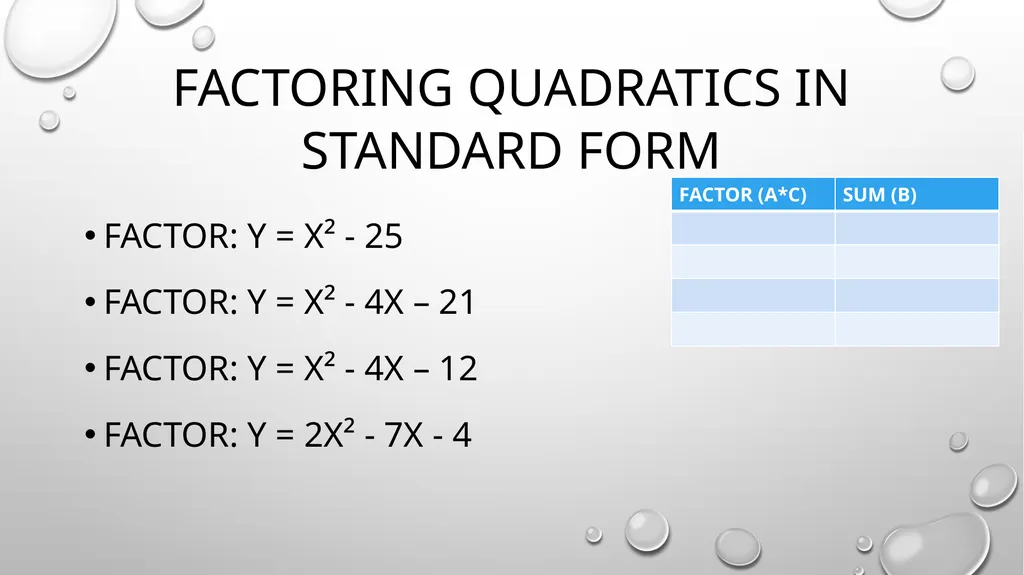
Factoring Quadratics in standard form Factor: y = x² - 25
Factor: y = x² - 4x – 21
Factor: Y = x² - 4x – 12
Factor: y = 2x² - 7x - 4<br>
32
Factoring Worksheet<br>
33
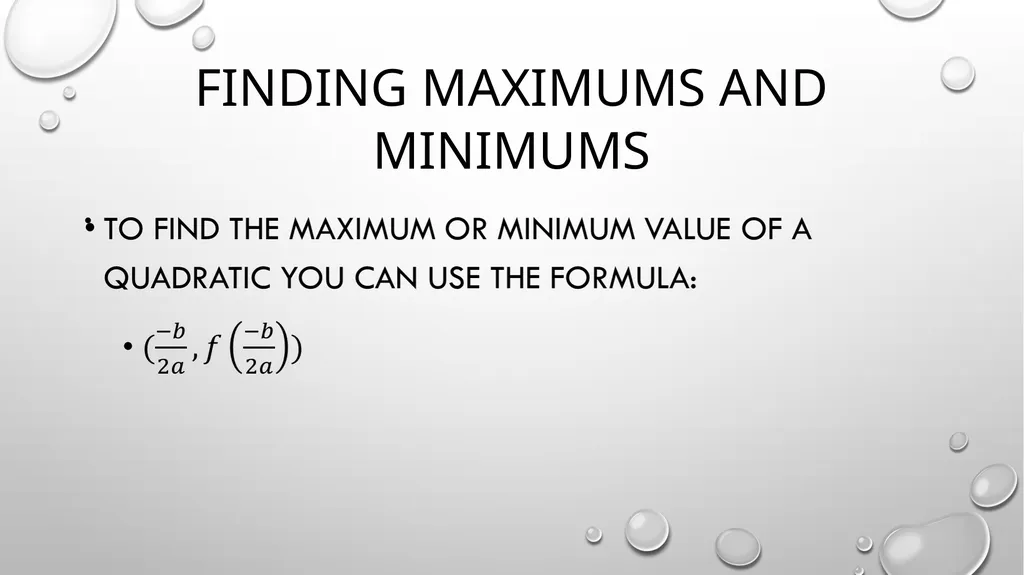
Finding Maximums and minimums<br>
35
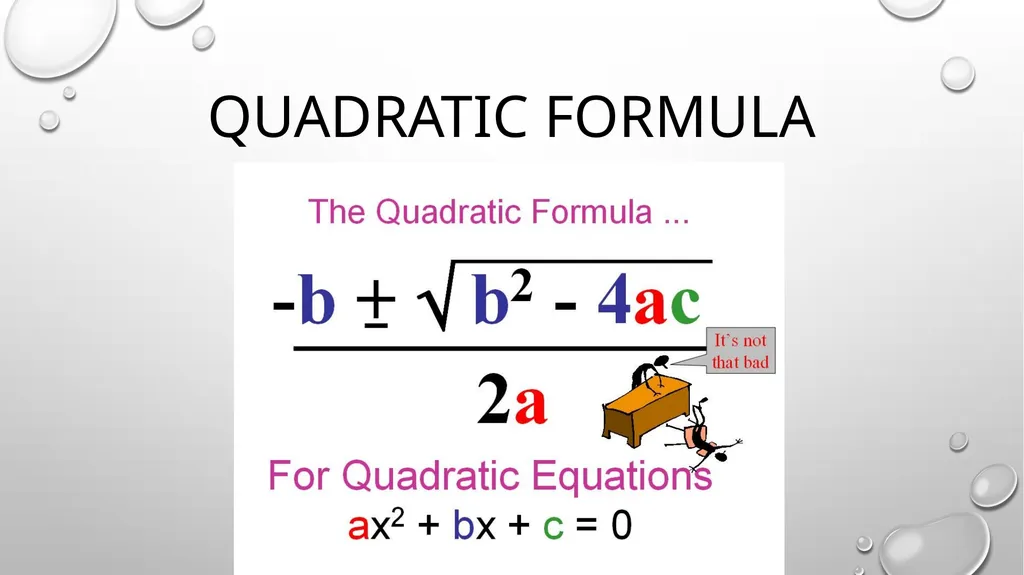
Quadratic Formula Also used to find the factors of a quadratic equation
When you use the quadratic formula the answers are the zero’s of the function. You then need to take the zero’s and put them into intercept form to re-write the equation.<br>
37
Quadratic Formula Song http://www.youtube.com/watch?v=O8ezDEk3qCg<br>
38
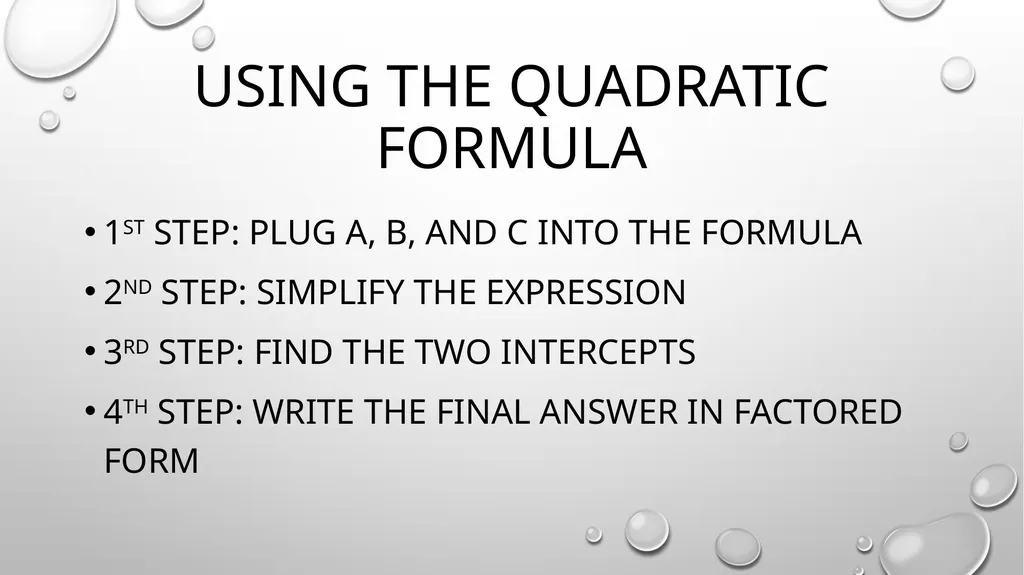
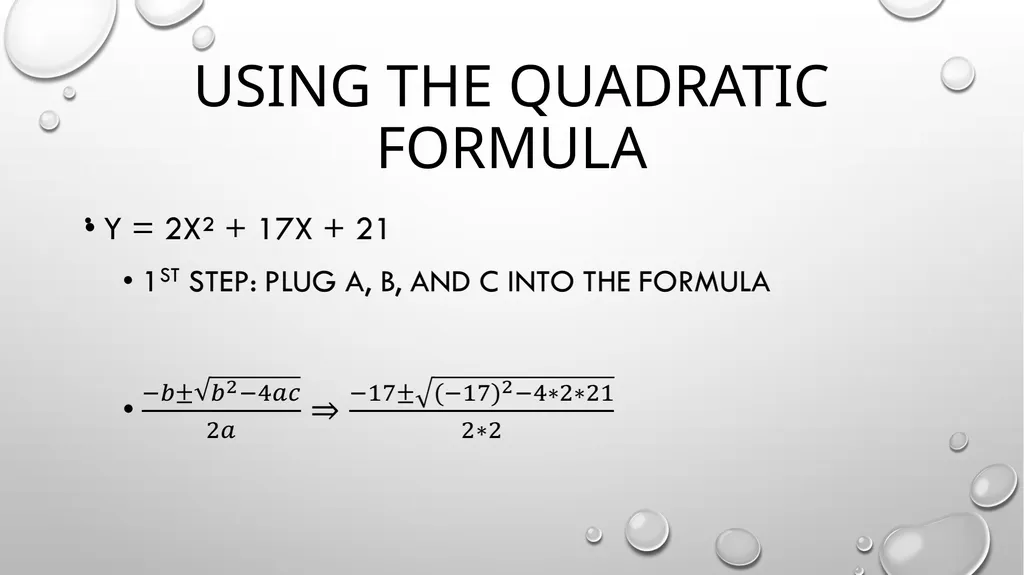
Using the quadratic Formula 1st Step: Plug A, B, and C into the formula
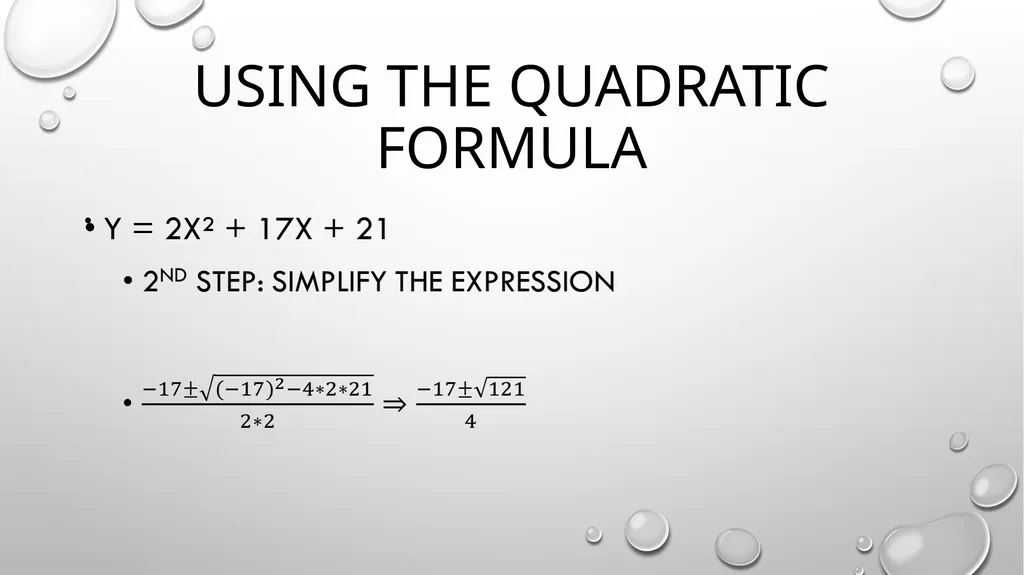
2nd Step: Simplify the expression
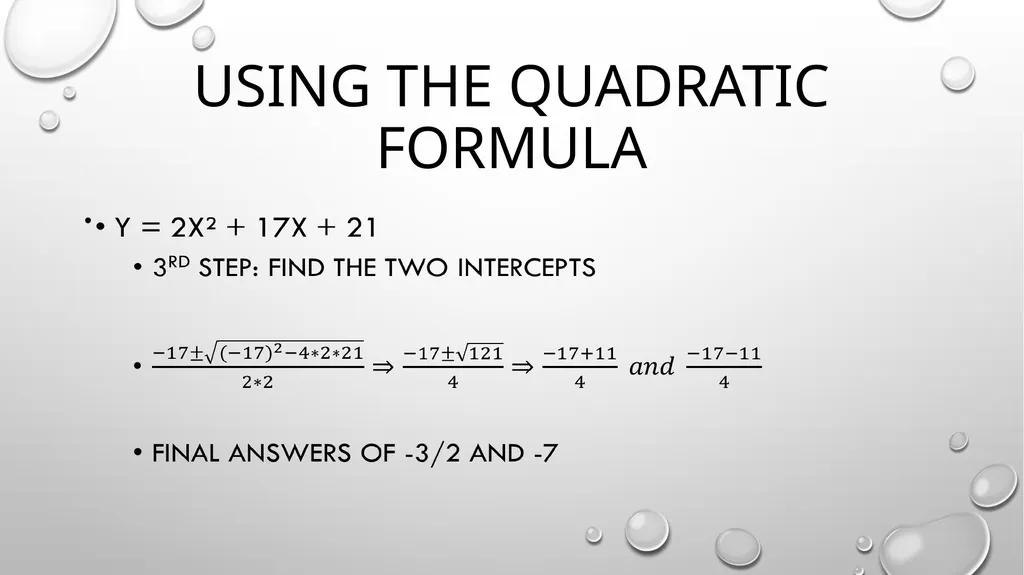
3rd Step: Find the two intercepts
4th Step: Write the final answer in factored form<br>
39
Using the quadratic Formula<br>
40
Using the quadratic Formula<br>
41
Using the quadratic Formula<br>
42
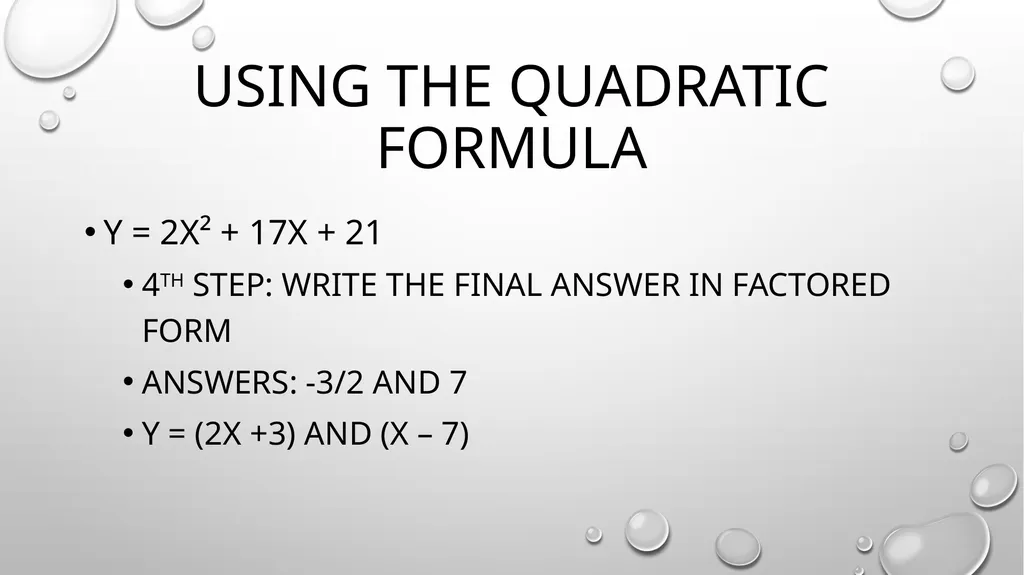
Using the quadratic Formula Y = 2x² + 17x + 21
4th Step: Write the final answer in factored form
Answers: -3/2 and 7
Y = (2x +3) and (x – 7)<br>
43
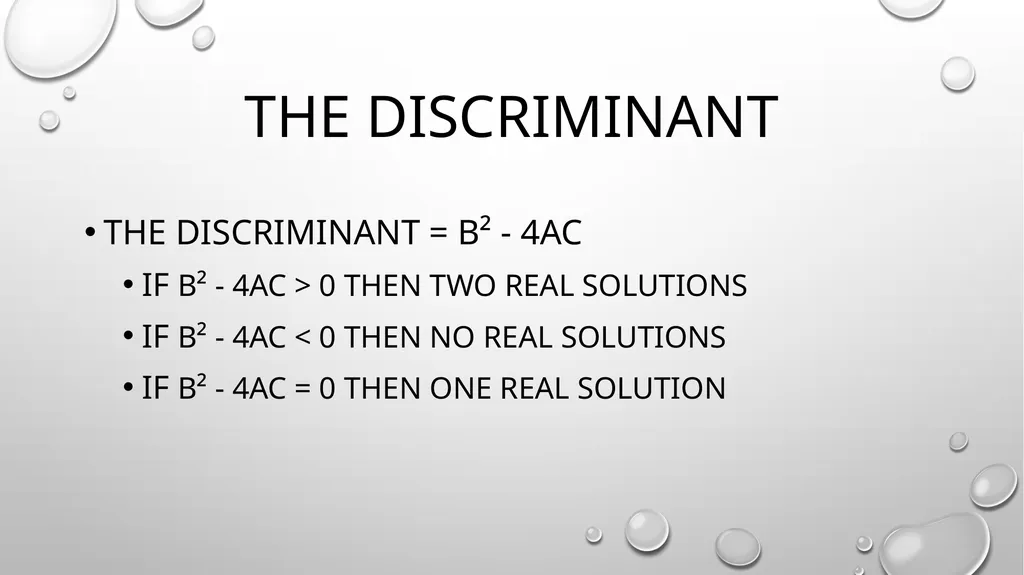
The Discriminant The discriminant = b² - 4ac
If b² - 4ac > 0 then two real solutions
IF b² - 4ac < 0 then no real solutions
If b² - 4ac = 0 then one real solution<br>
44
The discriminant Test:
Y = 2x² - 5x + 10
Y = -9x² + 12x – 4<br>
45
Importance of information�RECAP<br>
46
IF equation is in standard form When you factor you are writing it in intercept form
To find the zeros (X-intercepts) in intercept form, set each parentheses equal to zero and solve<br>
47
If equation is in intercept form To find the zeros (x- intercepts) set each parentheses equal to zero and solve
To find the y- intercept set x equal to zero and solve<br>
48
Quadratic formula The quadratic formula will give you the zeros (X- intercepts) of the function.
To write the equation in intercept form you need to change the sign of the zero and put it into the equation.– if a fraction put denominator with x and numerator by itself.<br>
49
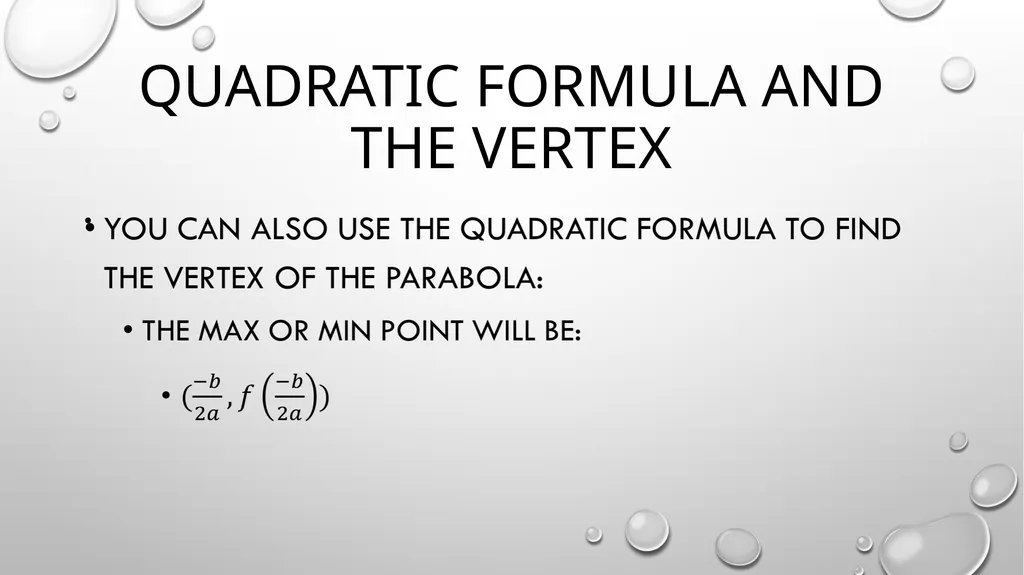
Quadratic formula and the vertex<br>
50
Applications of quadratics<br>
51
Overview of applications Throwing a ball
Height versus time function
Dropping anything
Profit versus cost
Maximization or minimization of something<br>
52
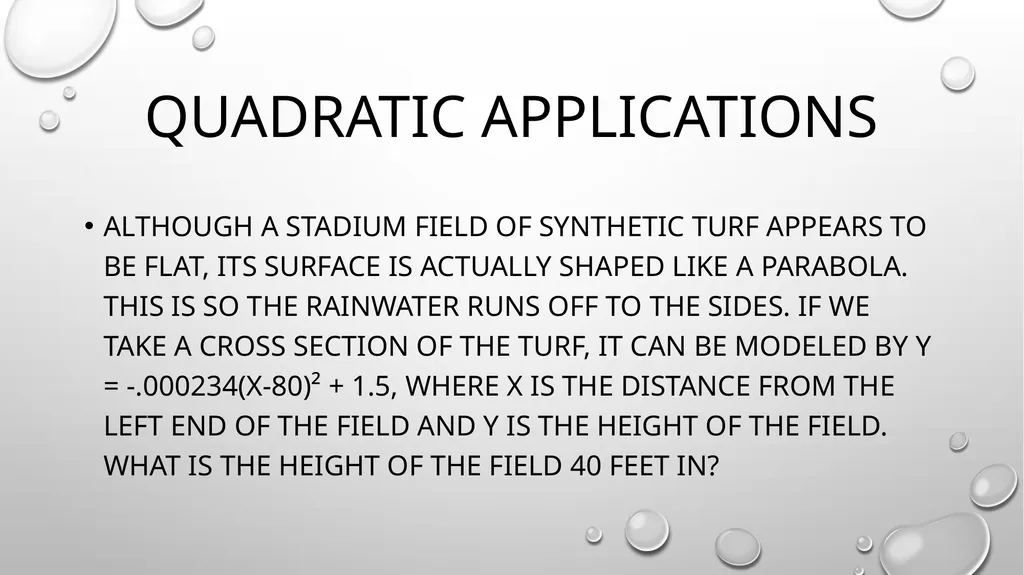
Quadratic applications Although a stadium field of synthetic turf appears to be flat, its surface is actually shaped like a parabola. This is so the rainwater runs off to the sides. If we take a cross section of the turf, it can be modeled by y = -.000234(x-80)² + 1.5, where x is the distance from the left end of the field and y is the height of the field. What is the height of the field 40 feet in?<br>
53
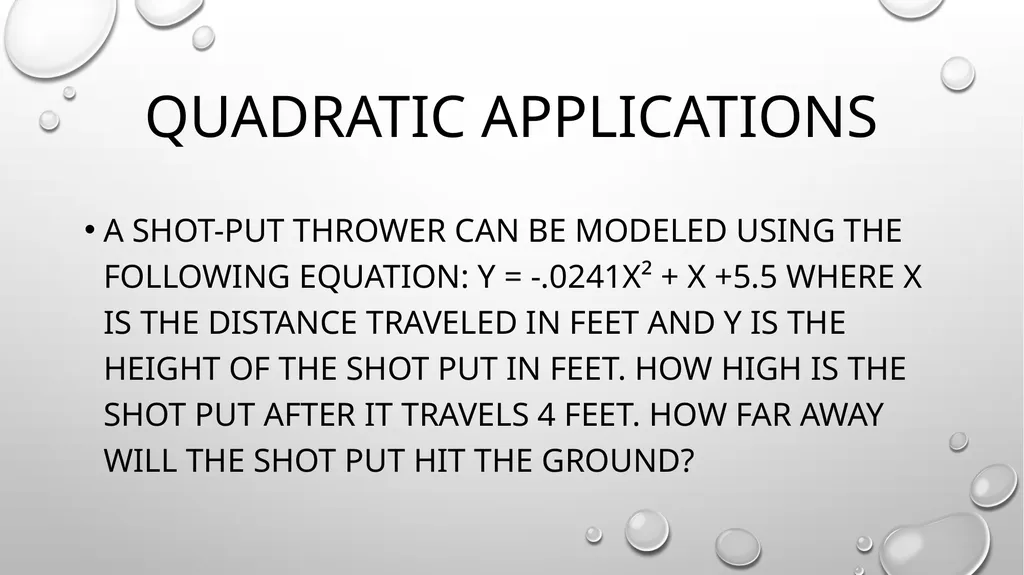
Quadratic applications A shot-put thrower can be modeled using the following equation: y = -.0241x² + x +5.5 where x is the distance traveled in feet and y is the height of the shot put in feet. How high is the shot put after it travels 4 feet. How far away will the shot put hit the ground?<br>
54
Quadratic Applications Marcus kicks a football in order to score a field goal. The height of the ball is given by the equation y = (-1/200)x² +x where y is the height of the football and x is the horizontal distance the ball travels. We want to know if he kicked the ball hard enough to go over the goal post which is 10 feet high.<br>