
Qualitative Research Approaches Training course in
LV
Published · 80 slides · 0 views

1 / 1











Description
Qualitative Research Approaches Training course in research methodology, research protocol development and scientific writing Geneva 2024 Dr Khalifa Elmusharaf MBBS, PgCert, PgDip, FRSPH, FFPH, MRSTMH, IPMAC, PhD Associate Professor in
Related Topics
Share
Embed code
Download this presentation From Below
"Qualitative Research Approaches Training course in" is the property of its rightful owner. Permission is granted to download and print the materials on this website for personal, non-commercial use only, and to display it on your personal computer provided you do not modify the materials and that you retain all copyright notices contained in the materials. By downloading content from our website, you accept the terms of this agreement.
Presentation Transcript
01
Qualitative
Research Approaches Training course in research methodology, research protocol development and scientific writing
Geneva 2024 Dr Khalifa Elmusharaf MBBS, PgCert, PgDip, FRSPH, FFPH, MRSTMH, IPMA®C, PhD Associate Professor in Public Health
Director of Public Health Programme
University of Birmingham Dubai, United Arab Emirates<br>
Geneva 2024 Dr Khalifa Elmusharaf MBBS, PgCert, PgDip, FRSPH, FFPH, MRSTMH, IPMA®C, PhD Associate Professor in Public Health
Director of Public Health Programme
University of Birmingham Dubai, United Arab Emirates<br>
02
Objective of Presentation By the end of this presentation, you should be able to:
Describe the common qualitative research approaches.
Demonstrate how and when to conduct different types of qualitative research.
Understand that focus group discussion and interview are not qualitative research methods or designs. They are just tools for data collection.<br>
Describe the common qualitative research approaches.
Demonstrate how and when to conduct different types of qualitative research.
Understand that focus group discussion and interview are not qualitative research methods or designs. They are just tools for data collection.<br>
03
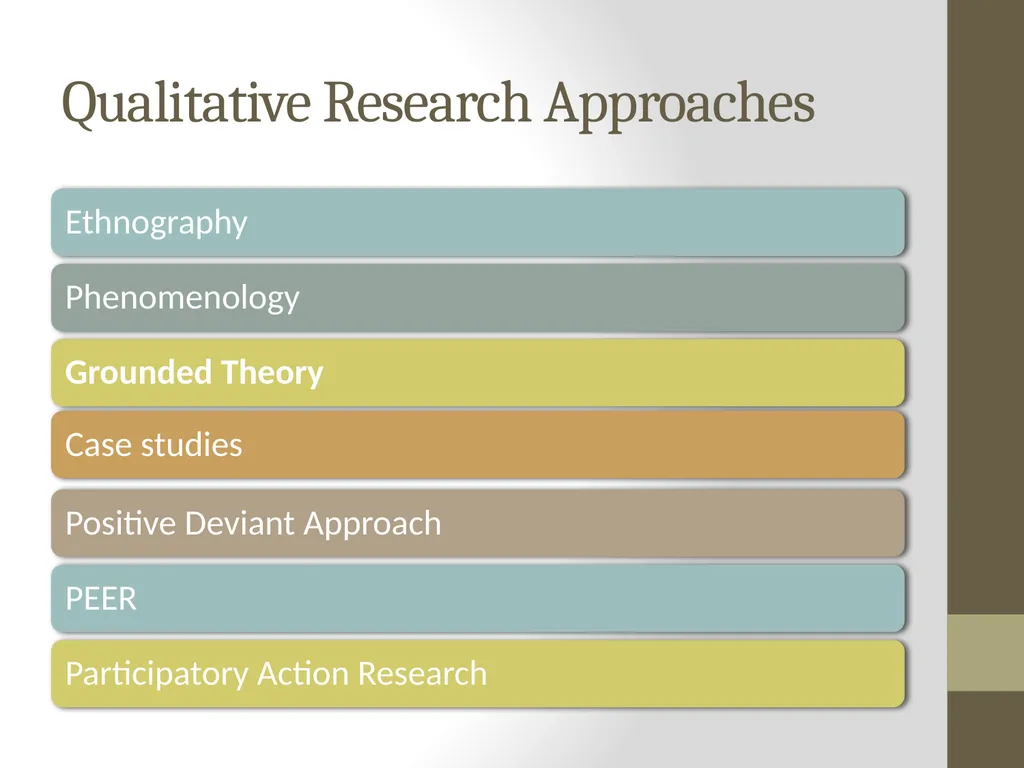
Introduction The term qualitative research is very general and includes a range of methods and designs (Boyd, 2001).
What these methods all have in common is that they approach research questions holistically and with a focus on human experience and the ways that people create meaning in their lives.<br>
What these methods all have in common is that they approach research questions holistically and with a focus on human experience and the ways that people create meaning in their lives.<br>
04
Introduction cont’d This presentation is not meant to cover all qualitative research approaches in details, but just to give an idea about different designs that are commonly used.
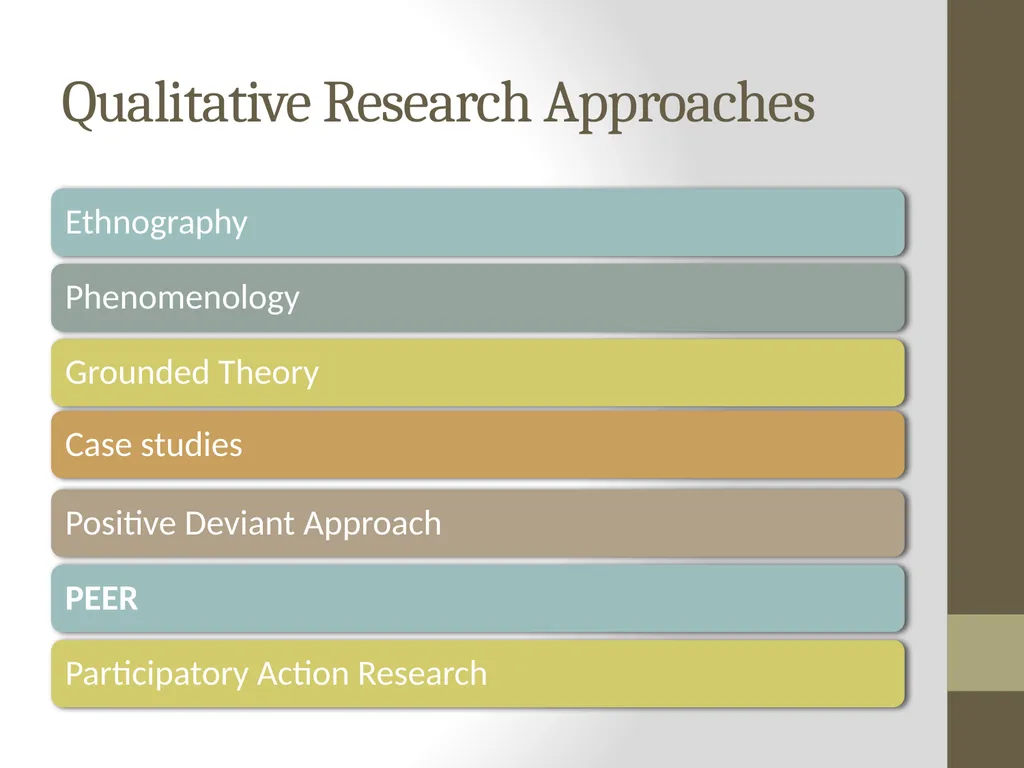
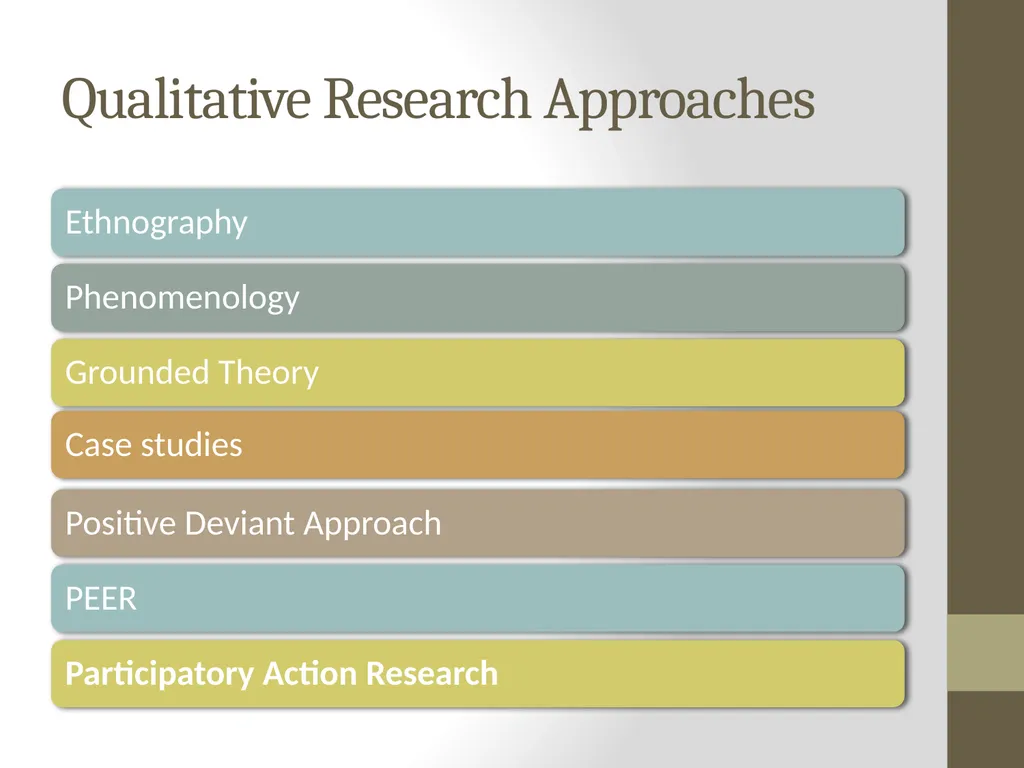
In this presentation we are going to focus on seven common approaches.<br>
In this presentation we are going to focus on seven common approaches.<br>
05
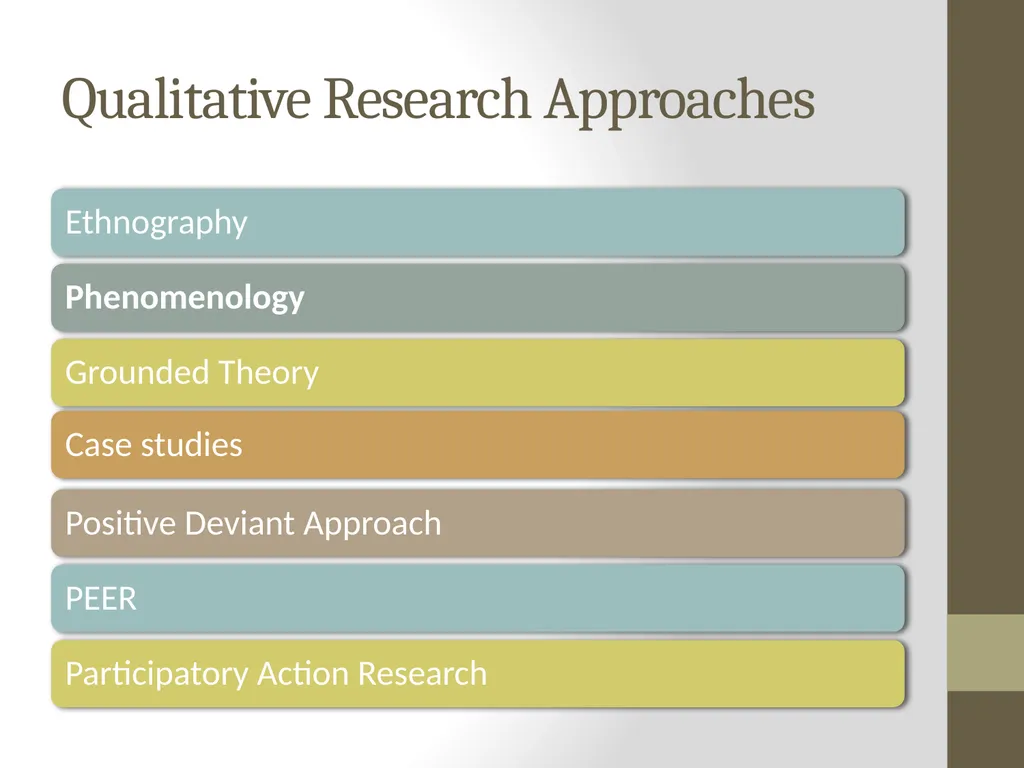
Self-assessment Look at the next three research projects:
What are the most appropriate qualitative methodological approaches to investigate their research questions?
This is a self-assessment and brainstorming exercise.
This is NOT an assignment.<br>
What are the most appropriate qualitative methodological approaches to investigate their research questions?
This is a self-assessment and brainstorming exercise.
This is NOT an assignment.<br>
06
Research 1 A survey conducted in a village in Sudan has revealed a high prevalence (70%) of Female Genital Mutilation (FGM).
You are requested to conduct a qualitative study using more than one methodological approach to look into:
Beliefs, cultures and in depth understanding regarding the practice of FGM.<br>
You are requested to conduct a qualitative study using more than one methodological approach to look into:
Beliefs, cultures and in depth understanding regarding the practice of FGM.<br>
07
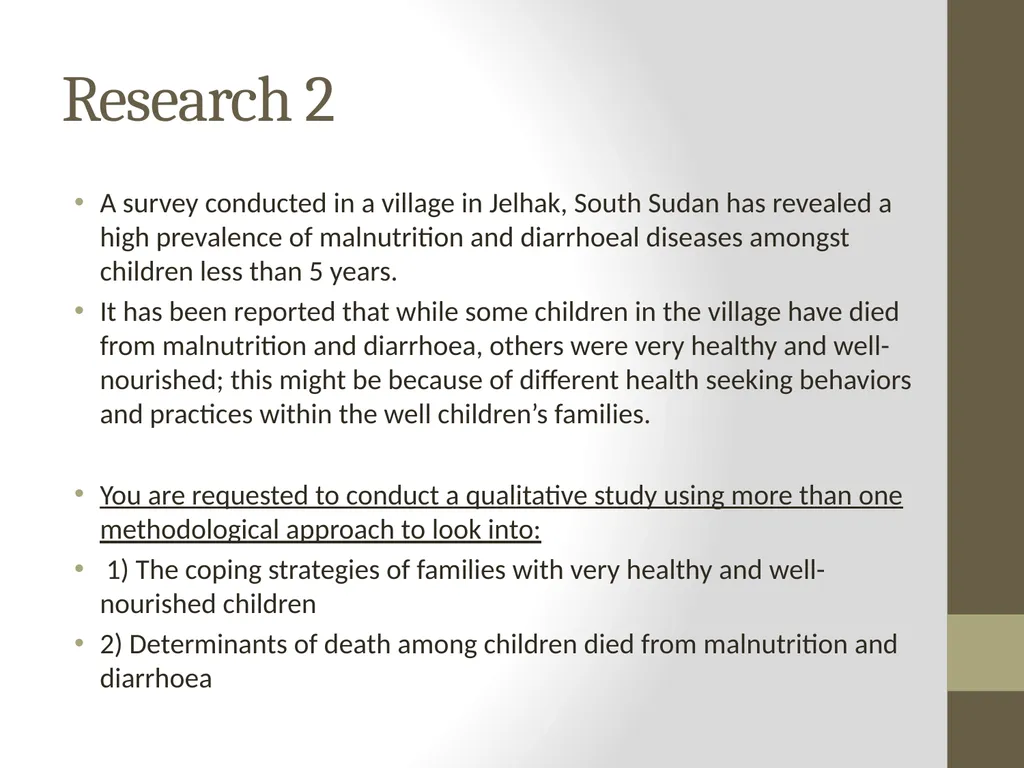
Research 2 A survey conducted in a village in Jelhak, South Sudan has revealed a high prevalence of malnutrition and diarrhoeal diseases amongst children less than 5 years.
It has been reported that while some children in the village have died from malnutrition and diarrhoea, others were very healthy and well-nourished; this might be because of different health seeking behaviors and practices within the well children’s families.
You are requested to conduct a qualitative study using more than one methodological approach to look into:
1) The coping strategies of families with very healthy and well-nourished children
2) Determinants of death among children died from malnutrition and diarrhoea<br>
It has been reported that while some children in the village have died from malnutrition and diarrhoea, others were very healthy and well-nourished; this might be because of different health seeking behaviors and practices within the well children’s families.
You are requested to conduct a qualitative study using more than one methodological approach to look into:
1) The coping strategies of families with very healthy and well-nourished children
2) Determinants of death among children died from malnutrition and diarrhoea<br>
08
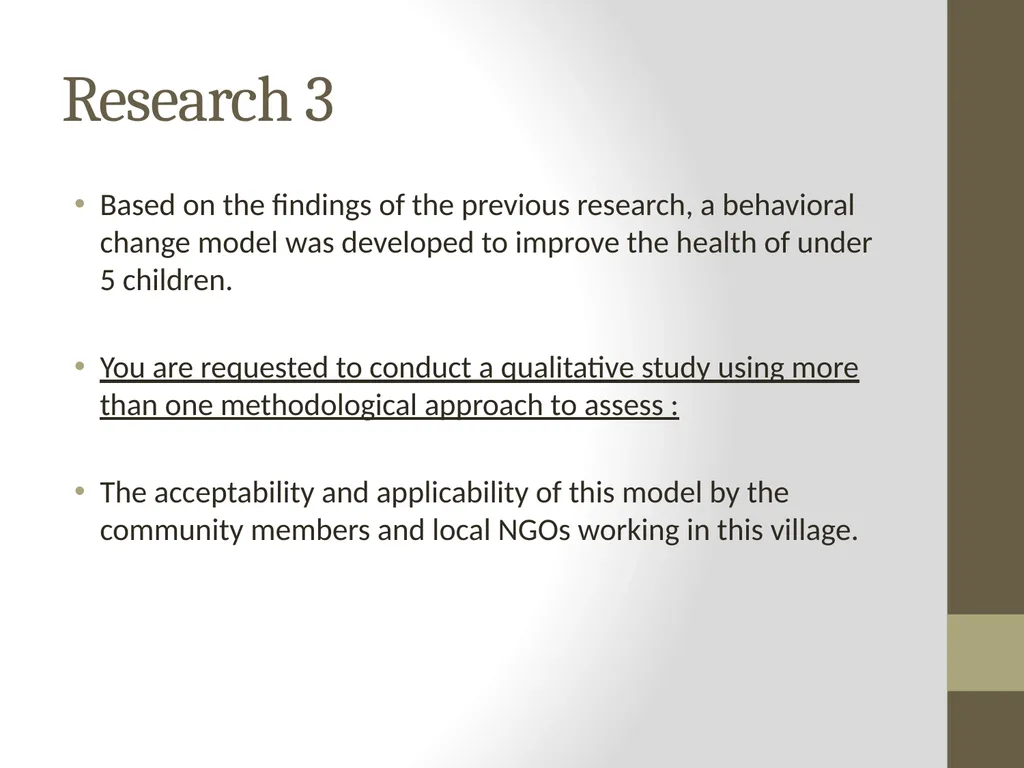
Research 3 Based on the findings of the previous research, a behavioral change model was developed to improve the health of under 5 children.
You are requested to conduct a qualitative study using more than one methodological approach to assess :
The acceptability and applicability of this model by the community members and local NGOs working in this village.<br>
You are requested to conduct a qualitative study using more than one methodological approach to assess :
The acceptability and applicability of this model by the community members and local NGOs working in this village.<br>
09
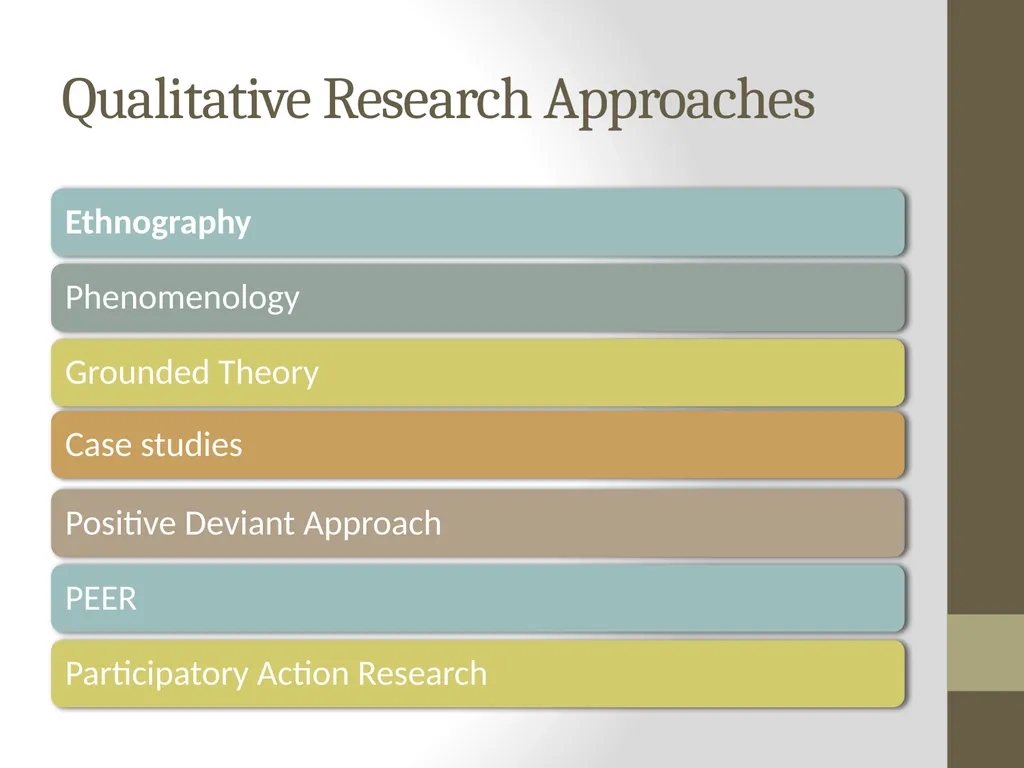
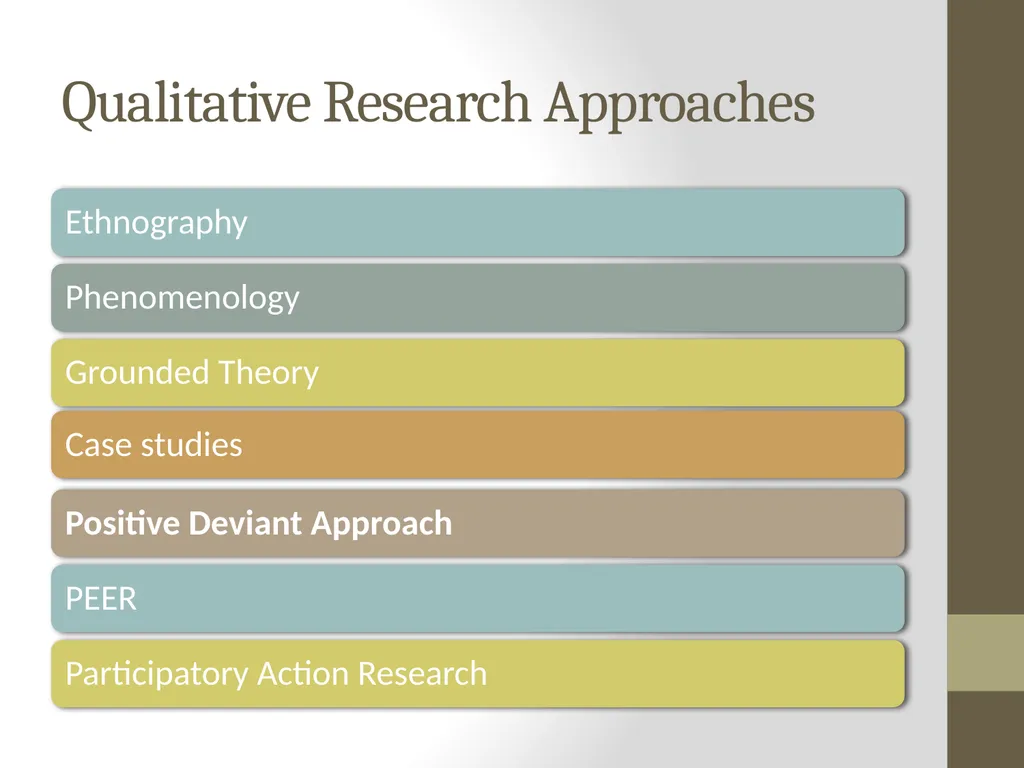
Qualitative Research Approaches<br>
10
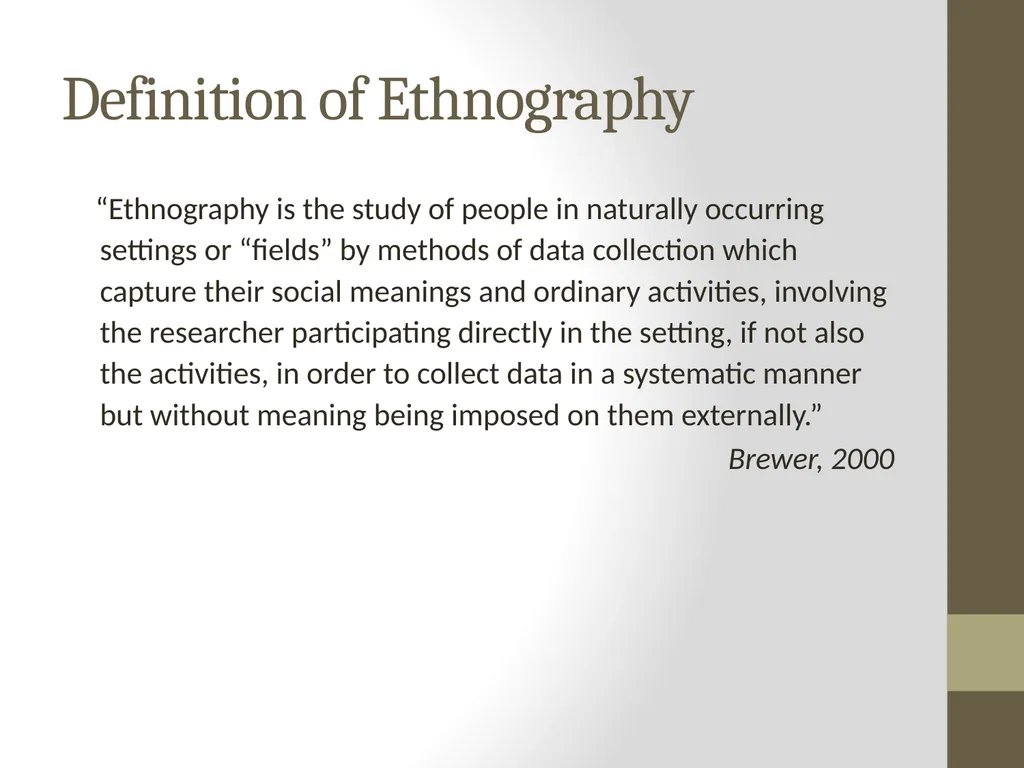
Definition of Ethnography “Ethnography is the study of people in naturally occurring settings or “fields” by methods of data collection which capture their social meanings and ordinary activities, involving the researcher participating directly in the setting, if not also the activities, in order to collect data in a systematic manner but without meaning being imposed on them externally.”
Brewer, 2000<br>
Brewer, 2000<br>
11
Other Definitions “ In its most characteristic form, it involves the ethnographer participating, overtly or covertly, in people’s lives for an extended period of time, watching what happens, listening to what is said, asking questions. In fact, collecting whatever data are available to throw light on the issues that are the focus of the research.”
Hammersley and Atkinson, 1995
“ A descriptive account of social life and culture in a particular social system based on detailed observations of what people actually do”.
Johnson 2000<br>
Hammersley and Atkinson, 1995
“ A descriptive account of social life and culture in a particular social system based on detailed observations of what people actually do”.
Johnson 2000<br>
12
Other Definitions cont’d Ethnography is a well-known form of qualitative research that focuses on the question: “What is the culture of a group of people?”
The term Ethnography means “portrait of a people” and it is a methodology for descriptive studies of cultures and peoples.<br>
The term Ethnography means “portrait of a people” and it is a methodology for descriptive studies of cultures and peoples.<br>
13
Importance of Ethnography in Health In health care settings, researchers may choose an ethnographic approach because the cultural parameter is suspected of affecting the population’s response to care or treatment.
For example, cultural rules about contact between males and females may contribute to reluctance of women from an Asian subgroup to take up cervical screening.<br>
For example, cultural rules about contact between males and females may contribute to reluctance of women from an Asian subgroup to take up cervical screening.<br>
14
Importance of Ethnography in Health cont’d Ethnography helps health care professionals to develop cultural awareness and sensitivity and enhances the provision and quality of care for people from all cultures.
Helps health professionals to contextualise the behaviour, beliefs and feeling of their clients or colleagues.
Health professionals become culturally sensitive and can identify the cultural influences on the individual and groups.<br>
Helps health professionals to contextualise the behaviour, beliefs and feeling of their clients or colleagues.
Health professionals become culturally sensitive and can identify the cultural influences on the individual and groups.<br>
15
Appropriate Methods Ethnographic studies entail spending extensive and long periods of time in the field by the researcher.
Data collection techniques include both formal and informal interviewing, often interviewing individuals on several occasions, and participant observation.<br>
Data collection techniques include both formal and informal interviewing, often interviewing individuals on several occasions, and participant observation.<br>
16
Ethnography Example A qualitative ethnographic study was conducted to explore the process and outcomes of a program of occupation for seniors with dementia.
Data from observations, interviews with patients and staff, and field notes were analyzed to discover the opportunities and barriers to conducting an occupational program in a day hospital unit.
(Borell, Gustavsson, Sandman & Kielhofner, 1994)<br>
Data from observations, interviews with patients and staff, and field notes were analyzed to discover the opportunities and barriers to conducting an occupational program in a day hospital unit.
(Borell, Gustavsson, Sandman & Kielhofner, 1994)<br>
17
Qualitative Research Approaches<br>
18
What is Phenomenology? Phenomenology is an approach to philosophy and method of inquiry aim to generate an exhaustive description of phenomenon of everyday experience to achieve an understanding more than description and is based on interpretation.<br>
19
Phenomenology answers the question: “What is it like to have a certain experience?”
It seeks to understand the phenomenon of a lived experience - this may be related to an emotion, such as loneliness or depression, to a relationship, or to being part of an organization or group. What is Phenomenology? Cont’d<br>
It seeks to understand the phenomenon of a lived experience - this may be related to an emotion, such as loneliness or depression, to a relationship, or to being part of an organization or group. What is Phenomenology? Cont’d<br>
20
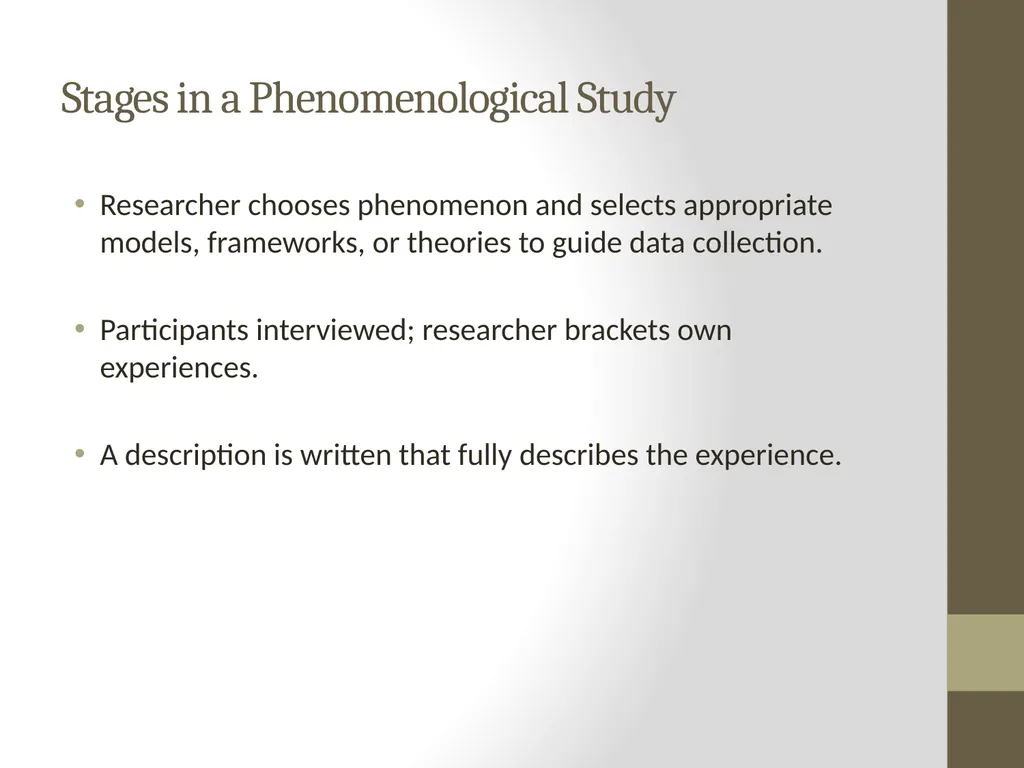
Stages in a Phenomenological Study Researcher chooses phenomenon and selects appropriate models, frameworks, or theories to guide data collection.
Participants interviewed; researcher brackets own experiences.
A description is written that fully describes the experience.<br>
Participants interviewed; researcher brackets own experiences.
A description is written that fully describes the experience.<br>
21
Descriptions of the participants’ experiences (possibly including researcher) are reduced to themes.
These themes are reduced to a statement that summarizes the essential meaning.
Researcher returns to participants to check validity of analysis. Stages in a Phenomenological Study cont’d<br>
These themes are reduced to a statement that summarizes the essential meaning.
Researcher returns to participants to check validity of analysis. Stages in a Phenomenological Study cont’d<br>
22
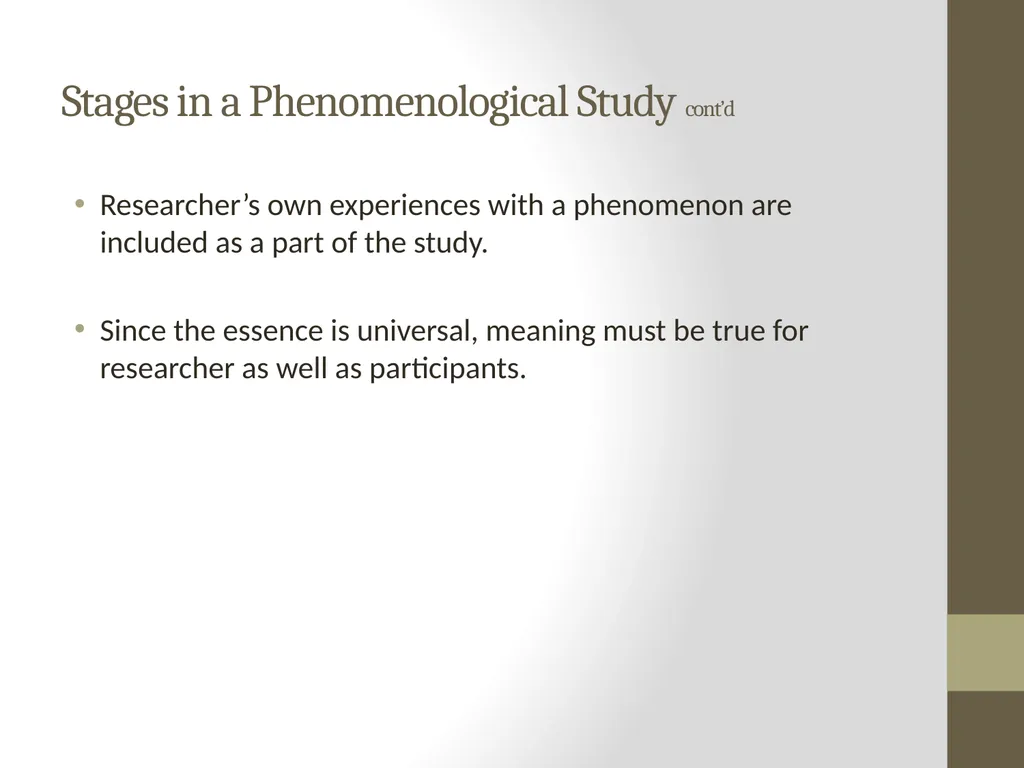
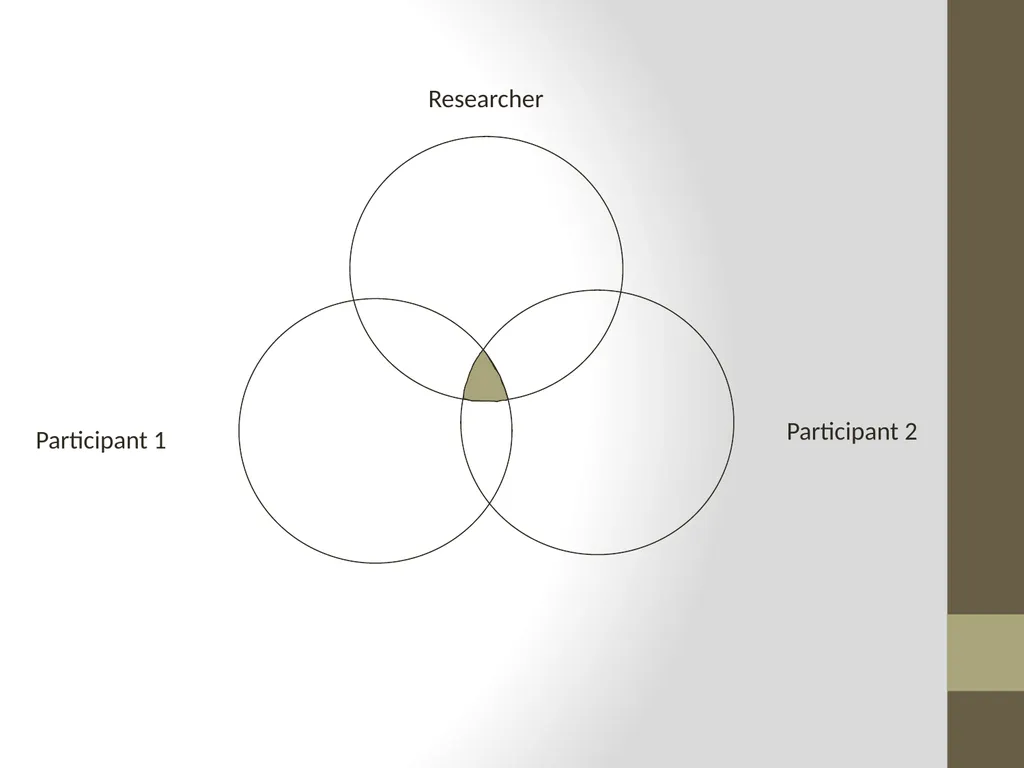
Researcher’s own experiences with a phenomenon are included as a part of the study.
Since the essence is universal, meaning must be true for researcher as well as participants. Stages in a Phenomenological Study cont’d<br>
Since the essence is universal, meaning must be true for researcher as well as participants. Stages in a Phenomenological Study cont’d<br>
23
Researcher Participant 1 Participant 2<br>
24
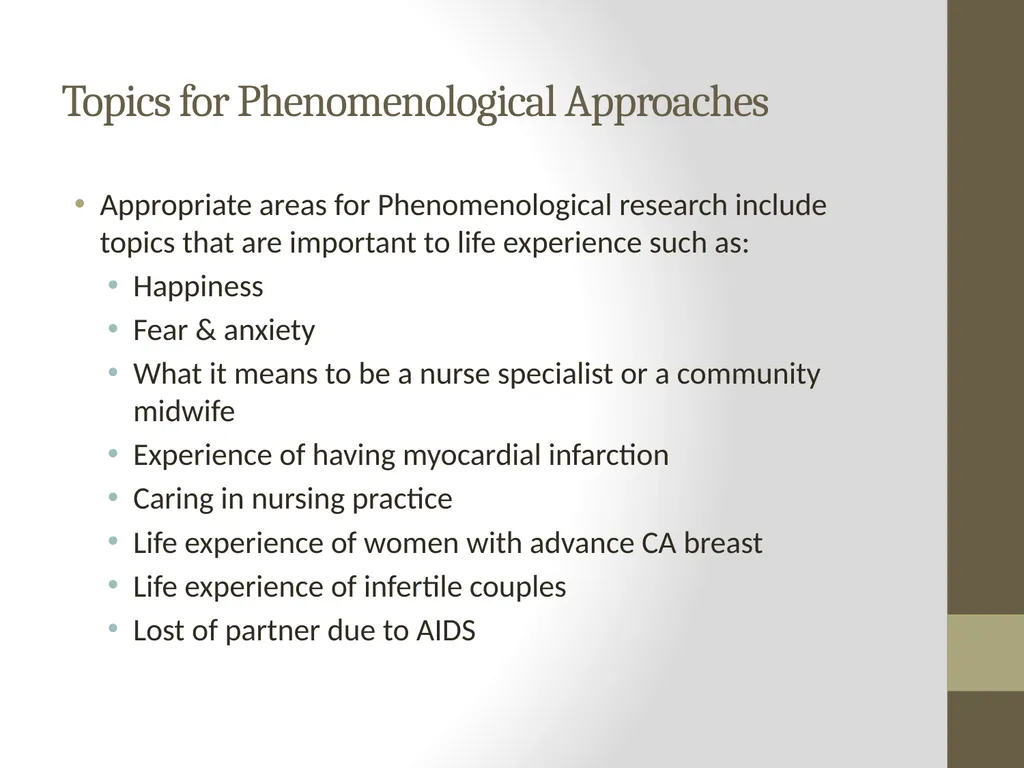
Topics for Phenomenological Approaches Appropriate areas for Phenomenological research include topics that are important to life experience such as:
Happiness
Fear & anxiety
What it means to be a nurse specialist or a community midwife
Experience of having myocardial infarction
Caring in nursing practice
Life experience of women with advance CA breast
Life experience of infertile couples
Lost of partner due to AIDS<br>
Happiness
Fear & anxiety
What it means to be a nurse specialist or a community midwife
Experience of having myocardial infarction
Caring in nursing practice
Life experience of women with advance CA breast
Life experience of infertile couples
Lost of partner due to AIDS<br>
25
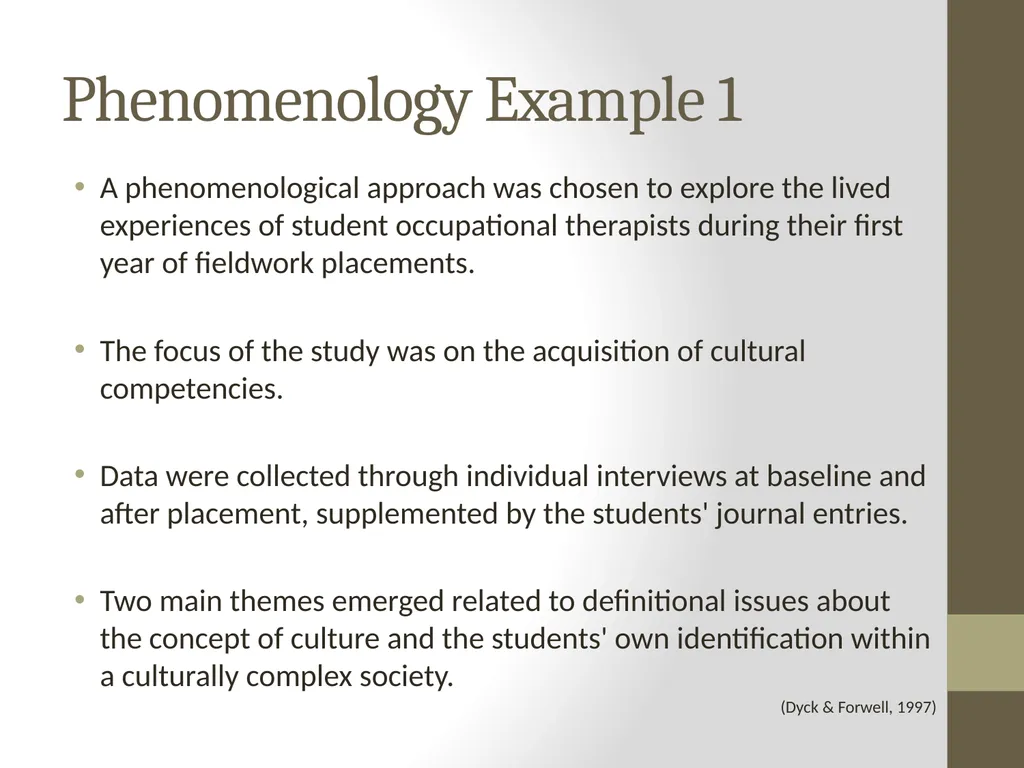
Phenomenology Example 1 A phenomenological approach was chosen to explore the lived experiences of student occupational therapists during their first year of fieldwork placements.
The focus of the study was on the acquisition of cultural competencies.
Data were collected through individual interviews at baseline and after placement, supplemented by the students' journal entries.
Two main themes emerged related to definitional issues about the concept of culture and the students' own identification within a culturally complex society.
(Dyck & Forwell, 1997)<br>
The focus of the study was on the acquisition of cultural competencies.
Data were collected through individual interviews at baseline and after placement, supplemented by the students' journal entries.
Two main themes emerged related to definitional issues about the concept of culture and the students' own identification within a culturally complex society.
(Dyck & Forwell, 1997)<br>
26
Phenomenology Example 2 Back pain is another example. Correlation studies may tell us about the types of people who experience back pain and the apparent causes. Randomised controlled trials of drugs compare the effectiveness of one analgesia against another.
But what is it actually like to live with back pain? What are the effects on peoples’ lives? What problems does it cause?<br>
But what is it actually like to live with back pain? What are the effects on peoples’ lives? What problems does it cause?<br>
27
Phenomenology Example 2 cont’d A phenomenological study might explore, for example, the effect that back pain has on sufferers’ relationships with other people by describing the strain it can cause in marriages or the effect on children of having a disabled parent.
Phenomenological research will not necessarily provide definitive explanations, but it does raise awareness and increases insight<br>
Phenomenological research will not necessarily provide definitive explanations, but it does raise awareness and increases insight<br>
28
Qualitative Research Approaches<br>
29
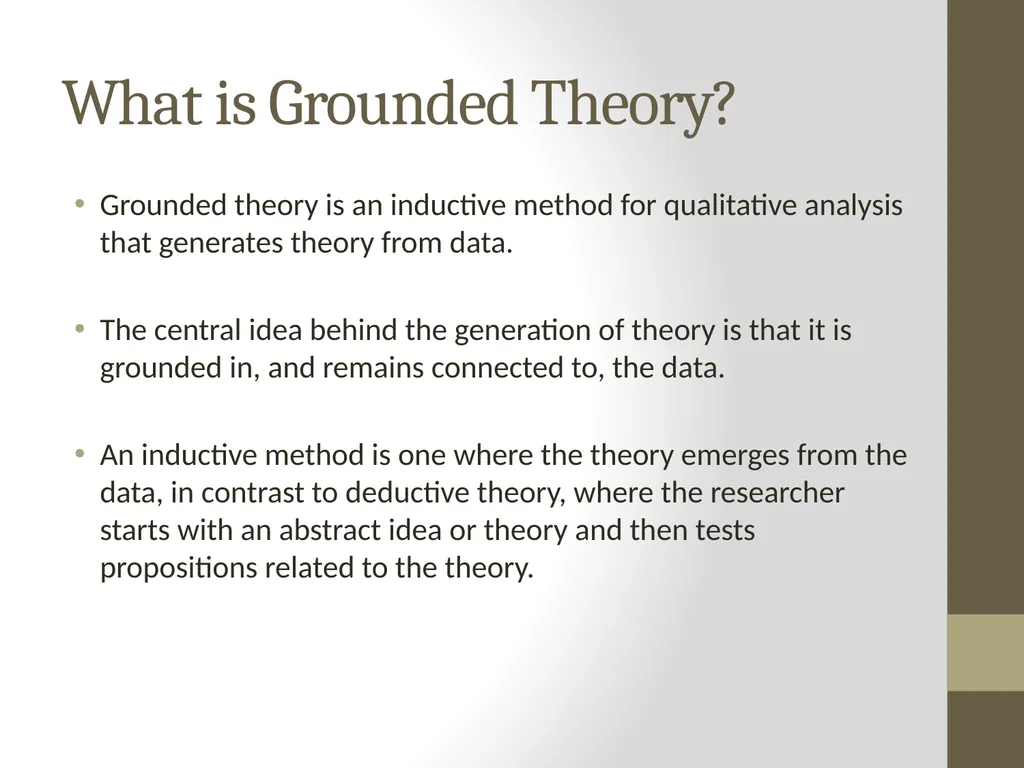
What is Grounded Theory? Grounded theory is an inductive method for qualitative analysis that generates theory from data.
The central idea behind the generation of theory is that it is grounded in, and remains connected to, the data.
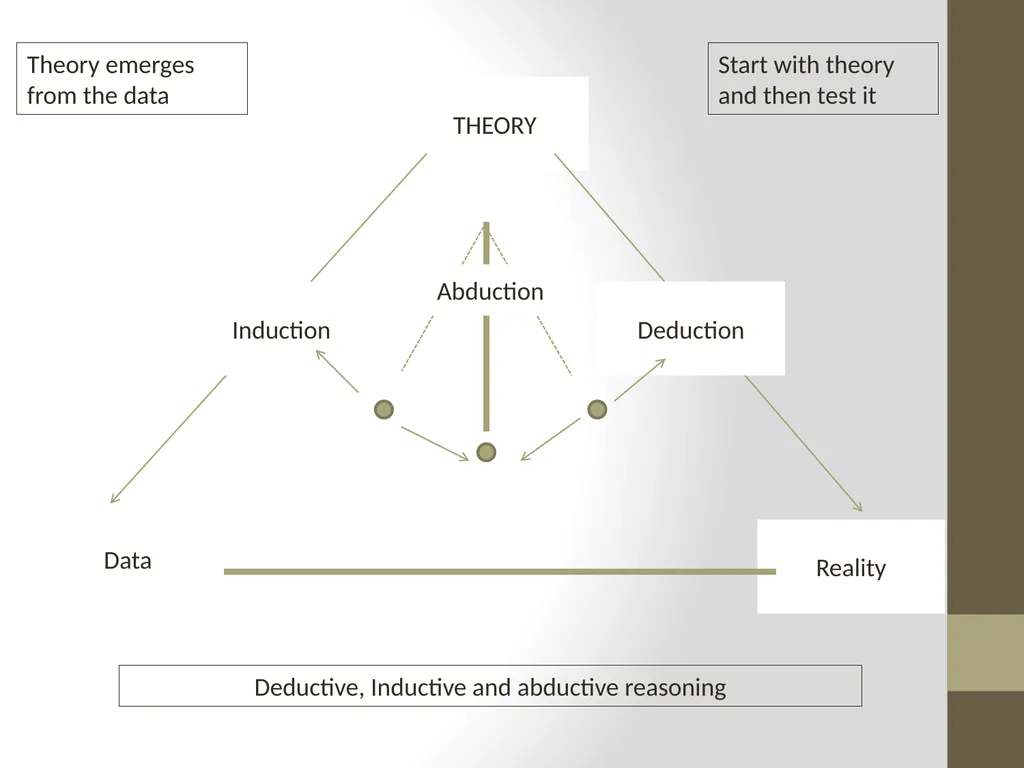
An inductive method is one where the theory emerges from the data, in contrast to deductive theory, where the researcher starts with an abstract idea or theory and then tests propositions related to the theory.<br>
The central idea behind the generation of theory is that it is grounded in, and remains connected to, the data.
An inductive method is one where the theory emerges from the data, in contrast to deductive theory, where the researcher starts with an abstract idea or theory and then tests propositions related to the theory.<br>
30
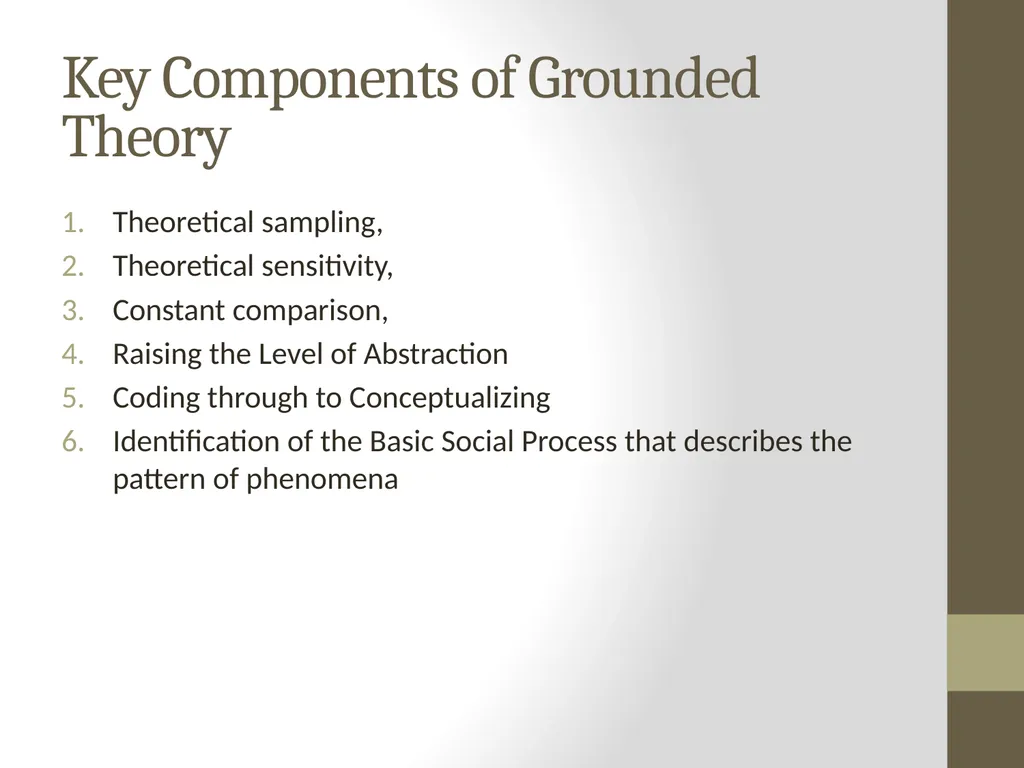
Key Components of Grounded Theory Theoretical sampling,
Theoretical sensitivity,
Constant comparison,
Raising the Level of Abstraction
Coding through to Conceptualizing
Identification of the Basic Social Process that describes the pattern of phenomena<br>
Theoretical sensitivity,
Constant comparison,
Raising the Level of Abstraction
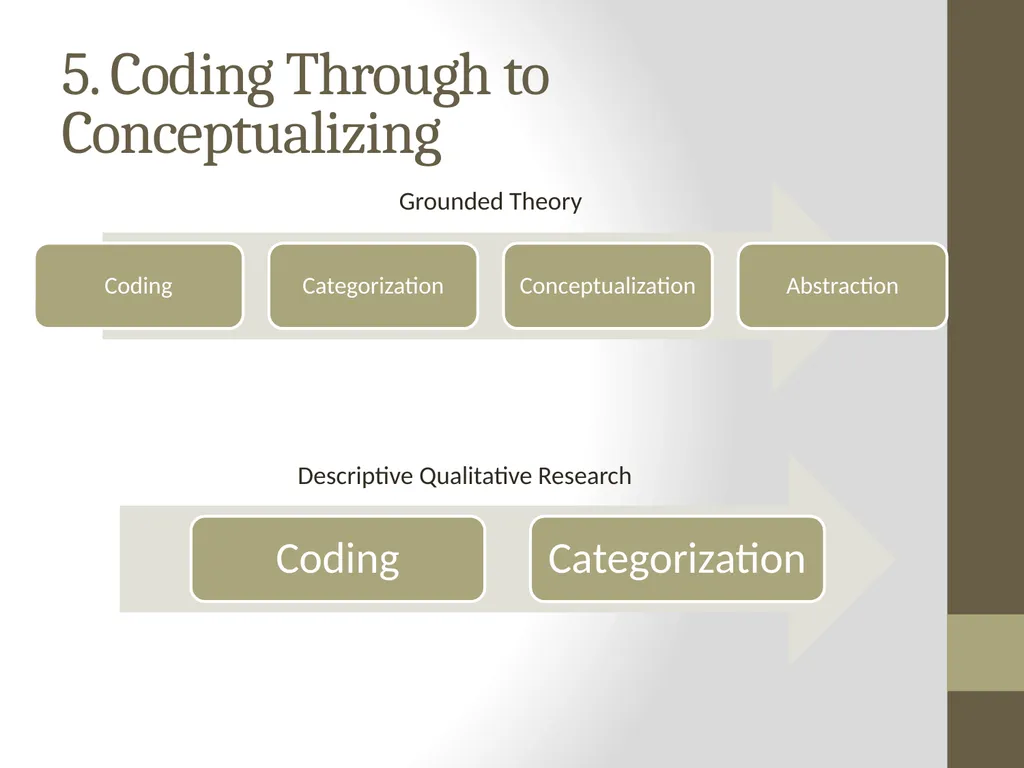
Coding through to Conceptualizing
Identification of the Basic Social Process that describes the pattern of phenomena<br>
31
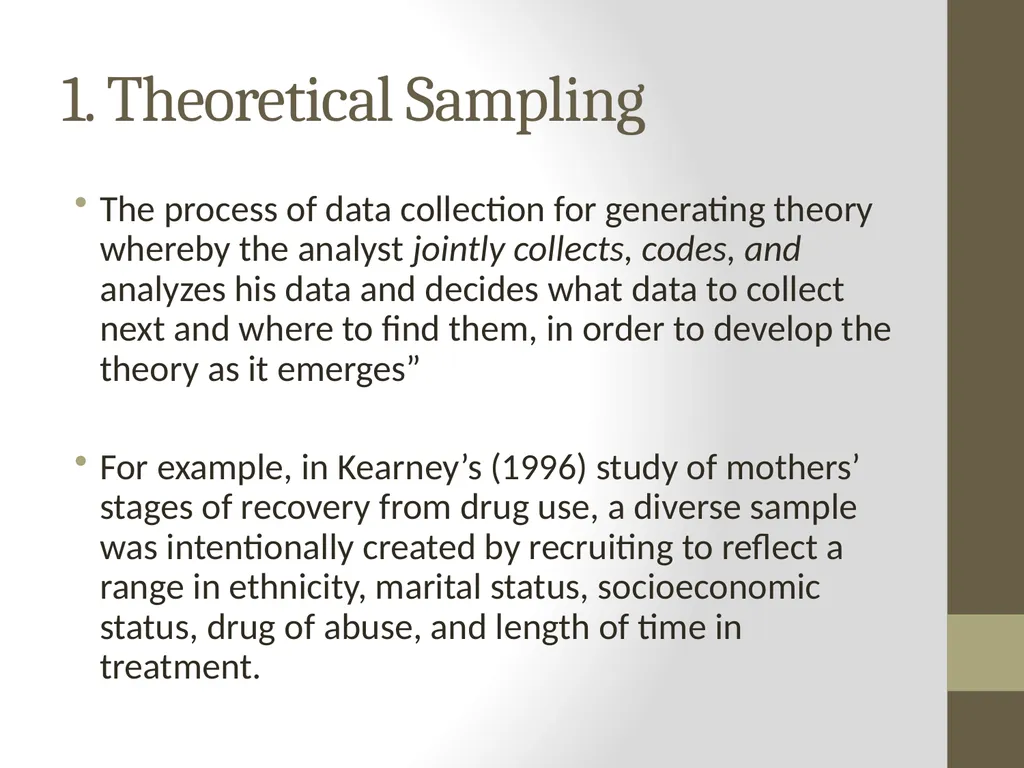
1. Theoretical Sampling The process of data collection for generating theory whereby the analyst jointly collects, codes, and analyzes his data and decides what data to collect next and where to find them, in order to develop the theory as it emerges”
For example, in Kearney’s (1996) study of mothers’ stages of recovery from drug use, a diverse sample was intentionally created by recruiting to reflect a range in ethnicity, marital status, socioeconomic status, drug of abuse, and length of time in treatment.<br>
For example, in Kearney’s (1996) study of mothers’ stages of recovery from drug use, a diverse sample was intentionally created by recruiting to reflect a range in ethnicity, marital status, socioeconomic status, drug of abuse, and length of time in treatment.<br>
32
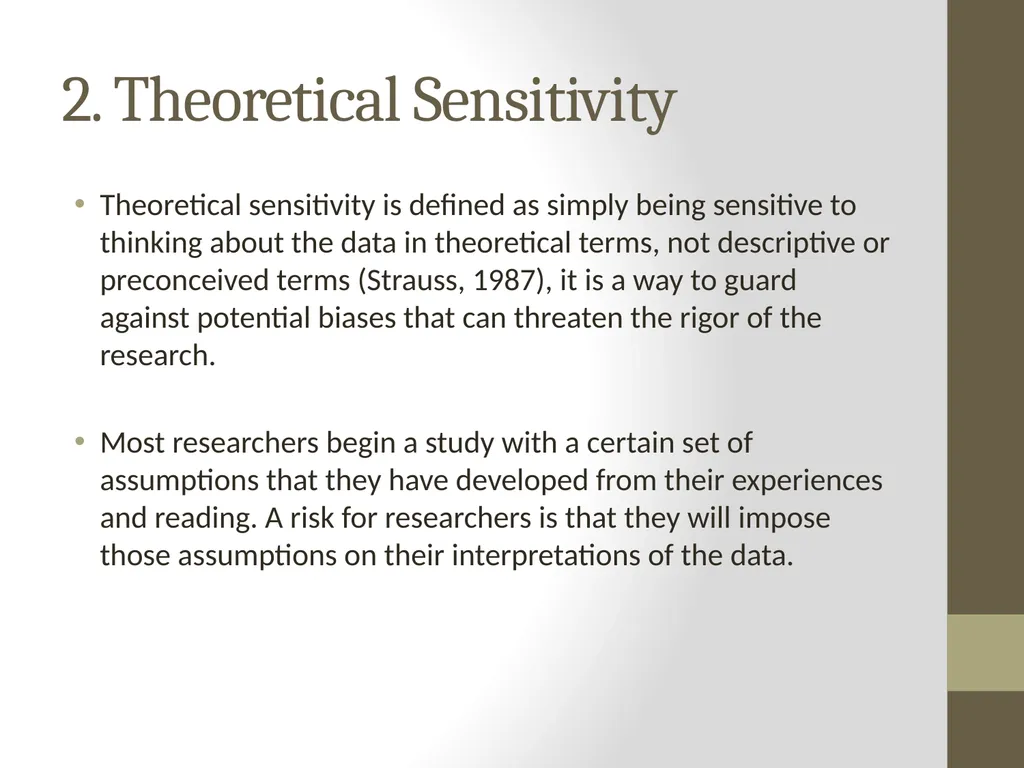
2. Theoretical Sensitivity Theoretical sensitivity is defined as simply being sensitive to thinking about the data in theoretical terms, not descriptive or preconceived terms (Strauss, 1987), it is a way to guard against potential biases that can threaten the rigor of the research.
Most researchers begin a study with a certain set of assumptions that they have developed from their experiences and reading. A risk for researchers is that they will impose those assumptions on their interpretations of the data.<br>
Most researchers begin a study with a certain set of assumptions that they have developed from their experiences and reading. A risk for researchers is that they will impose those assumptions on their interpretations of the data.<br>
33
3. Constant Comparison In traditional quantitative research, analysis does not occur until data collection is complete.
In grounded theory, the process of analysis begins at the same time as data collection.
Constant comparison, the simultaneous collection and analysis of data, is a cornerstone of the grounded theory method.<br>
In grounded theory, the process of analysis begins at the same time as data collection.
Constant comparison, the simultaneous collection and analysis of data, is a cornerstone of the grounded theory method.<br>
34
3. Constant Comparison cont’d The researcher uses an inductive deductive approach (going back and forth between the data and the emerging concepts and theory) to generate and extend the theory.
This process is not linear but is circular and involves constantly going back to the data and returning to participants.<br>
This process is not linear but is circular and involves constantly going back to the data and returning to participants.<br>
35
THEORY Reality Data Induction Deduction Abduction Deductive, Inductive and abductive reasoning Theory emerges from the data Start with theory and then test it<br>
36
4. Raising the Level of Abstraction Data collection methods:
Structured and unstructured interviews
Documents
Observations
Videotaping
Field notes
Media
Meetings
Informal discussions
Memoing (ongoing process of making notes on the researcher’s ideas and questions that occur during the process of data collection and analysis) (Schreiber, 2001)
“everything is data” (Wuest, 2000)<br>
Structured and unstructured interviews
Documents
Observations
Videotaping
Field notes
Media
Meetings
Informal discussions
Memoing (ongoing process of making notes on the researcher’s ideas and questions that occur during the process of data collection and analysis) (Schreiber, 2001)
“everything is data” (Wuest, 2000)<br>
37
5. Coding Through to Conceptualizing Grounded Theory Descriptive Qualitative Research<br>
38
6. Identification of the Basic Social Process that Describes the Pattern of Phenomena The theory is considered fully developed when the researcher has constructed an imageric or symbolic representation that explains the relationships among concepts and illuminates the actions and interactions of the participants (Milliken & Schreiber, 2001).
The ultimate goal of analyzing qualitative data for process is to account for, or explain, change in the social phenomenon being studied over time.<br>
The ultimate goal of analyzing qualitative data for process is to account for, or explain, change in the social phenomenon being studied over time.<br>
39
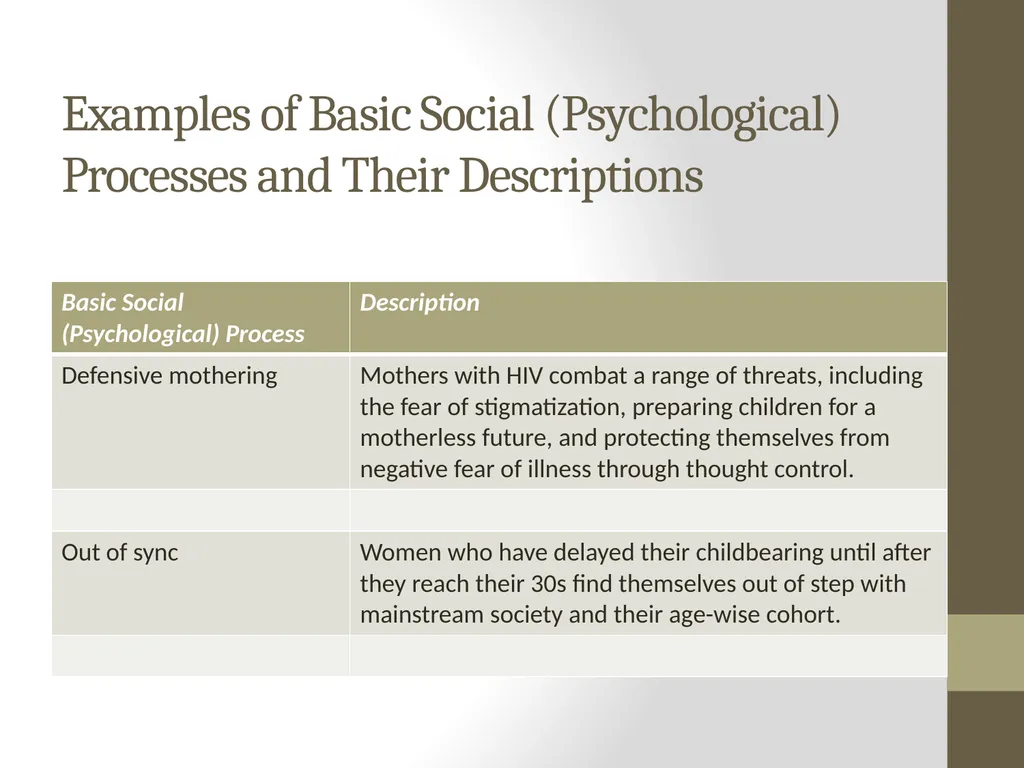
Examples of Basic Social (Psychological) Processes and Their Descriptions<br>
40
Grounded Theory Example 1 The grounded theory approach to data analysis was used to explore enjoyment experiences of persons with schizophrenia.
Interviews with nine participants focused on their descriptions of enjoyment.
The themes that emerged from the data analysis helped occupational therapists gain a better understanding of enjoyment experiences of persons with schizophrenia, and the factors that characterized their enjoyment experiences.
(Glaser & Strauss, 1967) (Emerson, Cook, Polatajko & Segal, 1998)<br>
Interviews with nine participants focused on their descriptions of enjoyment.
The themes that emerged from the data analysis helped occupational therapists gain a better understanding of enjoyment experiences of persons with schizophrenia, and the factors that characterized their enjoyment experiences.
(Glaser & Strauss, 1967) (Emerson, Cook, Polatajko & Segal, 1998)<br>
41
Grounded Theory Example 2 Other example of grounded theory with which many of us are familiar is theory about the grief process.
Researchers observed that people who were bereaved progressed through a series of stages and that each stage was characterised by certain responses: denial, anger, acceptance and resolution.
This is not a new phenomenon, people have been going through these stages for as long as society has existed, but the research formally acknowledged and described the experience.<br>
Researchers observed that people who were bereaved progressed through a series of stages and that each stage was characterised by certain responses: denial, anger, acceptance and resolution.
This is not a new phenomenon, people have been going through these stages for as long as society has existed, but the research formally acknowledged and described the experience.<br>
42
Grounded Theory Example 2 cont’d Now we use our knowledge of the grief process, new knowledge derived from grounded theory, to understand the experience of bereavement and to help the bereaved to come to terms with their loss.
We recognise when a person is having difficulty coming to terms with loss because we use the knowledge to recognise signs of “abnormal” grief and can offer help.<br>
We recognise when a person is having difficulty coming to terms with loss because we use the knowledge to recognise signs of “abnormal” grief and can offer help.<br>
43
Qualitative Research Approaches<br>
44
What is the Case Study? Case study is an approach to explore a phenomenon within its context using a variety of data sources.
This ensures that the issue is not explored through one lens, but rather a variety of lenses which allows for multiple facets of the phenomenon to be revealed and understood.<br>
This ensures that the issue is not explored through one lens, but rather a variety of lenses which allows for multiple facets of the phenomenon to be revealed and understood.<br>
45
What is the Case Study? Cont’d Case study research is used to describe an entity that forms a single unit such as a person, an organisation or an institution. Some research studies describe a series of cases.<br>
46
What is the Case Study? Cont’d Case study research ranges in complexity. The most simple is an illustrative description of a single event or occurrence.
More complex is the analysis of a social situation over a period of time.
The most complex is the extended case study which traces events involving the same actors over a period of time enabling the analysis to reflect changes and adjustments.<br>
More complex is the analysis of a social situation over a period of time.
The most complex is the extended case study which traces events involving the same actors over a period of time enabling the analysis to reflect changes and adjustments.<br>
47
Case Study Example 1 Case study research in health care has a range of uses.
For example, a case study may be conducted of the development of a new service such as a hospital discharge liaison scheme jointly run by health and social services in one locality.<br>
For example, a case study may be conducted of the development of a new service such as a hospital discharge liaison scheme jointly run by health and social services in one locality.<br>
48
Case Study Example 2 Another example of the case study approach would be to describe and analyse organisational change in the planning, purchasing or delivery of health services as in Total Purchasing pilot projects.<br>
49
Case Study Example 3 One of the most common uses of the case study is the evaluation of a particular care approach.
For example, an outreach teenage health service set up as an alternative to general practice based teenage clinics might be evaluated in terms of input, impact on the health of teenagers locally and the development of collaborative links with other groups involved in promoting teenage health.<br>
For example, an outreach teenage health service set up as an alternative to general practice based teenage clinics might be evaluated in terms of input, impact on the health of teenagers locally and the development of collaborative links with other groups involved in promoting teenage health.<br>
50
Qualitative Research Approaches<br>
51
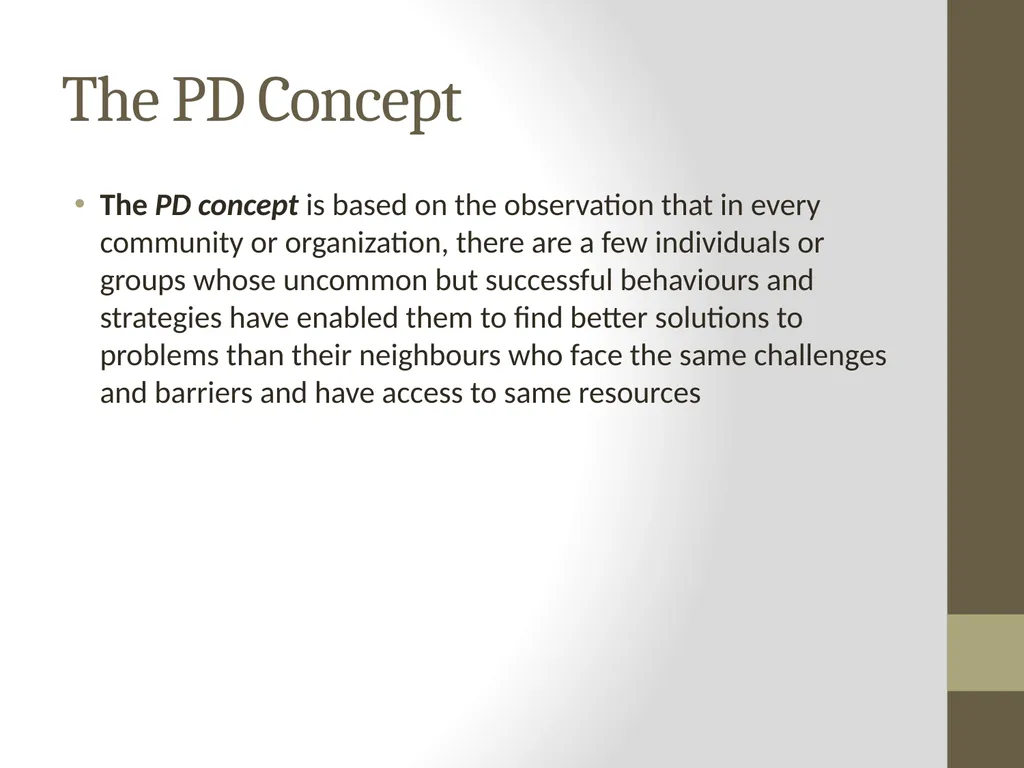
The PD Concept The PD concept is based on the observation that in every community or organization, there are a few individuals or groups whose uncommon but successful behaviours and strategies have enabled them to find better solutions to problems than their neighbours who face the same challenges and barriers and have access to same resources<br>
52
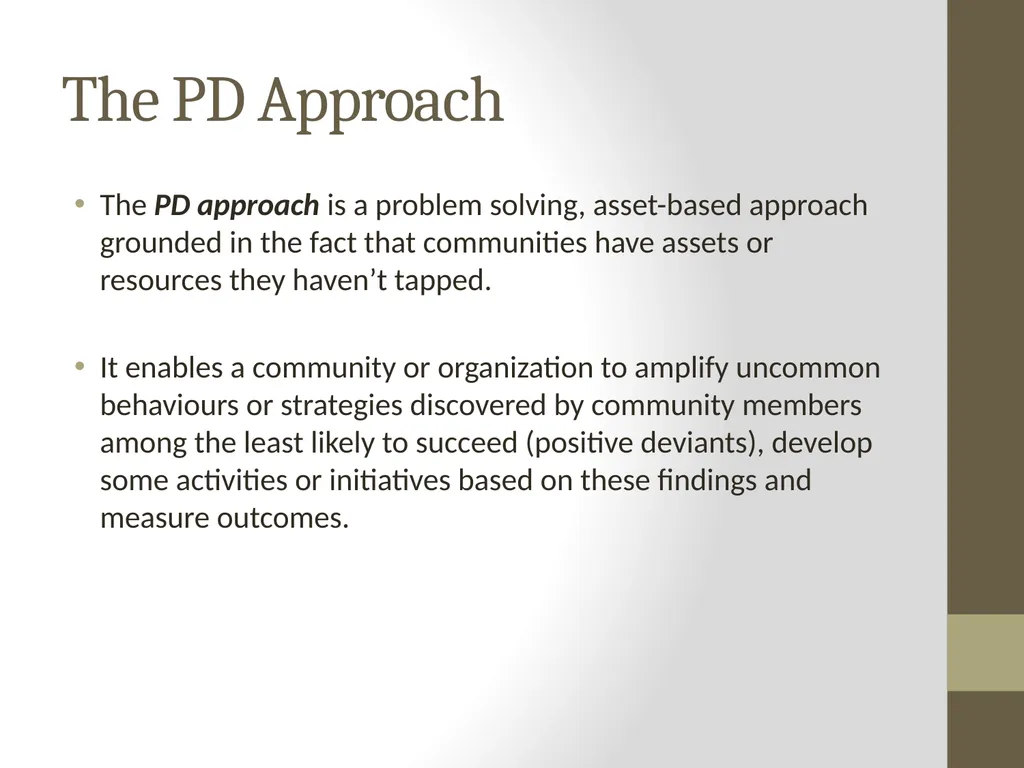
The PD Approach The PD approach is a problem solving, asset-based approach grounded in the fact that communities have assets or resources they haven’t tapped.
It enables a community or organization to amplify uncommon behaviours or strategies discovered by community members among the least likely to succeed (positive deviants), develop some activities or initiatives based on these findings and measure outcomes.<br>
It enables a community or organization to amplify uncommon behaviours or strategies discovered by community members among the least likely to succeed (positive deviants), develop some activities or initiatives based on these findings and measure outcomes.<br>
53
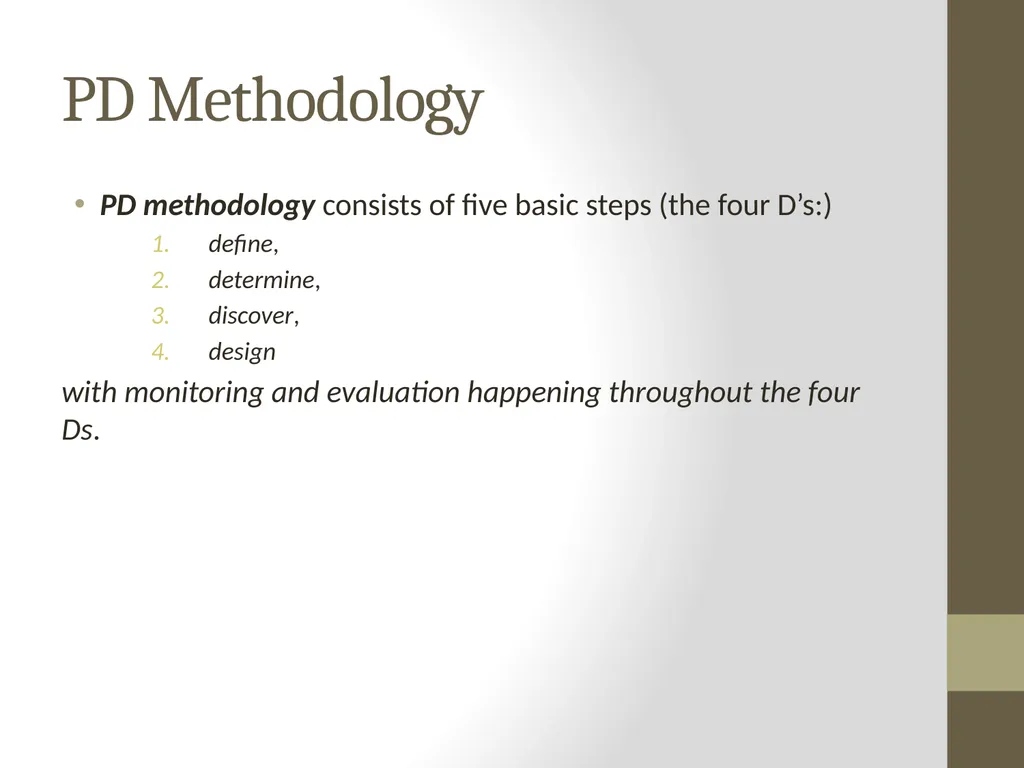
PD Methodology PD methodology consists of five basic steps (the four D’s:)
define,
determine,
discover,
design
with monitoring and evaluation happening throughout the four Ds.<br>
define,
determine,
discover,
design
with monitoring and evaluation happening throughout the four Ds.<br>
54
PD Process The term “PD process” refers to the entire journey encompassing the skillful use of experiential learning methods and skilled facilitation applied to the four steps of the PD design
It results in community mobilization and ownership, discovery of existing solutions, creation of new networks, and emergence of new solutions as a result of community initiatives.<br>
It results in community mobilization and ownership, discovery of existing solutions, creation of new networks, and emergence of new solutions as a result of community initiatives.<br>
55
When to use Positive Deviance Positive deviance should be considered as a possible approach when a concrete problem meets the following criteria:
The problem is not exclusively technical but also relational and requires behavioural or/and social change.
The problem is complex, seemingly intractable, and other solutions haven’t worked.
Positive deviant individuals or groups exist solutions are possible.<br>
The problem is not exclusively technical but also relational and requires behavioural or/and social change.
The problem is complex, seemingly intractable, and other solutions haven’t worked.
Positive deviant individuals or groups exist solutions are possible.<br>
56
When to use Positive Deviance cont’d Today, in every community there are “positive deviants” who are able to solve problems better than their neighbours.
These “Positive Deviants” all demonstrate certain behaviours and practices, which have enabled them to successfully solve problems and overcome formidable barriers which their neighbours, with access to the same resources and living in the same communities have not.<br>
These “Positive Deviants” all demonstrate certain behaviours and practices, which have enabled them to successfully solve problems and overcome formidable barriers which their neighbours, with access to the same resources and living in the same communities have not.<br>
57
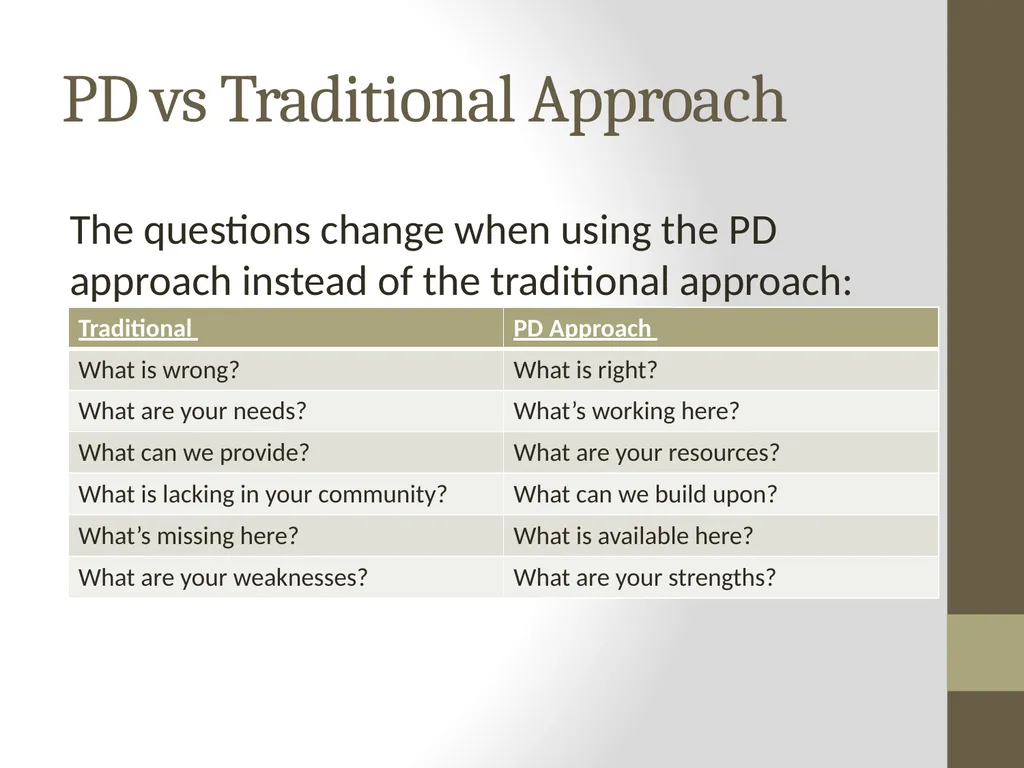
PD vs Traditional Approach The questions change when using the PD approach instead of the traditional approach:<br>
58
Qualitative Research Approaches<br>
59
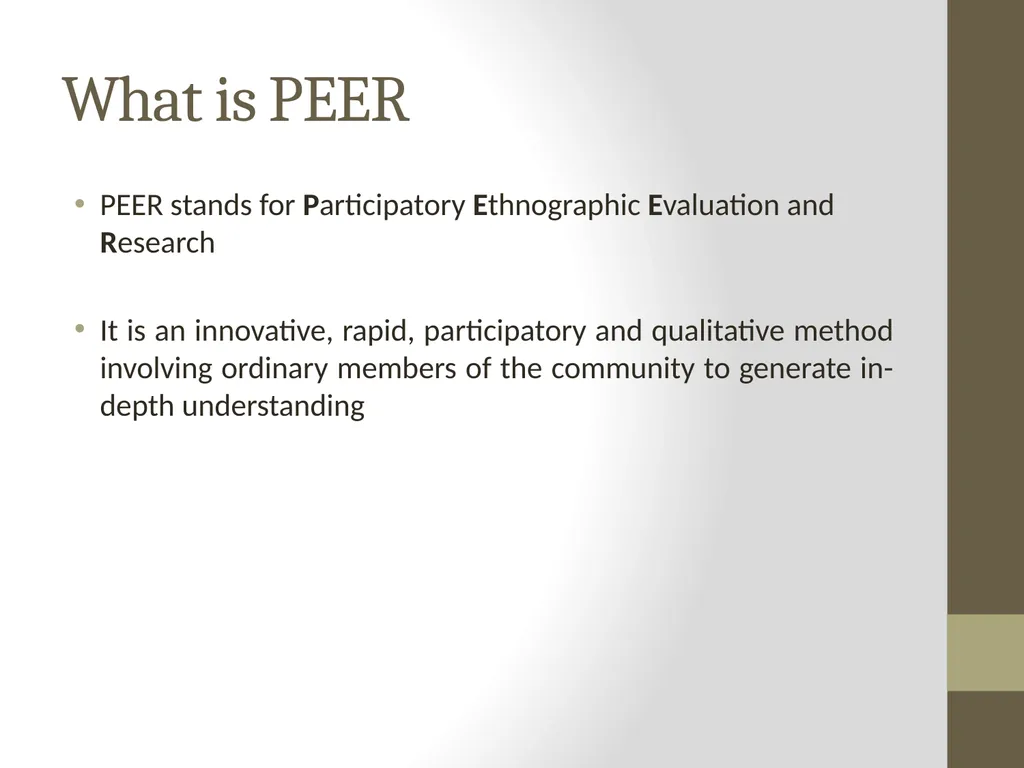
What is PEER PEER stands for Participatory Ethnographic Evaluation and Research
It is an innovative, rapid, participatory and qualitative method involving ordinary members of the community to generate in-depth understanding<br>
It is an innovative, rapid, participatory and qualitative method involving ordinary members of the community to generate in-depth understanding<br>
60
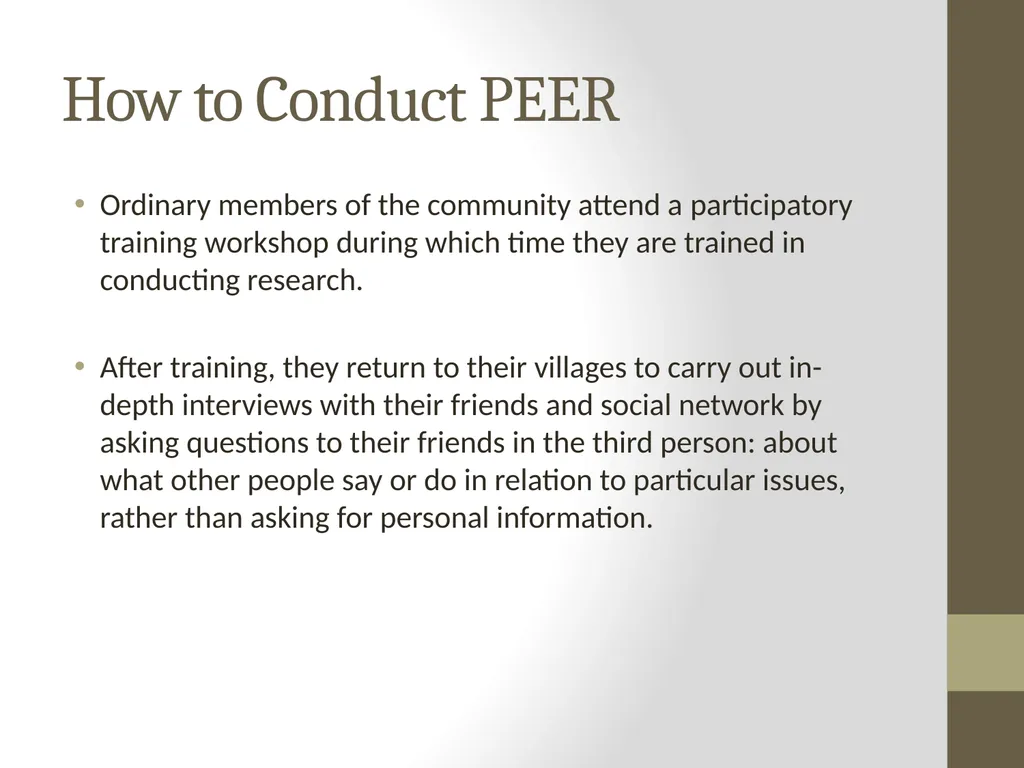
How to Conduct PEER Ordinary members of the community attend a participatory training workshop during which time they are trained in conducting research.
After training, they return to their villages to carry out in-depth interviews with their friends and social network by asking questions to their friends in the third person: about what other people say or do in relation to particular issues, rather than asking for personal information.<br>
After training, they return to their villages to carry out in-depth interviews with their friends and social network by asking questions to their friends in the third person: about what other people say or do in relation to particular issues, rather than asking for personal information.<br>
61
How to Conduct PEER cont’d Another workshop is conducted with them after data collection. They are given feedback on their experiences, and help to analyze the data by enacting dramas to illustrate typical scenarios from the data.
An educational session is held at the end so that any myths or misunderstandings the peer researchers were exposed to during data collection could be addressed.<br>
An educational session is held at the end so that any myths or misunderstandings the peer researchers were exposed to during data collection could be addressed.<br>
62
Advantages of PEER Builds capacity of local partners to carry out research in future.
Local partners become experts in important issues in their community, and form a pool of expertise who can be involved in future programmes.
It generates in-depth understanding.
Involves the participation of the target group from the early stages of the programme, building ownership and involvement in programme activities.
By this method we can hear the voice of hard-to-reach populations.<br>
Local partners become experts in important issues in their community, and form a pool of expertise who can be involved in future programmes.
It generates in-depth understanding.
Involves the participation of the target group from the early stages of the programme, building ownership and involvement in programme activities.
By this method we can hear the voice of hard-to-reach populations.<br>
63
Qualitative Research Approaches<br>
64
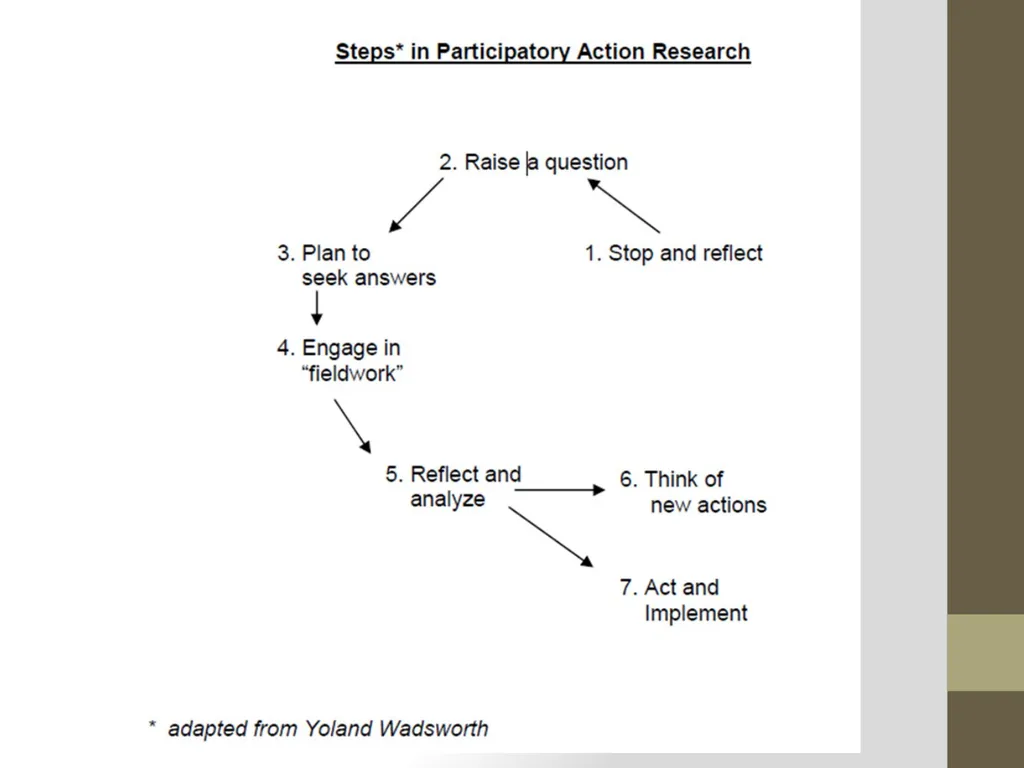
Participatory Action Research (PAR) PAR is a means of putting research capabilities in the hands of the deprived and disenfranchised people so that they can transform their lives for themselves.
Action research involves utilizing a systematic cyclical method of planning, taking action, observing, evaluating and critical reflection prior to planning the next cycle (O'Brien, 2001; McNiff, 2002).<br>
Action research involves utilizing a systematic cyclical method of planning, taking action, observing, evaluating and critical reflection prior to planning the next cycle (O'Brien, 2001; McNiff, 2002).<br>
65
Participatory Action Research cont’d The PAR attempt to avoid the traditional research where “experts” go to a community, study their subjects, and take away their data to write their papers, reports and theses.
PAR is ideally BY the local people and FOR the local people.
Research is designed to address specific issues identified by local people, and the results are directly applied to the problems at hand.<br>
PAR is ideally BY the local people and FOR the local people.
Research is designed to address specific issues identified by local people, and the results are directly applied to the problems at hand.<br>
66
Participatory Action Research cont’d Method used to involve community members in social change-oriented research.
Participants work with a facilitator to:
identify a community problem
develop research methodology
collect data
analyze findings
make recommendations about how the problem should be resolved.
The end result is to improve community or service quality.<br>
Participants work with a facilitator to:
identify a community problem
develop research methodology
collect data
analyze findings
make recommendations about how the problem should be resolved.
The end result is to improve community or service quality.<br>
67
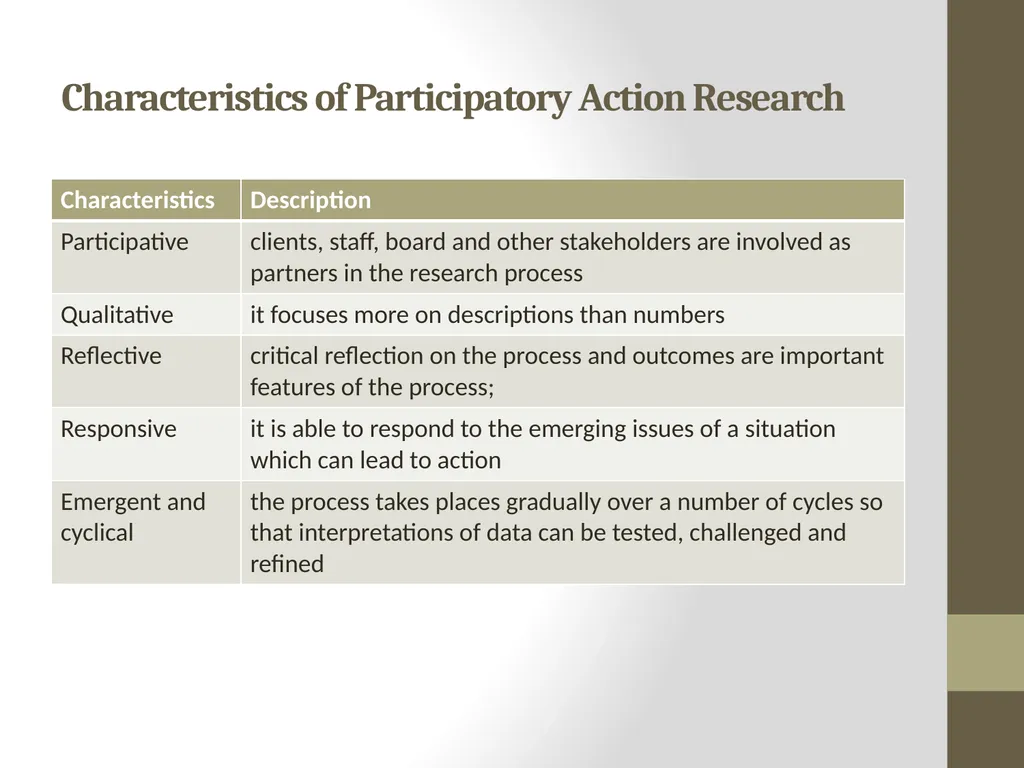
Characteristics of Participatory Action Research<br>
68
When is Action Research Used? Action research is used in real situations, rather than in contrived, experimental studies, since its primary focus is on solving real problems.
It can, however, be used by social scientists for preliminary or pilot research, especially when the situation is too ambiguous to frame a precise research question.
It is chosen when circumstances require flexibility, the involvement of the people in the research, or change must take place quickly or holistically.<br>
It can, however, be used by social scientists for preliminary or pilot research, especially when the situation is too ambiguous to frame a precise research question.
It is chosen when circumstances require flexibility, the involvement of the people in the research, or change must take place quickly or holistically.<br>
69
Advantages of Action Research Increases feelings of participant ownership of process/programs.
Increases likelihood that data will be used.
Increases likelihood that the resulting program or intervention will meet needs of stakeholders and be culturally appropriate.
Participants develop skills and confidence. They gain knowledge and information and thus become empowered.<br>
Increases likelihood that data will be used.
Increases likelihood that the resulting program or intervention will meet needs of stakeholders and be culturally appropriate.
Participants develop skills and confidence. They gain knowledge and information and thus become empowered.<br>
70
Qualitative Research Approaches<br>
71
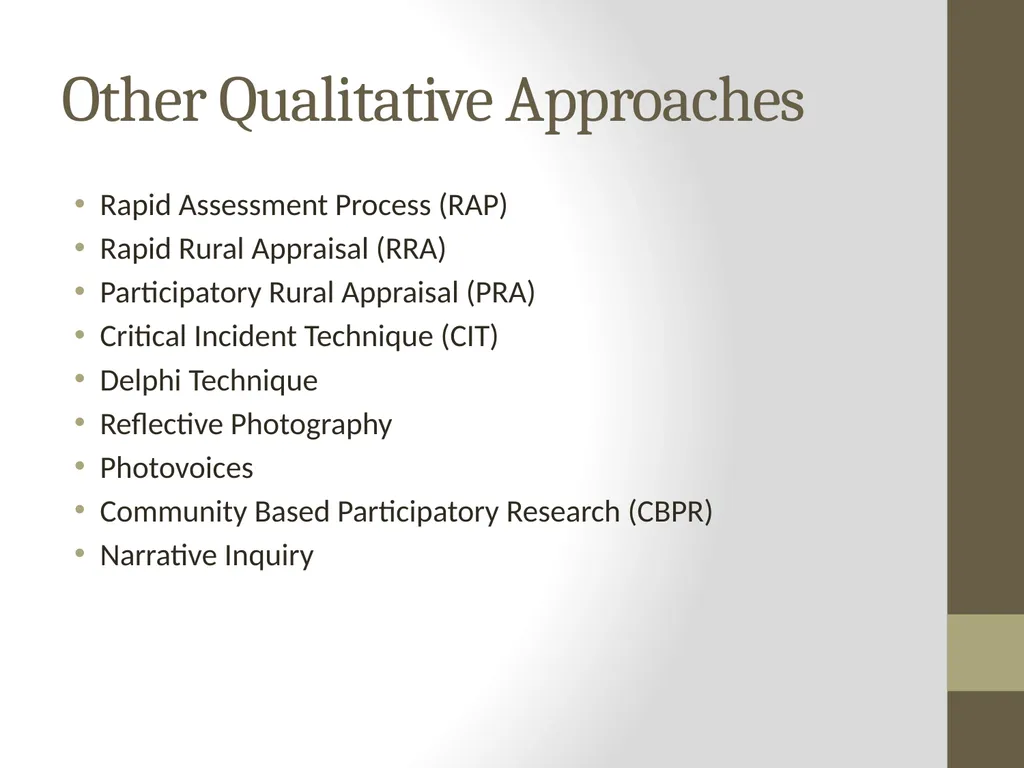
Other Qualitative Approaches Rapid Assessment Process (RAP)
Rapid Rural Appraisal (RRA)
Participatory Rural Appraisal (PRA)
Critical Incident Technique (CIT)
Delphi Technique
Reflective Photography
Photovoices
Community Based Participatory Research (CBPR)
Narrative Inquiry<br>
Rapid Rural Appraisal (RRA)
Participatory Rural Appraisal (PRA)
Critical Incident Technique (CIT)
Delphi Technique
Reflective Photography
Photovoices
Community Based Participatory Research (CBPR)
Narrative Inquiry<br>
72
END<br>