
Qualitative Research Social constructionism
EM
Published · 49 slides · 0 views

1 / 1






Description
Qualitative Research Social constructionism Understanding ways in which people construct their social reality. All experience historically and socially contingent All knowledge is mediated by historical and social conditions. For example
Related Topics
Share
Embed code
Download this presentation From Below
"Qualitative Research Social constructionism" is the property of its rightful owner. Permission is granted to download and print the materials on this website for personal, non-commercial use only, and to display it on your personal computer provided you do not modify the materials and that you retain all copyright notices contained in the materials. By downloading content from our website, you accept the terms of this agreement.
Presentation Transcript
01
Qualitative Research<br>
02
Social constructionism Understanding ways in which people construct their social reality.
All experience historically and socially contingent
All knowledge is mediated by historical and social conditions.
For example Feminism
Important impact on the discipline.
Women were either invisible
Challenges to epistemological and methodological foundations of positivist research.
Emphasis on reflexivity – the role of the researcher within the research process.<br>
All experience historically and socially contingent
All knowledge is mediated by historical and social conditions.
For example Feminism
Important impact on the discipline.
Women were either invisible
Challenges to epistemological and methodological foundations of positivist research.
Emphasis on reflexivity – the role of the researcher within the research process.<br>
03
Qualitative methodologies Meaning:
Phenomenological research
Grounded theory
Life story and narrative research.
Language use:
Discourse analysis.<br>
Phenomenological research
Grounded theory
Life story and narrative research.
Language use:
Discourse analysis.<br>
04
Qualitative Data Collection Techniques In depth Interviewing
Focus Groups
Participant Observations
Ethnographic Studies
Projective Techniques
Self-reporting<br>
Focus Groups
Participant Observations
Ethnographic Studies
Projective Techniques
Self-reporting<br>
05
The Qualitative Researcher as Bricoleur The bricoleur understands that research is an interactive process shaped by his own personal history, biography, gender, social class, race, and ethnicity and those of the people in the setting.
The product of the bricoleur’s labour is a bricolage, a complex, dense, reflexive, collage-like creation that represents the researchers images, understanding and interpretations of the world or phenomenon under analysis.
The bricolage will connect the parts to the whole, stressing the meaningful relationships that operate in the situations and social worlds studied.<br>
The product of the bricoleur’s labour is a bricolage, a complex, dense, reflexive, collage-like creation that represents the researchers images, understanding and interpretations of the world or phenomenon under analysis.
The bricolage will connect the parts to the whole, stressing the meaningful relationships that operate in the situations and social worlds studied.<br>
06
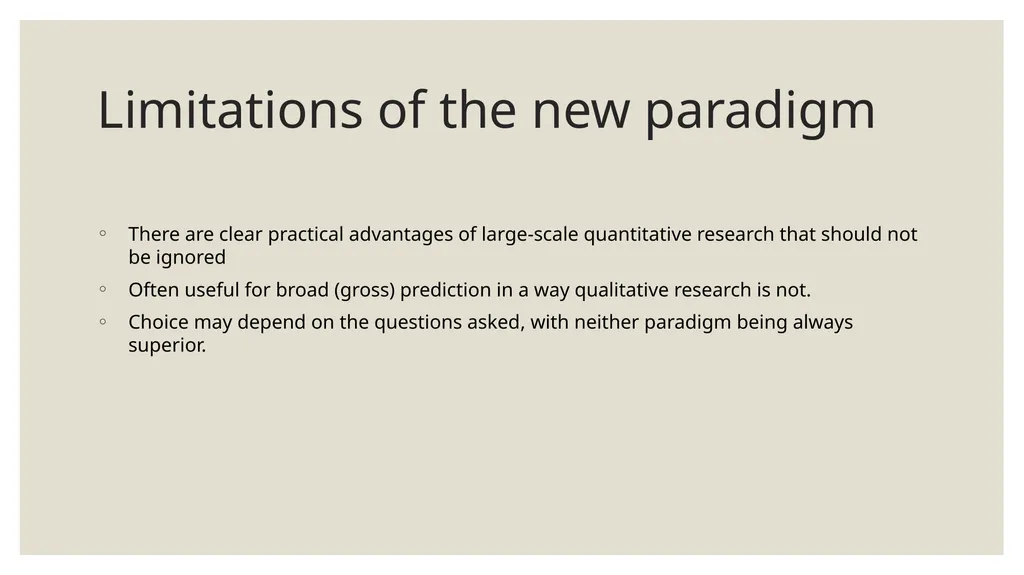
Limitations of the new paradigm There are clear practical advantages of large-scale quantitative research that should not be ignored
Often useful for broad (gross) prediction in a way qualitative research is not.
Choice may depend on the questions asked, with neither paradigm being always superior.<br>
Often useful for broad (gross) prediction in a way qualitative research is not.
Choice may depend on the questions asked, with neither paradigm being always superior.<br>
07
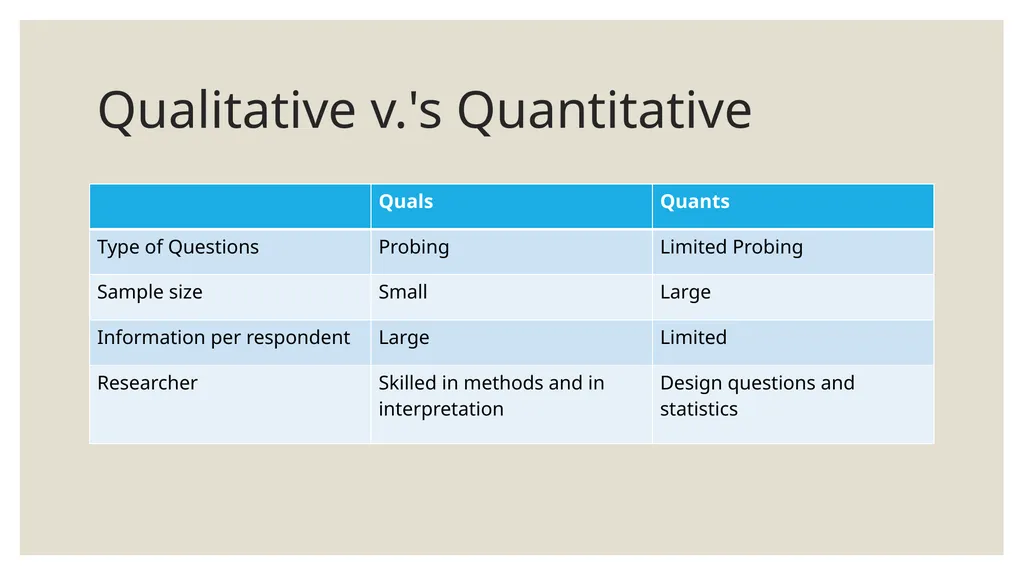
Qualitative v.'s Quantitative<br>
08
Phenomenological research methods<br>
09
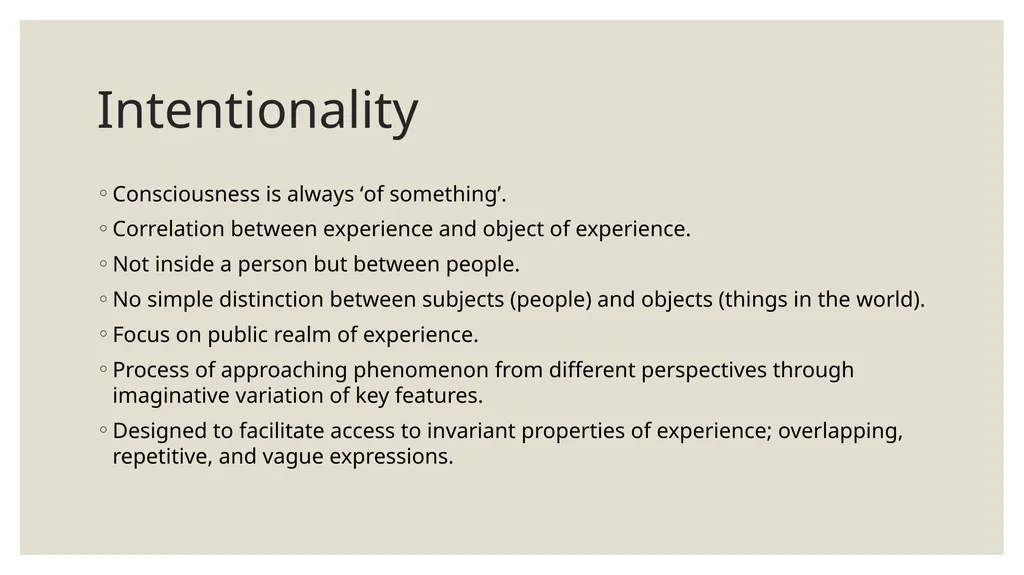
Intentionality Consciousness is always ‘of something’.
Correlation between experience and object of experience.
Not inside a person but between people.
No simple distinction between subjects (people) and objects (things in the world).
Focus on public realm of experience.
Process of approaching phenomenon from different perspectives through imaginative variation of key features.
Designed to facilitate access to invariant properties of experience; overlapping, repetitive, and vague expressions.<br>
Correlation between experience and object of experience.
Not inside a person but between people.
No simple distinction between subjects (people) and objects (things in the world).
Focus on public realm of experience.
Process of approaching phenomenon from different perspectives through imaginative variation of key features.
Designed to facilitate access to invariant properties of experience; overlapping, repetitive, and vague expressions.<br>
10
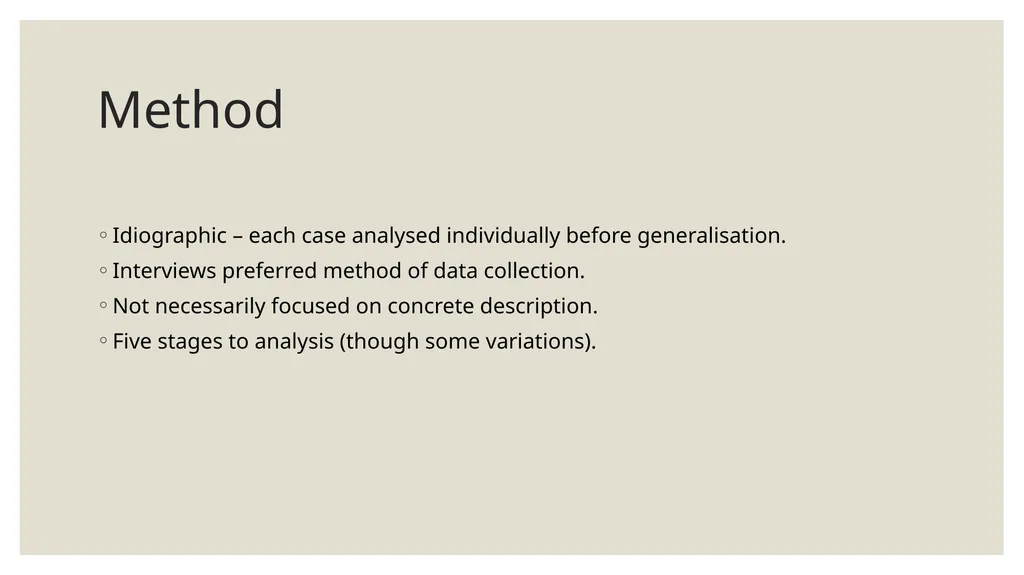
Method Idiographic – each case analysed individually before generalisation.
Interviews preferred method of data collection.
Not necessarily focused on concrete description.
Five stages to analysis (though some variations).<br>
Interviews preferred method of data collection.
Not necessarily focused on concrete description.
Five stages to analysis (though some variations).<br>
11
Data collection Emphasis on concrete description:
Written accounts
Interviews.
Small number of participants.
Vary participant by demographic characteristics to identify invariant properties of phenomenon.<br>
Written accounts
Interviews.
Small number of participants.
Vary participant by demographic characteristics to identify invariant properties of phenomenon.<br>
12
Analytic process 1) Reading for meaning
2) Identifying themes
3) Structuring themes
4) Producing a summary table
5) Integrating cases
Similar to a standard thematic analysis.<br>
2) Identifying themes
3) Structuring themes
4) Producing a summary table
5) Integrating cases
Similar to a standard thematic analysis.<br>
13
Strengths, limitations, debates Capture rich experiences
Emphasis on participant’s own world views
Naïve view of language
Overemphasis on description
Problem with bracketing.<br>
Emphasis on participant’s own world views
Naïve view of language
Overemphasis on description
Problem with bracketing.<br>
14
Grounded Theory<br>
15
Introduction Glaser & Strauss (1967) The Discovery of Grounded Theory: Strategies for Qualitative Research.
Key characteristics:
integrated data collection and analysis;
coding and analysis driven by the data;
development of theory;
memo-making;
theoretical sampling;
delay of literature review.<br>
Key characteristics:
integrated data collection and analysis;
coding and analysis driven by the data;
development of theory;
memo-making;
theoretical sampling;
delay of literature review.<br>
16
Theoretical background Considerable debate over epistemology
Range from interpretative to positivist.
Flexible method.
Debates may create problems for future use of this approach.
Essentially the approach is methodologically driven.<br>
Range from interpretative to positivist.
Flexible method.
Debates may create problems for future use of this approach.
Essentially the approach is methodologically driven.<br>
17
Meaning making Dynamic concern with meaning.
Develop ‘thick description’ (Geertz, 1973).
Uncover (or co-create) layers of meaning with the aim of developing theory.
Transcribe own data (essential part of analysis).
Explore ‘taken for granted assumptions’ with participants.<br>
Develop ‘thick description’ (Geertz, 1973).
Uncover (or co-create) layers of meaning with the aim of developing theory.
Transcribe own data (essential part of analysis).
Explore ‘taken for granted assumptions’ with participants.<br>
18
Coding Grounded in the data.
Line by line coding
Code every line of data (forces you to remain close to the data).
What is going on?
What are people doing?
What is this person saying?
What do these actions and statements take for granted?
How do structure and context serve to support, maintain, impede or change these actions and statements?<br>
Line by line coding
Code every line of data (forces you to remain close to the data).
What is going on?
What are people doing?
What is this person saying?
What do these actions and statements take for granted?
How do structure and context serve to support, maintain, impede or change these actions and statements?<br>
19
Constant comparative method Development of categories and theory.
Cyclical process of looking for similarities and differences within and between categories of meaning.
Differences will produce sub-categories.
Negative case analysis: search for a case that doesn’t fit a category
Refine or change categories.<br>
Cyclical process of looking for similarities and differences within and between categories of meaning.
Differences will produce sub-categories.
Negative case analysis: search for a case that doesn’t fit a category
Refine or change categories.<br>
20
Memo writing Begin from first moment of analysis and continue to end.
Reflections on data, represent development of theory.
Notes to self, detail on categories, relationships, etc.
Always partial and preliminary.
Should always be dated – temporal record.<br>
Reflections on data, represent development of theory.
Notes to self, detail on categories, relationships, etc.
Always partial and preliminary.
Should always be dated – temporal record.<br>
21
Strengths, limitations and debates Rich descriptions of life.
Development of theory.
Driven by data?
Discovery versus construction.
Full versus abbreviated form.
Social constructionist reformulation.
Lack of concern with reflexivity.
Is theory development inappropriate?<br>
Development of theory.
Driven by data?
Discovery versus construction.
Full versus abbreviated form.
Social constructionist reformulation.
Lack of concern with reflexivity.
Is theory development inappropriate?<br>
22
Discourse analysis<br>
23
The turn to language Rejection of cognitive approach:
Objects existing independently of thought.
Language:
Does things (action-oriented)
Creates objects themselves (constitutes subjectivity).<br>
Objects existing independently of thought.
Language:
Does things (action-oriented)
Creates objects themselves (constitutes subjectivity).<br>
24
Wittgenstein Language as a toolkit:
Rather than language in terms of reference and internal logic.
Language games:
Implicit rules
Discourse practices are interpretative repertoire.
Private language argument:
Private language not possible – language always a public social event.<br>
Rather than language in terms of reference and internal logic.
Language games:
Implicit rules
Discourse practices are interpretative repertoire.
Private language argument:
Private language not possible – language always a public social event.<br>
25
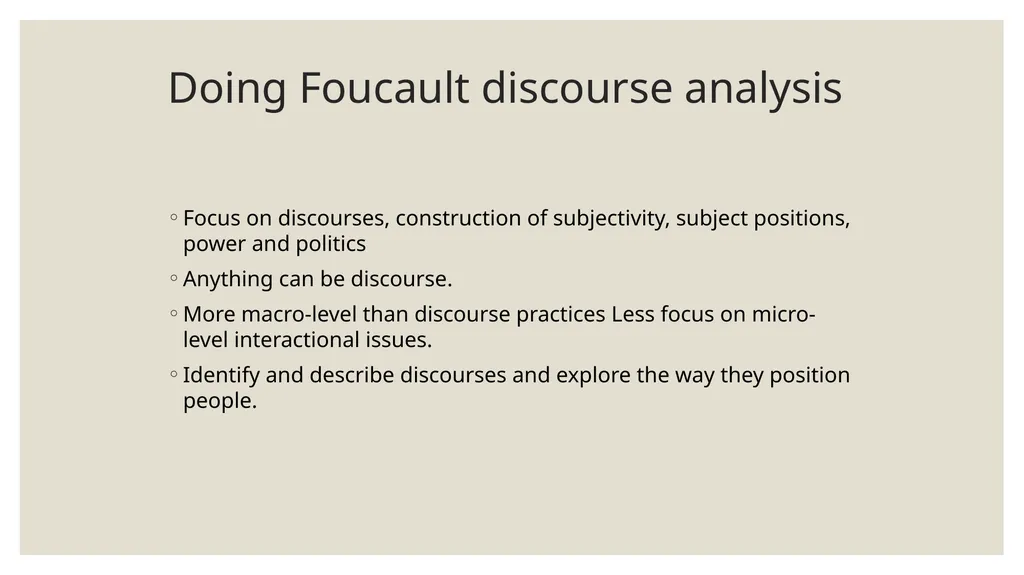
Doing Foucault discourse analysis Focus on discourses, construction of subjectivity, subject positions, power and politics
Anything can be discourse.
More macro-level than discourse practices Less focus on micro-level interactional issues.
Identify and describe discourses and explore the way they position people.<br>
Anything can be discourse.
More macro-level than discourse practices Less focus on micro-level interactional issues.
Identify and describe discourses and explore the way they position people.<br>
26
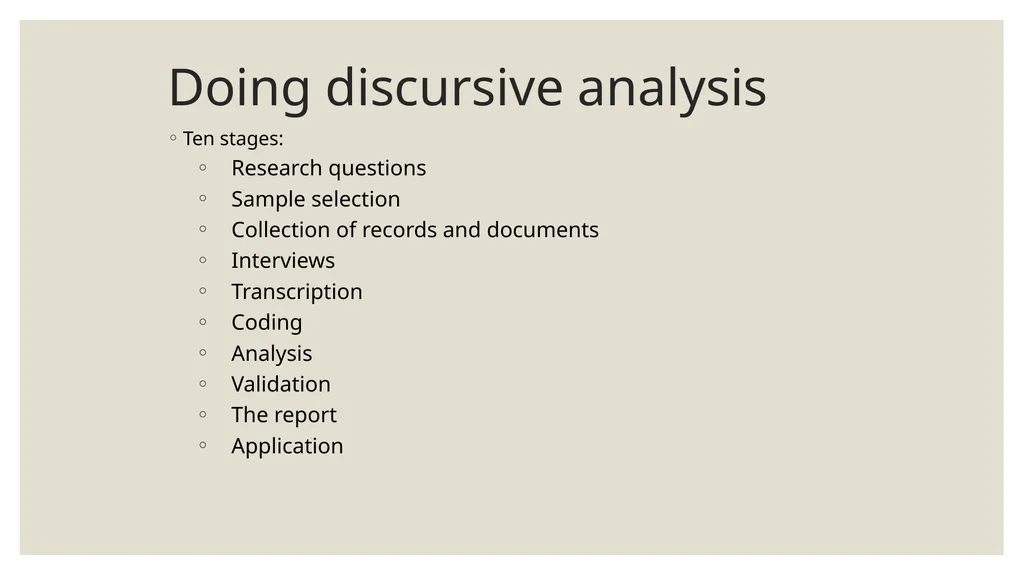
Doing discursive analysis Ten stages:
Research questions
Sample selection
Collection of records and documents
Interviews
Transcription
Coding
Analysis
Validation
The report
Application<br>
Research questions
Sample selection
Collection of records and documents
Interviews
Transcription
Coding
Analysis
Validation
The report
Application<br>
27
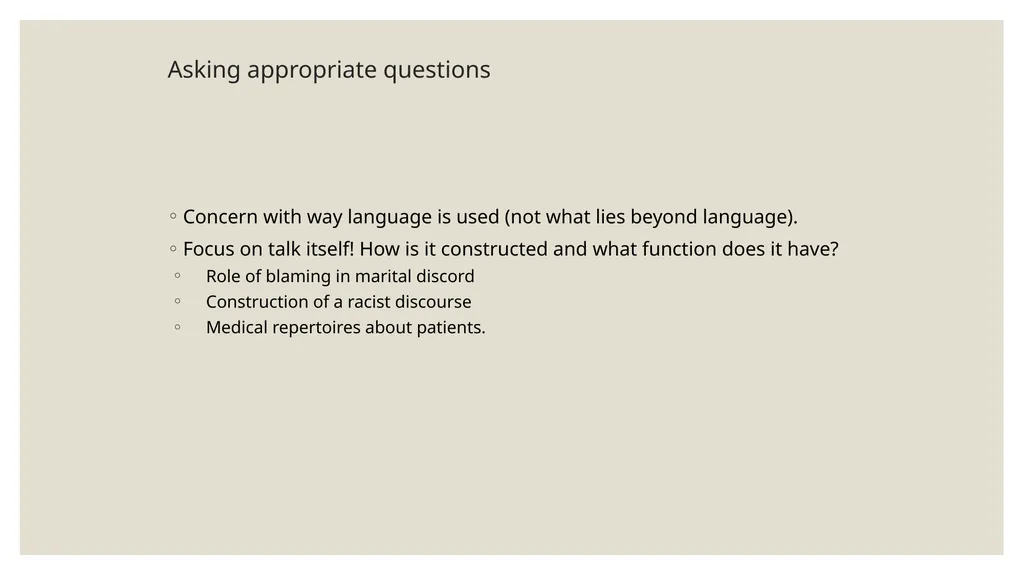
Asking appropriate questions Concern with way language is used (not what lies beyond language).
Focus on talk itself! How is it constructed and what function does it have?
Role of blaming in marital discord
Construction of a racist discourse
Medical repertoires about patients.<br>
Focus on talk itself! How is it constructed and what function does it have?
Role of blaming in marital discord
Construction of a racist discourse
Medical repertoires about patients.<br>
28
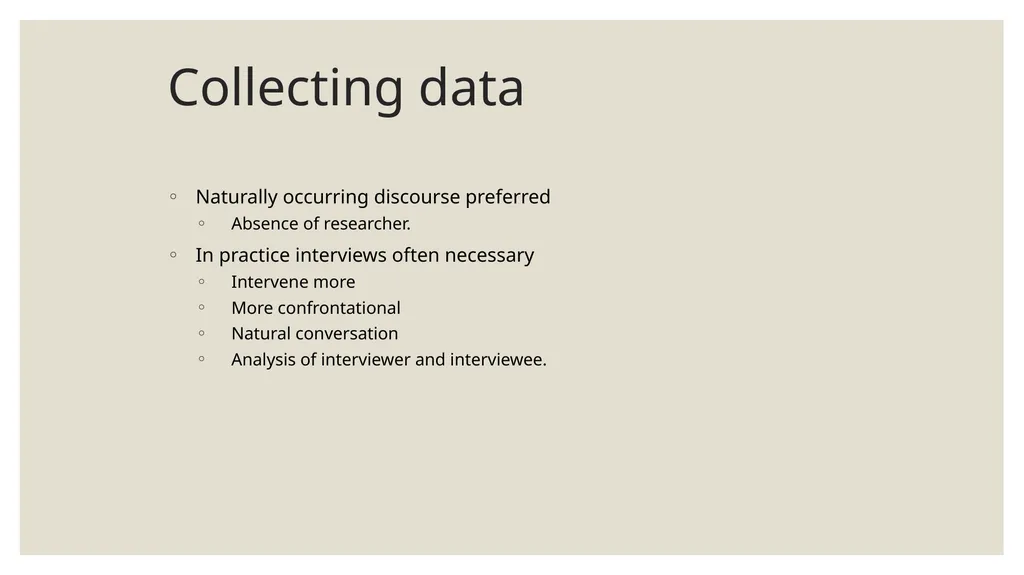
Collecting data Naturally occurring discourse preferred
Absence of researcher.
In practice interviews often necessary
Intervene more
More confrontational
Natural conversation
Analysis of interviewer and interviewee.<br>
Absence of researcher.
In practice interviews often necessary
Intervene more
More confrontational
Natural conversation
Analysis of interviewer and interviewee.<br>
29
Life story and narrative research<br>
30
Collecting data Documentation (self or other)
Great person likely to be documented.
Unstructured (sometimes semi-) interviews
Biographical
May need long-term relationship.
Participant observation
Triangulation important.<br>
Great person likely to be documented.
Unstructured (sometimes semi-) interviews
Biographical
May need long-term relationship.
Participant observation
Triangulation important.<br>
31
Analysing life story data From little to considerable editorial intervention
May attempt to ‘tell it like it is’ – edited
Reconstructed into an appropriate narrative form
Themes extracted
Plot type
Rhetorical structure
Narrative coherence and tone
Canonical narratives.<br>
May attempt to ‘tell it like it is’ – edited
Reconstructed into an appropriate narrative form
Themes extracted
Plot type
Rhetorical structure
Narrative coherence and tone
Canonical narratives.<br>
32
Narrative practice and form Greater focus on language.
Different forms of (small story) narrative analysis.
Three functions of language
Ideational function (content)
Interpersonal function (relationships)
Textual function (syntax, semantics).
Most life story work has concentrated on first level. Narrative analysis works at all three levels.<br>
Different forms of (small story) narrative analysis.
Three functions of language
Ideational function (content)
Interpersonal function (relationships)
Textual function (syntax, semantics).
Most life story work has concentrated on first level. Narrative analysis works at all three levels.<br>
33
Ethical issues Anonymity
Ownership
Relationship between researcher and participant
Balance between the personal and the professional.<br>
Ownership
Relationship between researcher and participant
Balance between the personal and the professional.<br>
34
Ethnography<br>
35
Ethnography emphasizes the observation of details of everyday life as they naturally unfold in the real world. This is sometimes called naturalistic research.
Ethnography is a method of describing a culture or society. This is primarily used in anthropological research.<br>
Ethnography is a method of describing a culture or society. This is primarily used in anthropological research.<br>
36
Applied Topics and Examples Those that by their nature defy simply quantification (for example, the interaction of students and teachers in classroom discussions).
Those that involve the study of individual or group activities over time (such as changes that occur in the attitudes of at-risk students as they participate in a specially designed, year long, reading program).
Those involving the study of formal organizations in their totality (for example, schools, school districts, and so forth.)
Those that can best be understood in a natural (as opposed to opposite) setting (for example, the behavior of students at a school event.)<br>
Those that involve the study of individual or group activities over time (such as changes that occur in the attitudes of at-risk students as they participate in a specially designed, year long, reading program).
Those involving the study of formal organizations in their totality (for example, schools, school districts, and so forth.)
Those that can best be understood in a natural (as opposed to opposite) setting (for example, the behavior of students at a school event.)<br>
37
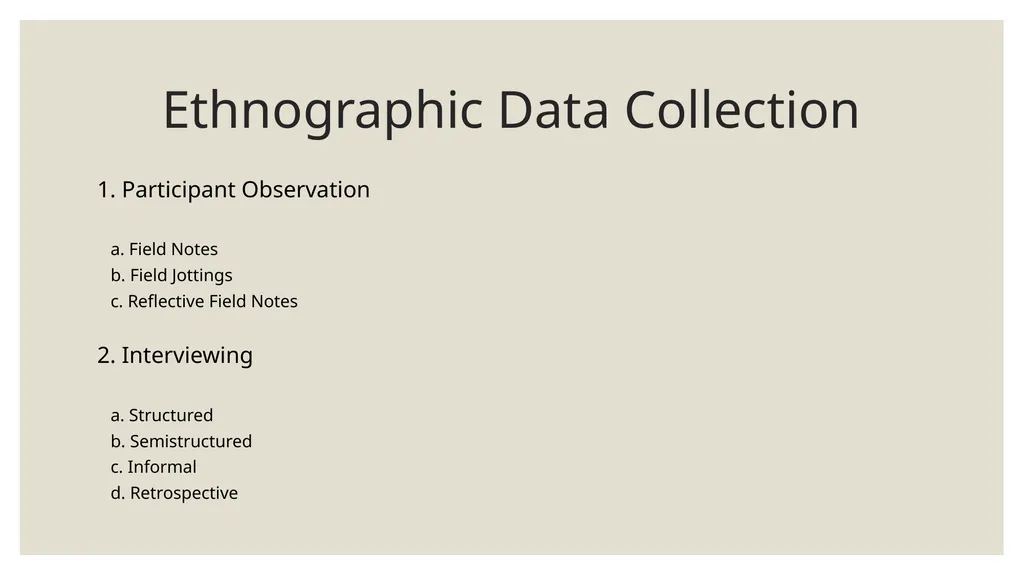
Ethnographic Data Collection 1. Participant Observation
a. Field Notes
b. Field Jottings
c. Reflective Field Notes
2. Interviewing
a. Structured
b. Semistructured
c. Informal
d. Retrospective<br>
a. Field Notes
b. Field Jottings
c. Reflective Field Notes
2. Interviewing
a. Structured
b. Semistructured
c. Informal
d. Retrospective<br>
38
Overt versus covert ethnography Closed/non-public vs. open/public settings
Overt role
Participants aware of researcher’s intentions
Covert role
Researcher’s identity not disclosed
Researchers may play different roles at different stages
Or move between roles<br>
Overt role
Participants aware of researcher’s intentions
Covert role
Researcher’s identity not disclosed
Researchers may play different roles at different stages
Or move between roles<br>
39
The covert role in ethnography Advantages
Obviates the need to negotiate access
Reactivity is not a problem
Disadvantages
Practical difficulties in taking notes
Cannot use other methods
Anxiety about ‘blowing your cover’
Ethical problems (deception, informed consent)<br>
Obviates the need to negotiate access
Reactivity is not a problem
Disadvantages
Practical difficulties in taking notes
Cannot use other methods
Anxiety about ‘blowing your cover’
Ethical problems (deception, informed consent)<br>
40
Transcribing, coding and organising textual data<br>
41
Introduction Transcription: first stage with textual data.
Coding: second stage, initial way of organising textual material.
Thematic analysis: widely used and recognised method for the analysis of textual data<br>
Coding: second stage, initial way of organising textual material.
Thematic analysis: widely used and recognised method for the analysis of textual data<br>
42
Transcription Fit for purpose:
Detail will vary depending on need (a discourse analyst will require much more detail than a phenomenologist).
Verbatim record of what was said by whom.
Do not correct language but report it as spoken.
Include interviewer and interviewee.<br>
Detail will vary depending on need (a discourse analyst will require much more detail than a phenomenologist).
Verbatim record of what was said by whom.
Do not correct language but report it as spoken.
Include interviewer and interviewee.<br>
43
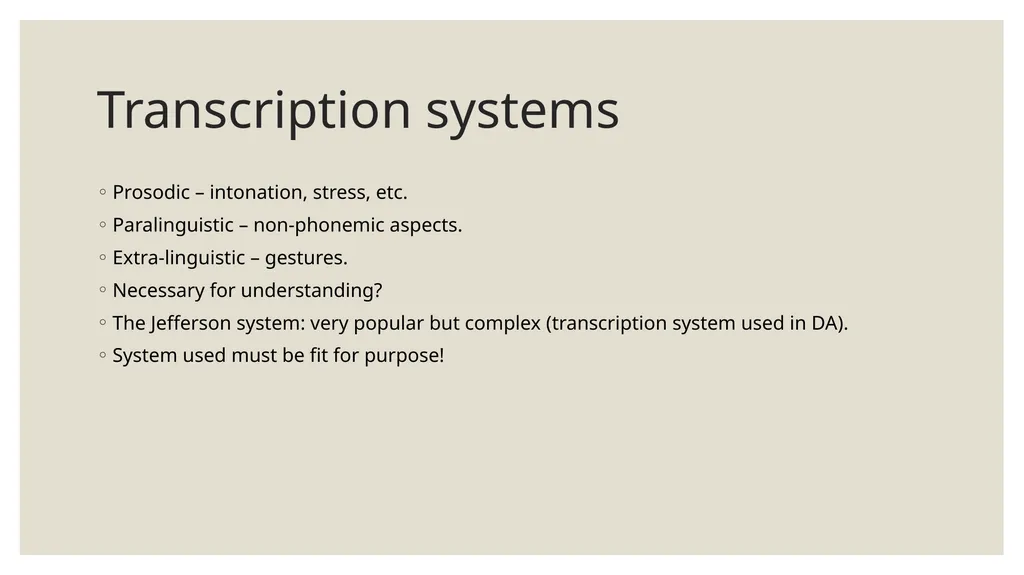
Transcription systems Prosodic – intonation, stress, etc.
Paralinguistic – non-phonemic aspects.
Extra-linguistic – gestures.
Necessary for understanding?
The Jefferson system: very popular but complex (transcription system used in DA).
System used must be fit for purpose!<br>
Paralinguistic – non-phonemic aspects.
Extra-linguistic – gestures.
Necessary for understanding?
The Jefferson system: very popular but complex (transcription system used in DA).
System used must be fit for purpose!<br>
44
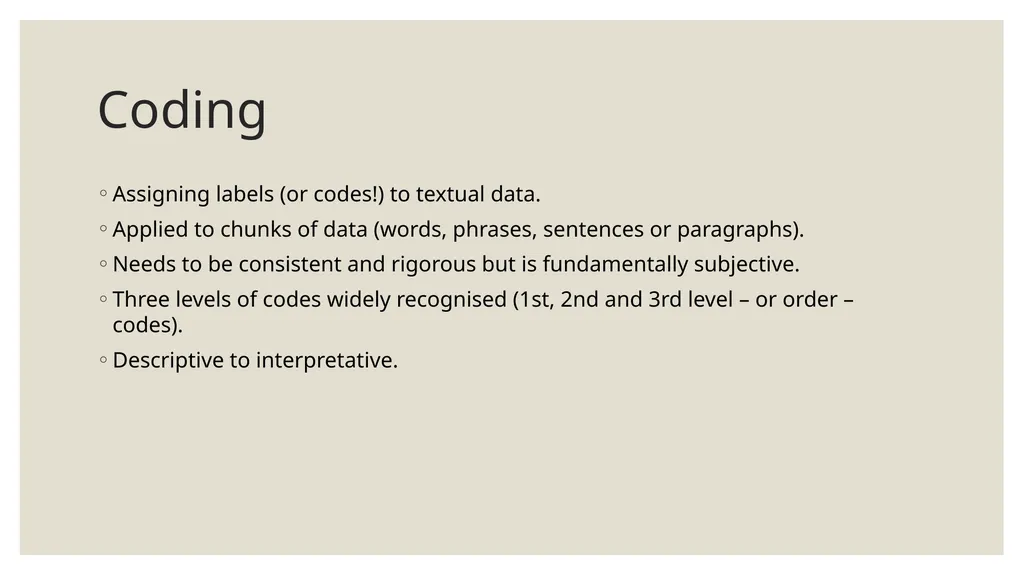
Coding Assigning labels (or codes!) to textual data.
Applied to chunks of data (words, phrases, sentences or paragraphs).
Needs to be consistent and rigorous but is fundamentally subjective.
Three levels of codes widely recognised (1st, 2nd and 3rd level – or order – codes).
Descriptive to interpretative.<br>
Applied to chunks of data (words, phrases, sentences or paragraphs).
Needs to be consistent and rigorous but is fundamentally subjective.
Three levels of codes widely recognised (1st, 2nd and 3rd level – or order – codes).
Descriptive to interpretative.<br>
45
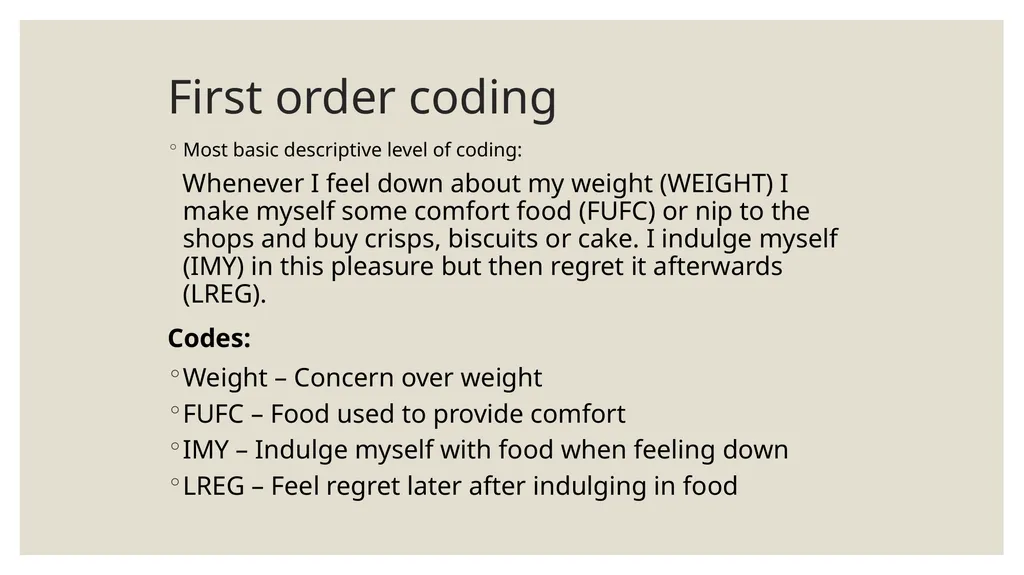
First order coding Most basic descriptive level of coding:
Whenever I feel down about my weight (WEIGHT) I make myself some comfort food (FUFC) or nip to the shops and buy crisps, biscuits or cake. I indulge myself (IMY) in this pleasure but then regret it afterwards (LREG).
Codes:
Weight – Concern over weight
FUFC – Food used to provide comfort
IMY – Indulge myself with food when feeling down
LREG – Feel regret later after indulging in food<br>
Whenever I feel down about my weight (WEIGHT) I make myself some comfort food (FUFC) or nip to the shops and buy crisps, biscuits or cake. I indulge myself (IMY) in this pleasure but then regret it afterwards (LREG).
Codes:
Weight – Concern over weight
FUFC – Food used to provide comfort
IMY – Indulge myself with food when feeling down
LREG – Feel regret later after indulging in food<br>
46
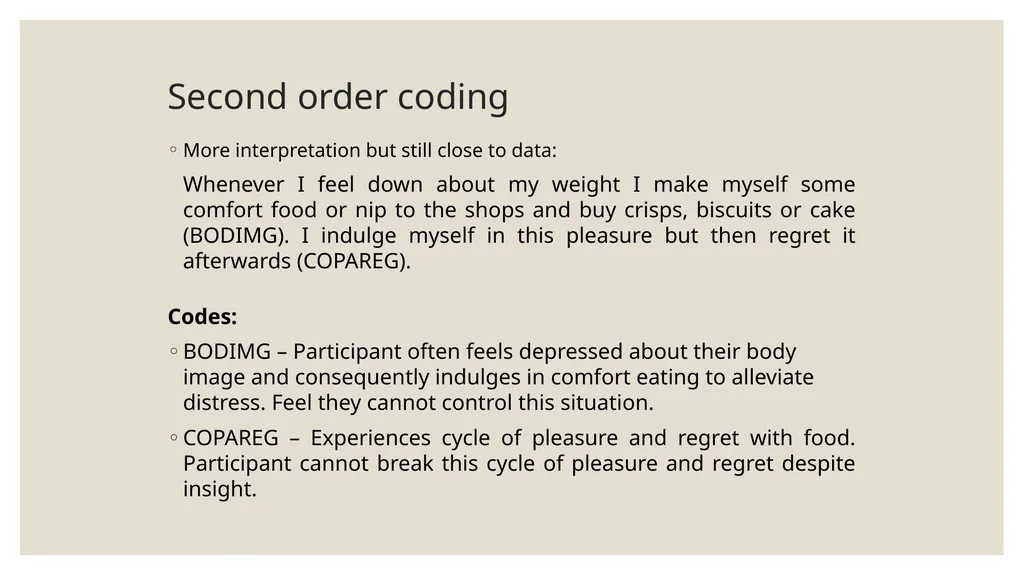
Second order coding More interpretation but still close to data:
Whenever I feel down about my weight I make myself some comfort food or nip to the shops and buy crisps, biscuits or cake (BODIMG). I indulge myself in this pleasure but then regret it afterwards (COPAREG).
Codes:
BODIMG – Participant often feels depressed about their body image and consequently indulges in comfort eating to alleviate distress. Feel they cannot control this situation.
COPAREG – Experiences cycle of pleasure and regret with food. Participant cannot break this cycle of pleasure and regret despite insight.<br>
Whenever I feel down about my weight I make myself some comfort food or nip to the shops and buy crisps, biscuits or cake (BODIMG). I indulge myself in this pleasure but then regret it afterwards (COPAREG).
Codes:
BODIMG – Participant often feels depressed about their body image and consequently indulges in comfort eating to alleviate distress. Feel they cannot control this situation.
COPAREG – Experiences cycle of pleasure and regret with food. Participant cannot break this cycle of pleasure and regret despite insight.<br>
47
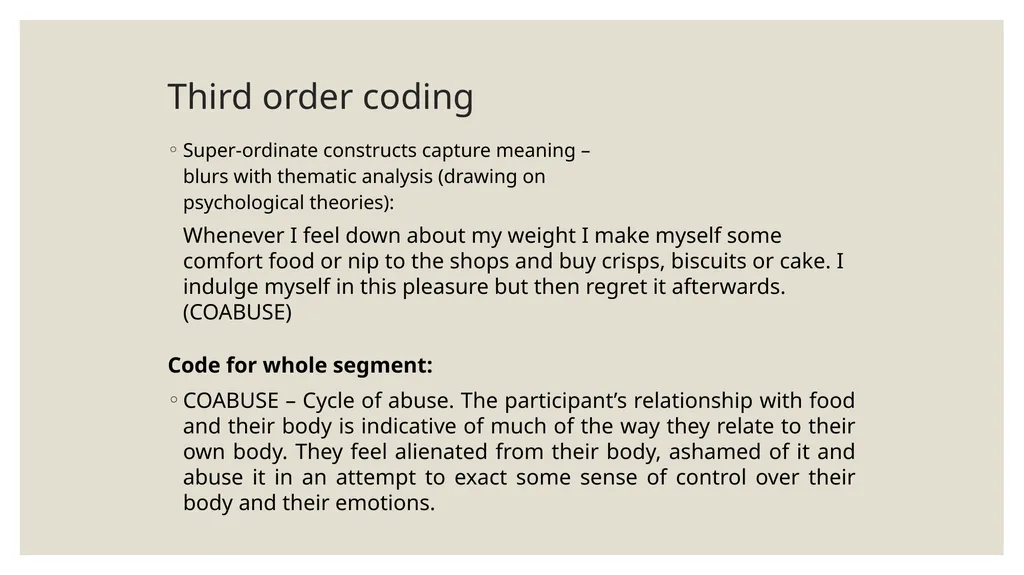
Third order coding Super-ordinate constructs capture meaning –
blurs with thematic analysis (drawing on
psychological theories):
Whenever I feel down about my weight I make myself some comfort food or nip to the shops and buy crisps, biscuits or cake. I indulge myself in this pleasure but then regret it afterwards. (COABUSE)
Code for whole segment:
COABUSE – Cycle of abuse. The participant’s relationship with food and their body is indicative of much of the way they relate to their own body. They feel alienated from their body, ashamed of it and abuse it in an attempt to exact some sense of control over their body and their emotions.<br>
blurs with thematic analysis (drawing on
psychological theories):
Whenever I feel down about my weight I make myself some comfort food or nip to the shops and buy crisps, biscuits or cake. I indulge myself in this pleasure but then regret it afterwards. (COABUSE)
Code for whole segment:
COABUSE – Cycle of abuse. The participant’s relationship with food and their body is indicative of much of the way they relate to their own body. They feel alienated from their body, ashamed of it and abuse it in an attempt to exact some sense of control over their body and their emotions.<br>
48
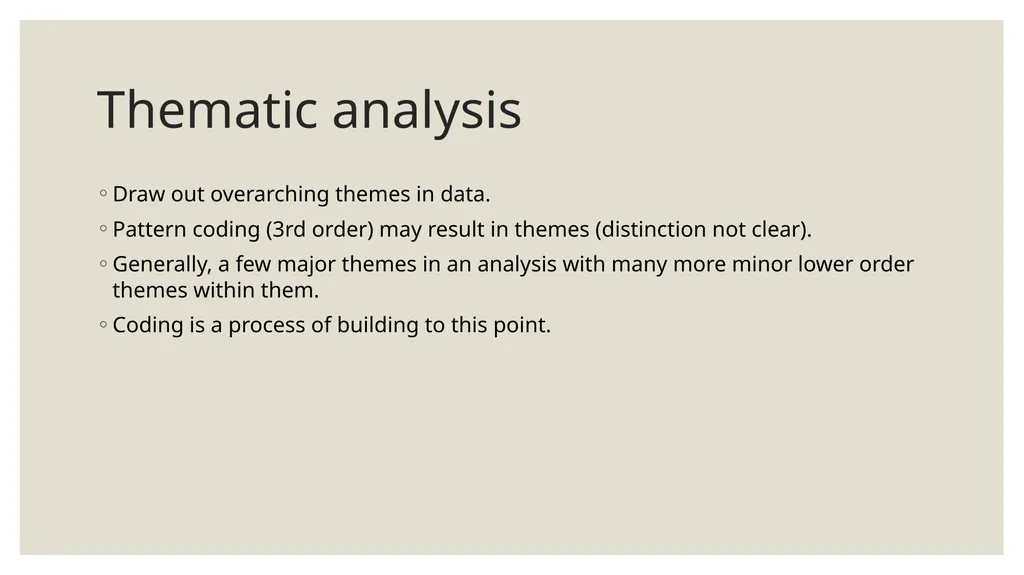
Thematic analysis Draw out overarching themes in data.
Pattern coding (3rd order) may result in themes (distinction not clear).
Generally, a few major themes in an analysis with many more minor lower order themes within them.
Coding is a process of building to this point.<br>
Pattern coding (3rd order) may result in themes (distinction not clear).
Generally, a few major themes in an analysis with many more minor lower order themes within them.
Coding is a process of building to this point.<br>
49
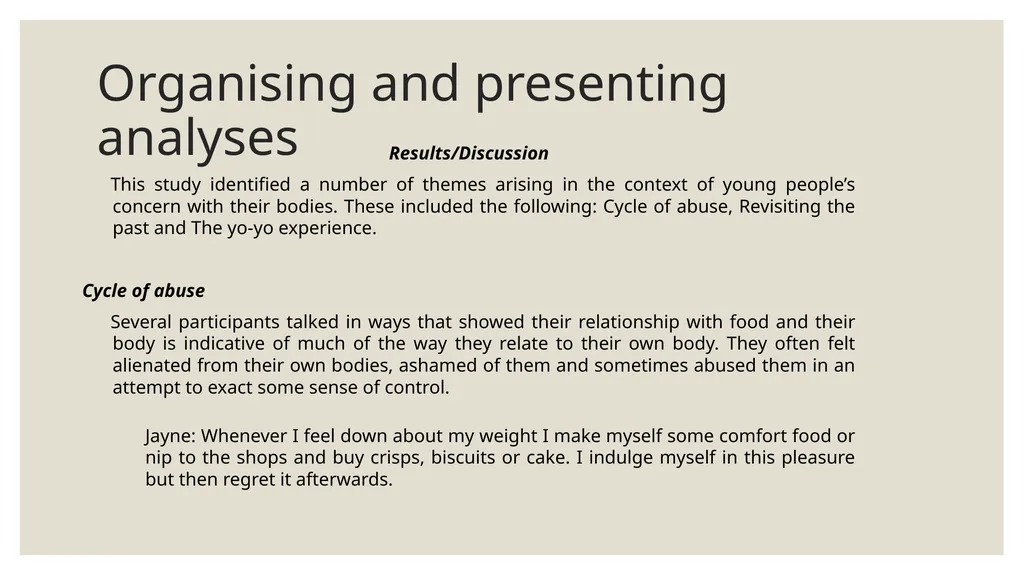
Organising and presenting analyses Results/Discussion
This study identified a number of themes arising in the context of young people’s concern with their bodies. These included the following: Cycle of abuse, Revisiting the past and The yo-yo experience.
Cycle of abuse
Several participants talked in ways that showed their relationship with food and their body is indicative of much of the way they relate to their own body. They often felt alienated from their own bodies, ashamed of them and sometimes abused them in an attempt to exact some sense of control.
Jayne: Whenever I feel down about my weight I make myself some comfort food or nip to the shops and buy crisps, biscuits or cake. I indulge myself in this pleasure but then regret it afterwards.<br>
This study identified a number of themes arising in the context of young people’s concern with their bodies. These included the following: Cycle of abuse, Revisiting the past and The yo-yo experience.
Cycle of abuse
Several participants talked in ways that showed their relationship with food and their body is indicative of much of the way they relate to their own body. They often felt alienated from their own bodies, ashamed of them and sometimes abused them in an attempt to exact some sense of control.
Jayne: Whenever I feel down about my weight I make myself some comfort food or nip to the shops and buy crisps, biscuits or cake. I indulge myself in this pleasure but then regret it afterwards.<br>