
Quality Improvement Planning Workbook © 2021
JO
Published · 48 slides · 0 views
1 / 1
Description
Quality Improvement Planning Workbook 2021 Australian Childrens Education and Care Quality Authority Copyright in this workbook and any materials included in the Quality Improvement Program is owned by ACECQA. The workbook and related
Related Topics
Share
Embed code
Download this presentation From Below
"Quality Improvement Planning Workbook © 2021" is the property of its rightful owner. Permission is granted to download and print the materials on this website for personal, non-commercial use only, and to display it on your personal computer provided you do not modify the materials and that you retain all copyright notices contained in the materials. By downloading content from our website, you accept the terms of this agreement.
Presentation Transcript
01
Quality Improvement Planning Workbook © 2021 Australian Children’s Education and Care Quality Authority Copyright in this workbook and any materials included in the Quality Improvement Program is owned by ACECQA. The workbook and related materials cannot be modified or adapted without written permission from ACECQA.<br>
02
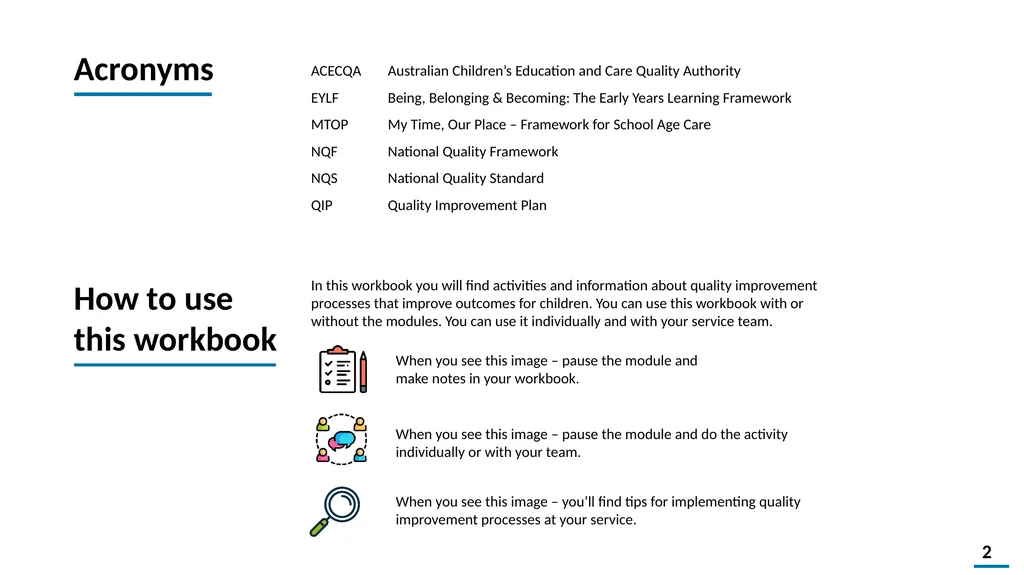
Acronyms ACECQA Australian Children’s Education and Care Quality Authority
EYLF Being, Belonging & Becoming: The Early Years Learning Framework
MTOP My Time, Our Place – Framework for School Age Care
NQF National Quality Framework
NQS National Quality Standard
QIP Quality Improvement Plan 2 How to use this workbook In this workbook you will find activities and information about quality improvement processes that improve outcomes for children. You can use this workbook with or without the modules. You can use it individually and with your service team. When you see this image – pause the module and make notes in your workbook. When you see this image – pause the module and do the activity individually or with your team. When you see this image – you’ll find tips for implementing quality improvement processes at your service.<br>
EYLF Being, Belonging & Becoming: The Early Years Learning Framework
MTOP My Time, Our Place – Framework for School Age Care
NQF National Quality Framework
NQS National Quality Standard
QIP Quality Improvement Plan 2 How to use this workbook In this workbook you will find activities and information about quality improvement processes that improve outcomes for children. You can use this workbook with or without the modules. You can use it individually and with your service team. When you see this image – pause the module and make notes in your workbook. When you see this image – pause the module and do the activity individually or with your team. When you see this image – you’ll find tips for implementing quality improvement processes at your service.<br>
03
Reflections of learning Notes 3<br>
04
Module 1 – Self-assessment 4<br>
05
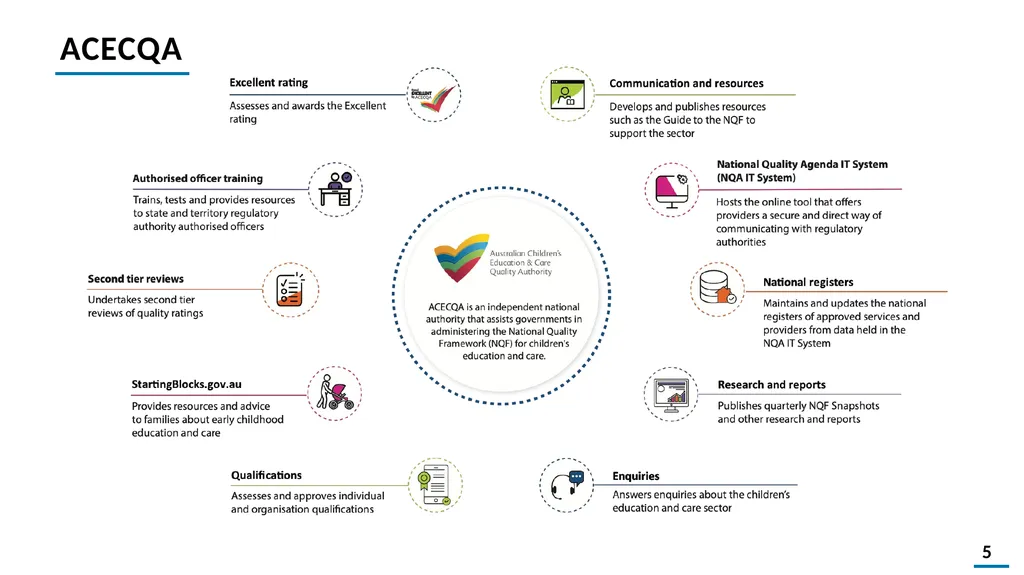
ACECQA 5<br>
06
Activity 1 Write down what do you already know about the
National Quality Standard (NQS)? 6<br>
07
7<br>
08
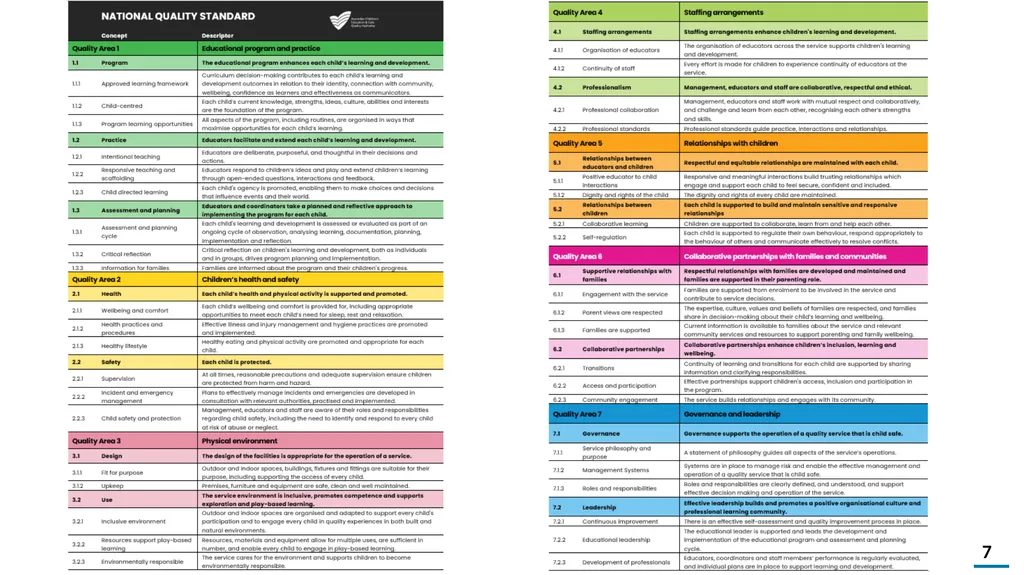
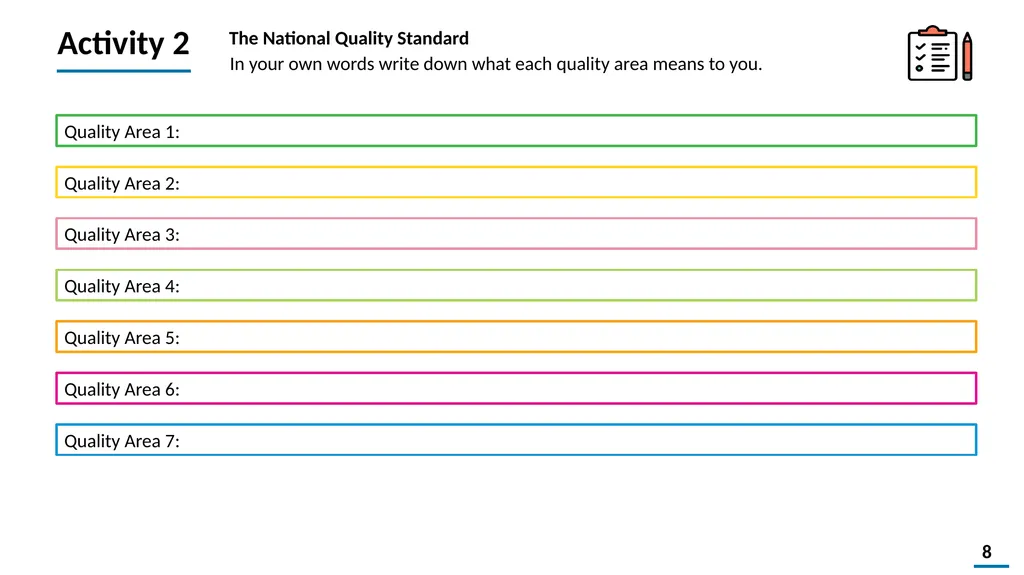
Quality Area 1: Quality Area 7: Quality Area 6: Quality Area 5: Quality Area 4: Quality Area 3: Quality Area 2: In your own words write down what each quality area means to you. Activity 2 The National Quality Standard 8<br>
09
QIP
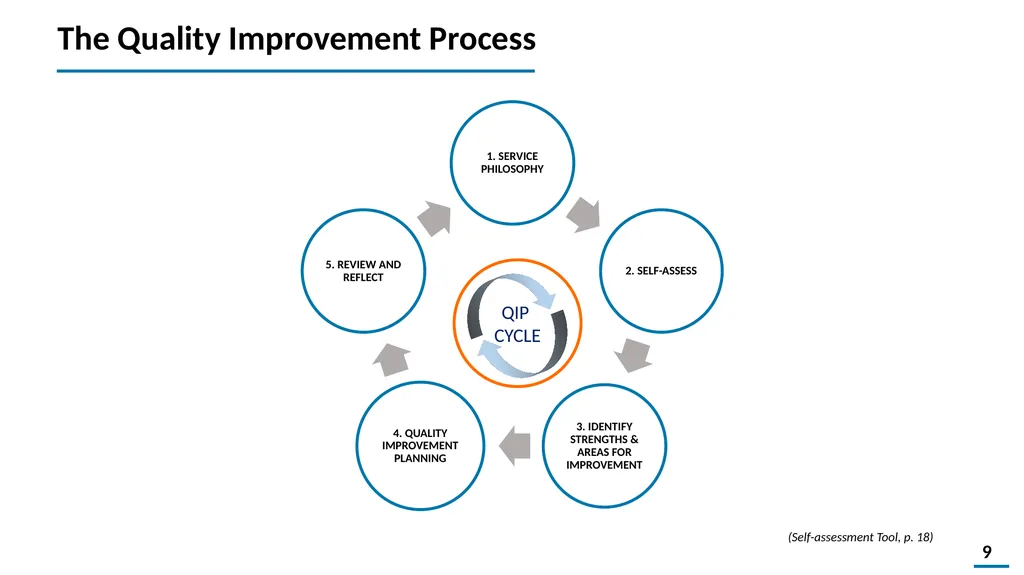
CYCLE 9 (Self-assessment Tool, p. 18) The Quality Improvement Process 9<br>
CYCLE 9 (Self-assessment Tool, p. 18) The Quality Improvement Process 9<br>
10
Activity 3 Why are quality improvement planning processes important to children? 10<br>
11
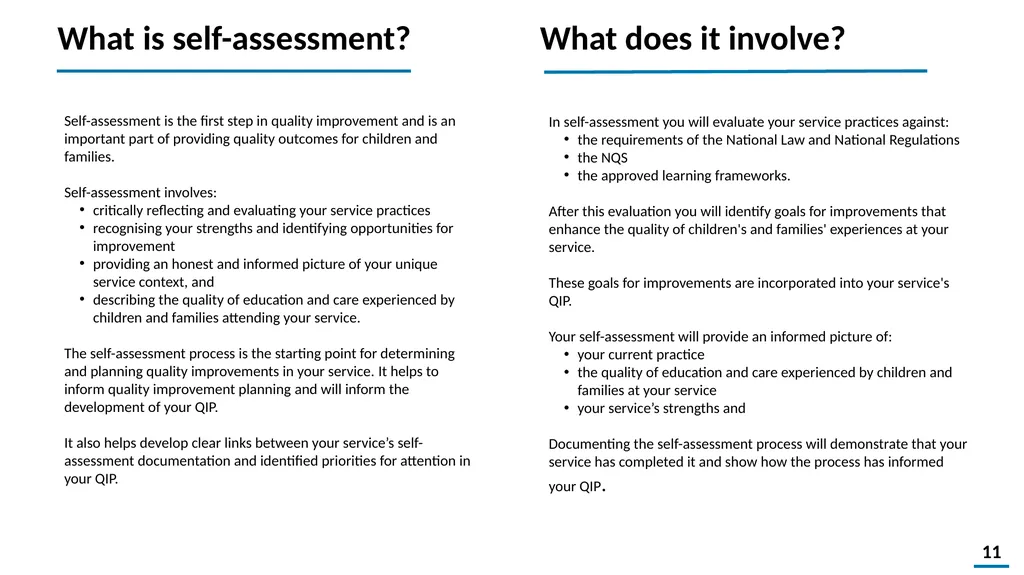
Self-assessment is the first step in quality improvement and is an important part of providing quality outcomes for children and families.
Self-assessment involves:
critically reflecting and evaluating your service practices
recognising your strengths and identifying opportunities for improvement
providing an honest and informed picture of your unique service context, and
describing the quality of education and care experienced by children and families attending your service.
The self-assessment process is the starting point for determining and planning quality improvements in your service. It helps to inform quality improvement planning and will inform the development of your QIP.
It also helps develop clear links between your service’s self-assessment documentation and identified priorities for attention in your QIP. What is self-assessment? 11 What does it involve? In self-assessment you will evaluate your service practices against:
the requirements of the National Law and National Regulations
the NQS
the approved learning frameworks.
After this evaluation you will identify goals for improvements that enhance the quality of children's and families' experiences at your service.
These goals for improvements are incorporated into your service's QIP.
Your self-assessment will provide an informed picture of:
your current practice
the quality of education and care experienced by children and families at your service
your service’s strengths and
Documenting the self-assessment process will demonstrate that your service has completed it and show how the process has informed your QIP.<br>
Self-assessment involves:
critically reflecting and evaluating your service practices
recognising your strengths and identifying opportunities for improvement
providing an honest and informed picture of your unique service context, and
describing the quality of education and care experienced by children and families attending your service.
The self-assessment process is the starting point for determining and planning quality improvements in your service. It helps to inform quality improvement planning and will inform the development of your QIP.
It also helps develop clear links between your service’s self-assessment documentation and identified priorities for attention in your QIP. What is self-assessment? 11 What does it involve? In self-assessment you will evaluate your service practices against:
the requirements of the National Law and National Regulations
the NQS
the approved learning frameworks.
After this evaluation you will identify goals for improvements that enhance the quality of children's and families' experiences at your service.
These goals for improvements are incorporated into your service's QIP.
Your self-assessment will provide an informed picture of:
your current practice
the quality of education and care experienced by children and families at your service
your service’s strengths and
Documenting the self-assessment process will demonstrate that your service has completed it and show how the process has informed your QIP.<br>
12
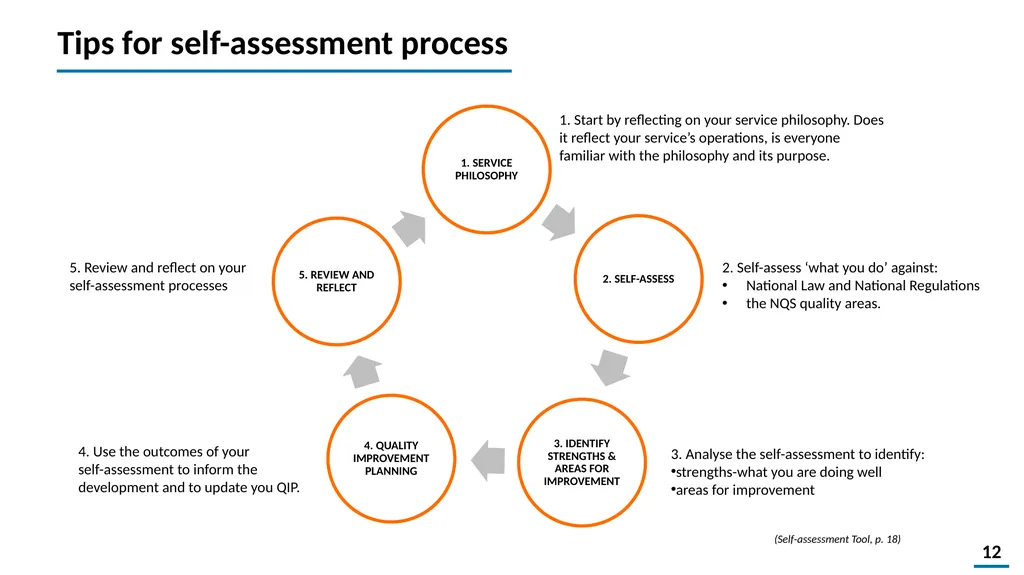
4. Use the outcomes of your
self-assessment to inform the development and to update you QIP. 5. Review and reflect on your self-assessment processes 1. Start by reflecting on your service philosophy. Does it reflect your service’s operations, is everyone familiar with the philosophy and its purpose. 2. Self-assess ‘what you do’ against:
National Law and National Regulations
the NQS quality areas. 3. Analyse the self-assessment to identify:
strengths-what you are doing well
areas for improvement (Self-assessment Tool, p. 18) Tips for self-assessment process 12<br>
National Law and National Regulations
the NQS quality areas. 3. Analyse the self-assessment to identify:
strengths-what you are doing well
areas for improvement (Self-assessment Tool, p. 18) Tips for self-assessment process 12<br>
13
Keep self-assessment active and ongoing
Staff meetings are an ideal opportunity to undertake critical reflection and self-assessment as a team.
You could identify a particular aspect of practice to discuss before the meeting, so that everyone has the chance to think about it beforehand. This will also empower staff to be involved in the self-assessment process.
Have an organised approach to continuous self-assessment which will help your service team stay focused on quality improvement.
Using an organised approach means:
having a plan to regularly review all aspects of the NQS
keeping a record of what has been assessed and when that occurred
sharing the responsibility amongst the team. Tips for self-assessment 13<br>
Staff meetings are an ideal opportunity to undertake critical reflection and self-assessment as a team.
You could identify a particular aspect of practice to discuss before the meeting, so that everyone has the chance to think about it beforehand. This will also empower staff to be involved in the self-assessment process.
Have an organised approach to continuous self-assessment which will help your service team stay focused on quality improvement.
Using an organised approach means:
having a plan to regularly review all aspects of the NQS
keeping a record of what has been assessed and when that occurred
sharing the responsibility amongst the team. Tips for self-assessment 13<br>
14
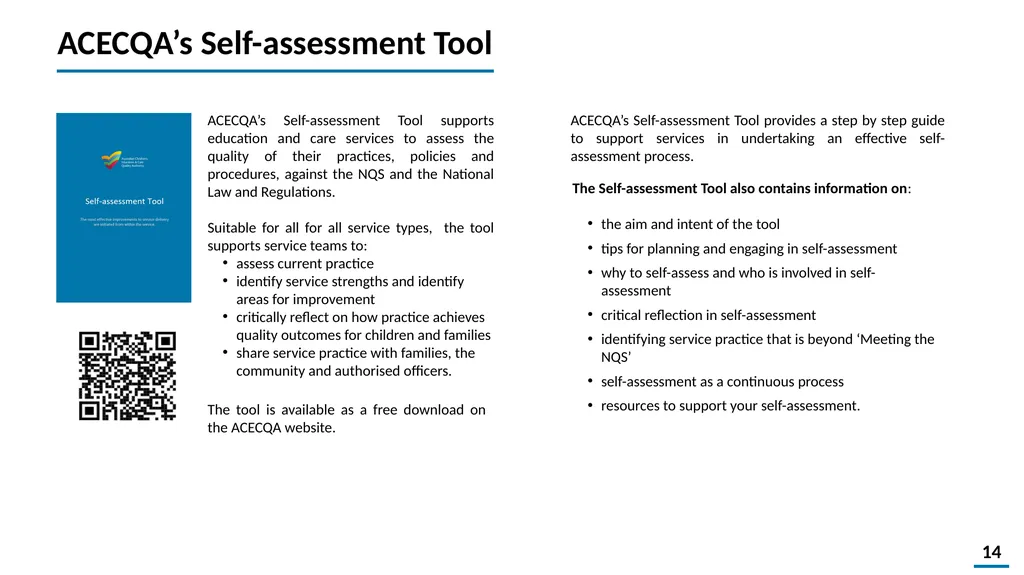
ACECQA’s Self-assessment Tool supports education and care services to assess the quality of their practices, policies and procedures, against the NQS and the National Law and Regulations.
Suitable for all for all service types, the tool supports service teams to:
assess current practice
identify service strengths and identify areas for improvement
critically reflect on how practice achieves quality outcomes for children and families
share service practice with families, the community and authorised officers. The tool is available as a free download on the ACECQA website. ACECQA’s Self-assessment Tool ACECQA’s Self-assessment Tool provides a step by step guide to support services in undertaking an effective self-assessment process. The Self-assessment Tool also contains information on:
the aim and intent of the tool
tips for planning and engaging in self-assessment
why to self-assess and who is involved in self-assessment
critical reflection in self-assessment
identifying service practice that is beyond ‘Meeting the NQS’
self-assessment as a continuous process
resources to support your self-assessment. 14<br>
Suitable for all for all service types, the tool supports service teams to:
assess current practice
identify service strengths and identify areas for improvement
critically reflect on how practice achieves quality outcomes for children and families
share service practice with families, the community and authorised officers. The tool is available as a free download on the ACECQA website. ACECQA’s Self-assessment Tool ACECQA’s Self-assessment Tool provides a step by step guide to support services in undertaking an effective self-assessment process. The Self-assessment Tool also contains information on:
the aim and intent of the tool
tips for planning and engaging in self-assessment
why to self-assess and who is involved in self-assessment
critical reflection in self-assessment
identifying service practice that is beyond ‘Meeting the NQS’
self-assessment as a continuous process
resources to support your self-assessment. 14<br>
15
ACECQA’s Self-assessment Tool provides a series of reflective questions to help you document your practices. Use these with your service team as you consider each quality area of the NQS.
What practices do we implement that demonstrates this standard?
How are our practices improving outcomes for children and families?
How do we demonstrate that our practice is typical for our service?
How do/could we articulate what informs our practice?
How do we engage with families and or the community?
What are the areas where we need to take immediate action?
What are the opportunities for quality improvement? ACECQA’s Self-assessment Tool 15<br>
What practices do we implement that demonstrates this standard?
How are our practices improving outcomes for children and families?
How do we demonstrate that our practice is typical for our service?
How do/could we articulate what informs our practice?
How do we engage with families and or the community?
What are the areas where we need to take immediate action?
What are the opportunities for quality improvement? ACECQA’s Self-assessment Tool 15<br>
16
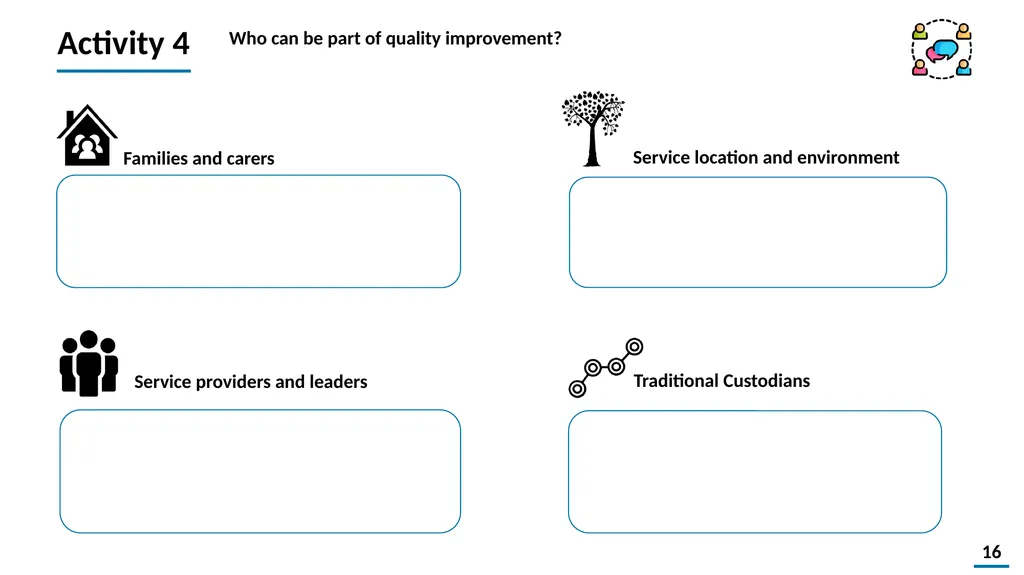
Service providers and leaders Families and carers Service location and environment Traditional Custodians 16 Activity 4 Who can be part of quality improvement? 16<br>
17
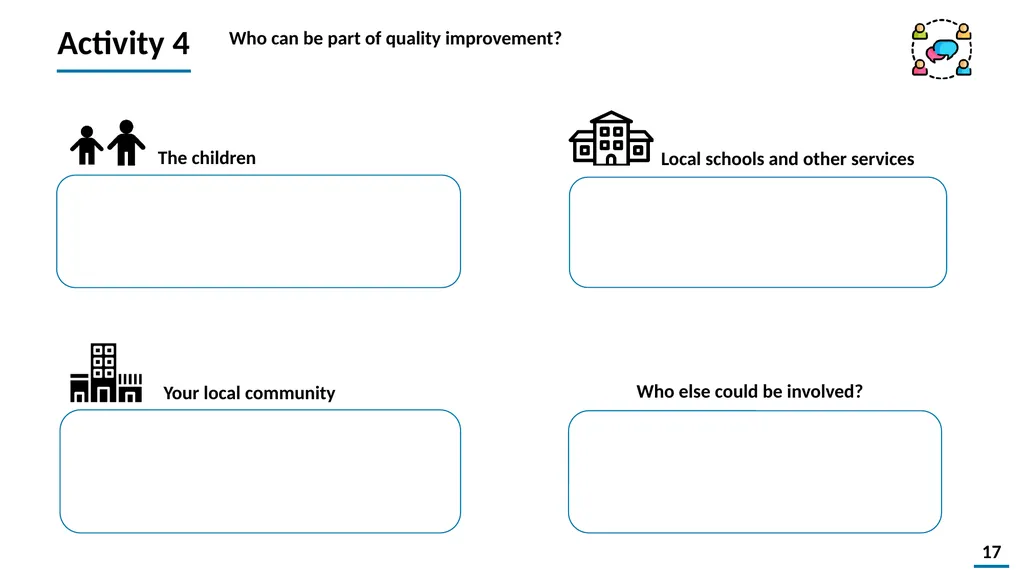
The children Local schools and other services Who else could be involved? Your local community Activity 4 Who can be part of quality improvement? 17<br>
18
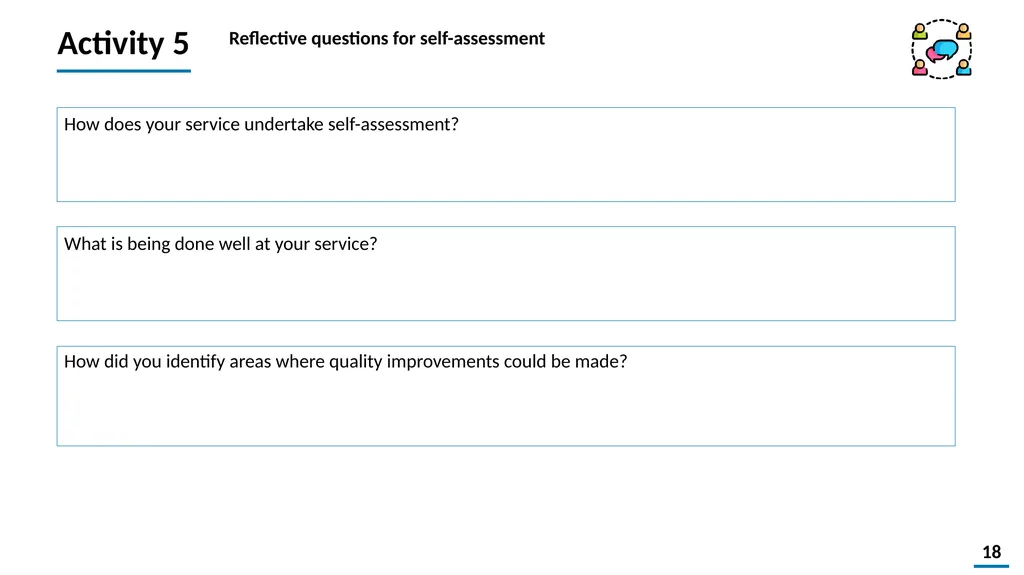
How does your service undertake self-assessment? What is being done well at your service? How did you identify areas where quality improvements could be made? Activity 5 Reflective questions for self-assessment 18<br>
19
Module 2 – Quality Improvement Plan 19<br>
20
The aim of a QIP is to help providers self-assess their performance in delivering quality education and care, and to plan future improvements.
A QIP must:
include an assessment of the programs and practices at the service against the NQS and National Regulations
identify areas for improvement
include a statement about the service’s philosophy.
A QIP will also showcase and celebrate your service's strengths. What is a Quality Improvement Plan (QIP)? 20<br>
A QIP must:
include an assessment of the programs and practices at the service against the NQS and National Regulations
identify areas for improvement
include a statement about the service’s philosophy.
A QIP will also showcase and celebrate your service's strengths. What is a Quality Improvement Plan (QIP)? 20<br>
21
List four things you know about your service QIP.
How are you involved in developing the QIP?
Write down two improvements you think are important at your service. Activity 1 Reflect on your service QIP 21<br>
How are you involved in developing the QIP?
Write down two improvements you think are important at your service. Activity 1 Reflect on your service QIP 21<br>
22
The National Legislation states that a QIP must:
include a statement about the service’s philosophy
include an assessment of the programs and practices at the service against the NQS and National Regulations
identify areas for improvement
be prepared for a new service within 3 months of the service approval being granted and provided to the regulatory authority upon request
be updated at least once a year
be available on request by the regulatory authority or families of a child enrolled or looking to enrol at the service.
*Penalties may apply The Legislative QIP Requirements 22<br>
include a statement about the service’s philosophy
include an assessment of the programs and practices at the service against the NQS and National Regulations
identify areas for improvement
be prepared for a new service within 3 months of the service approval being granted and provided to the regulatory authority upon request
be updated at least once a year
be available on request by the regulatory authority or families of a child enrolled or looking to enrol at the service.
*Penalties may apply The Legislative QIP Requirements 22<br>
23
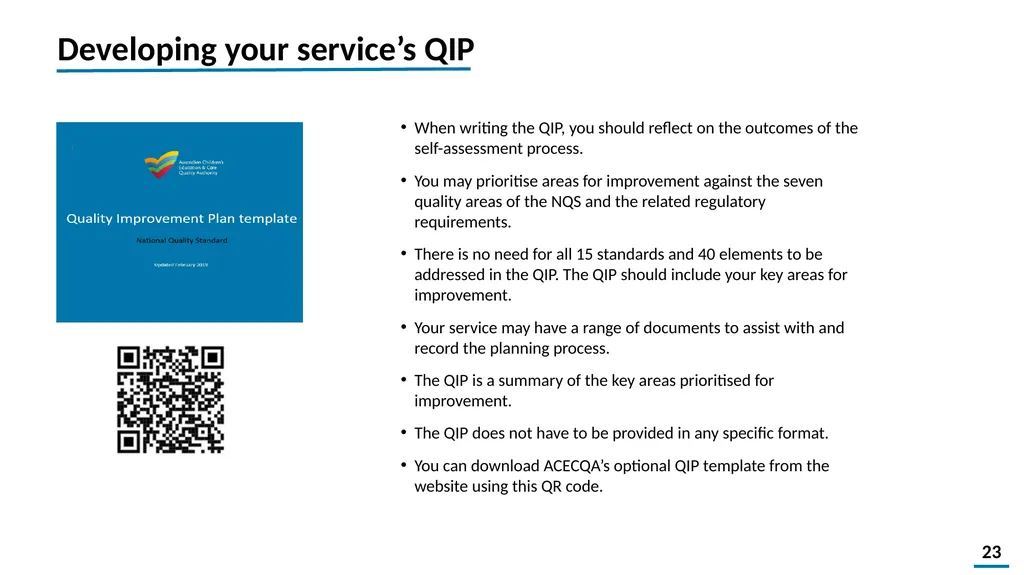
When writing the QIP, you should reflect on the outcomes of the self-assessment process.
You may prioritise areas for improvement against the seven quality areas of the NQS and the related regulatory requirements.
There is no need for all 15 standards and 40 elements to be addressed in the QIP. The QIP should include your key areas for improvement.
Your service may have a range of documents to assist with and record the planning process.
The QIP is a summary of the key areas prioritised for improvement.
The QIP does not have to be provided in any specific format.
You can download ACECQA’s optional QIP template from the website using this QR code. Developing your service’s QIP 23<br>
You may prioritise areas for improvement against the seven quality areas of the NQS and the related regulatory requirements.
There is no need for all 15 standards and 40 elements to be addressed in the QIP. The QIP should include your key areas for improvement.
Your service may have a range of documents to assist with and record the planning process.
The QIP is a summary of the key areas prioritised for improvement.
The QIP does not have to be provided in any specific format.
You can download ACECQA’s optional QIP template from the website using this QR code. Developing your service’s QIP 23<br>
24
Your service’s philosophy helps to guide all of your service’s operations including your continuous improvement strategies.
A statement of philosophy serves three purposes. It:
underpins the decisions, policies and daily practices of your service
reflects a shared understanding of the role of your service among staff, children, families and the community
guides educators in developing an educational program and practice that supports their beliefs and values about children’s learning.
Your philosophy will support your service’s broader vision for quality and quality improvement.
A statement of philosophy is more than a vision statement. Your service philosophy is the ‘why’ behind your work with children, their families and each other.
Your service philosophy should reflect the unique ‘personality’ and context of your service and be a shared vision. It should guide decision-making, policies, daily practices and the program and express a shared understanding of the role of your unique service to educators, children, families and the community. Developing your QIP - your service philosophy 24<br>
A statement of philosophy serves three purposes. It:
underpins the decisions, policies and daily practices of your service
reflects a shared understanding of the role of your service among staff, children, families and the community
guides educators in developing an educational program and practice that supports their beliefs and values about children’s learning.
Your philosophy will support your service’s broader vision for quality and quality improvement.
A statement of philosophy is more than a vision statement. Your service philosophy is the ‘why’ behind your work with children, their families and each other.
Your service philosophy should reflect the unique ‘personality’ and context of your service and be a shared vision. It should guide decision-making, policies, daily practices and the program and express a shared understanding of the role of your unique service to educators, children, families and the community. Developing your QIP - your service philosophy 24<br>
25
Write down or draw three strongly-held beliefs at your service.
Write down or draw what is unique about your service? How is it different to other services? Activity 2 Reflecting on your service philosophy – part 1 25<br>
Write down or draw what is unique about your service? How is it different to other services? Activity 2 Reflecting on your service philosophy – part 1 25<br>
26
Are these strongly-held beliefs visible in your philosophy?
How does your service philosophy and your unique practices provide a clear picture of your service delivery? Activity 2 Reflecting on your service philosophy – part 2 26<br>
How does your service philosophy and your unique practices provide a clear picture of your service delivery? Activity 2 Reflecting on your service philosophy – part 2 26<br>
27
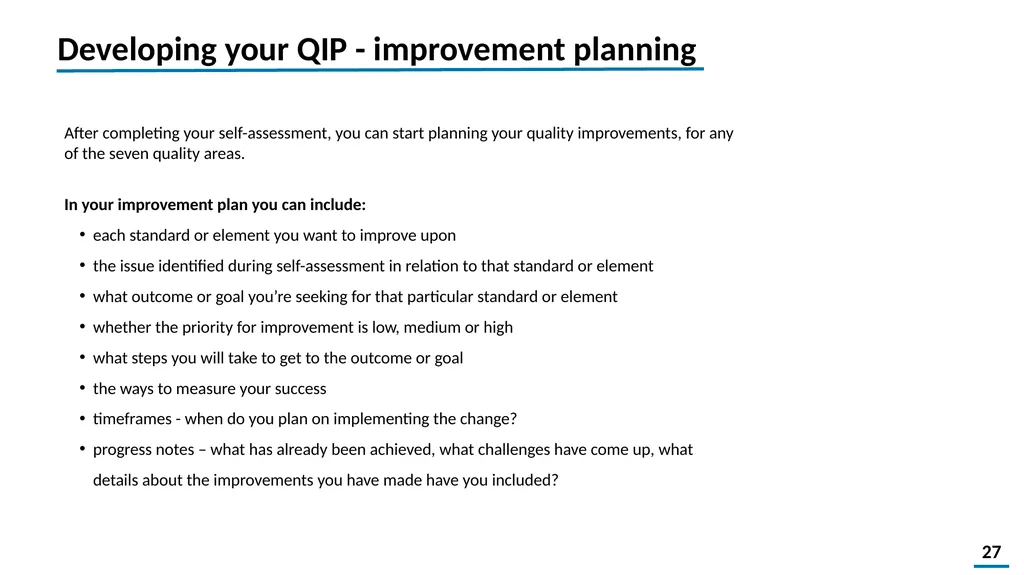
After completing your self-assessment, you can start planning your quality improvements, for any of the seven quality areas.
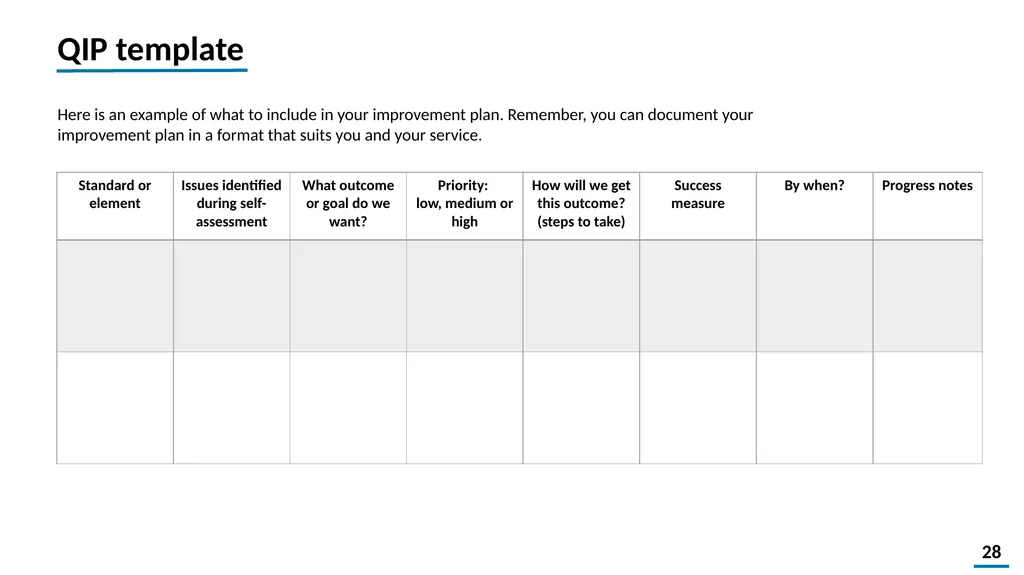
In your improvement plan you can include:
each standard or element you want to improve upon
the issue identified during self-assessment in relation to that standard or element
what outcome or goal you’re seeking for that particular standard or element
whether the priority for improvement is low, medium or high
what steps you will take to get to the outcome or goal
the ways to measure your success
timeframes - when do you plan on implementing the change?
progress notes – what has already been achieved, what challenges have come up, what details about the improvements you have made have you included? Developing your QIP - improvement planning 27<br>
In your improvement plan you can include:
each standard or element you want to improve upon
the issue identified during self-assessment in relation to that standard or element
what outcome or goal you’re seeking for that particular standard or element
whether the priority for improvement is low, medium or high
what steps you will take to get to the outcome or goal
the ways to measure your success
timeframes - when do you plan on implementing the change?
progress notes – what has already been achieved, what challenges have come up, what details about the improvements you have made have you included? Developing your QIP - improvement planning 27<br>
28
Here is an example of what to include in your improvement plan. Remember, you can document your improvement plan in a format that suits you and your service. QIP template 28<br>
29
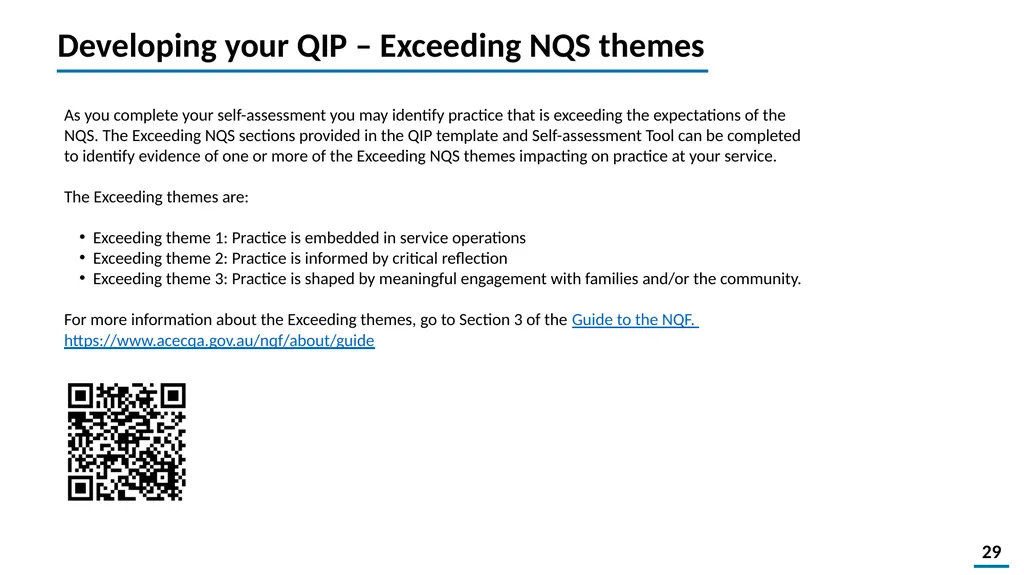
As you complete your self-assessment you may identify practice that is exceeding the expectations of the NQS. The Exceeding NQS sections provided in the QIP template and Self-assessment Tool can be completed to identify evidence of one or more of the Exceeding NQS themes impacting on practice at your service.
The Exceeding themes are:
Exceeding theme 1: Practice is embedded in service operations
Exceeding theme 2: Practice is informed by critical reflection
Exceeding theme 3: Practice is shaped by meaningful engagement with families and/or the community.
For more information about the Exceeding themes, go to Section 3 of the Guide to the NQF.
https://www.acecqa.gov.au/nqf/about/guide Developing your QIP – Exceeding NQS themes 29<br>
The Exceeding themes are:
Exceeding theme 1: Practice is embedded in service operations
Exceeding theme 2: Practice is informed by critical reflection
Exceeding theme 3: Practice is shaped by meaningful engagement with families and/or the community.
For more information about the Exceeding themes, go to Section 3 of the Guide to the NQF.
https://www.acecqa.gov.au/nqf/about/guide Developing your QIP – Exceeding NQS themes 29<br>
30
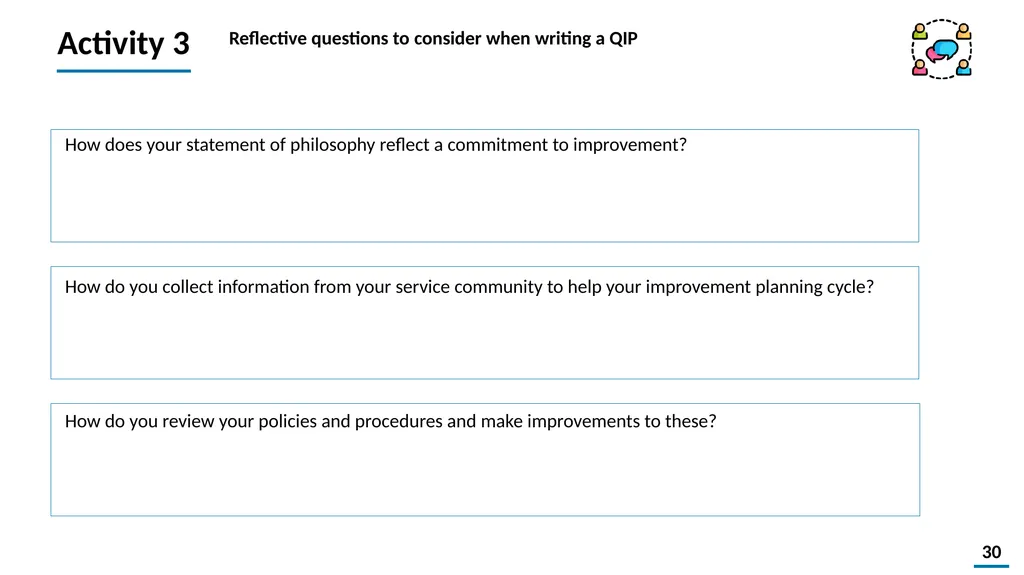
Activity 3 Reflective questions to consider when writing a QIP 30<br>
31
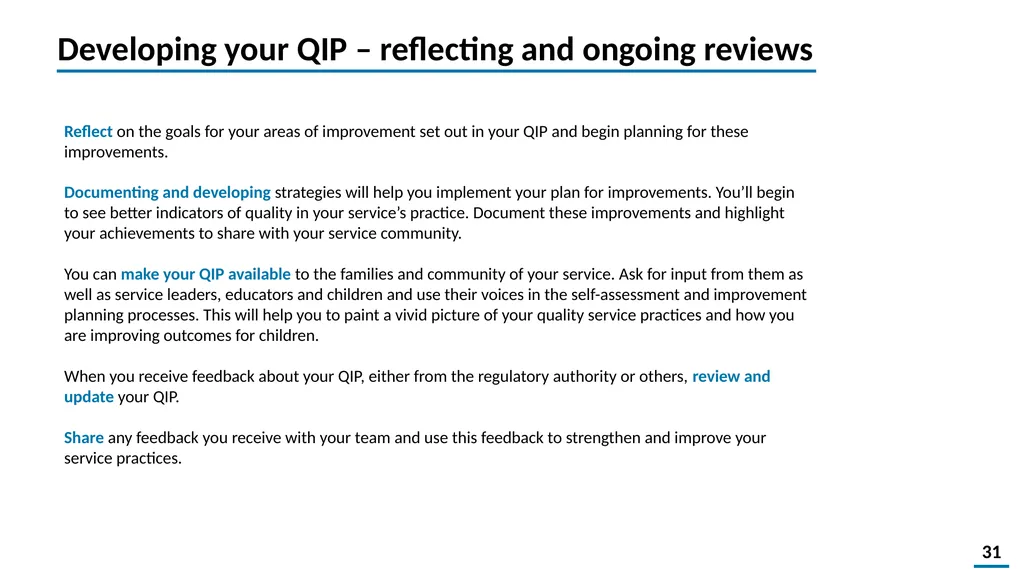
Reflect on the goals for your areas of improvement set out in your QIP and begin planning for these improvements.
Documenting and developing strategies will help you implement your plan for improvements. You’ll begin to see better indicators of quality in your service’s practice. Document these improvements and highlight your achievements to share with your service community.
You can make your QIP available to the families and community of your service. Ask for input from them as well as service leaders, educators and children and use their voices in the self-assessment and improvement planning processes. This will help you to paint a vivid picture of your quality service practices and how you are improving outcomes for children.
When you receive feedback about your QIP, either from the regulatory authority or others, review and update your QIP.
Share any feedback you receive with your team and use this feedback to strengthen and improve your service practices. Developing your QIP – reflecting and ongoing reviews 31<br>
Documenting and developing strategies will help you implement your plan for improvements. You’ll begin to see better indicators of quality in your service’s practice. Document these improvements and highlight your achievements to share with your service community.
You can make your QIP available to the families and community of your service. Ask for input from them as well as service leaders, educators and children and use their voices in the self-assessment and improvement planning processes. This will help you to paint a vivid picture of your quality service practices and how you are improving outcomes for children.
When you receive feedback about your QIP, either from the regulatory authority or others, review and update your QIP.
Share any feedback you receive with your team and use this feedback to strengthen and improve your service practices. Developing your QIP – reflecting and ongoing reviews 31<br>
32
Activity 4 Reflecting on your service QIP Think about the most recent feedback you have received about your QIP, practices, procedures or environments.
Write down any improvements that need to be made immediately to ensure the health, safety and wellbeing of children?
Write down four or five practices that you feel can be strengths listed in your QIP? 32<br>
Write down any improvements that need to be made immediately to ensure the health, safety and wellbeing of children?
Write down four or five practices that you feel can be strengths listed in your QIP? 32<br>
33
Module 3
Bringing it all together: quality improvement 33<br>
34
Activity 1 What makes your service unique? Individually or as a team, brainstorm as many things as you can that make you and your service unique. You can write or draw your ideas. 34<br>
35
Activity 2 Building a positive team culture Think about your role at the service and how your team works with each other. Write or draw:
How you are involved in building a positive team culture
How is the team already involved in the improvement processes at your service?
How could the team be more involved in the improvement processes at your service? 35<br>
How you are involved in building a positive team culture
How is the team already involved in the improvement processes at your service?
How could the team be more involved in the improvement processes at your service? 35<br>
36
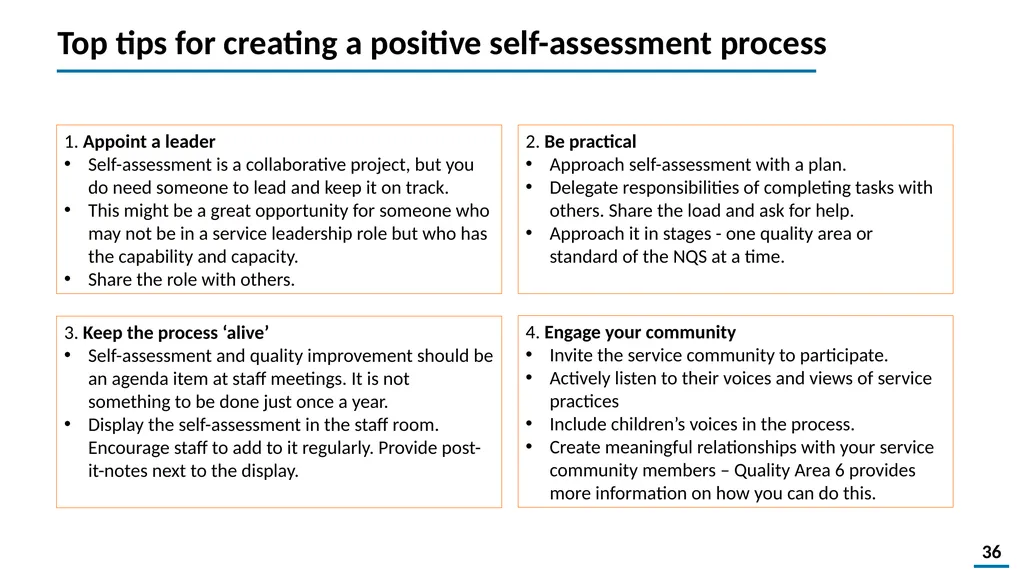
1. Appoint a leader
Self-assessment is a collaborative project, but you do need someone to lead and keep it on track.
This might be a great opportunity for someone who may not be in a service leadership role but who has the capability and capacity.
Share the role with others. 2. Be practical
Approach self-assessment with a plan.
Delegate responsibilities of completing tasks with others. Share the load and ask for help.
Approach it in stages - one quality area or standard of the NQS at a time. 3. Keep the process ‘alive’
Self-assessment and quality improvement should be an agenda item at staff meetings. It is not something to be done just once a year.
Display the self-assessment in the staff room. Encourage staff to add to it regularly. Provide post-it-notes next to the display. 4. Engage your community
Invite the service community to participate.
Actively listen to their voices and views of service practices
Include children’s voices in the process.
Create meaningful relationships with your service community members – Quality Area 6 provides more information on how you can do this. Top tips for creating a positive self-assessment process 36<br>
Self-assessment is a collaborative project, but you do need someone to lead and keep it on track.
This might be a great opportunity for someone who may not be in a service leadership role but who has the capability and capacity.
Share the role with others. 2. Be practical
Approach self-assessment with a plan.
Delegate responsibilities of completing tasks with others. Share the load and ask for help.
Approach it in stages - one quality area or standard of the NQS at a time. 3. Keep the process ‘alive’
Self-assessment and quality improvement should be an agenda item at staff meetings. It is not something to be done just once a year.
Display the self-assessment in the staff room. Encourage staff to add to it regularly. Provide post-it-notes next to the display. 4. Engage your community
Invite the service community to participate.
Actively listen to their voices and views of service practices
Include children’s voices in the process.
Create meaningful relationships with your service community members – Quality Area 6 provides more information on how you can do this. Top tips for creating a positive self-assessment process 36<br>
37
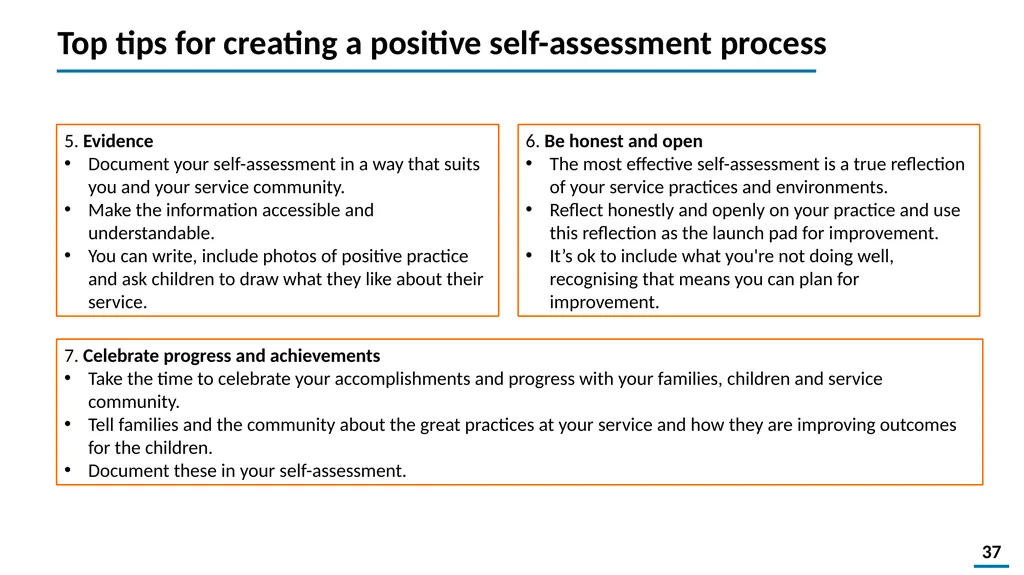
5. Evidence
Document your self-assessment in a way that suits you and your service community.
Make the information accessible and understandable.
You can write, include photos of positive practice and ask children to draw what they like about their service. 6. Be honest and open
The most effective self-assessment is a true reflection of your service practices and environments.
Reflect honestly and openly on your practice and use this reflection as the launch pad for improvement.
It’s ok to include what you're not doing well, recognising that means you can plan for improvement. 7. Celebrate progress and achievements
Take the time to celebrate your accomplishments and progress with your families, children and service community.
Tell families and the community about the great practices at your service and how they are improving outcomes for the children.
Document these in your self-assessment. Top tips for creating a positive self-assessment process 37<br>
Document your self-assessment in a way that suits you and your service community.
Make the information accessible and understandable.
You can write, include photos of positive practice and ask children to draw what they like about their service. 6. Be honest and open
The most effective self-assessment is a true reflection of your service practices and environments.
Reflect honestly and openly on your practice and use this reflection as the launch pad for improvement.
It’s ok to include what you're not doing well, recognising that means you can plan for improvement. 7. Celebrate progress and achievements
Take the time to celebrate your accomplishments and progress with your families, children and service community.
Tell families and the community about the great practices at your service and how they are improving outcomes for the children.
Document these in your self-assessment. Top tips for creating a positive self-assessment process 37<br>
38
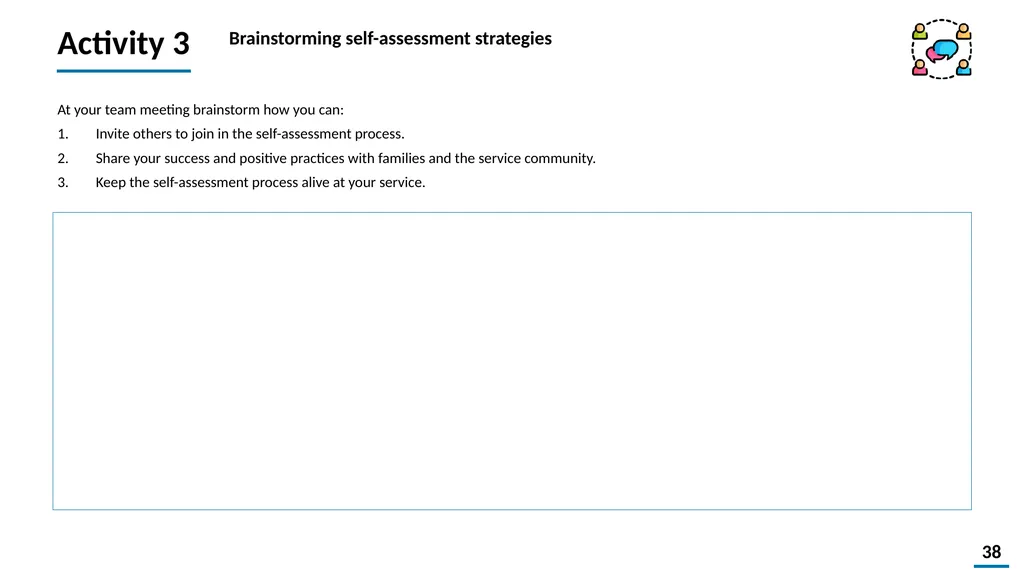
Activity 3 Brainstorming self-assessment strategies At your team meeting brainstorm how you can:
Invite others to join in the self-assessment process.
Share your success and positive practices with families and the service community.
Keep the self-assessment process alive at your service. 38<br>
Invite others to join in the self-assessment process.
Share your success and positive practices with families and the service community.
Keep the self-assessment process alive at your service. 38<br>
39
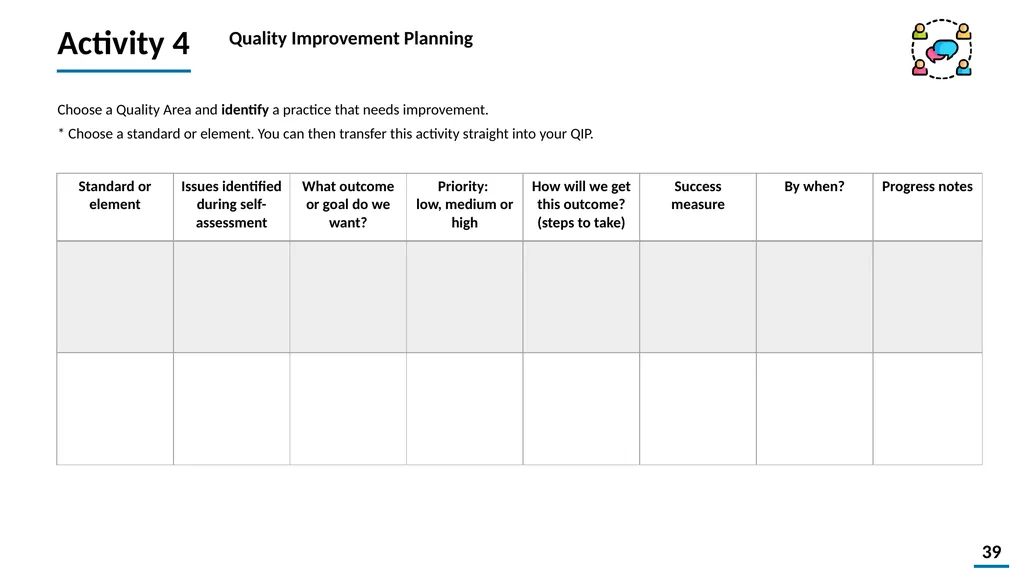
Activity 4 Quality Improvement Planning Choose a Quality Area and identify a practice that needs improvement.
* Choose a standard or element. You can then transfer this activity straight into your QIP. 39<br>
* Choose a standard or element. You can then transfer this activity straight into your QIP. 39<br>
40
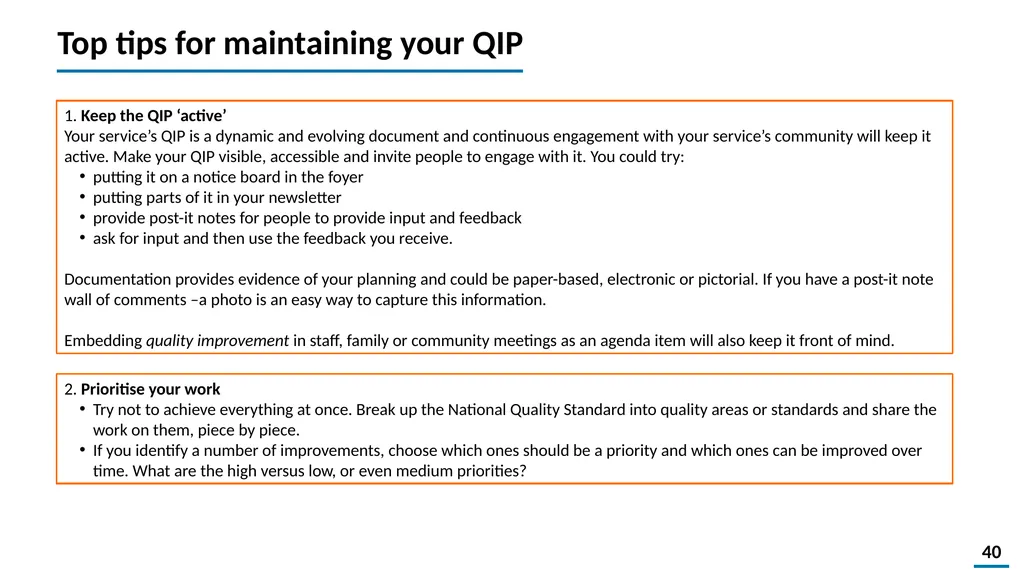
1. Keep the QIP ‘active’
Your service’s QIP is a dynamic and evolving document and continuous engagement with your service’s community will keep it active. Make your QIP visible, accessible and invite people to engage with it. You could try:
putting it on a notice board in the foyer
putting parts of it in your newsletter
provide post-it notes for people to provide input and feedback
ask for input and then use the feedback you receive.
Documentation provides evidence of your planning and could be paper-based, electronic or pictorial. If you have a post-it note wall of comments –a photo is an easy way to capture this information.
Embedding quality improvement in staff, family or community meetings as an agenda item will also keep it front of mind. 2. Prioritise your work
Try not to achieve everything at once. Break up the National Quality Standard into quality areas or standards and share the work on them, piece by piece.
If you identify a number of improvements, choose which ones should be a priority and which ones can be improved over time. What are the high versus low, or even medium priorities? Top tips for maintaining your QIP 40<br>
Your service’s QIP is a dynamic and evolving document and continuous engagement with your service’s community will keep it active. Make your QIP visible, accessible and invite people to engage with it. You could try:
putting it on a notice board in the foyer
putting parts of it in your newsletter
provide post-it notes for people to provide input and feedback
ask for input and then use the feedback you receive.
Documentation provides evidence of your planning and could be paper-based, electronic or pictorial. If you have a post-it note wall of comments –a photo is an easy way to capture this information.
Embedding quality improvement in staff, family or community meetings as an agenda item will also keep it front of mind. 2. Prioritise your work
Try not to achieve everything at once. Break up the National Quality Standard into quality areas or standards and share the work on them, piece by piece.
If you identify a number of improvements, choose which ones should be a priority and which ones can be improved over time. What are the high versus low, or even medium priorities? Top tips for maintaining your QIP 40<br>
41
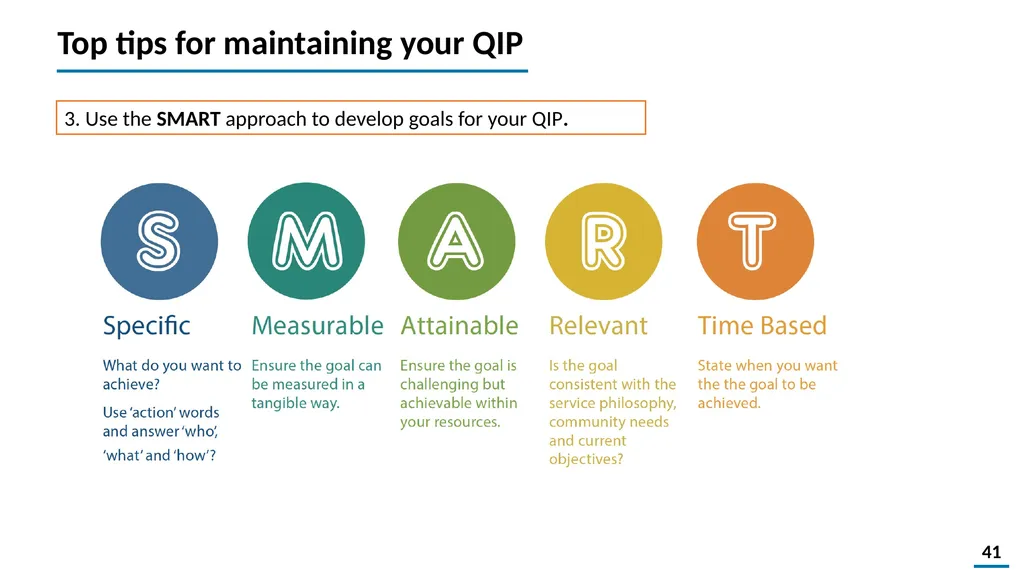
3. Use the SMART approach to develop goals for your QIP. 41 Top tips for maintaining your QIP 41<br>
42
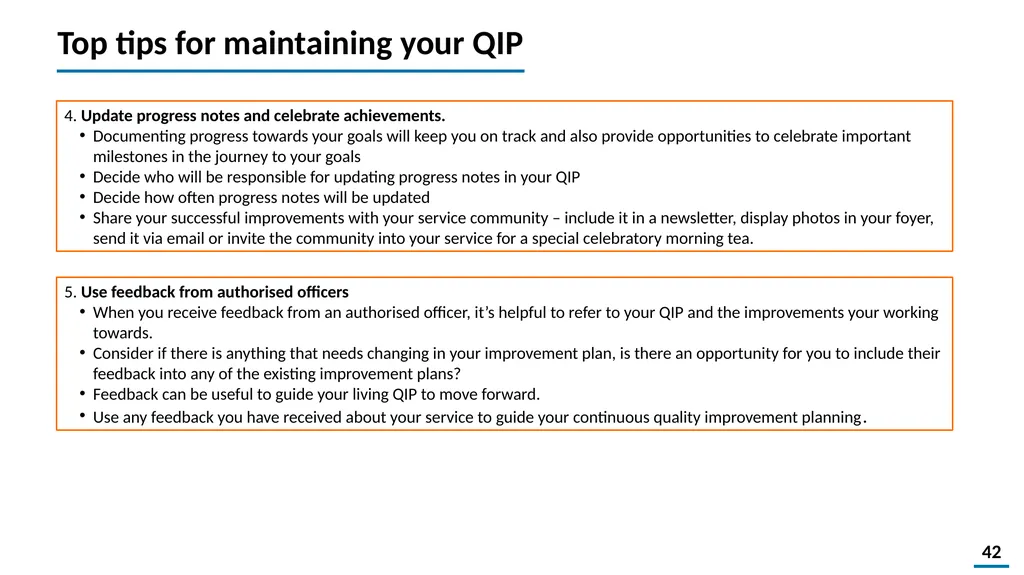
4. Update progress notes and celebrate achievements.
Documenting progress towards your goals will keep you on track and also provide opportunities to celebrate important milestones in the journey to your goals
Decide who will be responsible for updating progress notes in your QIP
Decide how often progress notes will be updated
Share your successful improvements with your service community – include it in a newsletter, display photos in your foyer, send it via email or invite the community into your service for a special celebratory morning tea. 5. Use feedback from authorised officers
When you receive feedback from an authorised officer, it’s helpful to refer to your QIP and the improvements your working towards.
Consider if there is anything that needs changing in your improvement plan, is there an opportunity for you to include their feedback into any of the existing improvement plans?
Feedback can be useful to guide your living QIP to move forward.
Use any feedback you have received about your service to guide your continuous quality improvement planning. Top tips for maintaining your QIP 42<br>
Documenting progress towards your goals will keep you on track and also provide opportunities to celebrate important milestones in the journey to your goals
Decide who will be responsible for updating progress notes in your QIP
Decide how often progress notes will be updated
Share your successful improvements with your service community – include it in a newsletter, display photos in your foyer, send it via email or invite the community into your service for a special celebratory morning tea. 5. Use feedback from authorised officers
When you receive feedback from an authorised officer, it’s helpful to refer to your QIP and the improvements your working towards.
Consider if there is anything that needs changing in your improvement plan, is there an opportunity for you to include their feedback into any of the existing improvement plans?
Feedback can be useful to guide your living QIP to move forward.
Use any feedback you have received about your service to guide your continuous quality improvement planning. Top tips for maintaining your QIP 42<br>
43
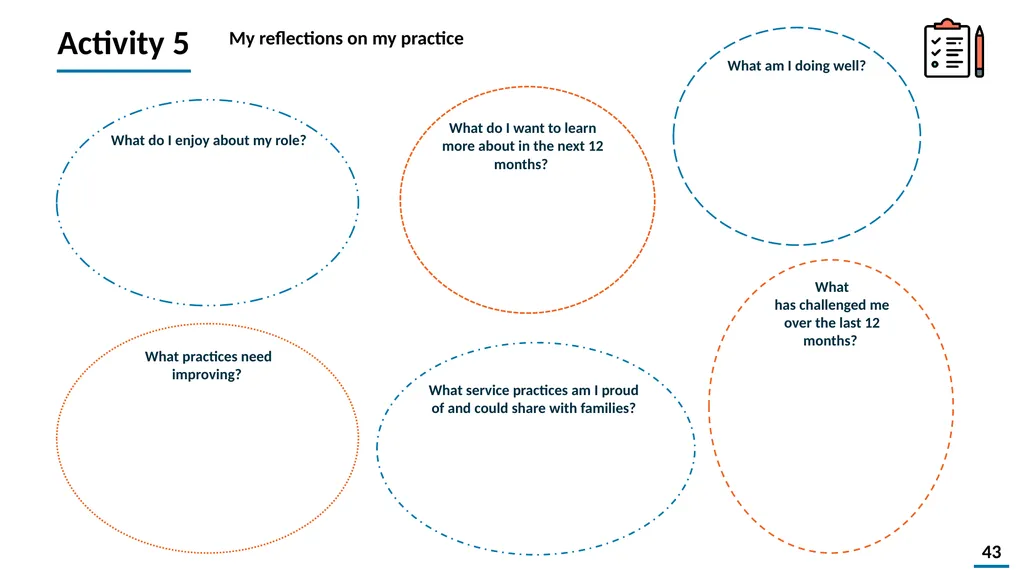
What do I enjoy about my role? What am I doing well? What
has challenged me over the last 12 months? What practices need improving? What do I want to learn more about in the next 12 months? What service practices am I proud of and could share with families? 43 Activity 5 My reflections on my practice 43<br>
has challenged me over the last 12 months? What practices need improving? What do I want to learn more about in the next 12 months? What service practices am I proud of and could share with families? 43 Activity 5 My reflections on my practice 43<br>
44
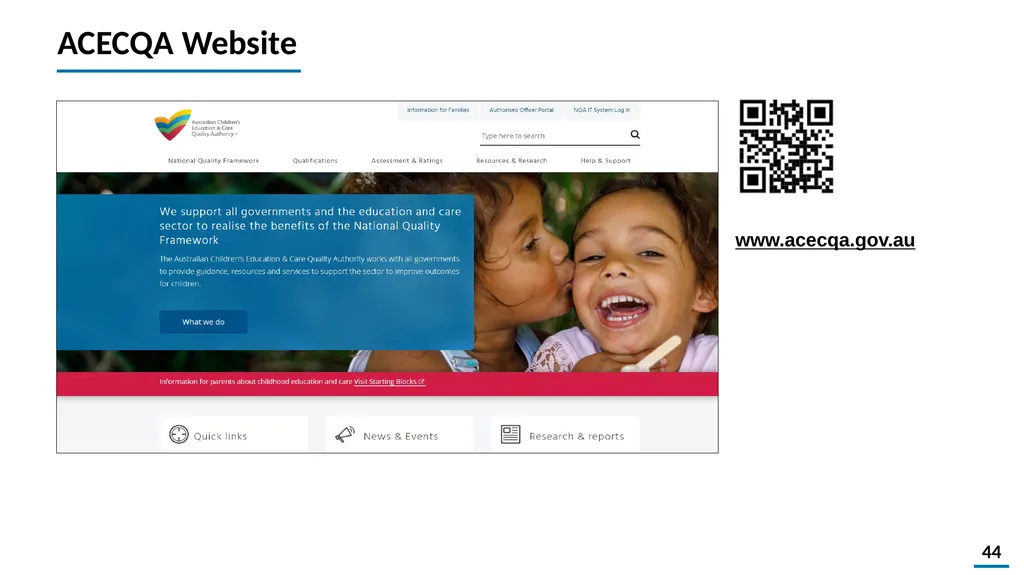
www.acecqa.gov.au ACECQA Website 44<br>
45
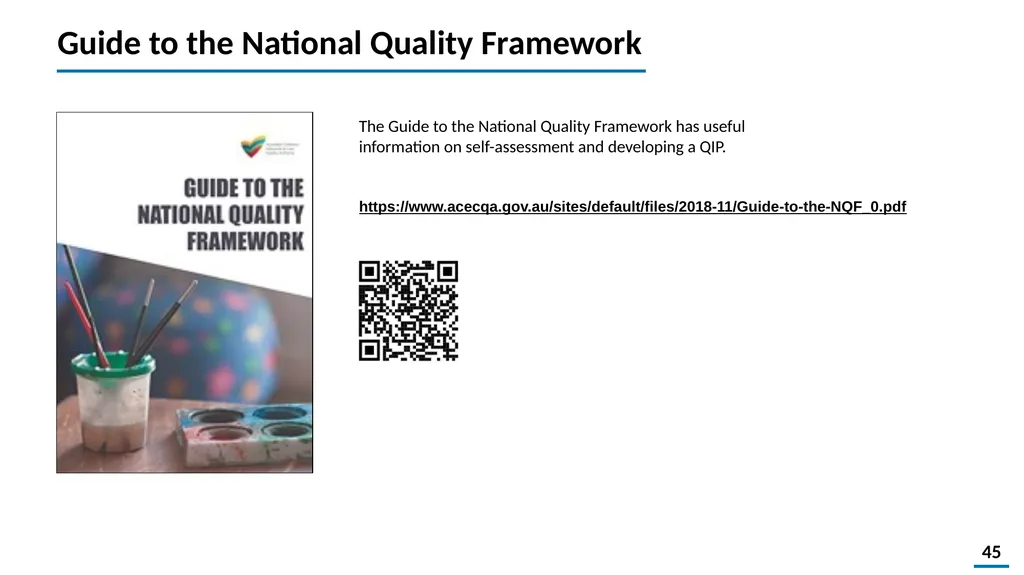
https://www.acecqa.gov.au/sites/default/files/2018-11/Guide-to-the-NQF_0.pdf The Guide to the National Quality Framework has useful information on self-assessment and developing a QIP. Guide to the National Quality Framework 45<br>
46
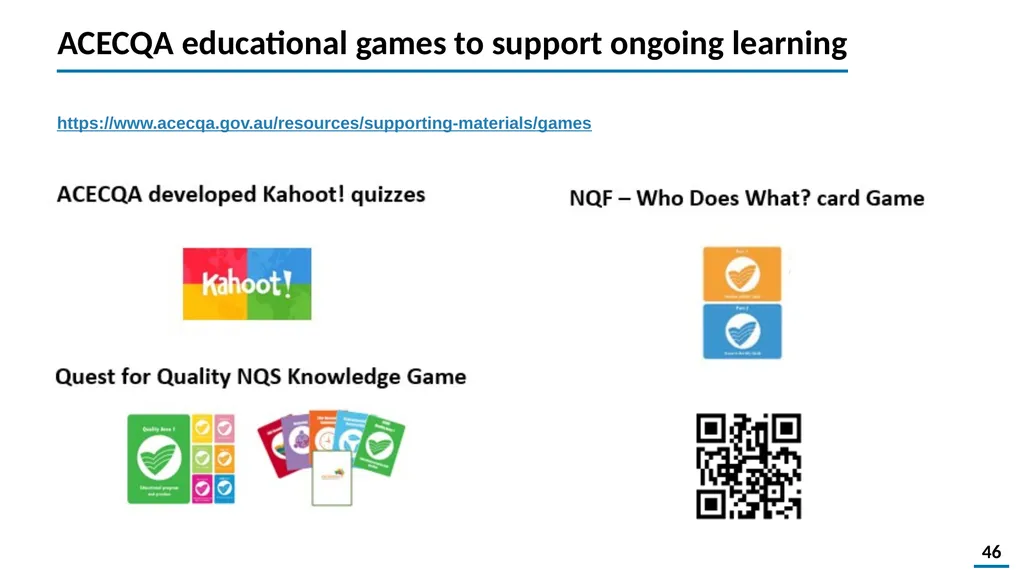
https://www.acecqa.gov.au/resources/supporting-materials/games ACECQA educational games to support ongoing learning 46<br>
47
ACECQA
Website: www.acecqa.gov.au
Email: info@acecqa.gov.au
Facebook: www.facebook.com/ACECQA
Phone: 1300 422 327
Subscribe to:
ACECQA Newsletter
‘We Hear You’ & NEL Blog ACECQA Contacts and subscriptions to support ongoing learning 47<br>
Website: www.acecqa.gov.au
Email: info@acecqa.gov.au
Facebook: www.facebook.com/ACECQA
Phone: 1300 422 327
Subscribe to:
ACECQA Newsletter
‘We Hear You’ & NEL Blog ACECQA Contacts and subscriptions to support ongoing learning 47<br>
48
Follow up actions Notes 48<br>