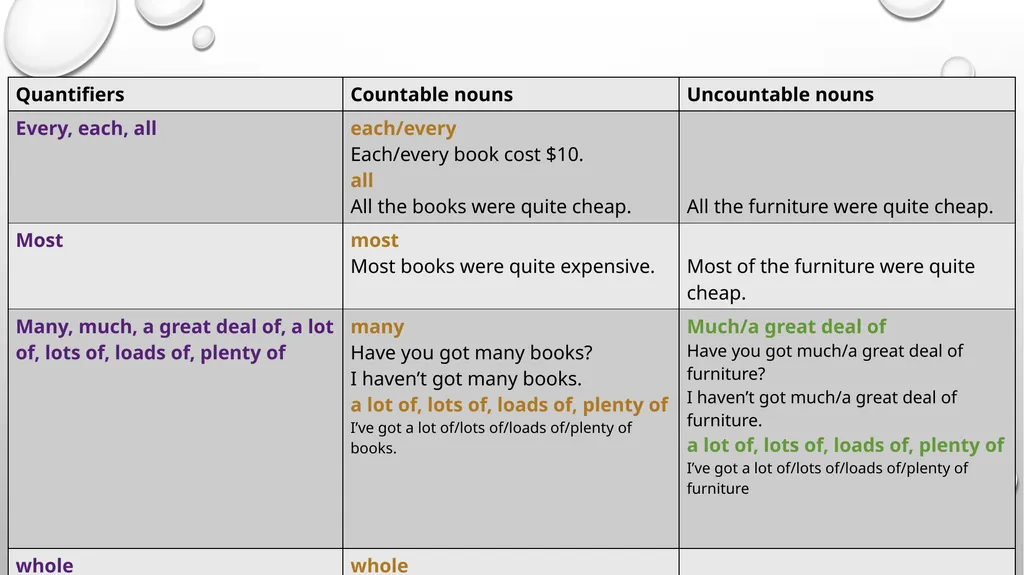
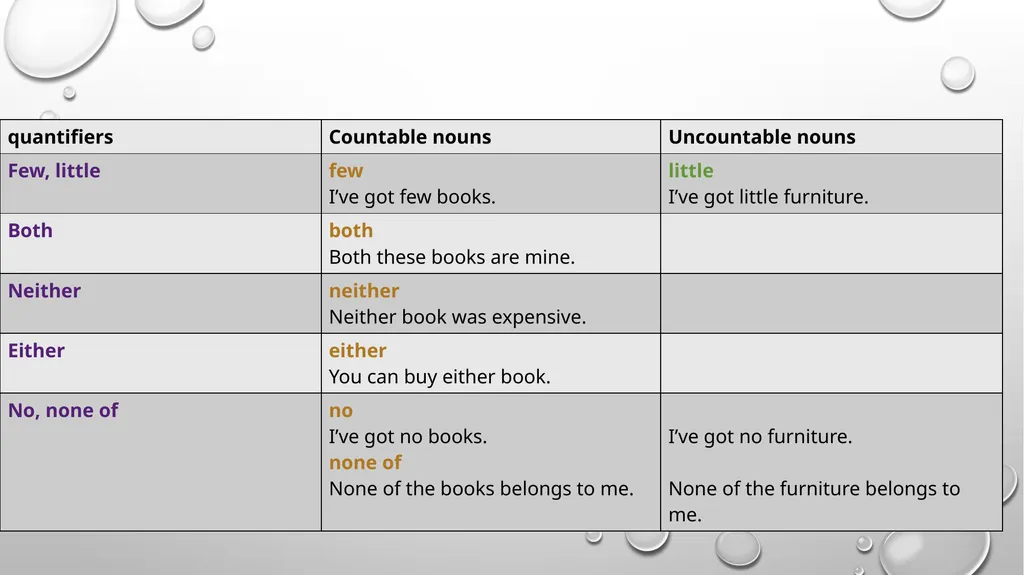
QUANTIFIERS marKOVIC anA Rastoder Elida Radusinovic Sanja Note: A FEW and A LITTLE have a similar meaning to some. We are staying in London for a few days. BUT FEW and LITTLE mean not as many or as much as wed like Unfortunately, there
"QUANTIFIERS marKOVIC anA Rastoder Elida" is the property of its rightful owner. Permission is granted to
download and print the materials on this website for personal, non-commercial use only, and to display it
on your personal computer provided you do not modify the materials and that you retain all copyright
notices contained in the materials. By downloading content from our website, you accept the terms of this
agreement.
Presentation Transcript
01
QUANTIFIERS marKOVIC anA
Rastoder Elida
Radusinovic Sanja<br>
02
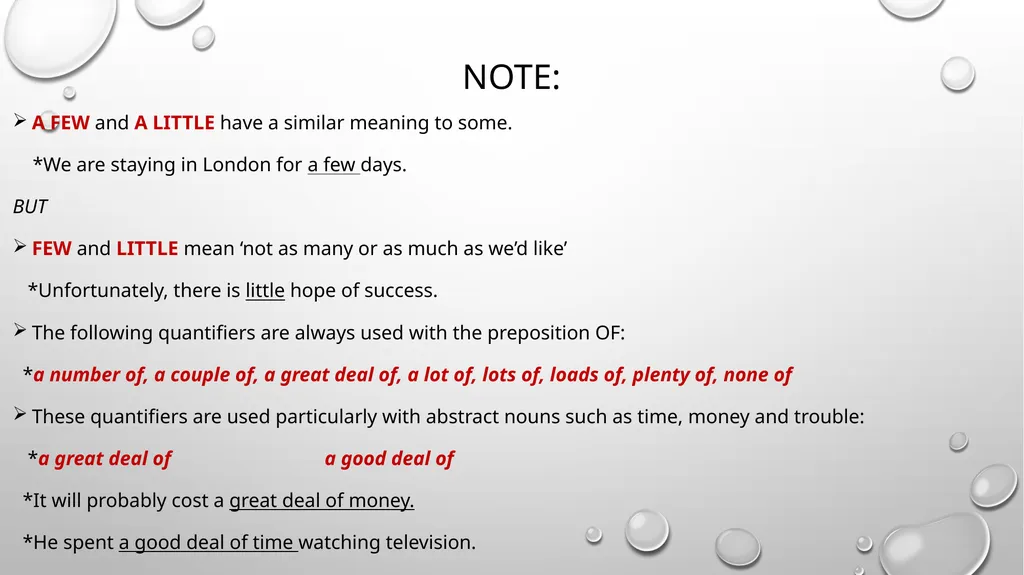
Note: A FEW and A LITTLE have a similar meaning to some.
*We are staying in London for a few days.
BUT
FEW and LITTLE mean ‘not as many or as much as we’d like’
*Unfortunately, there is little hope of success.
The following quantifiers are always used with the preposition OF:
*a number of, a couple of, a great deal of, a lot of, lots of, loads of, plenty of, none of
These quantifiers are used particularly with abstract nouns such as time, money and trouble:
*a great deal of a good deal of
*It will probably cost a great deal of money.
*He spent a good deal of time watching television.<br>
03
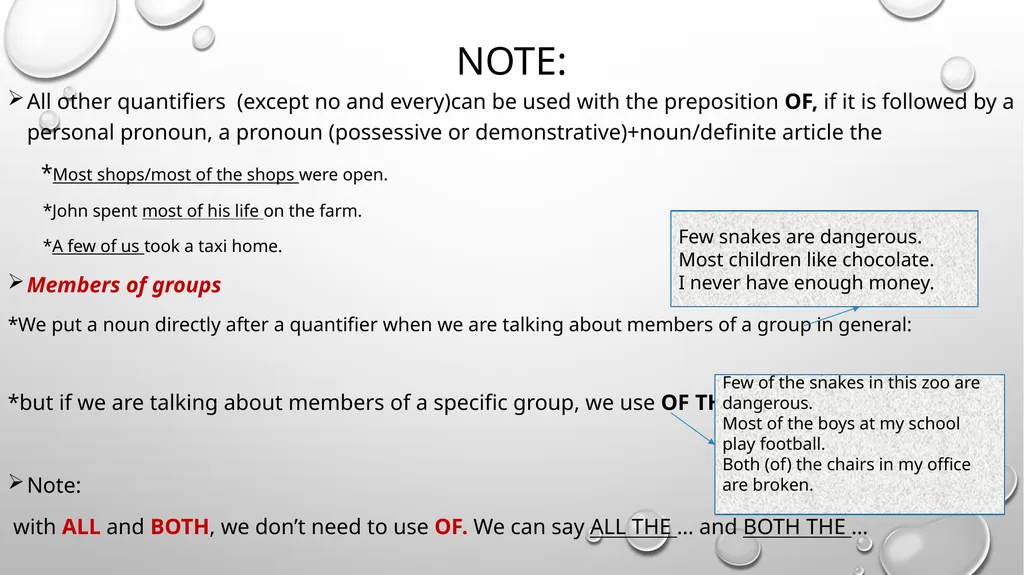
Note: All other quantifiers (except no and every)can be used with the preposition OF, if it is followed by a personal pronoun, a pronoun (possessive or demonstrative)+noun/definite article the
*Most shops/most of the shops were open.
*John spent most of his life on the farm.
*A few of us took a taxi home.
Members of groups
*We put a noun directly after a quantifier when we are talking about members of a group in general:
*but if we are talking about members of a specific group, we use OF THE as well:
Note:
with ALL and BOTH, we don’t need to use OF. We can say ALL THE … and BOTH THE … Few snakes are dangerous.
Most children like chocolate.
I never have enough money. Few of the snakes in this zoo are dangerous.
Most of the boys at my school play football.
Both (of) the chairs in my office are broken.<br>
04
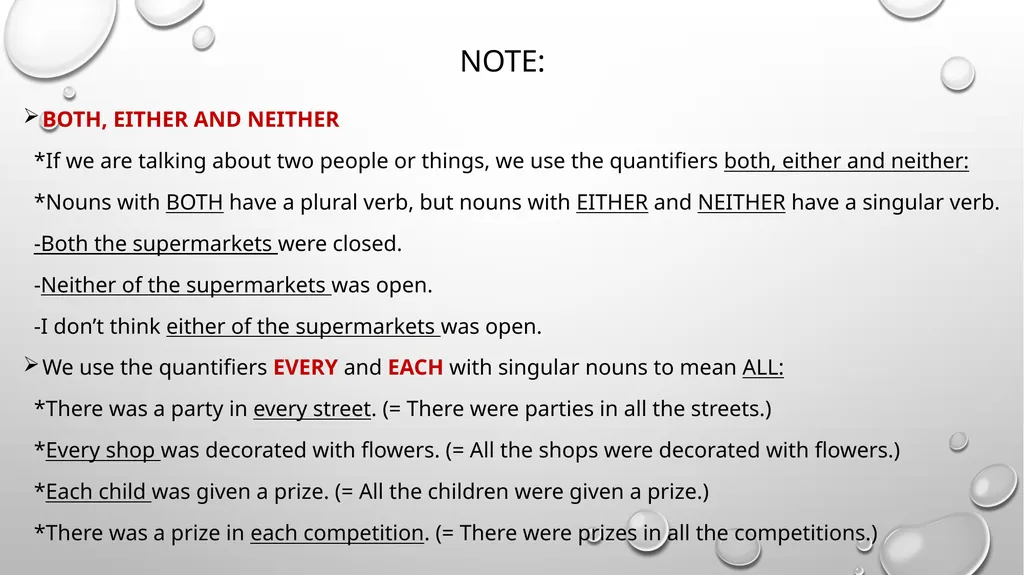
Note: BOTH, EITHER AND NEITHER
*If we are talking about two people or things, we use the quantifiers both, either and neither:
*Nouns with BOTH have a plural verb, but nouns with EITHER and NEITHER have a singular verb.
-Both the supermarkets were closed.
-Neither of the supermarkets was open.
-I don’t think either of the supermarkets was open.
We use the quantifiers EVERY and EACH with singular nouns to mean ALL:
*There was a party in every street. (= There were parties in all the streets.)
*Every shop was decorated with flowers. (= All the shops were decorated with flowers.)
*Each child was given a prize. (= All the children were given a prize.)
*There was a prize in each competition. (= There were prizes in all the competitions.)<br>
05
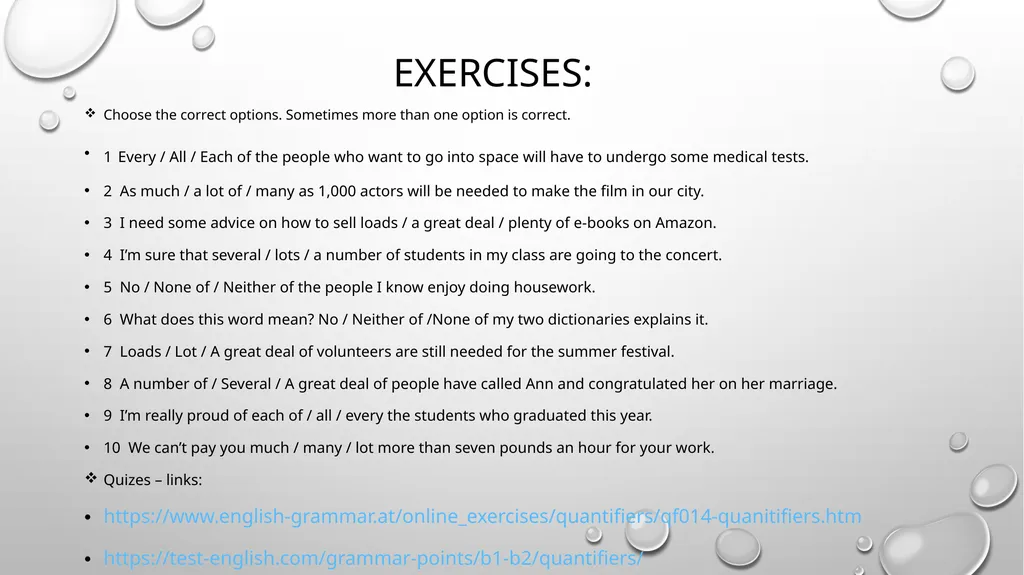
Exercises: Choose the correct options. Sometimes more than one option is correct.
1 Every / All / Each of the people who want to go into space will have to undergo some medical tests.
2 As much / a lot of / many as 1,000 actors will be needed to make the film in our city.
3 I need some advice on how to sell loads / a great deal / plenty of e-books on Amazon.
4 I’m sure that several / lots / a number of students in my class are going to the concert.
5 No / None of / Neither of the people I know enjoy doing housework.
6 What does this word mean? No / Neither of /None of my two dictionaries explains it.
7 Loads / Lot / A great deal of volunteers are still needed for the summer festival.
8 A number of / Several / A great deal of people have called Ann and congratulated her on her marriage.
9 I’m really proud of each of / all / every the students who graduated this year.
10 We can’t pay you much / many / lot more than seven pounds an hour for your work.
Quizes – links:
https://www.english-grammar.at/online_exercises/quantifiers/qf014-quanitifiers.htm
https://test-english.com/grammar-points/b1-b2/quantifiers/<br>