
Radar and Optical Observing Biases M.
Description: Radar and Optical Observing Biases M. Campbell-Brown University of Western Ontario All meteor observations Limiting mass is a function of speed Limiting mass is a function of meteor position Mass distribution index needed to correct rates
Related Topics
Download Presentation
"Radar and Optical Observing Biases M." is the property of its rightful owner. Permission is granted to download and print the materials on this website for personal, non-commercial use only, and to display it on your personal computer provided you do not modify the materials and that you retain all copyright notices contained in the materials. By downloading content from our website, you accept the terms of this agreement.
Presentation Transcript
slide1. Radar and Optical Observing Biases M. Campbell-Brown
University of Western Ontario<br>
slide2. All meteor observations Limiting mass is a function of speed
Limiting mass is a function of meteor position
Mass distribution index needed to correct rates
Detection algorithms<br>
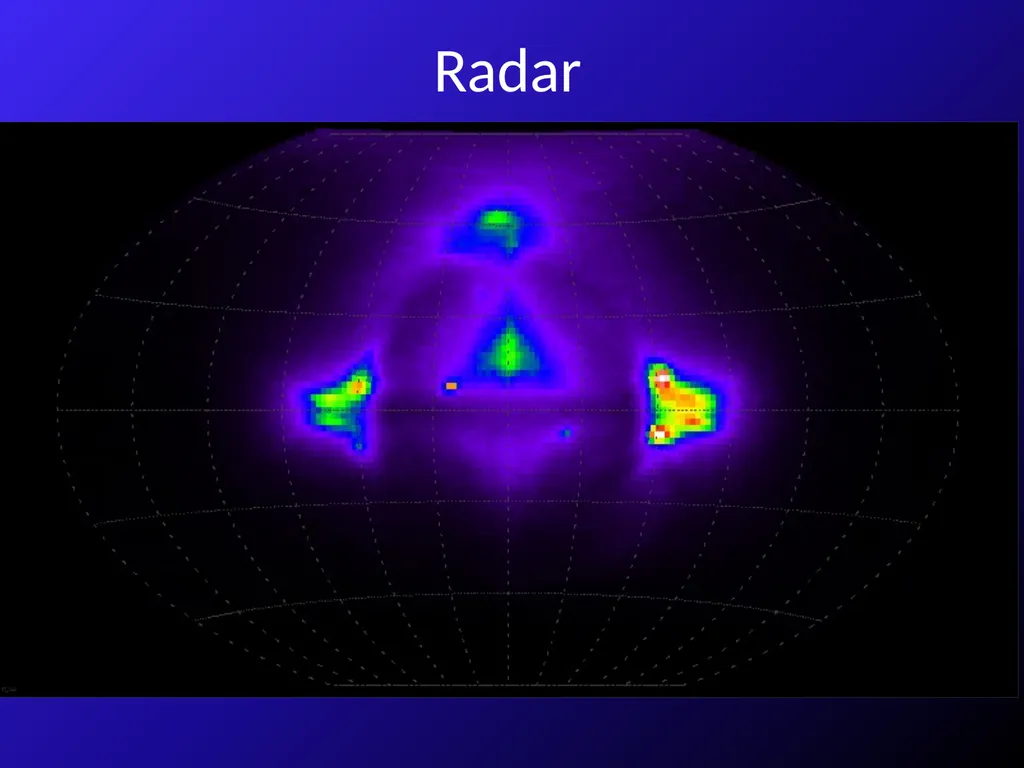
slide3. Radar<br>
slide4. All radars Ionization efficiency vs. speed
Generally observe a small portion of the trail (1st Fresnel zone/main beam): extrapolate to get total mass Radar<br>
slide5. Transverse scatter radars (backscatter) Initial trail radius
Finite velocity effect
PRF effect
Faraday rotation (linearly polarized beams) Transverse Radar<br>
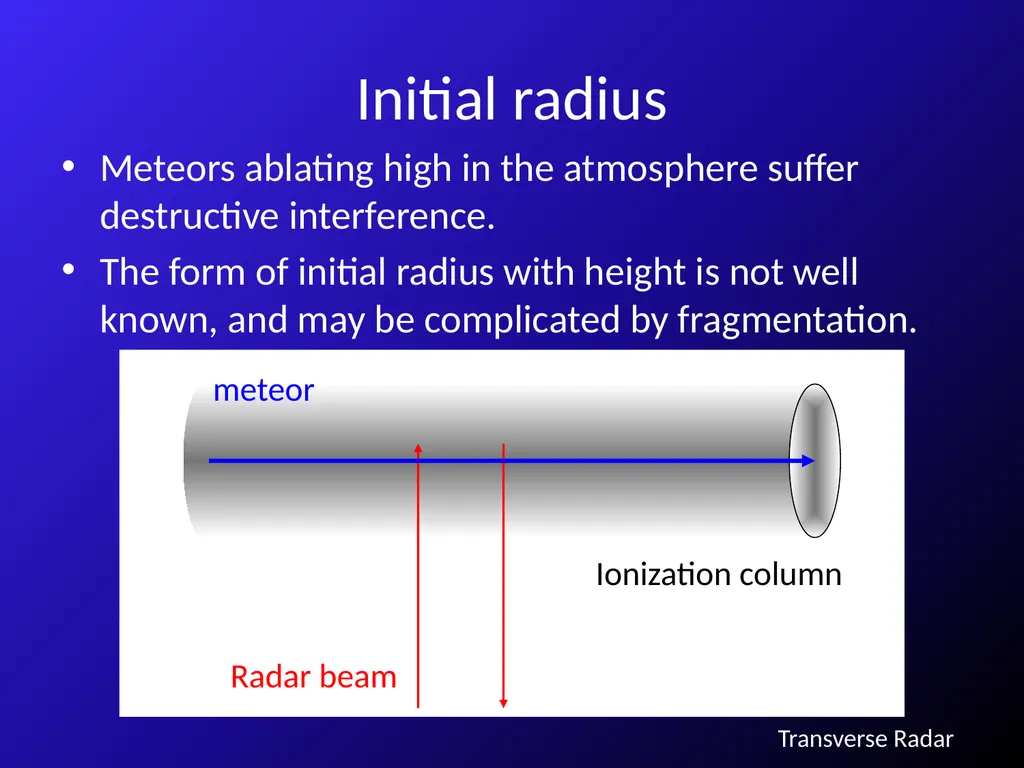
slide6. Initial radius Meteors ablating high in the atmosphere suffer destructive interference.
The form of initial radius with height is not well known, and may be complicated by fragmentation. meteor Ionization column Radar beam Transverse Radar<br>
slide7. Finite velocity effect A meteor trail expands as it crosses the first Fresnel zone (where most of the scattering occurs).
If the meteor is slow, it may be attenuated before it reaches maximum amplitude.
This effect is expected to be much smaller than the initial radius effect, but it affects mainly slow meteors. Transverse Radar<br>
slide8. PRF effect Meteor echoes, particularly from weak or high meteors, decay quickly.
If the pulse repetition frequency of the radar is not high enough, short echoes may be missed.
This is also usually much smaller than initial radius. Transverse Radar<br>
slide9. Faraday rotation When a radar beam travels through a region with free electrons (the ionosphere), along the magnetic field, the polarization of the beam rotates.
If the returning beam’s polarization is not parallel to the antenna, the echo is attenuated.
This effect occurs only in the afternoon, for certain directions, and is not an issue for circularly polarized beams. Transverse Radar<br>
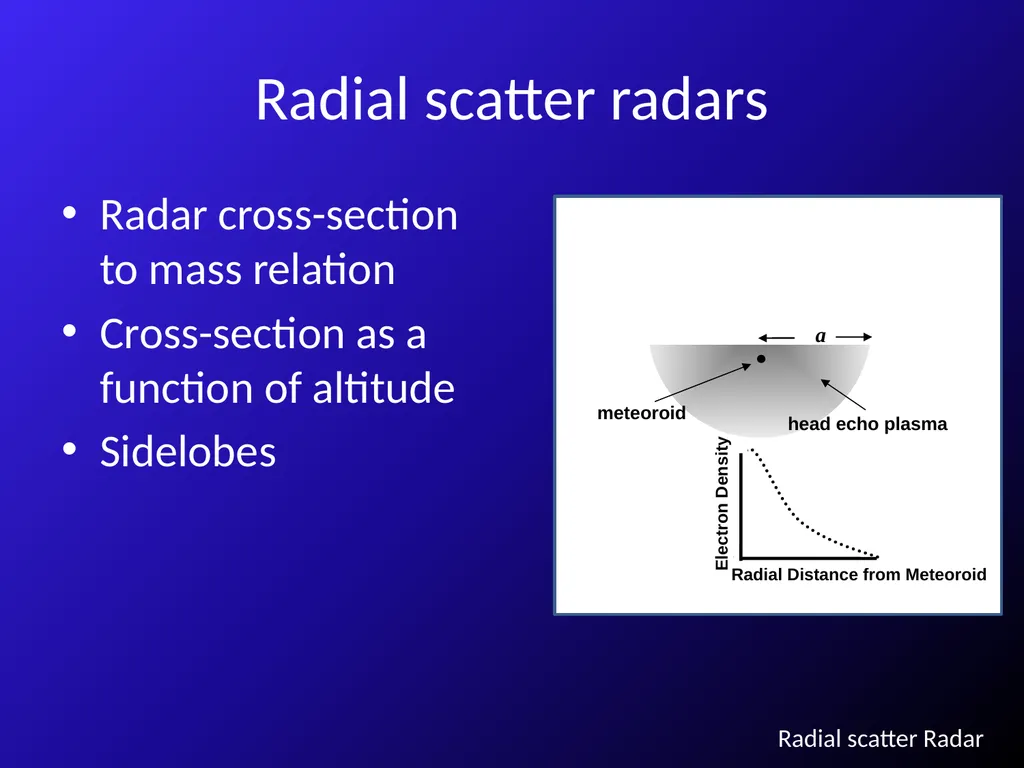
slide10. Radial scatter radars Radar cross-section to mass relation
Cross-section as a function of altitude
Sidelobes Radial scatter Radar<br>
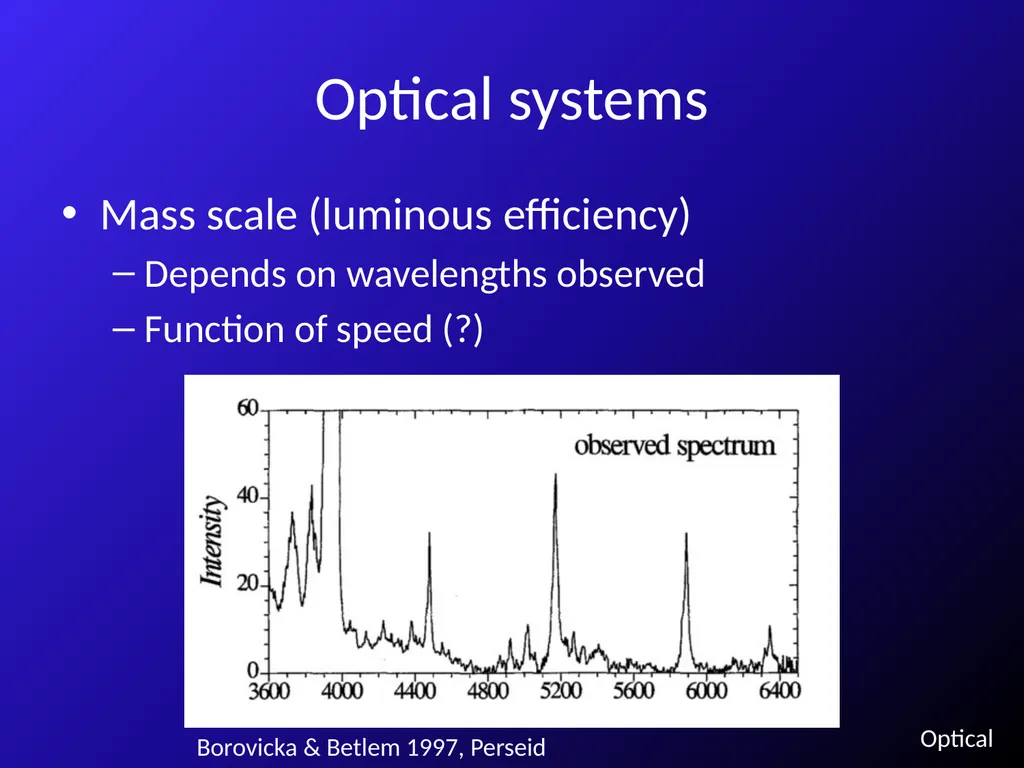
slide11. Optical systems Mass scale (luminous efficiency)
Depends on wavelengths observed
Function of speed (?) Borovicka & Betlem 1997, Perseid Optical<br>
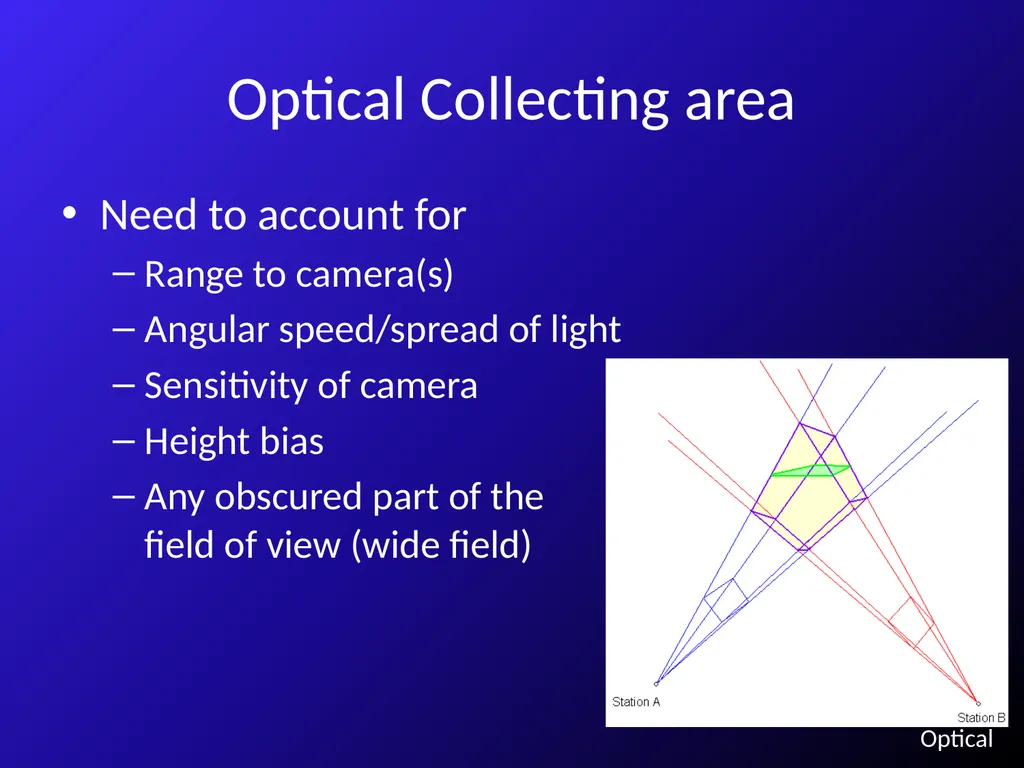
slide12. Optical Collecting area Need to account for
Range to camera(s)
Angular speed/spread of light
Sensitivity of camera
Height bias
Any obscured part of the field of view (wide field) Optical<br>
slide13. Limiting meteor magnitude Usually no single limit; different in different parts of the field
Depends on:
Sky conditions (limiting stellar magnitude)
Angular spread of light Optical<br>
University of Western Ontario<br>
slide2. All meteor observations Limiting mass is a function of speed
Limiting mass is a function of meteor position
Mass distribution index needed to correct rates
Detection algorithms<br>
slide3. Radar<br>
slide4. All radars Ionization efficiency vs. speed
Generally observe a small portion of the trail (1st Fresnel zone/main beam): extrapolate to get total mass Radar<br>
slide5. Transverse scatter radars (backscatter) Initial trail radius
Finite velocity effect
PRF effect
Faraday rotation (linearly polarized beams) Transverse Radar<br>
slide6. Initial radius Meteors ablating high in the atmosphere suffer destructive interference.
The form of initial radius with height is not well known, and may be complicated by fragmentation. meteor Ionization column Radar beam Transverse Radar<br>
slide7. Finite velocity effect A meteor trail expands as it crosses the first Fresnel zone (where most of the scattering occurs).
If the meteor is slow, it may be attenuated before it reaches maximum amplitude.
This effect is expected to be much smaller than the initial radius effect, but it affects mainly slow meteors. Transverse Radar<br>
slide8. PRF effect Meteor echoes, particularly from weak or high meteors, decay quickly.
If the pulse repetition frequency of the radar is not high enough, short echoes may be missed.
This is also usually much smaller than initial radius. Transverse Radar<br>
slide9. Faraday rotation When a radar beam travels through a region with free electrons (the ionosphere), along the magnetic field, the polarization of the beam rotates.
If the returning beam’s polarization is not parallel to the antenna, the echo is attenuated.
This effect occurs only in the afternoon, for certain directions, and is not an issue for circularly polarized beams. Transverse Radar<br>
slide10. Radial scatter radars Radar cross-section to mass relation
Cross-section as a function of altitude
Sidelobes Radial scatter Radar<br>
slide11. Optical systems Mass scale (luminous efficiency)
Depends on wavelengths observed
Function of speed (?) Borovicka & Betlem 1997, Perseid Optical<br>
slide12. Optical Collecting area Need to account for
Range to camera(s)
Angular speed/spread of light
Sensitivity of camera
Height bias
Any obscured part of the field of view (wide field) Optical<br>
slide13. Limiting meteor magnitude Usually no single limit; different in different parts of the field
Depends on:
Sky conditions (limiting stellar magnitude)
Angular spread of light Optical<br>