Recommended Practices for Assessing Procedural Competency The Procedure Workgroup Postponement to 2027 List of procedures Why Procedural Competency Matters Family physicians must perform procedures safely and autonomously. Competency
"Recommended Practices for Assessing Procedural" is the property of its rightful owner. Permission is granted to
download and print the materials on this website for personal, non-commercial use only, and to display it
on your personal computer provided you do not modify the materials and that you retain all copyright
notices contained in the materials. By downloading content from our website, you accept the terms of this
agreement.
Presentation Transcript
01
Recommended Practices for
Assessing Procedural Competency
The Procedure Workgroup<br>
02
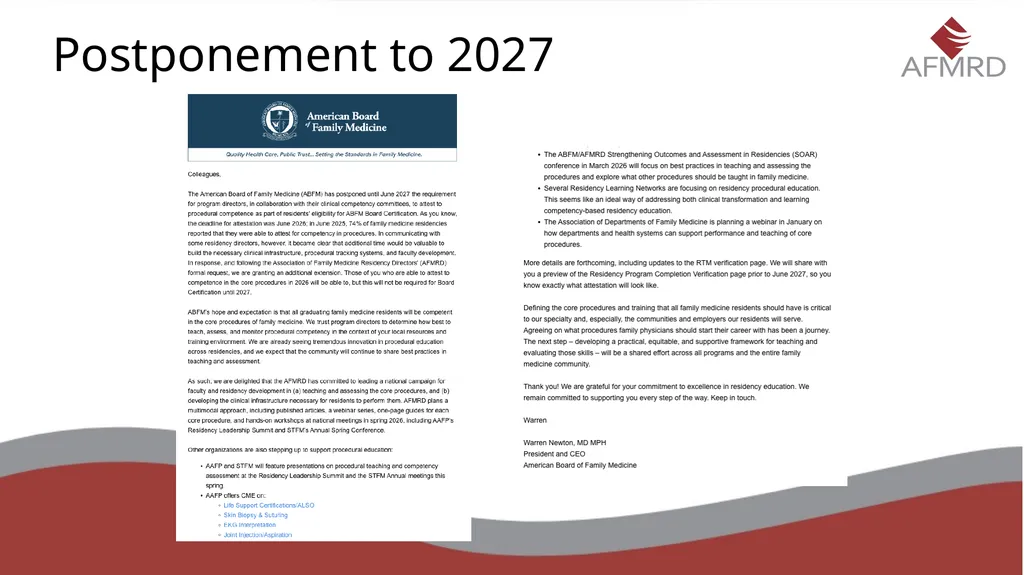
Postponement to 2027<br>
03
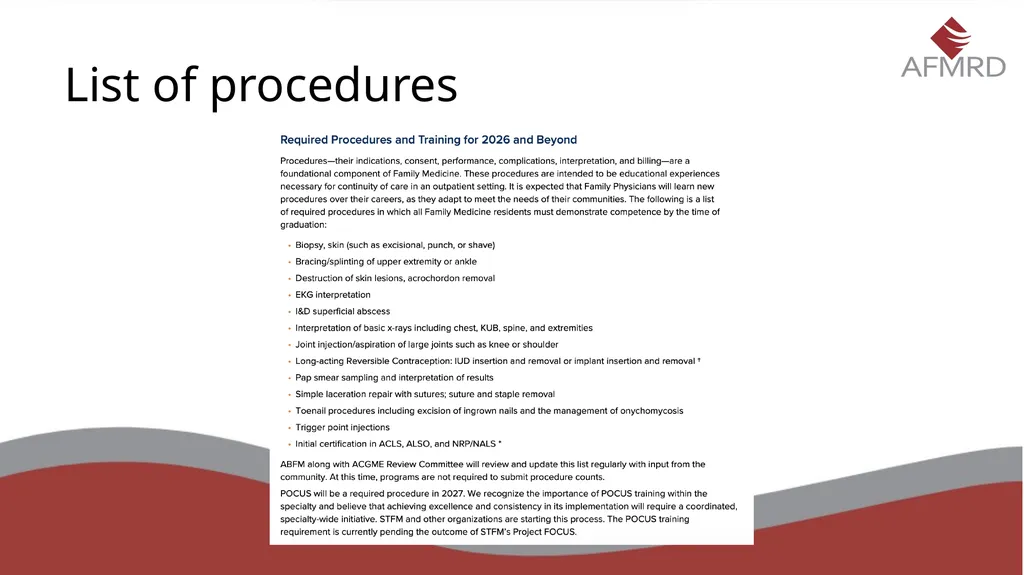
List of procedures<br>
04
Why Procedural Competency Matters Family physicians must perform procedures safely and autonomously.
Competency ≠ mastery; focus is on readiness, not perfection.
Aligns with lifelong learning and community-responsive care.<br>
05
Understanding Competency Includes judgment, autonomy, and help-seeking.
Mastery may come later through continued practice.
Learn to discern what to perform vs. refer.<br>
06
Individualized Pathways to Competency No fixed number of procedures guarantees competency.
Each resident progresses at a different pace.
Assess confidence in each procedural step.<br>
07
Core Foundational Skills Competency involves more than technical skill—it includes judgment, autonomy, and knowing when to seek help
Knowledge: indications, risks, complications.
Communication: education, consent.
Performance: technique, asepsis, teamwork.
Skills are transferable across procedures<br>
08
Structured Individualized Pathways to Competency No fixed number of procedures guarantees competency.
Each resident progresses at a different pace.
Assess confidence in each procedural step.
Combination of numbers (simulation and live), BSQs or other scales<br>
09
Curricular Approaches Traditional methods might not always work
Map where residents are exposed to procedures or procedural skills, and where supplements are needed
Use simulation, workshops, supervised practice.
Deliberate practice improves skill acquisition.<br>
10
Assessment Tools Use PCAT, BSQ, and other structured tools.
Ensure objective criteria and consistency – requires a system.
Invest in faculty development and calibration.<br>
11
Program Strategies Ensure exposure via clinics, rotations, scheduling.
Combine didactics with clinical practice.
Support faculty development.<br>
12
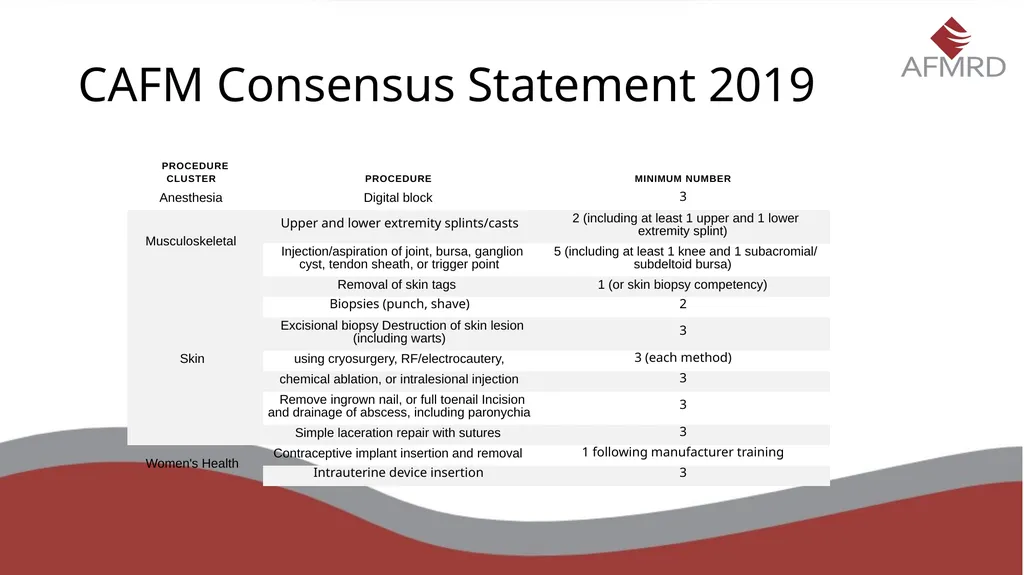
CAFM Consensus Statement 2019<br>
13
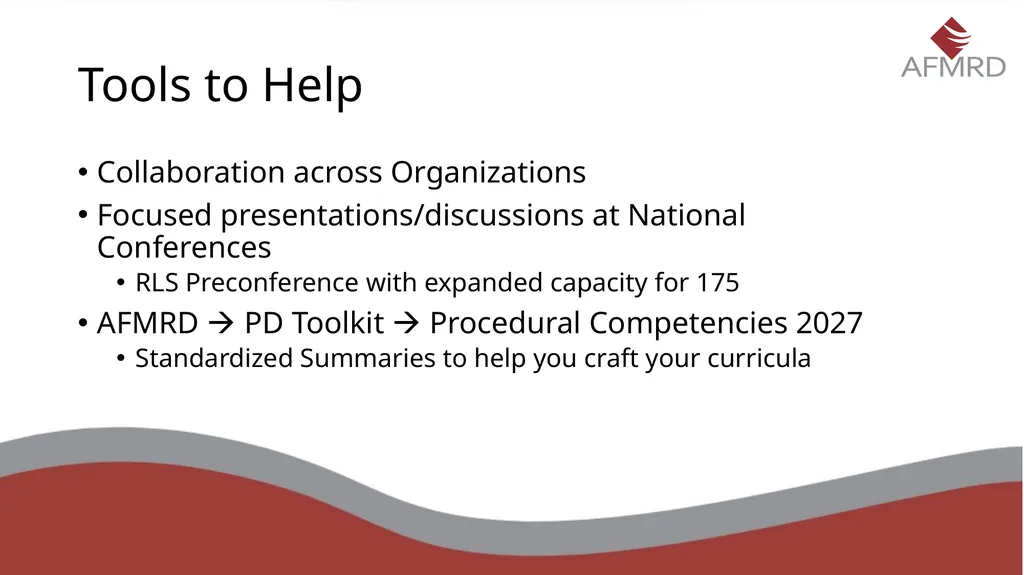
Tools to Help Collaboration across Organizations
Focused presentations/discussions at National Conferences
RLS Preconference with expanded capacity for 175
AFMRD PD Toolkit Procedural Competencies 2027
Standardized Summaries to help you craft your curricula<br>
14
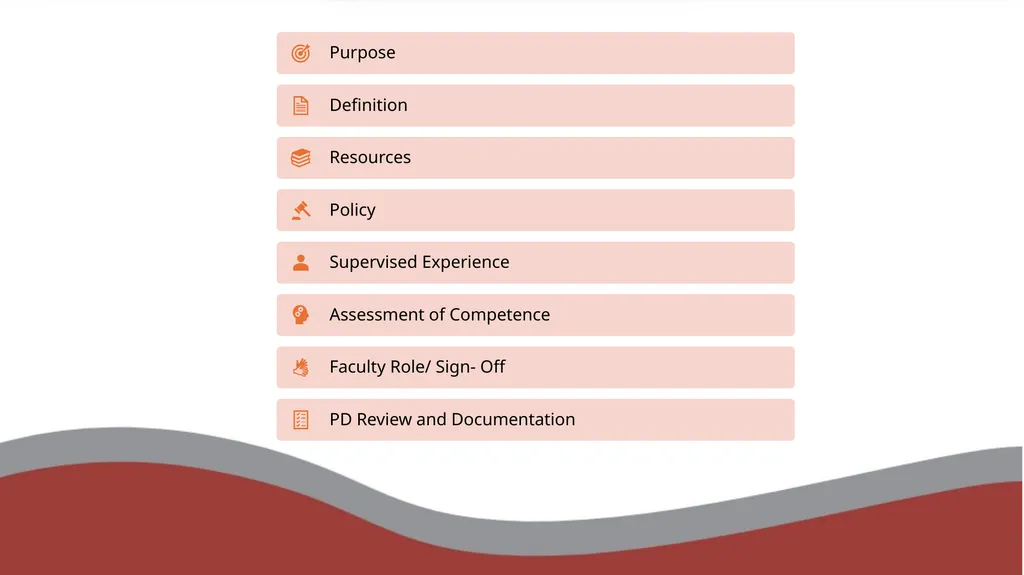
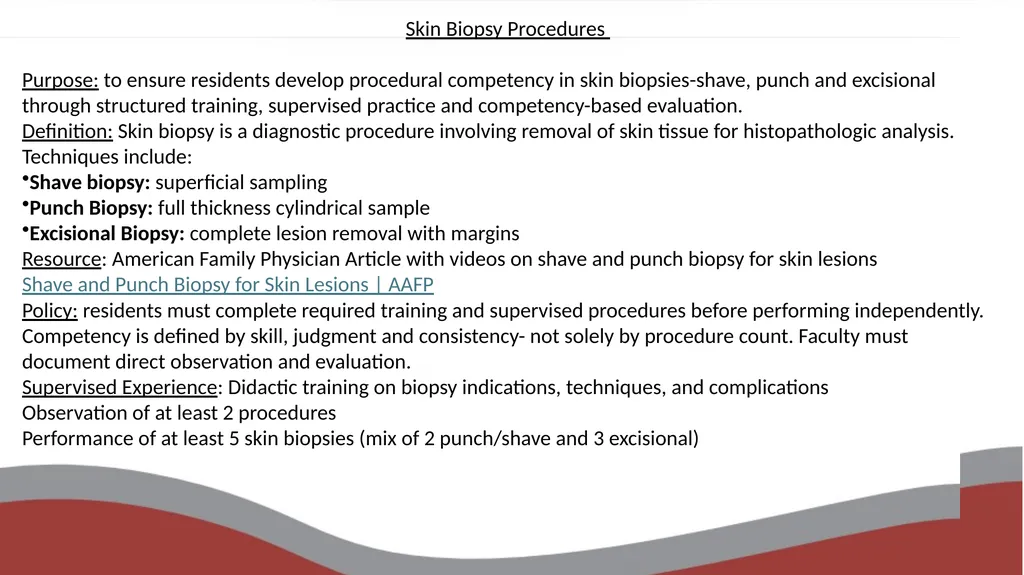
Skin Biopsy Procedures
Purpose: to ensure residents develop procedural competency in skin biopsies-shave, punch and excisional through structured training, supervised practice and competency-based evaluation.
Definition: Skin biopsy is a diagnostic procedure involving removal of skin tissue for histopathologic analysis. Techniques include:
Shave biopsy: superficial sampling
Punch Biopsy: full thickness cylindrical sample
Excisional Biopsy: complete lesion removal with margins
Resource: American Family Physician Article with videos on shave and punch biopsy for skin lesions Shave and Punch Biopsy for Skin Lesions | AAFP
Policy: residents must complete required training and supervised procedures before performing independently. Competency is defined by skill, judgment and consistency- not solely by procedure count. Faculty must document direct observation and evaluation.
Supervised Experience: Didactic training on biopsy indications, techniques, and complications
Observation of at least 2 procedures
Performance of at least 5 skin biopsies (mix of 2 punch/shave and 3 excisional)<br>
15
Assessment of competence:
Faculty will evaluate:
informed consent and knowledge of indications
Procedural set up and sterile technique
Anesthesia administration
Tissue handling, instrument use, and specimen management
Suturing and complication management
Post procedure care and documentation
Follow up and pathology review
Faculty Role and Sign-off
Faculty must directly observe and assess each procedure using a procedure competency assessment tool.
Upon satisfactory performance, faculty completes the skin biopsy competency sign off form.
Program Director Review and Documentation
Completed forms and direct observations on New Innovations are submitted to Program Director for review.
Competency logged in resident’s portfolio and milestone evaluation.
Competency will be formally reviewed during the semi-annual evaluations and CCC meetings
All documentation will be maintained in the resident’s portfolio and used to support milestone reporting and graduation readiness.<br>
16
Conclusion & Recommendations Focus on foundational skills and individualized learning.
Use structured curricula and validated tools.
Share and refine assessment tools across institutions.<br>