
Redesigning our systems to improve the participant

Description: Redesigning our systems to improve the participant experience Industry Briefing June 2022 Acknowledgement of Country Artwork: Side BY Side Artist: Terri Bean I acknowledge the Traditional Owners and Custodians of the Country on which we all
Related Topics
Download Presentation
"Redesigning our systems to improve the participant" is the property of its rightful owner. Permission is granted to download and print the materials on this website for personal, non-commercial use only, and to display it on your personal computer provided you do not modify the materials and that you retain all copyright notices contained in the materials. By downloading content from our website, you accept the terms of this agreement.
Presentation Transcript
slide1. Redesigning our systems to improve the participant experience Industry Briefing June 2022<br>
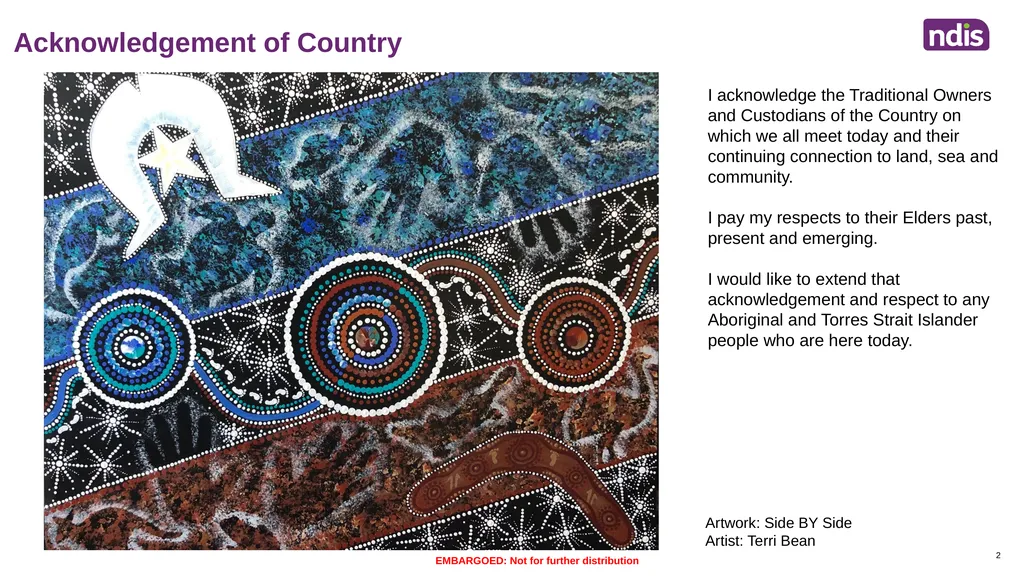
slide2. Acknowledgement of Country Artwork: Side BY Side
Artist: Terri Bean I acknowledge the Traditional Owners and Custodians of the Country on which we all meet today and their continuing connection to land, sea and community.
I pay my respects to their Elders past, present and emerging.
I would like to extend that acknowledgement and respect to any Aboriginal and Torres Strait Islander people who are here today.<br>
slide3. Purpose We are building a new client relationship management (CRM) system, replacing our SAP business system with a new Salesforce product, and introducing new NDIS online portals for participants and providers. Redesigning our systems to improve the participant experience is about:
Improving the participant and provider experience with the NDIS and responding to feedback.
Delivering on the Participant Service Charter, the Participant Service Guarantee and the Participant Service Improvement Plan.
Improving our systems and internal processes, and the way we work, without changing the NDIS Act or Rules.<br>
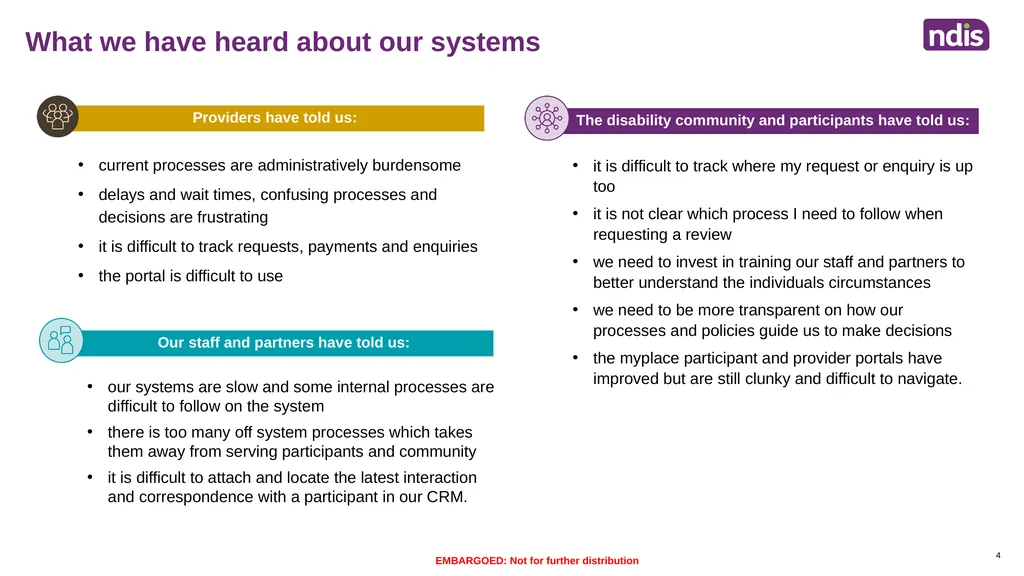
slide4. What we have heard about our systems<br>
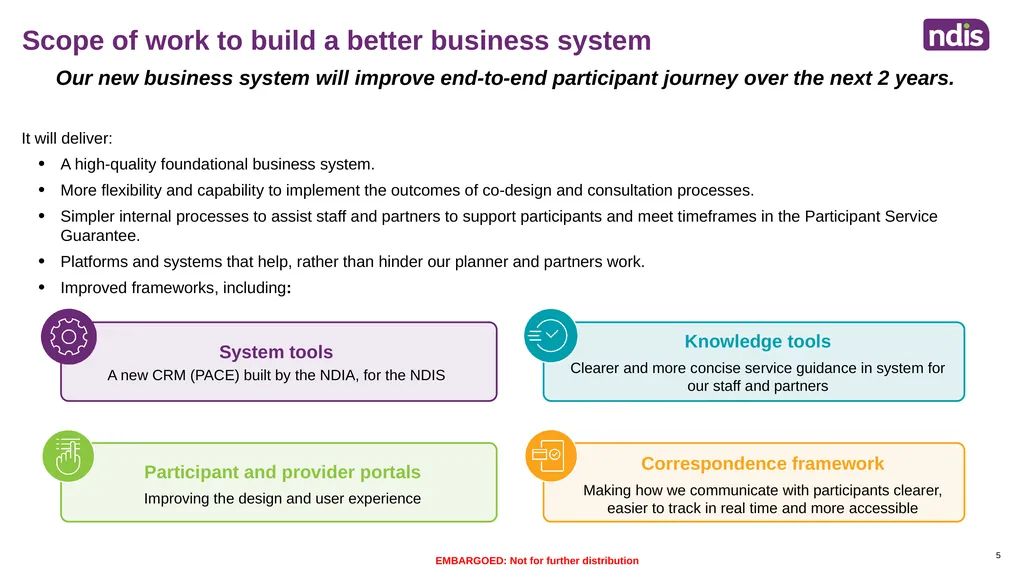
slide5. Our new business system will improve end-to-end participant journey over the next 2 years.
It will deliver:
A high-quality foundational business system.
More flexibility and capability to implement the outcomes of co-design and consultation processes.
Simpler internal processes to assist staff and partners to support participants and meet timeframes in the Participant Service Guarantee.
Platforms and systems that help, rather than hinder our planner and partners work.
Improved frameworks, including: Scope of work to build a better business system<br>
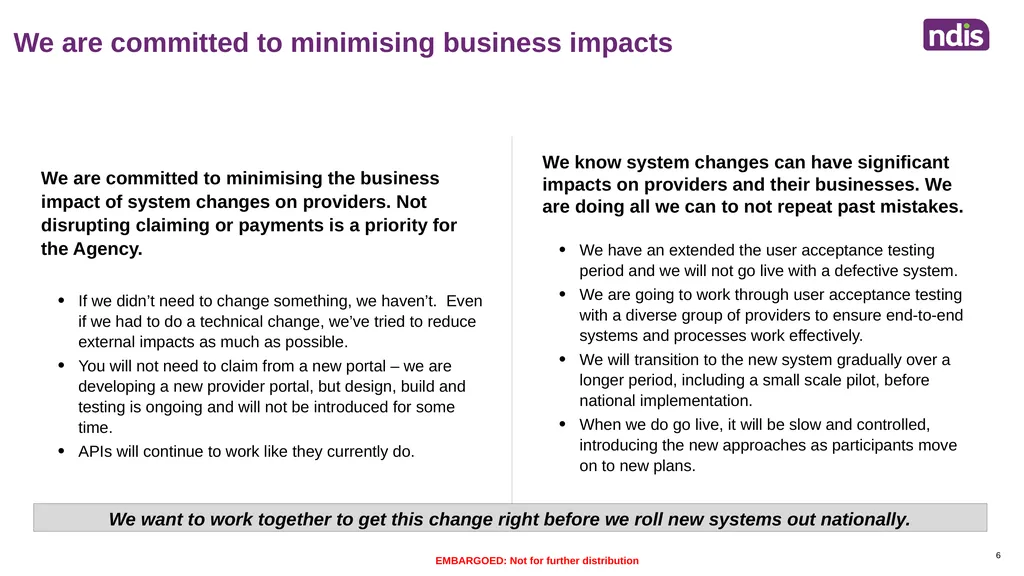
slide6. We are committed to minimising the business impact of system changes on providers. Not disrupting claiming or payments is a priority for the Agency.
If we didn’t need to change something, we haven’t. Even if we had to do a technical change, we’ve tried to reduce external impacts as much as possible.
You will not need to claim from a new portal – we are developing a new provider portal, but design, build and testing is ongoing and will not be introduced for some time.
APIs will continue to work like they currently do. We are committed to minimising business impacts We know system changes can have significant impacts on providers and their businesses. We are doing all we can to not repeat past mistakes.
We have an extended the user acceptance testing period and we will not go live with a defective system.
We are going to work through user acceptance testing with a diverse group of providers to ensure end-to-end systems and processes work effectively.
We will transition to the new system gradually over a longer period, including a small scale pilot, before national implementation.
When we do go live, it will be slow and controlled, introducing the new approaches as participants move on to new plans. We want to work together to get this change right before we roll new systems out nationally.<br>
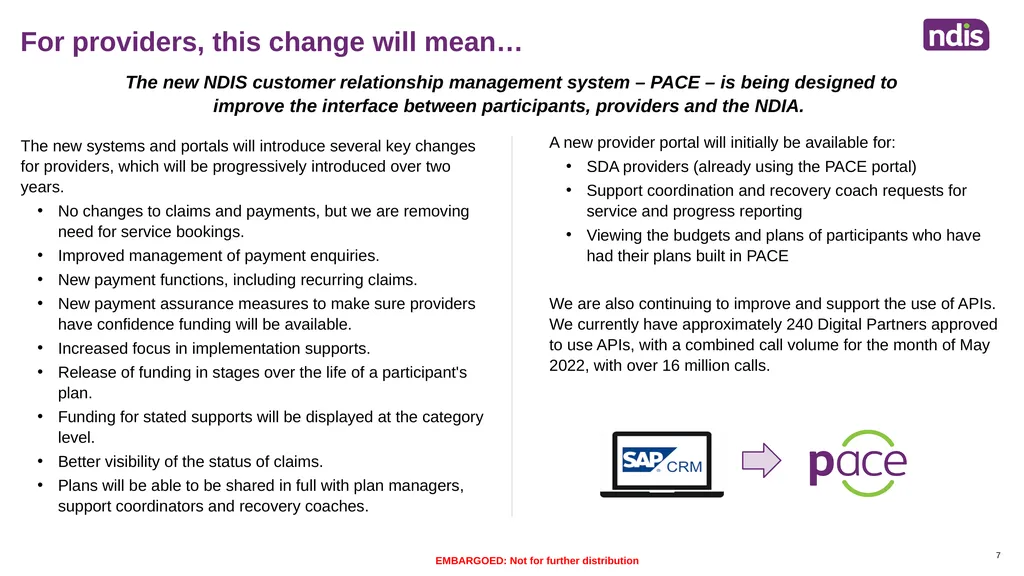
slide7. The new NDIS customer relationship management system – PACE – is being designed to improve the interface between participants, providers and the NDIA. For providers, this change will mean… The new systems and portals will introduce several key changes for providers, which will be progressively introduced over two years.
No changes to claims and payments, but we are removing need for service bookings.
Improved management of payment enquiries.
New payment functions, including recurring claims.
New payment assurance measures to make sure providers have confidence funding will be available.
Increased focus in implementation supports.
Release of funding in stages over the life of a participant's plan.
Funding for stated supports will be displayed at the category level.
Better visibility of the status of claims.
Plans will be able to be shared in full with plan managers, support coordinators and recovery coaches. A new provider portal will initially be available for:
SDA providers (already using the PACE portal)
Support coordination and recovery coach requests for service and progress reporting
Viewing the budgets and plans of participants who have had their plans built in PACE
We are also continuing to improve and support the use of APIs. We currently have approximately 240 Digital Partners approved to use APIs, with a combined call volume for the month of May 2022, with over 16 million calls.<br>
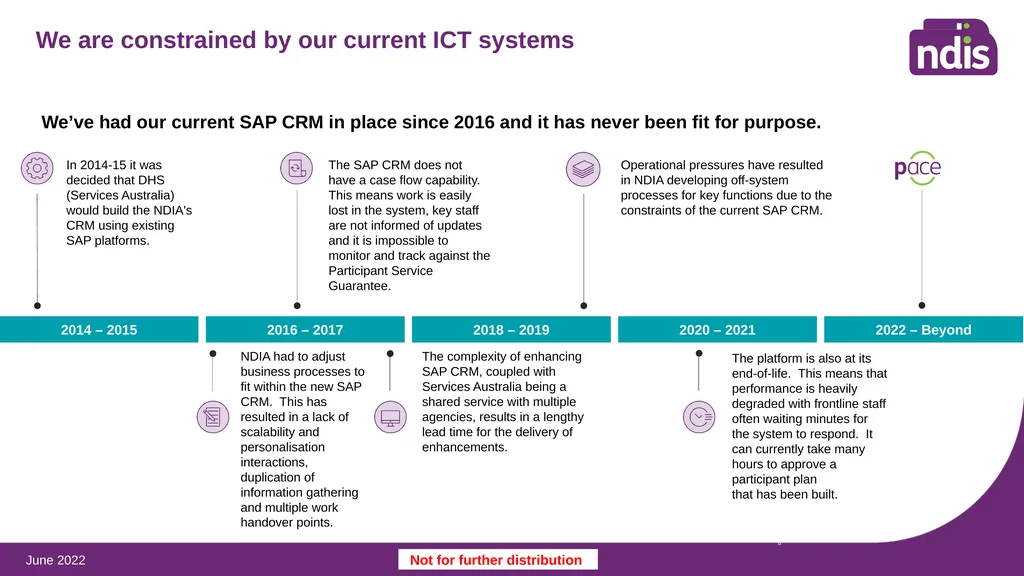
slide8. We are constrained by our current ICT systems 8 We’ve had our current SAP CRM in place since 2016 and it has never been fit for purpose. In 2014-15 it was decided that DHS (Services Australia) would build the NDIA's CRM using existing SAP platforms. NDIA had to adjust business processes to fit within the new SAP CRM. This has resulted in a lack of scalability and personalisation interactions, duplication of information gathering and multiple work handover points. The SAP CRM does not have a case flow capability. This means work is easily lost in the system, key staff are not informed of updates and it is impossible to monitor and track against the Participant Service Guarantee. The complexity of enhancing SAP CRM, coupled with Services Australia being a shared service with multiple agencies, results in a lengthy lead time for the delivery of enhancements. Operational pressures have resulted in NDIA developing off-system processes for key functions due to the constraints of the current SAP CRM. The platform is also at its end-of-life. This means that performance is heavily degraded with frontline staff often waiting minutes for the system to respond. It can currently take many hours to approve a participant plan that has been built.<br>
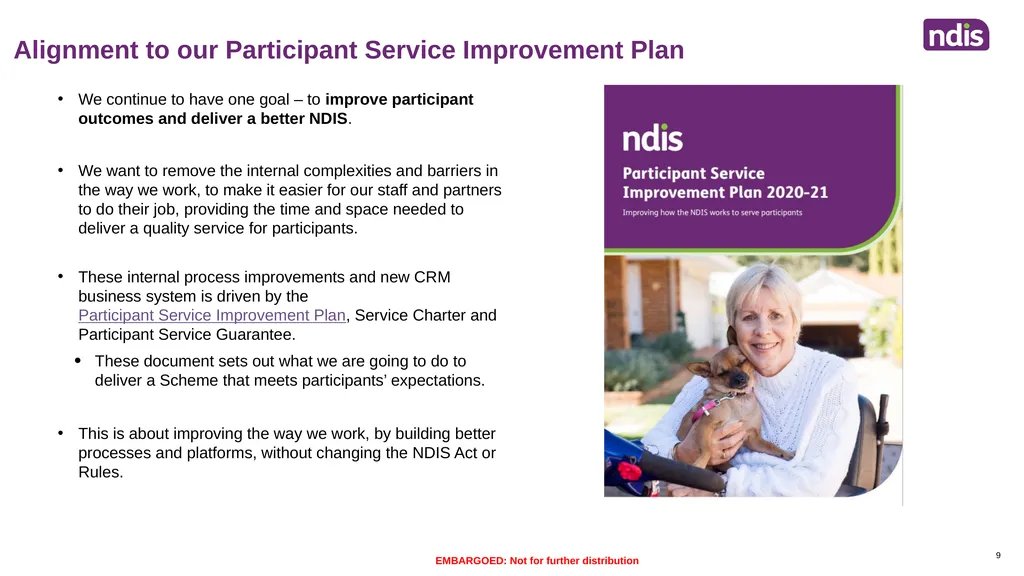
slide9. Alignment to our Participant Service Improvement Plan We continue to have one goal – to improve participant outcomes and deliver a better NDIS.
We want to remove the internal complexities and barriers in the way we work, to make it easier for our staff and partners to do their job, providing the time and space needed to deliver a quality service for participants.
These internal process improvements and new CRM business system is driven by the Participant Service Improvement Plan, Service Charter and Participant Service Guarantee.
These document sets out what we are going to do to deliver a Scheme that meets participants’ expectations.
This is about improving the way we work, by building better processes and platforms, without changing the NDIS Act or Rules.<br>
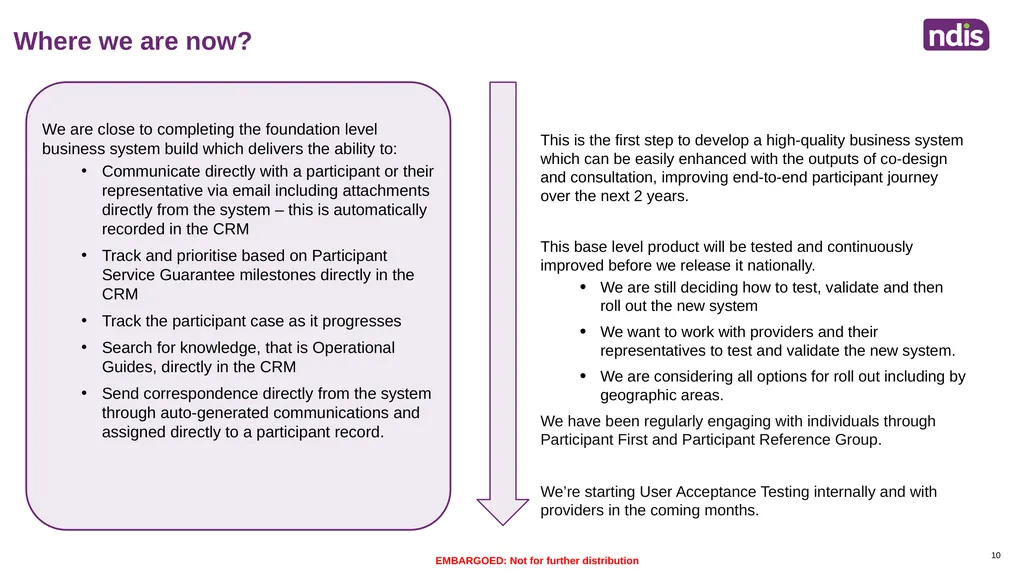
slide10. Where we are now? This is the first step to develop a high-quality business system which can be easily enhanced with the outputs of co-design and consultation, improving end-to-end participant journey over the next 2 years.
This base level product will be tested and continuously improved before we release it nationally.
We are still deciding how to test, validate and then roll out the new system
We want to work with providers and their representatives to test and validate the new system.
We are considering all options for roll out including by geographic areas.
We have been regularly engaging with individuals through Participant First and Participant Reference Group.
We’re starting User Acceptance Testing internally and with providers in the coming months.<br>
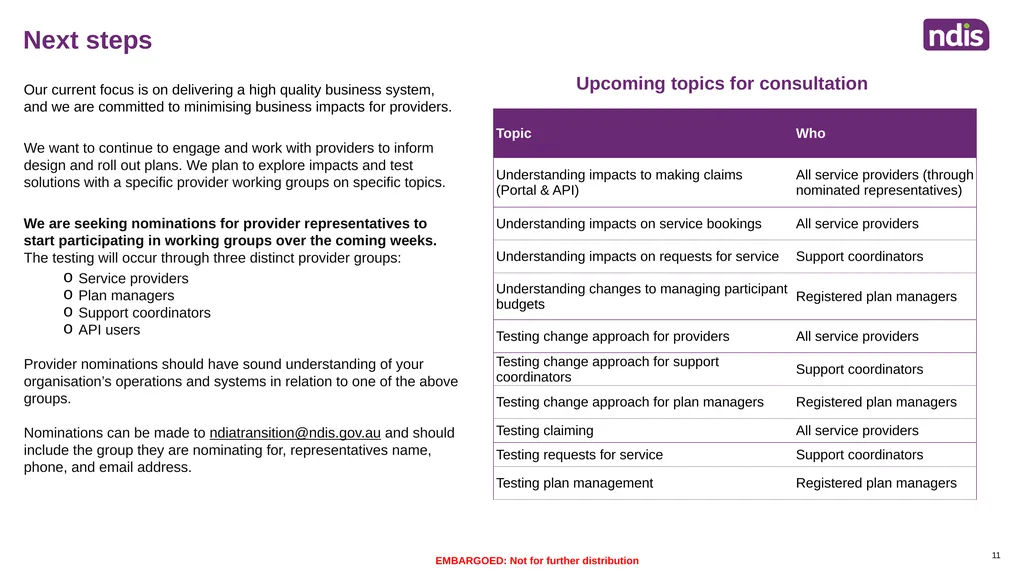
slide11. Next steps Our current focus is on delivering a high quality business system, and we are committed to minimising business impacts for providers.
We want to continue to engage and work with providers to inform design and roll out plans. We plan to explore impacts and test solutions with a specific provider working groups on specific topics.
We are seeking nominations for provider representatives to start participating in working groups over the coming weeks. The testing will occur through three distinct provider groups:
Service providers
Plan managers
Support coordinators
API users
Provider nominations should have sound understanding of your organisation’s operations and systems in relation to one of the above groups.
Nominations can be made to ndiatransition@ndis.gov.au and should include the group they are nominating for, representatives name, phone, and email address. Upcoming topics for consultation<br>
slide2. Acknowledgement of Country Artwork: Side BY Side
Artist: Terri Bean I acknowledge the Traditional Owners and Custodians of the Country on which we all meet today and their continuing connection to land, sea and community.
I pay my respects to their Elders past, present and emerging.
I would like to extend that acknowledgement and respect to any Aboriginal and Torres Strait Islander people who are here today.<br>
slide3. Purpose We are building a new client relationship management (CRM) system, replacing our SAP business system with a new Salesforce product, and introducing new NDIS online portals for participants and providers. Redesigning our systems to improve the participant experience is about:
Improving the participant and provider experience with the NDIS and responding to feedback.
Delivering on the Participant Service Charter, the Participant Service Guarantee and the Participant Service Improvement Plan.
Improving our systems and internal processes, and the way we work, without changing the NDIS Act or Rules.<br>
slide4. What we have heard about our systems<br>
slide5. Our new business system will improve end-to-end participant journey over the next 2 years.
It will deliver:
A high-quality foundational business system.
More flexibility and capability to implement the outcomes of co-design and consultation processes.
Simpler internal processes to assist staff and partners to support participants and meet timeframes in the Participant Service Guarantee.
Platforms and systems that help, rather than hinder our planner and partners work.
Improved frameworks, including: Scope of work to build a better business system<br>
slide6. We are committed to minimising the business impact of system changes on providers. Not disrupting claiming or payments is a priority for the Agency.
If we didn’t need to change something, we haven’t. Even if we had to do a technical change, we’ve tried to reduce external impacts as much as possible.
You will not need to claim from a new portal – we are developing a new provider portal, but design, build and testing is ongoing and will not be introduced for some time.
APIs will continue to work like they currently do. We are committed to minimising business impacts We know system changes can have significant impacts on providers and their businesses. We are doing all we can to not repeat past mistakes.
We have an extended the user acceptance testing period and we will not go live with a defective system.
We are going to work through user acceptance testing with a diverse group of providers to ensure end-to-end systems and processes work effectively.
We will transition to the new system gradually over a longer period, including a small scale pilot, before national implementation.
When we do go live, it will be slow and controlled, introducing the new approaches as participants move on to new plans. We want to work together to get this change right before we roll new systems out nationally.<br>
slide7. The new NDIS customer relationship management system – PACE – is being designed to improve the interface between participants, providers and the NDIA. For providers, this change will mean… The new systems and portals will introduce several key changes for providers, which will be progressively introduced over two years.
No changes to claims and payments, but we are removing need for service bookings.
Improved management of payment enquiries.
New payment functions, including recurring claims.
New payment assurance measures to make sure providers have confidence funding will be available.
Increased focus in implementation supports.
Release of funding in stages over the life of a participant's plan.
Funding for stated supports will be displayed at the category level.
Better visibility of the status of claims.
Plans will be able to be shared in full with plan managers, support coordinators and recovery coaches. A new provider portal will initially be available for:
SDA providers (already using the PACE portal)
Support coordination and recovery coach requests for service and progress reporting
Viewing the budgets and plans of participants who have had their plans built in PACE
We are also continuing to improve and support the use of APIs. We currently have approximately 240 Digital Partners approved to use APIs, with a combined call volume for the month of May 2022, with over 16 million calls.<br>
slide8. We are constrained by our current ICT systems 8 We’ve had our current SAP CRM in place since 2016 and it has never been fit for purpose. In 2014-15 it was decided that DHS (Services Australia) would build the NDIA's CRM using existing SAP platforms. NDIA had to adjust business processes to fit within the new SAP CRM. This has resulted in a lack of scalability and personalisation interactions, duplication of information gathering and multiple work handover points. The SAP CRM does not have a case flow capability. This means work is easily lost in the system, key staff are not informed of updates and it is impossible to monitor and track against the Participant Service Guarantee. The complexity of enhancing SAP CRM, coupled with Services Australia being a shared service with multiple agencies, results in a lengthy lead time for the delivery of enhancements. Operational pressures have resulted in NDIA developing off-system processes for key functions due to the constraints of the current SAP CRM. The platform is also at its end-of-life. This means that performance is heavily degraded with frontline staff often waiting minutes for the system to respond. It can currently take many hours to approve a participant plan that has been built.<br>
slide9. Alignment to our Participant Service Improvement Plan We continue to have one goal – to improve participant outcomes and deliver a better NDIS.
We want to remove the internal complexities and barriers in the way we work, to make it easier for our staff and partners to do their job, providing the time and space needed to deliver a quality service for participants.
These internal process improvements and new CRM business system is driven by the Participant Service Improvement Plan, Service Charter and Participant Service Guarantee.
These document sets out what we are going to do to deliver a Scheme that meets participants’ expectations.
This is about improving the way we work, by building better processes and platforms, without changing the NDIS Act or Rules.<br>
slide10. Where we are now? This is the first step to develop a high-quality business system which can be easily enhanced with the outputs of co-design and consultation, improving end-to-end participant journey over the next 2 years.
This base level product will be tested and continuously improved before we release it nationally.
We are still deciding how to test, validate and then roll out the new system
We want to work with providers and their representatives to test and validate the new system.
We are considering all options for roll out including by geographic areas.
We have been regularly engaging with individuals through Participant First and Participant Reference Group.
We’re starting User Acceptance Testing internally and with providers in the coming months.<br>
slide11. Next steps Our current focus is on delivering a high quality business system, and we are committed to minimising business impacts for providers.
We want to continue to engage and work with providers to inform design and roll out plans. We plan to explore impacts and test solutions with a specific provider working groups on specific topics.
We are seeking nominations for provider representatives to start participating in working groups over the coming weeks. The testing will occur through three distinct provider groups:
Service providers
Plan managers
Support coordinators
API users
Provider nominations should have sound understanding of your organisation’s operations and systems in relation to one of the above groups.
Nominations can be made to ndiatransition@ndis.gov.au and should include the group they are nominating for, representatives name, phone, and email address. Upcoming topics for consultation<br>