
Relaxed Consistency models and software
NS
Published · 46 slides · 0 views
1 / 1




Description
Relaxed Consistency models and software distributed memory Computer Architecture Textbook pp.79-83 Revisit to Readers-Writers Problem 0 Writer writes data then sets the synchronization flag Readerwaits until flag is set Writer Reader
Related Topics
Share
Embed code
Download this presentation From Below
"Relaxed Consistency models and software" is the property of its rightful owner. Permission is granted to download and print the materials on this website for personal, non-commercial use only, and to display it on your personal computer provided you do not modify the materials and that you retain all copyright notices contained in the materials. By downloading content from our website, you accept the terms of this agreement.
Presentation Transcript
01
Relaxed Consistency models
and software distributed memory Computer Architecture
Textbook pp.79-83<br>
Textbook pp.79-83<br>
02
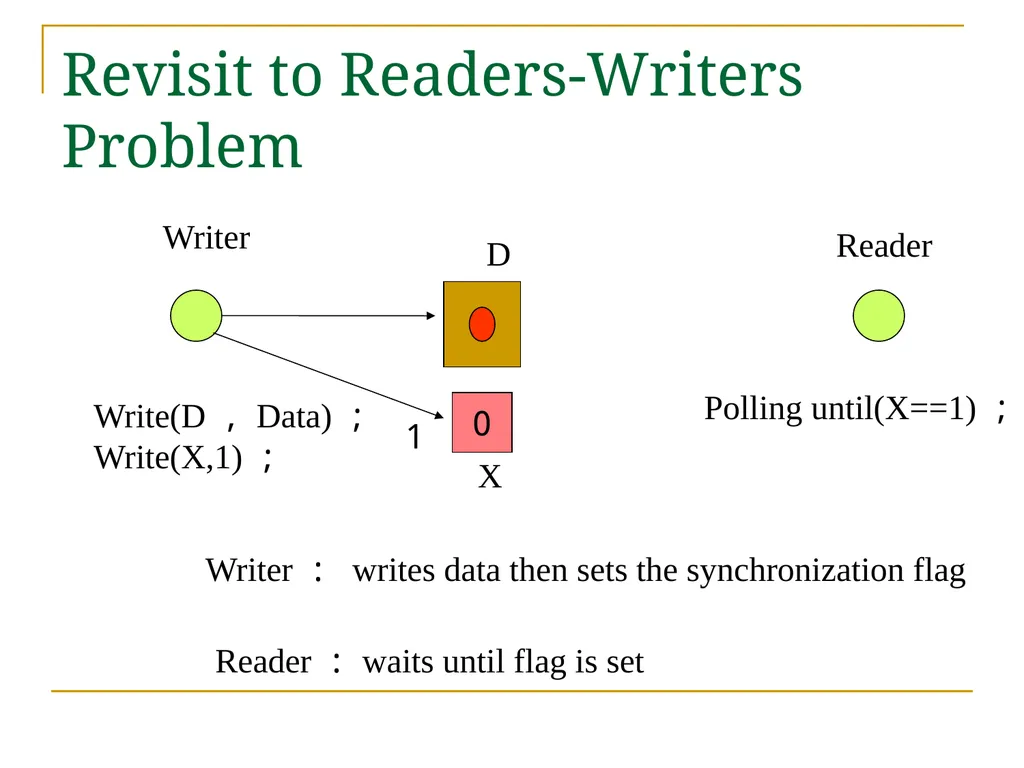
Revisit to Readers-Writers Problem 0 Writer: writes data then sets the synchronization flag Reader:waits until flag is set Writer Reader Write(D,Data);
Write(X,1); D X Polling until(X==1);<br>
Write(X,1); D X Polling until(X==1);<br>
03
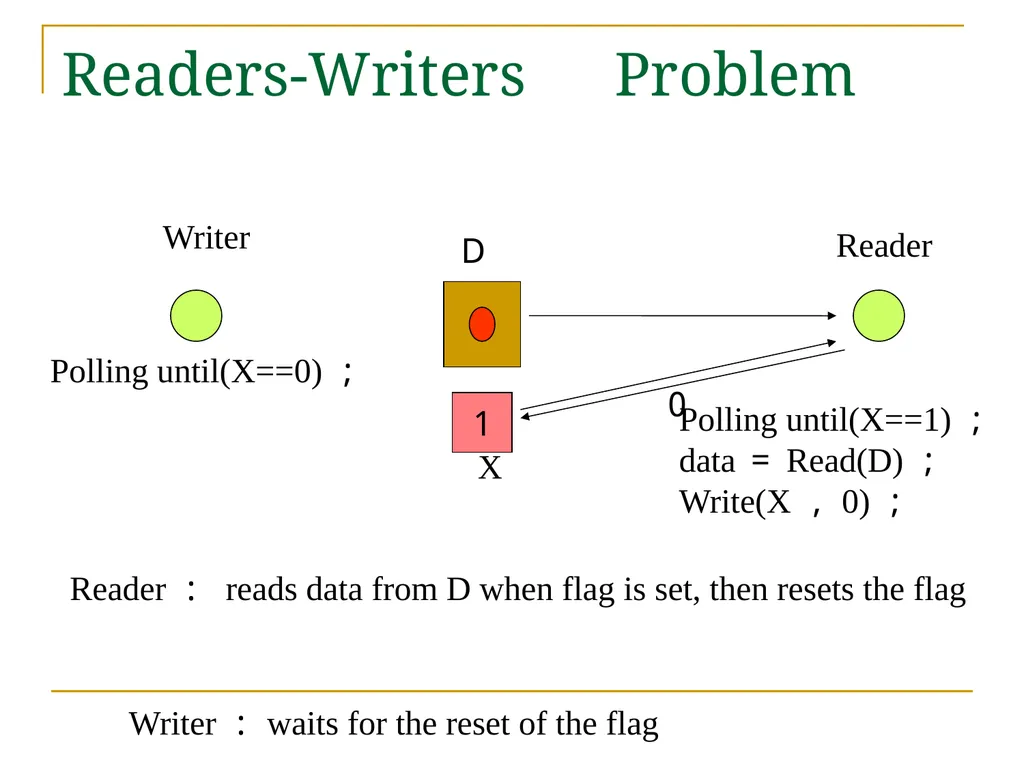
Readers-Writers Problem 1 Reader: reads data from D when flag is set, then resets the flag Writer Reader 0 Writer:waits for the reset of the flag D X Polling until(X==0); Polling until(X==1);
data=Read(D);
Write(X,0);<br>
data=Read(D);
Write(X,0);<br>
04
But is it true? In most machines, the order of read/write access from/to different address is not guaranteed.
The order is kept when each processor uses the sequential consistency or the total store ordering (TSO).<br>
The order is kept when each processor uses the sequential consistency or the total store ordering (TSO).<br>
05
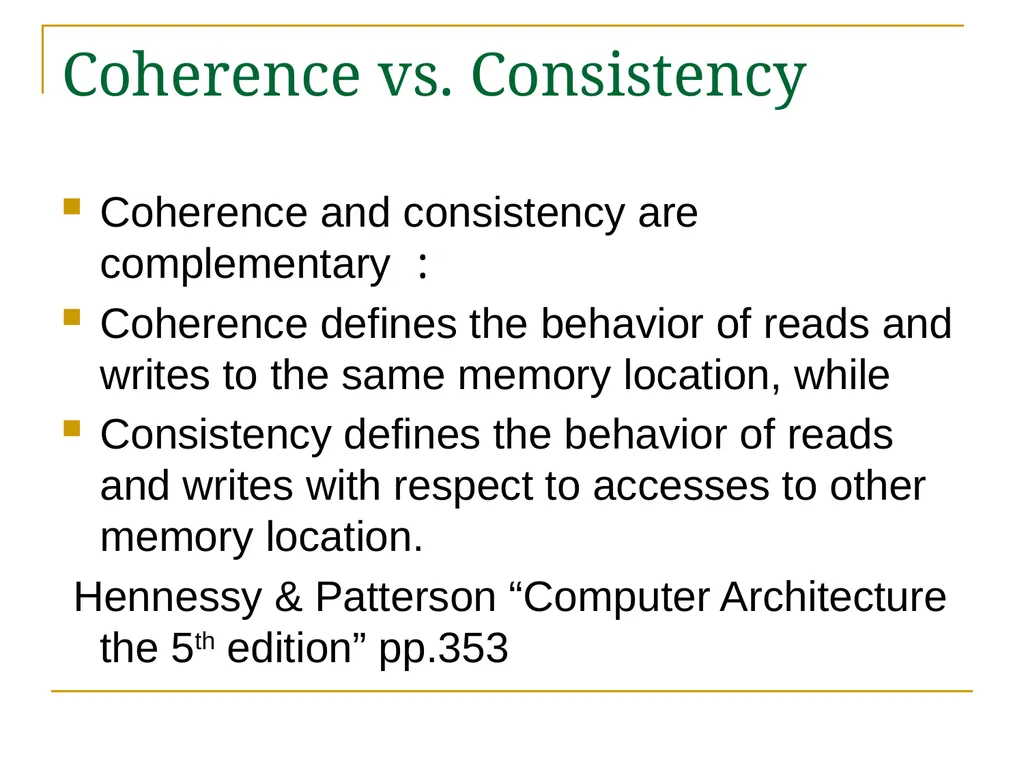
Coherence vs. Consistency Coherence and consistency are complementary:
Coherence defines the behavior of reads and writes to the same memory location, while
Consistency defines the behavior of reads and writes with respect to accesses to other memory location.
Hennessy & Patterson “Computer Architecture the 5th edition” pp.353<br>
Coherence defines the behavior of reads and writes to the same memory location, while
Consistency defines the behavior of reads and writes with respect to accesses to other memory location.
Hennessy & Patterson “Computer Architecture the 5th edition” pp.353<br>
06
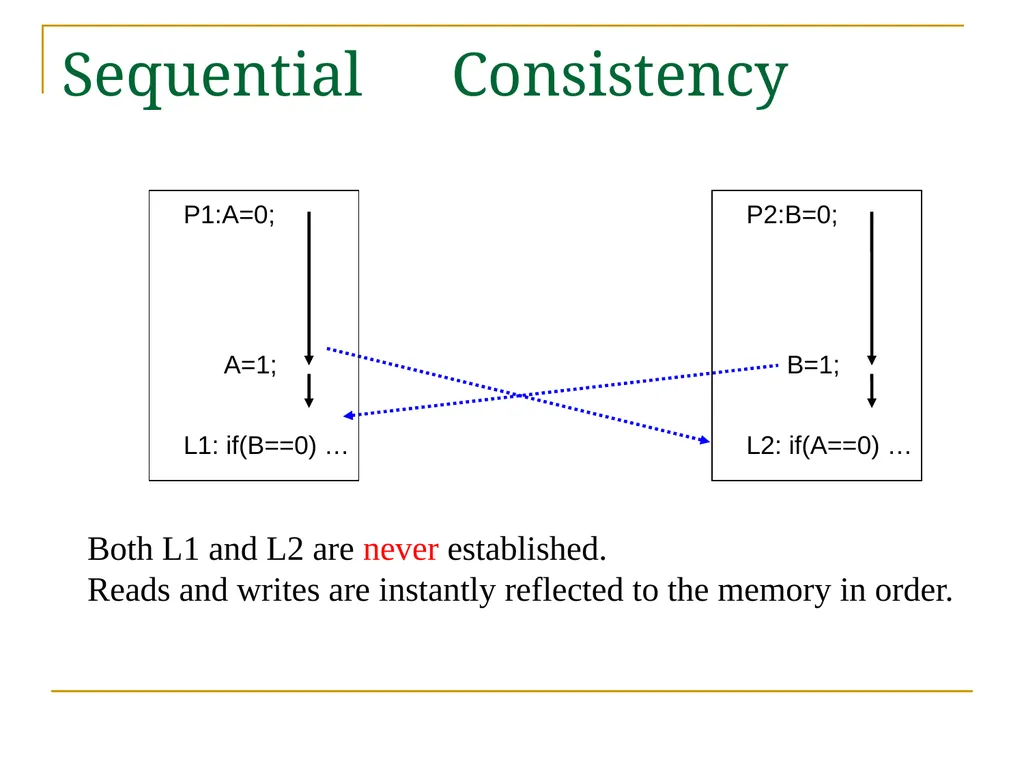
Sequential Consistency Both L1 and L2 are never established.
Reads and writes are instantly reflected to the memory in order. P1:A=0; A=1; L1: if(B==0) … P2:B=0; B=1; L2: if(A==0) …<br>
Reads and writes are instantly reflected to the memory in order. P1:A=0; A=1; L1: if(B==0) … P2:B=0; B=1; L2: if(A==0) …<br>
07
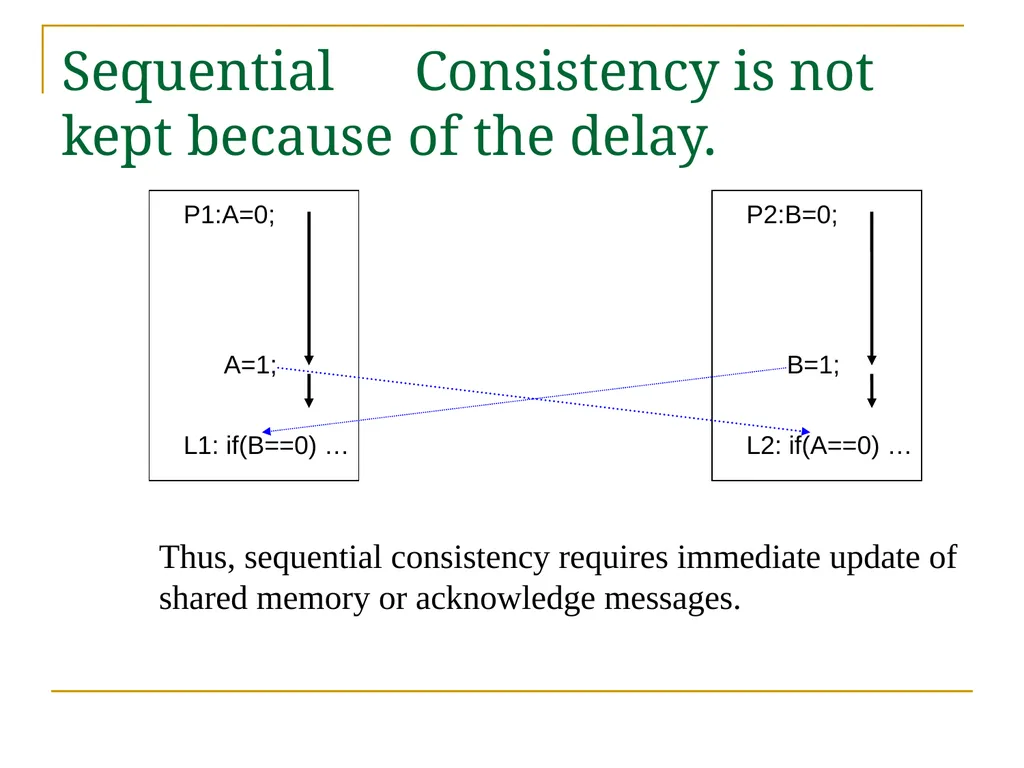
Sequential Consistency is not kept because of the delay. Thus, sequential consistency requires immediate update of
shared memory or acknowledge messages. P1:A=0; A=1; L1: if(B==0) … P2:B=0; B=1; L2: if(A==0) …<br>
shared memory or acknowledge messages. P1:A=0; A=1; L1: if(B==0) … P2:B=0; B=1; L2: if(A==0) …<br>
08
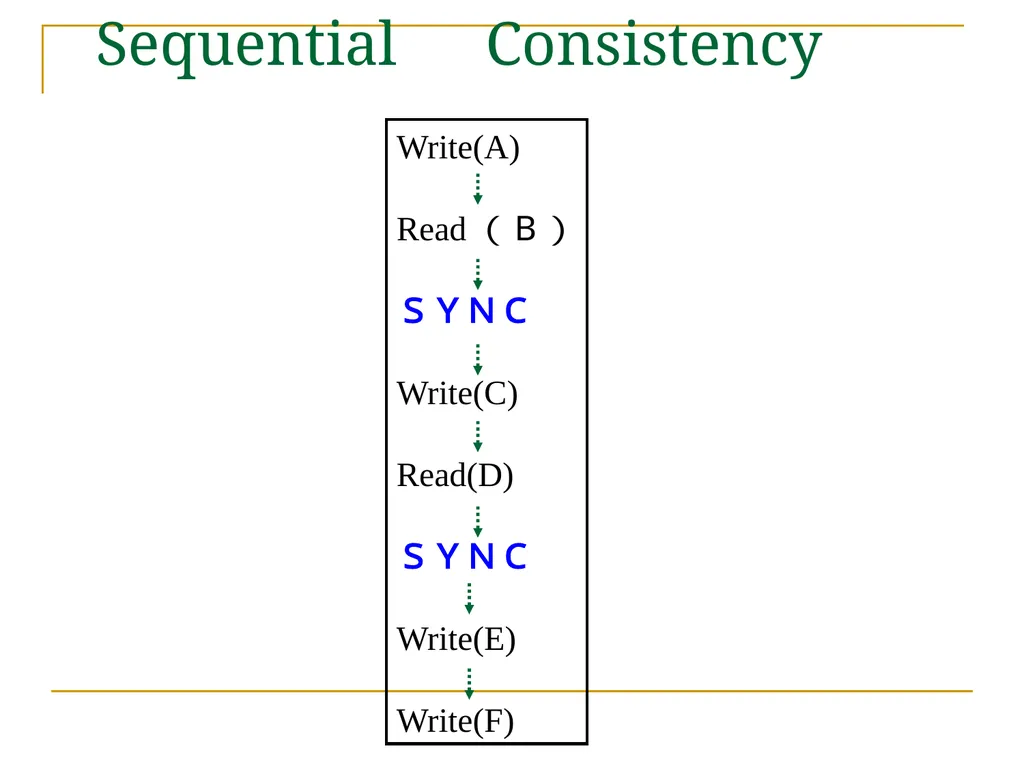
Sequential Consistency Write(A)
Read(B)
SYNC
Write(C)
Read(D)
SYNC
Write(E)
Write(F)<br>
Read(B)
SYNC
Write(C)
Read(D)
SYNC
Write(E)
Write(F)<br>
09
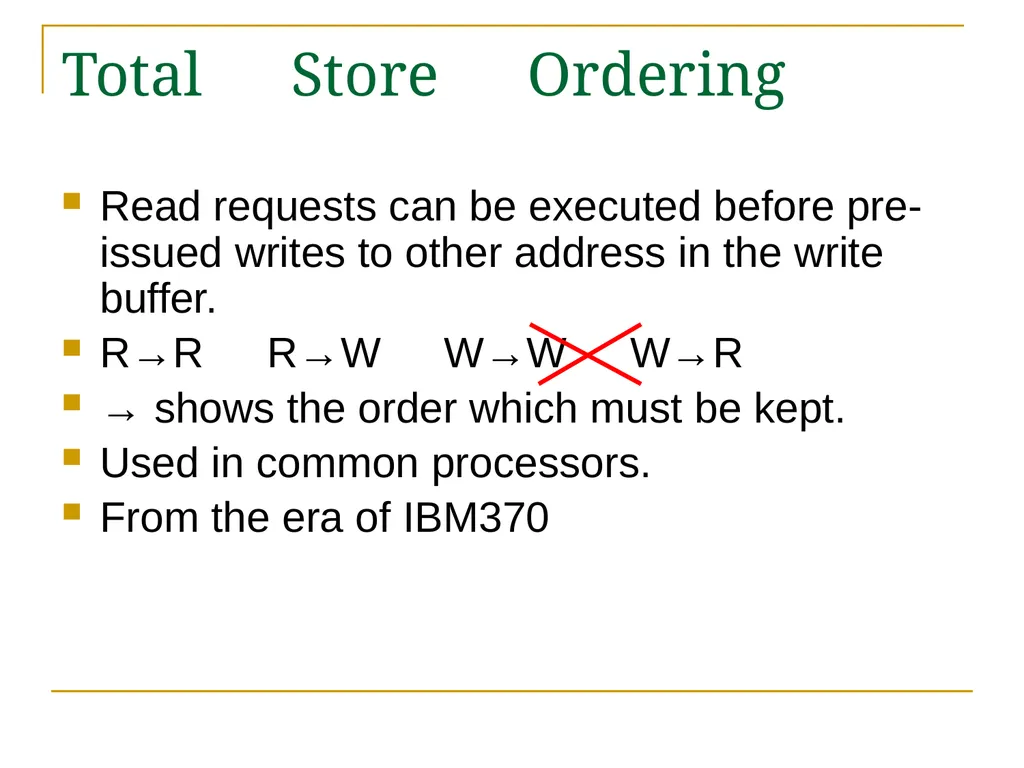
Total Store Ordering Read requests can be executed before pre-issued writes to other address in the write buffer.
R→R R→W W→W W→R
→ shows the order which must be kept.
Used in common processors.
From the era of IBM370<br>
R→R R→W W→W W→R
→ shows the order which must be kept.
Used in common processors.
From the era of IBM370<br>
10
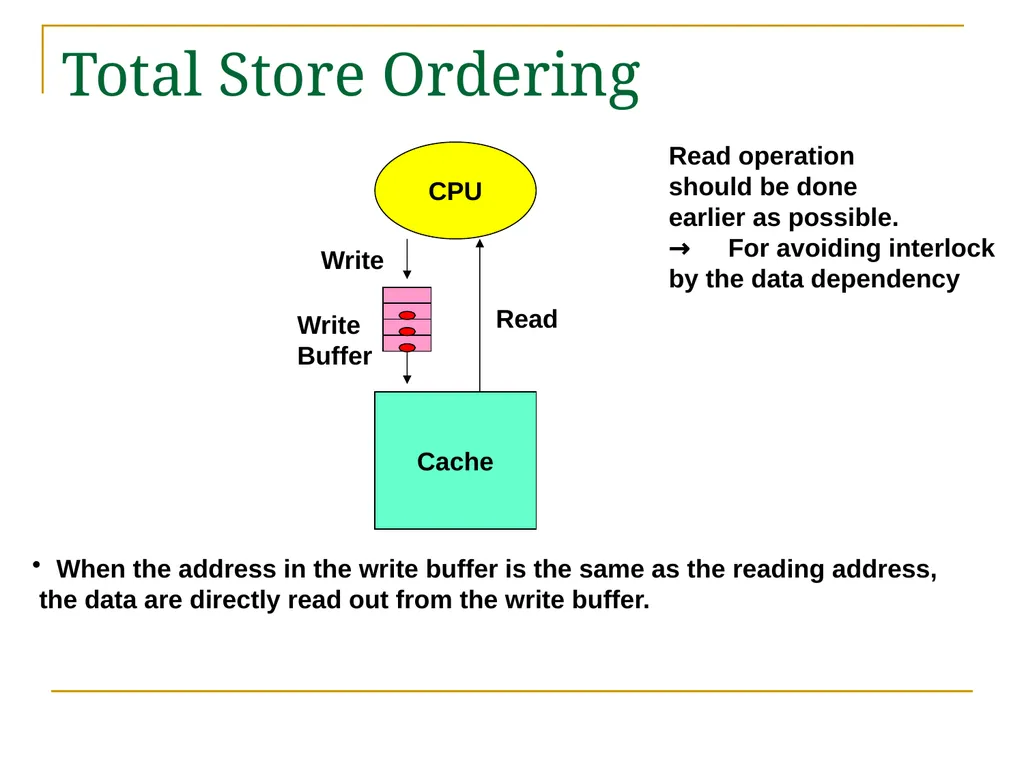
Total Store Ordering CPU Cache Read Write Write
Buffer Read operation
should be done
earlier as possible.
→ For avoiding interlock
by the data dependency When the address in the write buffer is the same as the reading address,
the data are directly read out from the write buffer.<br>
Buffer Read operation
should be done
earlier as possible.
→ For avoiding interlock
by the data dependency When the address in the write buffer is the same as the reading address,
the data are directly read out from the write buffer.<br>
11
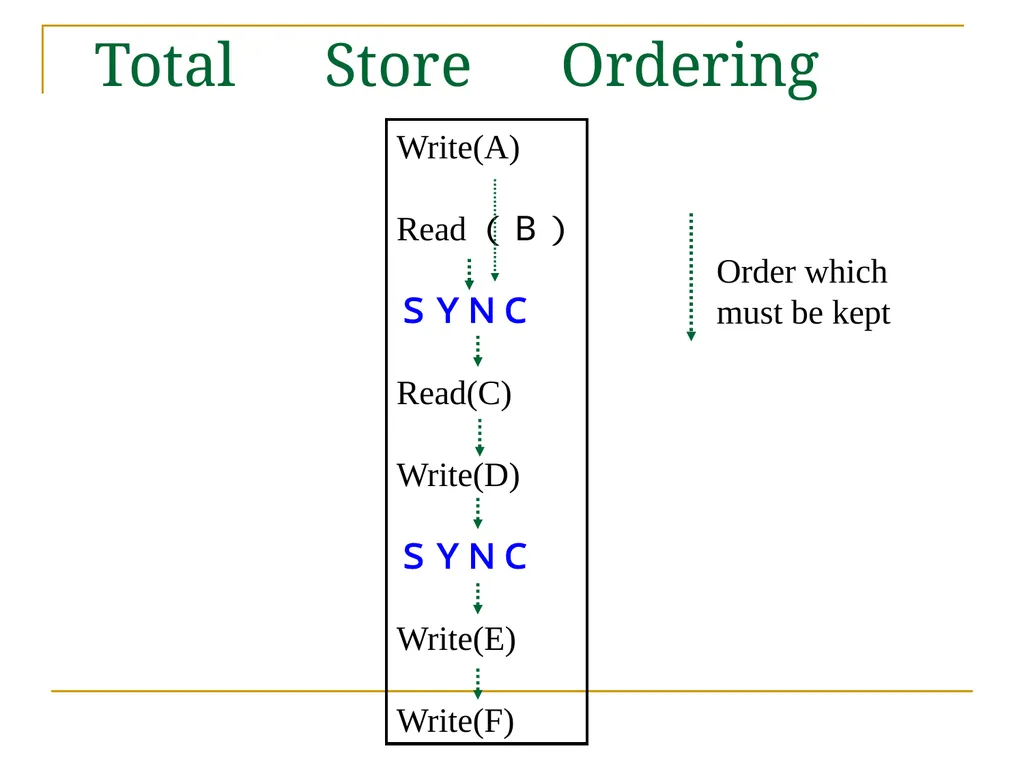
Total Store Ordering Write(A)
Read(B)
SYNC
Read(C)
Write(D)
SYNC
Write(E)
Write(F) Order which must be kept<br>
Read(B)
SYNC
Read(C)
Write(D)
SYNC
Write(E)
Write(F) Order which must be kept<br>
12
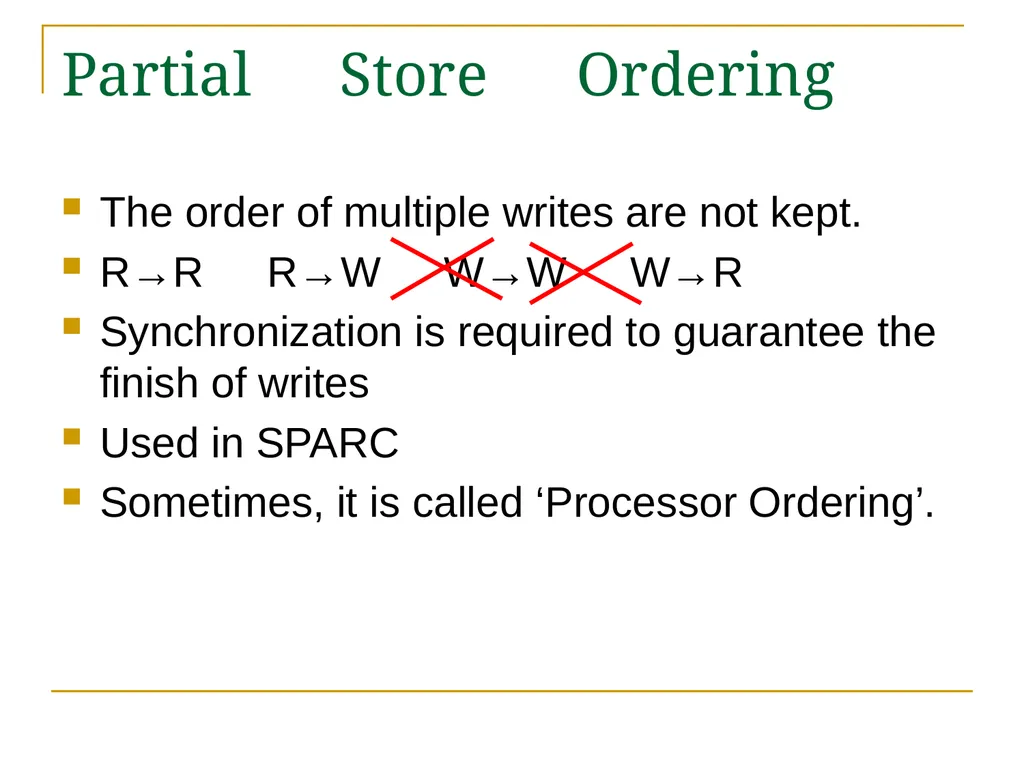
Partial Store Ordering The order of multiple writes are not kept.
R→R R→W W→W W→R
Synchronization is required to guarantee the finish of writes
Used in SPARC
Sometimes, it is called ‘Processor Ordering’.<br>
R→R R→W W→W W→R
Synchronization is required to guarantee the finish of writes
Used in SPARC
Sometimes, it is called ‘Processor Ordering’.<br>
13
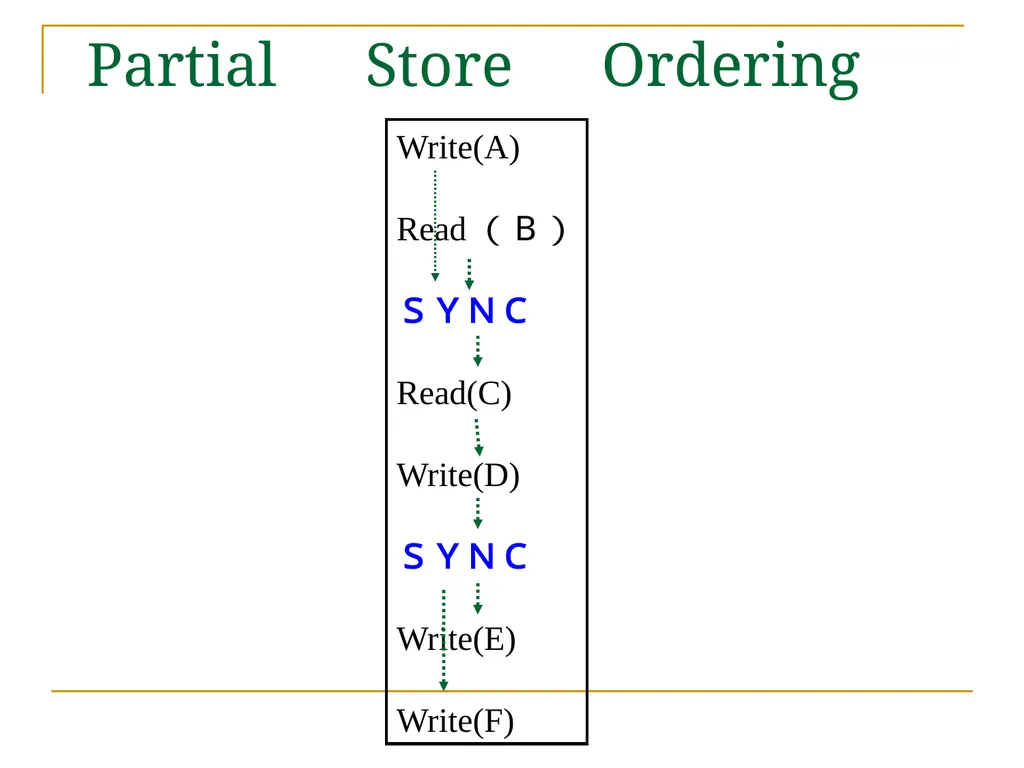
Partial Store Ordering Write(A)
Read(B)
SYNC
Read(C)
Write(D)
SYNC
Write(E)
Write(F)<br>
Read(B)
SYNC
Read(C)
Write(D)
SYNC
Write(E)
Write(F)<br>
14
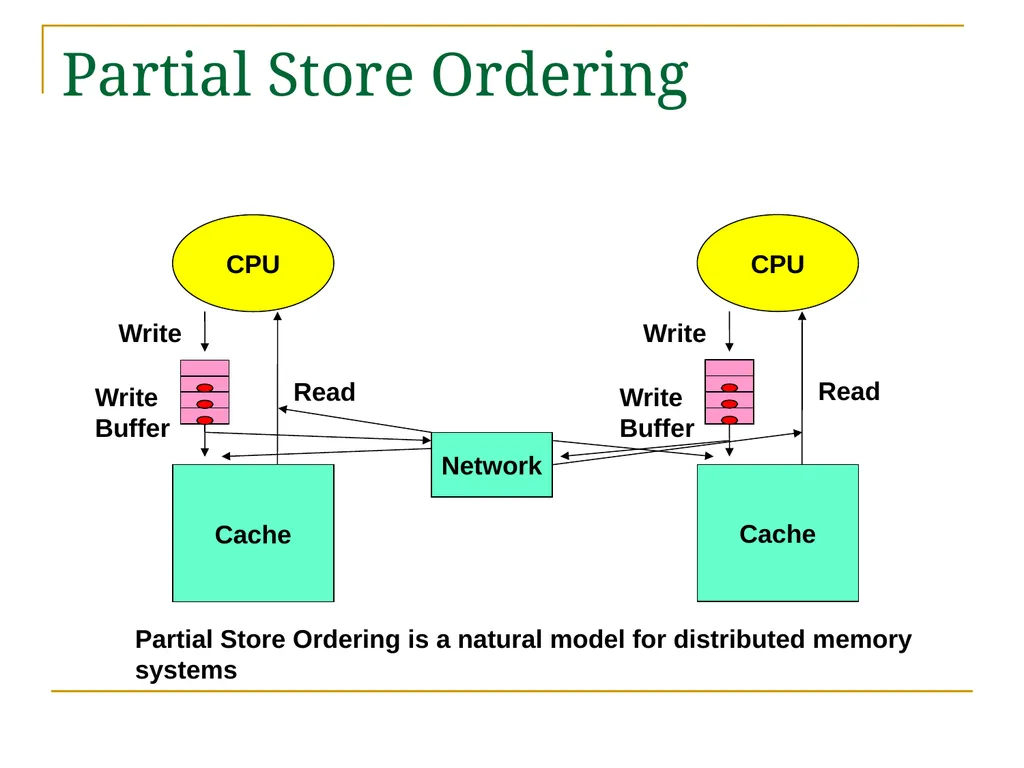
Partial Store Ordering CPU Cache Read Write Write
Buffer CPU Cache Read Write Write
Buffer Network Partial Store Ordering is a natural model for distributed memory
systems<br>
Buffer CPU Cache Read Write Write
Buffer Network Partial Store Ordering is a natural model for distributed memory
systems<br>
15
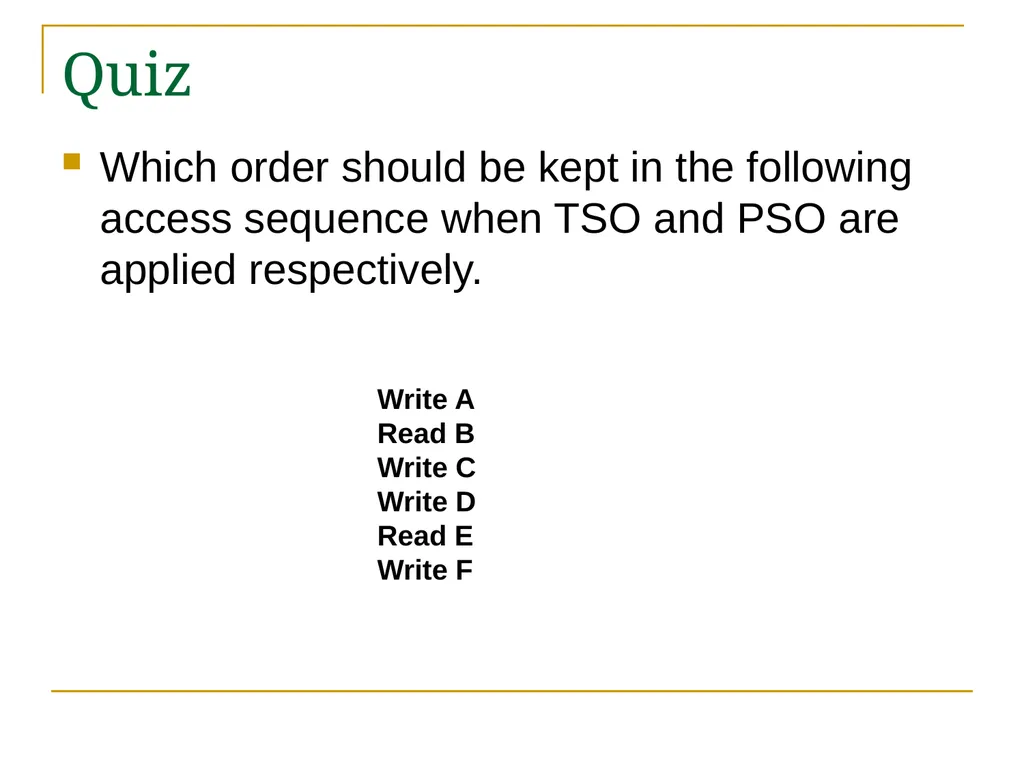
Quiz Which order should be kept in the following access sequence when TSO and PSO are applied respectively. Write A
Read B
Write C
Write D
Read E
Write F<br>
Read B
Write C
Write D
Read E
Write F<br>
16
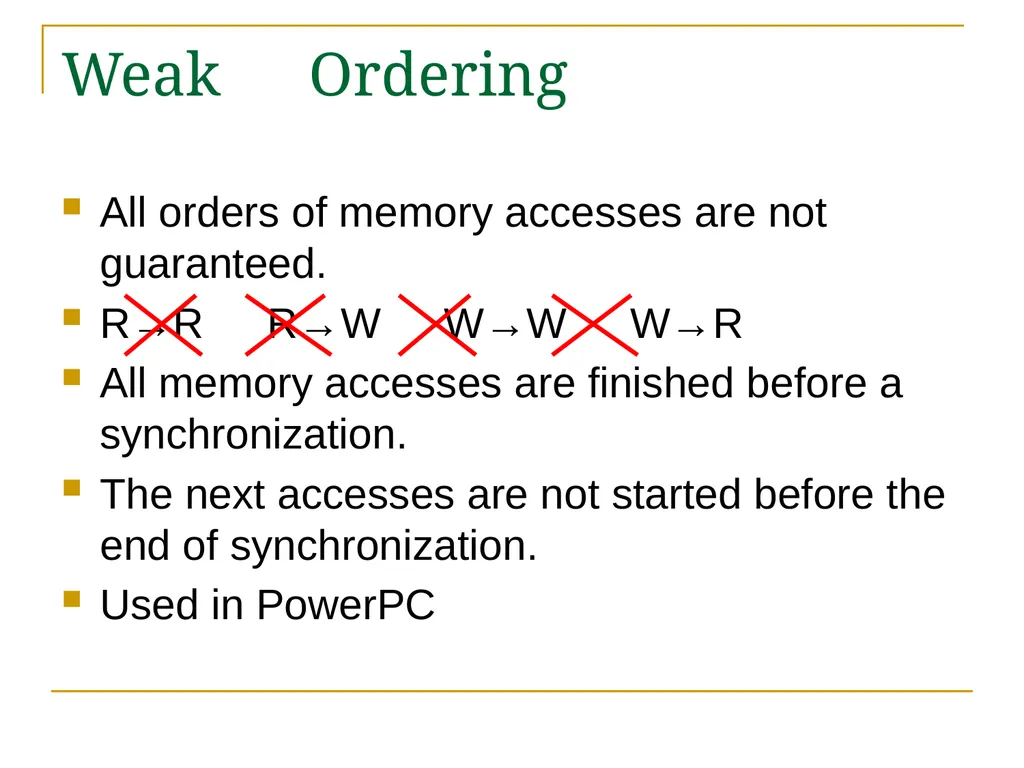
Weak Ordering All orders of memory accesses are not guaranteed.
R→R R→W W→W W→R
All memory accesses are finished before a synchronization.
The next accesses are not started before the end of synchronization.
Used in PowerPC<br>
R→R R→W W→W W→R
All memory accesses are finished before a synchronization.
The next accesses are not started before the end of synchronization.
Used in PowerPC<br>
17
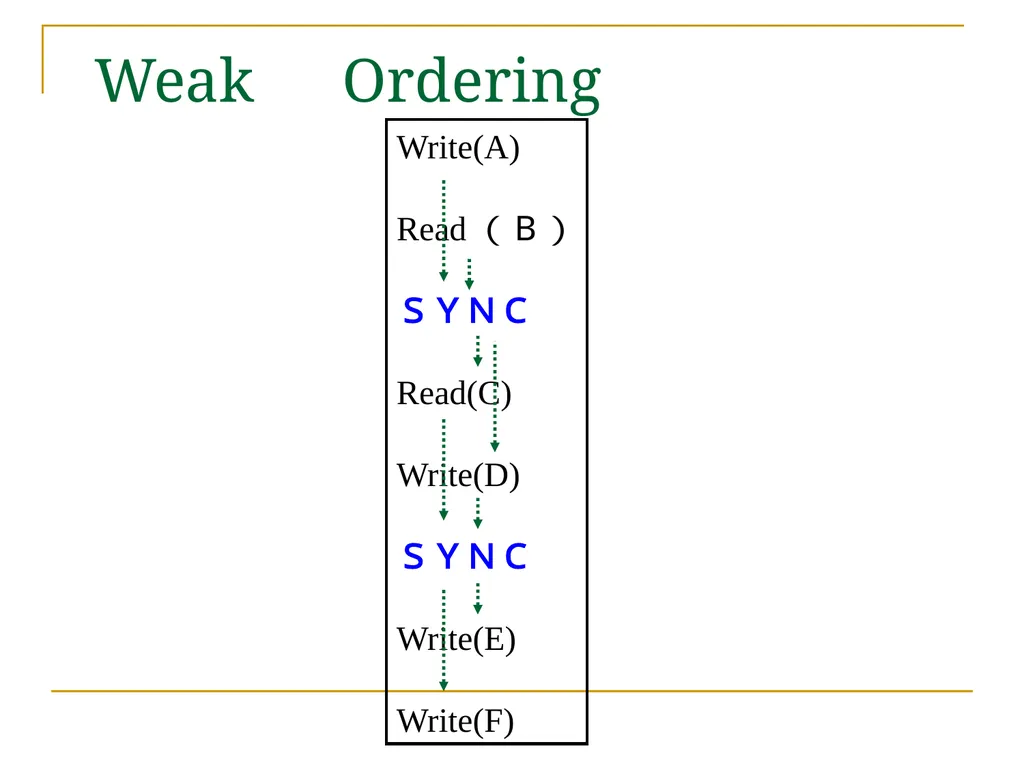
Weak Ordering Write(A)
Read(B)
SYNC
Read(C)
Write(D)
SYNC
Write(E)
Write(F)<br>
Read(B)
SYNC
Read(C)
Write(D)
SYNC
Write(E)
Write(F)<br>
18
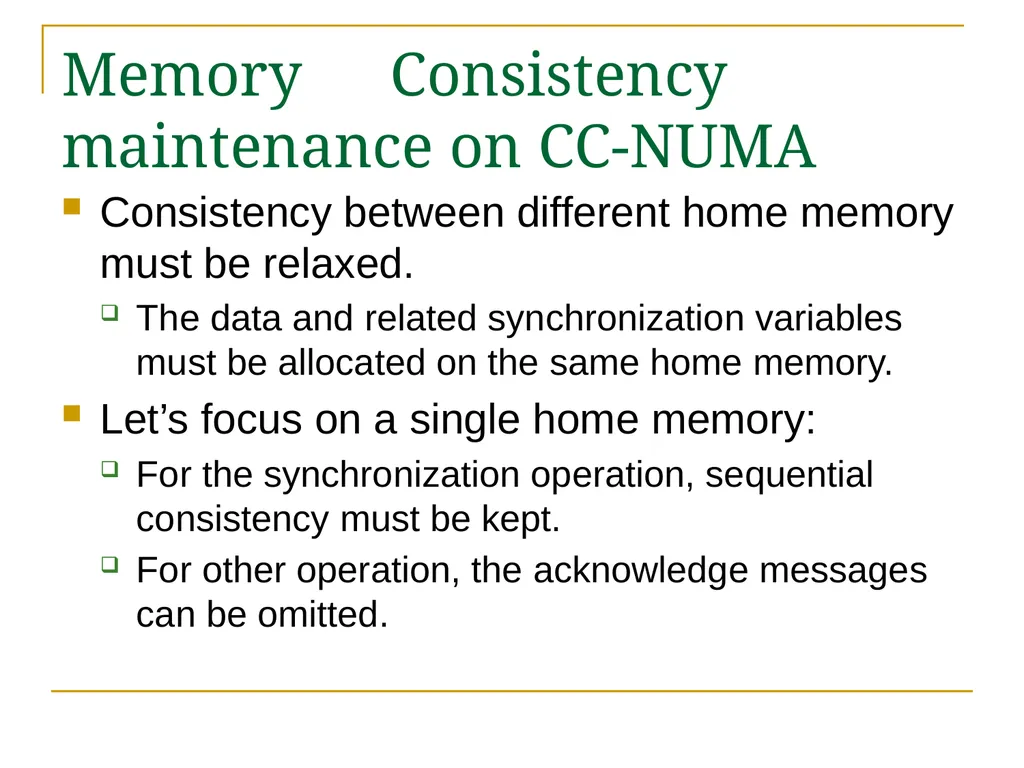
Memory Consistency maintenance on CC-NUMA Consistency between different home memory must be relaxed.
The data and related synchronization variables must be allocated on the same home memory.
Let’s focus on a single home memory:
For the synchronization operation, sequential consistency must be kept.
For other operation, the acknowledge messages can be omitted.<br>
The data and related synchronization variables must be allocated on the same home memory.
Let’s focus on a single home memory:
For the synchronization operation, sequential consistency must be kept.
For other operation, the acknowledge messages can be omitted.<br>
19
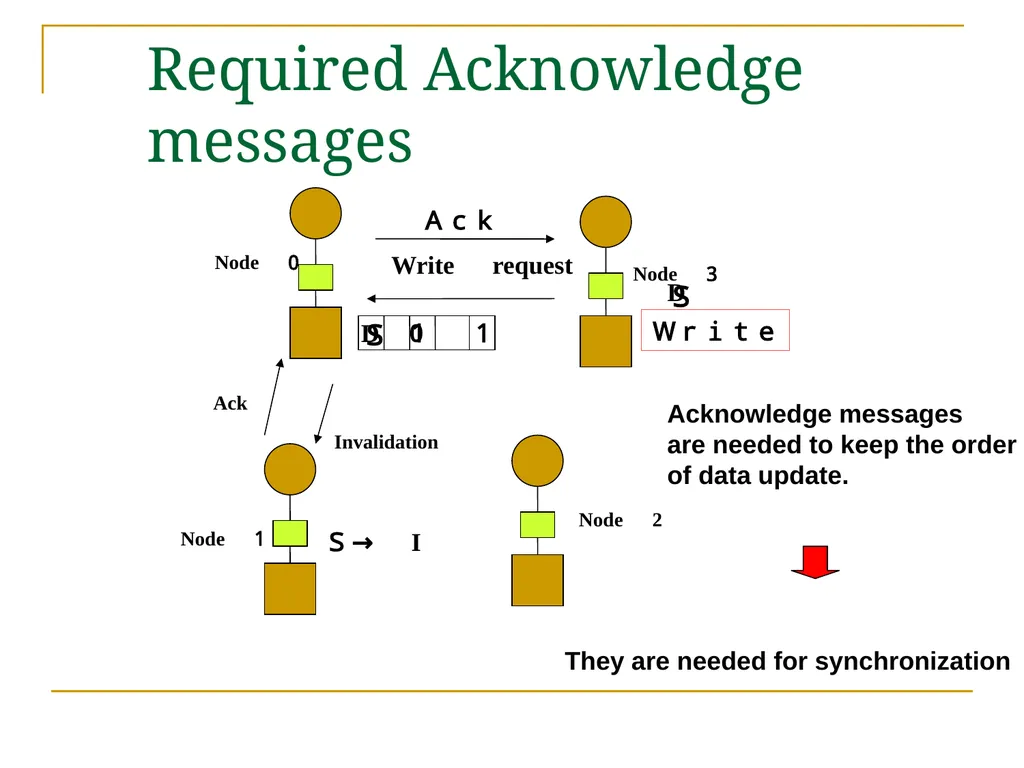
Required Acknowledge messages Node 1 Node 2 Node 3 Node 0 S S D S Write D 1 1 0 Acknowledge messages
are needed to keep the order
of data update. They are needed for synchronization<br>
are needed to keep the order
of data update. They are needed for synchronization<br>
20
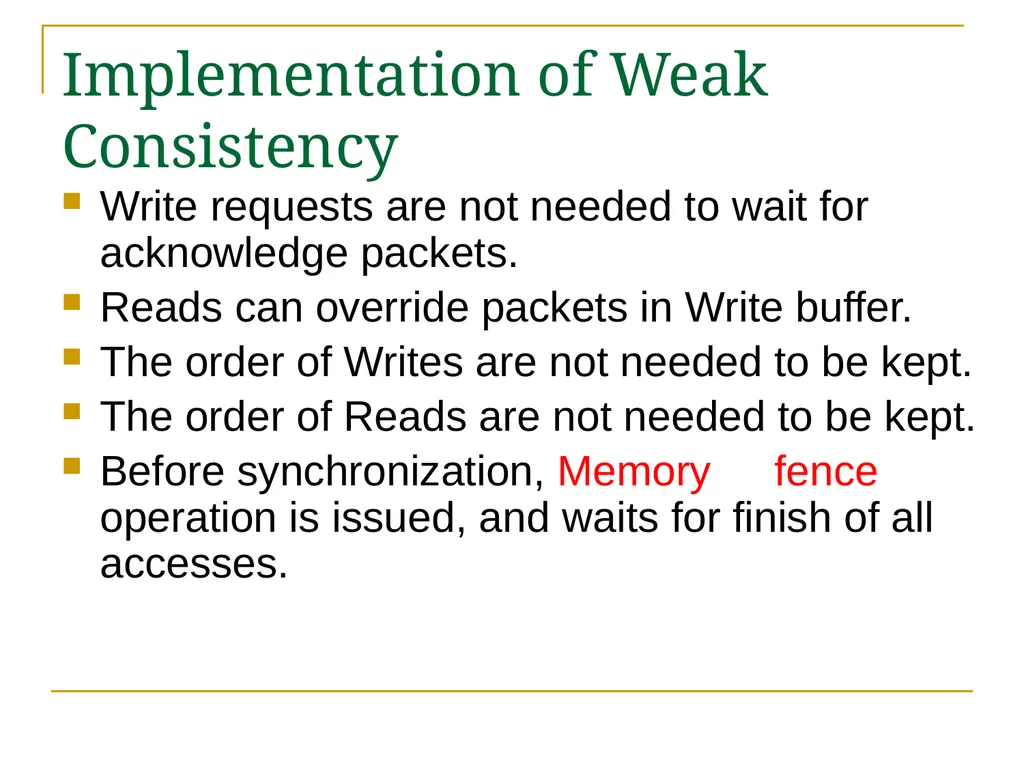
Implementation of Weak Consistency Write requests are not needed to wait for acknowledge packets.
Reads can override packets in Write buffer.
The order of Writes are not needed to be kept.
The order of Reads are not needed to be kept.
Before synchronization, Memory fence operation is issued, and waits for finish of all accesses.<br>
Reads can override packets in Write buffer.
The order of Writes are not needed to be kept.
The order of Reads are not needed to be kept.
Before synchronization, Memory fence operation is issued, and waits for finish of all accesses.<br>
21
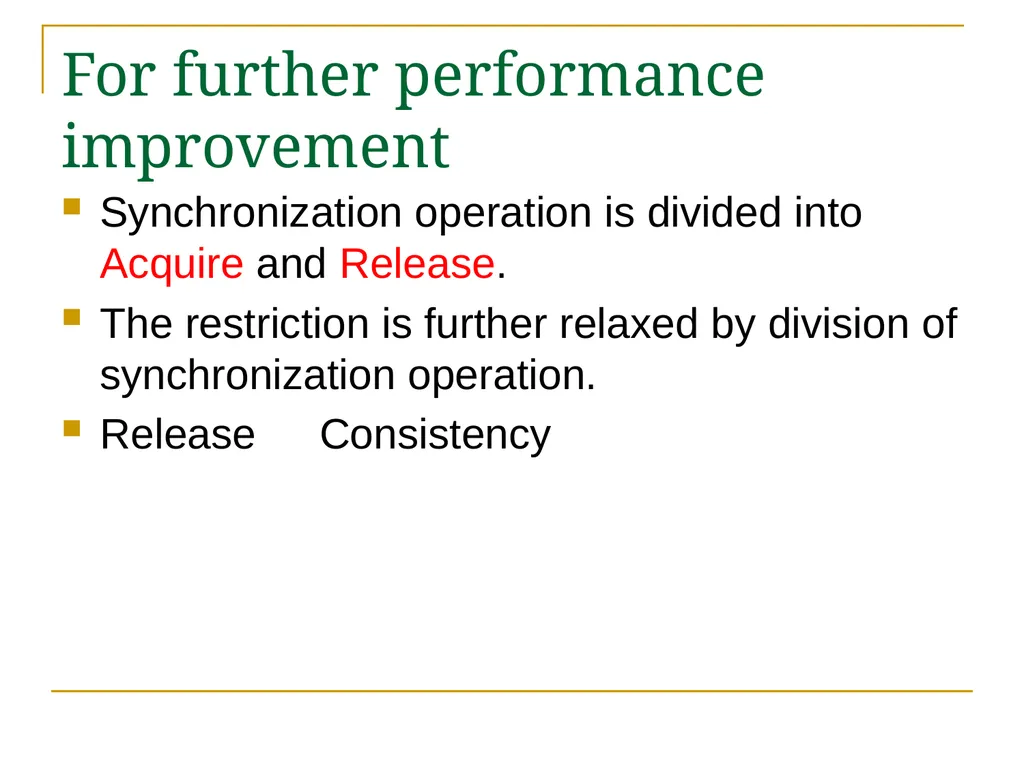
For further performance improvement Synchronization operation is divided into Acquire and Release.
The restriction is further relaxed by division of synchronization operation.
Release Consistency<br>
The restriction is further relaxed by division of synchronization operation.
Release Consistency<br>
22
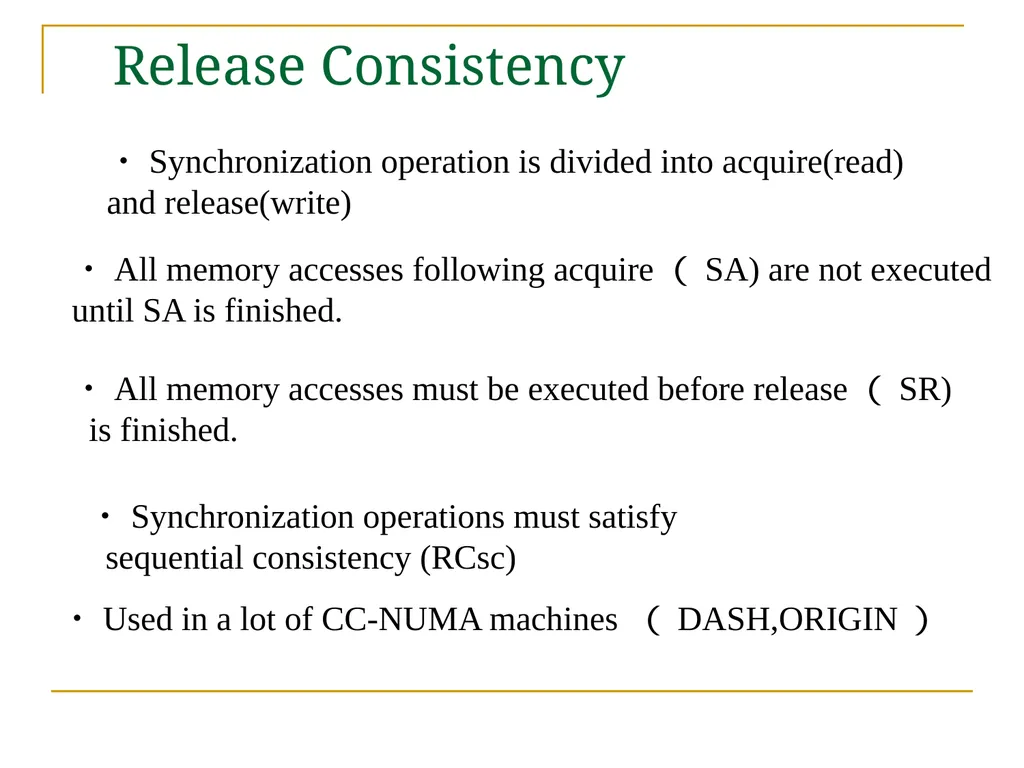
Release Consistency ・Synchronization operation is divided into acquire(read) and release(write) ・All memory accesses following acquire(SA) are not executed
until SA is finished. ・All memory accesses must be executed before release(SR)
is finished. ・Synchronization operations must satisfy
sequential consistency (RCsc) ・Used in a lot of CC-NUMA machines (DASH,ORIGIN)<br>
until SA is finished. ・All memory accesses must be executed before release(SR)
is finished. ・Synchronization operations must satisfy
sequential consistency (RCsc) ・Used in a lot of CC-NUMA machines (DASH,ORIGIN)<br>
23
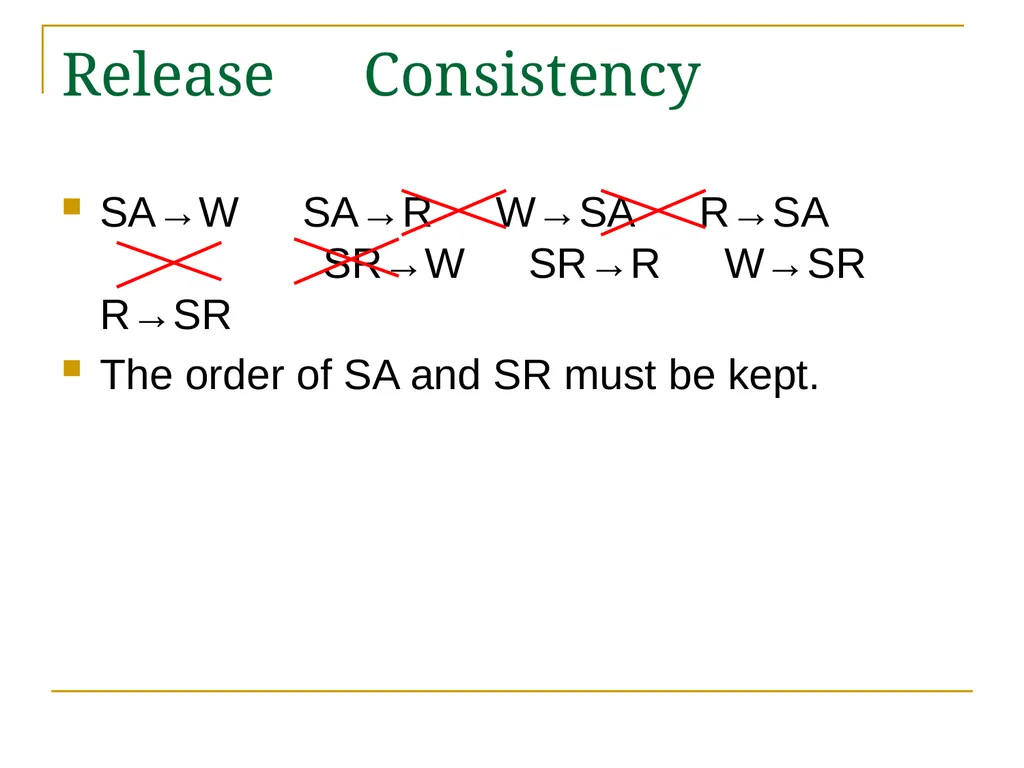
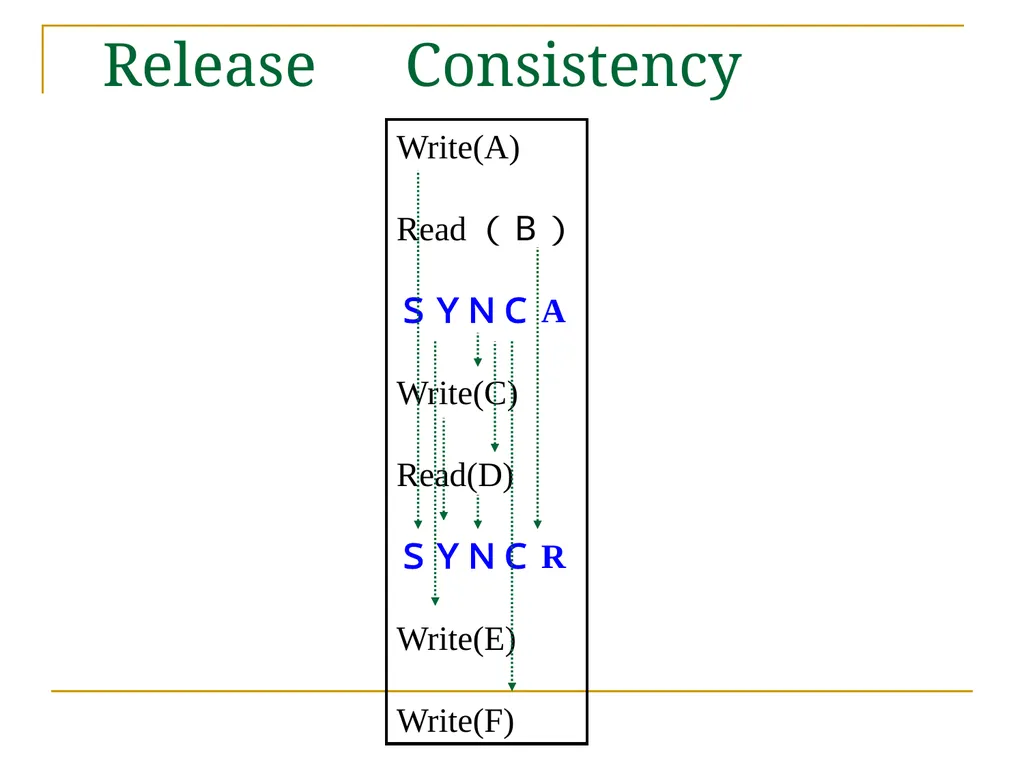
Release Consistency SA→W SA→R W→SA R→SA SR→W SR→R W→SR R→SR
The order of SA and SR must be kept.<br>
The order of SA and SR must be kept.<br>
24
Release Consistency Write(A)
Read(B)
SYNCA
Write(C)
Read(D)
SYNCR
Write(E)
Write(F)<br>
Read(B)
SYNCA
Write(C)
Read(D)
SYNCR
Write(E)
Write(F)<br>
25
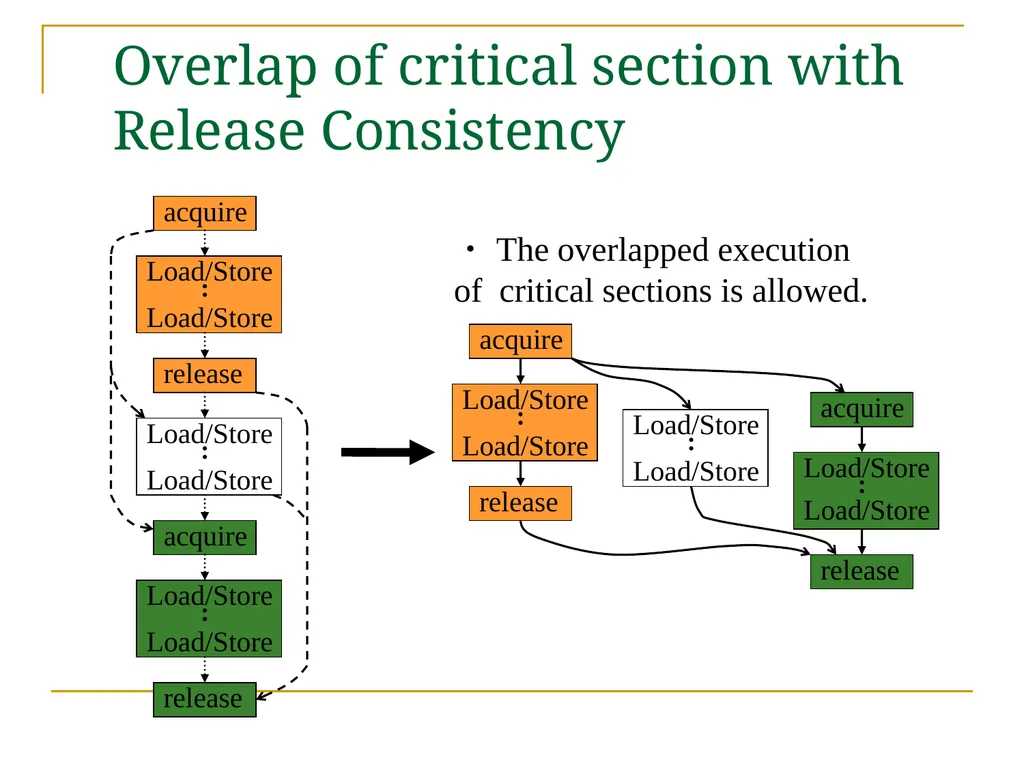
Overlap of critical section with Release Consistency acquire release Load/Store Load/Store<br>
26
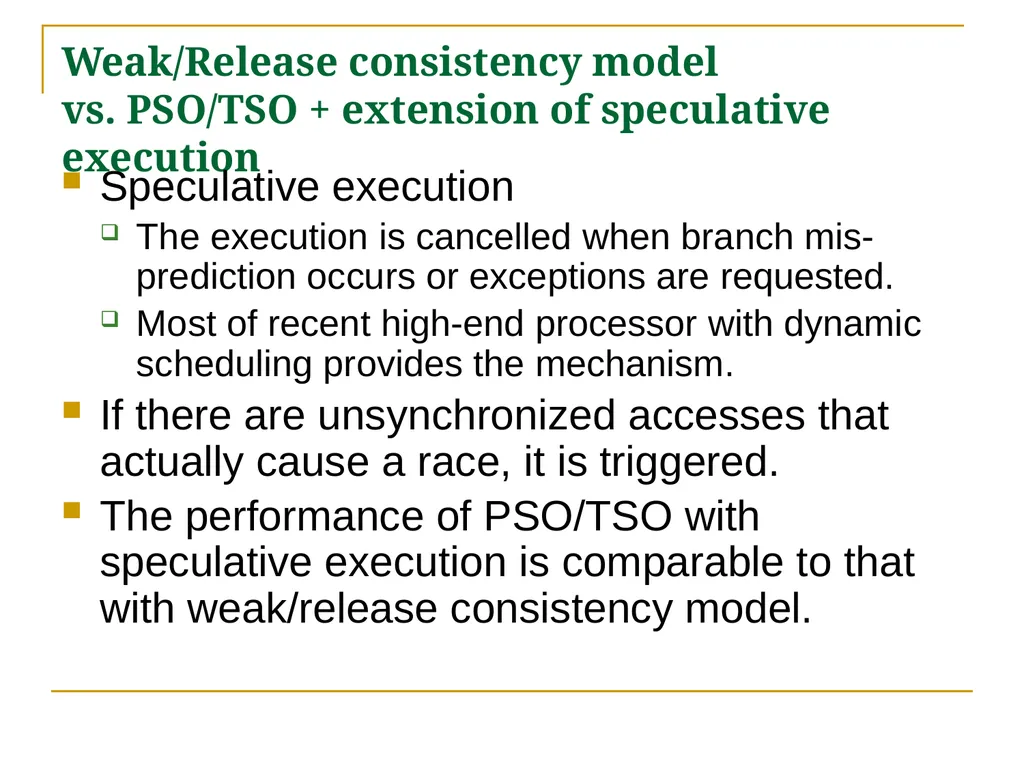
Weak/Release consistency model
vs. PSO/TSO + extension of speculative execution Speculative execution
The execution is cancelled when branch mis-prediction occurs or exceptions are requested.
Most of recent high-end processor with dynamic scheduling provides the mechanism.
If there are unsynchronized accesses that actually cause a race, it is triggered.
The performance of PSO/TSO with speculative execution is comparable to that with weak/release consistency model.<br>
The execution is cancelled when branch mis-prediction occurs or exceptions are requested.
Most of recent high-end processor with dynamic scheduling provides the mechanism.
If there are unsynchronized accesses that actually cause a race, it is triggered.
The performance of PSO/TSO with speculative execution is comparable to that with weak/release consistency model.<br>
27
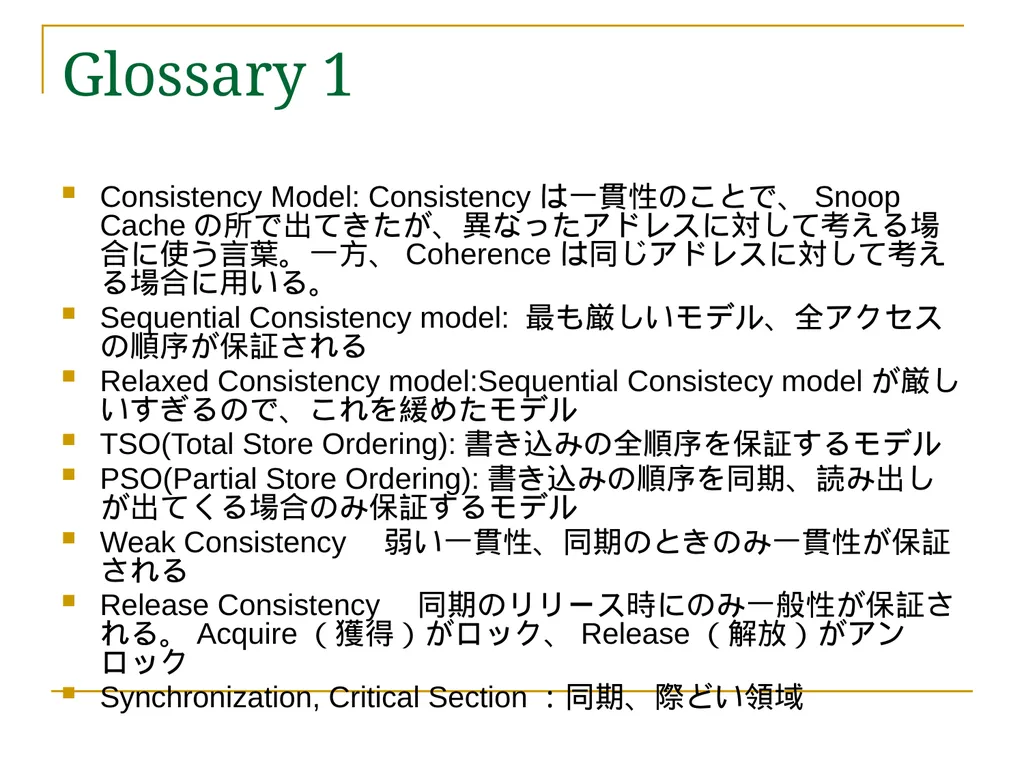
Glossary 1 Consistency Model: Consistencyは一貫性のことで、Snoop Cacheの所で出てきたが、異なったアドレスに対して考える場合に使う言葉。一方、Coherenceは同じアドレスに対して考える場合に用いる。
Sequential Consistency model: 最も厳しいモデル、全アクセスの順序が保証される
Relaxed Consistency model:Sequential Consistecy modelが厳しいすぎるので、これを緩めたモデル
TSO(Total Store Ordering):書き込みの全順序を保証するモデル
PSO(Partial Store Ordering):書き込みの順序を同期、読み出しが出てくる場合のみ保証するモデル
Weak Consistency 弱い一貫性、同期のときのみ一貫性が保証される
Release Consistency 同期のリリース時にのみ一般性が保証される。Acquire(獲得)がロック、Release(解放)がアンロック
Synchronization, Critical Section:同期、際どい領域<br>
Sequential Consistency model: 最も厳しいモデル、全アクセスの順序が保証される
Relaxed Consistency model:Sequential Consistecy modelが厳しいすぎるので、これを緩めたモデル
TSO(Total Store Ordering):書き込みの全順序を保証するモデル
PSO(Partial Store Ordering):書き込みの順序を同期、読み出しが出てくる場合のみ保証するモデル
Weak Consistency 弱い一貫性、同期のときのみ一貫性が保証される
Release Consistency 同期のリリース時にのみ一般性が保証される。Acquire(獲得)がロック、Release(解放)がアンロック
Synchronization, Critical Section:同期、際どい領域<br>
28
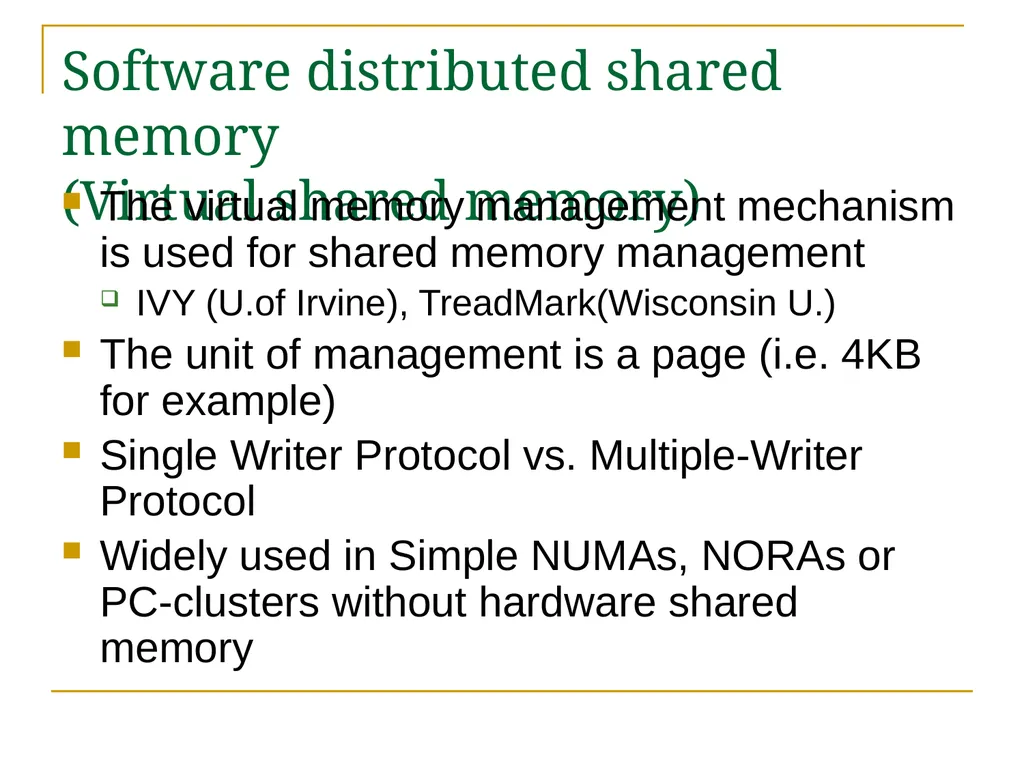
Software distributed shared memory
(Virtual shared memory) The virtual memory management mechanism is used for shared memory management
IVY (U.of Irvine), TreadMark(Wisconsin U.)
The unit of management is a page (i.e. 4KB for example)
Single Writer Protocol vs. Multiple-Writer Protocol
Widely used in Simple NUMAs, NORAs or PC-clusters without hardware shared memory<br>
IVY (U.of Irvine), TreadMark(Wisconsin U.)
The unit of management is a page (i.e. 4KB for example)
Single Writer Protocol vs. Multiple-Writer Protocol
Widely used in Simple NUMAs, NORAs or PC-clusters without hardware shared memory<br>
29
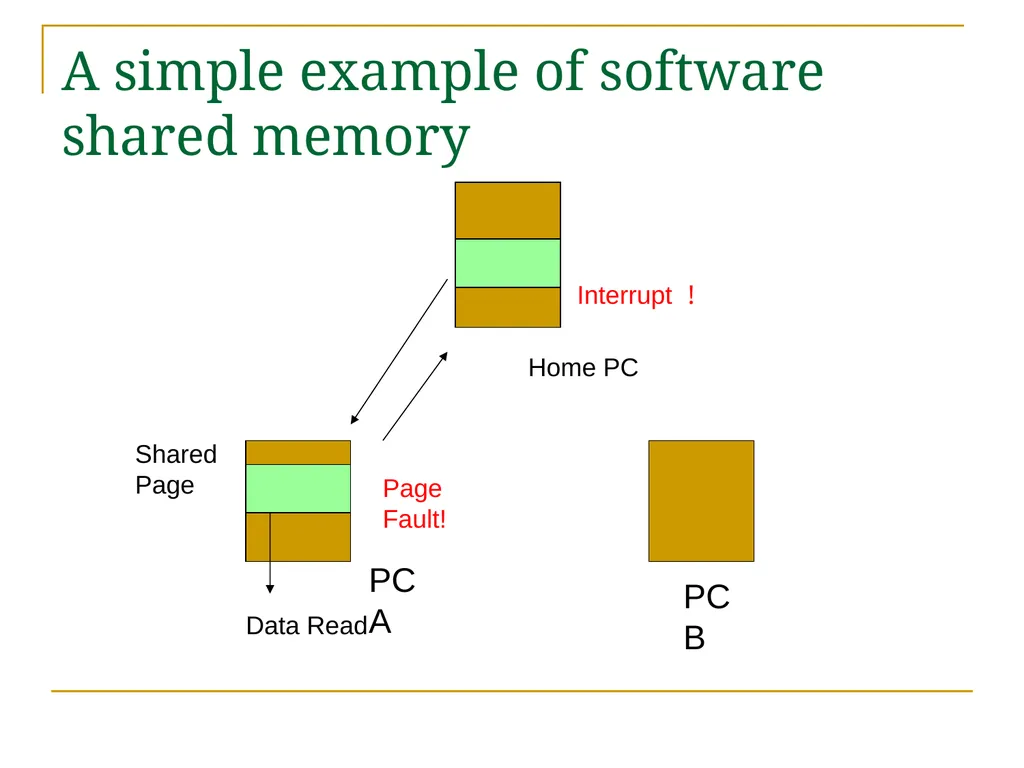
A simple example of software shared memory Data Read PC A PC B Shared Page Page
Fault! Home PC Interrupt!<br>
Fault! Home PC Interrupt!<br>
30
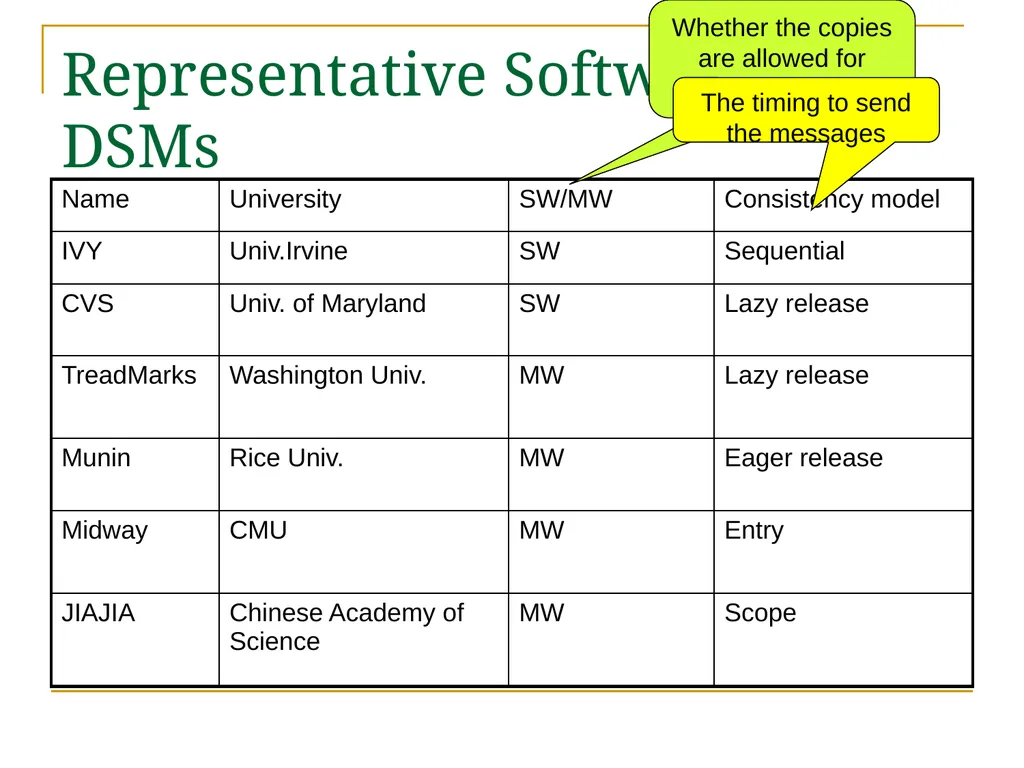
Representative Software DSMs Whether the copies are allowed for multiple writers The timing to send the messages<br>
31
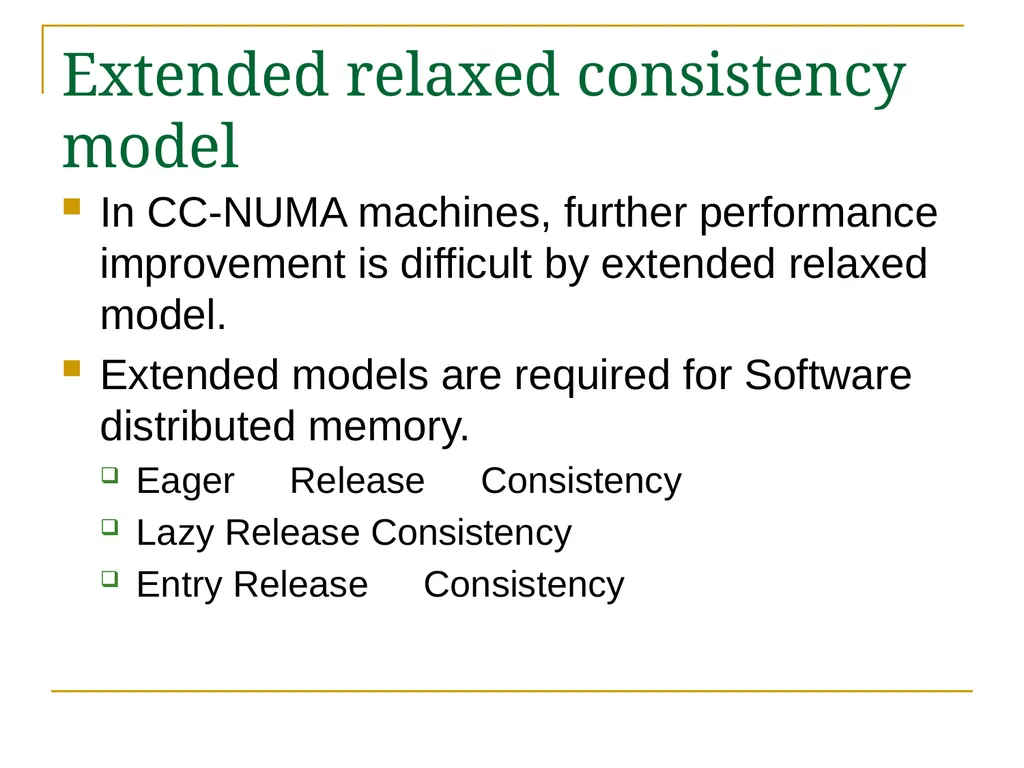
Extended relaxed consistency model In CC-NUMA machines, further performance improvement is difficult by extended relaxed model.
Extended models are required for Software distributed memory.
Eager Release Consistency
Lazy Release Consistency
Entry Release Consistency<br>
Extended models are required for Software distributed memory.
Eager Release Consistency
Lazy Release Consistency
Entry Release Consistency<br>
32
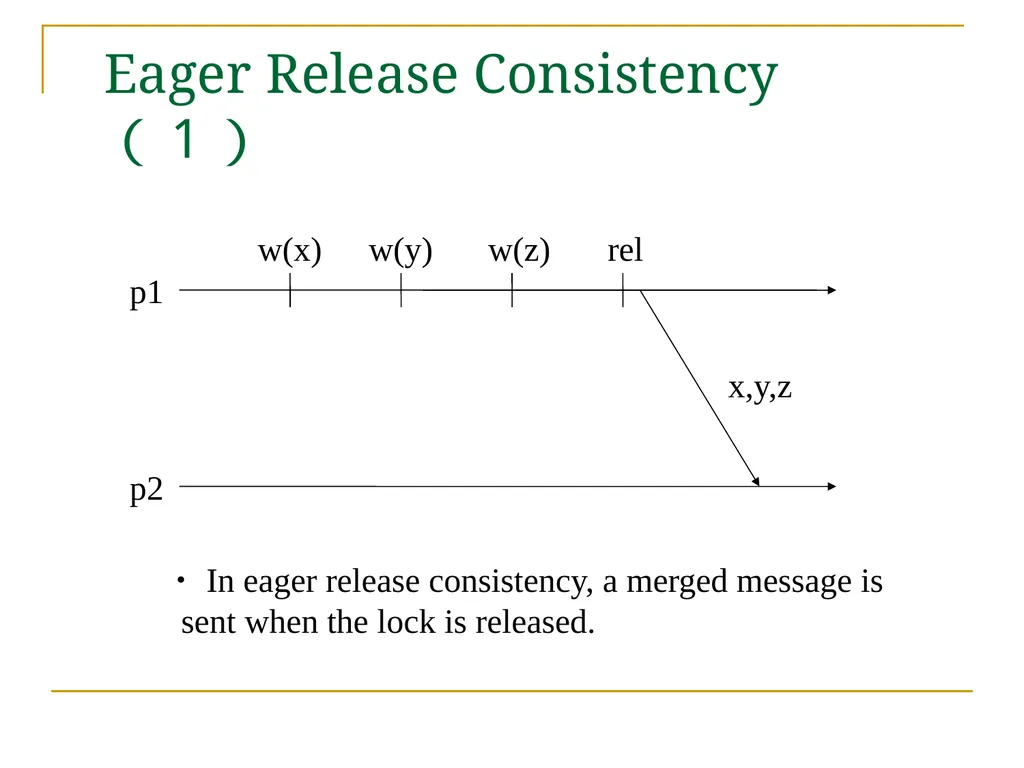
Eager Release Consistency(1) p1 p2 ・In release consistency, write messages are sent immediately.<br>
33
p1 p2 ・In eager release consistency, a merged message is
sent when the lock is released. Eager Release Consistency(1)<br>
sent when the lock is released. Eager Release Consistency(1)<br>
34
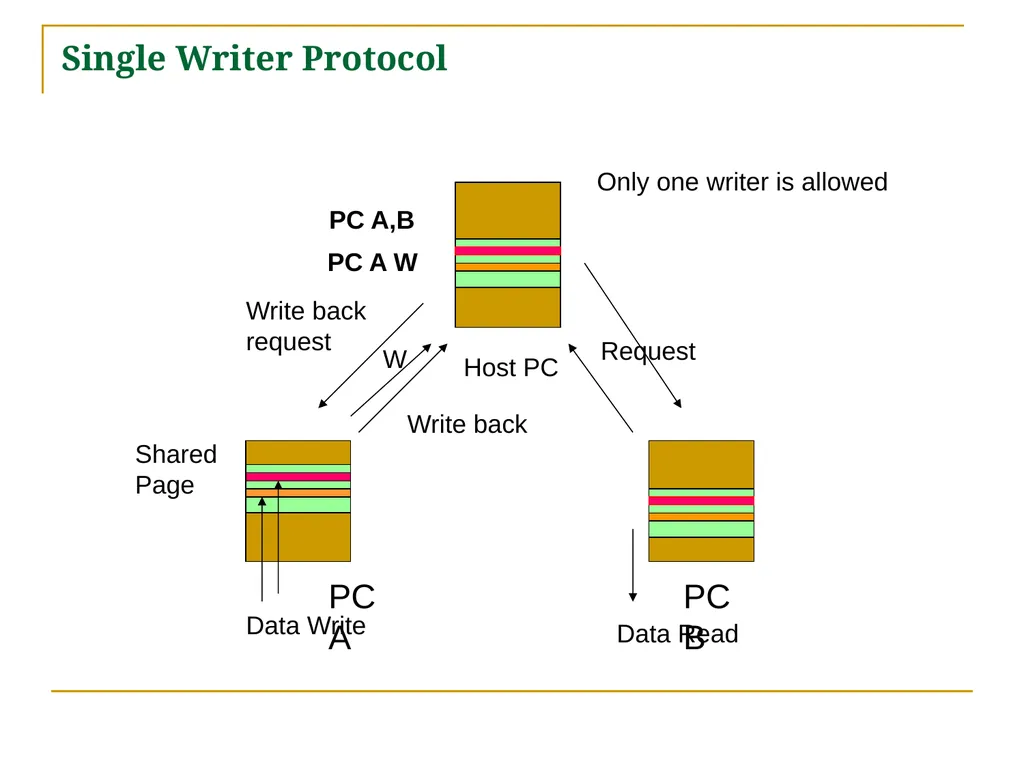
Single Writer Protocol Data Write PC A PC B Shared Page Data Read Request Write back
request Write back Host PC Only one writer is allowed W PC A W PC A,B<br>
request Write back Host PC Only one writer is allowed W PC A W PC A,B<br>
35
Eager Release Consistency(2) ・In Multiple-Writer Protocol, only difference is sent when released. p1 p2 w(x) w(y) acq acq rel rel Page<br>
36
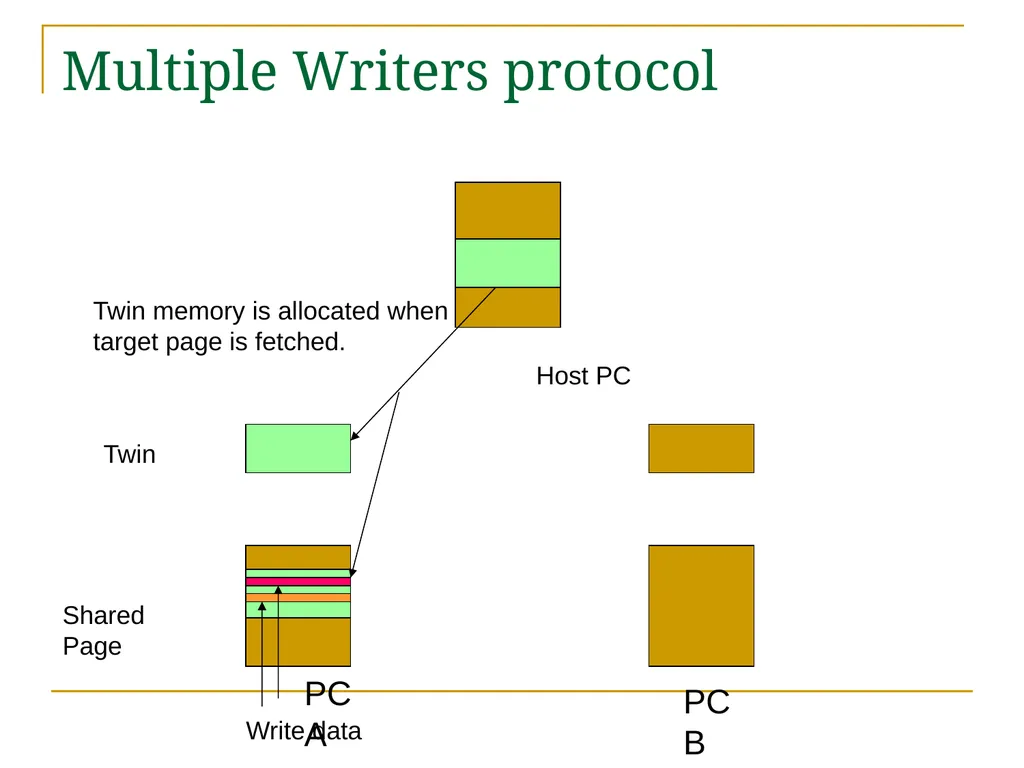
Multiple Writers protocol Write data PC A PC B Twin Shared Page Host PC<br>
37
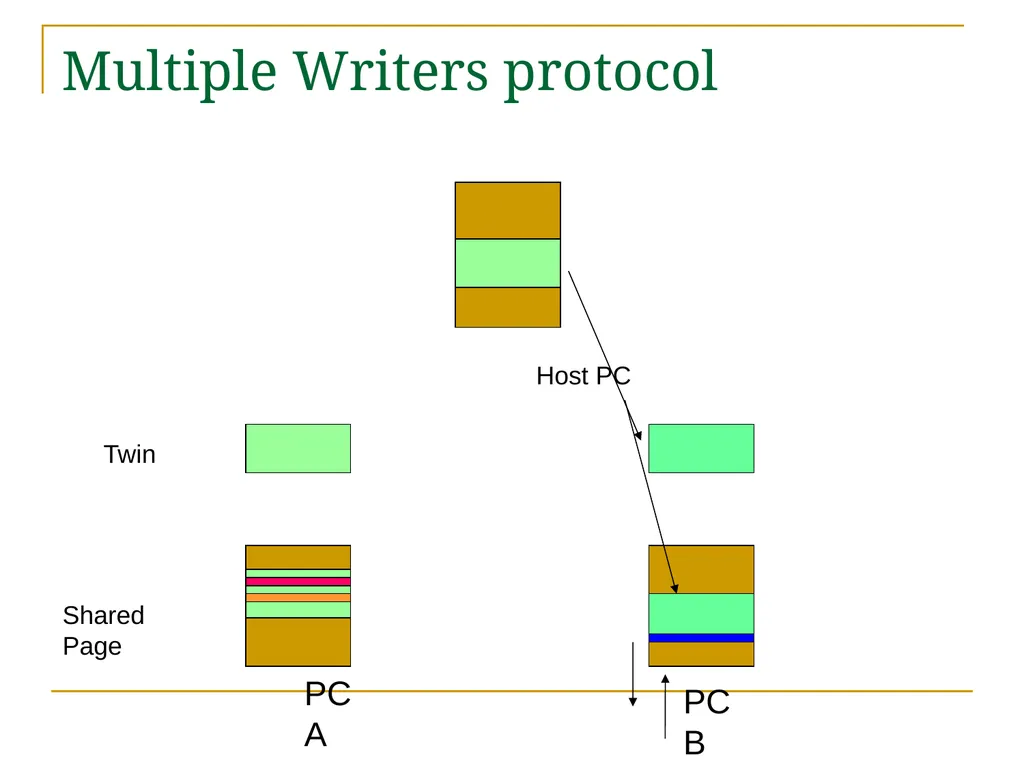
Multiple Writers protocol PC A PC B Twin Shared Page Host PC<br>
38
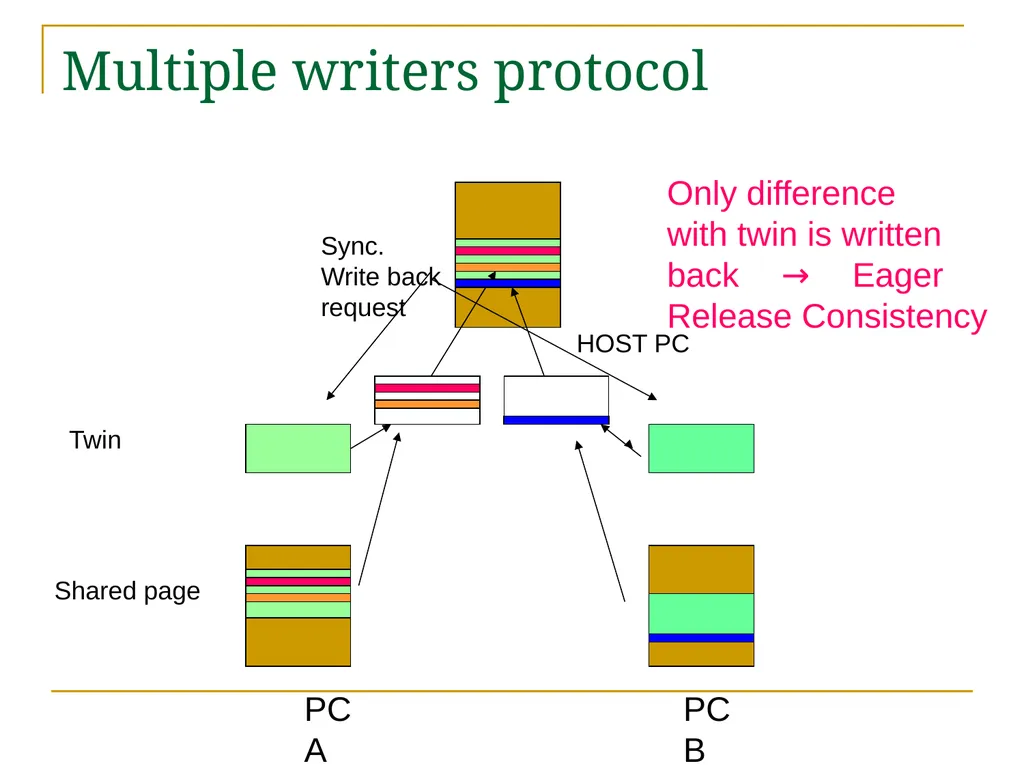
Multiple writers protocol PC A PC B Twin Shared page Only difference
with twin is written back → Eager Release Consistency HOST PC<br>
with twin is written back → Eager Release Consistency HOST PC<br>
39
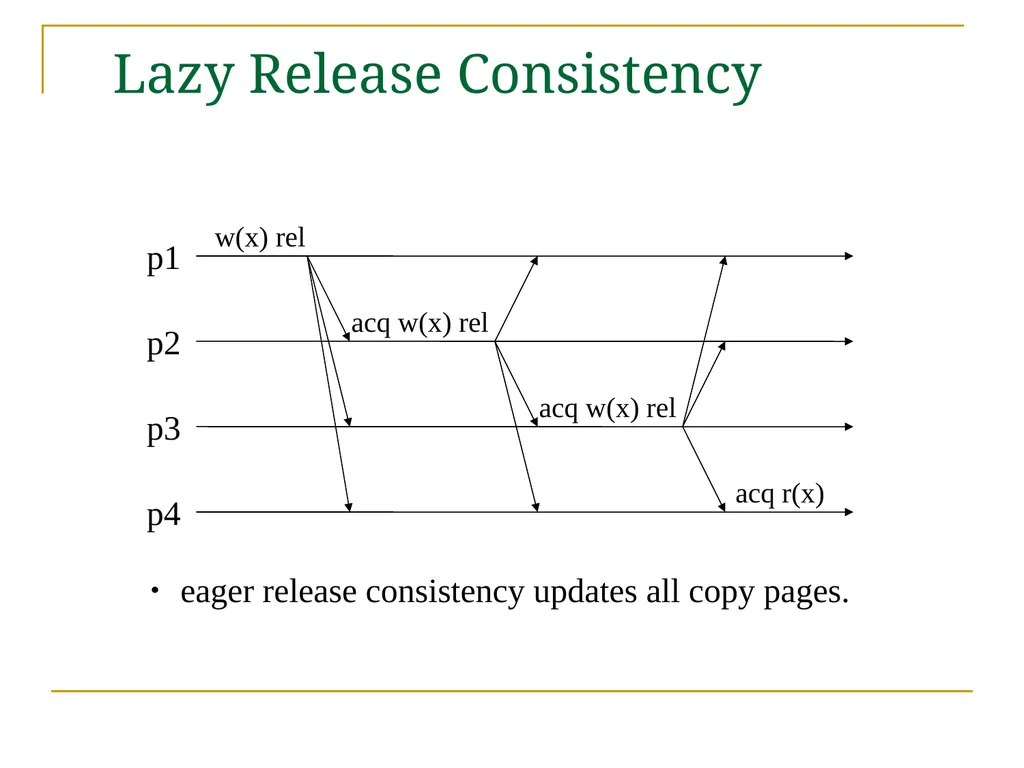
p1 p2 p3 p4 acq r(x) ・eager release consistency updates all copy pages. Lazy Release Consistency<br>
40
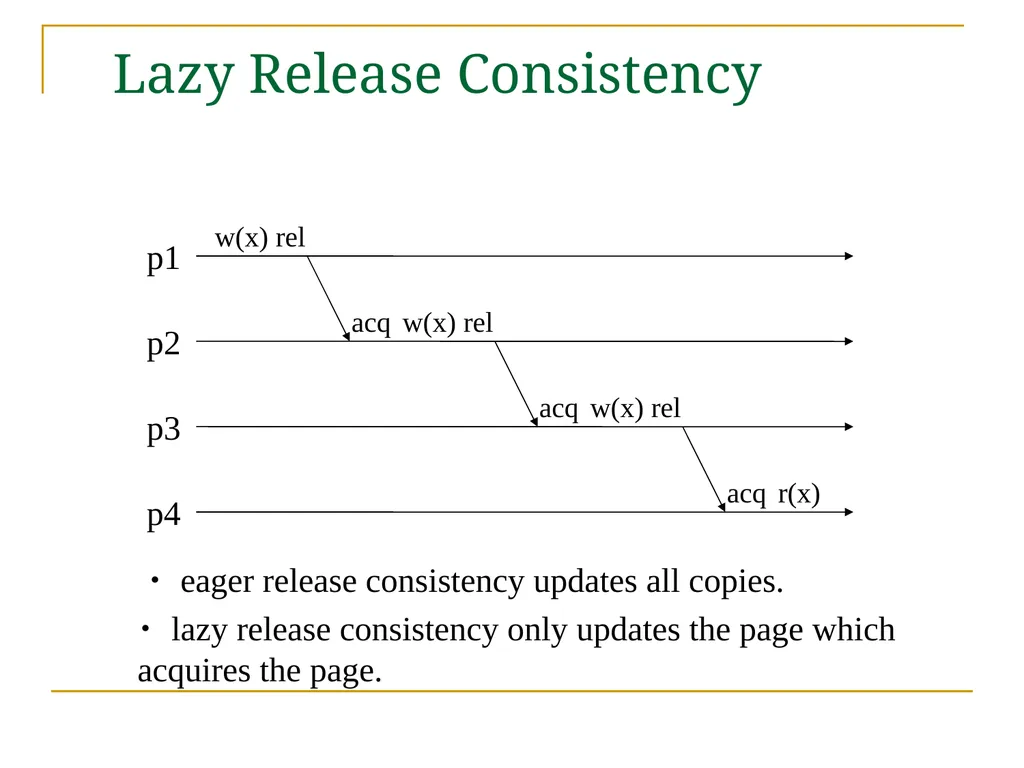
p1 p2 p3 p4 w(x) rel w(x) rel w(x) rel r(x) ・eager release consistency updates all copies. ・lazy release consistency only updates the page which
acquires the page. Lazy Release Consistency acq acq acq<br>
acquires the page. Lazy Release Consistency acq acq acq<br>
41
Entry Release Consistency(1) Shared data and synchronization objects are associated ・It executes acquire or release on a synchronization object
→Only guarantees consistency of the target shared data ・By caching synchronization object, the speed of entering
a critical section is enhanced (Only for the same processor) ・Cache miss (Page fault) will be reduced by associating
synchronization object and corresponding shared data.<br>
→Only guarantees consistency of the target shared data ・By caching synchronization object, the speed of entering
a critical section is enhanced (Only for the same processor) ・Cache miss (Page fault) will be reduced by associating
synchronization object and corresponding shared data.<br>
42
Entry Release Consistency(2) p1 p2 ・synchronization object S ⇔ shared data x,y acq S p3 ・synchronization object R ⇔ shared data z<br>
43
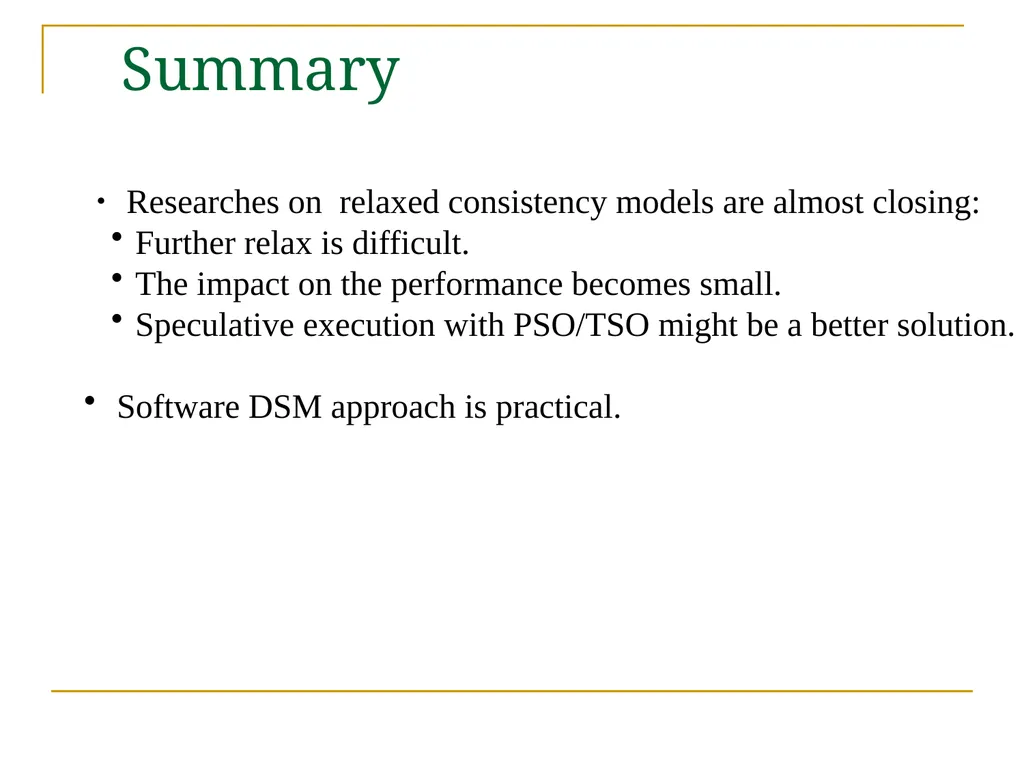
Summary ・Researches on relaxed consistency models are almost closing:
Further relax is difficult.
The impact on the performance becomes small.
Speculative execution with PSO/TSO might be a better solution.
Software DSM approach is practical.<br>
Further relax is difficult.
The impact on the performance becomes small.
Speculative execution with PSO/TSO might be a better solution.
Software DSM approach is practical.<br>
44
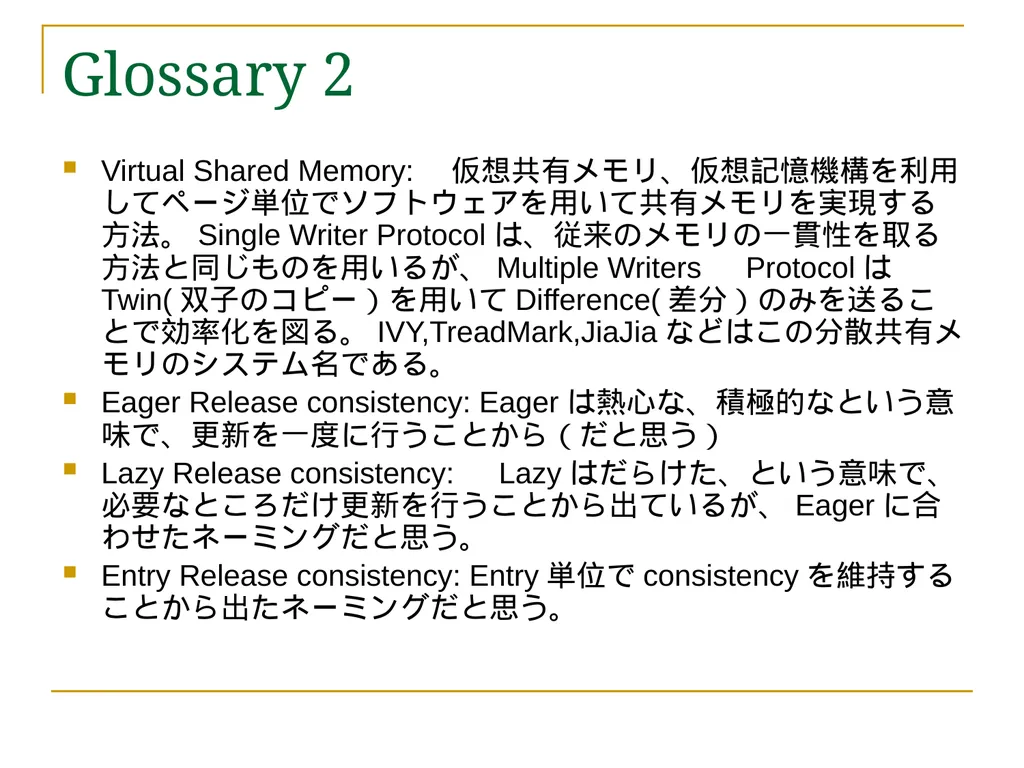
Glossary 2 Virtual Shared Memory: 仮想共有メモリ、仮想記憶機構を利用してページ単位でソフトウェアを用いて共有メモリを実現する方法。Single Writer Protocolは、従来のメモリの一貫性を取る方法と同じものを用いるが、Multiple Writers ProtocolはTwin(双子のコピー)を用いてDifference(差分)のみを送ることで効率化を図る。IVY,TreadMark,JiaJiaなどはこの分散共有メモリのシステム名である。
Eager Release consistency: Eagerは熱心な、積極的なという意味で、更新を一度に行うことから(だと思う)
Lazy Release consistency: Lazyはだらけた、という意味で、必要なところだけ更新を行うことから出ているが、Eagerに合わせたネーミングだと思う。
Entry Release consistency: Entry単位でconsistencyを維持することから出たネーミングだと思う。<br>
Eager Release consistency: Eagerは熱心な、積極的なという意味で、更新を一度に行うことから(だと思う)
Lazy Release consistency: Lazyはだらけた、という意味で、必要なところだけ更新を行うことから出ているが、Eagerに合わせたネーミングだと思う。
Entry Release consistency: Entry単位でconsistencyを維持することから出たネーミングだと思う。<br>
45
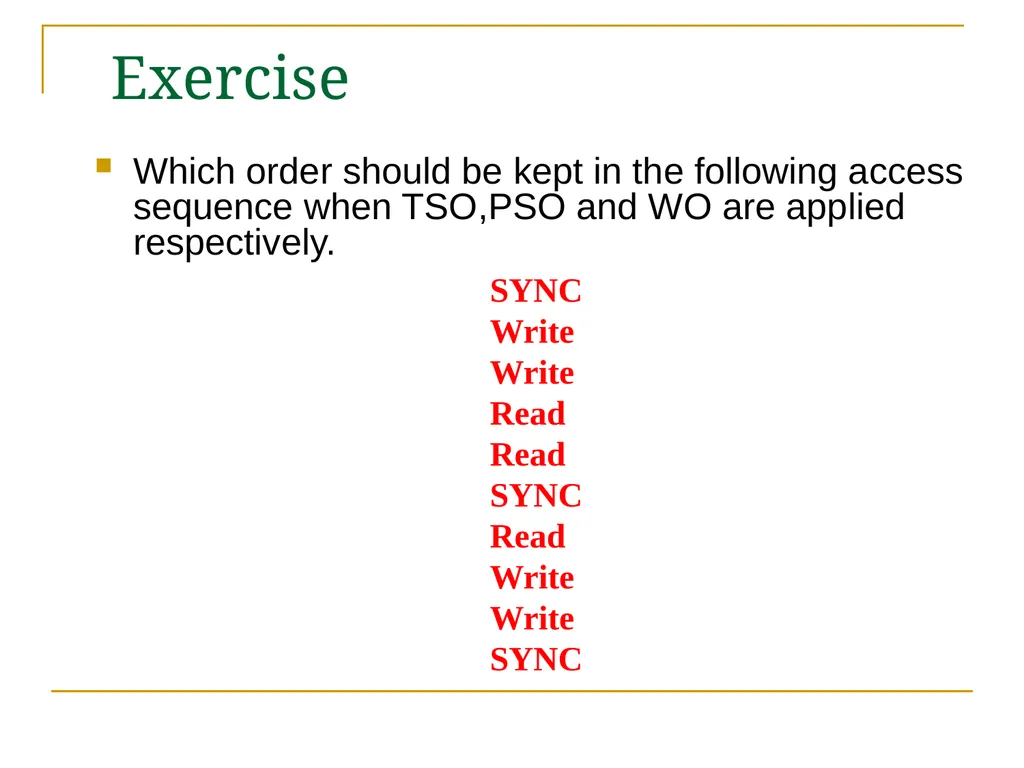
Exercise Which order should be kept in the following access sequence when TSO,PSO and WO are applied respectively. SYNC
Write
Write
Read
Read
SYNC
Read
Write
Write
SYNC<br>
Write
Write
Read
Read
SYNC
Read
Write
Write
SYNC<br>
46
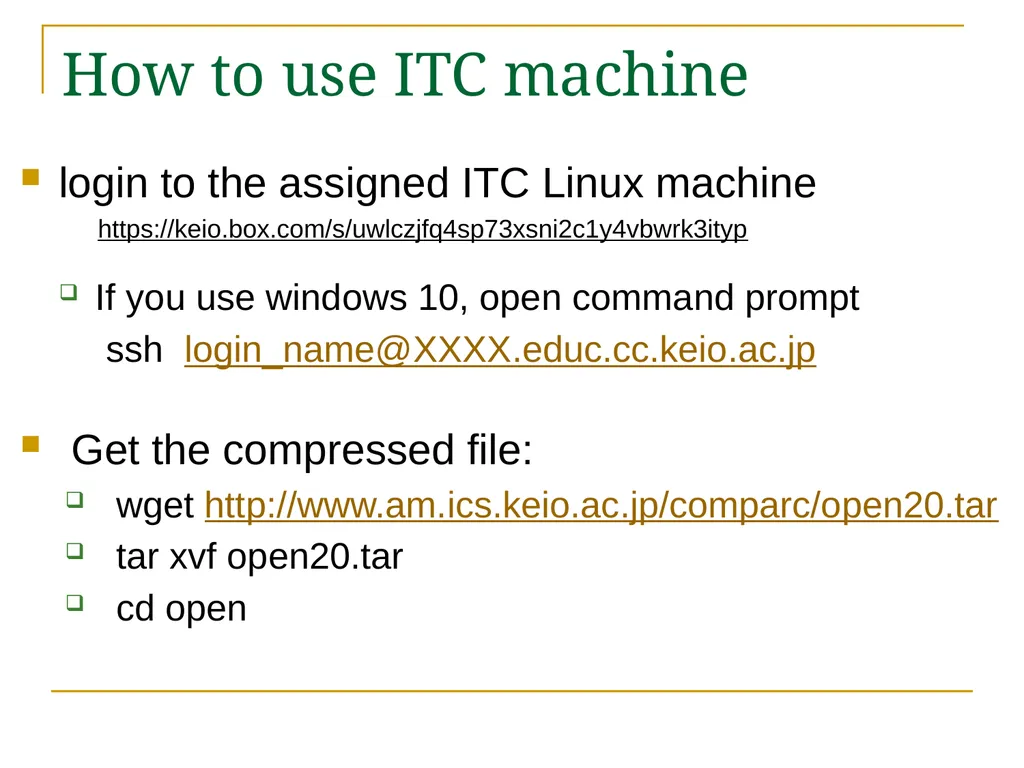
How to use ITC machine login to the assigned ITC Linux machine
If you use windows 10, open command prompt
ssh login_name@XXXX.educ.cc.keio.ac.jp
Get the compressed file:
wget http://www.am.ics.keio.ac.jp/comparc/open20.tar
tar xvf open20.tar
cd open https://keio.box.com/s/uwlczjfq4sp73xsni2c1y4vbwrk3ityp<br>
If you use windows 10, open command prompt
ssh login_name@XXXX.educ.cc.keio.ac.jp
Get the compressed file:
wget http://www.am.ics.keio.ac.jp/comparc/open20.tar
tar xvf open20.tar
cd open https://keio.box.com/s/uwlczjfq4sp73xsni2c1y4vbwrk3ityp<br>