Renal function in the PROUD study, a pragmatic
Description: Renal function in the PROUD study, a pragmatic open label randomised trial of Truvada as pre-exposure prophylaxis Iain Reeves, Ellen White, Elizabeth Brodnicki, David Dunn, Charles Lacey, Tristan Barber, Ann Sullivan, Hannah Alexander,
Related Topics
Download Presentation
"Renal function in the PROUD study, a pragmatic" is the property of its rightful owner. Permission is granted to download and print the materials on this website for personal, non-commercial use only, and to display it on your personal computer provided you do not modify the materials and that you retain all copyright notices contained in the materials. By downloading content from our website, you accept the terms of this agreement.
Presentation Transcript
slide1. Renal function in the PROUD study, a pragmatic open label randomised trial of Truvada as pre-exposure prophylaxis Iain Reeves, Ellen White, Elizabeth Brodnicki, David Dunn, Charles Lacey, Tristan Barber, Ann Sullivan, Hannah Alexander, Sheena McCormack<br>
slide2. Disclosures Gilead supplied Truvada used in the PROUD trial
Dr Iain Reeves has received sponsorship to attend conferences, honoraria and speaker fees, amounting to < £10,000 from Gilead in the past year<br>
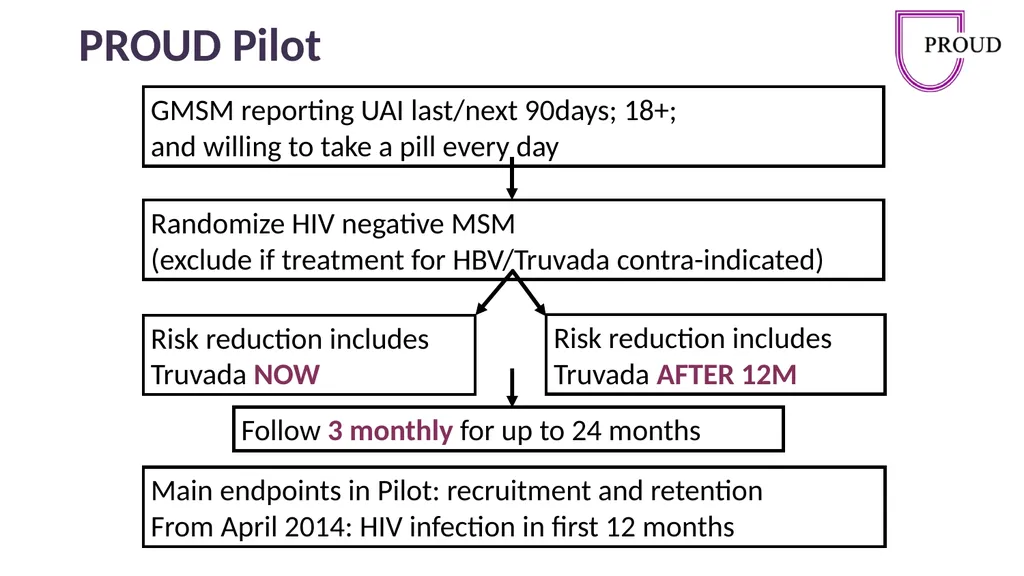
slide3. PROUD Pilot GMSM reporting UAI last/next 90days; 18+;
and willing to take a pill every day Risk reduction includes Truvada AFTER 12M Randomize HIV negative MSM
(exclude if treatment for HBV/Truvada contra-indicated) Main endpoints in Pilot: recruitment and retention
From April 2014: HIV infection in first 12 months Follow 3 monthly for up to 24 months Risk reduction includes Truvada NOW<br>
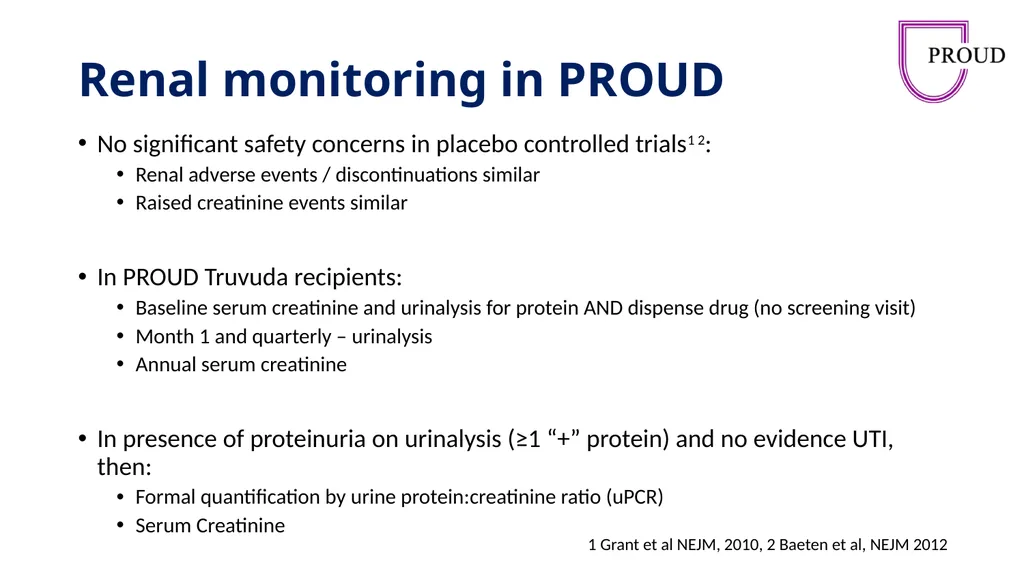
slide4. Renal monitoring in PROUD No significant safety concerns in placebo controlled trials1 2:
Renal adverse events / discontinuations similar
Raised creatinine events similar
In PROUD Truvuda recipients:
Baseline serum creatinine and urinalysis for protein AND dispense drug (no screening visit)
Month 1 and quarterly – urinalysis
Annual serum creatinine
In presence of proteinuria on urinalysis (≥1 “+” protein) and no evidence UTI, then:
Formal quantification by urine protein:creatinine ratio (uPCR)
Serum Creatinine 1 Grant et al NEJM, 2010, 2 Baeten et al, NEJM 2012<br>
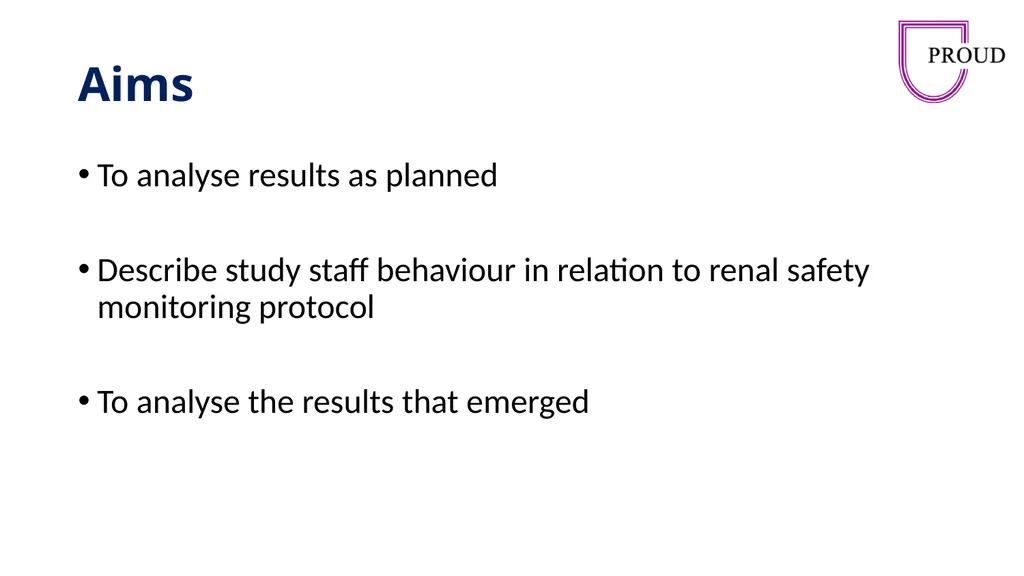
slide5. Aims To analyse results as planned
Describe study staff behaviour in relation to renal safety monitoring protocol
To analyse the results that emerged<br>
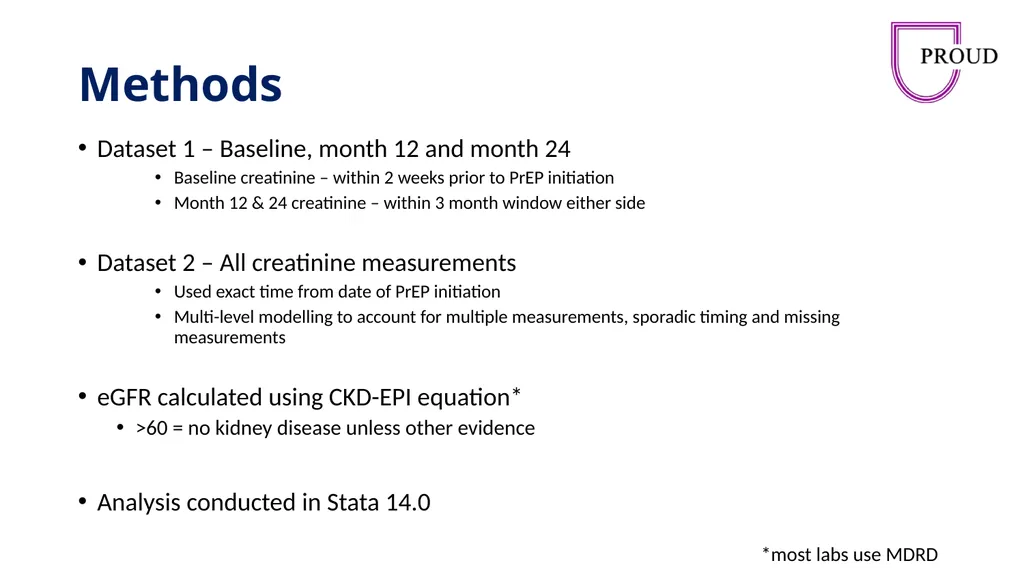
slide6. Methods Dataset 1 – Baseline, month 12 and month 24
Baseline creatinine – within 2 weeks prior to PrEP initiation
Month 12 & 24 creatinine – within 3 month window either side
Dataset 2 – All creatinine measurements
Used exact time from date of PrEP initiation
Multi-level modelling to account for multiple measurements, sporadic timing and missing measurements
eGFR calculated using CKD-EPI equation*
>60 = no kidney disease unless other evidence
Analysis conducted in Stata 14.0 *most labs use MDRD<br>
slide7. Results<br>
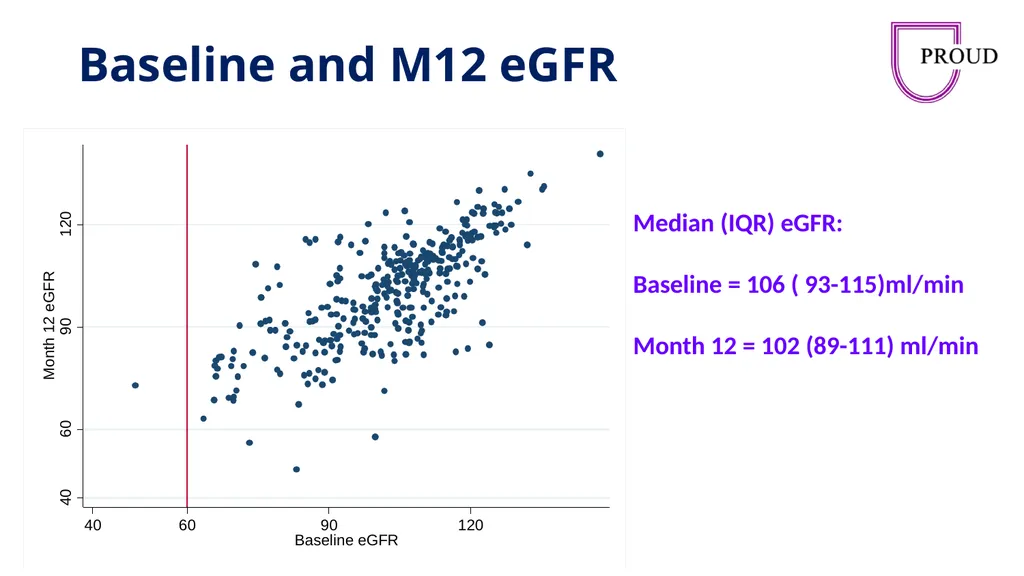
slide8. Baseline and M12 eGFR Median (IQR) eGFR:
Baseline = 106 ( 93-115)ml/min
Month 12 = 102 (89-111) ml/min<br>
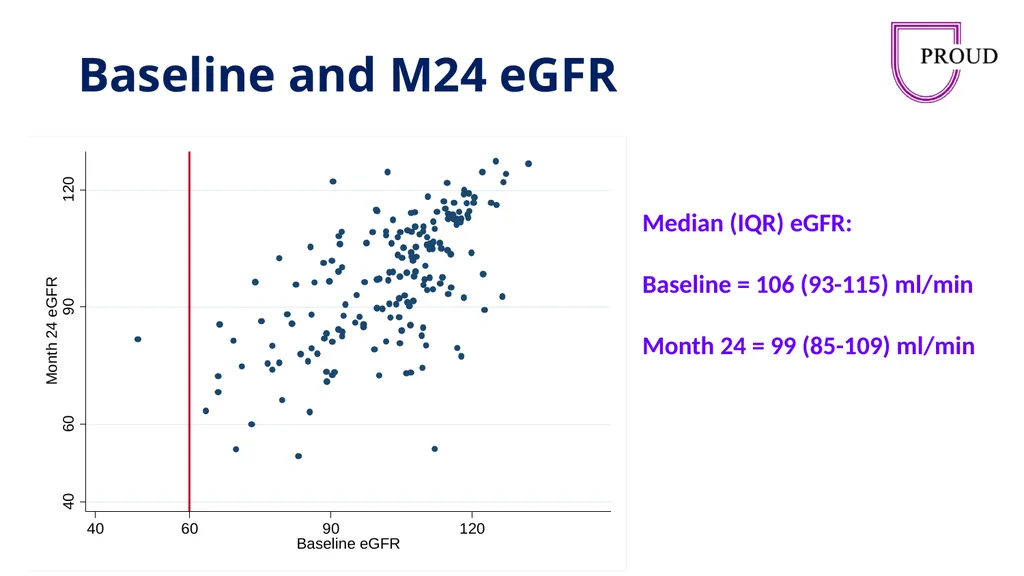
slide9. Baseline and M24 eGFR Median (IQR) eGFR:
Baseline = 106 (93-115) ml/min
Month 24 = 99 (85-109) ml/min<br>
slide10. Renal function over 2 years Completion rates of creatinine at baseline, m12 and m24 visits were 93%, 86%, 83% respectively.
Many more serum creatinine measurements were done:
Often each time patient had blood taken
Potential bias in over-sampling where there were concerns about renal function<br>
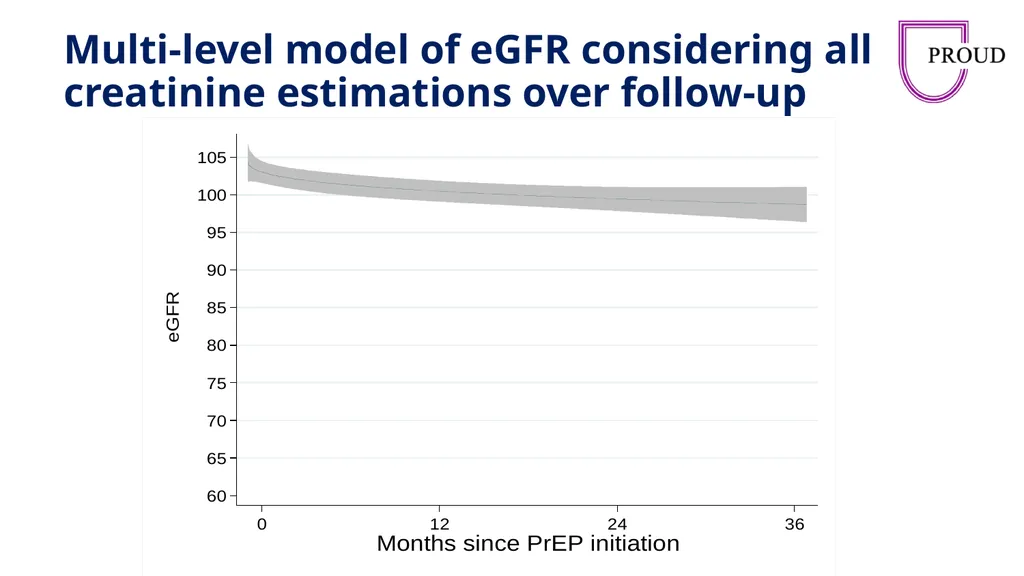
slide11. Multi-level model of eGFR considering all creatinine estimations over follow-up<br>
slide12. Renal adverse events leading to interruption of Truvada Three individuals interrupted because of renal events
One discontinuation1
One interruption, related to lithium co-administration – no longer at risk and now discontinued
One continues on Truvada Girometti et al, AIDS 2016<br>
slide13. Conclusions Truvada was generally very safe with a very small number of clinically relevant adverse events
Changes in eGFR over 2 years were very modest
Renal function was monitored more often than needed
Urine data to follow…<br>
slide14. Acknowledgements (1) Study participants
MRC CTU at UCL
Sarah Banbury, Liz Brodnicki, Christina Chung, Yolanda Collaco-Moraes, Monica Desai,
David Dolling, David Dunn, Mitzy Gafos, Sajad Khan, Brendan Mauger, Sheena McCormack,
Yinka Sowunmi, Gemma Wood
HIV & STI Dept, PHE
Monica Desai, Sarika Desai, Noel Gill, Anthony Nardone, GUMCAD team, HIV team
Clinics
Vanessa Apea (Barts Health NHS Trust), Christine Bowman (Sheffield Teaching Hospitals NHS
Foundation Trust), Michael Brady (Kings College Hospital NHS Foundation Trust), Martin Fisher
(Claude Nichol Centre), Julie Fox (Guy’s and St Thomas’s NHS Foundation Trust), Richard Gilson
(The Mortimer Market Centre), Charles Lacey (York Hospitals NHS Foundation Trust),
Nicola Mackie (St Mary’s Hospital), Alan McOwan (56 Dean Street), Iain Reeves (Homerton
University Hospital NHS Foundation Trust), Gabriel Schembri (Manchester Centre for Sexual
Health), Ann Sullivan (John Hunter Clinic for Sexual Health), Steve Taylor (Heart of England NHS
Foundation Trust)<br>
slide15. Acknowledgements (2) Trial Steering Committee
Independent members: Mike Adler (Co-Chair), Gus Cairns (Co-Chair), Dan Clutterbuck,
Rob Cookson, Claire Foreman, Stephen Nicholson, Tariq Sadiq, Matthew Williams
Investigator members: Brian Gazzard, Noel Gill, Anne Johnson, Sheena McCormack,
Andrew Phillips
Gilead: Matt Bosse, Rich Clarke, Jim Rooney, Murad Ruf
University of Liverpool: Saye Khoo
Independent Data Monitoring Committee: Anton Pozniak, Simon Collins, Fiona Lampe
Community Engagement Group
Community: Yusef Azad (NAT), Gus Cairns (NAM), Rob Cookson (LGF),
Tom Doyle (Mesmac), Justin Harbottle (THT), Marion Wadibia (NAZ),
Matthew Hodson (GMFA), Cary James (THT), Roger Pebody (NAM)
Clinics: Anthony Bains, Alan McOwan (Lead),
MRC CTU at UCL: Sheena McCormack, Mitzy Gafos, Annabelle South
Social Science Advisory Group
Interviewers: Caroline Rae, Gill Bell, Michael Rayment, Sonali Wayal, Will Nutland, Mitzy Gafos
Advisors: Ingrid Young, Ford Hickson, Lisa McDaid, Marsha Rosengarten, Nicolas Lorente, Agata Pacho, Elizabeth Poliquin, Anthony Nardone, Catherine Dodds, Adam Bourne, David Dolling, Sheena McCormack, Rob Horne<br>
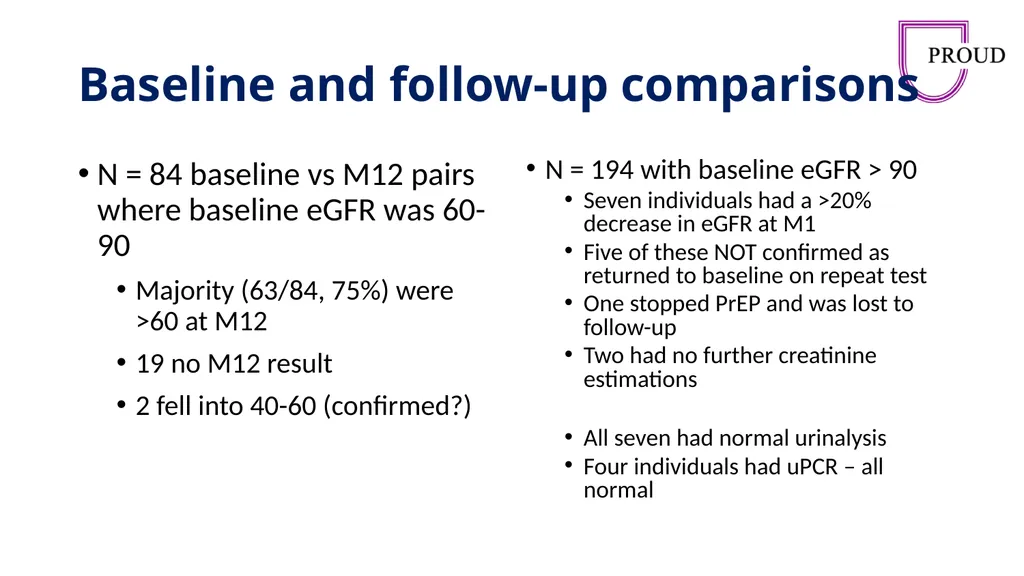
slide16. Baseline and follow-up comparisons N = 84 baseline vs M12 pairs where baseline eGFR was 60-90
Majority (63/84, 75%) were >60 at M12
19 no M12 result
2 fell into 40-60 (confirmed?) N = 194 with baseline eGFR > 90
Seven individuals had a >20% decrease in eGFR at M1
Five of these NOT confirmed as returned to baseline on repeat test
One stopped PrEP and was lost to follow-up
Two had no further creatinine estimations
All seven had normal urinalysis
Four individuals had uPCR – all normal<br>

slide2. Disclosures Gilead supplied Truvada used in the PROUD trial
Dr Iain Reeves has received sponsorship to attend conferences, honoraria and speaker fees, amounting to < £10,000 from Gilead in the past year<br>
slide3. PROUD Pilot GMSM reporting UAI last/next 90days; 18+;
and willing to take a pill every day Risk reduction includes Truvada AFTER 12M Randomize HIV negative MSM
(exclude if treatment for HBV/Truvada contra-indicated) Main endpoints in Pilot: recruitment and retention
From April 2014: HIV infection in first 12 months Follow 3 monthly for up to 24 months Risk reduction includes Truvada NOW<br>
slide4. Renal monitoring in PROUD No significant safety concerns in placebo controlled trials1 2:
Renal adverse events / discontinuations similar
Raised creatinine events similar
In PROUD Truvuda recipients:
Baseline serum creatinine and urinalysis for protein AND dispense drug (no screening visit)
Month 1 and quarterly – urinalysis
Annual serum creatinine
In presence of proteinuria on urinalysis (≥1 “+” protein) and no evidence UTI, then:
Formal quantification by urine protein:creatinine ratio (uPCR)
Serum Creatinine 1 Grant et al NEJM, 2010, 2 Baeten et al, NEJM 2012<br>
slide5. Aims To analyse results as planned
Describe study staff behaviour in relation to renal safety monitoring protocol
To analyse the results that emerged<br>
slide6. Methods Dataset 1 – Baseline, month 12 and month 24
Baseline creatinine – within 2 weeks prior to PrEP initiation
Month 12 & 24 creatinine – within 3 month window either side
Dataset 2 – All creatinine measurements
Used exact time from date of PrEP initiation
Multi-level modelling to account for multiple measurements, sporadic timing and missing measurements
eGFR calculated using CKD-EPI equation*
>60 = no kidney disease unless other evidence
Analysis conducted in Stata 14.0 *most labs use MDRD<br>
slide7. Results<br>
slide8. Baseline and M12 eGFR Median (IQR) eGFR:
Baseline = 106 ( 93-115)ml/min
Month 12 = 102 (89-111) ml/min<br>
slide9. Baseline and M24 eGFR Median (IQR) eGFR:
Baseline = 106 (93-115) ml/min
Month 24 = 99 (85-109) ml/min<br>
slide10. Renal function over 2 years Completion rates of creatinine at baseline, m12 and m24 visits were 93%, 86%, 83% respectively.
Many more serum creatinine measurements were done:
Often each time patient had blood taken
Potential bias in over-sampling where there were concerns about renal function<br>
slide11. Multi-level model of eGFR considering all creatinine estimations over follow-up<br>
slide12. Renal adverse events leading to interruption of Truvada Three individuals interrupted because of renal events
One discontinuation1
One interruption, related to lithium co-administration – no longer at risk and now discontinued
One continues on Truvada Girometti et al, AIDS 2016<br>
slide13. Conclusions Truvada was generally very safe with a very small number of clinically relevant adverse events
Changes in eGFR over 2 years were very modest
Renal function was monitored more often than needed
Urine data to follow…<br>
slide14. Acknowledgements (1) Study participants
MRC CTU at UCL
Sarah Banbury, Liz Brodnicki, Christina Chung, Yolanda Collaco-Moraes, Monica Desai,
David Dolling, David Dunn, Mitzy Gafos, Sajad Khan, Brendan Mauger, Sheena McCormack,
Yinka Sowunmi, Gemma Wood
HIV & STI Dept, PHE
Monica Desai, Sarika Desai, Noel Gill, Anthony Nardone, GUMCAD team, HIV team
Clinics
Vanessa Apea (Barts Health NHS Trust), Christine Bowman (Sheffield Teaching Hospitals NHS
Foundation Trust), Michael Brady (Kings College Hospital NHS Foundation Trust), Martin Fisher
(Claude Nichol Centre), Julie Fox (Guy’s and St Thomas’s NHS Foundation Trust), Richard Gilson
(The Mortimer Market Centre), Charles Lacey (York Hospitals NHS Foundation Trust),
Nicola Mackie (St Mary’s Hospital), Alan McOwan (56 Dean Street), Iain Reeves (Homerton
University Hospital NHS Foundation Trust), Gabriel Schembri (Manchester Centre for Sexual
Health), Ann Sullivan (John Hunter Clinic for Sexual Health), Steve Taylor (Heart of England NHS
Foundation Trust)<br>
slide15. Acknowledgements (2) Trial Steering Committee
Independent members: Mike Adler (Co-Chair), Gus Cairns (Co-Chair), Dan Clutterbuck,
Rob Cookson, Claire Foreman, Stephen Nicholson, Tariq Sadiq, Matthew Williams
Investigator members: Brian Gazzard, Noel Gill, Anne Johnson, Sheena McCormack,
Andrew Phillips
Gilead: Matt Bosse, Rich Clarke, Jim Rooney, Murad Ruf
University of Liverpool: Saye Khoo
Independent Data Monitoring Committee: Anton Pozniak, Simon Collins, Fiona Lampe
Community Engagement Group
Community: Yusef Azad (NAT), Gus Cairns (NAM), Rob Cookson (LGF),
Tom Doyle (Mesmac), Justin Harbottle (THT), Marion Wadibia (NAZ),
Matthew Hodson (GMFA), Cary James (THT), Roger Pebody (NAM)
Clinics: Anthony Bains, Alan McOwan (Lead),
MRC CTU at UCL: Sheena McCormack, Mitzy Gafos, Annabelle South
Social Science Advisory Group
Interviewers: Caroline Rae, Gill Bell, Michael Rayment, Sonali Wayal, Will Nutland, Mitzy Gafos
Advisors: Ingrid Young, Ford Hickson, Lisa McDaid, Marsha Rosengarten, Nicolas Lorente, Agata Pacho, Elizabeth Poliquin, Anthony Nardone, Catherine Dodds, Adam Bourne, David Dolling, Sheena McCormack, Rob Horne<br>
slide16. Baseline and follow-up comparisons N = 84 baseline vs M12 pairs where baseline eGFR was 60-90
Majority (63/84, 75%) were >60 at M12
19 no M12 result
2 fell into 40-60 (confirmed?) N = 194 with baseline eGFR > 90
Seven individuals had a >20% decrease in eGFR at M1
Five of these NOT confirmed as returned to baseline on repeat test
One stopped PrEP and was lost to follow-up
Two had no further creatinine estimations
All seven had normal urinalysis
Four individuals had uPCR – all normal<br>