Research Integrity and Ethics Wilna Venter, M.A.,
Description: Research Integrity and Ethics Wilna Venter, M.A., M.Ed. Cluster Manager: Strategic Support University of Cape Town Research Office Content Historical background Definition of research integrity and ethics Responsible conduct of research NIH
Related Topics
Download Presentation
"Research Integrity and Ethics Wilna Venter, M.A.," is the property of its rightful owner. Permission is granted to download and print the materials on this website for personal, non-commercial use only, and to display it on your personal computer provided you do not modify the materials and that you retain all copyright notices contained in the materials. By downloading content from our website, you accept the terms of this agreement.
Presentation Transcript
slide1. Research Integrity and Ethics Wilna Venter, M.A., M.Ed.
Cluster Manager: Strategic Support
University of Cape Town Research Office<br>
slide2. Content Historical background
Definition of research integrity and ethics
Responsible conduct of research
NIH compliance requirements<br>
slide3. Historical Background Nuremberg Code—1946
Declaration of Helsinki—1964
The Belmont Report—1979
Singapore Statement on Research Integrity—2010<br>
slide4. Definition of Research Integrity and Ethics Research integrity could be defined as (i) active adherence to the (ii) ethical principles and (iii) professional standards essential for the (iv) responsible conduct of research.<br>
slide5. Integrity in Research Research integrity is an integral part of all of the following stages in research process:
Planning of research
Conducting the research
Disseminating results<br>
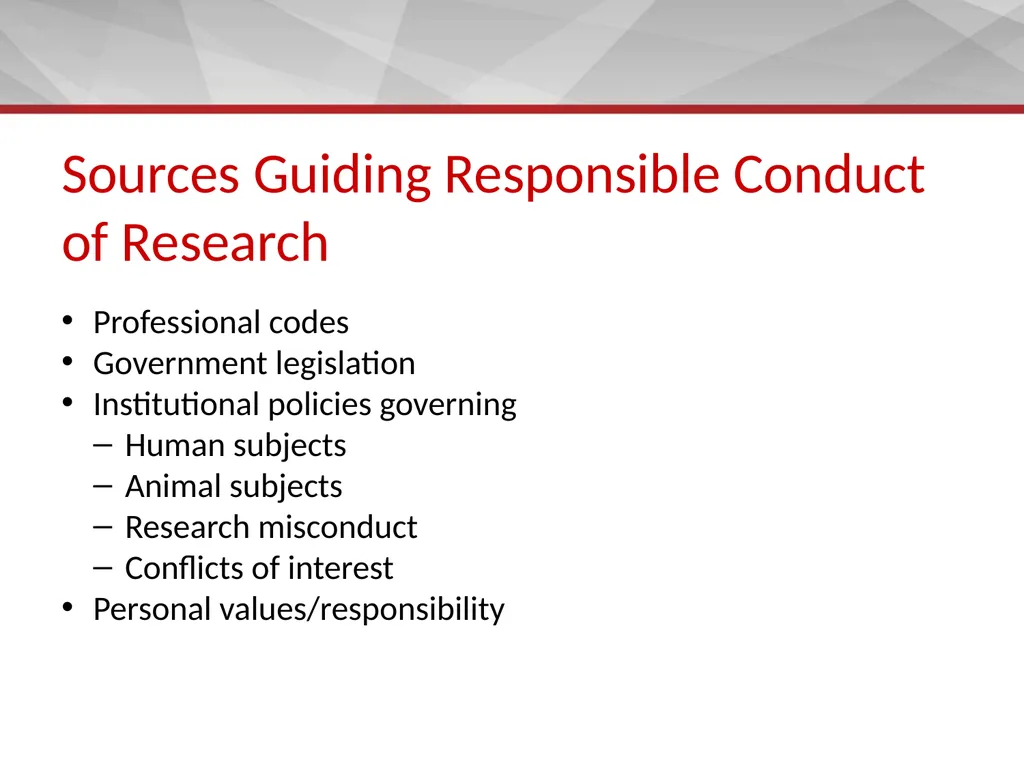
slide6. Sources Guiding Responsible Conduct of Research Professional codes
Government legislation
Institutional policies governing
Human subjects
Animal subjects
Research misconduct
Conflicts of interest
Personal values/responsibility<br>
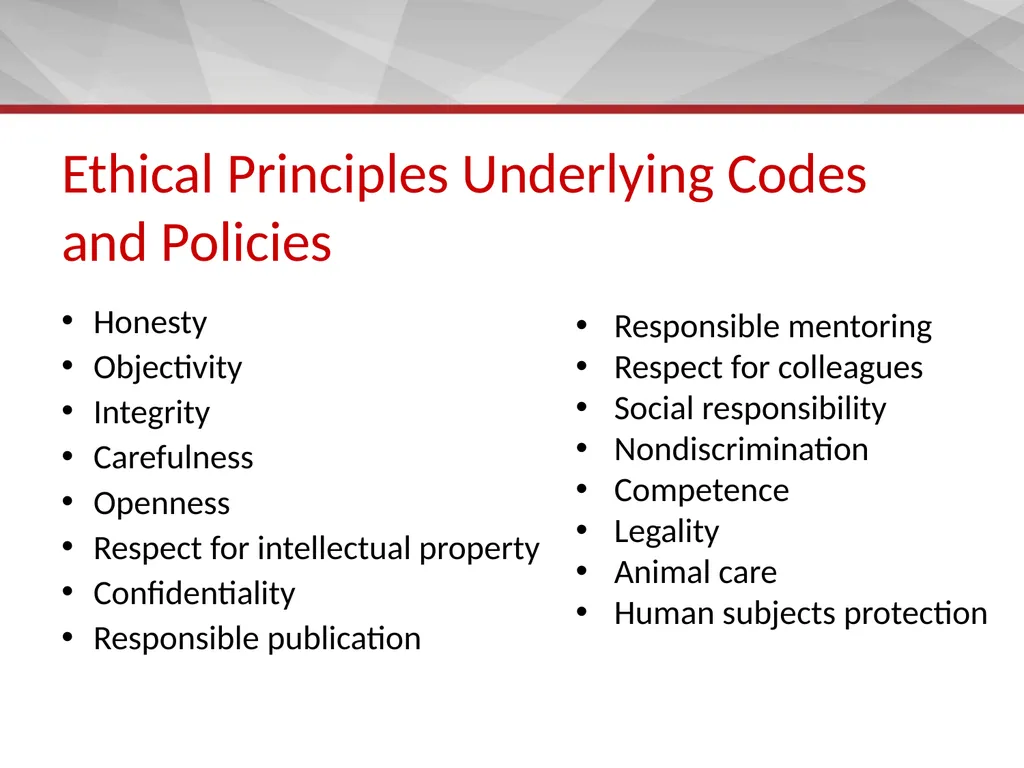
slide7. Ethical Principles Underlying Codes and Policies Honesty
Objectivity
Integrity
Carefulness
Openness
Respect for intellectual property
Confidentiality
Responsible publication Responsible mentoring
Respect for colleagues
Social responsibility
Nondiscrimination
Competence
Legality
Animal care
Human subjects protection<br>
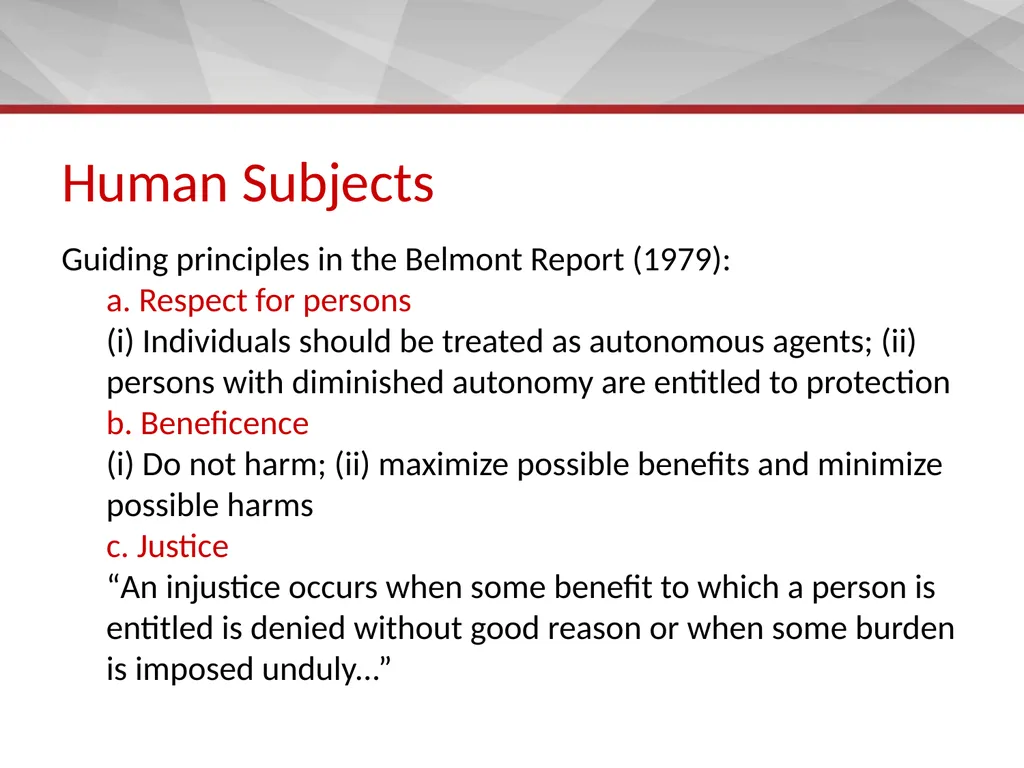
slide8. Human Subjects Guiding principles in the Belmont Report (1979):
a. Respect for persons
(i) Individuals should be treated as autonomous agents; (ii) persons with diminished autonomy are entitled to protection
b. Beneficence
(i) Do not harm; (ii) maximize possible benefits and minimize possible harms
c. Justice
“An injustice occurs when some benefit to which a person is entitled is denied without good reason or when some burden is imposed unduly...”<br>
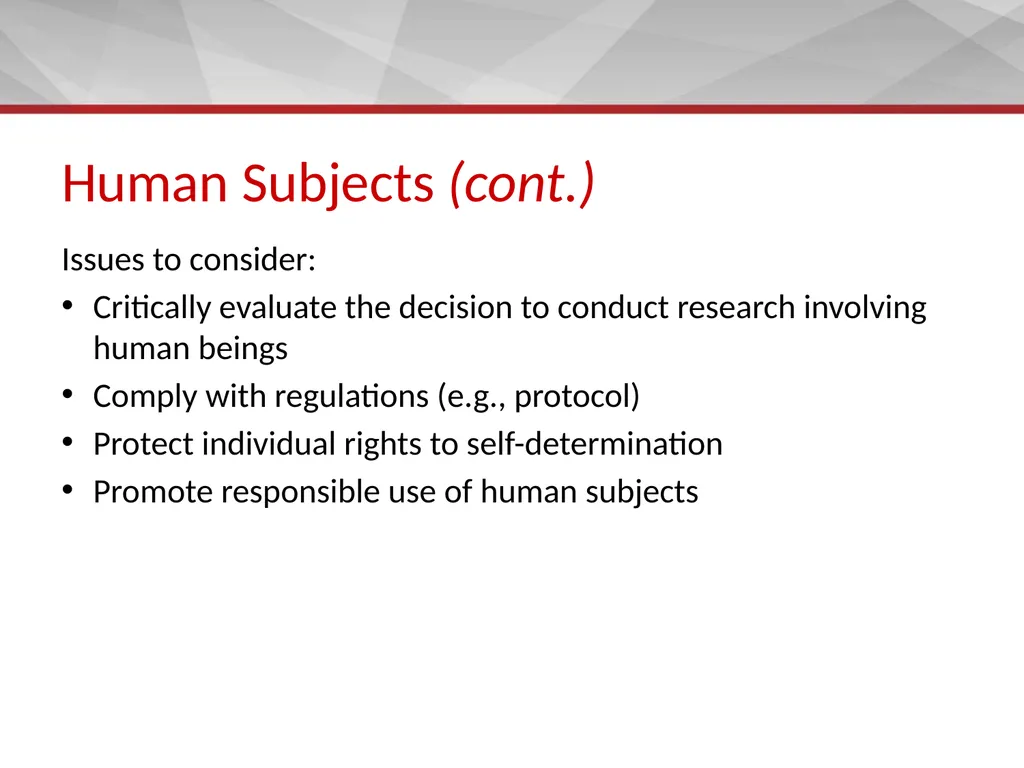
slide9. Human Subjects (cont.) Issues to consider:
Critically evaluate the decision to conduct research involving human beings
Comply with regulations (e.g., protocol)
Protect individual rights to self-determination
Promote responsible use of human subjects<br>
slide10. Animal Subjects Cruelty to Animals Act—1876
The central problem is determining what is and what is not humane treatment of animals, and how humane treatment can be promoted without prejudice to scientific and medical aims
Resource: Russell, W.M.S., & Burch ,R.L. (1959): Principles of Humane Animal Experimentation. Charles C. Thomas, Springfield, IL. Excerpts available at http://altweb.jhsph.edu/pubs/books/humane_exp/het-toc<br>
slide11. Publications and Authorship Research is incomplete until published
Publication is not merely a matter of credit
There are significant responsibilities in publishing, including accurate, complete, clear, and unbiased representation of the research
Authorship:
Credit
Responsibility for any deficits
Transparency
Who should be an author?<br>
slide12. Publications and Authorship (cont.) According to the International Committee of Medical Journal Editors (2006), someone should be listed as an author if and only if they have done all of the following:
Made substantial contributions to conception and design, acquisition of data, or analysis and interpretation of data;
Drafted the article or revised it critically for important intellectual content; and
Approved of the final version to be published.<br>
slide13. Biosecurity Biosecurity: efforts designed to minimize the likelihood that biological research will be misused for malicious purposes, such as bioweapons.
Dual-use research: any type of legitimate life sciences research that has the potential to be misused for malicious purposes.
Resource: National Science Advisory Board for Biosecurity . (2007). Proposed Framework for the Oversight of Dual Use Life Sciences Research: Strategies for Minimizing the Potential Misuse of Research Information. http://oba.od.nih.gov/biosecurity/pdf/Framework%20for%20transmittal%200807_Sept07.pdf<br>
slide14. Collaboration CHALLENGE: communication about what is to be achieved, methodology, and data sharing
Collective skills, knowledge, and resources
Funding favours program in which each key area is tied to a recognised expert in that field
Interdisciplinarity gives rise to significant breakthroughs
Private-sector and academic partnerships<br>
slide15. Conflict of Interest “A conflict of interest in research exists when the individual has interests in the outcome of the research that may lead to a personal advantage and that might therefore, in actuality or appearance, compromise the integrity of the research.” National Academy of Science, Integrity in Scientific Research
Resource: Brainard, J. (2000). The Ties that blind? (Financing that might influence medical research). Chronicle of Higher Education ,47, A31.<br>
slide16. Data Management Data acquisition, management, sharing, and ownership
Responsible conduct of research, therefore,
Begins with experimental design and protocol approval;
Involves recordkeeping in a way that ensures accuracy and avoids bias;
Guides criteria for including and excluding data from statistical analyses; and
Entails responsibility for collection, use, and sharing of data.
Resource: Department of Health and Human Services .(1990). Workshop on Data Management in Biomedical Research.<br>
slide17. Mentoring Promoting responsible conduct of research
Reducing the risk of research misconduct
Resource: Eastwood, S., Derish, P., Leash, E., & Ordway, S. (1996). Ethical issues in biomedical research: Perceptions and practices of postdoctoral research fellows responding to a survey. Science and Engineering Ethics, 2, 89-114.<br>
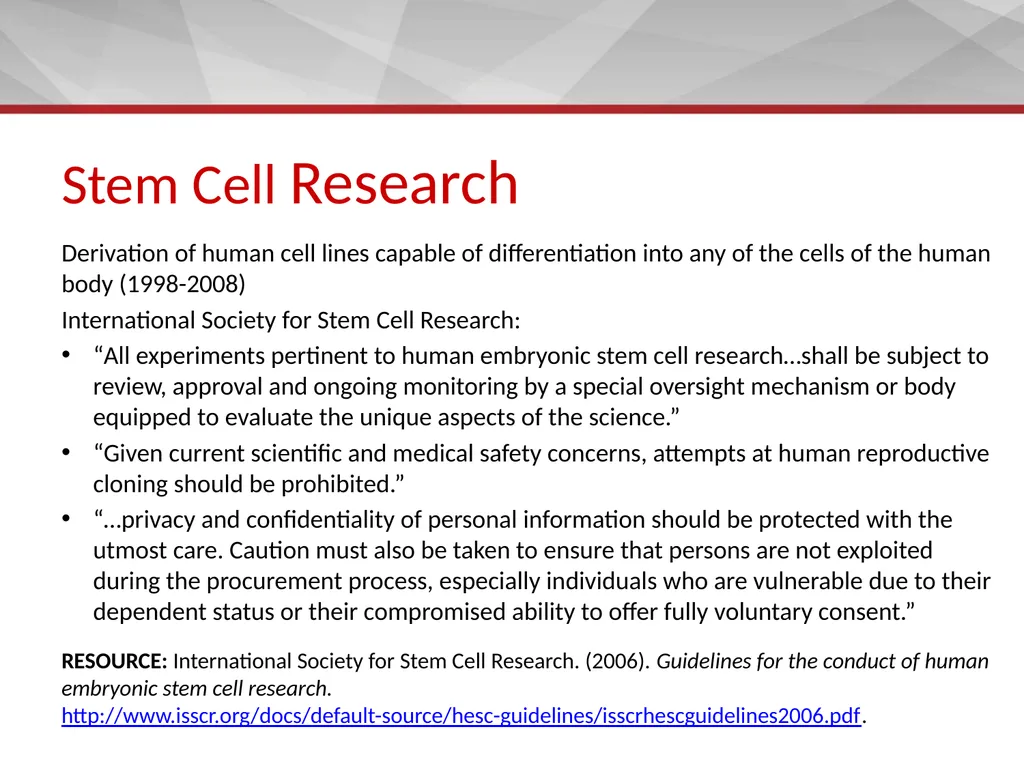
slide18. Stem Cell Research Derivation of human cell lines capable of differentiation into any of the cells of the human body (1998-2008)
International Society for Stem Cell Research:
“All experiments pertinent to human embryonic stem cell research…shall be subject to review, approval and ongoing monitoring by a special oversight mechanism or body equipped to evaluate the unique aspects of the science.”
“Given current scientific and medical safety concerns, attempts at human reproductive cloning should be prohibited.”
“…privacy and confidentiality of personal information should be protected with the utmost care. Caution must also be taken to ensure that persons are not exploited during the procurement process, especially individuals who are vulnerable due to their dependent status or their compromised ability to offer fully voluntary consent.”
RESOURCE: International Society for Stem Cell Research. (2006). Guidelines for the conduct of human embryonic stem cell research. http://www.isscr.org/docs/default-source/hesc-guidelines/isscrhescguidelines2006.pdf.<br>
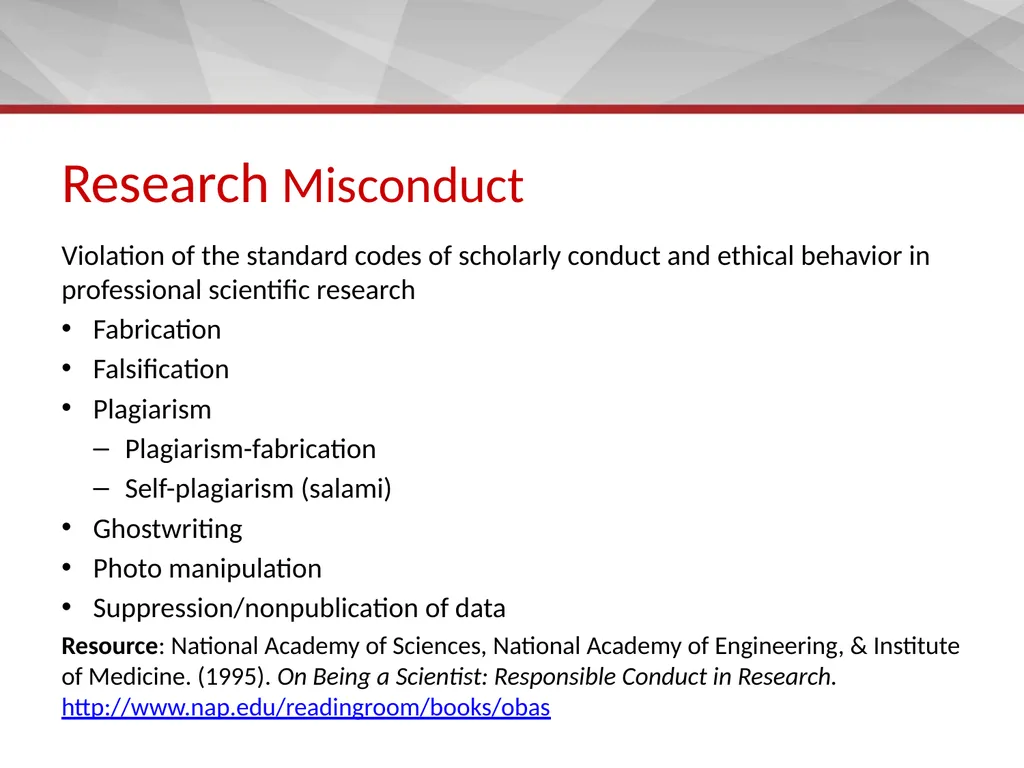
slide19. Research Misconduct Violation of the standard codes of scholarly conduct and ethical behavior in professional scientific research
Fabrication
Falsification
Plagiarism
Plagiarism-fabrication
Self-plagiarism (salami)
Ghostwriting
Photo manipulation
Suppression/nonpublication of data
Resource: National Academy of Sciences, National Academy of Engineering, & Institute of Medicine. (1995). On Being a Scientist: Responsible Conduct in Research. http://www.nap.edu/readingroom/books/obas<br>
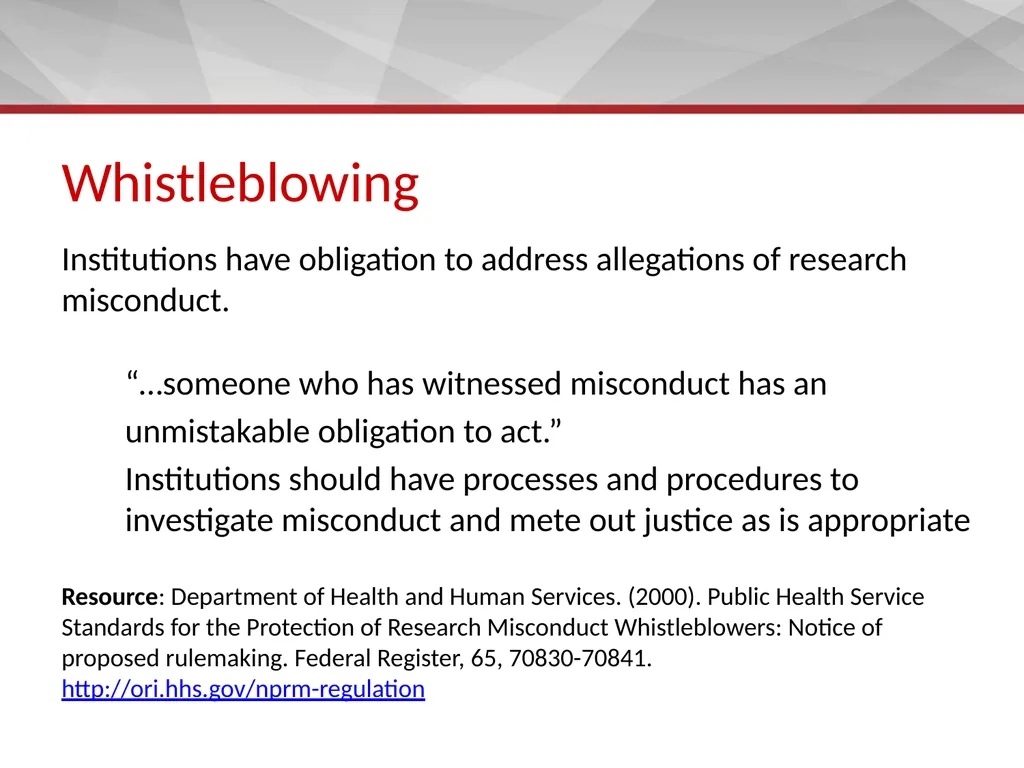
slide20. Whistleblowing Institutions have obligation to address allegations of research misconduct.
“…someone who has witnessed misconduct has an
unmistakable obligation to act.”
Institutions should have processes and procedures to investigate misconduct and mete out justice as is appropriate
Resource: Department of Health and Human Services. (2000). Public Health Service Standards for the Protection of Research Misconduct Whistleblowers: Notice of proposed rulemaking. Federal Register, 65, 70830-70841. http://ori.hhs.gov/nprm-regulation<br>
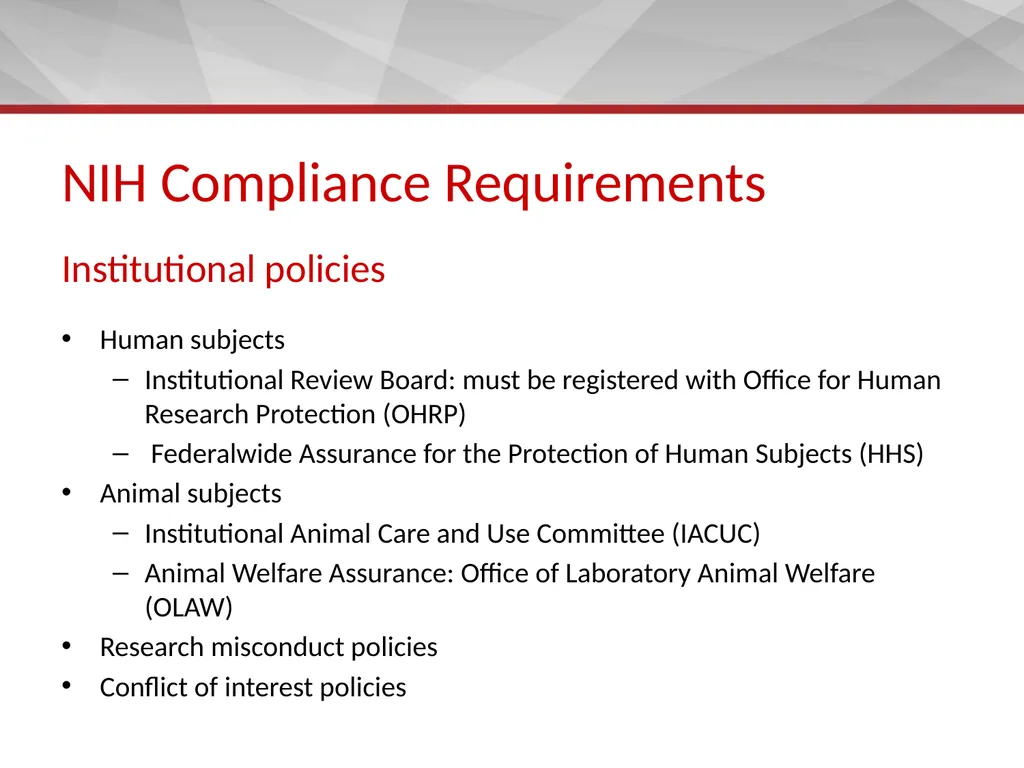
slide21. NIH Compliance Requirements Human subjects
Institutional Review Board: must be registered with Office for Human Research Protection (OHRP)
Federalwide Assurance for the Protection of Human Subjects (HHS)
Animal subjects
Institutional Animal Care and Use Committee (IACUC)
Animal Welfare Assurance: Office of Laboratory Animal Welfare (OLAW)
Research misconduct policies
Conflict of interest policies Institutional policies<br>

Cluster Manager: Strategic Support
University of Cape Town Research Office<br>
slide2. Content Historical background
Definition of research integrity and ethics
Responsible conduct of research
NIH compliance requirements<br>
slide3. Historical Background Nuremberg Code—1946
Declaration of Helsinki—1964
The Belmont Report—1979
Singapore Statement on Research Integrity—2010<br>
slide4. Definition of Research Integrity and Ethics Research integrity could be defined as (i) active adherence to the (ii) ethical principles and (iii) professional standards essential for the (iv) responsible conduct of research.<br>
slide5. Integrity in Research Research integrity is an integral part of all of the following stages in research process:
Planning of research
Conducting the research
Disseminating results<br>
slide6. Sources Guiding Responsible Conduct of Research Professional codes
Government legislation
Institutional policies governing
Human subjects
Animal subjects
Research misconduct
Conflicts of interest
Personal values/responsibility<br>
slide7. Ethical Principles Underlying Codes and Policies Honesty
Objectivity
Integrity
Carefulness
Openness
Respect for intellectual property
Confidentiality
Responsible publication Responsible mentoring
Respect for colleagues
Social responsibility
Nondiscrimination
Competence
Legality
Animal care
Human subjects protection<br>
slide8. Human Subjects Guiding principles in the Belmont Report (1979):
a. Respect for persons
(i) Individuals should be treated as autonomous agents; (ii) persons with diminished autonomy are entitled to protection
b. Beneficence
(i) Do not harm; (ii) maximize possible benefits and minimize possible harms
c. Justice
“An injustice occurs when some benefit to which a person is entitled is denied without good reason or when some burden is imposed unduly...”<br>
slide9. Human Subjects (cont.) Issues to consider:
Critically evaluate the decision to conduct research involving human beings
Comply with regulations (e.g., protocol)
Protect individual rights to self-determination
Promote responsible use of human subjects<br>
slide10. Animal Subjects Cruelty to Animals Act—1876
The central problem is determining what is and what is not humane treatment of animals, and how humane treatment can be promoted without prejudice to scientific and medical aims
Resource: Russell, W.M.S., & Burch ,R.L. (1959): Principles of Humane Animal Experimentation. Charles C. Thomas, Springfield, IL. Excerpts available at http://altweb.jhsph.edu/pubs/books/humane_exp/het-toc<br>
slide11. Publications and Authorship Research is incomplete until published
Publication is not merely a matter of credit
There are significant responsibilities in publishing, including accurate, complete, clear, and unbiased representation of the research
Authorship:
Credit
Responsibility for any deficits
Transparency
Who should be an author?<br>
slide12. Publications and Authorship (cont.) According to the International Committee of Medical Journal Editors (2006), someone should be listed as an author if and only if they have done all of the following:
Made substantial contributions to conception and design, acquisition of data, or analysis and interpretation of data;
Drafted the article or revised it critically for important intellectual content; and
Approved of the final version to be published.<br>
slide13. Biosecurity Biosecurity: efforts designed to minimize the likelihood that biological research will be misused for malicious purposes, such as bioweapons.
Dual-use research: any type of legitimate life sciences research that has the potential to be misused for malicious purposes.
Resource: National Science Advisory Board for Biosecurity . (2007). Proposed Framework for the Oversight of Dual Use Life Sciences Research: Strategies for Minimizing the Potential Misuse of Research Information. http://oba.od.nih.gov/biosecurity/pdf/Framework%20for%20transmittal%200807_Sept07.pdf<br>
slide14. Collaboration CHALLENGE: communication about what is to be achieved, methodology, and data sharing
Collective skills, knowledge, and resources
Funding favours program in which each key area is tied to a recognised expert in that field
Interdisciplinarity gives rise to significant breakthroughs
Private-sector and academic partnerships<br>
slide15. Conflict of Interest “A conflict of interest in research exists when the individual has interests in the outcome of the research that may lead to a personal advantage and that might therefore, in actuality or appearance, compromise the integrity of the research.” National Academy of Science, Integrity in Scientific Research
Resource: Brainard, J. (2000). The Ties that blind? (Financing that might influence medical research). Chronicle of Higher Education ,47, A31.<br>
slide16. Data Management Data acquisition, management, sharing, and ownership
Responsible conduct of research, therefore,
Begins with experimental design and protocol approval;
Involves recordkeeping in a way that ensures accuracy and avoids bias;
Guides criteria for including and excluding data from statistical analyses; and
Entails responsibility for collection, use, and sharing of data.
Resource: Department of Health and Human Services .(1990). Workshop on Data Management in Biomedical Research.<br>
slide17. Mentoring Promoting responsible conduct of research
Reducing the risk of research misconduct
Resource: Eastwood, S., Derish, P., Leash, E., & Ordway, S. (1996). Ethical issues in biomedical research: Perceptions and practices of postdoctoral research fellows responding to a survey. Science and Engineering Ethics, 2, 89-114.<br>
slide18. Stem Cell Research Derivation of human cell lines capable of differentiation into any of the cells of the human body (1998-2008)
International Society for Stem Cell Research:
“All experiments pertinent to human embryonic stem cell research…shall be subject to review, approval and ongoing monitoring by a special oversight mechanism or body equipped to evaluate the unique aspects of the science.”
“Given current scientific and medical safety concerns, attempts at human reproductive cloning should be prohibited.”
“…privacy and confidentiality of personal information should be protected with the utmost care. Caution must also be taken to ensure that persons are not exploited during the procurement process, especially individuals who are vulnerable due to their dependent status or their compromised ability to offer fully voluntary consent.”
RESOURCE: International Society for Stem Cell Research. (2006). Guidelines for the conduct of human embryonic stem cell research. http://www.isscr.org/docs/default-source/hesc-guidelines/isscrhescguidelines2006.pdf.<br>
slide19. Research Misconduct Violation of the standard codes of scholarly conduct and ethical behavior in professional scientific research
Fabrication
Falsification
Plagiarism
Plagiarism-fabrication
Self-plagiarism (salami)
Ghostwriting
Photo manipulation
Suppression/nonpublication of data
Resource: National Academy of Sciences, National Academy of Engineering, & Institute of Medicine. (1995). On Being a Scientist: Responsible Conduct in Research. http://www.nap.edu/readingroom/books/obas<br>
slide20. Whistleblowing Institutions have obligation to address allegations of research misconduct.
“…someone who has witnessed misconduct has an
unmistakable obligation to act.”
Institutions should have processes and procedures to investigate misconduct and mete out justice as is appropriate
Resource: Department of Health and Human Services. (2000). Public Health Service Standards for the Protection of Research Misconduct Whistleblowers: Notice of proposed rulemaking. Federal Register, 65, 70830-70841. http://ori.hhs.gov/nprm-regulation<br>
slide21. NIH Compliance Requirements Human subjects
Institutional Review Board: must be registered with Office for Human Research Protection (OHRP)
Federalwide Assurance for the Protection of Human Subjects (HHS)
Animal subjects
Institutional Animal Care and Use Committee (IACUC)
Animal Welfare Assurance: Office of Laboratory Animal Welfare (OLAW)
Research misconduct policies
Conflict of interest policies Institutional policies<br>