
RESPeCT PD pROGRAM RESPeCT Summer Institute Day 8
PC
Published · 51 slides · 0 views

1 / 1

Description
RESPeCT PD pROGRAM RESPeCT Summer Institute Day 8 Agenda for Day 8 Day-7 reflections Focus questions Introducing SCSL strategies F, G, and H Lesson analysis: SCSL strategies F, G, and H Energy Transfer lesson plan review Fall overview and
Related Topics
Share
Embed code
Download this presentation From Below
"RESPeCT PD pROGRAM RESPeCT Summer Institute Day 8" is the property of its rightful owner. Permission is granted to download and print the materials on this website for personal, non-commercial use only, and to display it on your personal computer provided you do not modify the materials and that you retain all copyright notices contained in the materials. By downloading content from our website, you accept the terms of this agreement.
Presentation Transcript
01
RESPeCT PD pROGRAM RESPeCT Summer Institute Day 8<br>
02
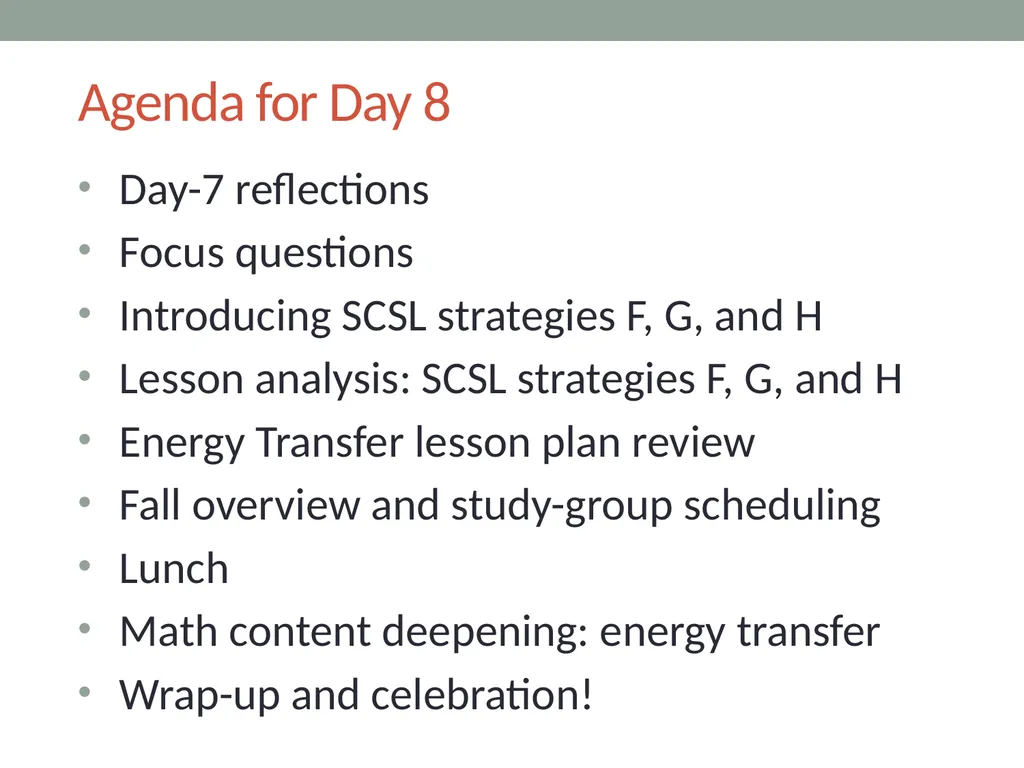
Agenda for Day 8 Day-7 reflections
Focus questions
Introducing SCSL strategies F, G, and H
Lesson analysis: SCSL strategies F, G, and H
Energy Transfer lesson plan review
Fall overview and study-group scheduling
Lunch
Math content deepening: energy transfer
Wrap-up and celebration!<br>
Focus questions
Introducing SCSL strategies F, G, and H
Lesson analysis: SCSL strategies F, G, and H
Energy Transfer lesson plan review
Fall overview and study-group scheduling
Lunch
Math content deepening: energy transfer
Wrap-up and celebration!<br>
03
Trends in Reflections<br>
04
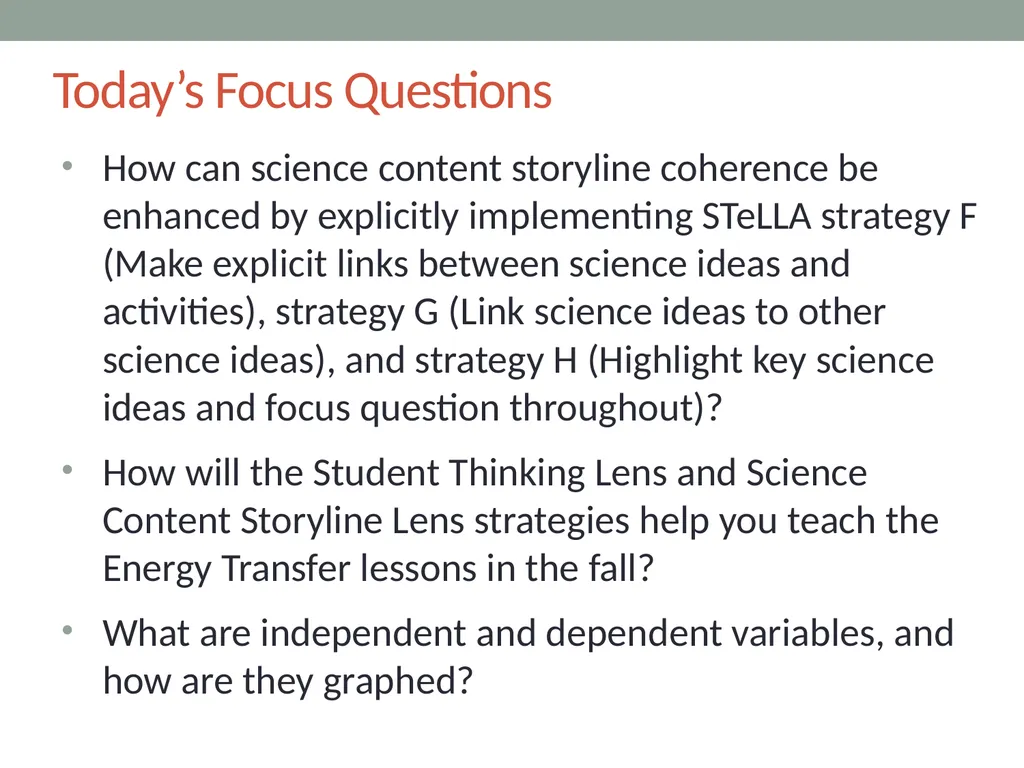
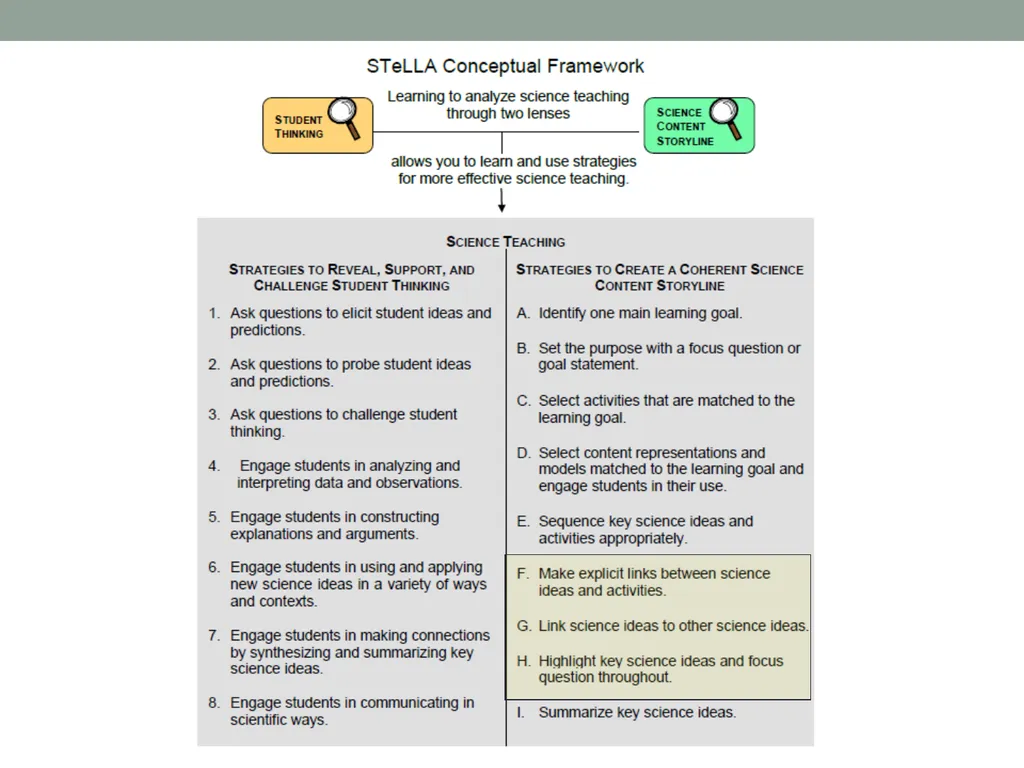
Today’s Focus Questions How can science content storyline coherence be enhanced by explicitly implementing STeLLA strategy F (Make explicit links between science ideas and activities), strategy G (Link science ideas to other science ideas), and strategy H (Highlight key science ideas and focus question throughout)?
How will the Student Thinking Lens and Science Content Storyline Lens strategies help you teach the Energy Transfer lessons in the fall?
What are independent and dependent variables, and how are they graphed?<br>
How will the Student Thinking Lens and Science Content Storyline Lens strategies help you teach the Energy Transfer lessons in the fall?
What are independent and dependent variables, and how are they graphed?<br>
05
Lesson Analysis: Focus Question 1 How can science content storyline coherence be enhanced by explicitly implementing STeLLA strategy F (Make explicit links between science ideas and activities), strategy G (Link science ideas to other science ideas), and strategy H (Highlight key science ideas and focus question throughout)?<br>
06
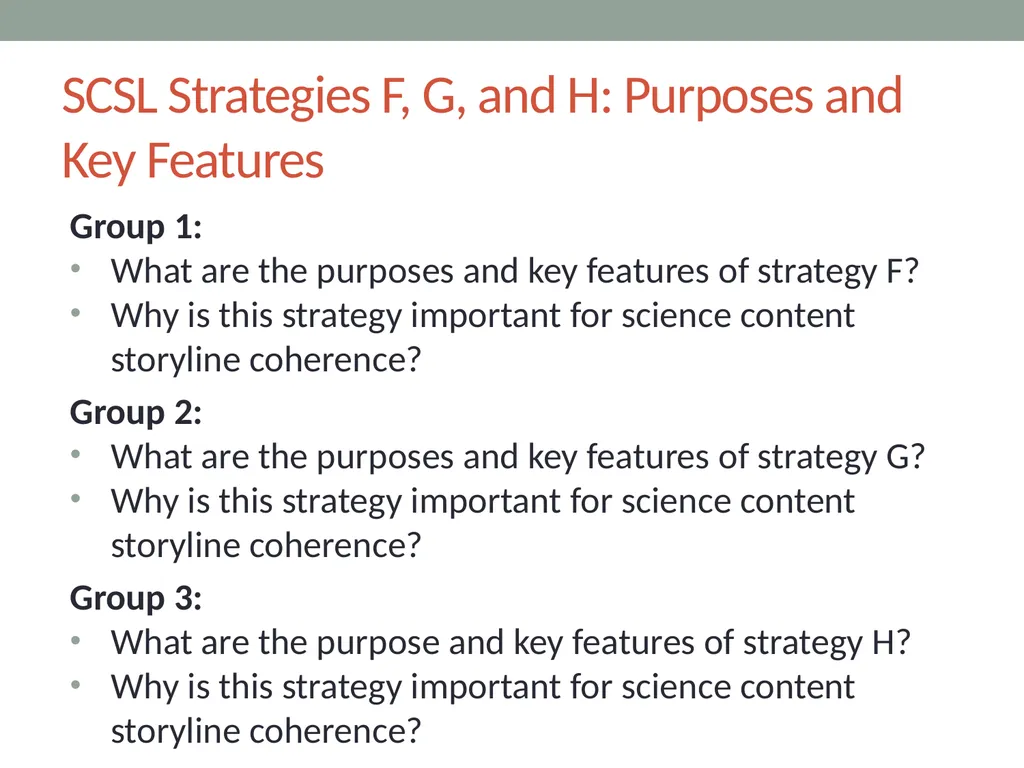
SCSL Strategies F, G, and H: Purposes and Key Features Group 1:
What are the purposes and key features of strategy F?
Why is this strategy important for science content storyline coherence?
Group 2:
What are the purposes and key features of strategy G?
Why is this strategy important for science content storyline coherence?
Group 3:
What are the purpose and key features of strategy H?
Why is this strategy important for science content storyline coherence?<br>
What are the purposes and key features of strategy F?
Why is this strategy important for science content storyline coherence?
Group 2:
What are the purposes and key features of strategy G?
Why is this strategy important for science content storyline coherence?
Group 3:
What are the purpose and key features of strategy H?
Why is this strategy important for science content storyline coherence?<br>
07
SCSL Strategies F, G, and H: Discussion Question What’s similar and different about these three strategies?<br>
08
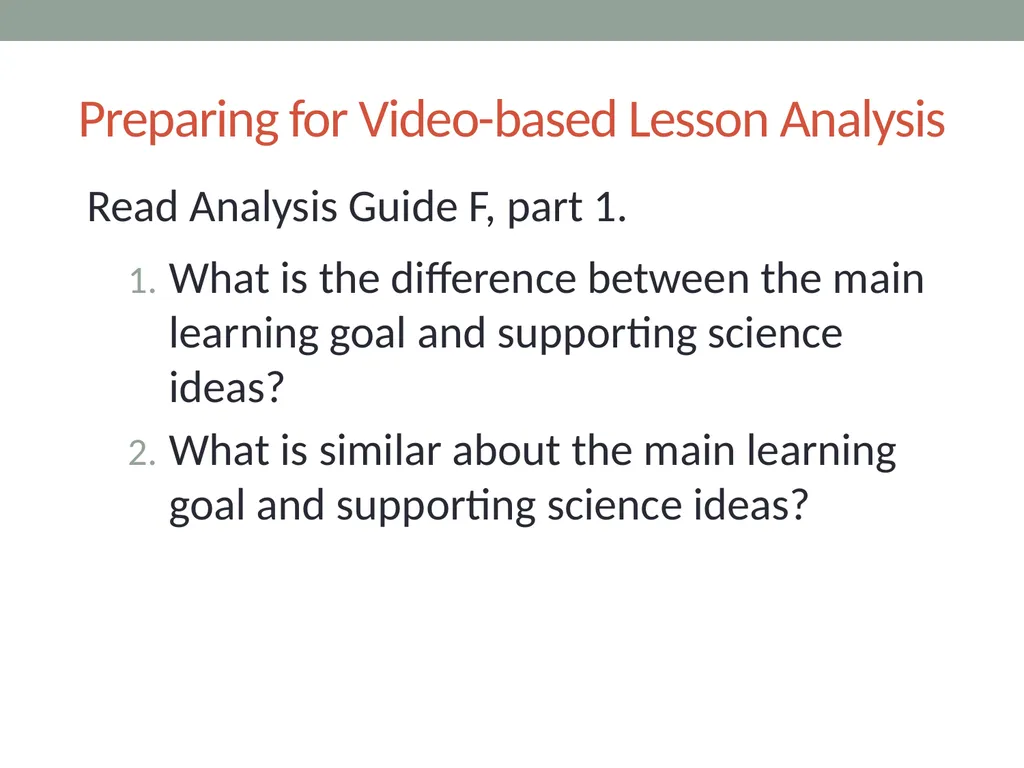
Preparing for Video-based Lesson Analysis Read Analysis Guide F, part 1.
What is the difference between the main learning goal and supporting science ideas?
What is similar about the main learning goal and supporting science ideas?<br>
What is the difference between the main learning goal and supporting science ideas?
What is similar about the main learning goal and supporting science ideas?<br>
09
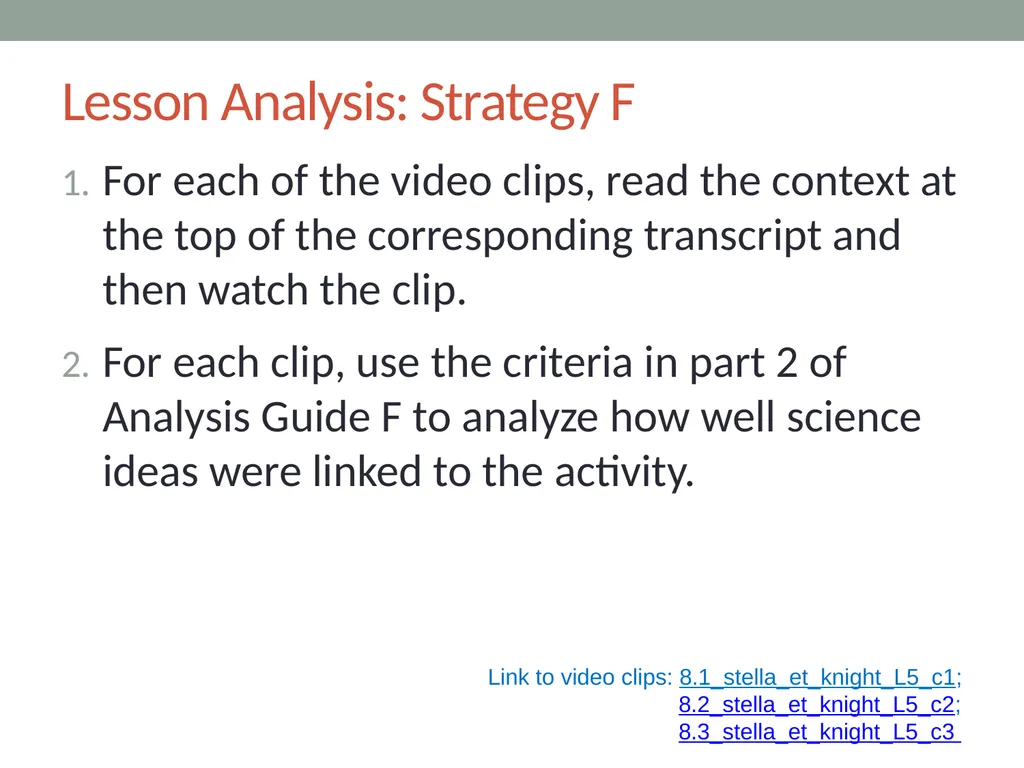
Lesson Analysis: Strategy F For each of the video clips, read the context at the top of the corresponding transcript and then watch the clip.
For each clip, use the criteria in part 2 of Analysis Guide F to analyze how well science ideas were linked to the activity. Link to video clips: 8.1_stella_et_knight_L5_c1; 8.2_stella_et_knight_L5_c2;
8.3_stella_et_knight_L5_c3<br>
For each clip, use the criteria in part 2 of Analysis Guide F to analyze how well science ideas were linked to the activity. Link to video clips: 8.1_stella_et_knight_L5_c1; 8.2_stella_et_knight_L5_c2;
8.3_stella_et_knight_L5_c3<br>
10
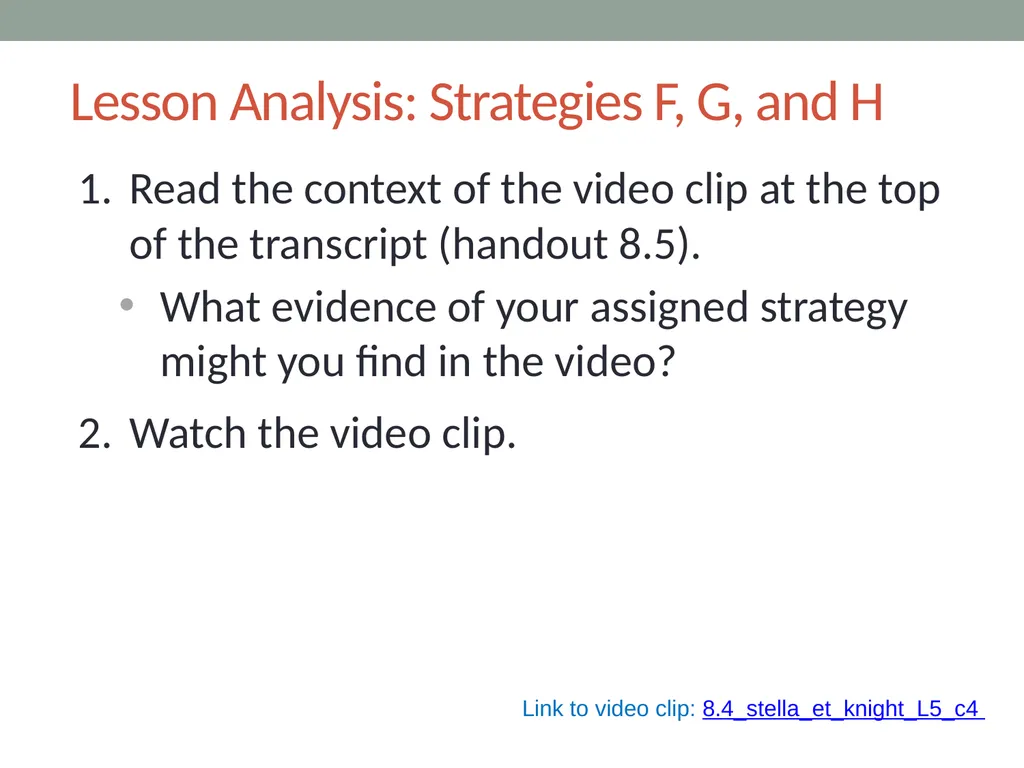
Lesson Analysis: Strategies F, G, and H Read the context of the video clip at the top of the transcript (handout 8.5).
What evidence of your assigned strategy might you find in the video?
Watch the video clip. Link to video clip: 8.4_stella_et_knight_L5_c4<br>
What evidence of your assigned strategy might you find in the video?
Watch the video clip. Link to video clip: 8.4_stella_et_knight_L5_c4<br>
11
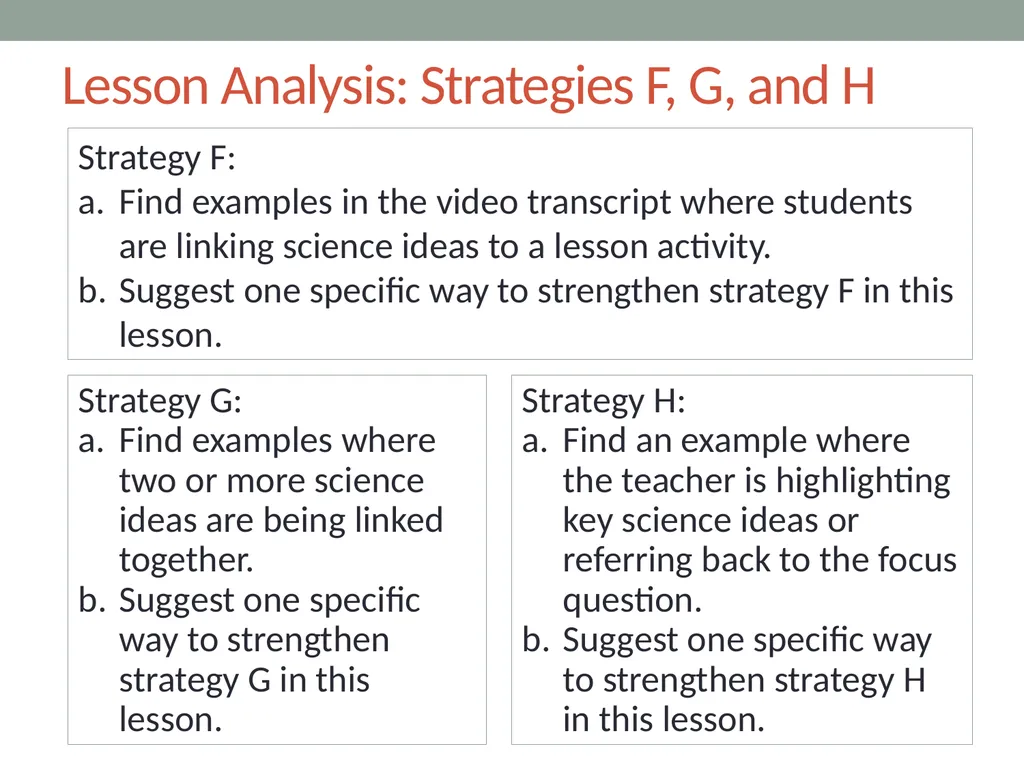
Lesson Analysis: Strategies F, G, and H Strategy G:
Find examples where two or more science ideas are being linked together.
Suggest one specific way to strengthen strategy G in this lesson. Strategy H:
Find an example where the teacher is highlighting key science ideas or referring back to the focus question.
Suggest one specific way to strengthen strategy H in this lesson. Strategy F:
Find examples in the video transcript where students are linking science ideas to a lesson activity.
Suggest one specific way to strengthen strategy F in this lesson.<br>
Find examples where two or more science ideas are being linked together.
Suggest one specific way to strengthen strategy G in this lesson. Strategy H:
Find an example where the teacher is highlighting key science ideas or referring back to the focus question.
Suggest one specific way to strengthen strategy H in this lesson. Strategy F:
Find examples in the video transcript where students are linking science ideas to a lesson activity.
Suggest one specific way to strengthen strategy F in this lesson.<br>
12
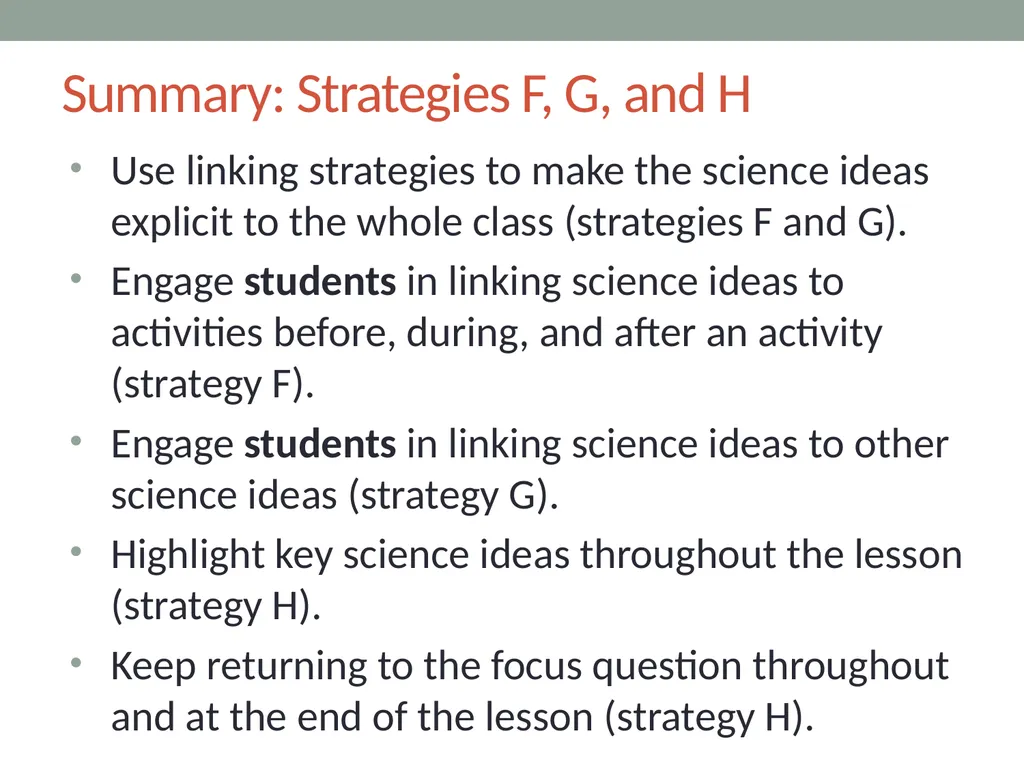
Summary: Strategies F, G, and H Use linking strategies to make the science ideas explicit to the whole class (strategies F and G).
Engage students in linking science ideas to activities before, during, and after an activity (strategy F).
Engage students in linking science ideas to other science ideas (strategy G).
Highlight key science ideas throughout the lesson (strategy H).
Keep returning to the focus question throughout and at the end of the lesson (strategy H).<br>
Engage students in linking science ideas to activities before, during, and after an activity (strategy F).
Engage students in linking science ideas to other science ideas (strategy G).
Highlight key science ideas throughout the lesson (strategy H).
Keep returning to the focus question throughout and at the end of the lesson (strategy H).<br>
13
Lesson Analysis: Focus Question 2 How will the Student Thinking Lens and Science Content Storyline Lens strategies help you teach the Energy Transfer lessons in the fall?<br>
14
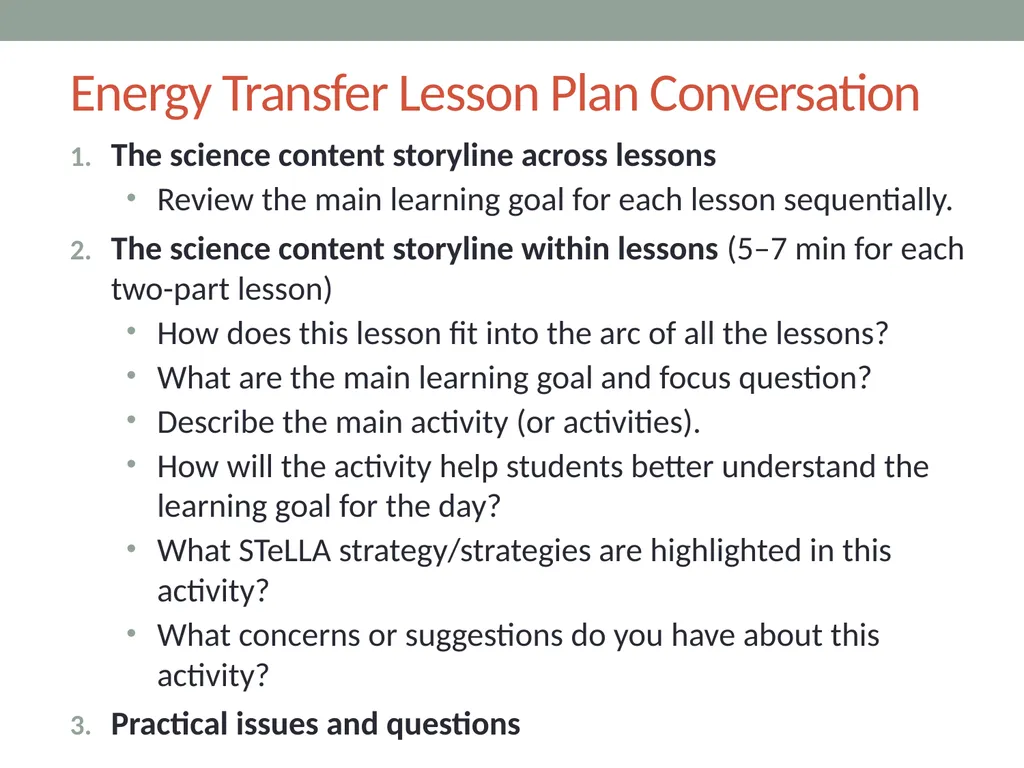
Energy Transfer Lesson Plan Conversation The science content storyline across lessons
Review the main learning goal for each lesson sequentially.
The science content storyline within lessons (5–7 min for each two-part lesson)
How does this lesson fit into the arc of all the lessons?
What are the main learning goal and focus question?
Describe the main activity (or activities).
How will the activity help students better understand the learning goal for the day?
What STeLLA strategy/strategies are highlighted in this activity?
What concerns or suggestions do you have about this activity?
Practical issues and questions<br>
Review the main learning goal for each lesson sequentially.
The science content storyline within lessons (5–7 min for each two-part lesson)
How does this lesson fit into the arc of all the lessons?
What are the main learning goal and focus question?
Describe the main activity (or activities).
How will the activity help students better understand the learning goal for the day?
What STeLLA strategy/strategies are highlighted in this activity?
What concerns or suggestions do you have about this activity?
Practical issues and questions<br>
15
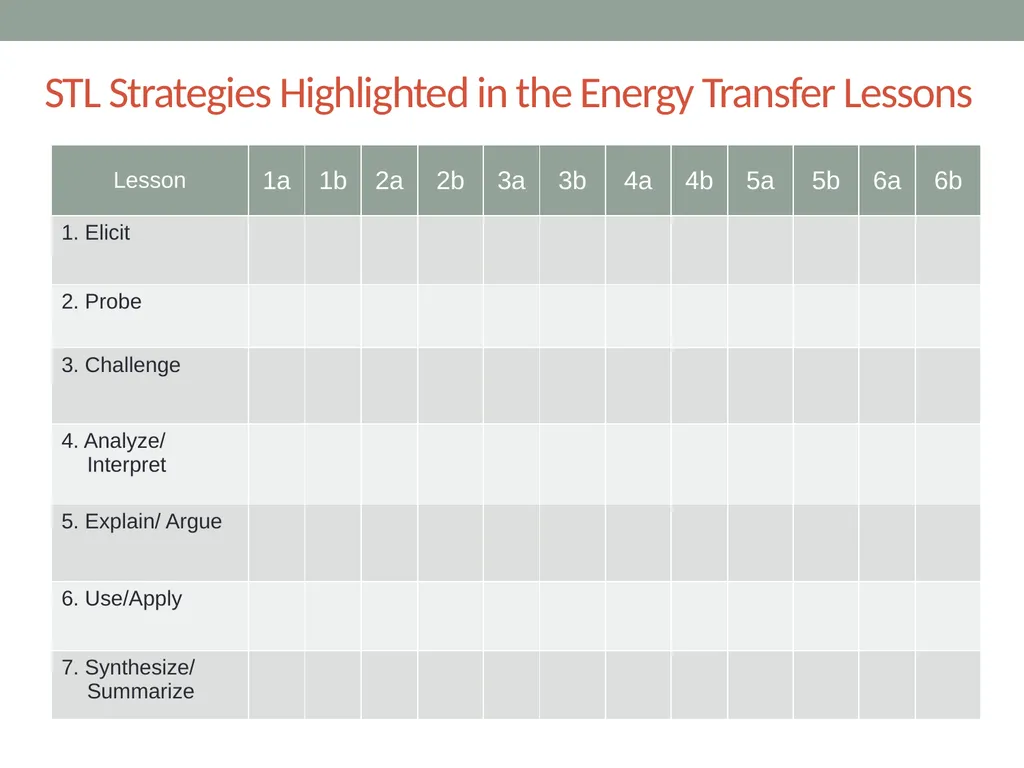
STL Strategies Highlighted in the Energy Transfer Lessons<br>
16
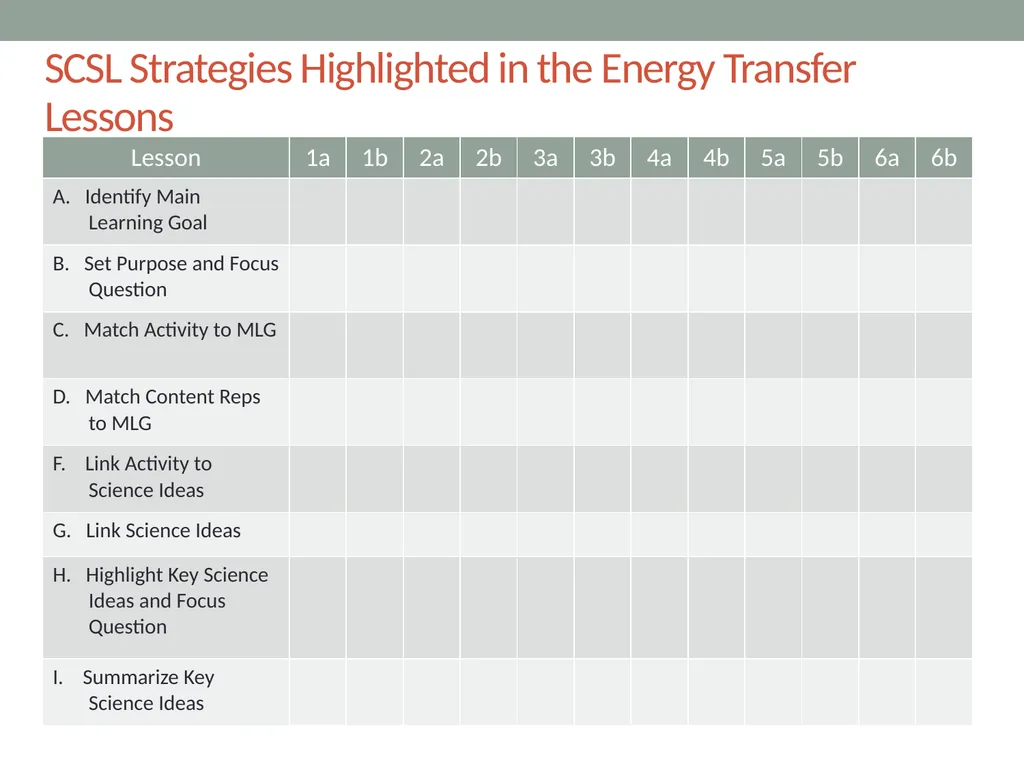
SCSL Strategies Highlighted in the Energy Transfer Lessons<br>
17
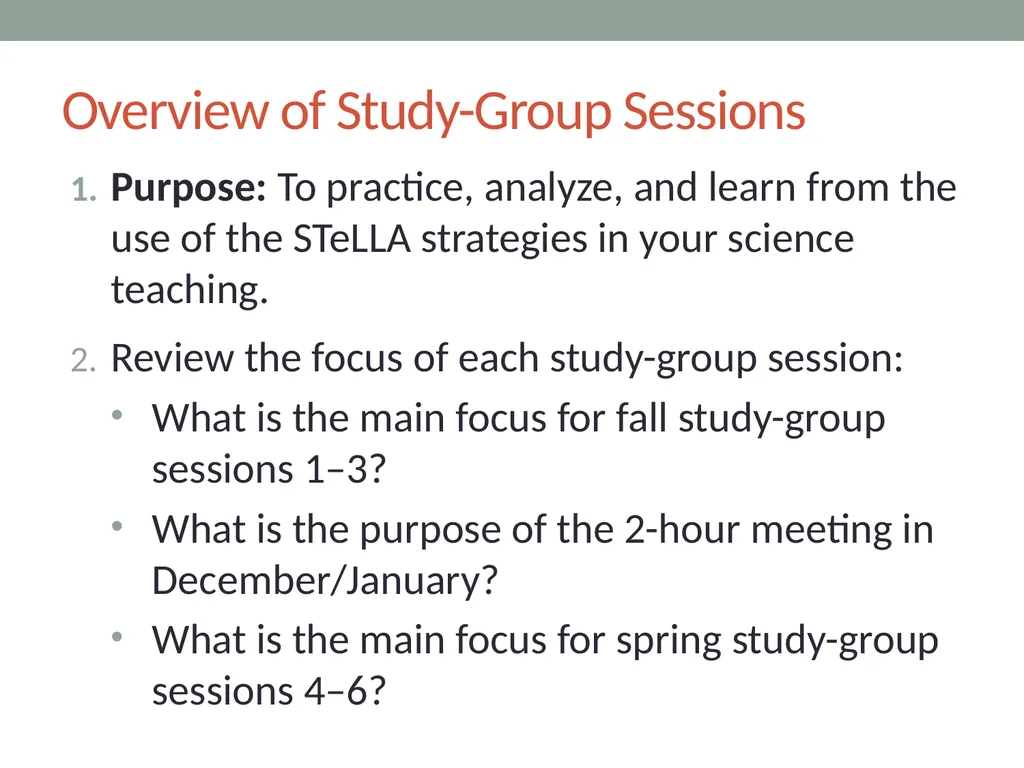
Overview of Study-Group Sessions Purpose: To practice, analyze, and learn from the use of the STeLLA strategies in your science teaching.
Review the focus of each study-group session:
What is the main focus for fall study-group sessions 1–3?
What is the purpose of the 2-hour meeting in December/January?
What is the main focus for spring study-group sessions 4–6?<br>
Review the focus of each study-group session:
What is the main focus for fall study-group sessions 1–3?
What is the purpose of the 2-hour meeting in December/January?
What is the main focus for spring study-group sessions 4–6?<br>
18
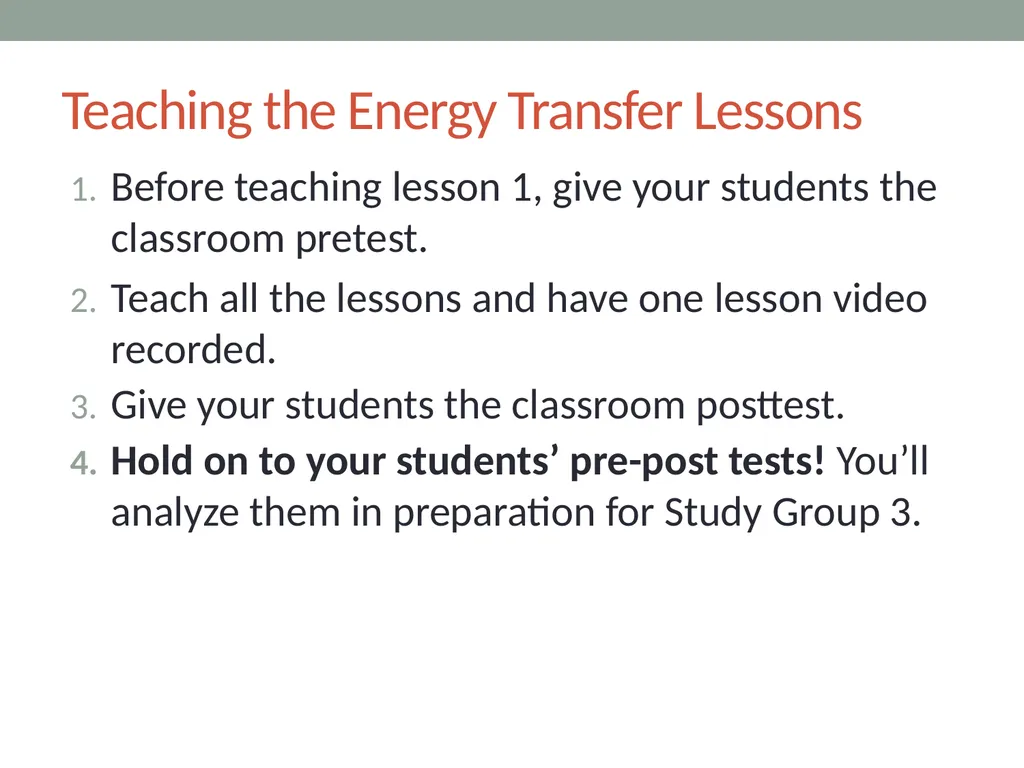
Teaching the Energy Transfer Lessons Before teaching lesson 1, give your students the classroom pretest.
Teach all the lessons and have one lesson video recorded.
Give your students the classroom posttest.
Hold on to your students’ pre-post tests! You’ll analyze them in preparation for Study Group 3.<br>
Teach all the lessons and have one lesson video recorded.
Give your students the classroom posttest.
Hold on to your students’ pre-post tests! You’ll analyze them in preparation for Study Group 3.<br>
19
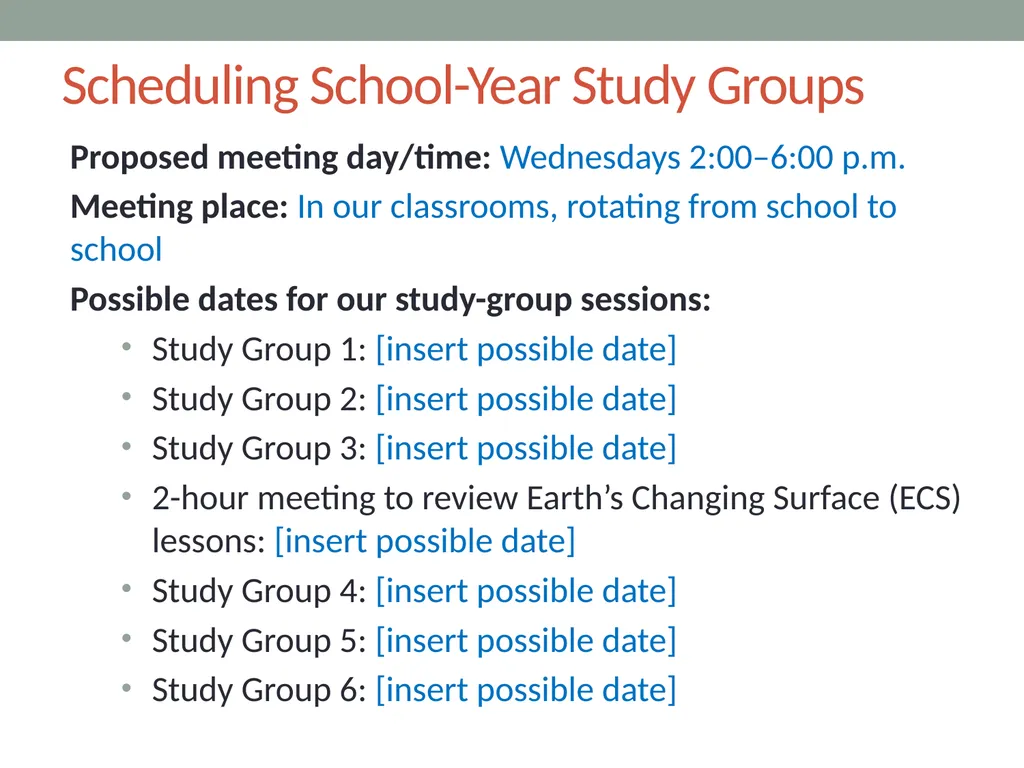
Scheduling School-Year Study Groups Proposed meeting day/time: Wednesdays 2:00–6:00 p.m.
Meeting place: In our classrooms, rotating from school to school
Possible dates for our study-group sessions:
Study Group 1: [insert possible date]
Study Group 2: [insert possible date]
Study Group 3: [insert possible date]
2-hour meeting to review Earth’s Changing Surface (ECS) lessons: [insert possible date]
Study Group 4: [insert possible date]
Study Group 5: [insert possible date]
Study Group 6: [insert possible date]<br>
Meeting place: In our classrooms, rotating from school to school
Possible dates for our study-group sessions:
Study Group 1: [insert possible date]
Study Group 2: [insert possible date]
Study Group 3: [insert possible date]
2-hour meeting to review Earth’s Changing Surface (ECS) lessons: [insert possible date]
Study Group 4: [insert possible date]
Study Group 5: [insert possible date]
Study Group 6: [insert possible date]<br>
20
Energy Transfer MATH CONTENT DEEPENING Grade 4<br>
21
Content Deepening Focus Question What are independent and dependent variables, and how are they graphed?<br>
22
Defining Variables What is an independent variable?
What is a dependent variable?
How are these variables graphed?
How are x and y variables identified?<br>
What is a dependent variable?
How are these variables graphed?
How are x and y variables identified?<br>
23
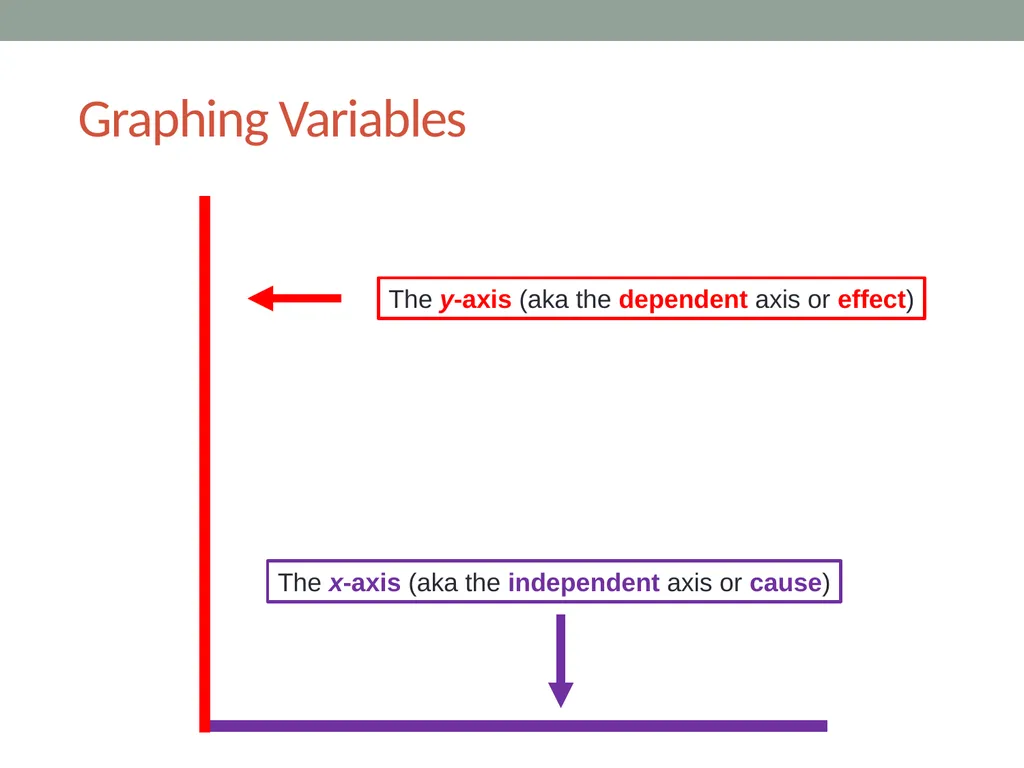
Graphing Variables The y-axis (aka the dependent axis or effect) The x-axis (aka the independent axis or cause)<br>
24
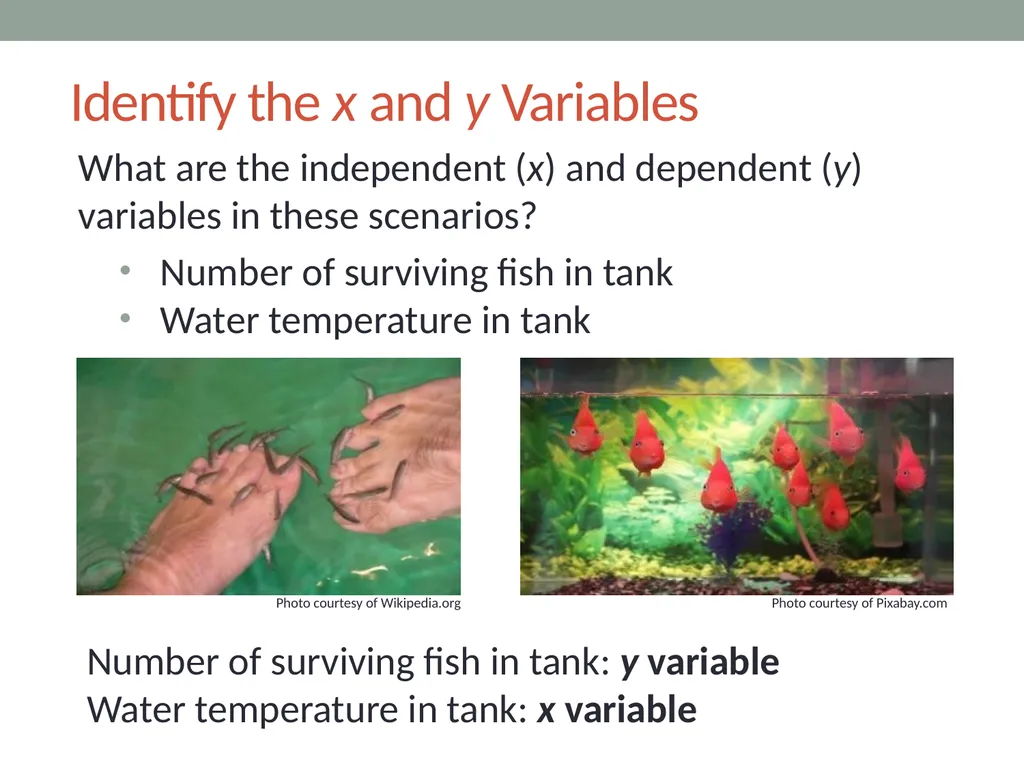
Identify the x and y Variables Photo courtesy of Wikipedia.org Photo courtesy of Pixabay.com What are the independent (x) and dependent (y) variables in these scenarios?
Number of surviving fish in tank
Water temperature in tank Number of surviving fish in tank: y variable
Water temperature in tank: x variable<br>
Number of surviving fish in tank
Water temperature in tank Number of surviving fish in tank: y variable
Water temperature in tank: x variable<br>
25
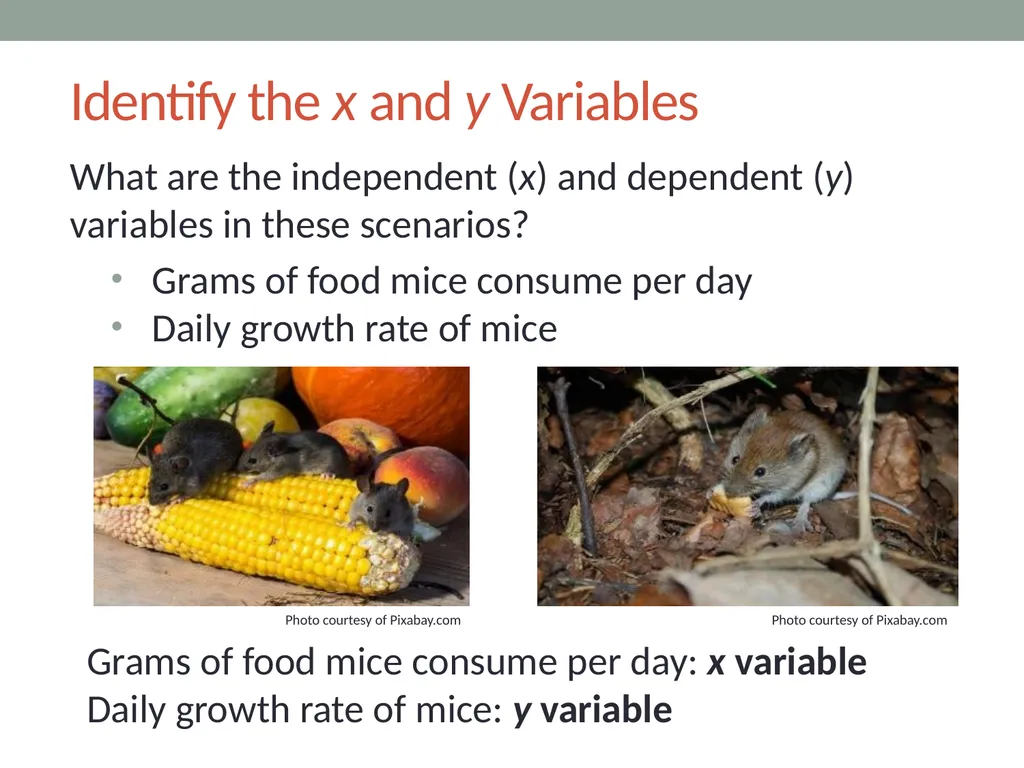
Identify the x and y Variables What are the independent (x) and dependent (y) variables in these scenarios?
Grams of food mice consume per day
Daily growth rate of mice Photo courtesy of Pixabay.com Photo courtesy of Pixabay.com Grams of food mice consume per day: x variable
Daily growth rate of mice: y variable<br>
Grams of food mice consume per day
Daily growth rate of mice Photo courtesy of Pixabay.com Photo courtesy of Pixabay.com Grams of food mice consume per day: x variable
Daily growth rate of mice: y variable<br>
26
Controlled versus Uncontrolled Variables Some x variables are easily controlled, such as the water temperature of a fish tank or the amount of food mice are fed.
Other x variables can’t be controlled; they can only be observed. This is especially the case when time is the x variable.<br>
Other x variables can’t be controlled; they can only be observed. This is especially the case when time is the x variable.<br>
27
The Time Variable Keep in mind that time isn’t automatically the x variable (cause). Under some conditions or treatments, it can be the y variable (effect).
When might time be a dependent (y) variable?
Can you give some examples?<br>
When might time be a dependent (y) variable?
Can you give some examples?<br>
28
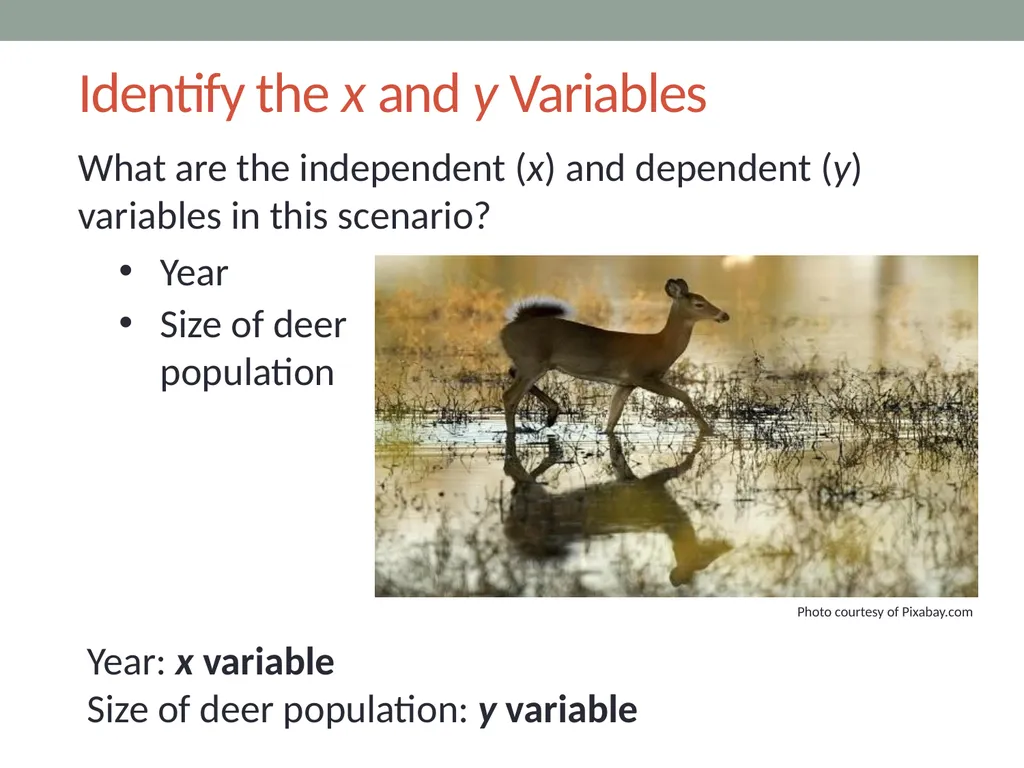
Identify the x and y Variables Photo courtesy of Pixabay.com What are the independent (x) and dependent (y) variables in this scenario?
Year
Size of deer population Year: x variable
Size of deer population: y variable<br>
Year
Size of deer population Year: x variable
Size of deer population: y variable<br>
29
What are the independent (x) and dependent (y) variables in this scenario?
Time to experience total pain relief
Dosage of ibuprofen Identify the x and y Variables Time to experience total pain relief: y variable
Dosage of ibuprofen: x variable Courtesy of Pixabay.com<br>
Time to experience total pain relief
Dosage of ibuprofen Identify the x and y Variables Time to experience total pain relief: y variable
Dosage of ibuprofen: x variable Courtesy of Pixabay.com<br>
30
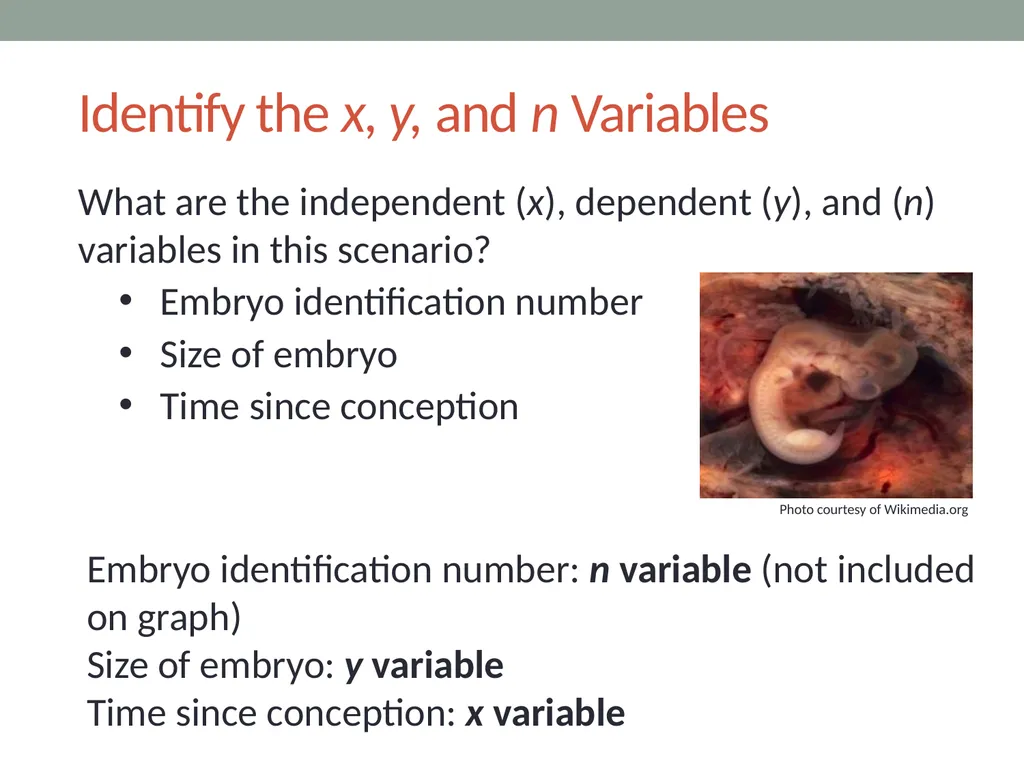
Identify the x, y, and n Variables What are the independent (x), dependent (y), and (n) variables in this scenario?
Embryo identification number
Size of embryo
Time since conception Photo courtesy of Wikimedia.org Embryo identification number: n variable (not included on graph)
Size of embryo: y variable
Time since conception: x variable<br>
Embryo identification number
Size of embryo
Time since conception Photo courtesy of Wikimedia.org Embryo identification number: n variable (not included on graph)
Size of embryo: y variable
Time since conception: x variable<br>
31
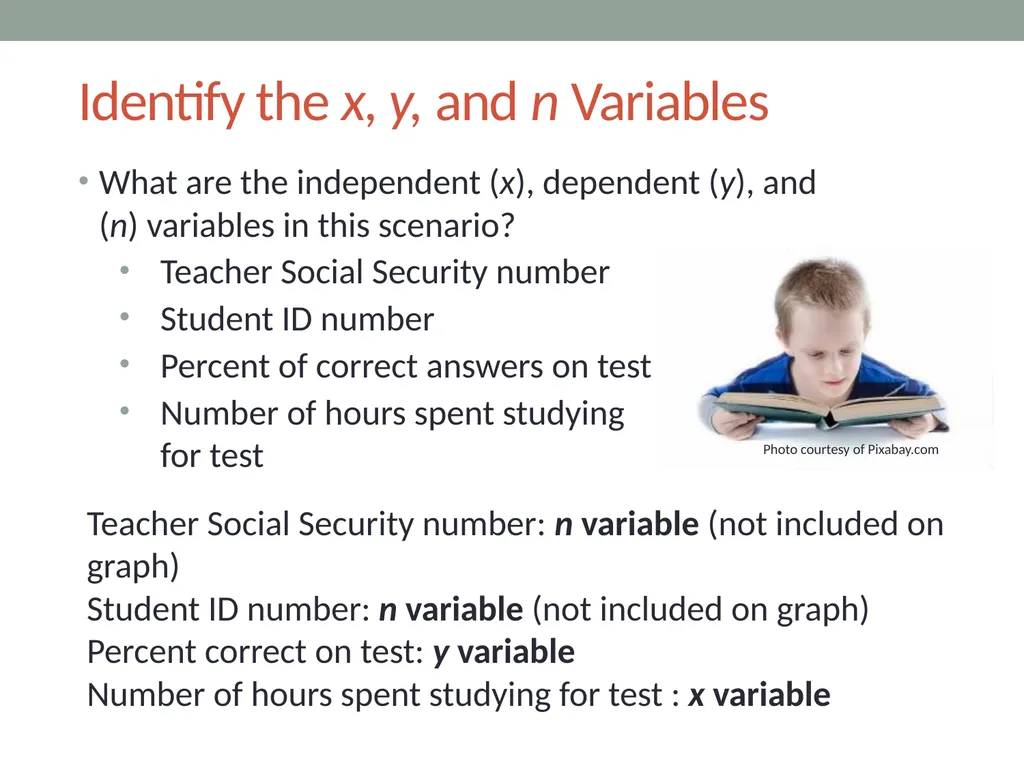
Identify the x, y, and n Variables What are the independent (x), dependent (y), and
(n) variables in this scenario?
Teacher Social Security number
Student ID number
Percent of correct answers on test
Number of hours spent studying for test Photo courtesy of Pixabay.com Teacher Social Security number: n variable (not included on graph)
Student ID number: n variable (not included on graph)
Percent correct on test: y variable
Number of hours spent studying for test : x variable<br>
Teacher Social Security number
Student ID number
Percent of correct answers on test
Number of hours spent studying for test Photo courtesy of Pixabay.com Teacher Social Security number: n variable (not included on graph)
Student ID number: n variable (not included on graph)
Percent correct on test: y variable
Number of hours spent studying for test : x variable<br>
32
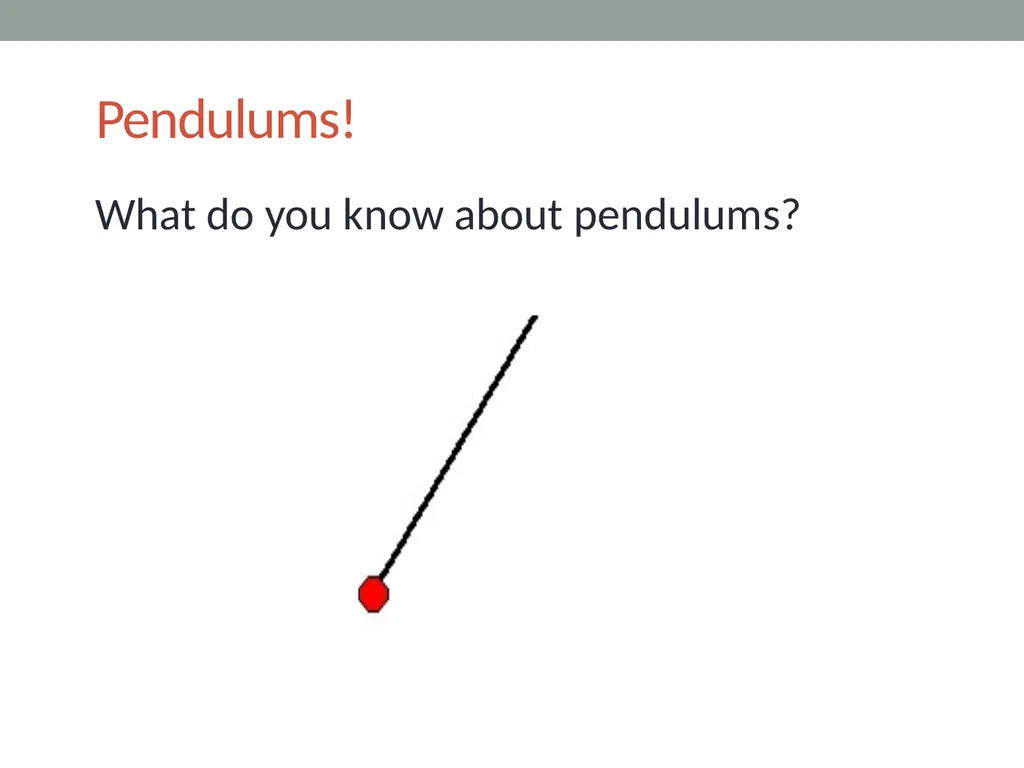
Pendulums! What do you know about pendulums?<br>
33
Defining a Pendulum How would you define the term pendulum?
Definition: A pendulum is something hanging from a fixed point, which, when pulled back and released, is free to swing down by gravity and then out and up because of its inertia, or tendency to stay in motion.
Let’s make a pendulum! Source: ScienceNetLinks; http://sciencenetlinks.com/student-teacher-sheets/foucaults-pendulum-answer-key/<br>
Definition: A pendulum is something hanging from a fixed point, which, when pulled back and released, is free to swing down by gravity and then out and up because of its inertia, or tendency to stay in motion.
Let’s make a pendulum! Source: ScienceNetLinks; http://sciencenetlinks.com/student-teacher-sheets/foucaults-pendulum-answer-key/<br>
34
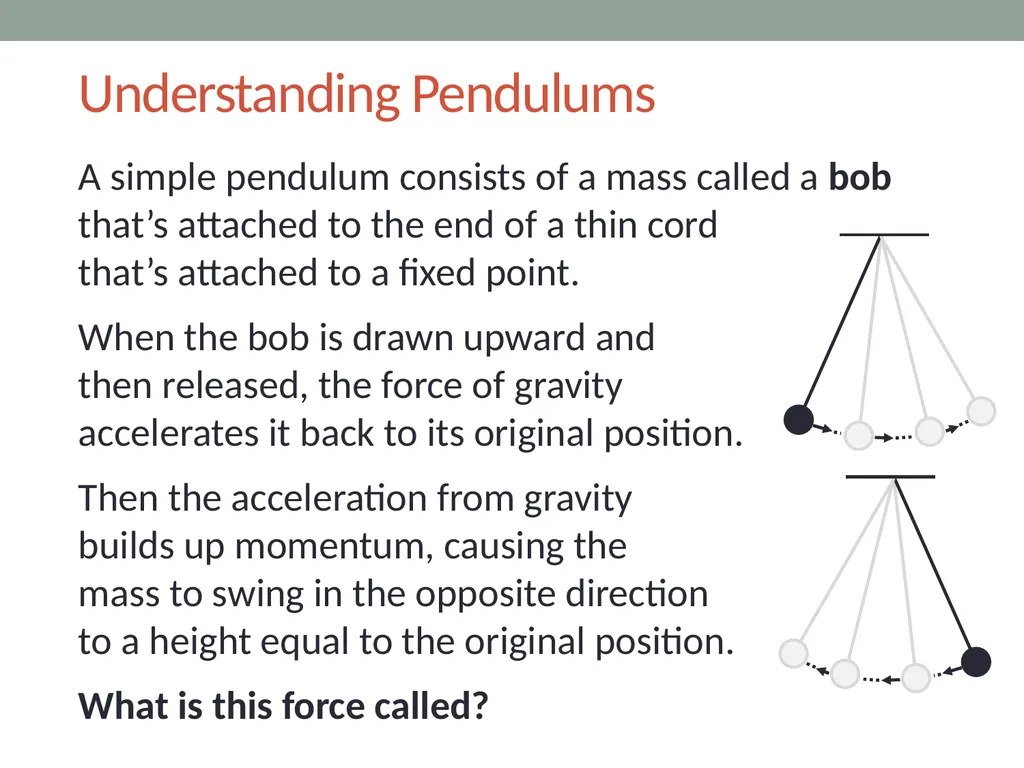
Understanding Pendulums A simple pendulum consists of a mass called a bob that’s attached to the end of a thin cord
that’s attached to a fixed point.
When the bob is drawn upward and then released, the force of gravity accelerates it back to its original position.
Then the acceleration from gravity builds up momentum, causing the mass to swing in the opposite direction to a height equal to the original position.
What is this force called?<br>
When the bob is drawn upward and then released, the force of gravity accelerates it back to its original position.
Then the acceleration from gravity builds up momentum, causing the mass to swing in the opposite direction to a height equal to the original position.
What is this force called?<br>
35
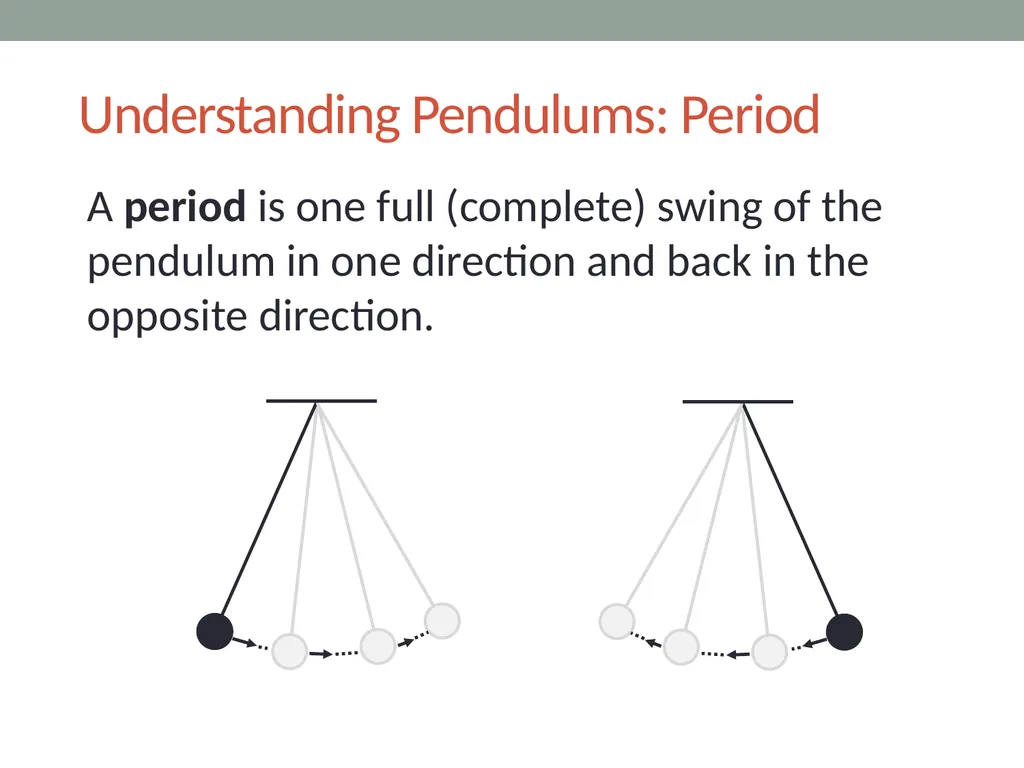
A period is one full (complete) swing of the pendulum in one direction and back in the opposite direction. Understanding Pendulums: Period<br>
36
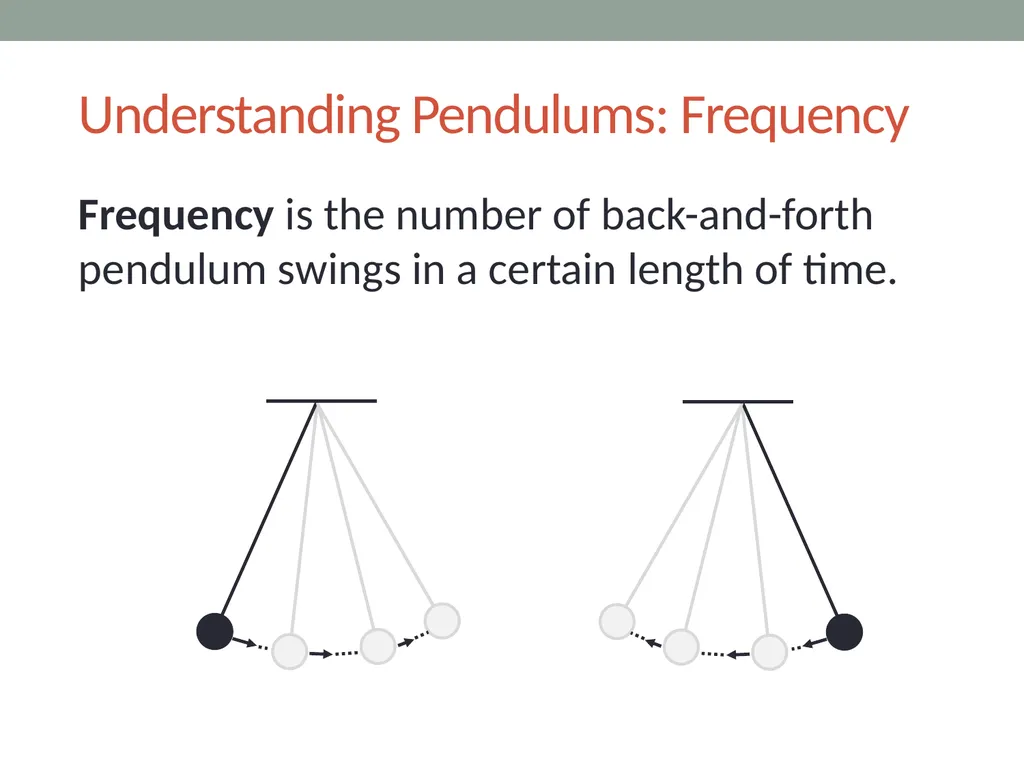
Frequency is the number of back-and-forth pendulum swings in a certain length of time. Understanding Pendulums: Frequency<br>
37
What variables affect the frequency (swing time) of a pendulum?
The four most common variables:
Starting angle of pendulum
String length
Bob mass
Gravity Variables That Affect Frequency<br>
The four most common variables:
Starting angle of pendulum
String length
Bob mass
Gravity Variables That Affect Frequency<br>
38
Design a Research Experiment How can we design a research experiment that tests pendulum frequency?
What variables can we control that might affect the outcome?
How can we control variables that affect pendulum frequency (swing time)?
Starting (pull-back) angle
String length
Bob mass<br>
What variables can we control that might affect the outcome?
How can we control variables that affect pendulum frequency (swing time)?
Starting (pull-back) angle
String length
Bob mass<br>
39
How would you design an experiment in which a pendulum swings exactly 60 times in a minute?
Pair up with an elbow partner and discuss your design. Record specific details about your design plan in your science notebooks.
You’ll need a timer and your pendulums for this experiment. Design a Research Experiment<br>
Pair up with an elbow partner and discuss your design. Record specific details about your design plan in your science notebooks.
You’ll need a timer and your pendulums for this experiment. Design a Research Experiment<br>
40
What is the dependent variable in this experiment? Explain.
What is the independent variable in this experiment? Explain.
What are the controls in this experiment? Explain.
On graph paper, create a graph showing pendulum length and number of swings. Make sure to label your x and y variables.
How would you describe your graph? Pendulum Experiment<br>
What is the independent variable in this experiment? Explain.
What are the controls in this experiment? Explain.
On graph paper, create a graph showing pendulum length and number of swings. Make sure to label your x and y variables.
How would you describe your graph? Pendulum Experiment<br>
41
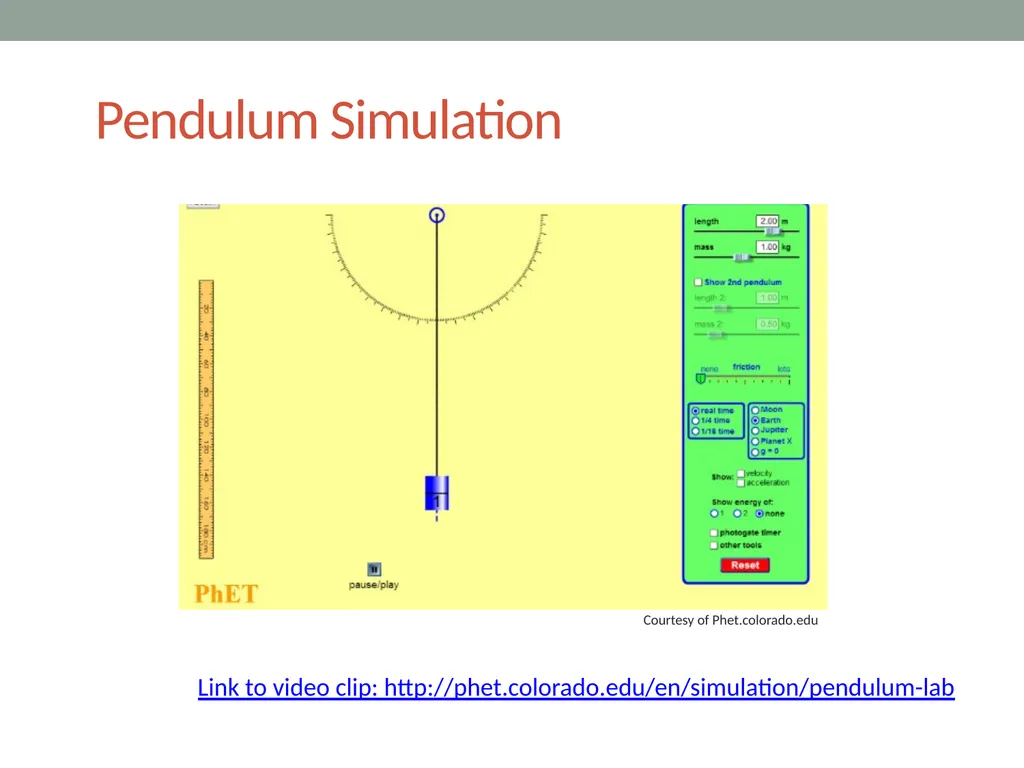
Link to video clip: http://phet.colorado.edu/en/simulation/pendulum-lab Courtesy of Phet.colorado.edu Pendulum Simulation<br>
42
Pendulum Length Changing pendulum length while keeping other variables constant changes the length of the period.
Longer pendulums have a lower frequency than shorter pendulums and thus have a longer period.<br>
Longer pendulums have a lower frequency than shorter pendulums and thus have a longer period.<br>
43
Bob Mass and Starting Angle Changing bob mass doesn’t affect pendulum frequency.
Changing the starting angle (how far you pull back the pendulum before releasing it) has only a very slight effect on pendulum frequency.<br>
Changing the starting angle (how far you pull back the pendulum before releasing it) has only a very slight effect on pendulum frequency.<br>
44
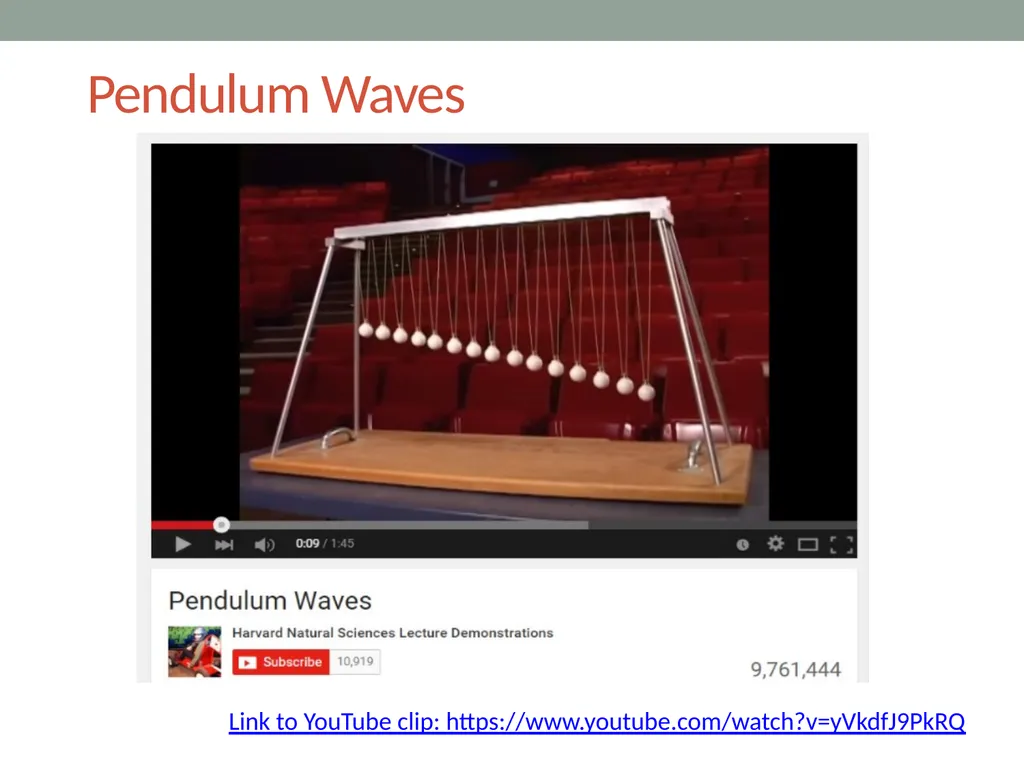
Pendulum Waves Link to YouTube clip: https://www.youtube.com/watch?v=yVkdfJ9PkRQ<br>
45
Reflect: Content Deepening Focus Question What are independent and dependent variables, and how are they graphed?<br>
46
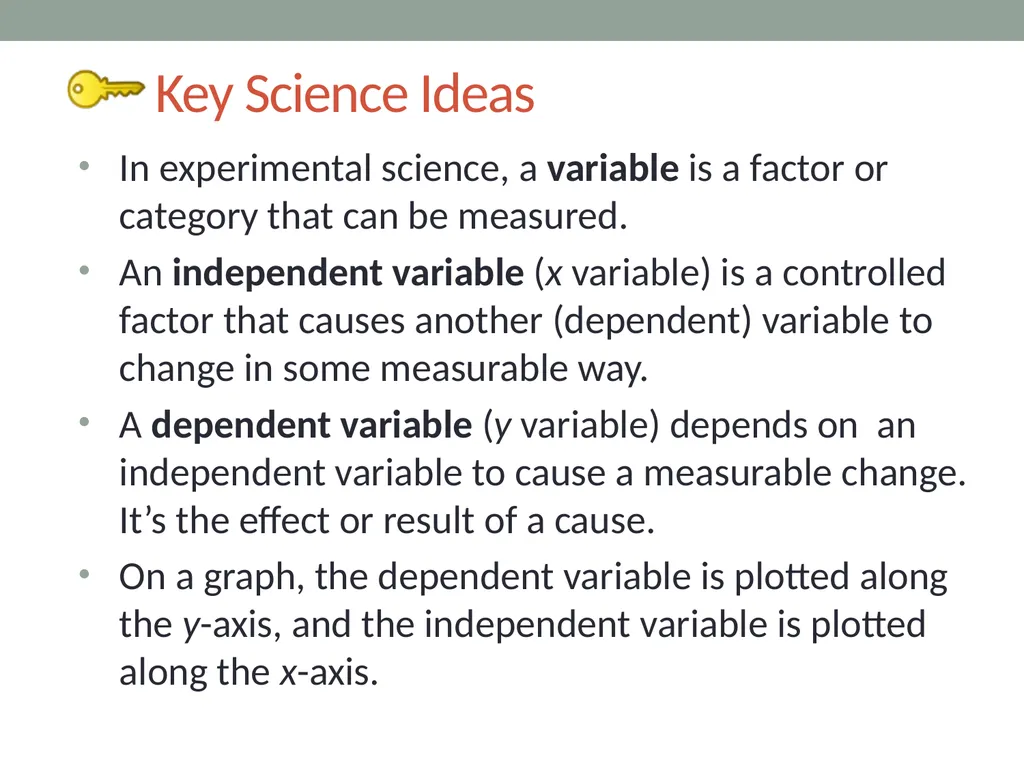
Key Science Ideas In experimental science, a variable is a factor or category that can be measured.
An independent variable (x variable) is a controlled factor that causes another (dependent) variable to change in some measurable way.
A dependent variable (y variable) depends on an independent variable to cause a measurable change. It’s the effect or result of a cause.
On a graph, the dependent variable is plotted along the y-axis, and the independent variable is plotted along the x-axis.<br>
An independent variable (x variable) is a controlled factor that causes another (dependent) variable to change in some measurable way.
A dependent variable (y variable) depends on an independent variable to cause a measurable change. It’s the effect or result of a cause.
On a graph, the dependent variable is plotted along the y-axis, and the independent variable is plotted along the x-axis.<br>
47
Today’s Focus Questions How can science content storyline coherence be enhanced by explicitly implementing STeLLA strategy F (Make explicit links between science ideas and activities), strategy G (Link science ideas to other science ideas), and strategy H (Highlight key science ideas and focus question throughout)?
How will the Student Thinking Lens and Science Content Storyline Lens strategies help you teach the Energy Transfer lessons in the fall?
What are independent and dependent variables, and how are they graphed?<br>
How will the Student Thinking Lens and Science Content Storyline Lens strategies help you teach the Energy Transfer lessons in the fall?
What are independent and dependent variables, and how are they graphed?<br>
48
Summarizing Science Content Storyline Lens Strategies What does the organization of the summary chart in the STeLLA strategies booklet highlight about the Science Content Storyline Lens strategies?
Do you want to make any revisions or additions to our chart on effective science teaching?<br>
Do you want to make any revisions or additions to our chart on effective science teaching?<br>
49
Let’s Celebrate! Design your own end-of-program celebration and insert any comments or instructions here.<br>
50
Thank You! Thank you for participating in the RESPeCT PD program!<br>