
RESPIRATORY EMERGENCIES LESSON-16 BY JITENDER
AS
Published · 43 slides · 0 views

1 / 1








Description
RESPIRATORY EMERGENCIES LESSON-16 BY JITENDER YADAV INSPPH Upon completion of this lesson you will be able to: Define respiratory distress and list the signs symptoms. Describe the management of respiratory distress Describe anaphylactic
Related Topics
Share
Embed code
Download this presentation From Below
"RESPIRATORY EMERGENCIES LESSON-16 BY JITENDER" is the property of its rightful owner. Permission is granted to download and print the materials on this website for personal, non-commercial use only, and to display it on your personal computer provided you do not modify the materials and that you retain all copyright notices contained in the materials. By downloading content from our website, you accept the terms of this agreement.
Presentation Transcript
01
RESPIRATORY EMERGENCIES LESSON-16 BY
JITENDER YADAV
INSP/PH<br>
JITENDER YADAV
INSP/PH<br>
02
Upon completion of this lesson you will be able to:
Define respiratory distress and list the signs/ symptoms.
Describe the management of respiratory distress
Describe anaphylactic shock and list the causes
Describe management of anaphylactic shock OBJECTIVES<br>
Define respiratory distress and list the signs/ symptoms.
Describe the management of respiratory distress
Describe anaphylactic shock and list the causes
Describe management of anaphylactic shock OBJECTIVES<br>
03
5. Enumerate the signs/symptoms of toxic
product inhalation and list the steps of
management
6. List the signs/symptoms of acute pulmonary
edema and describe its management OBJECTIVES<br>
product inhalation and list the steps of
management
6. List the signs/symptoms of acute pulmonary
edema and describe its management OBJECTIVES<br>
04
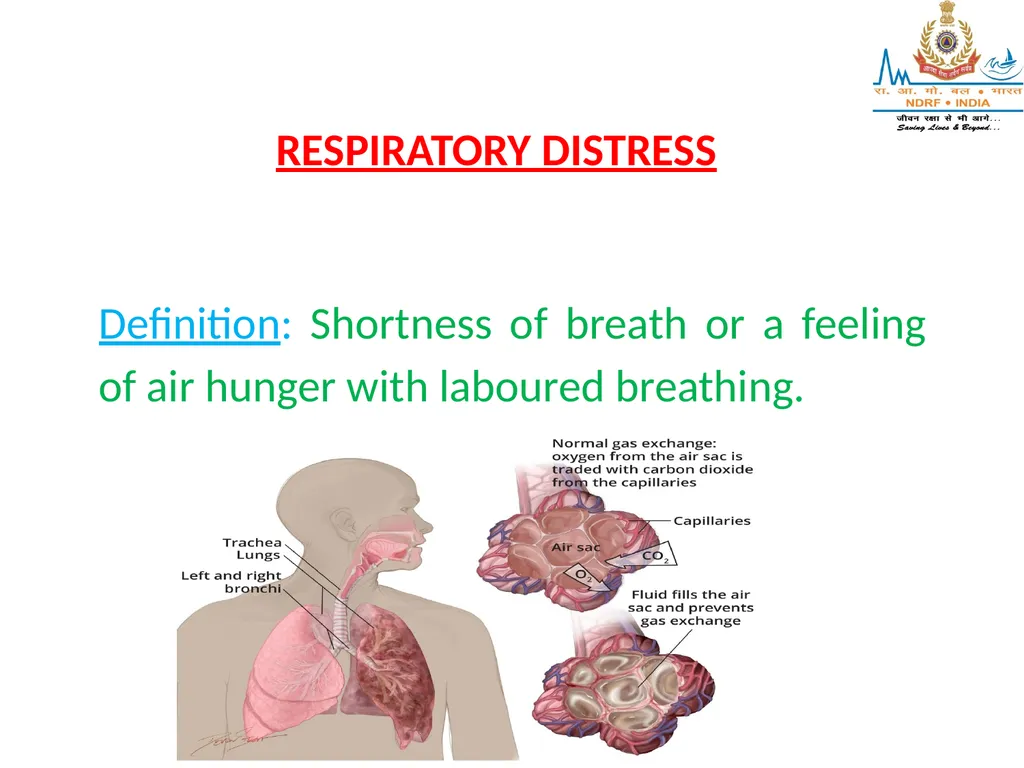
Definition: Shortness of breath or a feeling of air hunger with laboured breathing. RESPIRATORY DISTRESS<br>
05
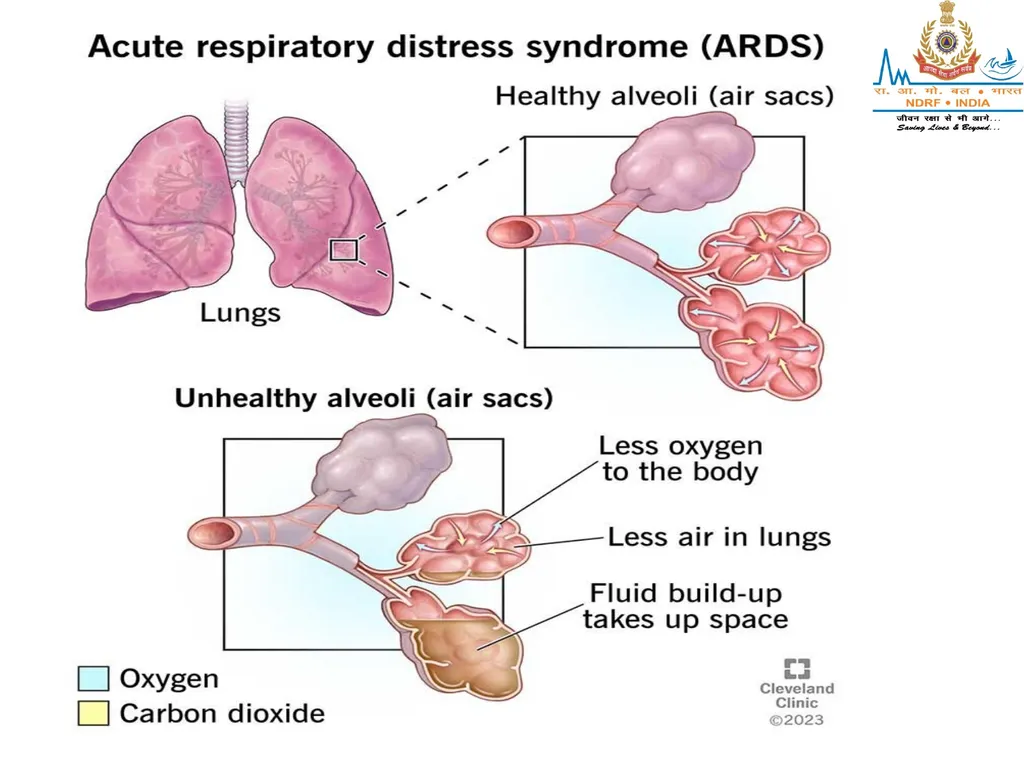
Affects one’s ability to exchange oxygen and carbon dioxide.
Common signs and symptoms inherent to all types of breathing difficulties.
Characterized by quick, laboured breathing, shortness of breath and the sensation of unavailable air.
Produce a blue coloration of the skin and mucous membranes. RESPIRATORY DISTRESS<br>
Common signs and symptoms inherent to all types of breathing difficulties.
Characterized by quick, laboured breathing, shortness of breath and the sensation of unavailable air.
Produce a blue coloration of the skin and mucous membranes. RESPIRATORY DISTRESS<br>
06
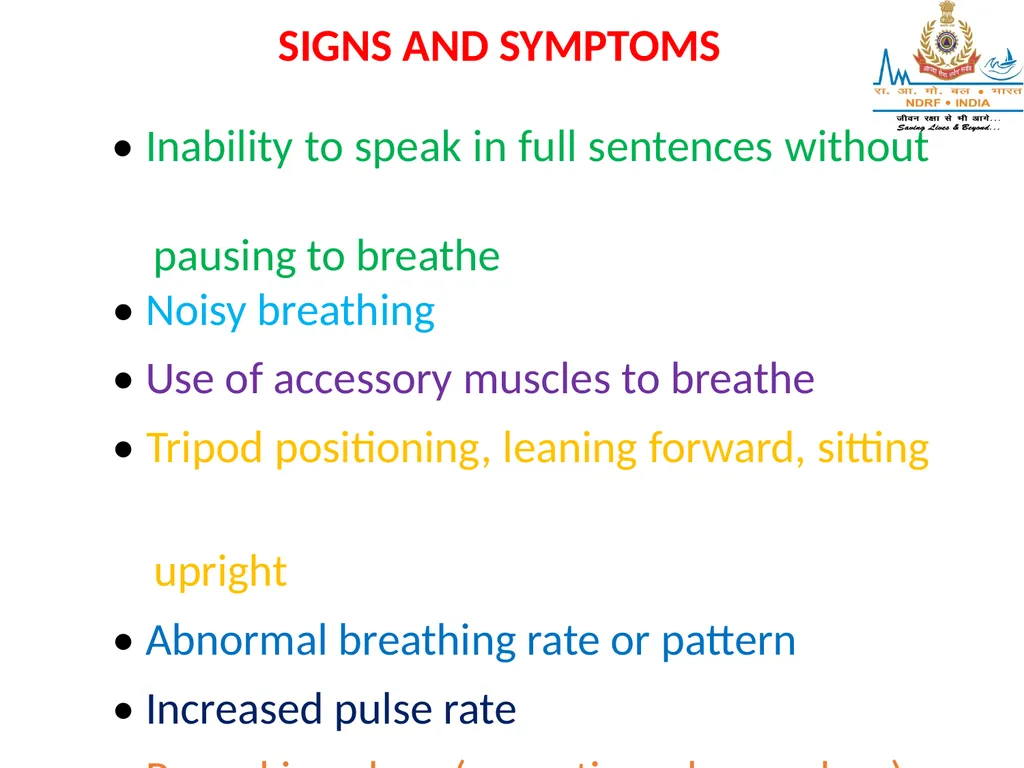
• Inability to speak in full sentences without
pausing to breathe
• Noisy breathing
• Use of accessory muscles to breathe
• Tripod positioning, leaning forward, sitting
upright
• Abnormal breathing rate or pattern
• Increased pulse rate
• Poor skin colour (cyanotic, pale or ashen) SIGNS AND SYMPTOMS<br>
pausing to breathe
• Noisy breathing
• Use of accessory muscles to breathe
• Tripod positioning, leaning forward, sitting
upright
• Abnormal breathing rate or pattern
• Increased pulse rate
• Poor skin colour (cyanotic, pale or ashen) SIGNS AND SYMPTOMS<br>
07
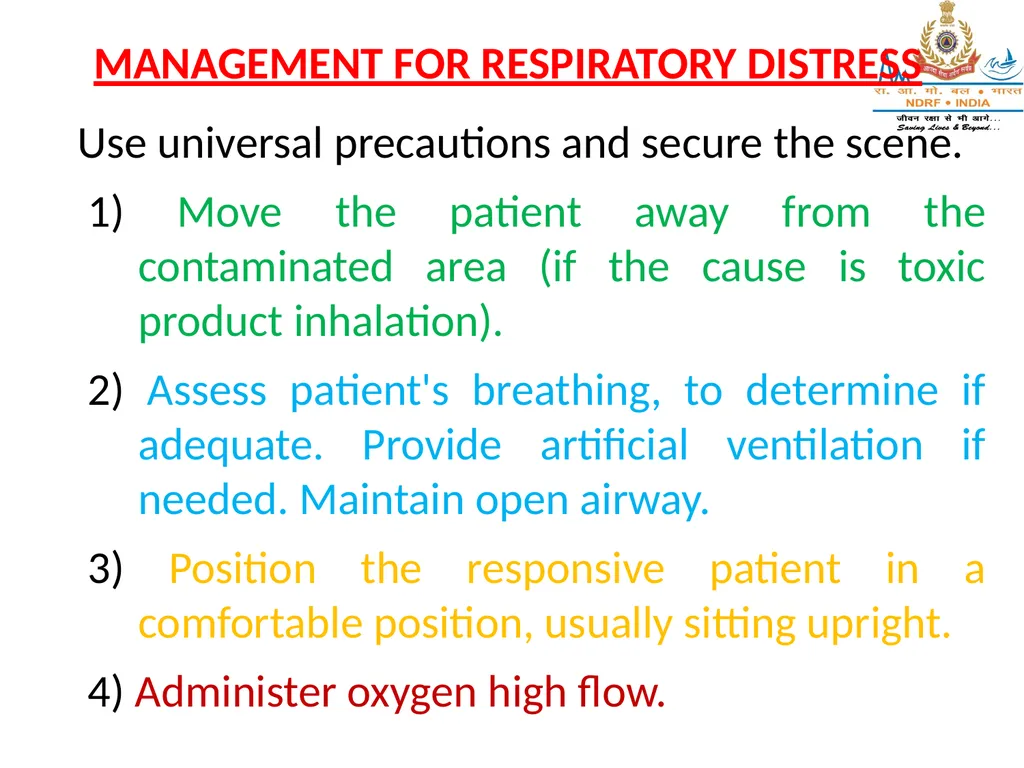
Use universal precautions and secure the scene.
1) Move the patient away from the contaminated area (if the cause is toxic product inhalation).
2) Assess patient's breathing, to determine if adequate. Provide artificial ventilation if needed. Maintain open airway.
3) Position the responsive patient in a comfortable position, usually sitting upright.
4) Administer oxygen high flow. MANAGEMENT FOR RESPIRATORY DISTRESS<br>
1) Move the patient away from the contaminated area (if the cause is toxic product inhalation).
2) Assess patient's breathing, to determine if adequate. Provide artificial ventilation if needed. Maintain open airway.
3) Position the responsive patient in a comfortable position, usually sitting upright.
4) Administer oxygen high flow. MANAGEMENT FOR RESPIRATORY DISTRESS<br>
08
5) Comfort and reassure the patient by providing emotional support.
6) If there is wheeze, then give nebulisation with 2ml Asthalin respirator solution + 1ml normal saline if available, otherwise give inj Deriphylin 1 amp IM/IV and inj Dexa 2ml IM/IV stat .
7) In case of COPD, start broad spectrum antibiotic like Cap.Amox 500mg 8 hrly or Cap.Augmentin 625mg 8 hrly.
Transport the patient as soon as possible.<br>
6) If there is wheeze, then give nebulisation with 2ml Asthalin respirator solution + 1ml normal saline if available, otherwise give inj Deriphylin 1 amp IM/IV and inj Dexa 2ml IM/IV stat .
7) In case of COPD, start broad spectrum antibiotic like Cap.Amox 500mg 8 hrly or Cap.Augmentin 625mg 8 hrly.
Transport the patient as soon as possible.<br>
09
The following conditions are among the more common respiratory problems one will encounter in the field.
1. BRONCHIAL ASTHMA
Bronchial asthma is an episodic illness characterized by the narrowing of the large air passages called the bronchi. The patient experiences difficulty exhaling air out of the lungs. This is usually due to a spasm of thin muscle that lines the bronchial walls. Asthma is generally triggered by allergens, strong scents, irritating gases, smoke and weather changes. MEDICAL CAUSES OF RESPIRATORY DISTRESS<br>
1. BRONCHIAL ASTHMA
Bronchial asthma is an episodic illness characterized by the narrowing of the large air passages called the bronchi. The patient experiences difficulty exhaling air out of the lungs. This is usually due to a spasm of thin muscle that lines the bronchial walls. Asthma is generally triggered by allergens, strong scents, irritating gases, smoke and weather changes. MEDICAL CAUSES OF RESPIRATORY DISTRESS<br>
10
2. Chronic Obstructive Pulmonary Disease
(COPD)
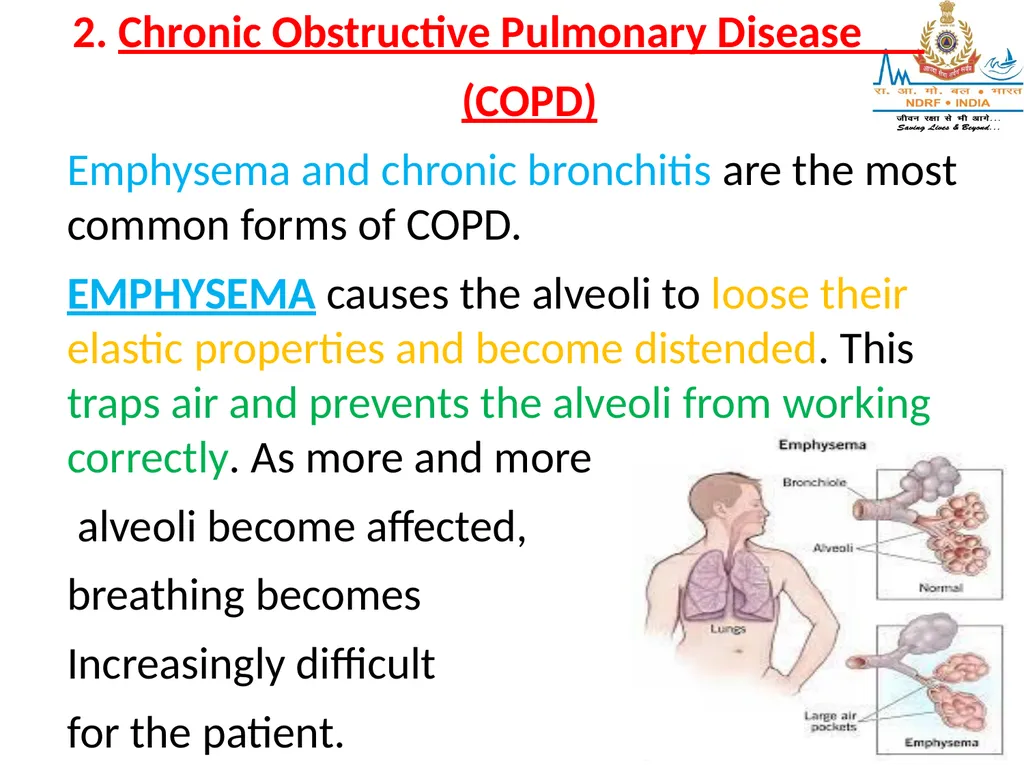
Emphysema and chronic bronchitis are the most common forms of COPD.
EMPHYSEMA causes the alveoli to loose their elastic properties and become distended. This traps air and prevents the alveoli from working correctly. As more and more
alveoli become affected,
breathing becomes
Increasingly difficult
for the patient.<br>
(COPD)
Emphysema and chronic bronchitis are the most common forms of COPD.
EMPHYSEMA causes the alveoli to loose their elastic properties and become distended. This traps air and prevents the alveoli from working correctly. As more and more
alveoli become affected,
breathing becomes
Increasingly difficult
for the patient.<br>
11
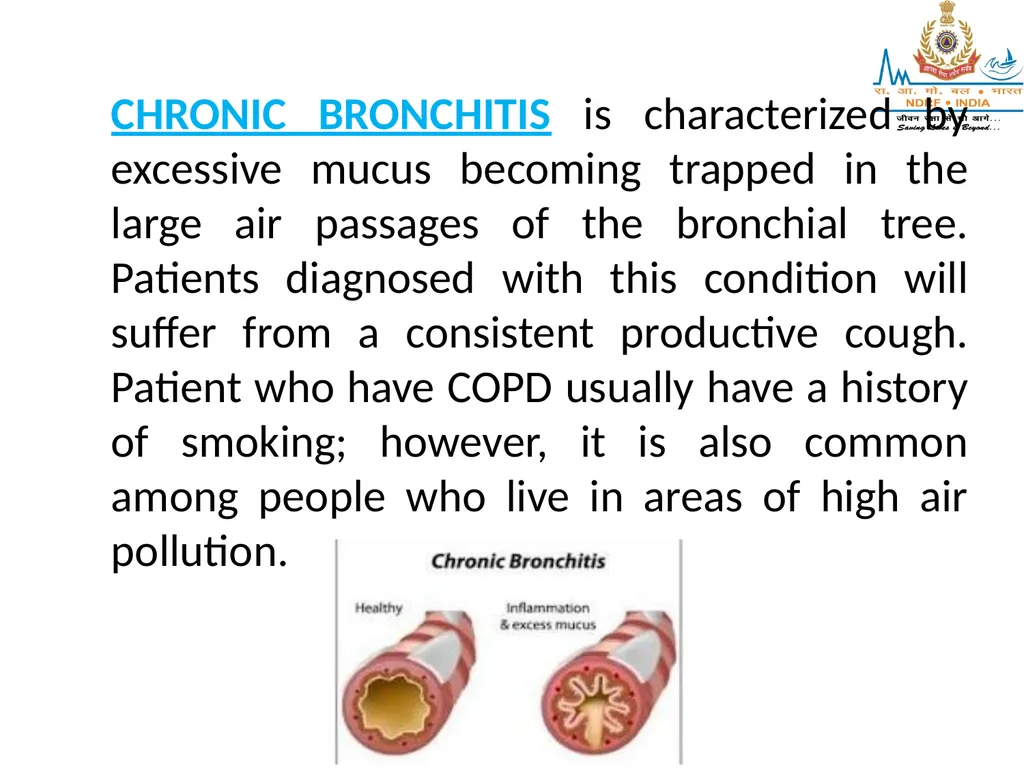
CHRONIC BRONCHITIS is characterized by excessive mucus becoming trapped in the large air passages of the bronchial tree. Patients diagnosed with this condition will suffer from a consistent productive cough. Patient who have COPD usually have a history of smoking; however, it is also common among people who live in areas of high air pollution.<br>
12
3. ANAPHYLAXIS
Anaphylaxis is an acute, severe allergic reaction that puts the patient’s life in immediate danger.
The reaction may be triggered by many different routes of exposure, including direct skin contact, ingestion and inhalation.
Exposure to the allergen will cause blood vessels to dilate rapidly and cause a drop in blood pressure (hypotension).<br>
Anaphylaxis is an acute, severe allergic reaction that puts the patient’s life in immediate danger.
The reaction may be triggered by many different routes of exposure, including direct skin contact, ingestion and inhalation.
Exposure to the allergen will cause blood vessels to dilate rapidly and cause a drop in blood pressure (hypotension).<br>
13
Many tissues may swell, including those lining the respiratory system.
This swelling can obstruct the airway, leading to respiratory failure.
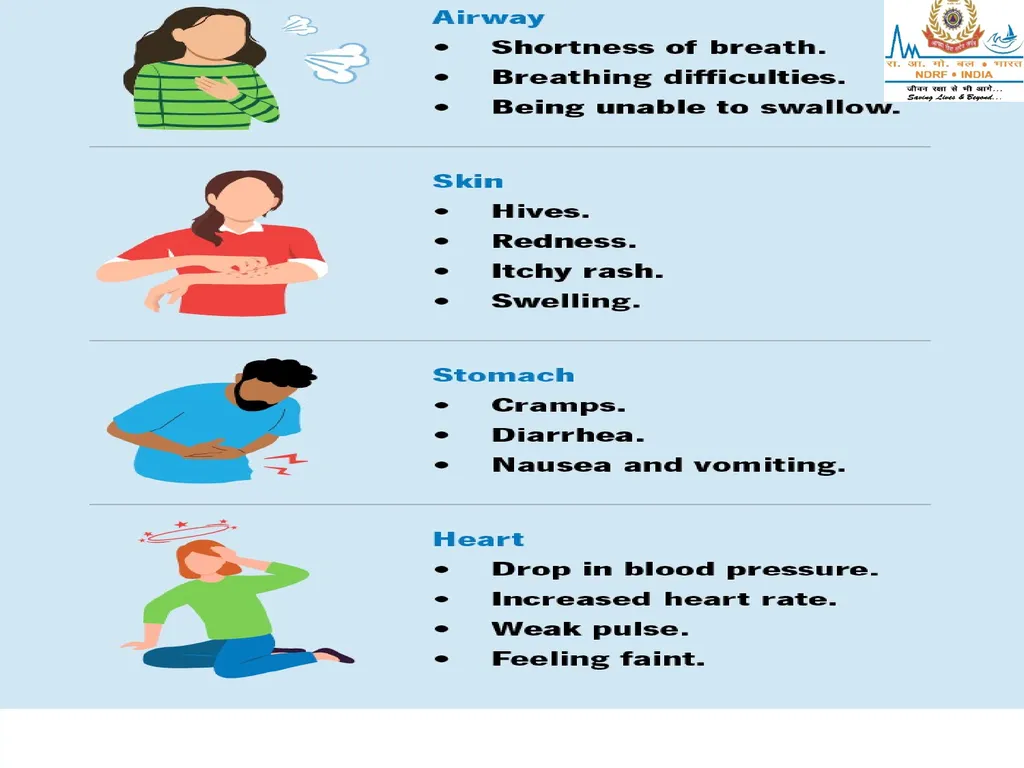
Signs and symptoms frequently observed are urticaria, oedema in the face, lips and neck.
In extreme cases, oedema can appear in the larynx and glottis making it difficult for the patient to breathe.<br>
This swelling can obstruct the airway, leading to respiratory failure.
Signs and symptoms frequently observed are urticaria, oedema in the face, lips and neck.
In extreme cases, oedema can appear in the larynx and glottis making it difficult for the patient to breathe.<br>
14
ANAPHYLACTIC SHOCK
Definition: A life-threatening reaction of the body caused by something to which the patient is extremely allergic.
This condition represents a true emergency where immediate transportation to a medical centre is imperative.<br>
Definition: A life-threatening reaction of the body caused by something to which the patient is extremely allergic.
This condition represents a true emergency where immediate transportation to a medical centre is imperative.<br>
15
Insect stings, including wasps and bees and ants
Foods and spices (especially shellfish)
Inhaled substances, including dust and pollen
Chemicals inhaled or in contact with the skin
Medications injected or taken by mouth, such as penicillin CAUSES OF ANAPHYLACTIC SHOCK<br>
Foods and spices (especially shellfish)
Inhaled substances, including dust and pollen
Chemicals inhaled or in contact with the skin
Medications injected or taken by mouth, such as penicillin CAUSES OF ANAPHYLACTIC SHOCK<br>
16
• Skin: May be swollen with burning and itching. Face and tongue may also be swollen (oedema).
• Breathing: Difficult and rapid breathing with possible wheezing.
• Pulse: Rapid, weak or not detected.
• State of consciousness: The patient may be restless and often may become unconscious. SIGNS OF ANAPHYLACTIC SHOCK<br>
• Breathing: Difficult and rapid breathing with possible wheezing.
• Pulse: Rapid, weak or not detected.
• State of consciousness: The patient may be restless and often may become unconscious. SIGNS OF ANAPHYLACTIC SHOCK<br>
17
When interviewing the patient, ask about allergies to anything and if he or she was in contact with that substance.
As with any type of shock treat the patient with total care (see management for shock).
The patient needs medications to combat the allergic reaction. MANAGEMENT FOR ANAPHYLACTIC SHOCK<br>
As with any type of shock treat the patient with total care (see management for shock).
The patient needs medications to combat the allergic reaction. MANAGEMENT FOR ANAPHYLACTIC SHOCK<br>
18
Administer Inj Adrenaline 1 amp SC slowly taking about 2 - 3 minutes. Take care as this medication can cause very rapid heart rate and sudden collapse of patient
Administer Inj. Avil 1 amp IM and Inj. Hydrocortisone Sodium Succinate 1 vial IV; Establish IV access
Administer Oxygen 10-15 l/min
Constantly monitor vital signs and be on the look out for airway obstruction by swelling of the soft tissues of upper airway
Transport the patient urgently<br>
Administer Inj. Avil 1 amp IM and Inj. Hydrocortisone Sodium Succinate 1 vial IV; Establish IV access
Administer Oxygen 10-15 l/min
Constantly monitor vital signs and be on the look out for airway obstruction by swelling of the soft tissues of upper airway
Transport the patient urgently<br>
19
Hyperventilation is a condition characterized by breathing too fast. It is normal for most people, such as when they are frightened, as long as the rate of breathing quickly returns to normal.
Hyperventilation syndrome is an abnormal state in which rapid breathing persists. It is commonly associated with anxiety. HYPERVENTILATION<br>
Hyperventilation syndrome is an abnormal state in which rapid breathing persists. It is commonly associated with anxiety. HYPERVENTILATION<br>
20
Rapid and deep breathing
Chest pain,
Dizziness,
Faintness,
Numbness around the mouth, hands and feet due to carbon dioxide wash-out and subsequent electrolyte imbalances. SYMPTOMS HYPERVENTILATION<br>
Chest pain,
Dizziness,
Faintness,
Numbness around the mouth, hands and feet due to carbon dioxide wash-out and subsequent electrolyte imbalances. SYMPTOMS HYPERVENTILATION<br>
21
Not every patient who is breathing rapidly or deeply is hyperventilating. Several serious conditions may be the cause, including fever, infections, trauma, diabetes or overdose. SYMPTOMS HYPERVENTILATION<br>
22
Hyperventilation is a relatively common respiratory emergency that can often be corrected by reassuring the patient and providing emotional support. If the patient does not respond immediately, administer oxygen; this will not make hyperventilation worse.
Avoid using the traditional method of treating anxiety-induced hyperventilation by having the patient breathe into a paper bag. Caution should be exercised when using this technique. Remember to allow the patient to receive enough oxygen.
If breathing does not improve with the explained measures, assume that the problem is more serious.<br>
Avoid using the traditional method of treating anxiety-induced hyperventilation by having the patient breathe into a paper bag. Caution should be exercised when using this technique. Remember to allow the patient to receive enough oxygen.
If breathing does not improve with the explained measures, assume that the problem is more serious.<br>
23
TOXIC PRODUCT INHALATION
Many fire-related deaths are due to problems associated with the inhalation of toxic products of combustion rather than from burns.
Patients can be affected by combustion in two different ways: pulmonary thermal injury (burning of the airways) and toxic product inhalation, to which the body’s response varies depending on the poison involved.<br>
Many fire-related deaths are due to problems associated with the inhalation of toxic products of combustion rather than from burns.
Patients can be affected by combustion in two different ways: pulmonary thermal injury (burning of the airways) and toxic product inhalation, to which the body’s response varies depending on the poison involved.<br>
24
Fluid in the lungs (oedema) may develop from pulmonary thermal injury when surrounding temperatures exceed 50°C (120°F).
Carbon monoxide and ammonia are common examples of inhaled toxic products.
A good initial assessment and history of the exposure are important findings in the smoke-inhalation patient. The reaction to toxic gases can appear immediately or hours after the inhalation.<br>
Carbon monoxide and ammonia are common examples of inhaled toxic products.
A good initial assessment and history of the exposure are important findings in the smoke-inhalation patient. The reaction to toxic gases can appear immediately or hours after the inhalation.<br>
25
• Irritation and inflammation of air passages, eyes and nose
• Altered frequency and depth of breathing
• Possible cardio-respiratory arrest
• Singed nasal hairs
• Dusty grey spittle
• Wheezing and noisy breathing
• Coughing
• Hoarseness SIGNS & SYMPTOMS OF TOXIC PRODUCT INHALATION<br>
• Altered frequency and depth of breathing
• Possible cardio-respiratory arrest
• Singed nasal hairs
• Dusty grey spittle
• Wheezing and noisy breathing
• Coughing
• Hoarseness SIGNS & SYMPTOMS OF TOXIC PRODUCT INHALATION<br>
26
Management for toxic product inhalation
Use universal precautions and secure the scene.
1) Remove the patient from the contaminated area.
2) Conduct initial assessment and apply basic life support as necessary.
3) If the patient is breathing and does not have any signs of neck or spinal trauma, place the patient in a comfortable seated position.
4) Administer oxygen 15 -20 L/min.
5) Treat for shock.
Transport the patient as soon as possible.<br>
Use universal precautions and secure the scene.
1) Remove the patient from the contaminated area.
2) Conduct initial assessment and apply basic life support as necessary.
3) If the patient is breathing and does not have any signs of neck or spinal trauma, place the patient in a comfortable seated position.
4) Administer oxygen 15 -20 L/min.
5) Treat for shock.
Transport the patient as soon as possible.<br>
27
ACUTE PULMONARY OEDEMA
This is an acute life threatening medical emergency where there is sudden collection of fluid in lungs and impairment of oxygenation.
Pathology: A rise in left atrial pressure causes an increase in pressure of the pulmonary arteries and veins. As a result fluid moves from capillaries into alveoli and interferes with oxygenation.<br>
This is an acute life threatening medical emergency where there is sudden collection of fluid in lungs and impairment of oxygenation.
Pathology: A rise in left atrial pressure causes an increase in pressure of the pulmonary arteries and veins. As a result fluid moves from capillaries into alveoli and interferes with oxygenation.<br>
28
Causes:
1. Acute myocardial infarction
2. Acute High altitude pulmonary oedema
3. Atrial fibrillation, rhythm disturbance of heart
4. Acute toxic gas inhalation
5. Pre existing valvular disease of heart suddenly worsening due to rupture or infection<br>
1. Acute myocardial infarction
2. Acute High altitude pulmonary oedema
3. Atrial fibrillation, rhythm disturbance of heart
4. Acute toxic gas inhalation
5. Pre existing valvular disease of heart suddenly worsening due to rupture or infection<br>
29
Signs & symptoms:
Distressed, agitated and restless patient
Cyanosis
Increased respiratory rate and laboured breathing
Coughing with profuse, frothy and blood streaked or pink sputum
Wheezing
Inability to speak
Sensation of severe tightness in chest and fighting for breath
Extensive crepitations and rhonchi in both lungs<br>
Distressed, agitated and restless patient
Cyanosis
Increased respiratory rate and laboured breathing
Coughing with profuse, frothy and blood streaked or pink sputum
Wheezing
Inability to speak
Sensation of severe tightness in chest and fighting for breath
Extensive crepitations and rhonchi in both lungs<br>
30
Management:
Help patient assume upright sitting or standing position as it reduces some amount of congestion in apices of lungs
In HAPO, descent of patient to lower altitude will provide dramatic relief
Administer high flow of oxygen
Administration of Inj. Lasix 1 amp IV may be considered after carefully considering the cause and vitals; not advised except in hospital set up unless as a last measure
Evacuate the patient urgently<br>
Help patient assume upright sitting or standing position as it reduces some amount of congestion in apices of lungs
In HAPO, descent of patient to lower altitude will provide dramatic relief
Administer high flow of oxygen
Administration of Inj. Lasix 1 amp IV may be considered after carefully considering the cause and vitals; not advised except in hospital set up unless as a last measure
Evacuate the patient urgently<br>
31
LUNG ABSCESS
This is the suppurative condition of lungs Parenchyma due to inflammatory causes like aspiration of the septic material, obstruction in the bronchial passage or may spread from surrounding structure the causative organism are streptococcus, staphylococcus and Pneumococcus.<br>
This is the suppurative condition of lungs Parenchyma due to inflammatory causes like aspiration of the septic material, obstruction in the bronchial passage or may spread from surrounding structure the causative organism are streptococcus, staphylococcus and Pneumococcus.<br>
32
Clinical Features:-
1- Depends on the virulence of the organism.
2- Onset is acute and insidious.
3- Cough with purulent sputum (fowling smell)
4- Pleuritic pain
5- High Fever
6- Progressive deterioration of health.
7- Loss of body weight.<br>
1- Depends on the virulence of the organism.
2- Onset is acute and insidious.
3- Cough with purulent sputum (fowling smell)
4- Pleuritic pain
5- High Fever
6- Progressive deterioration of health.
7- Loss of body weight.<br>
33
Prevention: - Precaution should be taken during operation of the mouth, nose and throat to prevent the inhalation of blood, tonsilar fragments etc.
Investigation:- chest x-ray,sputum culture and CBC
Treatment:-
1- Hospitalization of the patient.
2- To control the cough by cough depressant.
3- Postural drainage if sputum is difficult to bring up.<br>
Investigation:- chest x-ray,sputum culture and CBC
Treatment:-
1- Hospitalization of the patient.
2- To control the cough by cough depressant.
3- Postural drainage if sputum is difficult to bring up.<br>
34
4- Pain should be treated with analgesic and hot fomentation.
5- I.V. fluid if the patient is in a state of shock.
6- O₂ if there is Hypoxia.
7- Inj. Ceftriaxone 1gm initially I/V twice a day<br>
5- I.V. fluid if the patient is in a state of shock.
6- O₂ if there is Hypoxia.
7- Inj. Ceftriaxone 1gm initially I/V twice a day<br>
35
EMPHYSEMA
Definition:- Gaseous distention of tissue is known as emphysema.
Etiology:- The emphysema is followed after chronic bronchitis or bronchial asthma.
Pathology: - In emphysema, the alveoli are over distended and disruption of outer alveolar septa which may lead to bullae (the elevated lesion, which contain fluid).
In advance cases pulmonary hypertension may arise with dilation.<br>
Definition:- Gaseous distention of tissue is known as emphysema.
Etiology:- The emphysema is followed after chronic bronchitis or bronchial asthma.
Pathology: - In emphysema, the alveoli are over distended and disruption of outer alveolar septa which may lead to bullae (the elevated lesion, which contain fluid).
In advance cases pulmonary hypertension may arise with dilation.<br>
36
Sign & Symptom:-
1- The condition develops gradually and the chest become barrel shaped.
2- Expiratory dyspnea, although the respiratory muscles are in working condition, the
diaphragm is pushed and the spleen liver become enlarge.
3- Sign of chronic bronchitis<br>
1- The condition develops gradually and the chest become barrel shaped.
2- Expiratory dyspnea, although the respiratory muscles are in working condition, the
diaphragm is pushed and the spleen liver become enlarge.
3- Sign of chronic bronchitis<br>
37
4- Loss of weight, pallor & cyanosis.
5- Persistent cough wheezing and hypoxia.
6- Death may occur due to respiratory infection, (ventricular failure) and cardiac failure<br>
5- Persistent cough wheezing and hypoxia.
6- Death may occur due to respiratory infection, (ventricular failure) and cardiac failure<br>
38
General Treatment:-
1- During acute exacerbation the patient must be confined to bed.
2- Overweight should be corrected.
3- Encourage breathing exercise.
4- Inj. Ceftriaxone initially 1 gm BD (IV) for five days.
5- Broncho dilator if respiratory distress.<br>
1- During acute exacerbation the patient must be confined to bed.
2- Overweight should be corrected.
3- Encourage breathing exercise.
4- Inj. Ceftriaxone initially 1 gm BD (IV) for five days.
5- Broncho dilator if respiratory distress.<br>
39
6- O₂ should be given continuously at the rate of 2 to 4 liters per minute in order to prevent CO₂ narcosis.
7- Steam inhalation is helpful.
8- Cough expectorant should be given.
9- Tab Prednisolone 10 to 100 mg daily in divided doses.<br>
7- Steam inhalation is helpful.
8- Cough expectorant should be given.
9- Tab Prednisolone 10 to 100 mg daily in divided doses.<br>
40
ANY QUESTION BLS & CPR<br>
41
THANKS<br>