ENVIRONMENTAL EMERGENCIES LESSON-26 BY JITENDER YADAV INSPPH OBJECTIVES Upon completion of this lesson, you will be able to: List signs and symptoms of heat cramps, heat exhaustion and heat stroke. Describe their management. List the
"ENVIRONMENTAL EMERGENCIES LESSON-26 BY JITENDER" is the property of its rightful owner. Permission is granted to
download and print the materials on this website for personal, non-commercial use only, and to display it
on your personal computer provided you do not modify the materials and that you retain all copyright
notices contained in the materials. By downloading content from our website, you accept the terms of this
agreement.
Presentation Transcript
01
ENVIRONMENTAL EMERGENCIES LESSON-26 BY
JITENDER YADAV
INSP/PH<br>
02
OBJECTIVES Upon completion of this lesson, you will be able to:
List signs and symptoms of heat cramps, heat exhaustion and heat stroke. Describe their management.
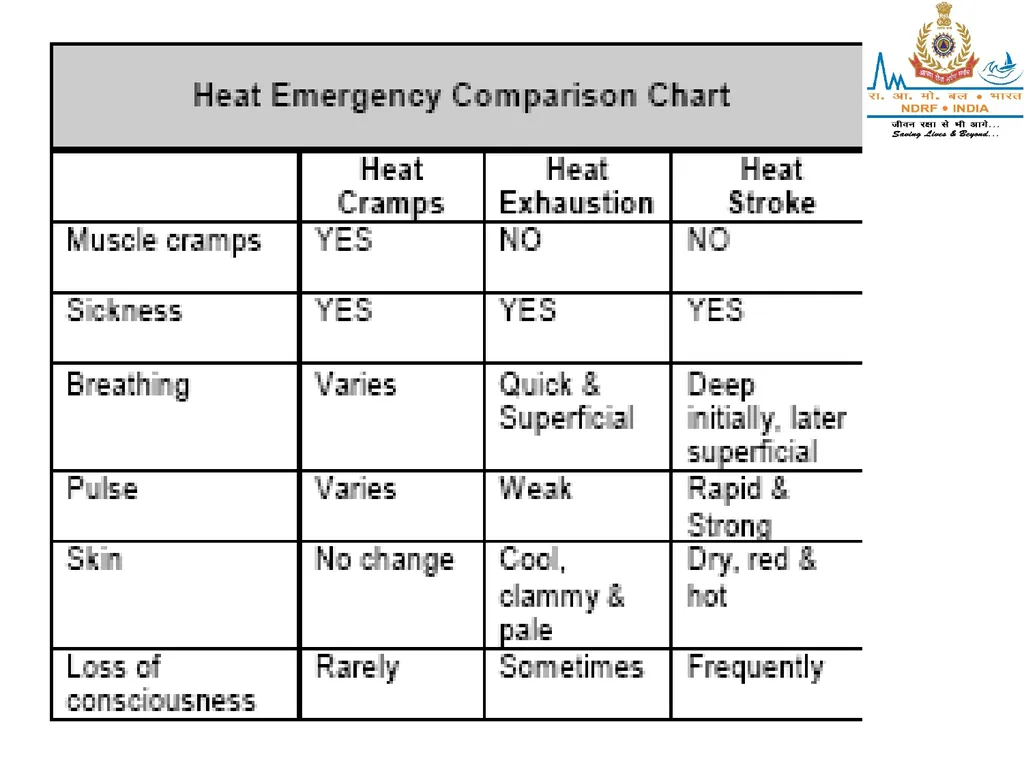
List the differentiating features between three heat emergencies.
Explain dehydration and list the causes.
Enumerate the signs and symptoms of dehydration and explain its management. Cont…<br>
03
ENVIRONMENTAL EMERGENCIES Exposure to excessive heat can produce serious health conditions especially in patients not acclimatized to heat<br>
1) HEAT CRAMPS Heat cramps consist of pain and muscle spasms that occur when the body loses a large quantity of salt through excessive sweating.
The core temperature of the body is not altered<br>
06
SIGNS AND SYMPTOMS OF HEAT CRAMPS Severe muscle cramps.
Exhaustion.
Nausea and vomiting.
Periods of fainting.<br>
07
MANAGEMENT FOR HEAT CRAMPS Move the patient to a cool area.
Give the patient water. The patient needs the water more than the salt, Do not delay giving water to look for salt.
Commercial electrolytes or oral rehydration solution (ORS) are the best if patient is conscious; if unconscious do not give anything by mouth; start IV DNS or NS and evacuate the patient.<br>
08
2) HEAT EXHAUSTION Heat exhaustion can occur when a person in poor physical condition exerts himself or herself during physical activity in a very hot environment, causing blood flow to be affected.
The body core temperature rises between 37 to 40° C<br>
09
SIGNS AND SYMPTOMS OF HEAT EXHAUSTION Rapid, shallow breathing.
Weak pulse.
Cold, clammy, pale skin and mucous membranes, with a lot of sweating.
Weakness.
Dizziness, sometimes leading to fainting.<br>
10
MANAGEMENT FOR HEAT EXHAUSTION Move the patient to a cool place to rest.
Remove or loosen clothing as necessary to cool the patient without causing chills.
Place the patient in a supine position with
legs elevated 20 to 30 cm.
Administer oxygen high flow.
Give water if conscious.
If unconscious do not give anything by mouth; start IV DNS or NS and evacuate the patient.<br>
11
3) HEAT STROKE Heat stroke is a very serious life-threatening condition. The body becomes overheated and, in many cases, the patient stops sweating. If left untreated, brain cells will begin to die.
The core temperature of the body will be more than 40° C<br>
12
SIGNS AND SYMPTOMS OF HEAT STROKE Deep, rapid breathing.
Rapid strong pulse followed by rapid weak pulse.
Dry, hot skin, sometimes red.
Dilated pupils.
Possible loss of consciousness
Convulsions or muscular tremors. Cont…<br>
13
MANAGEMENT FOR HEAT STROKE Cool the patient quickly in any way possible. Move the patient far fm the source of heat. Remove his garments and wrap the patient with wet sheets. Pour cold water on the sheets. This should normalize the patient’s core temperature and help prevent brain cells from dying.<br>
14
MANAGEMENT FOR HEAT STROKE Place cold bags or ice packs below each armpit , behind the knees and around the ankles, and one on each side of the neck.
Look for a large container or bathtub and submerge the patient in cold water up to the neck. Use ice to cool the water.<br>
15
DEHYDRATION Adult human body consists of 55-60% of body wt as water and it is distributed in various compartments like intracellular (70%), Extracellular (30% approx. 12 L). Of this extracellular water 75% is interstitial and 25% intravascular.
Water enter and leaves the body through the gastrointestinal tract and and is loss through the lungs, the skin and the kidneys<br>
16
DEHYDRATION Dehydration is a state where the body’s extra cellular fluid is lost with or without electrolyte loss.
Causes of ECF Depletion:
From GIT-
Vomiting
Diarrhea
Fistula
Intestinal obstruction<br>
17
DEHYDRATION From Kidneys:-
Diabetes Mellitus
Renal Diseases
Drugs like diuretics
From Skin:-
Sweating in hot environment, fever etc
From Kidneys:-
Burns
Ascites
Peritonitis
Acute Pancreatitis<br>
18
SIGNS AND SYMPTOMS Excessive thirst.
Concentrated urine & later reduced urine output.
Dizziness or fainting.
Weakness.
Hypotension especially postural hypotension
Loss of skin turgor. Cont…<br>
19
SIGNS AND SYMPTOMS Rapid pulse rate.
Shallow rapid breathing.
Confusion, stupor.
Systolic BP <100 mmHg
Cold extremities and poor capillary return. Cont…<br>
20
MANAGEMENT FOR DEHYDRATION In conditions where loss is expected as in diarrhea, working in hot environment, prophylactic measures with plenty of oral fluids is advised.
If patient is conscious and alert, oral rehydration solution should be given and continued till loss is controlled.<br>
21
MANAGEMENT FOR DEHYDRATION In moderate and severe dehydration and patients with altered mental status, IV fluid should be started preferably 0.9% NS and shift patient to hospital care for further evaluation.
Treatment of the underlying cause of dehydration.<br>
22
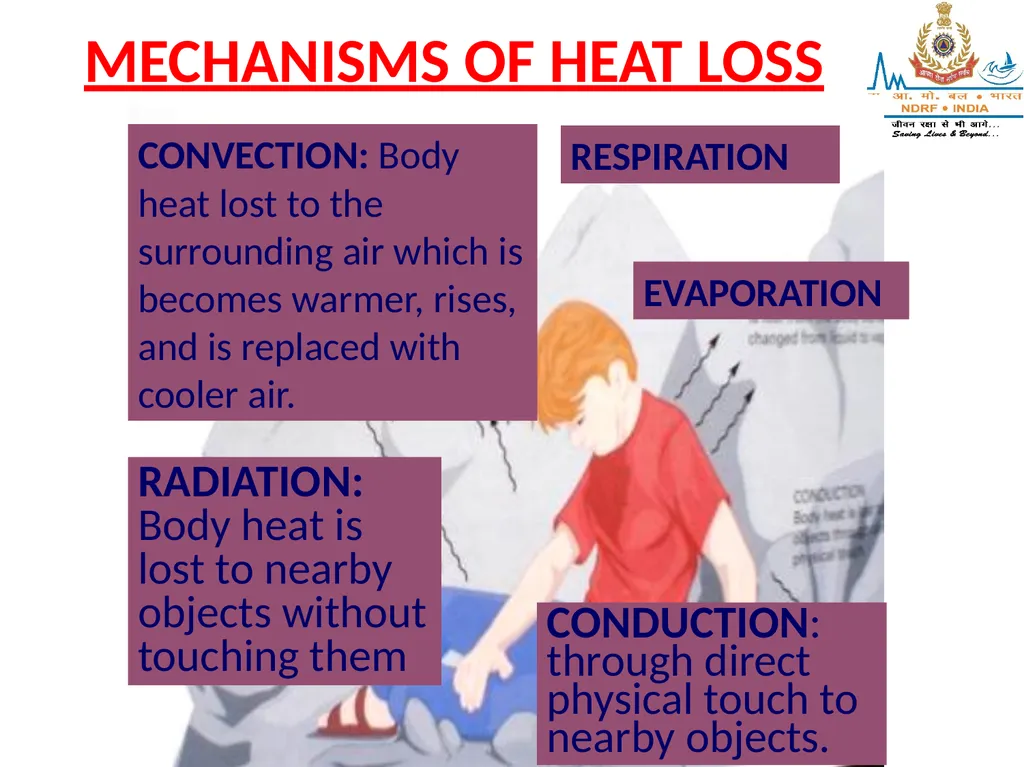
CONVECTION: Body heat lost to the surrounding air which is becomes warmer, rises, and is replaced with cooler air. RADIATION: Body heat is lost to nearby objects without touching them RESPIRATION EVAPORATION CONDUCTION: through direct physical touch to nearby objects. MECHANISMS OF HEAT LOSS<br>