Restraints Restraints Who Can be Restrained? Patients that may be at risk for harming themselves or others. For example, patients may be pulling at or compromising important tubes, lines, and other treatments. The patients is being
"Restraints Restraints Who Can be Restrained?" is the property of its rightful owner. Permission is granted to
download and print the materials on this website for personal, non-commercial use only, and to display it
on your personal computer provided you do not modify the materials and that you retain all copyright
notices contained in the materials. By downloading content from our website, you accept the terms of this
agreement.
Presentation Transcript
01
Restraints<br>
02
Restraints Who Can be Restrained?
Patients that may be at risk for harming themselves or others.
For example, patients may be pulling at or compromising important tubes, lines, and other treatments.
The patients is being combative with staff. Why would we need to restrain a patient?
To ensure the physical safety of the patient, a staff member, or others.
To promote healing and prevent harm.<br>
03
restraints When should a patient be restrained?
The use of restraint/seclusion is a last resort, after alternative interventions have either been considered or attempted.
Re-orientation
De-escalation
Increased observation and monitoring
Use of a sitter
Review and modification of medication regimens
Repositioning, Use of cushions/pads
Exercise
Verbal interventions
Bed alarm system
The patient is reassessed often so that we can discontinue the restraints as soon as possible, as this is our goal.<br>
04
Restraints What kind of restraints do we normally use?
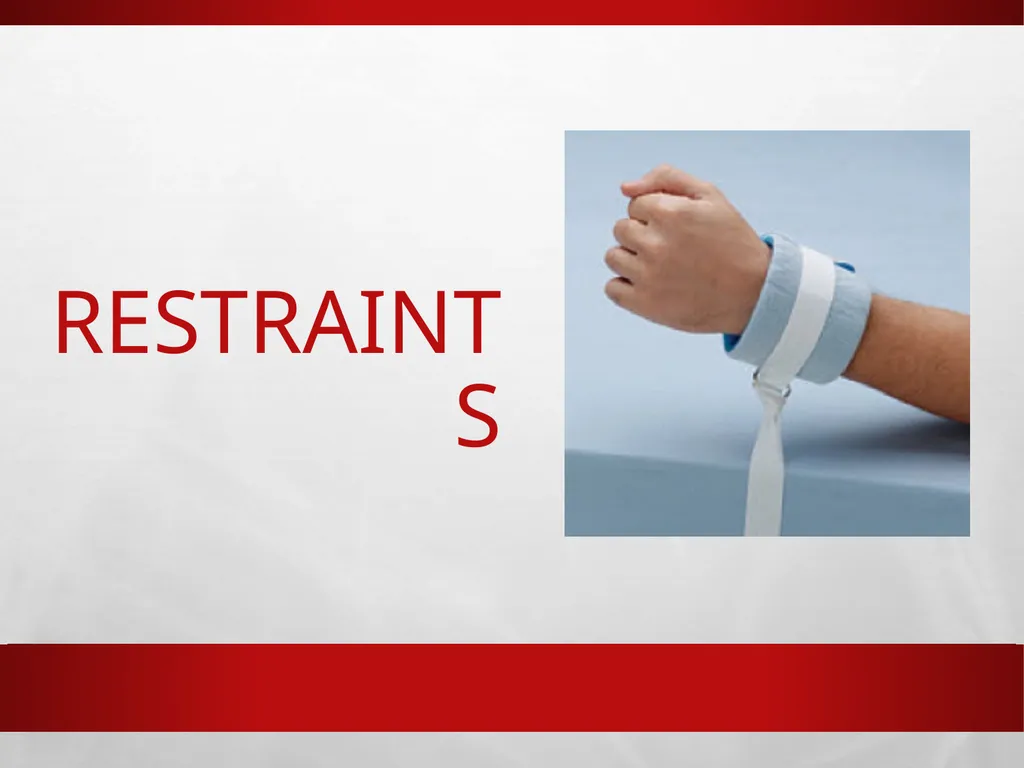
Soft fabric wrist/ankle restraints
vest restraints
What is not considered a restraint?
if a patient can easily remove a device, the device would not be considered a restraint.
A restraint does not include devices such as:
orthopedic prescribed devices
surgical dressings
Bandages
protective helmets
methods that involve the physical holding of a patient for the purpose of conducting routine physical examinations or tests<br>
05
Restraints How can you help a patient that is restrained and may be in distress?
If you enter a patient room, and you notice the patient "does not look right”, and the restraint may have the potential to harm the patient (Change in skin color, temperature, sensation, appearance)
1. Immediately release the restraint
2. Call for help
3. Try to calm the patient if possible<br>
06
Ordering requirements for restraints or seclusion This policy requires that a physician or other licensed independent practitioner (LIP) responsible for the care of the patient order restraint or seclusion prior to the application of restraint or seclusion.
In an emergent situation, the Nurse can apply the restraint, but the order must be obtained either during the emergency application of the restraint or seclusion or immediately afterwards (within a few minutes).
If restraint or seclusion is discontinued prior to the expiration of the original order, a new order must be obtained prior to reinitiating the use of restraint or seclusion.
Restraints are never to be used as a standing order or as a needed basis.<br>
07
Continued Violent restraints
initial orders are valid for the following time frame (provider face to face within 1hr):
18 and up- 4 hours
9-17 years old- 2 hours
Under 9- 1 hour
Violent renewal orders can be placed up to 24 hours.
If the violent episode will continue after 24 hours, a NEW order and a provider face to face must be done within 1 hour.
Non-violent restraints
The initial order is valid for 72 hours
If the patient remains in restraint for more than 72 hours, then a renewal order must be obtained.
Renewal order is valid for 72 hours<br>
08
Further Requirements for ordering restraints AND DOCUMENTATION- see Policy-MCH-2053<br>