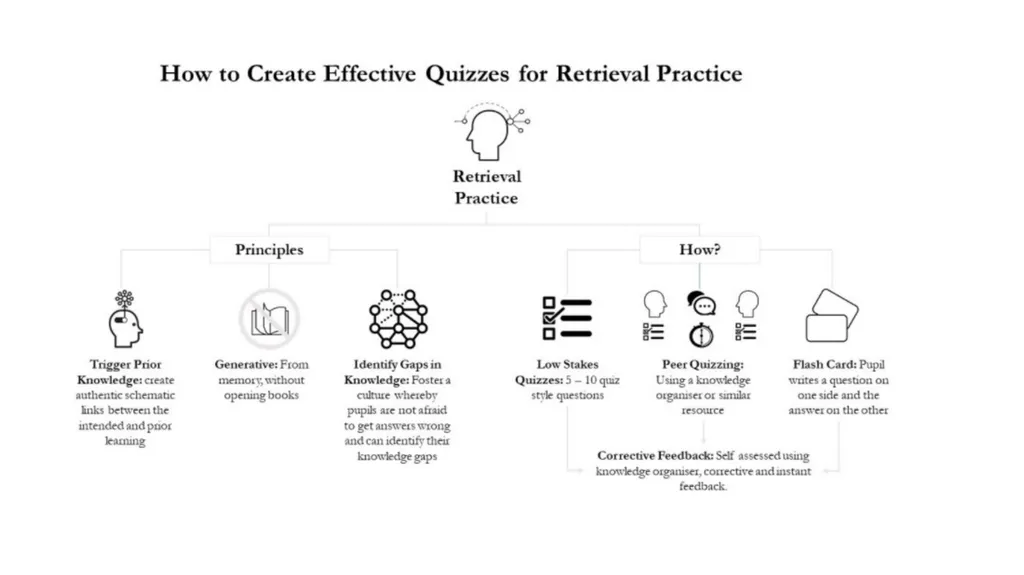
Retrieval Session Two Aims: to explore effective implementation of retrieval in the classroom Retrieval Quiz! What is the testing effect? What does Ebbinghaus forgetting curve tell us about newly-learned information? What is spacing and
"Retrieval Session Two Aims: to explore effective" is the property of its rightful owner. Permission is granted to
download and print the materials on this website for personal, non-commercial use only, and to display it
on your personal computer provided you do not modify the materials and that you retain all copyright
notices contained in the materials. By downloading content from our website, you accept the terms of this
agreement.
Presentation Transcript
01
Retrieval Session Two Aims: to explore effective implementation of retrieval in the classroom<br>
02
Retrieval Quiz! What is ‘the testing effect’?
What does Ebbinghaus’ forgetting curve tell us about newly-learned information?
What is spacing and why is it important?
What is schema and what does it show us about memory?<br>
03
Retrieval Quiz! ‘The testing effect’ is a phenomenon that states taking a test on studied material promotes remembering that material on a final test.
The Ebbinghaus forgetting curve shows how learning is forgotten over time if not revisiting after a gap (spacing effect).
Spacing is revisiting learning after a gap (just before it is forgotten) in order to prevent forgetting.
Schema is how we make sense of new information: by connecting it to existing knowledge. It shows how making links between different learning and ideas helps strengthen memory.<br>
04
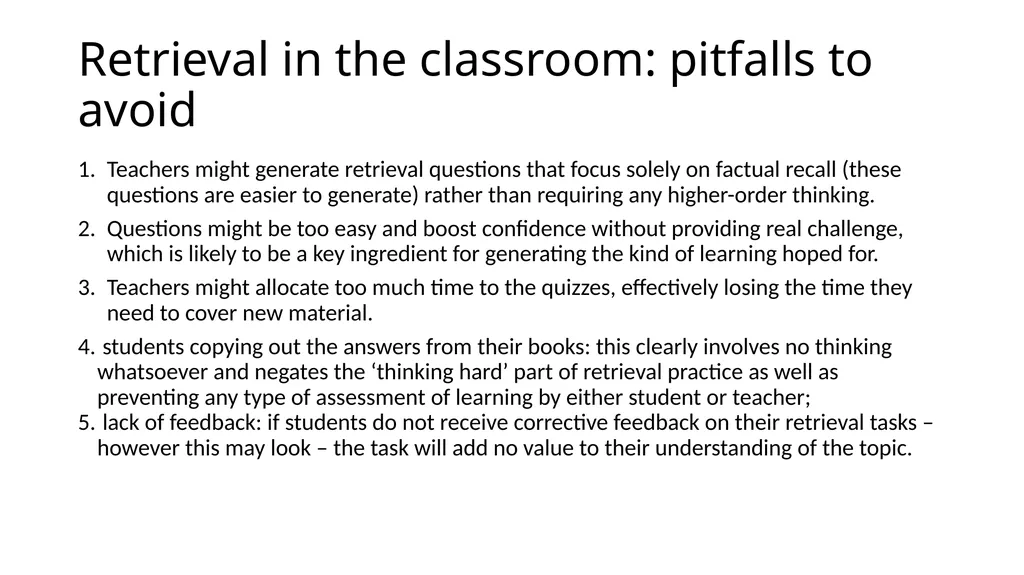
Retrieval in the classroom: pitfalls to avoid Teachers might generate retrieval questions that focus solely on factual recall (these questions are easier to generate) rather than requiring any higher-order thinking.
Questions might be too easy and boost confidence without providing real challenge, which is likely to be a key ingredient for generating the kind of learning hoped for.
Teachers might allocate too much time to the quizzes, effectively losing the time they need to cover new material.
students copying out the answers from their books: this clearly involves no thinking whatsoever and negates the ‘thinking hard’ part of retrieval practice as well as preventing any type of assessment of learning by either student or teacher;
lack of feedback: if students do not receive corrective feedback on their retrieval tasks – however this may look – the task will add no value to their understanding of the topic.<br>
05
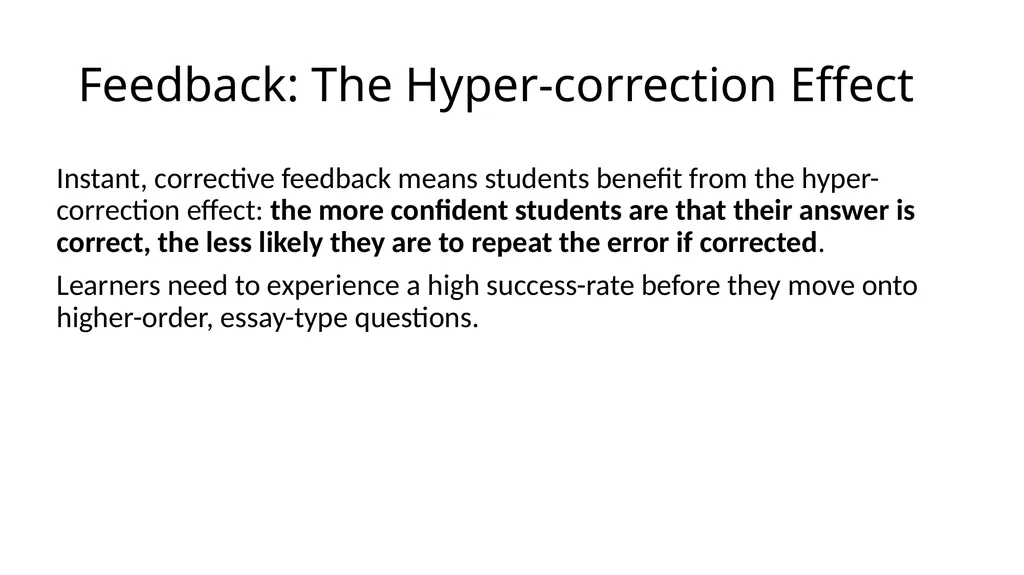
Feedback: The Hyper-correction Effect Instant, corrective feedback means students benefit from the hyper-correction effect: the more confident students are that their answer is correct, the less likely they are to repeat the error if corrected.
Learners need to experience a high success-rate before they move onto higher-order, essay-type questions.<br>
06
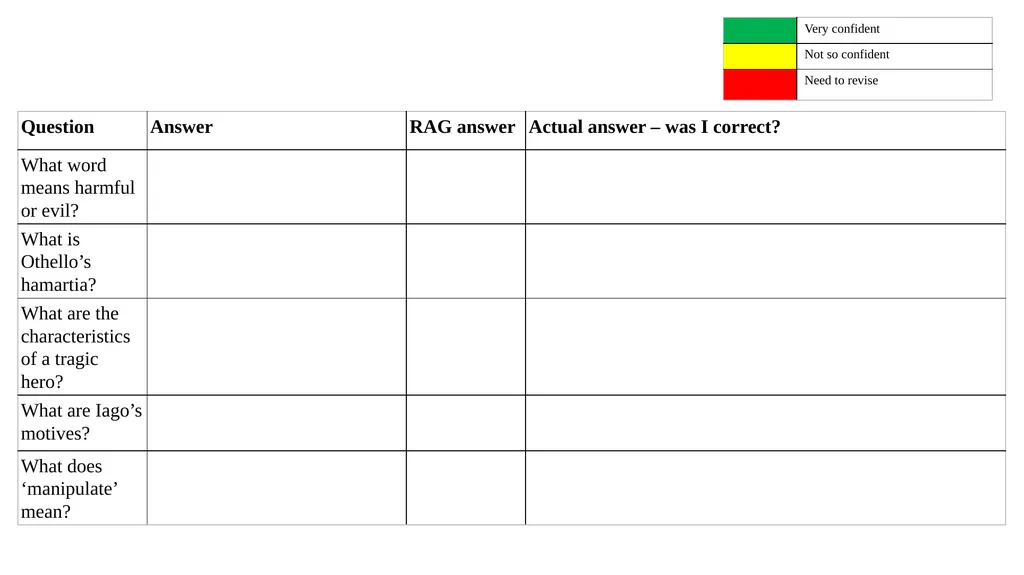
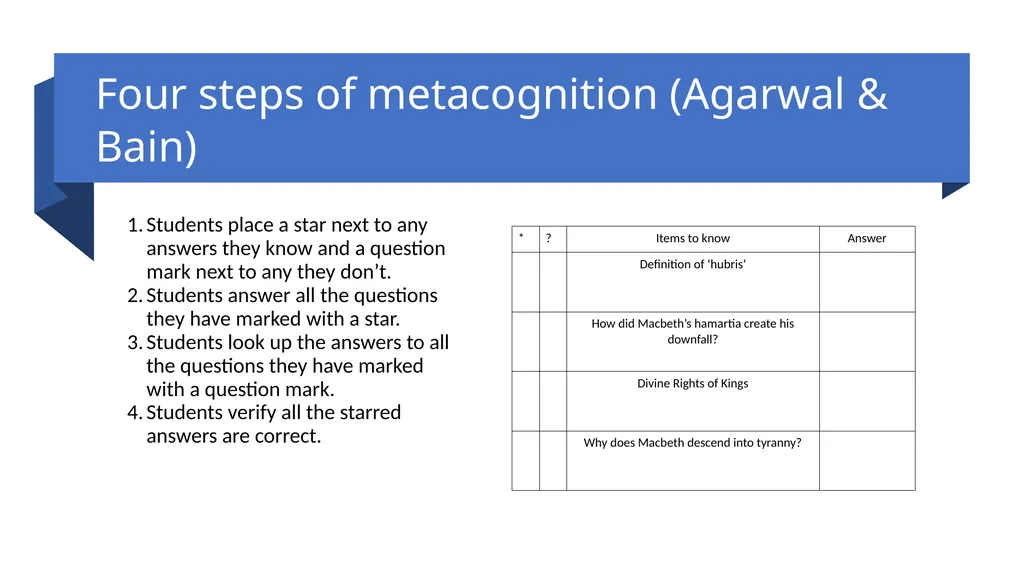
Four steps of metacognition (Agarwal & Bain) Students place a star next to any answers they know and a question mark next to any they don’t.
Students answer all the questions they have marked with a star.
Students look up the answers to all the questions they have marked with a question mark.
Students verify all the starred answers are correct.<br>
07
Varying Conditions of Retrieval Practice practise explaining something verbally in pairs
Use their knowledge to demonstrate why a particular argument/thesis statement is true
close books and engage in a discussion using the vocabulary they’ve learned
produce a timeline or essay plan exploring how a character in a novel develops as the story progresses
engage in a paired questioning exchange, devising and exchanging questions and answers<br>
08
Adding Challenge in Retrieval Practice Spacing – the longer the gap between initial teaching and retrieving, the harder the information will be to retrieve.
Extended questioning – it’s important that in feedback, teachers ask ‘why’ and ‘how’ questions to extend students’ thinking to higher-order ideas.
Mixed Retrieval Quizzes – quizzes that build from factual recall to more challenging ‘how’ and ‘why’ questions that reflect the high-order processing they will need to use in an essay/exam
Linking – getting students to draw similarities and differences with other schemes/texts/characters/themes will add challenge and aid memory through schema-building.<br>
09
Planning Retrieval for your Subject Area In departments, use the retrieval strategies document to plan some retrieval for a year 7 scheme of work that gradually reduces scaffold or cues to work towards mastery and automaticity.
Questions to consider:
How will you build factual recall?
How will you incorporate spacing?
How will you incorporate the hyper-correction effect?
How will you ensure there is immediate corrective feedback?<br>