
Revising the Standard Occupational Classification:
KL
Published · 40 slides · 0 views
1 / 1

Description
Revising the Standard Occupational Classification: How You Can Help U.S. Department of Health and Human Services Health Resources and Services Administration Bureau of Health Professions National Center for Health Workforce Analysis
Related Topics
Share
Embed code
Download this presentation From Below
"Revising the Standard Occupational Classification:" is the property of its rightful owner. Permission is granted to download and print the materials on this website for personal, non-commercial use only, and to display it on your personal computer provided you do not modify the materials and that you retain all copyright notices contained in the materials. By downloading content from our website, you accept the terms of this agreement.
Presentation Transcript
01
Revising the Standard Occupational Classification:
How You Can Help U.S. Department of Health and Human Services
Health Resources and Services Administration
Bureau of Health Professions
National Center for Health Workforce Analysis
NOVEMBER 12th, 2013 Edward Salsberg, MPA Michelle M. Washko, PhD<br>
Health Resources and Services Administration
Bureau of Health Professions
National Center for Health Workforce Analysis
NOVEMBER 12th, 2013 Edward Salsberg, MPA Michelle M. Washko, PhD<br>
02
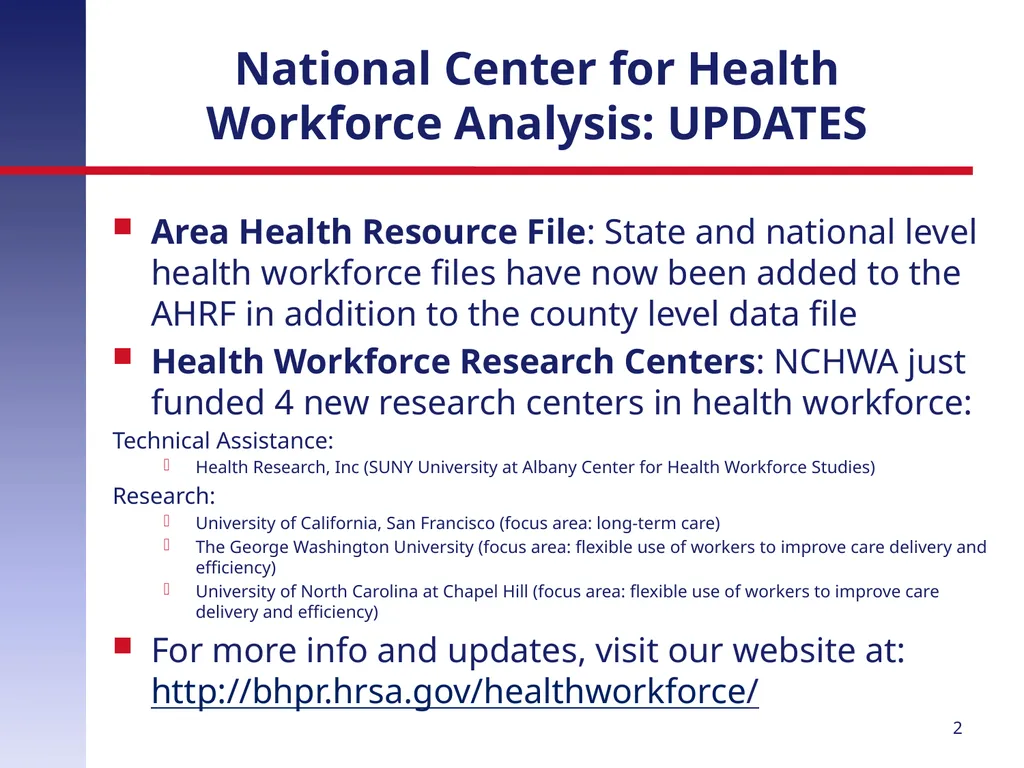
National Center for Health Workforce Analysis: UPDATES 2 Area Health Resource File: State and national level health workforce files have now been added to the AHRF in addition to the county level data file
Health Workforce Research Centers: NCHWA just funded 4 new research centers in health workforce:
Technical Assistance:
Health Research, Inc (SUNY University at Albany Center for Health Workforce Studies)
Research:
University of California, San Francisco (focus area: long-term care)
The George Washington University (focus area: flexible use of workers to improve care delivery and efficiency)
University of North Carolina at Chapel Hill (focus area: flexible use of workers to improve care delivery and efficiency)
For more info and updates, visit our website at: http://bhpr.hrsa.gov/healthworkforce/<br>
Health Workforce Research Centers: NCHWA just funded 4 new research centers in health workforce:
Technical Assistance:
Health Research, Inc (SUNY University at Albany Center for Health Workforce Studies)
Research:
University of California, San Francisco (focus area: long-term care)
The George Washington University (focus area: flexible use of workers to improve care delivery and efficiency)
University of North Carolina at Chapel Hill (focus area: flexible use of workers to improve care delivery and efficiency)
For more info and updates, visit our website at: http://bhpr.hrsa.gov/healthworkforce/<br>
03
Overview of Presentation Description of the Standard Occupational Classification
Standard Occupational Classification Revision 3<br>
Standard Occupational Classification Revision 3<br>
04
Description of the Standard Occupational Classification 4<br>
05
Standard Occupational Classification (SOC) Many uses for occupational information
Estimating supply and demand
Decisions on education and training
Job search and placement assistance
Employer decisions on compensation, training, business location 5<br>
Estimating supply and demand
Decisions on education and training
Job search and placement assistance
Employer decisions on compensation, training, business location 5<br>
06
Standard Occupational Classification (SOC) Classification is critical to providing information about occupations for these uses:
How are occupations defined?
How is occupational information organized and presented?
Standard Occupational Classification (SOC) answers these questions for Federal statistics 6<br>
How are occupations defined?
How is occupational information organized and presented?
Standard Occupational Classification (SOC) answers these questions for Federal statistics 6<br>
07
Why the SOC? Before the SOC – chaos!
Federal statistical agencies produced data using different occupational categories
Data did not fit together
With the SOC – comparability!
Data from different statistical agencies fit together
Data can be used to tell a more complete story 7<br>
Federal statistical agencies produced data using different occupational categories
Data did not fit together
With the SOC – comparability!
Data from different statistical agencies fit together
Data can be used to tell a more complete story 7<br>
08
Revising the SOC:
How You Can Help First
What is the SOC
Who is responsible for the SOC
How the SOC is structured
Then
History of SOC revisions
The SOC revision process
General timeframes 8<br>
What is the SOC
Who is responsible for the SOC
How the SOC is structured
Then
History of SOC revisions
The SOC revision process
General timeframes 8<br>
09
Revising the SOC:
How You Can Help Finally
How you can provide input
What information we need from you
How to stay connected 9<br>
How you can provide input
What information we need from you
How to stay connected 9<br>
10
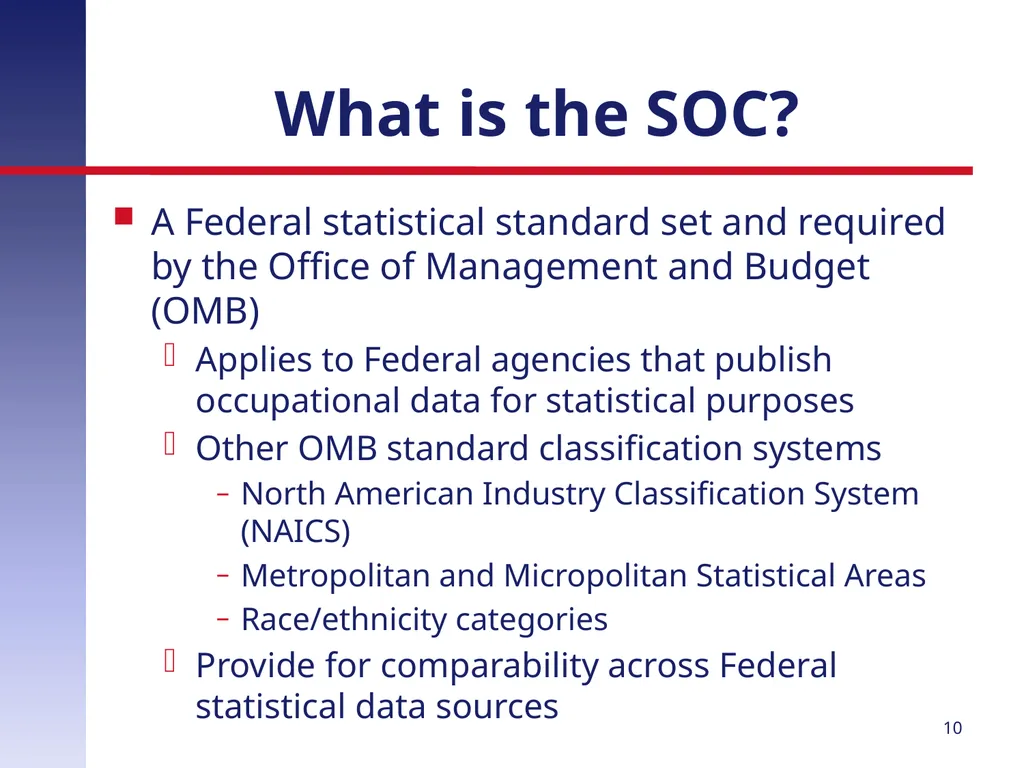
What is the SOC? A Federal statistical standard set and required by the Office of Management and Budget (OMB)
Applies to Federal agencies that publish occupational data for statistical purposes
Other OMB standard classification systems
North American Industry Classification System (NAICS)
Metropolitan and Micropolitan Statistical Areas
Race/ethnicity categories
Provide for comparability across Federal statistical data sources 10<br>
Applies to Federal agencies that publish occupational data for statistical purposes
Other OMB standard classification systems
North American Industry Classification System (NAICS)
Metropolitan and Micropolitan Statistical Areas
Race/ethnicity categories
Provide for comparability across Federal statistical data sources 10<br>
11
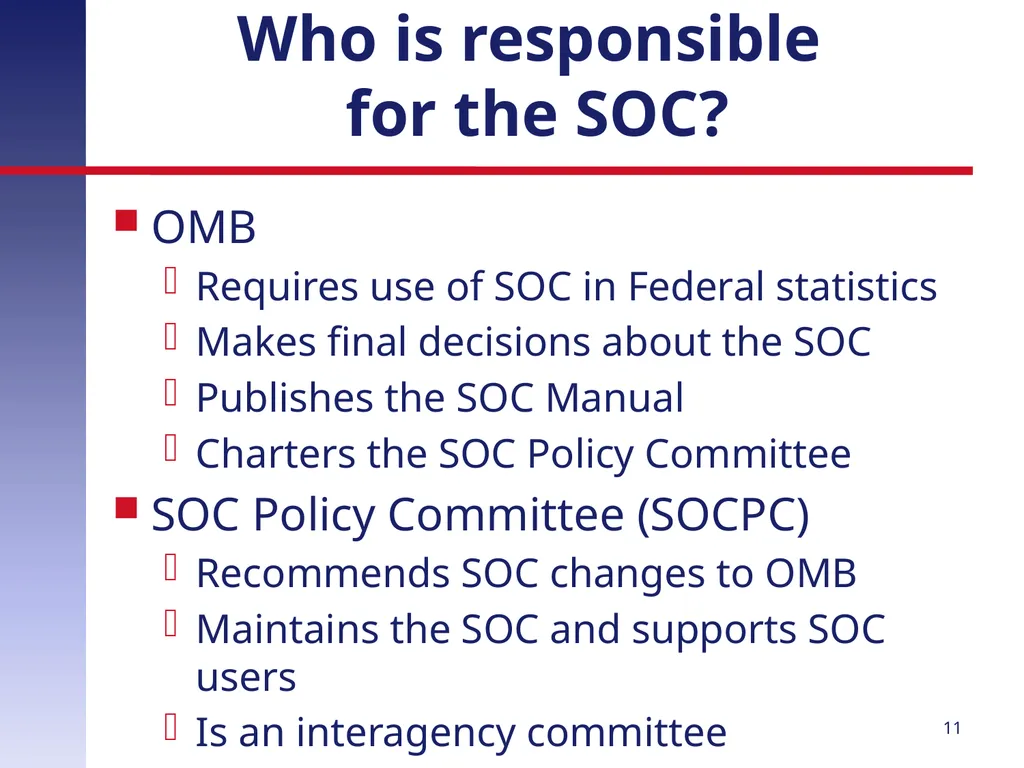
Who is responsible
for the SOC? OMB
Requires use of SOC in Federal statistics
Makes final decisions about the SOC
Publishes the SOC Manual
Charters the SOC Policy Committee
SOC Policy Committee (SOCPC)
Recommends SOC changes to OMB
Maintains the SOC and supports SOC users
Is an interagency committee 11<br>
Requires use of SOC in Federal statistics
Makes final decisions about the SOC
Publishes the SOC Manual
Charters the SOC Policy Committee
SOC Policy Committee (SOCPC)
Recommends SOC changes to OMB
Maintains the SOC and supports SOC users
Is an interagency committee 11<br>
12
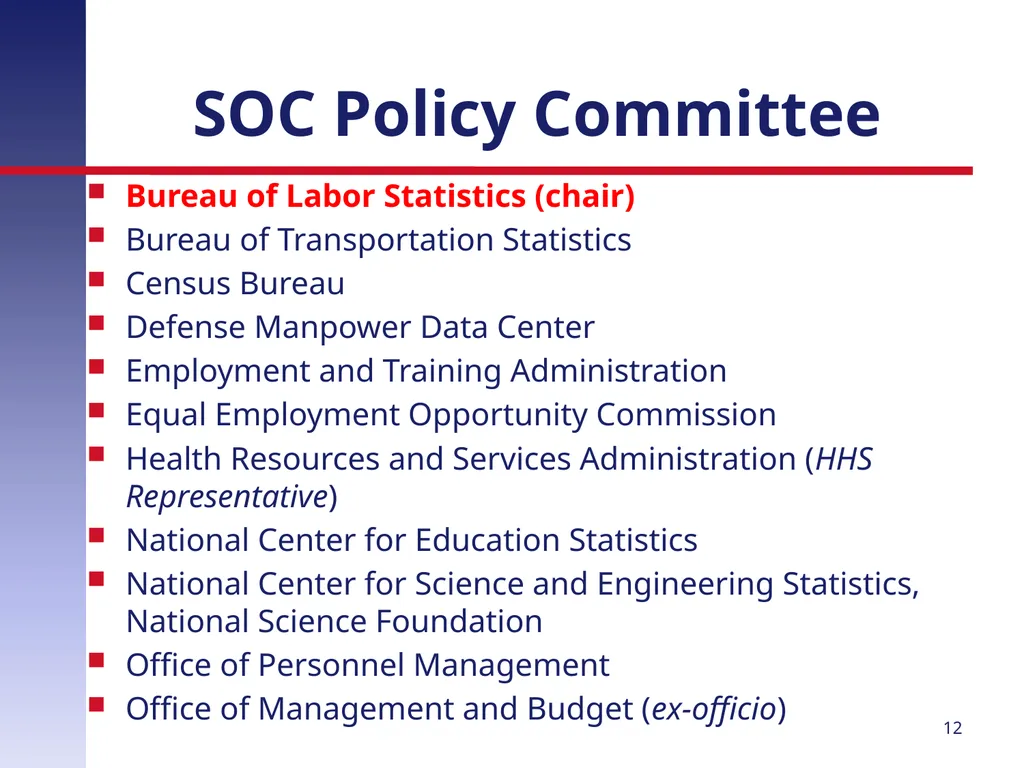
SOC Policy Committee Bureau of Labor Statistics (chair)
Bureau of Transportation Statistics
Census Bureau
Defense Manpower Data Center
Employment and Training Administration
Equal Employment Opportunity Commission
Health Resources and Services Administration (HHS Representative)
National Center for Education Statistics
National Center for Science and Engineering Statistics, National Science Foundation
Office of Personnel Management
Office of Management and Budget (ex-officio) 12<br>
Bureau of Transportation Statistics
Census Bureau
Defense Manpower Data Center
Employment and Training Administration
Equal Employment Opportunity Commission
Health Resources and Services Administration (HHS Representative)
National Center for Education Statistics
National Center for Science and Engineering Statistics, National Science Foundation
Office of Personnel Management
Office of Management and Budget (ex-officio) 12<br>
13
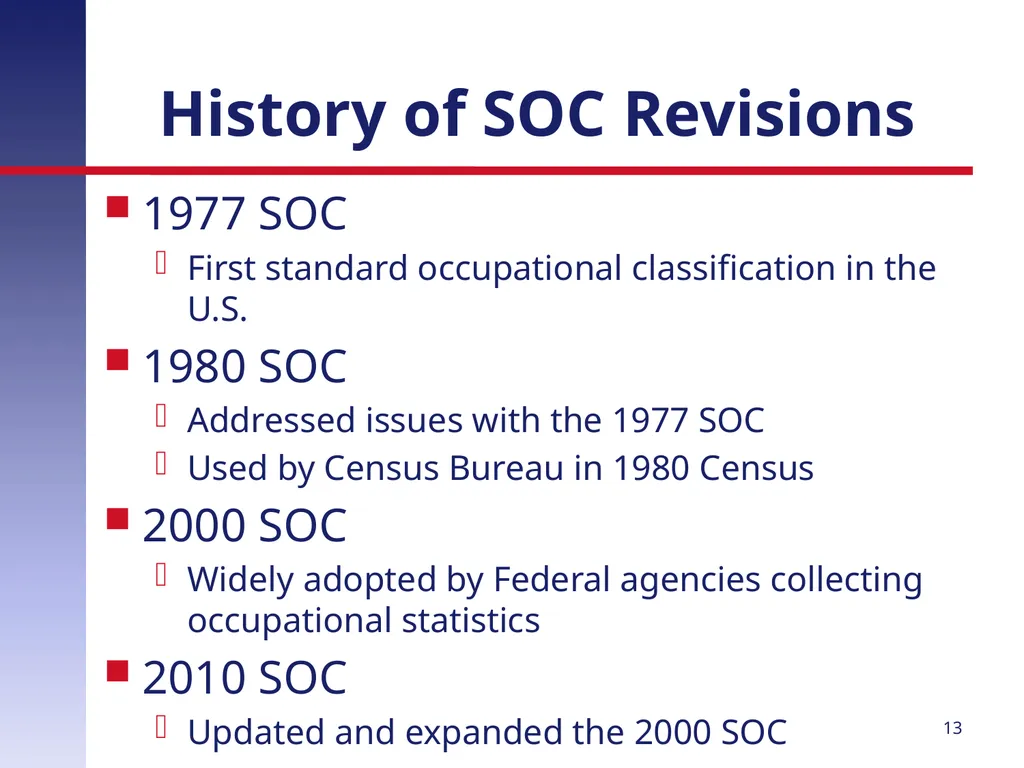
History of SOC Revisions 1977 SOC
First standard occupational classification in the U.S.
1980 SOC
Addressed issues with the 1977 SOC
Used by Census Bureau in 1980 Census
2000 SOC
Widely adopted by Federal agencies collecting occupational statistics
2010 SOC
Updated and expanded the 2000 SOC 13<br>
First standard occupational classification in the U.S.
1980 SOC
Addressed issues with the 1977 SOC
Used by Census Bureau in 1980 Census
2000 SOC
Widely adopted by Federal agencies collecting occupational statistics
2010 SOC
Updated and expanded the 2000 SOC 13<br>
14
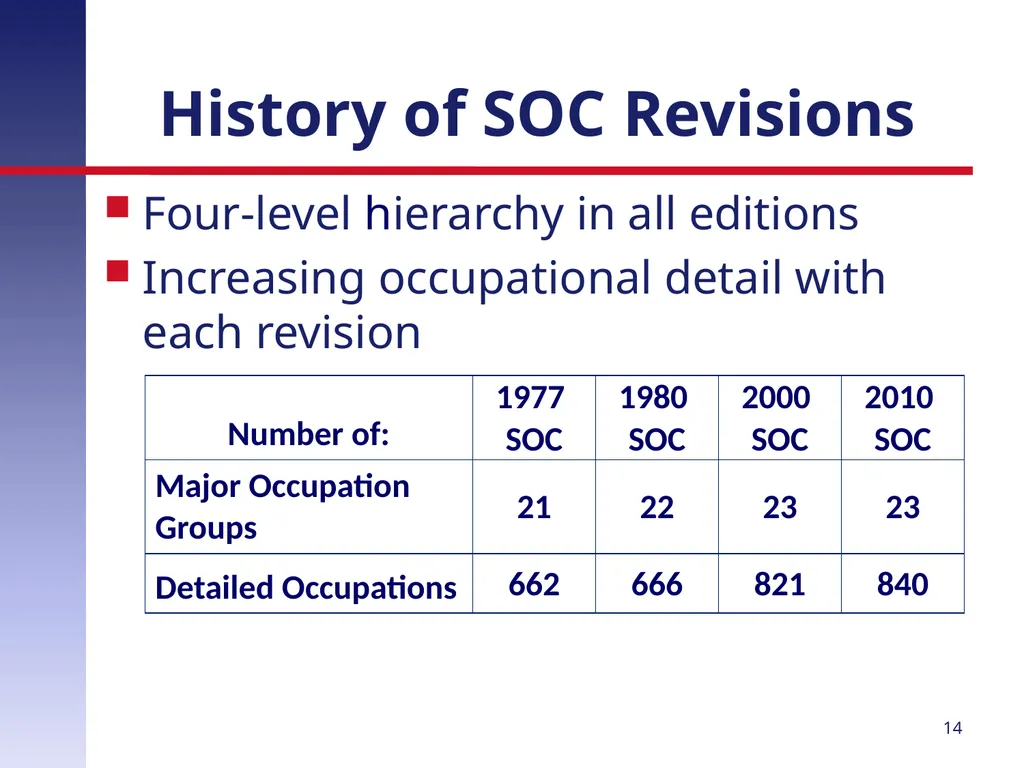
History of SOC Revisions Four-level hierarchy in all editions
Increasing occupational detail with each revision 14<br>
Increasing occupational detail with each revision 14<br>
15
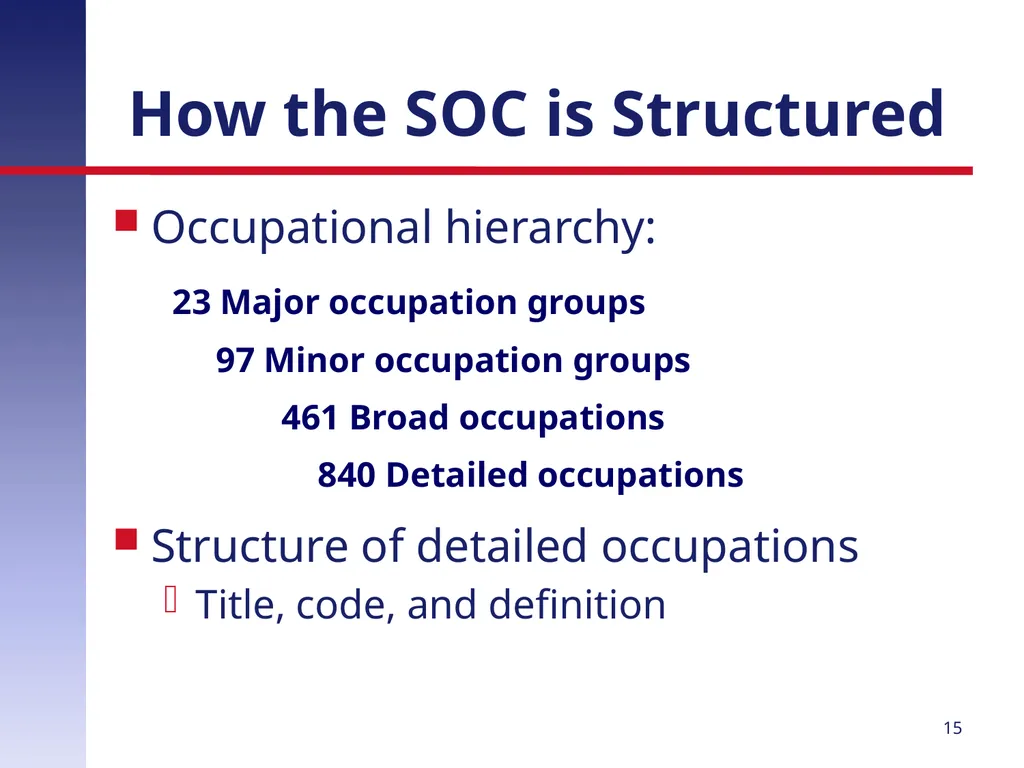
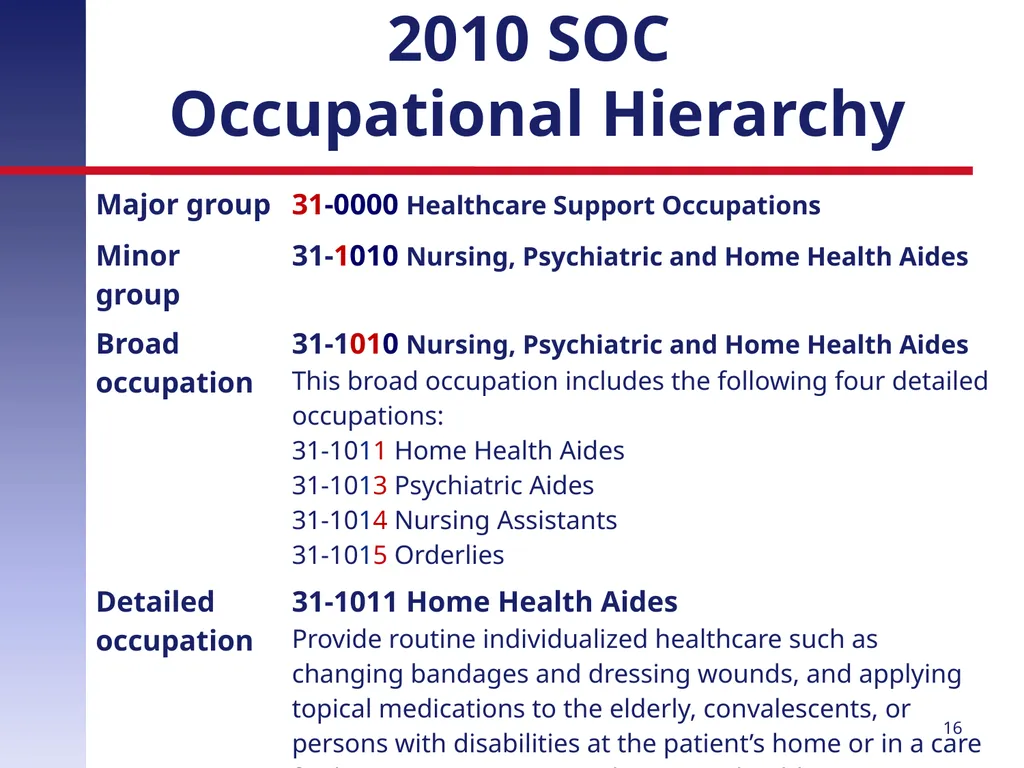
How the SOC is Structured Occupational hierarchy:
Structure of detailed occupations
Title, code, and definition 15<br>
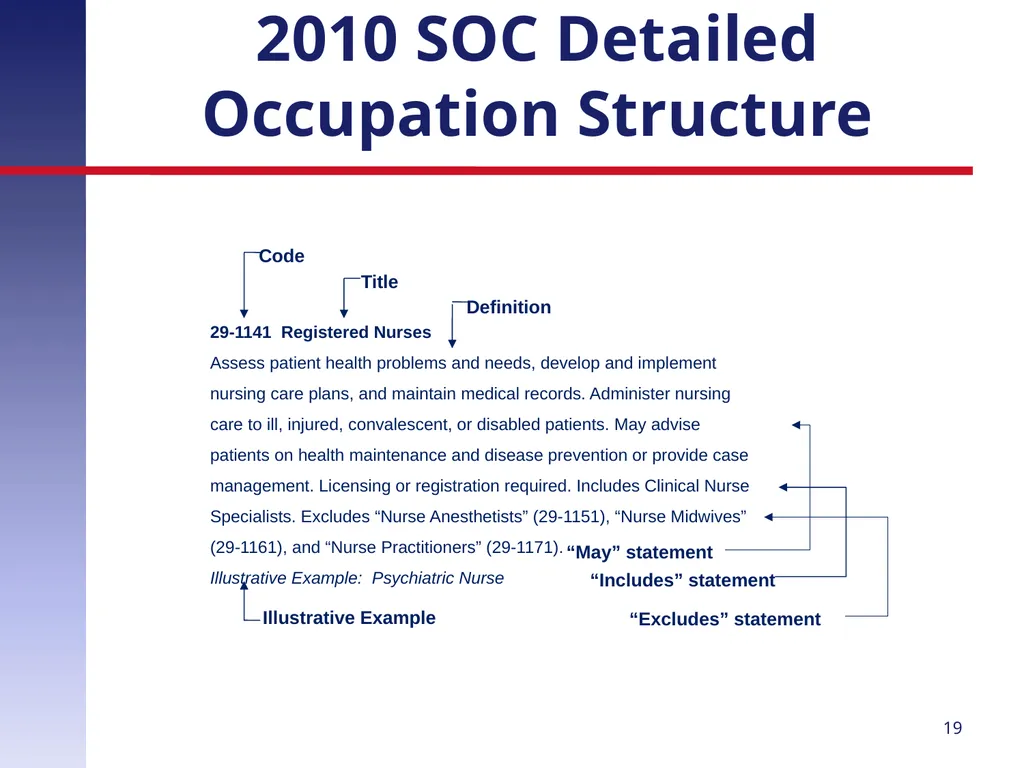
Structure of detailed occupations
Title, code, and definition 15<br>
16
2010 SOC
Occupational Hierarchy 16<br>
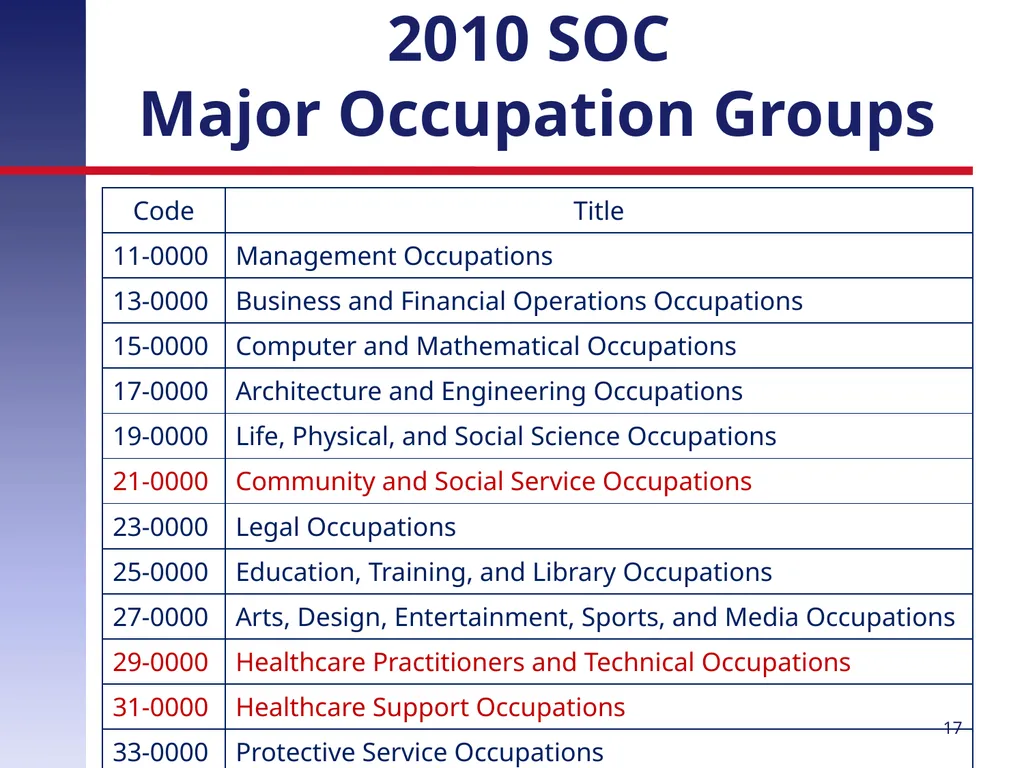
17
2010 SOC
Major Occupation Groups 17<br>
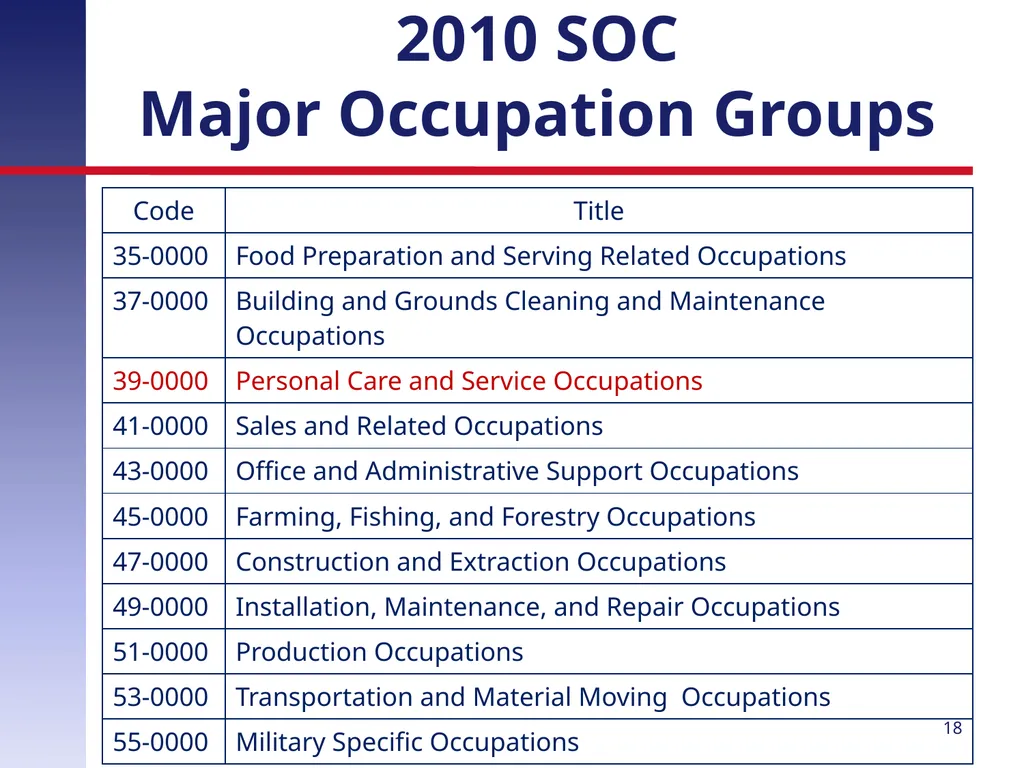
18
2010 SOC
Major Occupation Groups 18<br>
19
2010 SOC Detailed Occupation Structure 19<br>
20
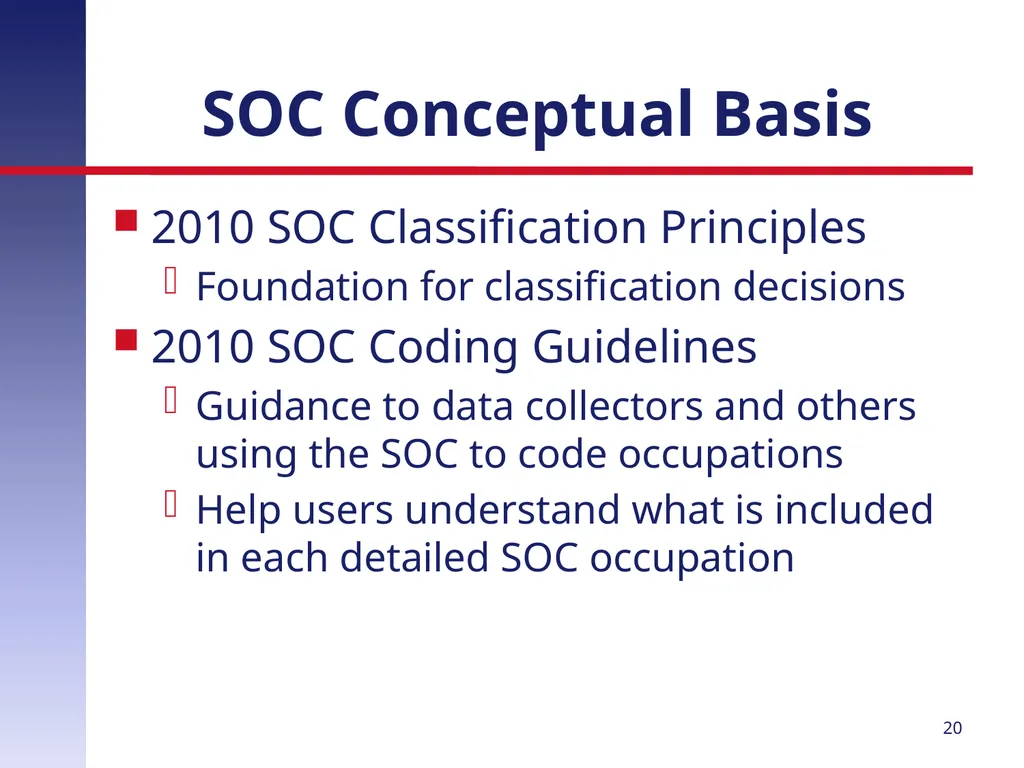
SOC Conceptual Basis 2010 SOC Classification Principles
Foundation for classification decisions
2010 SOC Coding Guidelines
Guidance to data collectors and others using the SOC to code occupations
Help users understand what is included in each detailed SOC occupation 20<br>
Foundation for classification decisions
2010 SOC Coding Guidelines
Guidance to data collectors and others using the SOC to code occupations
Help users understand what is included in each detailed SOC occupation 20<br>
21
2010 SOC
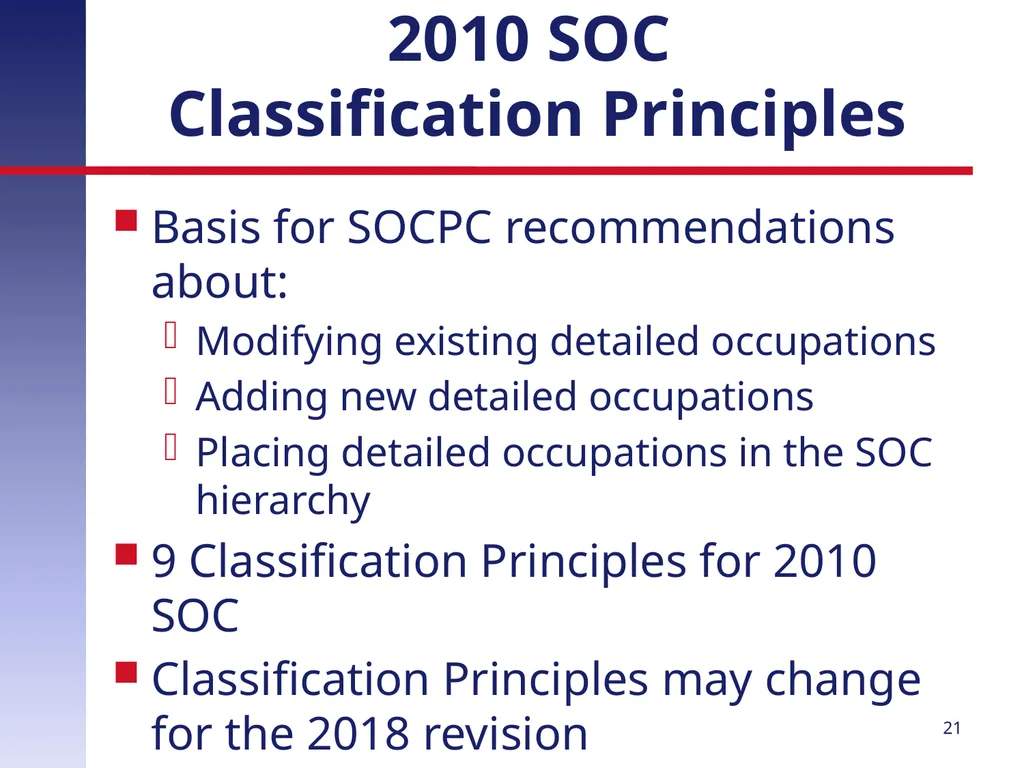
Classification Principles Basis for SOCPC recommendations about:
Modifying existing detailed occupations
Adding new detailed occupations
Placing detailed occupations in the SOC hierarchy
9 Classification Principles for 2010 SOC
Classification Principles may change for the 2018 revision 21<br>
Modifying existing detailed occupations
Adding new detailed occupations
Placing detailed occupations in the SOC hierarchy
9 Classification Principles for 2010 SOC
Classification Principles may change for the 2018 revision 21<br>
22
2010 SOC
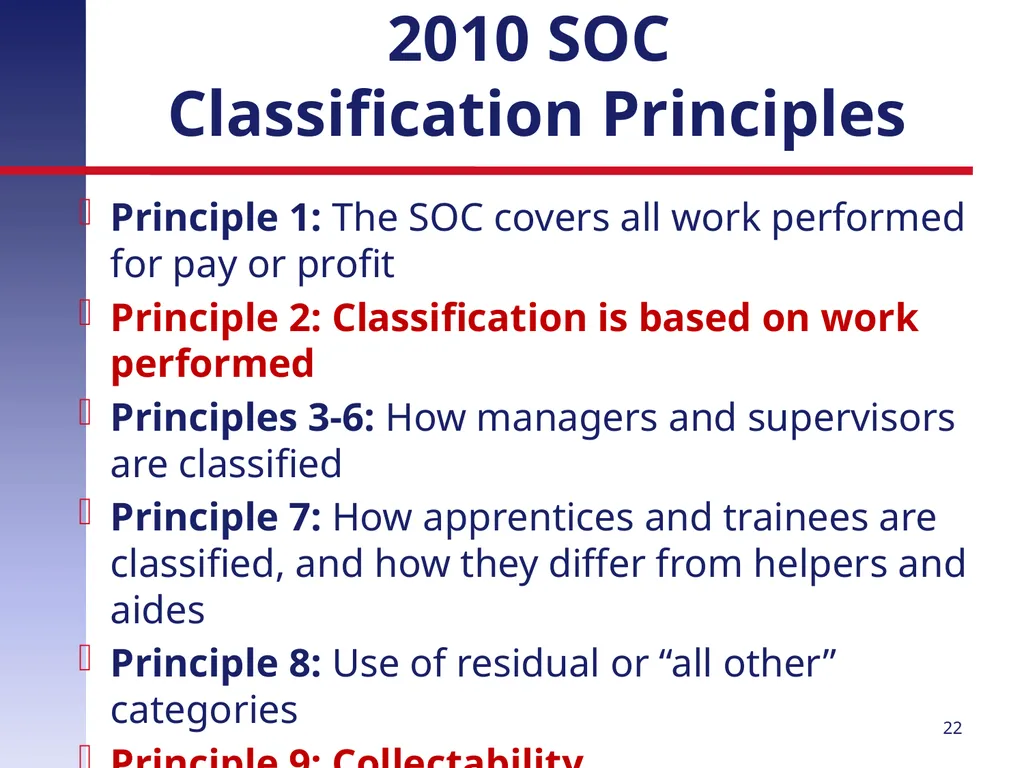
Classification Principles Principle 1: The SOC covers all work performed for pay or profit
Principle 2: Classification is based on work performed
Principles 3-6: How managers and supervisors are classified
Principle 7: How apprentices and trainees are classified, and how they differ from helpers and aides
Principle 8: Use of residual or “all other” categories
Principle 9: Collectability 22<br>
Principle 2: Classification is based on work performed
Principles 3-6: How managers and supervisors are classified
Principle 7: How apprentices and trainees are classified, and how they differ from helpers and aides
Principle 8: Use of residual or “all other” categories
Principle 9: Collectability 22<br>
23
2010 SOC
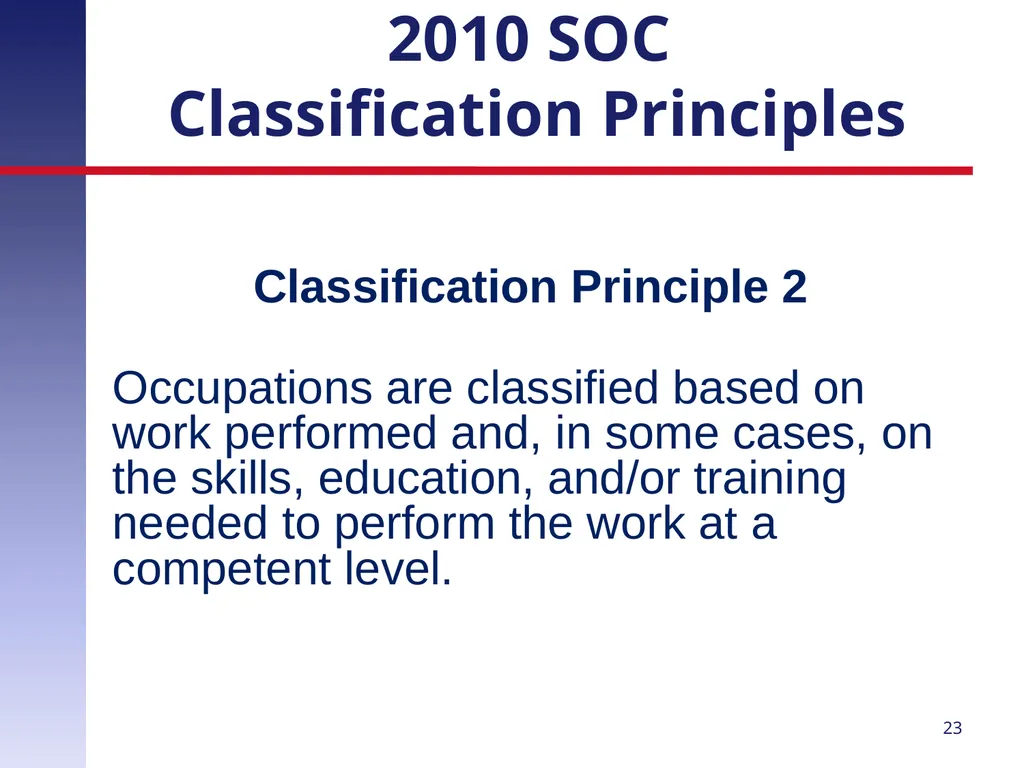
Classification Principles 23 Classification Principle 2
Occupations are classified based on work performed and, in some cases, on the skills, education, and/or training needed to perform the work at a competent level.<br>
Occupations are classified based on work performed and, in some cases, on the skills, education, and/or training needed to perform the work at a competent level.<br>
24
2010 SOC
Classification Principles 24 Classification Principle 9
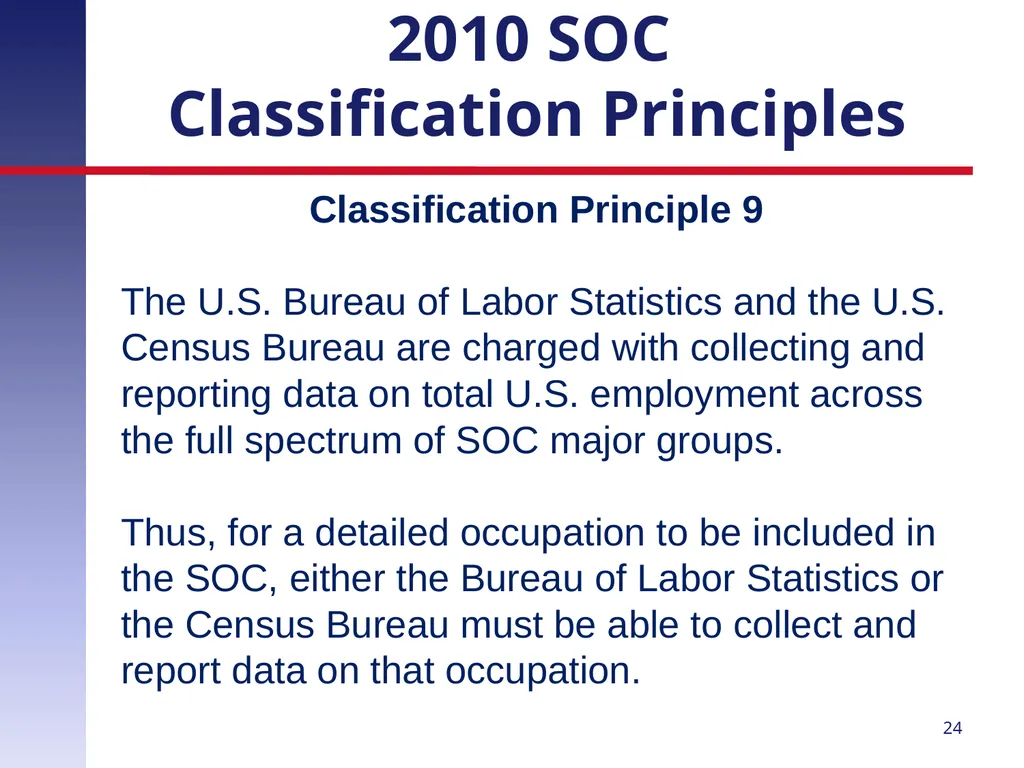
The U.S. Bureau of Labor Statistics and the U.S. Census Bureau are charged with collecting and reporting data on total U.S. employment across the full spectrum of SOC major groups.
Thus, for a detailed occupation to be included in the SOC, either the Bureau of Labor Statistics or the Census Bureau must be able to collect and report data on that occupation.<br>
The U.S. Bureau of Labor Statistics and the U.S. Census Bureau are charged with collecting and reporting data on total U.S. employment across the full spectrum of SOC major groups.
Thus, for a detailed occupation to be included in the SOC, either the Bureau of Labor Statistics or the Census Bureau must be able to collect and report data on that occupation.<br>
25
2010 SOC
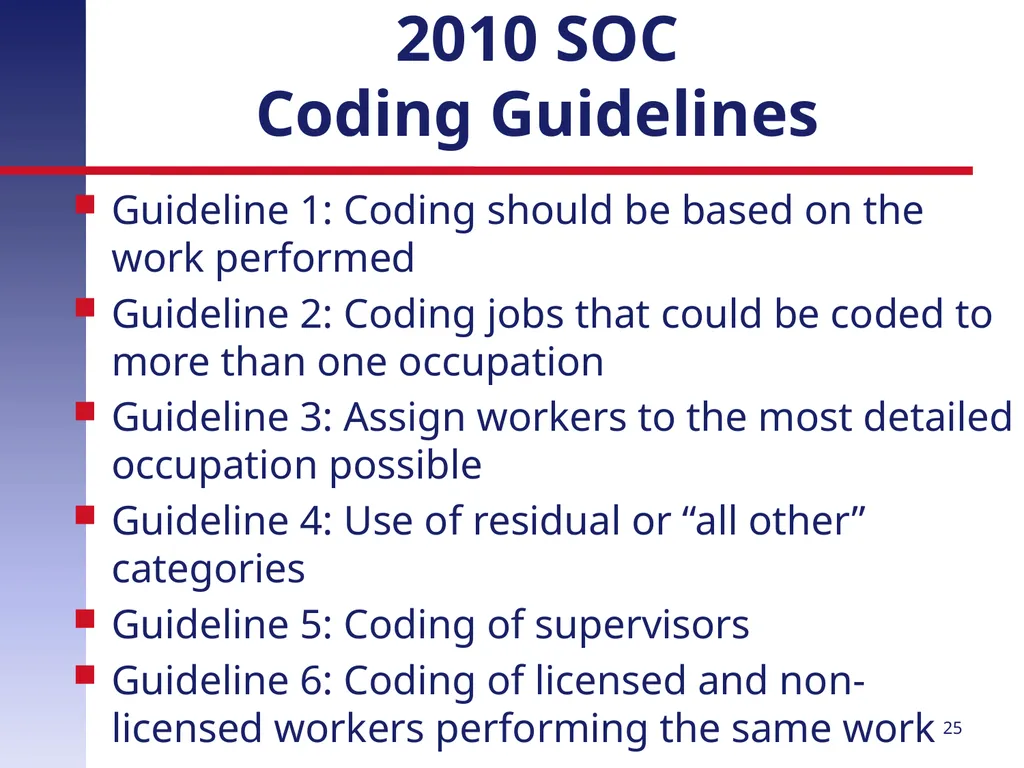
Coding Guidelines Guideline 1: Coding should be based on the work performed
Guideline 2: Coding jobs that could be coded to more than one occupation
Guideline 3: Assign workers to the most detailed occupation possible
Guideline 4: Use of residual or “all other” categories
Guideline 5: Coding of supervisors
Guideline 6: Coding of licensed and non-licensed workers performing the same work 25<br>
Guideline 2: Coding jobs that could be coded to more than one occupation
Guideline 3: Assign workers to the most detailed occupation possible
Guideline 4: Use of residual or “all other” categories
Guideline 5: Coding of supervisors
Guideline 6: Coding of licensed and non-licensed workers performing the same work 25<br>
26
Standard Occupational Classification Revision 26<br>
27
Revising the SOC Overview of the SOC revision process
Phases of the process
Soliciting and reviewing public input
What kind of information does the SOCPC need?
General timeframe 27<br>
Phases of the process
Soliciting and reviewing public input
What kind of information does the SOCPC need?
General timeframe 27<br>
28
SOC Revision:
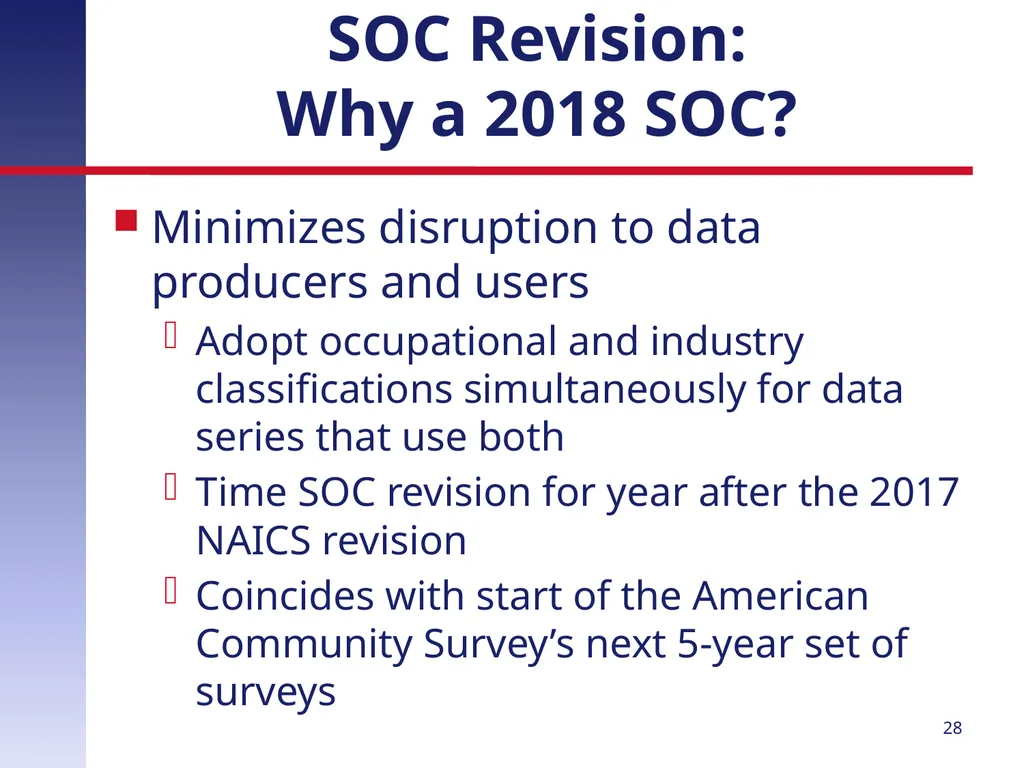
Why a 2018 SOC? Minimizes disruption to data producers and users
Adopt occupational and industry classifications simultaneously for data series that use both
Time SOC revision for year after the 2017 NAICS revision
Coincides with start of the American Community Survey’s next 5-year set of surveys 28<br>
Adopt occupational and industry classifications simultaneously for data series that use both
Time SOC revision for year after the 2017 NAICS revision
Coincides with start of the American Community Survey’s next 5-year set of surveys 28<br>
29
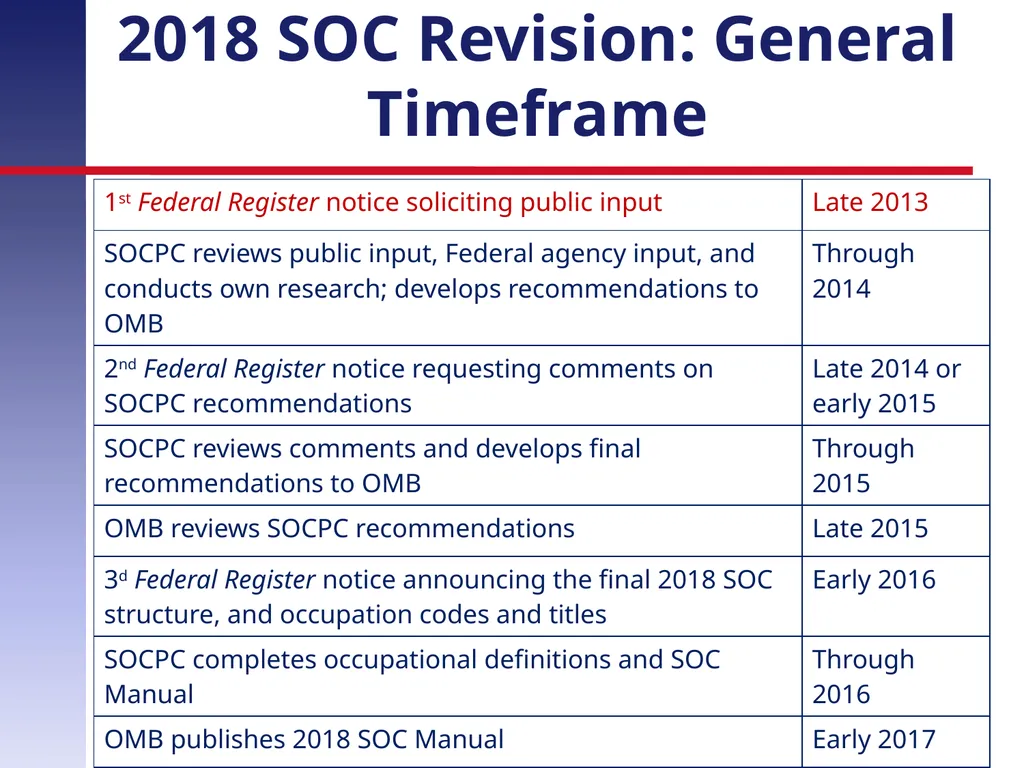
2018 SOC Revision: General Timeframe 29<br>
30
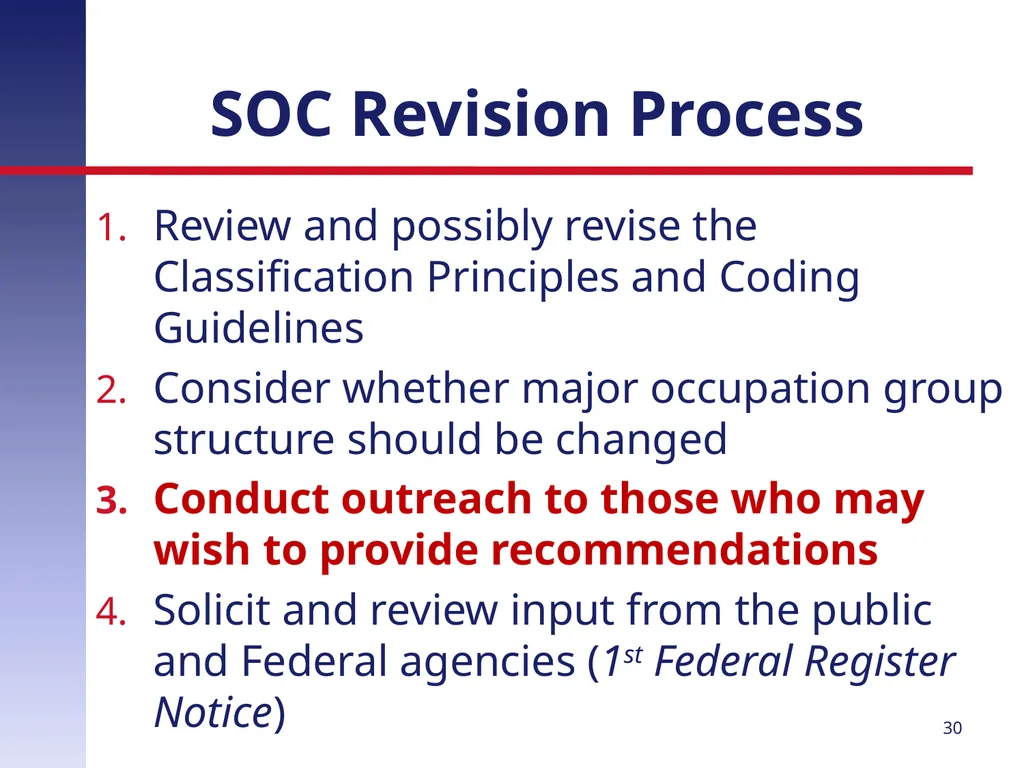
SOC Revision Process Review and possibly revise the Classification Principles and Coding Guidelines
Consider whether major occupation group structure should be changed
Conduct outreach to those who may wish to provide recommendations
Solicit and review input from the public and Federal agencies (1st Federal Register Notice) 30<br>
Consider whether major occupation group structure should be changed
Conduct outreach to those who may wish to provide recommendations
Solicit and review input from the public and Federal agencies (1st Federal Register Notice) 30<br>
31
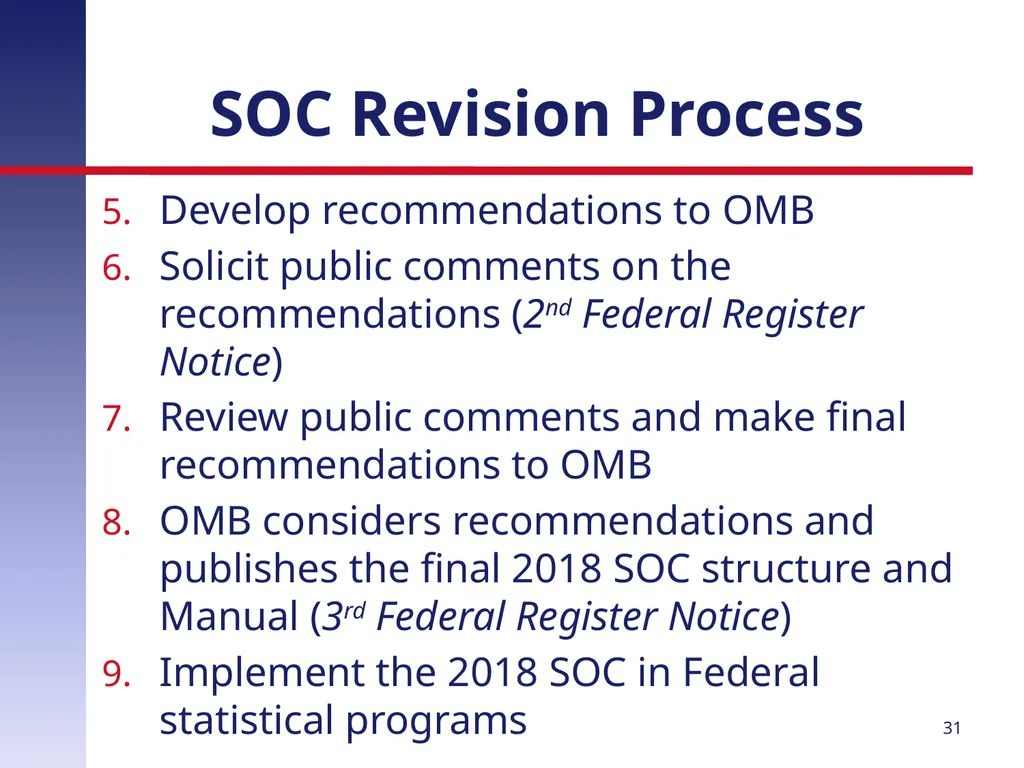
SOC Revision Process Develop recommendations to OMB
Solicit public comments on the recommendations (2nd Federal Register Notice)
Review public comments and make final recommendations to OMB
OMB considers recommendations and publishes the final 2018 SOC structure and Manual (3rd Federal Register Notice)
Implement the 2018 SOC in Federal statistical programs 31<br>
Solicit public comments on the recommendations (2nd Federal Register Notice)
Review public comments and make final recommendations to OMB
OMB considers recommendations and publishes the final 2018 SOC structure and Manual (3rd Federal Register Notice)
Implement the 2018 SOC in Federal statistical programs 31<br>
32
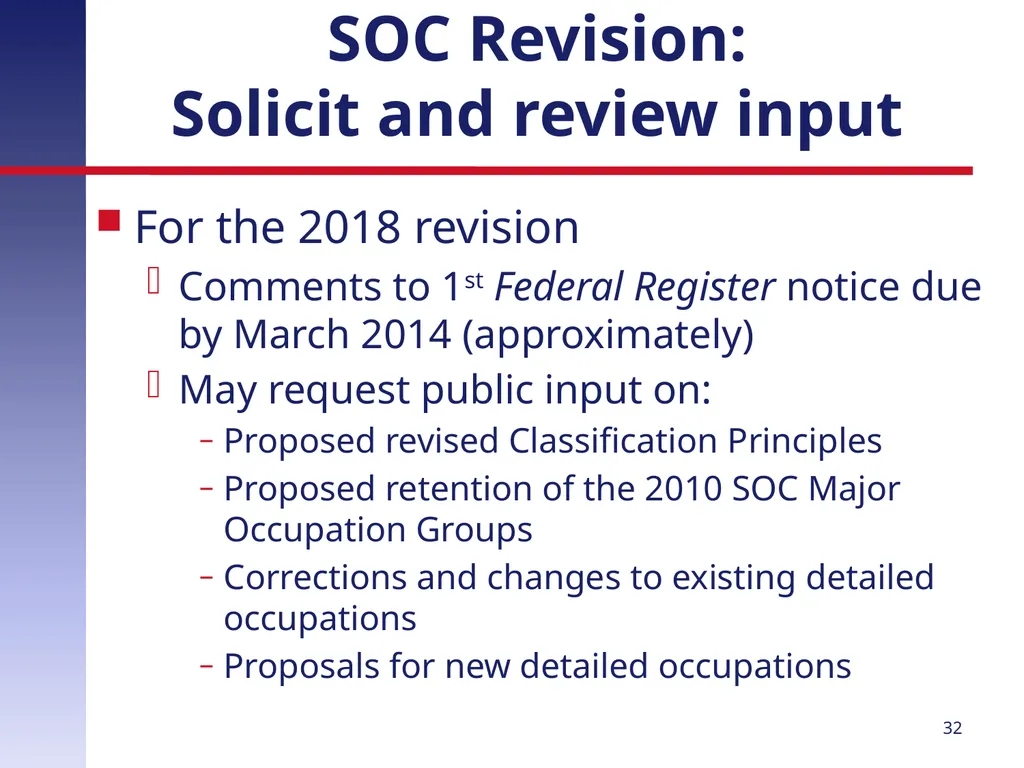
SOC Revision:
Solicit and review input For the 2018 revision
Comments to 1st Federal Register notice due by March 2014 (approximately)
May request public input on:
Proposed revised Classification Principles
Proposed retention of the 2010 SOC Major Occupation Groups
Corrections and changes to existing detailed occupations
Proposals for new detailed occupations 32<br>
Comments to 1st Federal Register notice due by March 2014 (approximately)
May request public input on:
Proposed revised Classification Principles
Proposed retention of the 2010 SOC Major Occupation Groups
Corrections and changes to existing detailed occupations
Proposals for new detailed occupations 32<br>
33
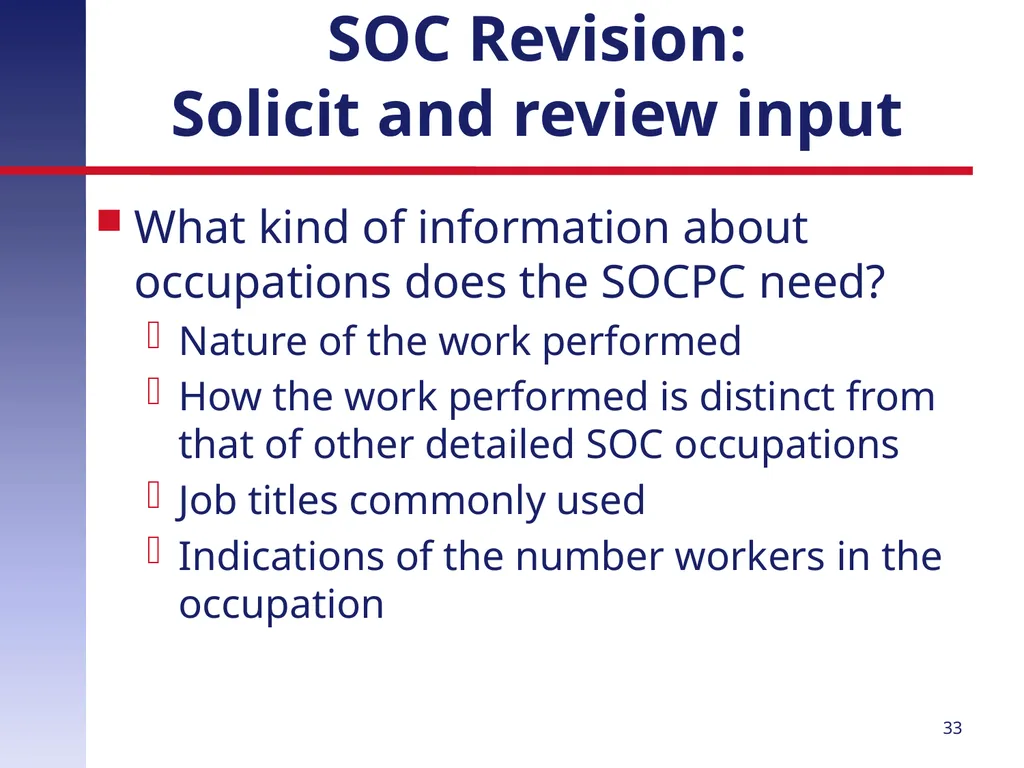
SOC Revision:
Solicit and review input What kind of information about occupations does the SOCPC need?
Nature of the work performed
How the work performed is distinct from that of other detailed SOC occupations
Job titles commonly used
Indications of the number workers in the occupation 33<br>
Nature of the work performed
How the work performed is distinct from that of other detailed SOC occupations
Job titles commonly used
Indications of the number workers in the occupation 33<br>
34
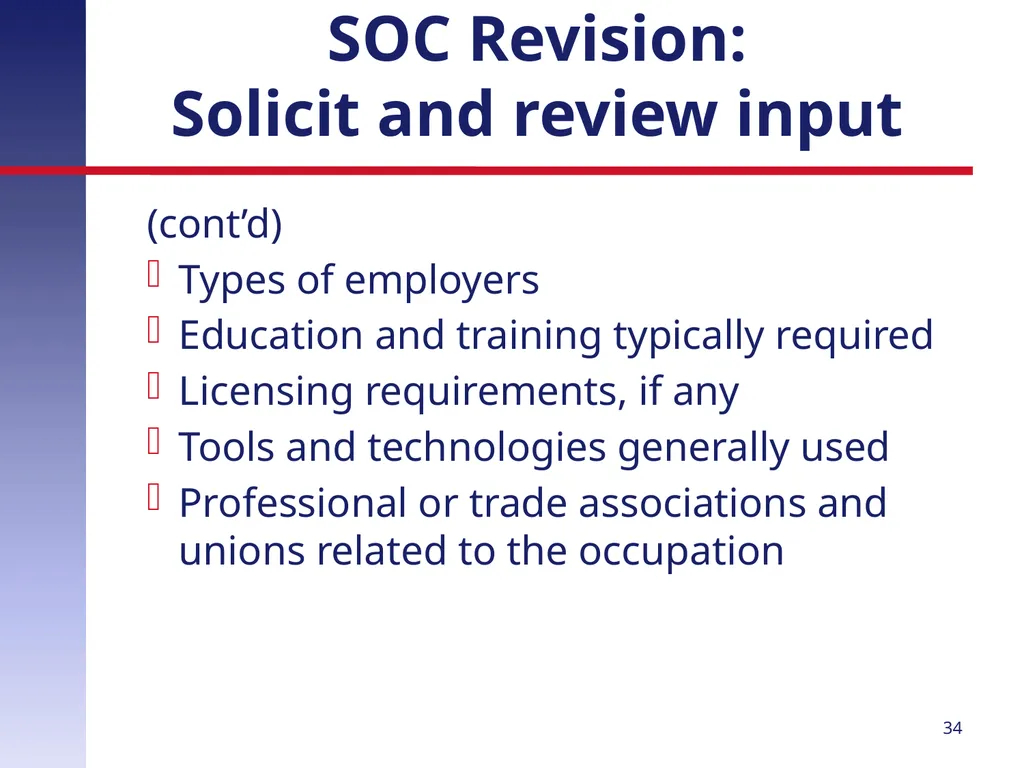
SOC Revision:
Solicit and review input (cont’d)
Types of employers
Education and training typically required
Licensing requirements, if any
Tools and technologies generally used
Professional or trade associations and unions related to the occupation 34<br>
Types of employers
Education and training typically required
Licensing requirements, if any
Tools and technologies generally used
Professional or trade associations and unions related to the occupation 34<br>
35
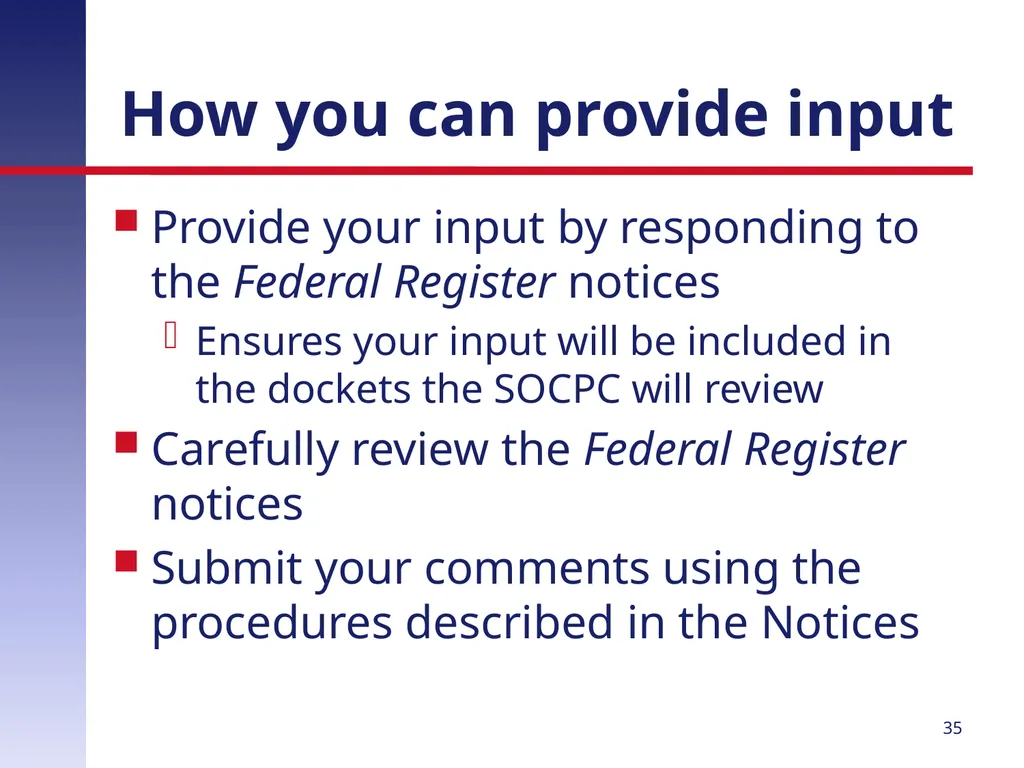
How you can provide input Provide your input by responding to the Federal Register notices
Ensures your input will be included in the dockets the SOCPC will review
Carefully review the Federal Register notices
Submit your comments using the procedures described in the Notices 35<br>
Ensures your input will be included in the dockets the SOCPC will review
Carefully review the Federal Register notices
Submit your comments using the procedures described in the Notices 35<br>
36
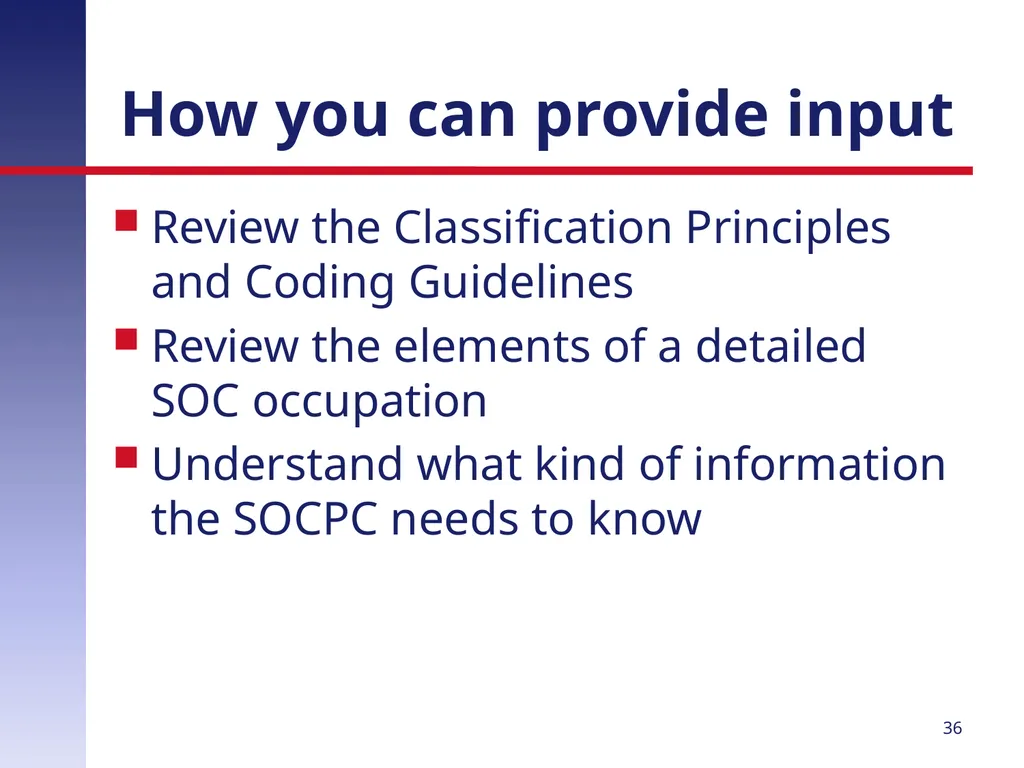
How you can provide input Review the Classification Principles and Coding Guidelines
Review the elements of a detailed SOC occupation
Understand what kind of information the SOCPC needs to know 36<br>
Review the elements of a detailed SOC occupation
Understand what kind of information the SOCPC needs to know 36<br>
37
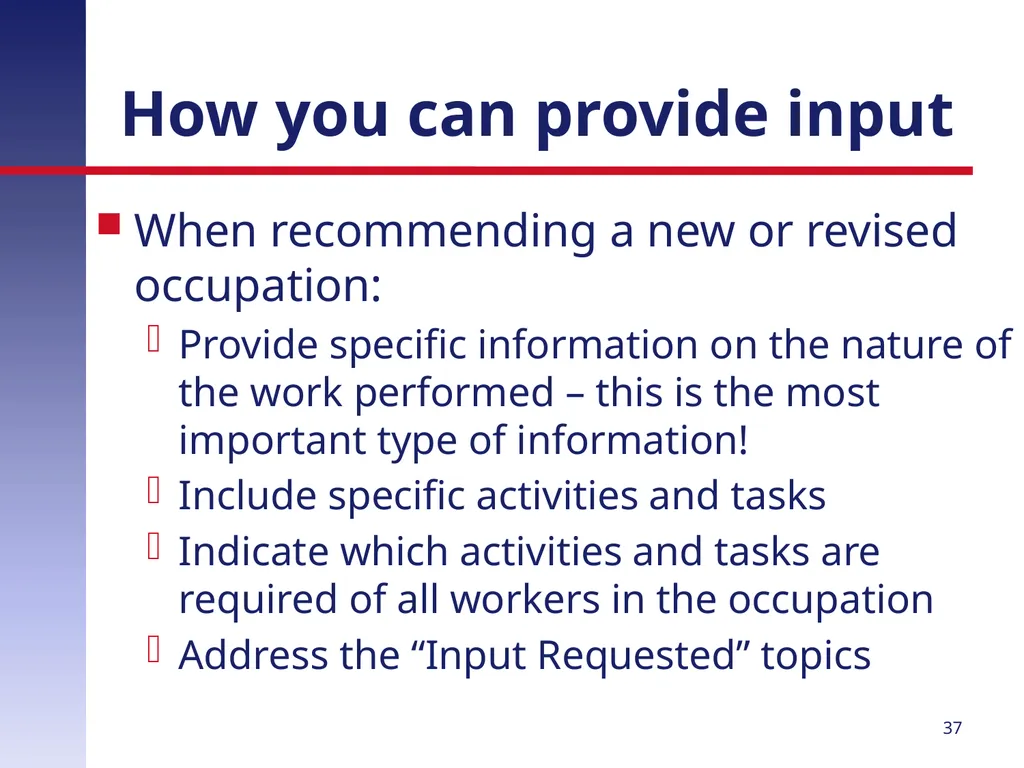
How you can provide input When recommending a new or revised occupation:
Provide specific information on the nature of the work performed – this is the most important type of information!
Include specific activities and tasks
Indicate which activities and tasks are required of all workers in the occupation
Address the “Input Requested” topics 37<br>
Provide specific information on the nature of the work performed – this is the most important type of information!
Include specific activities and tasks
Indicate which activities and tasks are required of all workers in the occupation
Address the “Input Requested” topics 37<br>
38
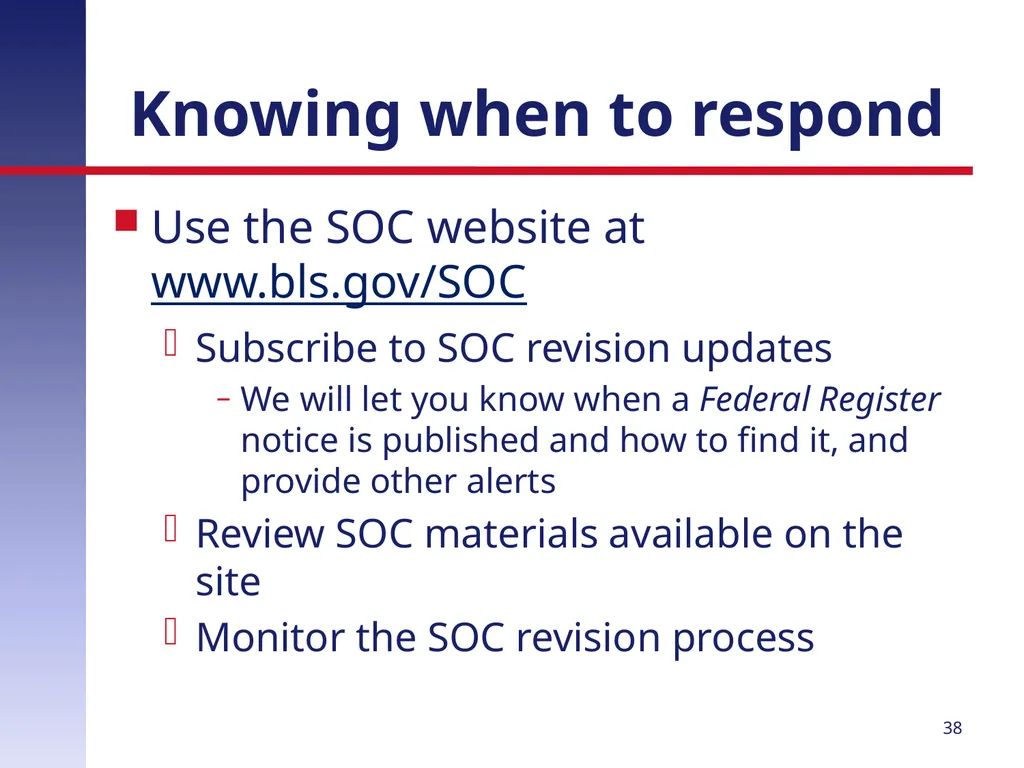
Knowing when to respond Use the SOC website at www.bls.gov/SOC
Subscribe to SOC revision updates
We will let you know when a Federal Register notice is published and how to find it, and provide other alerts
Review SOC materials available on the site
Monitor the SOC revision process 38<br>
Subscribe to SOC revision updates
We will let you know when a Federal Register notice is published and how to find it, and provide other alerts
Review SOC materials available on the site
Monitor the SOC revision process 38<br>
39
Your input is important! The SOC Policy Committee values the comments we receive.
Your comments will be critical to making the 2018 Standard Occupational Classification as current and accurate as it can be.
Thank you. 39<br>
Your comments will be critical to making the 2018 Standard Occupational Classification as current and accurate as it can be.
Thank you. 39<br>
40
Michelle Washko
301-443-9846
Mwashko@HRSA.gov<br>