
Revision Pack: Literature Paper Two An Inspector





Description: Revision Pack: Literature Paper Two An Inspector Calls Contents Page I have 5 Minutes Glossary of Key Terms: Pick 5 random terms, preferably ones that you lack confidence with, define them and create 5 revision cards. Ask someone to test
Related Topics
Download Presentation
"Revision Pack: Literature Paper Two An Inspector" is the property of its rightful owner. Permission is granted to download and print the materials on this website for personal, non-commercial use only, and to display it on your personal computer provided you do not modify the materials and that you retain all copyright notices contained in the materials. By downloading content from our website, you accept the terms of this agreement.
Presentation Transcript
slide1. Revision Pack: Literature Paper Two<br>
slide2. An Inspector Calls Contents Page I have 5 Minutes
Glossary of Key Terms: Pick 5 random terms, preferably ones that you lack confidence with, define them and create 5 revision cards. Ask someone to test you on these.
Character Profiles: Write down 3 adjectives for one character (e.g., Eric Birling) and a key quote. Bonus points if your adjectives link to your quotation or you are able to bullet point any analytical points.
Themes: Summarise one theme (e.g., Social Responsibility) in one sentence and one quotation. Bonus points if you can form this into a strong thesis statement.
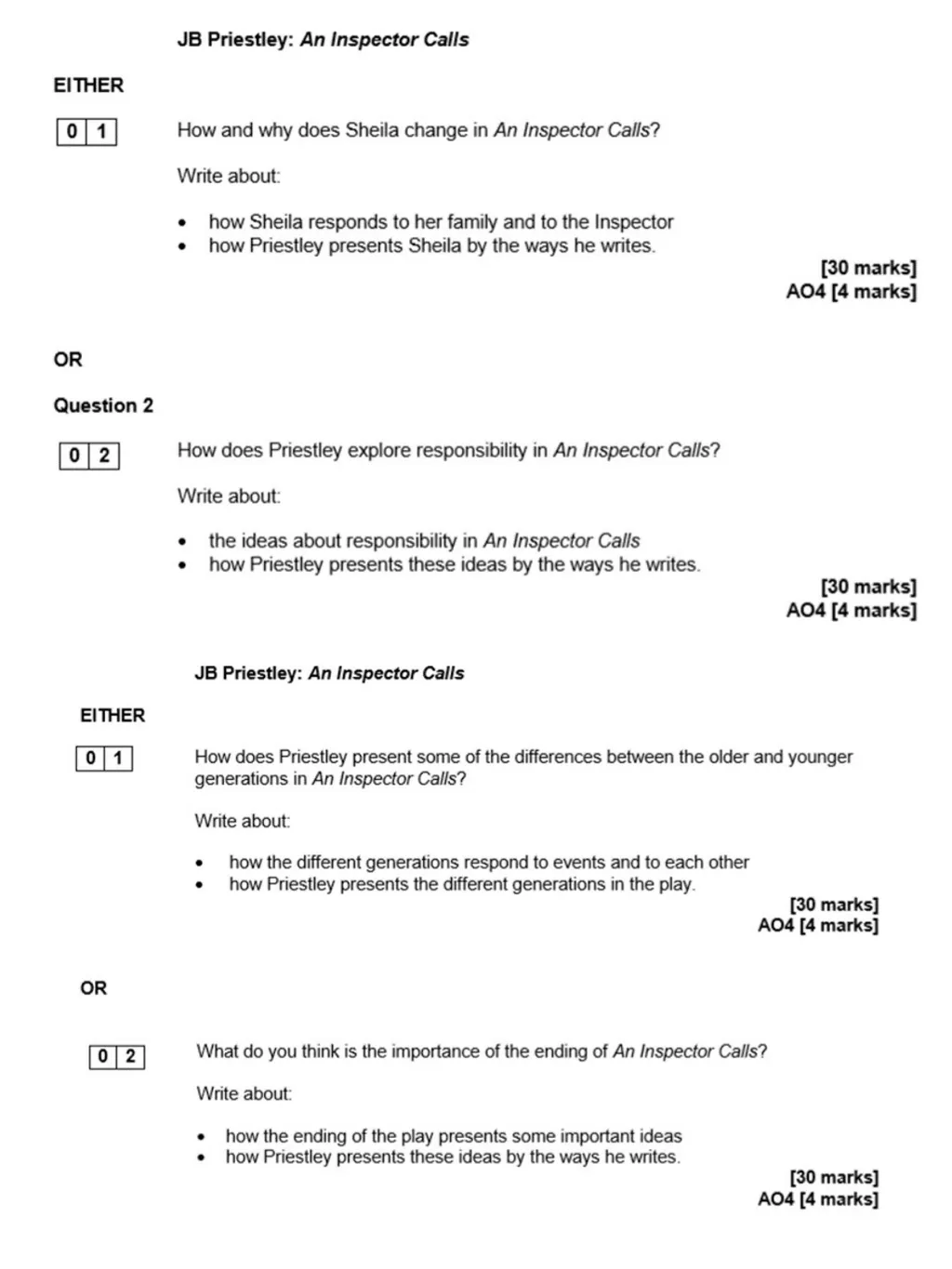
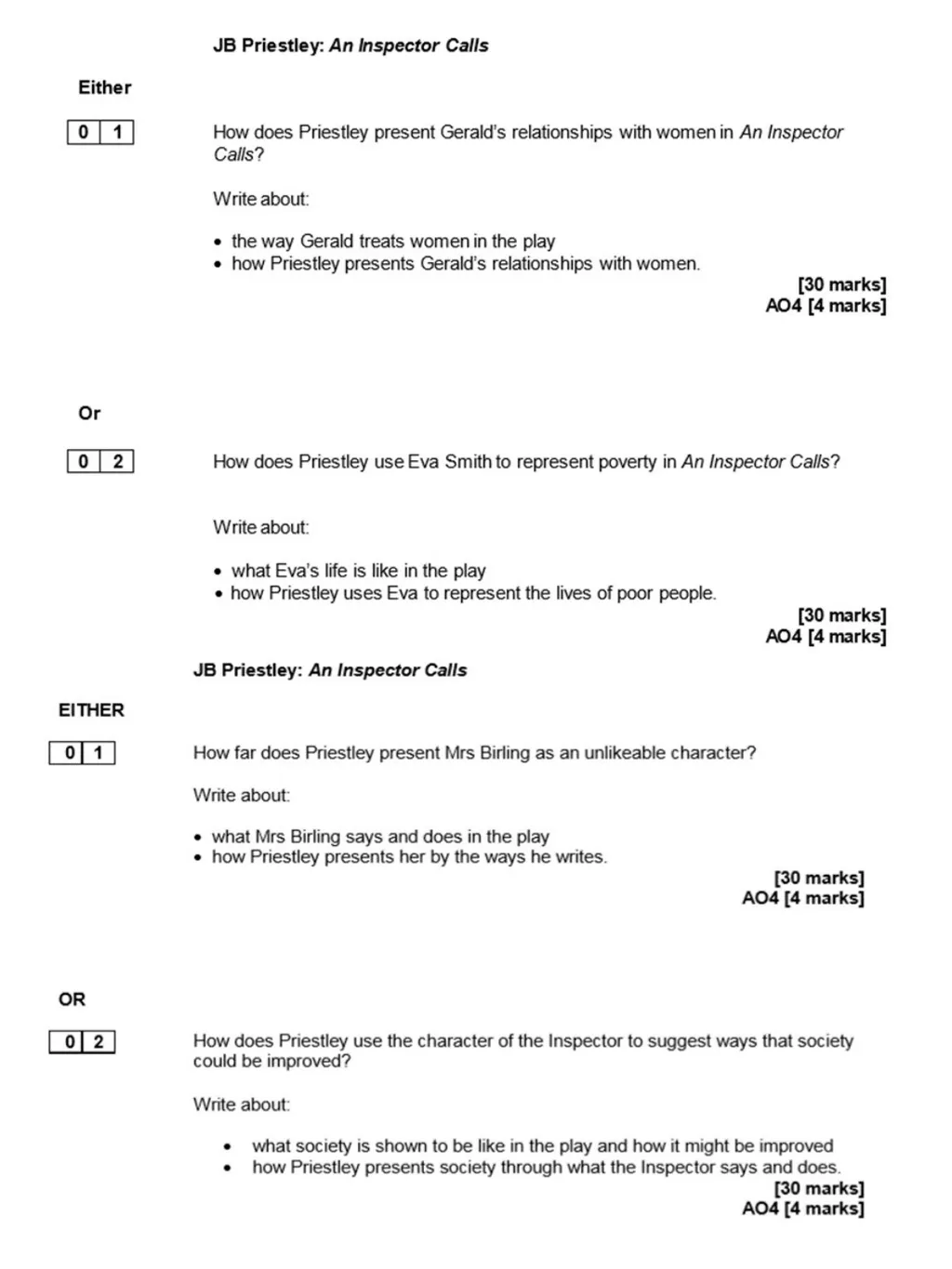
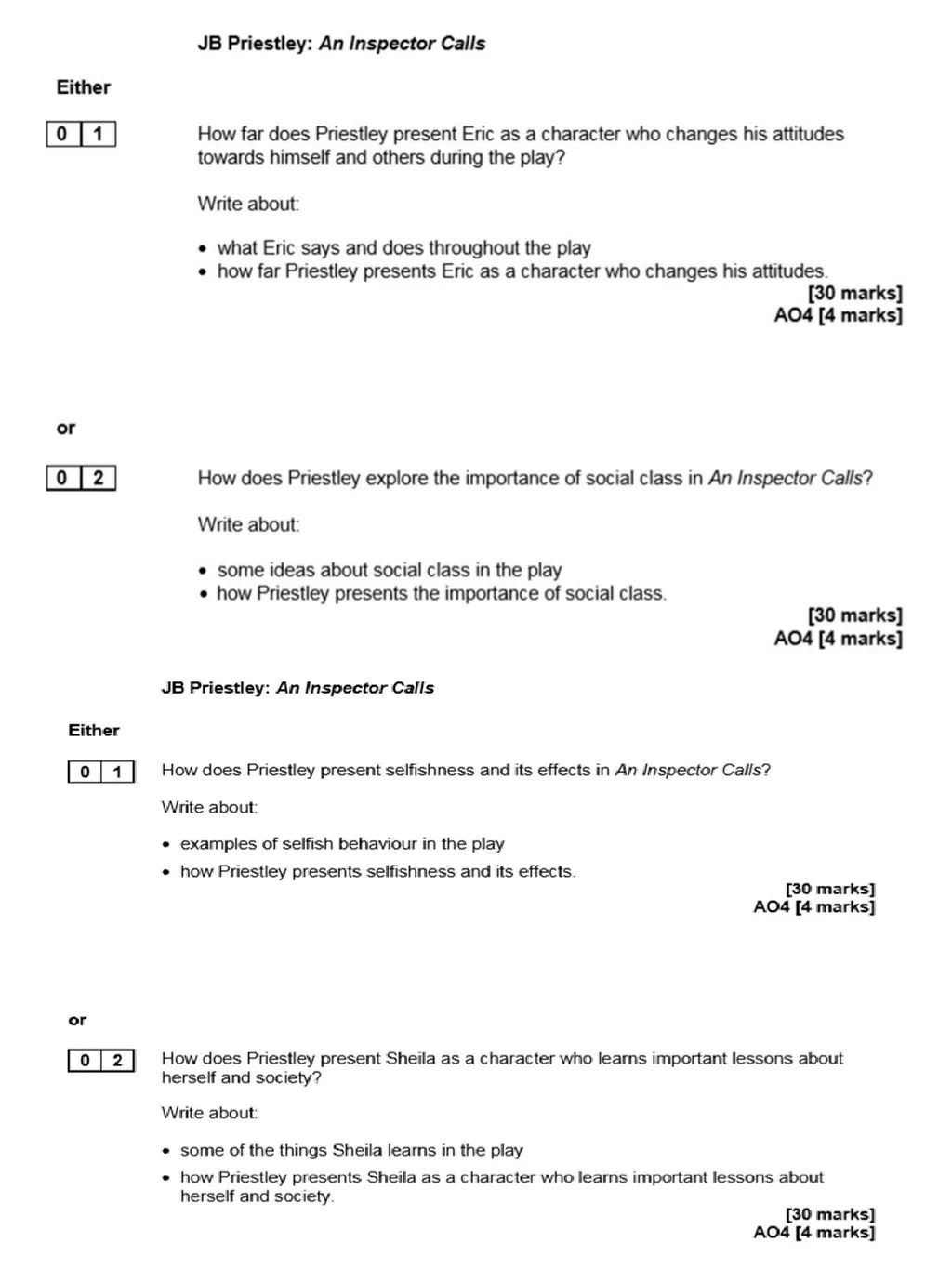
Exam Preparation: Look at one past paper question (at the end of the An Inspector Calls section) and quickly plan 3 bullet points you’d include.
Flashcards: Create 3 flashcards focusing on a gap in your knowledge for AIC.
Flashcards: Shuffle 5 flashcards that you have already created and test yourself.
I have 15 Minutes
Overview and Key Scenes: Re-read a key scene and jot down its importance for theme and character development.
Context: Create a quick spider diagram of how 1912/1945 context links to one character or theme.
Assessment Mark Sheet - Look at example paragraphs and assess the responses against the exam components.
Theme Tracking Across The Play - draw together the relevant information to enable you to approach a thematic exam question.
Priestley’s Intentions and Big Ideas: behind An Inspector Calls. This builds AO3 understanding and links directly to exam skills.
I have 30 Minutes
Timed Essay Plan for AIC: Do a timed essay plan for one question (intro + 3 paragraphs + conclusion).
Top Mark Essay Skills: Develop skills in drafting a body paragraph, thesis statement, and conclusion, with strong analysis linking big ideas, context, and Priestley’s purpose.
Question Bank – Relationships: Choose one pair (e.g., Sheila & Gerald) and write two paragraphs exploring how their relationship changes. Use the character cards to help you.
Additional Reading and Videos: Read/watch a short resource, then write a 5-bullet summary of new insights. GCSEPod, Mr Bruff, Seneca, CGP Guides etc.
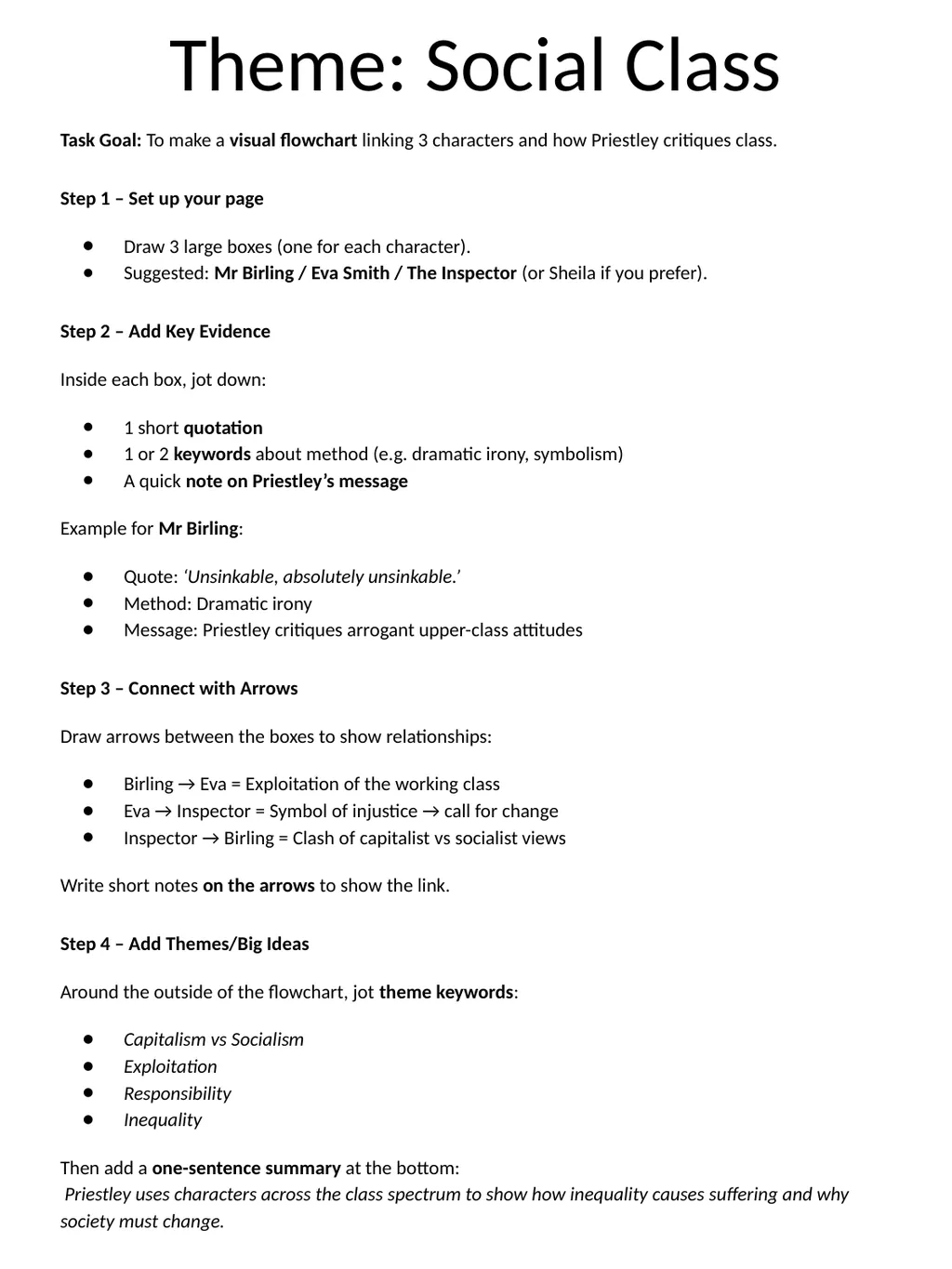
Themes – Social Class: Create a flowchart linking 3 characters to how Priestley critiques class.<br>
slide3. have 50 Minutes
Exam Preparation: Write a full timed essay on one past paper question.
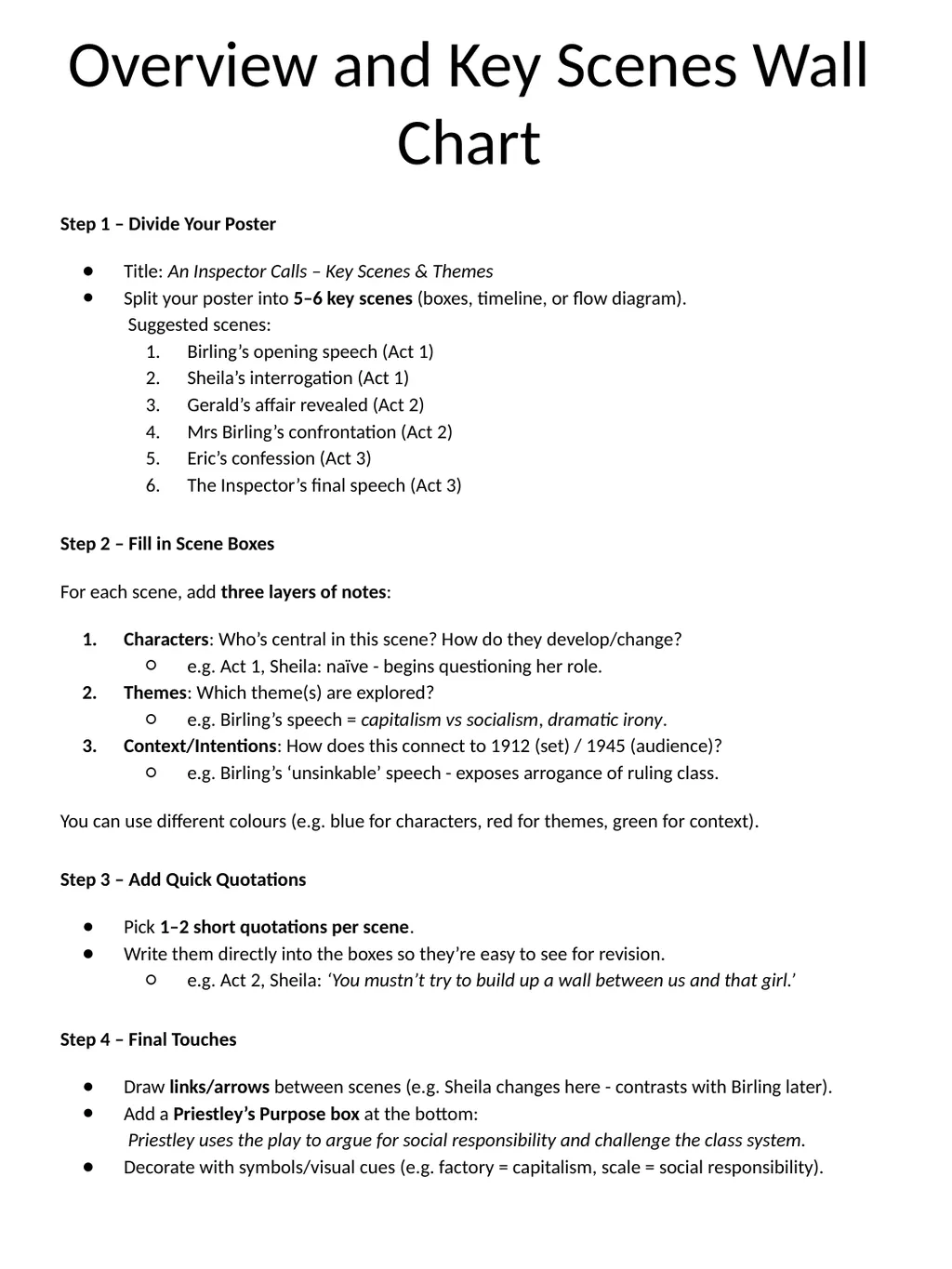
Notes - Overview and Key Scenes: Create a revision wall chart/poster mapping scenes to themes, characters, and context.
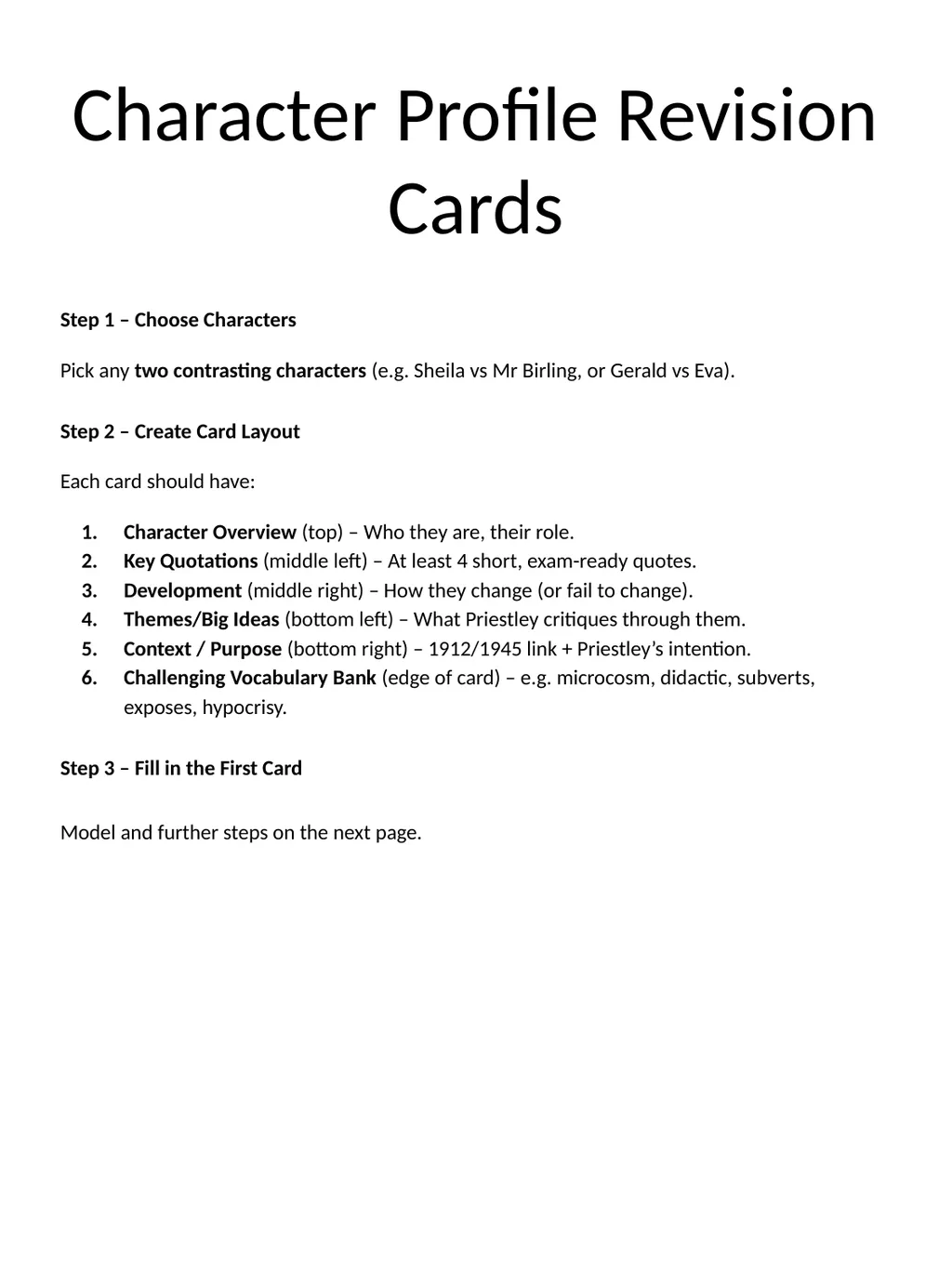
Character Profiles: Write detailed revision cards for two characters including quotes, development, themes, context.
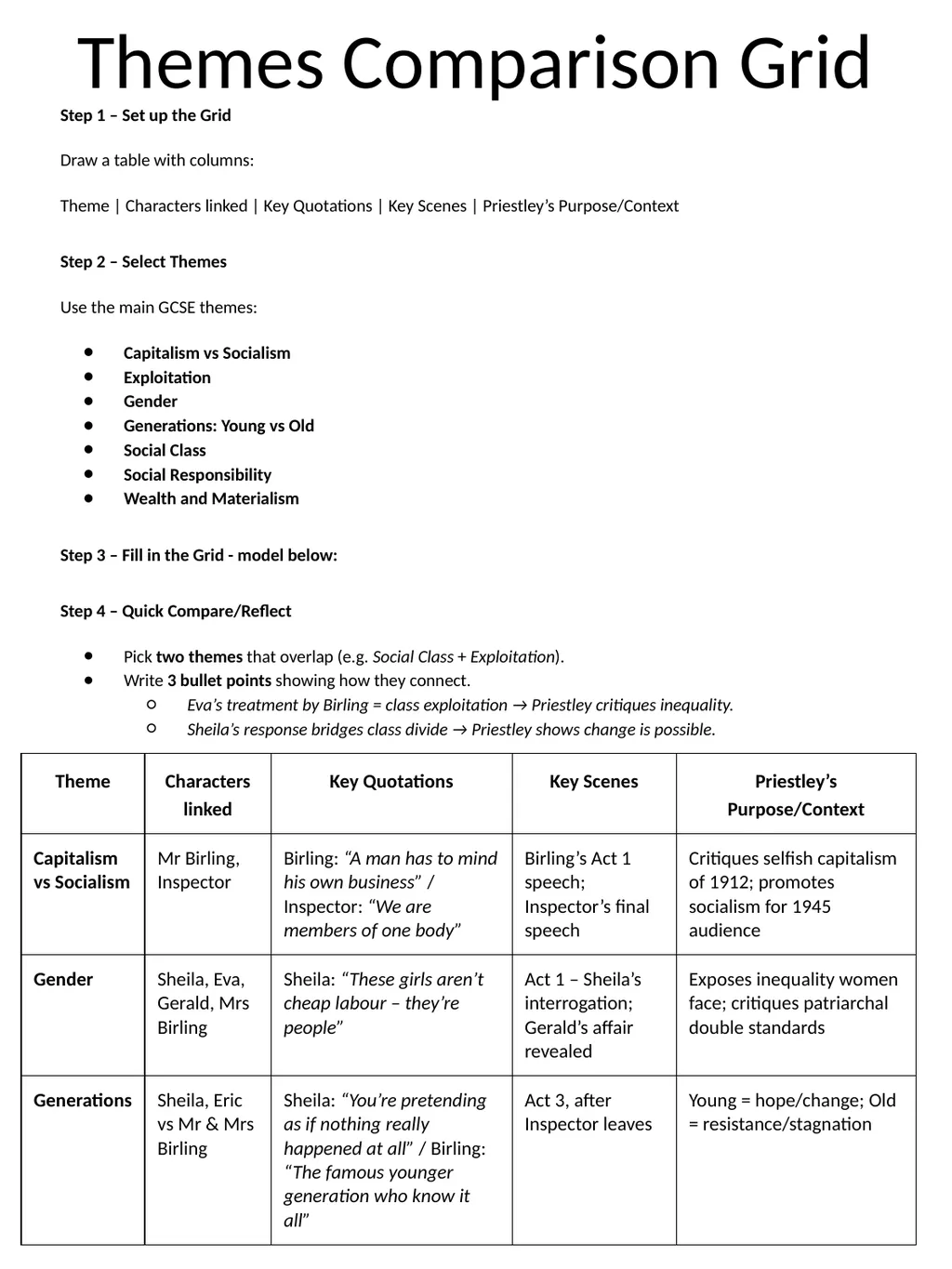
Themes: Do a comparison grid: across all themes, note which characters, quotes, and scenes support them.
An Inspector Calls (2017 film version): Watch a full act and write a short comparison of how the director presents characters vs Priestley’s stage directions.<br>
slide4. Themes: How to Write a Thesis Statement (for An Inspector Calls) 1. What is a thesis statement?
A thesis statement is the central argument of your essay. It’s usually 1–2 sentences in the introduction that:
Directly answers the question.
Takes a clear stance on the theme/character/idea.
Can be expanded into topic sentences for body paragraphs.
2. Formula for a strong thesis
[Theme/character] is presented by Priestley as [judgement/argument], in order to [writer’s intention / effect on audience].
3. Example – Social Responsibility
One-sentence summary: Social responsibility is shown as essential for a fairer society.
Key quotation: ‘We are members of one body. We are responsible for each other.’
Thesis statement: Priestley presents social responsibility as a moral duty, showing that ignoring it leads to tragic consequences, in order to encourage his audience to embrace socialist values.
4. Quick Practice Task (5 minutes)
Pick one theme (e.g., Gender, Generations, Social Class).
Write:
A 1-sentence summary of how Priestley presents it.
A quotation that supports your point.
A thesis statement linking Priestley’s message to the audience.
5. Bonus Challenge
Transform your thesis into 3 sub-points (potential body paragraphs). Example for Social Responsibility:
Mr Birling embodies selfishness and neglect of duty.
Sheila shows how individuals can change and accept responsibility.
The Inspector is Priestley’s voice, teaching collective responsibility.<br>
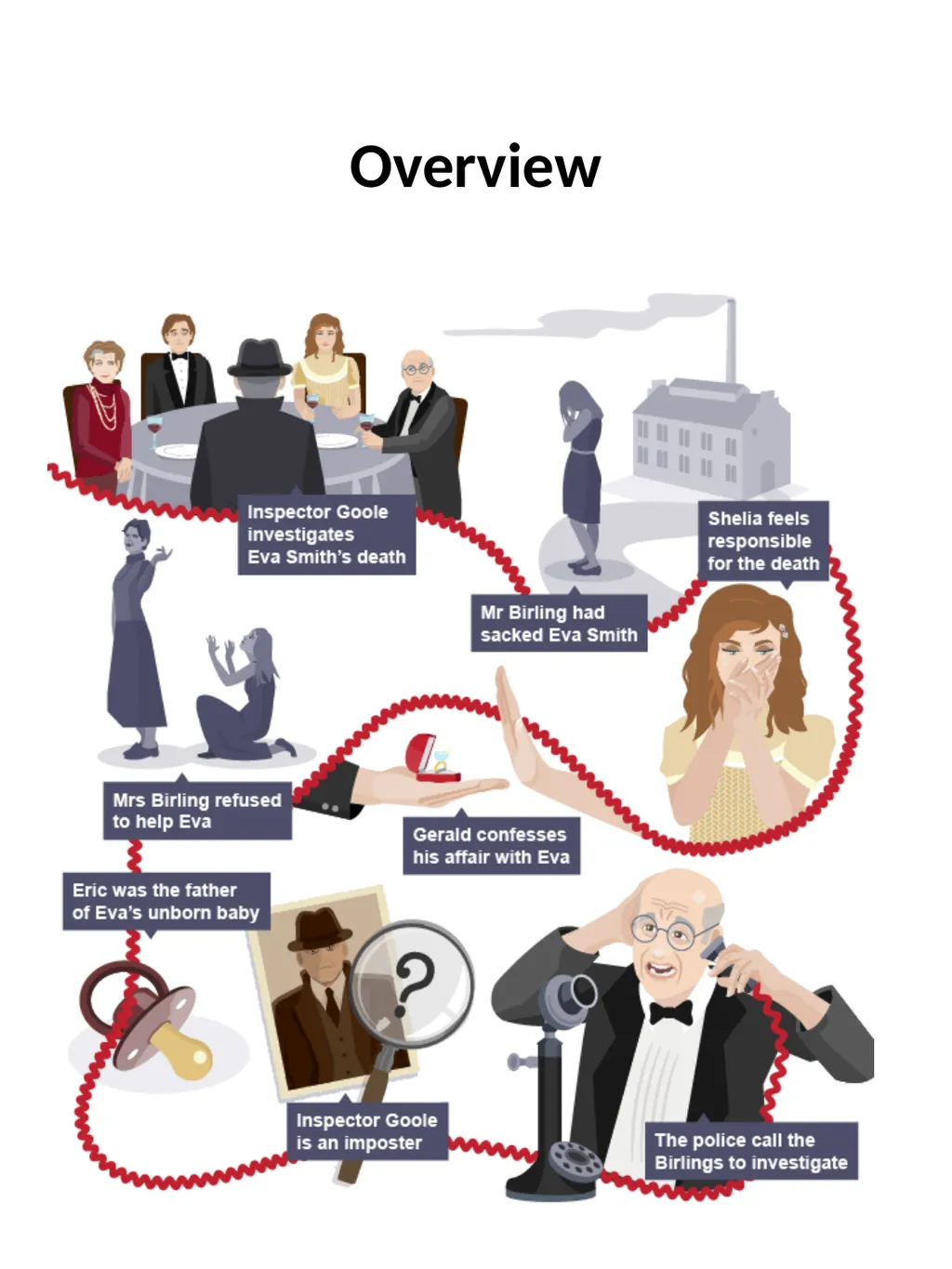
slide5. Overview<br>
slide6. An inspector arrives at the Birling house. He tells them how a girl called Eva Smith has killed herself by drinking disinfectant - he wants to ask them some questions.
The Inspector reveals that the girl used to work in Arthur Birling's factory and he had her sacked for going on strike. Mr Birling refuses to accept any responsibility for her death.
The Inspector then reveals that Sheila thought that Eva had made fun of her, complained and got her sacked. Sheila is deeply ashamed and feels responsible for the girl’s death.
The Inspector forces Gerald to confess to an affair he had with Eva. Sheila respects Gerald’s honesty but returns the engagement ring he gave her.
It is revealed that Sybil Birling had refused to help the pregnant Eva.
It turns out that it was Eric who got Eva pregnant, and stole money from his father to help her.
The Inspector leaves. The family ring the infirmary and there is no record of a girl dying from drinking disinfectant.
Suddenly the phone rings, Mr Birling answers it, to his horror the phone call reveals that a young woman has just died from drinking disinfectant and the police are on their way to question them about it. The curtain falls and the play ends.<br>
slide7. Key Scene Analysis Each of these tasks = 15 minutes of active revision. Do one per session, or all four over a week for a complete key-scene refresh.
Task 1 – Act 1: Mr Birling’s ‘community and all that nonsense’ speech
Re-read: Focus on Birling’s views about capitalism, self-interest, and his predictions about war and the Titanic.
Notes:
Themes: Capitalism vs Socialism, Social Responsibility, Generations.
Character Development: Birling appears arrogant, short-sighted, and self-centred. Priestley sets him up as a figure to be criticised.
Audience Impact: 1945 audience knows Birling is wrong - makes Priestley’s socialist message stronger.
Thesis Sentence: Priestley uses Birling’s dismissive speech about community to expose the dangers of selfish capitalism and to encourage the audience to reject such attitudes.
Task 2 – Act 2: Sheila confronts Gerald about Daisy Renton
Re-read (5 mins): Look at Sheila’s questions and Gerald’s defensive responses.
Notes (5 mins):
Themes: Gender, Exploitation, Relationships.
Character Development: Sheila matures, showing honesty and empathy; Gerald reveals flaws and dishonesty.
Audience Impact: Audience sides with Sheila; Priestley suggests women and the younger generation are more capable of moral progress.
Thesis Sentence (3 mins): Priestley uses Sheila and Gerald’s confrontation to expose the exploitative treatment of women, while showing that moral growth comes from honesty and self-awareness.<br>
slide8. Task 3 – Act 3: Eric’s confession
Re-read: Pay attention to Eric’s admission of his behaviour and how his parents react.
Notes:
Themes: Social Class, Gender, Responsibility.
Character Development: Eric admits guilt, accepts responsibility, and contrasts with his parents’ refusal to change.
Audience Impact: Highlights how the younger generation offer hope for change, unlike the older generation.
Thesis Sentence: Priestley uses Eric’s confession to stress that the younger generation can learn from their mistakes, while the older generation cling to privilege and denial.
Task 4 – Final Scene: The Inspector’s speech (‘We are members of one body…’)
Re-read: Focus on the Inspector’s final words and tone before he leaves.
Notes:
Themes: Social Responsibility, Capitalism vs Socialism, Generations.
Character Development: The Inspector acts as Priestley’s mouthpiece, challenging all characters equally.
Audience Impact: Priestley delivers a warning: ignoring responsibility leads to ‘fire and blood and anguish.’
Thesis Sentence: Priestley uses the Inspector’s final speech as the moral climax of the play, urging the audience to embrace collective responsibility or face devastating consequences.<br>
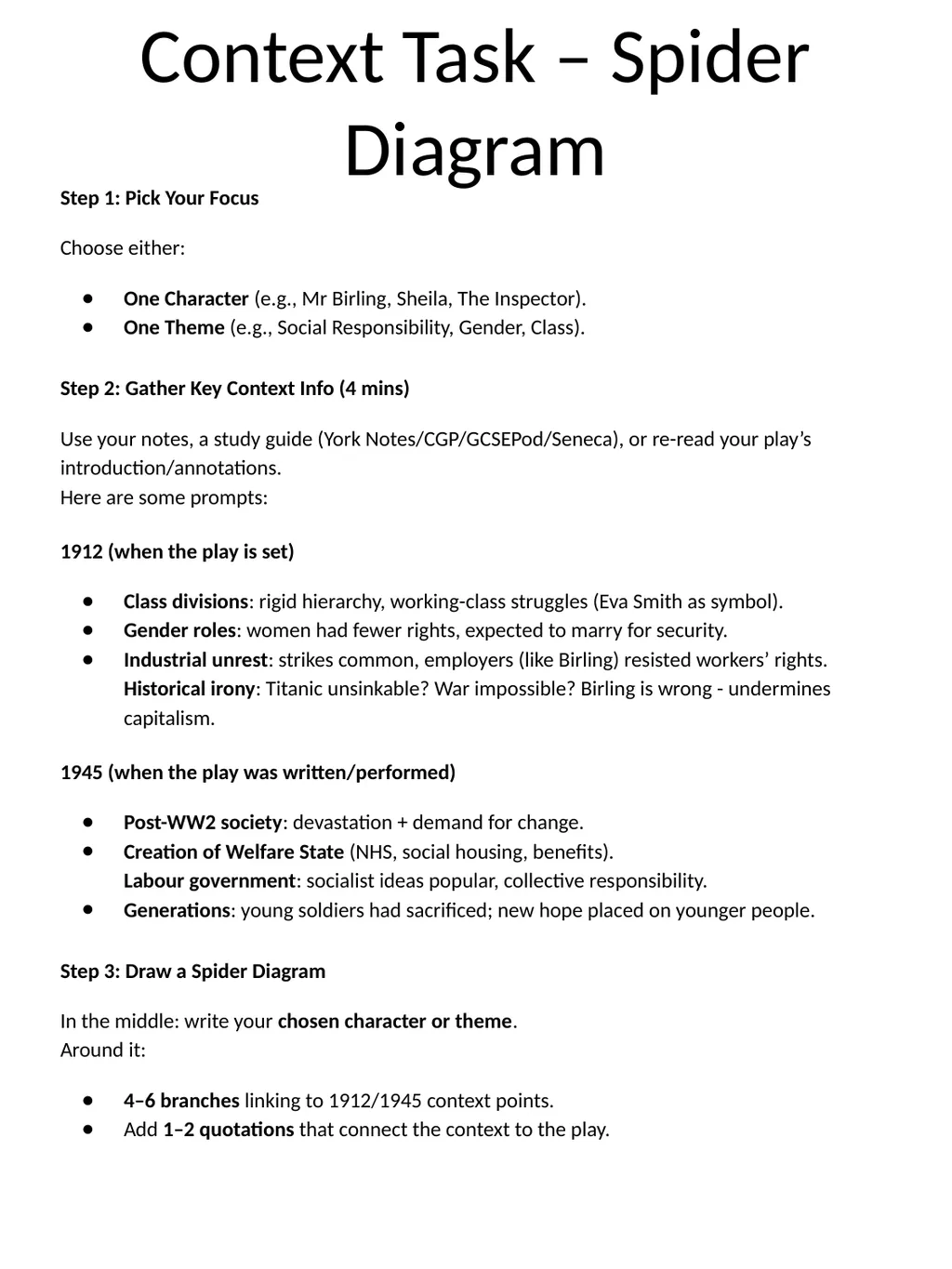
slide9. Context Task – Spider Diagram Step 1: Pick Your Focus
Choose either:
One Character (e.g., Mr Birling, Sheila, The Inspector).
One Theme (e.g., Social Responsibility, Gender, Class).
Step 2: Gather Key Context Info (4 mins)
Use your notes, a study guide (York Notes/CGP/GCSEPod/Seneca), or re-read your play’s introduction/annotations. Here are some prompts:
1912 (when the play is set)
Class divisions: rigid hierarchy, working-class struggles (Eva Smith as symbol).
Gender roles: women had fewer rights, expected to marry for security.
Industrial unrest: strikes common, employers (like Birling) resisted workers’ rights. Historical irony: Titanic unsinkable? War impossible? Birling is wrong - undermines capitalism.
1945 (when the play was written/performed)
Post-WW2 society: devastation + demand for change.
Creation of Welfare State (NHS, social housing, benefits). Labour government: socialist ideas popular, collective responsibility.
Generations: young soldiers had sacrificed; new hope placed on younger people.
Step 3: Draw a Spider Diagram
In the middle: write your chosen character or theme. Around it:
4–6 branches linking to 1912/1945 context points.
Add 1–2 quotations that connect the context to the play.<br>
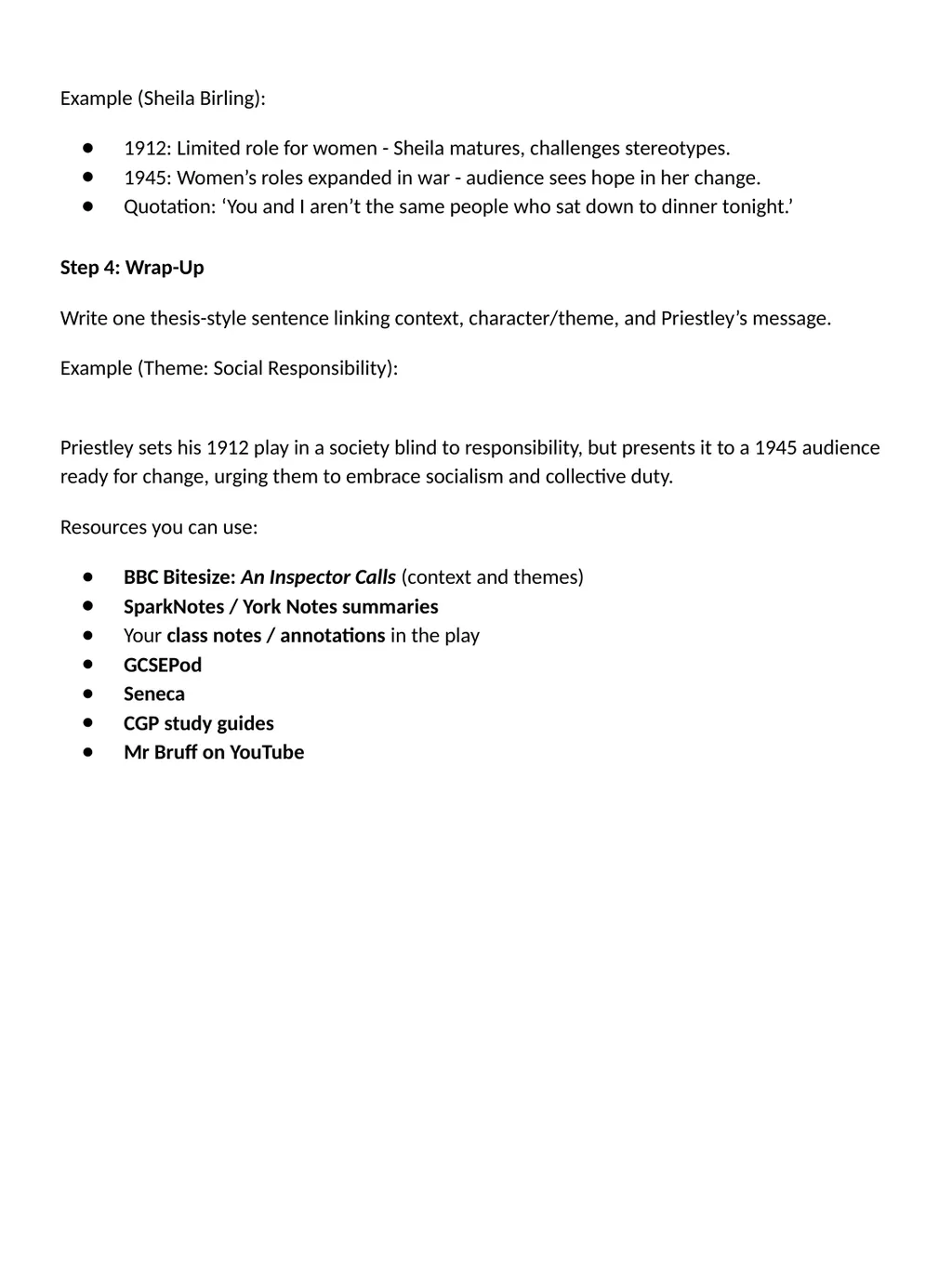
slide10. Example (Sheila Birling):
1912: Limited role for women - Sheila matures, challenges stereotypes.
1945: Women’s roles expanded in war - audience sees hope in her change.
Quotation: ‘You and I aren’t the same people who sat down to dinner tonight.’
Step 4: Wrap-Up
Write one thesis-style sentence linking context, character/theme, and Priestley’s message.
Example (Theme: Social Responsibility):
Priestley sets his 1912 play in a society blind to responsibility, but presents it to a 1945 audience ready for change, urging them to embrace socialism and collective duty.
Resources you can use:
BBC Bitesize: An Inspector Calls (context and themes)
SparkNotes / York Notes summaries
Your class notes / annotations in the play
GCSEPod
Seneca
CGP study guides
Mr Bruff on YouTube<br>
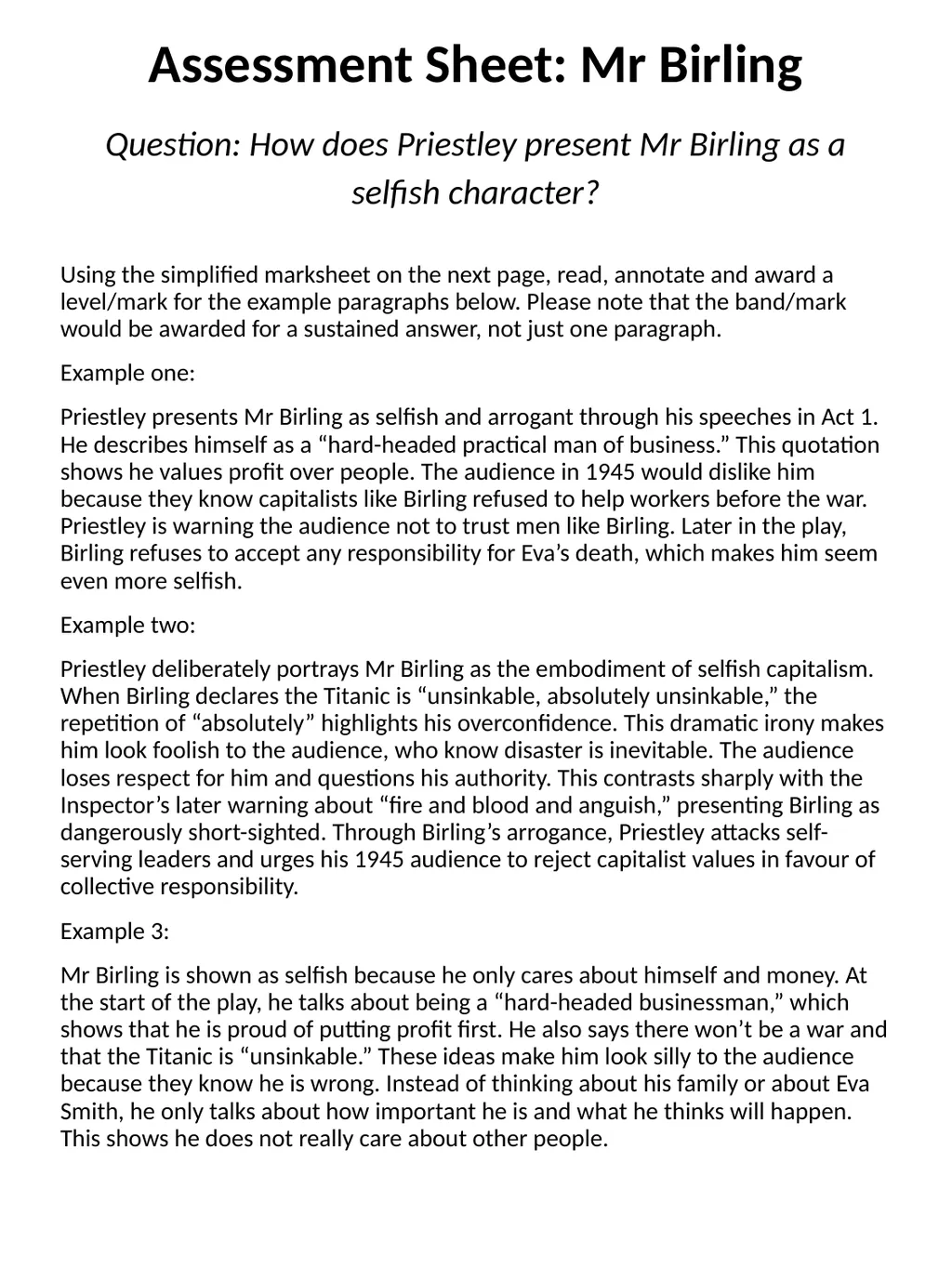
slide11. Assessment Sheet: Mr Birling
Question: How does Priestley present Mr Birling as a selfish character? Using the simplified marksheet on the next page, read, annotate and award a level/mark for the example paragraphs below. Please note that the band/mark would be awarded for a sustained answer, not just one paragraph.
Example one:
Priestley presents Mr Birling as selfish and arrogant through his speeches in Act 1. He describes himself as a “hard-headed practical man of business.” This quotation shows he values profit over people. The audience in 1945 would dislike him because they know capitalists like Birling refused to help workers before the war. Priestley is warning the audience not to trust men like Birling. Later in the play, Birling refuses to accept any responsibility for Eva’s death, which makes him seem even more selfish.
Example two:
Priestley deliberately portrays Mr Birling as the embodiment of selfish capitalism. When Birling declares the Titanic is “unsinkable, absolutely unsinkable,” the repetition of “absolutely” highlights his overconfidence. This dramatic irony makes him look foolish to the audience, who know disaster is inevitable. The audience loses respect for him and questions his authority. This contrasts sharply with the Inspector’s later warning about “fire and blood and anguish,” presenting Birling as dangerously short-sighted. Through Birling’s arrogance, Priestley attacks self-serving leaders and urges his 1945 audience to reject capitalist values in favour of collective responsibility.
Example 3:
Mr Birling is shown as selfish because he only cares about himself and money. At the start of the play, he talks about being a “hard-headed businessman,” which shows that he is proud of putting profit first. He also says there won’t be a war and that the Titanic is “unsinkable.” These ideas make him look silly to the audience because they know he is wrong. Instead of thinking about his family or about Eva Smith, he only talks about how important he is and what he thinks will happen. This shows he does not really care about other people.<br>
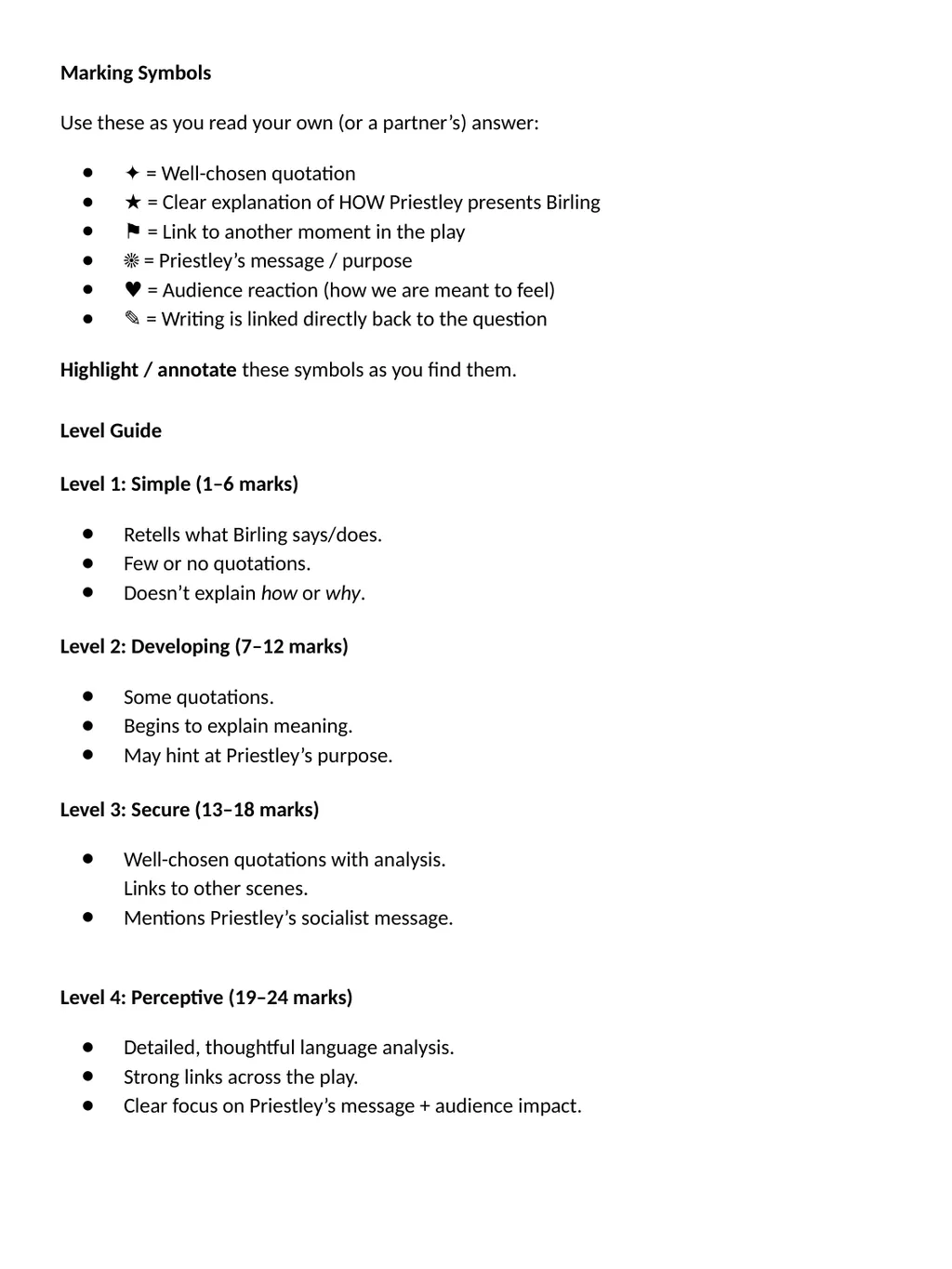
slide12. Marking Symbols
Use these as you read your own (or a partner’s) answer:
✦ = Well-chosen quotation
★ = Clear explanation of HOW Priestley presents Birling
⚑ = Link to another moment in the play
☀ = Priestley’s message / purpose
♥ = Audience reaction (how we are meant to feel)
✎ = Writing is linked directly back to the question
Highlight / annotate these symbols as you find them.
Level Guide
Level 1: Simple (1–6 marks)
Retells what Birling says/does.
Few or no quotations.
Doesn’t explain how or why.
Level 2: Developing (7–12 marks)
Some quotations.
Begins to explain meaning.
May hint at Priestley’s purpose.
Level 3: Secure (13–18 marks)
Well-chosen quotations with analysis. Links to other scenes.
Mentions Priestley’s socialist message.
Level 4: Perceptive (19–24 marks)
Detailed, thoughtful language analysis.
Strong links across the play.
Clear focus on Priestley’s message + audience impact.<br>
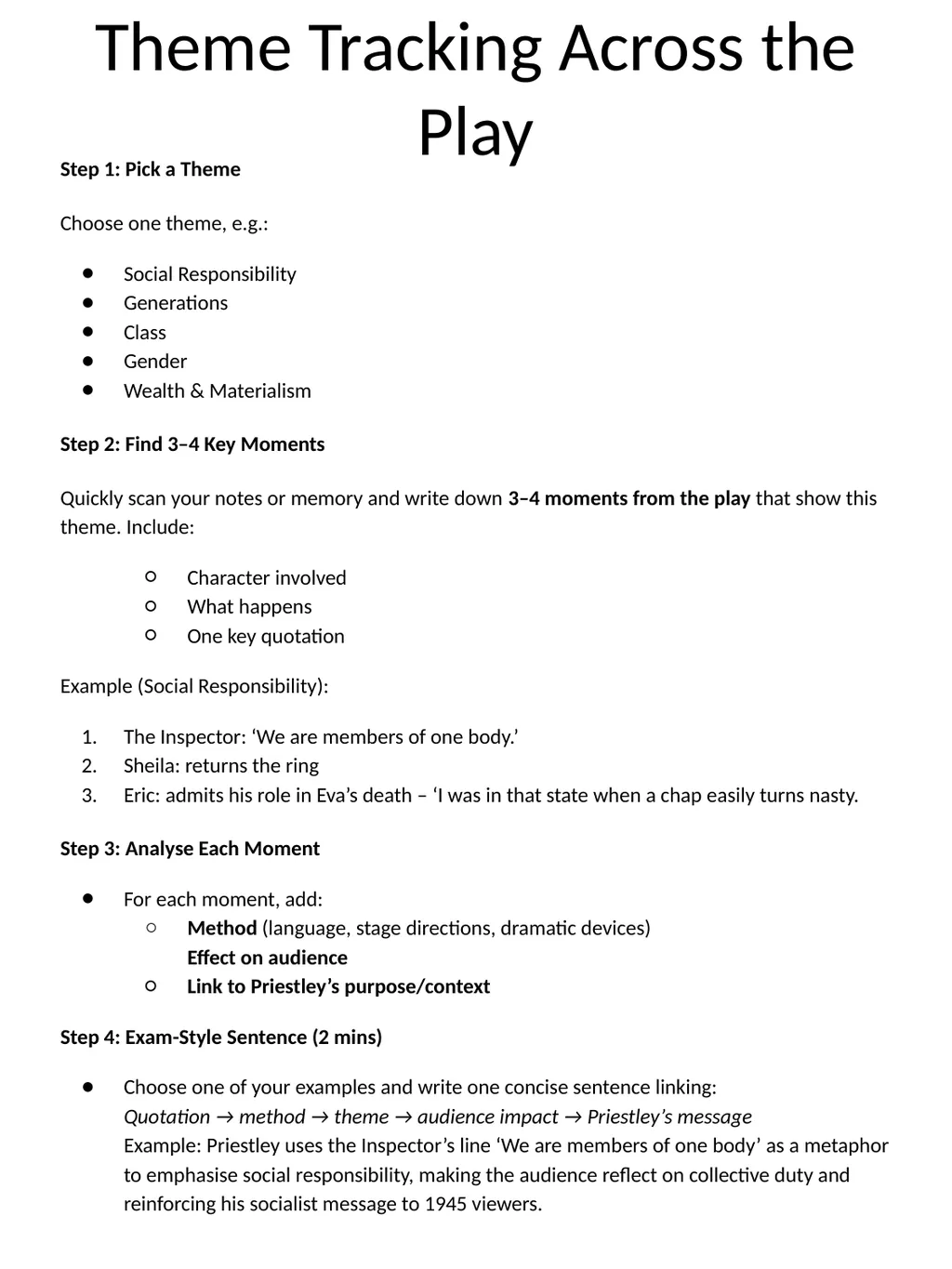
slide13. Theme Tracking Across the Play Step 1: Pick a Theme
Choose one theme, e.g.:
Social Responsibility
Generations
Class
Gender
Wealth & Materialism
Step 2: Find 3–4 Key Moments
Quickly scan your notes or memory and write down 3–4 moments from the play that show this theme. Include:
Character involved
What happens
One key quotation
Example (Social Responsibility):
The Inspector: ‘We are members of one body.’
Sheila: returns the ring
Eric: admits his role in Eva’s death – ‘I was in that state when a chap easily turns nasty.
Step 3: Analyse Each Moment
For each moment, add:
Method (language, stage directions, dramatic devices) Effect on audience
Link to Priestley’s purpose/context
Step 4: Exam-Style Sentence (2 mins)
Choose one of your examples and write one concise sentence linking: Quotation → method → theme → audience impact → Priestley’s message Example: Priestley uses the Inspector’s line ‘We are members of one body’ as a metaphor to emphasise social responsibility, making the audience reflect on collective duty and reinforcing his socialist message to 1945 viewers.<br>
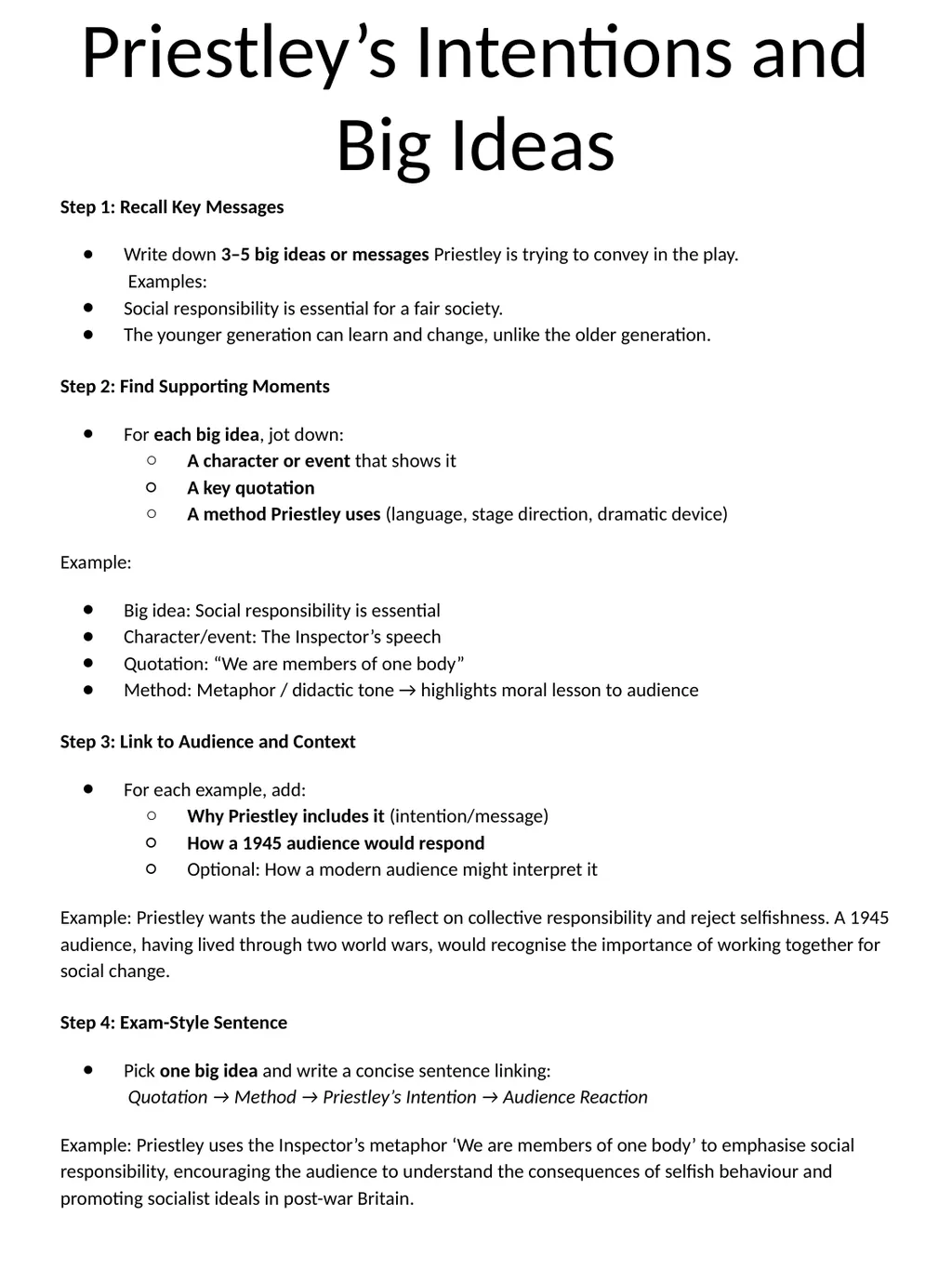
slide14. Priestley’s Intentions and Big Ideas Step 1: Recall Key Messages
Write down 3–5 big ideas or messages Priestley is trying to convey in the play. Examples:
Social responsibility is essential for a fair society.
The younger generation can learn and change, unlike the older generation.
Step 2: Find Supporting Moments
For each big idea, jot down:
A character or event that shows it
A key quotation
A method Priestley uses (language, stage direction, dramatic device)
Example:
Big idea: Social responsibility is essential
Character/event: The Inspector’s speech
Quotation: “We are members of one body”
Method: Metaphor / didactic tone → highlights moral lesson to audience
Step 3: Link to Audience and Context
For each example, add:
Why Priestley includes it (intention/message)
How a 1945 audience would respond
Optional: How a modern audience might interpret it
Example: Priestley wants the audience to reflect on collective responsibility and reject selfishness. A 1945 audience, having lived through two world wars, would recognise the importance of working together for social change.
Step 4: Exam-Style Sentence
Pick one big idea and write a concise sentence linking: Quotation → Method → Priestley’s Intention → Audience Reaction
Example: Priestley uses the Inspector’s metaphor ‘We are members of one body’ to emphasise social responsibility, encouraging the audience to understand the consequences of selfish behaviour and promoting socialist ideals in post-war Britain.<br>
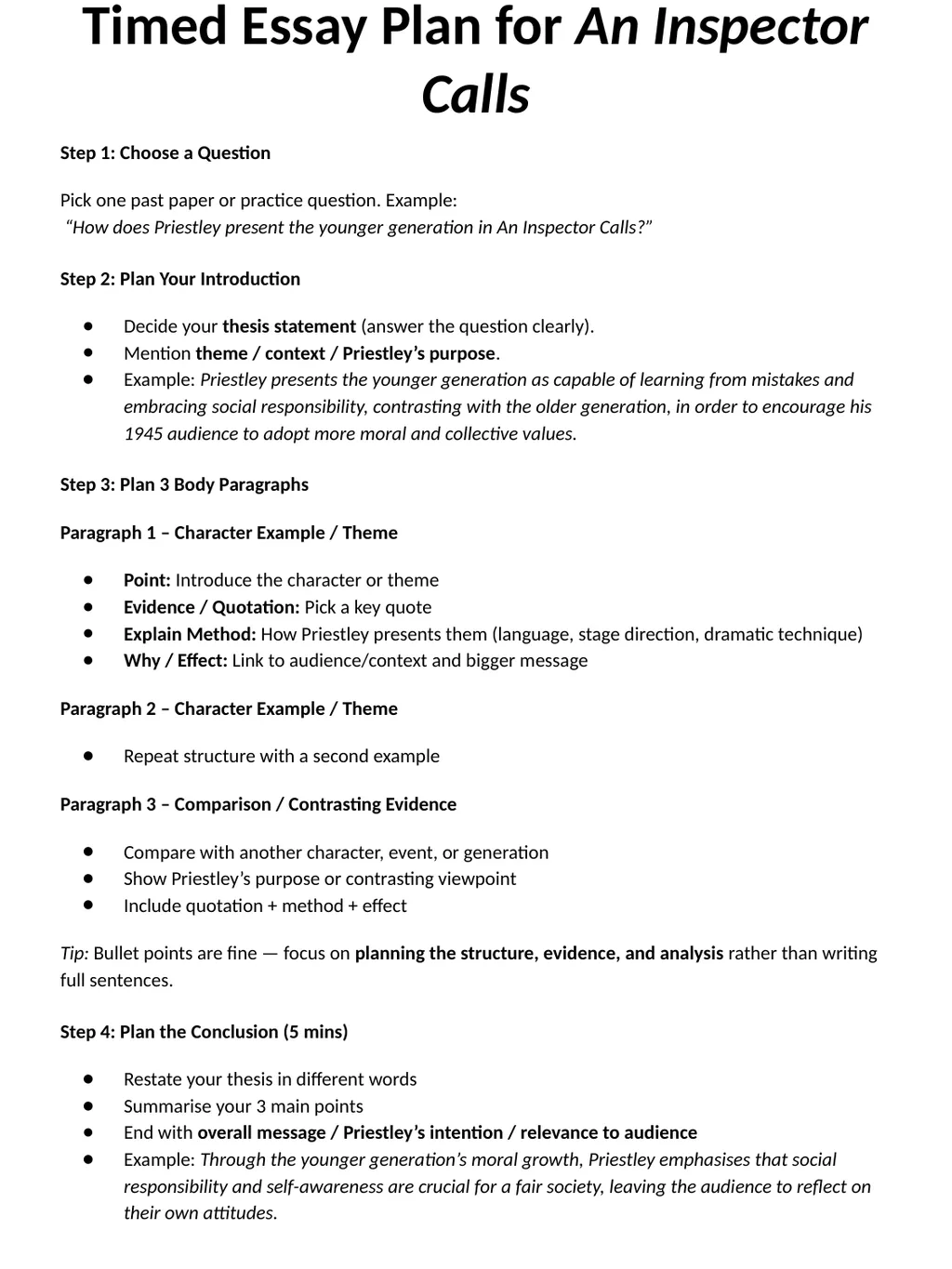
slide16. Timed Essay Plan for An Inspector Calls Step 1: Choose a Question
Pick one past paper or practice question. Example: “How does Priestley present the younger generation in An Inspector Calls?”
Step 2: Plan Your Introduction
Decide your thesis statement (answer the question clearly).
Mention theme / context / Priestley’s purpose.
Example: Priestley presents the younger generation as capable of learning from mistakes and embracing social responsibility, contrasting with the older generation, in order to encourage his 1945 audience to adopt more moral and collective values.
Step 3: Plan 3 Body Paragraphs
Paragraph 1 – Character Example / Theme
Point: Introduce the character or theme
Evidence / Quotation: Pick a key quote
Explain Method: How Priestley presents them (language, stage direction, dramatic technique)
Why / Effect: Link to audience/context and bigger message
Paragraph 2 – Character Example / Theme
Repeat structure with a second example
Paragraph 3 – Comparison / Contrasting Evidence
Compare with another character, event, or generation
Show Priestley’s purpose or contrasting viewpoint
Include quotation + method + effect
Tip: Bullet points are fine — focus on planning the structure, evidence, and analysis rather than writing full sentences.
Step 4: Plan the Conclusion (5 mins)
Restate your thesis in different words
Summarise your 3 main points
End with overall message / Priestley’s intention / relevance to audience
Example: Through the younger generation’s moral growth, Priestley emphasises that social responsibility and self-awareness are crucial for a fair society, leaving the audience to reflect on their own attitudes.<br>
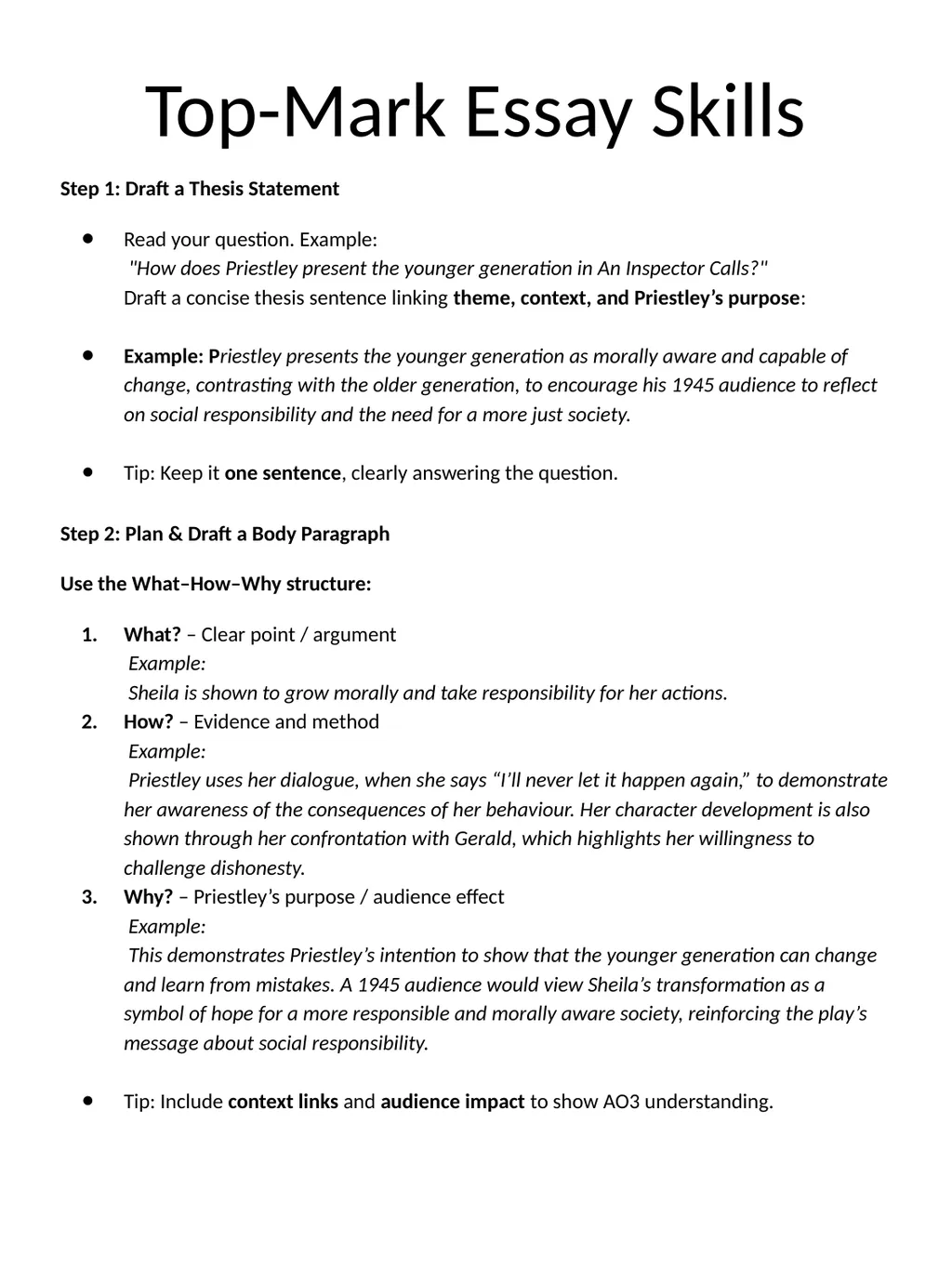
slide17. Top-Mark Essay Skills Step 1: Draft a Thesis Statement
Read your question. Example: "How does Priestley present the younger generation in An Inspector Calls?" Draft a concise thesis sentence linking theme, context, and Priestley’s purpose:
Example: Priestley presents the younger generation as morally aware and capable of change, contrasting with the older generation, to encourage his 1945 audience to reflect on social responsibility and the need for a more just society.
Tip: Keep it one sentence, clearly answering the question.
Step 2: Plan & Draft a Body Paragraph
Use the What–How–Why structure:
What? – Clear point / argument Example: Sheila is shown to grow morally and take responsibility for her actions.
How? – Evidence and method Example: Priestley uses her dialogue, when she says “I’ll never let it happen again,” to demonstrate her awareness of the consequences of her behaviour. Her character development is also shown through her confrontation with Gerald, which highlights her willingness to challenge dishonesty.
Why? – Priestley’s purpose / audience effect Example: This demonstrates Priestley’s intention to show that the younger generation can change and learn from mistakes. A 1945 audience would view Sheila’s transformation as a symbol of hope for a more responsible and morally aware society, reinforcing the play’s message about social responsibility.
Tip: Include context links and audience impact to show AO3 understanding.<br>
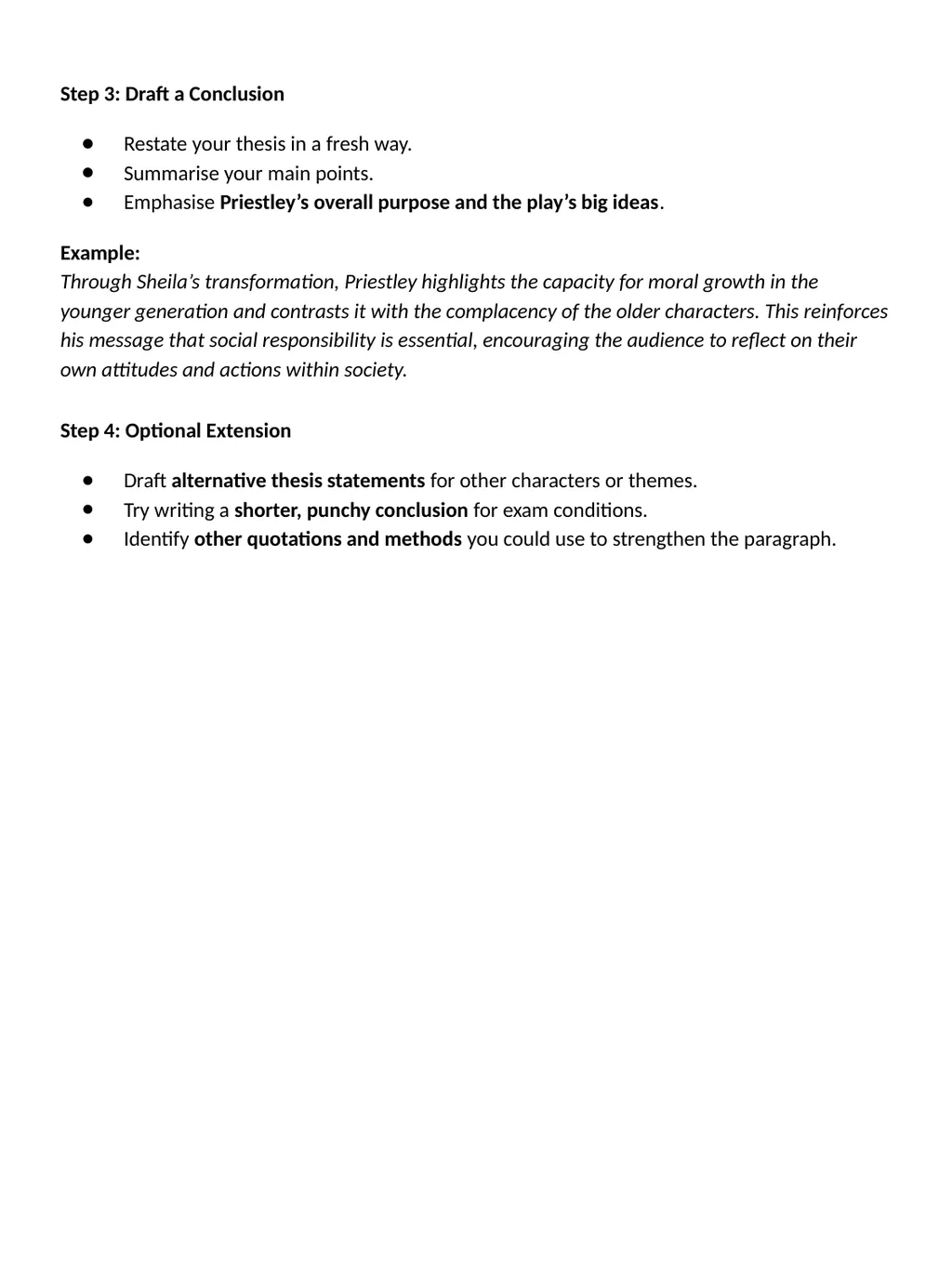
slide18. Step 3: Draft a Conclusion
Restate your thesis in a fresh way.
Summarise your main points.
Emphasise Priestley’s overall purpose and the play’s big ideas.
Example: Through Sheila’s transformation, Priestley highlights the capacity for moral growth in the younger generation and contrasts it with the complacency of the older characters. This reinforces his message that social responsibility is essential, encouraging the audience to reflect on their own attitudes and actions within society.
Step 4: Optional Extension
Draft alternative thesis statements for other characters or themes.
Try writing a shorter, punchy conclusion for exam conditions.
Identify other quotations and methods you could use to strengthen the paragraph.<br>
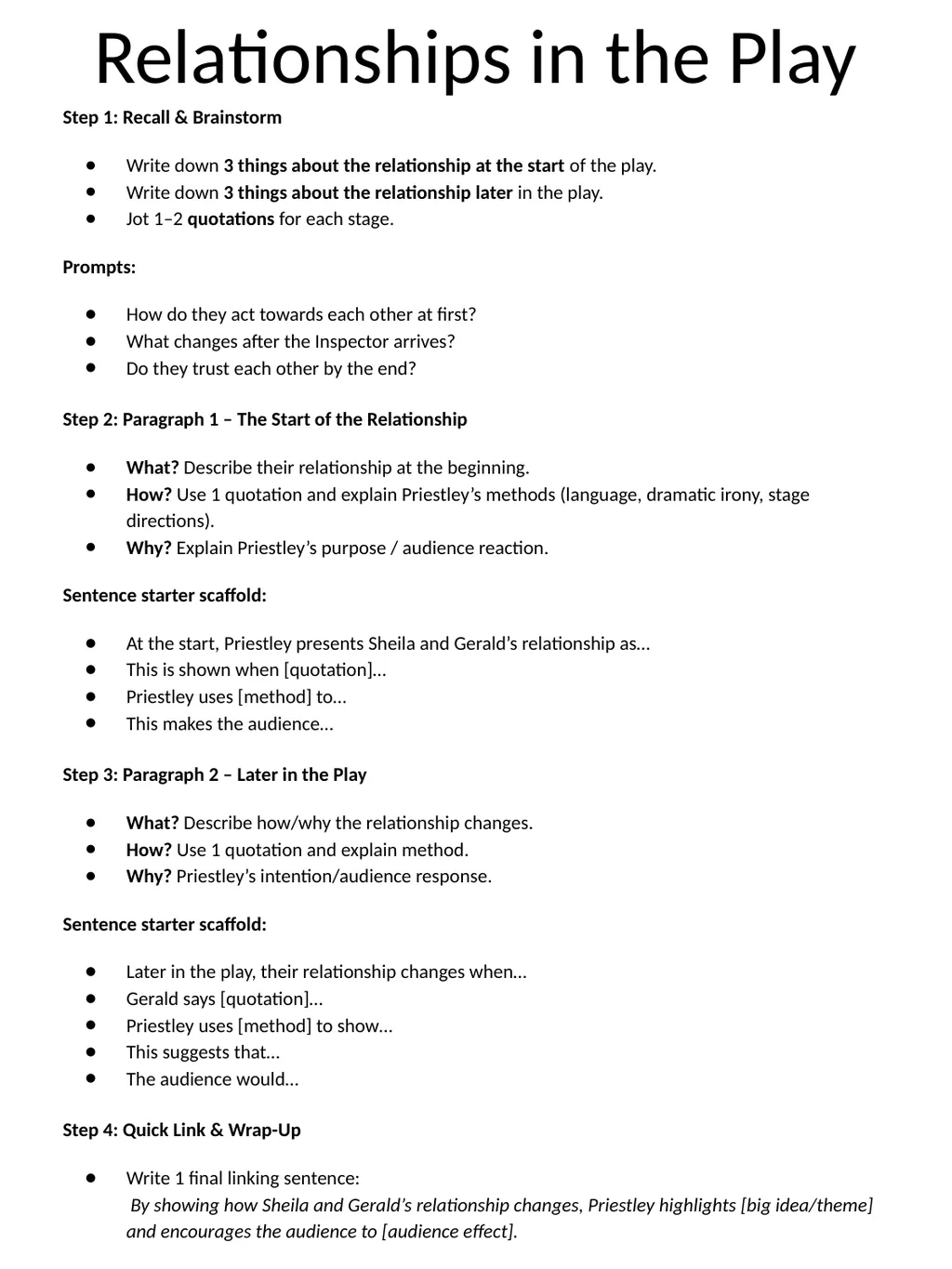
slide19. Relationships in the Play Step 1: Recall & Brainstorm
Write down 3 things about the relationship at the start of the play.
Write down 3 things about the relationship later in the play.
Jot 1–2 quotations for each stage.
Prompts:
How do they act towards each other at first?
What changes after the Inspector arrives?
Do they trust each other by the end?
Step 2: Paragraph 1 – The Start of the Relationship
What? Describe their relationship at the beginning.
How? Use 1 quotation and explain Priestley’s methods (language, dramatic irony, stage directions).
Why? Explain Priestley’s purpose / audience reaction.
Sentence starter scaffold:
At the start, Priestley presents Sheila and Gerald’s relationship as…
This is shown when [quotation]…
Priestley uses [method] to…
This makes the audience…
Step 3: Paragraph 2 – Later in the Play
What? Describe how/why the relationship changes.
How? Use 1 quotation and explain method.
Why? Priestley’s intention/audience response.
Sentence starter scaffold:
Later in the play, their relationship changes when…
Gerald says [quotation]…
Priestley uses [method] to show…
This suggests that…
The audience would…
Step 4: Quick Link & Wrap-Up
Write 1 final linking sentence: By showing how Sheila and Gerald’s relationship changes, Priestley highlights [big idea/theme] and encourages the audience to [audience effect].<br>
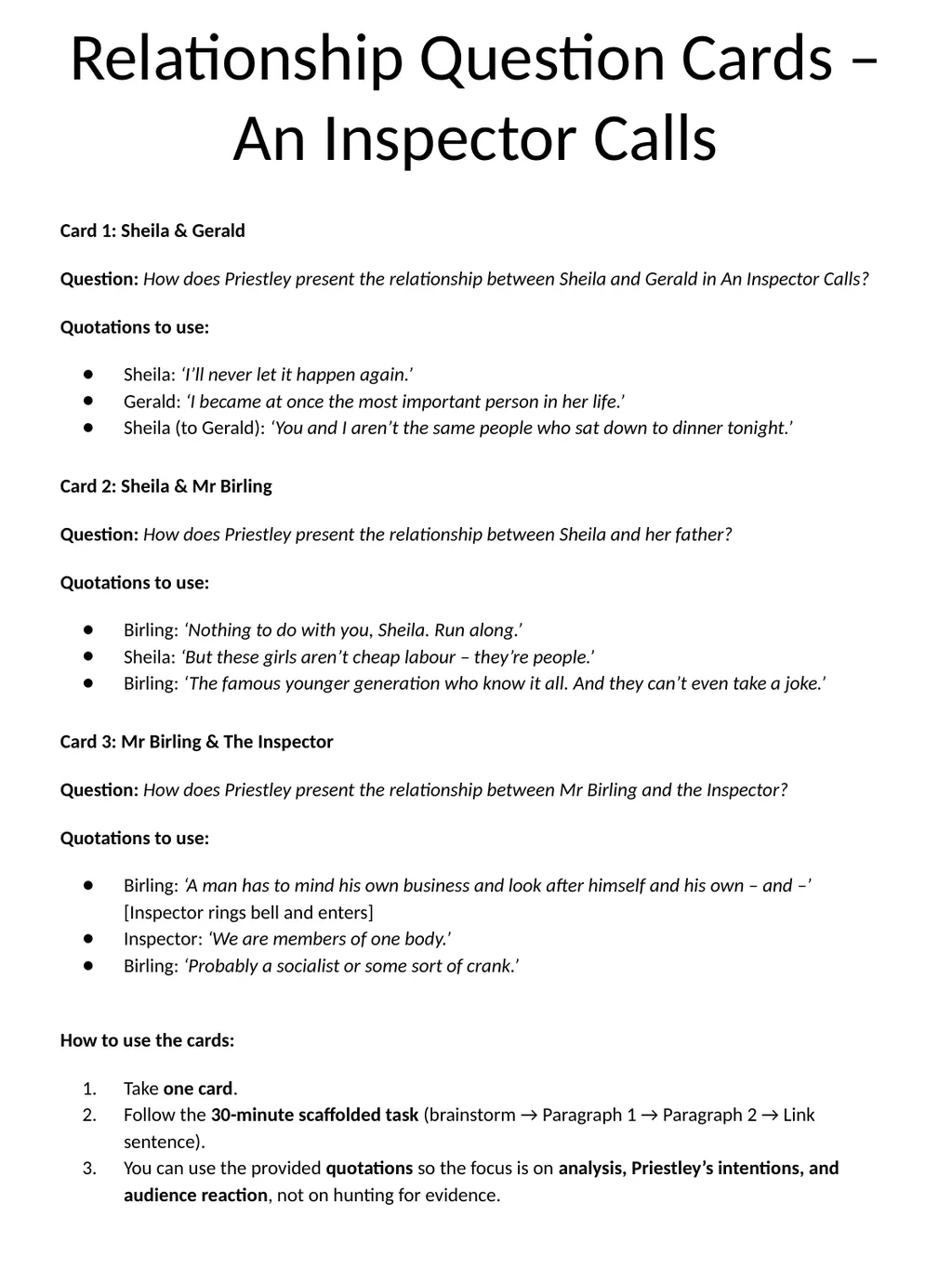
slide20. Relationship Question Cards – An Inspector Calls Card 1: Sheila & Gerald
Question: How does Priestley present the relationship between Sheila and Gerald in An Inspector Calls?
Quotations to use:
Sheila: ‘I’ll never let it happen again.’
Gerald: ‘I became at once the most important person in her life.’
Sheila (to Gerald): ‘You and I aren’t the same people who sat down to dinner tonight.’
Card 2: Sheila & Mr Birling
Question: How does Priestley present the relationship between Sheila and her father?
Quotations to use:
Birling: ‘Nothing to do with you, Sheila. Run along.’
Sheila: ‘But these girls aren’t cheap labour – they’re people.’
Birling: ‘The famous younger generation who know it all. And they can’t even take a joke.’
Card 3: Mr Birling & The Inspector
Question: How does Priestley present the relationship between Mr Birling and the Inspector?
Quotations to use:
Birling: ‘A man has to mind his own business and look after himself and his own – and –’ [Inspector rings bell and enters]
Inspector: ‘We are members of one body.’
Birling: ‘Probably a socialist or some sort of crank.’
How to use the cards:
Take one card.
Follow the 30-minute scaffolded task (brainstorm → Paragraph 1 → Paragraph 2 → Link sentence).
You can use the provided quotations so the focus is on analysis, Priestley’s intentions, and audience reaction, not on hunting for evidence.<br>
slide21. Theme: Social Class Task Goal: To make a visual flowchart linking 3 characters and how Priestley critiques class.
Step 1 – Set up your page
Draw 3 large boxes (one for each character).
Suggested: Mr Birling / Eva Smith / The Inspector (or Sheila if you prefer).
Step 2 – Add Key Evidence
Inside each box, jot down:
1 short quotation
1 or 2 keywords about method (e.g. dramatic irony, symbolism)
A quick note on Priestley’s message
Example for Mr Birling:
Quote: ‘Unsinkable, absolutely unsinkable.’
Method: Dramatic irony
Message: Priestley critiques arrogant upper-class attitudes
Step 3 – Connect with Arrows
Draw arrows between the boxes to show relationships:
Birling → Eva = Exploitation of the working class
Eva → Inspector = Symbol of injustice → call for change
Inspector → Birling = Clash of capitalist vs socialist views
Write short notes on the arrows to show the link.
Step 4 – Add Themes/Big Ideas
Around the outside of the flowchart, jot theme keywords:
Capitalism vs Socialism
Exploitation
Responsibility
Inequality
Then add a one-sentence summary at the bottom: Priestley uses characters across the class spectrum to show how inequality causes suffering and why society must change.<br>
slide22. Overview and Key Scenes Wall Chart Step 1 – Divide Your Poster
Title: An Inspector Calls – Key Scenes & Themes
Split your poster into 5–6 key scenes (boxes, timeline, or flow diagram). Suggested scenes:
Birling’s opening speech (Act 1)
Sheila’s interrogation (Act 1)
Gerald’s affair revealed (Act 2)
Mrs Birling’s confrontation (Act 2)
Eric’s confession (Act 3)
The Inspector’s final speech (Act 3)
Step 2 – Fill in Scene Boxes
For each scene, add three layers of notes:
Characters: Who’s central in this scene? How do they develop/change?
e.g. Act 1, Sheila: naïve - begins questioning her role.
Themes: Which theme(s) are explored?
e.g. Birling’s speech = capitalism vs socialism, dramatic irony.
Context/Intentions: How does this connect to 1912 (set) / 1945 (audience)?
e.g. Birling’s ‘unsinkable’ speech - exposes arrogance of ruling class.
You can use different colours (e.g. blue for characters, red for themes, green for context).
Step 3 – Add Quick Quotations
Pick 1–2 short quotations per scene.
Write them directly into the boxes so they’re easy to see for revision.
e.g. Act 2, Sheila: ‘You mustn’t try to build up a wall between us and that girl.’
Step 4 – Final Touches
Draw links/arrows between scenes (e.g. Sheila changes here - contrasts with Birling later).
Add a Priestley’s Purpose box at the bottom: Priestley uses the play to argue for social responsibility and challenge the class system.
Decorate with symbols/visual cues (e.g. factory = capitalism, scale = social responsibility).<br>
slide23. Character Profile Revision Cards Step 1 – Choose Characters
Pick any two contrasting characters (e.g. Sheila vs Mr Birling, or Gerald vs Eva).
Step 2 – Create Card Layout
Each card should have:
Character Overview (top) – Who they are, their role.
Key Quotations (middle left) – At least 4 short, exam-ready quotes.
Development (middle right) – How they change (or fail to change).
Themes/Big Ideas (bottom left) – What Priestley critiques through them.
Context / Purpose (bottom right) – 1912/1945 link + Priestley’s intention.
Challenging Vocabulary Bank (edge of card) – e.g. microcosm, didactic, subverts, exposes, hypocrisy.
Step 3 – Fill in the First Card
Model and further steps on the next page.<br>
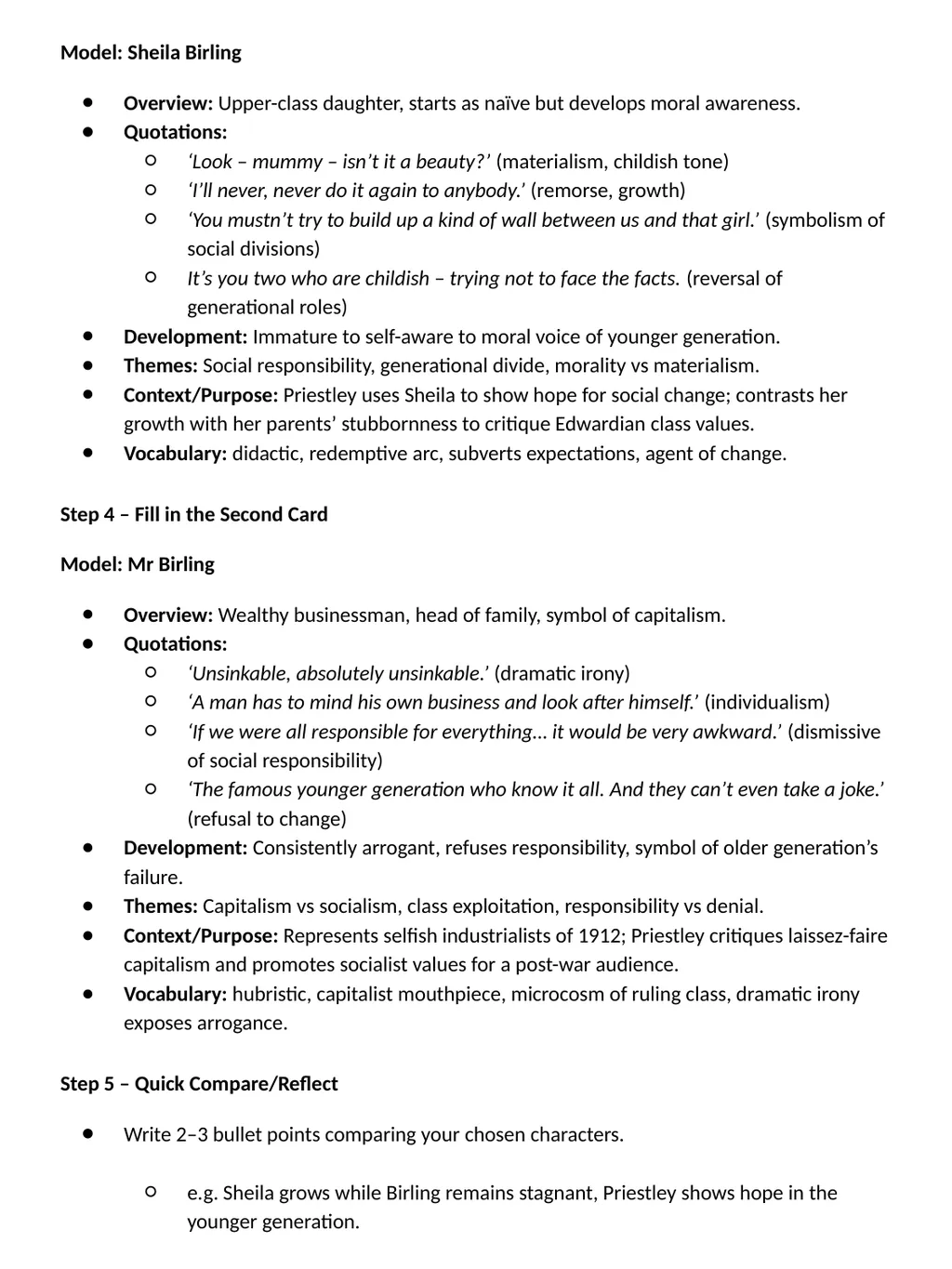
slide24. Model: Sheila Birling
Overview: Upper-class daughter, starts as naïve but develops moral awareness.
Quotations:
‘Look – mummy – isn’t it a beauty?’ (materialism, childish tone)
‘I’ll never, never do it again to anybody.’ (remorse, growth)
‘You mustn’t try to build up a kind of wall between us and that girl.’ (symbolism of social divisions)
It’s you two who are childish – trying not to face the facts. (reversal of generational roles)
Development: Immature to self-aware to moral voice of younger generation.
Themes: Social responsibility, generational divide, morality vs materialism.
Context/Purpose: Priestley uses Sheila to show hope for social change; contrasts her growth with her parents’ stubbornness to critique Edwardian class values.
Vocabulary: didactic, redemptive arc, subverts expectations, agent of change.
Step 4 – Fill in the Second Card
Model: Mr Birling
Overview: Wealthy businessman, head of family, symbol of capitalism.
Quotations:
‘Unsinkable, absolutely unsinkable.’ (dramatic irony)
‘A man has to mind his own business and look after himself.’ (individualism)
‘If we were all responsible for everything… it would be very awkward.’ (dismissive of social responsibility)
‘The famous younger generation who know it all. And they can’t even take a joke.’ (refusal to change)
Development: Consistently arrogant, refuses responsibility, symbol of older generation’s failure.
Themes: Capitalism vs socialism, class exploitation, responsibility vs denial.
Context/Purpose: Represents selfish industrialists of 1912; Priestley critiques laissez-faire capitalism and promotes socialist values for a post-war audience.
Vocabulary: hubristic, capitalist mouthpiece, microcosm of ruling class, dramatic irony exposes arrogance.
Step 5 – Quick Compare/Reflect
Write 2–3 bullet points comparing your chosen characters.
e.g. Sheila grows while Birling remains stagnant, Priestley shows hope in the younger generation.<br>
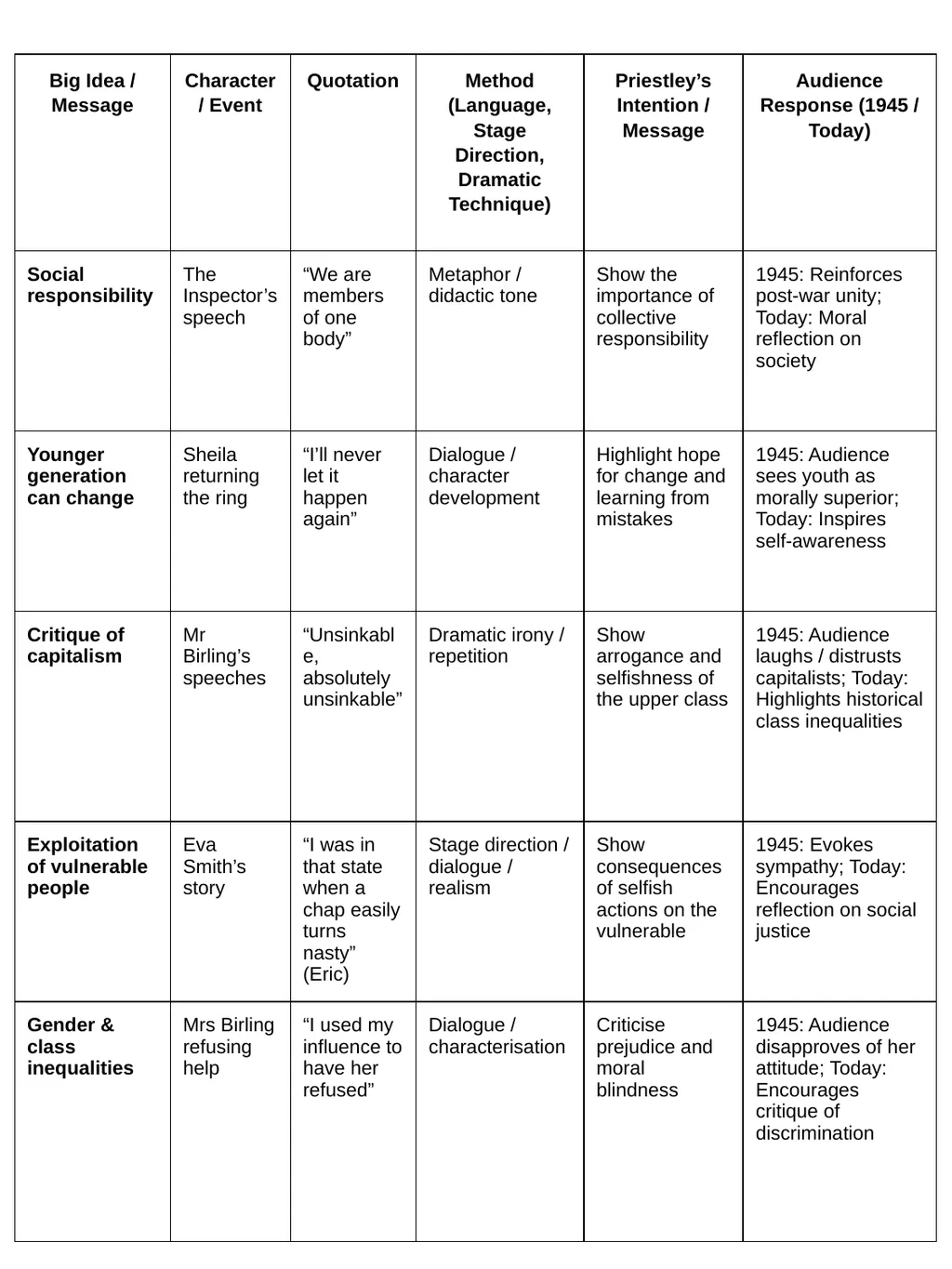
slide25. Themes Comparison Grid Step 1 – Set up the Grid
Draw a table with columns:
Theme | Characters linked | Key Quotations | Key Scenes | Priestley’s Purpose/Context
Step 2 – Select Themes
Use the main GCSE themes:
Capitalism vs Socialism
Exploitation
Gender
Generations: Young vs Old
Social Class
Social Responsibility
Wealth and Materialism
Step 3 – Fill in the Grid - model below:
Step 4 – Quick Compare/Reflect
Pick two themes that overlap (e.g. Social Class + Exploitation).
Write 3 bullet points showing how they connect.
Eva’s treatment by Birling = class exploitation → Priestley critiques inequality.
Sheila’s response bridges class divide → Priestley shows change is possible.<br>
slide26. Exam Preparation<br>
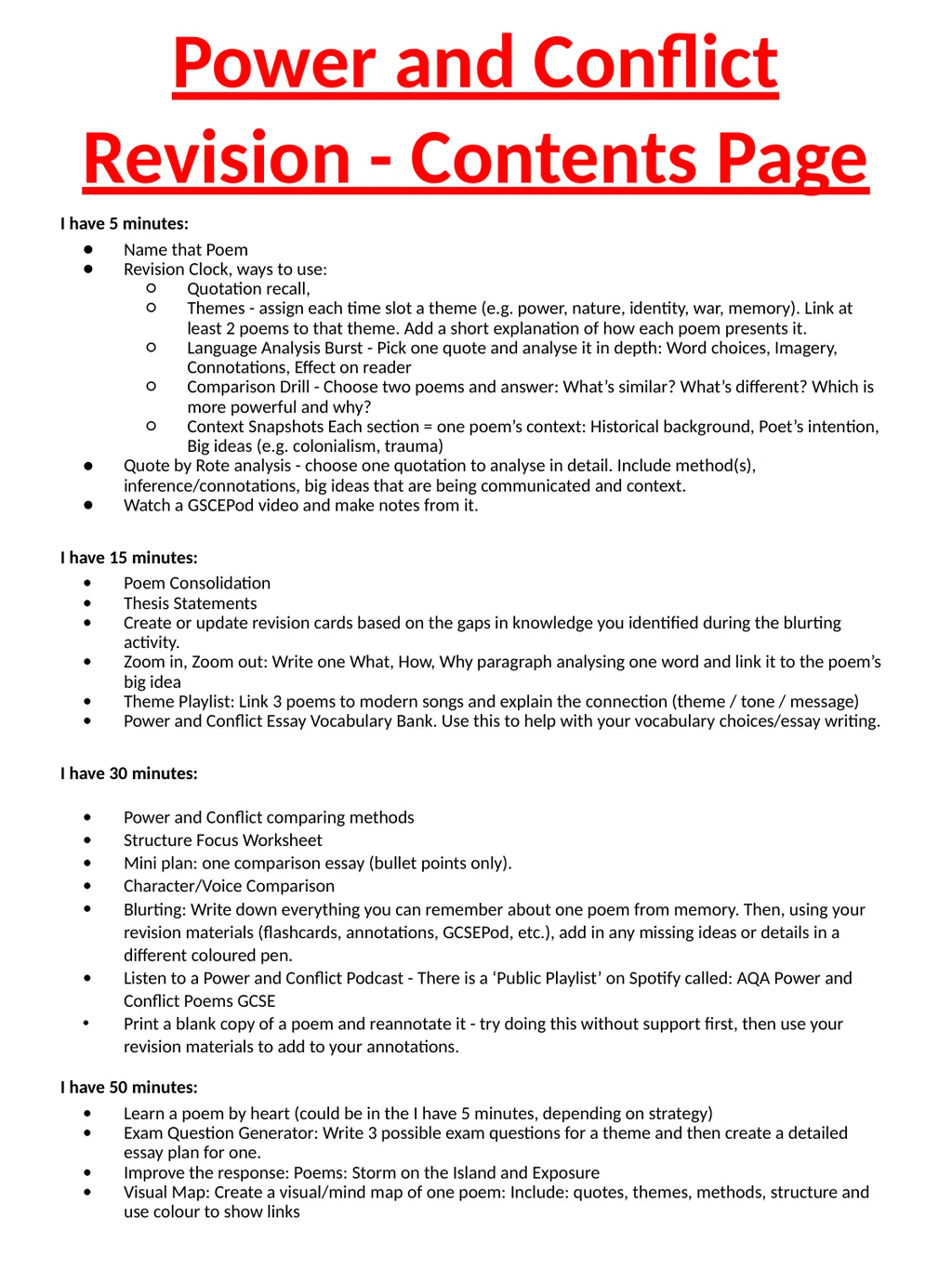
slide30. Power and Conflict Revision - Contents Page I have 5 minutes:
Name that Poem
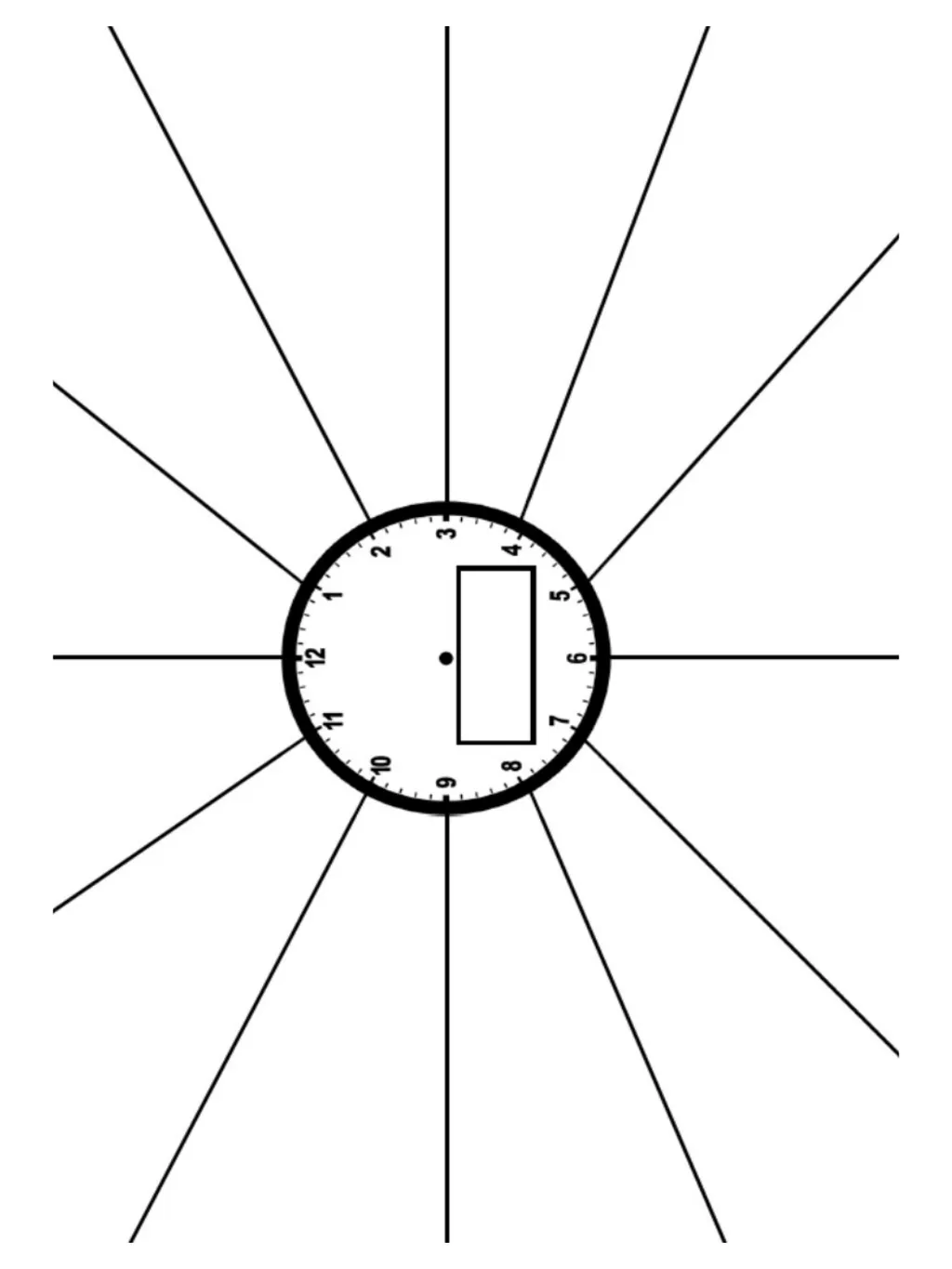
Revision Clock, ways to use:
Quotation recall,
Themes - assign each time slot a theme (e.g. power, nature, identity, war, memory). Link at least 2 poems to that theme. Add a short explanation of how each poem presents it.
Language Analysis Burst - Pick one quote and analyse it in depth: Word choices, Imagery, Connotations, Effect on reader
Comparison Drill - Choose two poems and answer: What’s similar? What’s different? Which is more powerful and why?
Context Snapshots Each section = one poem’s context: Historical background, Poet’s intention, Big ideas (e.g. colonialism, trauma)
Quote by Rote analysis - choose one quotation to analyse in detail. Include method(s), inference/connotations, big ideas that are being communicated and context.
Watch a GSCEPod video and make notes from it.
I have 15 minutes:
Poem Consolidation
Thesis Statements
Create or update revision cards based on the gaps in knowledge you identified during the blurting activity.
Zoom in, Zoom out: Write one What, How, Why paragraph analysing one word and link it to the poem’s big idea
Theme Playlist: Link 3 poems to modern songs and explain the connection (theme / tone / message)
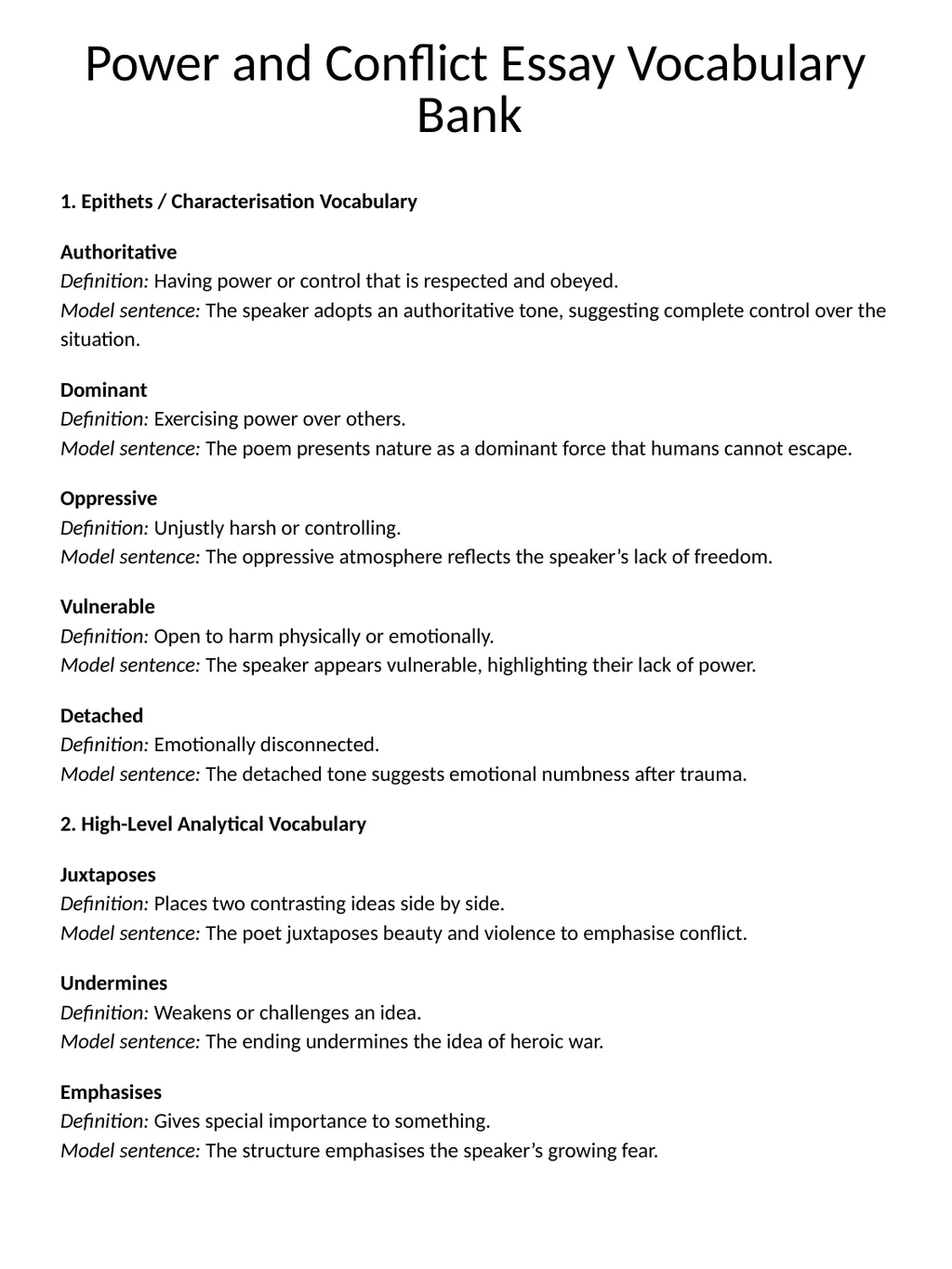
Power and Conflict Essay Vocabulary Bank. Use this to help with your vocabulary choices/essay writing.
I have 30 minutes:
Power and Conflict comparing methods
Structure Focus Worksheet
Mini plan: one comparison essay (bullet points only).
Character/Voice Comparison
Blurting: Write down everything you can remember about one poem from memory. Then, using your revision materials (flashcards, annotations, GCSEPod, etc.), add in any missing ideas or details in a different coloured pen.
Listen to a Power and Conflict Podcast - There is a ‘Public Playlist’ on Spotify called: AQA Power and Conflict Poems GCSE
Print a blank copy of a poem and reannotate it - try doing this without support first, then use your revision materials to add to your annotations.
I have 50 minutes:
Learn a poem by heart (could be in the I have 5 minutes, depending on strategy)
Exam Question Generator: Write 3 possible exam questions for a theme and then create a detailed essay plan for one.
Improve the response: Poems: Storm on the Island and Exposure
Visual Map: Create a visual/mind map of one poem: Include: quotes, themes, methods, structure and use colour to show links<br>
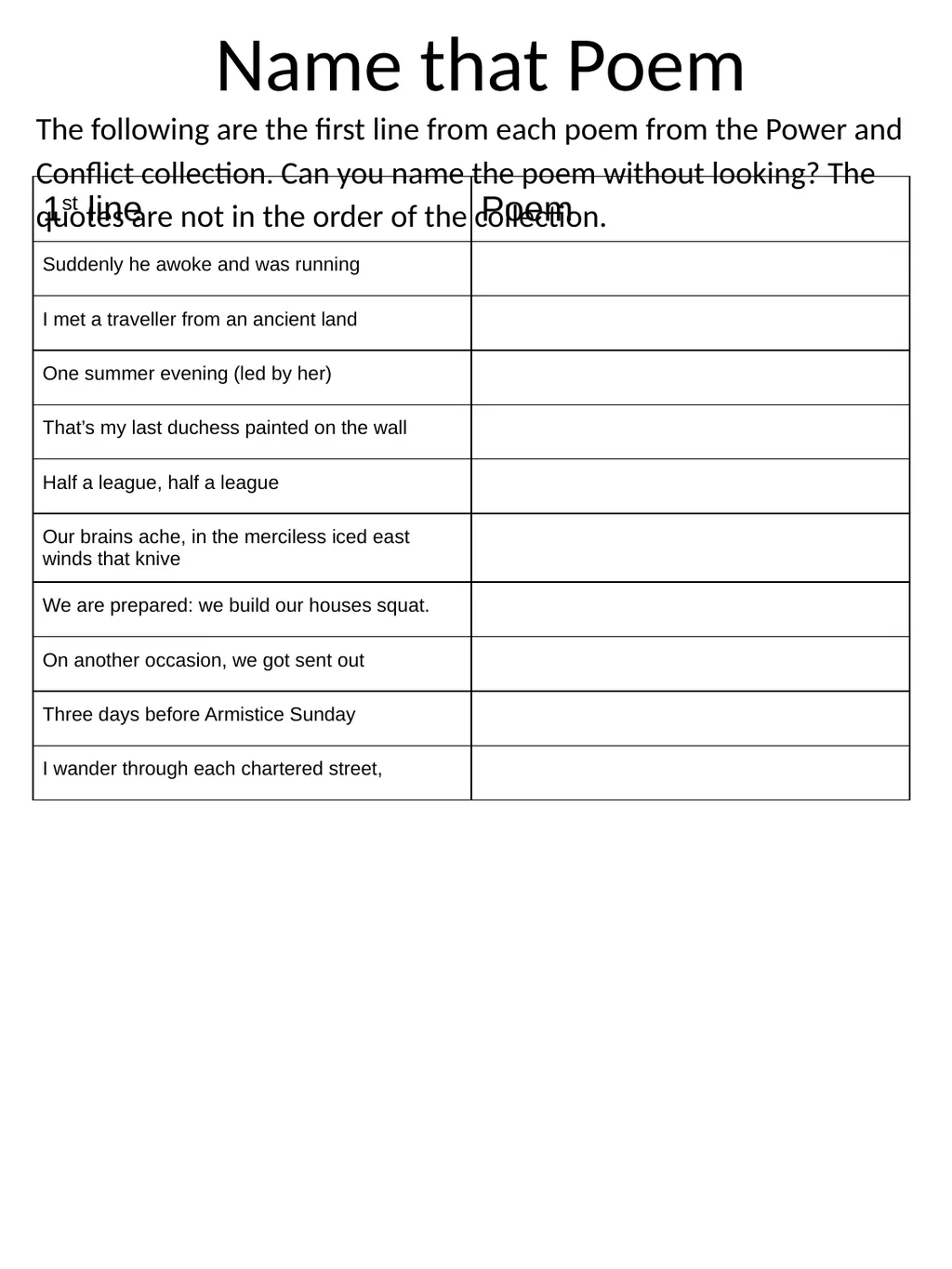
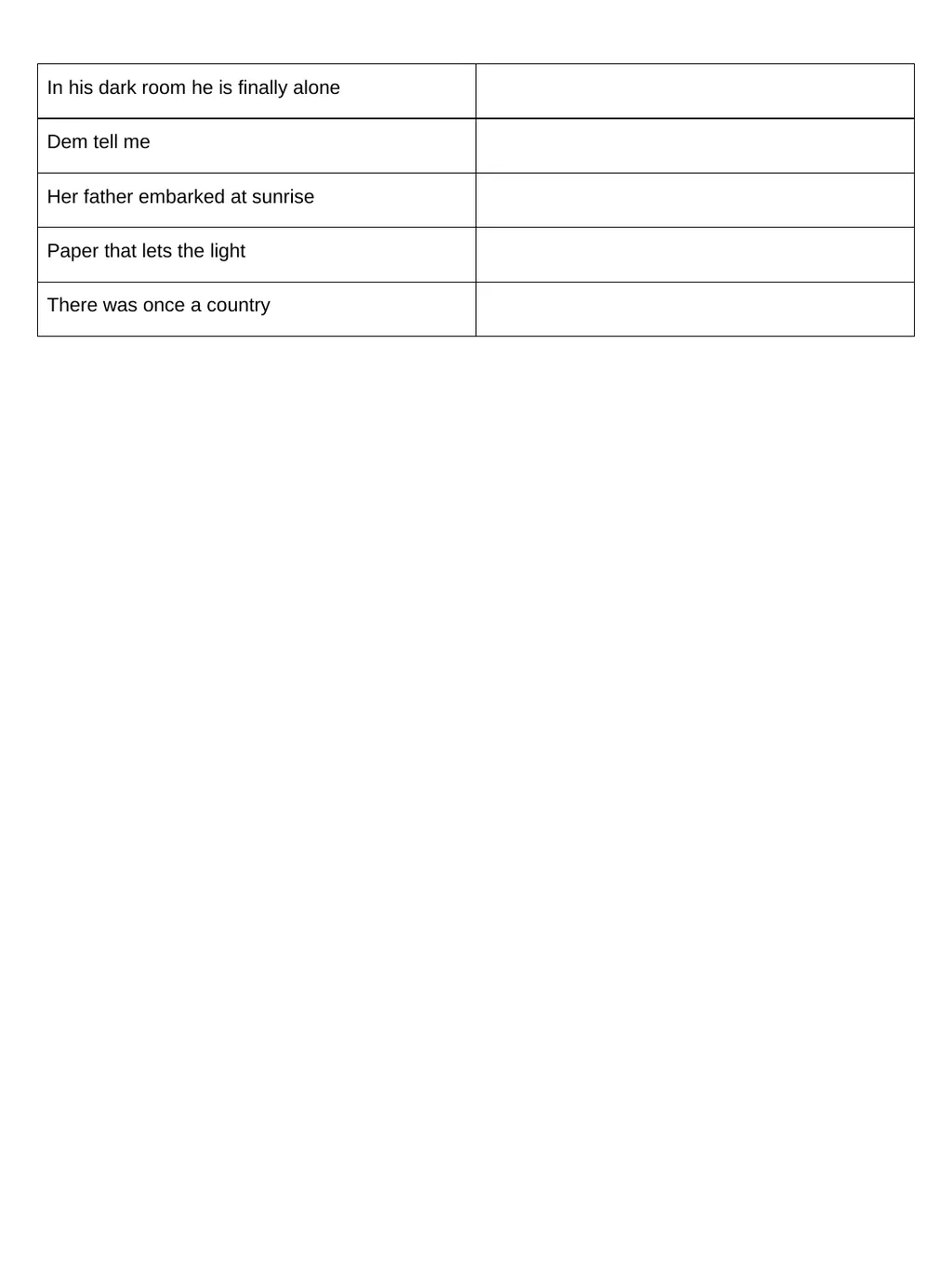
slide31. Name that Poem The following are the first line from each poem from the Power and Conflict collection. Can you name the poem without looking? The quotes are not in the order of the collection.<br>
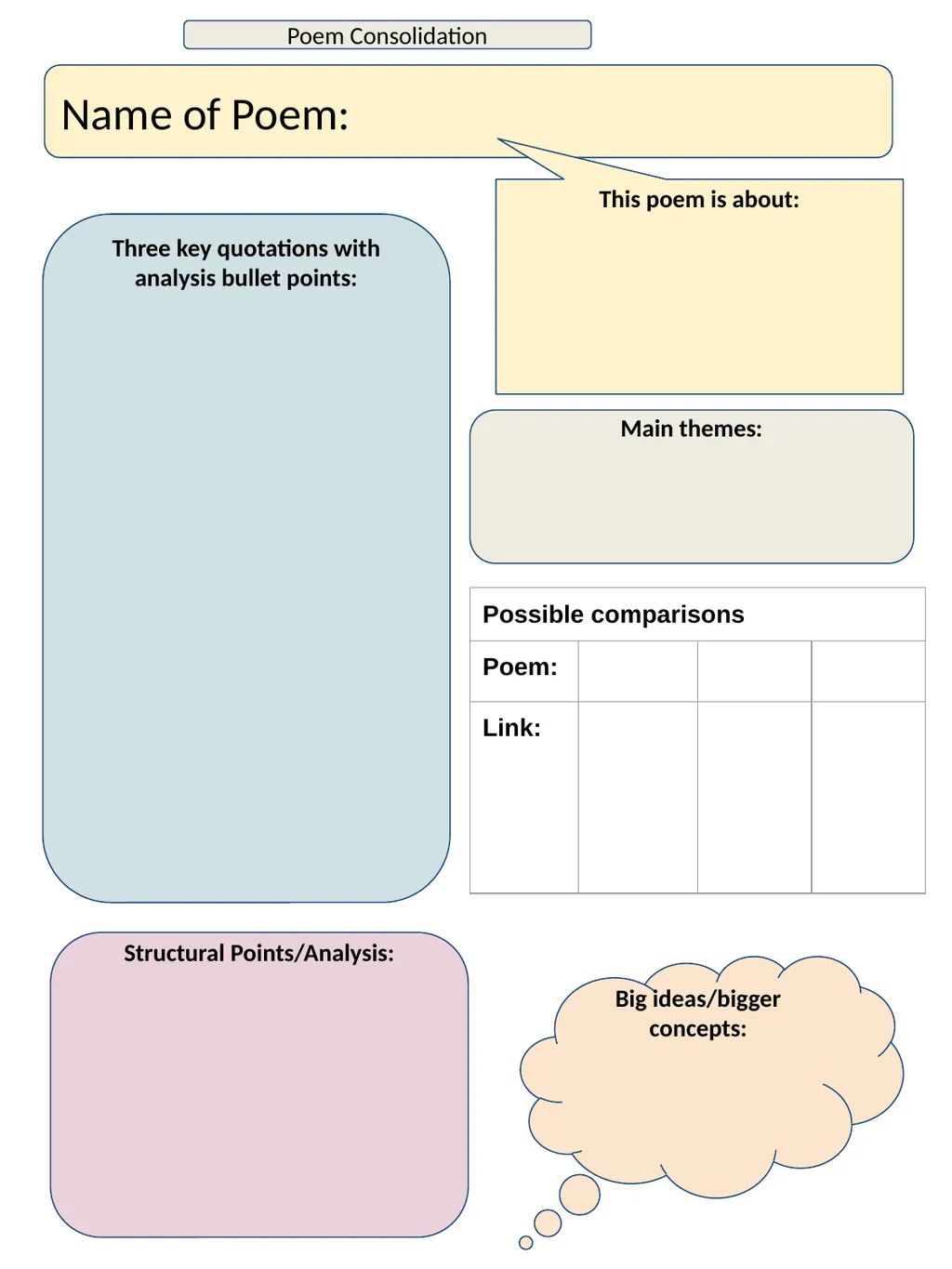
slide34. Name of Poem: Three key quotations with analysis bullet points: Structural Points/Analysis: This poem is about: Big ideas/bigger concepts: Main themes: Poem Consolidation<br>
slide35. Power and Conflict Essay Vocabulary Bank 1. Epithets / Characterisation Vocabulary
Authoritative Definition: Having power or control that is respected and obeyed. Model sentence: The speaker adopts an authoritative tone, suggesting complete control over the situation.
Dominant Definition: Exercising power over others. Model sentence: The poem presents nature as a dominant force that humans cannot escape.
Oppressive Definition: Unjustly harsh or controlling. Model sentence: The oppressive atmosphere reflects the speaker’s lack of freedom.
Vulnerable Definition: Open to harm physically or emotionally. Model sentence: The speaker appears vulnerable, highlighting their lack of power.
Detached Definition: Emotionally disconnected. Model sentence: The detached tone suggests emotional numbness after trauma.
2. High-Level Analytical Vocabulary
Juxtaposes Definition: Places two contrasting ideas side by side. Model sentence: The poet juxtaposes beauty and violence to emphasise conflict.
Undermines Definition: Weakens or challenges an idea. Model sentence: The ending undermines the idea of heroic war.
Emphasises Definition: Gives special importance to something. Model sentence: The structure emphasises the speaker’s growing fear.<br>
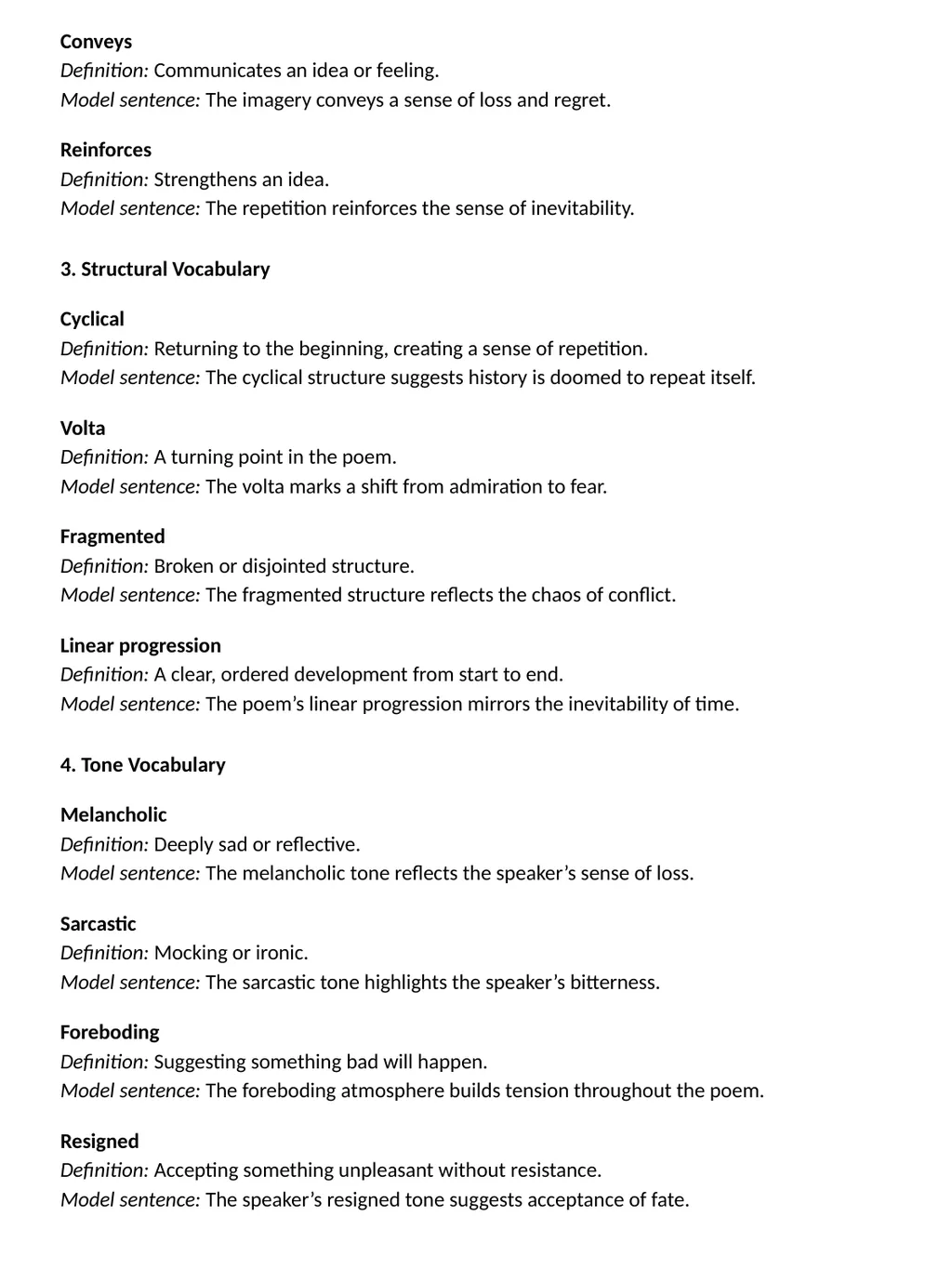
slide36. Conveys Definition: Communicates an idea or feeling. Model sentence: The imagery conveys a sense of loss and regret.
Reinforces Definition: Strengthens an idea. Model sentence: The repetition reinforces the sense of inevitability.
3. Structural Vocabulary
Cyclical Definition: Returning to the beginning, creating a sense of repetition. Model sentence: The cyclical structure suggests history is doomed to repeat itself.
Volta Definition: A turning point in the poem. Model sentence: The volta marks a shift from admiration to fear.
Fragmented Definition: Broken or disjointed structure. Model sentence: The fragmented structure reflects the chaos of conflict.
Linear progression Definition: A clear, ordered development from start to end. Model sentence: The poem’s linear progression mirrors the inevitability of time.
4. Tone Vocabulary
Melancholic Definition: Deeply sad or reflective. Model sentence: The melancholic tone reflects the speaker’s sense of loss.
Sarcastic Definition: Mocking or ironic. Model sentence: The sarcastic tone highlights the speaker’s bitterness.
Foreboding Definition: Suggesting something bad will happen. Model sentence: The foreboding atmosphere builds tension throughout the poem.
Resigned Definition: Accepting something unpleasant without resistance. Model sentence: The speaker’s resigned tone suggests acceptance of fate.<br>
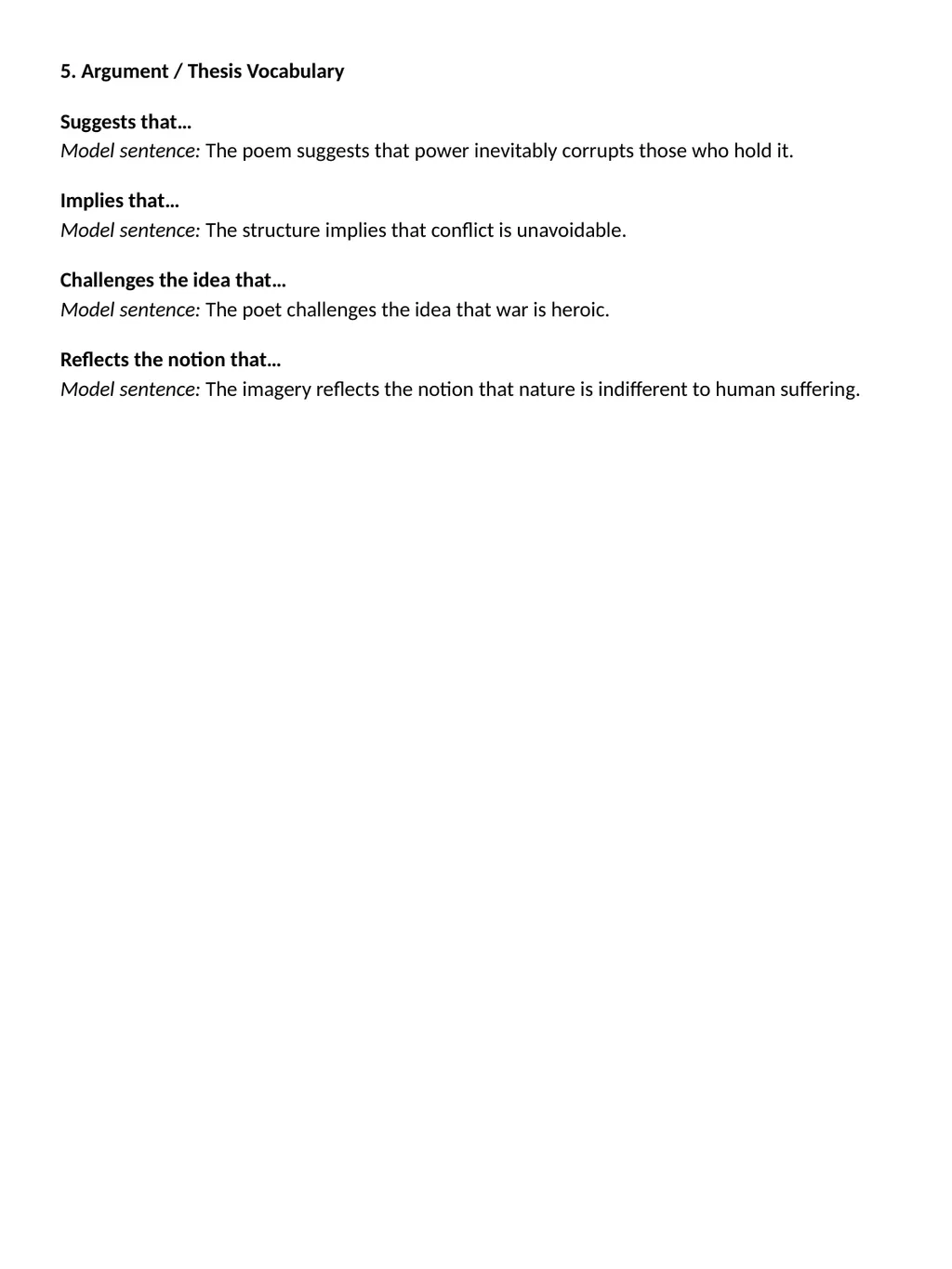
slide37. 5. Argument / Thesis Vocabulary
Suggests that… Model sentence: The poem suggests that power inevitably corrupts those who hold it.
Implies that… Model sentence: The structure implies that conflict is unavoidable.
Challenges the idea that… Model sentence: The poet challenges the idea that war is heroic.
Reflects the notion that… Model sentence: The imagery reflects the notion that nature is indifferent to human suffering.<br>
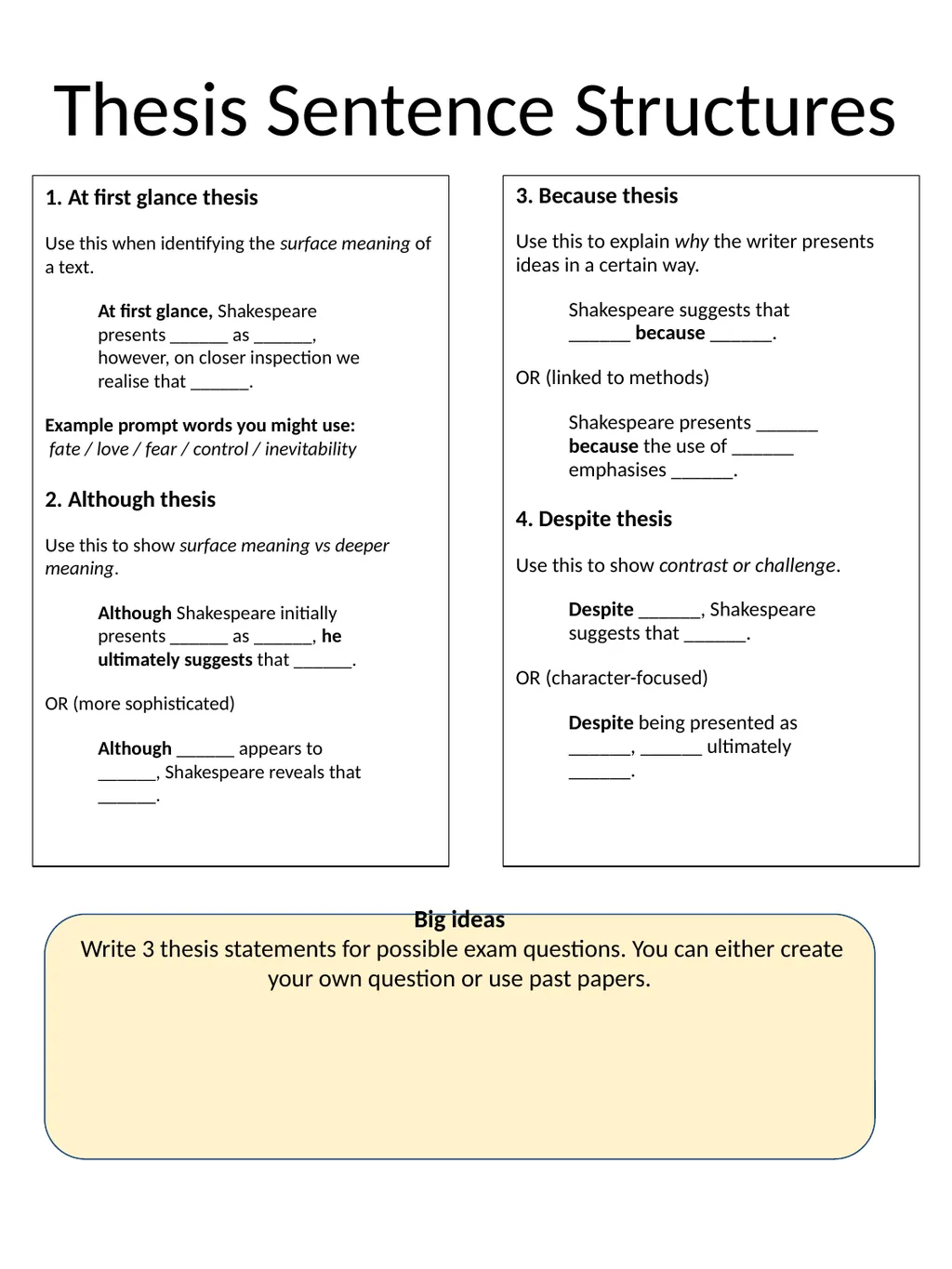
slide38. Thesis Sentence Structures 1. At first glance thesis
Use this when identifying the surface meaning of a text.
At first glance, Shakespeare presents ______ as ______, however, on closer inspection we realise that ______.
Example prompt words you might use: fate / love / fear / control / inevitability
2. Although thesis
Use this to show surface meaning vs deeper meaning.
Although Shakespeare initially presents ______ as ______, he ultimately suggests that ______.
OR (more sophisticated)
Although ______ appears to ______, Shakespeare reveals that ______. 3. Because thesis
Use this to explain why the writer presents ideas in a certain way.
Shakespeare suggests that ______ because ______.
OR (linked to methods)
Shakespeare presents ______ because the use of ______ emphasises ______.
4. Despite thesis
Use this to show contrast or challenge.
Despite ______, Shakespeare suggests that ______.
OR (character-focused)
Despite being presented as ______, ______ ultimately ______. Big ideas
Write 3 thesis statements for possible exam questions. You can either create your own question or use past papers.<br>
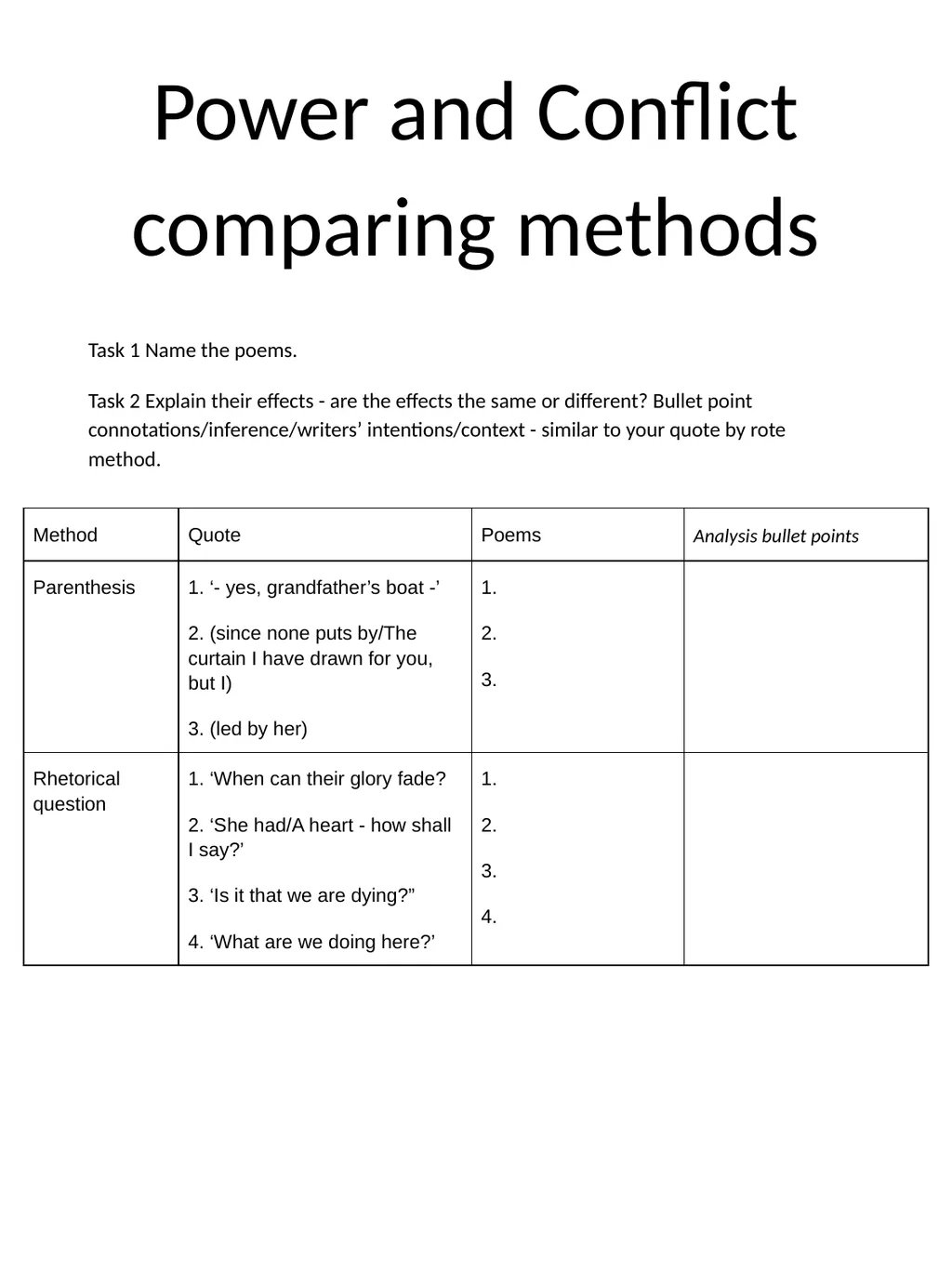
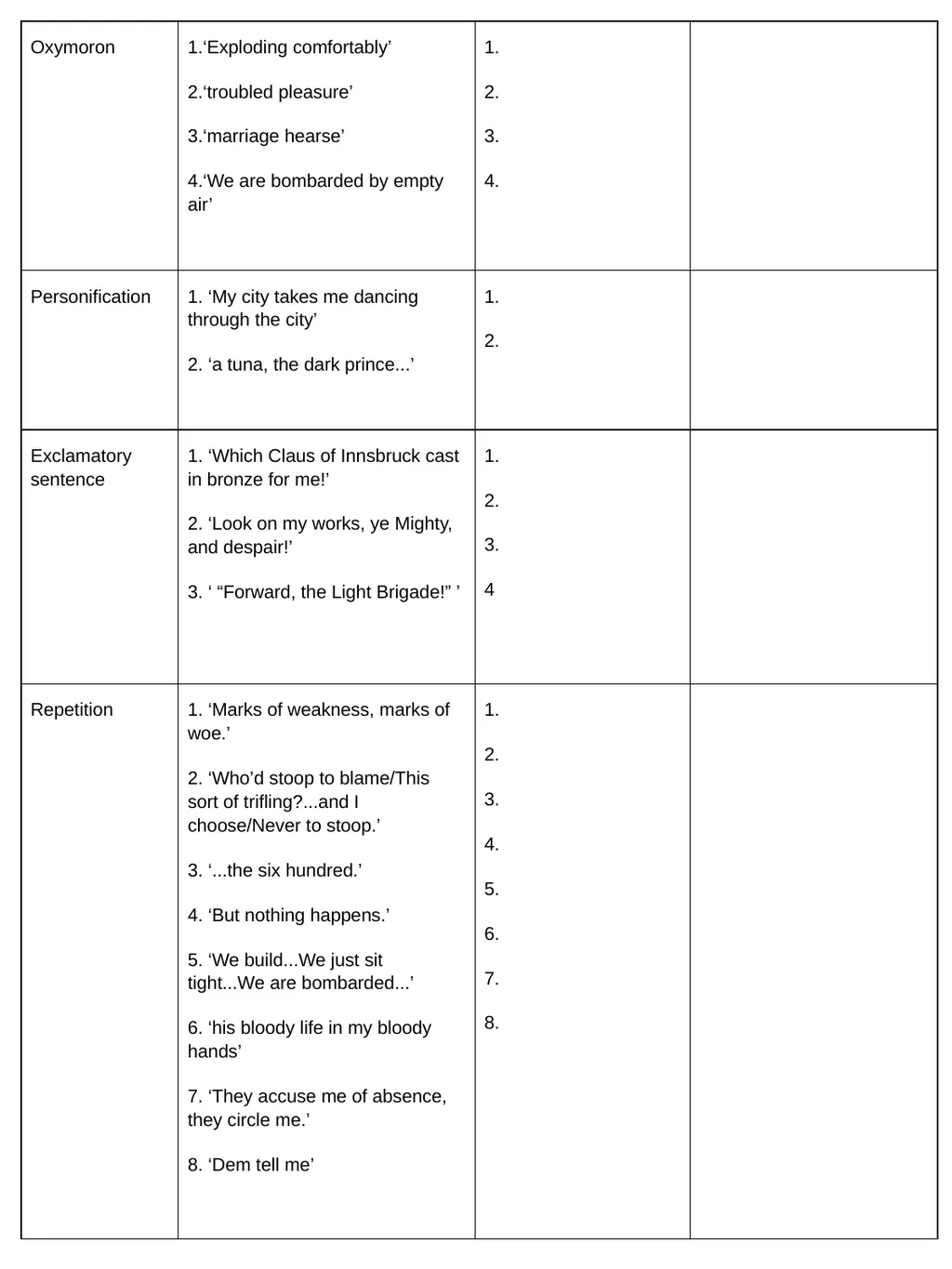
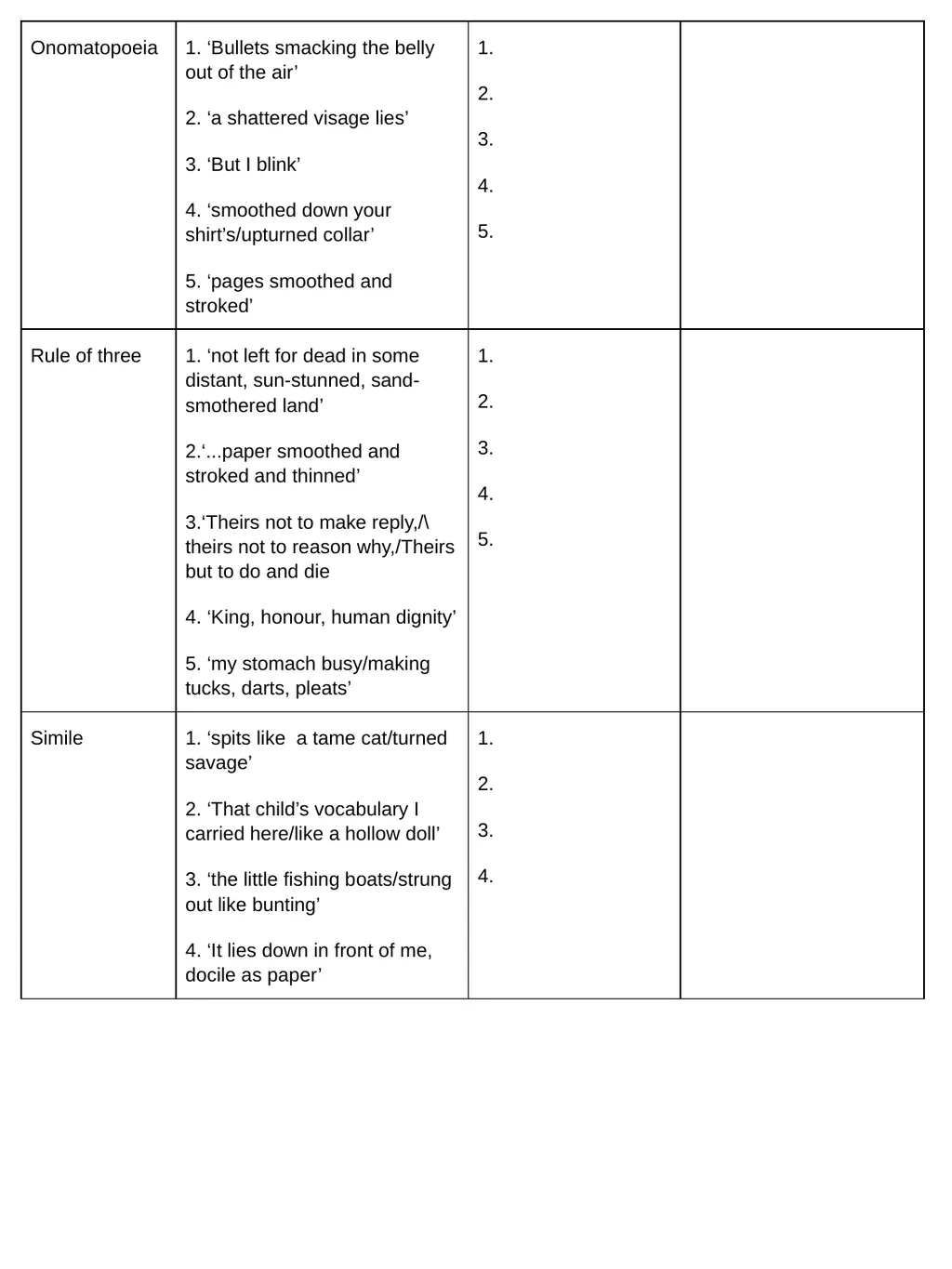
slide39. Power and Conflict comparing methods Task 1 Name the poems.
Task 2 Explain their effects - are the effects the same or different? Bullet point connotations/inference/writers’ intentions/context - similar to your quote by rote method.<br>
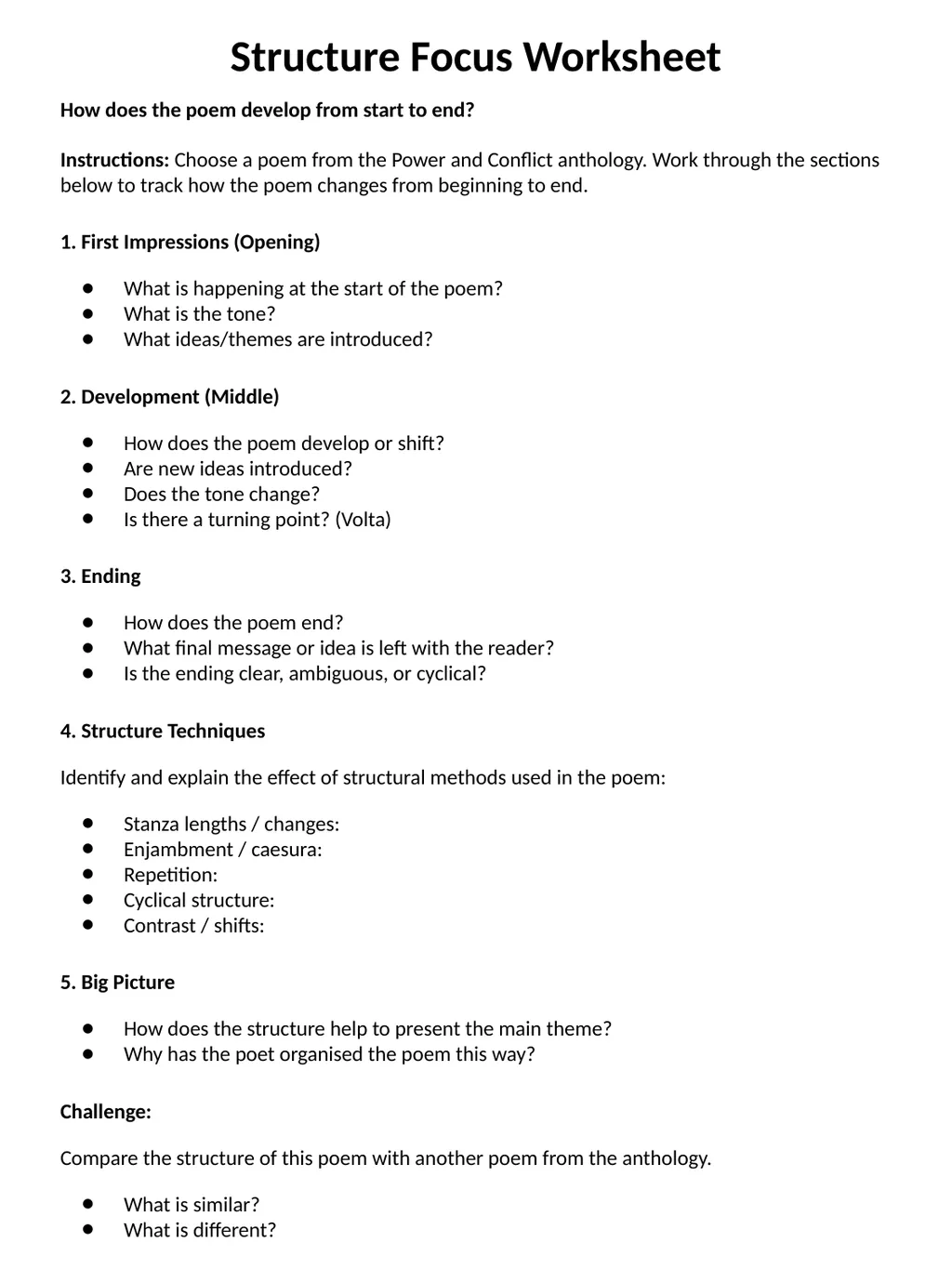
slide42. Structure Focus Worksheet How does the poem develop from start to end?
Instructions: Choose a poem from the Power and Conflict anthology. Work through the sections below to track how the poem changes from beginning to end.
1. First Impressions (Opening)
What is happening at the start of the poem?
What is the tone?
What ideas/themes are introduced?
2. Development (Middle)
How does the poem develop or shift?
Are new ideas introduced?
Does the tone change?
Is there a turning point? (Volta)
3. Ending
How does the poem end?
What final message or idea is left with the reader?
Is the ending clear, ambiguous, or cyclical?
4. Structure Techniques
Identify and explain the effect of structural methods used in the poem:
Stanza lengths / changes:
Enjambment / caesura:
Repetition:
Cyclical structure:
Contrast / shifts:
5. Big Picture
How does the structure help to present the main theme?
Why has the poet organised the poem this way?
Challenge:
Compare the structure of this poem with another poem from the anthology.
What is similar?
What is different?<br>
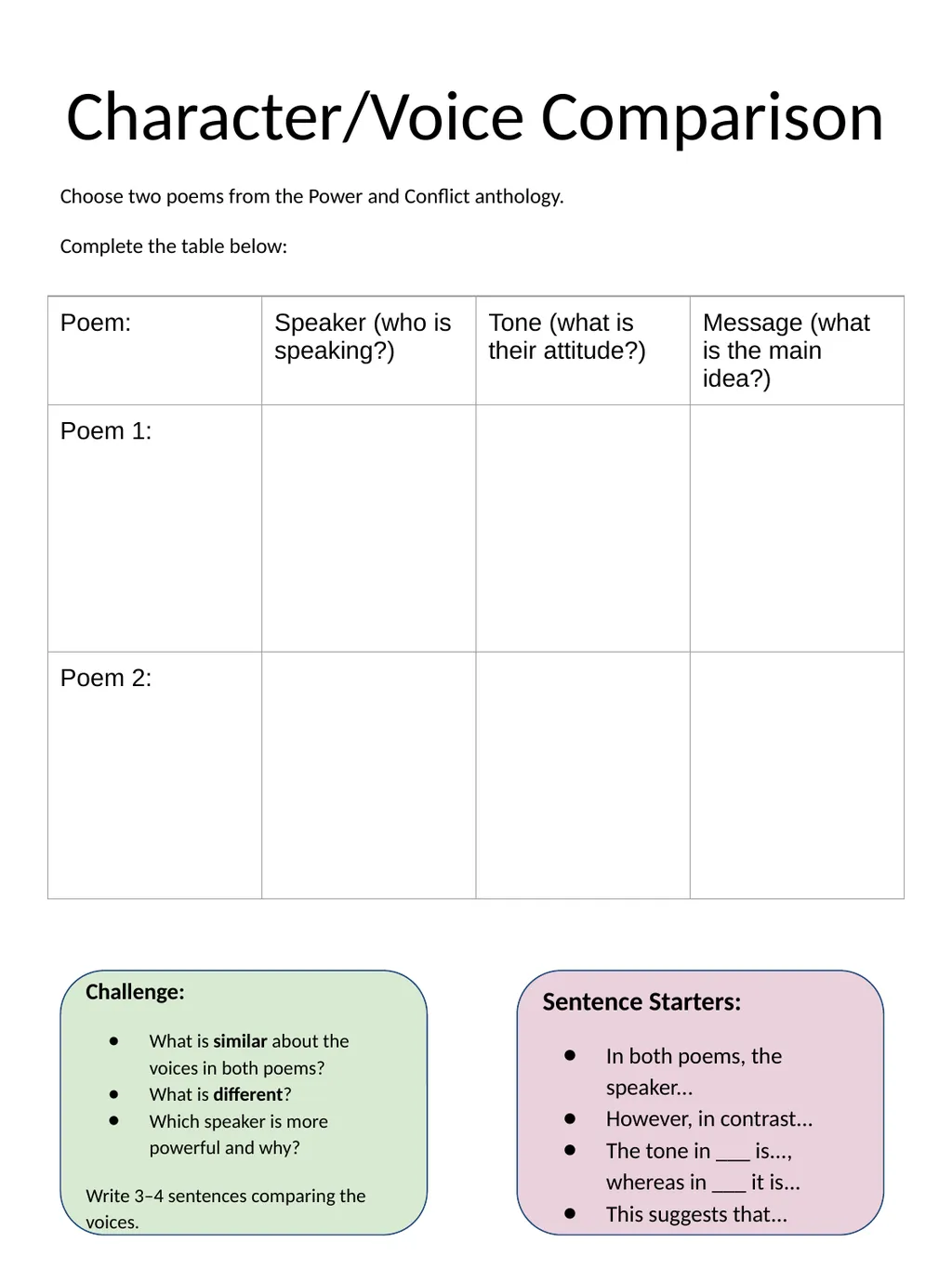
slide43. Character/Voice Comparison Choose two poems from the Power and Conflict anthology.
Complete the table below: Challenge:
What is similar about the voices in both poems?
What is different?
Which speaker is more powerful and why?
Write 3–4 sentences comparing the voices. Sentence Starters:
In both poems, the speaker...
However, in contrast...
The tone in ___ is..., whereas in ___ it is...
This suggests that...<br>
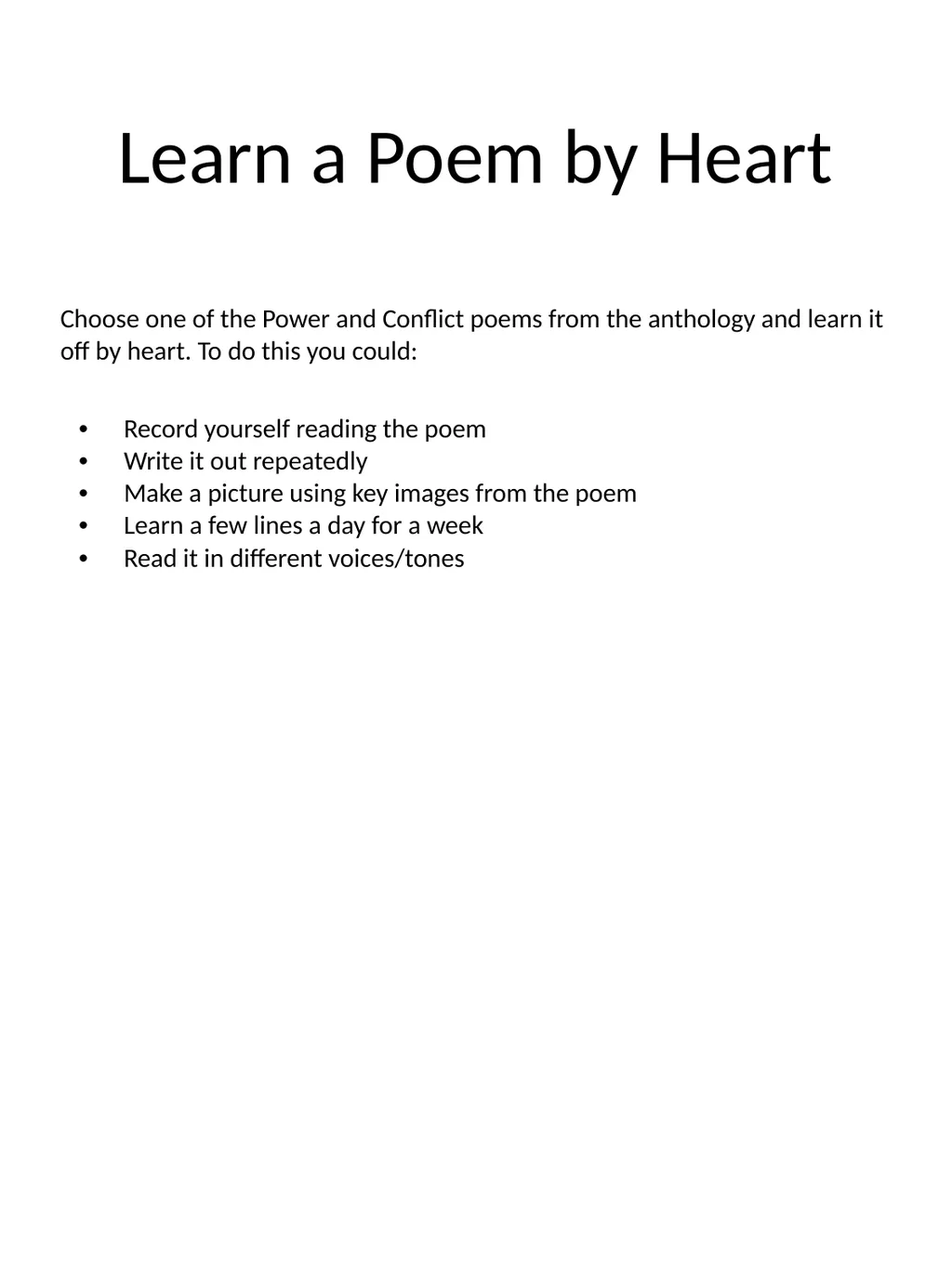
slide44. Learn a Poem by Heart Choose one of the Power and Conflict poems from the anthology and learn it off by heart. To do this you could:
Record yourself reading the poem
Write it out repeatedly
Make a picture using key images from the poem
Learn a few lines a day for a week
Read it in different voices/tones<br>
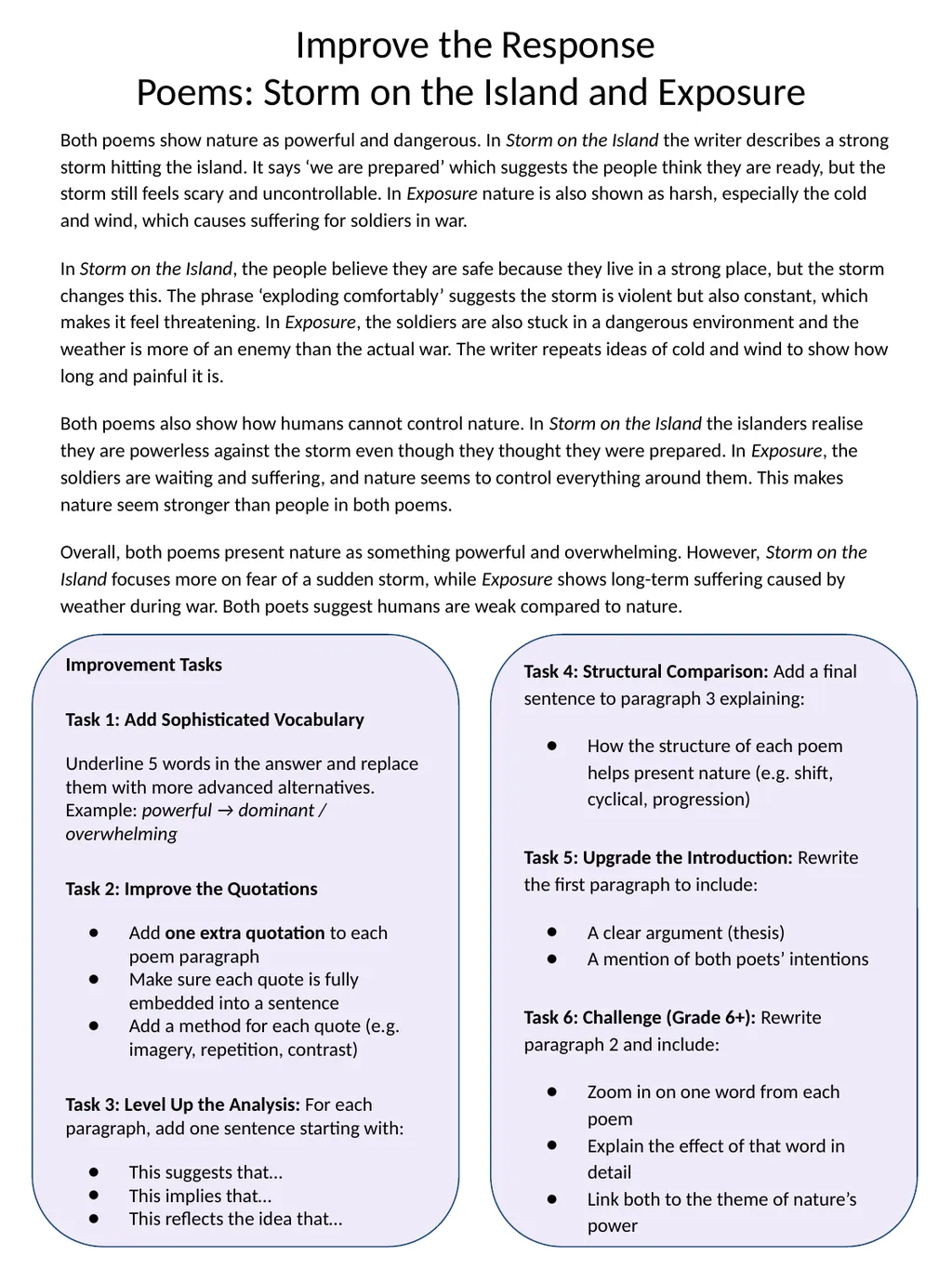
slide45. Improve the Response
Poems: Storm on the Island and Exposure Both poems show nature as powerful and dangerous. In Storm on the Island the writer describes a strong storm hitting the island. It says ‘we are prepared’ which suggests the people think they are ready, but the storm still feels scary and uncontrollable. In Exposure nature is also shown as harsh, especially the cold and wind, which causes suffering for soldiers in war.
In Storm on the Island, the people believe they are safe because they live in a strong place, but the storm changes this. The phrase ‘exploding comfortably’ suggests the storm is violent but also constant, which makes it feel threatening. In Exposure, the soldiers are also stuck in a dangerous environment and the weather is more of an enemy than the actual war. The writer repeats ideas of cold and wind to show how long and painful it is.
Both poems also show how humans cannot control nature. In Storm on the Island the islanders realise they are powerless against the storm even though they thought they were prepared. In Exposure, the soldiers are waiting and suffering, and nature seems to control everything around them. This makes nature seem stronger than people in both poems.
Overall, both poems present nature as something powerful and overwhelming. However, Storm on the Island focuses more on fear of a sudden storm, while Exposure shows long-term suffering caused by weather during war. Both poets suggest humans are weak compared to nature. Improvement Tasks
Task 1: Add Sophisticated Vocabulary
Underline 5 words in the answer and replace them with more advanced alternatives. Example: powerful → dominant / overwhelming
Task 2: Improve the Quotations
Add one extra quotation to each poem paragraph
Make sure each quote is fully embedded into a sentence
Add a method for each quote (e.g. imagery, repetition, contrast)
Task 3: Level Up the Analysis: For each paragraph, add one sentence starting with:
This suggests that…
This implies that…
This reflects the idea that… Task 4: Structural Comparison: Add a final sentence to paragraph 3 explaining:
How the structure of each poem helps present nature (e.g. shift, cyclical, progression)
Task 5: Upgrade the Introduction: Rewrite the first paragraph to include:
A clear argument (thesis)
A mention of both poets’ intentions
Task 6: Challenge (Grade 6+): Rewrite paragraph 2 and include:
Zoom in on one word from each poem
Explain the effect of that word in detail
Link both to the theme of nature’s power<br>
slide46. Exam Preparation<br>
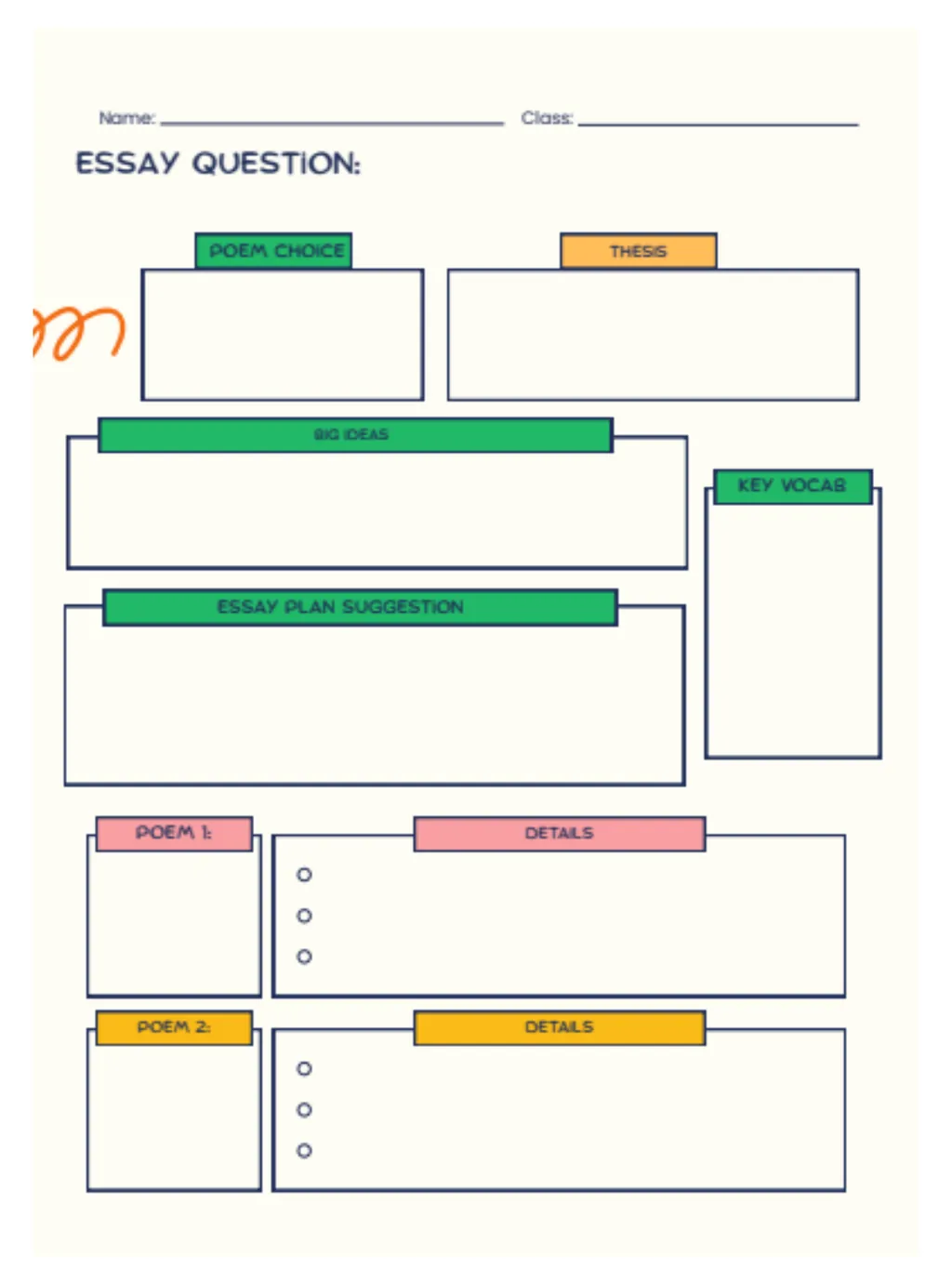
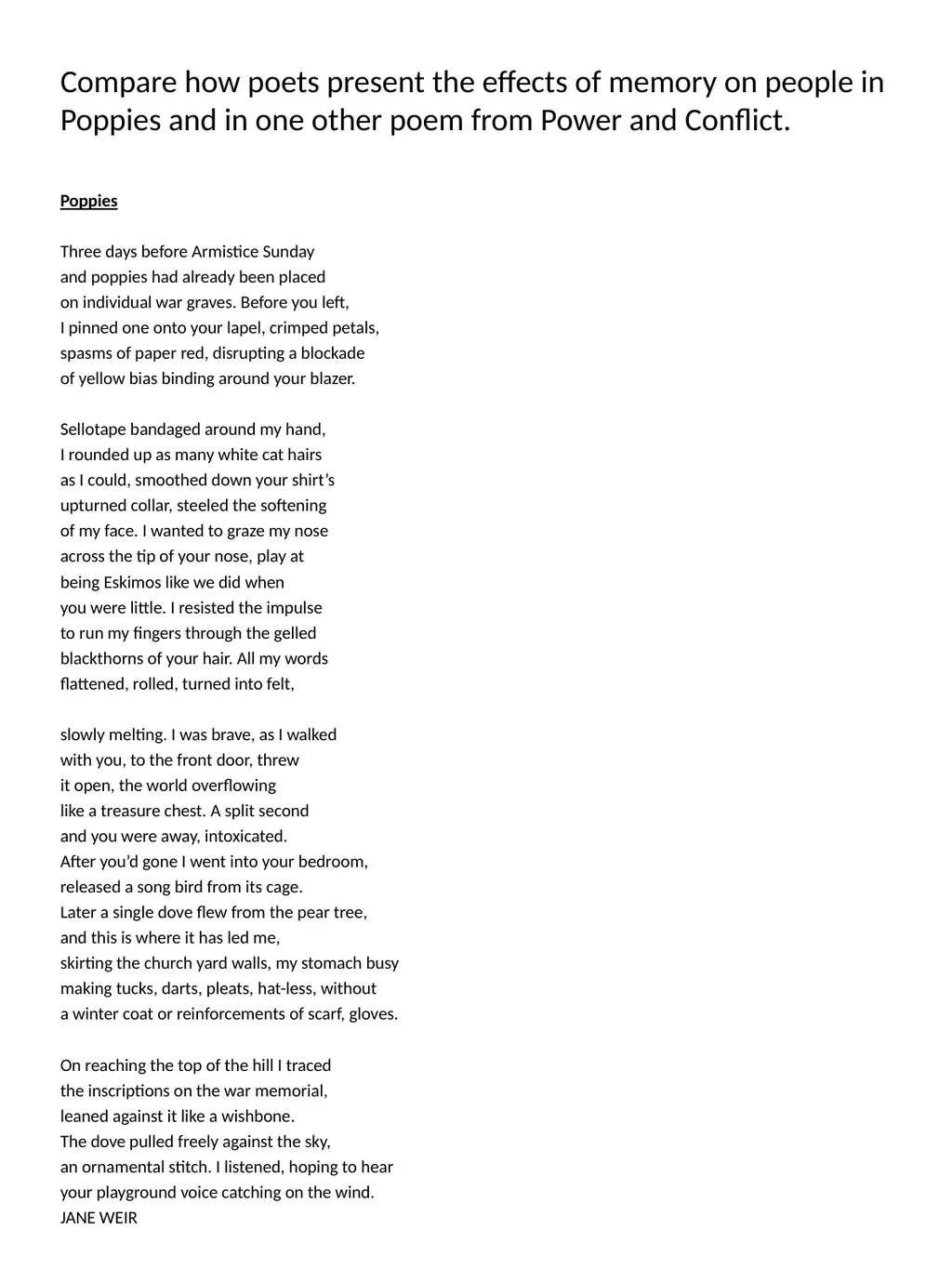
slide49. Compare how poets present the effects of memory on people in Poppies and in one other poem from Power and Conflict. Poppies
Three days before Armistice Sunday
and poppies had already been placed
on individual war graves. Before you left,
I pinned one onto your lapel, crimped petals,
spasms of paper red, disrupting a blockade
of yellow bias binding around your blazer.
Sellotape bandaged around my hand,
I rounded up as many white cat hairs
as I could, smoothed down your shirt’s
upturned collar, steeled the softening
of my face. I wanted to graze my nose
across the tip of your nose, play at
being Eskimos like we did when
you were little. I resisted the impulse
to run my fingers through the gelled
blackthorns of your hair. All my words
flattened, rolled, turned into felt,
slowly melting. I was brave, as I walked
with you, to the front door, threw
it open, the world overflowing
like a treasure chest. A split second
and you were away, intoxicated.
After you’d gone I went into your bedroom,
released a song bird from its cage.
Later a single dove flew from the pear tree,
and this is where it has led me,
skirting the church yard walls, my stomach busy
making tucks, darts, pleats, hat-less, without
a winter coat or reinforcements of scarf, gloves.
On reaching the top of the hill I traced
the inscriptions on the war memorial,
leaned against it like a wishbone.
The dove pulled freely against the sky,
an ornamental stitch. I listened, hoping to hear
your playground voice catching on the wind.
JANE WEIR<br>
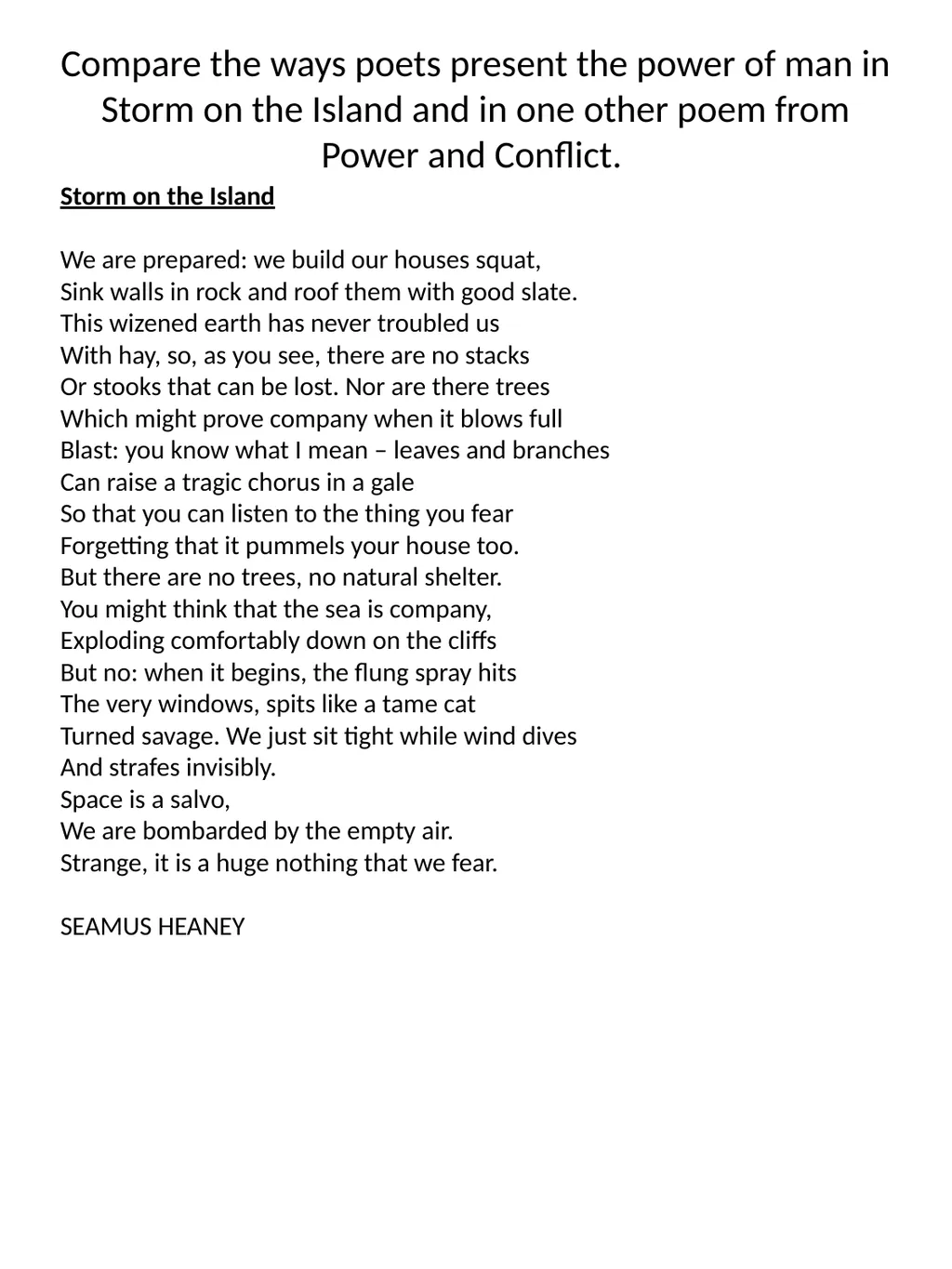
slide50. Compare the ways poets present the power of man in Storm on the Island and in one other poem from Power and Conflict. Storm on the Island
We are prepared: we build our houses squat,
Sink walls in rock and roof them with good slate.
This wizened earth has never troubled us
With hay, so, as you see, there are no stacks
Or stooks that can be lost. Nor are there trees
Which might prove company when it blows full
Blast: you know what I mean – leaves and branches
Can raise a tragic chorus in a gale
So that you can listen to the thing you fear
Forgetting that it pummels your house too.
But there are no trees, no natural shelter.
You might think that the sea is company,
Exploding comfortably down on the cliffs
But no: when it begins, the flung spray hits
The very windows, spits like a tame cat
Turned savage. We just sit tight while wind dives
And strafes invisibly.
Space is a salvo,
We are bombarded by the empty air.
Strange, it is a huge nothing that we fear.
SEAMUS HEANEY<br>
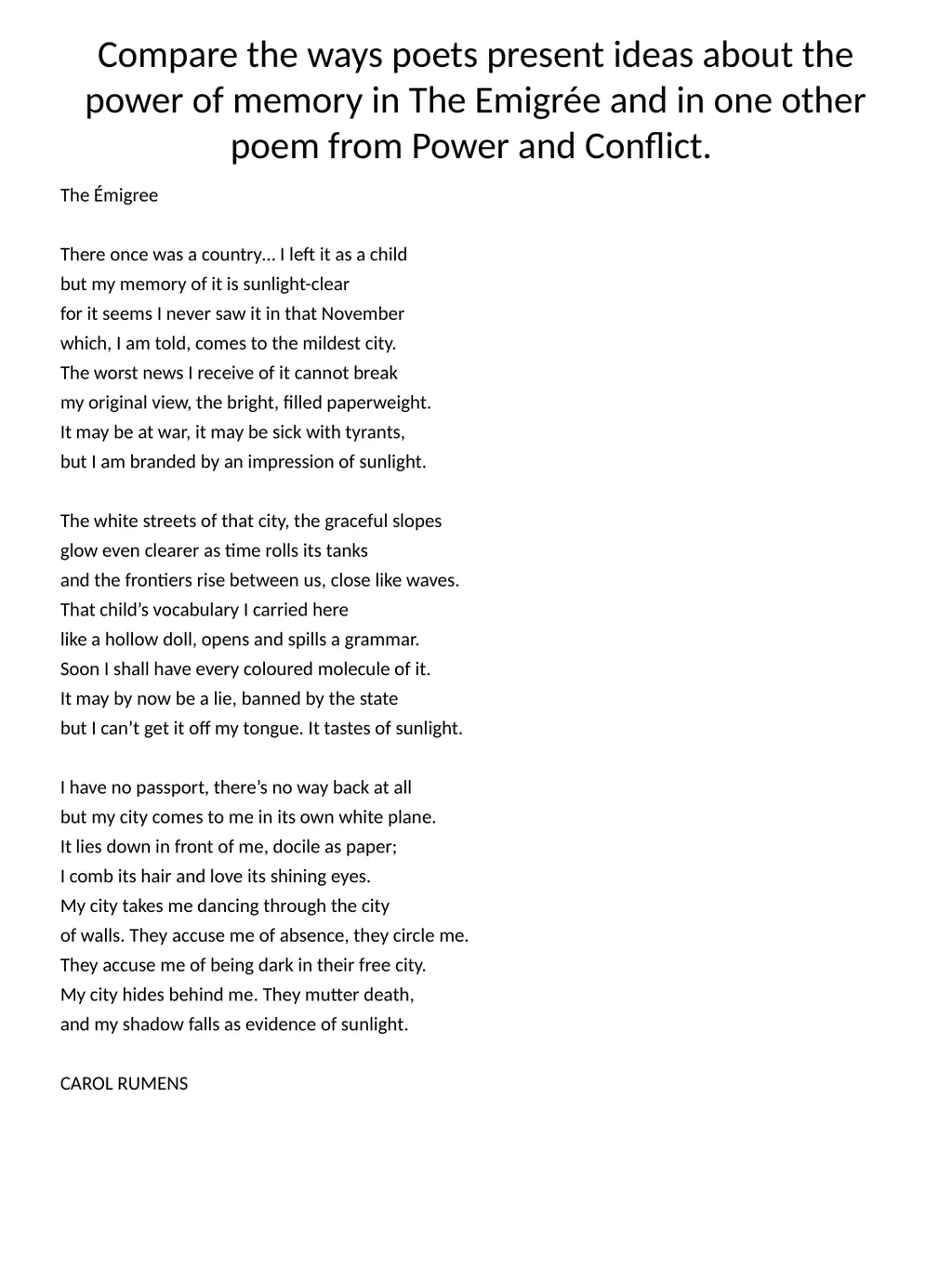
slide51. Compare the ways poets present ideas about the power of memory in The Emigrée and in one other poem from Power and Conflict. The Émigree
There once was a country… I left it as a child
but my memory of it is sunlight-clear
for it seems I never saw it in that November
which, I am told, comes to the mildest city.
The worst news I receive of it cannot break
my original view, the bright, filled paperweight.
It may be at war, it may be sick with tyrants,
but I am branded by an impression of sunlight.
The white streets of that city, the graceful slopes
glow even clearer as time rolls its tanks
and the frontiers rise between us, close like waves.
That child’s vocabulary I carried here
like a hollow doll, opens and spills a grammar.
Soon I shall have every coloured molecule of it.
It may by now be a lie, banned by the state
but I can’t get it off my tongue. It tastes of sunlight.
I have no passport, there’s no way back at all
but my city comes to me in its own white plane.
It lies down in front of me, docile as paper;
I comb its hair and love its shining eyes.
My city takes me dancing through the city
of walls. They accuse me of absence, they circle me.
They accuse me of being dark in their free city.
My city hides behind me. They mutter death,
and my shadow falls as evidence of sunlight.
CAROL RUMENS<br>
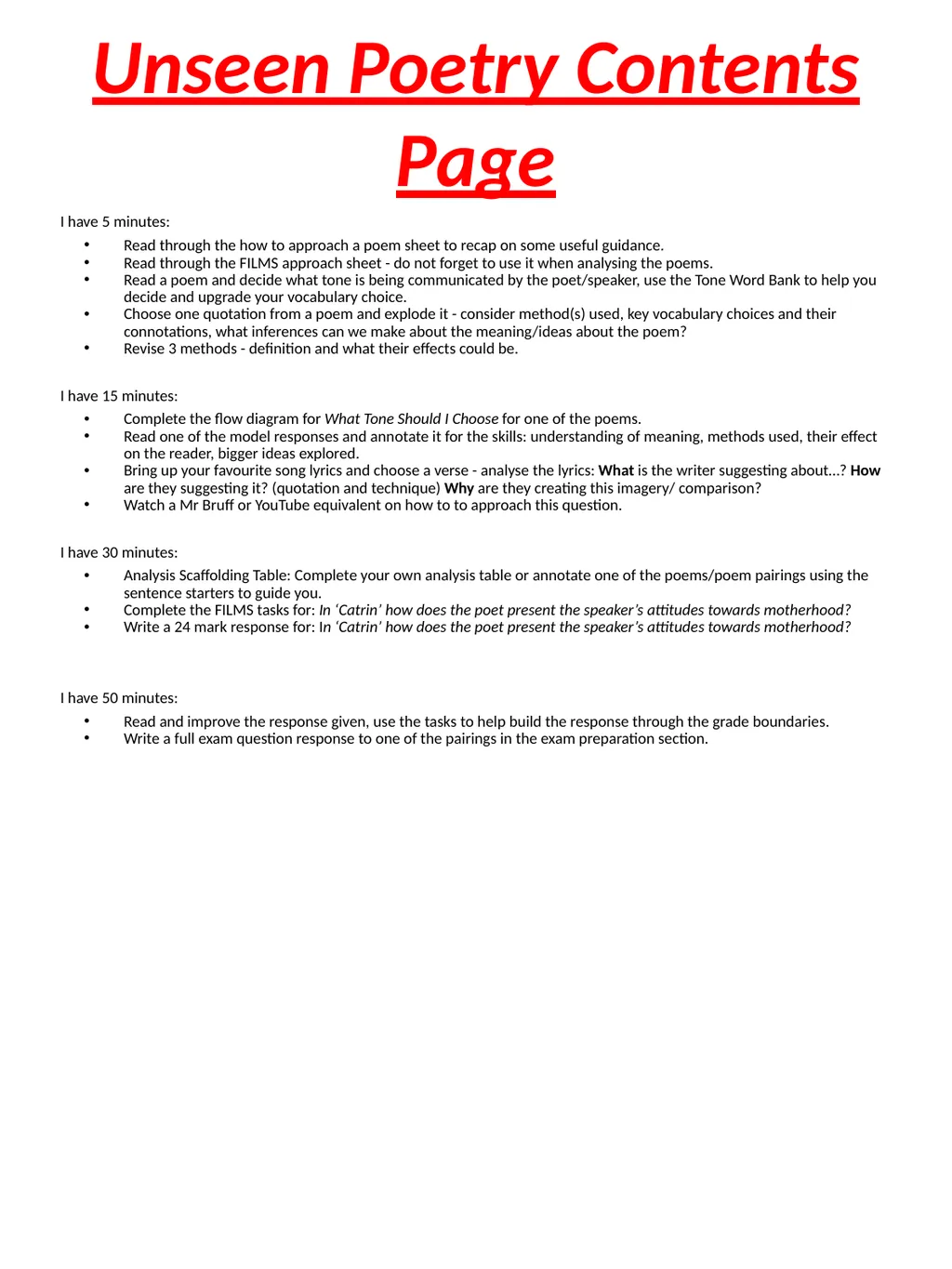
slide52. Unseen Poetry Contents Page I have 5 minutes:
Read through the how to approach a poem sheet to recap on some useful guidance.
Read through the FILMS approach sheet - do not forget to use it when analysing the poems.
Read a poem and decide what tone is being communicated by the poet/speaker, use the Tone Word Bank to help you decide and upgrade your vocabulary choice.
Choose one quotation from a poem and explode it - consider method(s) used, key vocabulary choices and their connotations, what inferences can we make about the meaning/ideas about the poem?
Revise 3 methods - definition and what their effects could be.
I have 15 minutes:
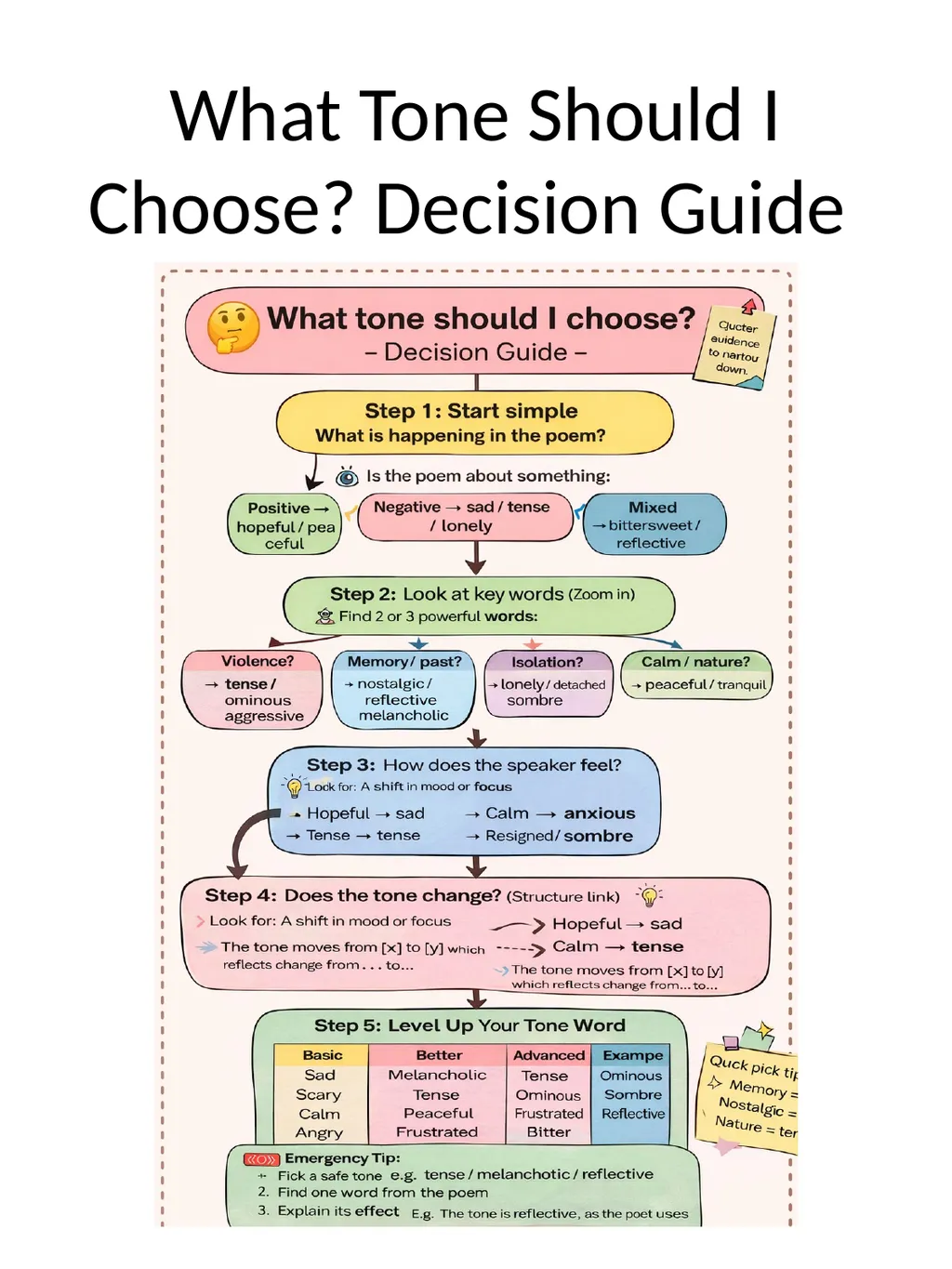
Complete the flow diagram for What Tone Should I Choose for one of the poems.
Read one of the model responses and annotate it for the skills: understanding of meaning, methods used, their effect on the reader, bigger ideas explored.
Bring up your favourite song lyrics and choose a verse - analyse the lyrics: What is the writer suggesting about…? How are they suggesting it? (quotation and technique) Why are they creating this imagery/ comparison?
Watch a Mr Bruff or YouTube equivalent on how to to approach this question.
I have 30 minutes:
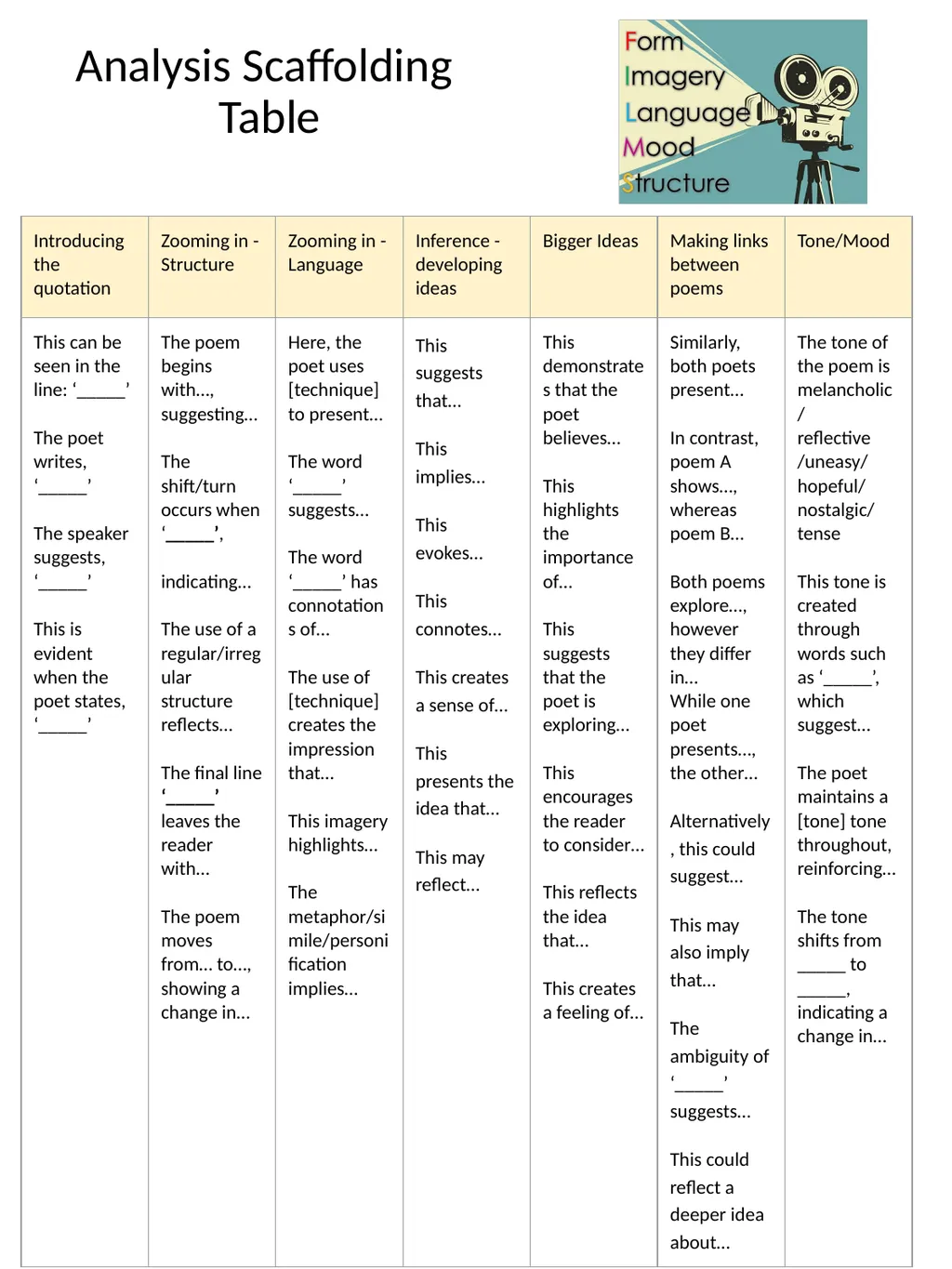
Analysis Scaffolding Table: Complete your own analysis table or annotate one of the poems/poem pairings using the sentence starters to guide you.
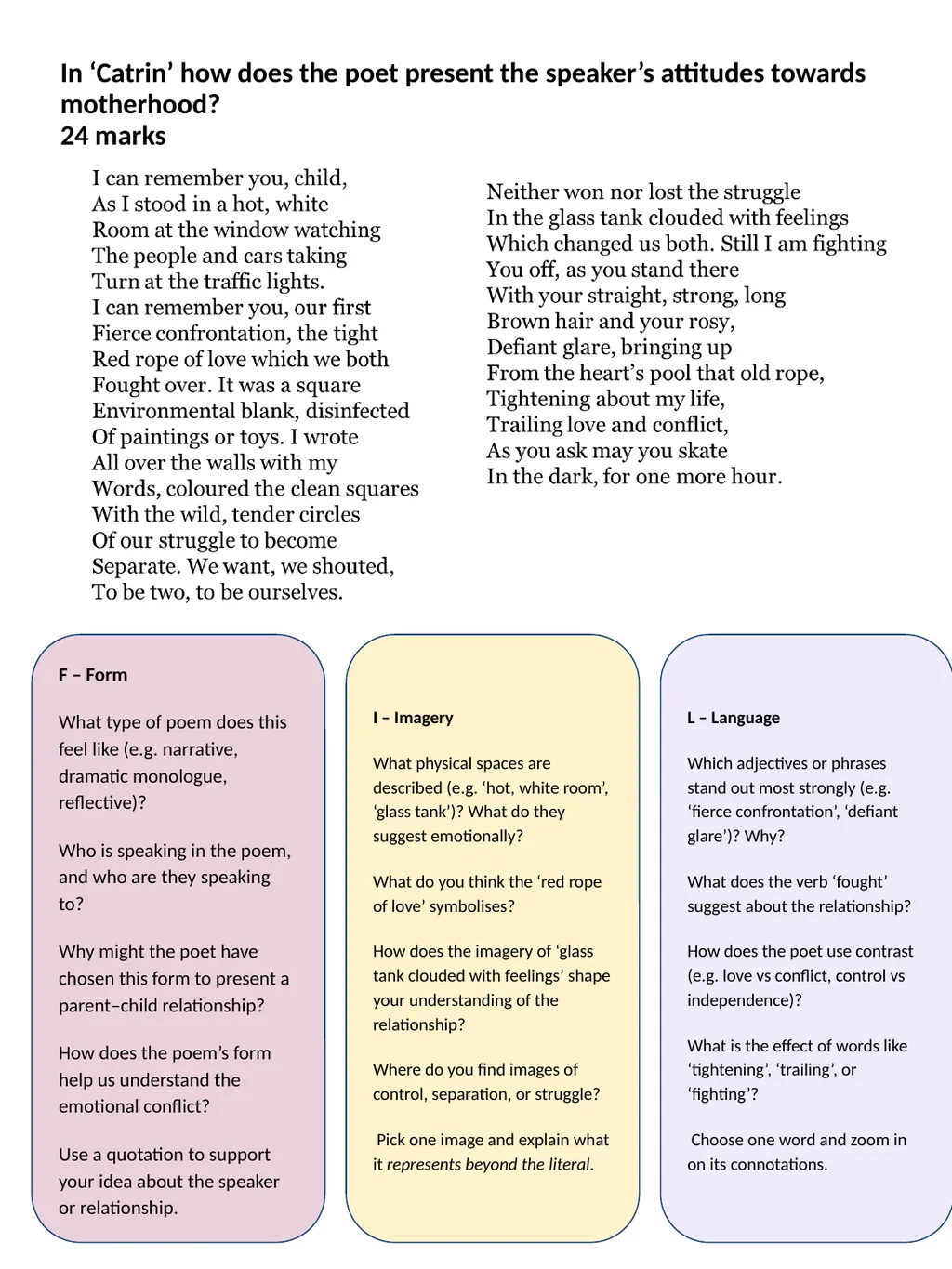
Complete the FILMS tasks for: In ‘Catrin’ how does the poet present the speaker’s attitudes towards motherhood?
Write a 24 mark response for: In ‘Catrin’ how does the poet present the speaker’s attitudes towards motherhood?
I have 50 minutes:
Read and improve the response given, use the tasks to help build the response through the grade boundaries.
Write a full exam question response to one of the pairings in the exam preparation section.<br>
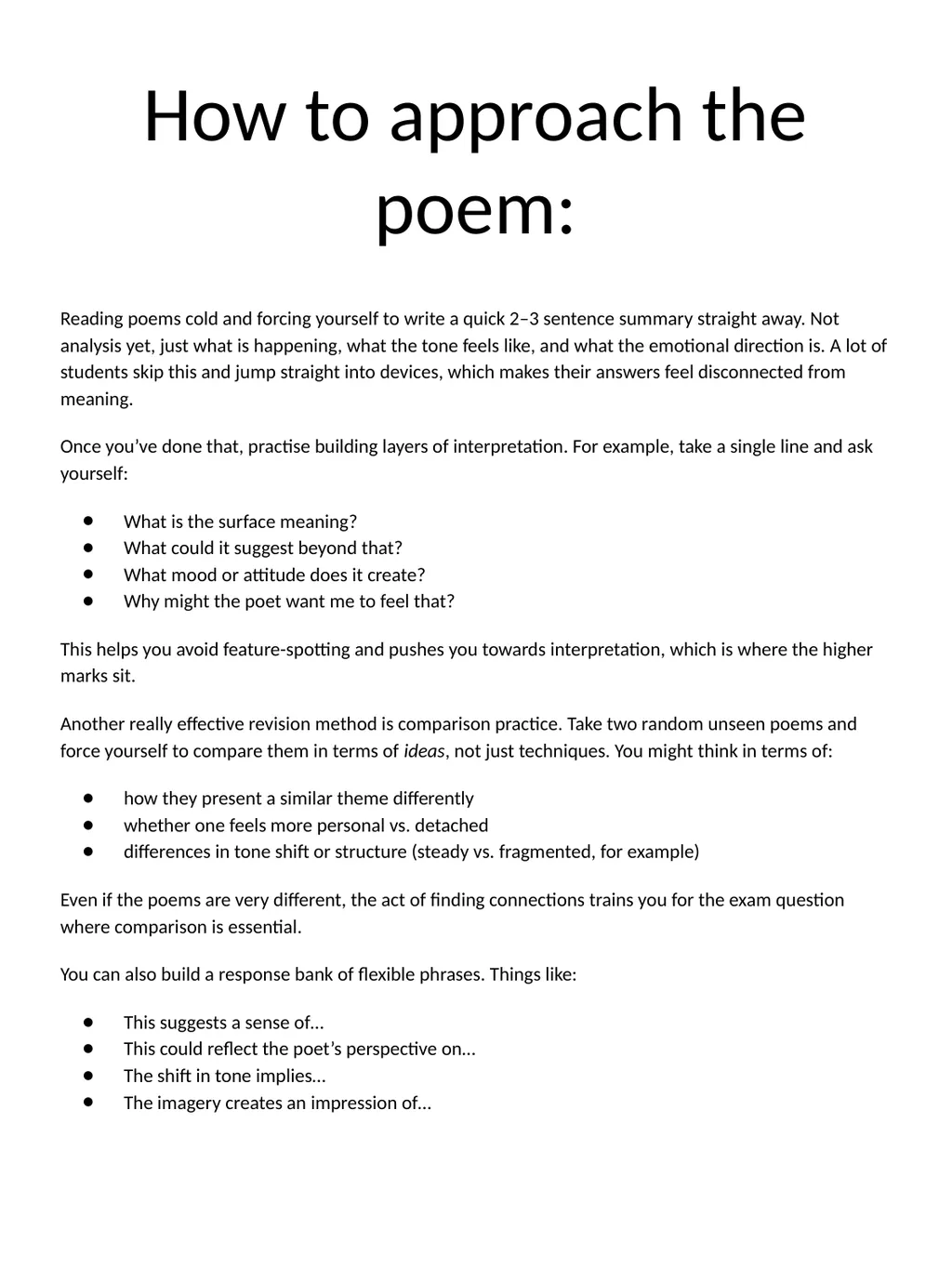
slide53. How to approach the poem: Reading poems cold and forcing yourself to write a quick 2–3 sentence summary straight away. Not analysis yet, just what is happening, what the tone feels like, and what the emotional direction is. A lot of students skip this and jump straight into devices, which makes their answers feel disconnected from meaning.
Once you’ve done that, practise building layers of interpretation. For example, take a single line and ask yourself:
What is the surface meaning?
What could it suggest beyond that?
What mood or attitude does it create?
Why might the poet want me to feel that?
This helps you avoid feature-spotting and pushes you towards interpretation, which is where the higher marks sit.
Another really effective revision method is comparison practice. Take two random unseen poems and force yourself to compare them in terms of ideas, not just techniques. You might think in terms of:
how they present a similar theme differently
whether one feels more personal vs. detached
differences in tone shift or structure (steady vs. fragmented, for example)
Even if the poems are very different, the act of finding connections trains you for the exam question where comparison is essential.
You can also build a response bank of flexible phrases. Things like:
This suggests a sense of…
This could reflect the poet’s perspective on…
The shift in tone implies…
The imagery creates an impression of…<br>
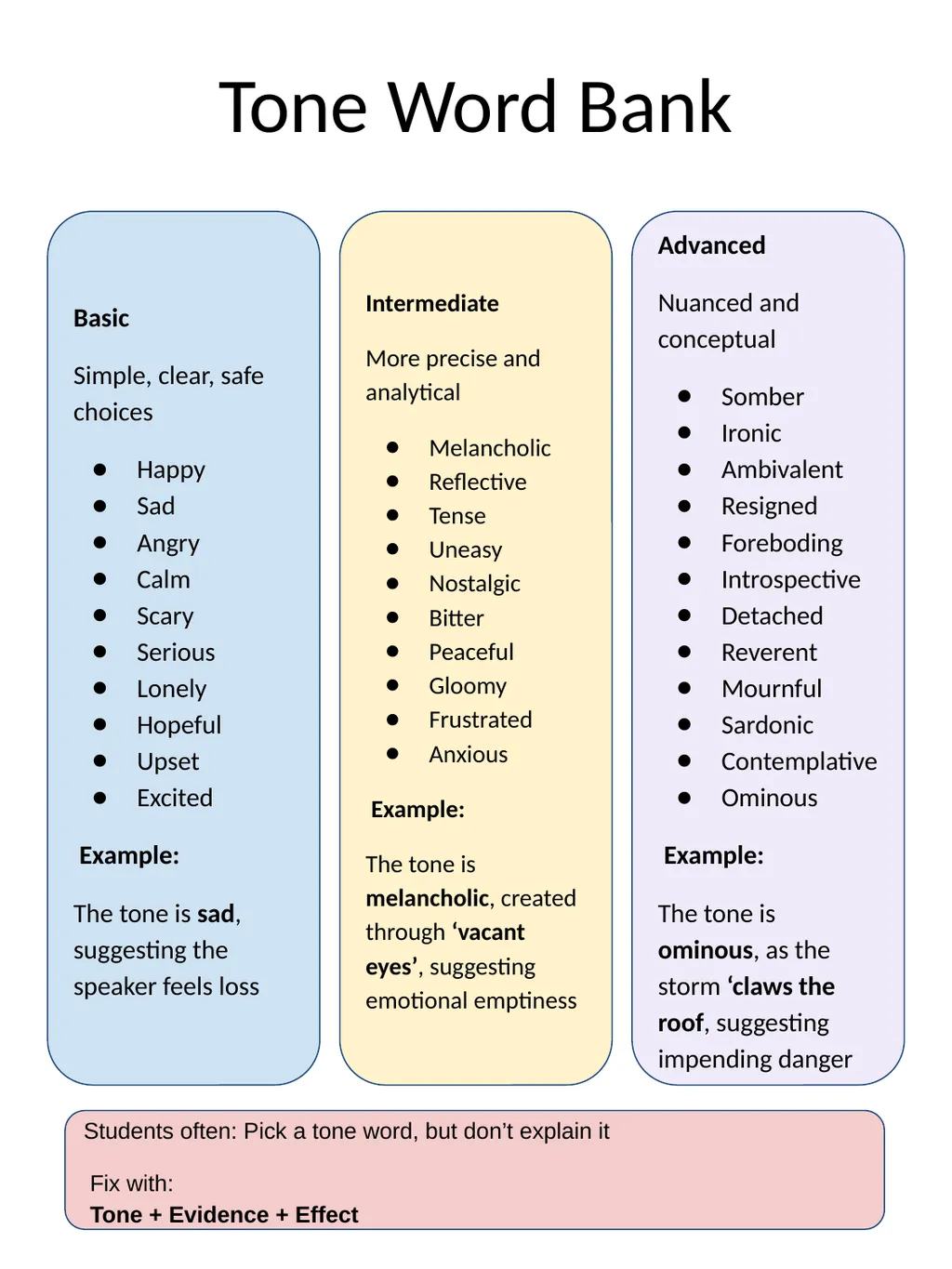
slide55. Tone Word Bank Basic
Simple, clear, safe choices
Happy
Sad
Angry
Calm
Scary
Serious
Lonely
Hopeful
Upset
Excited
Example:
The tone is sad, suggesting the speaker feels loss Intermediate
More precise and analytical
Melancholic
Reflective
Tense
Uneasy
Nostalgic
Bitter
Peaceful
Gloomy
Frustrated
Anxious
Example:
The tone is melancholic, created through ‘vacant eyes’, suggesting emotional emptiness Advanced
Nuanced and conceptual
Somber
Ironic
Ambivalent
Resigned
Foreboding
Introspective
Detached
Reverent
Mournful
Sardonic
Contemplative
Ominous
Example:
The tone is ominous, as the storm ‘claws the roof, suggesting impending danger Students often: Pick a tone word, but don’t explain it
Fix with: Tone + Evidence + Effect<br>
slide56. What Tone Should I Choose? Decision Guide<br>
slide57. Analysis Scaffolding
Table<br>
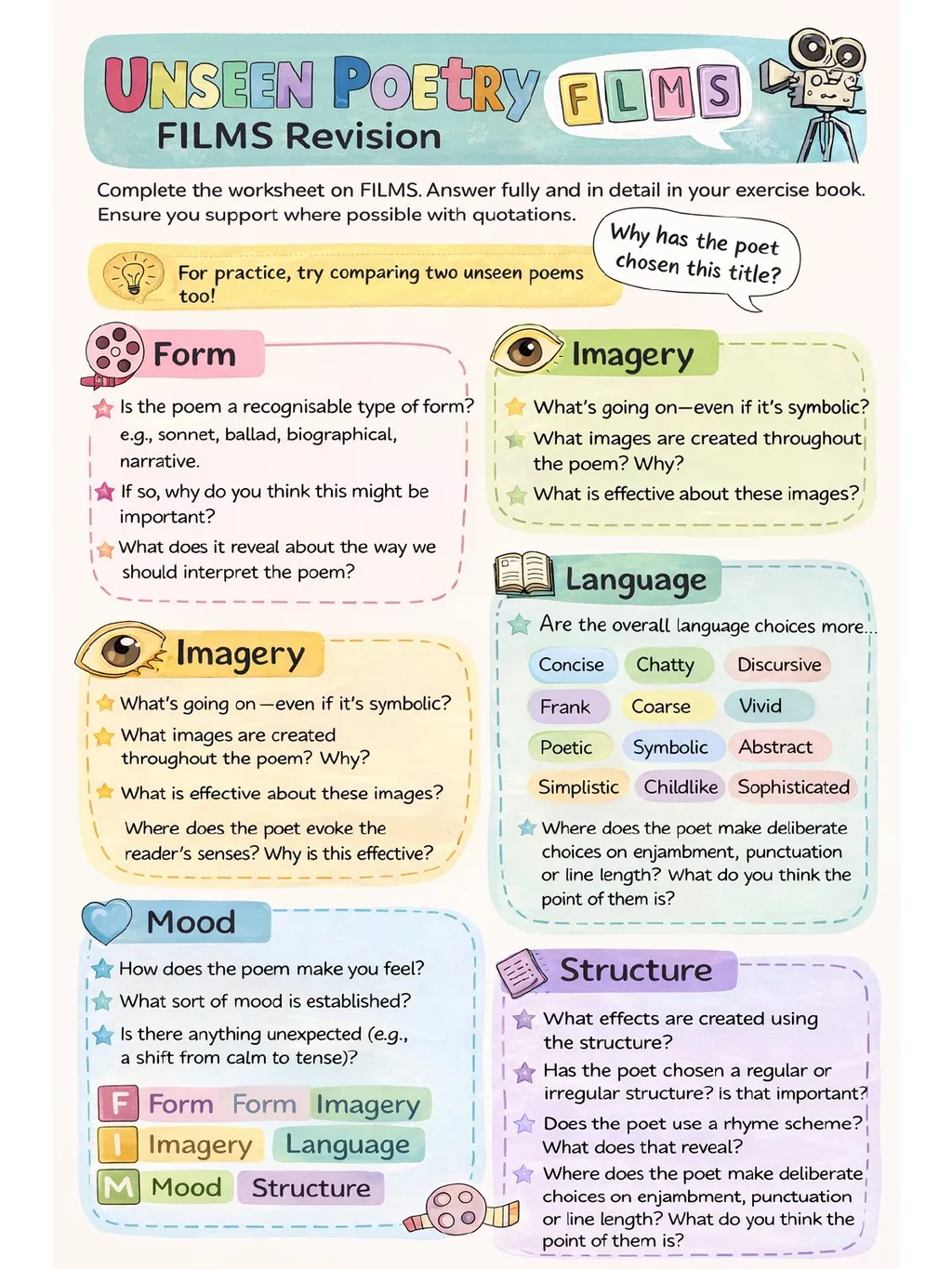
slide58. In ‘Catrin’ how does the poet present the speaker’s attitudes towards motherhood?
24 marks F – Form
What type of poem does this feel like (e.g. narrative, dramatic monologue, reflective)?
Who is speaking in the poem, and who are they speaking to?
Why might the poet have chosen this form to present a parent–child relationship?
How does the poem’s form help us understand the emotional conflict?
Use a quotation to support your idea about the speaker or relationship. I – Imagery
What physical spaces are described (e.g. ‘hot, white room’, ‘glass tank’)? What do they suggest emotionally?
What do you think the ‘red rope of love’ symbolises?
How does the imagery of ‘glass tank clouded with feelings’ shape your understanding of the relationship?
Where do you find images of control, separation, or struggle?
Pick one image and explain what it represents beyond the literal. L – Language
Which adjectives or phrases stand out most strongly (e.g. ‘fierce confrontation’, ‘defiant glare’)? Why?
What does the verb ‘fought’ suggest about the relationship?
How does the poet use contrast (e.g. love vs conflict, control vs independence)?
What is the effect of words like ‘tightening’, ‘trailing’, or ‘fighting’?
Choose one word and zoom in on its connotations.<br>
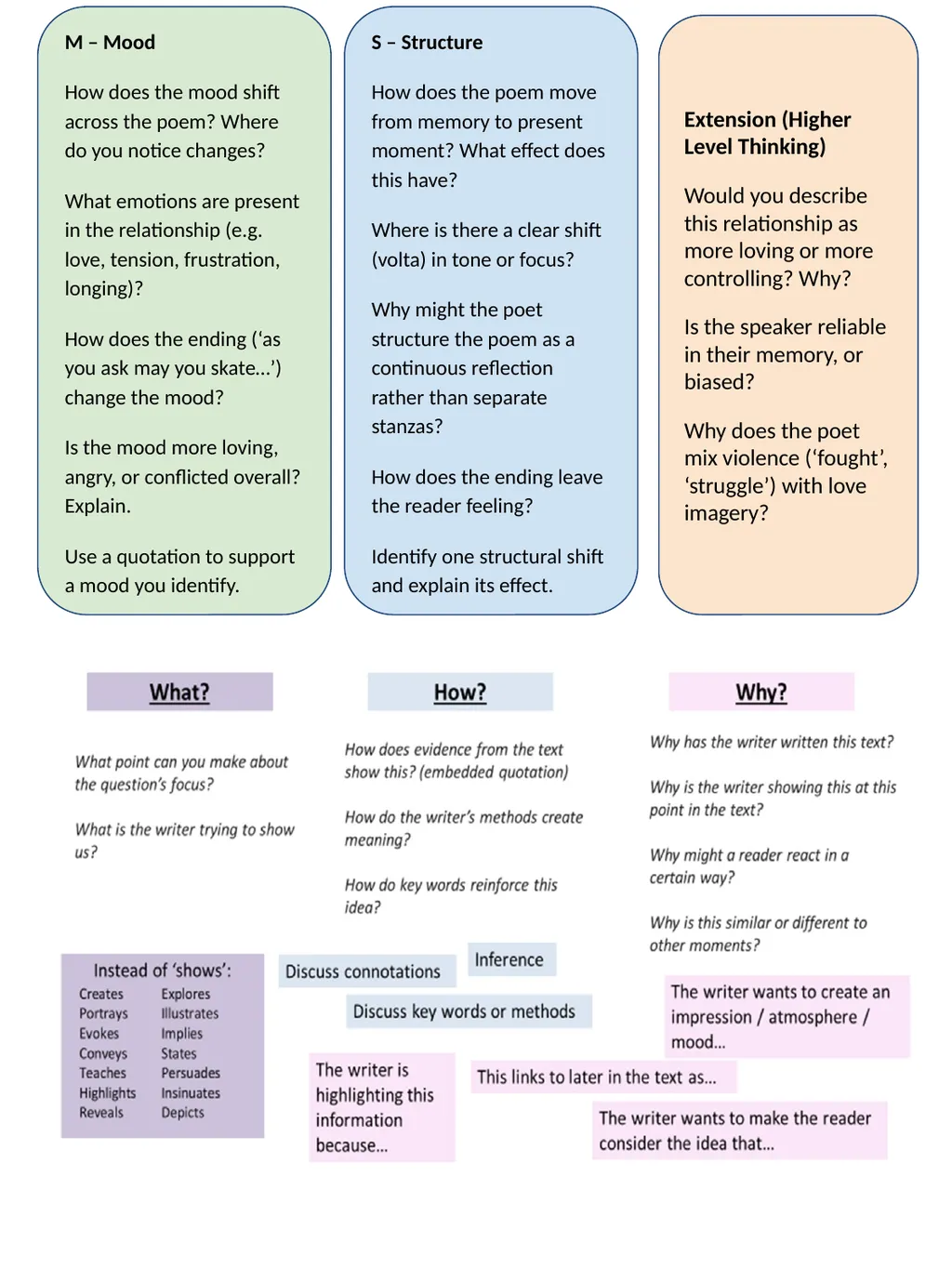
slide59. M – Mood
How does the mood shift across the poem? Where do you notice changes?
What emotions are present in the relationship (e.g. love, tension, frustration, longing)?
How does the ending (‘as you ask may you skate…’) change the mood?
Is the mood more loving, angry, or conflicted overall? Explain.
Use a quotation to support a mood you identify. S – Structure
How does the poem move from memory to present moment? What effect does this have?
Where is there a clear shift (volta) in tone or focus?
Why might the poet structure the poem as a continuous reflection rather than separate stanzas?
How does the ending leave the reader feeling?
Identify one structural shift and explain its effect. Extension (Higher Level Thinking)
Would you describe this relationship as more loving or more controlling? Why?
Is the speaker reliable in their memory, or biased?
Why does the poet mix violence (‘fought’, ‘struggle’) with love imagery?<br>
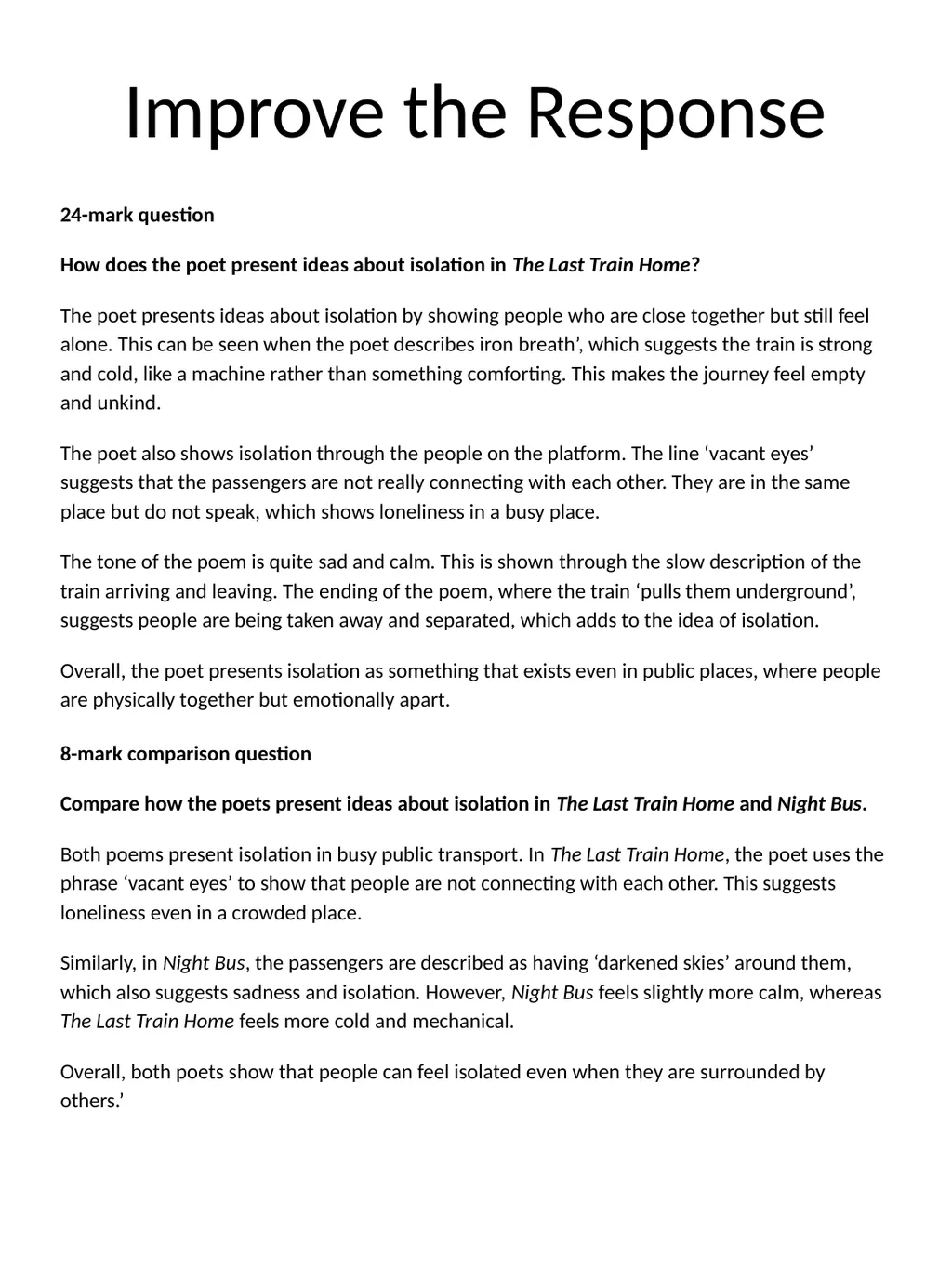
slide60. Improve the Response 24-mark question
How does the poet present ideas about isolation in The Last Train Home?
The poet presents ideas about isolation by showing people who are close together but still feel alone. This can be seen when the poet describes iron breath’, which suggests the train is strong and cold, like a machine rather than something comforting. This makes the journey feel empty and unkind.
The poet also shows isolation through the people on the platform. The line ‘vacant eyes’ suggests that the passengers are not really connecting with each other. They are in the same place but do not speak, which shows loneliness in a busy place.
The tone of the poem is quite sad and calm. This is shown through the slow description of the train arriving and leaving. The ending of the poem, where the train ‘pulls them underground’, suggests people are being taken away and separated, which adds to the idea of isolation.
Overall, the poet presents isolation as something that exists even in public places, where people are physically together but emotionally apart.
8-mark comparison question
Compare how the poets present ideas about isolation in The Last Train Home and Night Bus.
Both poems present isolation in busy public transport. In The Last Train Home, the poet uses the phrase ‘vacant eyes’ to show that people are not connecting with each other. This suggests loneliness even in a crowded place.
Similarly, in Night Bus, the passengers are described as having ‘darkened skies’ around them, which also suggests sadness and isolation. However, Night Bus feels slightly more calm, whereas The Last Train Home feels more cold and mechanical.
Overall, both poets show that people can feel isolated even when they are surrounded by others.’<br>
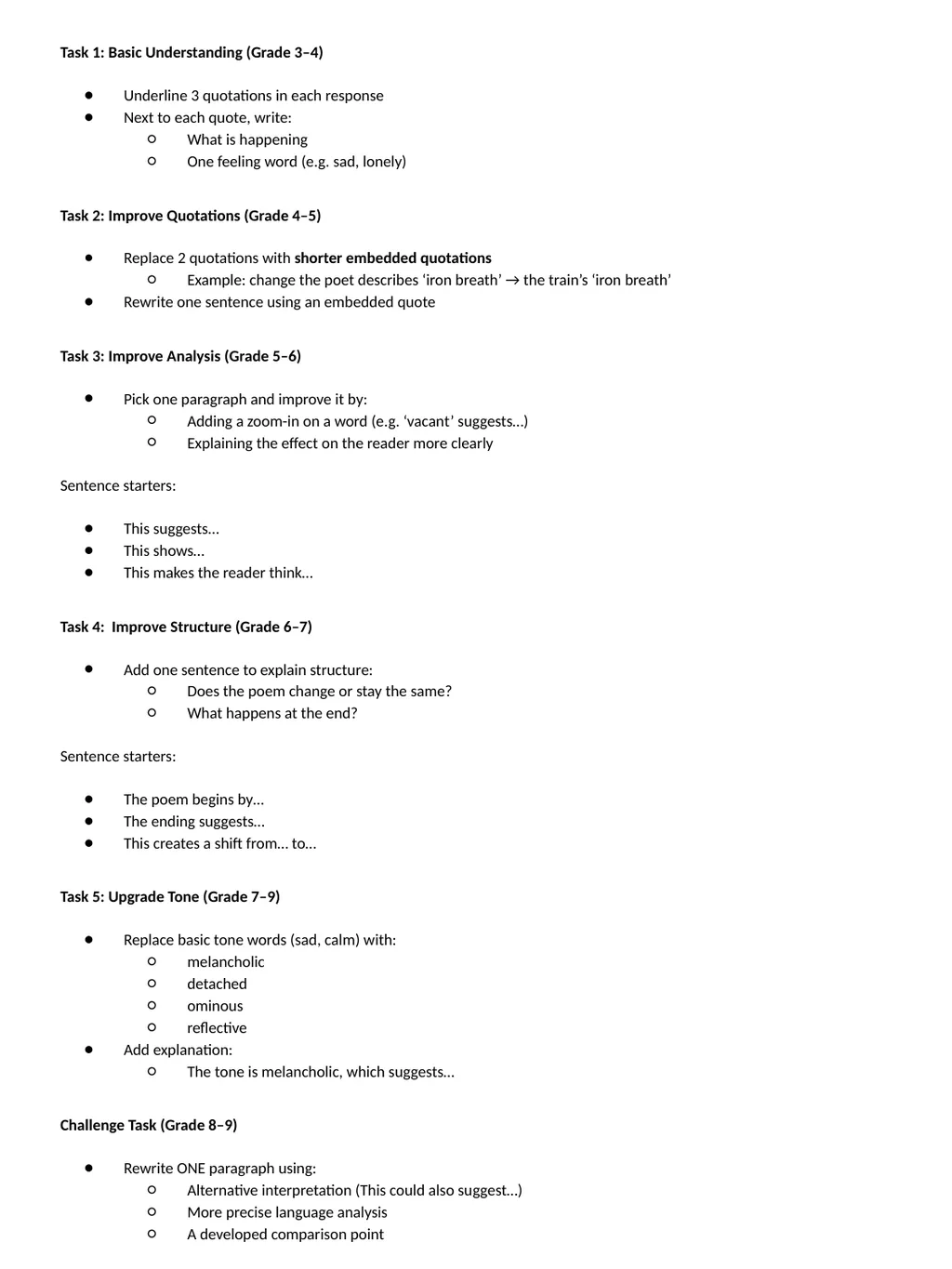
slide61. Task 1: Basic Understanding (Grade 3–4)
Underline 3 quotations in each response
Next to each quote, write:
What is happening
One feeling word (e.g. sad, lonely)
Task 2: Improve Quotations (Grade 4–5)
Replace 2 quotations with shorter embedded quotations
Example: change the poet describes ‘iron breath’ → the train’s ‘iron breath’
Rewrite one sentence using an embedded quote
Task 3: Improve Analysis (Grade 5–6)
Pick one paragraph and improve it by:
Adding a zoom-in on a word (e.g. ‘vacant’ suggests…)
Explaining the effect on the reader more clearly
Sentence starters:
This suggests…
This shows…
This makes the reader think…
Task 4: Improve Structure (Grade 6–7)
Add one sentence to explain structure:
Does the poem change or stay the same?
What happens at the end?
Sentence starters:
The poem begins by…
The ending suggests…
This creates a shift from… to…
Task 5: Upgrade Tone (Grade 7–9)
Replace basic tone words (sad, calm) with:
melancholic
detached
ominous
reflective
Add explanation:
The tone is melancholic, which suggests…
Challenge Task (Grade 8–9)
Rewrite ONE paragraph using:
Alternative interpretation (This could also suggest…)
More precise language analysis
A developed comparison point<br>
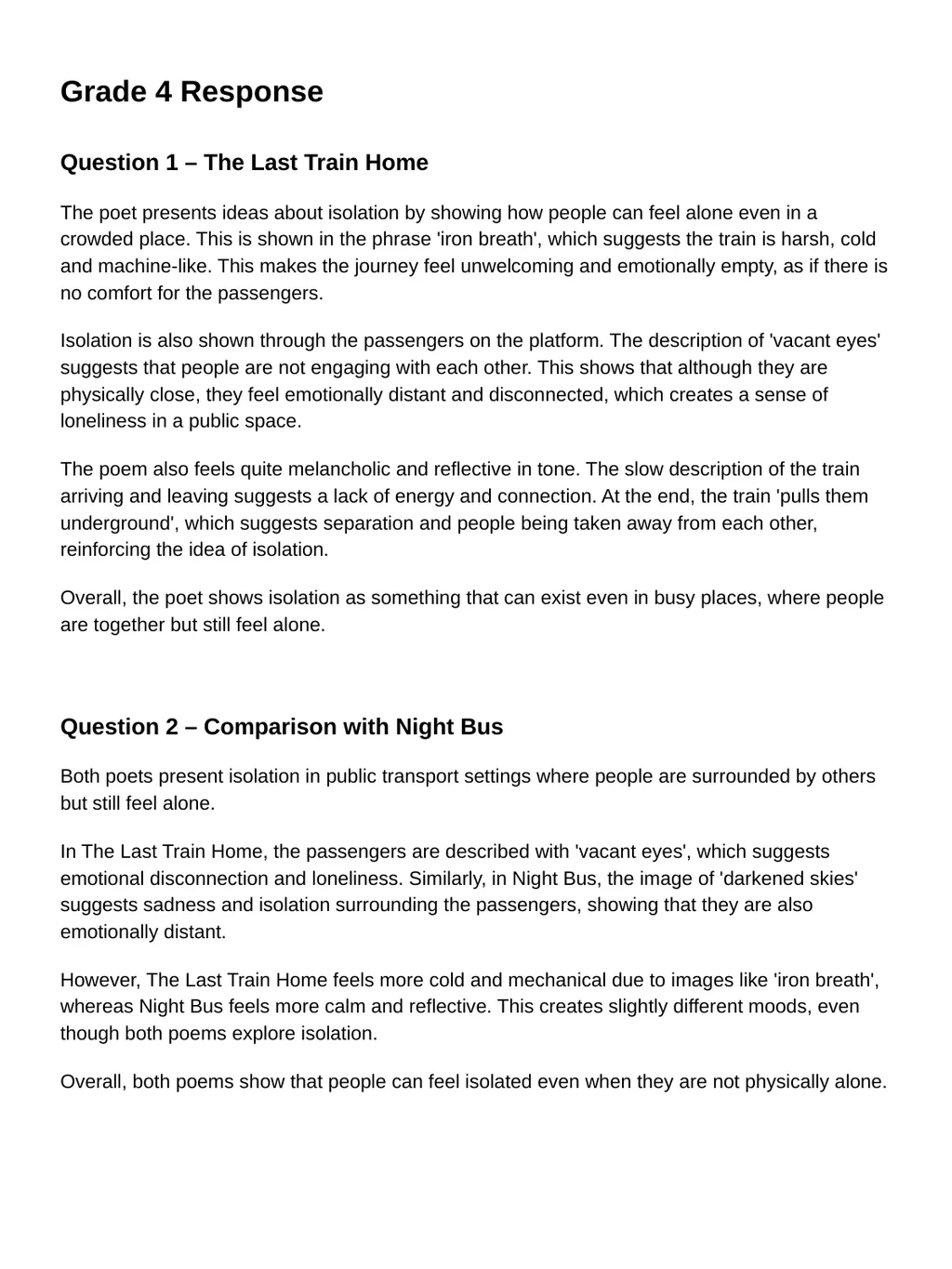
slide62. Grade 4 Response Question 1 – The Last Train Home
The poet presents ideas about isolation by showing how people can feel alone even in a crowded place. This is shown in the phrase 'iron breath', which suggests the train is harsh, cold and machine-like. This makes the journey feel unwelcoming and emotionally empty, as if there is no comfort for the passengers.
Isolation is also shown through the passengers on the platform. The description of 'vacant eyes' suggests that people are not engaging with each other. This shows that although they are physically close, they feel emotionally distant and disconnected, which creates a sense of loneliness in a public space.
The poem also feels quite melancholic and reflective in tone. The slow description of the train arriving and leaving suggests a lack of energy and connection. At the end, the train 'pulls them underground', which suggests separation and people being taken away from each other, reinforcing the idea of isolation.
Overall, the poet shows isolation as something that can exist even in busy places, where people are together but still feel alone.
Question 2 – Comparison with Night Bus
Both poets present isolation in public transport settings where people are surrounded by others but still feel alone.
In The Last Train Home, the passengers are described with 'vacant eyes', which suggests emotional disconnection and loneliness. Similarly, in Night Bus, the image of 'darkened skies' suggests sadness and isolation surrounding the passengers, showing that they are also emotionally distant.
However, The Last Train Home feels more cold and mechanical due to images like 'iron breath', whereas Night Bus feels more calm and reflective. This creates slightly different moods, even though both poems explore isolation.
Overall, both poems show that people can feel isolated even when they are not physically alone.<br>
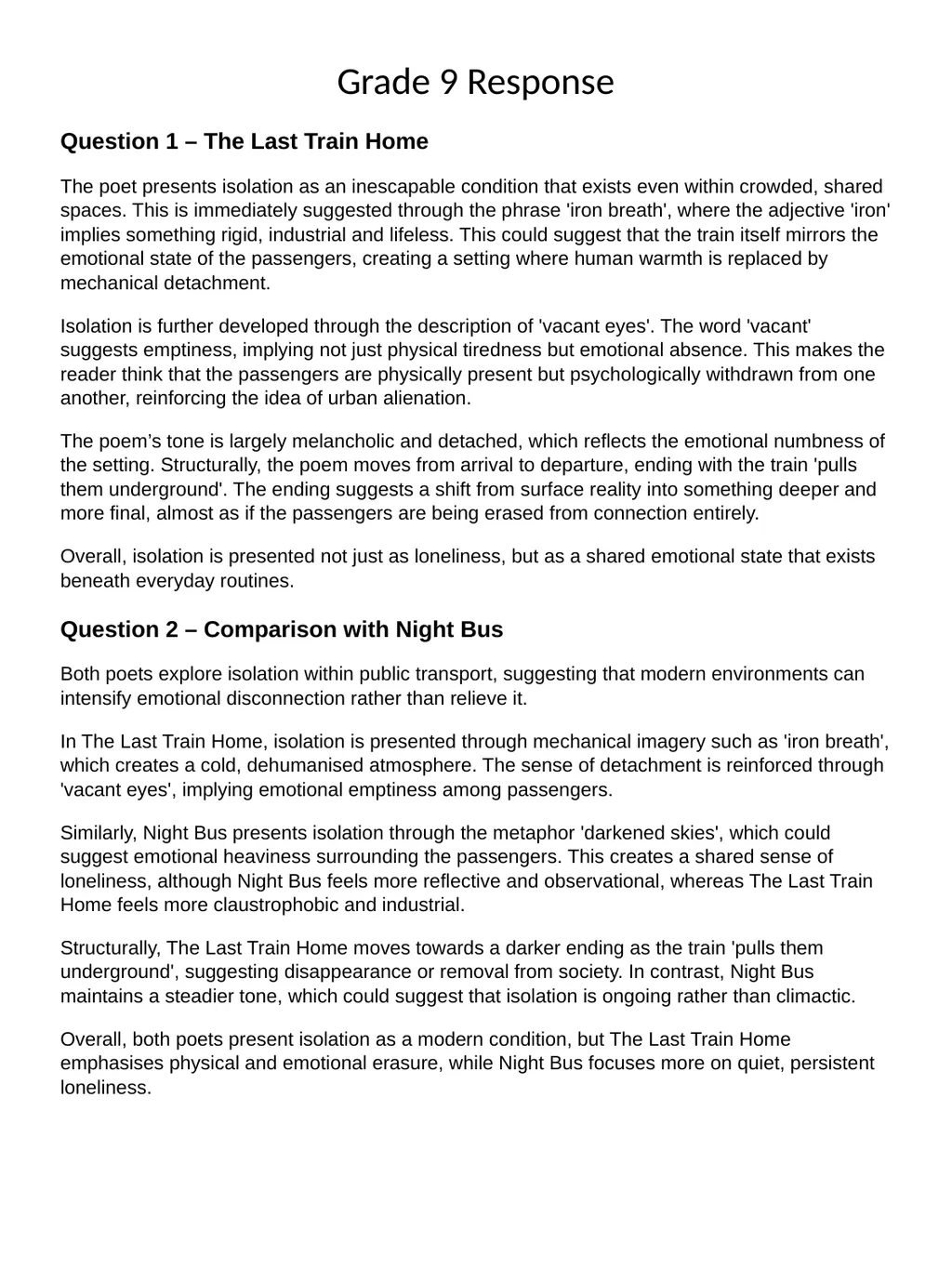
slide63. Grade 9 Response Question 1 – The Last Train Home
The poet presents isolation as an inescapable condition that exists even within crowded, shared spaces. This is immediately suggested through the phrase 'iron breath', where the adjective 'iron' implies something rigid, industrial and lifeless. This could suggest that the train itself mirrors the emotional state of the passengers, creating a setting where human warmth is replaced by mechanical detachment.
Isolation is further developed through the description of 'vacant eyes'. The word 'vacant' suggests emptiness, implying not just physical tiredness but emotional absence. This makes the reader think that the passengers are physically present but psychologically withdrawn from one another, reinforcing the idea of urban alienation.
The poem’s tone is largely melancholic and detached, which reflects the emotional numbness of the setting. Structurally, the poem moves from arrival to departure, ending with the train 'pulls them underground'. The ending suggests a shift from surface reality into something deeper and more final, almost as if the passengers are being erased from connection entirely.
Overall, isolation is presented not just as loneliness, but as a shared emotional state that exists beneath everyday routines.
Question 2 – Comparison with Night Bus
Both poets explore isolation within public transport, suggesting that modern environments can intensify emotional disconnection rather than relieve it.
In The Last Train Home, isolation is presented through mechanical imagery such as 'iron breath', which creates a cold, dehumanised atmosphere. The sense of detachment is reinforced through 'vacant eyes', implying emotional emptiness among passengers.
Similarly, Night Bus presents isolation through the metaphor 'darkened skies', which could suggest emotional heaviness surrounding the passengers. This creates a shared sense of loneliness, although Night Bus feels more reflective and observational, whereas The Last Train Home feels more claustrophobic and industrial.
Structurally, The Last Train Home moves towards a darker ending as the train 'pulls them underground', suggesting disappearance or removal from society. In contrast, Night Bus maintains a steadier tone, which could suggest that isolation is ongoing rather than climactic.
Overall, both poets present isolation as a modern condition, but The Last Train Home emphasises physical and emotional erasure, while Night Bus focuses more on quiet, persistent loneliness.<br>
slide64. Exam Preparation<br>
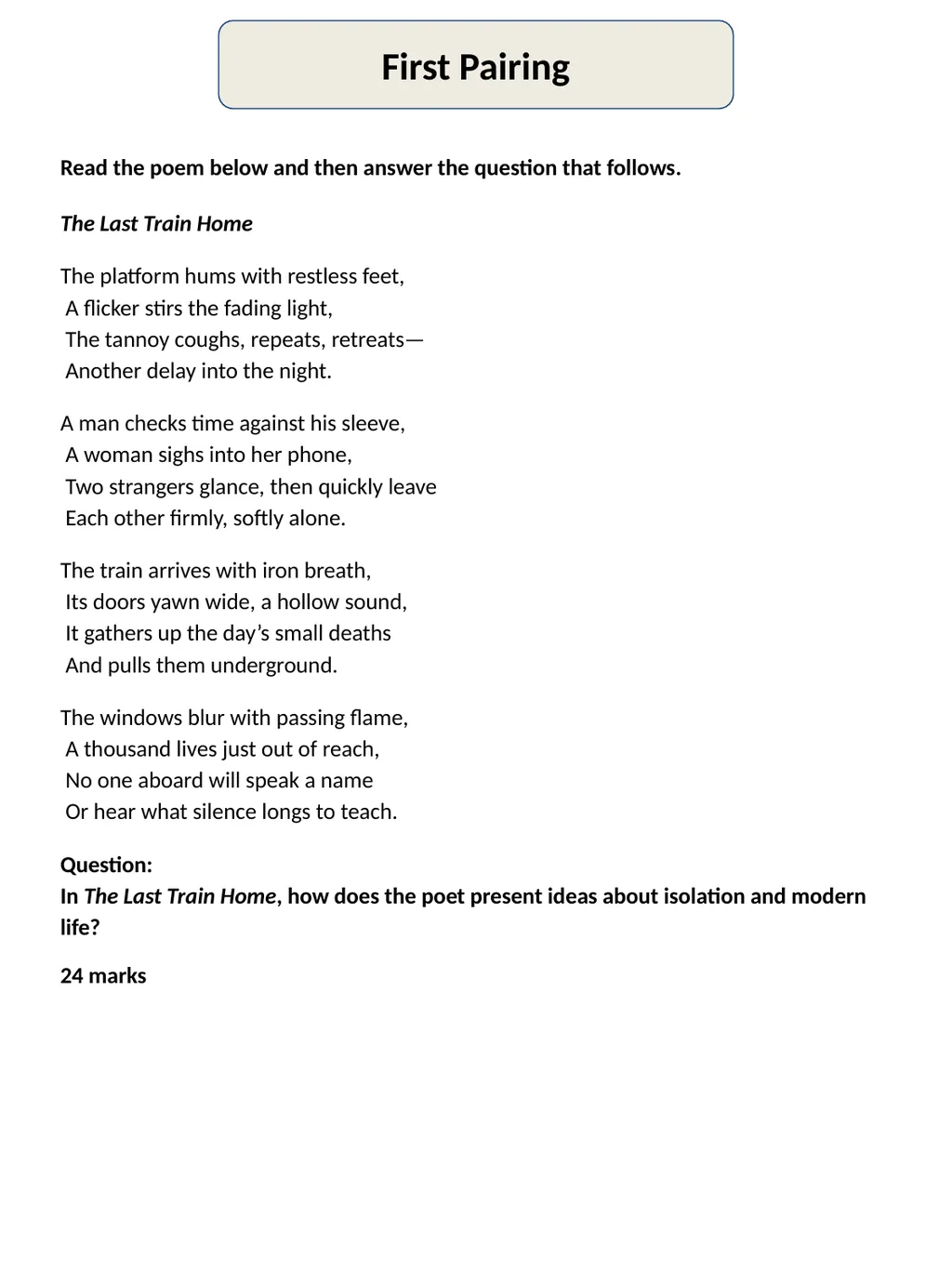
slide65. Read the poem below and then answer the question that follows.
The Last Train Home
The platform hums with restless feet, A flicker stirs the fading light, The tannoy coughs, repeats, retreats— Another delay into the night.
A man checks time against his sleeve, A woman sighs into her phone, Two strangers glance, then quickly leave Each other firmly, softly alone.
The train arrives with iron breath, Its doors yawn wide, a hollow sound, It gathers up the day’s small deaths And pulls them underground.
The windows blur with passing flame, A thousand lives just out of reach, No one aboard will speak a name Or hear what silence longs to teach.
Question: In The Last Train Home, how does the poet present ideas about isolation and modern life?
24 marks First Pairing<br>
slide66. Night Bus
The bus is lit with tired light, A moving room of vacant eyes, Each passenger avoids the night Reflected back in darkened skies.
A driver hums, the engine sighs, The city slips, unnamed, unseen, No one asks and none replies— Just miles of what has always been.
Comparison Question (8 marks): Compare how the poets present ideas about isolation in ‘The Last Train Home’ and in ‘Night Bus’.<br>
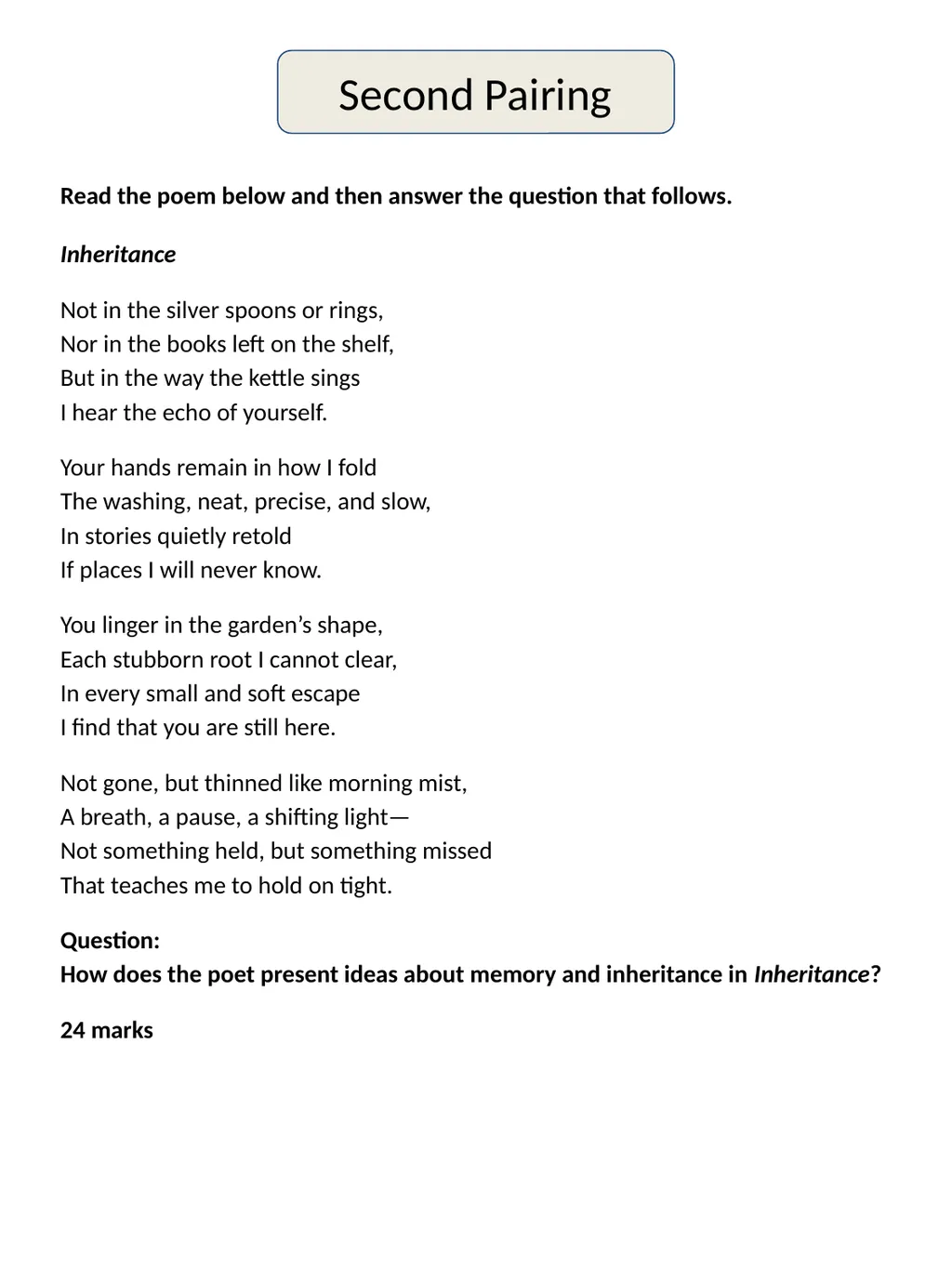
slide67. Read the poem below and then answer the question that follows.
Inheritance
Not in the silver spoons or rings, Nor in the books left on the shelf, But in the way the kettle sings I hear the echo of yourself.
Your hands remain in how I fold The washing, neat, precise, and slow, In stories quietly retold If places I will never know.
You linger in the garden’s shape, Each stubborn root I cannot clear, In every small and soft escape I find that you are still here.
Not gone, but thinned like morning mist, A breath, a pause, a shifting light— Not something held, but something missed That teaches me to hold on tight.
Question: How does the poet present ideas about memory and inheritance in Inheritance?
24 marks Second Pairing<br>
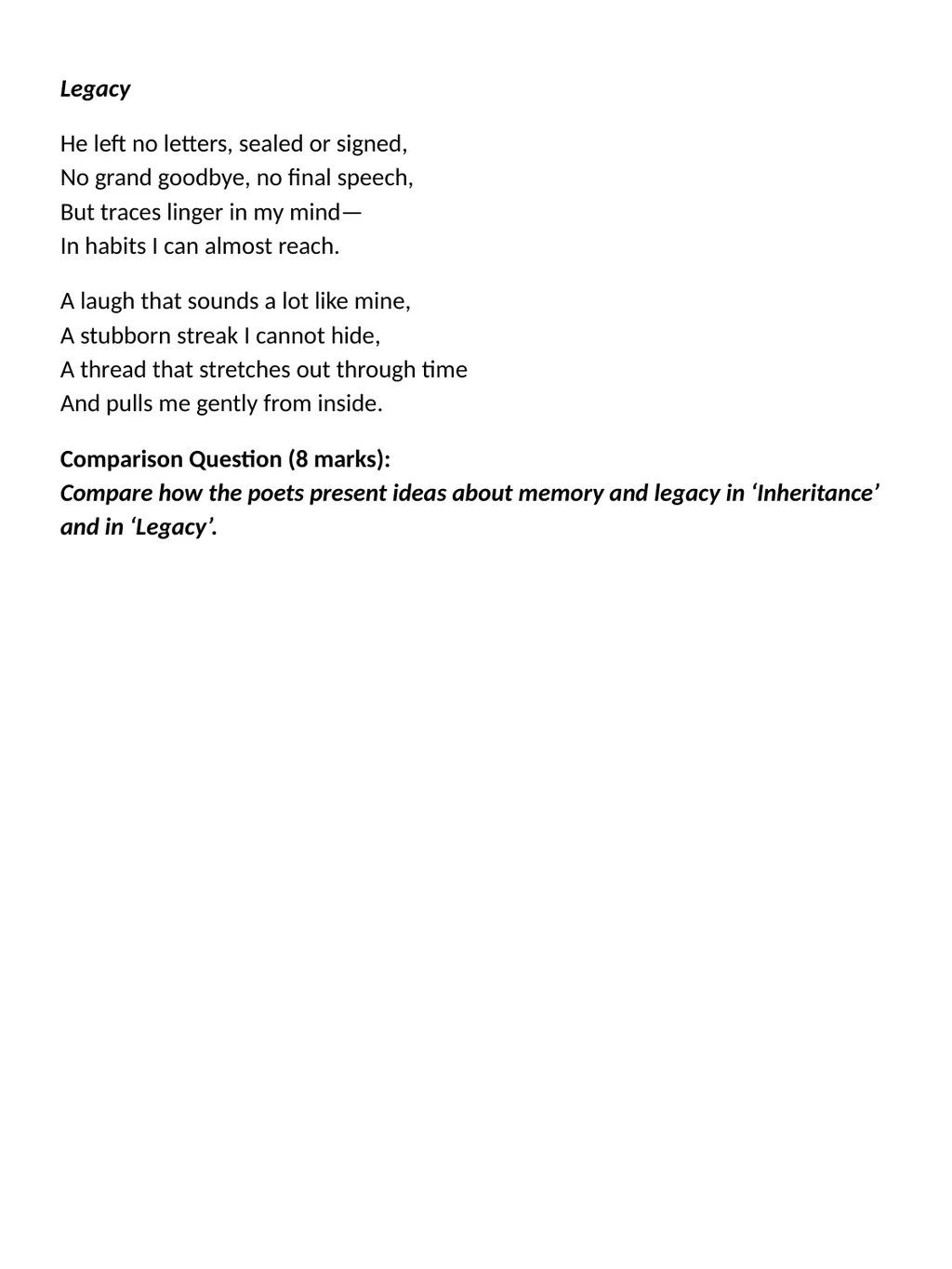
slide68. Legacy
He left no letters, sealed or signed, No grand goodbye, no final speech, But traces linger in my mind— In habits I can almost reach.
A laugh that sounds a lot like mine, A stubborn streak I cannot hide, A thread that stretches out through time And pulls me gently from inside.
Comparison Question (8 marks): Compare how the poets present ideas about memory and legacy in ‘Inheritance’ and in ‘Legacy’.<br>
slide69. Read the poem below and then answer the question that follows.
Storm Warning
The sky hangs low, a bruised complaint, The air is thick with what may break, The trees stand still, as if they faint Before the storm they cannot shake.
A child runs in, the shutters close, A mother counts the seconds slow, The wind begins its rising prose— A voice that everyone must know.
It claws the roof, it shakes the frame, It howls of things both lost and found, It calls each person by their name Without a face, without a sound.
Then just as sudden, it is gone— A quiet none of them can trust, They step outside to carry on, But something fragile turned to dust.
Question: How does the poet present the power of nature in Storm Warning?
24 Marks Third Pairing<br>
slide70. After the Rain
The storm has passed without a trace, The pavement dries, the sky turns blue, Yet something lingers in this place— A sense the world has shifted too.
The leaves lie scattered, torn and thrown, A quiet settles, thin and strange, As if the air itself has known The cost of such a sudden change.
Comparison Question (8 marks): Compare how the poets present the effects of nature in ‘Storm Warning’ and in ‘After the Rain’.<br>
slide71. Read the poem below and then answer the question that follows.
The Photograph
It sits between the yellowed pages, A moment trapped in borrowed light, Their smiles untouched by coming ages, Their eyes untroubled by the night.
A hand half-raised, a joke half-told, A summer day that would not last, The frame is cracked, the edges old, But still it whispers of the past.
I study faces I don’t know, Yet feel their laughter in my chest, And wonder where such people go When time has laid them down to rest.
The silence hums, the image stays— A fragile truth I cannot prove, That life is more than numbered days, But something memory makes us move.
Question: How does the poet present the significance of the past in The Photograph?
24 marks Fourth Pairing<br>
slide72. Old Shoes
They sit beside the bedroom door, Worn thin with journeys I don’t know, Their leather creased from years before, From steps that time has hidden now.
No voice remains, no stories told, Just quiet shapes that used to move, A life reduced to things grown old— Still holding more than they can prove.
Comparison Question (8 marks): Compare how the poets present ideas about the past in ‘The Photograph’ and in ‘Old Shoes’.<br>
slide2. An Inspector Calls Contents Page I have 5 Minutes
Glossary of Key Terms: Pick 5 random terms, preferably ones that you lack confidence with, define them and create 5 revision cards. Ask someone to test you on these.
Character Profiles: Write down 3 adjectives for one character (e.g., Eric Birling) and a key quote. Bonus points if your adjectives link to your quotation or you are able to bullet point any analytical points.
Themes: Summarise one theme (e.g., Social Responsibility) in one sentence and one quotation. Bonus points if you can form this into a strong thesis statement.
Exam Preparation: Look at one past paper question (at the end of the An Inspector Calls section) and quickly plan 3 bullet points you’d include.
Flashcards: Create 3 flashcards focusing on a gap in your knowledge for AIC.
Flashcards: Shuffle 5 flashcards that you have already created and test yourself.
I have 15 Minutes
Overview and Key Scenes: Re-read a key scene and jot down its importance for theme and character development.
Context: Create a quick spider diagram of how 1912/1945 context links to one character or theme.
Assessment Mark Sheet - Look at example paragraphs and assess the responses against the exam components.
Theme Tracking Across The Play - draw together the relevant information to enable you to approach a thematic exam question.
Priestley’s Intentions and Big Ideas: behind An Inspector Calls. This builds AO3 understanding and links directly to exam skills.
I have 30 Minutes
Timed Essay Plan for AIC: Do a timed essay plan for one question (intro + 3 paragraphs + conclusion).
Top Mark Essay Skills: Develop skills in drafting a body paragraph, thesis statement, and conclusion, with strong analysis linking big ideas, context, and Priestley’s purpose.
Question Bank – Relationships: Choose one pair (e.g., Sheila & Gerald) and write two paragraphs exploring how their relationship changes. Use the character cards to help you.
Additional Reading and Videos: Read/watch a short resource, then write a 5-bullet summary of new insights. GCSEPod, Mr Bruff, Seneca, CGP Guides etc.
Themes – Social Class: Create a flowchart linking 3 characters to how Priestley critiques class.<br>
slide3. have 50 Minutes
Exam Preparation: Write a full timed essay on one past paper question.
Notes - Overview and Key Scenes: Create a revision wall chart/poster mapping scenes to themes, characters, and context.
Character Profiles: Write detailed revision cards for two characters including quotes, development, themes, context.
Themes: Do a comparison grid: across all themes, note which characters, quotes, and scenes support them.
An Inspector Calls (2017 film version): Watch a full act and write a short comparison of how the director presents characters vs Priestley’s stage directions.<br>
slide4. Themes: How to Write a Thesis Statement (for An Inspector Calls) 1. What is a thesis statement?
A thesis statement is the central argument of your essay. It’s usually 1–2 sentences in the introduction that:
Directly answers the question.
Takes a clear stance on the theme/character/idea.
Can be expanded into topic sentences for body paragraphs.
2. Formula for a strong thesis
[Theme/character] is presented by Priestley as [judgement/argument], in order to [writer’s intention / effect on audience].
3. Example – Social Responsibility
One-sentence summary: Social responsibility is shown as essential for a fairer society.
Key quotation: ‘We are members of one body. We are responsible for each other.’
Thesis statement: Priestley presents social responsibility as a moral duty, showing that ignoring it leads to tragic consequences, in order to encourage his audience to embrace socialist values.
4. Quick Practice Task (5 minutes)
Pick one theme (e.g., Gender, Generations, Social Class).
Write:
A 1-sentence summary of how Priestley presents it.
A quotation that supports your point.
A thesis statement linking Priestley’s message to the audience.
5. Bonus Challenge
Transform your thesis into 3 sub-points (potential body paragraphs). Example for Social Responsibility:
Mr Birling embodies selfishness and neglect of duty.
Sheila shows how individuals can change and accept responsibility.
The Inspector is Priestley’s voice, teaching collective responsibility.<br>
slide5. Overview<br>
slide6. An inspector arrives at the Birling house. He tells them how a girl called Eva Smith has killed herself by drinking disinfectant - he wants to ask them some questions.
The Inspector reveals that the girl used to work in Arthur Birling's factory and he had her sacked for going on strike. Mr Birling refuses to accept any responsibility for her death.
The Inspector then reveals that Sheila thought that Eva had made fun of her, complained and got her sacked. Sheila is deeply ashamed and feels responsible for the girl’s death.
The Inspector forces Gerald to confess to an affair he had with Eva. Sheila respects Gerald’s honesty but returns the engagement ring he gave her.
It is revealed that Sybil Birling had refused to help the pregnant Eva.
It turns out that it was Eric who got Eva pregnant, and stole money from his father to help her.
The Inspector leaves. The family ring the infirmary and there is no record of a girl dying from drinking disinfectant.
Suddenly the phone rings, Mr Birling answers it, to his horror the phone call reveals that a young woman has just died from drinking disinfectant and the police are on their way to question them about it. The curtain falls and the play ends.<br>
slide7. Key Scene Analysis Each of these tasks = 15 minutes of active revision. Do one per session, or all four over a week for a complete key-scene refresh.
Task 1 – Act 1: Mr Birling’s ‘community and all that nonsense’ speech
Re-read: Focus on Birling’s views about capitalism, self-interest, and his predictions about war and the Titanic.
Notes:
Themes: Capitalism vs Socialism, Social Responsibility, Generations.
Character Development: Birling appears arrogant, short-sighted, and self-centred. Priestley sets him up as a figure to be criticised.
Audience Impact: 1945 audience knows Birling is wrong - makes Priestley’s socialist message stronger.
Thesis Sentence: Priestley uses Birling’s dismissive speech about community to expose the dangers of selfish capitalism and to encourage the audience to reject such attitudes.
Task 2 – Act 2: Sheila confronts Gerald about Daisy Renton
Re-read (5 mins): Look at Sheila’s questions and Gerald’s defensive responses.
Notes (5 mins):
Themes: Gender, Exploitation, Relationships.
Character Development: Sheila matures, showing honesty and empathy; Gerald reveals flaws and dishonesty.
Audience Impact: Audience sides with Sheila; Priestley suggests women and the younger generation are more capable of moral progress.
Thesis Sentence (3 mins): Priestley uses Sheila and Gerald’s confrontation to expose the exploitative treatment of women, while showing that moral growth comes from honesty and self-awareness.<br>
slide8. Task 3 – Act 3: Eric’s confession
Re-read: Pay attention to Eric’s admission of his behaviour and how his parents react.
Notes:
Themes: Social Class, Gender, Responsibility.
Character Development: Eric admits guilt, accepts responsibility, and contrasts with his parents’ refusal to change.
Audience Impact: Highlights how the younger generation offer hope for change, unlike the older generation.
Thesis Sentence: Priestley uses Eric’s confession to stress that the younger generation can learn from their mistakes, while the older generation cling to privilege and denial.
Task 4 – Final Scene: The Inspector’s speech (‘We are members of one body…’)
Re-read: Focus on the Inspector’s final words and tone before he leaves.
Notes:
Themes: Social Responsibility, Capitalism vs Socialism, Generations.
Character Development: The Inspector acts as Priestley’s mouthpiece, challenging all characters equally.
Audience Impact: Priestley delivers a warning: ignoring responsibility leads to ‘fire and blood and anguish.’
Thesis Sentence: Priestley uses the Inspector’s final speech as the moral climax of the play, urging the audience to embrace collective responsibility or face devastating consequences.<br>
slide9. Context Task – Spider Diagram Step 1: Pick Your Focus
Choose either:
One Character (e.g., Mr Birling, Sheila, The Inspector).
One Theme (e.g., Social Responsibility, Gender, Class).
Step 2: Gather Key Context Info (4 mins)
Use your notes, a study guide (York Notes/CGP/GCSEPod/Seneca), or re-read your play’s introduction/annotations. Here are some prompts:
1912 (when the play is set)
Class divisions: rigid hierarchy, working-class struggles (Eva Smith as symbol).
Gender roles: women had fewer rights, expected to marry for security.
Industrial unrest: strikes common, employers (like Birling) resisted workers’ rights. Historical irony: Titanic unsinkable? War impossible? Birling is wrong - undermines capitalism.
1945 (when the play was written/performed)
Post-WW2 society: devastation + demand for change.
Creation of Welfare State (NHS, social housing, benefits). Labour government: socialist ideas popular, collective responsibility.
Generations: young soldiers had sacrificed; new hope placed on younger people.
Step 3: Draw a Spider Diagram
In the middle: write your chosen character or theme. Around it:
4–6 branches linking to 1912/1945 context points.
Add 1–2 quotations that connect the context to the play.<br>
slide10. Example (Sheila Birling):
1912: Limited role for women - Sheila matures, challenges stereotypes.
1945: Women’s roles expanded in war - audience sees hope in her change.
Quotation: ‘You and I aren’t the same people who sat down to dinner tonight.’
Step 4: Wrap-Up
Write one thesis-style sentence linking context, character/theme, and Priestley’s message.
Example (Theme: Social Responsibility):
Priestley sets his 1912 play in a society blind to responsibility, but presents it to a 1945 audience ready for change, urging them to embrace socialism and collective duty.
Resources you can use:
BBC Bitesize: An Inspector Calls (context and themes)
SparkNotes / York Notes summaries
Your class notes / annotations in the play
GCSEPod
Seneca
CGP study guides
Mr Bruff on YouTube<br>
slide11. Assessment Sheet: Mr Birling
Question: How does Priestley present Mr Birling as a selfish character? Using the simplified marksheet on the next page, read, annotate and award a level/mark for the example paragraphs below. Please note that the band/mark would be awarded for a sustained answer, not just one paragraph.
Example one:
Priestley presents Mr Birling as selfish and arrogant through his speeches in Act 1. He describes himself as a “hard-headed practical man of business.” This quotation shows he values profit over people. The audience in 1945 would dislike him because they know capitalists like Birling refused to help workers before the war. Priestley is warning the audience not to trust men like Birling. Later in the play, Birling refuses to accept any responsibility for Eva’s death, which makes him seem even more selfish.
Example two:
Priestley deliberately portrays Mr Birling as the embodiment of selfish capitalism. When Birling declares the Titanic is “unsinkable, absolutely unsinkable,” the repetition of “absolutely” highlights his overconfidence. This dramatic irony makes him look foolish to the audience, who know disaster is inevitable. The audience loses respect for him and questions his authority. This contrasts sharply with the Inspector’s later warning about “fire and blood and anguish,” presenting Birling as dangerously short-sighted. Through Birling’s arrogance, Priestley attacks self-serving leaders and urges his 1945 audience to reject capitalist values in favour of collective responsibility.
Example 3:
Mr Birling is shown as selfish because he only cares about himself and money. At the start of the play, he talks about being a “hard-headed businessman,” which shows that he is proud of putting profit first. He also says there won’t be a war and that the Titanic is “unsinkable.” These ideas make him look silly to the audience because they know he is wrong. Instead of thinking about his family or about Eva Smith, he only talks about how important he is and what he thinks will happen. This shows he does not really care about other people.<br>
slide12. Marking Symbols
Use these as you read your own (or a partner’s) answer:
✦ = Well-chosen quotation
★ = Clear explanation of HOW Priestley presents Birling
⚑ = Link to another moment in the play
☀ = Priestley’s message / purpose
♥ = Audience reaction (how we are meant to feel)
✎ = Writing is linked directly back to the question
Highlight / annotate these symbols as you find them.
Level Guide
Level 1: Simple (1–6 marks)
Retells what Birling says/does.
Few or no quotations.
Doesn’t explain how or why.
Level 2: Developing (7–12 marks)
Some quotations.
Begins to explain meaning.
May hint at Priestley’s purpose.
Level 3: Secure (13–18 marks)
Well-chosen quotations with analysis. Links to other scenes.
Mentions Priestley’s socialist message.
Level 4: Perceptive (19–24 marks)
Detailed, thoughtful language analysis.
Strong links across the play.
Clear focus on Priestley’s message + audience impact.<br>
slide13. Theme Tracking Across the Play Step 1: Pick a Theme
Choose one theme, e.g.:
Social Responsibility
Generations
Class
Gender
Wealth & Materialism
Step 2: Find 3–4 Key Moments
Quickly scan your notes or memory and write down 3–4 moments from the play that show this theme. Include:
Character involved
What happens
One key quotation
Example (Social Responsibility):
The Inspector: ‘We are members of one body.’
Sheila: returns the ring
Eric: admits his role in Eva’s death – ‘I was in that state when a chap easily turns nasty.
Step 3: Analyse Each Moment
For each moment, add:
Method (language, stage directions, dramatic devices) Effect on audience
Link to Priestley’s purpose/context
Step 4: Exam-Style Sentence (2 mins)
Choose one of your examples and write one concise sentence linking: Quotation → method → theme → audience impact → Priestley’s message Example: Priestley uses the Inspector’s line ‘We are members of one body’ as a metaphor to emphasise social responsibility, making the audience reflect on collective duty and reinforcing his socialist message to 1945 viewers.<br>
slide14. Priestley’s Intentions and Big Ideas Step 1: Recall Key Messages
Write down 3–5 big ideas or messages Priestley is trying to convey in the play. Examples:
Social responsibility is essential for a fair society.
The younger generation can learn and change, unlike the older generation.
Step 2: Find Supporting Moments
For each big idea, jot down:
A character or event that shows it
A key quotation
A method Priestley uses (language, stage direction, dramatic device)
Example:
Big idea: Social responsibility is essential
Character/event: The Inspector’s speech
Quotation: “We are members of one body”
Method: Metaphor / didactic tone → highlights moral lesson to audience
Step 3: Link to Audience and Context
For each example, add:
Why Priestley includes it (intention/message)
How a 1945 audience would respond
Optional: How a modern audience might interpret it
Example: Priestley wants the audience to reflect on collective responsibility and reject selfishness. A 1945 audience, having lived through two world wars, would recognise the importance of working together for social change.
Step 4: Exam-Style Sentence
Pick one big idea and write a concise sentence linking: Quotation → Method → Priestley’s Intention → Audience Reaction
Example: Priestley uses the Inspector’s metaphor ‘We are members of one body’ to emphasise social responsibility, encouraging the audience to understand the consequences of selfish behaviour and promoting socialist ideals in post-war Britain.<br>
slide16. Timed Essay Plan for An Inspector Calls Step 1: Choose a Question
Pick one past paper or practice question. Example: “How does Priestley present the younger generation in An Inspector Calls?”
Step 2: Plan Your Introduction
Decide your thesis statement (answer the question clearly).
Mention theme / context / Priestley’s purpose.
Example: Priestley presents the younger generation as capable of learning from mistakes and embracing social responsibility, contrasting with the older generation, in order to encourage his 1945 audience to adopt more moral and collective values.
Step 3: Plan 3 Body Paragraphs
Paragraph 1 – Character Example / Theme
Point: Introduce the character or theme
Evidence / Quotation: Pick a key quote
Explain Method: How Priestley presents them (language, stage direction, dramatic technique)
Why / Effect: Link to audience/context and bigger message
Paragraph 2 – Character Example / Theme
Repeat structure with a second example
Paragraph 3 – Comparison / Contrasting Evidence
Compare with another character, event, or generation
Show Priestley’s purpose or contrasting viewpoint
Include quotation + method + effect
Tip: Bullet points are fine — focus on planning the structure, evidence, and analysis rather than writing full sentences.
Step 4: Plan the Conclusion (5 mins)
Restate your thesis in different words
Summarise your 3 main points
End with overall message / Priestley’s intention / relevance to audience
Example: Through the younger generation’s moral growth, Priestley emphasises that social responsibility and self-awareness are crucial for a fair society, leaving the audience to reflect on their own attitudes.<br>
slide17. Top-Mark Essay Skills Step 1: Draft a Thesis Statement
Read your question. Example: "How does Priestley present the younger generation in An Inspector Calls?" Draft a concise thesis sentence linking theme, context, and Priestley’s purpose:
Example: Priestley presents the younger generation as morally aware and capable of change, contrasting with the older generation, to encourage his 1945 audience to reflect on social responsibility and the need for a more just society.
Tip: Keep it one sentence, clearly answering the question.
Step 2: Plan & Draft a Body Paragraph
Use the What–How–Why structure:
What? – Clear point / argument Example: Sheila is shown to grow morally and take responsibility for her actions.
How? – Evidence and method Example: Priestley uses her dialogue, when she says “I’ll never let it happen again,” to demonstrate her awareness of the consequences of her behaviour. Her character development is also shown through her confrontation with Gerald, which highlights her willingness to challenge dishonesty.
Why? – Priestley’s purpose / audience effect Example: This demonstrates Priestley’s intention to show that the younger generation can change and learn from mistakes. A 1945 audience would view Sheila’s transformation as a symbol of hope for a more responsible and morally aware society, reinforcing the play’s message about social responsibility.
Tip: Include context links and audience impact to show AO3 understanding.<br>
slide18. Step 3: Draft a Conclusion
Restate your thesis in a fresh way.
Summarise your main points.
Emphasise Priestley’s overall purpose and the play’s big ideas.
Example: Through Sheila’s transformation, Priestley highlights the capacity for moral growth in the younger generation and contrasts it with the complacency of the older characters. This reinforces his message that social responsibility is essential, encouraging the audience to reflect on their own attitudes and actions within society.
Step 4: Optional Extension
Draft alternative thesis statements for other characters or themes.
Try writing a shorter, punchy conclusion for exam conditions.
Identify other quotations and methods you could use to strengthen the paragraph.<br>
slide19. Relationships in the Play Step 1: Recall & Brainstorm
Write down 3 things about the relationship at the start of the play.
Write down 3 things about the relationship later in the play.
Jot 1–2 quotations for each stage.
Prompts:
How do they act towards each other at first?
What changes after the Inspector arrives?
Do they trust each other by the end?
Step 2: Paragraph 1 – The Start of the Relationship
What? Describe their relationship at the beginning.
How? Use 1 quotation and explain Priestley’s methods (language, dramatic irony, stage directions).
Why? Explain Priestley’s purpose / audience reaction.
Sentence starter scaffold:
At the start, Priestley presents Sheila and Gerald’s relationship as…
This is shown when [quotation]…
Priestley uses [method] to…
This makes the audience…
Step 3: Paragraph 2 – Later in the Play
What? Describe how/why the relationship changes.
How? Use 1 quotation and explain method.
Why? Priestley’s intention/audience response.
Sentence starter scaffold:
Later in the play, their relationship changes when…
Gerald says [quotation]…
Priestley uses [method] to show…
This suggests that…
The audience would…
Step 4: Quick Link & Wrap-Up
Write 1 final linking sentence: By showing how Sheila and Gerald’s relationship changes, Priestley highlights [big idea/theme] and encourages the audience to [audience effect].<br>
slide20. Relationship Question Cards – An Inspector Calls Card 1: Sheila & Gerald
Question: How does Priestley present the relationship between Sheila and Gerald in An Inspector Calls?
Quotations to use:
Sheila: ‘I’ll never let it happen again.’
Gerald: ‘I became at once the most important person in her life.’
Sheila (to Gerald): ‘You and I aren’t the same people who sat down to dinner tonight.’
Card 2: Sheila & Mr Birling
Question: How does Priestley present the relationship between Sheila and her father?
Quotations to use:
Birling: ‘Nothing to do with you, Sheila. Run along.’
Sheila: ‘But these girls aren’t cheap labour – they’re people.’
Birling: ‘The famous younger generation who know it all. And they can’t even take a joke.’
Card 3: Mr Birling & The Inspector
Question: How does Priestley present the relationship between Mr Birling and the Inspector?
Quotations to use:
Birling: ‘A man has to mind his own business and look after himself and his own – and –’ [Inspector rings bell and enters]
Inspector: ‘We are members of one body.’
Birling: ‘Probably a socialist or some sort of crank.’
How to use the cards:
Take one card.
Follow the 30-minute scaffolded task (brainstorm → Paragraph 1 → Paragraph 2 → Link sentence).
You can use the provided quotations so the focus is on analysis, Priestley’s intentions, and audience reaction, not on hunting for evidence.<br>
slide21. Theme: Social Class Task Goal: To make a visual flowchart linking 3 characters and how Priestley critiques class.
Step 1 – Set up your page
Draw 3 large boxes (one for each character).
Suggested: Mr Birling / Eva Smith / The Inspector (or Sheila if you prefer).
Step 2 – Add Key Evidence
Inside each box, jot down:
1 short quotation
1 or 2 keywords about method (e.g. dramatic irony, symbolism)
A quick note on Priestley’s message
Example for Mr Birling:
Quote: ‘Unsinkable, absolutely unsinkable.’
Method: Dramatic irony
Message: Priestley critiques arrogant upper-class attitudes
Step 3 – Connect with Arrows
Draw arrows between the boxes to show relationships:
Birling → Eva = Exploitation of the working class
Eva → Inspector = Symbol of injustice → call for change
Inspector → Birling = Clash of capitalist vs socialist views
Write short notes on the arrows to show the link.
Step 4 – Add Themes/Big Ideas
Around the outside of the flowchart, jot theme keywords:
Capitalism vs Socialism
Exploitation
Responsibility
Inequality
Then add a one-sentence summary at the bottom: Priestley uses characters across the class spectrum to show how inequality causes suffering and why society must change.<br>
slide22. Overview and Key Scenes Wall Chart Step 1 – Divide Your Poster
Title: An Inspector Calls – Key Scenes & Themes
Split your poster into 5–6 key scenes (boxes, timeline, or flow diagram). Suggested scenes:
Birling’s opening speech (Act 1)
Sheila’s interrogation (Act 1)
Gerald’s affair revealed (Act 2)
Mrs Birling’s confrontation (Act 2)
Eric’s confession (Act 3)
The Inspector’s final speech (Act 3)
Step 2 – Fill in Scene Boxes
For each scene, add three layers of notes:
Characters: Who’s central in this scene? How do they develop/change?
e.g. Act 1, Sheila: naïve - begins questioning her role.
Themes: Which theme(s) are explored?
e.g. Birling’s speech = capitalism vs socialism, dramatic irony.
Context/Intentions: How does this connect to 1912 (set) / 1945 (audience)?
e.g. Birling’s ‘unsinkable’ speech - exposes arrogance of ruling class.
You can use different colours (e.g. blue for characters, red for themes, green for context).
Step 3 – Add Quick Quotations
Pick 1–2 short quotations per scene.
Write them directly into the boxes so they’re easy to see for revision.
e.g. Act 2, Sheila: ‘You mustn’t try to build up a wall between us and that girl.’
Step 4 – Final Touches
Draw links/arrows between scenes (e.g. Sheila changes here - contrasts with Birling later).
Add a Priestley’s Purpose box at the bottom: Priestley uses the play to argue for social responsibility and challenge the class system.
Decorate with symbols/visual cues (e.g. factory = capitalism, scale = social responsibility).<br>
slide23. Character Profile Revision Cards Step 1 – Choose Characters
Pick any two contrasting characters (e.g. Sheila vs Mr Birling, or Gerald vs Eva).
Step 2 – Create Card Layout
Each card should have:
Character Overview (top) – Who they are, their role.
Key Quotations (middle left) – At least 4 short, exam-ready quotes.
Development (middle right) – How they change (or fail to change).
Themes/Big Ideas (bottom left) – What Priestley critiques through them.
Context / Purpose (bottom right) – 1912/1945 link + Priestley’s intention.
Challenging Vocabulary Bank (edge of card) – e.g. microcosm, didactic, subverts, exposes, hypocrisy.
Step 3 – Fill in the First Card
Model and further steps on the next page.<br>
slide24. Model: Sheila Birling
Overview: Upper-class daughter, starts as naïve but develops moral awareness.
Quotations:
‘Look – mummy – isn’t it a beauty?’ (materialism, childish tone)
‘I’ll never, never do it again to anybody.’ (remorse, growth)
‘You mustn’t try to build up a kind of wall between us and that girl.’ (symbolism of social divisions)
It’s you two who are childish – trying not to face the facts. (reversal of generational roles)
Development: Immature to self-aware to moral voice of younger generation.
Themes: Social responsibility, generational divide, morality vs materialism.
Context/Purpose: Priestley uses Sheila to show hope for social change; contrasts her growth with her parents’ stubbornness to critique Edwardian class values.
Vocabulary: didactic, redemptive arc, subverts expectations, agent of change.
Step 4 – Fill in the Second Card
Model: Mr Birling
Overview: Wealthy businessman, head of family, symbol of capitalism.
Quotations:
‘Unsinkable, absolutely unsinkable.’ (dramatic irony)
‘A man has to mind his own business and look after himself.’ (individualism)
‘If we were all responsible for everything… it would be very awkward.’ (dismissive of social responsibility)
‘The famous younger generation who know it all. And they can’t even take a joke.’ (refusal to change)
Development: Consistently arrogant, refuses responsibility, symbol of older generation’s failure.
Themes: Capitalism vs socialism, class exploitation, responsibility vs denial.
Context/Purpose: Represents selfish industrialists of 1912; Priestley critiques laissez-faire capitalism and promotes socialist values for a post-war audience.
Vocabulary: hubristic, capitalist mouthpiece, microcosm of ruling class, dramatic irony exposes arrogance.
Step 5 – Quick Compare/Reflect
Write 2–3 bullet points comparing your chosen characters.
e.g. Sheila grows while Birling remains stagnant, Priestley shows hope in the younger generation.<br>
slide25. Themes Comparison Grid Step 1 – Set up the Grid
Draw a table with columns:
Theme | Characters linked | Key Quotations | Key Scenes | Priestley’s Purpose/Context
Step 2 – Select Themes
Use the main GCSE themes:
Capitalism vs Socialism
Exploitation
Gender
Generations: Young vs Old
Social Class
Social Responsibility
Wealth and Materialism
Step 3 – Fill in the Grid - model below:
Step 4 – Quick Compare/Reflect
Pick two themes that overlap (e.g. Social Class + Exploitation).
Write 3 bullet points showing how they connect.
Eva’s treatment by Birling = class exploitation → Priestley critiques inequality.
Sheila’s response bridges class divide → Priestley shows change is possible.<br>
slide26. Exam Preparation<br>
slide30. Power and Conflict Revision - Contents Page I have 5 minutes:
Name that Poem
Revision Clock, ways to use:
Quotation recall,
Themes - assign each time slot a theme (e.g. power, nature, identity, war, memory). Link at least 2 poems to that theme. Add a short explanation of how each poem presents it.
Language Analysis Burst - Pick one quote and analyse it in depth: Word choices, Imagery, Connotations, Effect on reader
Comparison Drill - Choose two poems and answer: What’s similar? What’s different? Which is more powerful and why?
Context Snapshots Each section = one poem’s context: Historical background, Poet’s intention, Big ideas (e.g. colonialism, trauma)
Quote by Rote analysis - choose one quotation to analyse in detail. Include method(s), inference/connotations, big ideas that are being communicated and context.
Watch a GSCEPod video and make notes from it.
I have 15 minutes:
Poem Consolidation
Thesis Statements
Create or update revision cards based on the gaps in knowledge you identified during the blurting activity.
Zoom in, Zoom out: Write one What, How, Why paragraph analysing one word and link it to the poem’s big idea
Theme Playlist: Link 3 poems to modern songs and explain the connection (theme / tone / message)
Power and Conflict Essay Vocabulary Bank. Use this to help with your vocabulary choices/essay writing.
I have 30 minutes:
Power and Conflict comparing methods
Structure Focus Worksheet
Mini plan: one comparison essay (bullet points only).
Character/Voice Comparison
Blurting: Write down everything you can remember about one poem from memory. Then, using your revision materials (flashcards, annotations, GCSEPod, etc.), add in any missing ideas or details in a different coloured pen.
Listen to a Power and Conflict Podcast - There is a ‘Public Playlist’ on Spotify called: AQA Power and Conflict Poems GCSE
Print a blank copy of a poem and reannotate it - try doing this without support first, then use your revision materials to add to your annotations.
I have 50 minutes:
Learn a poem by heart (could be in the I have 5 minutes, depending on strategy)
Exam Question Generator: Write 3 possible exam questions for a theme and then create a detailed essay plan for one.
Improve the response: Poems: Storm on the Island and Exposure
Visual Map: Create a visual/mind map of one poem: Include: quotes, themes, methods, structure and use colour to show links<br>
slide31. Name that Poem The following are the first line from each poem from the Power and Conflict collection. Can you name the poem without looking? The quotes are not in the order of the collection.<br>
slide34. Name of Poem: Three key quotations with analysis bullet points: Structural Points/Analysis: This poem is about: Big ideas/bigger concepts: Main themes: Poem Consolidation<br>
slide35. Power and Conflict Essay Vocabulary Bank 1. Epithets / Characterisation Vocabulary
Authoritative Definition: Having power or control that is respected and obeyed. Model sentence: The speaker adopts an authoritative tone, suggesting complete control over the situation.
Dominant Definition: Exercising power over others. Model sentence: The poem presents nature as a dominant force that humans cannot escape.
Oppressive Definition: Unjustly harsh or controlling. Model sentence: The oppressive atmosphere reflects the speaker’s lack of freedom.
Vulnerable Definition: Open to harm physically or emotionally. Model sentence: The speaker appears vulnerable, highlighting their lack of power.
Detached Definition: Emotionally disconnected. Model sentence: The detached tone suggests emotional numbness after trauma.
2. High-Level Analytical Vocabulary
Juxtaposes Definition: Places two contrasting ideas side by side. Model sentence: The poet juxtaposes beauty and violence to emphasise conflict.
Undermines Definition: Weakens or challenges an idea. Model sentence: The ending undermines the idea of heroic war.
Emphasises Definition: Gives special importance to something. Model sentence: The structure emphasises the speaker’s growing fear.<br>
slide36. Conveys Definition: Communicates an idea or feeling. Model sentence: The imagery conveys a sense of loss and regret.
Reinforces Definition: Strengthens an idea. Model sentence: The repetition reinforces the sense of inevitability.
3. Structural Vocabulary
Cyclical Definition: Returning to the beginning, creating a sense of repetition. Model sentence: The cyclical structure suggests history is doomed to repeat itself.
Volta Definition: A turning point in the poem. Model sentence: The volta marks a shift from admiration to fear.
Fragmented Definition: Broken or disjointed structure. Model sentence: The fragmented structure reflects the chaos of conflict.
Linear progression Definition: A clear, ordered development from start to end. Model sentence: The poem’s linear progression mirrors the inevitability of time.
4. Tone Vocabulary
Melancholic Definition: Deeply sad or reflective. Model sentence: The melancholic tone reflects the speaker’s sense of loss.
Sarcastic Definition: Mocking or ironic. Model sentence: The sarcastic tone highlights the speaker’s bitterness.
Foreboding Definition: Suggesting something bad will happen. Model sentence: The foreboding atmosphere builds tension throughout the poem.
Resigned Definition: Accepting something unpleasant without resistance. Model sentence: The speaker’s resigned tone suggests acceptance of fate.<br>
slide37. 5. Argument / Thesis Vocabulary
Suggests that… Model sentence: The poem suggests that power inevitably corrupts those who hold it.
Implies that… Model sentence: The structure implies that conflict is unavoidable.
Challenges the idea that… Model sentence: The poet challenges the idea that war is heroic.
Reflects the notion that… Model sentence: The imagery reflects the notion that nature is indifferent to human suffering.<br>
slide38. Thesis Sentence Structures 1. At first glance thesis
Use this when identifying the surface meaning of a text.
At first glance, Shakespeare presents ______ as ______, however, on closer inspection we realise that ______.
Example prompt words you might use: fate / love / fear / control / inevitability
2. Although thesis
Use this to show surface meaning vs deeper meaning.
Although Shakespeare initially presents ______ as ______, he ultimately suggests that ______.
OR (more sophisticated)
Although ______ appears to ______, Shakespeare reveals that ______. 3. Because thesis
Use this to explain why the writer presents ideas in a certain way.
Shakespeare suggests that ______ because ______.
OR (linked to methods)
Shakespeare presents ______ because the use of ______ emphasises ______.
4. Despite thesis
Use this to show contrast or challenge.
Despite ______, Shakespeare suggests that ______.
OR (character-focused)
Despite being presented as ______, ______ ultimately ______. Big ideas
Write 3 thesis statements for possible exam questions. You can either create your own question or use past papers.<br>
slide39. Power and Conflict comparing methods Task 1 Name the poems.
Task 2 Explain their effects - are the effects the same or different? Bullet point connotations/inference/writers’ intentions/context - similar to your quote by rote method.<br>
slide42. Structure Focus Worksheet How does the poem develop from start to end?
Instructions: Choose a poem from the Power and Conflict anthology. Work through the sections below to track how the poem changes from beginning to end.
1. First Impressions (Opening)
What is happening at the start of the poem?
What is the tone?
What ideas/themes are introduced?
2. Development (Middle)
How does the poem develop or shift?
Are new ideas introduced?
Does the tone change?
Is there a turning point? (Volta)
3. Ending
How does the poem end?
What final message or idea is left with the reader?
Is the ending clear, ambiguous, or cyclical?
4. Structure Techniques
Identify and explain the effect of structural methods used in the poem:
Stanza lengths / changes:
Enjambment / caesura:
Repetition:
Cyclical structure:
Contrast / shifts:
5. Big Picture
How does the structure help to present the main theme?
Why has the poet organised the poem this way?
Challenge:
Compare the structure of this poem with another poem from the anthology.
What is similar?
What is different?<br>
slide43. Character/Voice Comparison Choose two poems from the Power and Conflict anthology.
Complete the table below: Challenge:
What is similar about the voices in both poems?
What is different?
Which speaker is more powerful and why?
Write 3–4 sentences comparing the voices. Sentence Starters:
In both poems, the speaker...
However, in contrast...
The tone in ___ is..., whereas in ___ it is...
This suggests that...<br>
slide44. Learn a Poem by Heart Choose one of the Power and Conflict poems from the anthology and learn it off by heart. To do this you could:
Record yourself reading the poem
Write it out repeatedly
Make a picture using key images from the poem
Learn a few lines a day for a week
Read it in different voices/tones<br>
slide45. Improve the Response
Poems: Storm on the Island and Exposure Both poems show nature as powerful and dangerous. In Storm on the Island the writer describes a strong storm hitting the island. It says ‘we are prepared’ which suggests the people think they are ready, but the storm still feels scary and uncontrollable. In Exposure nature is also shown as harsh, especially the cold and wind, which causes suffering for soldiers in war.
In Storm on the Island, the people believe they are safe because they live in a strong place, but the storm changes this. The phrase ‘exploding comfortably’ suggests the storm is violent but also constant, which makes it feel threatening. In Exposure, the soldiers are also stuck in a dangerous environment and the weather is more of an enemy than the actual war. The writer repeats ideas of cold and wind to show how long and painful it is.
Both poems also show how humans cannot control nature. In Storm on the Island the islanders realise they are powerless against the storm even though they thought they were prepared. In Exposure, the soldiers are waiting and suffering, and nature seems to control everything around them. This makes nature seem stronger than people in both poems.
Overall, both poems present nature as something powerful and overwhelming. However, Storm on the Island focuses more on fear of a sudden storm, while Exposure shows long-term suffering caused by weather during war. Both poets suggest humans are weak compared to nature. Improvement Tasks
Task 1: Add Sophisticated Vocabulary
Underline 5 words in the answer and replace them with more advanced alternatives. Example: powerful → dominant / overwhelming
Task 2: Improve the Quotations
Add one extra quotation to each poem paragraph
Make sure each quote is fully embedded into a sentence
Add a method for each quote (e.g. imagery, repetition, contrast)
Task 3: Level Up the Analysis: For each paragraph, add one sentence starting with:
This suggests that…
This implies that…
This reflects the idea that… Task 4: Structural Comparison: Add a final sentence to paragraph 3 explaining:
How the structure of each poem helps present nature (e.g. shift, cyclical, progression)
Task 5: Upgrade the Introduction: Rewrite the first paragraph to include:
A clear argument (thesis)
A mention of both poets’ intentions
Task 6: Challenge (Grade 6+): Rewrite paragraph 2 and include:
Zoom in on one word from each poem
Explain the effect of that word in detail
Link both to the theme of nature’s power<br>
slide46. Exam Preparation<br>
slide49. Compare how poets present the effects of memory on people in Poppies and in one other poem from Power and Conflict. Poppies
Three days before Armistice Sunday
and poppies had already been placed
on individual war graves. Before you left,
I pinned one onto your lapel, crimped petals,
spasms of paper red, disrupting a blockade
of yellow bias binding around your blazer.
Sellotape bandaged around my hand,
I rounded up as many white cat hairs
as I could, smoothed down your shirt’s
upturned collar, steeled the softening
of my face. I wanted to graze my nose
across the tip of your nose, play at
being Eskimos like we did when
you were little. I resisted the impulse
to run my fingers through the gelled
blackthorns of your hair. All my words
flattened, rolled, turned into felt,
slowly melting. I was brave, as I walked
with you, to the front door, threw
it open, the world overflowing
like a treasure chest. A split second
and you were away, intoxicated.
After you’d gone I went into your bedroom,
released a song bird from its cage.
Later a single dove flew from the pear tree,
and this is where it has led me,
skirting the church yard walls, my stomach busy
making tucks, darts, pleats, hat-less, without
a winter coat or reinforcements of scarf, gloves.
On reaching the top of the hill I traced
the inscriptions on the war memorial,
leaned against it like a wishbone.
The dove pulled freely against the sky,
an ornamental stitch. I listened, hoping to hear
your playground voice catching on the wind.
JANE WEIR<br>
slide50. Compare the ways poets present the power of man in Storm on the Island and in one other poem from Power and Conflict. Storm on the Island
We are prepared: we build our houses squat,
Sink walls in rock and roof them with good slate.
This wizened earth has never troubled us
With hay, so, as you see, there are no stacks
Or stooks that can be lost. Nor are there trees
Which might prove company when it blows full
Blast: you know what I mean – leaves and branches
Can raise a tragic chorus in a gale
So that you can listen to the thing you fear
Forgetting that it pummels your house too.
But there are no trees, no natural shelter.
You might think that the sea is company,
Exploding comfortably down on the cliffs
But no: when it begins, the flung spray hits
The very windows, spits like a tame cat
Turned savage. We just sit tight while wind dives
And strafes invisibly.
Space is a salvo,
We are bombarded by the empty air.
Strange, it is a huge nothing that we fear.
SEAMUS HEANEY<br>
slide51. Compare the ways poets present ideas about the power of memory in The Emigrée and in one other poem from Power and Conflict. The Émigree
There once was a country… I left it as a child
but my memory of it is sunlight-clear
for it seems I never saw it in that November
which, I am told, comes to the mildest city.
The worst news I receive of it cannot break
my original view, the bright, filled paperweight.
It may be at war, it may be sick with tyrants,
but I am branded by an impression of sunlight.
The white streets of that city, the graceful slopes
glow even clearer as time rolls its tanks
and the frontiers rise between us, close like waves.
That child’s vocabulary I carried here
like a hollow doll, opens and spills a grammar.
Soon I shall have every coloured molecule of it.
It may by now be a lie, banned by the state
but I can’t get it off my tongue. It tastes of sunlight.
I have no passport, there’s no way back at all
but my city comes to me in its own white plane.
It lies down in front of me, docile as paper;
I comb its hair and love its shining eyes.
My city takes me dancing through the city
of walls. They accuse me of absence, they circle me.
They accuse me of being dark in their free city.
My city hides behind me. They mutter death,
and my shadow falls as evidence of sunlight.
CAROL RUMENS<br>
slide52. Unseen Poetry Contents Page I have 5 minutes:
Read through the how to approach a poem sheet to recap on some useful guidance.
Read through the FILMS approach sheet - do not forget to use it when analysing the poems.
Read a poem and decide what tone is being communicated by the poet/speaker, use the Tone Word Bank to help you decide and upgrade your vocabulary choice.
Choose one quotation from a poem and explode it - consider method(s) used, key vocabulary choices and their connotations, what inferences can we make about the meaning/ideas about the poem?
Revise 3 methods - definition and what their effects could be.
I have 15 minutes:
Complete the flow diagram for What Tone Should I Choose for one of the poems.
Read one of the model responses and annotate it for the skills: understanding of meaning, methods used, their effect on the reader, bigger ideas explored.
Bring up your favourite song lyrics and choose a verse - analyse the lyrics: What is the writer suggesting about…? How are they suggesting it? (quotation and technique) Why are they creating this imagery/ comparison?
Watch a Mr Bruff or YouTube equivalent on how to to approach this question.
I have 30 minutes:
Analysis Scaffolding Table: Complete your own analysis table or annotate one of the poems/poem pairings using the sentence starters to guide you.
Complete the FILMS tasks for: In ‘Catrin’ how does the poet present the speaker’s attitudes towards motherhood?
Write a 24 mark response for: In ‘Catrin’ how does the poet present the speaker’s attitudes towards motherhood?
I have 50 minutes:
Read and improve the response given, use the tasks to help build the response through the grade boundaries.
Write a full exam question response to one of the pairings in the exam preparation section.<br>
slide53. How to approach the poem: Reading poems cold and forcing yourself to write a quick 2–3 sentence summary straight away. Not analysis yet, just what is happening, what the tone feels like, and what the emotional direction is. A lot of students skip this and jump straight into devices, which makes their answers feel disconnected from meaning.
Once you’ve done that, practise building layers of interpretation. For example, take a single line and ask yourself:
What is the surface meaning?
What could it suggest beyond that?
What mood or attitude does it create?
Why might the poet want me to feel that?
This helps you avoid feature-spotting and pushes you towards interpretation, which is where the higher marks sit.
Another really effective revision method is comparison practice. Take two random unseen poems and force yourself to compare them in terms of ideas, not just techniques. You might think in terms of:
how they present a similar theme differently
whether one feels more personal vs. detached
differences in tone shift or structure (steady vs. fragmented, for example)
Even if the poems are very different, the act of finding connections trains you for the exam question where comparison is essential.
You can also build a response bank of flexible phrases. Things like:
This suggests a sense of…
This could reflect the poet’s perspective on…
The shift in tone implies…
The imagery creates an impression of…<br>
slide55. Tone Word Bank Basic
Simple, clear, safe choices
Happy
Sad
Angry
Calm
Scary
Serious
Lonely
Hopeful
Upset
Excited
Example:
The tone is sad, suggesting the speaker feels loss Intermediate
More precise and analytical
Melancholic
Reflective
Tense
Uneasy
Nostalgic
Bitter
Peaceful
Gloomy
Frustrated
Anxious
Example:
The tone is melancholic, created through ‘vacant eyes’, suggesting emotional emptiness Advanced
Nuanced and conceptual
Somber
Ironic
Ambivalent
Resigned
Foreboding
Introspective
Detached
Reverent
Mournful
Sardonic
Contemplative
Ominous
Example:
The tone is ominous, as the storm ‘claws the roof, suggesting impending danger Students often: Pick a tone word, but don’t explain it
Fix with: Tone + Evidence + Effect<br>
slide56. What Tone Should I Choose? Decision Guide<br>
slide57. Analysis Scaffolding
Table<br>
slide58. In ‘Catrin’ how does the poet present the speaker’s attitudes towards motherhood?
24 marks F – Form
What type of poem does this feel like (e.g. narrative, dramatic monologue, reflective)?
Who is speaking in the poem, and who are they speaking to?
Why might the poet have chosen this form to present a parent–child relationship?
How does the poem’s form help us understand the emotional conflict?
Use a quotation to support your idea about the speaker or relationship. I – Imagery
What physical spaces are described (e.g. ‘hot, white room’, ‘glass tank’)? What do they suggest emotionally?
What do you think the ‘red rope of love’ symbolises?
How does the imagery of ‘glass tank clouded with feelings’ shape your understanding of the relationship?
Where do you find images of control, separation, or struggle?
Pick one image and explain what it represents beyond the literal. L – Language
Which adjectives or phrases stand out most strongly (e.g. ‘fierce confrontation’, ‘defiant glare’)? Why?
What does the verb ‘fought’ suggest about the relationship?
How does the poet use contrast (e.g. love vs conflict, control vs independence)?
What is the effect of words like ‘tightening’, ‘trailing’, or ‘fighting’?
Choose one word and zoom in on its connotations.<br>
slide59. M – Mood
How does the mood shift across the poem? Where do you notice changes?
What emotions are present in the relationship (e.g. love, tension, frustration, longing)?
How does the ending (‘as you ask may you skate…’) change the mood?
Is the mood more loving, angry, or conflicted overall? Explain.
Use a quotation to support a mood you identify. S – Structure
How does the poem move from memory to present moment? What effect does this have?
Where is there a clear shift (volta) in tone or focus?
Why might the poet structure the poem as a continuous reflection rather than separate stanzas?
How does the ending leave the reader feeling?
Identify one structural shift and explain its effect. Extension (Higher Level Thinking)
Would you describe this relationship as more loving or more controlling? Why?
Is the speaker reliable in their memory, or biased?
Why does the poet mix violence (‘fought’, ‘struggle’) with love imagery?<br>
slide60. Improve the Response 24-mark question
How does the poet present ideas about isolation in The Last Train Home?
The poet presents ideas about isolation by showing people who are close together but still feel alone. This can be seen when the poet describes iron breath’, which suggests the train is strong and cold, like a machine rather than something comforting. This makes the journey feel empty and unkind.
The poet also shows isolation through the people on the platform. The line ‘vacant eyes’ suggests that the passengers are not really connecting with each other. They are in the same place but do not speak, which shows loneliness in a busy place.
The tone of the poem is quite sad and calm. This is shown through the slow description of the train arriving and leaving. The ending of the poem, where the train ‘pulls them underground’, suggests people are being taken away and separated, which adds to the idea of isolation.
Overall, the poet presents isolation as something that exists even in public places, where people are physically together but emotionally apart.
8-mark comparison question
Compare how the poets present ideas about isolation in The Last Train Home and Night Bus.
Both poems present isolation in busy public transport. In The Last Train Home, the poet uses the phrase ‘vacant eyes’ to show that people are not connecting with each other. This suggests loneliness even in a crowded place.
Similarly, in Night Bus, the passengers are described as having ‘darkened skies’ around them, which also suggests sadness and isolation. However, Night Bus feels slightly more calm, whereas The Last Train Home feels more cold and mechanical.
Overall, both poets show that people can feel isolated even when they are surrounded by others.’<br>
slide61. Task 1: Basic Understanding (Grade 3–4)
Underline 3 quotations in each response
Next to each quote, write:
What is happening
One feeling word (e.g. sad, lonely)
Task 2: Improve Quotations (Grade 4–5)
Replace 2 quotations with shorter embedded quotations
Example: change the poet describes ‘iron breath’ → the train’s ‘iron breath’
Rewrite one sentence using an embedded quote
Task 3: Improve Analysis (Grade 5–6)
Pick one paragraph and improve it by:
Adding a zoom-in on a word (e.g. ‘vacant’ suggests…)
Explaining the effect on the reader more clearly
Sentence starters:
This suggests…
This shows…
This makes the reader think…
Task 4: Improve Structure (Grade 6–7)
Add one sentence to explain structure:
Does the poem change or stay the same?
What happens at the end?
Sentence starters:
The poem begins by…
The ending suggests…
This creates a shift from… to…
Task 5: Upgrade Tone (Grade 7–9)
Replace basic tone words (sad, calm) with:
melancholic
detached
ominous
reflective
Add explanation:
The tone is melancholic, which suggests…
Challenge Task (Grade 8–9)
Rewrite ONE paragraph using:
Alternative interpretation (This could also suggest…)
More precise language analysis
A developed comparison point<br>
slide62. Grade 4 Response Question 1 – The Last Train Home
The poet presents ideas about isolation by showing how people can feel alone even in a crowded place. This is shown in the phrase 'iron breath', which suggests the train is harsh, cold and machine-like. This makes the journey feel unwelcoming and emotionally empty, as if there is no comfort for the passengers.
Isolation is also shown through the passengers on the platform. The description of 'vacant eyes' suggests that people are not engaging with each other. This shows that although they are physically close, they feel emotionally distant and disconnected, which creates a sense of loneliness in a public space.
The poem also feels quite melancholic and reflective in tone. The slow description of the train arriving and leaving suggests a lack of energy and connection. At the end, the train 'pulls them underground', which suggests separation and people being taken away from each other, reinforcing the idea of isolation.
Overall, the poet shows isolation as something that can exist even in busy places, where people are together but still feel alone.
Question 2 – Comparison with Night Bus
Both poets present isolation in public transport settings where people are surrounded by others but still feel alone.
In The Last Train Home, the passengers are described with 'vacant eyes', which suggests emotional disconnection and loneliness. Similarly, in Night Bus, the image of 'darkened skies' suggests sadness and isolation surrounding the passengers, showing that they are also emotionally distant.
However, The Last Train Home feels more cold and mechanical due to images like 'iron breath', whereas Night Bus feels more calm and reflective. This creates slightly different moods, even though both poems explore isolation.
Overall, both poems show that people can feel isolated even when they are not physically alone.<br>
slide63. Grade 9 Response Question 1 – The Last Train Home
The poet presents isolation as an inescapable condition that exists even within crowded, shared spaces. This is immediately suggested through the phrase 'iron breath', where the adjective 'iron' implies something rigid, industrial and lifeless. This could suggest that the train itself mirrors the emotional state of the passengers, creating a setting where human warmth is replaced by mechanical detachment.
Isolation is further developed through the description of 'vacant eyes'. The word 'vacant' suggests emptiness, implying not just physical tiredness but emotional absence. This makes the reader think that the passengers are physically present but psychologically withdrawn from one another, reinforcing the idea of urban alienation.
The poem’s tone is largely melancholic and detached, which reflects the emotional numbness of the setting. Structurally, the poem moves from arrival to departure, ending with the train 'pulls them underground'. The ending suggests a shift from surface reality into something deeper and more final, almost as if the passengers are being erased from connection entirely.
Overall, isolation is presented not just as loneliness, but as a shared emotional state that exists beneath everyday routines.
Question 2 – Comparison with Night Bus
Both poets explore isolation within public transport, suggesting that modern environments can intensify emotional disconnection rather than relieve it.
In The Last Train Home, isolation is presented through mechanical imagery such as 'iron breath', which creates a cold, dehumanised atmosphere. The sense of detachment is reinforced through 'vacant eyes', implying emotional emptiness among passengers.
Similarly, Night Bus presents isolation through the metaphor 'darkened skies', which could suggest emotional heaviness surrounding the passengers. This creates a shared sense of loneliness, although Night Bus feels more reflective and observational, whereas The Last Train Home feels more claustrophobic and industrial.
Structurally, The Last Train Home moves towards a darker ending as the train 'pulls them underground', suggesting disappearance or removal from society. In contrast, Night Bus maintains a steadier tone, which could suggest that isolation is ongoing rather than climactic.
Overall, both poets present isolation as a modern condition, but The Last Train Home emphasises physical and emotional erasure, while Night Bus focuses more on quiet, persistent loneliness.<br>
slide64. Exam Preparation<br>
slide65. Read the poem below and then answer the question that follows.
The Last Train Home
The platform hums with restless feet, A flicker stirs the fading light, The tannoy coughs, repeats, retreats— Another delay into the night.
A man checks time against his sleeve, A woman sighs into her phone, Two strangers glance, then quickly leave Each other firmly, softly alone.
The train arrives with iron breath, Its doors yawn wide, a hollow sound, It gathers up the day’s small deaths And pulls them underground.
The windows blur with passing flame, A thousand lives just out of reach, No one aboard will speak a name Or hear what silence longs to teach.
Question: In The Last Train Home, how does the poet present ideas about isolation and modern life?
24 marks First Pairing<br>
slide66. Night Bus
The bus is lit with tired light, A moving room of vacant eyes, Each passenger avoids the night Reflected back in darkened skies.
A driver hums, the engine sighs, The city slips, unnamed, unseen, No one asks and none replies— Just miles of what has always been.
Comparison Question (8 marks): Compare how the poets present ideas about isolation in ‘The Last Train Home’ and in ‘Night Bus’.<br>
slide67. Read the poem below and then answer the question that follows.
Inheritance
Not in the silver spoons or rings, Nor in the books left on the shelf, But in the way the kettle sings I hear the echo of yourself.
Your hands remain in how I fold The washing, neat, precise, and slow, In stories quietly retold If places I will never know.
You linger in the garden’s shape, Each stubborn root I cannot clear, In every small and soft escape I find that you are still here.
Not gone, but thinned like morning mist, A breath, a pause, a shifting light— Not something held, but something missed That teaches me to hold on tight.
Question: How does the poet present ideas about memory and inheritance in Inheritance?
24 marks Second Pairing<br>
slide68. Legacy
He left no letters, sealed or signed, No grand goodbye, no final speech, But traces linger in my mind— In habits I can almost reach.
A laugh that sounds a lot like mine, A stubborn streak I cannot hide, A thread that stretches out through time And pulls me gently from inside.
Comparison Question (8 marks): Compare how the poets present ideas about memory and legacy in ‘Inheritance’ and in ‘Legacy’.<br>
slide69. Read the poem below and then answer the question that follows.
Storm Warning
The sky hangs low, a bruised complaint, The air is thick with what may break, The trees stand still, as if they faint Before the storm they cannot shake.
A child runs in, the shutters close, A mother counts the seconds slow, The wind begins its rising prose— A voice that everyone must know.
It claws the roof, it shakes the frame, It howls of things both lost and found, It calls each person by their name Without a face, without a sound.
Then just as sudden, it is gone— A quiet none of them can trust, They step outside to carry on, But something fragile turned to dust.
Question: How does the poet present the power of nature in Storm Warning?
24 Marks Third Pairing<br>
slide70. After the Rain
The storm has passed without a trace, The pavement dries, the sky turns blue, Yet something lingers in this place— A sense the world has shifted too.
The leaves lie scattered, torn and thrown, A quiet settles, thin and strange, As if the air itself has known The cost of such a sudden change.
Comparison Question (8 marks): Compare how the poets present the effects of nature in ‘Storm Warning’ and in ‘After the Rain’.<br>
slide71. Read the poem below and then answer the question that follows.
The Photograph
It sits between the yellowed pages, A moment trapped in borrowed light, Their smiles untouched by coming ages, Their eyes untroubled by the night.
A hand half-raised, a joke half-told, A summer day that would not last, The frame is cracked, the edges old, But still it whispers of the past.
I study faces I don’t know, Yet feel their laughter in my chest, And wonder where such people go When time has laid them down to rest.
The silence hums, the image stays— A fragile truth I cannot prove, That life is more than numbered days, But something memory makes us move.
Question: How does the poet present the significance of the past in The Photograph?
24 marks Fourth Pairing<br>
slide72. Old Shoes
They sit beside the bedroom door, Worn thin with journeys I don’t know, Their leather creased from years before, From steps that time has hidden now.
No voice remains, no stories told, Just quiet shapes that used to move, A life reduced to things grown old— Still holding more than they can prove.
Comparison Question (8 marks): Compare how the poets present ideas about the past in ‘The Photograph’ and in ‘Old Shoes’.<br>