
Rice Strategy : Quality, safety & Nutrition Ms.
MT
Published · 24 slides · 0 views

1 / 1


Description
Rice Strategy : Quality, safety Nutrition Ms. Shashi Sareen Senior Food Safety Nutrition Officer FAO Regional Office for the Asia the Pacific E-mail: shashi.sareenfao.org Supported by Quality: Mr Anut Visetrojana, ACFS Thailand
Related Topics
Share
Embed code
Download this presentation From Below
"Rice Strategy : Quality, safety & Nutrition Ms." is the property of its rightful owner. Permission is granted to download and print the materials on this website for personal, non-commercial use only, and to display it on your personal computer provided you do not modify the materials and that you retain all copyright notices contained in the materials. By downloading content from our website, you accept the terms of this agreement.
Presentation Transcript
01
Rice Strategy : Quality, safety & Nutrition Ms. Shashi Sareen
Senior Food Safety & Nutrition Officer
FAO Regional Office for the Asia & the Pacific
E-mail: shashi.sareen@fao.org<br>
Senior Food Safety & Nutrition Officer
FAO Regional Office for the Asia & the Pacific
E-mail: shashi.sareen@fao.org<br>
02
Supported by Quality:
Mr Anut Visetrojana, ACFS Thailand
Nutrition:
Mr Longvah T, National Institute of Nutrition, India<br>
Mr Anut Visetrojana, ACFS Thailand
Nutrition:
Mr Longvah T, National Institute of Nutrition, India<br>
03
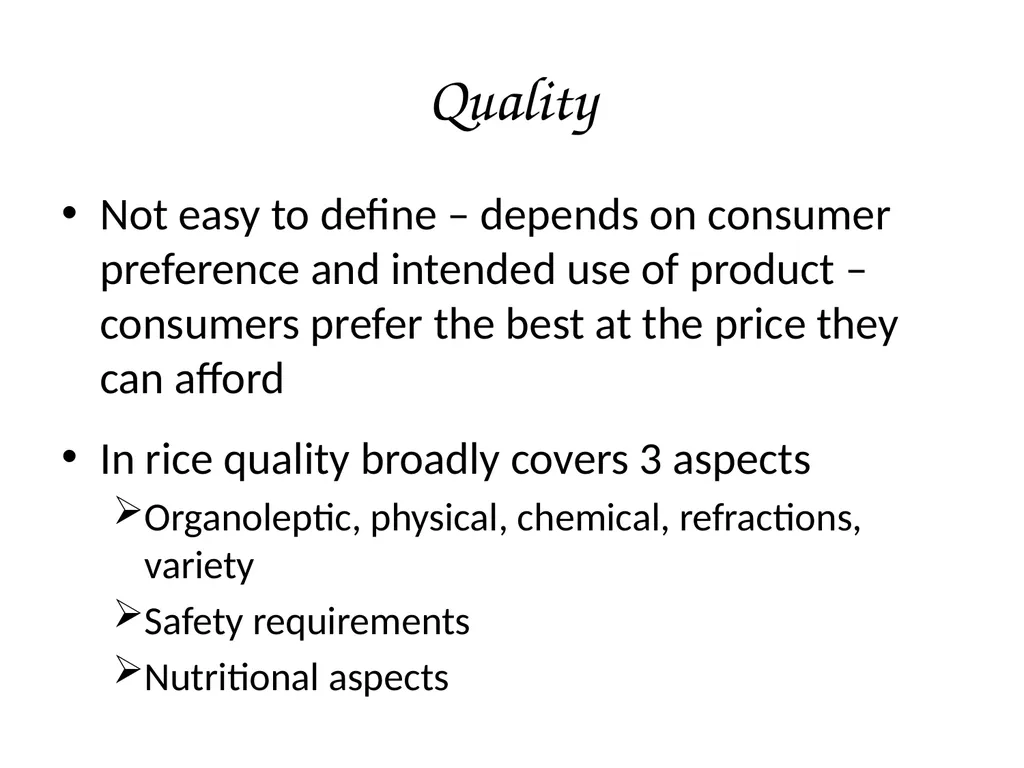
Quality Not easy to define – depends on consumer preference and intended use of product – consumers prefer the best at the price they can afford
In rice quality broadly covers 3 aspects
Organoleptic, physical, chemical, refractions, variety
Safety requirements
Nutritional aspects<br>
In rice quality broadly covers 3 aspects
Organoleptic, physical, chemical, refractions, variety
Safety requirements
Nutritional aspects<br>
04
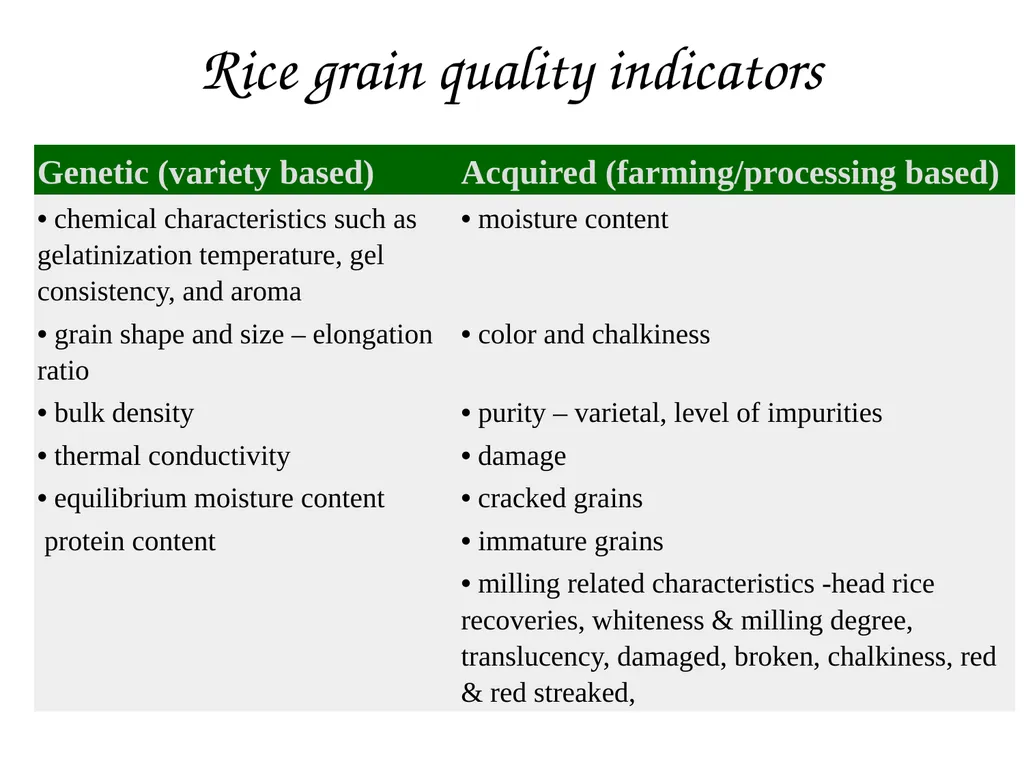
Rice grain quality indicators<br>
05
Factors affecting quality Production, harvesting, processing, handling
Moisture, temperature, insect and micro-organisms, impurities, immature grain, thermal & mechanical stress, mixed varieties, etc<br>
Moisture, temperature, insect and micro-organisms, impurities, immature grain, thermal & mechanical stress, mixed varieties, etc<br>
06
Safety & other related issues Pesticide residues – high pesticide use, prohibited ones
Heavy metals – As, Pb, Cd, Cr, Hg
Aflatoxin – Codex limit 15ppb
Packaging – clean, labelling, toxic inks, glue
Traceability – safety & recalls, authenticity (organic/ Gis), include in legislation with clear role of industry - origin
Standards
Market recognition & premium price – Organic/ GI
Certifications
Fumigation
GMOs
Environmental impacts - fumigants, rice fields major generators of methane and nitrous oxide<br>
Heavy metals – As, Pb, Cd, Cr, Hg
Aflatoxin – Codex limit 15ppb
Packaging – clean, labelling, toxic inks, glue
Traceability – safety & recalls, authenticity (organic/ Gis), include in legislation with clear role of industry - origin
Standards
Market recognition & premium price – Organic/ GI
Certifications
Fumigation
GMOs
Environmental impacts - fumigants, rice fields major generators of methane and nitrous oxide<br>
07
Standards Codex standard – Codex STAN 198-1995
Husked rice, milled rice, and parboiled rice, all for direct human consumption; not apply to other products derived from rice or to glutinous rice.
Composition & Q factors – moisture, extraneous matter, filth, organic/ inorganic extraneous matter, pesticide residues, heavy metals, hygiene, packaging labelling, Classification (l, l/w, both), milling degree
Codex generic standards – organic, labelling, residues, contaminants, etc
ISO 7301 husked, husked parboiled, milled & milled parboiled
Organic – IFOAM, Asian Regional Organic Standard<br>
Husked rice, milled rice, and parboiled rice, all for direct human consumption; not apply to other products derived from rice or to glutinous rice.
Composition & Q factors – moisture, extraneous matter, filth, organic/ inorganic extraneous matter, pesticide residues, heavy metals, hygiene, packaging labelling, Classification (l, l/w, both), milling degree
Codex generic standards – organic, labelling, residues, contaminants, etc
ISO 7301 husked, husked parboiled, milled & milled parboiled
Organic – IFOAM, Asian Regional Organic Standard<br>
08
Market recognition and premium price Organic rice and GI rice
legal and institutional framework
Certification system
Traceability
International standards
Benefit – creation of a system, certification and meeting safety requirements<br>
legal and institutional framework
Certification system
Traceability
International standards
Benefit – creation of a system, certification and meeting safety requirements<br>
09
Rice Certifications Different types – safety (GAP, ISO 220,000…) quality (ISO 9000), GIs, Organic…
Purpose is to have a 3rd party assurance for compliance to standards
Issues - Cost, time period, documentation development/ maintenance
Strategic decisions – understand & conscious decisions, mandatory/voluntary, producer/ producer groups<br>
Purpose is to have a 3rd party assurance for compliance to standards
Issues - Cost, time period, documentation development/ maintenance
Strategic decisions – understand & conscious decisions, mandatory/voluntary, producer/ producer groups<br>
10
Fumigation Stored grain insects causing damage to grain – quality and safety issues
Managed by various means – sanitation, storage in sound dry conditions, managing temperature/ aeration, fumigation
Gases that can be used CH3Br, N2, PH3, CO2; CH3Br has ozone depleting potential so use restricted
CH3Br – Montreal Protocol/IPPC refrain from use except for quarantine treatments
Explore other options – alternate techniques – use of CO2 ethyl formate (EtF) treatment – but need more studies
Good practices for fumigation (eg Thailand)<br>
Managed by various means – sanitation, storage in sound dry conditions, managing temperature/ aeration, fumigation
Gases that can be used CH3Br, N2, PH3, CO2; CH3Br has ozone depleting potential so use restricted
CH3Br – Montreal Protocol/IPPC refrain from use except for quarantine treatments
Explore other options – alternate techniques – use of CO2 ethyl formate (EtF) treatment – but need more studies
Good practices for fumigation (eg Thailand)<br>
11
Genetic Modifications Application of recombinant DNA technology or genetic engineering
Benefits – nutritional eg high B-carotene, stem borer resistant, other studies
Concerns – food safety, environmental effects, socio economic, public perceptions, testing to check
Establishment of regulatory frameworks<br>
Benefits – nutritional eg high B-carotene, stem borer resistant, other studies
Concerns – food safety, environmental effects, socio economic, public perceptions, testing to check
Establishment of regulatory frameworks<br>
12
Strategic Policy Options in Quality/ safety Basic safety parameters essential (non negotiable)– important are pesticide residues, As, Pb, aflatoxin - either adopt international standards or base on risk assessments
For quality parameters – consumer choice so countries to decide on strategy – eg variety, cooking quality
Value addition – GIs/ organic - focus on niche markets, develop label & marketing, strengthen producers/ producer groups
Certifications – seed quality (purity/ varietal admixtures), GAP, GMP, ISO 22000, GIs, Organic – country level/ regional level schemes specifically for rice for recognition across the region, individual/group schemes, strengthen certification capacity (regional)<br>
For quality parameters – consumer choice so countries to decide on strategy – eg variety, cooking quality
Value addition – GIs/ organic - focus on niche markets, develop label & marketing, strengthen producers/ producer groups
Certifications – seed quality (purity/ varietal admixtures), GAP, GMP, ISO 22000, GIs, Organic – country level/ regional level schemes specifically for rice for recognition across the region, individual/group schemes, strengthen certification capacity (regional)<br>
13
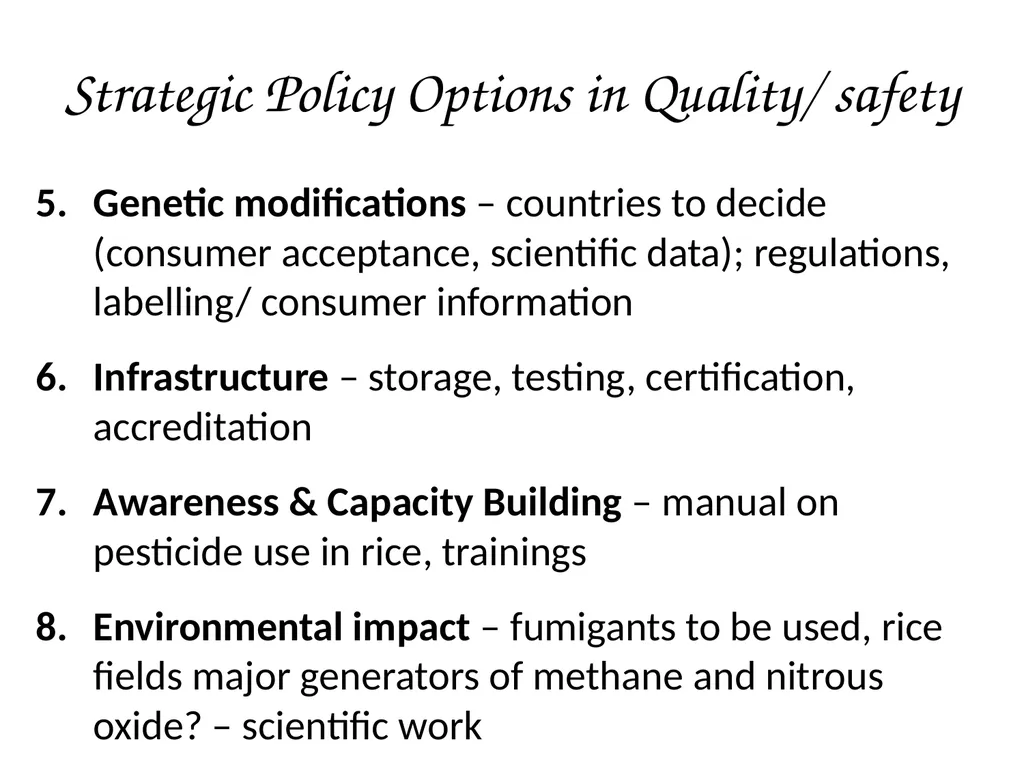
Strategic Policy Options in Quality/ safety Genetic modifications – countries to decide (consumer acceptance, scientific data); regulations, labelling/ consumer information
Infrastructure – storage, testing, certification, accreditation
Awareness & Capacity Building – manual on pesticide use in rice, trainings
Environmental impact – fumigants to be used, rice fields major generators of methane and nitrous oxide? – scientific work<br>
Infrastructure – storage, testing, certification, accreditation
Awareness & Capacity Building – manual on pesticide use in rice, trainings
Environmental impact – fumigants to be used, rice fields major generators of methane and nitrous oxide? – scientific work<br>
14
Nutrition<br>
15
Importance of nutrition in rice About 3 b people consume rice and in Asia 30% calories from rice
7 countries account for 80% total rice production
Other nutrients also – protein, B-complex, essential fatty acids, dietary fibre….<br>
7 countries account for 80% total rice production
Other nutrients also – protein, B-complex, essential fatty acids, dietary fibre….<br>
16
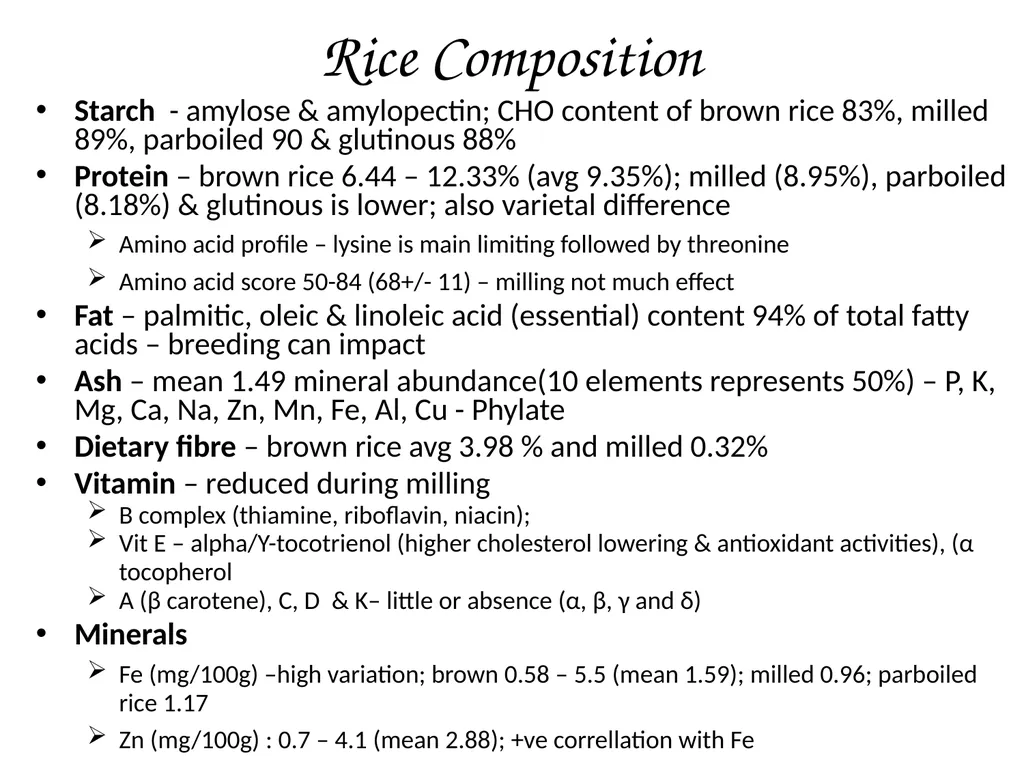
Rice Composition Starch - amylose & amylopectin; CHO content of brown rice 83%, milled 89%, parboiled 90 & glutinous 88%
Protein – brown rice 6.44 – 12.33% (avg 9.35%); milled (8.95%), parboiled (8.18%) & glutinous is lower; also varietal difference
Amino acid profile – lysine is main limiting followed by threonine
Amino acid score 50-84 (68+/- 11) – milling not much effect
Fat – palmitic, oleic & linoleic acid (essential) content 94% of total fatty acids – breeding can impact
Ash – mean 1.49 mineral abundance(10 elements represents 50%) – P, K, Mg, Ca, Na, Zn, Mn, Fe, Al, Cu - Phylate
Dietary fibre – brown rice avg 3.98 % and milled 0.32%
Vitamin – reduced during milling
B complex (thiamine, riboflavin, niacin);
Vit E – alpha/Y-tocotrienol (higher cholesterol lowering & antioxidant activities), (α tocopherol
A (β carotene), C, D & K– little or absence (α, β, γ and δ)
Minerals
Fe (mg/100g) –high variation; brown 0.58 – 5.5 (mean 1.59); milled 0.96; parboiled rice 1.17
Zn (mg/100g) : 0.7 – 4.1 (mean 2.88); +ve correllation with Fe<br>
Protein – brown rice 6.44 – 12.33% (avg 9.35%); milled (8.95%), parboiled (8.18%) & glutinous is lower; also varietal difference
Amino acid profile – lysine is main limiting followed by threonine
Amino acid score 50-84 (68+/- 11) – milling not much effect
Fat – palmitic, oleic & linoleic acid (essential) content 94% of total fatty acids – breeding can impact
Ash – mean 1.49 mineral abundance(10 elements represents 50%) – P, K, Mg, Ca, Na, Zn, Mn, Fe, Al, Cu - Phylate
Dietary fibre – brown rice avg 3.98 % and milled 0.32%
Vitamin – reduced during milling
B complex (thiamine, riboflavin, niacin);
Vit E – alpha/Y-tocotrienol (higher cholesterol lowering & antioxidant activities), (α tocopherol
A (β carotene), C, D & K– little or absence (α, β, γ and δ)
Minerals
Fe (mg/100g) –high variation; brown 0.58 – 5.5 (mean 1.59); milled 0.96; parboiled rice 1.17
Zn (mg/100g) : 0.7 – 4.1 (mean 2.88); +ve correllation with Fe<br>
17
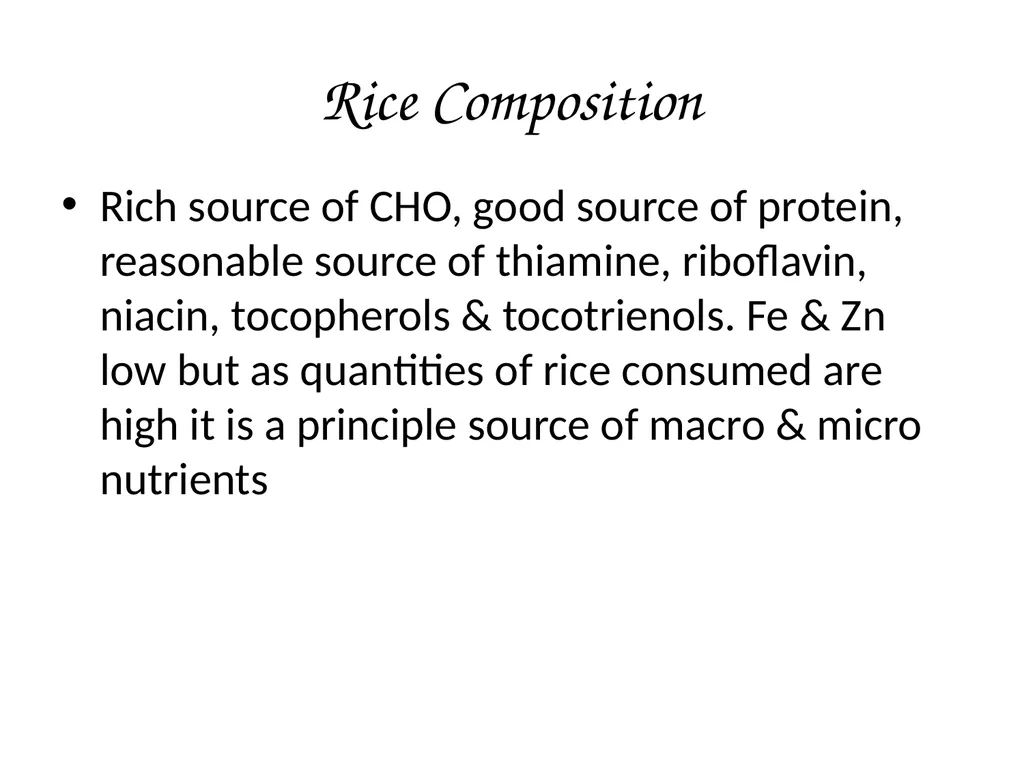
Rice Composition Rich source of CHO, good source of protein, reasonable source of thiamine, riboflavin, niacin, tocopherols & tocotrienols. Fe & Zn low but as quantities of rice consumed are high it is a principle source of macro & micro nutrients<br>
18
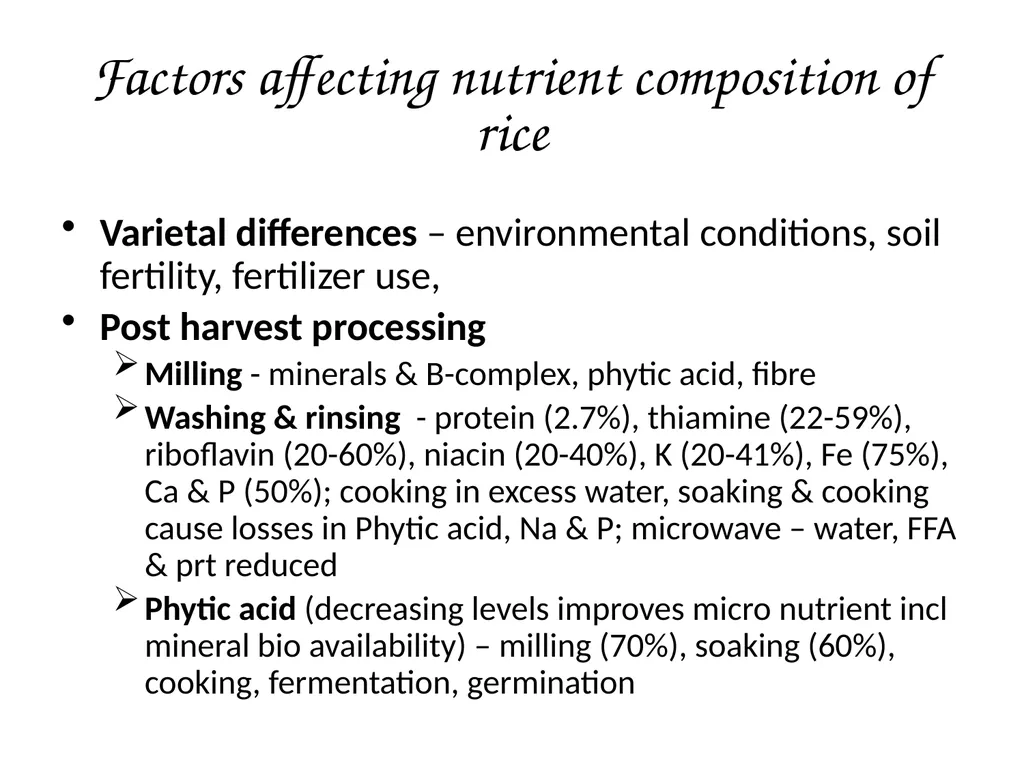
Factors affecting nutrient composition of rice Varietal differences – environmental conditions, soil fertility, fertilizer use,
Post harvest processing
Milling - minerals & B-complex, phytic acid, fibre
Washing & rinsing - protein (2.7%), thiamine (22-59%), riboflavin (20-60%), niacin (20-40%), K (20-41%), Fe (75%), Ca & P (50%); cooking in excess water, soaking & cooking cause losses in Phytic acid, Na & P; microwave – water, FFA & prt reduced
Phytic acid (decreasing levels improves micro nutrient incl mineral bio availability) – milling (70%), soaking (60%), cooking, fermentation, germination<br>
Post harvest processing
Milling - minerals & B-complex, phytic acid, fibre
Washing & rinsing - protein (2.7%), thiamine (22-59%), riboflavin (20-60%), niacin (20-40%), K (20-41%), Fe (75%), Ca & P (50%); cooking in excess water, soaking & cooking cause losses in Phytic acid, Na & P; microwave – water, FFA & prt reduced
Phytic acid (decreasing levels improves micro nutrient incl mineral bio availability) – milling (70%), soaking (60%), cooking, fermentation, germination<br>
19
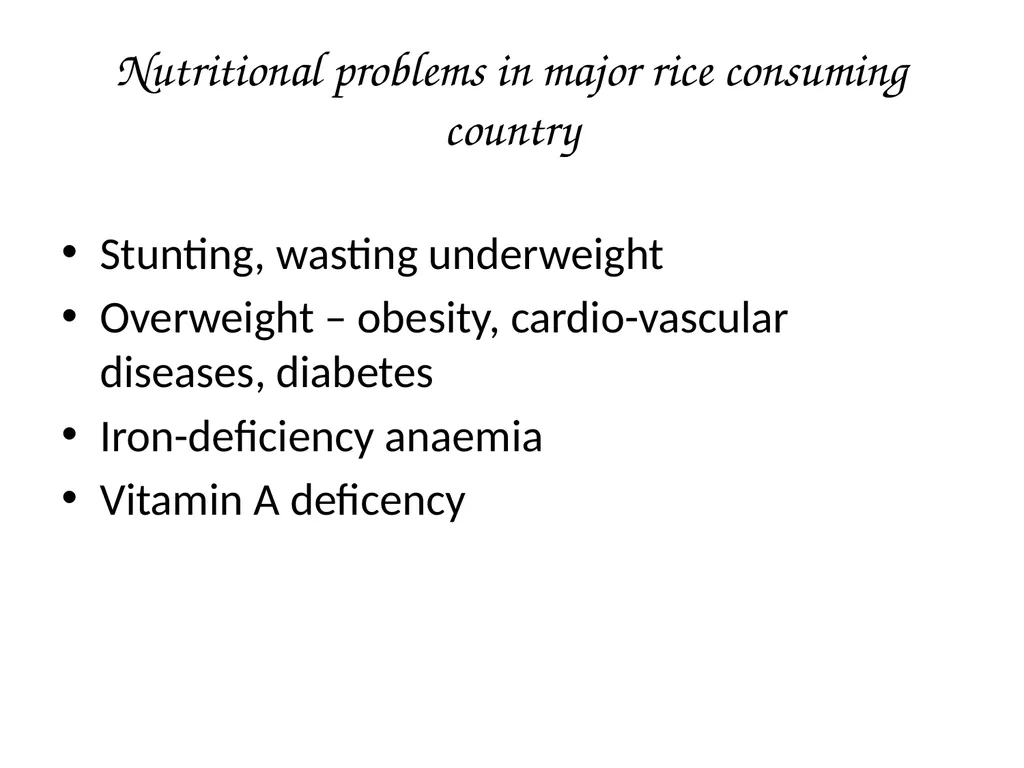
Nutritional problems in major rice consuming country Stunting, wasting underweight
Overweight – obesity, cardio-vascular diseases, diabetes
Iron-deficiency anaemia
Vitamin A deficency<br>
Overweight – obesity, cardio-vascular diseases, diabetes
Iron-deficiency anaemia
Vitamin A deficency<br>
20
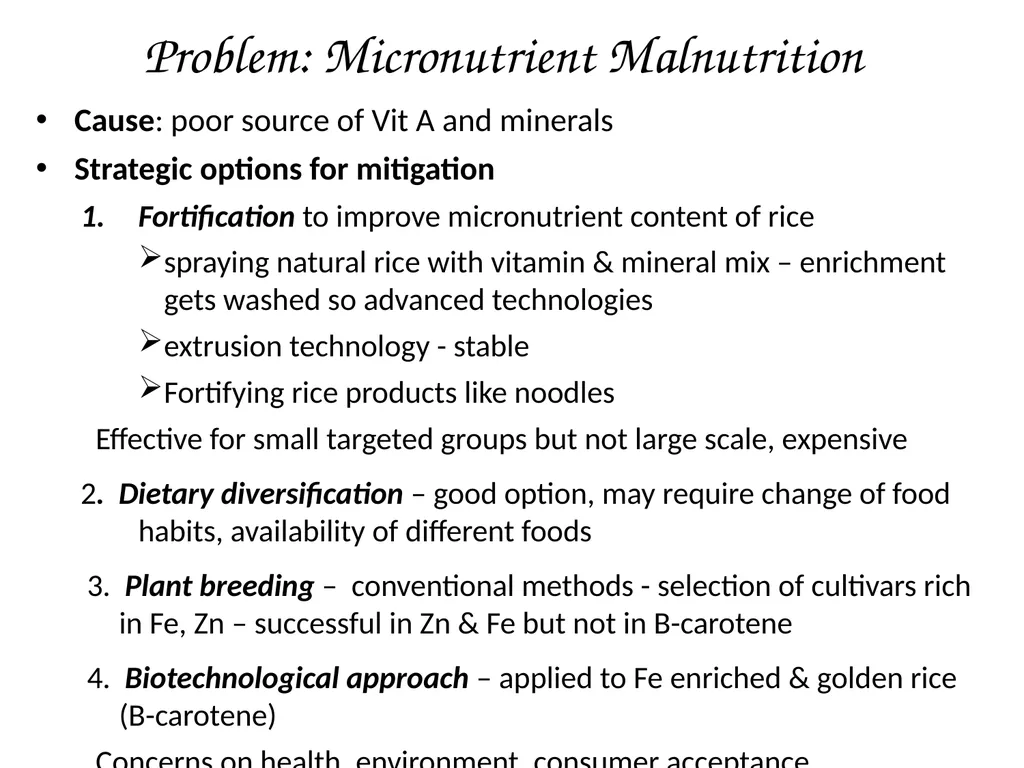
Problem: Micronutrient Malnutrition Cause: poor source of Vit A and minerals
Strategic options for mitigation
Fortification to improve micronutrient content of rice
spraying natural rice with vitamin & mineral mix – enrichment gets washed so advanced technologies
extrusion technology - stable
Fortifying rice products like noodles
Effective for small targeted groups but not large scale, expensive
2. Dietary diversification – good option, may require change of food habits, availability of different foods
3. Plant breeding – conventional methods - selection of cultivars rich in Fe, Zn – successful in Zn & Fe but not in B-carotene
4. Biotechnological approach – applied to Fe enriched & golden rice (B-carotene)
Concerns on health, environment, consumer acceptance…<br>
Strategic options for mitigation
Fortification to improve micronutrient content of rice
spraying natural rice with vitamin & mineral mix – enrichment gets washed so advanced technologies
extrusion technology - stable
Fortifying rice products like noodles
Effective for small targeted groups but not large scale, expensive
2. Dietary diversification – good option, may require change of food habits, availability of different foods
3. Plant breeding – conventional methods - selection of cultivars rich in Fe, Zn – successful in Zn & Fe but not in B-carotene
4. Biotechnological approach – applied to Fe enriched & golden rice (B-carotene)
Concerns on health, environment, consumer acceptance…<br>
21
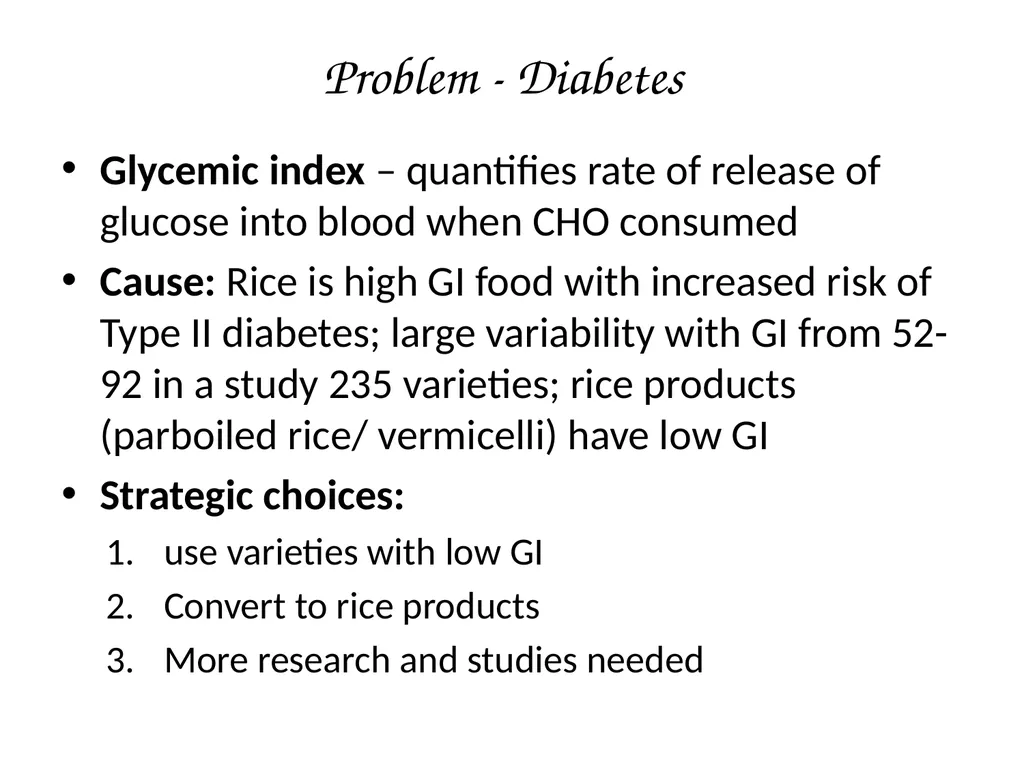
Problem - Diabetes Glycemic index – quantifies rate of release of glucose into blood when CHO consumed
Cause: Rice is high GI food with increased risk of Type II diabetes; large variability with GI from 52-92 in a study 235 varieties; rice products (parboiled rice/ vermicelli) have low GI
Strategic choices:
use varieties with low GI
Convert to rice products
More research and studies needed<br>
Cause: Rice is high GI food with increased risk of Type II diabetes; large variability with GI from 52-92 in a study 235 varieties; rice products (parboiled rice/ vermicelli) have low GI
Strategic choices:
use varieties with low GI
Convert to rice products
More research and studies needed<br>
22
Other methods for improving nutritional content of rice Rice processing/ rice products/ by products
Brown rice, germinated brown rice, parboiled rice – phytochemicals in brown/ coloured rice has health benefits
Rice products – rice flakes high fibre/ Fe,
Rice bran – rich in protein, fibre, Ca, Fe, B-complex…
Strategic choices: consumer awareness<br>
Brown rice, germinated brown rice, parboiled rice – phytochemicals in brown/ coloured rice has health benefits
Rice products – rice flakes high fibre/ Fe,
Rice bran – rich in protein, fibre, Ca, Fe, B-complex…
Strategic choices: consumer awareness<br>
23
Conclusion (Nutrition) Genetic diversity to be further studied – comprehensive database for nutrient data at cultivar level
Beneficial effects of brown rice is in germ/bran of grain – increase consumption, with education
Processing and cooking practices need to be emphasized with education & awareness
Biofortification may be explored
Glycemic index – studies needed
Studies on rice bran and its addition to other rice products
Food-based approaches for dietary diversification<br>
Beneficial effects of brown rice is in germ/bran of grain – increase consumption, with education
Processing and cooking practices need to be emphasized with education & awareness
Biofortification may be explored
Glycemic index – studies needed
Studies on rice bran and its addition to other rice products
Food-based approaches for dietary diversification<br>
24
THANK YOU Any Questions?<br>