
Rig Move Operations Renjeev Kurup, Team Lead,
PT
Published · 23 slides · 0 views

1 / 1
Description
Rig Move Operations Renjeev Kurup, Team Lead, Maritime Integrity, UK HSE JUR Kolskaya, 18 Dec 2011 53 people lost their lives Icing poor weather Rig took water and listed Overturned and sank KOLSKAYA (shipsandoil.com) Kulluk, 31 Dec 2012
Related Topics
Share
Embed code
Download this presentation From Below
"Rig Move Operations Renjeev Kurup, Team Lead," is the property of its rightful owner. Permission is granted to download and print the materials on this website for personal, non-commercial use only, and to display it on your personal computer provided you do not modify the materials and that you retain all copyright notices contained in the materials. By downloading content from our website, you accept the terms of this agreement.
Presentation Transcript
01
Rig Move Operations Renjeev Kurup,
Team Lead, Maritime Integrity, UK HSE<br>
Team Lead, Maritime Integrity, UK HSE<br>
02
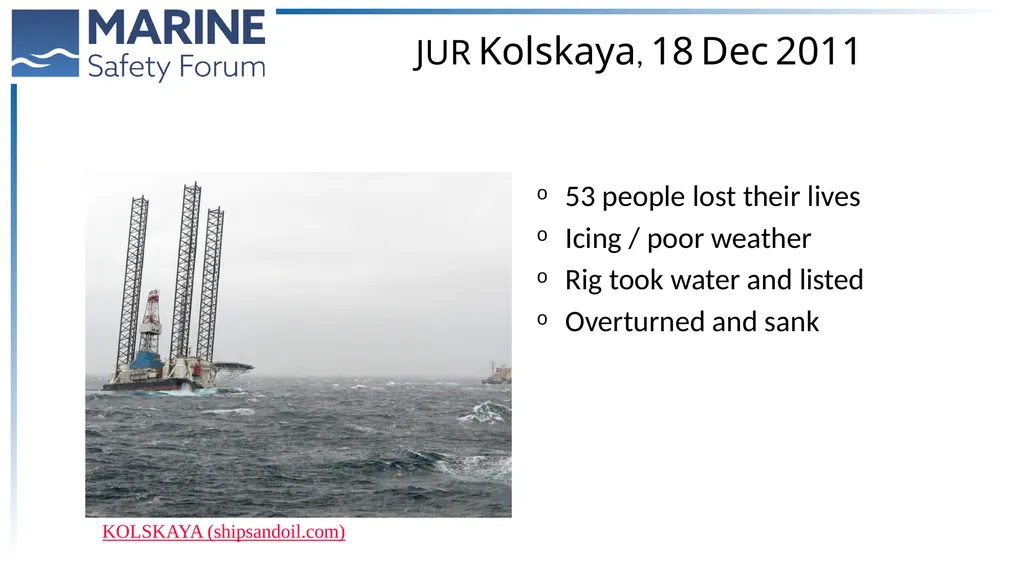
JUR Kolskaya, 18 Dec 2011 53 people lost their lives
Icing / poor weather
Rig took water and listed
Overturned and sank KOLSKAYA (shipsandoil.com)<br>
Icing / poor weather
Rig took water and listed
Overturned and sank KOLSKAYA (shipsandoil.com)<br>
03
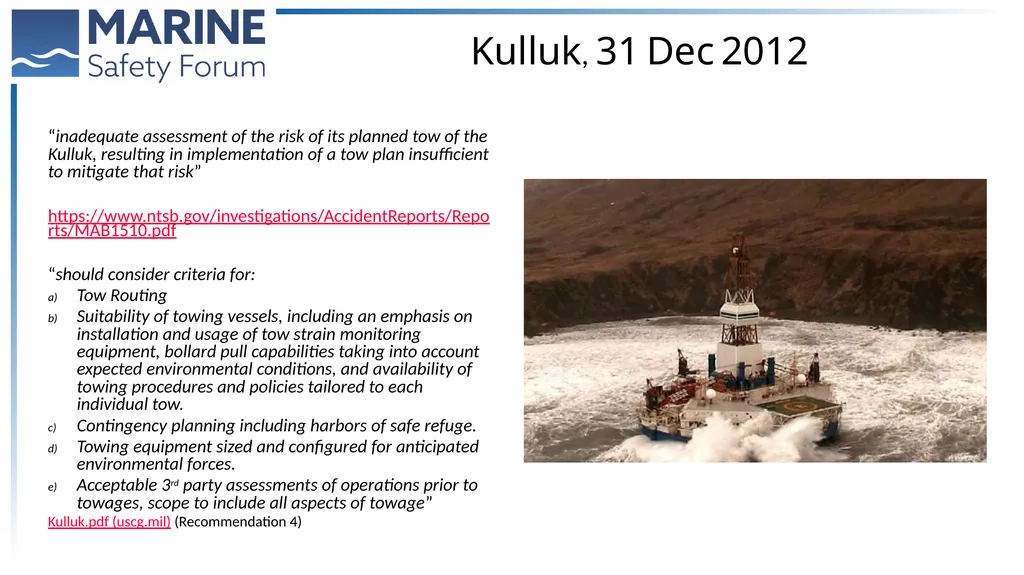
Kulluk, 31 Dec 2012 “inadequate assessment of the risk of its planned tow of the Kulluk, resulting in implementation of a tow plan insufficient to mitigate that risk”
https://www.ntsb.gov/investigations/AccidentReports/Reports/MAB1510.pdf
“should consider criteria for:
Tow Routing
Suitability of towing vessels, including an emphasis on installation and usage of tow strain monitoring equipment, bollard pull capabilities taking into account expected environmental conditions, and availability of towing procedures and policies tailored to each individual tow.
Contingency planning including harbors of safe refuge.
Towing equipment sized and configured for anticipated environmental forces.
Acceptable 3rd party assessments of operations prior to towages, scope to include all aspects of towage”
Kulluk.pdf (uscg.mil) (Recommendation 4)<br>
https://www.ntsb.gov/investigations/AccidentReports/Reports/MAB1510.pdf
“should consider criteria for:
Tow Routing
Suitability of towing vessels, including an emphasis on installation and usage of tow strain monitoring equipment, bollard pull capabilities taking into account expected environmental conditions, and availability of towing procedures and policies tailored to each individual tow.
Contingency planning including harbors of safe refuge.
Towing equipment sized and configured for anticipated environmental forces.
Acceptable 3rd party assessments of operations prior to towages, scope to include all aspects of towage”
Kulluk.pdf (uscg.mil) (Recommendation 4)<br>
04
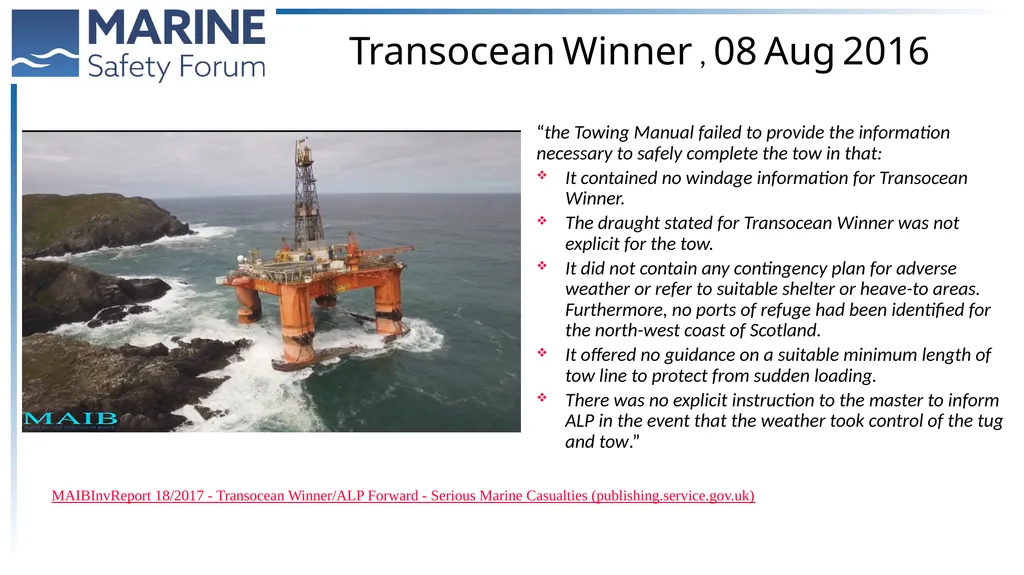
Transocean Winner , 08 Aug 2016 “the Towing Manual failed to provide the information necessary to safely complete the tow in that:
It contained no windage information for Transocean Winner.
The draught stated for Transocean Winner was not explicit for the tow.
It did not contain any contingency plan for adverse weather or refer to suitable shelter or heave-to areas. Furthermore, no ports of refuge had been identified for the north-west coast of Scotland.
It offered no guidance on a suitable minimum length of tow line to protect from sudden loading.
There was no explicit instruction to the master to inform ALP in the event that the weather took control of the tug and tow.” MAIBInvReport 18/2017 - Transocean Winner/ALP Forward - Serious Marine Casualties (publishing.service.gov.uk)<br>
It contained no windage information for Transocean Winner.
The draught stated for Transocean Winner was not explicit for the tow.
It did not contain any contingency plan for adverse weather or refer to suitable shelter or heave-to areas. Furthermore, no ports of refuge had been identified for the north-west coast of Scotland.
It offered no guidance on a suitable minimum length of tow line to protect from sudden loading.
There was no explicit instruction to the master to inform ALP in the event that the weather took control of the tug and tow.” MAIBInvReport 18/2017 - Transocean Winner/ALP Forward - Serious Marine Casualties (publishing.service.gov.uk)<br>
05
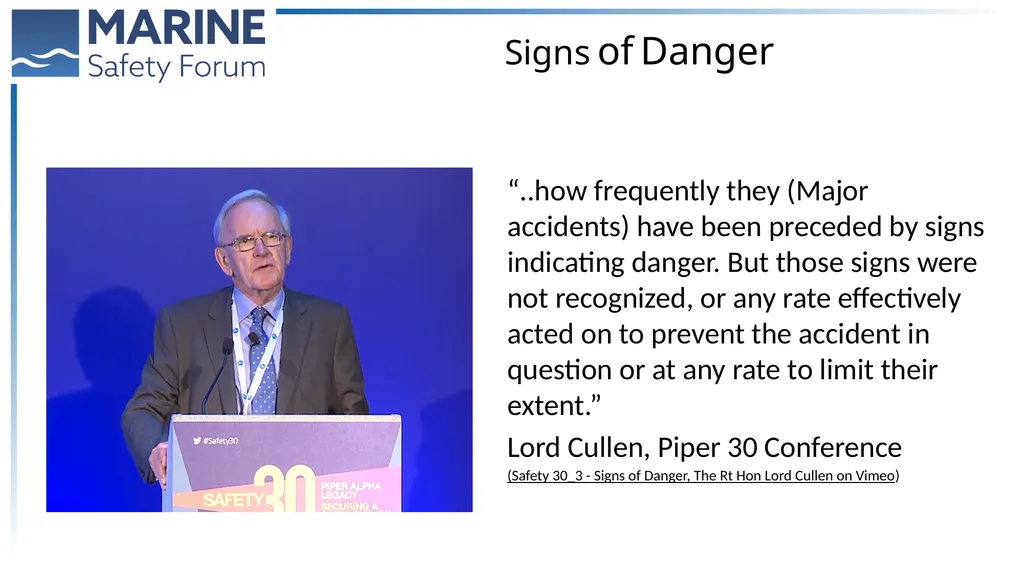
Signs of Danger “..how frequently they (Major accidents) have been preceded by signs indicating danger. But those signs were not recognized, or any rate effectively acted on to prevent the accident in question or at any rate to limit their extent.”
Lord Cullen, Piper 30 Conference
(Safety 30_3 - Signs of Danger, The Rt Hon Lord Cullen on Vimeo)<br>
Lord Cullen, Piper 30 Conference
(Safety 30_3 - Signs of Danger, The Rt Hon Lord Cullen on Vimeo)<br>
06
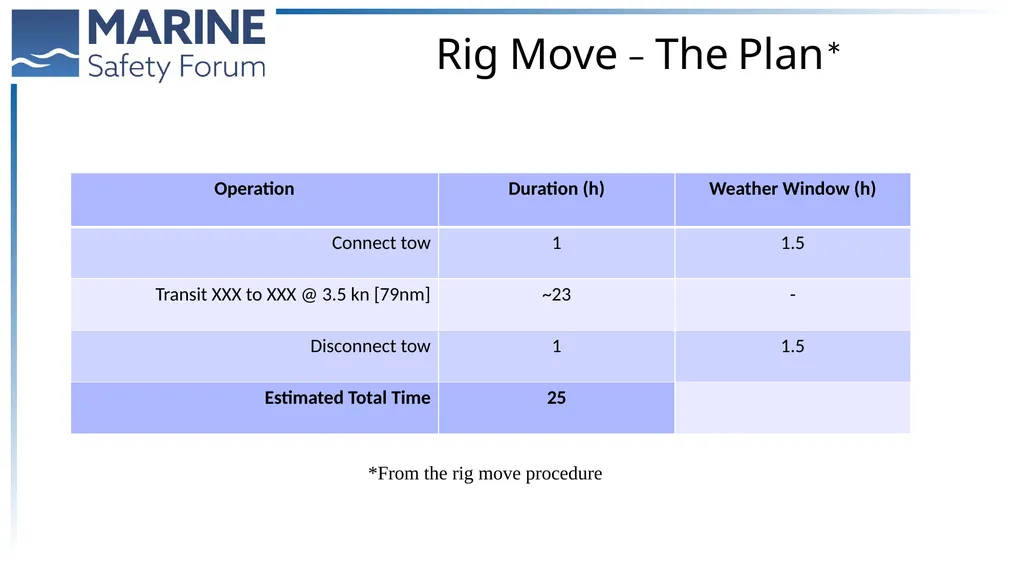
Rig Move – The Plan* *From the rig move procedure<br>
07
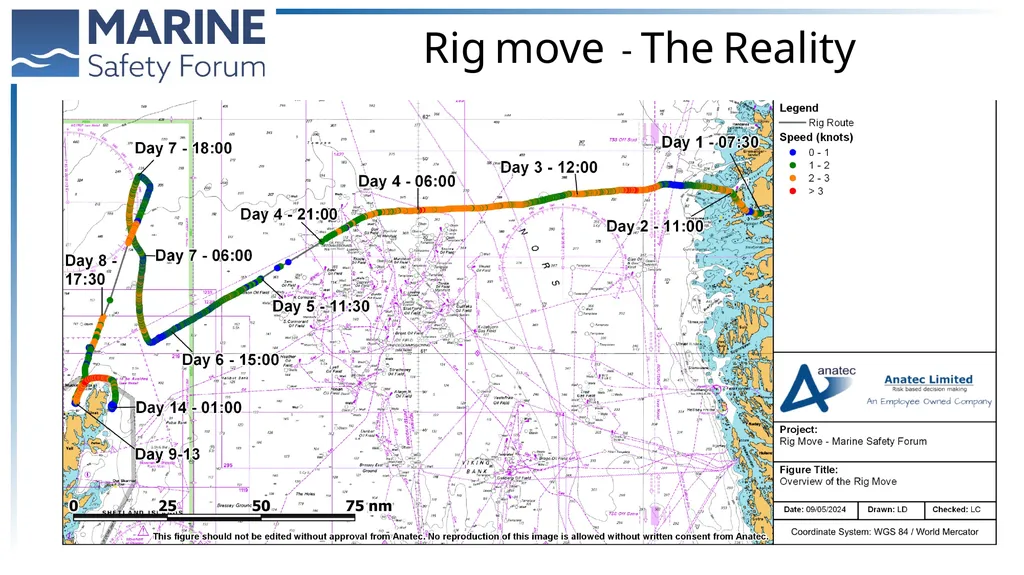
Rig move - The Reality<br>
08
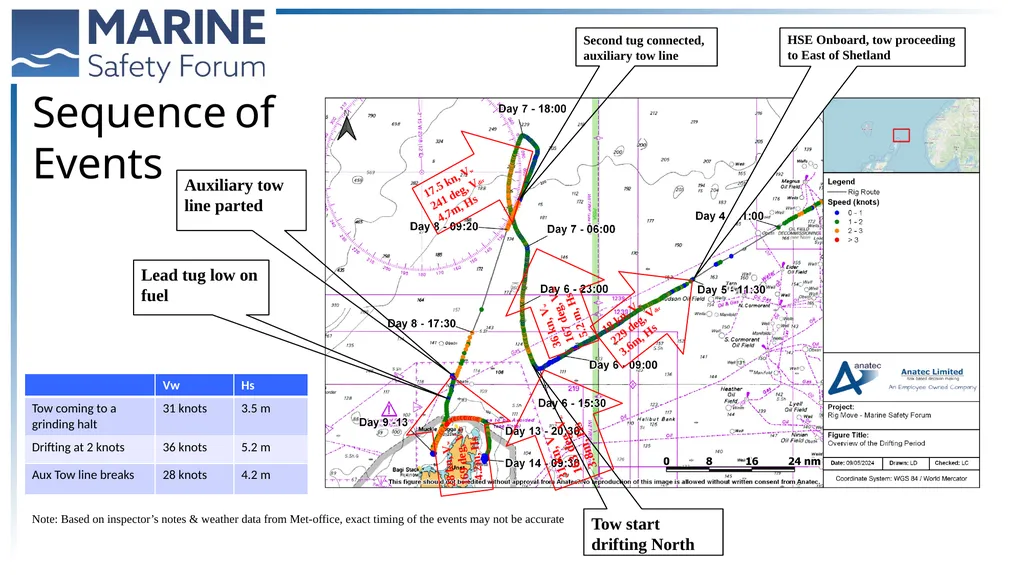
Sequence of Events HSE Onboard, tow proceeding to East of Shetland Tow start drifting North Second tug connected, auxiliary tow line Auxiliary tow line parted 18 kn, Vw
229 deg, Vdir
3.6m, Hs 31 kn, Vw
163 deg, Vdir 3.8m, Hs 36 kn, Vw
167 deg, Vdir
5.2 m, Hs 17.5 kn, Vw
241 deg, Vdir
4.7m, Hs 28 kn, Vw
169 deg, Vdir
4.2m, Hs Lead tug low on fuel Note: Based on inspector’s notes & weather data from Met-office, exact timing of the events may not be accurate<br>
229 deg, Vdir
3.6m, Hs 31 kn, Vw
163 deg, Vdir 3.8m, Hs 36 kn, Vw
167 deg, Vdir
5.2 m, Hs 17.5 kn, Vw
241 deg, Vdir
4.7m, Hs 28 kn, Vw
169 deg, Vdir
4.2m, Hs Lead tug low on fuel Note: Based on inspector’s notes & weather data from Met-office, exact timing of the events may not be accurate<br>
09
MSC/Circ.884 – Guidelines for Safe Ocean Towage
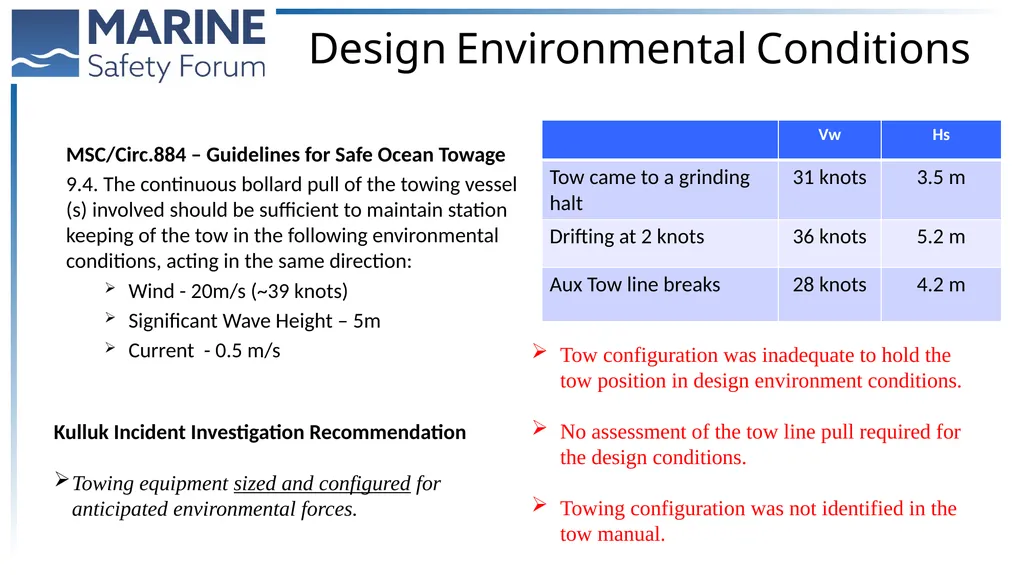
9.4. The continuous bollard pull of the towing vessel (s) involved should be sufficient to maintain station keeping of the tow in the following environmental conditions, acting in the same direction:
Wind - 20m/s (~39 knots)
Significant Wave Height – 5m
Current - 0.5 m/s Kulluk Incident Investigation Recommendation
Towing equipment sized and configured for anticipated environmental forces. Tow configuration was inadequate to hold the tow position in design environment conditions.
No assessment of the tow line pull required for the design conditions.
Towing configuration was not identified in the tow manual. Design Environmental Conditions<br>
9.4. The continuous bollard pull of the towing vessel (s) involved should be sufficient to maintain station keeping of the tow in the following environmental conditions, acting in the same direction:
Wind - 20m/s (~39 knots)
Significant Wave Height – 5m
Current - 0.5 m/s Kulluk Incident Investigation Recommendation
Towing equipment sized and configured for anticipated environmental forces. Tow configuration was inadequate to hold the tow position in design environment conditions.
No assessment of the tow line pull required for the design conditions.
Towing configuration was not identified in the tow manual. Design Environmental Conditions<br>
10
MSC/Circ.884 – Guidelines for Safe Ocean Towage
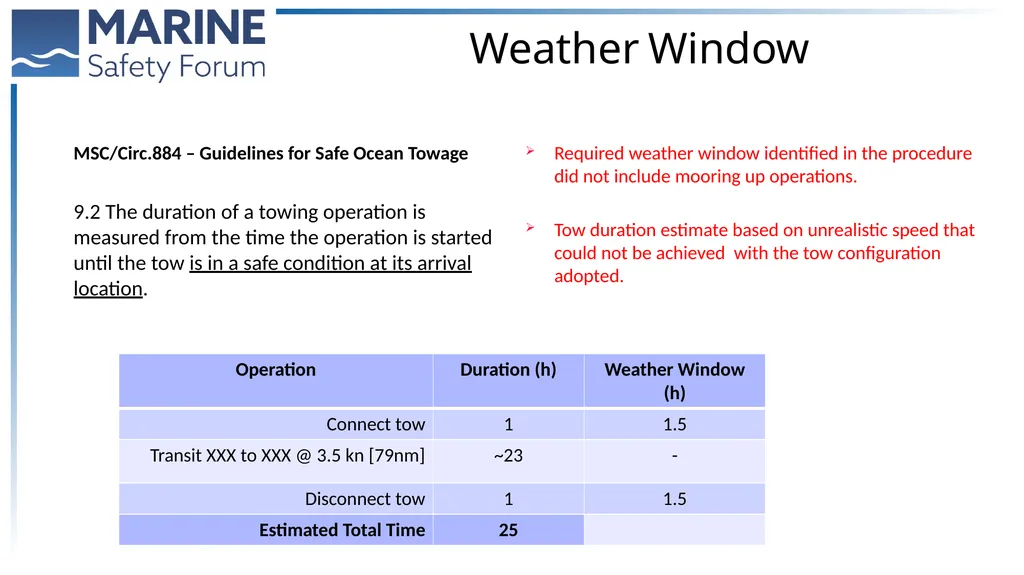
9.2 The duration of a towing operation is measured from the time the operation is started until the tow is in a safe condition at its arrival location. Required weather window identified in the procedure did not include mooring up operations.
Tow duration estimate based on unrealistic speed that could not be achieved with the tow configuration adopted. Weather Window<br>
9.2 The duration of a towing operation is measured from the time the operation is started until the tow is in a safe condition at its arrival location. Required weather window identified in the procedure did not include mooring up operations.
Tow duration estimate based on unrealistic speed that could not be achieved with the tow configuration adopted. Weather Window<br>
11
MSC/Circ.884 – Guidelines for Safe Ocean Towage
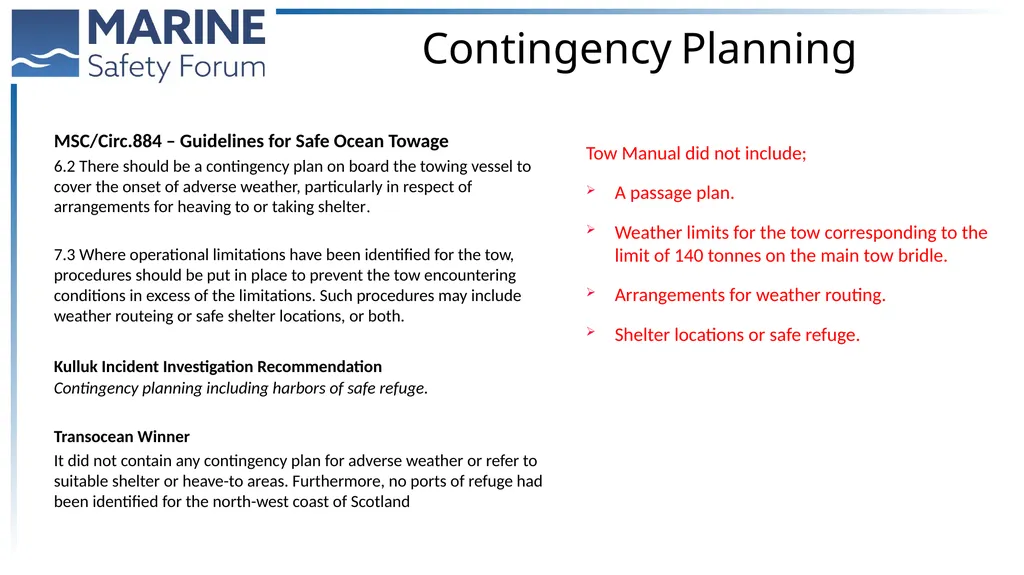
6.2 There should be a contingency plan on board the towing vessel to cover the onset of adverse weather, particularly in respect of arrangements for heaving to or taking shelter.
7.3 Where operational limitations have been identified for the tow, procedures should be put in place to prevent the tow encountering conditions in excess of the limitations. Such procedures may include weather routeing or safe shelter locations, or both.
Kulluk Incident Investigation Recommendation
Contingency planning including harbors of safe refuge.
Transocean Winner
It did not contain any contingency plan for adverse weather or refer to suitable shelter or heave-to areas. Furthermore, no ports of refuge had been identified for the north-west coast of Scotland Tow Manual did not include;
A passage plan.
Weather limits for the tow corresponding to the limit of 140 tonnes on the main tow bridle.
Arrangements for weather routing.
Shelter locations or safe refuge. Contingency Planning<br>
6.2 There should be a contingency plan on board the towing vessel to cover the onset of adverse weather, particularly in respect of arrangements for heaving to or taking shelter.
7.3 Where operational limitations have been identified for the tow, procedures should be put in place to prevent the tow encountering conditions in excess of the limitations. Such procedures may include weather routeing or safe shelter locations, or both.
Kulluk Incident Investigation Recommendation
Contingency planning including harbors of safe refuge.
Transocean Winner
It did not contain any contingency plan for adverse weather or refer to suitable shelter or heave-to areas. Furthermore, no ports of refuge had been identified for the north-west coast of Scotland Tow Manual did not include;
A passage plan.
Weather limits for the tow corresponding to the limit of 140 tonnes on the main tow bridle.
Arrangements for weather routing.
Shelter locations or safe refuge. Contingency Planning<br>
12
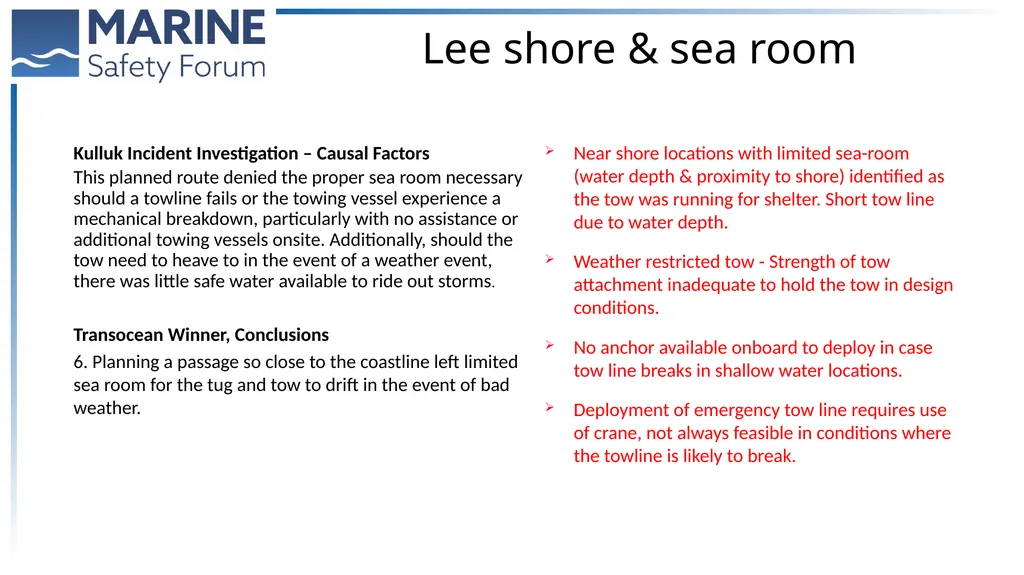
Kulluk Incident Investigation – Causal Factors
This planned route denied the proper sea room necessary should a towline fails or the towing vessel experience a mechanical breakdown, particularly with no assistance or additional towing vessels onsite. Additionally, should the tow need to heave to in the event of a weather event, there was little safe water available to ride out storms.
Transocean Winner, Conclusions
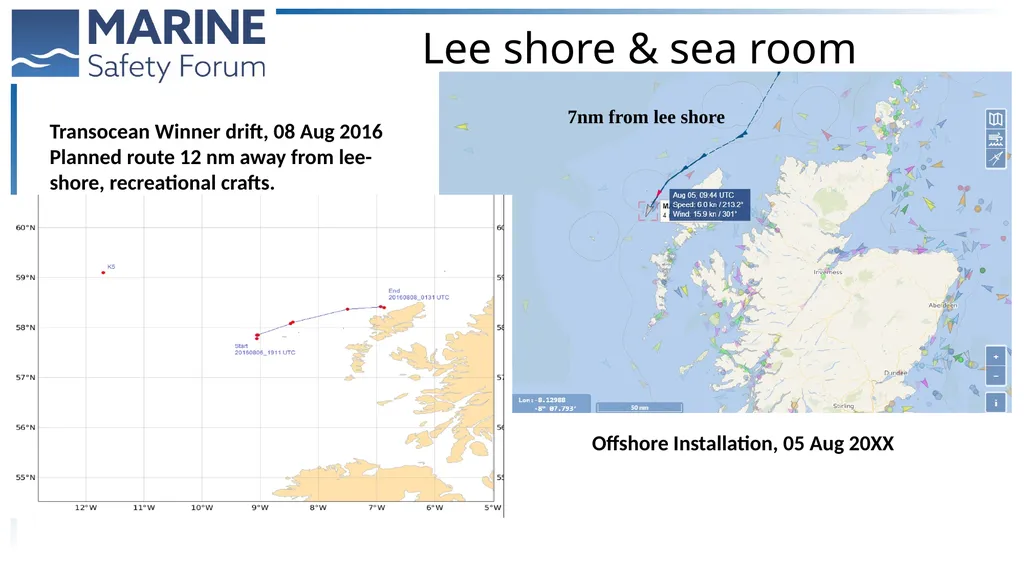
6. Planning a passage so close to the coastline left limited sea room for the tug and tow to drift in the event of bad weather. Near shore locations with limited sea-room (water depth & proximity to shore) identified as the tow was running for shelter. Short tow line due to water depth.
Weather restricted tow - Strength of tow attachment inadequate to hold the tow in design conditions.
No anchor available onboard to deploy in case tow line breaks in shallow water locations.
Deployment of emergency tow line requires use of crane, not always feasible in conditions where the towline is likely to break. Lee shore & sea room<br>
This planned route denied the proper sea room necessary should a towline fails or the towing vessel experience a mechanical breakdown, particularly with no assistance or additional towing vessels onsite. Additionally, should the tow need to heave to in the event of a weather event, there was little safe water available to ride out storms.
Transocean Winner, Conclusions
6. Planning a passage so close to the coastline left limited sea room for the tug and tow to drift in the event of bad weather. Near shore locations with limited sea-room (water depth & proximity to shore) identified as the tow was running for shelter. Short tow line due to water depth.
Weather restricted tow - Strength of tow attachment inadequate to hold the tow in design conditions.
No anchor available onboard to deploy in case tow line breaks in shallow water locations.
Deployment of emergency tow line requires use of crane, not always feasible in conditions where the towline is likely to break. Lee shore & sea room<br>
13
MSC/Circ.884 – Guidelines for Safe Ocean Towage
13.3 Prior to sailing, the watertight and weathertight integrity should be confirmed by an inspection of the closing arrangements for all hatches, valves, airpipes, and other openings through which water might enter the towed object and affect its stability. It should also be confirmed that any watertight doors or other closing arrangements within the hull are securely closed and that any portable closing plates are in place.
13.13 Emergency towing equipment should be provided in case of bridle failure or inability to recover the bridle. This equipment should preferably be fitted at the bow of the towed object and should consist of a spare bridle or towing pennant fitted with a floating rope and buoy allowing it to be picked up without any significant hazard.
Transocean Winner
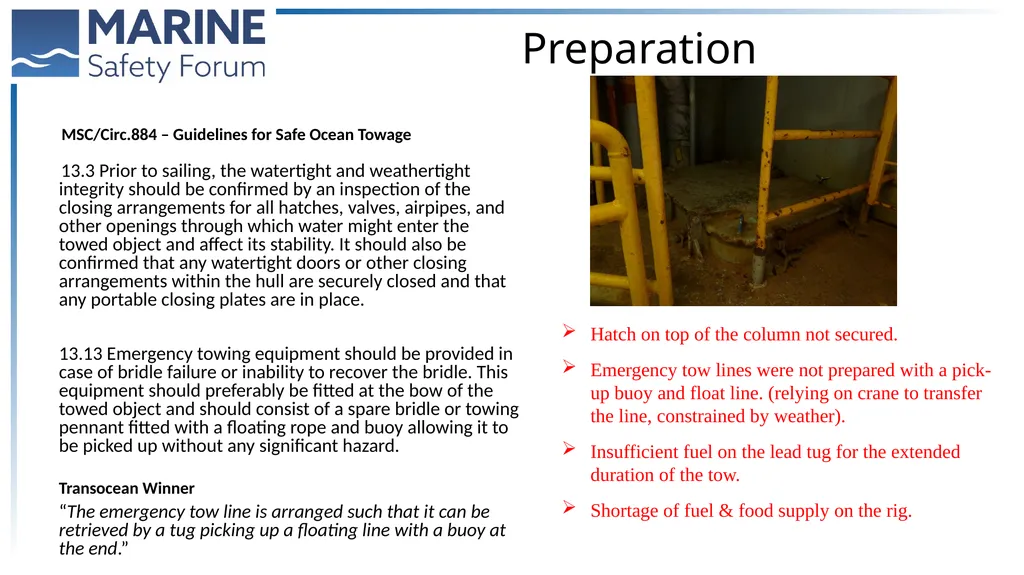
“The emergency tow line is arranged such that it can be retrieved by a tug picking up a floating line with a buoy at the end.” Hatch on top of the column not secured.
Emergency tow lines were not prepared with a pick-up buoy and float line. (relying on crane to transfer the line, constrained by weather).
Insufficient fuel on the lead tug for the extended duration of the tow.
Shortage of fuel & food supply on the rig. Preparation<br>
13.3 Prior to sailing, the watertight and weathertight integrity should be confirmed by an inspection of the closing arrangements for all hatches, valves, airpipes, and other openings through which water might enter the towed object and affect its stability. It should also be confirmed that any watertight doors or other closing arrangements within the hull are securely closed and that any portable closing plates are in place.
13.13 Emergency towing equipment should be provided in case of bridle failure or inability to recover the bridle. This equipment should preferably be fitted at the bow of the towed object and should consist of a spare bridle or towing pennant fitted with a floating rope and buoy allowing it to be picked up without any significant hazard.
Transocean Winner
“The emergency tow line is arranged such that it can be retrieved by a tug picking up a floating line with a buoy at the end.” Hatch on top of the column not secured.
Emergency tow lines were not prepared with a pick-up buoy and float line. (relying on crane to transfer the line, constrained by weather).
Insufficient fuel on the lead tug for the extended duration of the tow.
Shortage of fuel & food supply on the rig. Preparation<br>
14
Following hazards not identified or assessed in the RA
Damage to the main tow line
Proximity to lee shore and shallow water depths
Restricted sea room (at shelter locations)
Change in weather conditions and direction
Slow moving tow and the ability to respond to changing weather directions.
Strength of the tow lines compared to the tow size/wind area
Fuel onboard the tug Risk Assessment<br>
Damage to the main tow line
Proximity to lee shore and shallow water depths
Restricted sea room (at shelter locations)
Change in weather conditions and direction
Slow moving tow and the ability to respond to changing weather directions.
Strength of the tow lines compared to the tow size/wind area
Fuel onboard the tug Risk Assessment<br>
15
Transocean Winner drift, 08 Aug 2016 Planned route 12 nm away from lee-shore, recreational crafts. 7nm from lee shore Lee shore & sea room Offshore Installation, 05 Aug 20XX<br>
16
Other observations Most common - Lack of clear definition appropriate limiting weather criteria & weather window.
Insufficient, project specific, operation specific weather forecasts – use of online tools.
Not considering limits of towing configuration (Components of tow line, attachments)
Excessive loads on towlines, high bollard pull tugs
Watertight integrity during tow – manholes/hatches left open during tow, opening tank covers for watertight integrity check during tow (jack ups).
Lack of contingency measurers.
Insufficient manning levels (e.g. to manage jacking operations), fatigue
Poor/lack of control over management of change.
Lack of implementation of control measures identified during rig move risk assessment.
Loss of grating in passageways and escape routes, other safety equipment during tow.
Pressure on AHTs to do anchor handling in conditions that is not safe - AHTs dismissed during anchor handling operations as they refused to work in weather conditions experienced.<br>
Insufficient, project specific, operation specific weather forecasts – use of online tools.
Not considering limits of towing configuration (Components of tow line, attachments)
Excessive loads on towlines, high bollard pull tugs
Watertight integrity during tow – manholes/hatches left open during tow, opening tank covers for watertight integrity check during tow (jack ups).
Lack of contingency measurers.
Insufficient manning levels (e.g. to manage jacking operations), fatigue
Poor/lack of control over management of change.
Lack of implementation of control measures identified during rig move risk assessment.
Loss of grating in passageways and escape routes, other safety equipment during tow.
Pressure on AHTs to do anchor handling in conditions that is not safe - AHTs dismissed during anchor handling operations as they refused to work in weather conditions experienced.<br>
17
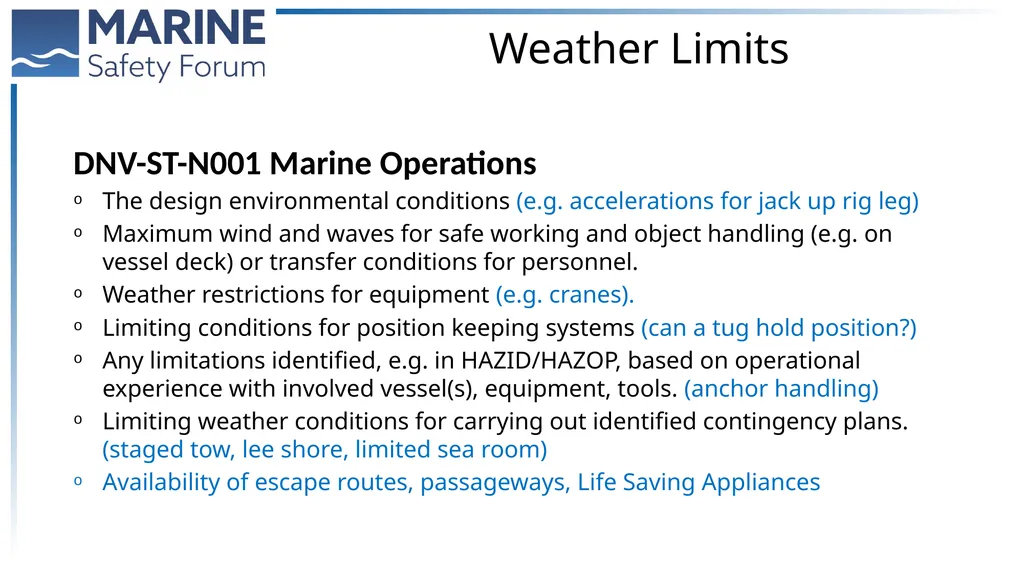
DNV-ST-N001 Marine Operations
The design environmental conditions (e.g. accelerations for jack up rig leg)
Maximum wind and waves for safe working and object handling (e.g. on vessel deck) or transfer conditions for personnel.
Weather restrictions for equipment (e.g. cranes).
Limiting conditions for position keeping systems (can a tug hold position?)
Any limitations identified, e.g. in HAZID/HAZOP, based on operational experience with involved vessel(s), equipment, tools. (anchor handling)
Limiting weather conditions for carrying out identified contingency plans. (staged tow, lee shore, limited sea room)
Availability of escape routes, passageways, Life Saving Appliances Weather Limits<br>
The design environmental conditions (e.g. accelerations for jack up rig leg)
Maximum wind and waves for safe working and object handling (e.g. on vessel deck) or transfer conditions for personnel.
Weather restrictions for equipment (e.g. cranes).
Limiting conditions for position keeping systems (can a tug hold position?)
Any limitations identified, e.g. in HAZID/HAZOP, based on operational experience with involved vessel(s), equipment, tools. (anchor handling)
Limiting weather conditions for carrying out identified contingency plans. (staged tow, lee shore, limited sea room)
Availability of escape routes, passageways, Life Saving Appliances Weather Limits<br>
18
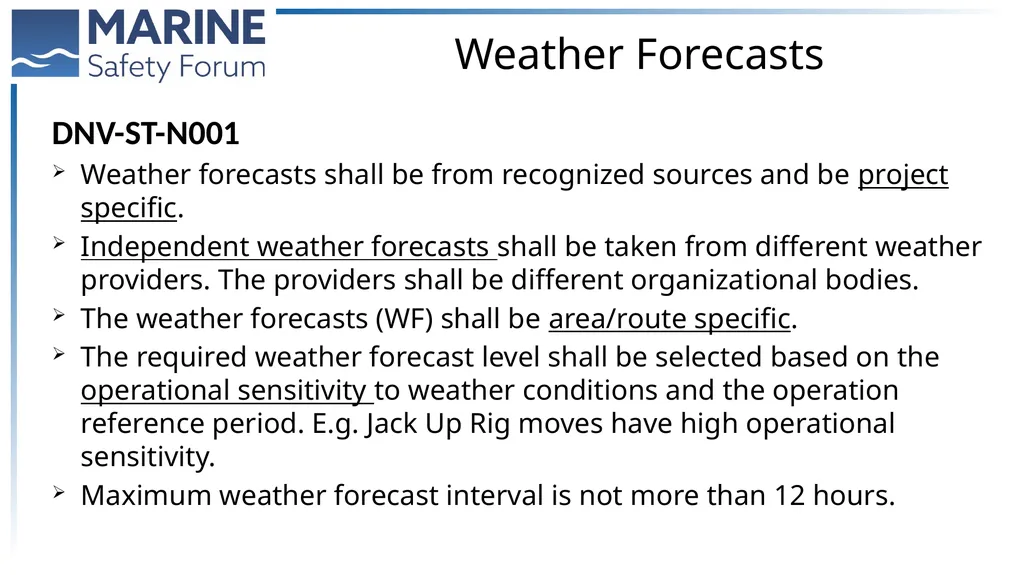
Weather Forecasts DNV-ST-N001
Weather forecasts shall be from recognized sources and be project specific.
Independent weather forecasts shall be taken from different weather providers. The providers shall be different organizational bodies.
The weather forecasts (WF) shall be area/route specific.
The required weather forecast level shall be selected based on the operational sensitivity to weather conditions and the operation reference period. E.g. Jack Up Rig moves have high operational sensitivity.
Maximum weather forecast interval is not more than 12 hours.<br>
Weather forecasts shall be from recognized sources and be project specific.
Independent weather forecasts shall be taken from different weather providers. The providers shall be different organizational bodies.
The weather forecasts (WF) shall be area/route specific.
The required weather forecast level shall be selected based on the operational sensitivity to weather conditions and the operation reference period. E.g. Jack Up Rig moves have high operational sensitivity.
Maximum weather forecast interval is not more than 12 hours.<br>
19
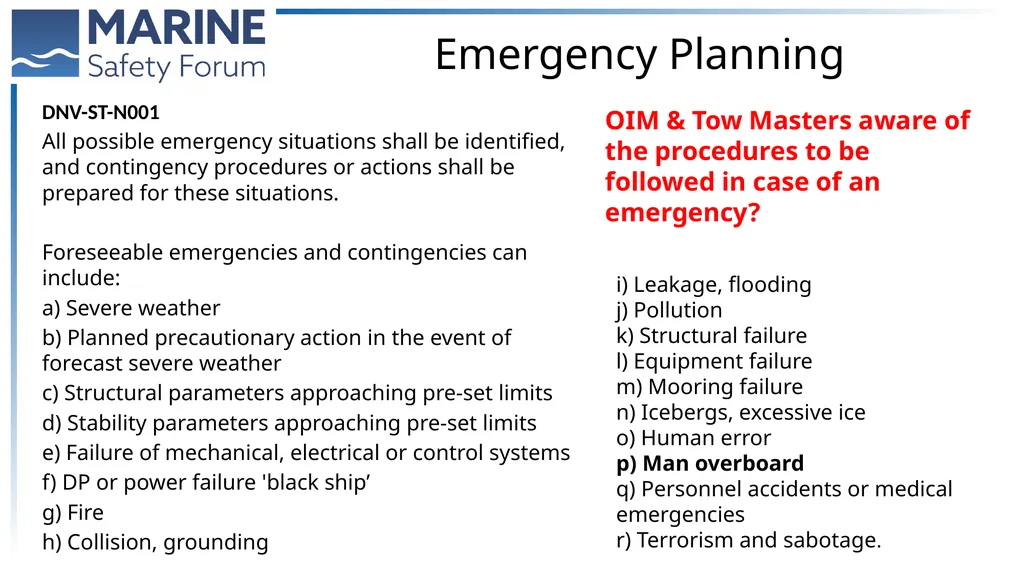
Emergency Planning DNV-ST-N001
All possible emergency situations shall be identified, and contingency procedures or actions shall be prepared for these situations.
Foreseeable emergencies and contingencies can include:
a) Severe weather
b) Planned precautionary action in the event of forecast severe weather
c) Structural parameters approaching pre-set limits
d) Stability parameters approaching pre-set limits
e) Failure of mechanical, electrical or control systems
f) DP or power failure 'black ship’
g) Fire
h) Collision, grounding i) Leakage, flooding
j) Pollution
k) Structural failure
l) Equipment failure
m) Mooring failure
n) Icebergs, excessive ice
o) Human error
p) Man overboard
q) Personnel accidents or medical emergencies
r) Terrorism and sabotage. OIM & Tow Masters aware of the procedures to be followed in case of an emergency?<br>
All possible emergency situations shall be identified, and contingency procedures or actions shall be prepared for these situations.
Foreseeable emergencies and contingencies can include:
a) Severe weather
b) Planned precautionary action in the event of forecast severe weather
c) Structural parameters approaching pre-set limits
d) Stability parameters approaching pre-set limits
e) Failure of mechanical, electrical or control systems
f) DP or power failure 'black ship’
g) Fire
h) Collision, grounding i) Leakage, flooding
j) Pollution
k) Structural failure
l) Equipment failure
m) Mooring failure
n) Icebergs, excessive ice
o) Human error
p) Man overboard
q) Personnel accidents or medical emergencies
r) Terrorism and sabotage. OIM & Tow Masters aware of the procedures to be followed in case of an emergency?<br>
20
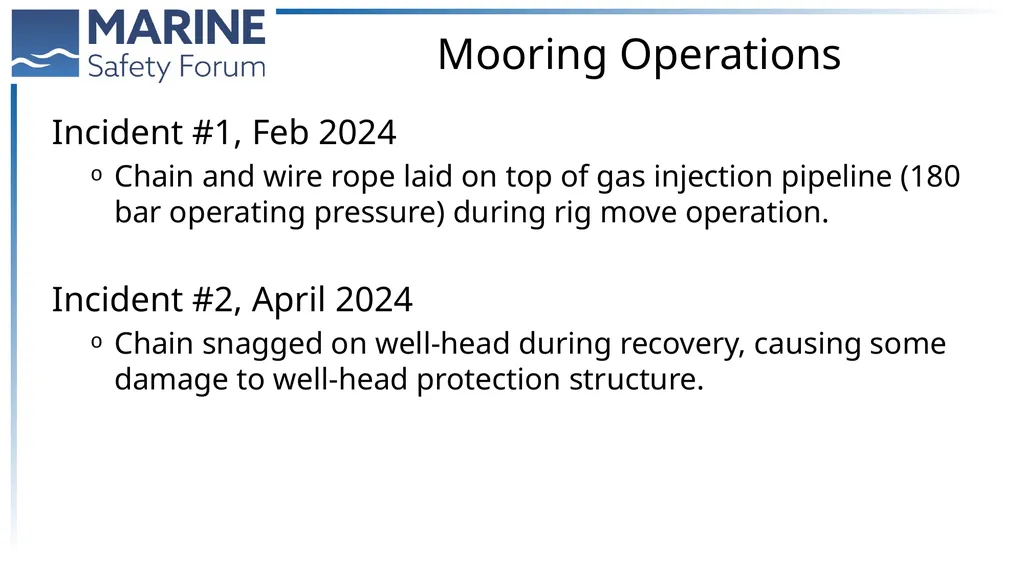
Mooring Operations Incident #1, Feb 2024
Chain and wire rope laid on top of gas injection pipeline (180 bar operating pressure) during rig move operation.
Incident #2, April 2024
Chain snagged on well-head during recovery, causing some damage to well-head protection structure.<br>
Chain and wire rope laid on top of gas injection pipeline (180 bar operating pressure) during rig move operation.
Incident #2, April 2024
Chain snagged on well-head during recovery, causing some damage to well-head protection structure.<br>
21
Planning, preparation and conduct of Rig Move Operations Legal Requirements
The Management of Health and Safety at Work Regulations 1999
Risk Assessment
3.(1) Every employer shall make a suitable and sufficient assessment of —
the risks to the health and safety of his employees to which they are exposed whilst they are at work; and
the risks to the health and safety of persons not in his employment arising out of or in connection with the conduct by him of his undertaking,
Health & Safety Arrangements
5.(1) Every employer shall make and give effect to such arrangements as are appropriate, having regard to the nature of his activities and the size of his undertaking, for the effective planning, organisation, control, monitoring and review of the preventive and protective measures.<br>
The Management of Health and Safety at Work Regulations 1999
Risk Assessment
3.(1) Every employer shall make a suitable and sufficient assessment of —
the risks to the health and safety of his employees to which they are exposed whilst they are at work; and
the risks to the health and safety of persons not in his employment arising out of or in connection with the conduct by him of his undertaking,
Health & Safety Arrangements
5.(1) Every employer shall make and give effect to such arrangements as are appropriate, having regard to the nature of his activities and the size of his undertaking, for the effective planning, organisation, control, monitoring and review of the preventive and protective measures.<br>
22
Acknowledgements Dr Lucy Campbell
Director, Anatec
lucy@anatec.com Mr. Ewan J Fraser
Business Operations Support Executive,
Offshore Energy, Met Office
ewan.fraser@metoffice.gov.uk<br>
Director, Anatec
lucy@anatec.com Mr. Ewan J Fraser
Business Operations Support Executive,
Offshore Energy, Met Office
ewan.fraser@metoffice.gov.uk<br>
23
Questions ?<br>