ROLE OF THE CAPITAL MARKET IN LONG TERM

Published  . 0 views
↓ Download
ROLE OF THE CAPITAL MARKET IN LONG TERM
1 / 1
ROLE OF THE CAPITAL MARKET IN LONG TERM - slide 1 of 23 ROLE OF THE CAPITAL MARKET IN LONG TERM - slide 2 of 23 ROLE OF THE CAPITAL MARKET IN LONG TERM - slide 3 of 23 ROLE OF THE CAPITAL MARKET IN LONG TERM - slide 4 of 23 ROLE OF THE CAPITAL MARKET IN LONG TERM - slide 5 of 23 ROLE OF THE CAPITAL MARKET IN LONG TERM - slide 6 of 23 ROLE OF THE CAPITAL MARKET IN LONG TERM - slide 7 of 23 ROLE OF THE CAPITAL MARKET IN LONG TERM - slide 8 of 23 ROLE OF THE CAPITAL MARKET IN LONG TERM - slide 9 of 23 ROLE OF THE CAPITAL MARKET IN LONG TERM - slide 10 of 23 ROLE OF THE CAPITAL MARKET IN LONG TERM - slide 11 of 23 ROLE OF THE CAPITAL MARKET IN LONG TERM - slide 12 of 23 ROLE OF THE CAPITAL MARKET IN LONG TERM - slide 13 of 23 ROLE OF THE CAPITAL MARKET IN LONG TERM - slide 14 of 23 ROLE OF THE CAPITAL MARKET IN LONG TERM - slide 15 of 23 ROLE OF THE CAPITAL MARKET IN LONG TERM - slide 16 of 23 ROLE OF THE CAPITAL MARKET IN LONG TERM - slide 17 of 23 ROLE OF THE CAPITAL MARKET IN LONG TERM - slide 18 of 23 ROLE OF THE CAPITAL MARKET IN LONG TERM - slide 19 of 23 ROLE OF THE CAPITAL MARKET IN LONG TERM - slide 20 of 23 ROLE OF THE CAPITAL MARKET IN LONG TERM - slide 21 of 23 ROLE OF THE CAPITAL MARKET IN LONG TERM - slide 22 of 23 ROLE OF THE CAPITAL MARKET IN LONG TERM - slide 23 of 23
Description: ROLE OF THE CAPITAL MARKET IN LONG TERM DEVELOPMENT FINANCING Presented by John Robson Kamanga Chief Executive Officer Malawi Stock Exchange. 22 November 2018 CONTENTS Defining Capital Markets Functions of the Stock Exchange as a player

Related Topics

Download Presentation

"ROLE OF THE CAPITAL MARKET IN LONG TERM" is the property of its rightful owner. Permission is granted to download and print the materials on this website for personal, non-commercial use only, and to display it on your personal computer provided you do not modify the materials and that you retain all copyright notices contained in the materials. By downloading content from our website, you accept the terms of this agreement.

Presentation Transcript

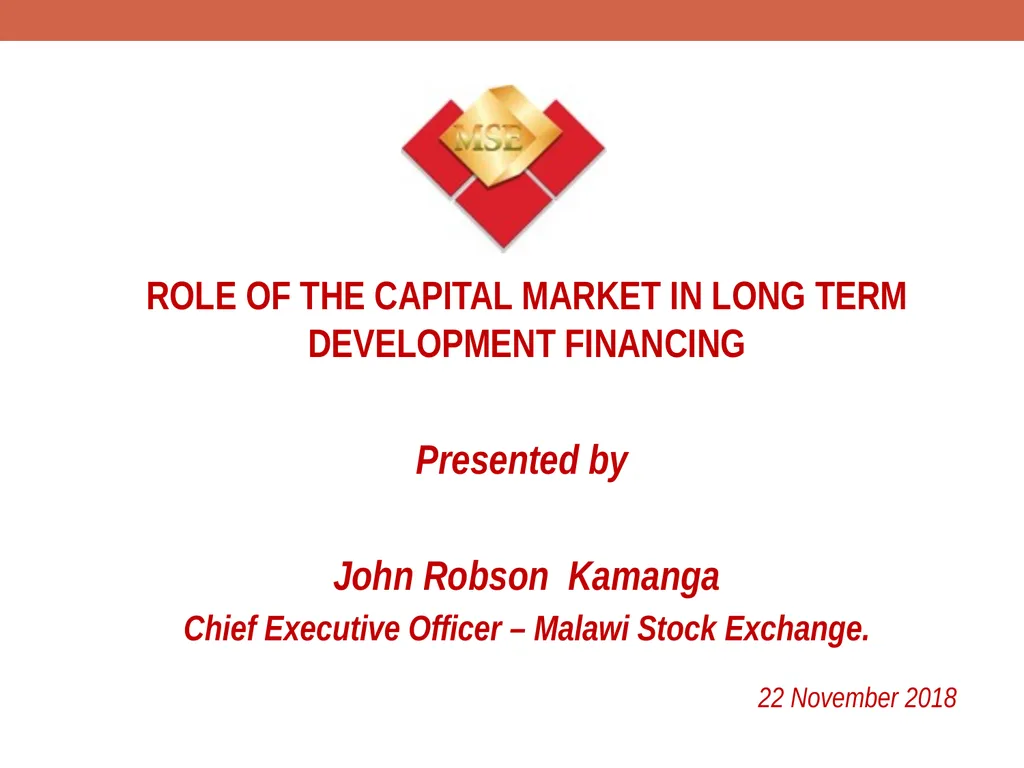
slide1. ROLE OF THE CAPITAL MARKET IN LONG TERM DEVELOPMENT FINANCING

Presented by

John Robson Kamanga
Chief Executive Officer – Malawi Stock Exchange. 22 November 2018<br>
slide2. CONTENTS Defining Capital Markets
Functions of the Stock Exchange as a player in the Capital Market
What is Development Finance?
Areas that development finance seeks to finance
The Capital Market as a source of development finance
Why the Capital Market?
Achievements of the Malawi Stock Exchange
What other capital markets have done
Opportunities for Capital Markets
Challenges of the Capital Market
Solutions<br>
slide3. 1. DEFINING CAPITAL MARKETS The Capital Market is a part of the financial system concerned with channeling wealth from savers/investors to institutions (public or private) that can put it to long term productive use.

Primary market
Where capital is raised
Where new issue of capital market instruments is done

Secondary market
Where investor’s trade in previously issued securities
Where trading of securities is done<br>
slide4. 2. FUNCTIONS OF THE STOCK EXCHANGE AS A PLAYER IN THE CAPITAL MARKET Providing a link between financial raisers and financial suppliers (investors)
Providing market place for buyers and sellers of investment assets
Supervising trading activities
Supervising the conduct of member firms
Providing information services such as share price information
Providing announcements made by listed companies<br>
slide5. 3. WHAT IS DEVELOPMENT FINANCE? Development finance involves public and private investment in physical development, redevelopment and/or business and industry aimed at supporting, encouraging and influencing expansion.

Development finance aims to establish proactive approaches that leverage public and private resources to solve the needs of business, industry, developers and investors.<br>
slide6. 4. AREAS THAT DEVELOPMENT FINANCE SEEKS TO FINANCE Government projects e.g. roads, utilities, airports, schools etc
Established industry e.g industrial parks, manufacturing, commercial retail centers etc
Development & redevelopment - projects that require major public resource commitments to catalyze new private sector development
Small businesses and micro-enterprises
Entrepreneurs - not ready for traditional financing and need a unique approach to help them find the working capital needed to expand and grow.<br>
slide7. 5. THE CAPITAL MARKET AS A SOURCE OF DEVELOPMENT FINANCE Government
bonds Main Board Alternative Capital Market The MSE has platforms to cater for various capital needs to provide inclusive access to capital for businesses. Corporate
bonds<br>
slide8. 6. WHY THE CAPITAL MARKET ? Large pool of resources
Low cost financing
Long term financing
May offer funding for riskier activities that would traditionally not be served by the banking sector
Offers locally denominated funding that is free from exchange rate risk
Wealth distribution through investor participation
Value creation<br>
slide9. 6.1 LARGE POOL OF FUNDS A. Initial Public Offers<br>
slide10. LARGE POOL OF FUNDS CONTINUED… B. Rights issues<br>
slide11. LARGE POOL OF FUNDS CONTINUED… C. Bonds (Government & Private)<br>
slide12. 6.2 EFFICIENT WAY OF RAISING CAPITAL Low cost of raising funds<br>
slide13. 6.3 WEALTH DISTRIBUTION<br>
slide14. 6.4 VALUE CREATION Market price depicts investors perception of a company.<br>
slide15. 7. ACHIEVEMENTS OF THE MALAWI STOCK EXCHANGE Helped companies rebrand to achieve expansion beyond our borders – FMBCH acquisition of Barclays Bank Zimbabwe

Helped a bank meet its capital adequacy requirement – NBS Bank MK11.8 bn rights issue.

Helped a company restructure its balance sheet - MPICO MK9bn rights issue.

Helped a bank increase capital for growth of its operations – NFB 14bn Medium Term Note Program.<br>
slide16. ACHIEVEMENTS CONTINUED… Created a pool of investors to stock market investments - >40,000 shareholders.

Key member on financial inclusion of Malawians through Financial Literacy program.

Created a platform for Small and Medium Enterprises.

Provided platform to Government for trading of its instruments<br>
slide17. 8. WHAT OTHER CAPITAL MARKETS HAVE DONE Kenya Electricity Generating Company (KenGen) listed through a government sale of 30% stake to the public in 2006. Over USD295 million was realized.

In 2016, KenGen raised about US$260mn through a rights issue with the aim of injecting new equity into the Company, thereby creating additional debt headroom needed to access future loans to facilitate KenGen’s expansion having successfully finalized the Geothermal baseload in 2014 with a JICA Loan Funding.<br>
slide18. WHAT OTHER CAPITAL MARKETS HAVE DONE CONTINUED… KenGen Geothermal baseload<br>
slide19. WHAT OTHER CAPITAL MARKETS HAVE DONE CONTINUED… NIGERIA<br>
slide20. 9. OPPORTUNITIES FOR CAPITAL MARKETS Growth in Pension Fund Assets
Growing middle income class
Frontier markets with untapped natural resources looking for financial resources.
Increase in institutions of higher learning providing investor education
Government demand for debt for implementation of infrastructure projects
Growth in demand for funds in the real estate sector
Growing interest in PPP
High commercial bank lending rates<br>
slide21. 10. CHALLENGES OF THE CAPITAL MARKET Limited supply of products to satisfy potential demand on both primary and secondary markets.
Low usage of capital markets for capital mobilization by potential issuers.
Inadequate expertise for structuring of complex capital market products which leads to shortage of well prepared projects.
High transactional costs.
Multiple taxation in form of surtax, dividend tax, withholding tax which erode attractiveness of the capital market.
Balancing and consistency of macroeconomic variables<br>
slide22. 11. SOLUTIONS Implement sound macroeconomic and policy frameworks.
Government to take a leading role through MOF to have parastatals issue and list Bonds to fund development projects and also list commercial parastatals.
Integration of the capital market to the financial system.
Improve legal and regulatory framework.
Development of securities instruments to align the risk-return appetite of institutional investors.
Intensify financial literacy programs.
Introduction of credit rating entities to facilitate the Bond market.<br>
slide23. THANK YOU!<br>