
ROUNDTABLE ON FINANCIAL MISCONDUCT THEME: “What

Description: ROUNDTABLE ON FINANCIAL MISCONDUCT THEME: What constitutes Financial Misconduct: Raising awareness on the reporting of Financial Misconduct and its implications in the Public Service 28 February 2013 PRESENTATION OUTLINE Introduction
Related Topics
Download Presentation
"ROUNDTABLE ON FINANCIAL MISCONDUCT THEME: “What" is the property of its rightful owner. Permission is granted to download and print the materials on this website for personal, non-commercial use only, and to display it on your personal computer provided you do not modify the materials and that you retain all copyright notices contained in the materials. By downloading content from our website, you accept the terms of this agreement.
Presentation Transcript
slide1. ROUNDTABLE ON
FINANCIAL MISCONDUCT THEME: “What constitutes Financial Misconduct: Raising awareness on the reporting of Financial Misconduct and its implications in the Public Service”
28 February 2013<br>
slide2. PRESENTATION OUTLINE Introduction
Legislative Framework on Financial Misconduct
Reporting by Departments on Financial Misconduct
The PSC’s roles and responsibilities relating to Financial Misconduct
Challenges encountered
Implications for the Public Service
Conclusion 2<br>
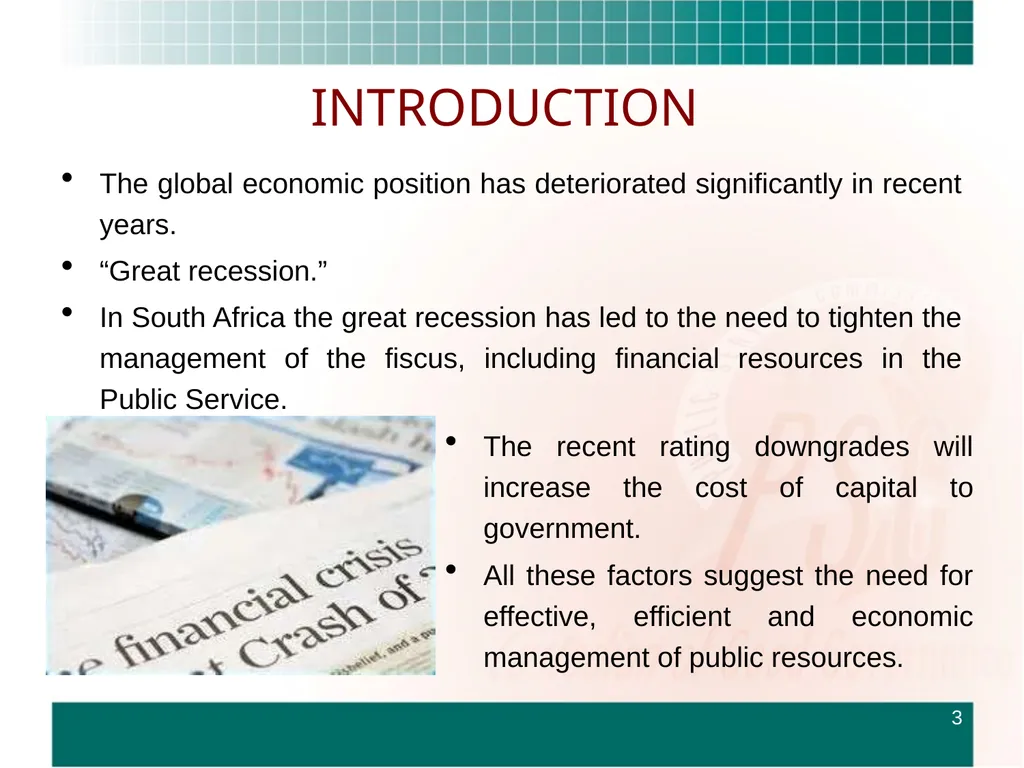
slide3. The global economic position has deteriorated significantly in recent years.
“Great recession.”
In South Africa the great recession has led to the need to tighten the management of the fiscus, including financial resources in the Public Service. The recent rating downgrades will increase the cost of capital to government.
All these factors suggest the need for effective, efficient and economic management of public resources. INTRODUCTION 3<br>
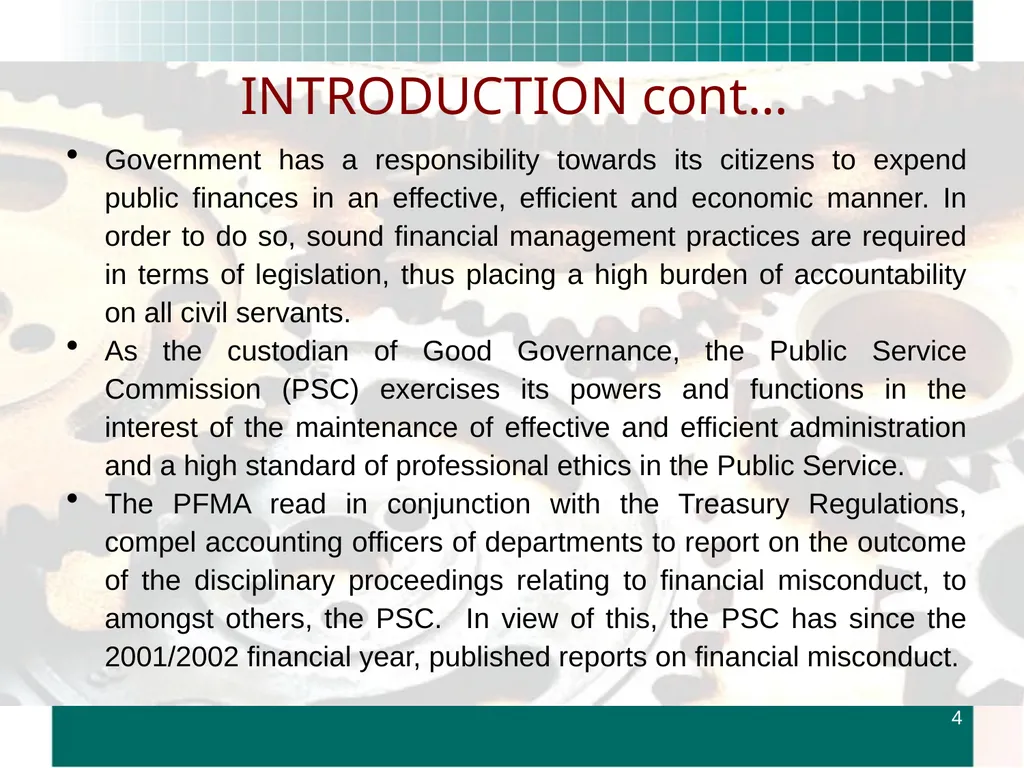
slide4. INTRODUCTION cont… Government has a responsibility towards its citizens to expend public finances in an effective, efficient and economic manner. In order to do so, sound financial management practices are required in terms of legislation, thus placing a high burden of accountability on all civil servants.
As the custodian of Good Governance, the Public Service Commission (PSC) exercises its powers and functions in the interest of the maintenance of effective and efficient administration and a high standard of professional ethics in the Public Service.
The PFMA read in conjunction with the Treasury Regulations, compel accounting officers of departments to report on the outcome of the disciplinary proceedings relating to financial misconduct, to amongst others, the PSC. In view of this, the PSC has since the 2001/2002 financial year, published reports on financial misconduct. 4<br>
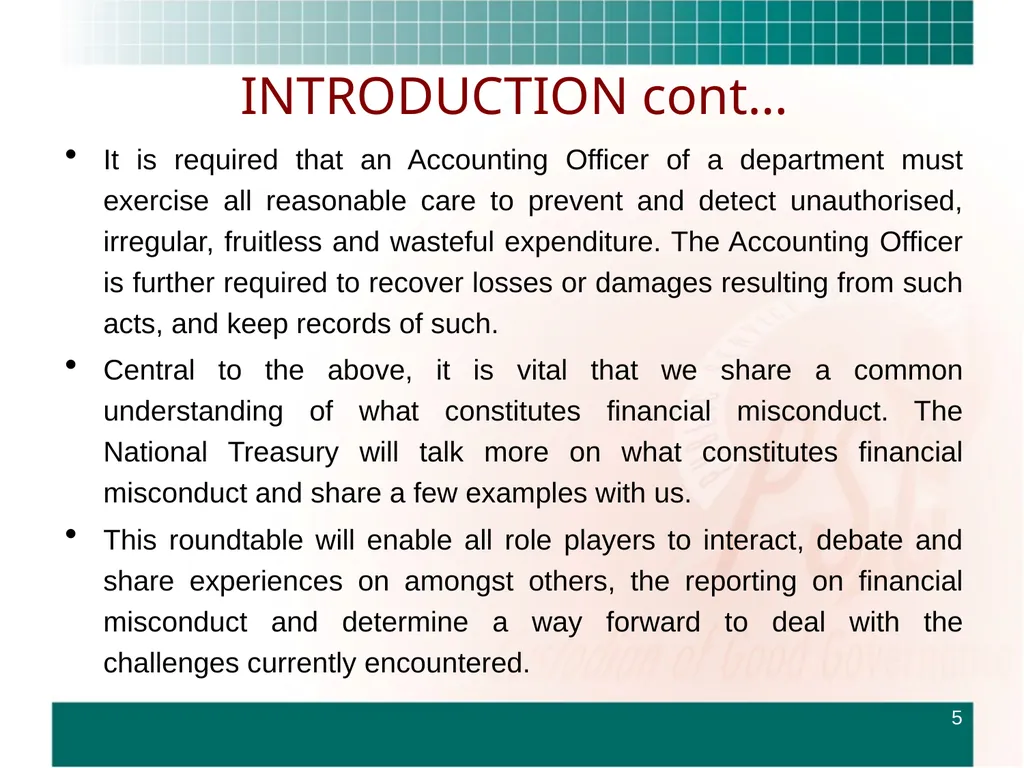
slide5. INTRODUCTION cont… It is required that an Accounting Officer of a department must exercise all reasonable care to prevent and detect unauthorised, irregular, fruitless and wasteful expenditure. The Accounting Officer is further required to recover losses or damages resulting from such acts, and keep records of such.
Central to the above, it is vital that we share a common understanding of what constitutes financial misconduct. The National Treasury will talk more on what constitutes financial misconduct and share a few examples with us.
This roundtable will enable all role players to interact, debate and share experiences on amongst others, the reporting on financial misconduct and determine a way forward to deal with the challenges currently encountered. 5<br>
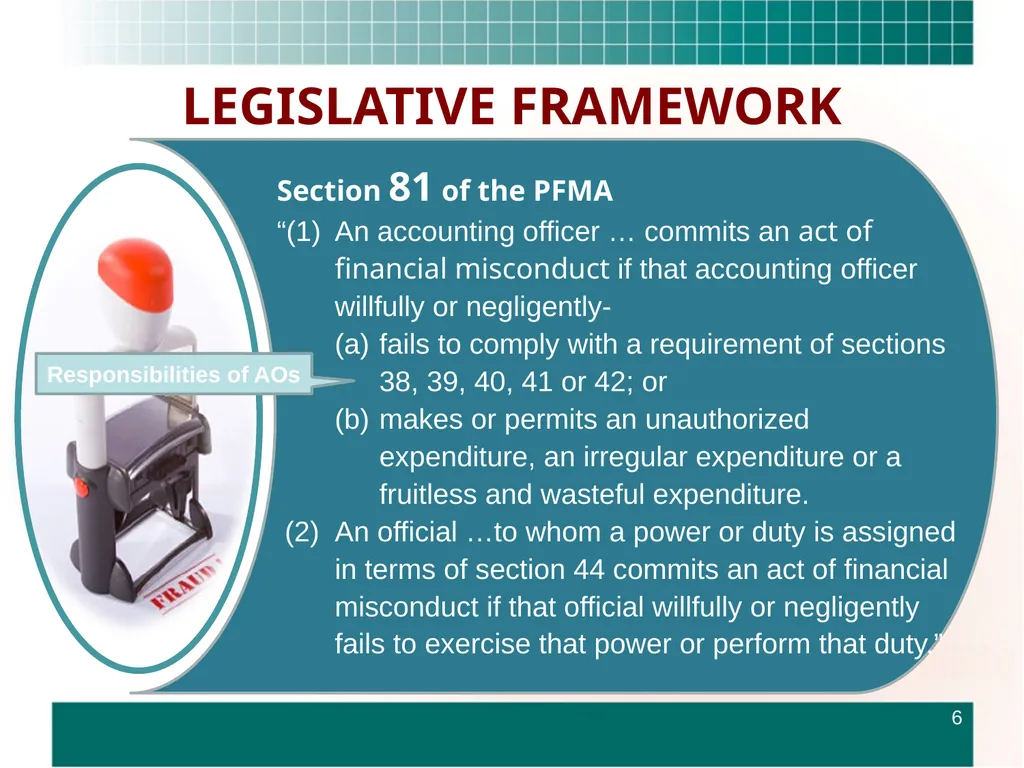
slide6. Section 81 of the PFMA
“(1) An accounting officer … commits an act of financial misconduct if that accounting officer willfully or negligently-
(a) fails to comply with a requirement of sections 38, 39, 40, 41 or 42; or
(b) makes or permits an unauthorized expenditure, an irregular expenditure or a fruitless and wasteful expenditure.
(2) An official …to whom a power or duty is assigned in terms of section 44 commits an act of financial misconduct if that official willfully or negligently fails to exercise that power or perform that duty.” LEGISLATIVE FRAMEWORK 6 Responsibilities of AOs<br>
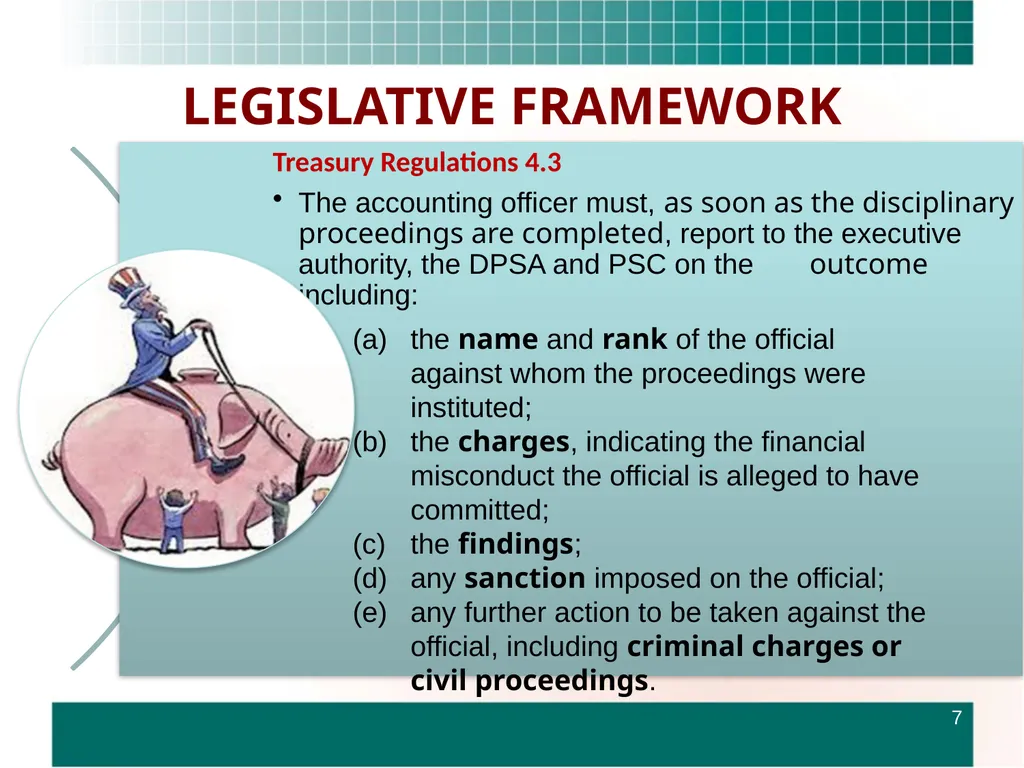
slide7. LEGISLATIVE FRAMEWORK 7<br>
slide8. In order to deepen analysis on finalised cases reported, a reporting format was developed. In addition to the Treasury Regulations, the PSC requires departments to report on-
the salary level of the employee (if the employee is at SMS level a copy of the job description should be included);
the amount involved;
the recovery of the loss in the particular and previous financial year;
the reasons for the increase/decrease in financial misconduct cases;
any trend in relation to cases on a particular salary level and the possible reasons for such a trend. 8 THE PSC’S ROLE AND RESPONSIBILITIES<br>
slide9. A database of reported cases has been established and maintained since 2005.
The PSC verifies the information provided by departments in those cases where insufficient information is provided.
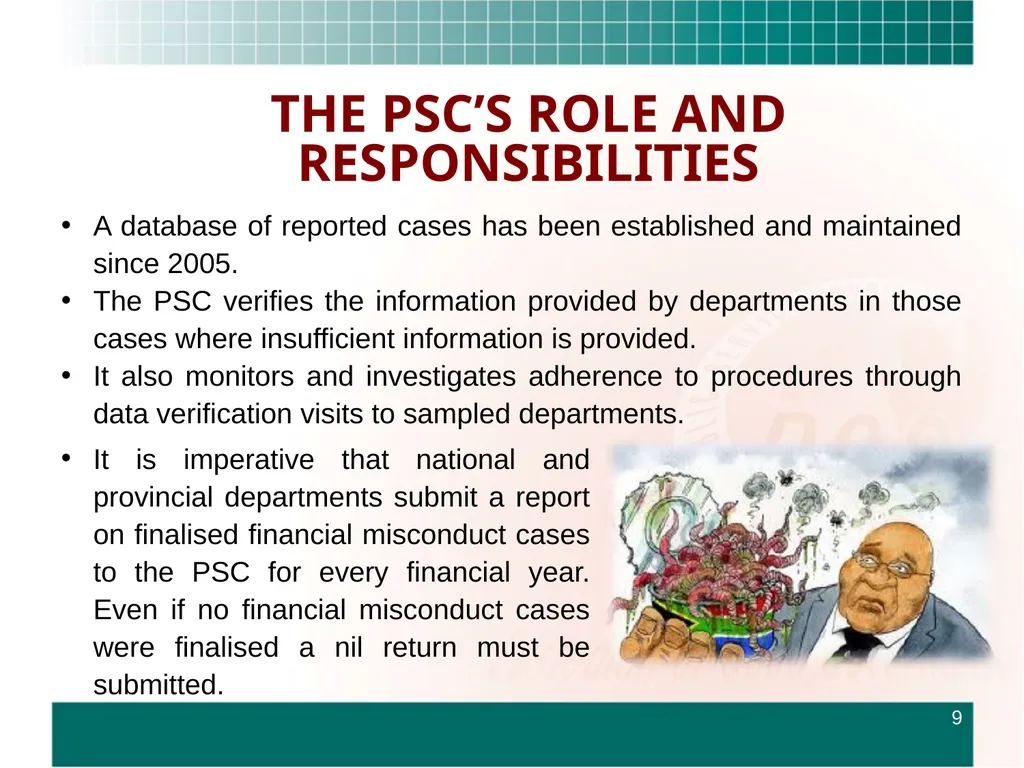
It also monitors and investigates adherence to procedures through data verification visits to sampled departments. 9 THE PSC’S ROLE AND RESPONSIBILITIES It is imperative that national and provincial departments submit a report on finalised financial misconduct cases to the PSC for every financial year. Even if no financial misconduct cases were finalised a nil return must be submitted.<br>
slide10. CHALLENGES ENCOUNTERED (1) Departments are compelled to report the outcome of finalized misconduct cases to the PSC. However, most departments do not comply and must on a continuous basis be reminded to report to the PSC.
Departments do not adhere to the deadline for reporting.
Inaccurate and incomplete information provided, e.g.
Outcome of the case not reported (1% in 2011/12).
Sanction not reflected (1.7% in 2011/12).
Criminal action/civil proceedings not reflected (39% of cases no indication given in 2011/12).
No reporting on the recovery of money lost/ recovered.
Less than 1% of departments provide an analysis of trends on financial misconduct cases. 10<br>
slide11. CHALLENGES ENCOUNTERED (2) During data verification visits to departments the following major challenges were identified: 11 The information in individual files are not accurately maintained (e.g. documents were left loose in the files and were are not filed according to the sequence of events).
Some departments do not maintain any form of a database of cases.
Disciplinary cases are not recorded on the PERSAL system.
Proper records of the recovery of monies lost through financial misconduct were not maintained.
Labour Relations/HR sections do not communicate the outcome of disciplinary matters to the Finance section, thereby making recovery of money lost to the State impossible.
Some departments do not have sufficient investigative capacity, resulting in delays in the finalisation of cases or the withdrawal of cases.<br>
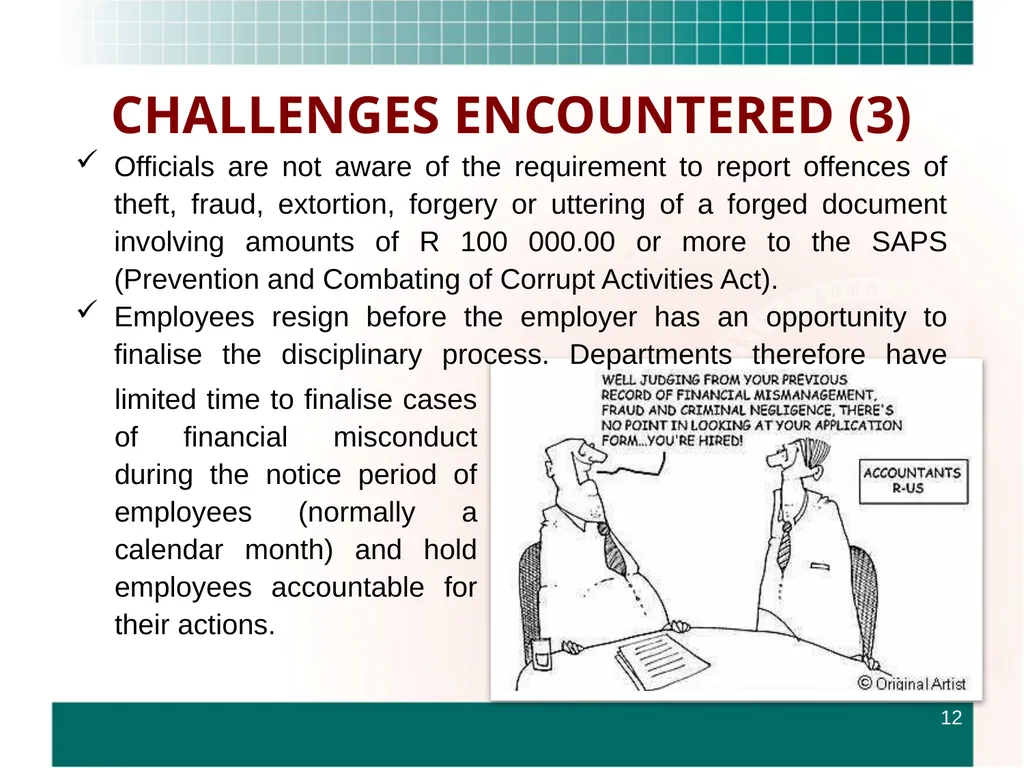
slide12. Officials are not aware of the requirement to report offences of theft, fraud, extortion, forgery or uttering of a forged document involving amounts of R 100 000.00 or more to the SAPS (Prevention and Combating of Corrupt Activities Act).
Employees resign before the employer has an opportunity to finalise the disciplinary process. Departments therefore have CHALLENGES ENCOUNTERED (3) limited time to finalise cases of financial misconduct during the notice period of employees (normally a calendar month) and hold employees accountable for their actions. 12<br>
slide13. CHALLENGES ENCOUNTERED (4) Individuals tasked with the responsibility of completing the PSC’s reporting format indicated that they have great difficulty in determining what constitutes financial misconduct.
There is also no shared understanding amongst departments regarding the date on which a case is regarded as finalised. Departments report on cases that are still on appeal.
Furthermore, the relevant prescripts (the PFMA and the Treasury Regulations) do not provide for a definition for financial misconduct.
This results in non-financial misconduct cases being reported (e.g. alcohol abuse, absenteeism).
The inaccuracy of information provided by departments has reinforced the need for greater engagement to deepen the culture of compliance, improve reporting on all aspects, and strengthen internal controls and risk management within the Public Service. 13<br>
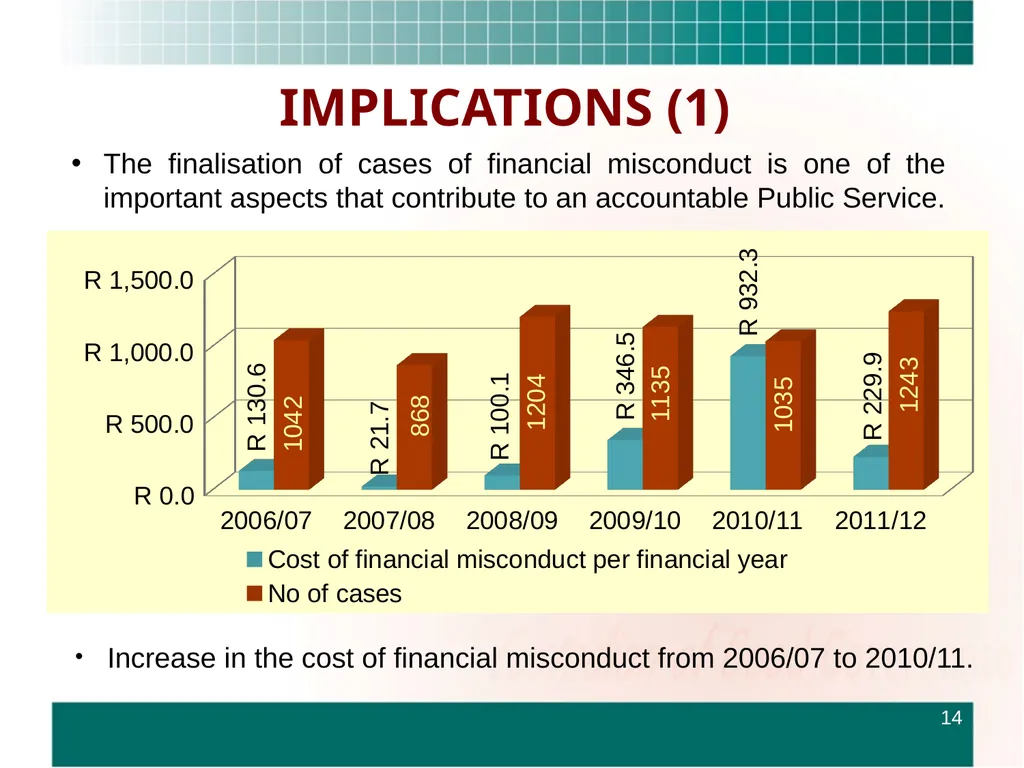
slide14. IMPLICATIONS (1) The finalisation of cases of financial misconduct is one of the important aspects that contribute to an accountable Public Service. Increase in the cost of financial misconduct from 2006/07 to 2010/11. 14<br>
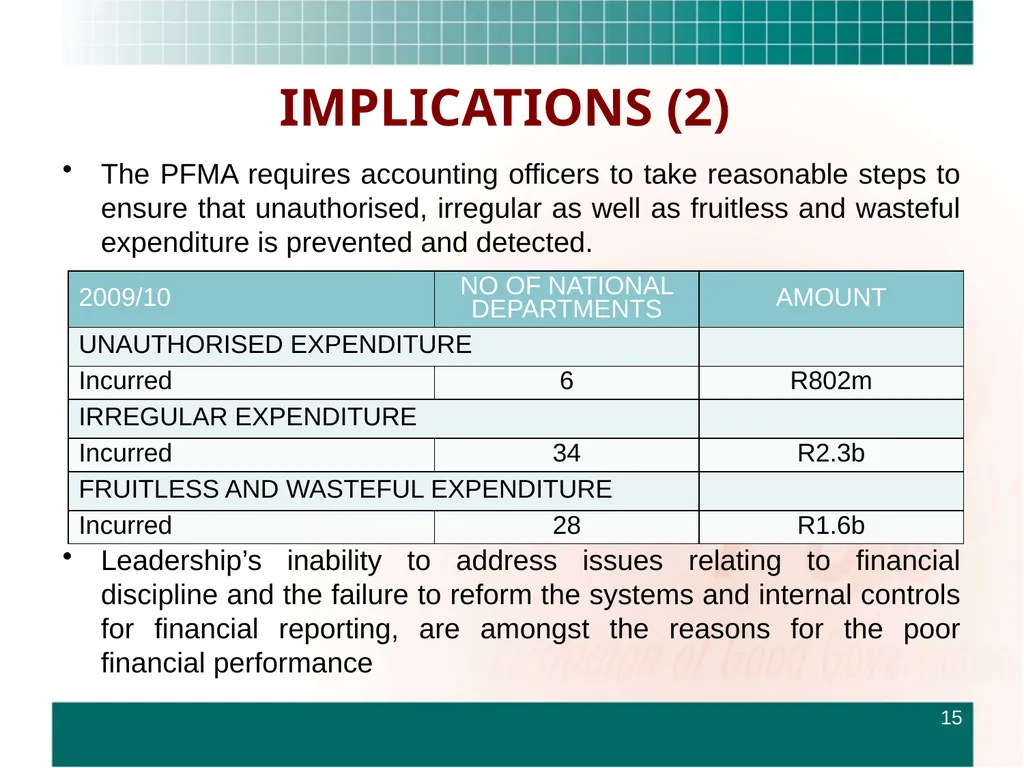
slide15. The PFMA requires accounting officers to take reasonable steps to ensure that unauthorised, irregular as well as fruitless and wasteful expenditure is prevented and detected.
Leadership’s inability to address issues relating to financial discipline and the failure to reform the systems and internal controls for financial reporting, are amongst the reasons for the poor financial performance IMPLICATIONS (2) 15<br>
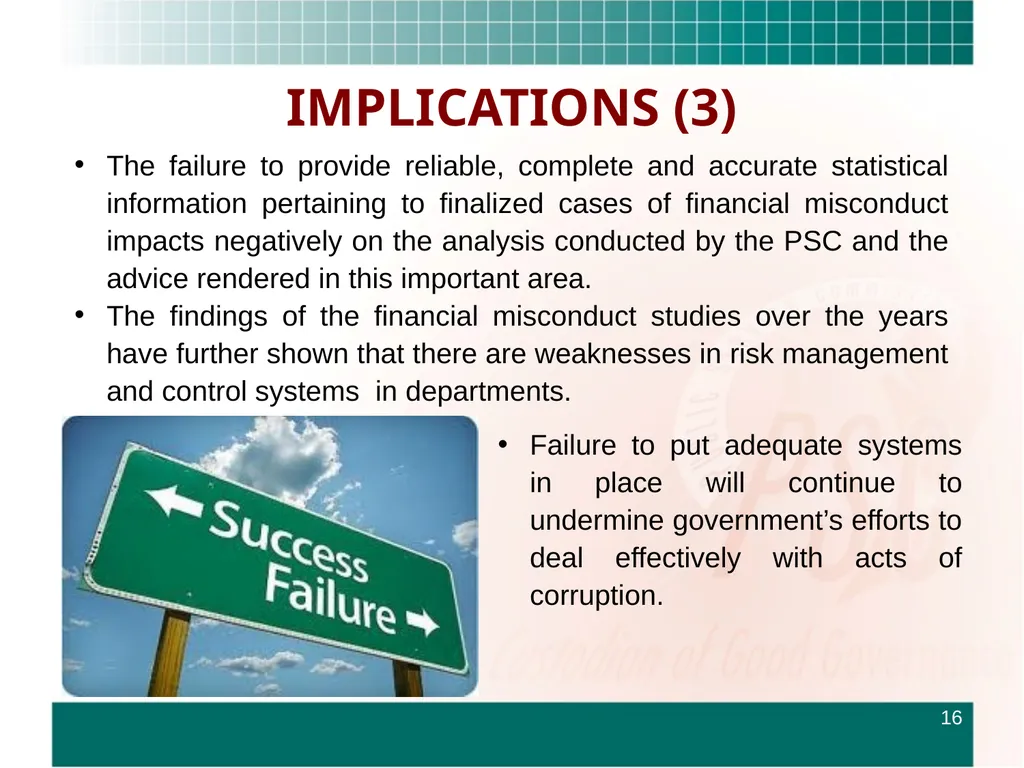
slide16. IMPLICATIONS (3) The failure to provide reliable, complete and accurate statistical information pertaining to finalized cases of financial misconduct impacts negatively on the analysis conducted by the PSC and the advice rendered in this important area.
The findings of the financial misconduct studies over the years have further shown that there are weaknesses in risk management and control systems in departments. 16 Failure to put adequate systems in place will continue to undermine government’s efforts to deal effectively with acts of corruption.<br>
slide17. CONCLUSION 17 The number of cases of financial misconduct reported to the PSC is low given the high rate of unauthorised, irregular and fruitless and wasteful expenditure, as well as the rate of non-compliance within the Public Service.
Leadership’s inability to address issues relating to financial discipline and the failure to reform the systems and internal controls for financial reporting, are among the reasons for poor financial performance. This Roundtable is aimed at improving compliance with reporting, the quality of reporting and also to provide participants with a broader, in-depth and shared understanding of what constitutes financial misconduct.<br>
FINANCIAL MISCONDUCT THEME: “What constitutes Financial Misconduct: Raising awareness on the reporting of Financial Misconduct and its implications in the Public Service”
28 February 2013<br>
slide2. PRESENTATION OUTLINE Introduction
Legislative Framework on Financial Misconduct
Reporting by Departments on Financial Misconduct
The PSC’s roles and responsibilities relating to Financial Misconduct
Challenges encountered
Implications for the Public Service
Conclusion 2<br>
slide3. The global economic position has deteriorated significantly in recent years.
“Great recession.”
In South Africa the great recession has led to the need to tighten the management of the fiscus, including financial resources in the Public Service. The recent rating downgrades will increase the cost of capital to government.
All these factors suggest the need for effective, efficient and economic management of public resources. INTRODUCTION 3<br>
slide4. INTRODUCTION cont… Government has a responsibility towards its citizens to expend public finances in an effective, efficient and economic manner. In order to do so, sound financial management practices are required in terms of legislation, thus placing a high burden of accountability on all civil servants.
As the custodian of Good Governance, the Public Service Commission (PSC) exercises its powers and functions in the interest of the maintenance of effective and efficient administration and a high standard of professional ethics in the Public Service.
The PFMA read in conjunction with the Treasury Regulations, compel accounting officers of departments to report on the outcome of the disciplinary proceedings relating to financial misconduct, to amongst others, the PSC. In view of this, the PSC has since the 2001/2002 financial year, published reports on financial misconduct. 4<br>
slide5. INTRODUCTION cont… It is required that an Accounting Officer of a department must exercise all reasonable care to prevent and detect unauthorised, irregular, fruitless and wasteful expenditure. The Accounting Officer is further required to recover losses or damages resulting from such acts, and keep records of such.
Central to the above, it is vital that we share a common understanding of what constitutes financial misconduct. The National Treasury will talk more on what constitutes financial misconduct and share a few examples with us.
This roundtable will enable all role players to interact, debate and share experiences on amongst others, the reporting on financial misconduct and determine a way forward to deal with the challenges currently encountered. 5<br>
slide6. Section 81 of the PFMA
“(1) An accounting officer … commits an act of financial misconduct if that accounting officer willfully or negligently-
(a) fails to comply with a requirement of sections 38, 39, 40, 41 or 42; or
(b) makes or permits an unauthorized expenditure, an irregular expenditure or a fruitless and wasteful expenditure.
(2) An official …to whom a power or duty is assigned in terms of section 44 commits an act of financial misconduct if that official willfully or negligently fails to exercise that power or perform that duty.” LEGISLATIVE FRAMEWORK 6 Responsibilities of AOs<br>
slide7. LEGISLATIVE FRAMEWORK 7<br>
slide8. In order to deepen analysis on finalised cases reported, a reporting format was developed. In addition to the Treasury Regulations, the PSC requires departments to report on-
the salary level of the employee (if the employee is at SMS level a copy of the job description should be included);
the amount involved;
the recovery of the loss in the particular and previous financial year;
the reasons for the increase/decrease in financial misconduct cases;
any trend in relation to cases on a particular salary level and the possible reasons for such a trend. 8 THE PSC’S ROLE AND RESPONSIBILITIES<br>
slide9. A database of reported cases has been established and maintained since 2005.
The PSC verifies the information provided by departments in those cases where insufficient information is provided.
It also monitors and investigates adherence to procedures through data verification visits to sampled departments. 9 THE PSC’S ROLE AND RESPONSIBILITIES It is imperative that national and provincial departments submit a report on finalised financial misconduct cases to the PSC for every financial year. Even if no financial misconduct cases were finalised a nil return must be submitted.<br>
slide10. CHALLENGES ENCOUNTERED (1) Departments are compelled to report the outcome of finalized misconduct cases to the PSC. However, most departments do not comply and must on a continuous basis be reminded to report to the PSC.
Departments do not adhere to the deadline for reporting.
Inaccurate and incomplete information provided, e.g.
Outcome of the case not reported (1% in 2011/12).
Sanction not reflected (1.7% in 2011/12).
Criminal action/civil proceedings not reflected (39% of cases no indication given in 2011/12).
No reporting on the recovery of money lost/ recovered.
Less than 1% of departments provide an analysis of trends on financial misconduct cases. 10<br>
slide11. CHALLENGES ENCOUNTERED (2) During data verification visits to departments the following major challenges were identified: 11 The information in individual files are not accurately maintained (e.g. documents were left loose in the files and were are not filed according to the sequence of events).
Some departments do not maintain any form of a database of cases.
Disciplinary cases are not recorded on the PERSAL system.
Proper records of the recovery of monies lost through financial misconduct were not maintained.
Labour Relations/HR sections do not communicate the outcome of disciplinary matters to the Finance section, thereby making recovery of money lost to the State impossible.
Some departments do not have sufficient investigative capacity, resulting in delays in the finalisation of cases or the withdrawal of cases.<br>
slide12. Officials are not aware of the requirement to report offences of theft, fraud, extortion, forgery or uttering of a forged document involving amounts of R 100 000.00 or more to the SAPS (Prevention and Combating of Corrupt Activities Act).
Employees resign before the employer has an opportunity to finalise the disciplinary process. Departments therefore have CHALLENGES ENCOUNTERED (3) limited time to finalise cases of financial misconduct during the notice period of employees (normally a calendar month) and hold employees accountable for their actions. 12<br>
slide13. CHALLENGES ENCOUNTERED (4) Individuals tasked with the responsibility of completing the PSC’s reporting format indicated that they have great difficulty in determining what constitutes financial misconduct.
There is also no shared understanding amongst departments regarding the date on which a case is regarded as finalised. Departments report on cases that are still on appeal.
Furthermore, the relevant prescripts (the PFMA and the Treasury Regulations) do not provide for a definition for financial misconduct.
This results in non-financial misconduct cases being reported (e.g. alcohol abuse, absenteeism).
The inaccuracy of information provided by departments has reinforced the need for greater engagement to deepen the culture of compliance, improve reporting on all aspects, and strengthen internal controls and risk management within the Public Service. 13<br>
slide14. IMPLICATIONS (1) The finalisation of cases of financial misconduct is one of the important aspects that contribute to an accountable Public Service. Increase in the cost of financial misconduct from 2006/07 to 2010/11. 14<br>
slide15. The PFMA requires accounting officers to take reasonable steps to ensure that unauthorised, irregular as well as fruitless and wasteful expenditure is prevented and detected.
Leadership’s inability to address issues relating to financial discipline and the failure to reform the systems and internal controls for financial reporting, are amongst the reasons for the poor financial performance IMPLICATIONS (2) 15<br>
slide16. IMPLICATIONS (3) The failure to provide reliable, complete and accurate statistical information pertaining to finalized cases of financial misconduct impacts negatively on the analysis conducted by the PSC and the advice rendered in this important area.
The findings of the financial misconduct studies over the years have further shown that there are weaknesses in risk management and control systems in departments. 16 Failure to put adequate systems in place will continue to undermine government’s efforts to deal effectively with acts of corruption.<br>
slide17. CONCLUSION 17 The number of cases of financial misconduct reported to the PSC is low given the high rate of unauthorised, irregular and fruitless and wasteful expenditure, as well as the rate of non-compliance within the Public Service.
Leadership’s inability to address issues relating to financial discipline and the failure to reform the systems and internal controls for financial reporting, are among the reasons for poor financial performance. This Roundtable is aimed at improving compliance with reporting, the quality of reporting and also to provide participants with a broader, in-depth and shared understanding of what constitutes financial misconduct.<br>