
RS GCSE AQA A - 8062 Year 11 - Work
FD
Published · 120 slides · 0 views

1 / 1










Description
RS GCSE AQA A - 8062 Year 11 - Work Booklet Exam Information Component 1 - The study of religions Content Christianity Key beliefs Jesus and salvation Worship and festivals Role of the church Islam Key beliefs Authority Worship Duties and
Related Topics
Share
Embed code
Download this presentation From Below
"RS GCSE AQA A - 8062 Year 11 - Work" is the property of its rightful owner. Permission is granted to download and print the materials on this website for personal, non-commercial use only, and to display it on your personal computer provided you do not modify the materials and that you retain all copyright notices contained in the materials. By downloading content from our website, you accept the terms of this agreement.
Presentation Transcript
01
RS GCSE
AQA A - 8062
Year 11 - Work Booklet<br>
AQA A - 8062
Year 11 - Work Booklet<br>
02
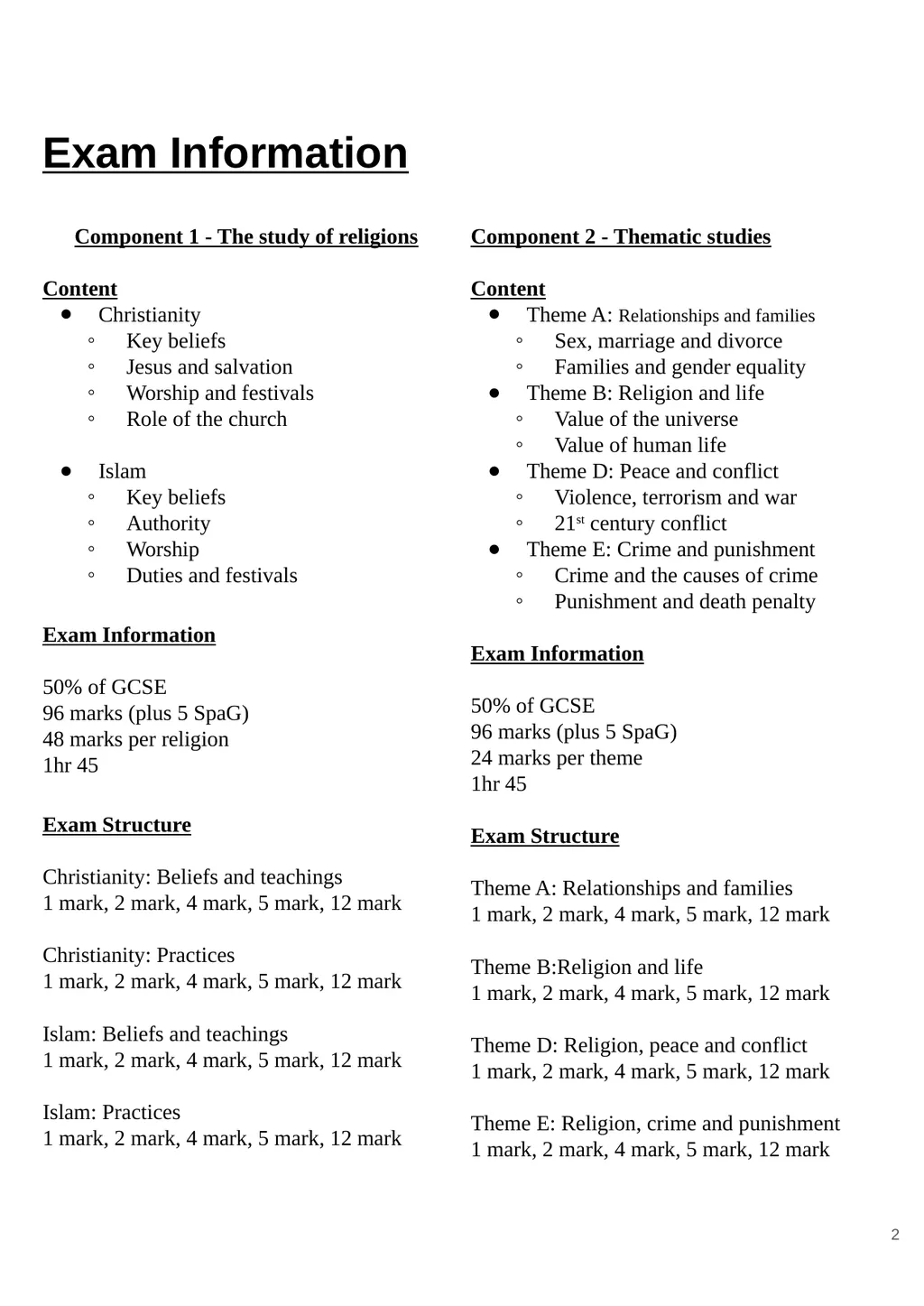
Exam Information Component 1 - The study of religions
Content
Christianity
Key beliefs
Jesus and salvation
Worship and festivals
Role of the church
Islam
Key beliefs
Authority
Worship
Duties and festivals
Exam Information
50% of GCSE
96 marks (plus 5 SpaG)
48 marks per religion
1hr 45
Exam Structure
Christianity: Beliefs and teachings
1 mark, 2 mark, 4 mark, 5 mark, 12 mark
Christianity: Practices
1 mark, 2 mark, 4 mark, 5 mark, 12 mark
Islam: Beliefs and teachings
1 mark, 2 mark, 4 mark, 5 mark, 12 mark
Islam: Practices
1 mark, 2 mark, 4 mark, 5 mark, 12 mark 2 Component 2 - Thematic studies
Content
Theme A: Relationships and families
Sex, marriage and divorce
Families and gender equality
Theme B: Religion and life
Value of the universe
Value of human life
Theme D: Peace and conflict
Violence, terrorism and war
21st century conflict
Theme E: Crime and punishment
Crime and the causes of crime
Punishment and death penalty
Exam Information
50% of GCSE
96 marks (plus 5 SpaG)
24 marks per theme
1hr 45
Exam Structure
Theme A: Relationships and families
1 mark, 2 mark, 4 mark, 5 mark, 12 mark
Theme B:Religion and life
1 mark, 2 mark, 4 mark, 5 mark, 12 mark
Theme D: Religion, peace and conflict
1 mark, 2 mark, 4 mark, 5 mark, 12 mark
Theme E: Religion, crime and punishment
1 mark, 2 mark, 4 mark, 5 mark, 12 mark<br>
Content
Christianity
Key beliefs
Jesus and salvation
Worship and festivals
Role of the church
Islam
Key beliefs
Authority
Worship
Duties and festivals
Exam Information
50% of GCSE
96 marks (plus 5 SpaG)
48 marks per religion
1hr 45
Exam Structure
Christianity: Beliefs and teachings
1 mark, 2 mark, 4 mark, 5 mark, 12 mark
Christianity: Practices
1 mark, 2 mark, 4 mark, 5 mark, 12 mark
Islam: Beliefs and teachings
1 mark, 2 mark, 4 mark, 5 mark, 12 mark
Islam: Practices
1 mark, 2 mark, 4 mark, 5 mark, 12 mark 2 Component 2 - Thematic studies
Content
Theme A: Relationships and families
Sex, marriage and divorce
Families and gender equality
Theme B: Religion and life
Value of the universe
Value of human life
Theme D: Peace and conflict
Violence, terrorism and war
21st century conflict
Theme E: Crime and punishment
Crime and the causes of crime
Punishment and death penalty
Exam Information
50% of GCSE
96 marks (plus 5 SpaG)
24 marks per theme
1hr 45
Exam Structure
Theme A: Relationships and families
1 mark, 2 mark, 4 mark, 5 mark, 12 mark
Theme B:Religion and life
1 mark, 2 mark, 4 mark, 5 mark, 12 mark
Theme D: Religion, peace and conflict
1 mark, 2 mark, 4 mark, 5 mark, 12 mark
Theme E: Religion, crime and punishment
1 mark, 2 mark, 4 mark, 5 mark, 12 mark<br>
03
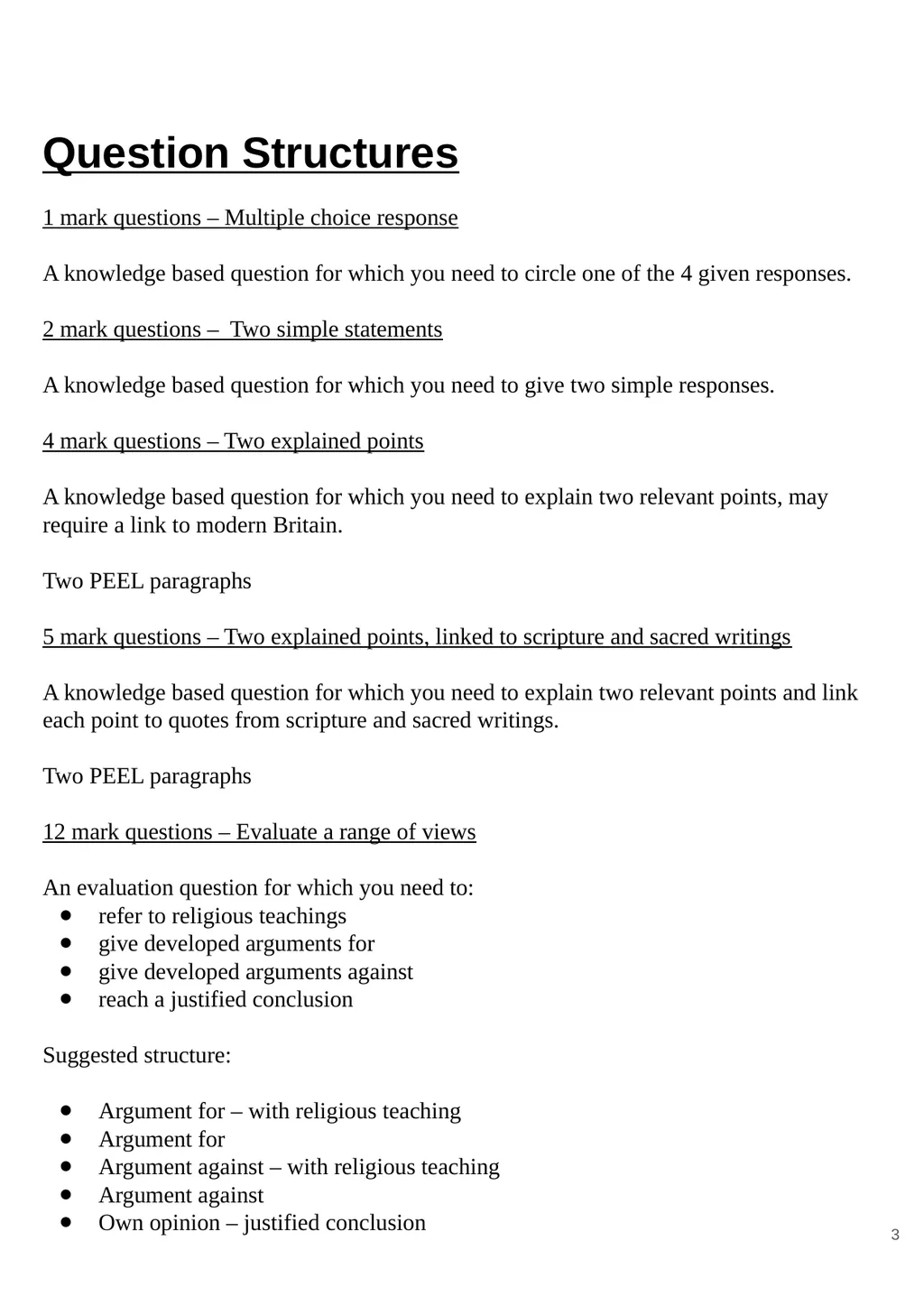
Question Structures 1 mark questions – Multiple choice response
A knowledge based question for which you need to circle one of the 4 given responses.
2 mark questions – Two simple statements
A knowledge based question for which you need to give two simple responses.
4 mark questions – Two explained points
A knowledge based question for which you need to explain two relevant points, may require a link to modern Britain.
Two PEEL paragraphs
5 mark questions – Two explained points, linked to scripture and sacred writings
A knowledge based question for which you need to explain two relevant points and link each point to quotes from scripture and sacred writings.
Two PEEL paragraphs
12 mark questions – Evaluate a range of views
An evaluation question for which you need to:
refer to religious teachings
give developed arguments for
give developed arguments against
reach a justified conclusion
Suggested structure:
Argument for – with religious teaching
Argument for
Argument against – with religious teaching
Argument against
Own opinion – justified conclusion 3<br>
A knowledge based question for which you need to circle one of the 4 given responses.
2 mark questions – Two simple statements
A knowledge based question for which you need to give two simple responses.
4 mark questions – Two explained points
A knowledge based question for which you need to explain two relevant points, may require a link to modern Britain.
Two PEEL paragraphs
5 mark questions – Two explained points, linked to scripture and sacred writings
A knowledge based question for which you need to explain two relevant points and link each point to quotes from scripture and sacred writings.
Two PEEL paragraphs
12 mark questions – Evaluate a range of views
An evaluation question for which you need to:
refer to religious teachings
give developed arguments for
give developed arguments against
reach a justified conclusion
Suggested structure:
Argument for – with religious teaching
Argument for
Argument against – with religious teaching
Argument against
Own opinion – justified conclusion 3<br>
04
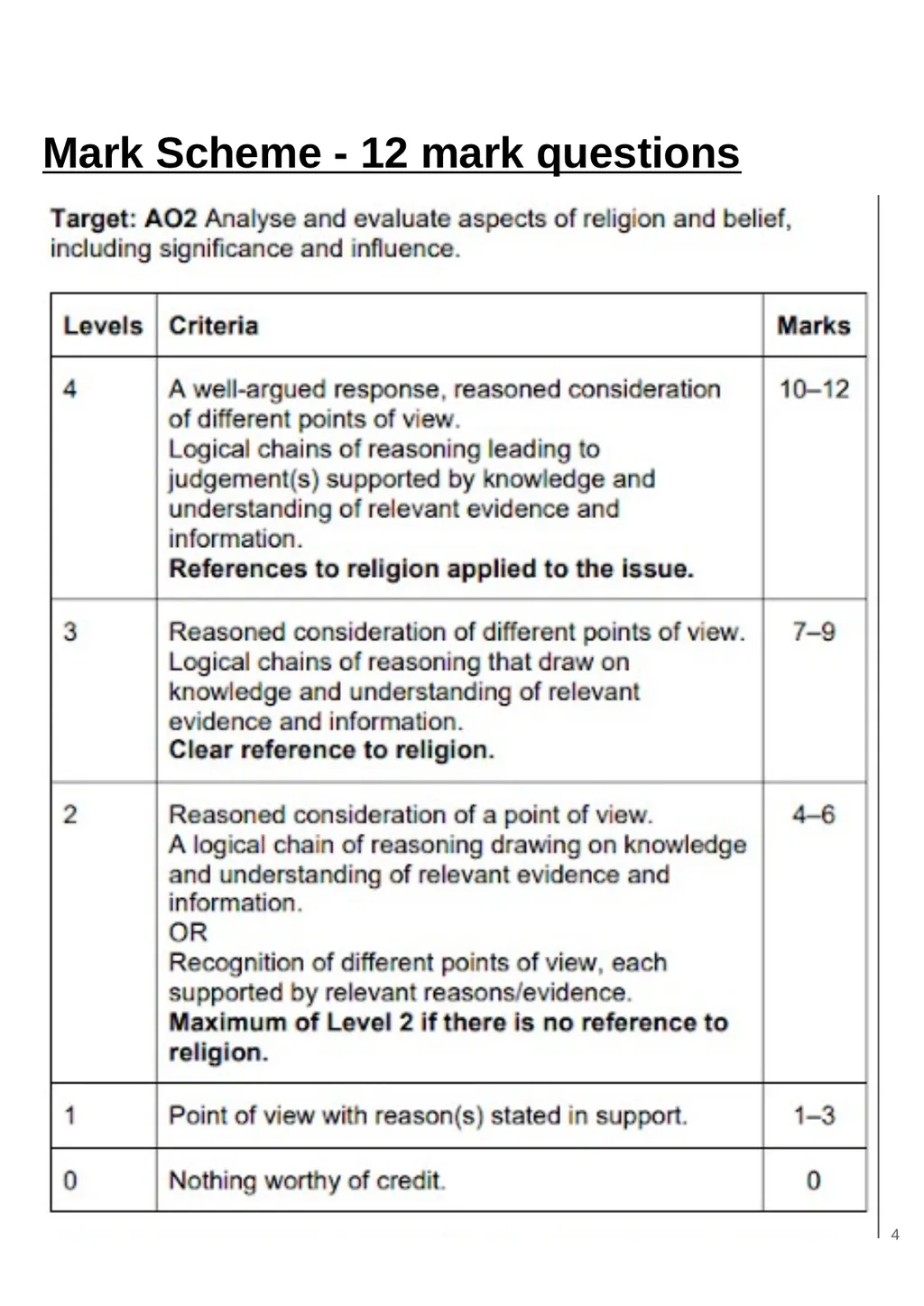
Mark Scheme - 12 mark questions 4<br>
05
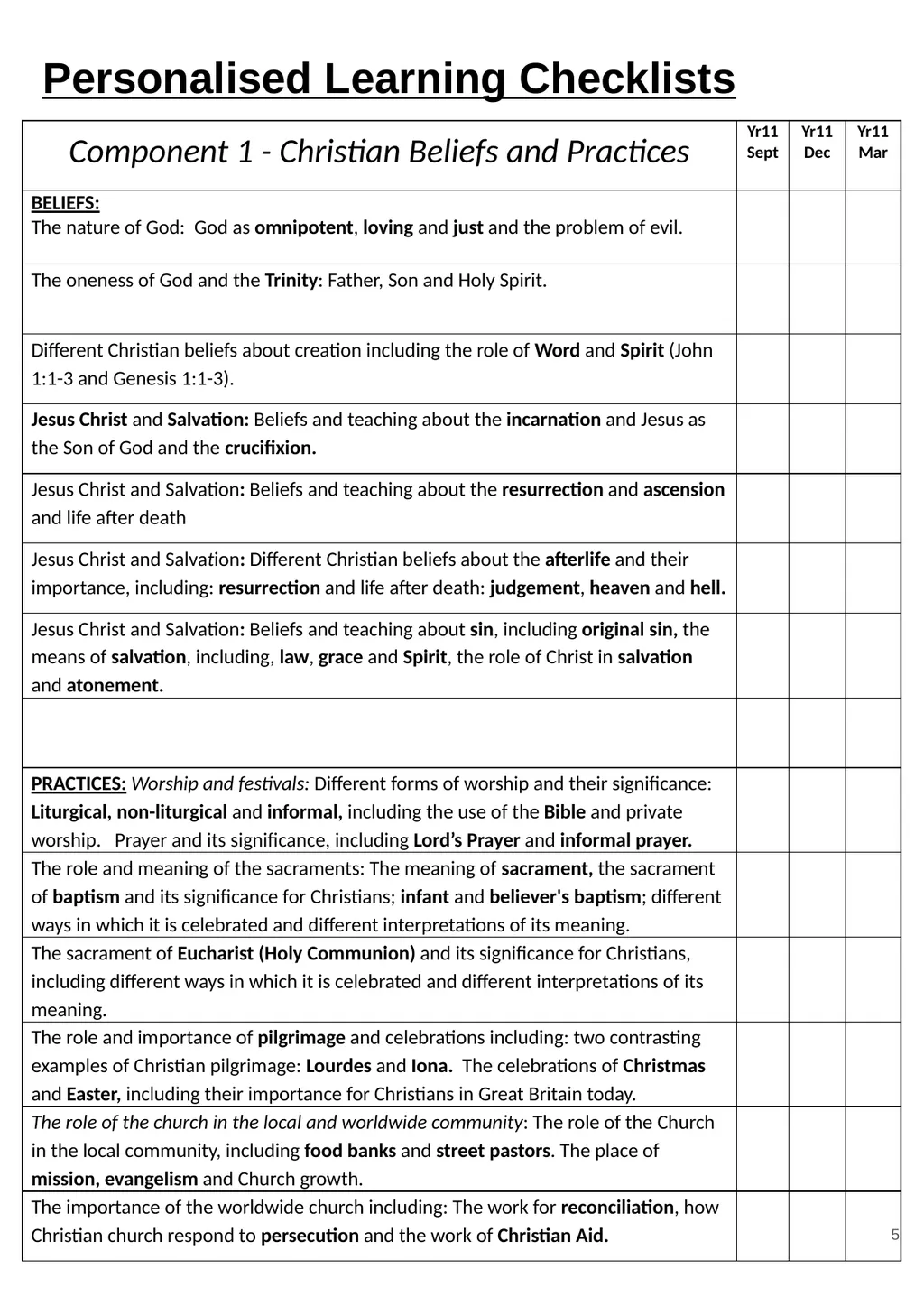
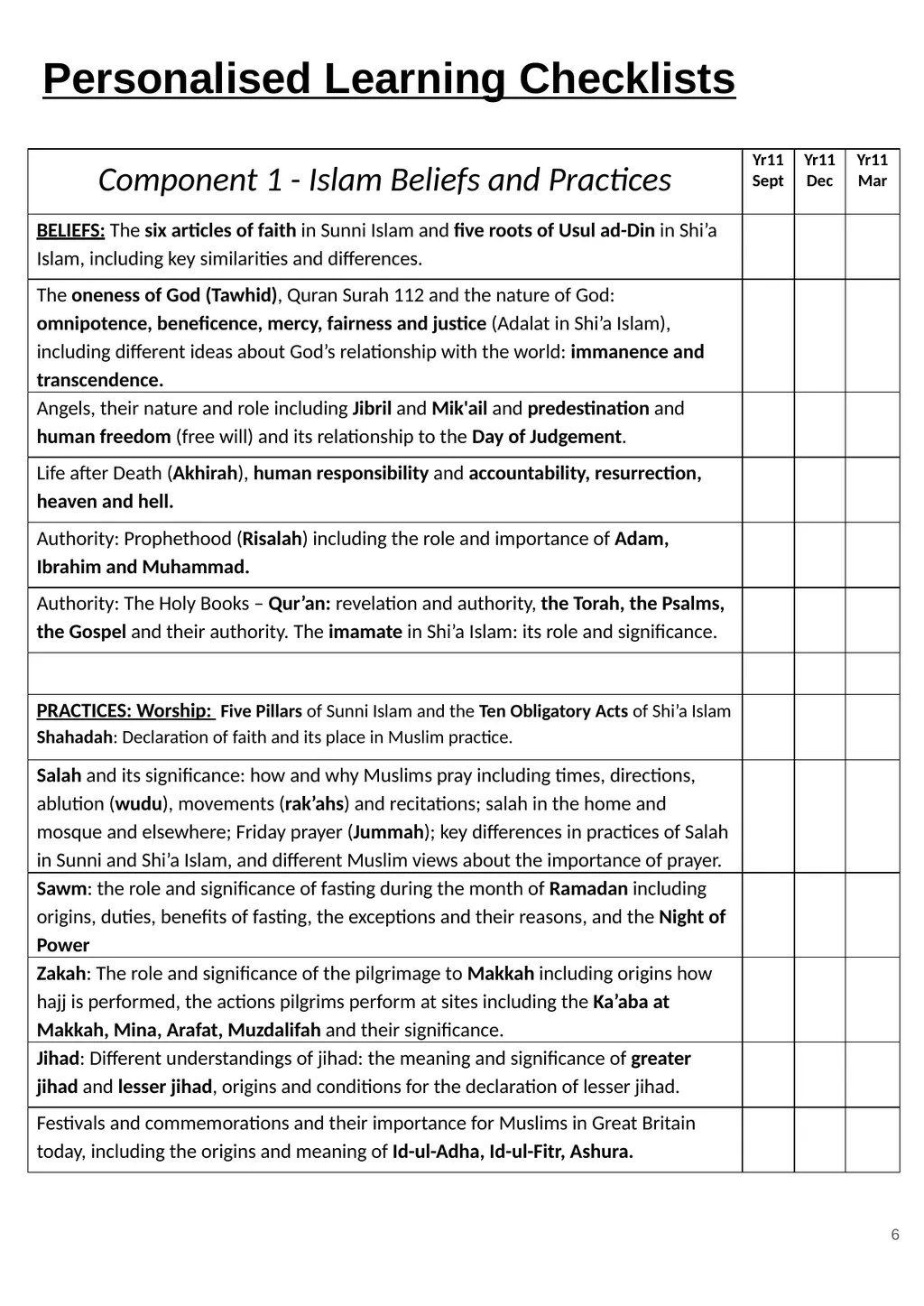
5 Personalised Learning Checklists<br>
06
6 Personalised Learning Checklists<br>
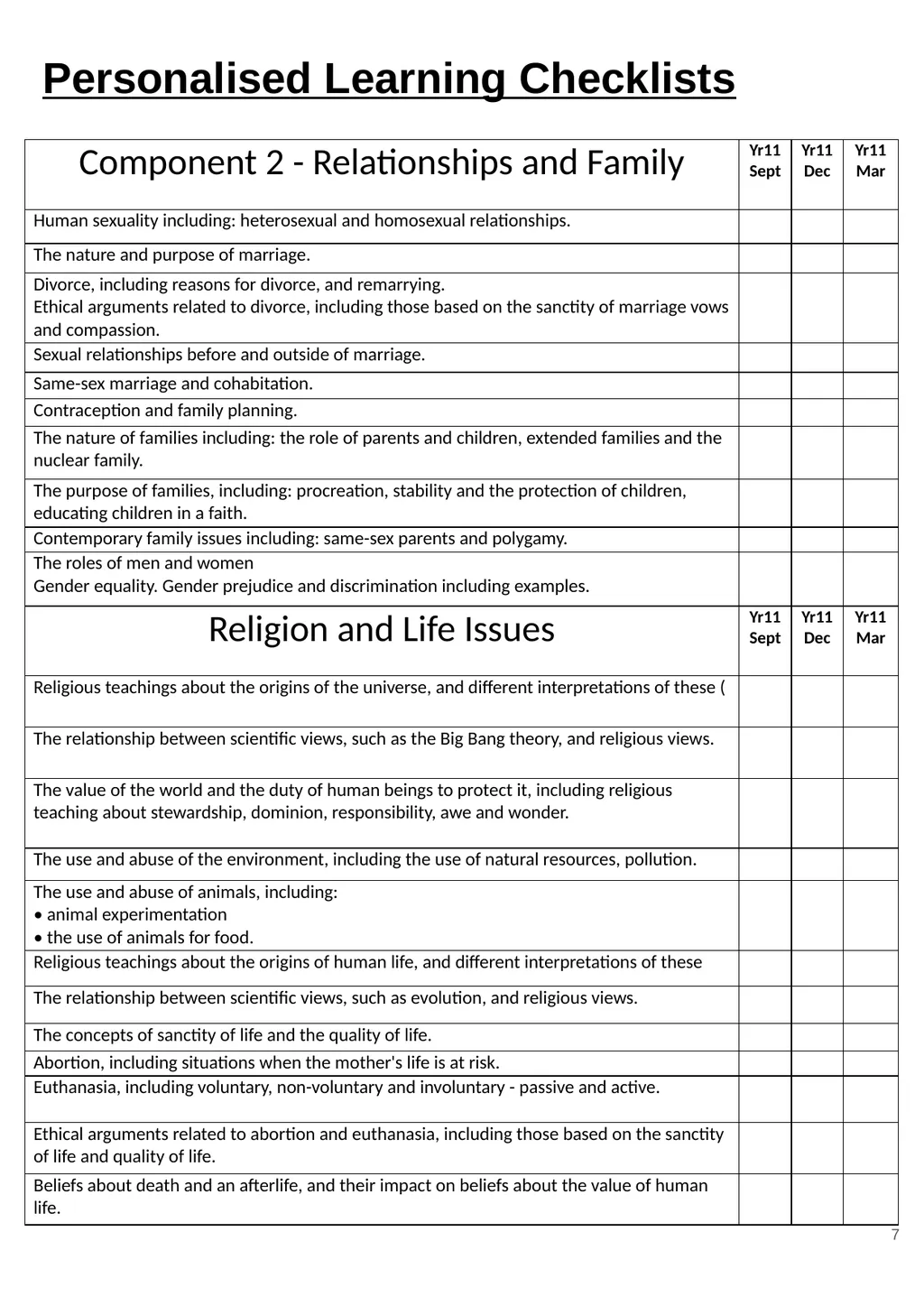
07
7 Personalised Learning Checklists<br>
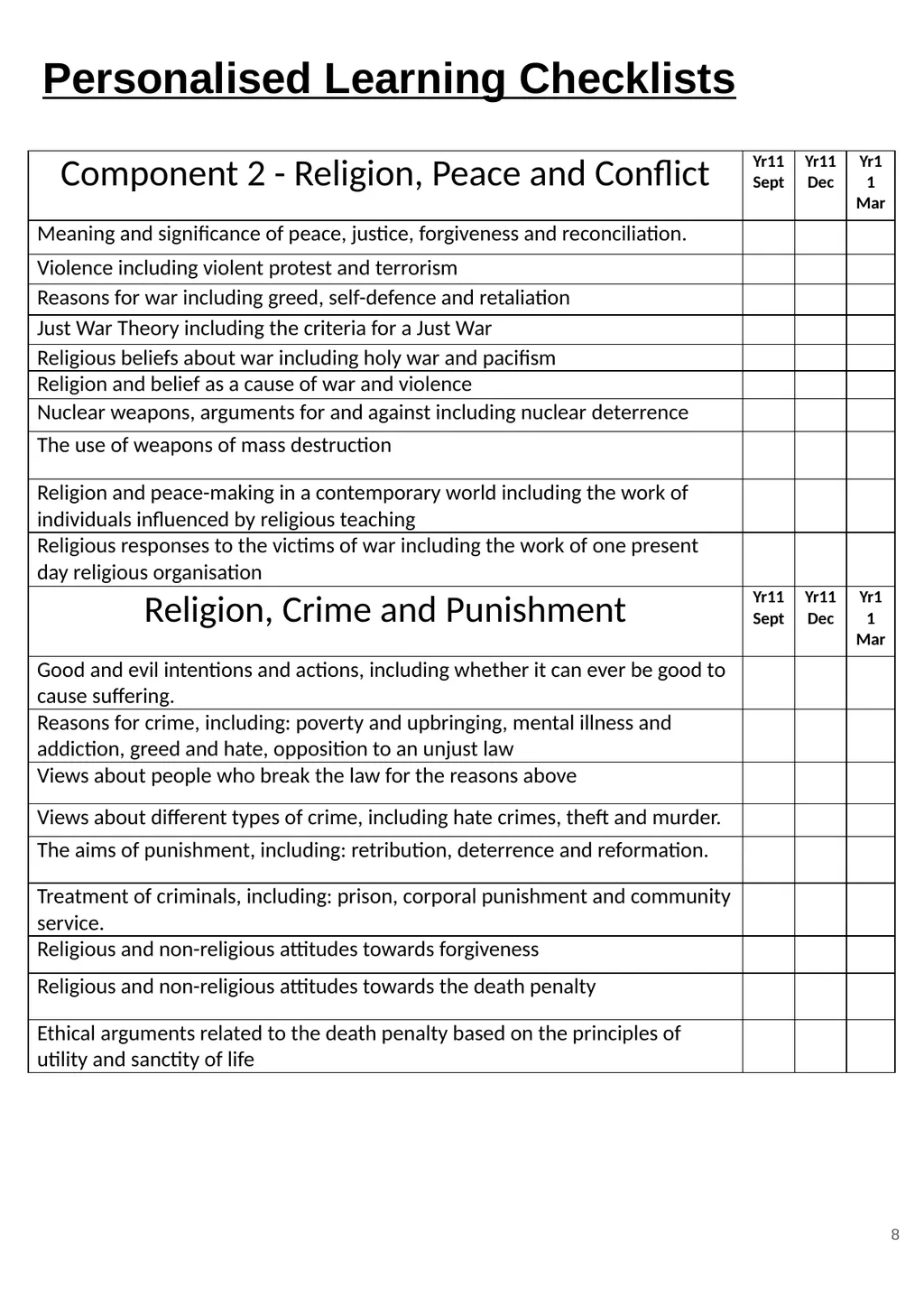
08
8 Personalised Learning Checklists<br>
09
Component 1 - Study of Religion<br>
10
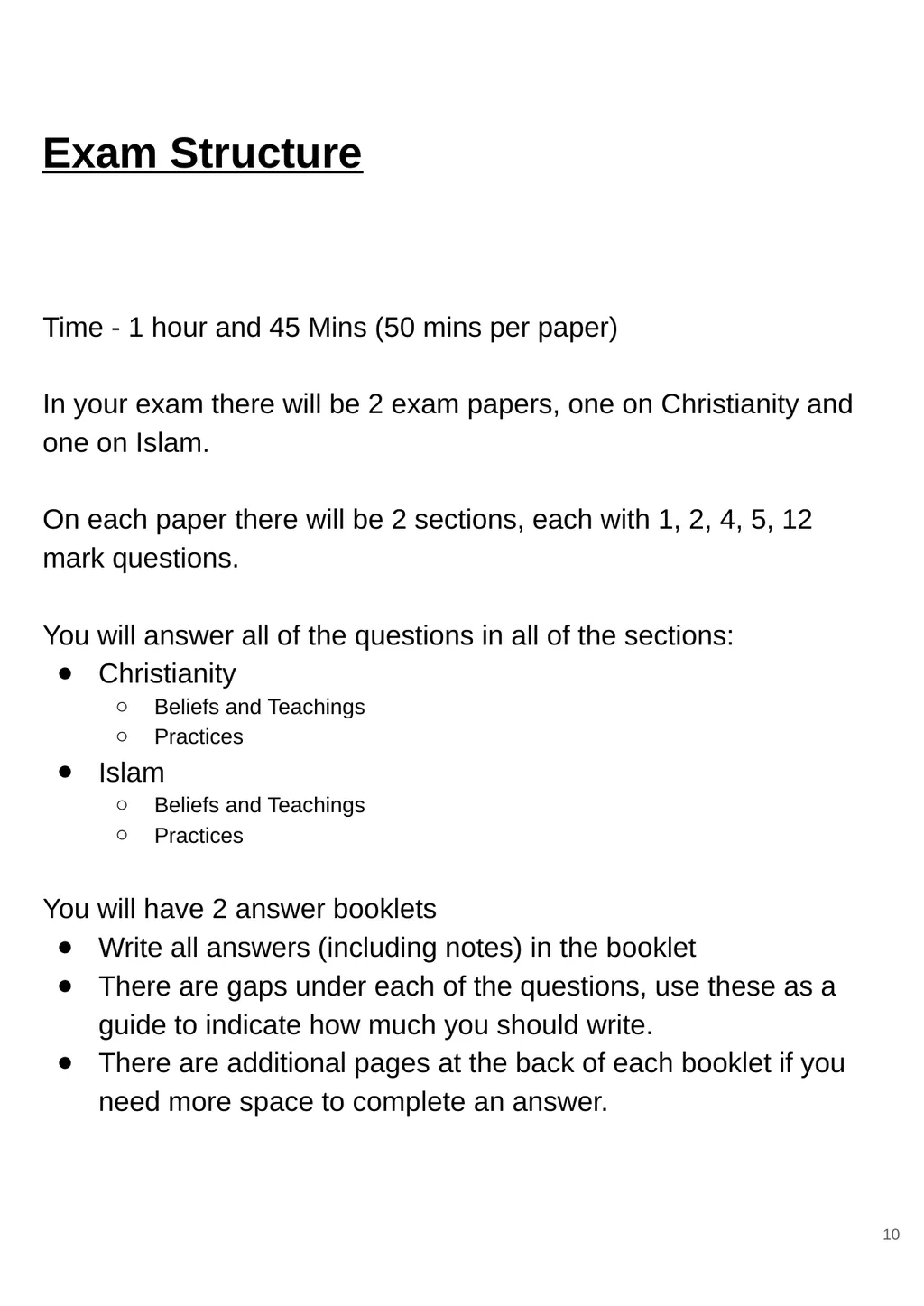
Exam Structure Time - 1 hour and 45 Mins (50 mins per paper)
In your exam there will be 2 exam papers, one on Christianity and one on Islam.
On each paper there will be 2 sections, each with 1, 2, 4, 5, 12 mark questions.
You will answer all of the questions in all of the sections:
Christianity
Beliefs and Teachings
Practices
Islam
Beliefs and Teachings
Practices
You will have 2 answer booklets
Write all answers (including notes) in the booklet
There are gaps under each of the questions, use these as a guide to indicate how much you should write.
There are additional pages at the back of each booklet if you need more space to complete an answer. 10<br>
In your exam there will be 2 exam papers, one on Christianity and one on Islam.
On each paper there will be 2 sections, each with 1, 2, 4, 5, 12 mark questions.
You will answer all of the questions in all of the sections:
Christianity
Beliefs and Teachings
Practices
Islam
Beliefs and Teachings
Practices
You will have 2 answer booklets
Write all answers (including notes) in the booklet
There are gaps under each of the questions, use these as a guide to indicate how much you should write.
There are additional pages at the back of each booklet if you need more space to complete an answer. 10<br>
11
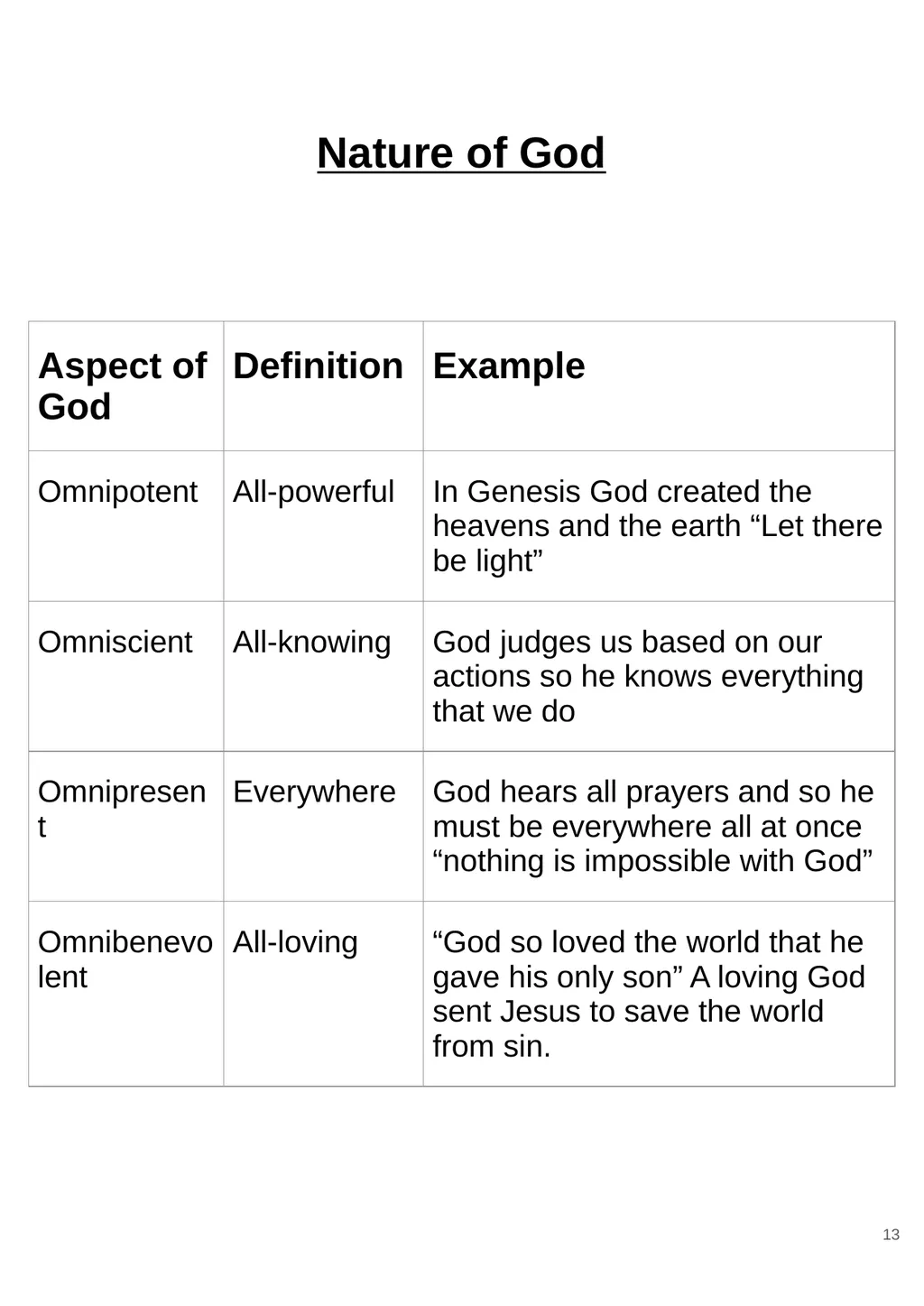
Christianity Beliefs and Teachings Nature of God
Omnipotent, omniscient, omnibenevolent, omnipresent
Loving and just
Problem of evil and suffering
The Trinity (Father, Son and Holy Spirit)
Creation (Literalist vs Non-literalist)
Afterlife (resurrection, judgement, heaven, hell and purgatory)
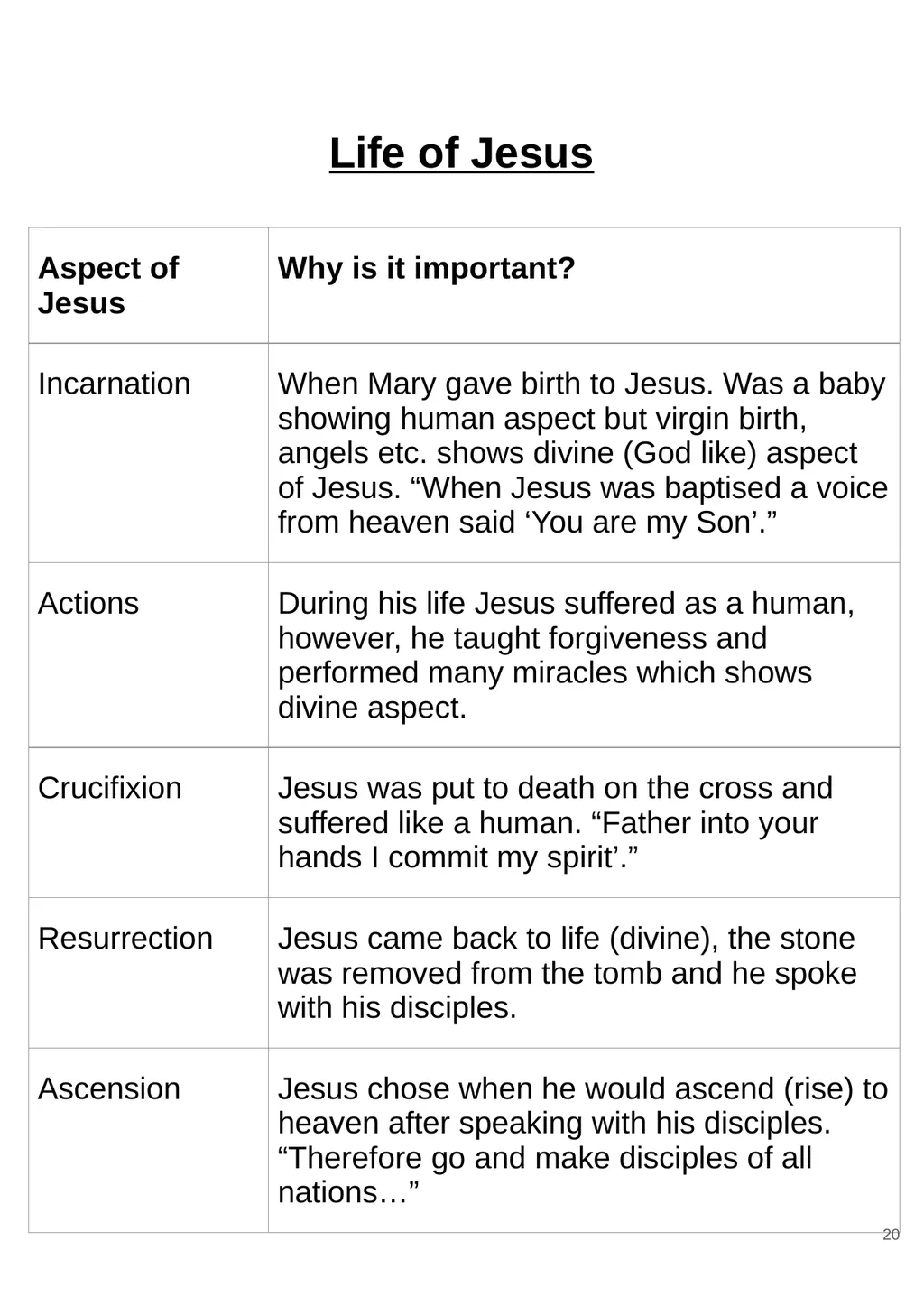
Life of Jesus
Incarnation and Jesus as the Son of God
Crucifixion, resurrection and ascension
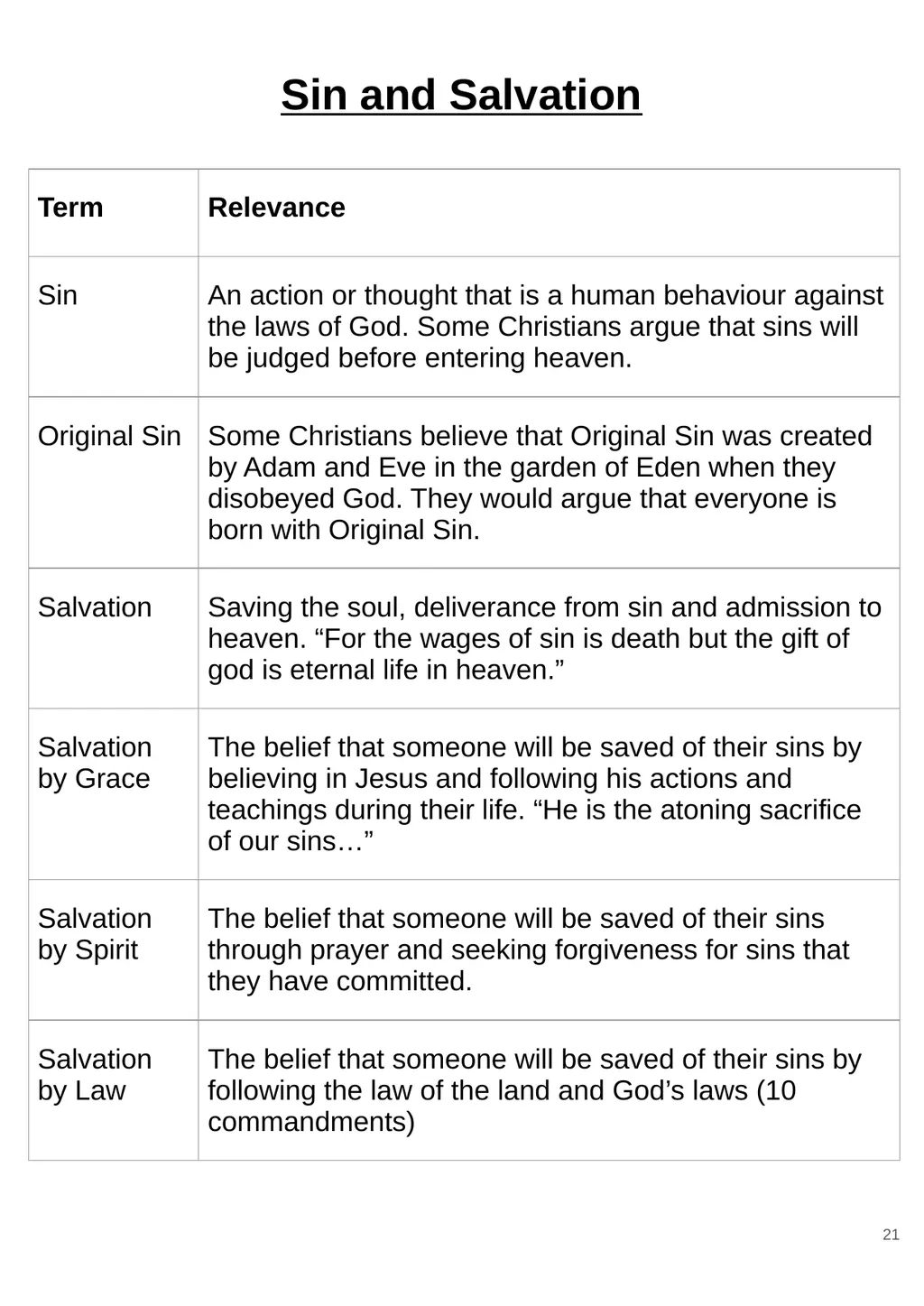
Sin and Original Sin
Salvation (Law, Grace and Spirit) 11<br>
Omnipotent, omniscient, omnibenevolent, omnipresent
Loving and just
Problem of evil and suffering
The Trinity (Father, Son and Holy Spirit)
Creation (Literalist vs Non-literalist)
Afterlife (resurrection, judgement, heaven, hell and purgatory)
Life of Jesus
Incarnation and Jesus as the Son of God
Crucifixion, resurrection and ascension
Sin and Original Sin
Salvation (Law, Grace and Spirit) 11<br>
12
Christianity Beliefs and Teachings -
Key Teachings 12<br>
Key Teachings 12<br>
13
Nature of God 13<br>
14
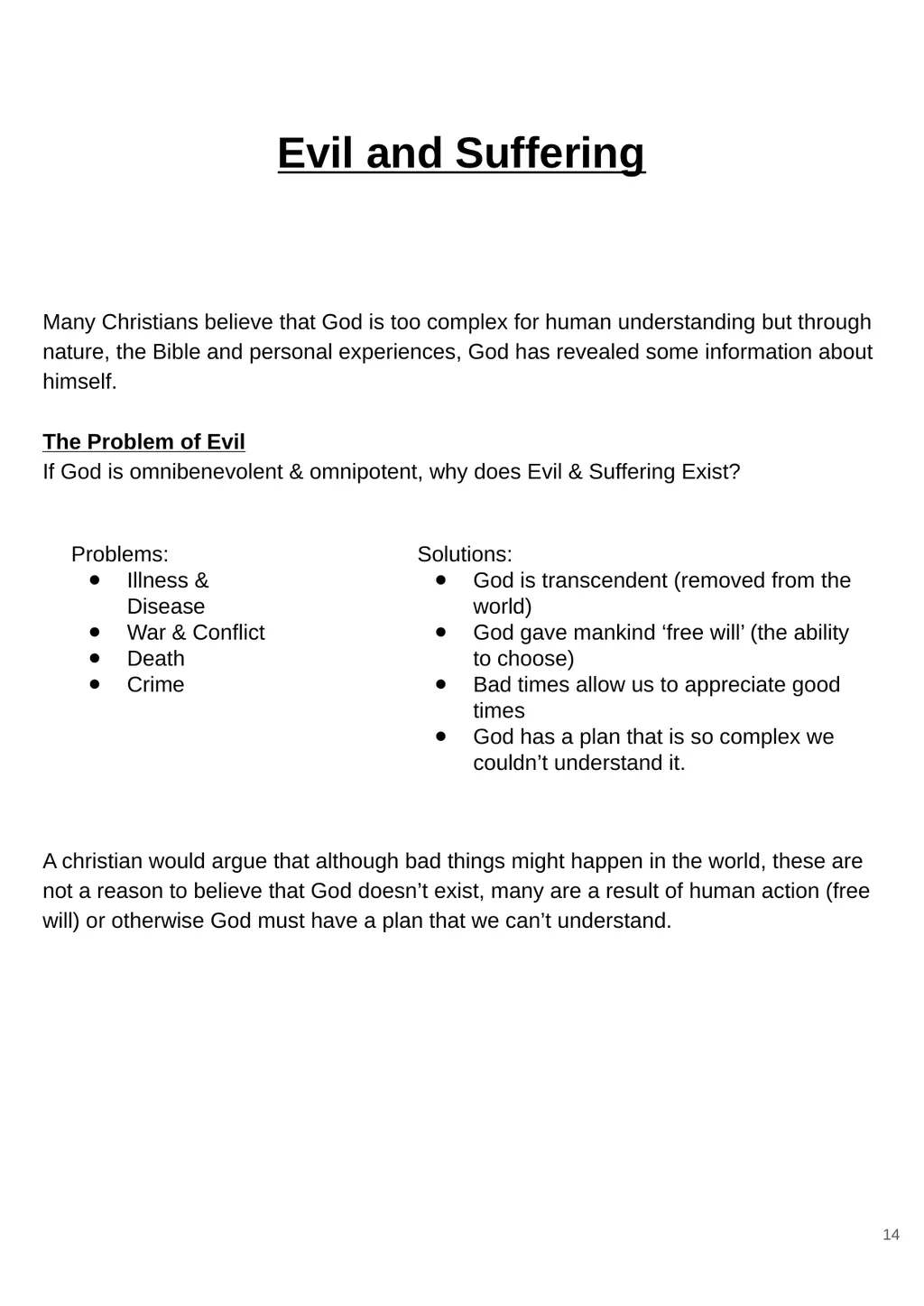
Evil and Suffering Many Christians believe that God is too complex for human understanding but through nature, the Bible and personal experiences, God has revealed some information about himself.
The Problem of Evil
If God is omnibenevolent & omnipotent, why does Evil & Suffering Exist?
A christian would argue that although bad things might happen in the world, these are not a reason to believe that God doesn’t exist, many are a result of human action (free will) or otherwise God must have a plan that we can’t understand. Problems:
Illness & Disease
War & Conflict
Death
Crime Solutions:
God is transcendent (removed from the world)
God gave mankind ‘free will’ (the ability to choose)
Bad times allow us to appreciate good times
God has a plan that is so complex we couldn’t understand it. 14<br>
The Problem of Evil
If God is omnibenevolent & omnipotent, why does Evil & Suffering Exist?
A christian would argue that although bad things might happen in the world, these are not a reason to believe that God doesn’t exist, many are a result of human action (free will) or otherwise God must have a plan that we can’t understand. Problems:
Illness & Disease
War & Conflict
Death
Crime Solutions:
God is transcendent (removed from the world)
God gave mankind ‘free will’ (the ability to choose)
Bad times allow us to appreciate good times
God has a plan that is so complex we couldn’t understand it. 14<br>
15
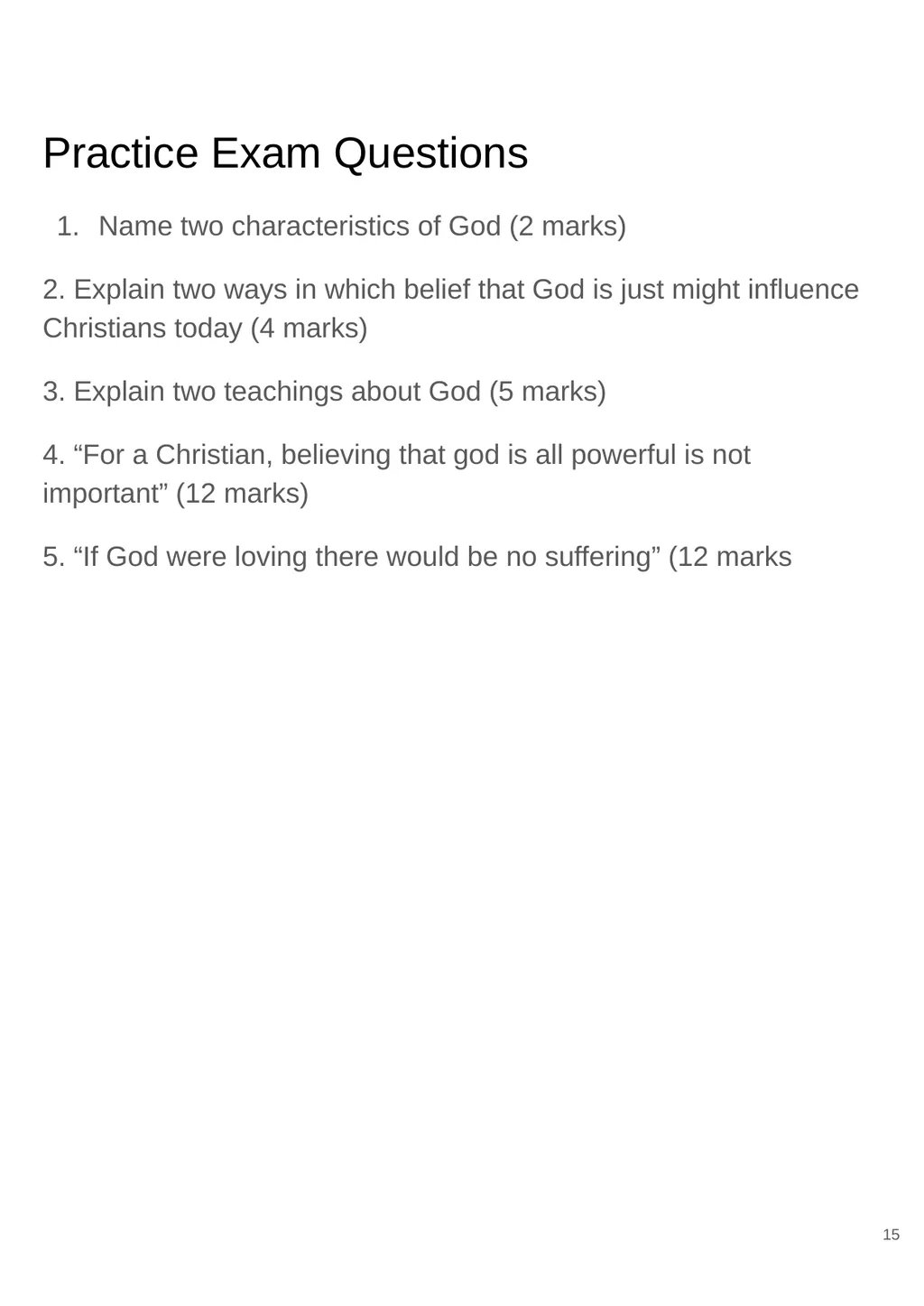
Practice Exam Questions Name two characteristics of God (2 marks)
2. Explain two ways in which belief that God is just might influence Christians today (4 marks)
3. Explain two teachings about God (5 marks)
4. “For a Christian, believing that god is all powerful is not important” (12 marks)
5. “If God were loving there would be no suffering” (12 marks 15<br>
2. Explain two ways in which belief that God is just might influence Christians today (4 marks)
3. Explain two teachings about God (5 marks)
4. “For a Christian, believing that god is all powerful is not important” (12 marks)
5. “If God were loving there would be no suffering” (12 marks 15<br>
16
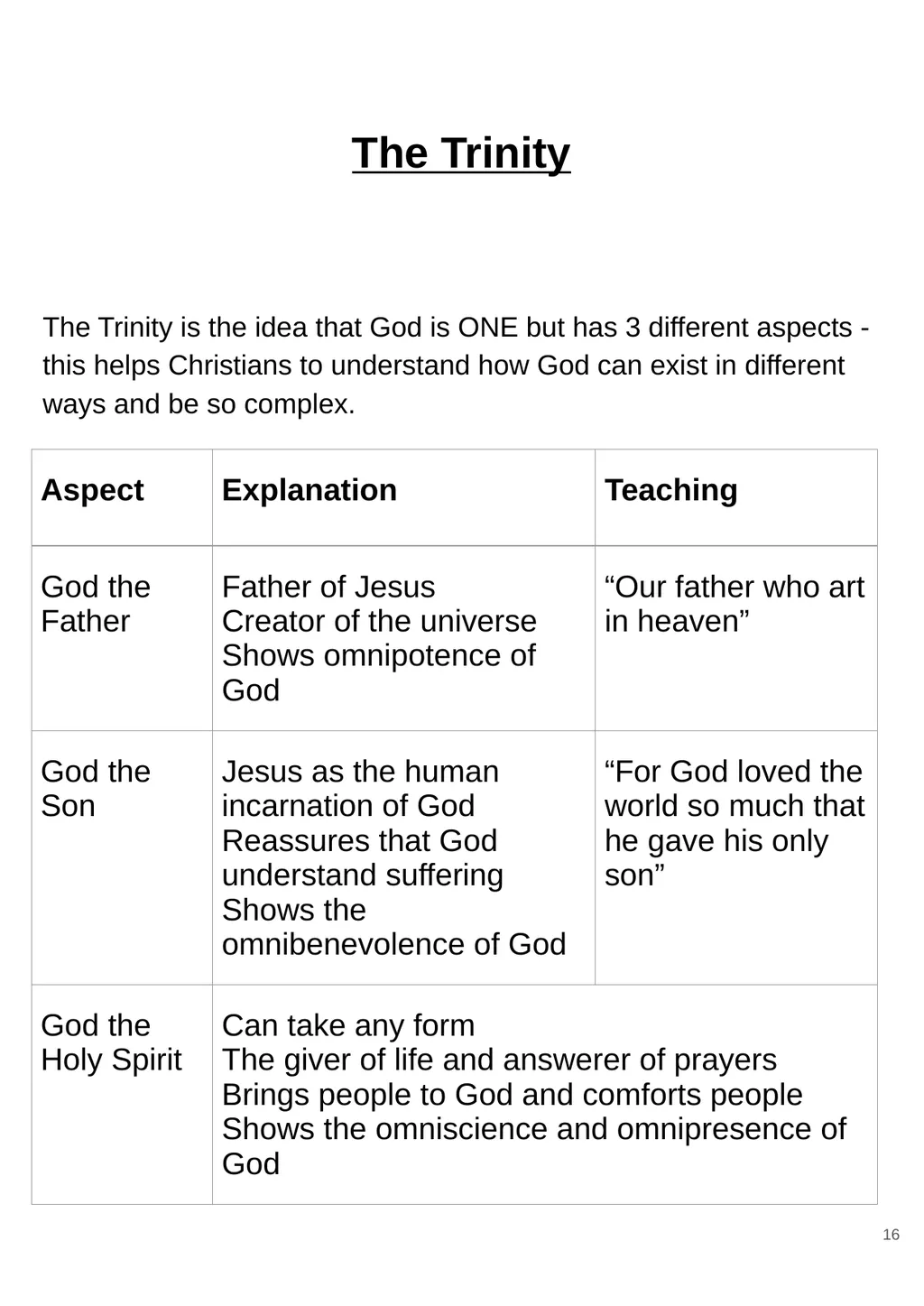
The Trinity The Trinity is the idea that God is ONE but has 3 different aspects - this helps Christians to understand how God can exist in different ways and be so complex. 16<br>
17
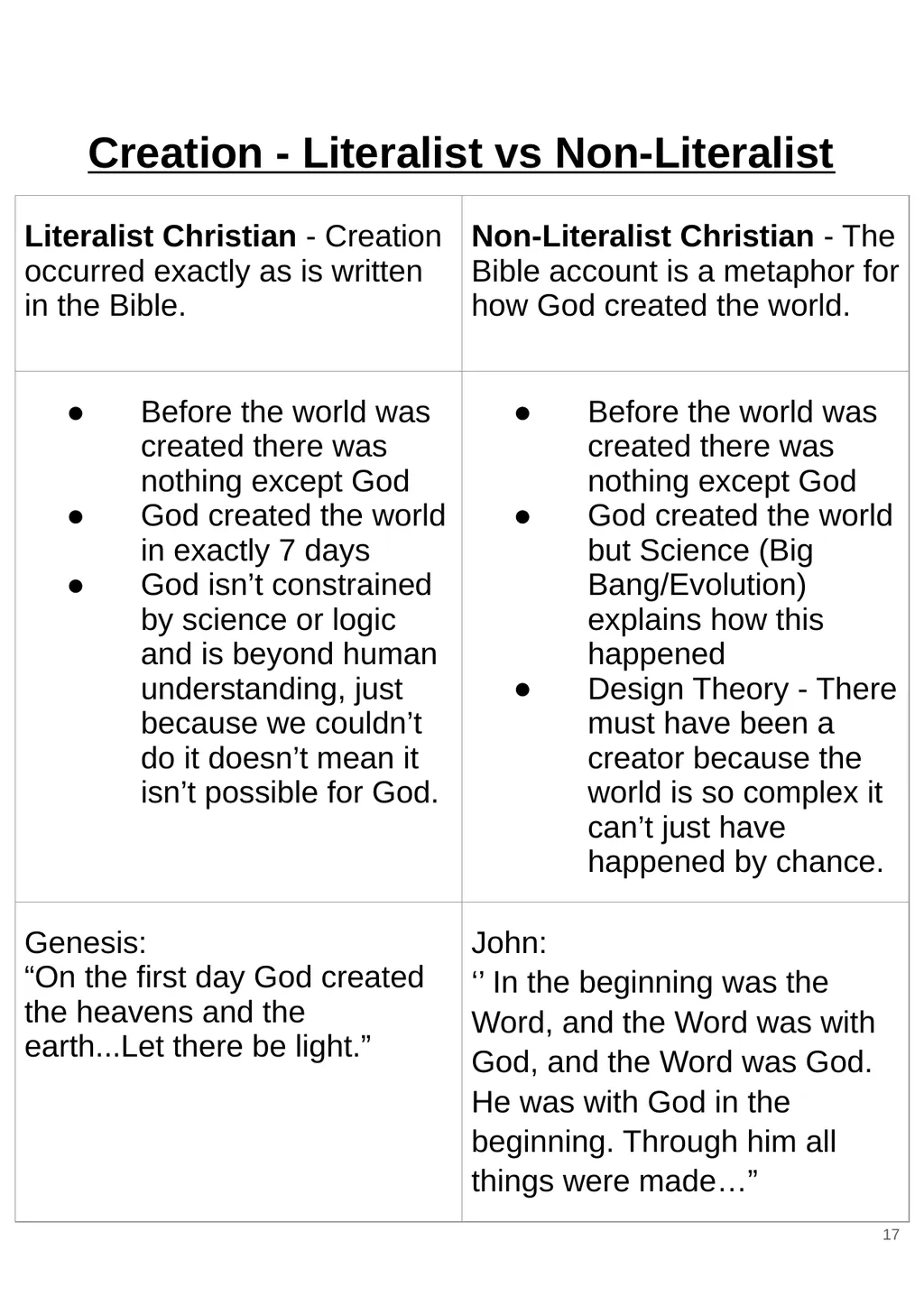
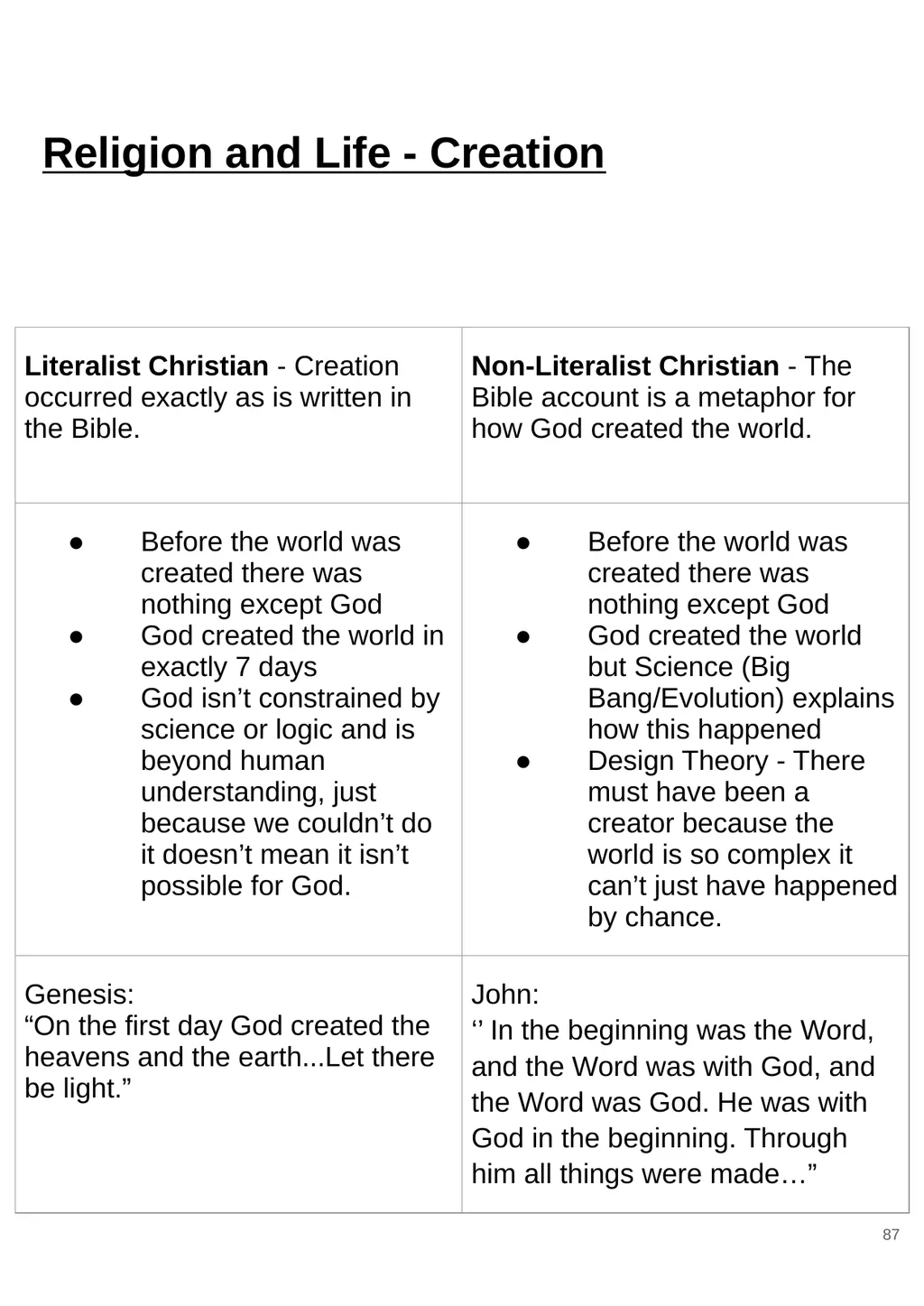
Creation - Literalist vs Non-Literalist 17<br>
18
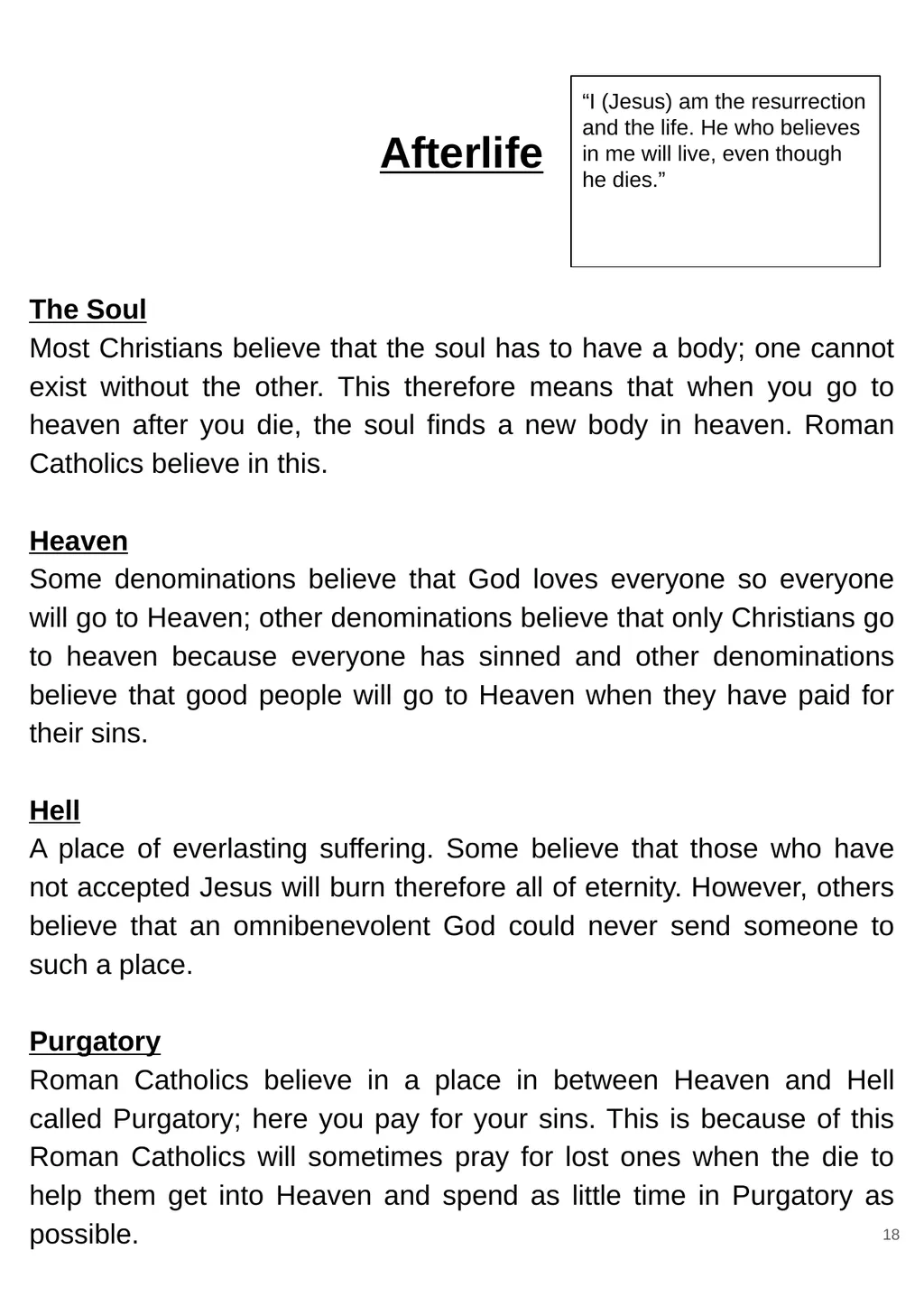
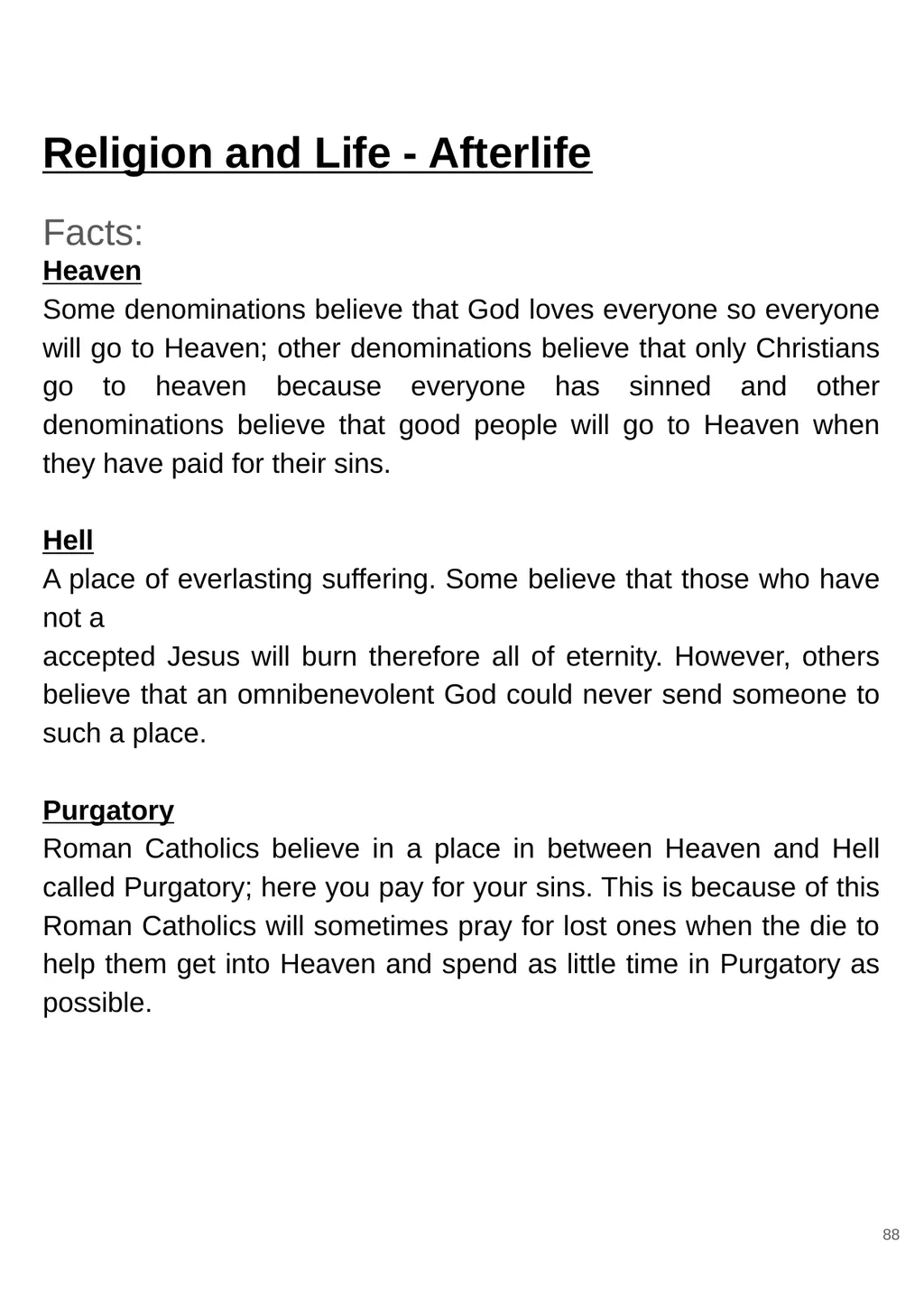
Afterlife The Soul
Most Christians believe that the soul has to have a body; one cannot exist without the other. This therefore means that when you go to heaven after you die, the soul finds a new body in heaven. Roman Catholics believe in this.
Heaven
Some denominations believe that God loves everyone so everyone will go to Heaven; other denominations believe that only Christians go to heaven because everyone has sinned and other denominations believe that good people will go to Heaven when they have paid for their sins.
Hell
A place of everlasting suffering. Some believe that those who have not accepted Jesus will burn therefore all of eternity. However, others believe that an omnibenevolent God could never send someone to such a place.
Purgatory
Roman Catholics believe in a place in between Heaven and Hell called Purgatory; here you pay for your sins. This is because of this Roman Catholics will sometimes pray for lost ones when the die to help them get into Heaven and spend as little time in Purgatory as possible. “I (Jesus) am the resurrection and the life. He who believes in me will live, even though he dies.” 18<br>
Most Christians believe that the soul has to have a body; one cannot exist without the other. This therefore means that when you go to heaven after you die, the soul finds a new body in heaven. Roman Catholics believe in this.
Heaven
Some denominations believe that God loves everyone so everyone will go to Heaven; other denominations believe that only Christians go to heaven because everyone has sinned and other denominations believe that good people will go to Heaven when they have paid for their sins.
Hell
A place of everlasting suffering. Some believe that those who have not accepted Jesus will burn therefore all of eternity. However, others believe that an omnibenevolent God could never send someone to such a place.
Purgatory
Roman Catholics believe in a place in between Heaven and Hell called Purgatory; here you pay for your sins. This is because of this Roman Catholics will sometimes pray for lost ones when the die to help them get into Heaven and spend as little time in Purgatory as possible. “I (Jesus) am the resurrection and the life. He who believes in me will live, even though he dies.” 18<br>
19
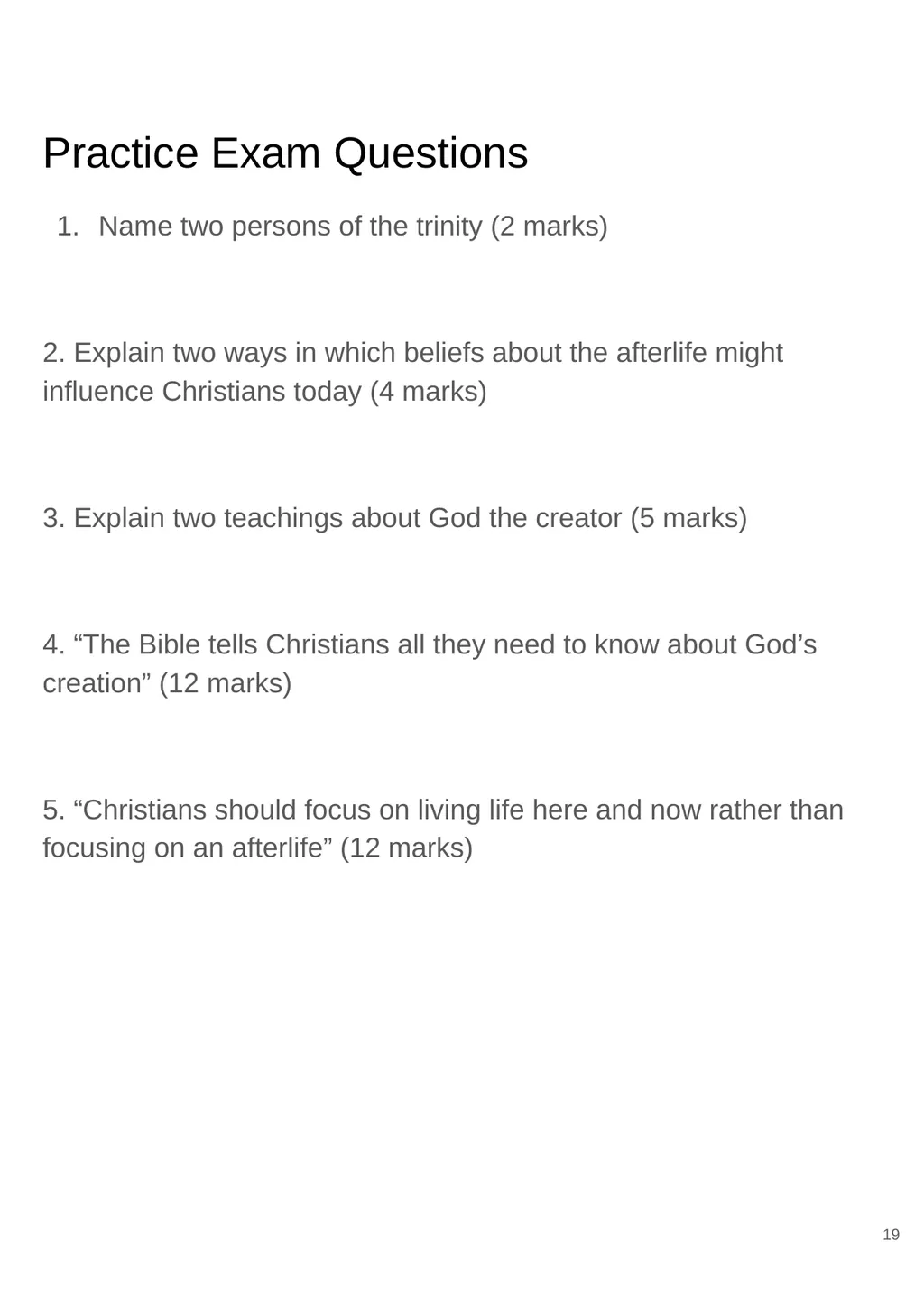
Practice Exam Questions Name two persons of the trinity (2 marks)
2. Explain two ways in which beliefs about the afterlife might influence Christians today (4 marks)
3. Explain two teachings about God the creator (5 marks)
4. “The Bible tells Christians all they need to know about God’s creation” (12 marks)
5. “Christians should focus on living life here and now rather than focusing on an afterlife” (12 marks) 19<br>
2. Explain two ways in which beliefs about the afterlife might influence Christians today (4 marks)
3. Explain two teachings about God the creator (5 marks)
4. “The Bible tells Christians all they need to know about God’s creation” (12 marks)
5. “Christians should focus on living life here and now rather than focusing on an afterlife” (12 marks) 19<br>
20
Life of Jesus 20<br>
21
Sin and Salvation 21<br>
22
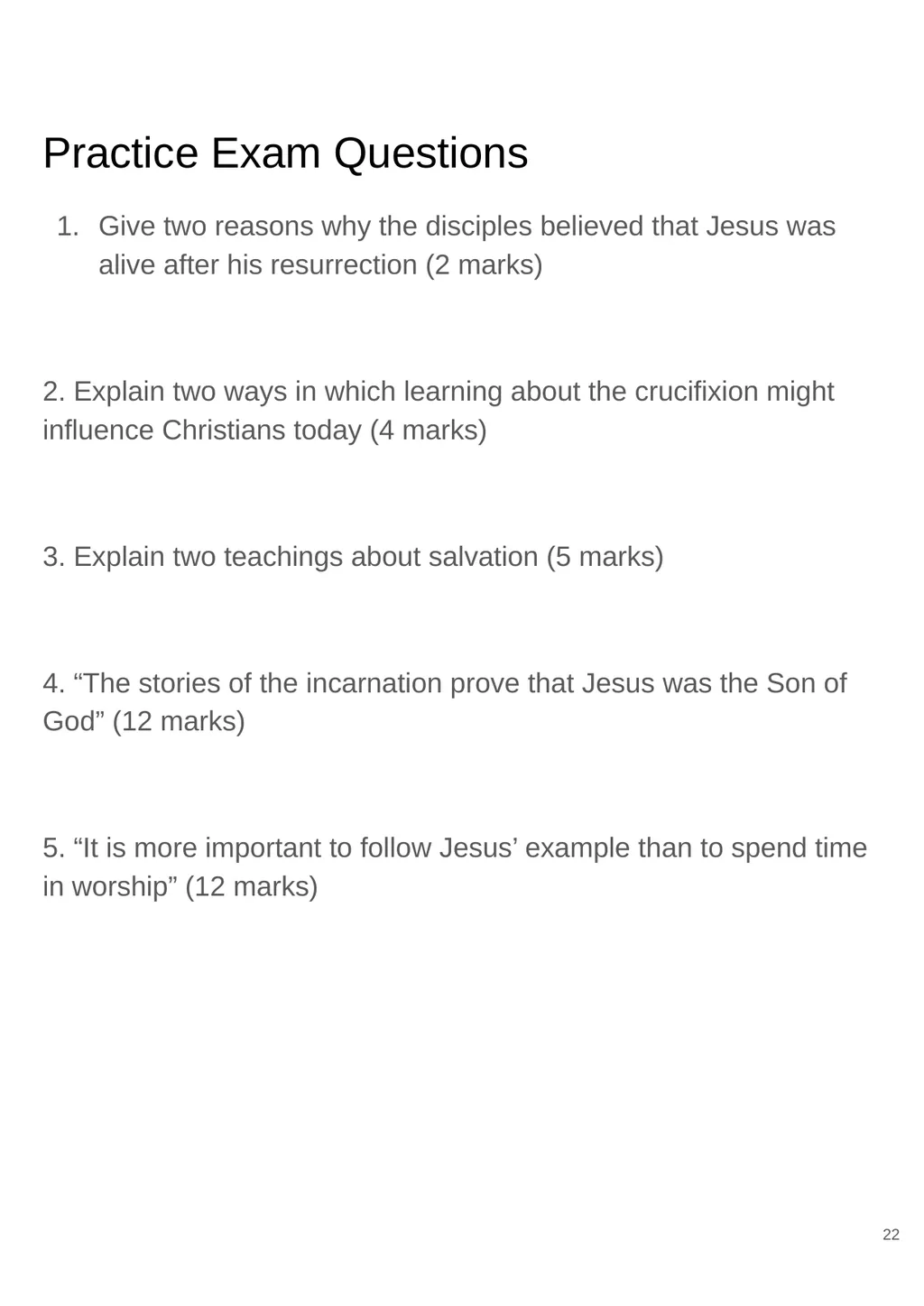
Practice Exam Questions Give two reasons why the disciples believed that Jesus was alive after his resurrection (2 marks)
2. Explain two ways in which learning about the crucifixion might influence Christians today (4 marks)
3. Explain two teachings about salvation (5 marks)
4. “The stories of the incarnation prove that Jesus was the Son of God” (12 marks)
5. “It is more important to follow Jesus’ example than to spend time in worship” (12 marks) 22<br>
2. Explain two ways in which learning about the crucifixion might influence Christians today (4 marks)
3. Explain two teachings about salvation (5 marks)
4. “The stories of the incarnation prove that Jesus was the Son of God” (12 marks)
5. “It is more important to follow Jesus’ example than to spend time in worship” (12 marks) 22<br>
23
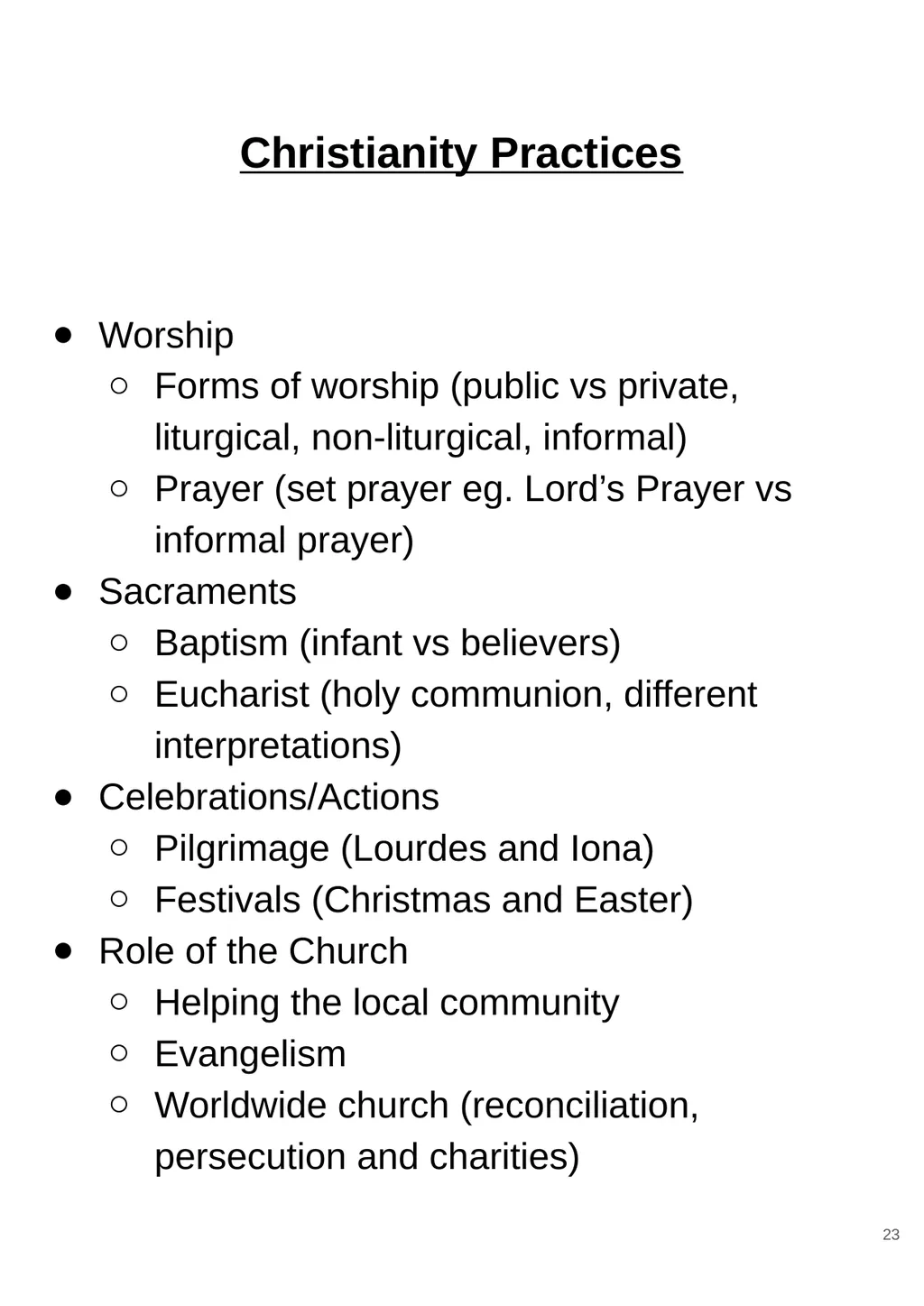
Christianity Practices Worship
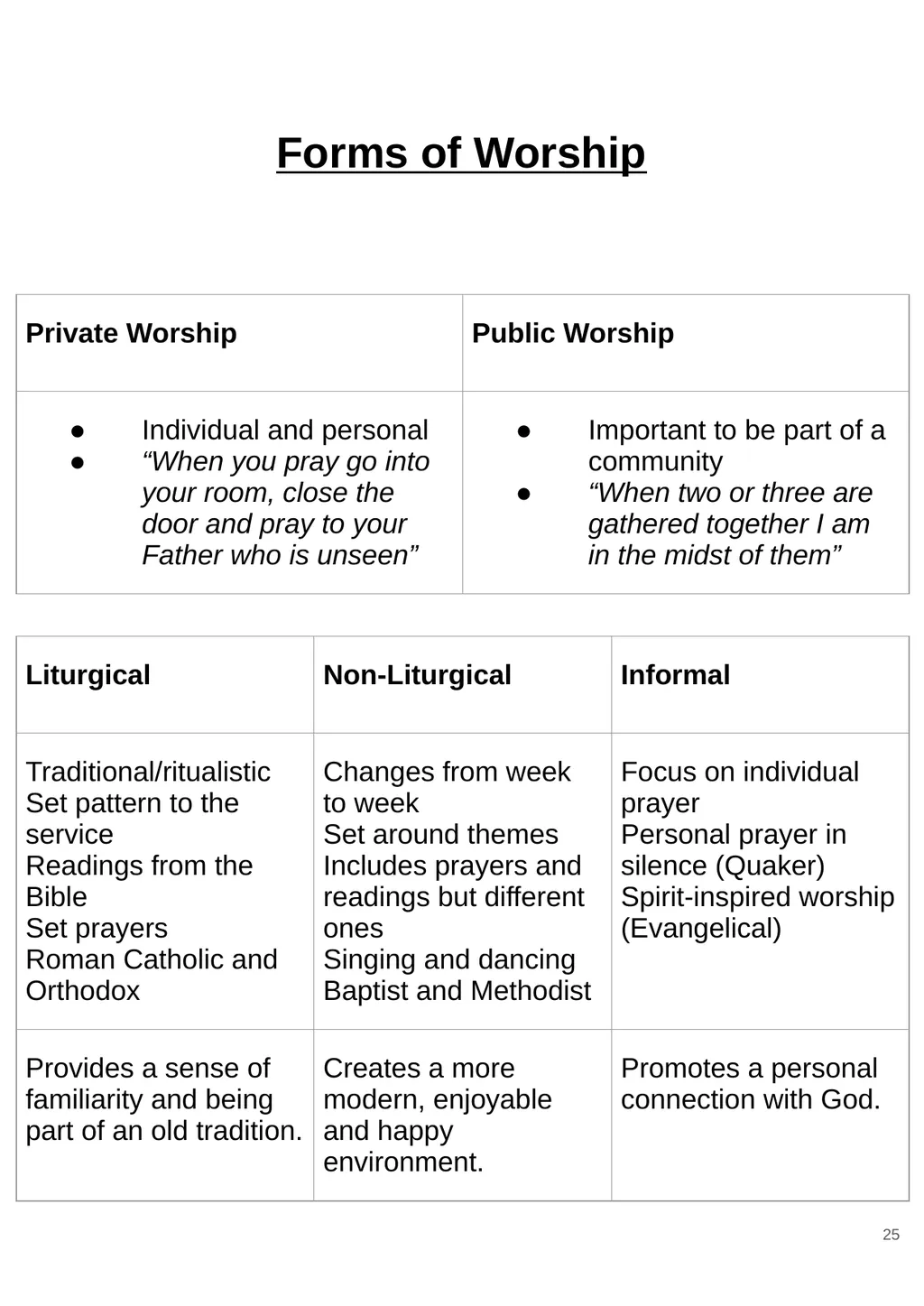
Forms of worship (public vs private, liturgical, non-liturgical, informal)
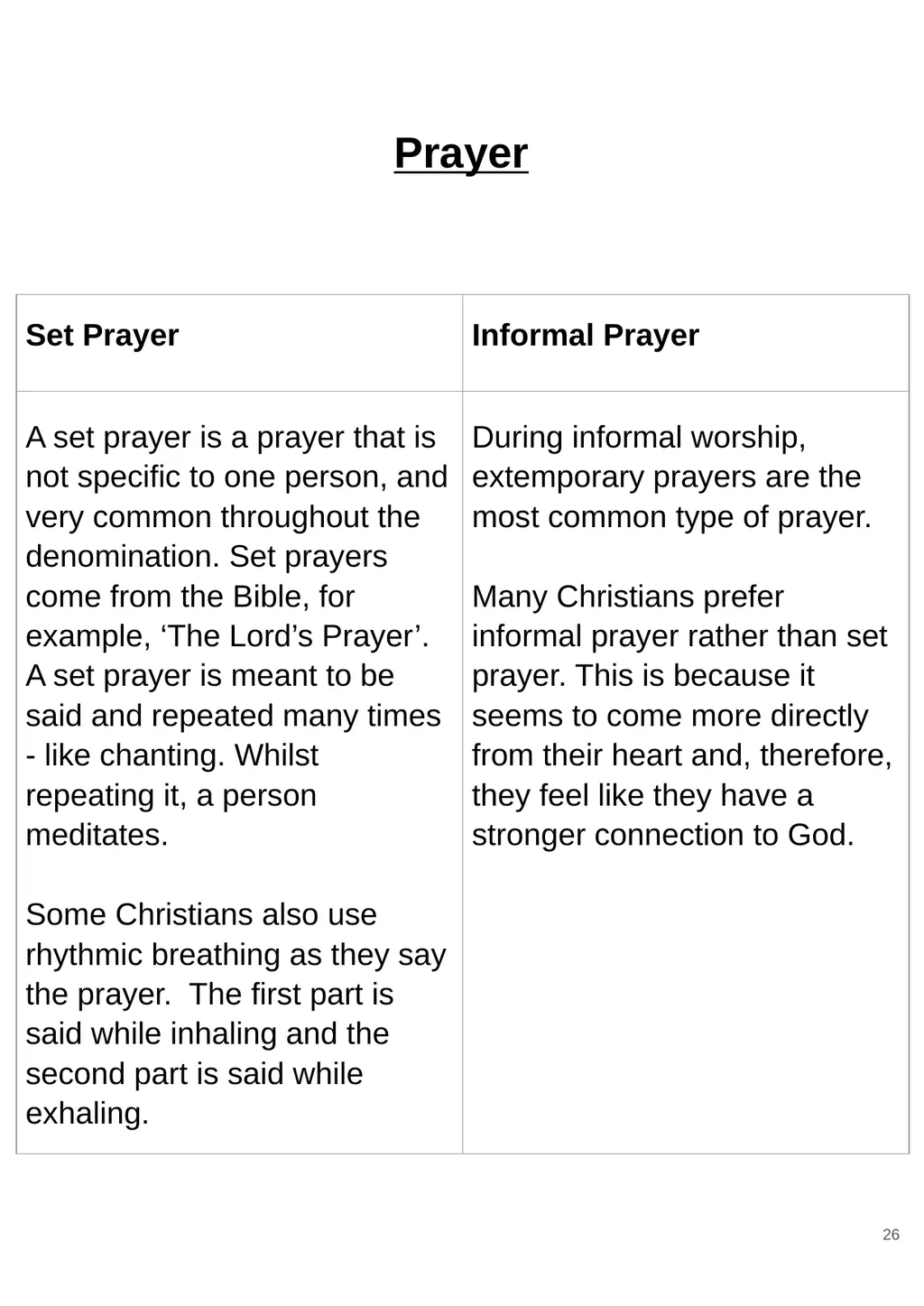
Prayer (set prayer eg. Lord’s Prayer vs informal prayer)
Sacraments
Baptism (infant vs believers)
Eucharist (holy communion, different interpretations)
Celebrations/Actions
Pilgrimage (Lourdes and Iona)
Festivals (Christmas and Easter)
Role of the Church
Helping the local community
Evangelism
Worldwide church (reconciliation, persecution and charities) 23<br>
Forms of worship (public vs private, liturgical, non-liturgical, informal)
Prayer (set prayer eg. Lord’s Prayer vs informal prayer)
Sacraments
Baptism (infant vs believers)
Eucharist (holy communion, different interpretations)
Celebrations/Actions
Pilgrimage (Lourdes and Iona)
Festivals (Christmas and Easter)
Role of the Church
Helping the local community
Evangelism
Worldwide church (reconciliation, persecution and charities) 23<br>
24
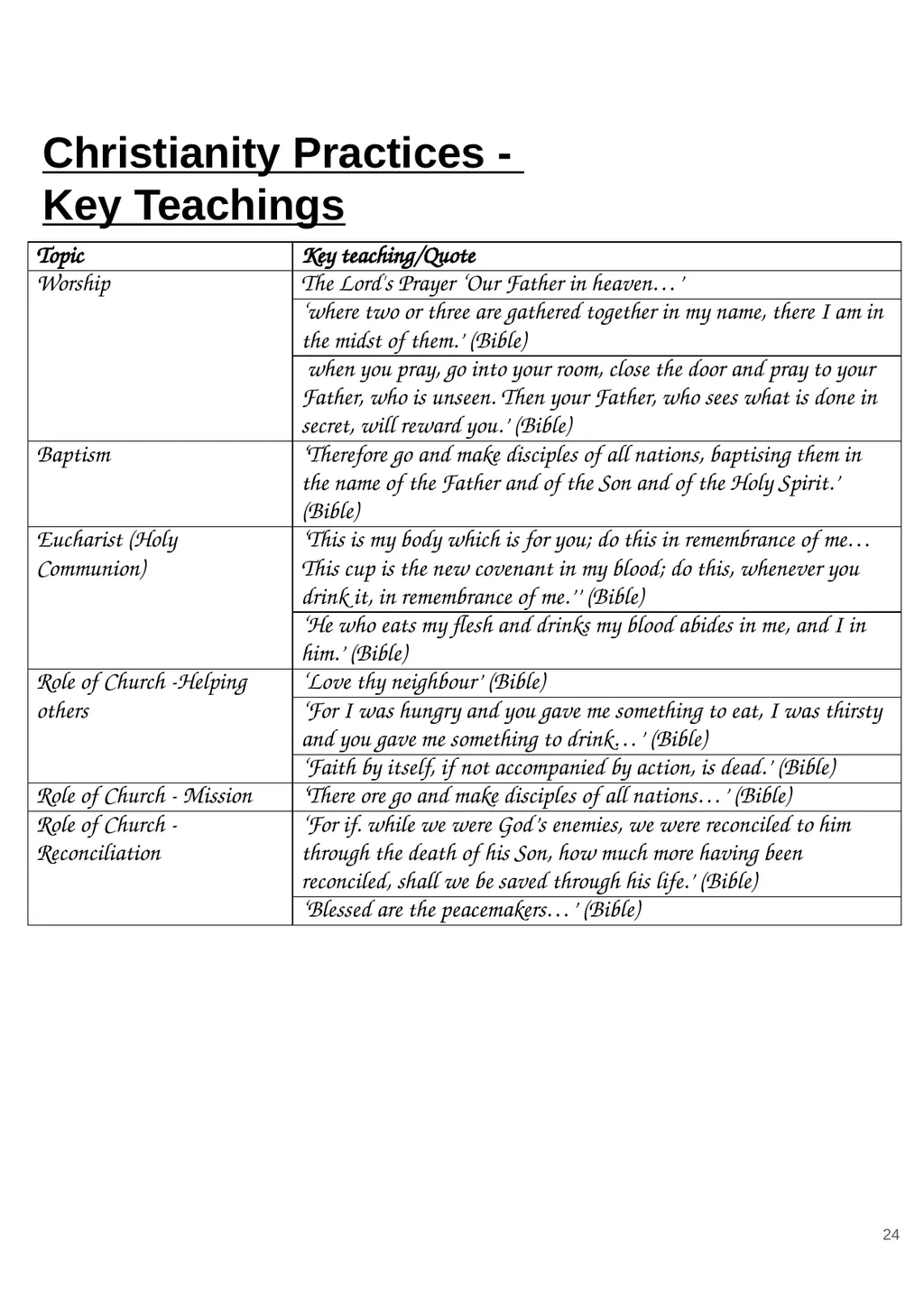
Christianity Practices -
Key Teachings 24<br>
Key Teachings 24<br>
25
Forms of Worship 25<br>
26
Prayer 26<br>
27
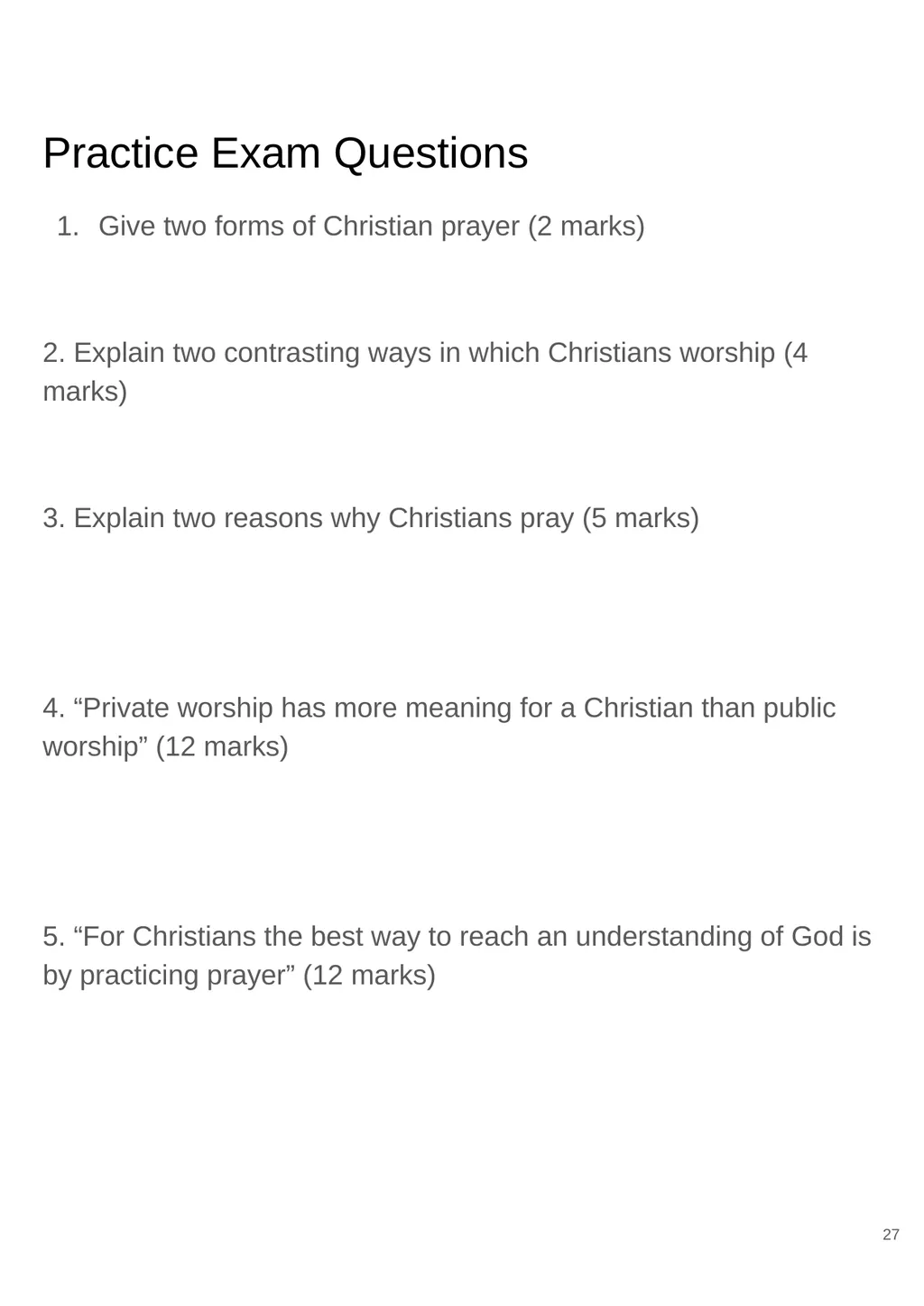
Practice Exam Questions Give two forms of Christian prayer (2 marks)
2. Explain two contrasting ways in which Christians worship (4 marks)
3. Explain two reasons why Christians pray (5 marks)
4. “Private worship has more meaning for a Christian than public worship” (12 marks)
5. “For Christians the best way to reach an understanding of God is by practicing prayer” (12 marks) 27<br>
2. Explain two contrasting ways in which Christians worship (4 marks)
3. Explain two reasons why Christians pray (5 marks)
4. “Private worship has more meaning for a Christian than public worship” (12 marks)
5. “For Christians the best way to reach an understanding of God is by practicing prayer” (12 marks) 27<br>
28
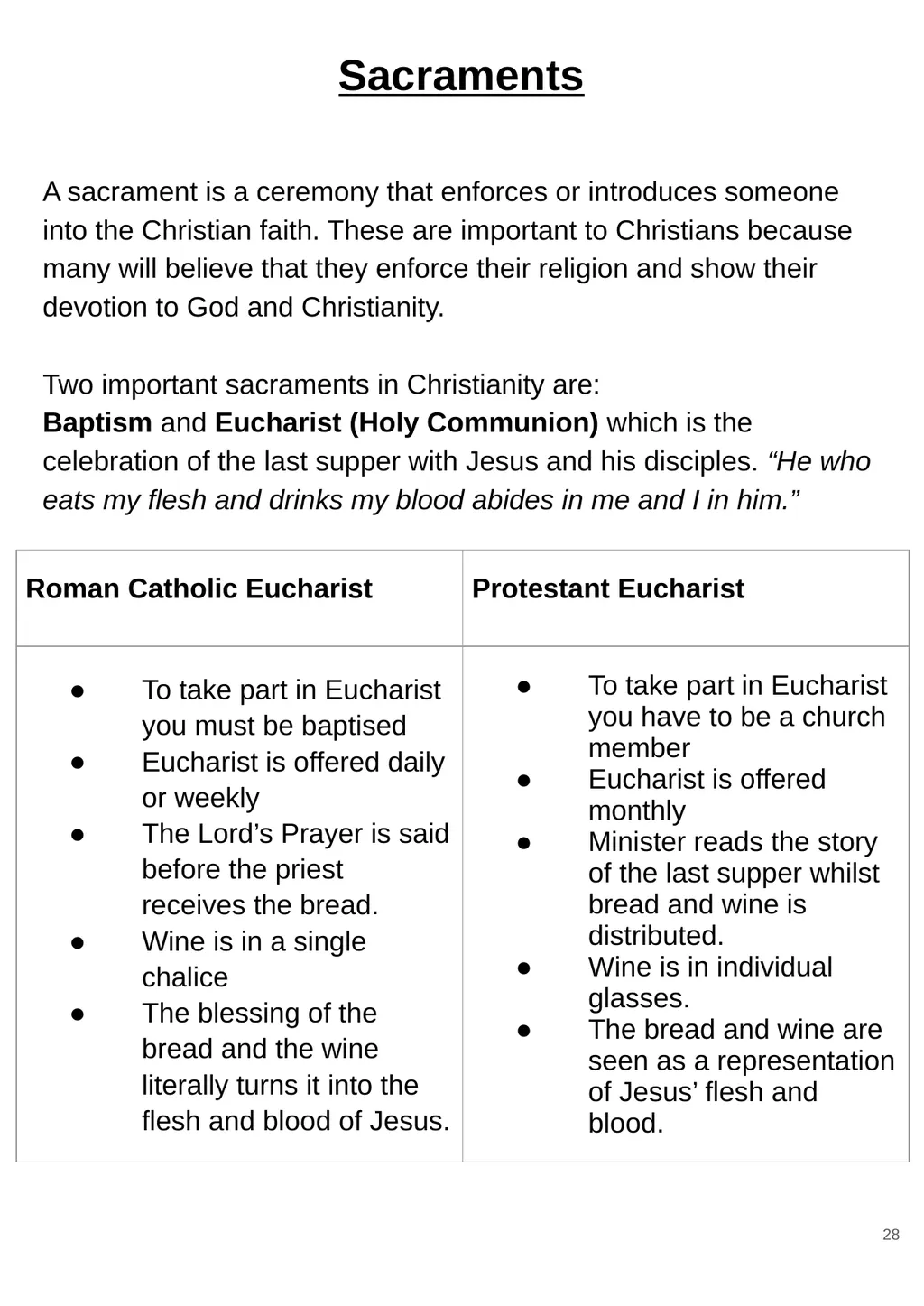
Sacraments A sacrament is a ceremony that enforces or introduces someone into the Christian faith. These are important to Christians because many will believe that they enforce their religion and show their devotion to God and Christianity.
Two important sacraments in Christianity are:
Baptism and Eucharist (Holy Communion) which is the celebration of the last supper with Jesus and his disciples. “He who eats my flesh and drinks my blood abides in me and I in him.” 28<br>
Two important sacraments in Christianity are:
Baptism and Eucharist (Holy Communion) which is the celebration of the last supper with Jesus and his disciples. “He who eats my flesh and drinks my blood abides in me and I in him.” 28<br>
29
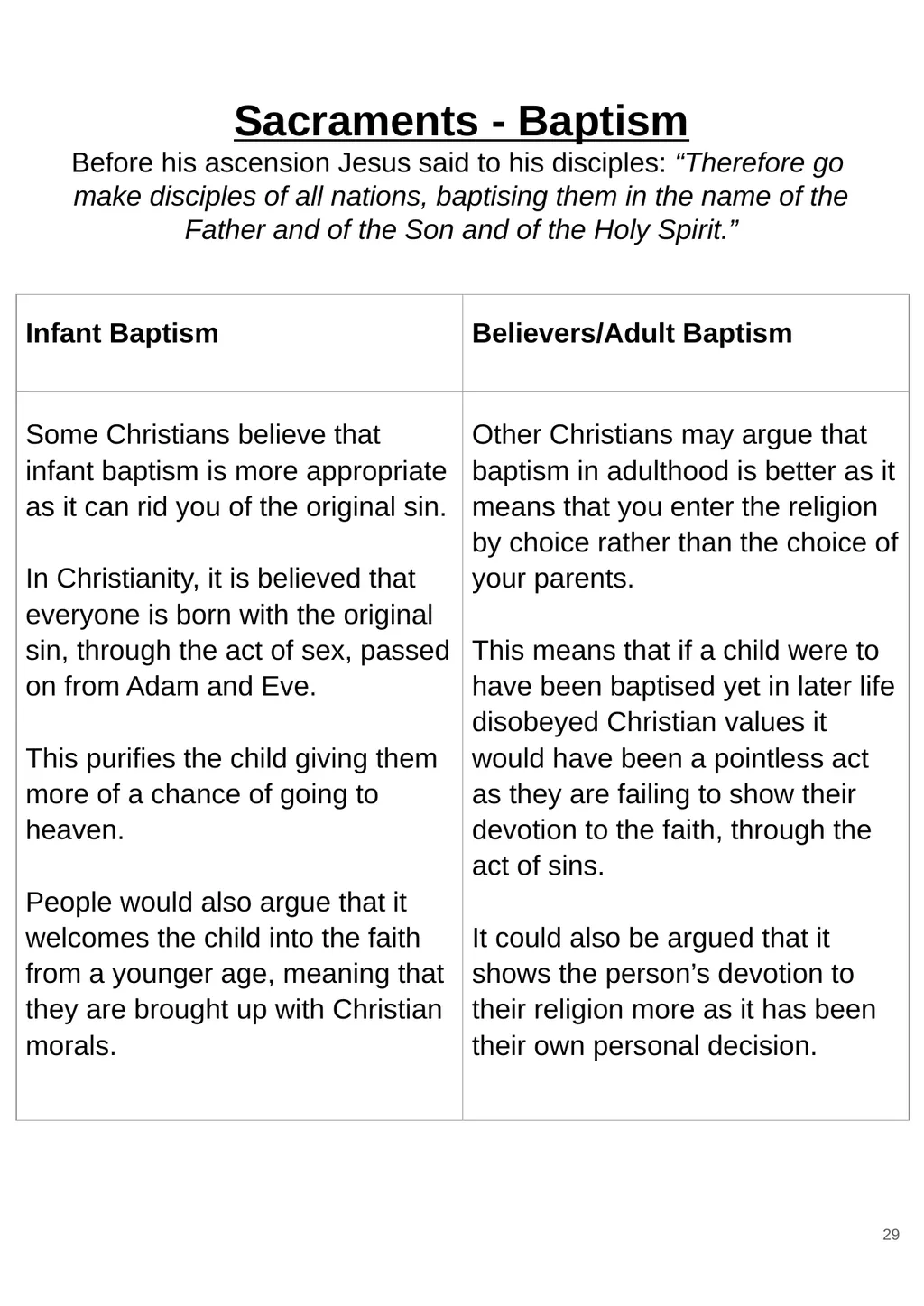
Sacraments - Baptism
Before his ascension Jesus said to his disciples: “Therefore go make disciples of all nations, baptising them in the name of the Father and of the Son and of the Holy Spirit.” 29<br>
Before his ascension Jesus said to his disciples: “Therefore go make disciples of all nations, baptising them in the name of the Father and of the Son and of the Holy Spirit.” 29<br>
30
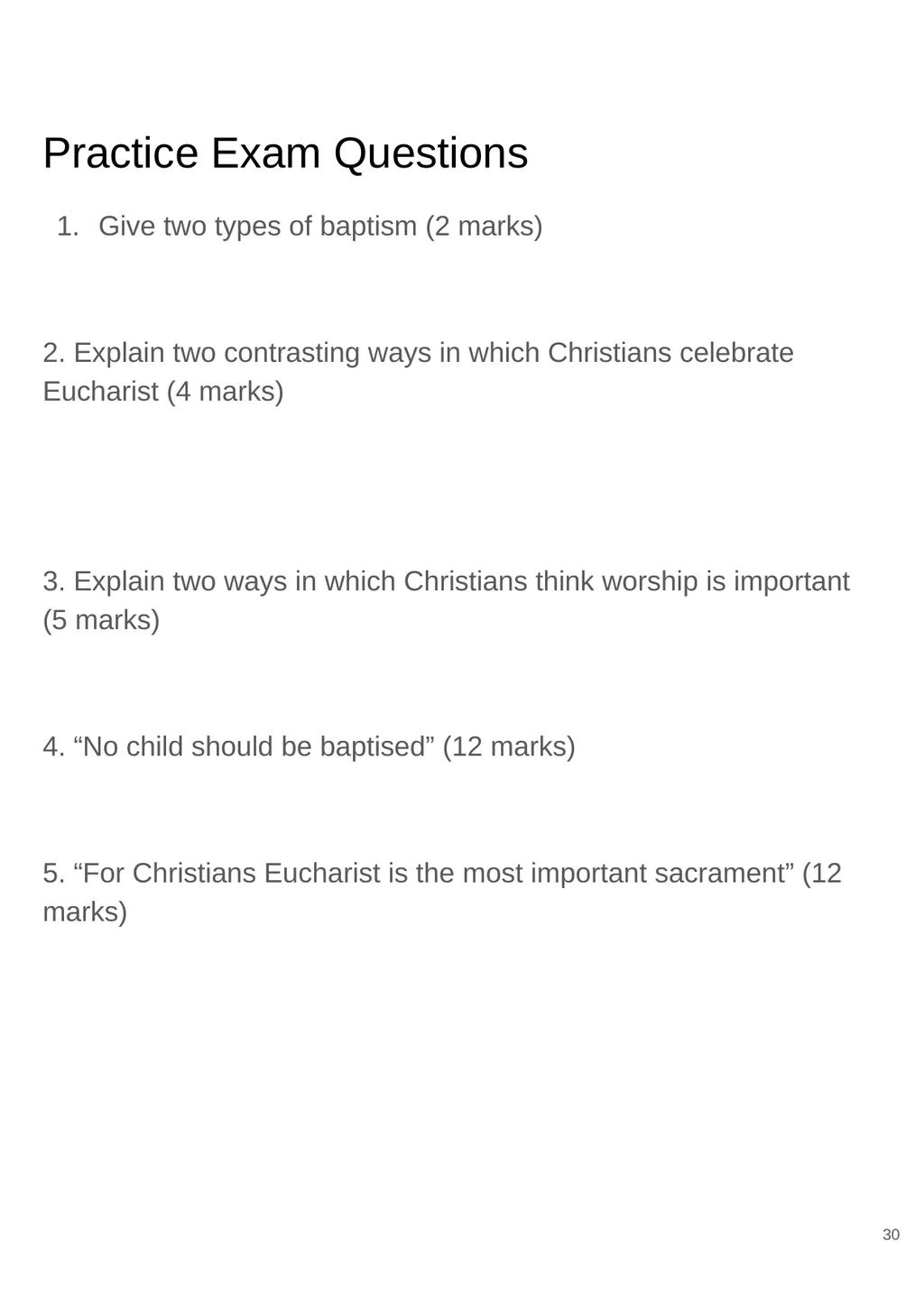
Practice Exam Questions Give two types of baptism (2 marks)
2. Explain two contrasting ways in which Christians celebrate Eucharist (4 marks)
3. Explain two ways in which Christians think worship is important (5 marks)
4. “No child should be baptised” (12 marks)
5. “For Christians Eucharist is the most important sacrament” (12 marks) 30<br>
2. Explain two contrasting ways in which Christians celebrate Eucharist (4 marks)
3. Explain two ways in which Christians think worship is important (5 marks)
4. “No child should be baptised” (12 marks)
5. “For Christians Eucharist is the most important sacrament” (12 marks) 30<br>
31
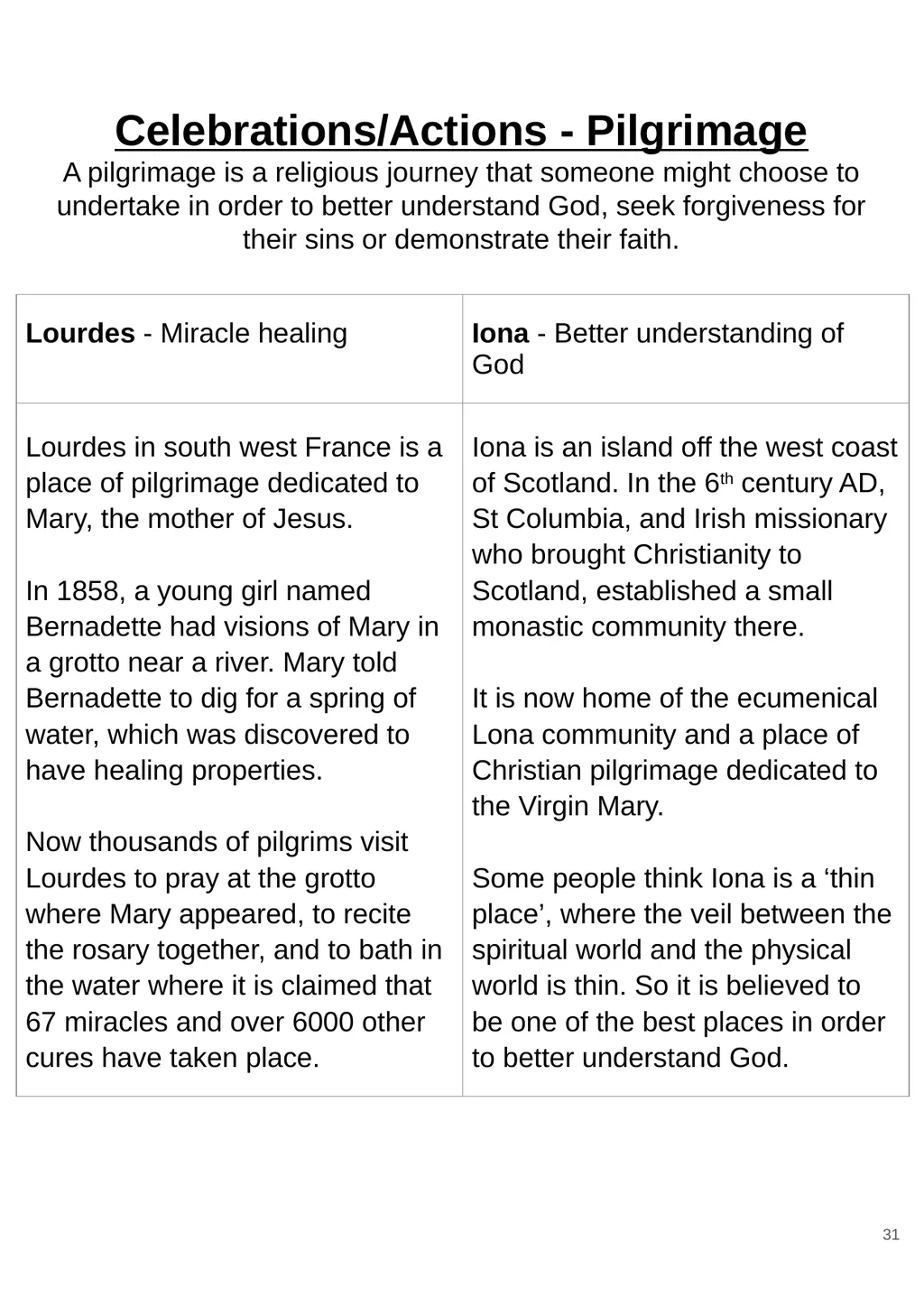
Celebrations/Actions - Pilgrimage
A pilgrimage is a religious journey that someone might choose to undertake in order to better understand God, seek forgiveness for their sins or demonstrate their faith. 31<br>
A pilgrimage is a religious journey that someone might choose to undertake in order to better understand God, seek forgiveness for their sins or demonstrate their faith. 31<br>
32
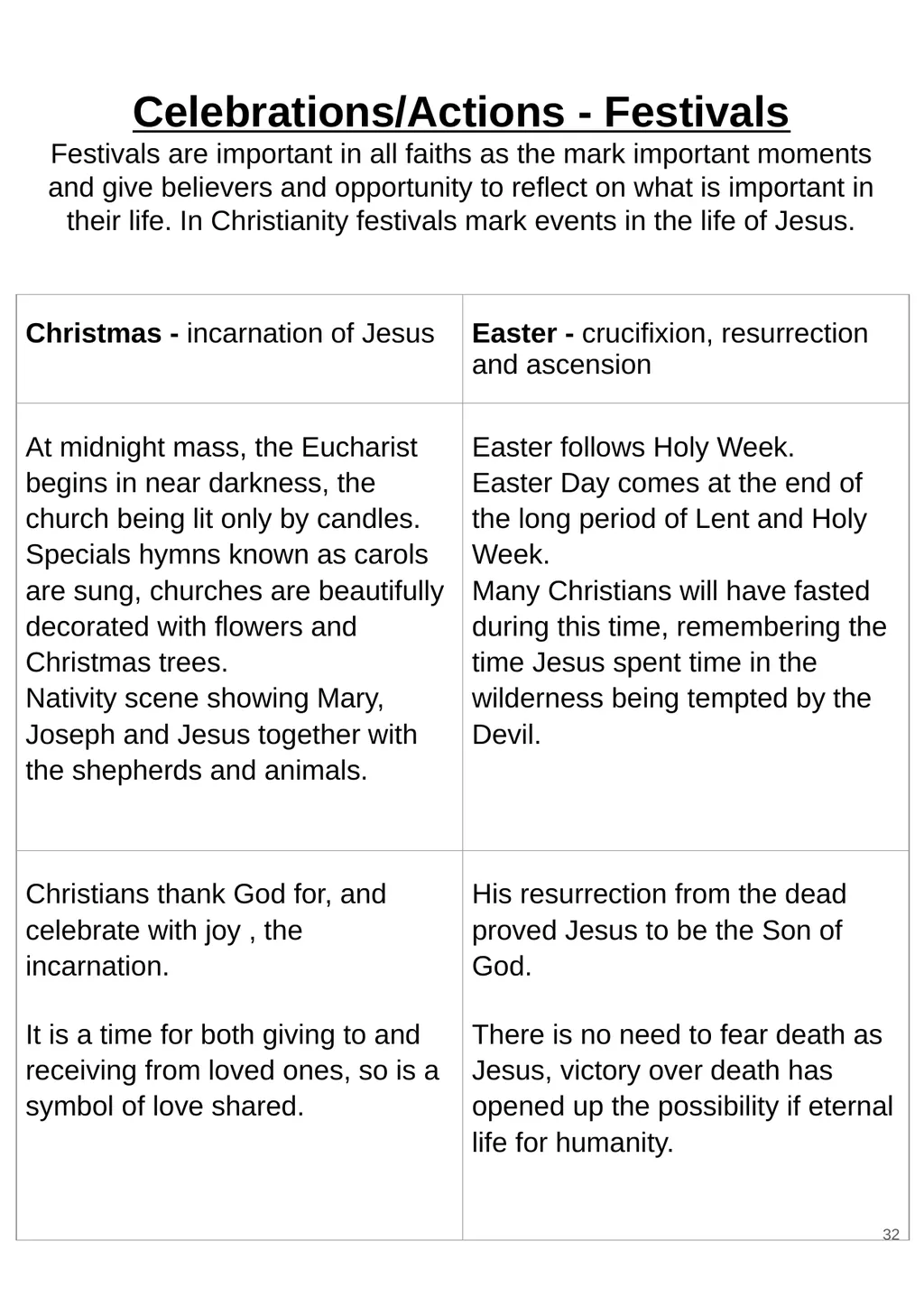
Celebrations/Actions - Festivals
Festivals are important in all faiths as the mark important moments and give believers and opportunity to reflect on what is important in their life. In Christianity festivals mark events in the life of Jesus. 32<br>
Festivals are important in all faiths as the mark important moments and give believers and opportunity to reflect on what is important in their life. In Christianity festivals mark events in the life of Jesus. 32<br>
33
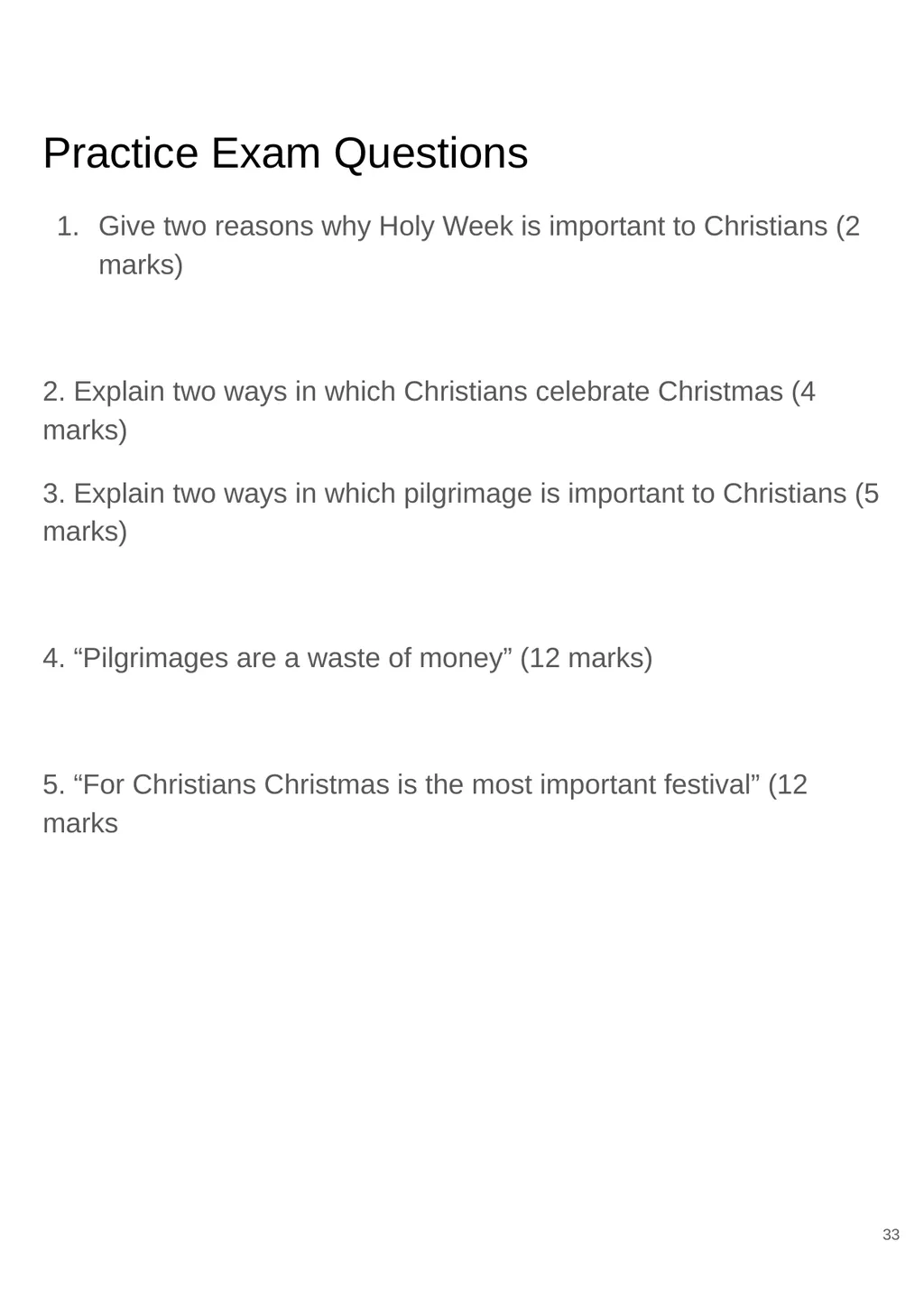
Practice Exam Questions Give two reasons why Holy Week is important to Christians (2 marks)
2. Explain two ways in which Christians celebrate Christmas (4 marks)
3. Explain two ways in which pilgrimage is important to Christians (5 marks)
4. “Pilgrimages are a waste of money” (12 marks)
5. “For Christians Christmas is the most important festival” (12 marks 33<br>
2. Explain two ways in which Christians celebrate Christmas (4 marks)
3. Explain two ways in which pilgrimage is important to Christians (5 marks)
4. “Pilgrimages are a waste of money” (12 marks)
5. “For Christians Christmas is the most important festival” (12 marks 33<br>
34
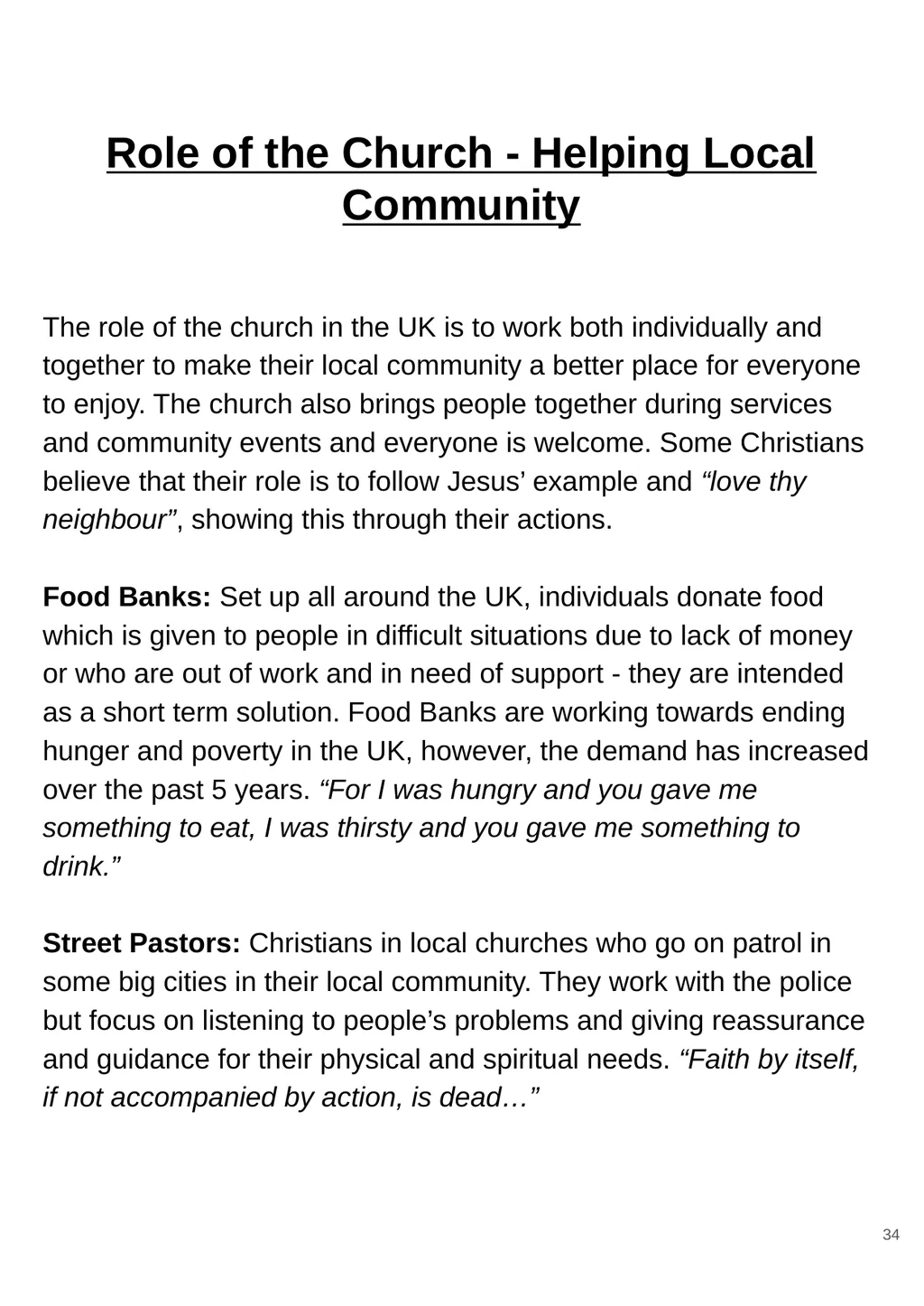
Role of the Church - Helping Local Community The role of the church in the UK is to work both individually and together to make their local community a better place for everyone to enjoy. The church also brings people together during services and community events and everyone is welcome. Some Christians believe that their role is to follow Jesus’ example and “love thy neighbour”, showing this through their actions.
Food Banks: Set up all around the UK, individuals donate food which is given to people in difficult situations due to lack of money or who are out of work and in need of support - they are intended as a short term solution. Food Banks are working towards ending hunger and poverty in the UK, however, the demand has increased over the past 5 years. “For I was hungry and you gave me something to eat, I was thirsty and you gave me something to drink.”
Street Pastors: Christians in local churches who go on patrol in some big cities in their local community. They work with the police but focus on listening to people’s problems and giving reassurance and guidance for their physical and spiritual needs. “Faith by itself, if not accompanied by action, is dead…” 34<br>
Food Banks: Set up all around the UK, individuals donate food which is given to people in difficult situations due to lack of money or who are out of work and in need of support - they are intended as a short term solution. Food Banks are working towards ending hunger and poverty in the UK, however, the demand has increased over the past 5 years. “For I was hungry and you gave me something to eat, I was thirsty and you gave me something to drink.”
Street Pastors: Christians in local churches who go on patrol in some big cities in their local community. They work with the police but focus on listening to people’s problems and giving reassurance and guidance for their physical and spiritual needs. “Faith by itself, if not accompanied by action, is dead…” 34<br>
35
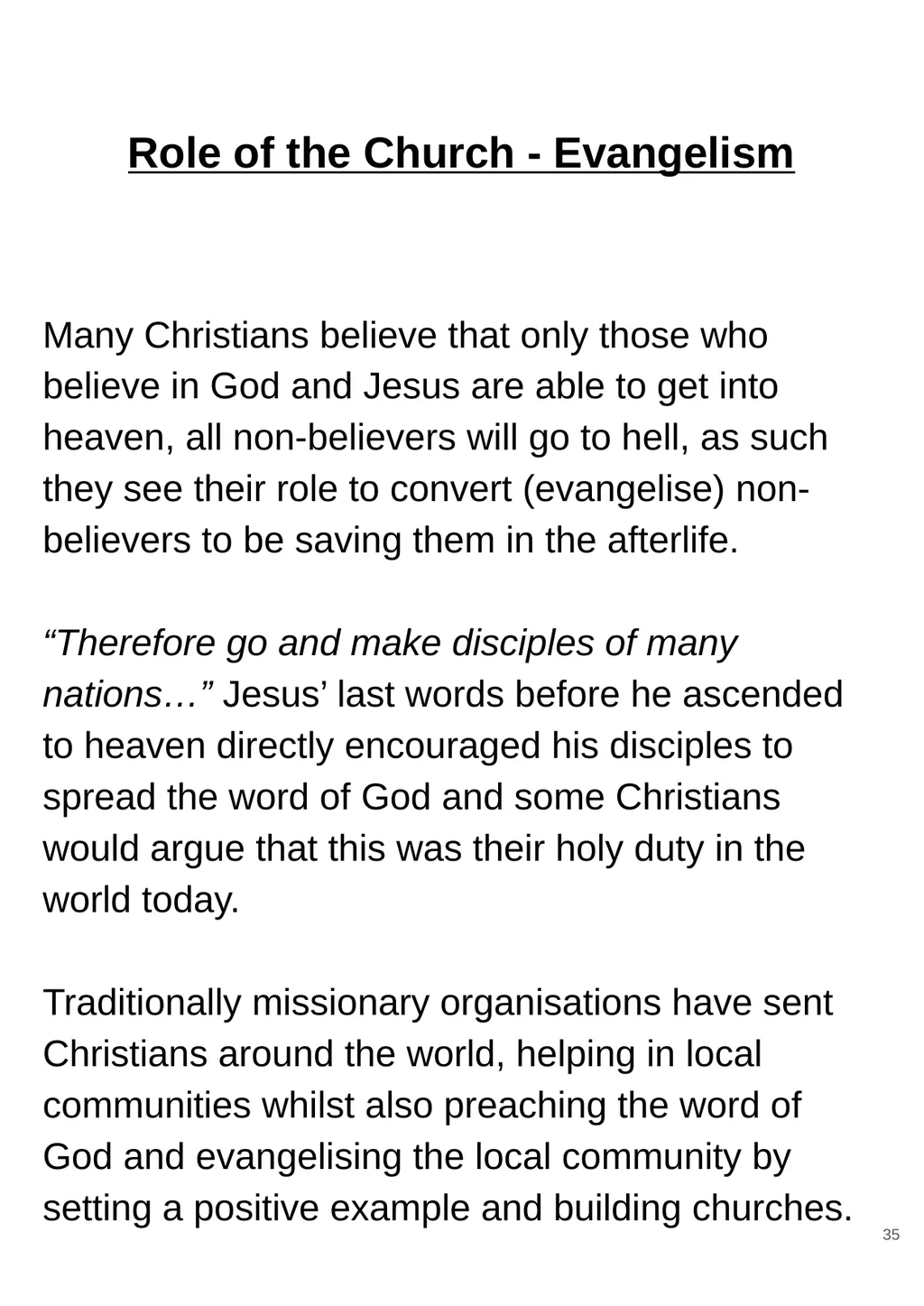
Role of the Church - Evangelism Many Christians believe that only those who believe in God and Jesus are able to get into heaven, all non-believers will go to hell, as such they see their role to convert (evangelise) non-believers to be saving them in the afterlife.
“Therefore go and make disciples of many nations…” Jesus’ last words before he ascended to heaven directly encouraged his disciples to spread the word of God and some Christians would argue that this was their holy duty in the world today.
Traditionally missionary organisations have sent Christians around the world, helping in local communities whilst also preaching the word of God and evangelising the local community by setting a positive example and building churches. 35<br>
“Therefore go and make disciples of many nations…” Jesus’ last words before he ascended to heaven directly encouraged his disciples to spread the word of God and some Christians would argue that this was their holy duty in the world today.
Traditionally missionary organisations have sent Christians around the world, helping in local communities whilst also preaching the word of God and evangelising the local community by setting a positive example and building churches. 35<br>
36
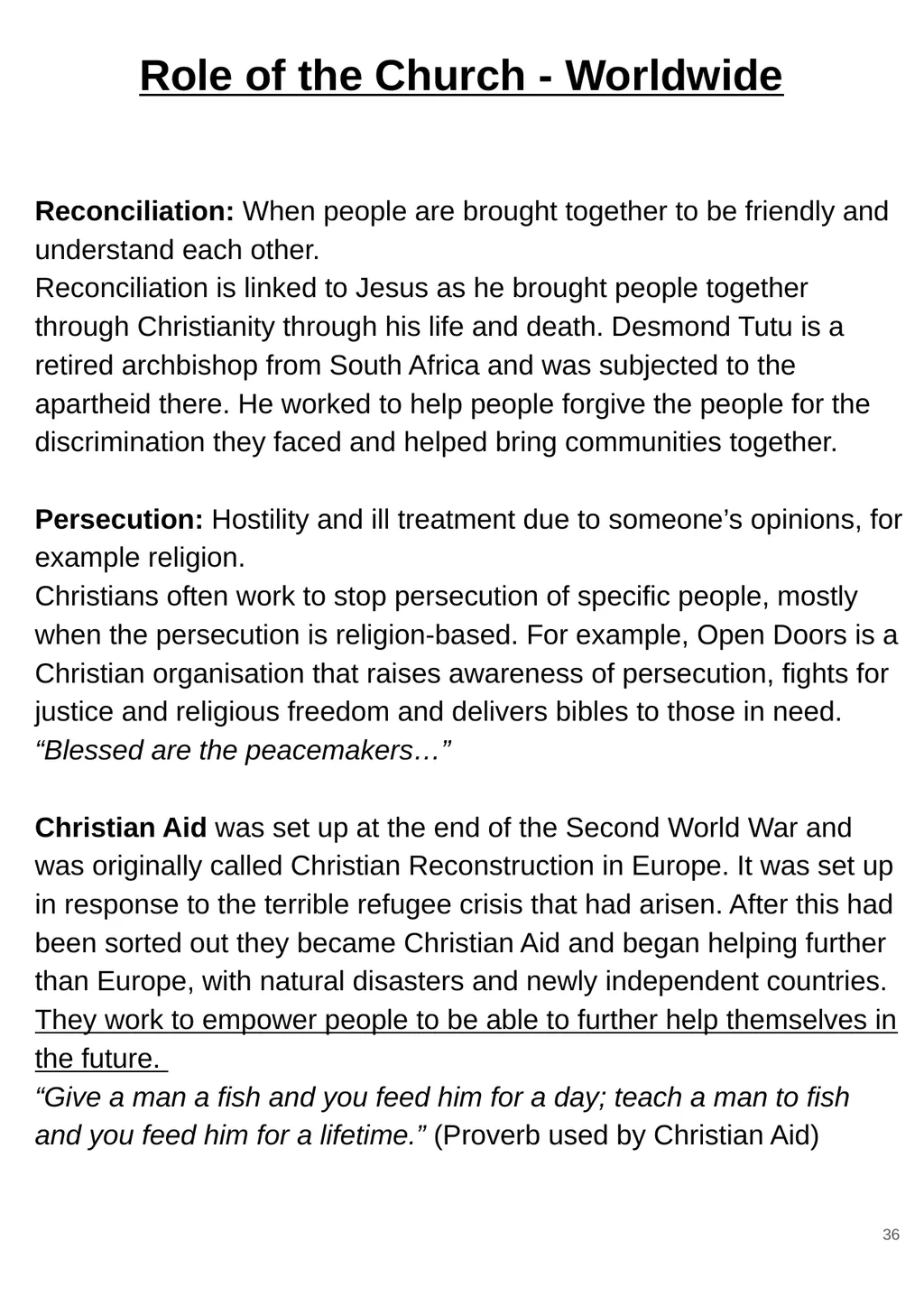
Role of the Church - Worldwide Reconciliation: When people are brought together to be friendly and understand each other.
Reconciliation is linked to Jesus as he brought people together through Christianity through his life and death. Desmond Tutu is a retired archbishop from South Africa and was subjected to the apartheid there. He worked to help people forgive the people for the discrimination they faced and helped bring communities together.
Persecution: Hostility and ill treatment due to someone’s opinions, for example religion.
Christians often work to stop persecution of specific people, mostly when the persecution is religion-based. For example, Open Doors is a Christian organisation that raises awareness of persecution, fights for justice and religious freedom and delivers bibles to those in need. “Blessed are the peacemakers…”
Christian Aid was set up at the end of the Second World War and was originally called Christian Reconstruction in Europe. It was set up in response to the terrible refugee crisis that had arisen. After this had been sorted out they became Christian Aid and began helping further than Europe, with natural disasters and newly independent countries. They work to empower people to be able to further help themselves in the future.
“Give a man a fish and you feed him for a day; teach a man to fish and you feed him for a lifetime.” (Proverb used by Christian Aid) 36<br>
Reconciliation is linked to Jesus as he brought people together through Christianity through his life and death. Desmond Tutu is a retired archbishop from South Africa and was subjected to the apartheid there. He worked to help people forgive the people for the discrimination they faced and helped bring communities together.
Persecution: Hostility and ill treatment due to someone’s opinions, for example religion.
Christians often work to stop persecution of specific people, mostly when the persecution is religion-based. For example, Open Doors is a Christian organisation that raises awareness of persecution, fights for justice and religious freedom and delivers bibles to those in need. “Blessed are the peacemakers…”
Christian Aid was set up at the end of the Second World War and was originally called Christian Reconstruction in Europe. It was set up in response to the terrible refugee crisis that had arisen. After this had been sorted out they became Christian Aid and began helping further than Europe, with natural disasters and newly independent countries. They work to empower people to be able to further help themselves in the future.
“Give a man a fish and you feed him for a day; teach a man to fish and you feed him for a lifetime.” (Proverb used by Christian Aid) 36<br>
37
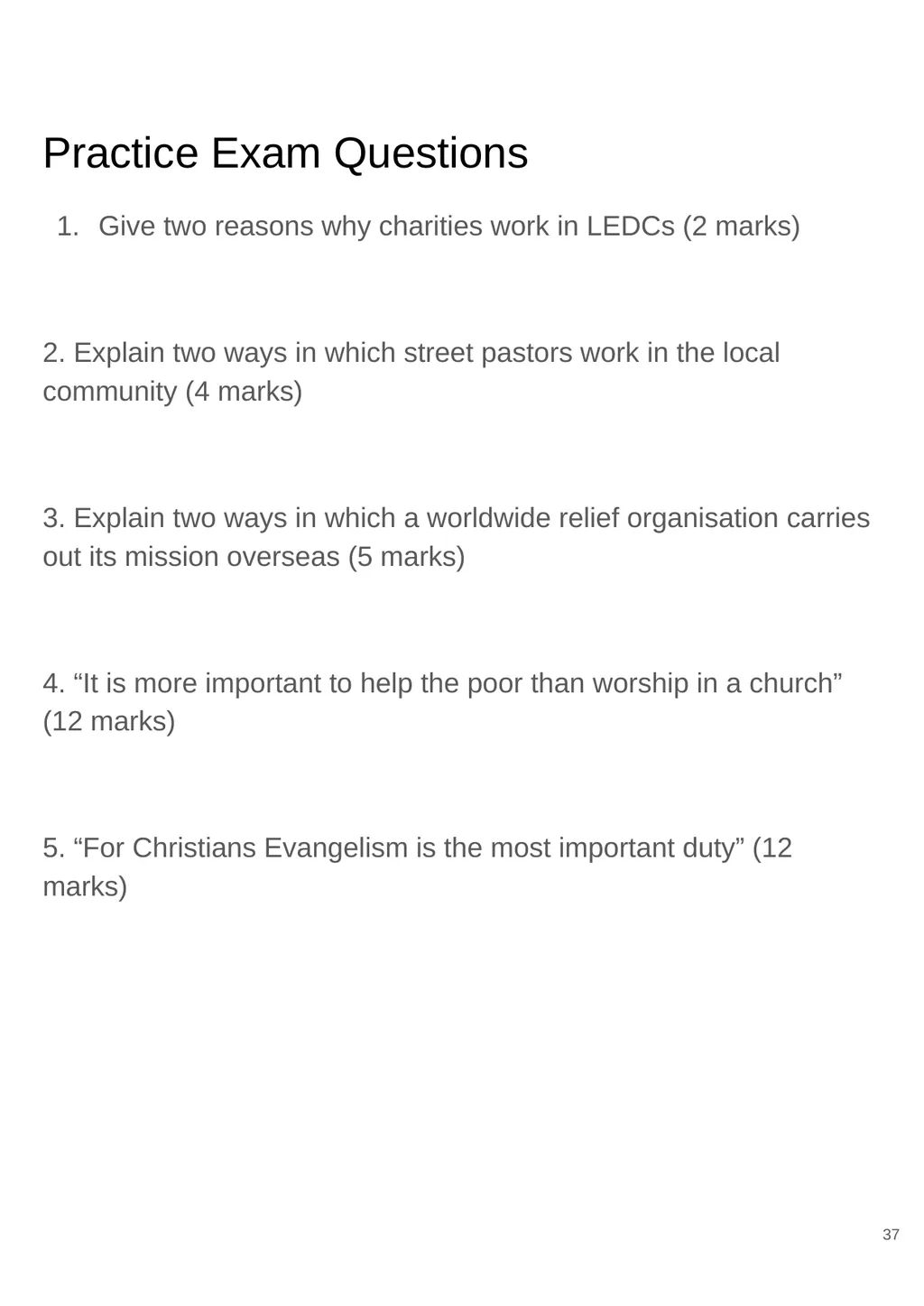
Practice Exam Questions Give two reasons why charities work in LEDCs (2 marks)
2. Explain two ways in which street pastors work in the local community (4 marks)
3. Explain two ways in which a worldwide relief organisation carries out its mission overseas (5 marks)
4. “It is more important to help the poor than worship in a church” (12 marks)
5. “For Christians Evangelism is the most important duty” (12 marks) 37<br>
2. Explain two ways in which street pastors work in the local community (4 marks)
3. Explain two ways in which a worldwide relief organisation carries out its mission overseas (5 marks)
4. “It is more important to help the poor than worship in a church” (12 marks)
5. “For Christians Evangelism is the most important duty” (12 marks) 37<br>
38
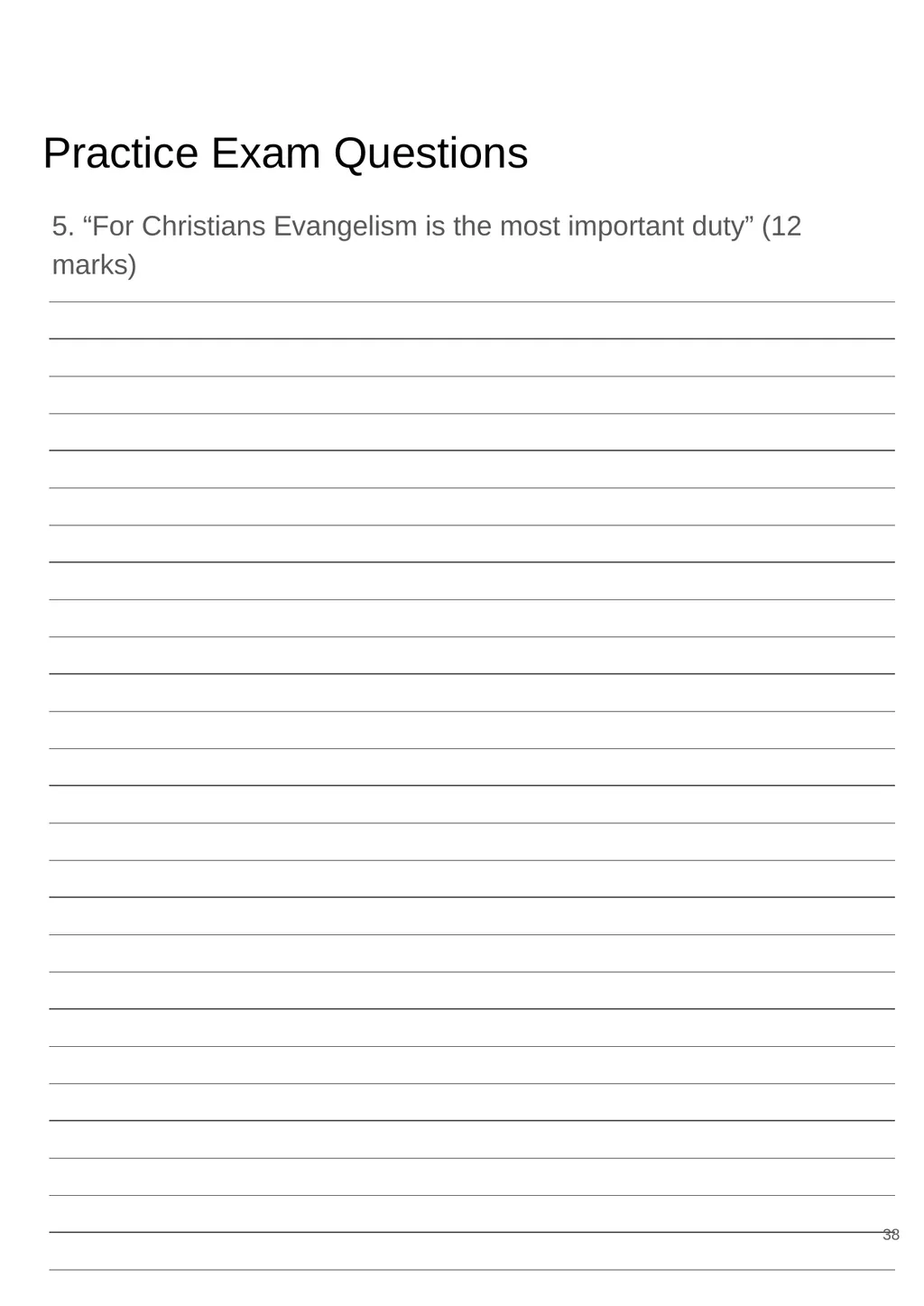
Practice Exam Questions 5. “For Christians Evangelism is the most important duty” (12 marks) 38<br>
39
Islam Beliefs and Teachings Sunni and Shi’a Islam
Key beliefs
Six articles of faith (Sunni) and Five Roots of Usul ad-Din (Shi’a)
Nature of Allah (Tawhid, omnipotence, beneficence, mercy, fairness and justice
Angels - Jibril and Mikhail, predestination, free will and Day of Judgement
Afterlife (Akhirah) - resurrection, heaven and hell
Prophethood (Risalah) - Adam, Ibrahim and Muhammad
Holy Books
Qur’an: revelation and authority
Torah, Psalms, Gospel and Scrolls of Abraham
The Imamate (Shi’a) 39<br>
Key beliefs
Six articles of faith (Sunni) and Five Roots of Usul ad-Din (Shi’a)
Nature of Allah (Tawhid, omnipotence, beneficence, mercy, fairness and justice
Angels - Jibril and Mikhail, predestination, free will and Day of Judgement
Afterlife (Akhirah) - resurrection, heaven and hell
Prophethood (Risalah) - Adam, Ibrahim and Muhammad
Holy Books
Qur’an: revelation and authority
Torah, Psalms, Gospel and Scrolls of Abraham
The Imamate (Shi’a) 39<br>
40
Islam Beliefs and Teachings -
Key Teachings 40<br>
Key Teachings 40<br>
41
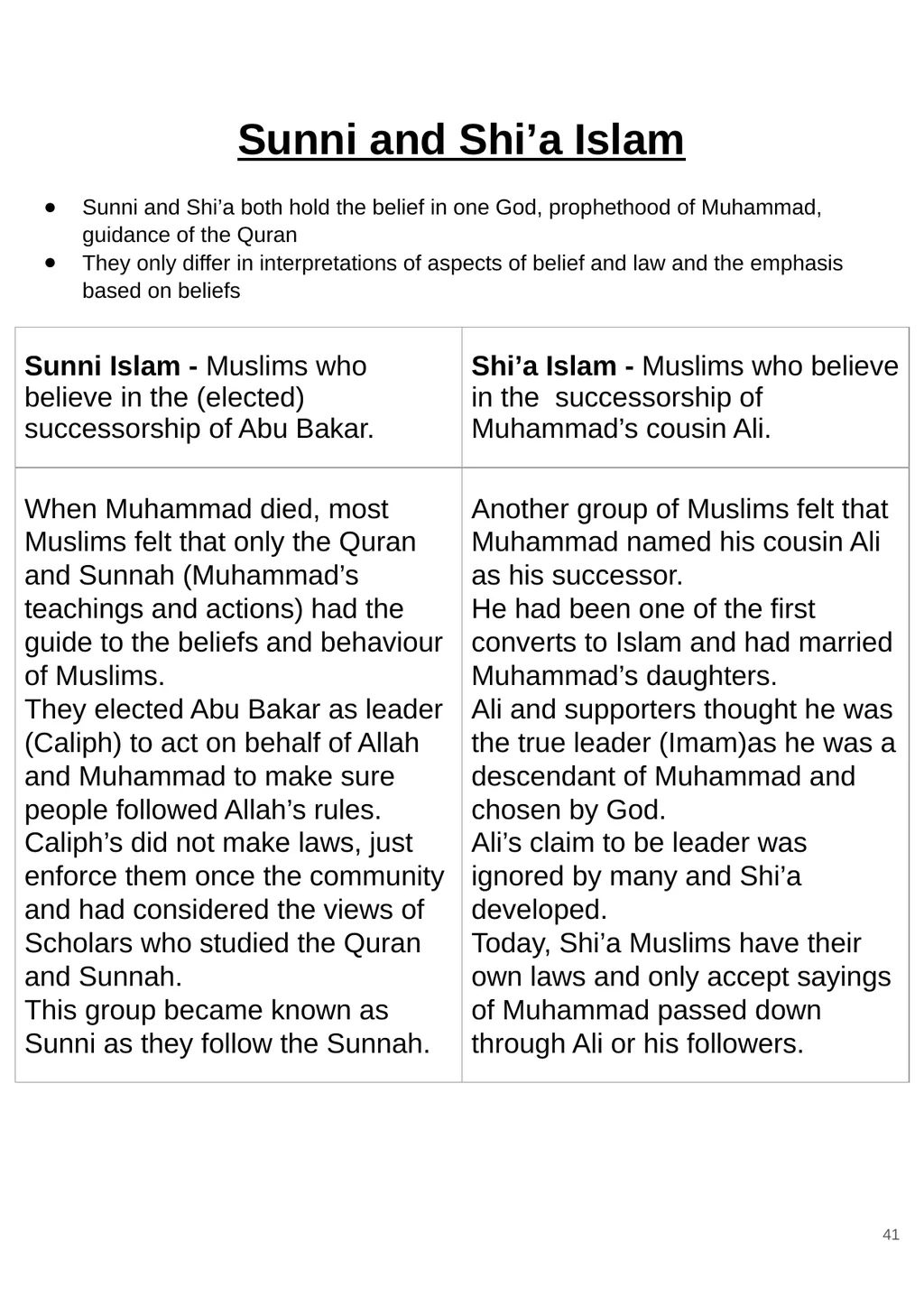
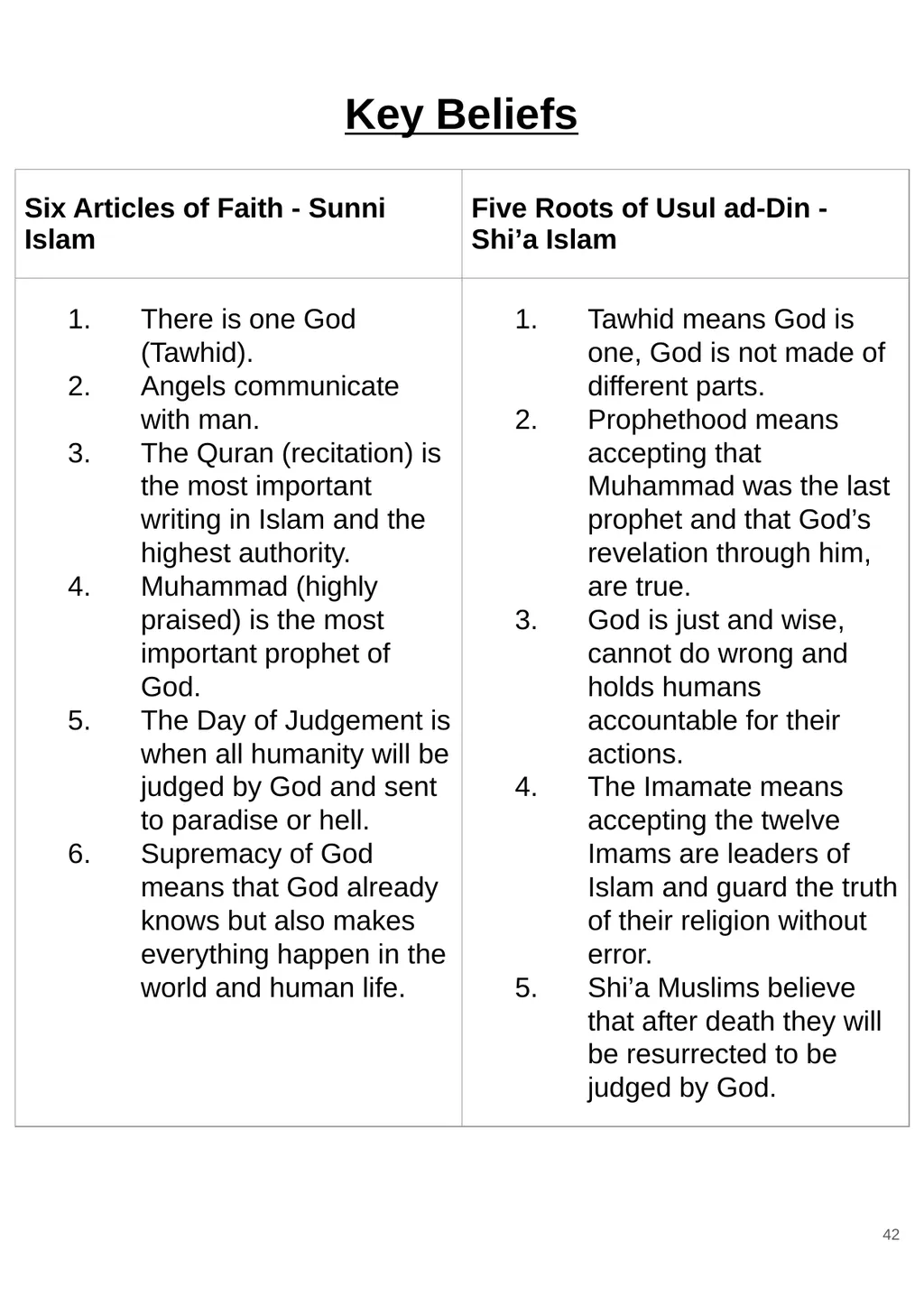
Sunni and Shi’a Islam Sunni and Shi’a both hold the belief in one God, prophethood of Muhammad, guidance of the Quran
They only differ in interpretations of aspects of belief and law and the emphasis based on beliefs 41<br>
They only differ in interpretations of aspects of belief and law and the emphasis based on beliefs 41<br>
42
Key Beliefs 42<br>
43
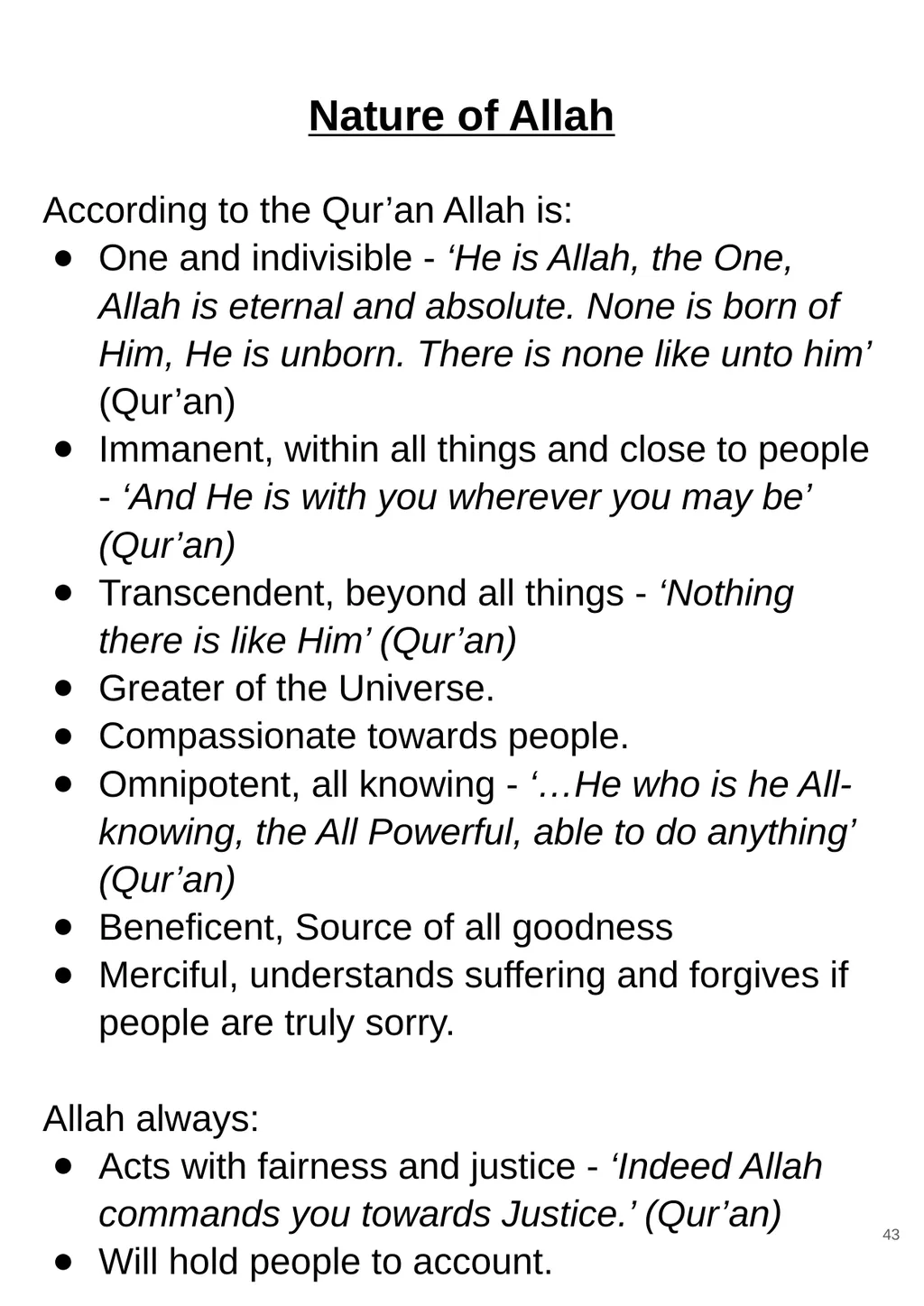
Nature of Allah According to the Qur’an Allah is:
One and indivisible - ‘He is Allah, the One, Allah is eternal and absolute. None is born of Him, He is unborn. There is none like unto him’ (Qur’an)
Immanent, within all things and close to people - ‘And He is with you wherever you may be’ (Qur’an)
Transcendent, beyond all things - ‘Nothing there is like Him’ (Qur’an)
Greater of the Universe.
Compassionate towards people.
Omnipotent, all knowing - ‘…He who is he All-knowing, the All Powerful, able to do anything’ (Qur’an)
Beneficent, Source of all goodness
Merciful, understands suffering and forgives if people are truly sorry.
Allah always:
Acts with fairness and justice - ‘Indeed Allah commands you towards Justice.’ (Qur’an)
Will hold people to account. 43<br>
One and indivisible - ‘He is Allah, the One, Allah is eternal and absolute. None is born of Him, He is unborn. There is none like unto him’ (Qur’an)
Immanent, within all things and close to people - ‘And He is with you wherever you may be’ (Qur’an)
Transcendent, beyond all things - ‘Nothing there is like Him’ (Qur’an)
Greater of the Universe.
Compassionate towards people.
Omnipotent, all knowing - ‘…He who is he All-knowing, the All Powerful, able to do anything’ (Qur’an)
Beneficent, Source of all goodness
Merciful, understands suffering and forgives if people are truly sorry.
Allah always:
Acts with fairness and justice - ‘Indeed Allah commands you towards Justice.’ (Qur’an)
Will hold people to account. 43<br>
44
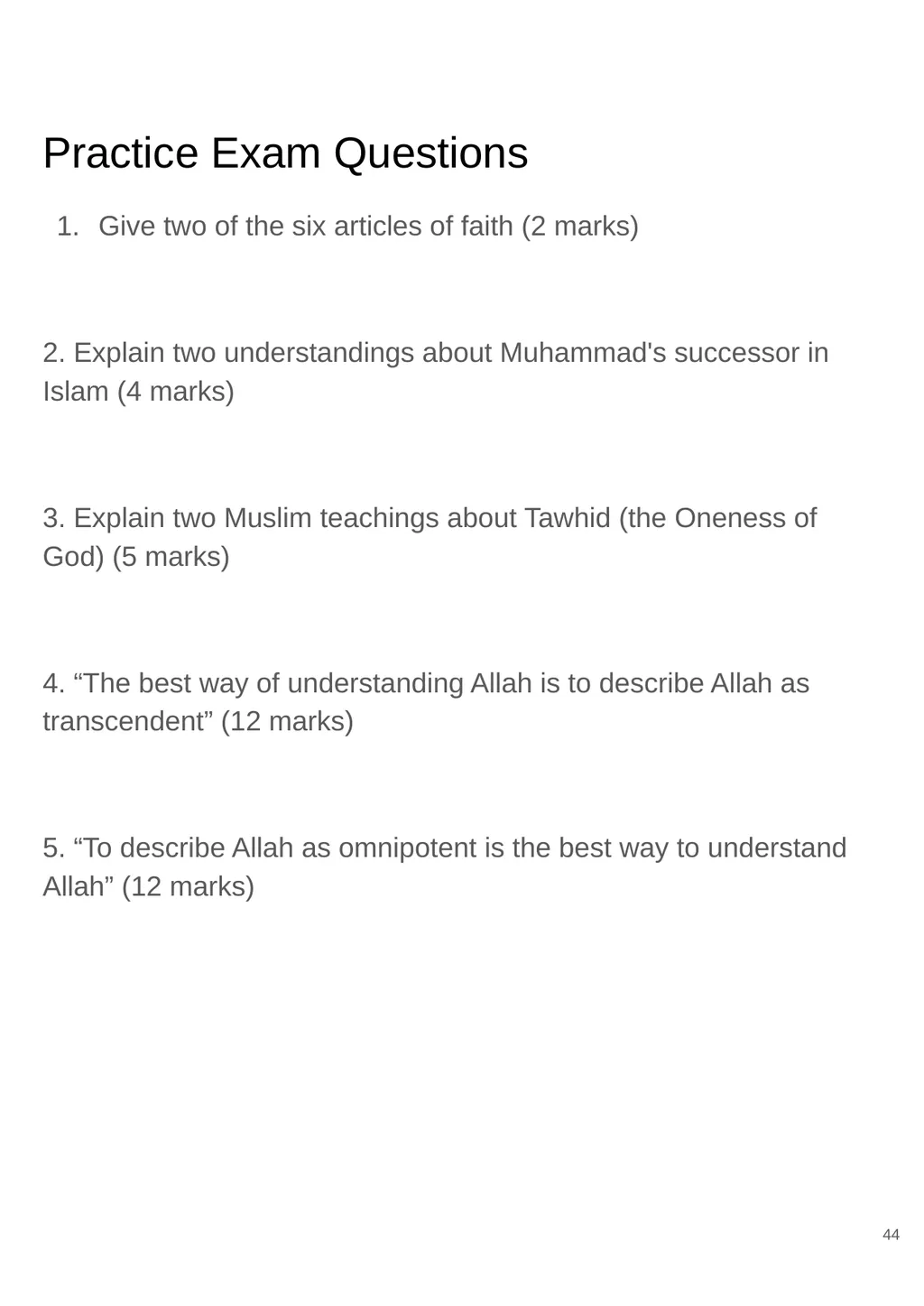
Practice Exam Questions Give two of the six articles of faith (2 marks)
2. Explain two understandings about Muhammad's successor in Islam (4 marks)
3. Explain two Muslim teachings about Tawhid (the Oneness of God) (5 marks)
4. “The best way of understanding Allah is to describe Allah as transcendent” (12 marks)
5. “To describe Allah as omnipotent is the best way to understand Allah” (12 marks) 44<br>
2. Explain two understandings about Muhammad's successor in Islam (4 marks)
3. Explain two Muslim teachings about Tawhid (the Oneness of God) (5 marks)
4. “The best way of understanding Allah is to describe Allah as transcendent” (12 marks)
5. “To describe Allah as omnipotent is the best way to understand Allah” (12 marks) 44<br>
45
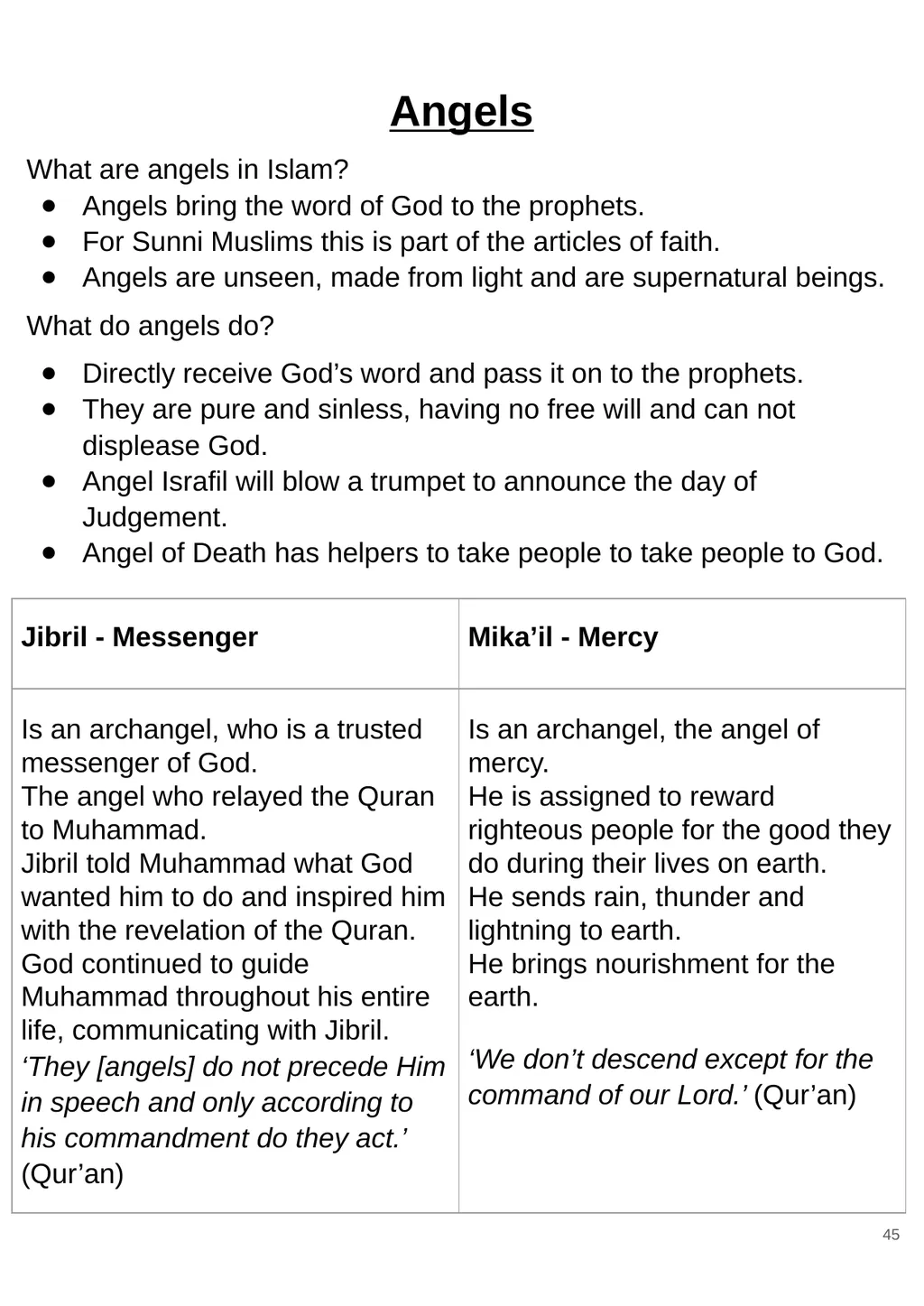
Angels What are angels in Islam?
Angels bring the word of God to the prophets.
For Sunni Muslims this is part of the articles of faith.
Angels are unseen, made from light and are supernatural beings.
What do angels do?
Directly receive God’s word and pass it on to the prophets.
They are pure and sinless, having no free will and can not displease God.
Angel Israfil will blow a trumpet to announce the day of Judgement.
Angel of Death has helpers to take people to take people to God. 45<br>
Angels bring the word of God to the prophets.
For Sunni Muslims this is part of the articles of faith.
Angels are unseen, made from light and are supernatural beings.
What do angels do?
Directly receive God’s word and pass it on to the prophets.
They are pure and sinless, having no free will and can not displease God.
Angel Israfil will blow a trumpet to announce the day of Judgement.
Angel of Death has helpers to take people to take people to God. 45<br>
46
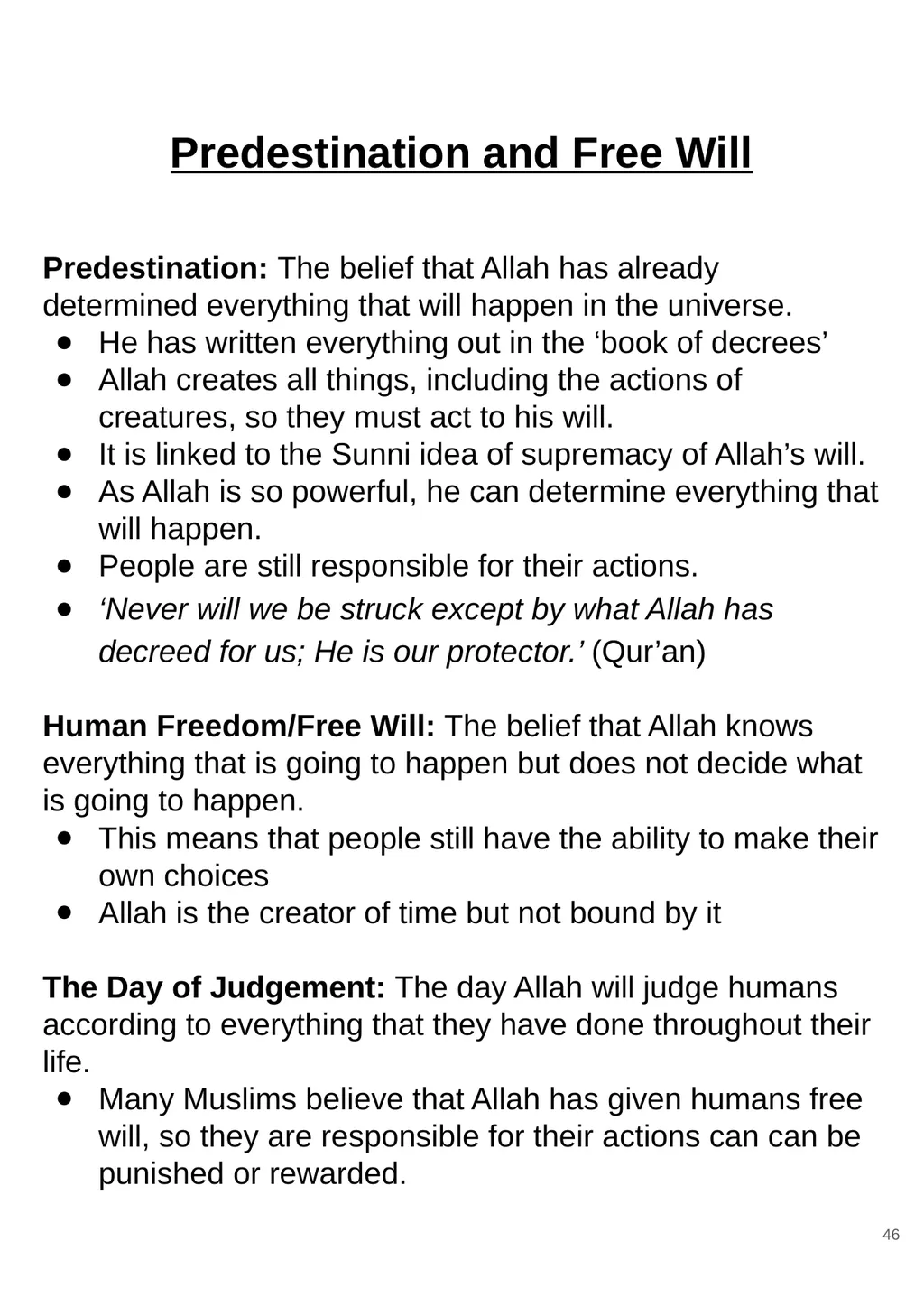
Predestination and Free Will Predestination: The belief that Allah has already determined everything that will happen in the universe.
He has written everything out in the ‘book of decrees’
Allah creates all things, including the actions of creatures, so they must act to his will.
It is linked to the Sunni idea of supremacy of Allah’s will.
As Allah is so powerful, he can determine everything that will happen.
People are still responsible for their actions.
‘Never will we be struck except by what Allah has decreed for us; He is our protector.’ (Qur’an)
Human Freedom/Free Will: The belief that Allah knows everything that is going to happen but does not decide what is going to happen.
This means that people still have the ability to make their own choices
Allah is the creator of time but not bound by it
The Day of Judgement: The day Allah will judge humans according to everything that they have done throughout their life.
Many Muslims believe that Allah has given humans free will, so they are responsible for their actions can can be punished or rewarded. 46<br>
He has written everything out in the ‘book of decrees’
Allah creates all things, including the actions of creatures, so they must act to his will.
It is linked to the Sunni idea of supremacy of Allah’s will.
As Allah is so powerful, he can determine everything that will happen.
People are still responsible for their actions.
‘Never will we be struck except by what Allah has decreed for us; He is our protector.’ (Qur’an)
Human Freedom/Free Will: The belief that Allah knows everything that is going to happen but does not decide what is going to happen.
This means that people still have the ability to make their own choices
Allah is the creator of time but not bound by it
The Day of Judgement: The day Allah will judge humans according to everything that they have done throughout their life.
Many Muslims believe that Allah has given humans free will, so they are responsible for their actions can can be punished or rewarded. 46<br>
47
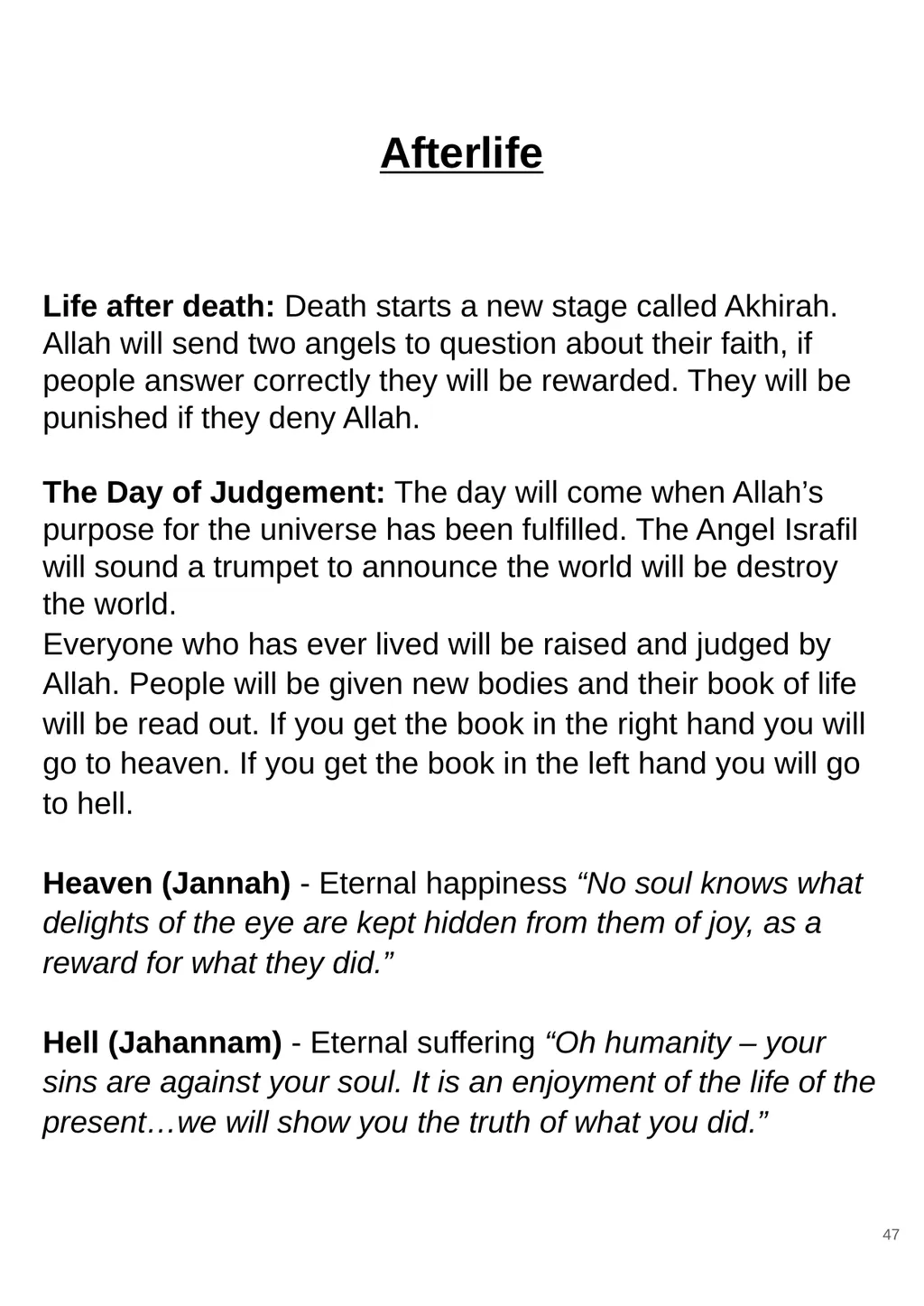
Afterlife Life after death: Death starts a new stage called Akhirah. Allah will send two angels to question about their faith, if people answer correctly they will be rewarded. They will be punished if they deny Allah.
The Day of Judgement: The day will come when Allah’s purpose for the universe has been fulfilled. The Angel Israfil will sound a trumpet to announce the world will be destroy the world.
Everyone who has ever lived will be raised and judged by Allah. People will be given new bodies and their book of life will be read out. If you get the book in the right hand you will go to heaven. If you get the book in the left hand you will go to hell.
Heaven (Jannah) - Eternal happiness “No soul knows what delights of the eye are kept hidden from them of joy, as a reward for what they did.”
Hell (Jahannam) - Eternal suffering “Oh humanity – your sins are against your soul. It is an enjoyment of the life of the present…we will show you the truth of what you did.” 47<br>
The Day of Judgement: The day will come when Allah’s purpose for the universe has been fulfilled. The Angel Israfil will sound a trumpet to announce the world will be destroy the world.
Everyone who has ever lived will be raised and judged by Allah. People will be given new bodies and their book of life will be read out. If you get the book in the right hand you will go to heaven. If you get the book in the left hand you will go to hell.
Heaven (Jannah) - Eternal happiness “No soul knows what delights of the eye are kept hidden from them of joy, as a reward for what they did.”
Hell (Jahannam) - Eternal suffering “Oh humanity – your sins are against your soul. It is an enjoyment of the life of the present…we will show you the truth of what you did.” 47<br>
48
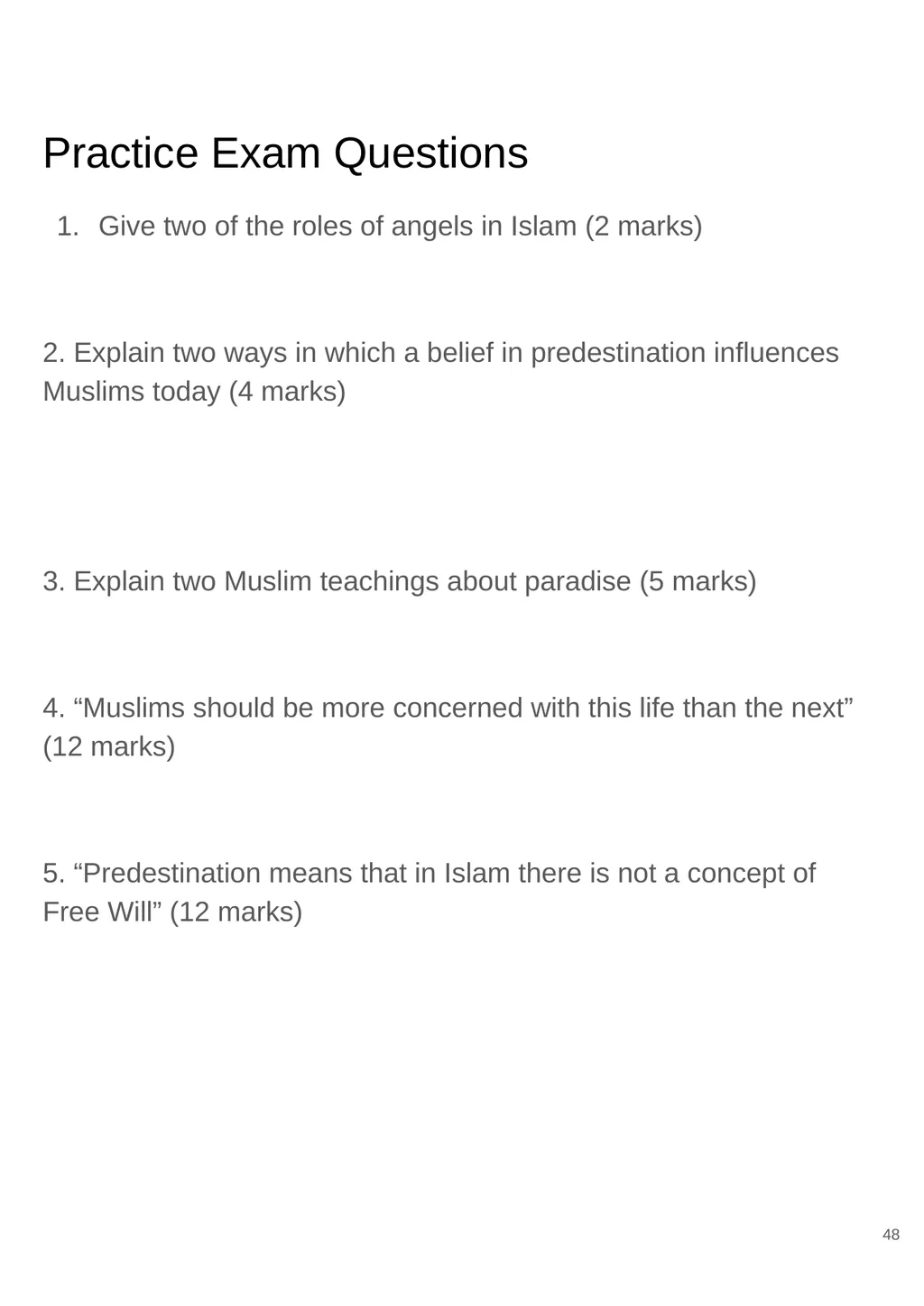
Practice Exam Questions Give two of the roles of angels in Islam (2 marks)
2. Explain two ways in which a belief in predestination influences Muslims today (4 marks)
3. Explain two Muslim teachings about paradise (5 marks)
4. “Muslims should be more concerned with this life than the next” (12 marks)
5. “Predestination means that in Islam there is not a concept of Free Will” (12 marks) 48<br>
2. Explain two ways in which a belief in predestination influences Muslims today (4 marks)
3. Explain two Muslim teachings about paradise (5 marks)
4. “Muslims should be more concerned with this life than the next” (12 marks)
5. “Predestination means that in Islam there is not a concept of Free Will” (12 marks) 48<br>
49
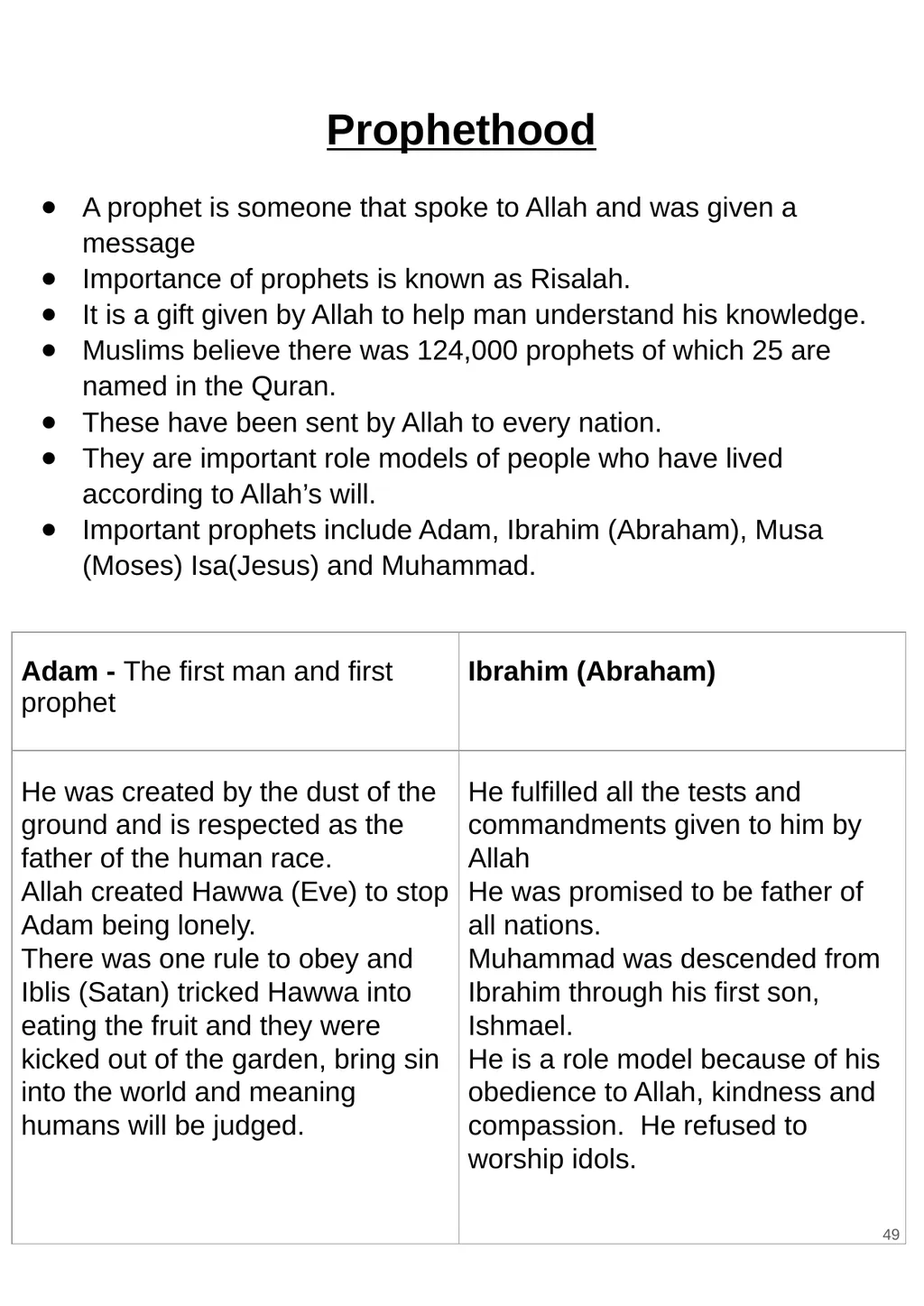
Prophethood A prophet is someone that spoke to Allah and was given a message
Importance of prophets is known as Risalah.
It is a gift given by Allah to help man understand his knowledge.
Muslims believe there was 124,000 prophets of which 25 are named in the Quran.
These have been sent by Allah to every nation.
They are important role models of people who have lived according to Allah’s will.
Important prophets include Adam, Ibrahim (Abraham), Musa (Moses) Isa(Jesus) and Muhammad. 49<br>
Importance of prophets is known as Risalah.
It is a gift given by Allah to help man understand his knowledge.
Muslims believe there was 124,000 prophets of which 25 are named in the Quran.
These have been sent by Allah to every nation.
They are important role models of people who have lived according to Allah’s will.
Important prophets include Adam, Ibrahim (Abraham), Musa (Moses) Isa(Jesus) and Muhammad. 49<br>
50
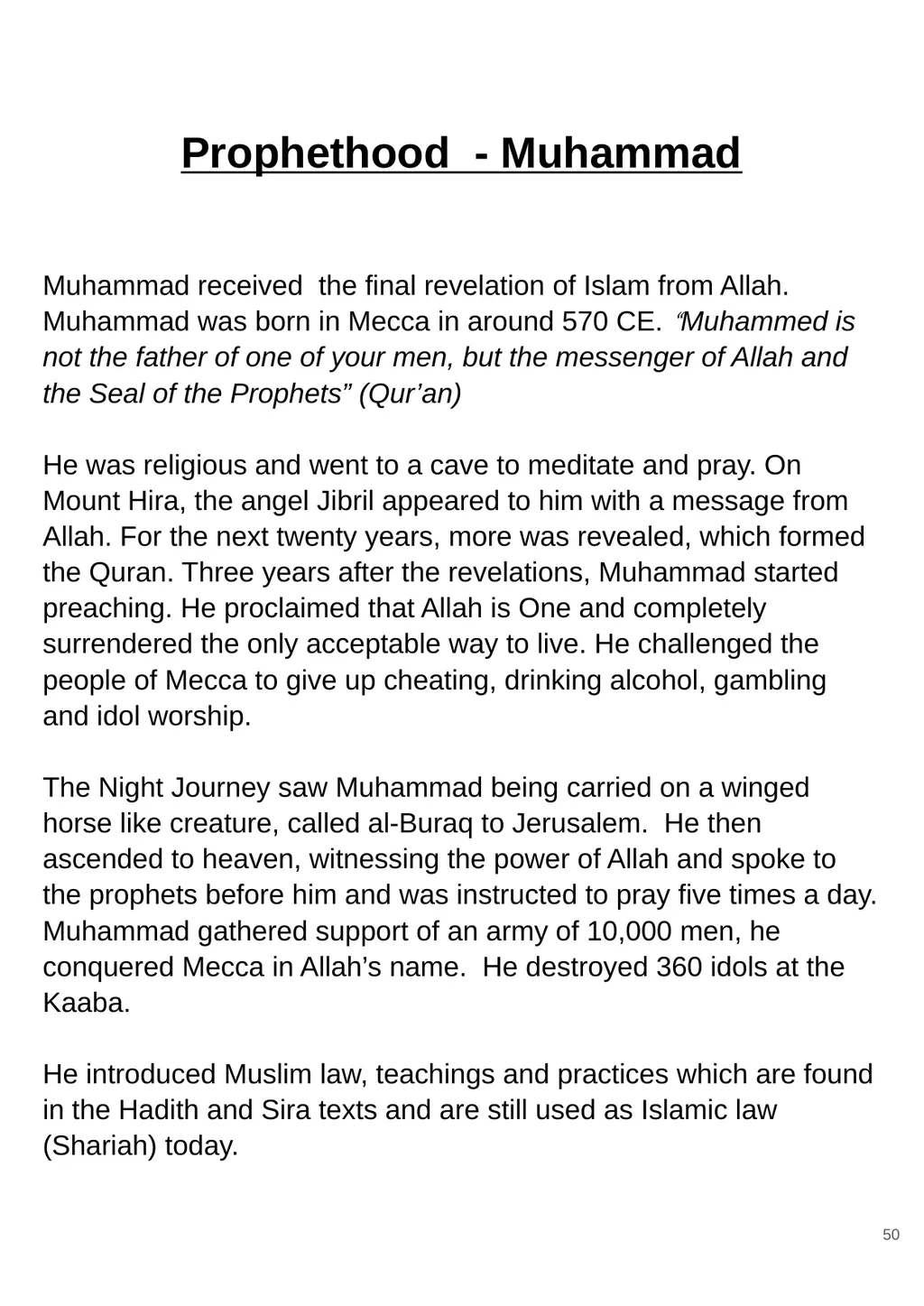
Prophethood - Muhammad Muhammad received the final revelation of Islam from Allah. Muhammad was born in Mecca in around 570 CE. “Muhammed is not the father of one of your men, but the messenger of Allah and the Seal of the Prophets” (Qur’an)
He was religious and went to a cave to meditate and pray. On Mount Hira, the angel Jibril appeared to him with a message from Allah. For the next twenty years, more was revealed, which formed the Quran. Three years after the revelations, Muhammad started preaching. He proclaimed that Allah is One and completely surrendered the only acceptable way to live. He challenged the people of Mecca to give up cheating, drinking alcohol, gambling and idol worship.
The Night Journey saw Muhammad being carried on a winged horse like creature, called al-Buraq to Jerusalem. He then ascended to heaven, witnessing the power of Allah and spoke to the prophets before him and was instructed to pray five times a day. Muhammad gathered support of an army of 10,000 men, he conquered Mecca in Allah’s name. He destroyed 360 idols at the Kaaba.
He introduced Muslim law, teachings and practices which are found in the Hadith and Sira texts and are still used as Islamic law (Shariah) today. 50<br>
He was religious and went to a cave to meditate and pray. On Mount Hira, the angel Jibril appeared to him with a message from Allah. For the next twenty years, more was revealed, which formed the Quran. Three years after the revelations, Muhammad started preaching. He proclaimed that Allah is One and completely surrendered the only acceptable way to live. He challenged the people of Mecca to give up cheating, drinking alcohol, gambling and idol worship.
The Night Journey saw Muhammad being carried on a winged horse like creature, called al-Buraq to Jerusalem. He then ascended to heaven, witnessing the power of Allah and spoke to the prophets before him and was instructed to pray five times a day. Muhammad gathered support of an army of 10,000 men, he conquered Mecca in Allah’s name. He destroyed 360 idols at the Kaaba.
He introduced Muslim law, teachings and practices which are found in the Hadith and Sira texts and are still used as Islamic law (Shariah) today. 50<br>
51
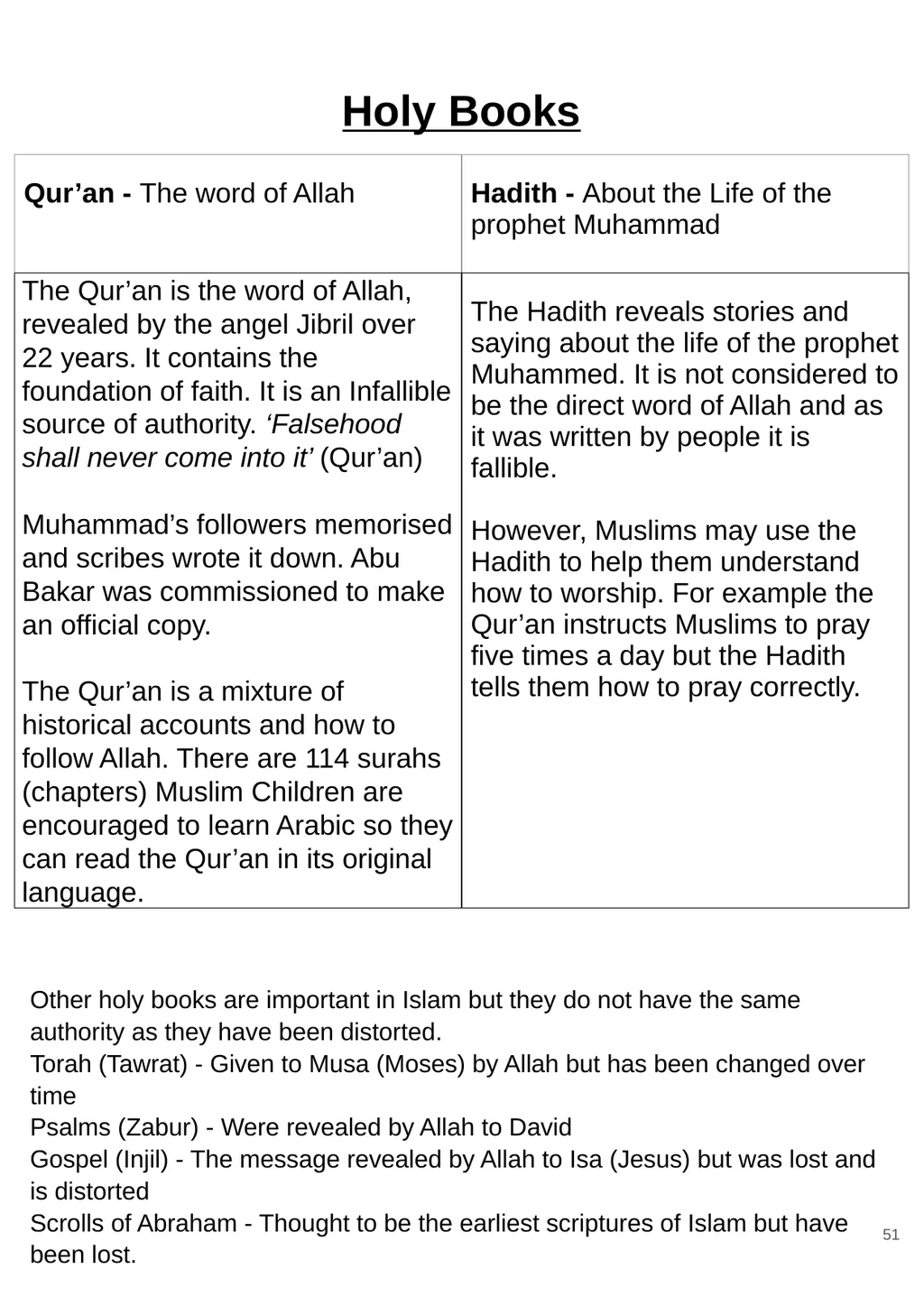
Holy Books Other holy books are important in Islam but they do not have the same authority as they have been distorted.
Torah (Tawrat) - Given to Musa (Moses) by Allah but has been changed over time
Psalms (Zabur) - Were revealed by Allah to David
Gospel (Injil) - The message revealed by Allah to Isa (Jesus) but was lost and is distorted
Scrolls of Abraham - Thought to be the earliest scriptures of Islam but have been lost. 51<br>
Torah (Tawrat) - Given to Musa (Moses) by Allah but has been changed over time
Psalms (Zabur) - Were revealed by Allah to David
Gospel (Injil) - The message revealed by Allah to Isa (Jesus) but was lost and is distorted
Scrolls of Abraham - Thought to be the earliest scriptures of Islam but have been lost. 51<br>
52
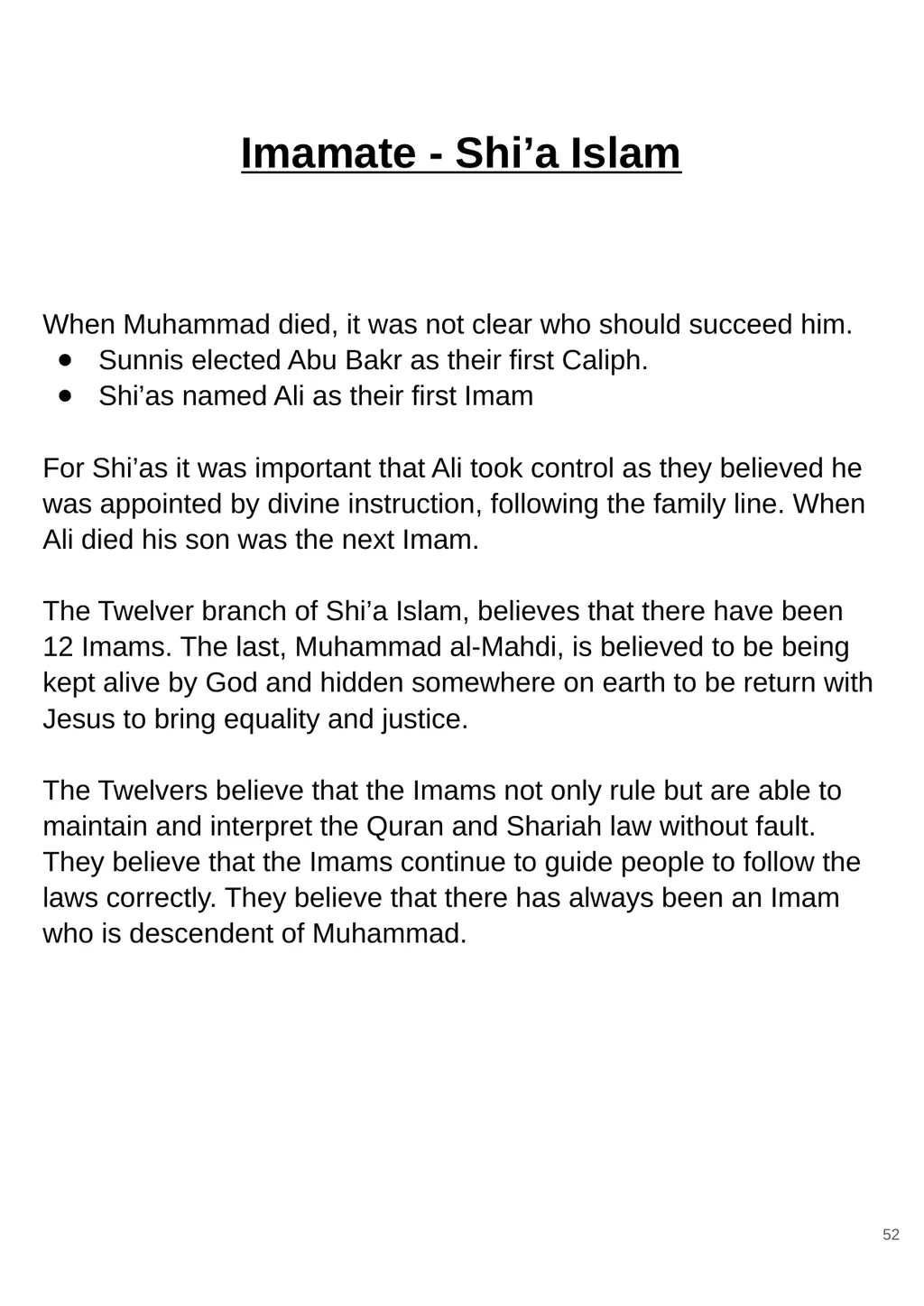
Imamate - Shi’a Islam When Muhammad died, it was not clear who should succeed him.
Sunnis elected Abu Bakr as their first Caliph.
Shi’as named Ali as their first Imam
For Shi’as it was important that Ali took control as they believed he was appointed by divine instruction, following the family line. When Ali died his son was the next Imam.
The Twelver branch of Shi’a Islam, believes that there have been 12 Imams. The last, Muhammad al-Mahdi, is believed to be being kept alive by God and hidden somewhere on earth to be return with Jesus to bring equality and justice.
The Twelvers believe that the Imams not only rule but are able to maintain and interpret the Quran and Shariah law without fault. They believe that the Imams continue to guide people to follow the laws correctly. They believe that there has always been an Imam who is descendent of Muhammad. 52<br>
Sunnis elected Abu Bakr as their first Caliph.
Shi’as named Ali as their first Imam
For Shi’as it was important that Ali took control as they believed he was appointed by divine instruction, following the family line. When Ali died his son was the next Imam.
The Twelver branch of Shi’a Islam, believes that there have been 12 Imams. The last, Muhammad al-Mahdi, is believed to be being kept alive by God and hidden somewhere on earth to be return with Jesus to bring equality and justice.
The Twelvers believe that the Imams not only rule but are able to maintain and interpret the Quran and Shariah law without fault. They believe that the Imams continue to guide people to follow the laws correctly. They believe that there has always been an Imam who is descendent of Muhammad. 52<br>
53
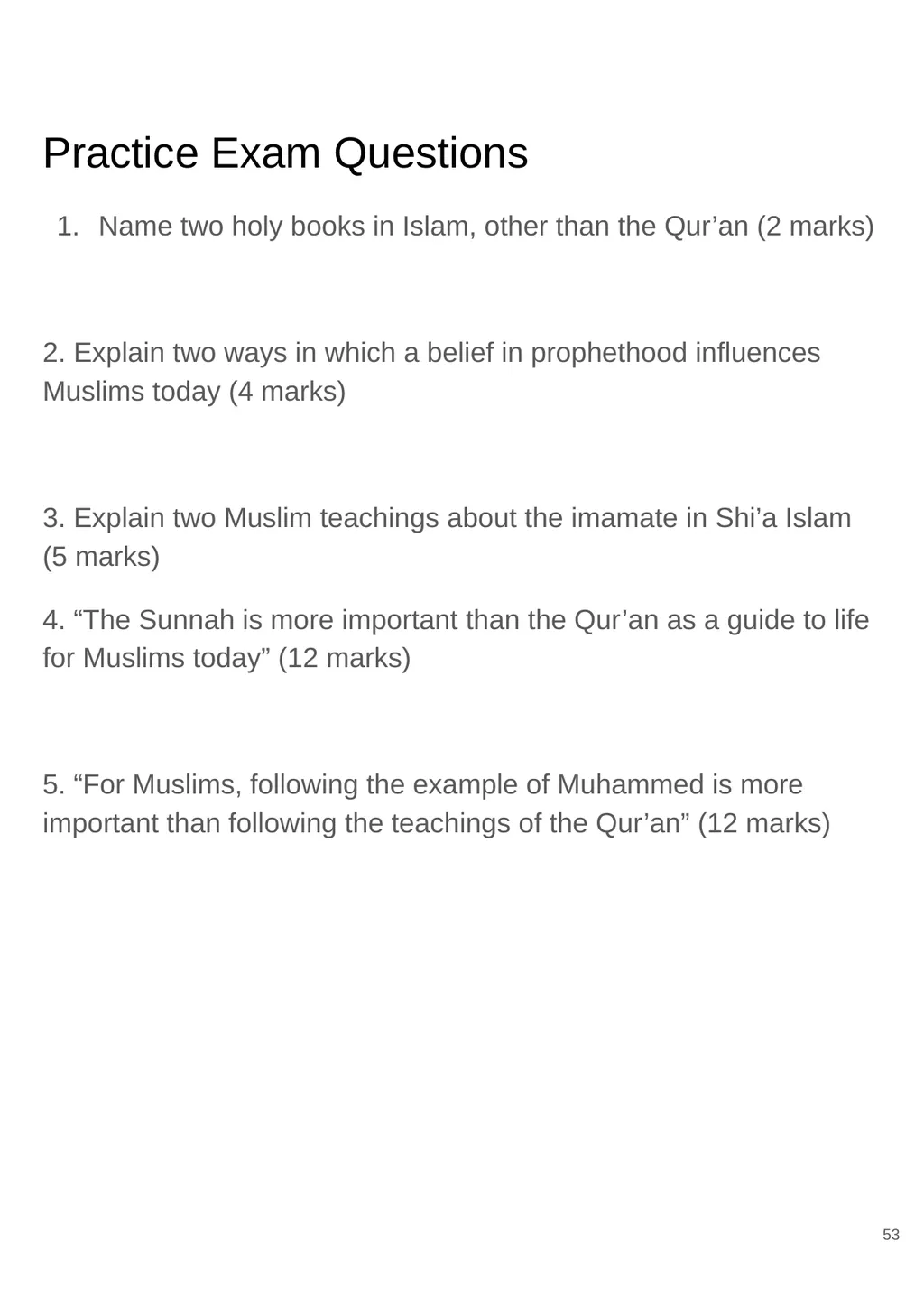
Practice Exam Questions Name two holy books in Islam, other than the Qur’an (2 marks)
2. Explain two ways in which a belief in prophethood influences Muslims today (4 marks)
3. Explain two Muslim teachings about the imamate in Shi’a Islam (5 marks)
4. “The Sunnah is more important than the Qur’an as a guide to life for Muslims today” (12 marks)
5. “For Muslims, following the example of Muhammed is more important than following the teachings of the Qur’an” (12 marks) 53<br>
2. Explain two ways in which a belief in prophethood influences Muslims today (4 marks)
3. Explain two Muslim teachings about the imamate in Shi’a Islam (5 marks)
4. “The Sunnah is more important than the Qur’an as a guide to life for Muslims today” (12 marks)
5. “For Muslims, following the example of Muhammed is more important than following the teachings of the Qur’an” (12 marks) 53<br>
54
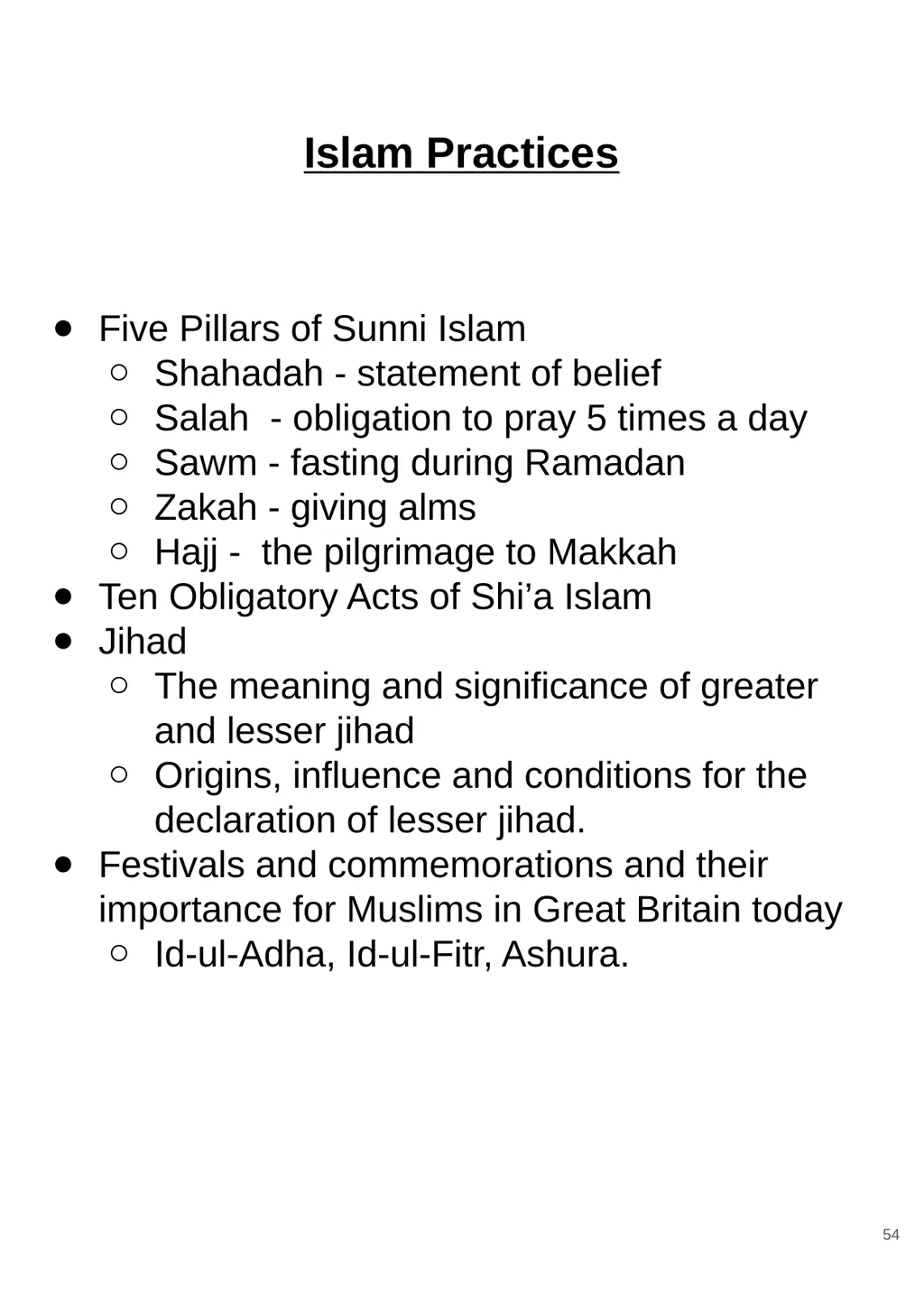
Islam Practices Five Pillars of Sunni Islam
Shahadah - statement of belief
Salah - obligation to pray 5 times a day
Sawm - fasting during Ramadan
Zakah - giving alms
Hajj - the pilgrimage to Makkah
Ten Obligatory Acts of Shi’a Islam
Jihad
The meaning and significance of greater and lesser jihad
Origins, influence and conditions for the declaration of lesser jihad.
Festivals and commemorations and their importance for Muslims in Great Britain today
Id-ul-Adha, Id-ul-Fitr, Ashura. 54<br>
Shahadah - statement of belief
Salah - obligation to pray 5 times a day
Sawm - fasting during Ramadan
Zakah - giving alms
Hajj - the pilgrimage to Makkah
Ten Obligatory Acts of Shi’a Islam
Jihad
The meaning and significance of greater and lesser jihad
Origins, influence and conditions for the declaration of lesser jihad.
Festivals and commemorations and their importance for Muslims in Great Britain today
Id-ul-Adha, Id-ul-Fitr, Ashura. 54<br>
55
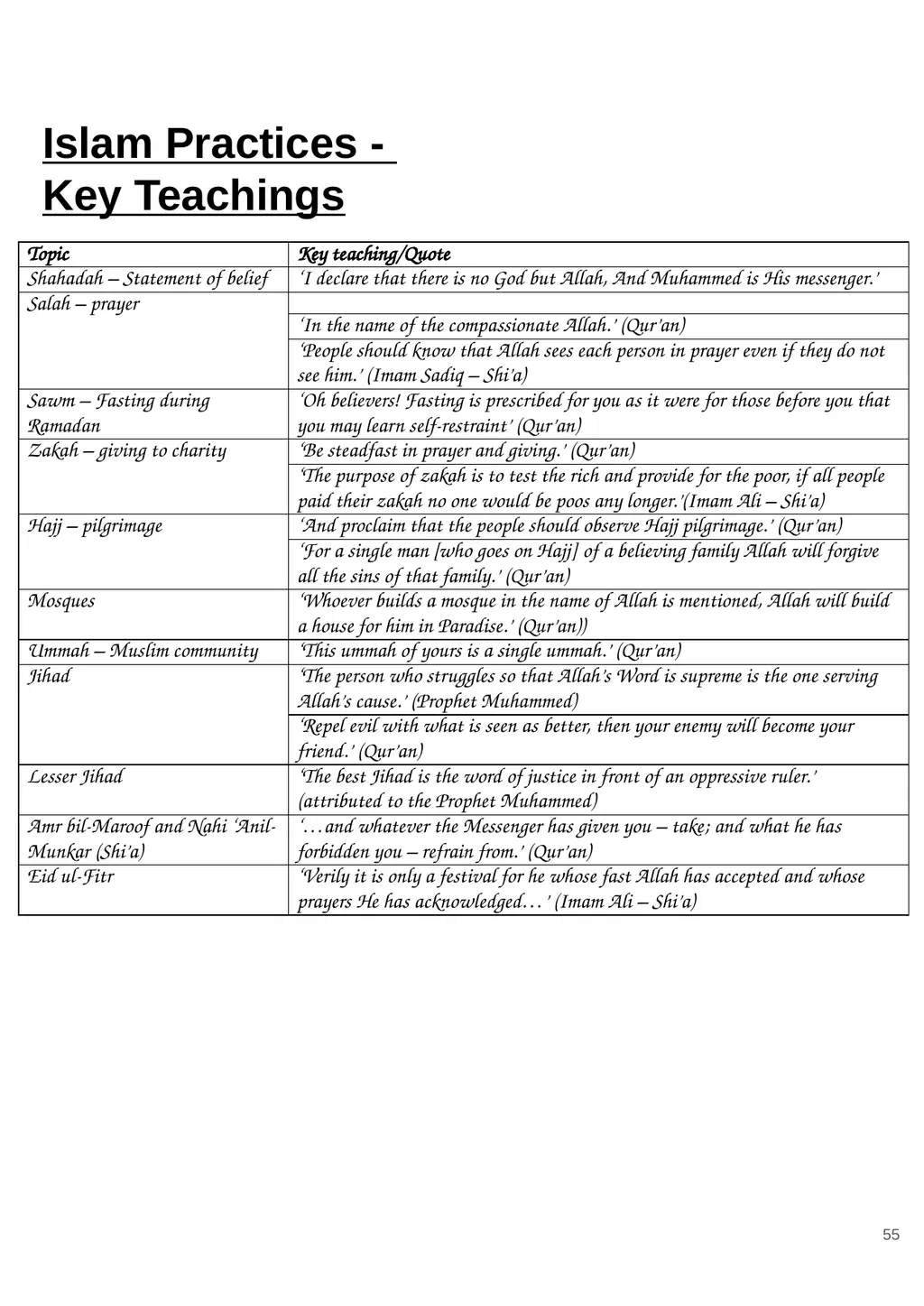
Islam Practices -
Key Teachings 55<br>
Key Teachings 55<br>
56
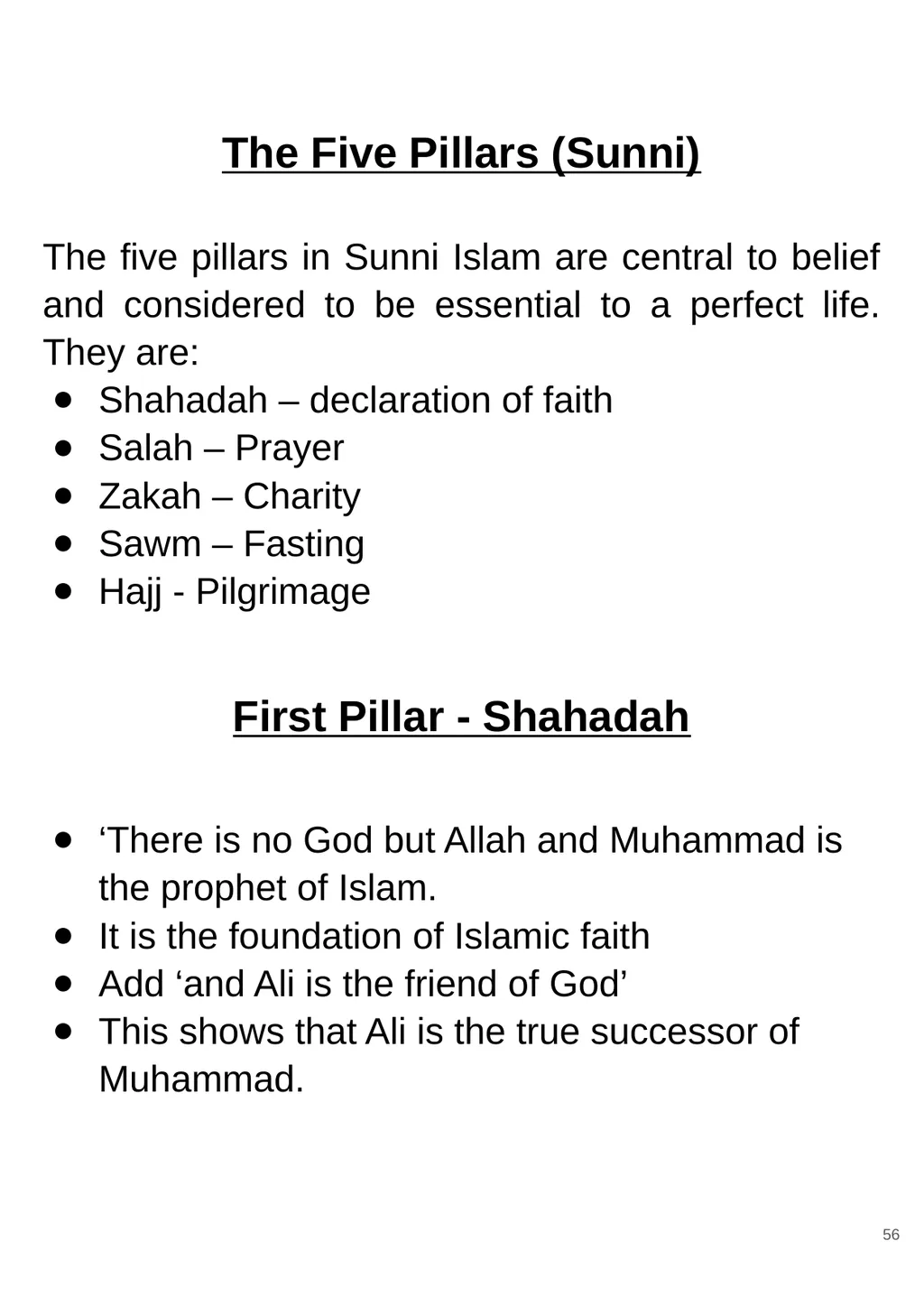
The Five Pillars (Sunni) The five pillars in Sunni Islam are central to belief and considered to be essential to a perfect life. They are:
Shahadah – declaration of faith
Salah – Prayer
Zakah – Charity
Sawm – Fasting
Hajj - Pilgrimage
First Pillar - Shahadah
‘There is no God but Allah and Muhammad is the prophet of Islam.
It is the foundation of Islamic faith
Add ‘and Ali is the friend of God’
This shows that Ali is the true successor of Muhammad. 56<br>
Shahadah – declaration of faith
Salah – Prayer
Zakah – Charity
Sawm – Fasting
Hajj - Pilgrimage
First Pillar - Shahadah
‘There is no God but Allah and Muhammad is the prophet of Islam.
It is the foundation of Islamic faith
Add ‘and Ali is the friend of God’
This shows that Ali is the true successor of Muhammad. 56<br>
57
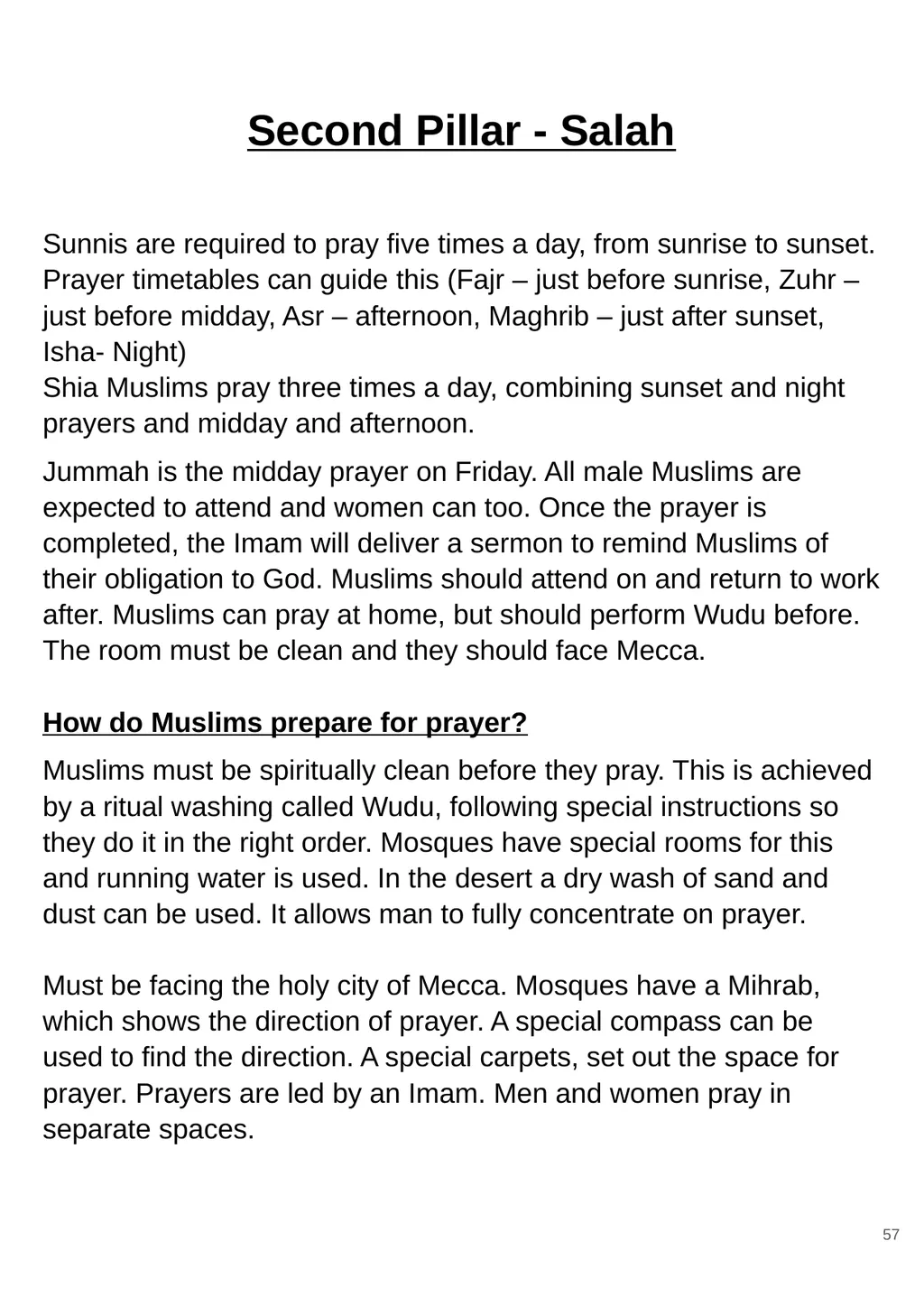
Second Pillar - Salah Sunnis are required to pray five times a day, from sunrise to sunset. Prayer timetables can guide this (Fajr – just before sunrise, Zuhr – just before midday, Asr – afternoon, Maghrib – just after sunset, Isha- Night)
Shia Muslims pray three times a day, combining sunset and night prayers and midday and afternoon.
Jummah is the midday prayer on Friday. All male Muslims are expected to attend and women can too. Once the prayer is completed, the Imam will deliver a sermon to remind Muslims of their obligation to God. Muslims should attend on and return to work after. Muslims can pray at home, but should perform Wudu before. The room must be clean and they should face Mecca.
How do Muslims prepare for prayer?
Muslims must be spiritually clean before they pray. This is achieved by a ritual washing called Wudu, following special instructions so they do it in the right order. Mosques have special rooms for this and running water is used. In the desert a dry wash of sand and dust can be used. It allows man to fully concentrate on prayer.
Must be facing the holy city of Mecca. Mosques have a Mihrab, which shows the direction of prayer. A special compass can be used to find the direction. A special carpets, set out the space for prayer. Prayers are led by an Imam. Men and women pray in separate spaces. 57<br>
Shia Muslims pray three times a day, combining sunset and night prayers and midday and afternoon.
Jummah is the midday prayer on Friday. All male Muslims are expected to attend and women can too. Once the prayer is completed, the Imam will deliver a sermon to remind Muslims of their obligation to God. Muslims should attend on and return to work after. Muslims can pray at home, but should perform Wudu before. The room must be clean and they should face Mecca.
How do Muslims prepare for prayer?
Muslims must be spiritually clean before they pray. This is achieved by a ritual washing called Wudu, following special instructions so they do it in the right order. Mosques have special rooms for this and running water is used. In the desert a dry wash of sand and dust can be used. It allows man to fully concentrate on prayer.
Must be facing the holy city of Mecca. Mosques have a Mihrab, which shows the direction of prayer. A special compass can be used to find the direction. A special carpets, set out the space for prayer. Prayers are led by an Imam. Men and women pray in separate spaces. 57<br>
58
Second Pillar - Salah The basic actions of prayer are:
While standing, Muslims recite the first chapter from the Quran.
While bowing, Muslims say in Arabic; ‘Glory be to my Lord who is the greatest’ three times. This bowing position show they believe God to be great.
Returning to an upright position, they make a recitation praising God.
They kneel with their forehead, nose, hands, knees and toes touching the floor. This is called prostration shows complete obedience to God. They recite ‘How perfect is my Lord the most high’.
Muslims then sit reciting ‘God is greatest’ and after pausing for a few seconds, they repeat ‘God is greatest’.
Why is prayer important in Islam?
It is what God commanded them to do.
It is a way Muslims across the world are united.
It reminds them that God is more important than they are. 58<br>
While standing, Muslims recite the first chapter from the Quran.
While bowing, Muslims say in Arabic; ‘Glory be to my Lord who is the greatest’ three times. This bowing position show they believe God to be great.
Returning to an upright position, they make a recitation praising God.
They kneel with their forehead, nose, hands, knees and toes touching the floor. This is called prostration shows complete obedience to God. They recite ‘How perfect is my Lord the most high’.
Muslims then sit reciting ‘God is greatest’ and after pausing for a few seconds, they repeat ‘God is greatest’.
Why is prayer important in Islam?
It is what God commanded them to do.
It is a way Muslims across the world are united.
It reminds them that God is more important than they are. 58<br>
59
Practice Exam Questions Give two reasons why Shahadah is the first pillar (2 marks)
2. Explain two contrasting understandings of Salah (4 marks)
3. Explain two ways in which Muslims view Salah as important (5 marks) 59<br>
2. Explain two contrasting understandings of Salah (4 marks)
3. Explain two ways in which Muslims view Salah as important (5 marks) 59<br>
60
Third Pillar - Sawm Ramadan is the ninth month of the Islamic calendar. It is believed that during Ramadan the Quran was first revealed. Many Muslims recite the whole Quran, in daily sections over 30 days. This allows Muslims to remember the importance of the teachings and their importance in their daily lives. Muslims will fast, complete charity and please God.
Ramadan sees Muslims fast in daylight hours. They get up before sunrise to eat and drink enough to keep them satisfied until the end of the day.
The evening meal is often shared with family and friends, prayers are said and readings from the Quran. This can be difficult for Muslims living in non-Muslim countries. The focus of Ramadan is God. It is time to purify the thought to cleanse the soul.
People can be excused like pregnant women, nursing mothers, babies, young children and those who are ill. Some older children, may fast for a shorter length of time to help prepare themselves. It helps empathise with the poor. They may invite the poor to eat with them. Many pay Zakat during this month.
Night of Power is an important festival that marks the beginning of God’s revelation. Observing the Night of Power give Muslims benefits of worshipping for a thousand months. Muslims try to keep awake on each possible night of each, devoting to prayers and studying the Quran. 60<br>
Ramadan sees Muslims fast in daylight hours. They get up before sunrise to eat and drink enough to keep them satisfied until the end of the day.
The evening meal is often shared with family and friends, prayers are said and readings from the Quran. This can be difficult for Muslims living in non-Muslim countries. The focus of Ramadan is God. It is time to purify the thought to cleanse the soul.
People can be excused like pregnant women, nursing mothers, babies, young children and those who are ill. Some older children, may fast for a shorter length of time to help prepare themselves. It helps empathise with the poor. They may invite the poor to eat with them. Many pay Zakat during this month.
Night of Power is an important festival that marks the beginning of God’s revelation. Observing the Night of Power give Muslims benefits of worshipping for a thousand months. Muslims try to keep awake on each possible night of each, devoting to prayers and studying the Quran. 60<br>
61
Fourth Pillar - Zakat For Muslims who have savings, it is compulsory to give 2.5% of their savings to the poor. Muslims work out how much to pay during Ramadan. This is an acknowledgement that everything comes from God, by giving to the poor. Zakat means to purify or cleanse, removing selfishness and greed. The figure of 2.5% was figured out by scholars as it was not stated in the Quran.
Muslims can choose how to pay, some pay in gold. It can be paid directly to a charity like Islamic relief. Some may pay a Sadaqah, which is a voluntary payment on top of zakat.
Fulfilling a duty imposed by God, making clear they are a true Muslim.
Shows a good attitude towards money as you are sharing.
It strengthens communities
It links to prayers and puts them into action.
Khums refers to 20% of the excess income earned by Shi’a Muslims. Half goes to religious leaders and half goes to the poor. 61<br>
Muslims can choose how to pay, some pay in gold. It can be paid directly to a charity like Islamic relief. Some may pay a Sadaqah, which is a voluntary payment on top of zakat.
Fulfilling a duty imposed by God, making clear they are a true Muslim.
Shows a good attitude towards money as you are sharing.
It strengthens communities
It links to prayers and puts them into action.
Khums refers to 20% of the excess income earned by Shi’a Muslims. Half goes to religious leaders and half goes to the poor. 61<br>
62
Practice Exam Questions Give two rituals that are performed during Salah (2 marks)
2. Explain two contrasting Muslim views about the importance of Sawm (4 marks)
3. Explain two ways in which Muslims view Zakah as important (5 marks) 62<br>
2. Explain two contrasting Muslim views about the importance of Sawm (4 marks)
3. Explain two ways in which Muslims view Zakah as important (5 marks) 62<br>
63
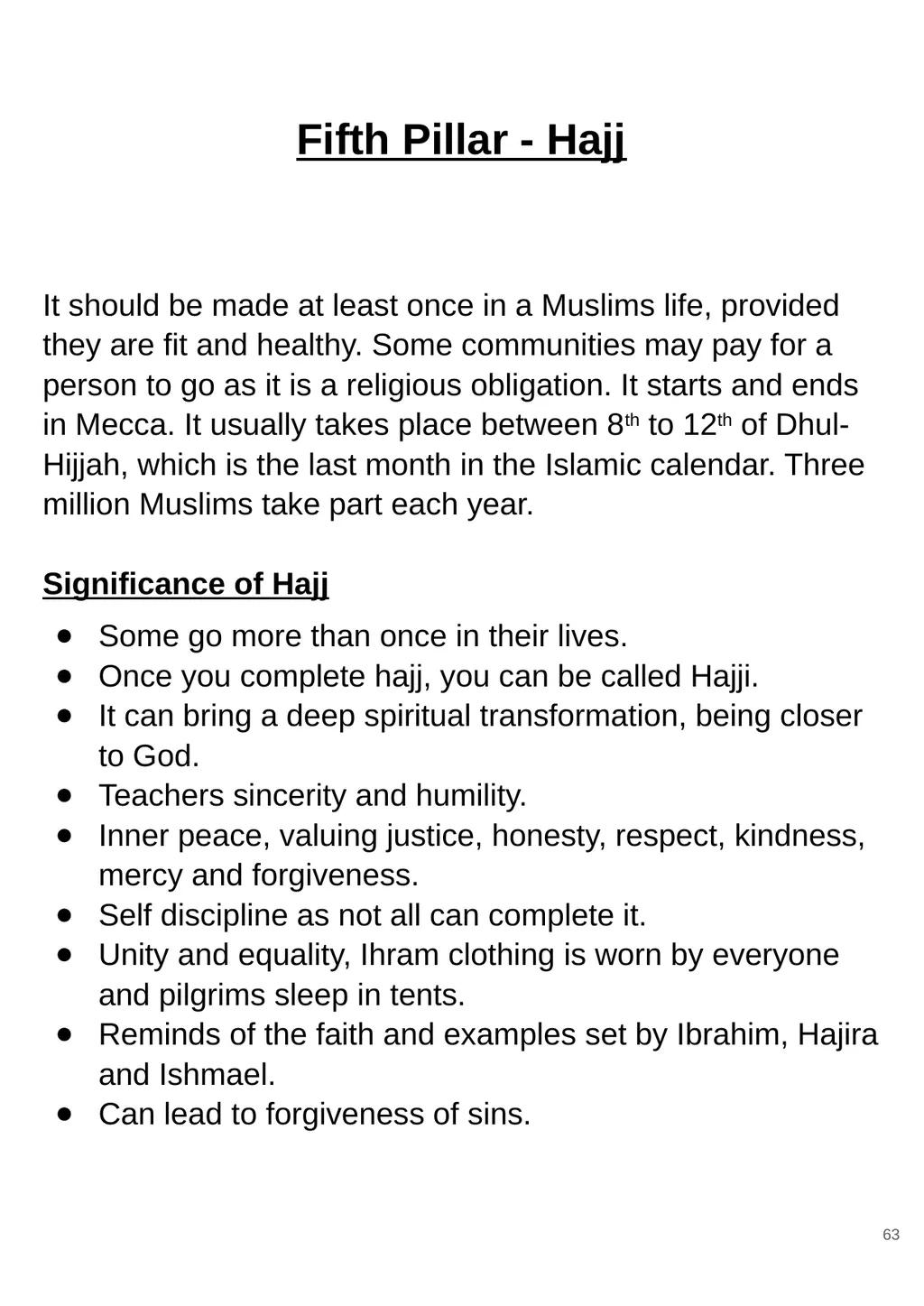
Fifth Pillar - Hajj It should be made at least once in a Muslims life, provided they are fit and healthy. Some communities may pay for a person to go as it is a religious obligation. It starts and ends in Mecca. It usually takes place between 8th to 12th of Dhul-Hijjah, which is the last month in the Islamic calendar. Three million Muslims take part each year.
Significance of Hajj
Some go more than once in their lives.
Once you complete hajj, you can be called Hajji.
It can bring a deep spiritual transformation, being closer to God.
Teachers sincerity and humility.
Inner peace, valuing justice, honesty, respect, kindness, mercy and forgiveness.
Self discipline as not all can complete it.
Unity and equality, Ihram clothing is worn by everyone and pilgrims sleep in tents.
Reminds of the faith and examples set by Ibrahim, Hajira and Ishmael.
Can lead to forgiveness of sins. 63<br>
Significance of Hajj
Some go more than once in their lives.
Once you complete hajj, you can be called Hajji.
It can bring a deep spiritual transformation, being closer to God.
Teachers sincerity and humility.
Inner peace, valuing justice, honesty, respect, kindness, mercy and forgiveness.
Self discipline as not all can complete it.
Unity and equality, Ihram clothing is worn by everyone and pilgrims sleep in tents.
Reminds of the faith and examples set by Ibrahim, Hajira and Ishmael.
Can lead to forgiveness of sins. 63<br>
64
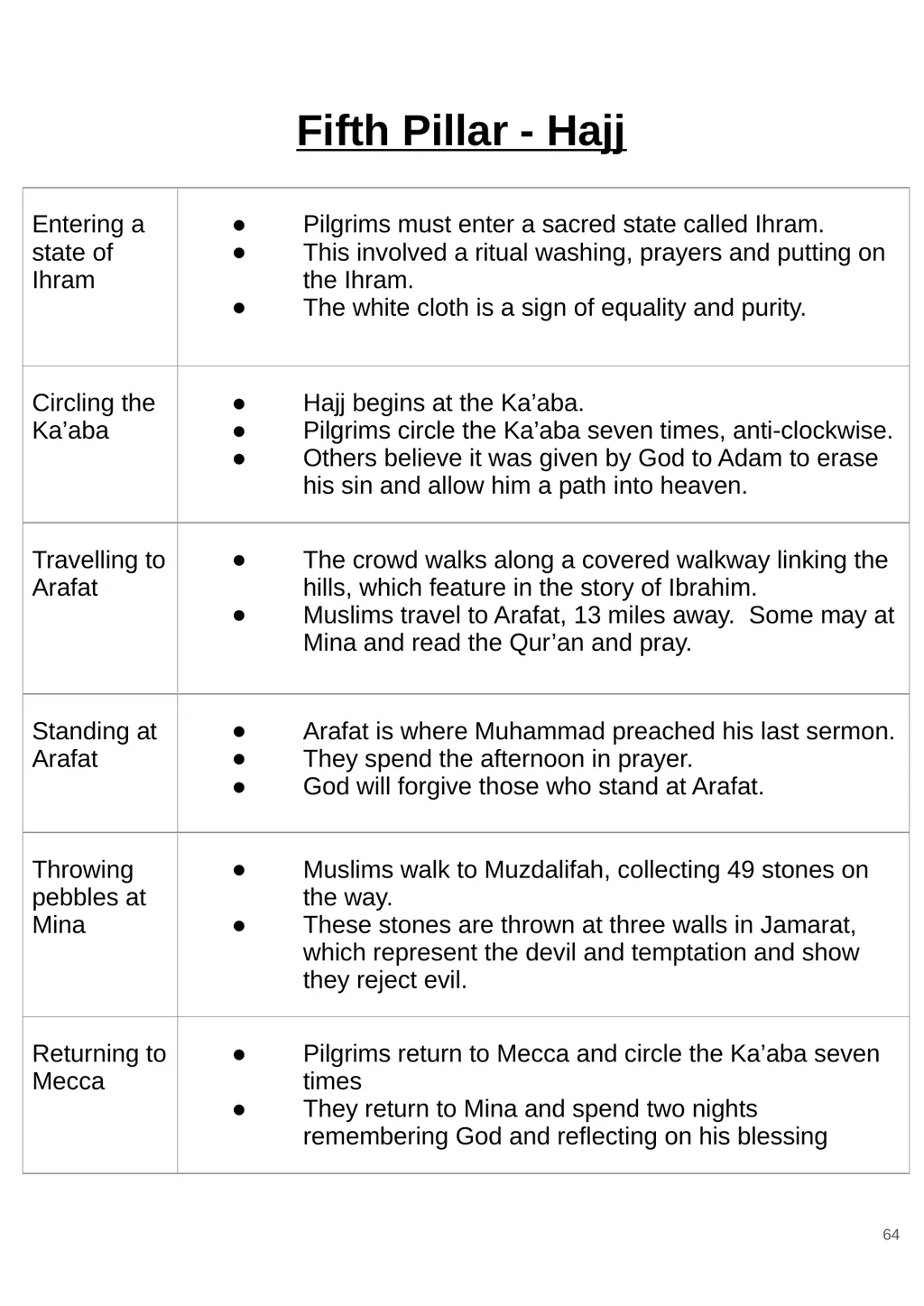
Fifth Pillar - Hajj 64<br>
65
Practice Exam Questions Give two places pilgrims visit during Hajj (2 marks)
2. Explain two contrasting Muslim views about the importance of Hajj (4 marks)
3. Explain two ways in which the Ka’aba is important in the Muslim Hajj (5 marks)
4. “Shahadah is the most important of the five pillars” (12 marks)
5. “Prayer is more beneficial than going on Hajj” (12 marks) 65<br>
2. Explain two contrasting Muslim views about the importance of Hajj (4 marks)
3. Explain two ways in which the Ka’aba is important in the Muslim Hajj (5 marks)
4. “Shahadah is the most important of the five pillars” (12 marks)
5. “Prayer is more beneficial than going on Hajj” (12 marks) 65<br>
66
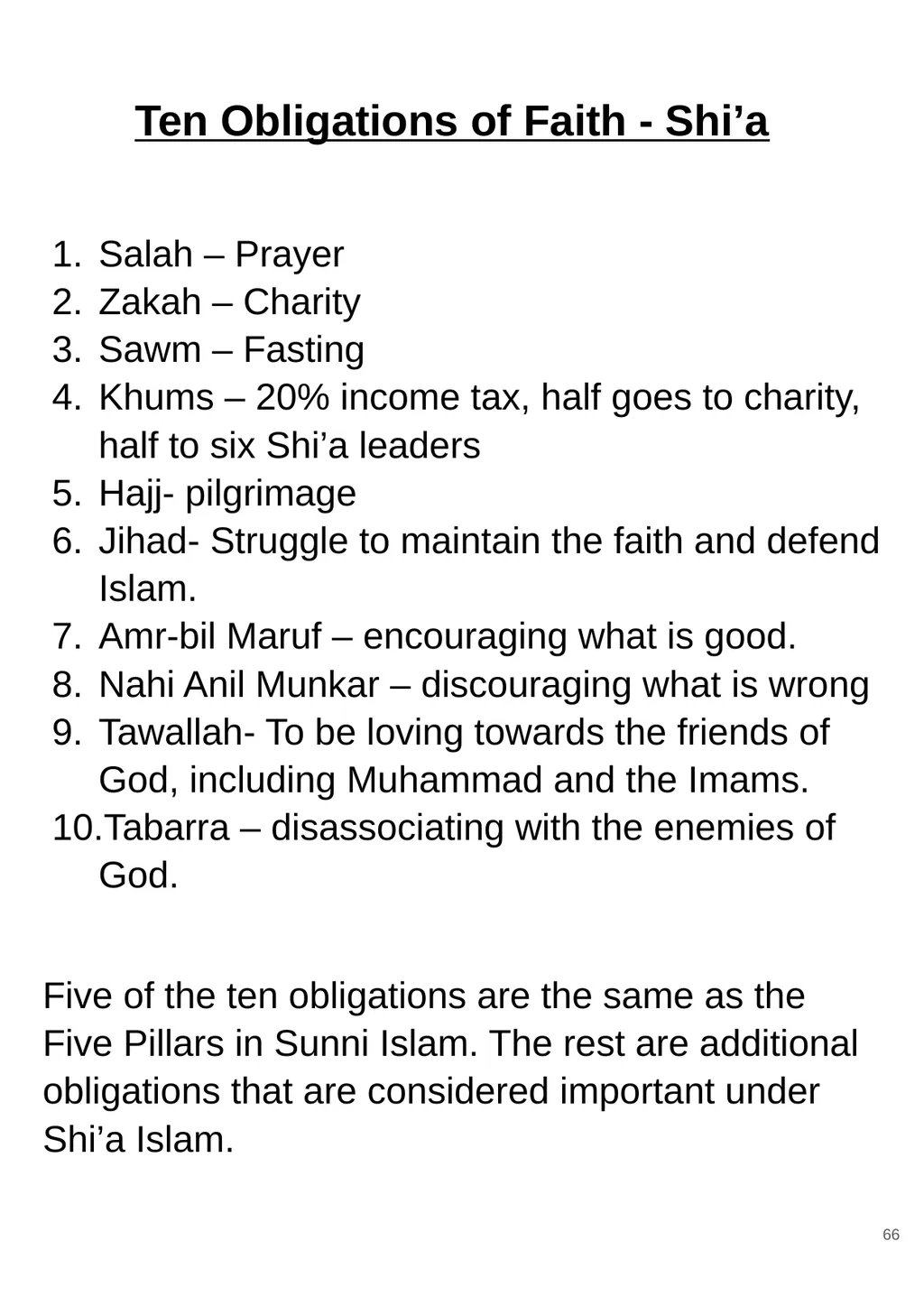
Ten Obligations of Faith - Shi’a Salah – Prayer
Zakah – Charity
Sawm – Fasting
Khums – 20% income tax, half goes to charity, half to six Shi’a leaders
Hajj- pilgrimage
Jihad- Struggle to maintain the faith and defend Islam.
Amr-bil Maruf – encouraging what is good.
Nahi Anil Munkar – discouraging what is wrong
Tawallah- To be loving towards the friends of God, including Muhammad and the Imams.
Tabarra – disassociating with the enemies of God.
Five of the ten obligations are the same as the Five Pillars in Sunni Islam. The rest are additional obligations that are considered important under Shi’a Islam. 66<br>
Zakah – Charity
Sawm – Fasting
Khums – 20% income tax, half goes to charity, half to six Shi’a leaders
Hajj- pilgrimage
Jihad- Struggle to maintain the faith and defend Islam.
Amr-bil Maruf – encouraging what is good.
Nahi Anil Munkar – discouraging what is wrong
Tawallah- To be loving towards the friends of God, including Muhammad and the Imams.
Tabarra – disassociating with the enemies of God.
Five of the ten obligations are the same as the Five Pillars in Sunni Islam. The rest are additional obligations that are considered important under Shi’a Islam. 66<br>
67
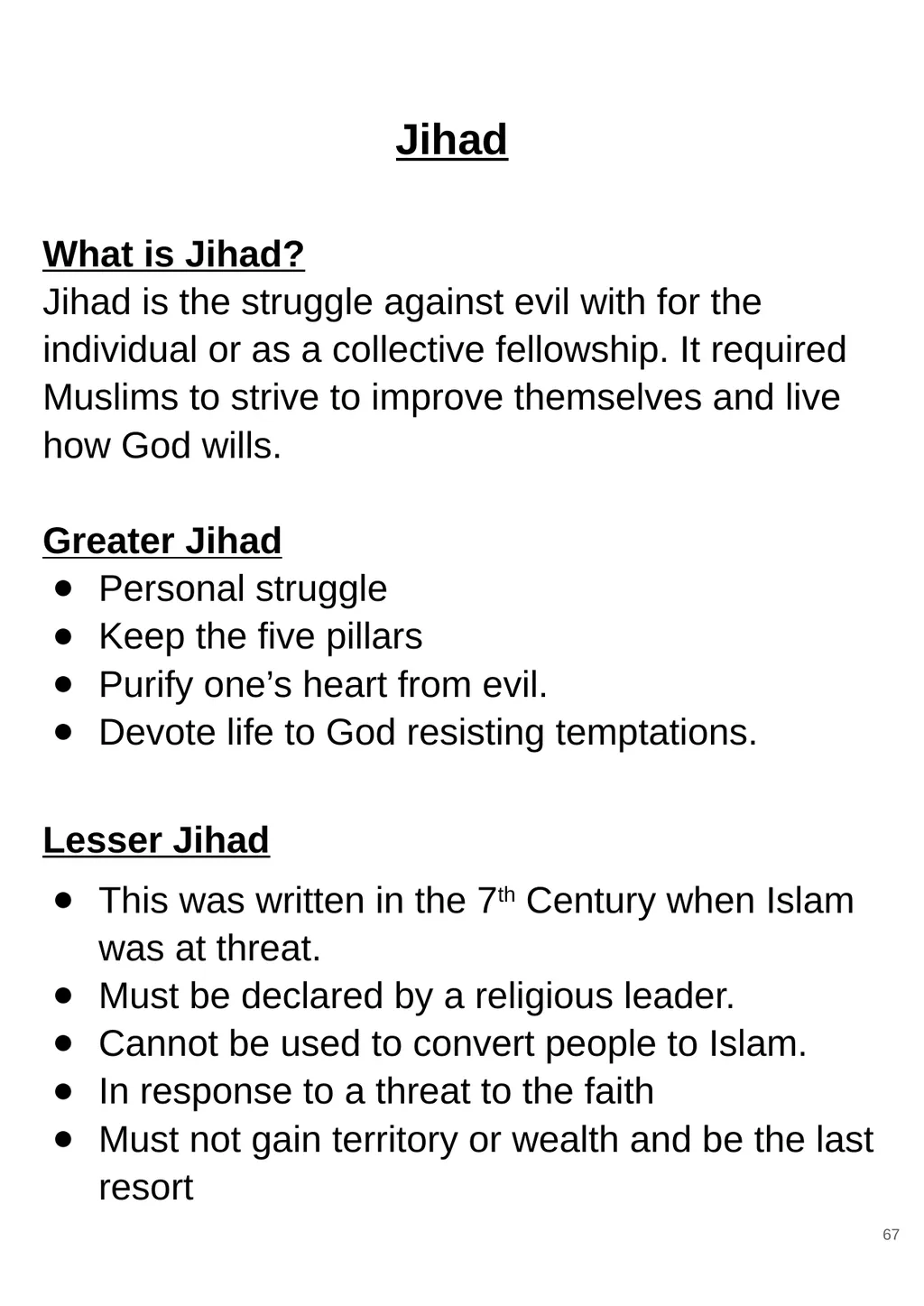
Jihad What is Jihad?
Jihad is the struggle against evil with for the individual or as a collective fellowship. It required Muslims to strive to improve themselves and live how God wills.
Greater Jihad
Personal struggle
Keep the five pillars
Purify one’s heart from evil.
Devote life to God resisting temptations.
Lesser Jihad
This was written in the 7th Century when Islam was at threat.
Must be declared by a religious leader.
Cannot be used to convert people to Islam.
In response to a threat to the faith
Must not gain territory or wealth and be the last resort 67<br>
Jihad is the struggle against evil with for the individual or as a collective fellowship. It required Muslims to strive to improve themselves and live how God wills.
Greater Jihad
Personal struggle
Keep the five pillars
Purify one’s heart from evil.
Devote life to God resisting temptations.
Lesser Jihad
This was written in the 7th Century when Islam was at threat.
Must be declared by a religious leader.
Cannot be used to convert people to Islam.
In response to a threat to the faith
Must not gain territory or wealth and be the last resort 67<br>
68
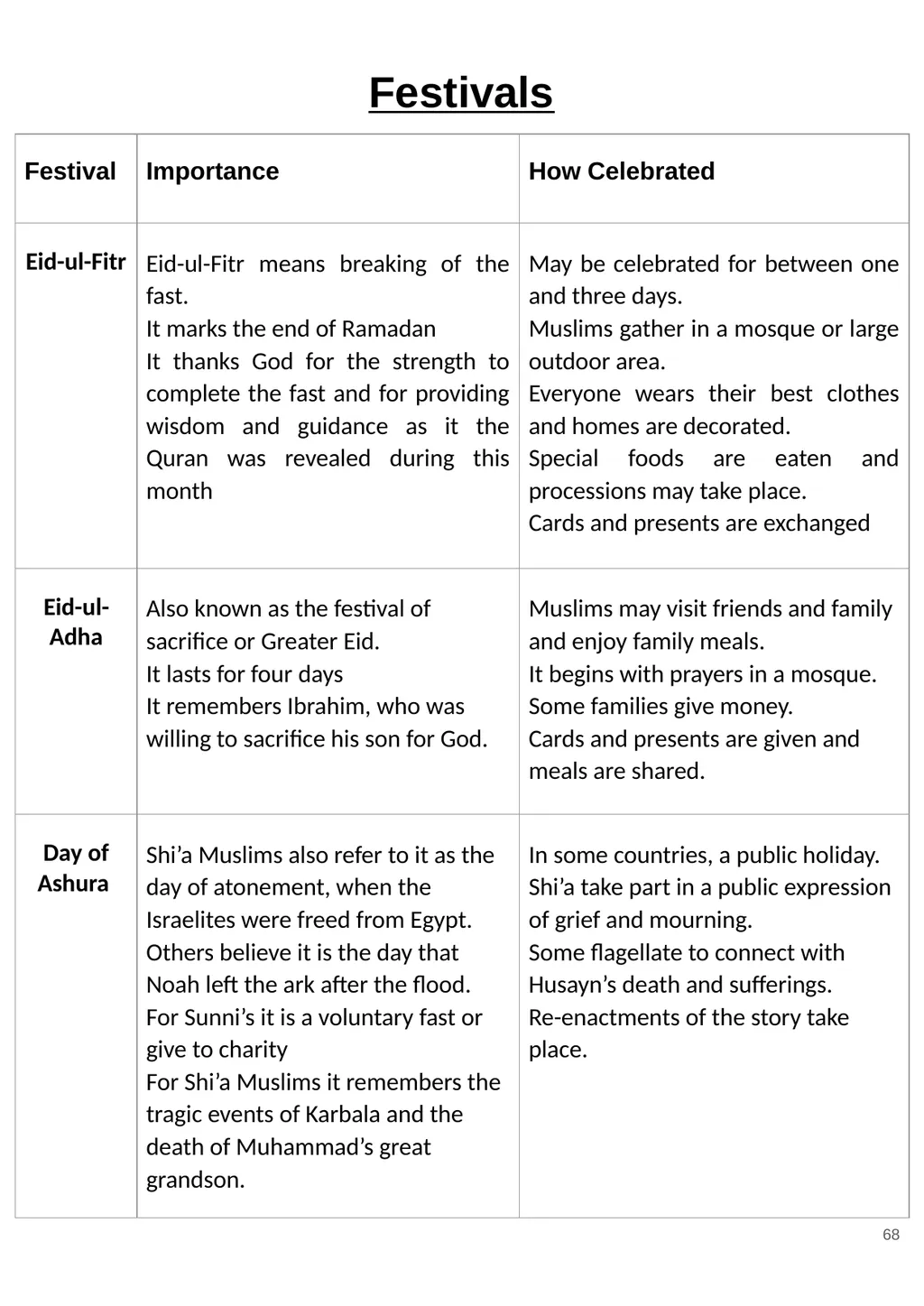
Festivals 68<br>
69
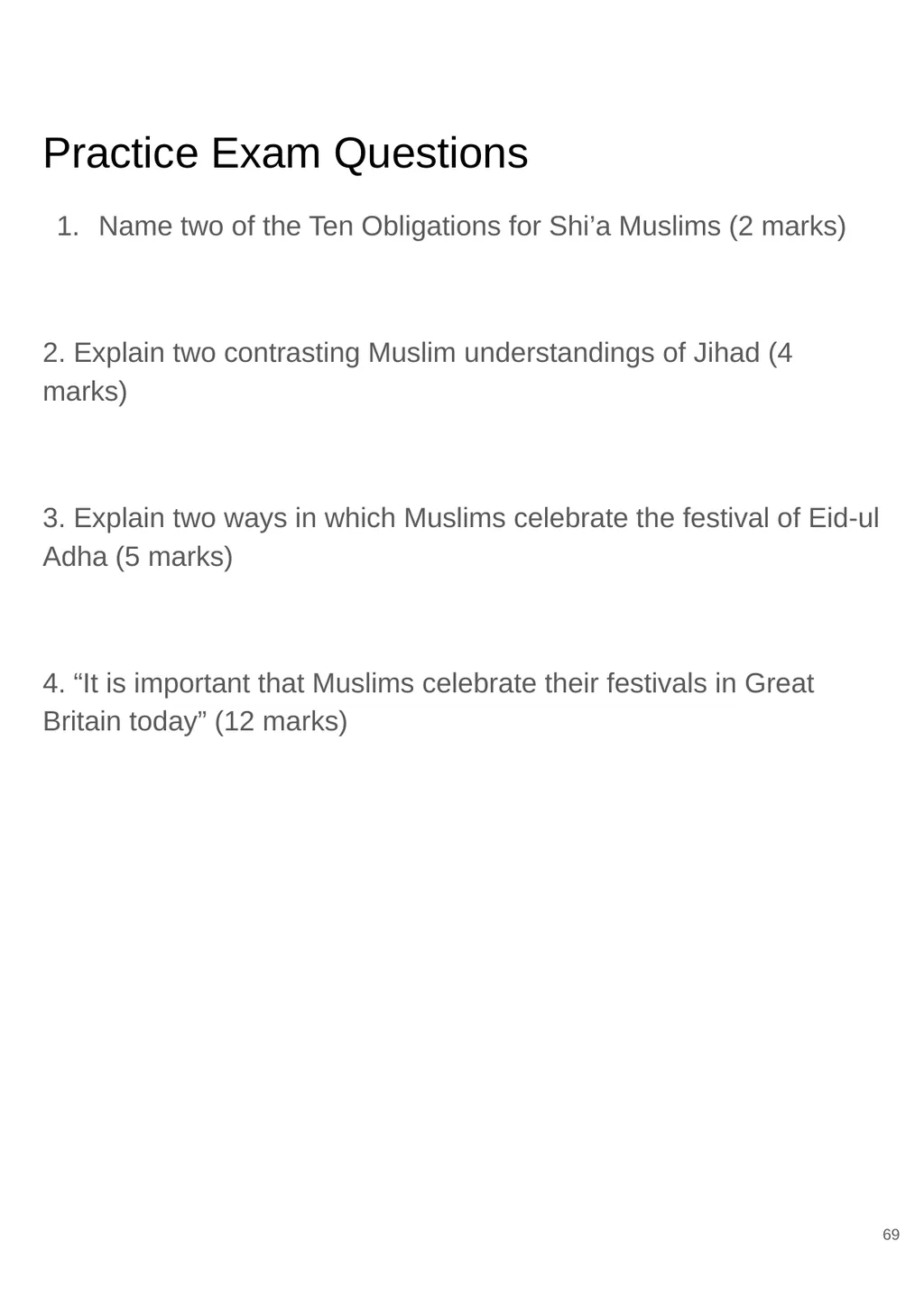
Practice Exam Questions Name two of the Ten Obligations for Shi’a Muslims (2 marks)
2. Explain two contrasting Muslim understandings of Jihad (4 marks)
3. Explain two ways in which Muslims celebrate the festival of Eid-ul Adha (5 marks)
4. “It is important that Muslims celebrate their festivals in Great Britain today” (12 marks) 69<br>
2. Explain two contrasting Muslim understandings of Jihad (4 marks)
3. Explain two ways in which Muslims celebrate the festival of Eid-ul Adha (5 marks)
4. “It is important that Muslims celebrate their festivals in Great Britain today” (12 marks) 69<br>
70
Component 2 - Thematic Studies<br>
71
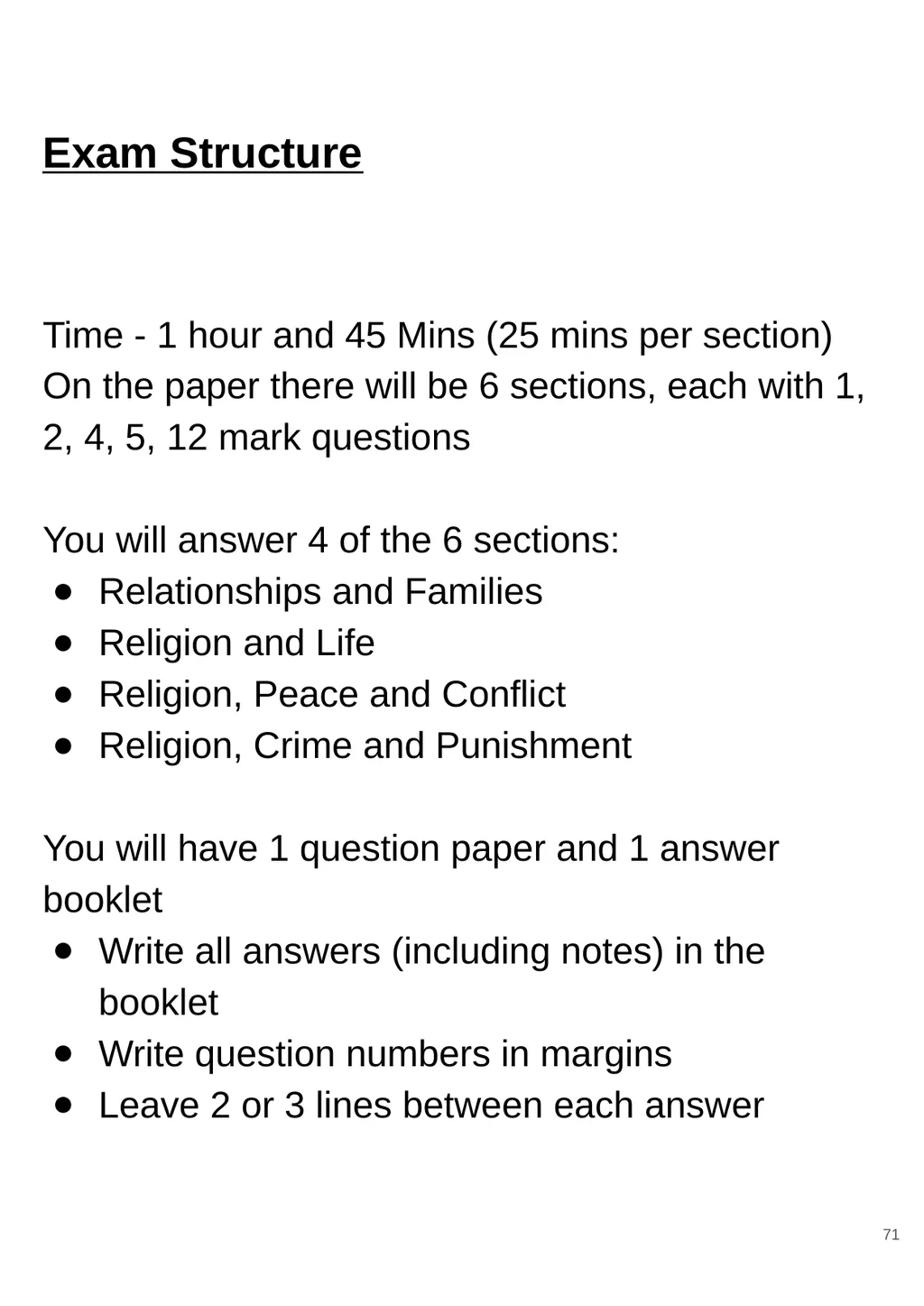
Exam Structure Time - 1 hour and 45 Mins (25 mins per section)
On the paper there will be 6 sections, each with 1, 2, 4, 5, 12 mark questions
You will answer 4 of the 6 sections:
Relationships and Families
Religion and Life
Religion, Peace and Conflict
Religion, Crime and Punishment
You will have 1 question paper and 1 answer booklet
Write all answers (including notes) in the booklet
Write question numbers in margins
Leave 2 or 3 lines between each answer 71<br>
On the paper there will be 6 sections, each with 1, 2, 4, 5, 12 mark questions
You will answer 4 of the 6 sections:
Relationships and Families
Religion and Life
Religion, Peace and Conflict
Religion, Crime and Punishment
You will have 1 question paper and 1 answer booklet
Write all answers (including notes) in the booklet
Write question numbers in margins
Leave 2 or 3 lines between each answer 71<br>
72
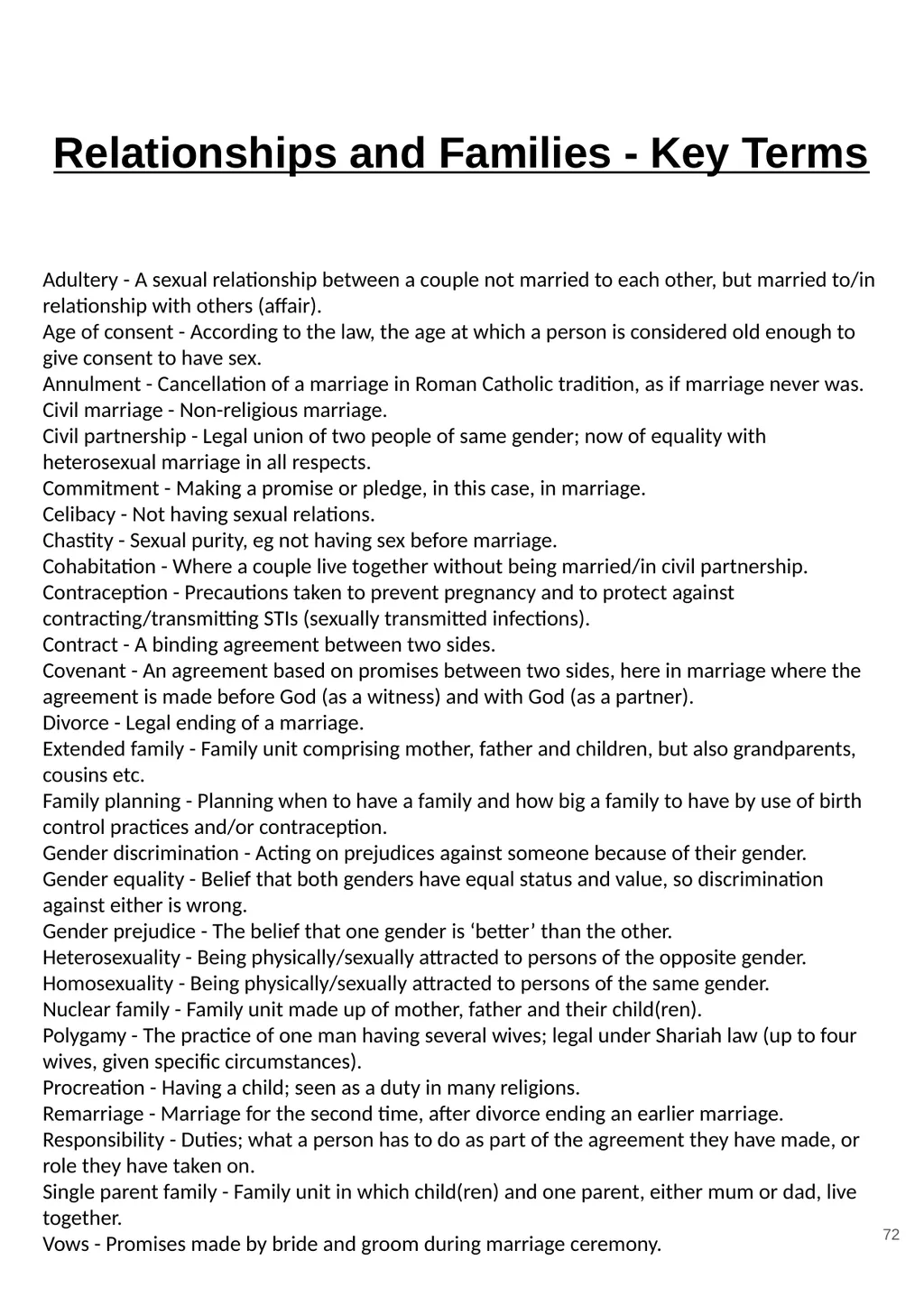
Relationships and Families - Key Terms Adultery - A sexual relationship between a couple not married to each other, but married to/in relationship with others (affair).
Age of consent - According to the law, the age at which a person is considered old enough to give consent to have sex.
Annulment - Cancellation of a marriage in Roman Catholic tradition, as if marriage never was.
Civil marriage - Non-religious marriage.
Civil partnership - Legal union of two people of same gender; now of equality with heterosexual marriage in all respects.
Commitment - Making a promise or pledge, in this case, in marriage.
Celibacy - Not having sexual relations.
Chastity - Sexual purity, eg not having sex before marriage.
Cohabitation - Where a couple live together without being married/in civil partnership.
Contraception - Precautions taken to prevent pregnancy and to protect against contracting/transmitting STIs (sexually transmitted infections).
Contract - A binding agreement between two sides.
Covenant - An agreement based on promises between two sides, here in marriage where the agreement is made before God (as a witness) and with God (as a partner).
Divorce - Legal ending of a marriage.
Extended family - Family unit comprising mother, father and children, but also grandparents, cousins etc.
Family planning - Planning when to have a family and how big a family to have by use of birth control practices and/or contraception.
Gender discrimination - Acting on prejudices against someone because of their gender.
Gender equality - Belief that both genders have equal status and value, so discrimination against either is wrong.
Gender prejudice - The belief that one gender is ‘better’ than the other.
Heterosexuality - Being physically/sexually attracted to persons of the opposite gender.
Homosexuality - Being physically/sexually attracted to persons of the same gender.
Nuclear family - Family unit made up of mother, father and their child(ren).
Polygamy - The practice of one man having several wives; legal under Shariah law (up to four wives, given specific circumstances).
Procreation - Having a child; seen as a duty in many religions.
Remarriage - Marriage for the second time, after divorce ending an earlier marriage.
Responsibility - Duties; what a person has to do as part of the agreement they have made, or role they have taken on.
Single parent family - Family unit in which child(ren) and one parent, either mum or dad, live together.
Vows - Promises made by bride and groom during marriage ceremony. 72<br>
Age of consent - According to the law, the age at which a person is considered old enough to give consent to have sex.
Annulment - Cancellation of a marriage in Roman Catholic tradition, as if marriage never was.
Civil marriage - Non-religious marriage.
Civil partnership - Legal union of two people of same gender; now of equality with heterosexual marriage in all respects.
Commitment - Making a promise or pledge, in this case, in marriage.
Celibacy - Not having sexual relations.
Chastity - Sexual purity, eg not having sex before marriage.
Cohabitation - Where a couple live together without being married/in civil partnership.
Contraception - Precautions taken to prevent pregnancy and to protect against contracting/transmitting STIs (sexually transmitted infections).
Contract - A binding agreement between two sides.
Covenant - An agreement based on promises between two sides, here in marriage where the agreement is made before God (as a witness) and with God (as a partner).
Divorce - Legal ending of a marriage.
Extended family - Family unit comprising mother, father and children, but also grandparents, cousins etc.
Family planning - Planning when to have a family and how big a family to have by use of birth control practices and/or contraception.
Gender discrimination - Acting on prejudices against someone because of their gender.
Gender equality - Belief that both genders have equal status and value, so discrimination against either is wrong.
Gender prejudice - The belief that one gender is ‘better’ than the other.
Heterosexuality - Being physically/sexually attracted to persons of the opposite gender.
Homosexuality - Being physically/sexually attracted to persons of the same gender.
Nuclear family - Family unit made up of mother, father and their child(ren).
Polygamy - The practice of one man having several wives; legal under Shariah law (up to four wives, given specific circumstances).
Procreation - Having a child; seen as a duty in many religions.
Remarriage - Marriage for the second time, after divorce ending an earlier marriage.
Responsibility - Duties; what a person has to do as part of the agreement they have made, or role they have taken on.
Single parent family - Family unit in which child(ren) and one parent, either mum or dad, live together.
Vows - Promises made by bride and groom during marriage ceremony. 72<br>
73
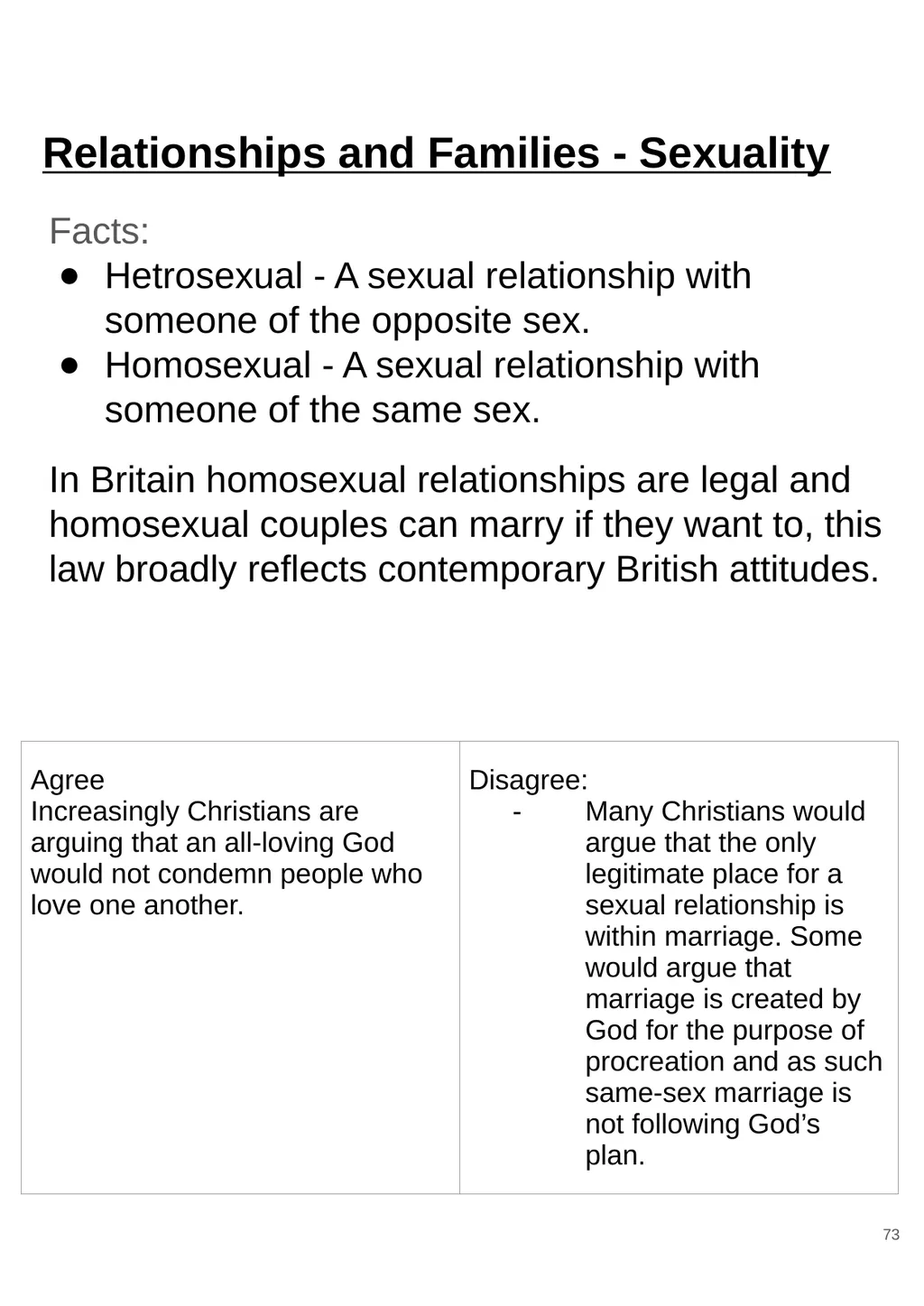
Relationships and Families - Sexuality Facts:
Hetrosexual - A sexual relationship with someone of the opposite sex.
Homosexual - A sexual relationship with someone of the same sex.
In Britain homosexual relationships are legal and homosexual couples can marry if they want to, this law broadly reflects contemporary British attitudes. 73<br>
Hetrosexual - A sexual relationship with someone of the opposite sex.
Homosexual - A sexual relationship with someone of the same sex.
In Britain homosexual relationships are legal and homosexual couples can marry if they want to, this law broadly reflects contemporary British attitudes. 73<br>
74
Relationships and Families - Contraception Facts:
Contraception - Any method that is used to prevent pregnancy (condoms etc)
Natural contraception - Method to guard against pregnancy by monitoring a woman’s fertility cycle 74<br>
Contraception - Any method that is used to prevent pregnancy (condoms etc)
Natural contraception - Method to guard against pregnancy by monitoring a woman’s fertility cycle 74<br>
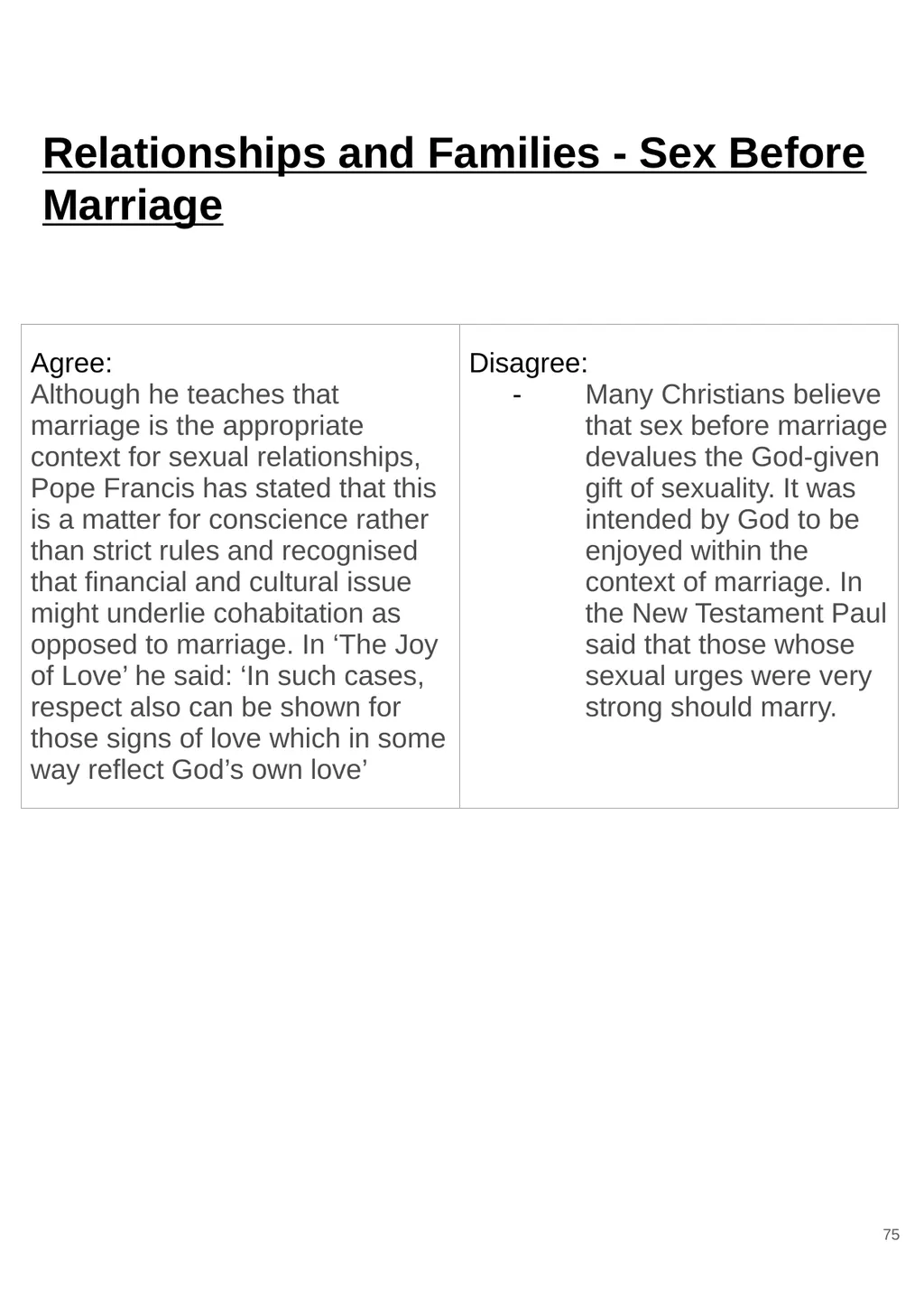
75
Relationships and Families - Sex Before Marriage 75<br>
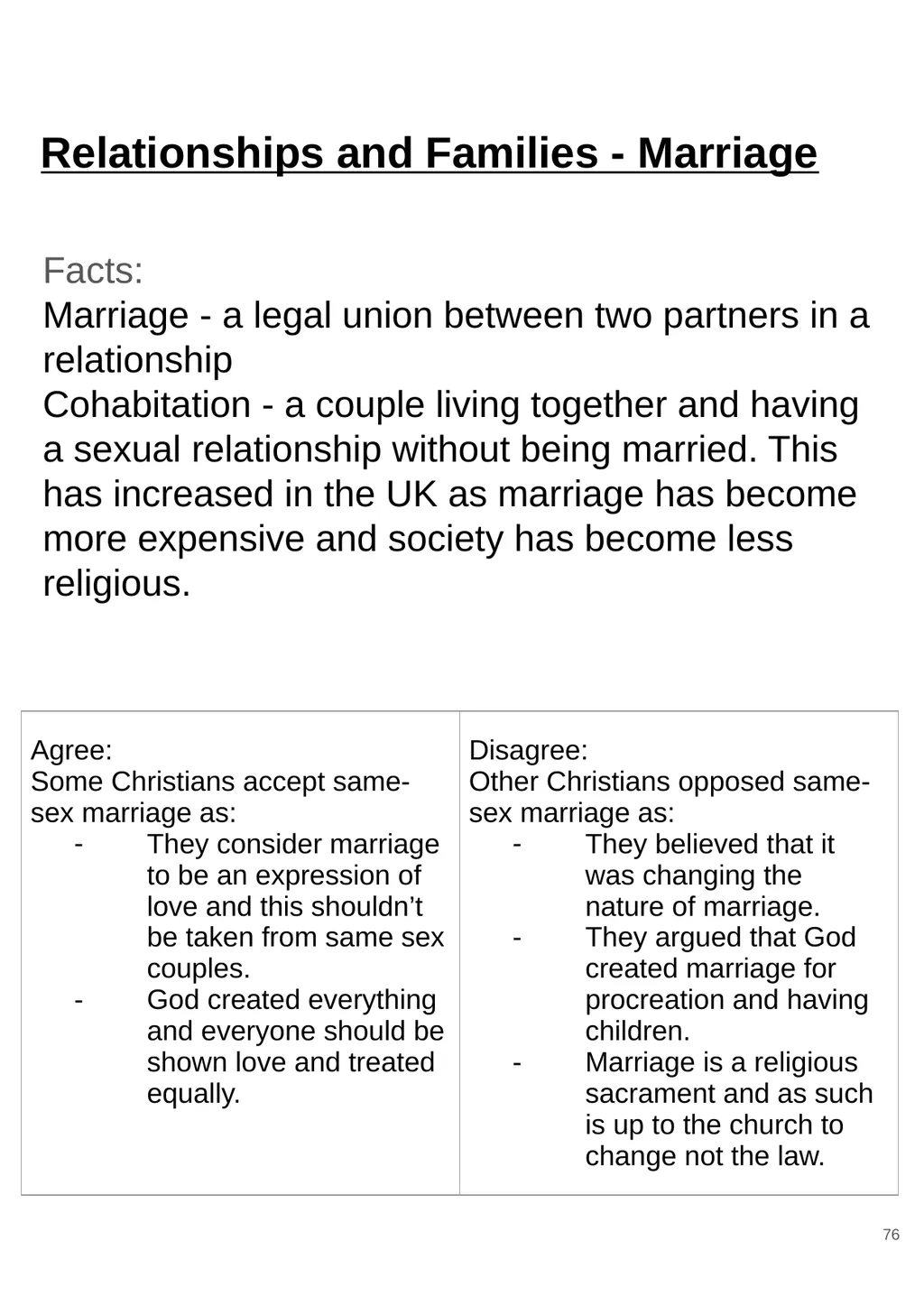
76
Relationships and Families - Marriage Facts:
Marriage - a legal union between two partners in a relationship
Cohabitation - a couple living together and having a sexual relationship without being married. This has increased in the UK as marriage has become more expensive and society has become less religious. 76<br>
Marriage - a legal union between two partners in a relationship
Cohabitation - a couple living together and having a sexual relationship without being married. This has increased in the UK as marriage has become more expensive and society has become less religious. 76<br>
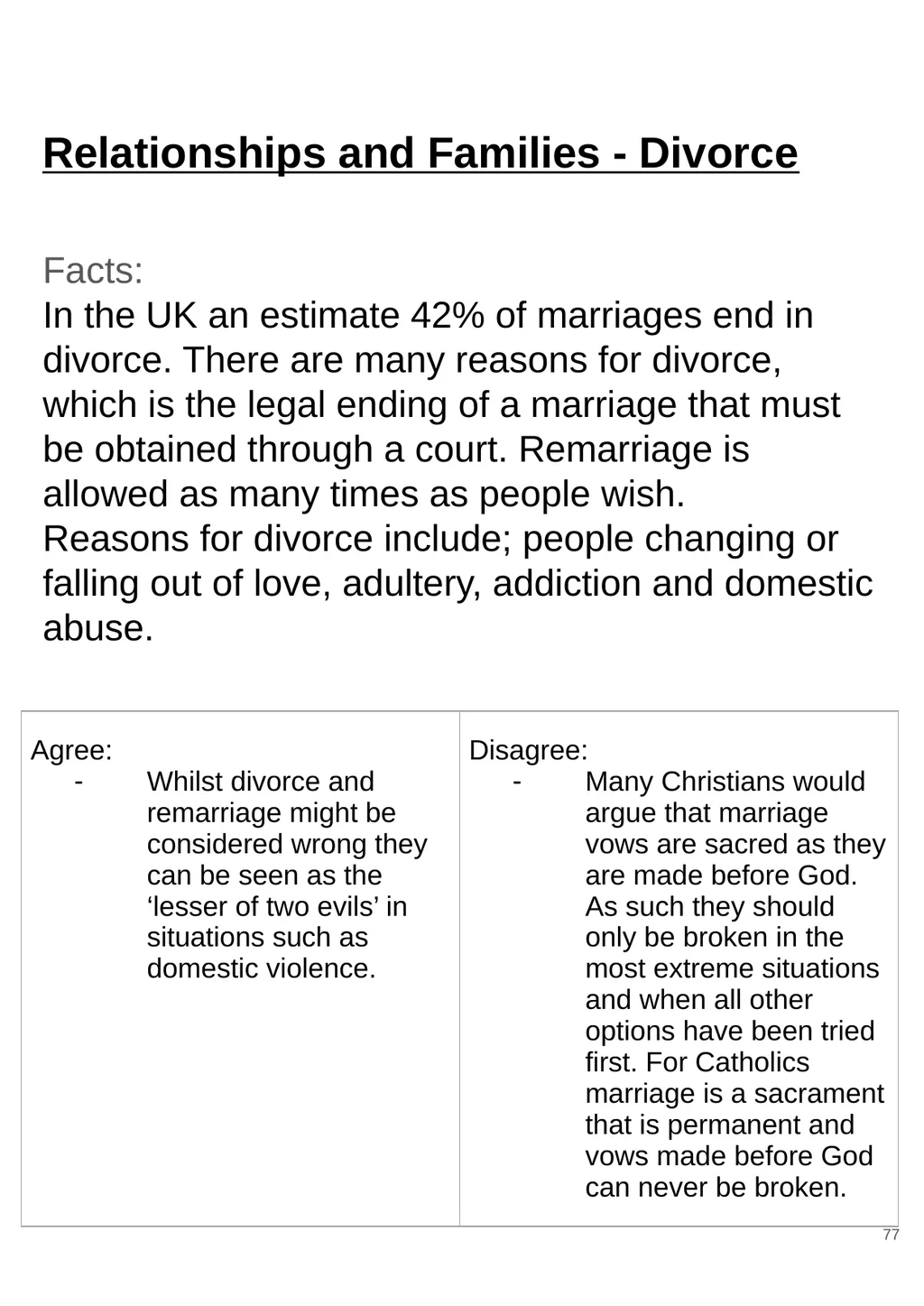
77
Relationships and Families - Divorce Facts:
In the UK an estimate 42% of marriages end in divorce. There are many reasons for divorce, which is the legal ending of a marriage that must be obtained through a court. Remarriage is allowed as many times as people wish.
Reasons for divorce include; people changing or falling out of love, adultery, addiction and domestic abuse. 77<br>
In the UK an estimate 42% of marriages end in divorce. There are many reasons for divorce, which is the legal ending of a marriage that must be obtained through a court. Remarriage is allowed as many times as people wish.
Reasons for divorce include; people changing or falling out of love, adultery, addiction and domestic abuse. 77<br>
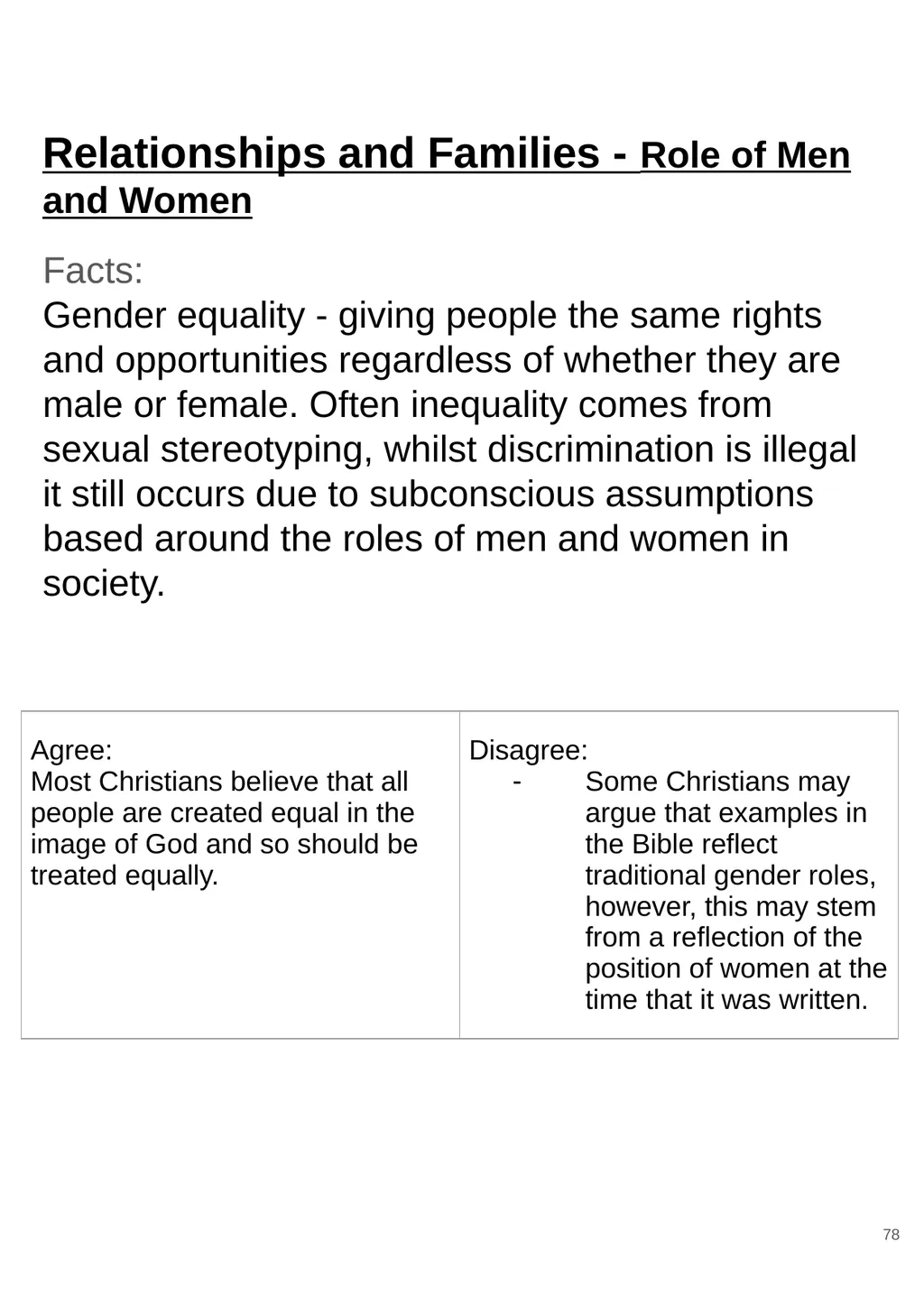
78
Relationships and Families - Role of Men and Women Facts:
Gender equality - giving people the same rights and opportunities regardless of whether they are male or female. Often inequality comes from sexual stereotyping, whilst discrimination is illegal it still occurs due to subconscious assumptions based around the roles of men and women in society. 78<br>
Gender equality - giving people the same rights and opportunities regardless of whether they are male or female. Often inequality comes from sexual stereotyping, whilst discrimination is illegal it still occurs due to subconscious assumptions based around the roles of men and women in society. 78<br>
79
Nature of families In recent years the nature of families has moved away from the nuclear family and with increased divorce, remarriage, adoption and social change more complex family groups are becoming commonplace.
Extended families - A family that extends beyond just parents and their children, to include grandparents etc.
Nuclear families - A couple and their children, regarded as the basic social unit.
Purpose of Families
Procreation
Stability and the protection of children
Educating children in a faith. 79<br>
Extended families - A family that extends beyond just parents and their children, to include grandparents etc.
Nuclear families - A couple and their children, regarded as the basic social unit.
Purpose of Families
Procreation
Stability and the protection of children
Educating children in a faith. 79<br>
80
Contemporary family issues Same sex parents - people of the same-sex who are raising children together. Some traditional Christians disagree with this because they feel that it is preferable for children to grow up with a male and a female role model as parents. However, others may argue that it is more important for them to be in a loving and stable environment regardless of gender.
Polygamy - the practice or custom of having more than one wife at the same time. The law in the UK prohibits polygamy and whilst there are examples of polygamous relationships in the Bible most Christians would argue that marriage is between one man and one woman. 80<br>
Polygamy - the practice or custom of having more than one wife at the same time. The law in the UK prohibits polygamy and whilst there are examples of polygamous relationships in the Bible most Christians would argue that marriage is between one man and one woman. 80<br>
81
Practice Exam Questions - 2 mark Give two reasons why people divorce
2. Give two reasons for people having children
3. Give two types of family
4. Give two types of contraception
5. Give two reasons why people get married
6. Give two purposes of a family
7. Give two contemporary family issues
8. Give two views about the role of men and women 81<br>
2. Give two reasons for people having children
3. Give two types of family
4. Give two types of contraception
5. Give two reasons why people get married
6. Give two purposes of a family
7. Give two contemporary family issues
8. Give two views about the role of men and women 81<br>
82
Practice Exam Questions - 4 mark Explain two contrasting beliefs about contraception
2. Explain two contrasting beliefs about the role of the family
3. Explain two contrasting religious beliefs about divorce
1. Explain two religious beliefs about remarriage
2. Explain two religious beliefs about homosexuality
3. Explain two religious beliefs about sex before marriage
1. “A vow should never be broken so divorces should not be allowed” (12 marks)
2. “Women as well as men should be able to be leaders in their religion” (12 marks)
3. “When couples have children they should always bring them up in their faith” (12 marks) 82 Practice Exam Questions - 5 mark<br>
2. Explain two contrasting beliefs about the role of the family
3. Explain two contrasting religious beliefs about divorce
1. Explain two religious beliefs about remarriage
2. Explain two religious beliefs about homosexuality
3. Explain two religious beliefs about sex before marriage
1. “A vow should never be broken so divorces should not be allowed” (12 marks)
2. “Women as well as men should be able to be leaders in their religion” (12 marks)
3. “When couples have children they should always bring them up in their faith” (12 marks) 82 Practice Exam Questions - 5 mark<br>
83
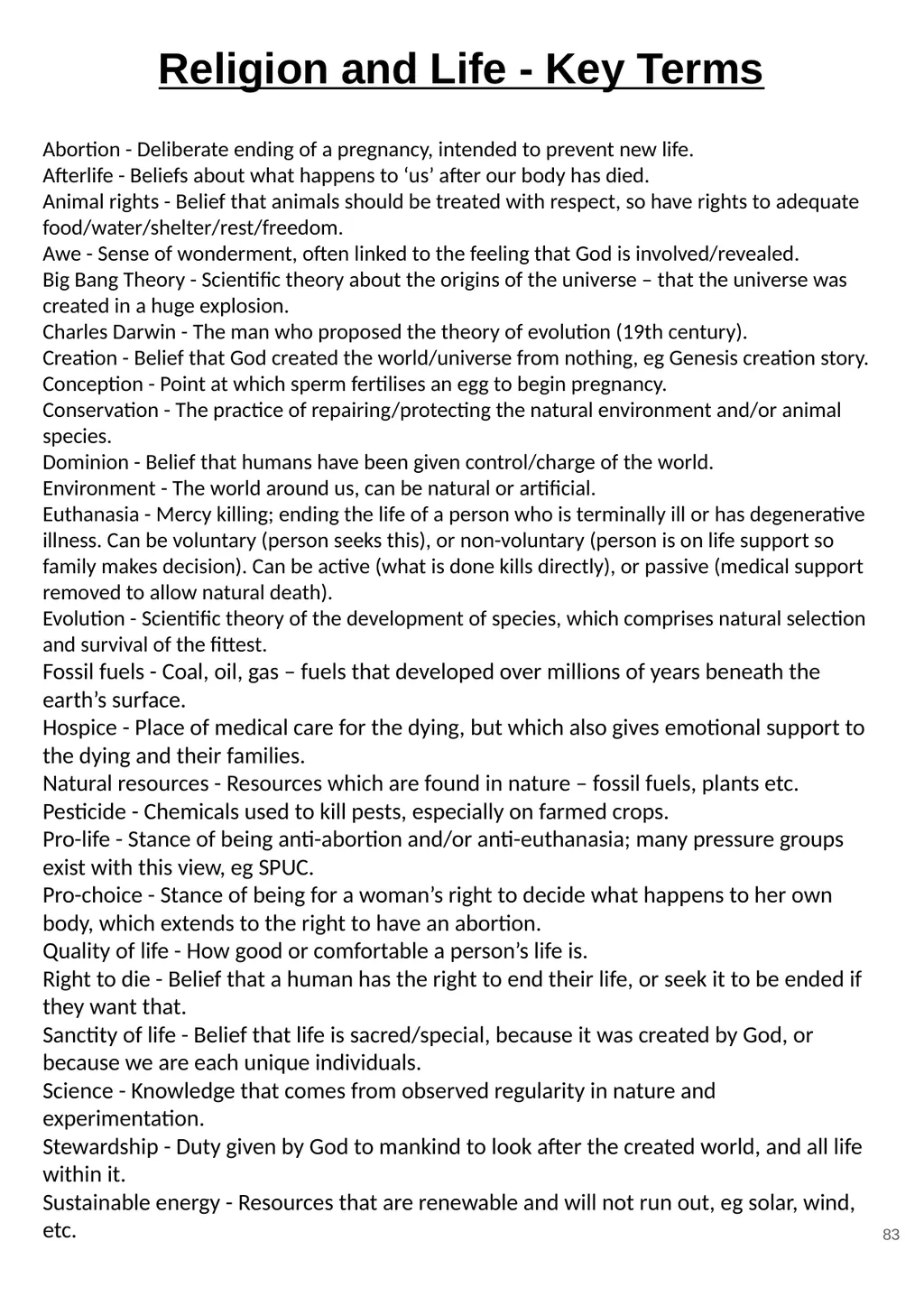
Religion and Life - Key Terms Abortion - Deliberate ending of a pregnancy, intended to prevent new life.
Afterlife - Beliefs about what happens to ‘us’ after our body has died.
Animal rights - Belief that animals should be treated with respect, so have rights to adequate food/water/shelter/rest/freedom.
Awe - Sense of wonderment, often linked to the feeling that God is involved/revealed.
Big Bang Theory - Scientific theory about the origins of the universe – that the universe was created in a huge explosion.
Charles Darwin - The man who proposed the theory of evolution (19th century).
Creation - Belief that God created the world/universe from nothing, eg Genesis creation story.
Conception - Point at which sperm fertilises an egg to begin pregnancy.
Conservation - The practice of repairing/protecting the natural environment and/or animal species.
Dominion - Belief that humans have been given control/charge of the world.
Environment - The world around us, can be natural or artificial.
Euthanasia - Mercy killing; ending the life of a person who is terminally ill or has degenerative illness. Can be voluntary (person seeks this), or non-voluntary (person is on life support so family makes decision). Can be active (what is done kills directly), or passive (medical support removed to allow natural death).
Evolution - Scientific theory of the development of species, which comprises natural selection and survival of the fittest.
Fossil fuels - Coal, oil, gas – fuels that developed over millions of years beneath the earth’s surface.
Hospice - Place of medical care for the dying, but which also gives emotional support to the dying and their families.
Natural resources - Resources which are found in nature – fossil fuels, plants etc.
Pesticide - Chemicals used to kill pests, especially on farmed crops.
Pro-life - Stance of being anti-abortion and/or anti-euthanasia; many pressure groups exist with this view, eg SPUC.
Pro-choice - Stance of being for a woman’s right to decide what happens to her own body, which extends to the right to have an abortion.
Quality of life - How good or comfortable a person’s life is.
Right to die - Belief that a human has the right to end their life, or seek it to be ended if they want that.
Sanctity of life - Belief that life is sacred/special, because it was created by God, or because we are each unique individuals.
Science - Knowledge that comes from observed regularity in nature and experimentation.
Stewardship - Duty given by God to mankind to look after the created world, and all life within it.
Sustainable energy - Resources that are renewable and will not run out, eg solar, wind, etc. 83<br>
Afterlife - Beliefs about what happens to ‘us’ after our body has died.
Animal rights - Belief that animals should be treated with respect, so have rights to adequate food/water/shelter/rest/freedom.
Awe - Sense of wonderment, often linked to the feeling that God is involved/revealed.
Big Bang Theory - Scientific theory about the origins of the universe – that the universe was created in a huge explosion.
Charles Darwin - The man who proposed the theory of evolution (19th century).
Creation - Belief that God created the world/universe from nothing, eg Genesis creation story.
Conception - Point at which sperm fertilises an egg to begin pregnancy.
Conservation - The practice of repairing/protecting the natural environment and/or animal species.
Dominion - Belief that humans have been given control/charge of the world.
Environment - The world around us, can be natural or artificial.
Euthanasia - Mercy killing; ending the life of a person who is terminally ill or has degenerative illness. Can be voluntary (person seeks this), or non-voluntary (person is on life support so family makes decision). Can be active (what is done kills directly), or passive (medical support removed to allow natural death).
Evolution - Scientific theory of the development of species, which comprises natural selection and survival of the fittest.
Fossil fuels - Coal, oil, gas – fuels that developed over millions of years beneath the earth’s surface.
Hospice - Place of medical care for the dying, but which also gives emotional support to the dying and their families.
Natural resources - Resources which are found in nature – fossil fuels, plants etc.
Pesticide - Chemicals used to kill pests, especially on farmed crops.
Pro-life - Stance of being anti-abortion and/or anti-euthanasia; many pressure groups exist with this view, eg SPUC.
Pro-choice - Stance of being for a woman’s right to decide what happens to her own body, which extends to the right to have an abortion.
Quality of life - How good or comfortable a person’s life is.
Right to die - Belief that a human has the right to end their life, or seek it to be ended if they want that.
Sanctity of life - Belief that life is sacred/special, because it was created by God, or because we are each unique individuals.
Science - Knowledge that comes from observed regularity in nature and experimentation.
Stewardship - Duty given by God to mankind to look after the created world, and all life within it.
Sustainable energy - Resources that are renewable and will not run out, eg solar, wind, etc. 83<br>
84
Religion and Life - Animal Experimentation Facts:
Medical Testing - the testing of medicines on animals (legal in UK)
Cosmetic Testing - the testing of make-up on animals (not legal in UK) 84<br>
Medical Testing - the testing of medicines on animals (legal in UK)
Cosmetic Testing - the testing of make-up on animals (not legal in UK) 84<br>
85
Religion and Life - Abortion Facts:
Abortion - Deliberate expulsion of the foetus
Up to 24 weeks if mother’s life is in danger or the child will be born with a severe disability 85<br>
Abortion - Deliberate expulsion of the foetus
Up to 24 weeks if mother’s life is in danger or the child will be born with a severe disability 85<br>
86
Religion and Life - Euthanasia Facts:
Passive Euthanasia - withdrawing life saving treatment (life support machine)
Active Euthanasia - committing an action that would result in somebody dying
Hospice - Medical facility for the treatment of someone who is terminally ill, offering palliative care 86<br>
Passive Euthanasia - withdrawing life saving treatment (life support machine)
Active Euthanasia - committing an action that would result in somebody dying
Hospice - Medical facility for the treatment of someone who is terminally ill, offering palliative care 86<br>
87
Religion and Life - Creation 87<br>
88
Religion and Life - Afterlife Facts:
Heaven
Some denominations believe that God loves everyone so everyone will go to Heaven; other denominations believe that only Christians go to heaven because everyone has sinned and other denominations believe that good people will go to Heaven when they have paid for their sins.
Hell
A place of everlasting suffering. Some believe that those who have not a
accepted Jesus will burn therefore all of eternity. However, others believe that an omnibenevolent God could never send someone to such a place.
Purgatory
Roman Catholics believe in a place in between Heaven and Hell called Purgatory; here you pay for your sins. This is because of this Roman Catholics will sometimes pray for lost ones when the die to help them get into Heaven and spend as little time in Purgatory as possible. 88<br>
Heaven
Some denominations believe that God loves everyone so everyone will go to Heaven; other denominations believe that only Christians go to heaven because everyone has sinned and other denominations believe that good people will go to Heaven when they have paid for their sins.
Hell
A place of everlasting suffering. Some believe that those who have not a
accepted Jesus will burn therefore all of eternity. However, others believe that an omnibenevolent God could never send someone to such a place.
Purgatory
Roman Catholics believe in a place in between Heaven and Hell called Purgatory; here you pay for your sins. This is because of this Roman Catholics will sometimes pray for lost ones when the die to help them get into Heaven and spend as little time in Purgatory as possible. 88<br>
89
Practice Exam Questions - 2 mark Give two reasons why believers might oppose animal testing
2. Give two ways in which humans use animals
3. Give two types of pollution
4. Give two ways believers might show the duty of stewardship
5. Give two different ideas about the creation of the universe
6. Give two types of euthanasia
7. Give two ways humans use the environment
8. Give two situations when abortion is legal in the UK 89<br>
2. Give two ways in which humans use animals
3. Give two types of pollution
4. Give two ways believers might show the duty of stewardship
5. Give two different ideas about the creation of the universe
6. Give two types of euthanasia
7. Give two ways humans use the environment
8. Give two situations when abortion is legal in the UK 89<br>
90
Practice Exam Questions - 4 mark Explain two contrasting beliefs about abortion
2. Explain two contrasting beliefs about animal experimentation
3. Explain two contrasting religious beliefs about the Design argument for God’s existence
1. Explain two religious beliefs about the afterlife
2. Explain two religious beliefs about euthanasia
3. Explain two religious beliefs about pollution
1. “Religious believers should not eat meat” (12 marks
2. “Evolution proves that religious beliefs about the origins of life are wrong” (12 marks)
3. “Abortion is never acceptable” (12 marks) 90 Practice Exam Questions - 5 mark Practice Exam Questions - 12 mark<br>
2. Explain two contrasting beliefs about animal experimentation
3. Explain two contrasting religious beliefs about the Design argument for God’s existence
1. Explain two religious beliefs about the afterlife
2. Explain two religious beliefs about euthanasia
3. Explain two religious beliefs about pollution
1. “Religious believers should not eat meat” (12 marks
2. “Evolution proves that religious beliefs about the origins of life are wrong” (12 marks)
3. “Abortion is never acceptable” (12 marks) 90 Practice Exam Questions - 5 mark Practice Exam Questions - 12 mark<br>
91
Peace and Conflict - Key Terms Anti-war - Attitude that (a) war is wrong and should be protested/worked against.
Civil war - Armed conflict between factions within the same country.
Conflict - Dispute between sides, can be between individuals, groups or nations.
Conventional warfare - War fought using ‘ordinary’ weapons, ie those covered/sanctioned by the Geneva Conventions.
Forgiveness - Letting go of blame against a person for wrongs they have done; moving on.
Genocide - The killing of groups of/many people from a specific ethnic group, having targeted them for their ethnicity.
Guerrilla warfare - Form of warfare in which a small group fights in a non-regular manner against a Government and its forces.
Holy War - War sanctioned by God, used in Islam and Judaism; rules for such a war.
Humanitarian organisation - For example, Red Cross/Crescent; organisation which works to alleviate the suffering of those made victims by war (or natural disaster).
Justice - Bringing fairness back to a situation.
Just War - Set of rules for fighting a war in a way acceptable to God, used in Christianity and Sikhism.
Nuclear weapons/war - A weapon of mass destruction; war fought using such a weapon (none so far in world history).
Pacifism - Belief that all violence is wrong, which then affects all behaviours.
Peace - The opposite of war; harmony between all in society.
Protest - Making known one’s disagreement over something.
Reconciliation - Making up between two groups/sides after disagreement.
Retaliation - To pay someone back for their actions that have caused harm.
Terrorism - Use of violence and threats to intimidate others, usually Government; used for political purposes to build fear in the ordinary population and so secure demands from Government.
War - Armed conflict between two or more sides.
Weapons of mass destruction
Weapons which are uncontrollable and cause indiscriminate damage, eg nuclear, chemical, biological. 91<br>
Civil war - Armed conflict between factions within the same country.
Conflict - Dispute between sides, can be between individuals, groups or nations.
Conventional warfare - War fought using ‘ordinary’ weapons, ie those covered/sanctioned by the Geneva Conventions.
Forgiveness - Letting go of blame against a person for wrongs they have done; moving on.
Genocide - The killing of groups of/many people from a specific ethnic group, having targeted them for their ethnicity.
Guerrilla warfare - Form of warfare in which a small group fights in a non-regular manner against a Government and its forces.
Holy War - War sanctioned by God, used in Islam and Judaism; rules for such a war.
Humanitarian organisation - For example, Red Cross/Crescent; organisation which works to alleviate the suffering of those made victims by war (or natural disaster).
Justice - Bringing fairness back to a situation.
Just War - Set of rules for fighting a war in a way acceptable to God, used in Christianity and Sikhism.
Nuclear weapons/war - A weapon of mass destruction; war fought using such a weapon (none so far in world history).
Pacifism - Belief that all violence is wrong, which then affects all behaviours.
Peace - The opposite of war; harmony between all in society.
Protest - Making known one’s disagreement over something.
Reconciliation - Making up between two groups/sides after disagreement.
Retaliation - To pay someone back for their actions that have caused harm.
Terrorism - Use of violence and threats to intimidate others, usually Government; used for political purposes to build fear in the ordinary population and so secure demands from Government.
War - Armed conflict between two or more sides.
Weapons of mass destruction
Weapons which are uncontrollable and cause indiscriminate damage, eg nuclear, chemical, biological. 91<br>
92
Religion, War and Peace - Violent protest/terrorism Facts:
Violent Protests are when someone uses violent means to change something with regards to the government. Peaceful protests are also a part of democratic life. People are allowed to legally protest their views. If this involves a march, police need to know six days before. Police have the right to cancel this march.
Terrorism is a planned action intended to cause death or serious harm to civilians with the purpose of achieving political change through creating fear. 92<br>
Violent Protests are when someone uses violent means to change something with regards to the government. Peaceful protests are also a part of democratic life. People are allowed to legally protest their views. If this involves a march, police need to know six days before. Police have the right to cancel this march.
Terrorism is a planned action intended to cause death or serious harm to civilians with the purpose of achieving political change through creating fear. 92<br>
93
Religion, War and Peace - Pacifism and Going to War Facts:
Reasons for war - Greed/Self Defence/Retaliation
Just war - Last resort/Just cause/Minimise civilian casualties/proper authority
Pacifism - the belief that violence is always wrong 93<br>
Reasons for war - Greed/Self Defence/Retaliation
Just war - Last resort/Just cause/Minimise civilian casualties/proper authority
Pacifism - the belief that violence is always wrong 93<br>
94
Religion, War and Peace - WMDs Facts:
WMD - Weapons of Mass Destruction
Nuclear, Chemical and Biological weapons 94<br>
WMD - Weapons of Mass Destruction
Nuclear, Chemical and Biological weapons 94<br>
95
Peace, Justice, Forgiveness and Reconciliation Peace is an absence of conflict which leads to happiness and harmony.
Something which many people in the UK take for granted
Real peace involves a feeling of wellbeing
People can achieve inner peace through prayer or meditation
Justice means bringing about what is right, fair, according to the law or making up for what has been done wrong.
Without justice there can never be peace.
Unfairness makes people angry and can lead to conflict within society
Justice can be achieved in many ways eg the law: prison for life or execution.
Forgiveness means showing grace and mercy. Pardoning someone for what they have done.
Reconciliation is a sacrament in the Catholic Church. When individuals or groups restore friendships after conflict.
Reconciliation follows conflict.
It is when individuals forgive and restore friendship after conflict.
It involves gradual steps to rebuild a relationship so that there is no more future conflict. 95<br>
Something which many people in the UK take for granted
Real peace involves a feeling of wellbeing
People can achieve inner peace through prayer or meditation
Justice means bringing about what is right, fair, according to the law or making up for what has been done wrong.
Without justice there can never be peace.
Unfairness makes people angry and can lead to conflict within society
Justice can be achieved in many ways eg the law: prison for life or execution.
Forgiveness means showing grace and mercy. Pardoning someone for what they have done.
Reconciliation is a sacrament in the Catholic Church. When individuals or groups restore friendships after conflict.
Reconciliation follows conflict.
It is when individuals forgive and restore friendship after conflict.
It involves gradual steps to rebuild a relationship so that there is no more future conflict. 95<br>
96
Reasons for war Greed
Historically many wars have been fought for land, money, power and resources.
In the modern world this is generally not seen as a good reason for going to war
“For the love of money is the root of all evil”
Self defence
Most people consider fighting to defend your own country morally acceptable
The UK fought in the Second World War against Nazi aggression to prevent Britain being invaded.
Retaliation
If a war is started in response to an act of aggression
In 2001 the USA declared war on Afghanistan in response to the 9/11 terrorist attacks
“Do not repay anyone evil for evil”
“An eye for an eye” 96<br>
Historically many wars have been fought for land, money, power and resources.
In the modern world this is generally not seen as a good reason for going to war
“For the love of money is the root of all evil”
Self defence
Most people consider fighting to defend your own country morally acceptable
The UK fought in the Second World War against Nazi aggression to prevent Britain being invaded.
Retaliation
If a war is started in response to an act of aggression
In 2001 the USA declared war on Afghanistan in response to the 9/11 terrorist attacks
“Do not repay anyone evil for evil”
“An eye for an eye” 96<br>
97
Just War Theory A war that the Christian Church defines as acceptable. This must fulfill certain criteria.
The war must be fought for a JUST CAUSE – the war must be started for a good reason – e.g. self-defence, and not because of greed
A war is just if it is begun as the LAST RESORT, all non violent means of solving the conflict must have been tried and failed before you turn to war
The war must be lawfully declared by a PROPER AUTHORITY, a government or the United Nations. The politicians must make the most important decisions
There must be a REASONABLE CHANCE OF SUCCESS. You cannot go to war and waste the lives of brave soldiers for something which you have very little chance of winning, lives should not be wasted.
It must be fought with the intent to ESTABLISH GOOD, or fought with good intention. It must be fought to restore peace.
Every effort must be made to make sure that as little violence as possible is used to achieve victory and methods should AVOID KILLING CIVILIANS, those not in the military should not be harmed
The force used in the war must be proportional to the cause. It would not be proportional to drop a nuclear weapon on a small country for invading a small island. SUFFICIENT FORCE!
War must only occur is the GOOD OUTWEIGHS THE EVIL that has lead to the war 97<br>
The war must be fought for a JUST CAUSE – the war must be started for a good reason – e.g. self-defence, and not because of greed
A war is just if it is begun as the LAST RESORT, all non violent means of solving the conflict must have been tried and failed before you turn to war
The war must be lawfully declared by a PROPER AUTHORITY, a government or the United Nations. The politicians must make the most important decisions
There must be a REASONABLE CHANCE OF SUCCESS. You cannot go to war and waste the lives of brave soldiers for something which you have very little chance of winning, lives should not be wasted.
It must be fought with the intent to ESTABLISH GOOD, or fought with good intention. It must be fought to restore peace.
Every effort must be made to make sure that as little violence as possible is used to achieve victory and methods should AVOID KILLING CIVILIANS, those not in the military should not be harmed
The force used in the war must be proportional to the cause. It would not be proportional to drop a nuclear weapon on a small country for invading a small island. SUFFICIENT FORCE!
War must only occur is the GOOD OUTWEIGHS THE EVIL that has lead to the war 97<br>
98
Holy War Holy War
Holy wars have religious aims or goals. They were authorised by God or by a spiritual leader and because of this those who take part will receive a reward such as going to Heaven when they die. Religious leaders may declare holy war to defend their religion or their followers who are being persecuted in another country. Some holy wars have been fought to spread the faith or win back a country that used to follow the beliefs of a particular religion.
In Christianity teachings such as “an eye for an eye” are quotes to show that it is ok to return violence with violence. For other Christians the teachings of Jesus make it clear that violence is not to be tolerated. In the gospel of Matthew it is quoted that “anyone who murders will be sent to judgement.” 98<br>
Holy wars have religious aims or goals. They were authorised by God or by a spiritual leader and because of this those who take part will receive a reward such as going to Heaven when they die. Religious leaders may declare holy war to defend their religion or their followers who are being persecuted in another country. Some holy wars have been fought to spread the faith or win back a country that used to follow the beliefs of a particular religion.
In Christianity teachings such as “an eye for an eye” are quotes to show that it is ok to return violence with violence. For other Christians the teachings of Jesus make it clear that violence is not to be tolerated. In the gospel of Matthew it is quoted that “anyone who murders will be sent to judgement.” 98<br>
99
Religions and the Victims of War Helping Victims of War
When wars happen there are many casualties with different injuries. There are lots of different charities (organisations) that help out in different ways. Some provide first aid, other provide money etc. most workers are voluntary. Many of these charities happen to be Christian organisations because they are run by Christians who follow key religious teachings- Eg: Turn the other cheek.
As a result of wars in other countries, some people have to flee and leave everything they have. These people are called refugees. Many religious believers would argue that we have a responsibility to help refugees because they are innocent of any wrongdoing.
Organisation
The Red Cross is an example of an organisation that helps the victims of war, it is motivated by the Christian faith (hence the cross) and focuses on providing medical aid for innocent civilians harmed in areas of conflict. 99<br>
When wars happen there are many casualties with different injuries. There are lots of different charities (organisations) that help out in different ways. Some provide first aid, other provide money etc. most workers are voluntary. Many of these charities happen to be Christian organisations because they are run by Christians who follow key religious teachings- Eg: Turn the other cheek.
As a result of wars in other countries, some people have to flee and leave everything they have. These people are called refugees. Many religious believers would argue that we have a responsibility to help refugees because they are innocent of any wrongdoing.
Organisation
The Red Cross is an example of an organisation that helps the victims of war, it is motivated by the Christian faith (hence the cross) and focuses on providing medical aid for innocent civilians harmed in areas of conflict. 99<br>
100
Practice Exam Questions - 2 mark Give two religious beliefs about terrorism
2. Give two examples of individuals who have worked for peace
3. Give two religious beliefs about reconciliation
4. Give two religious beliefs about violent protest
5. Give two reasons for going to war
6. Give two reasons against war
7. Give two ways in which believers help victims of war
8. Give two beliefs that show violence is wrong 100<br>
2. Give two examples of individuals who have worked for peace
3. Give two religious beliefs about reconciliation
4. Give two religious beliefs about violent protest
5. Give two reasons for going to war
6. Give two reasons against war
7. Give two ways in which believers help victims of war
8. Give two beliefs that show violence is wrong 100<br>
101
Practice Exam Questions - 4 mark Explain two contrasting beliefs about violence
2. Explain two contrasting beliefs about pacifism
3. Explain two contrasting religious beliefs about justice 101<br>
2. Explain two contrasting beliefs about pacifism
3. Explain two contrasting religious beliefs about justice 101<br>
102
Practice Exam Questions - 5 mark Explain two religious beliefs about just war
2. Explain two religious beliefs about helping victims of war
3. Explain two religious beliefs about holy wars 102<br>
2. Explain two religious beliefs about helping victims of war
3. Explain two religious beliefs about holy wars 102<br>
103
Practice Exam Questions 1. “It is justified for a country to possess nuclear weapons” (12 marks) 103<br>
104
Practice Exam Questions 2. “Peace is an impossible dream” (12 marks) 104<br>
105
Practice Exam Questions 3. “There can be no such thing as a just war, because innocent will always suffer” (12 marks) 105<br>
106
Crime and Punishment - Key Terms Capital punishment - Death penalty; state sanctioned execution for a capital offence; not legal in UK.
Community service order - UK punishment involving the criminal doing a set number of hours of physical labour.
Conscience - Sense of right and wrong; guilty voice in our head; seen as the voice of God by many religious believers.
Corporal punishment - Punishment in which physical pain is inflicted on the criminal; not legal in the UK.
Crime - Action which breaks the law; can be against the person (eg murder), against property (eg vandalism), or against the state (eg treason).
Deterrence - Aim of punishment to put a person off committing a crime by the level of punishment.
Duty - What we have a responsibility to do.
Evil - Something or someone considered morally very wrong or wicked; often linked to the idea of a devil or other malevolent being.
Forgiveness - Letting go of blame against a person for wrongs they have done; moving on.
Greed - Reason for committing crime – wanting or desiring something or more of something.
Hate crime - A crime committed because of prejudice, eg assaulting a person because they are gay or Asian.
Imprisonment - Locking someone up and taking away of civil liberties of a criminal.
Imprisonment - Locking someone up and taking away of civil liberties of a criminal.
Law - The rules a country demands its citizens follow, the breaking of which leads to punishment.
Murder - Unlawfully killing another person.
Order - The enforcement of rules, eg by a police force.
Parole - Release of a criminal from prison under the condition they will meet with a parole officer who can monitor their behaviour.
Protection - Additional aim of punishment; to keep people safe.
Reformation - Aim of punishment; helping the criminal see how and why their behaviour was wrong, so that their mindset changes for the better.
Reparation - Additional aim of punishment; where the criminal makes up for, or pays back for, their crimes.
Retribution - Aim of punishment; getting the criminal back for their crimes.
Theft - Taking something without the owner’s consent.
Victim - Those who are directly affected by a crime, eg the person assaulted.
Vindication - Additional aim of punishment; the punishment exists to justify the law.
Young offenders - Criminals under the age of 18. 106<br>
Community service order - UK punishment involving the criminal doing a set number of hours of physical labour.
Conscience - Sense of right and wrong; guilty voice in our head; seen as the voice of God by many religious believers.
Corporal punishment - Punishment in which physical pain is inflicted on the criminal; not legal in the UK.
Crime - Action which breaks the law; can be against the person (eg murder), against property (eg vandalism), or against the state (eg treason).
Deterrence - Aim of punishment to put a person off committing a crime by the level of punishment.
Duty - What we have a responsibility to do.
Evil - Something or someone considered morally very wrong or wicked; often linked to the idea of a devil or other malevolent being.
Forgiveness - Letting go of blame against a person for wrongs they have done; moving on.
Greed - Reason for committing crime – wanting or desiring something or more of something.
Hate crime - A crime committed because of prejudice, eg assaulting a person because they are gay or Asian.
Imprisonment - Locking someone up and taking away of civil liberties of a criminal.
Imprisonment - Locking someone up and taking away of civil liberties of a criminal.
Law - The rules a country demands its citizens follow, the breaking of which leads to punishment.
Murder - Unlawfully killing another person.
Order - The enforcement of rules, eg by a police force.
Parole - Release of a criminal from prison under the condition they will meet with a parole officer who can monitor their behaviour.
Protection - Additional aim of punishment; to keep people safe.
Reformation - Aim of punishment; helping the criminal see how and why their behaviour was wrong, so that their mindset changes for the better.
Reparation - Additional aim of punishment; where the criminal makes up for, or pays back for, their crimes.
Retribution - Aim of punishment; getting the criminal back for their crimes.
Theft - Taking something without the owner’s consent.
Victim - Those who are directly affected by a crime, eg the person assaulted.
Vindication - Additional aim of punishment; the punishment exists to justify the law.
Young offenders - Criminals under the age of 18. 106<br>
107
Religion, Crime and Punishment - Aims of punishment Retribution – Revenge for the victim/their family/society (“eye for an eye”)
Reformation – To educate the criminal so that they do not commit crimes in the future (“forgive others as you would wish to be forgiven”)
Reparation – To repair the damage done to society (commonly used in connection with punishments like community service)
Deterrent – To stop other people from committing the crime
Public Protection – To prevent the criminal from committing future crimes and as such protecting the public (“love thy neighbour”) 107<br>
Reformation – To educate the criminal so that they do not commit crimes in the future (“forgive others as you would wish to be forgiven”)
Reparation – To repair the damage done to society (commonly used in connection with punishments like community service)
Deterrent – To stop other people from committing the crime
Public Protection – To prevent the criminal from committing future crimes and as such protecting the public (“love thy neighbour”) 107<br>
108
Religion, Crime and Punishment - Corporal Punishment Facts:
Corporal Punishment - Using pain as a punishment
Beating/stoning etc. 108<br>
Corporal Punishment - Using pain as a punishment
Beating/stoning etc. 108<br>
109
Religion, Crime and Punishment - Capital Punishment Facts:
Capital Punishment - Death Penalty
Electric chair/lethal injection/hanging 109<br>
Capital Punishment - Death Penalty
Electric chair/lethal injection/hanging 109<br>
110
Religion, Crime and Punishment - Forgiveness Christians would argue that forgiveness is very important.
In the Lord’s Prayer Jesus said ‘forgive us our sins as we forgive those who sin against us.’ Meaning that we should forgive others as we would wish to be forgiven.
They would argue that forgiveness is not a replacement for punishment, however, the punishment should be compassionate and aim to reform the person so that they do not reoffend.
Christians would argue that nobody is without sin and so it is only God who is able to judge people for their actions and condemn them accordingly. 110<br>
In the Lord’s Prayer Jesus said ‘forgive us our sins as we forgive those who sin against us.’ Meaning that we should forgive others as we would wish to be forgiven.
They would argue that forgiveness is not a replacement for punishment, however, the punishment should be compassionate and aim to reform the person so that they do not reoffend.
Christians would argue that nobody is without sin and so it is only God who is able to judge people for their actions and condemn them accordingly. 110<br>
111
Religion, Crime and Punishment - Following the Law Types of crime
Hate crime - violent actions against someone because of their race, religion, sexuality, disability or gender. Christians would condemn these as it is not an example of a loving act.
Murder - the unlawful and deliberate killing of another human being. Christians would condemn this as one of the ten commandments is ‘thou shalt not kill’.
Theft - The unlawful taking of someone’s property, considered to be a less serious crime than murder as it targets property and not the person. A Christian might argue that someone committing theft out of need as opposed to greed should be cared for and would consider the teaching ‘do unto others as you would wish them to do to you.’ 111<br>
Hate crime - violent actions against someone because of their race, religion, sexuality, disability or gender. Christians would condemn these as it is not an example of a loving act.
Murder - the unlawful and deliberate killing of another human being. Christians would condemn this as one of the ten commandments is ‘thou shalt not kill’.
Theft - The unlawful taking of someone’s property, considered to be a less serious crime than murder as it targets property and not the person. A Christian might argue that someone committing theft out of need as opposed to greed should be cared for and would consider the teaching ‘do unto others as you would wish them to do to you.’ 111<br>
112
Good and Evil intentions and actions Key Terms:
Action – a thing that is done.
Intention – an aim or plan that prompts actions.
Evil – extremely unpleasant or immoral. Can be seen as supernatural (e.g. devil/Iblis).
Sometimes good or evil actions can be done for the wrong/right reasons. For example – surgery is cutting someone with a knife, but the intention is good as it makes the person better.
Religious Teachings:
Jesus told his followers to ‘love your neighbour as yourself’. 112<br>
Action – a thing that is done.
Intention – an aim or plan that prompts actions.
Evil – extremely unpleasant or immoral. Can be seen as supernatural (e.g. devil/Iblis).
Sometimes good or evil actions can be done for the wrong/right reasons. For example – surgery is cutting someone with a knife, but the intention is good as it makes the person better.
Religious Teachings:
Jesus told his followers to ‘love your neighbour as yourself’. 112<br>
113
Why do people commit crime? Environmental Reason – Where people live and their background influences some people into crime. (Poverty)
Social Reasons – Some people break the law because they want to fit in or because of peer pressure.
Psychological Reasons – Human nature may cause people to commit crime. Some people have more deep rooted mental illnesses
Drug Addiction – Crime figures routinely show that drug addiction is the highest single cause of crime. Under the influence of alcohol or illegal drugs a person’s judgement is impaired
Opposition to an unjust law - Any breach of the law is wrong. However, there are times when people have deliberately broken laws that they consider to be unjust. In America in 1955 Rosa Parks refused to give up her bus seat to a white person during segregation. This action became a symbol of the Civil Rights movement that brought about a change in the law. 113<br>
Social Reasons – Some people break the law because they want to fit in or because of peer pressure.
Psychological Reasons – Human nature may cause people to commit crime. Some people have more deep rooted mental illnesses
Drug Addiction – Crime figures routinely show that drug addiction is the highest single cause of crime. Under the influence of alcohol or illegal drugs a person’s judgement is impaired
Opposition to an unjust law - Any breach of the law is wrong. However, there are times when people have deliberately broken laws that they consider to be unjust. In America in 1955 Rosa Parks refused to give up her bus seat to a white person during segregation. This action became a symbol of the Civil Rights movement that brought about a change in the law. 113<br>
114
Types of crime Christians are generally against people breaking the law of their country without just cause. The law exists to protect all citizens rights and security so it should always be followed. Most Christians would argue that offenders should be helped to change their ways so as not to reoffend when the punishment is over.
Types of crime
Hate crime - violent actions against someone because of their race, religion, sexuality, disability or gender. Christians would condemn these as it is not an example of a loving act.
Murder - the unlawful and deliberate killing of another human being. Christians would condemn this as one of the ten commandments is ‘thou shalt not kill’.
Theft - The unlawful taking of someone’s property, considered to be a less serious crime than murder as it targets property and not the person. A Christian might argue that someone committing theft out of need as opposed to greed should be cared for and would consider the teaching ‘do unto others as you would wish them to do to you.’ 114<br>
Types of crime
Hate crime - violent actions against someone because of their race, religion, sexuality, disability or gender. Christians would condemn these as it is not an example of a loving act.
Murder - the unlawful and deliberate killing of another human being. Christians would condemn this as one of the ten commandments is ‘thou shalt not kill’.
Theft - The unlawful taking of someone’s property, considered to be a less serious crime than murder as it targets property and not the person. A Christian might argue that someone committing theft out of need as opposed to greed should be cared for and would consider the teaching ‘do unto others as you would wish them to do to you.’ 114<br>
115
Practice Exam Questions - 2 mark Give two aims of punishment
2. Give two types of punishment
3. Give two causes of crime
4. Give two concerns people have with prisons
5. Give two reasons for the use of community service
6. Give two reasons to support corporal punishment
7. Give two reasons against capital punishment
8. Give two types of crime 115<br>
2. Give two types of punishment
3. Give two causes of crime
4. Give two concerns people have with prisons
5. Give two reasons for the use of community service
6. Give two reasons to support corporal punishment
7. Give two reasons against capital punishment
8. Give two types of crime 115<br>
116
Practice Exam Questions - 4 mark Explain two contrasting beliefs about the Death Penalty
2. Explain two contrasting beliefs about forgiveness
3. Explain two similar religious beliefs about justice 116<br>
2. Explain two contrasting beliefs about forgiveness
3. Explain two similar religious beliefs about justice 116<br>
117
Practice Exam Questions - 5 mark Explain two religious beliefs about the need to follow the law
2. Explain two religious beliefs about people who break the law because of mental illness
3. Explain two religious beliefs about the death penalty 117<br>
2. Explain two religious beliefs about people who break the law because of mental illness
3. Explain two religious beliefs about the death penalty 117<br>
118
Practice Exam Questions 1. “The primary aim of punishment should be rehabilitation” (12 marks) 118<br>
119
Practice Exam Questions 2. “Opposition to an unjust law is the only reason to commit a crime” (12 marks) 119<br>
120
Practice Exam Questions 3. “Murder is the worst crime that a person can commit” (12 marks) 120<br>