
Rule Based Systems If <condition> then
TG
Published · 45 slides · 0 views
1 / 1
Description
Rule Based Systems If condition then consequence Rules to solve problems What is forward chaining? What is backward chaining? Expert systems RB Deduction Systems Rule looks like If Cond1 Cond2 Then Then1 Then2 VocabularyTerminology
Related Topics
Share
Embed code
Download this presentation From Below
"Rule Based Systems If <condition> then" is the property of its rightful owner. Permission is granted to download and print the materials on this website for personal, non-commercial use only, and to display it on your personal computer provided you do not modify the materials and that you retain all copyright notices contained in the materials. By downloading content from our website, you accept the terms of this agreement.
Presentation Transcript
01
Rule Based Systems If <condition> then <consequence>
Rules to solve problems
What is forward chaining?
What is backward chaining?
Expert systems<br>
Rules to solve problems
What is forward chaining?
What is backward chaining?
Expert systems<br>
02
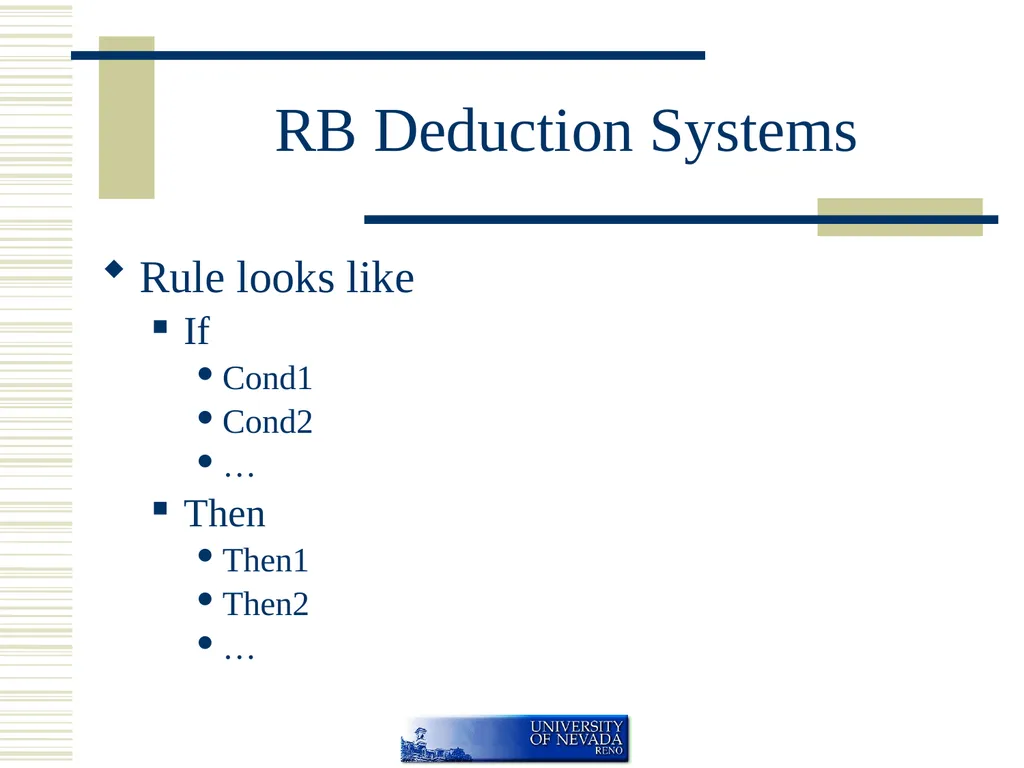
RB Deduction Systems Rule looks like
If
Cond1
Cond2
…
Then
Then1
Then2
…<br>
If
Cond1
Cond2
…
Then
Then1
Then2
…<br>
03
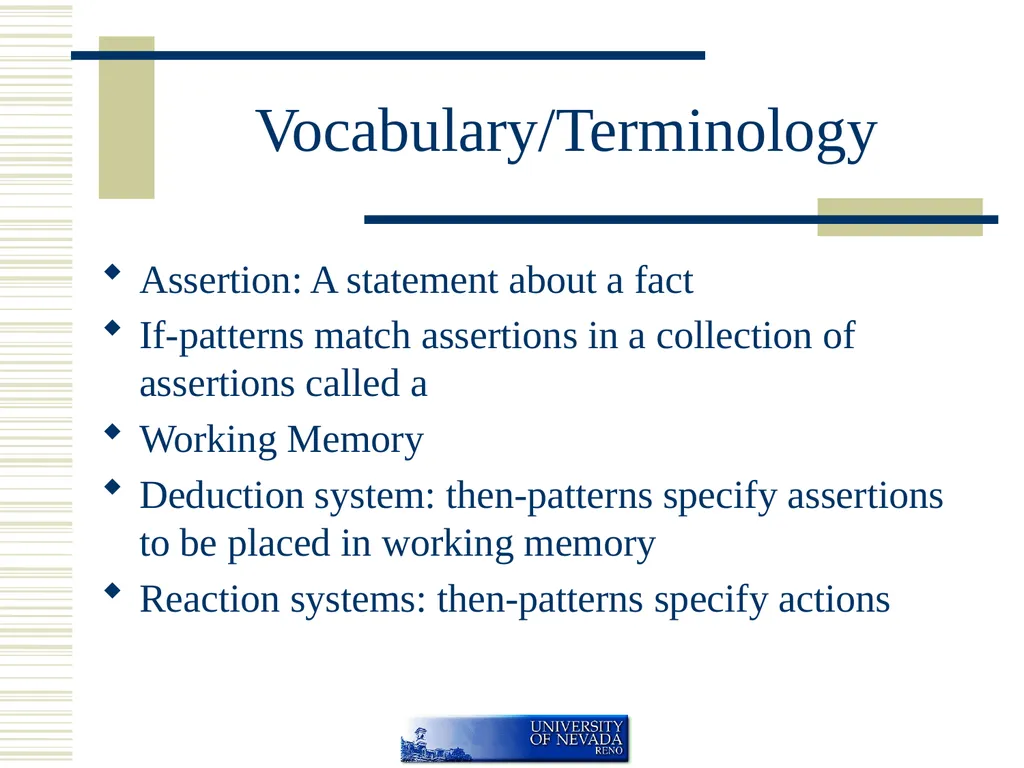
Vocabulary/Terminology Assertion: A statement about a fact
If-patterns match assertions in a collection of assertions called a
Working Memory
Deduction system: then-patterns specify assertions to be placed in working memory
Reaction systems: then-patterns specify actions<br>
If-patterns match assertions in a collection of assertions called a
Working Memory
Deduction system: then-patterns specify assertions to be placed in working memory
Reaction systems: then-patterns specify actions<br>
04
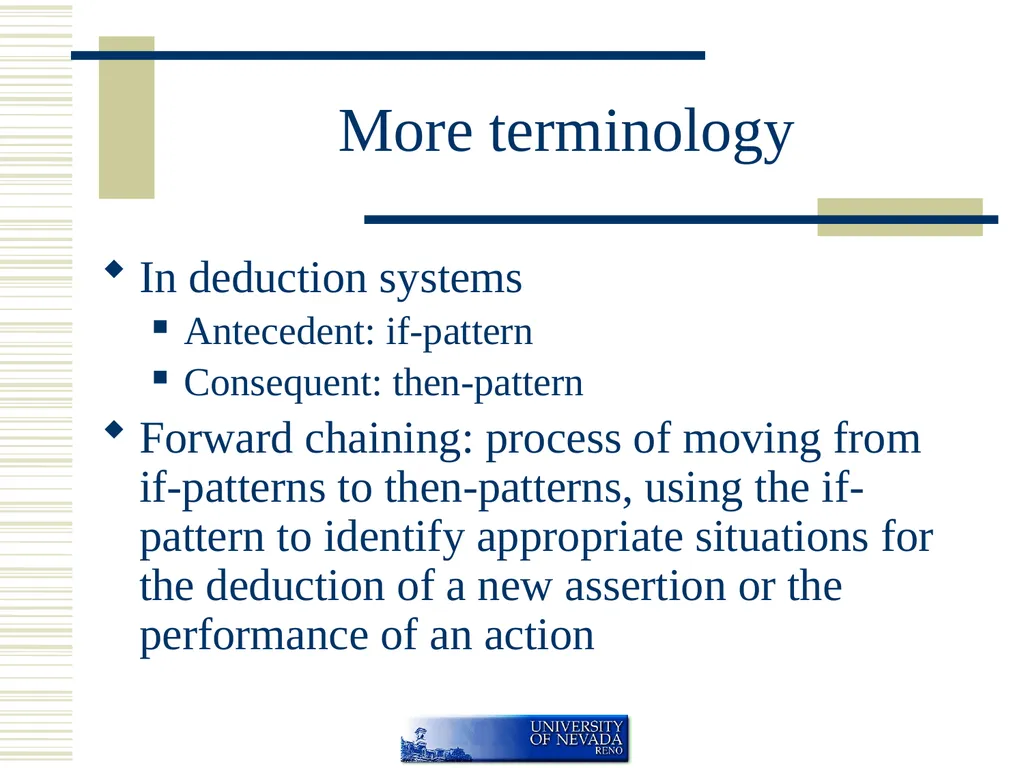
More terminology In deduction systems
Antecedent: if-pattern
Consequent: then-pattern
Forward chaining: process of moving from if-patterns to then-patterns, using the if-pattern to identify appropriate situations for the deduction of a new assertion or the performance of an action<br>
Antecedent: if-pattern
Consequent: then-pattern
Forward chaining: process of moving from if-patterns to then-patterns, using the if-pattern to identify appropriate situations for the deduction of a new assertion or the performance of an action<br>
05
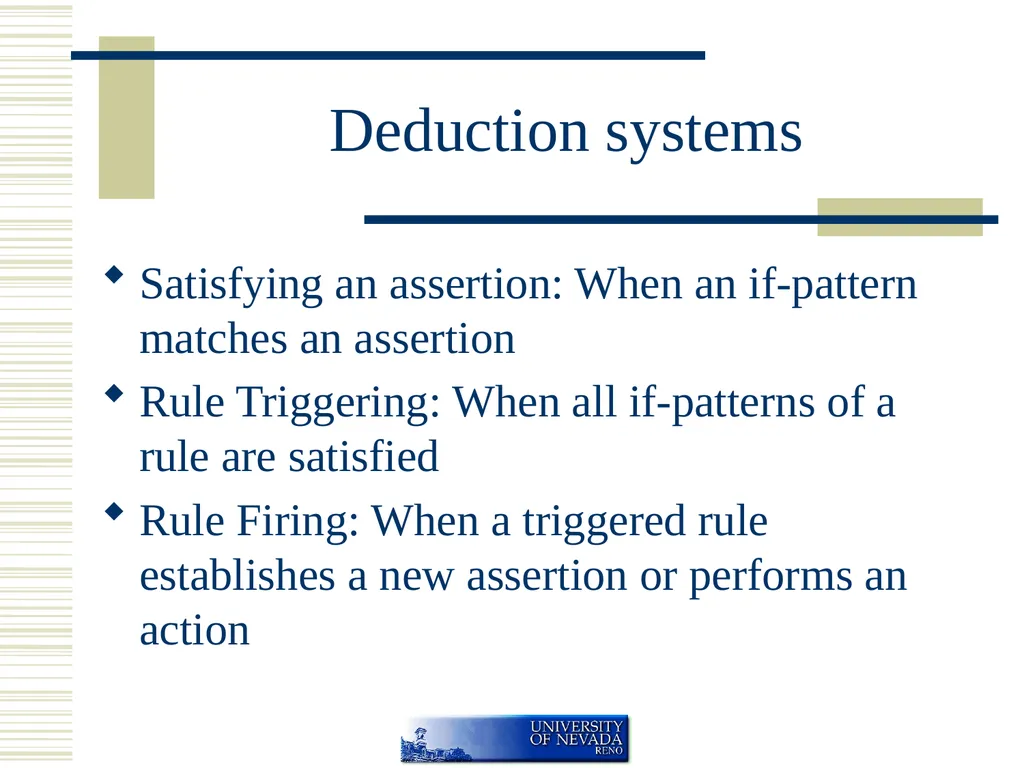
Deduction systems Satisfying an assertion: When an if-pattern matches an assertion
Rule Triggering: When all if-patterns of a rule are satisfied
Rule Firing: When a triggered rule establishes a new assertion or performs an action<br>
Rule Triggering: When all if-patterns of a rule are satisfied
Rule Firing: When a triggered rule establishes a new assertion or performs an action<br>
06
Zookeeper Identifies animals in a small zoo
Robbie the robot can perceive
Color, size, hair, gives milk, …
Can tell that an object is an animal, but cannot tell what animal it is
Would be nice to write Robbie an animal identification system<br>
Robbie the robot can perceive
Color, size, hair, gives milk, …
Can tell that an object is an animal, but cannot tell what animal it is
Would be nice to write Robbie an animal identification system<br>
07
Zookeeper Designs One if-then rule for each animal in the zoo
Similar to the “giant table” approach to ttt
If-then rules produce intermediate assertions
Only a few antecedents each. Easier
Forward chaining through intermediate assertions to identity of animal<br>
Similar to the “giant table” approach to ttt
If-then rules produce intermediate assertions
Only a few antecedents each. Easier
Forward chaining through intermediate assertions to identity of animal<br>
08
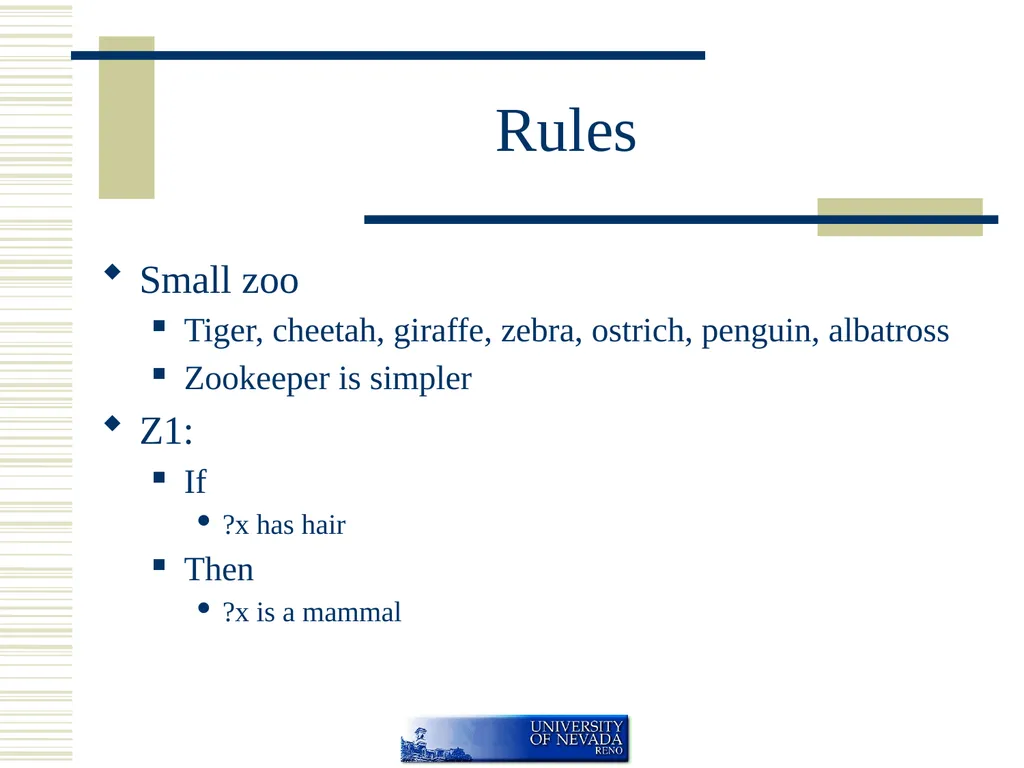
Rules Small zoo
Tiger, cheetah, giraffe, zebra, ostrich, penguin, albatross
Zookeeper is simpler
Z1:
If
?x has hair
Then
?x is a mammal<br>
Tiger, cheetah, giraffe, zebra, ostrich, penguin, albatross
Zookeeper is simpler
Z1:
If
?x has hair
Then
?x is a mammal<br>
09
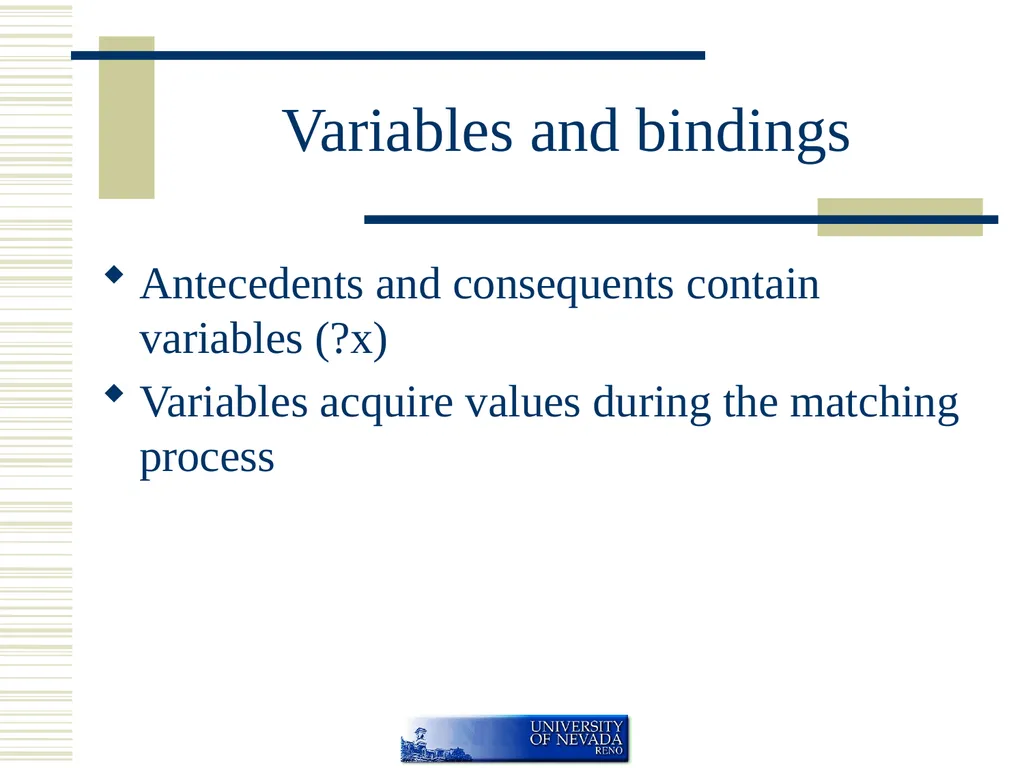
Variables and bindings Antecedents and consequents contain variables (?x)
Variables acquire values during the matching process<br>
Variables acquire values during the matching process<br>
10
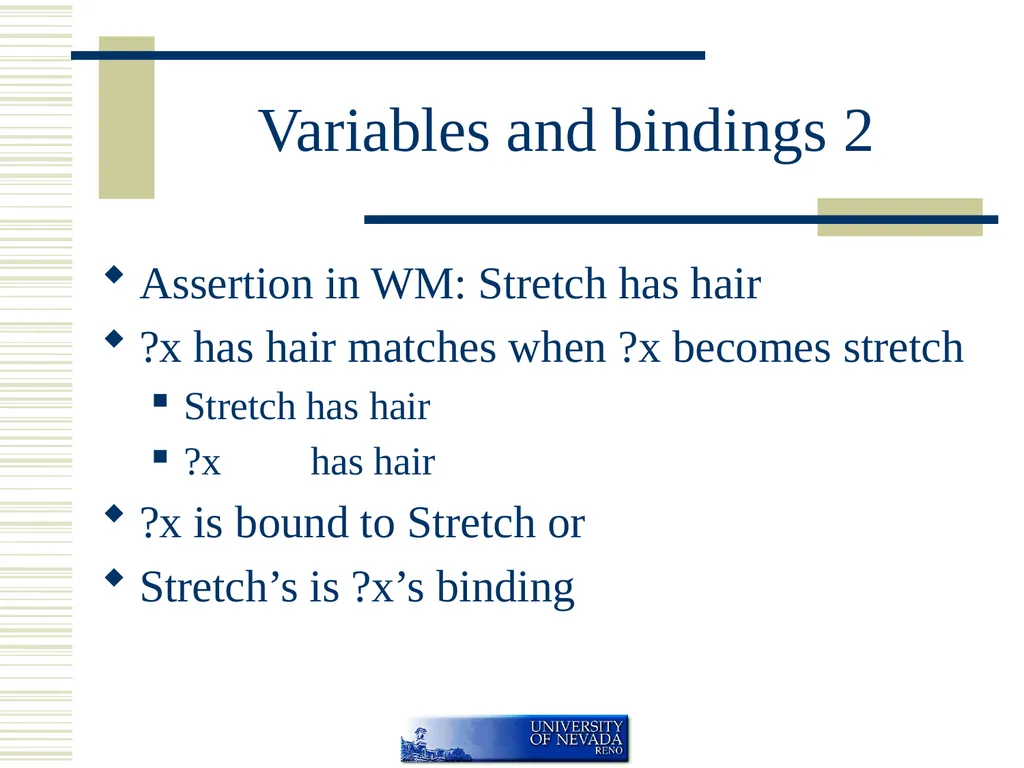
Variables and bindings 2 Assertion in WM: Stretch has hair
?x has hair matches when ?x becomes stretch
Stretch has hair
?x has hair
?x is bound to Stretch or
Stretch’s is ?x’s binding<br>
?x has hair matches when ?x becomes stretch
Stretch has hair
?x has hair
?x is bound to Stretch or
Stretch’s is ?x’s binding<br>
11
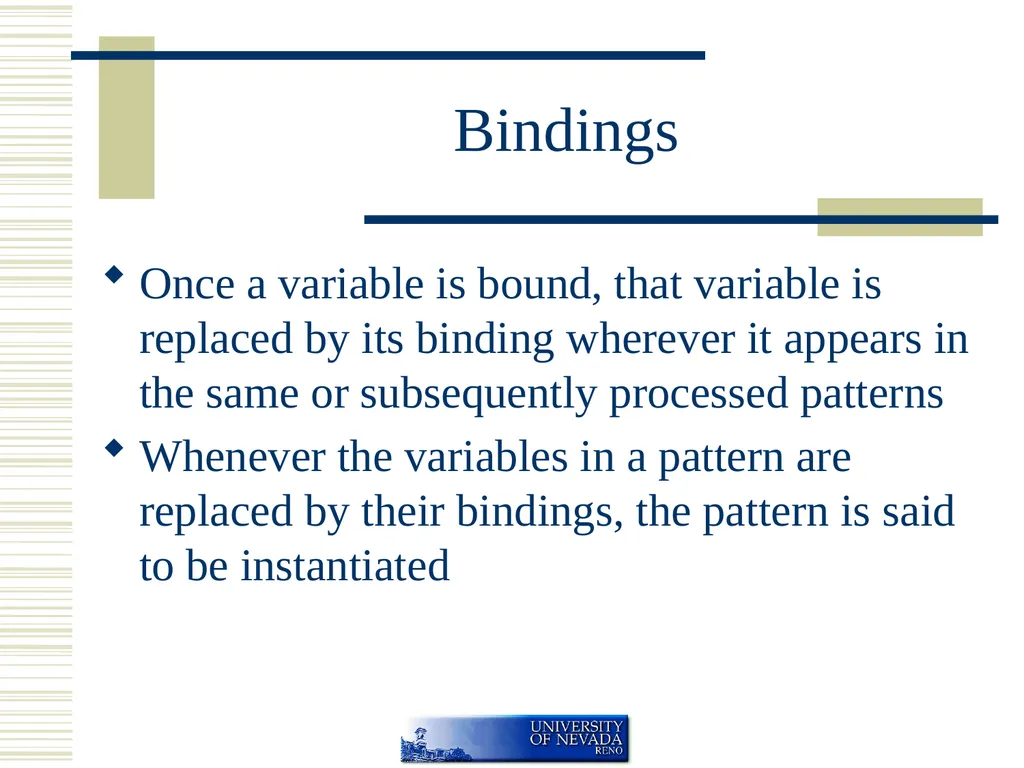
Bindings Once a variable is bound, that variable is replaced by its binding wherever it appears in the same or subsequently processed patterns
Whenever the variables in a pattern are replaced by their bindings, the pattern is said to be instantiated<br>
Whenever the variables in a pattern are replaced by their bindings, the pattern is said to be instantiated<br>
12
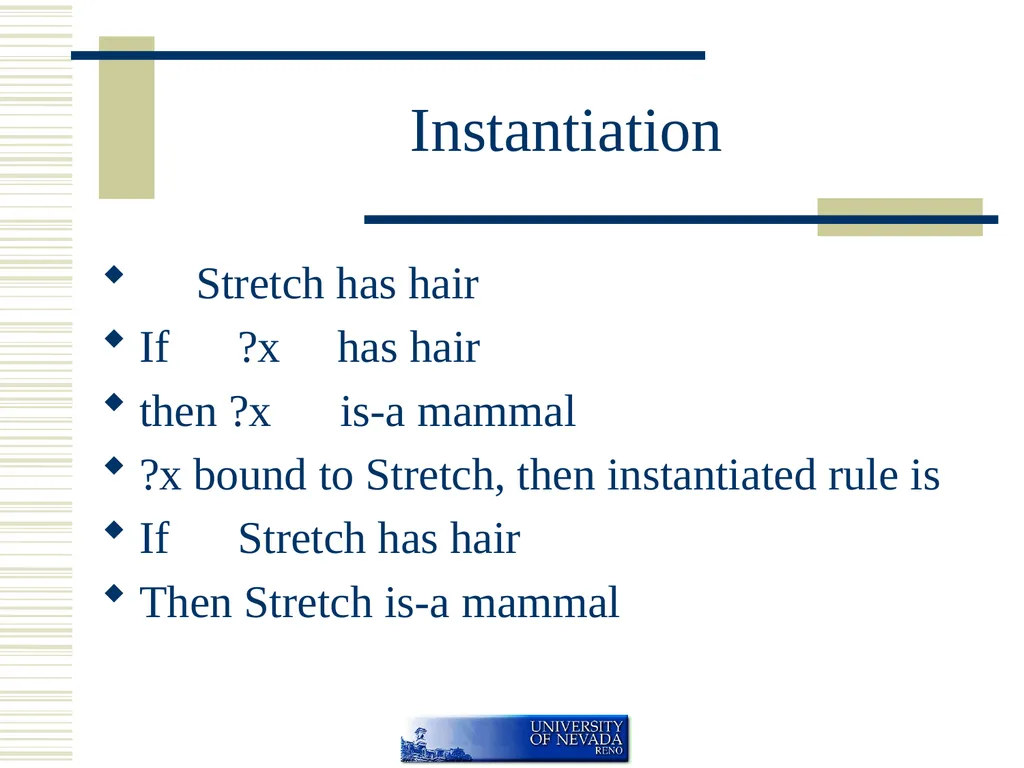
Instantiation Stretch has hair
If ?x has hair
then ?x is-a mammal
?x bound to Stretch, then instantiated rule is
If Stretch has hair
Then Stretch is-a mammal<br>
If ?x has hair
then ?x is-a mammal
?x bound to Stretch, then instantiated rule is
If Stretch has hair
Then Stretch is-a mammal<br>
13
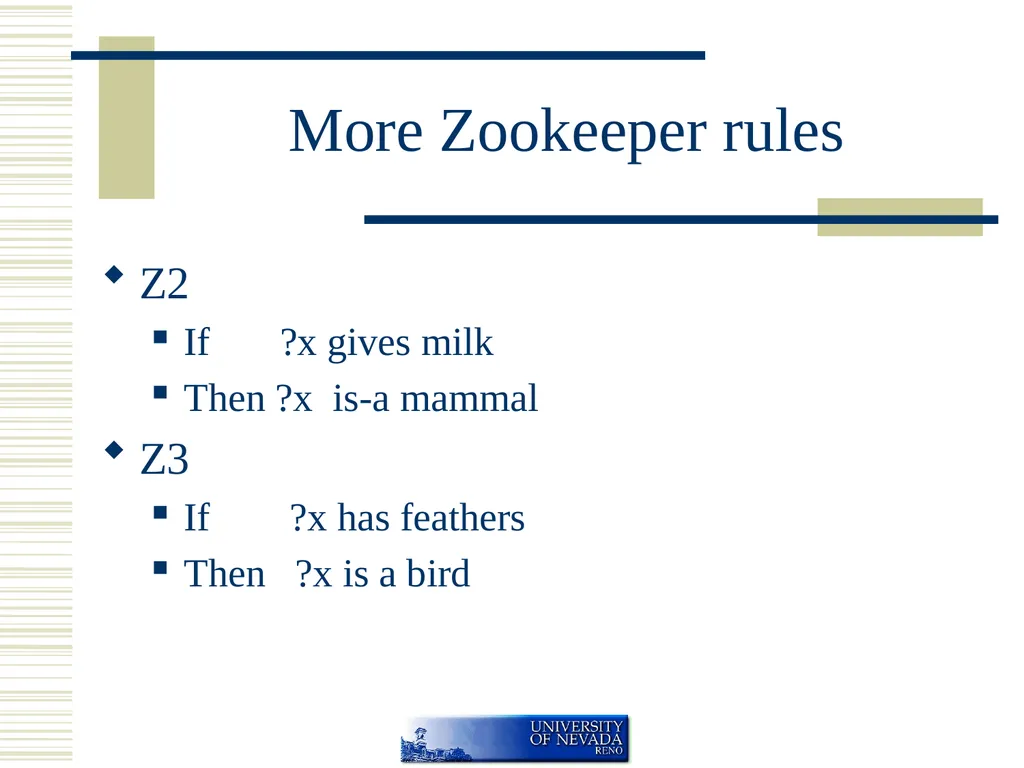
More Zookeeper rules Z2
If ?x gives milk
Then ?x is-a mammal
Z3
If ?x has feathers
Then ?x is a bird<br>
If ?x gives milk
Then ?x is-a mammal
Z3
If ?x has feathers
Then ?x is a bird<br>
14
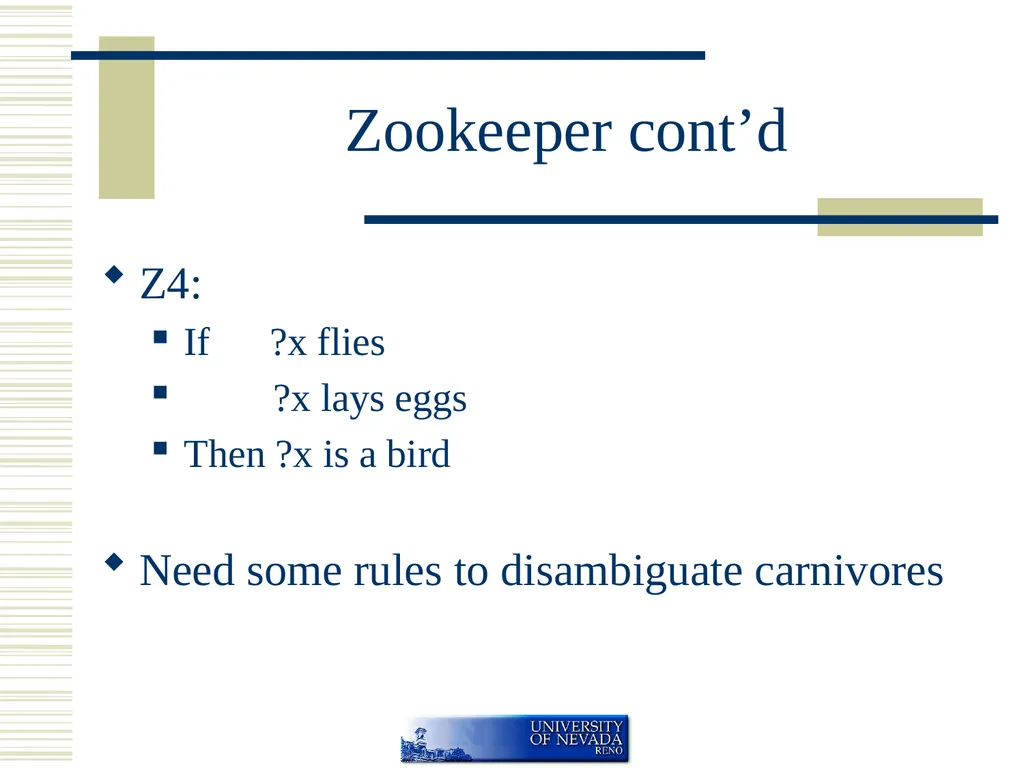
Zookeeper cont’d Z4:
If ?x flies
?x lays eggs
Then ?x is a bird
Need some rules to disambiguate carnivores<br>
If ?x flies
?x lays eggs
Then ?x is a bird
Need some rules to disambiguate carnivores<br>
15
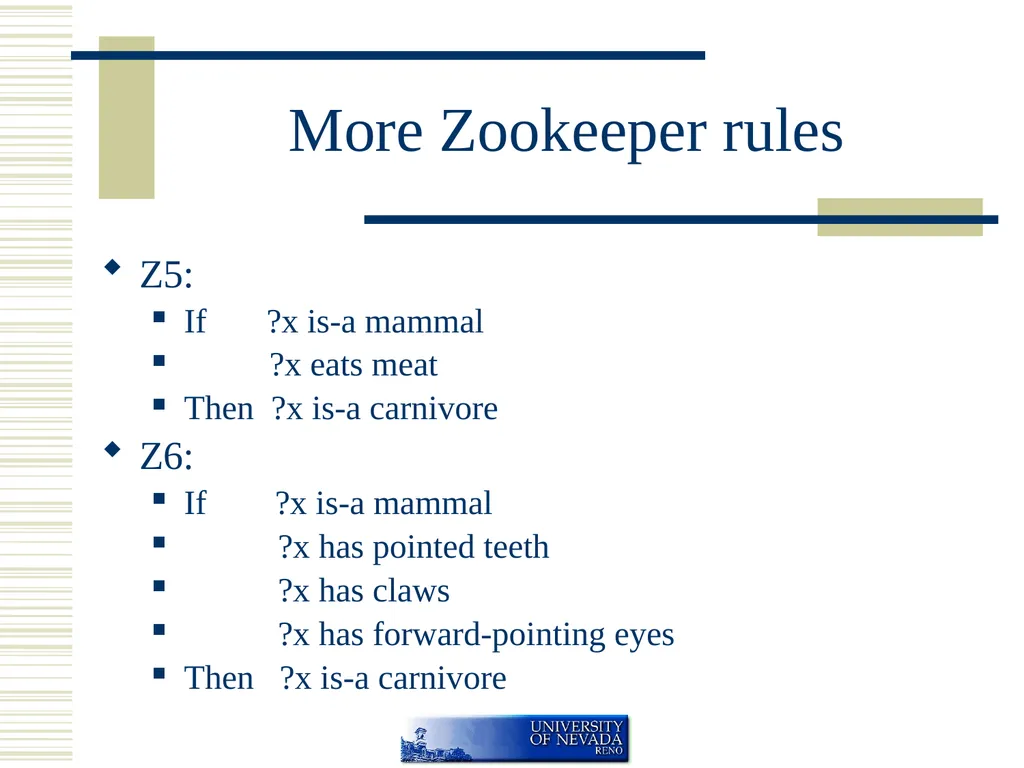
More Zookeeper rules Z5:
If ?x is-a mammal
?x eats meat
Then ?x is-a carnivore
Z6:
If ?x is-a mammal
?x has pointed teeth
?x has claws
?x has forward-pointing eyes
Then ?x is-a carnivore<br>
If ?x is-a mammal
?x eats meat
Then ?x is-a carnivore
Z6:
If ?x is-a mammal
?x has pointed teeth
?x has claws
?x has forward-pointing eyes
Then ?x is-a carnivore<br>
16
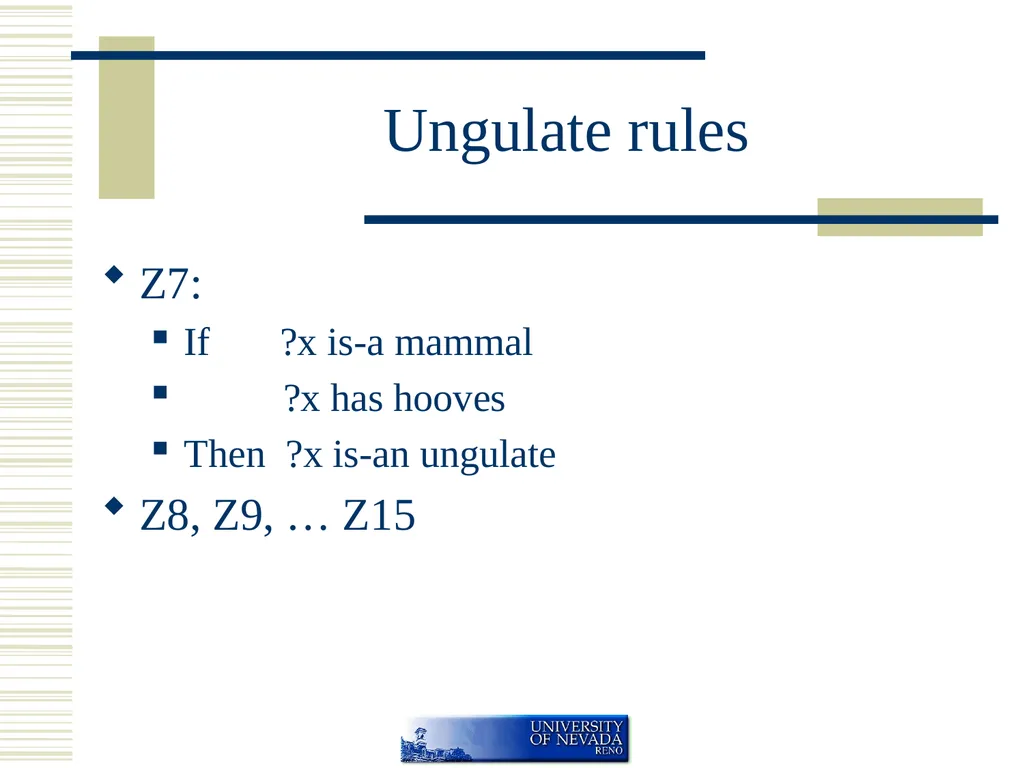
Ungulate rules Z7:
If ?x is-a mammal
?x has hooves
Then ?x is-an ungulate
Z8, Z9, … Z15<br>
If ?x is-a mammal
?x has hooves
Then ?x is-an ungulate
Z8, Z9, … Z15<br>
17
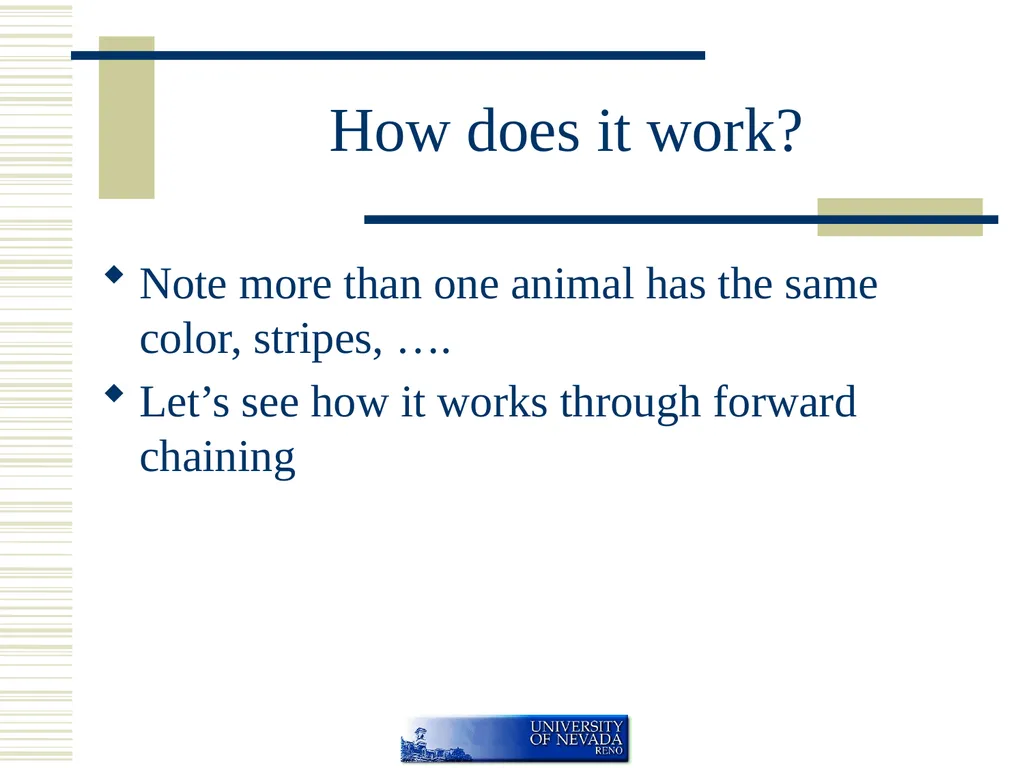
How does it work? Note more than one animal has the same color, stripes, ….
Let’s see how it works through forward chaining<br>
Let’s see how it works through forward chaining<br>
18
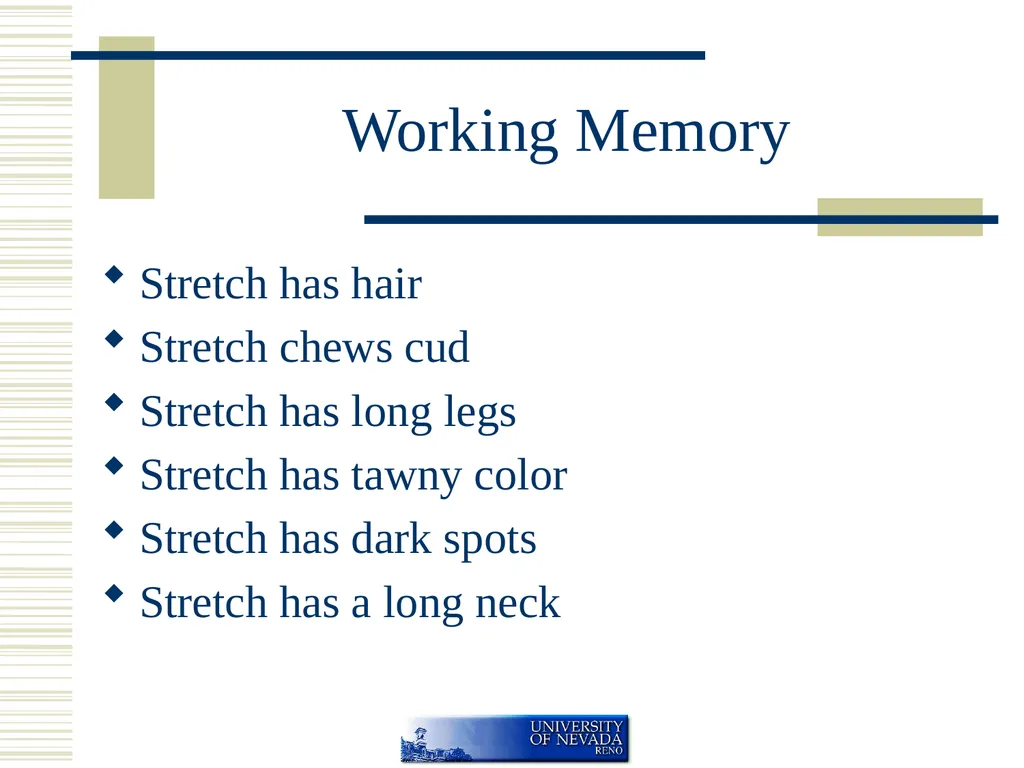
Working Memory Stretch has hair
Stretch chews cud
Stretch has long legs
Stretch has tawny color
Stretch has dark spots
Stretch has a long neck<br>
Stretch chews cud
Stretch has long legs
Stretch has tawny color
Stretch has dark spots
Stretch has a long neck<br>
19
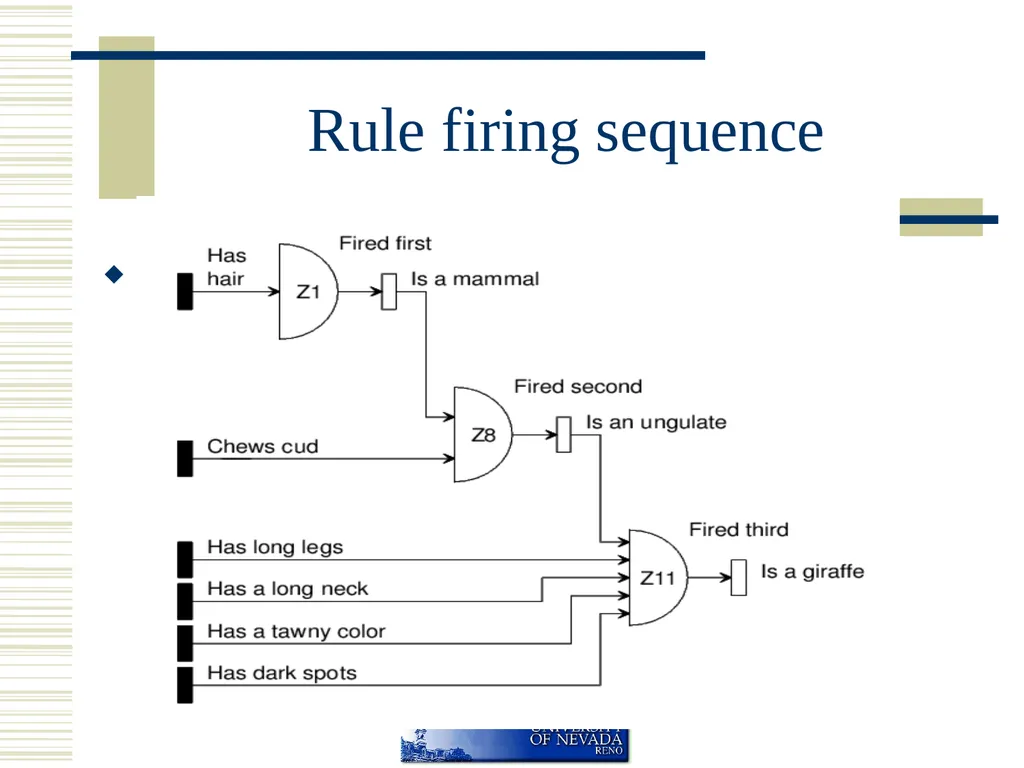
Rule firing sequence ?<br>
20
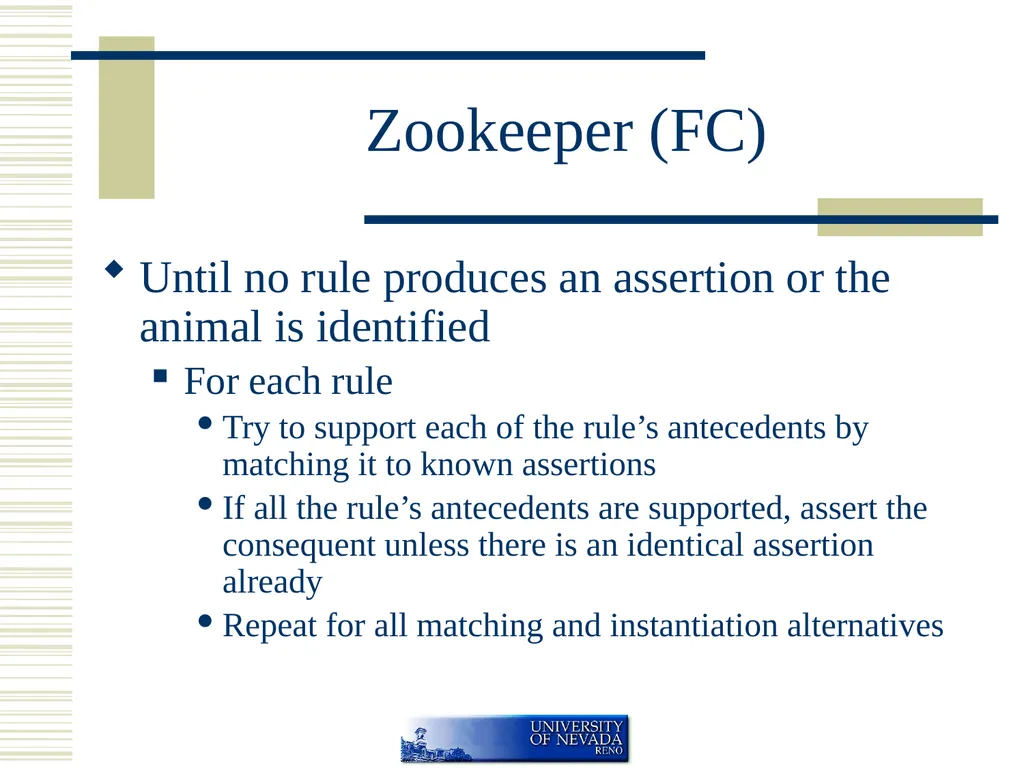
Zookeeper (FC) Until no rule produces an assertion or the animal is identified
For each rule
Try to support each of the rule’s antecedents by matching it to known assertions
If all the rule’s antecedents are supported, assert the consequent unless there is an identical assertion already
Repeat for all matching and instantiation alternatives<br>
For each rule
Try to support each of the rule’s antecedents by matching it to known assertions
If all the rule’s antecedents are supported, assert the consequent unless there is an identical assertion already
Repeat for all matching and instantiation alternatives<br>
21
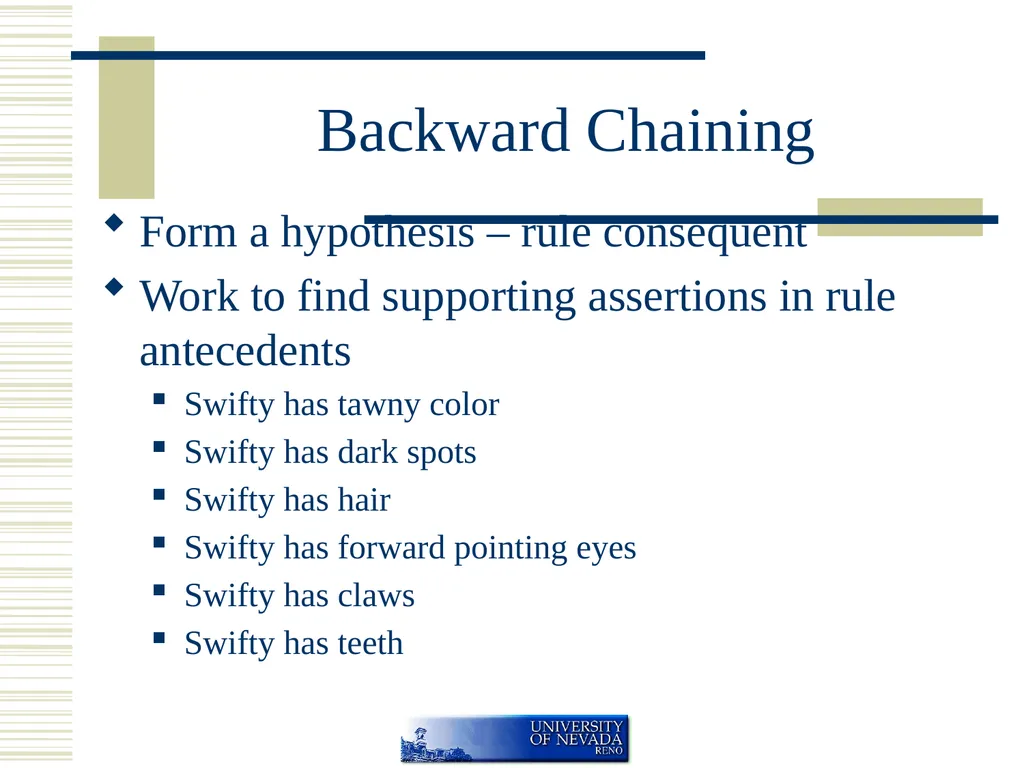
Backward Chaining Form a hypothesis – rule consequent
Work to find supporting assertions in rule antecedents
Swifty has tawny color
Swifty has dark spots
Swifty has hair
Swifty has forward pointing eyes
Swifty has claws
Swifty has teeth<br>
Work to find supporting assertions in rule antecedents
Swifty has tawny color
Swifty has dark spots
Swifty has hair
Swifty has forward pointing eyes
Swifty has claws
Swifty has teeth<br>
22
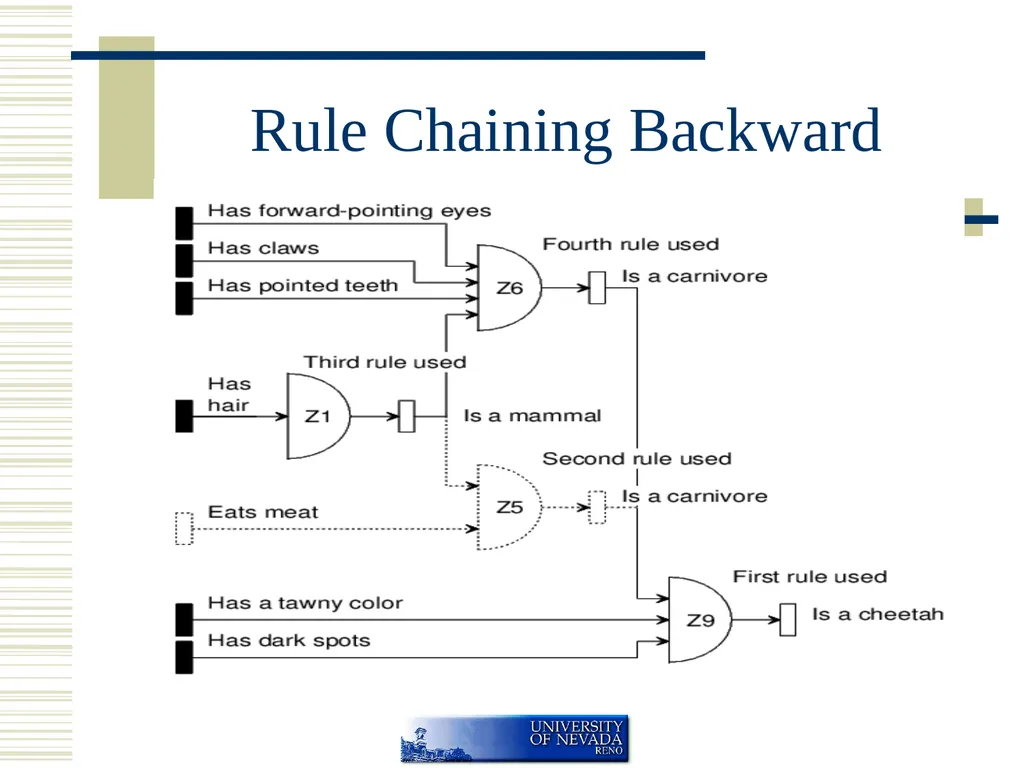
Rule Chaining Backward<br>
23
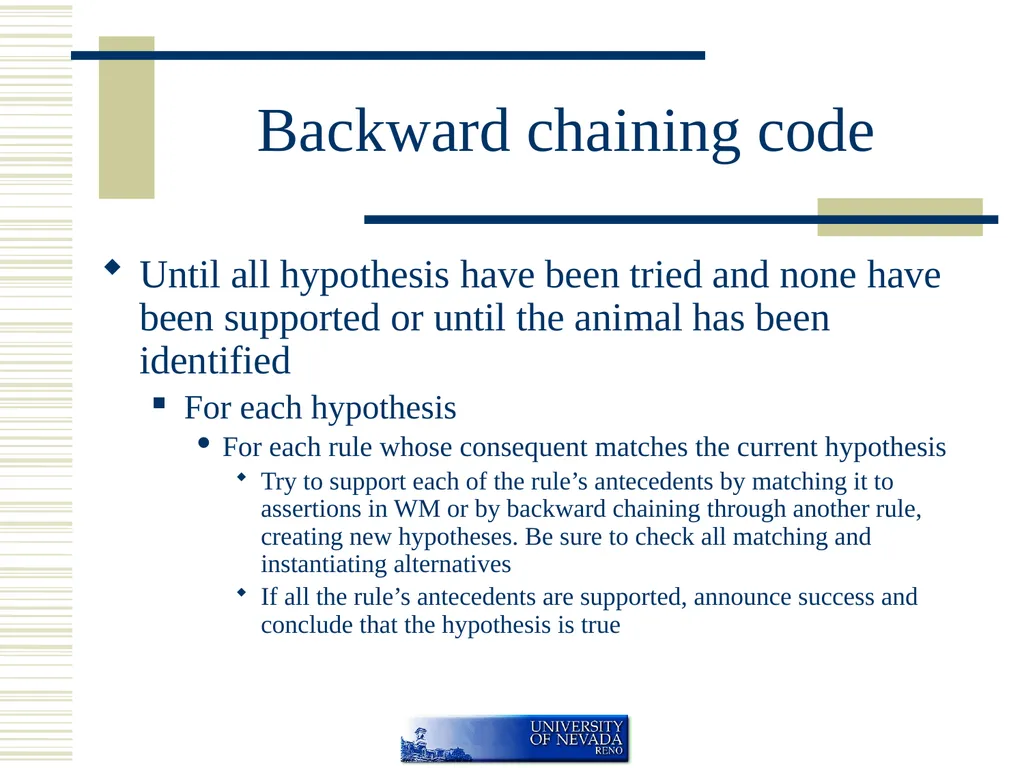
Backward chaining code Until all hypothesis have been tried and none have been supported or until the animal has been identified
For each hypothesis
For each rule whose consequent matches the current hypothesis
Try to support each of the rule’s antecedents by matching it to assertions in WM or by backward chaining through another rule, creating new hypotheses. Be sure to check all matching and instantiating alternatives
If all the rule’s antecedents are supported, announce success and conclude that the hypothesis is true<br>
For each hypothesis
For each rule whose consequent matches the current hypothesis
Try to support each of the rule’s antecedents by matching it to assertions in WM or by backward chaining through another rule, creating new hypotheses. Be sure to check all matching and instantiating alternatives
If all the rule’s antecedents are supported, announce success and conclude that the hypothesis is true<br>
24
Forward or backward Depends on the problem!
Fan-out versus Fan-in
If the facts can lead to a large number of conclusions, but the number of ways to reach the particular conclusion we are interested in is small, then there is more fan-out than fan-in. Use backward chaining<br>
Fan-out versus Fan-in
If the facts can lead to a large number of conclusions, but the number of ways to reach the particular conclusion we are interested in is small, then there is more fan-out than fan-in. Use backward chaining<br>
25
Backward or Forward? If the number of ways of reaching the particular conclusion in which you are interested is large, but the number of conclusions you are likely to reach using the assertions is small, you have more fan-in.
Use forward chaining<br>
Use forward chaining<br>
26
Forward or Backward If fan-in an fan-out are about the same
If you have not yet gathered any facts, and if you are only interested in whether one of many possible conclusions is true, use backward chaining
If you are only interested in whether an animal is a carnivore, only look at antecedents of carnivore rule to focus fact finding<br>
If you have not yet gathered any facts, and if you are only interested in whether one of many possible conclusions is true, use backward chaining
If you are only interested in whether an animal is a carnivore, only look at antecedents of carnivore rule to focus fact finding<br>
27
Get all the facts If you have all the facts that you will ever get, and are interested in everything that you can conclude from those facts, use Forward chaining
If you catch a fleeting glimpse of an animal, gathered a set of facts. No more facts possible because animal is gone: Forward chain<br>
If you catch a fleeting glimpse of an animal, gathered a set of facts. No more facts possible because animal is gone: Forward chain<br>
28
Mycin<br>
29
Mycin<br>
30
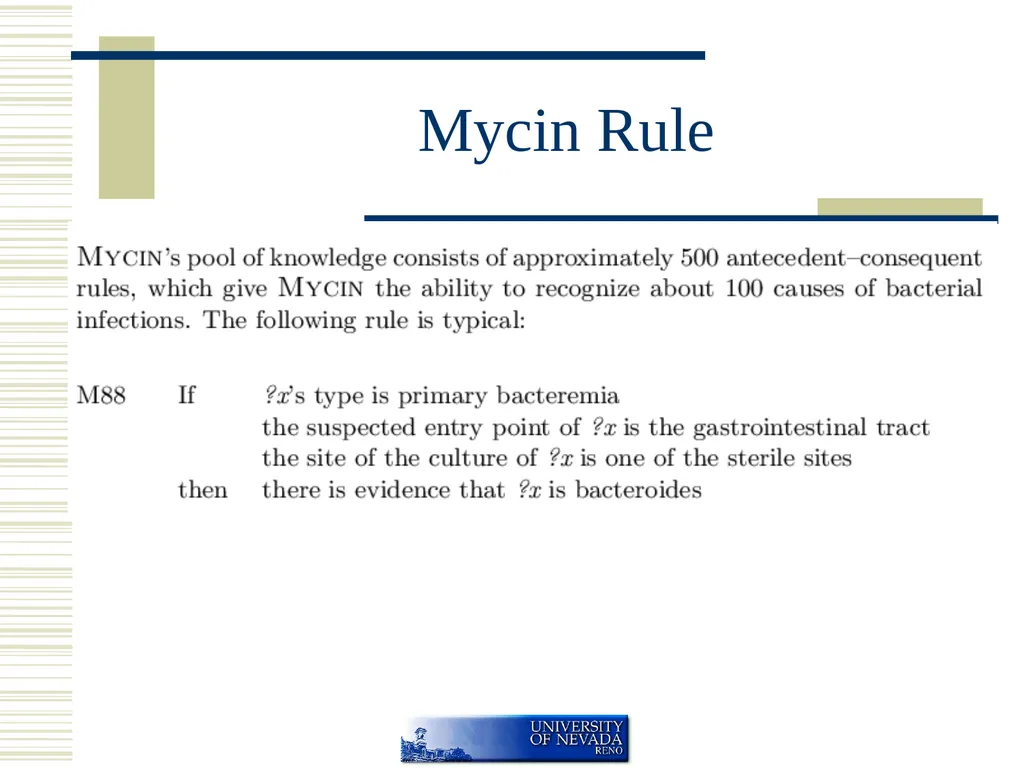
Mycin Rule<br>
31
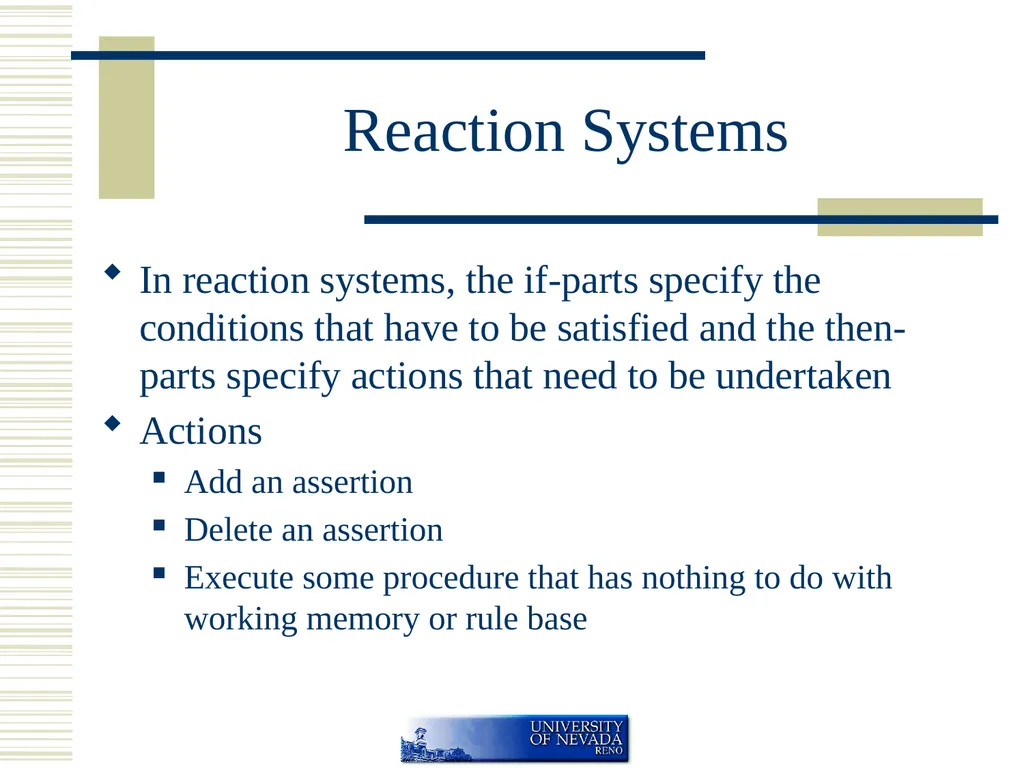
Reaction Systems In reaction systems, the if-parts specify the conditions that have to be satisfied and the then-parts specify actions that need to be undertaken
Actions
Add an assertion
Delete an assertion
Execute some procedure that has nothing to do with working memory or rule base<br>
Actions
Add an assertion
Delete an assertion
Execute some procedure that has nothing to do with working memory or rule base<br>
32
Grocery bagging Robbie needs to know how to bag groceries
Plan A: For each item in store, design a rule?
Plan B: Four grocery bagging steps, differing sets of rules active within each of these four steps<br>
Plan A: For each item in store, design a rule?
Plan B: Four grocery bagging steps, differing sets of rules active within each of these four steps<br>
33
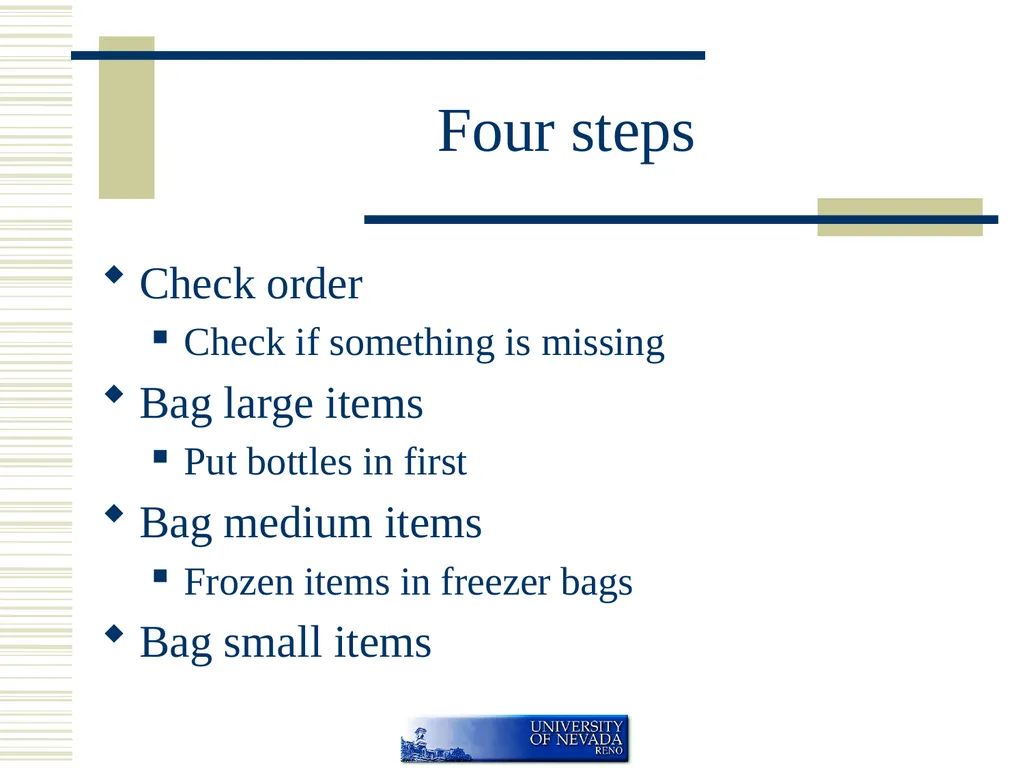
Four steps Check order
Check if something is missing
Bag large items
Put bottles in first
Bag medium items
Frozen items in freezer bags
Bag small items<br>
Check if something is missing
Bag large items
Put bottles in first
Bag medium items
Frozen items in freezer bags
Bag small items<br>
34
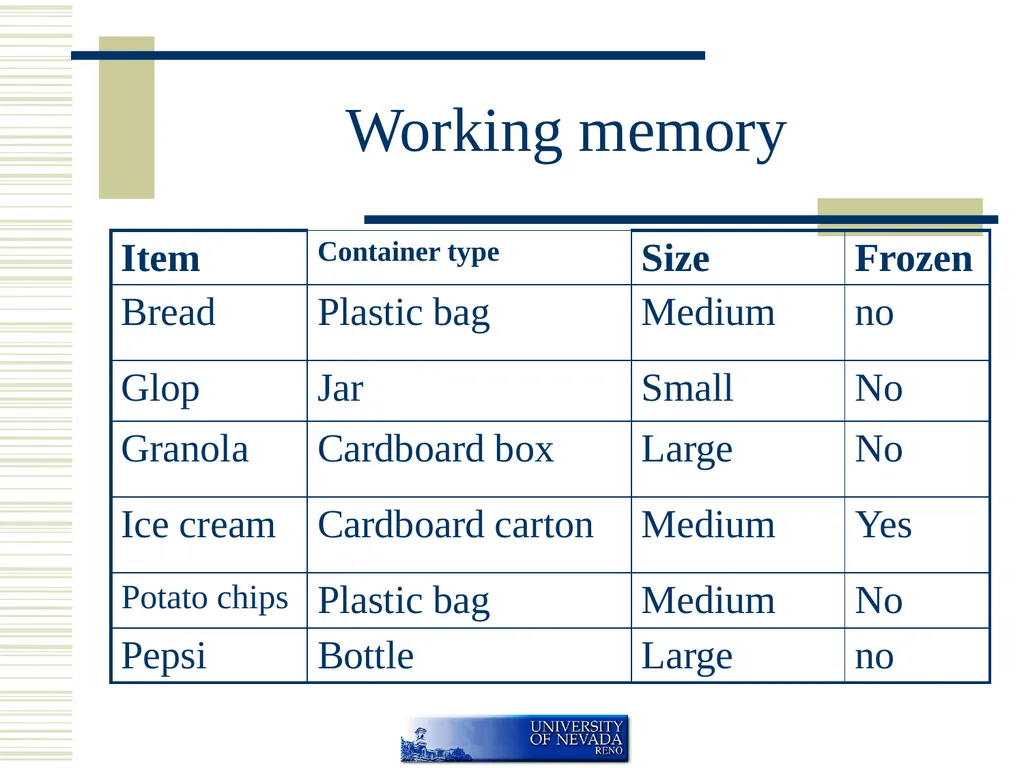
Working memory<br>
35
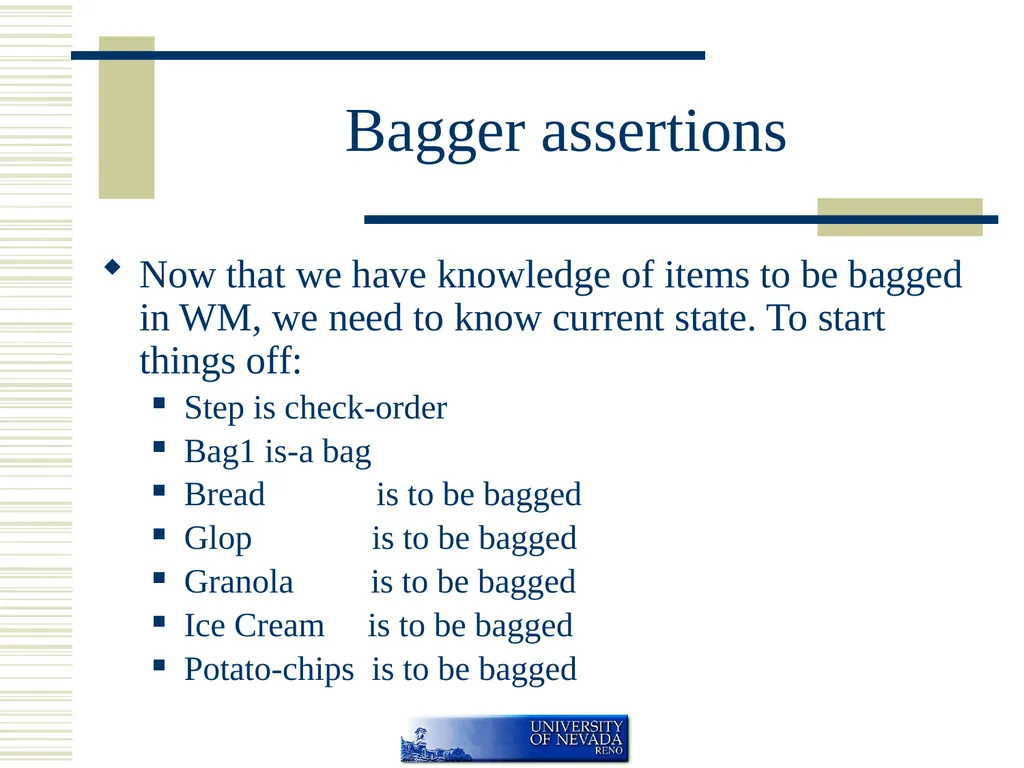
Bagger assertions Now that we have knowledge of items to be bagged in WM, we need to know current state. To start things off:
Step is check-order
Bag1 is-a bag
Bread is to be bagged
Glop is to be bagged
Granola is to be bagged
Ice Cream is to be bagged
Potato-chips is to be bagged<br>
Step is check-order
Bag1 is-a bag
Bread is to be bagged
Glop is to be bagged
Granola is to be bagged
Ice Cream is to be bagged
Potato-chips is to be bagged<br>
36
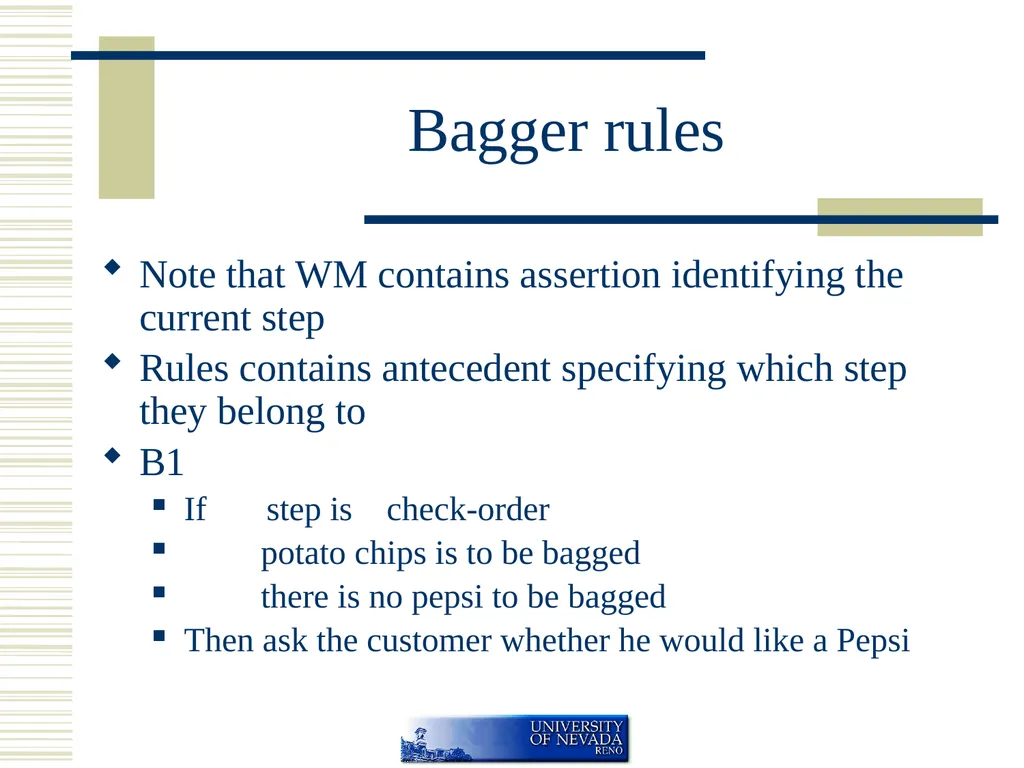
Bagger rules Note that WM contains assertion identifying the current step
Rules contains antecedent specifying which step they belong to
B1
If step is check-order
potato chips is to be bagged
there is no pepsi to be bagged
Then ask the customer whether he would like a Pepsi<br>
Rules contains antecedent specifying which step they belong to
B1
If step is check-order
potato chips is to be bagged
there is no pepsi to be bagged
Then ask the customer whether he would like a Pepsi<br>
37
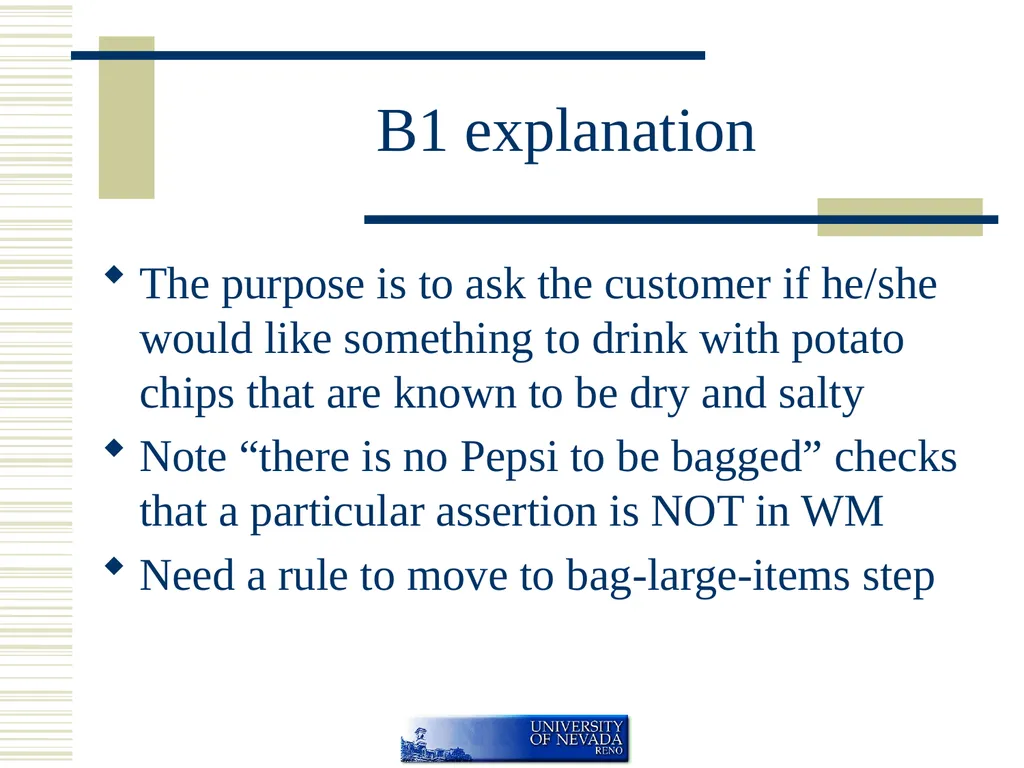
B1 explanation The purpose is to ask the customer if he/she would like something to drink with potato chips that are known to be dry and salty
Note “there is no Pepsi to be bagged” checks that a particular assertion is NOT in WM
Need a rule to move to bag-large-items step<br>
Note “there is no Pepsi to be bagged” checks that a particular assertion is NOT in WM
Need a rule to move to bag-large-items step<br>
38
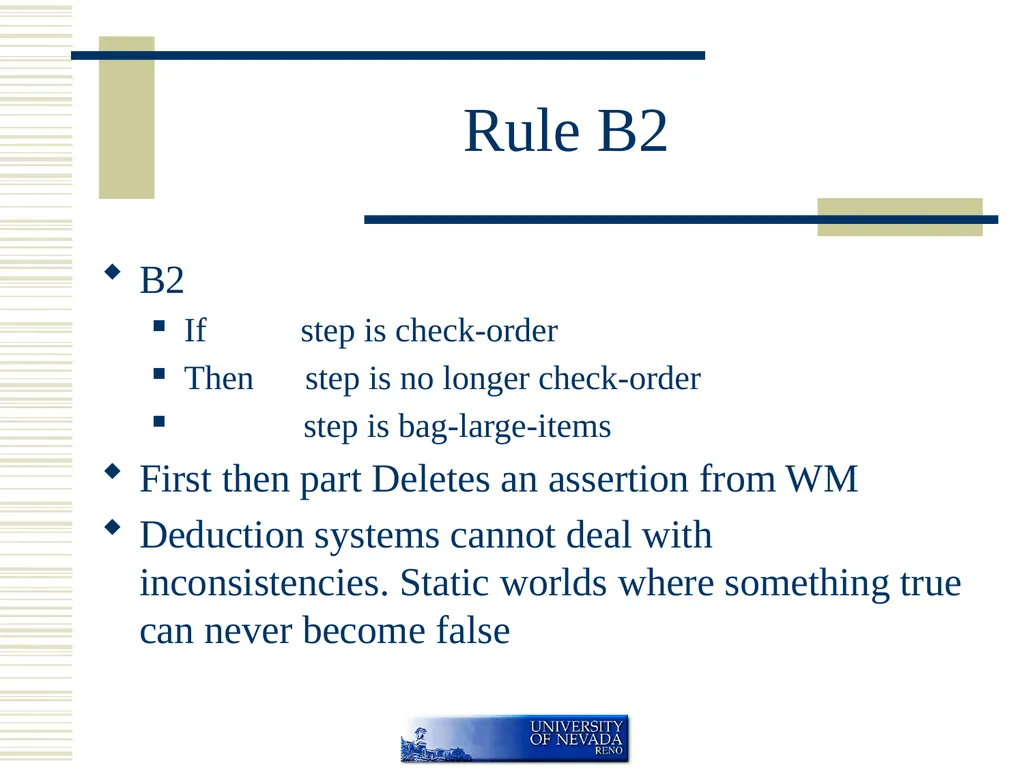
Rule B2 B2
If step is check-order
Then step is no longer check-order
step is bag-large-items
First then part Deletes an assertion from WM
Deduction systems cannot deal with inconsistencies. Static worlds where something true can never become false<br>
If step is check-order
Then step is no longer check-order
step is bag-large-items
First then part Deletes an assertion from WM
Deduction systems cannot deal with inconsistencies. Static worlds where something true can never become false<br>
39
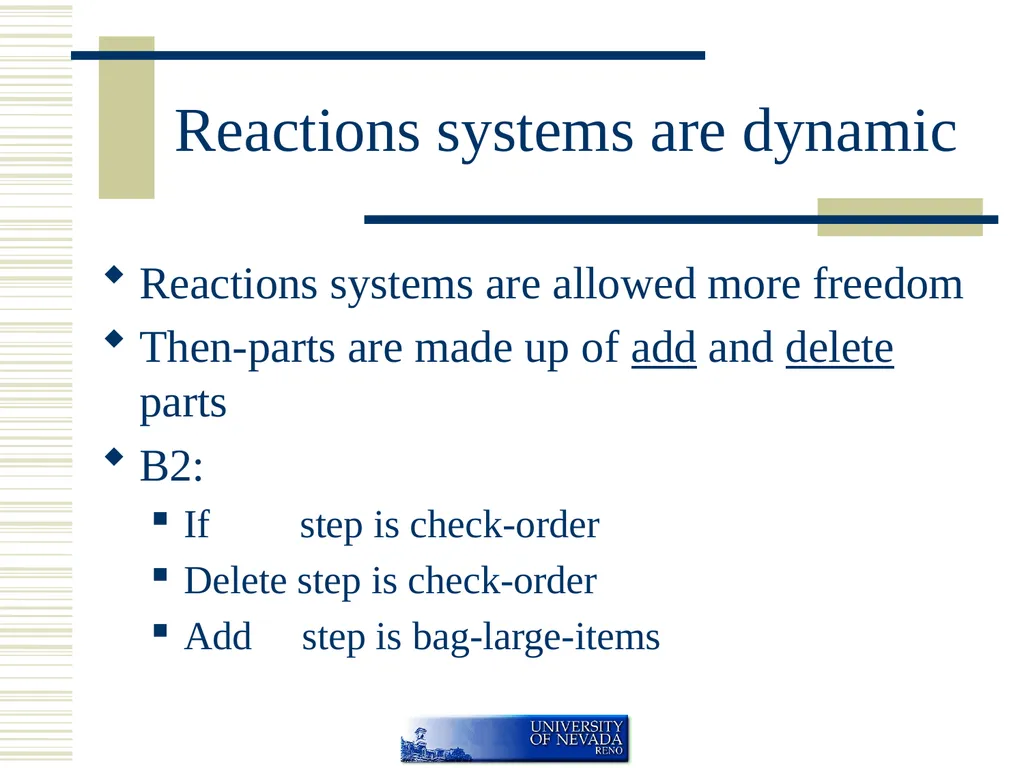
Reactions systems are dynamic Reactions systems are allowed more freedom
Then-parts are made up of add and delete parts
B2:
If step is check-order
Delete step is check-order
Add step is bag-large-items<br>
Then-parts are made up of add and delete parts
B2:
If step is check-order
Delete step is check-order
Add step is bag-large-items<br>
40
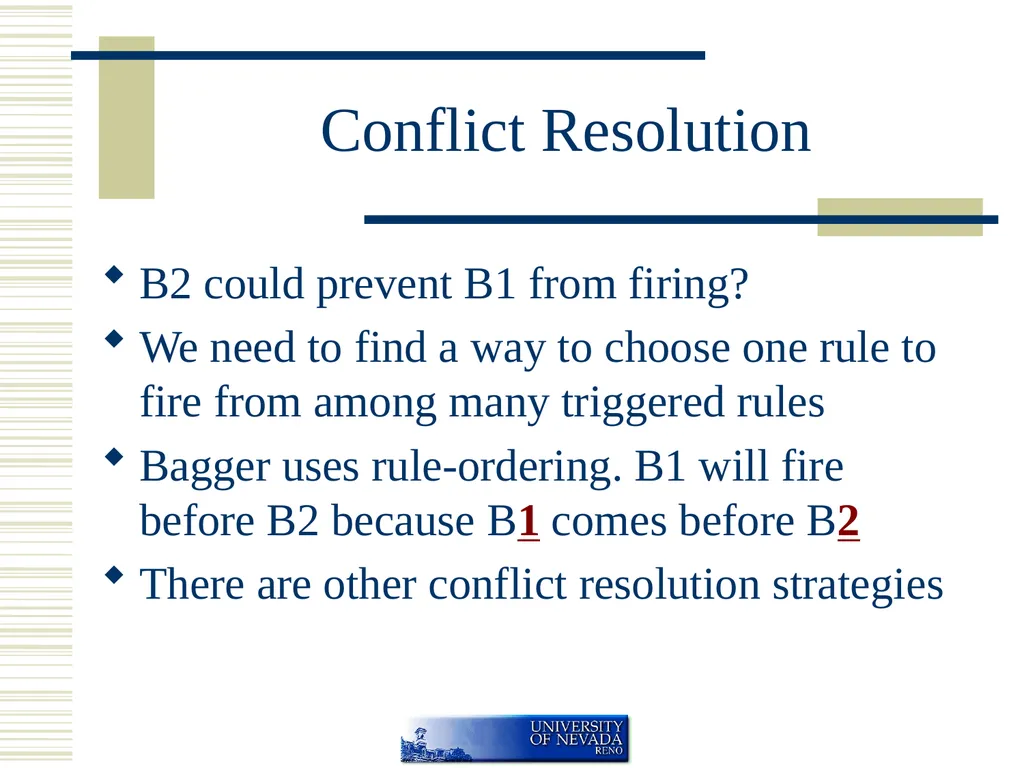
Conflict Resolution B2 could prevent B1 from firing?
We need to find a way to choose one rule to fire from among many triggered rules
Bagger uses rule-ordering. B1 will fire before B2 because B1 comes before B2
There are other conflict resolution strategies<br>
We need to find a way to choose one rule to fire from among many triggered rules
Bagger uses rule-ordering. B1 will fire before B2 because B1 comes before B2
There are other conflict resolution strategies<br>
41
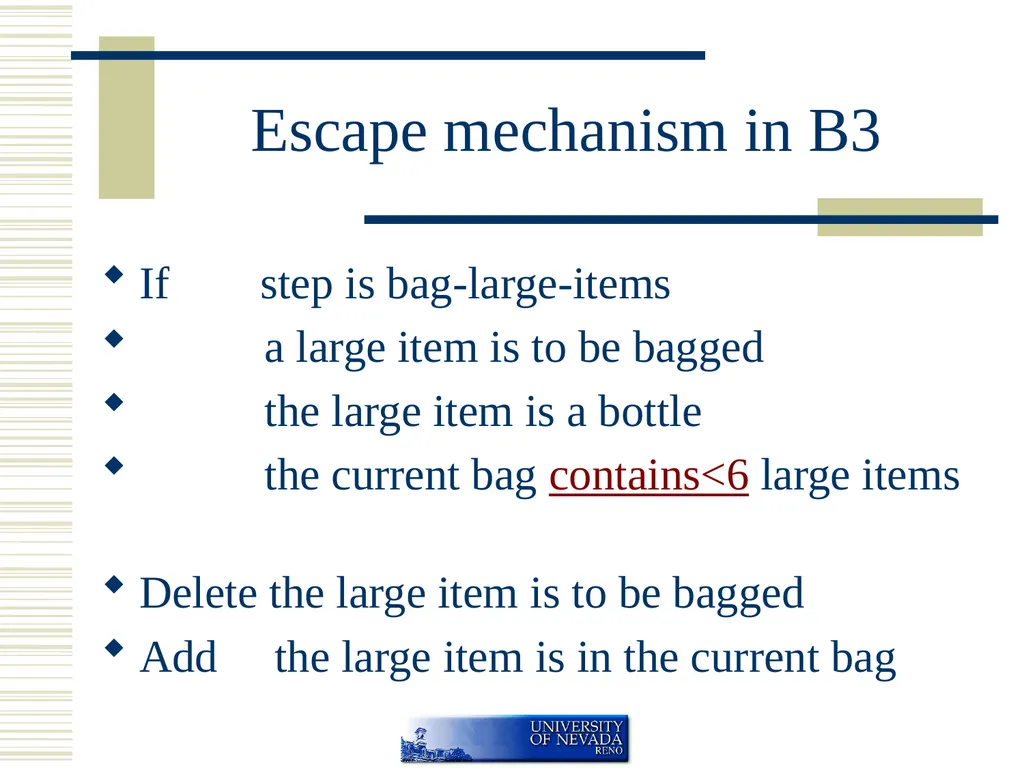
Escape mechanism in B3 If step is bag-large-items
a large item is to be bagged
the large item is a bottle
the current bag contains<6 large items
Delete the large item is to be bagged
Add the large item is in the current bag<br>
a large item is to be bagged
the large item is a bottle
the current bag contains<6 large items
Delete the large item is to be bagged
Add the large item is in the current bag<br>
42
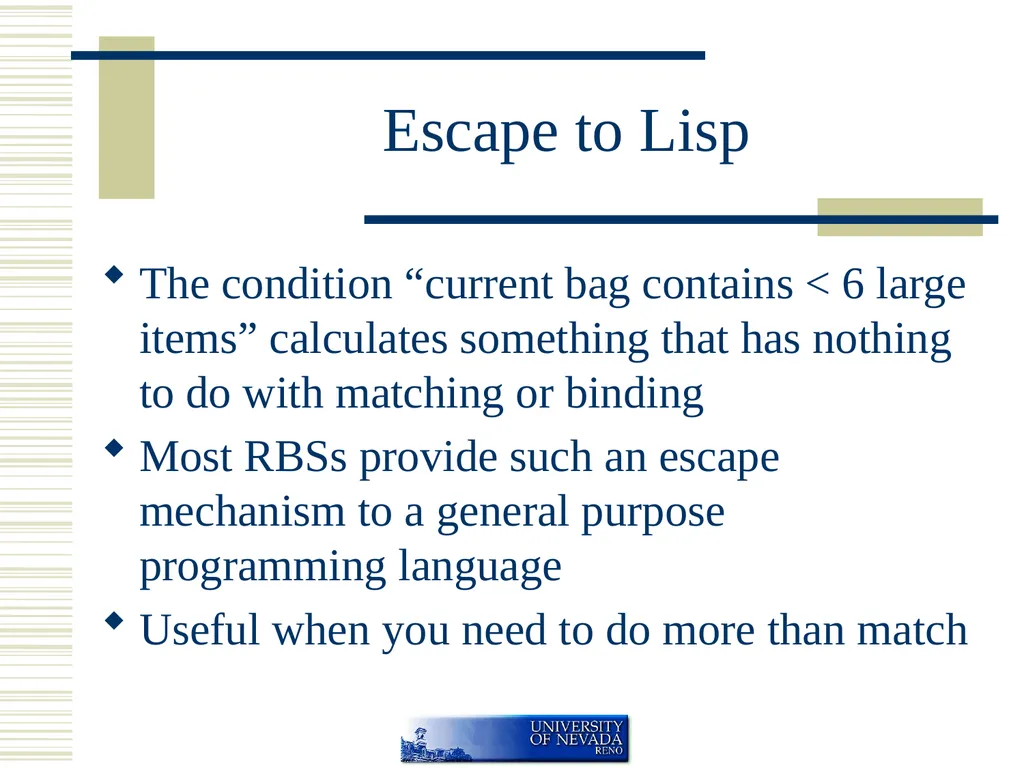
Escape to Lisp The condition “current bag contains < 6 large items” calculates something that has nothing to do with matching or binding
Most RBSs provide such an escape mechanism to a general purpose programming language
Useful when you need to do more than match<br>
Most RBSs provide such an escape mechanism to a general purpose programming language
Useful when you need to do more than match<br>
43
Bagger example Code on web page<br>
44
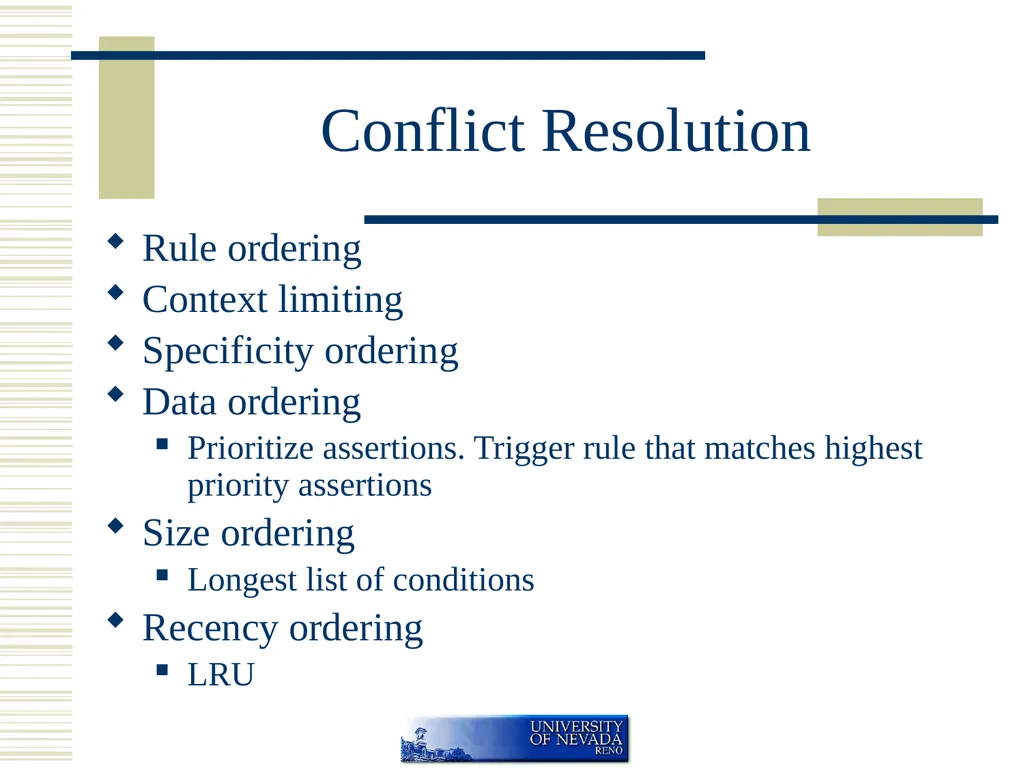
Conflict Resolution Rule ordering
Context limiting
Specificity ordering
Data ordering
Prioritize assertions. Trigger rule that matches highest priority assertions
Size ordering
Longest list of conditions
Recency ordering
LRU<br>
Context limiting
Specificity ordering
Data ordering
Prioritize assertions. Trigger rule that matches highest priority assertions
Size ordering
Longest list of conditions
Recency ordering
LRU<br>