Safe journey, safe driver, safe vehicle MODULE 2 OF 3 DRIVING FOR WORK The practical controls. What has to be checked, planned and in place before a work journey starts. Toolbox talk staff briefing approx. 25 minutes IN THIS MODULE
"Safe journey, safe driver, safe vehicle MODULE 2" is the property of its rightful owner. Permission is granted to
download and print the materials on this website for personal, non-commercial use only, and to display it
on your personal computer provided you do not modify the materials and that you retain all copyright
notices contained in the materials. By downloading content from our website, you accept the terms of this
agreement.
Presentation Transcript
01
Safe journey,
safe driver,
safe vehicle MODULE 2 OF 3 · DRIVING FOR WORK The practical controls. What has to be checked, planned and in place before a work journey starts. Toolbox talk / staff briefing · approx. 25 minutes IN THIS MODULE
Planning the journey
License, health and fitness
The walkaround check
Loads and equipment
Grey fleet checks
Construction-specific risks<br>
02
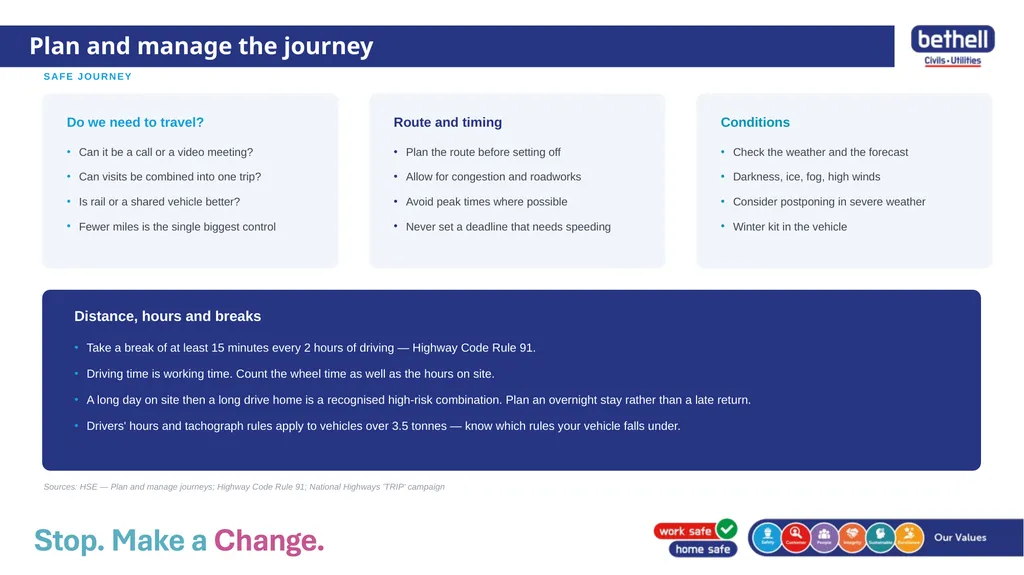
Plan and manage the journey SAFE JOURNEY Do we need to travel? Can it be a call or a video meeting?
Can visits be combined into one trip?
Is rail or a shared vehicle better?
Fewer miles is the single biggest control Route and timing Plan the route before setting off
Allow for congestion and roadworks
Avoid peak times where possible
Never set a deadline that needs speeding Conditions Check the weather and the forecast
Darkness, ice, fog, high winds
Consider postponing in severe weather
Winter kit in the vehicle Distance, hours and breaks Take a break of at least 15 minutes every 2 hours of driving — Highway Code Rule 91.
Driving time is working time. Count the wheel time as well as the hours on site.
A long day on site then a long drive home is a recognised high-risk combination. Plan an overnight stay rather than a late return.
Drivers' hours and tachograph rules apply to vehicles over 3.5 tonnes — know which rules your vehicle falls under. Sources: HSE — Plan and manage journeys; Highway Code Rule 91; National Highways 'TRIP' campaign<br>
03
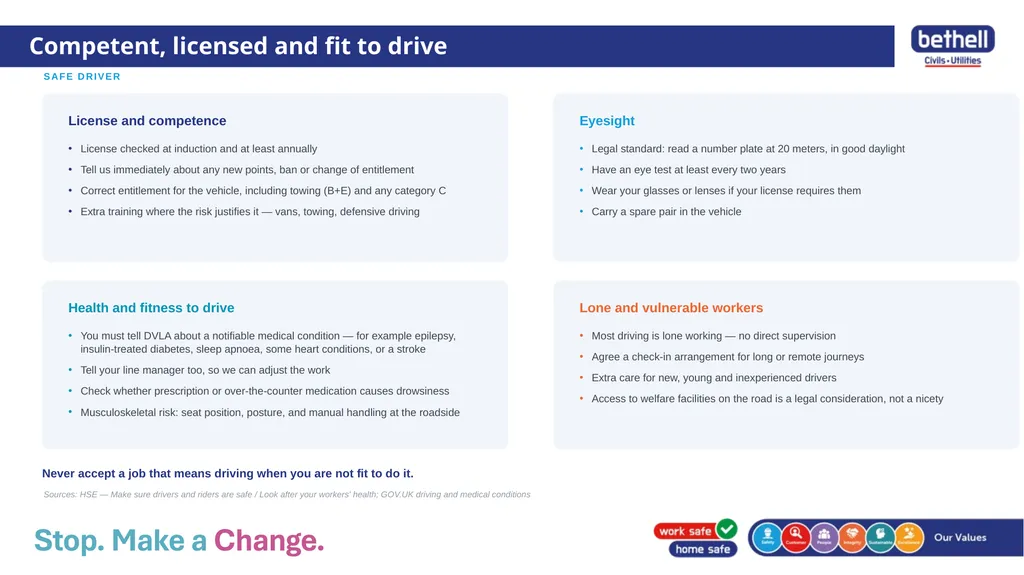
Competent, licensed and fit to drive SAFE DRIVER License and competence License checked at induction and at least annually
Tell us immediately about any new points, ban or change of entitlement
Correct entitlement for the vehicle, including towing (B+E) and any category C
Extra training where the risk justifies it — vans, towing, defensive driving Eyesight Legal standard: read a number plate at 20 meters, in good daylight
Have an eye test at least every two years
Wear your glasses or lenses if your license requires them
Carry a spare pair in the vehicle Health and fitness to drive You must tell DVLA about a notifiable medical condition — for example epilepsy, insulin-treated diabetes, sleep apnoea, some heart conditions, or a stroke
Tell your line manager too, so we can adjust the work
Check whether prescription or over-the-counter medication causes drowsiness
Musculoskeletal risk: seat position, posture, and manual handling at the roadside Lone and vulnerable workers Most driving is lone working — no direct supervision
Agree a check-in arrangement for long or remote journeys
Extra care for new, young and inexperienced drivers
Access to welfare facilities on the road is a legal consideration, not a nicety Never accept a job that means driving when you are not fit to do it. Sources: HSE — Make sure drivers and riders are safe / Look after your workers' health; GOV.UK driving and medical conditions<br>
04
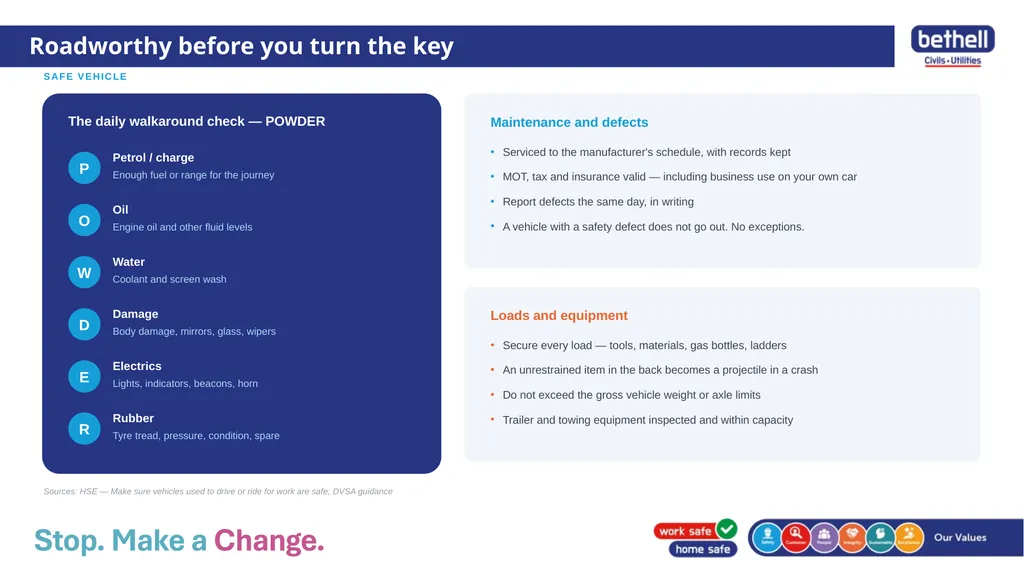
Roadworthy before you turn the key SAFE VEHICLE The daily walkaround check — POWDER P Petrol / charge Enough fuel or range for the journey O Oil Engine oil and other fluid levels W Water Coolant and screen wash D Damage Body damage, mirrors, glass, wipers E Electrics Lights, indicators, beacons, horn R Rubber Tyre tread, pressure, condition, spare Maintenance and defects Serviced to the manufacturer's schedule, with records kept
MOT, tax and insurance valid — including business use on your own car
Report defects the same day, in writing
A vehicle with a safety defect does not go out. No exceptions. Loads and equipment Secure every load — tools, materials, gas bottles, ladders
An unrestrained item in the back becomes a projectile in a crash
Do not exceed the gross vehicle weight or axle limits
Trailer and towing equipment inspected and within capacity Sources: HSE — Make sure vehicles used to drive or ride for work are safe; DVSA guidance<br>
05
Your own car, our legal duty GREY FLEET A grey fleet vehicle is a privately owned vehicle used for a work journey. Roughly 14 million private vehicles are used for business in the UK, and they are typically far older than company or lease vehicles — which makes them the part of the fleet most often missed. Before you use your own vehicle for work, your employer must have seen: A valid driving license with the right entitlement Motor insurance that covers business use — social, domestic and pleasure is not enough A current MOT certificate, where the vehicle is over three years old Valid vehicle excise duty Evidence the vehicle is serviced and roadworthy A signed declaration that you will keep all of the above current Why it gets missed The vehicle is not on any fleet list, so nobody checks it
No telematics, no service data, no visibility of condition
Average grey fleet vehicle is several years older than a lease car Why it still matters Employers duty of care is identical to a company vehicle
Employers insurers and the HSE will both ask to see the checks
In a fatal case, the absence of records is the finding Sources: HSE — driving and riding safely for work; Driving for Better Business, Grey Fleet Review<br>
06
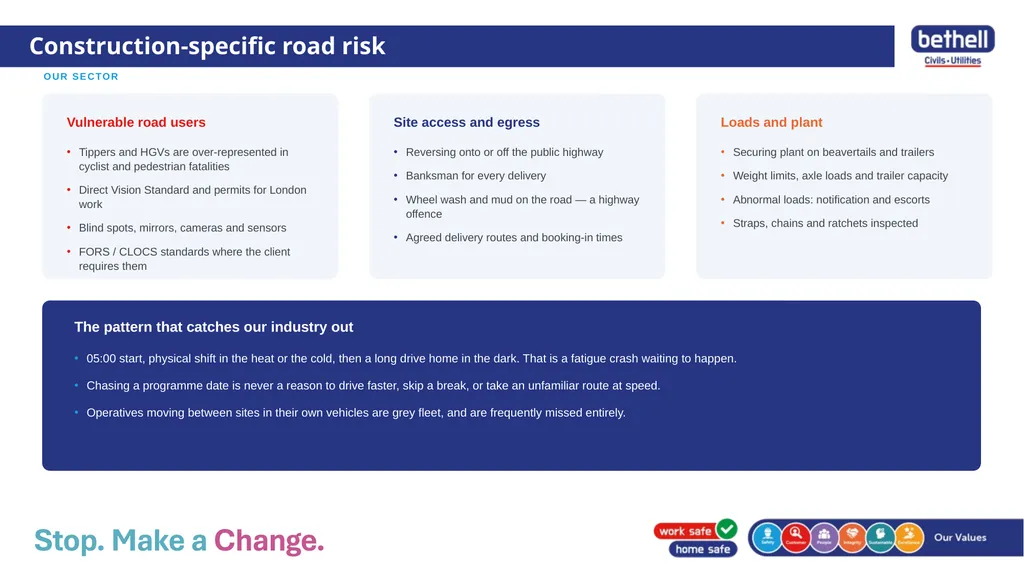
Construction-specific road risk OUR SECTOR Vulnerable road users Tippers and HGVs are over-represented in cyclist and pedestrian fatalities
Direct Vision Standard and permits for London work
Blind spots, mirrors, cameras and sensors
FORS / CLOCS standards where the client requires them Site access and egress Reversing onto or off the public highway
Banksman for every delivery
Wheel wash and mud on the road — a highway offence
Agreed delivery routes and booking-in times Loads and plant Securing plant on beavertails and trailers
Weight limits, axle loads and trailer capacity
Abnormal loads: notification and escorts
Straps, chains and ratchets inspected The pattern that catches our industry out 05:00 start, physical shift in the heat or the cold, then a long drive home in the dark. That is a fatigue crash waiting to happen.
Chasing a programme date is never a reason to drive faster, skip a break, or take an unfamiliar route at speed.
Operatives moving between sites in their own vehicles are grey fleet, and are frequently missed entirely.<br>
07
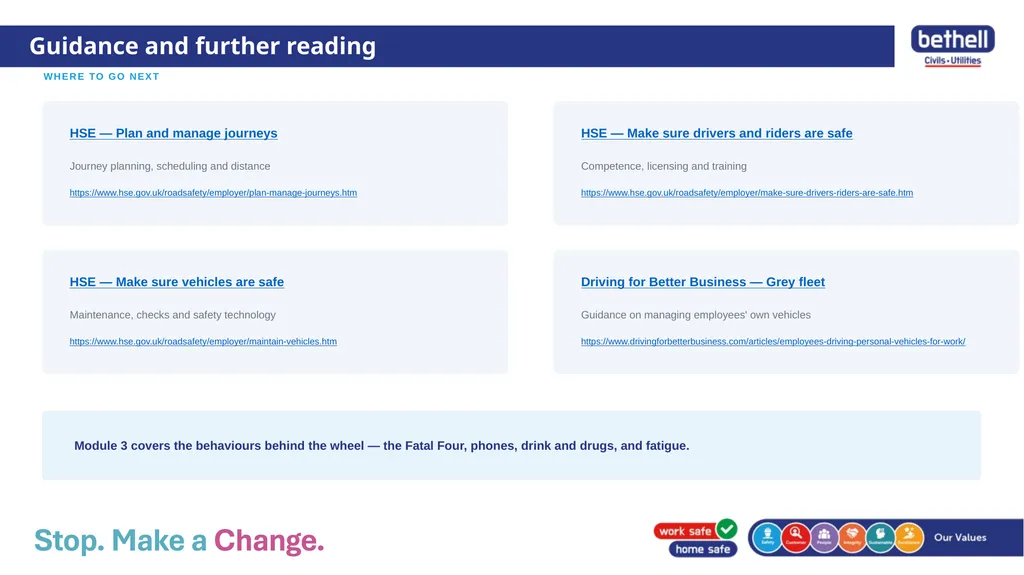
Guidance and further reading WHERE TO GO NEXT HSE — Plan and manage journeys Journey planning, scheduling and distance https://www.hse.gov.uk/roadsafety/employer/plan-manage-journeys.htm HSE — Make sure drivers and riders are safe Competence, licensing and training https://www.hse.gov.uk/roadsafety/employer/make-sure-drivers-riders-are-safe.htm HSE — Make sure vehicles are safe Maintenance, checks and safety technology https://www.hse.gov.uk/roadsafety/employer/maintain-vehicles.htm Driving for Better Business — Grey fleet Guidance on managing employees' own vehicles https://www.drivingforbetterbusiness.com/articles/employees-driving-personal-vehicles-for-work/ Module 3 covers the behaviours behind the wheel — the Fatal Four, phones, drink and drugs, and fatigue.<br>
08
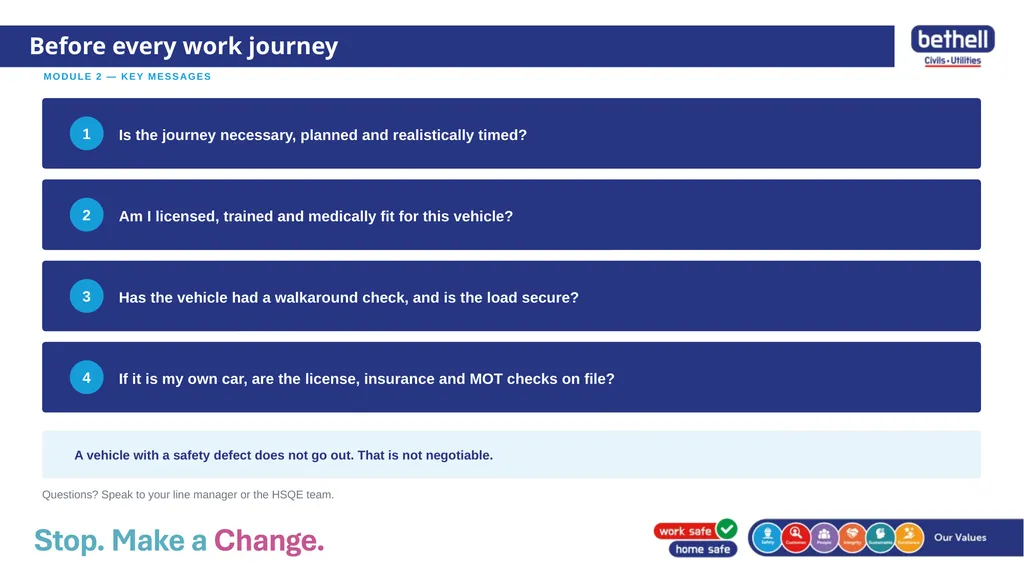
Before every work journey MODULE 2 — KEY MESSAGES 1 Is the journey necessary, planned and realistically timed? 2 Am I licensed, trained and medically fit for this vehicle? 3 Has the vehicle had a walkaround check, and is the load secure? 4 If it is my own car, are the license, insurance and MOT checks on file? A vehicle with a safety defect does not go out. That is not negotiable. Questions? Speak to your line manager or the HSQE team.<br>