SAND CRACK UNIT-VI Dr. Mithilesh Kumar Assistant Professor cum Jr. Scientist Department Surgery and Radiology Bihar Veterinary College, Patna-800014 Definition: fissure of horny wall parallel to dorsal wall or parallel to coronet. An
"SAND CRACK UNIT-VI Dr. Mithilesh Kumar Assistant" is the property of its rightful owner. Permission is granted to
download and print the materials on this website for personal, non-commercial use only, and to display it
on your personal computer provided you do not modify the materials and that you retain all copyright
notices contained in the materials. By downloading content from our website, you accept the terms of this
agreement.
Presentation Transcript
01
SAND CRACK UNIT-VI Dr. Mithilesh Kumar
Assistant Professor cum Jr. Scientist
Department Surgery and Radiology
Bihar Veterinary College,
Patna-800014<br>
02
Definition: fissure of horny wall parallel to dorsal wall or parallel to coronet.
An uncommon form is an axial wall crack.
Incidence: low in dairy breeds.
Predisposition: transverse form predisposed by overgrowth of digital horn and severe chronic laminitic horn rings.
Longitudinal form predisposed by dry environment, trauma at coronary band.<br>
03
Signs:
transverse form usually cosmetic blemish only, no lameness
single claw form indicates local stress; multiple claws (e.g. all eight) indicates systemic insult e.g. parturition, diet change, altered environment
pododerm rarely exposed
longitudinal form may be gross and involve whole length of coronet to bearing surface<br>
04
in other longitudinal cases diagnosis is difficult when fissure is limited to small and extremely painful coronary lesion, which is partly obscured by hairs. Such cases have severe trauma to pododerm and early entry of infection.
axial wall fissure is also hard to identify and can extend to coronary band causing severe pain.<br>
05
Treatment
transverse form: pare distal section of horn, especially when it forms hinge with more proximal portion and can cause pain on underlying laminae when flexed upwards: shorten toe and bearing surface to avoid movement of fractured portion
longitudinal form: remove any excessive granulation tissue (pododerm) protruding through sandcrack<br>
06
cleanse well, local astringent, local antibiotic spray, bandage and rest, possibly with block on adjacent claw especially with painful involvement of coronary band
in severe case clean fissure well with grinder or Dremel drill, drill hole at proximal end of crack and fill with resin, and block other digit Guarded prognosis in vertical fissures.
Prophylaxis Regular foot trimming, use of oils on at-risk cattle in dry environment.<br>
07
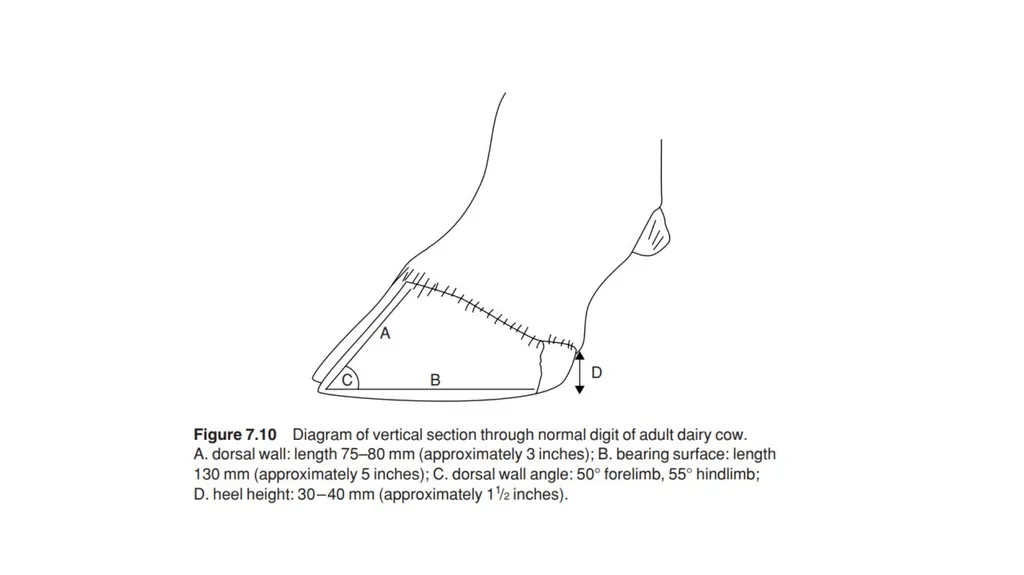
Hoof deformities, overgrowth and corrective foot trimming Hoof deformities may be inherited, or acquired as a result of insufficient wear, or claw diseases such as laminitis.
based on:
length of dorsal hoof wall from coronet to toe (measured with pair of commercial dividers)
angle of dorsal wall to ground (protractor)
heel depth (pair of dividers) (see Figure 7.10)<br>
08
It was found that:
cows surviving for three or four lactations had shorter hooves and steeper angles than non-survivors, based on measurements made during the first lactation
heritability of hoof length, employing sire comparisons, increased from first to fourth lactation
increases in milk yield from first to second lactation were greater in cows with short, large-angled hooves in the first lactation<br>
09
first lactation cows with above features had shorter calving to conception interval following the second lactation
high yielding cows tend to have longer and lower-angled hooves after their second parturition
calving to conception interval within the same lactation was greater in cows with longer, smaller-angled hooves than in those with shorter, steeper-angled hooves.<br>