04
NEPAD Science Technology & Innovation Hub (NSTIH) Established in the office of the CEO
Main coordinating center for all STI programmes within NEPAD Agency
Recommendation from the 1st Bureau meeting of AMCOST IV<br>
05
Main Functions of NSTIH Enhancing, coordinating and consolidating NEPAD STI programmes and projects
Facilitating effective delivery of STI programmes across Africa based on the NEPAD Agency mandate
Mainstreaming STI into NEPAD programmes and projects
Enhance the visibility of Impact oriented NEPAD Agency STI programmes<br>
06
Current Programmes of NSTIH
Implementation of the CPA<br>
07
Programme Focus R&D programmes
Human capacity building
Institutional strengthening
Support to RECs<br>
08
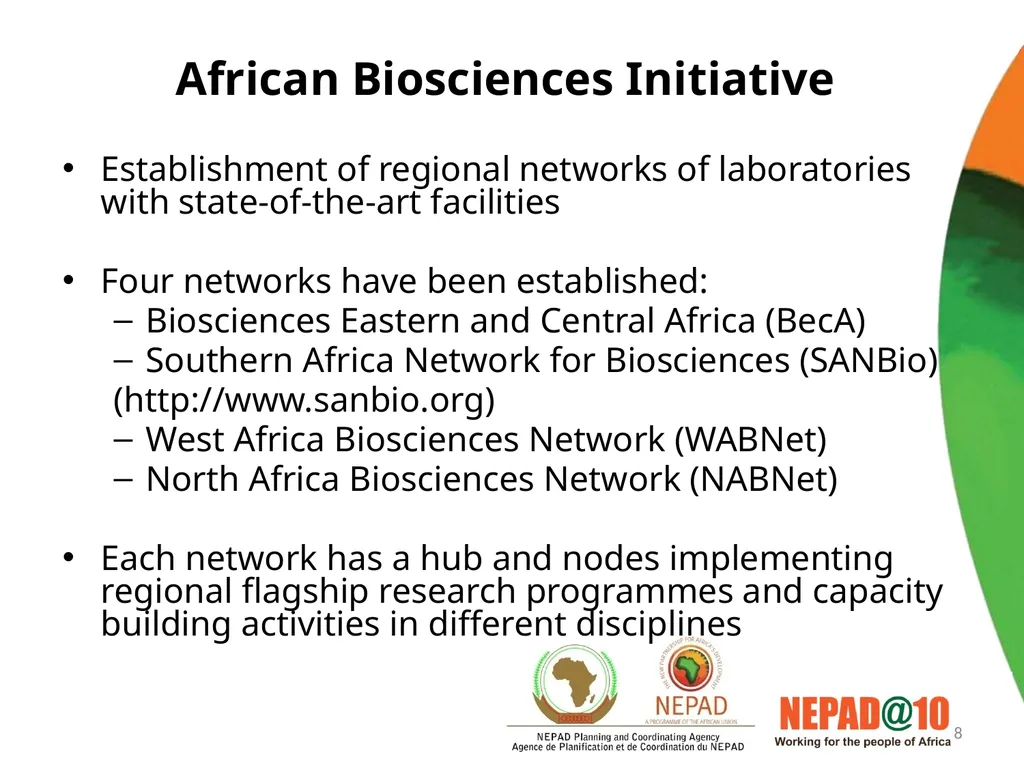
8 African Biosciences Initiative Establishment of regional networks of laboratories with state-of-the-art facilities
Four networks have been established:
Biosciences Eastern and Central Africa (BecA)
Southern Africa Network for Biosciences (SANBio)
(http://www.sanbio.org)
West Africa Biosciences Network (WABNet)
North Africa Biosciences Network (NABNet)
Each network has a hub and nodes implementing regional flagship research programmes and capacity building activities in different disciplines<br>
09
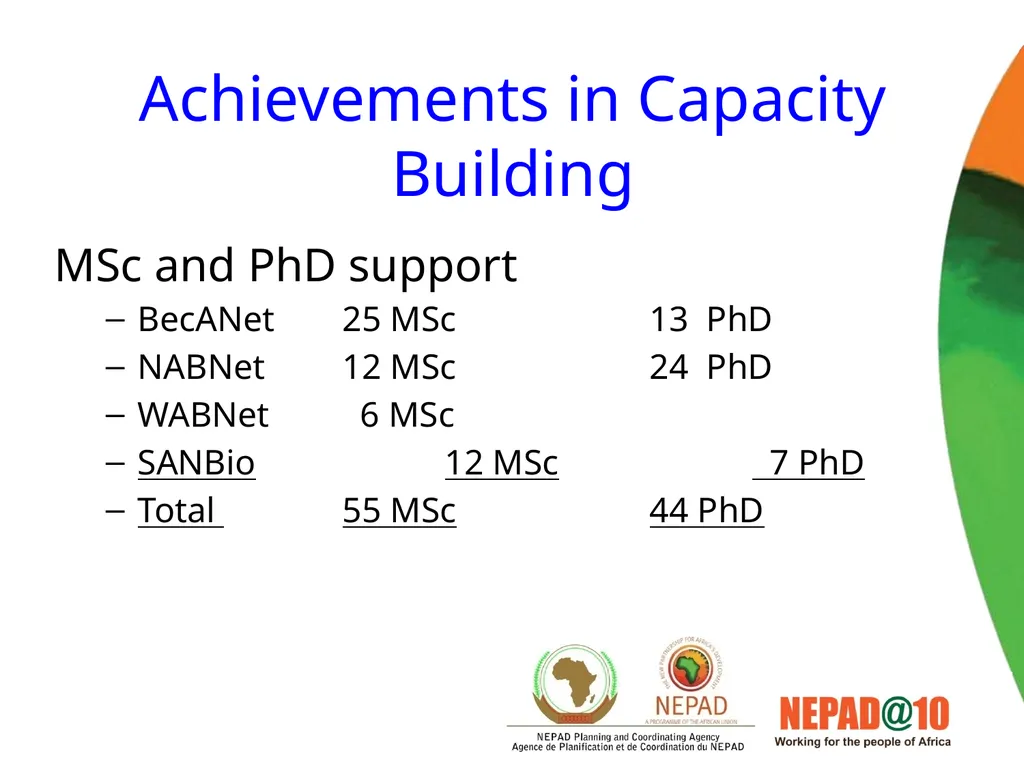
Achievements in Capacity Building MSc and PhD support
BecANet 25 MSc 13 PhD
NABNet 12 MSc 24 PhD
WABNet 6 MSc
SANBio 12 MSc 7 PhD
Total 55 MSc 44 PhD<br>
10
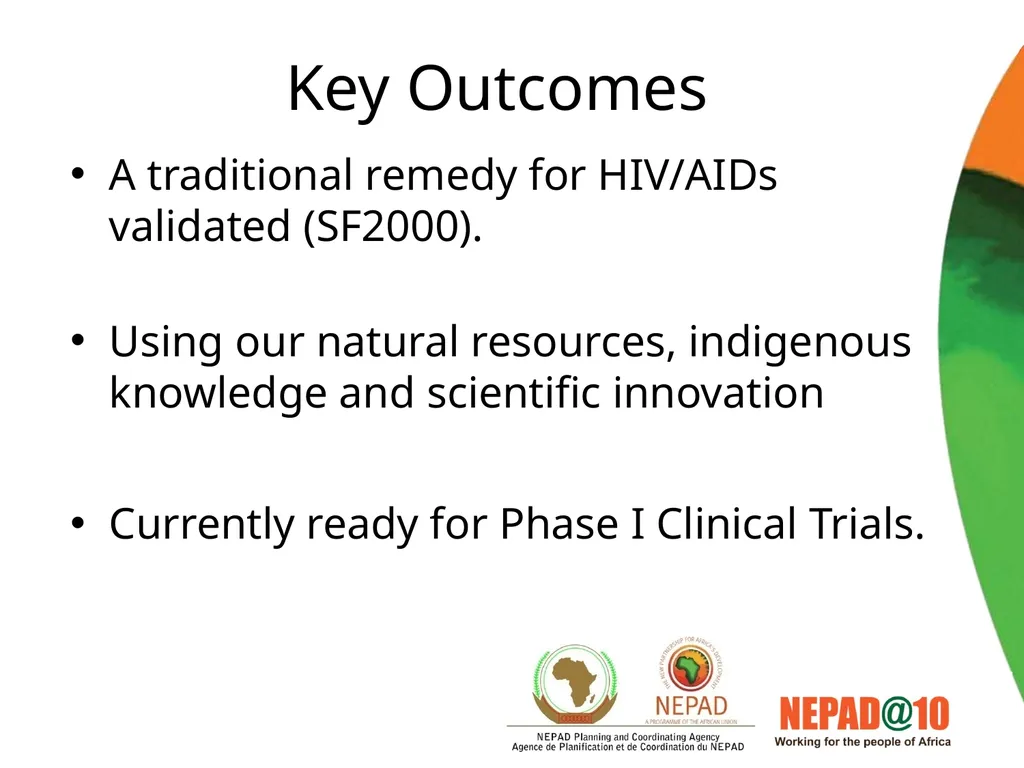
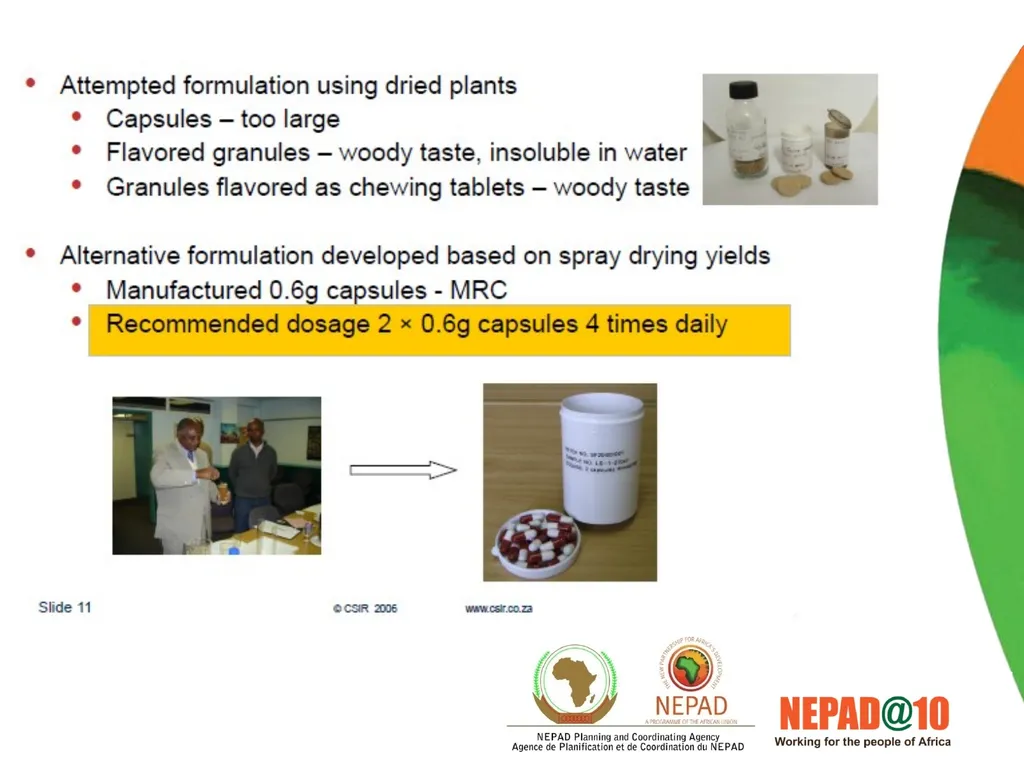
Key Outcomes A traditional remedy for HIV/AIDs validated (SF2000).
Using our natural resources, indigenous knowledge and scientific innovation
Currently ready for Phase I Clinical Trials.<br>
11
Key Outcomes Establishment of State-of-the-Art research facilities at the BecA Hub-ILRI, Nairobi which has enabled:
Formulation of a challenge fund to build regional capacity for biosciences research - The Africa Biosciences Challenge Fund (ABCF)
Tackling important agricultural constraints in food production, nutrition and animal health http://hub.africabiosciences.org/about-abcf/<br>
12
Key outcomes Establishment of a Bioinformatics Core Facility at the University of Mauritius
Researchers from 10 institutions within SADC trained in using a stand alone Bioinformatics toolkit (which can run without the internet)
SADC PGR Policy Guidelines have been developed and Member States supported to review national PGR and PGR-related policies<br>
13
Key outcomes Over 600 farmers trained on improved mushroom production technologies
Establishment of Pilot Mushroom Technology Park in Namibia and Genebank in Swaziland
Action –research – 65 fish farmers (reaching approx 400 members plus others) ; 2 districts of Malawi www.nepadsanbiofishnode.org<br>
14
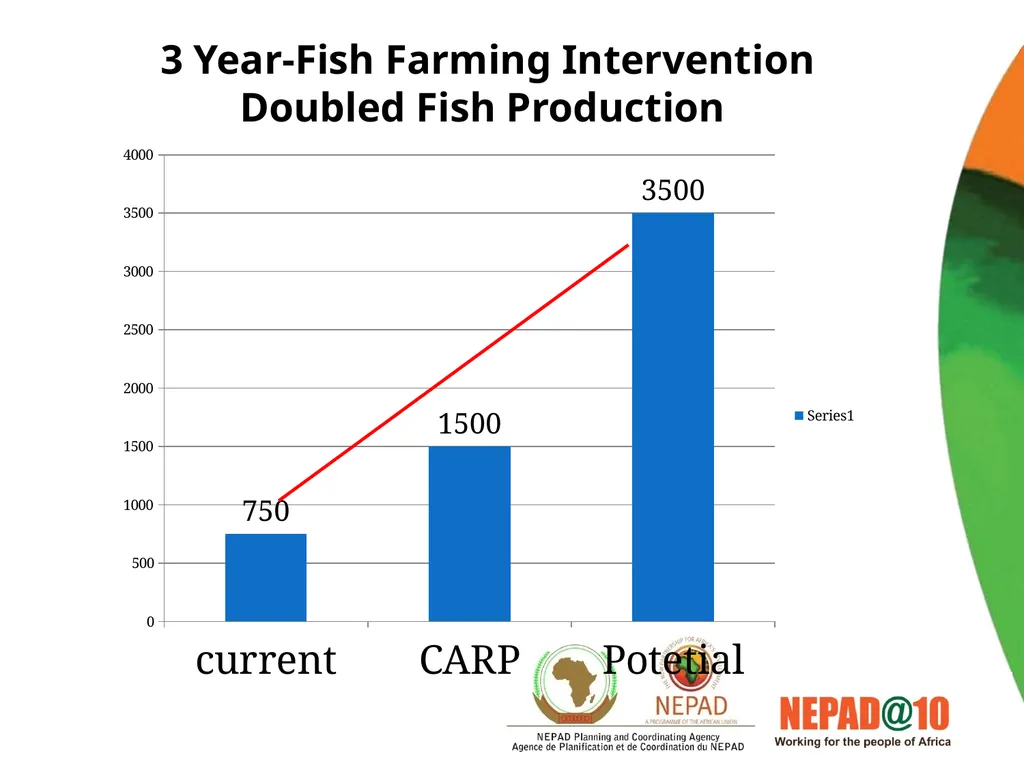
3 Year-Fish Farming Intervention Doubled Fish Production<br>
15
The BIKS qualification and programme was adopted by the SADC Ministers of S&T at their meeting in Seychelles (August 2009) as a regional IKS teaching programme.
Establishment of African Young Scientists Initiative on Climate Change (AYSICC) – Continental youth network on IKS and climate change Indigenous Knowledge Systems Interventions<br>
17
18 African Biosafety Network of Expertise (ABNE) Provides biosafety information resources to member states
http://www.nepadbiosafety.net
Conducted training sessions on biotechnology regulatory processes in Burkina Faso
Trained evaluators in Ghana
Trained inspectors for field trials in Nigeria
Programmes on awareness creation & understanding for government officials<br>
18
19 Science & Technology for Health Currently involved in the following programmes:
Eval Health: Development of Impact Assessment
Tools for R & D projects/programmes in Africa
African Medicines Regulation Harmonization (AMRH) in RECs<br>
19
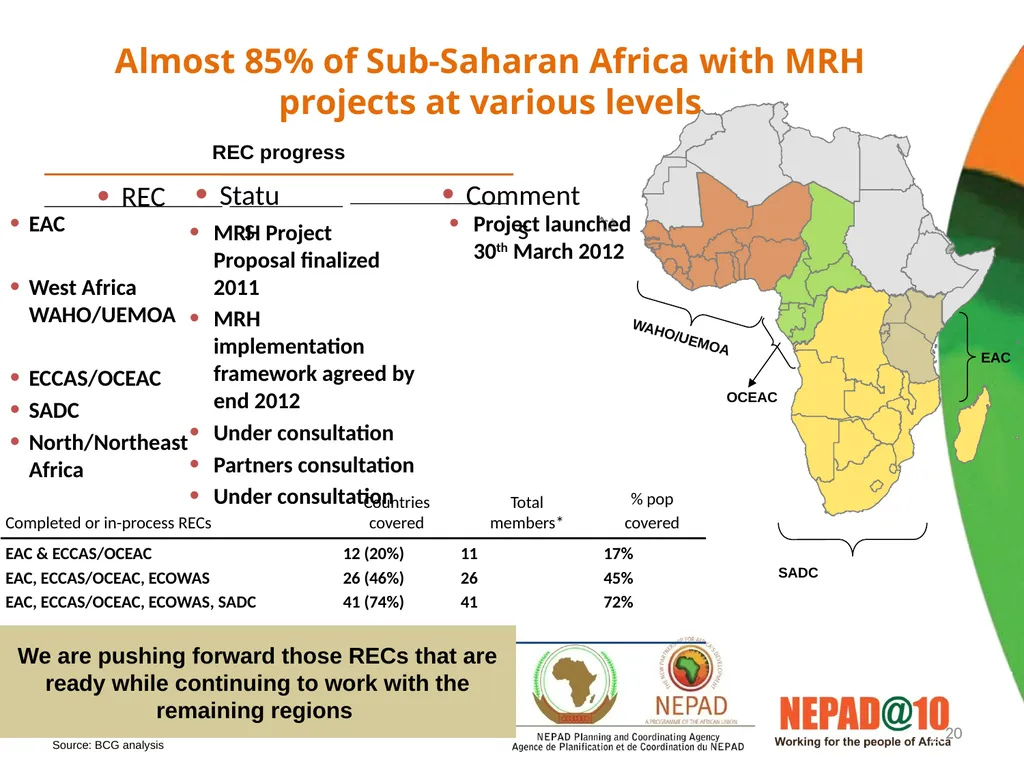
Almost 85% of Sub-Saharan Africa with MRH projects at various levels 20 REC progress Source: BCG analysis SADC We are pushing forward those RECs that are ready while continuing to work with the remaining regions REC EAC
West Africa WAHO/UEMOA
ECCAS/OCEAC
SADC
North/Northeast�Africa Status Comments MRH Project Proposal finalized 2011
MRH implementation framework agreed by end 2012
Under consultation
Partners consultation
Under consultation Project launched 30th March 2012 20<br>
20
NEPAD SOUTHERN AFRICAN NETWORK OF WATER CENTRES OF EXCELLENCE 21 Aim - To improved human and environmental well-being through research and development in water and sanitation
Hub established at the Stellenbosch University in South Africa
Financial support from Government of South Africa -DST and EC support
Nodes currently existing in Mozambique, Malawi, Zambia and Botswana
West Africa Water Sciences Network established in October 2009<br>
21
22 Laser Technology Implemented through the African Laser Centre (ALC) hosted by the CSIR – South Africa
A pan African network focusing on research and training with membership from all the regions of the continent
Implemented 47 projects from 2006 to 2009
Trained 83 MSc and 119 PhD from 2006 to 2011<br>
22
African Mathematical Sciences Network (AMINet) African Institute of Mathematical Sciences (AIMS) in Cape Town was designated a centre of excellence at AMCOST 1 in 2003
Since 2003, AIMS has graduated 412 post-graduates from 32 different African countries
AIMS coordinates the implementation of AMINet where other nodes have been established in Senegal, Ghana and Nigeria<br>
23
Material Science Quality Infrastructure
Focus on standards harmonisation<br>
24
Support to the RECs AMRH – Harmonisation of regulation of medicines
SADC – SADC PGR Policy Guidelines; Process of setting up the SADC desk
COMESA – Development of COMESA Programme on STI
ECOWAS – Development of ECOPOST<br>
25
26 ASTII Programme
Overall Goal : To contribute towards the improvement of the quality of science, technology and innovation policies at national, regional and continental levels
Purpose: To strengthen Africa’s capacity to develop and use Science, Technology and Innovation (ASTII) Indicators.
Publication of the Africa Innovation outlook a major milestone for informing policy and programme development. Policy Programmes<br>
26
Funding of Programmes In-kind support – Member states hosting hubs and nodes
Support in cash – Some member states and partners have contributes financially to NEPAD programmes<br>
27
Challenges Mobilisation of adequate and sustainable resources
Private sector involvement
Demonstrating accountability with no benchmarking/baseline
Wide differences in project implementation capacities amongst Member States<br>
28
Challenges Maintaining network approach
Institutionalisation of programmes in RECs and Member States
Linking the CPA programmes to other sectoral programmes<br>
29
Lessons Learnt The importance of Monitoring, Evaluation and Impact Assessment
The focus should be on impact and bringing products to the market
Technology delivery to the ground
Engagement of Private sector<br>
30
Lessons Learned Importance of a robust Knowledge feedback system to enable reflection and learning for improving design of interventions
Importance of communicating the benefits of STI programmes
Funding of STI programmes by member states is important for sustainability<br>
31
Lessons Learned Sustainability
Member states need to have policies, strategic plans and priority projects/programme clearly set and communicated
Strengthening institutions to carry on with programme beyond partner support<br>
32
Opportunities The networks and centres of excellence that have been established
Emerging partnerships on STI in Africa and world wide
Advances in STI and engineering worldwide
Africa’s Economic growth and development
Public pressure for solutions
Existence of RECs<br>
33
Looking Ahead
Review of the CPA
Based on the lessons learnt since 2005, focus on out-scaling and up-scaling current programmes across Africa<br>