
Scientific Temper and Critical Thinking Arunabha
LS
Published · 34 slides · 0 views

1 / 1





Description
Scientific Temper and Critical Thinking Arunabha Misra AIPSN Science Popularization and Scientific Temper Desk An interesting incident of 10.01.1836 Madhusudan Gupta, a Hindu Brahmin teacher of Sanskrit College, Calcutta, Dissected Human
Related Topics
Share
Embed code
Download this presentation From Below
"Scientific Temper and Critical Thinking Arunabha" is the property of its rightful owner. Permission is granted to download and print the materials on this website for personal, non-commercial use only, and to display it on your personal computer provided you do not modify the materials and that you retain all copyright notices contained in the materials. By downloading content from our website, you accept the terms of this agreement.
Presentation Transcript
01
Scientific Temper and Critical Thinking Arunabha Misra
AIPSN
Science Popularization and Scientific Temper Desk<br>
AIPSN
Science Popularization and Scientific Temper Desk<br>
02
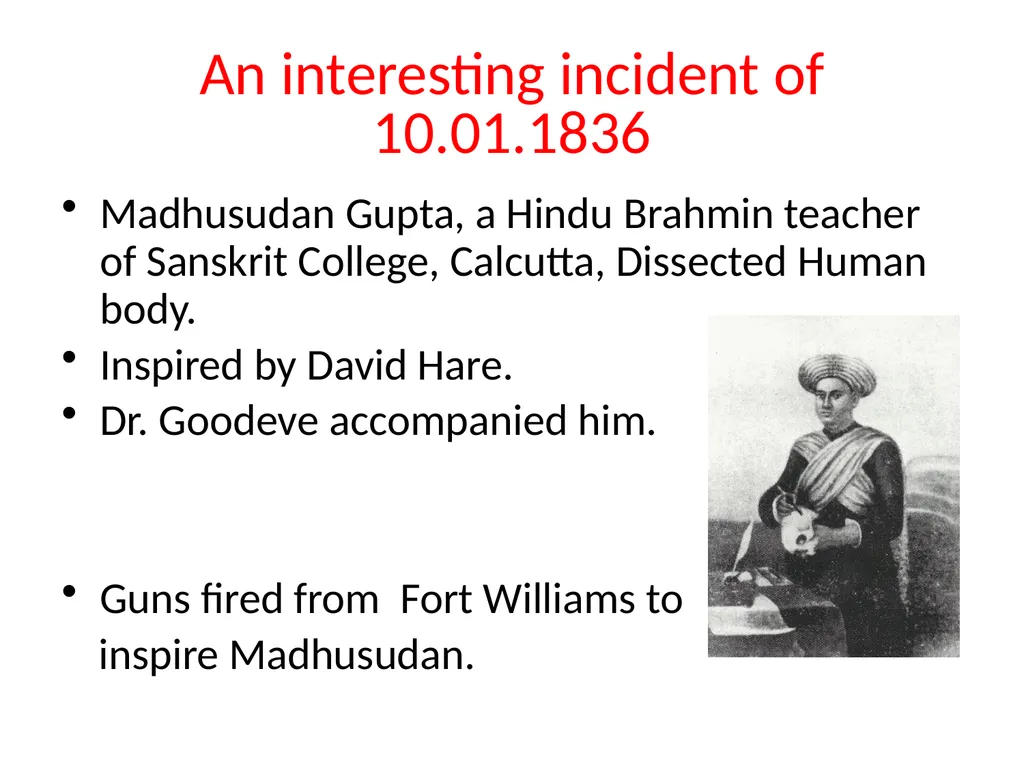
An interesting incident of 10.01.1836 Madhusudan Gupta, a Hindu Brahmin teacher of Sanskrit College, Calcutta, Dissected Human body.
Inspired by David Hare.
Dr. Goodeve accompanied him.
Guns fired from Fort Williams to
inspire Madhusudan.<br>
Inspired by David Hare.
Dr. Goodeve accompanied him.
Guns fired from Fort Williams to
inspire Madhusudan.<br>
03
An Account of the Event “ It had needed sometime, some exercise of persuasive art , before Madhusudan could bent up his mind to the attempt but having once taken the resolution he never flinched from it. At the appointed hour scalps in his hand he followed Dr Goodeve into the go-down where the body lay really”. –Kshitindranath Thakur<br>
04
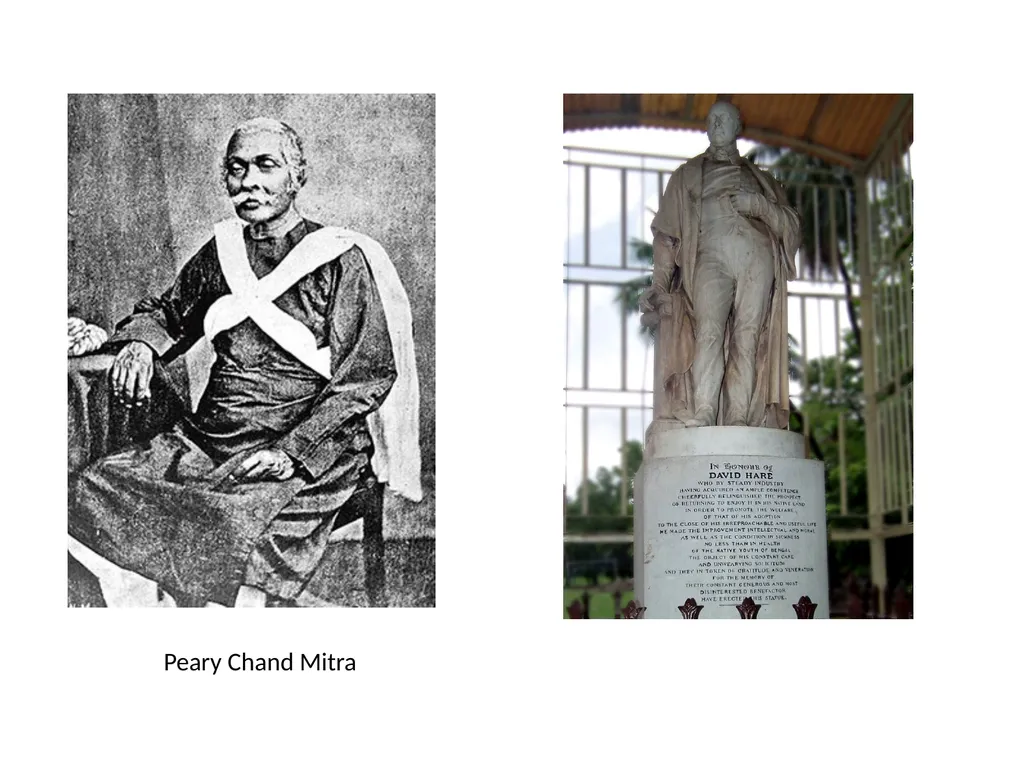
Pearychand Mitra wrote in Life Sketch of David Hare One evening as I was visiting with him (Hare) I saw Baboo Madhusudan Gupta, the then Professor of the Sanskrit Medical Science of the Sanskrit College entering the room in all haste. Mr. Hare viewing him in all haste said at once, “Well, Muddo, what have you been doing all this time? Do you know what amount of pain and anxious thoughts you have kept me in for a week almost? I have been to Radhakanta and I am hopeful from what he said to me. Now what have you to say? Have you found the text in your Shastras authorizing the dissection of dead bodies? Maddo answering in affirmative said, “ Sir, fear no opposition from the orthodox section of the community. I and my pundit friends are prepared to meet them if they come forward ,which I am sure, they will not do”.<br>
05
Peary Chand Mitra<br>
06
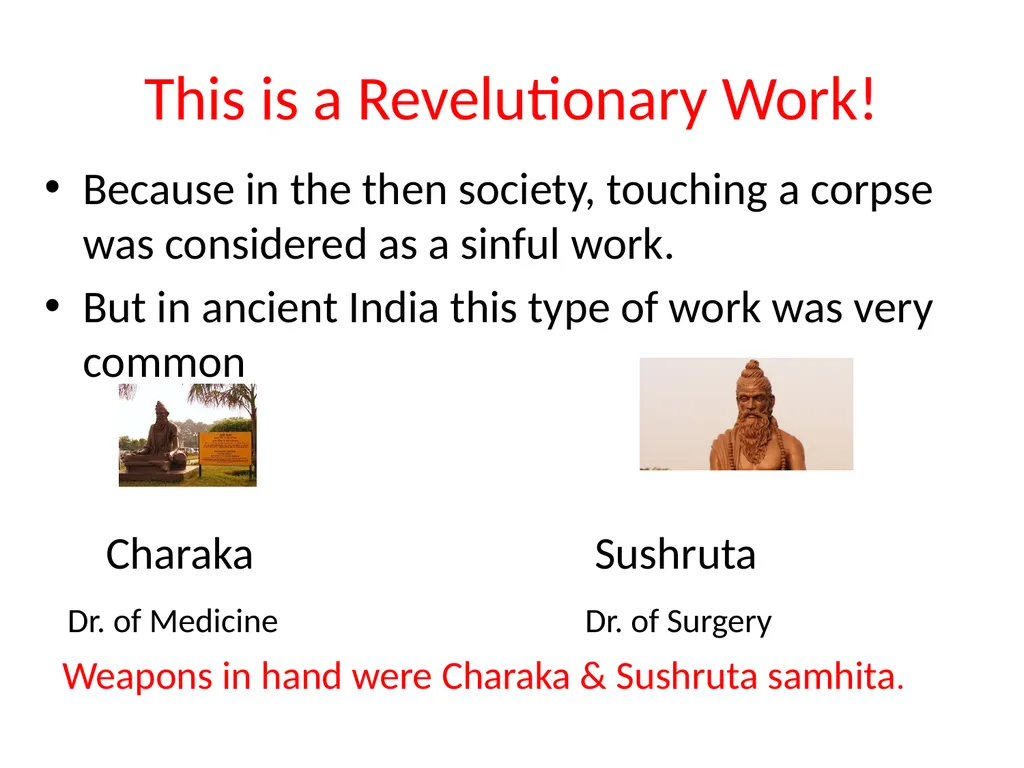
This is a Revelutionary Work! Because in the then society, touching a corpse was considered as a sinful work.
But in ancient India this type of work was very common
Charaka Sushruta
Dr. of Medicine Dr. of Surgery
Weapons in hand were Charaka & Sushruta samhita.<br>
But in ancient India this type of work was very common
Charaka Sushruta
Dr. of Medicine Dr. of Surgery
Weapons in hand were Charaka & Sushruta samhita.<br>
07
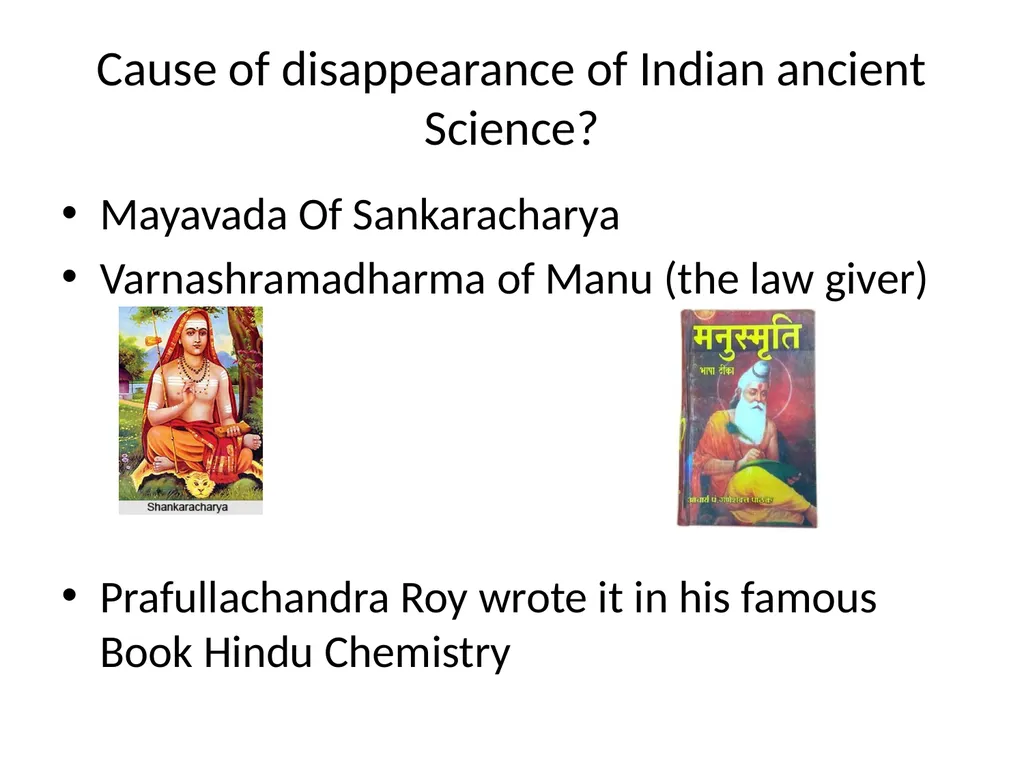
Cause of disappearance of Indian ancient Science? Mayavada Of Sankaracharya
Varnashramadharma of Manu (the law giver)
Prafullachandra Roy wrote it in his famous Book Hindu Chemistry<br>
Varnashramadharma of Manu (the law giver)
Prafullachandra Roy wrote it in his famous Book Hindu Chemistry<br>
08
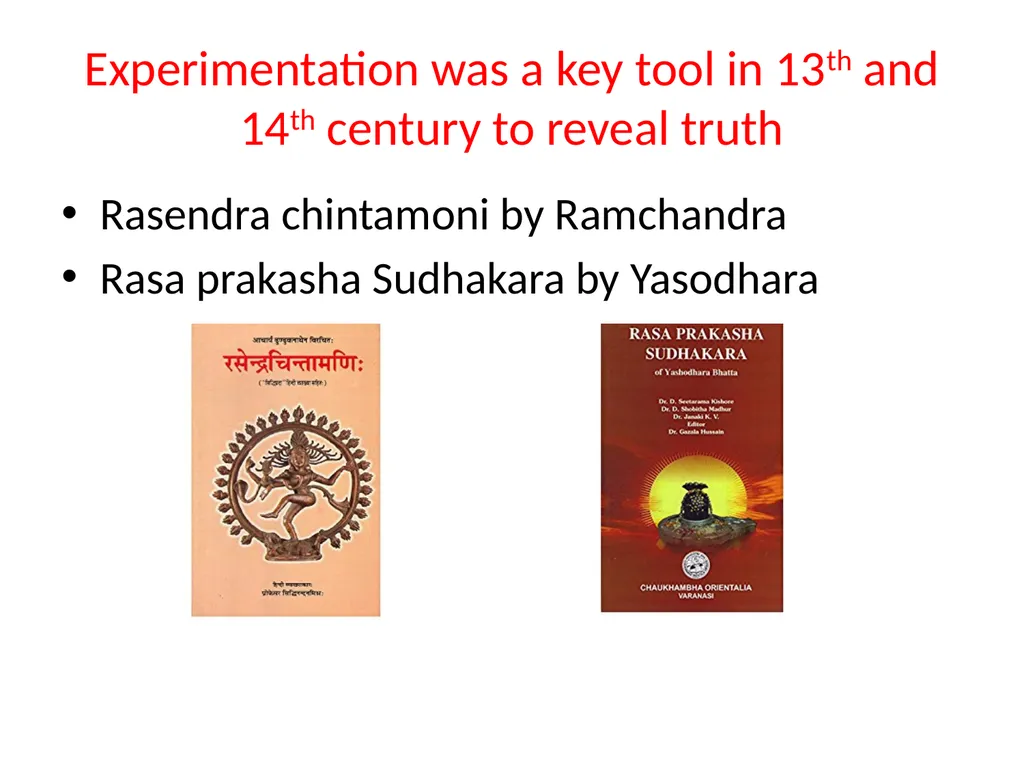
Experimentation was a key tool in 13th and 14th century to reveal truth Rasendra chintamoni by Ramchandra
Rasa prakasha Sudhakara by Yasodhara<br>
Rasa prakasha Sudhakara by Yasodhara<br>
09
Experimental Sciences by Ancient Hindus
(13th or 14th century A D) Ramchandra: ‘That which I have heard of learned men and have read in the sastras but have not been able to verify by experiment, I have discarded. On the other hand, those operations which I have according to directions of my sage teachers been able to perform with my own hands – those alone I am committing to writing.’
Yasodhara: ‘All the chemical operations described in my book have been performed with my own hands – I am not writing from mere hear say. Everything related is based upon my own conviction and observations.’<br>
Yasodhara: ‘All the chemical operations described in my book have been performed with my own hands – I am not writing from mere hear say. Everything related is based upon my own conviction and observations.’<br>
10
Experimentation even in Veda Story of Uddalok Aruni and his son Svetaketu in Chhandogya Uponishada.
Without food Swetaketu forgot everything of Veda, and commemorated again after having food for few days.
Concluded: Anno (food) develops Mono (mind) = Chetana<br>
Without food Swetaketu forgot everything of Veda, and commemorated again after having food for few days.
Concluded: Anno (food) develops Mono (mind) = Chetana<br>
11
Svetaketu- Uddalok Mantra-5.4: Summary: The subtlest effects:
Hence, dear boy, MIND is made up of Food; PRANA is made up of Water and SPEECH is made up of Fire.
An Experiment on Life:
Mantra-7.1: Svetaketu was instructed to Fast:
Dear boy, man consists of sixteen parts. For fifteen days do not eat. Drink as much as water as you like, for Prana is made up of water. If one does not drink, his Prana is cut off.
Mantra-7.2: The Effect of Fasting:
For fifteen days, Svetaketu did not eat. Then he approached his father, saying: ” Revered Sir, what shall I say?”. “My dear boy, now chant the Rig, Yajur and Sama Vedas.” said the father. The boy said: ” They do not at all arise in me, Revered Sir.”
Mantra-7.4 : Svetaketu eats and recovers his mind:
Svetaketu then ate well, and approached his father again. This time, whatever the father asked him, he answered them all well.<br>
Hence, dear boy, MIND is made up of Food; PRANA is made up of Water and SPEECH is made up of Fire.
An Experiment on Life:
Mantra-7.1: Svetaketu was instructed to Fast:
Dear boy, man consists of sixteen parts. For fifteen days do not eat. Drink as much as water as you like, for Prana is made up of water. If one does not drink, his Prana is cut off.
Mantra-7.2: The Effect of Fasting:
For fifteen days, Svetaketu did not eat. Then he approached his father, saying: ” Revered Sir, what shall I say?”. “My dear boy, now chant the Rig, Yajur and Sama Vedas.” said the father. The boy said: ” They do not at all arise in me, Revered Sir.”
Mantra-7.4 : Svetaketu eats and recovers his mind:
Svetaketu then ate well, and approached his father again. This time, whatever the father asked him, he answered them all well.<br>
12
Jawaharlal Nehru: Discovery of India:1946 “The application of science is inevitable and unavoidable for all countries and people today. But…..it is the scientific approach, the adventurous and yet critical temper of science, the search for truth and new knowledge, the refusal for accept anything without testing and trial , the capacity to change previous conclusions in the face of new evidence, the reliance on observed facts and not on pre conceived theory, the hard discipline of the mind,- all this is necessary, not merely for application of science but for life itself and solutions of its any problems”.<br>
13
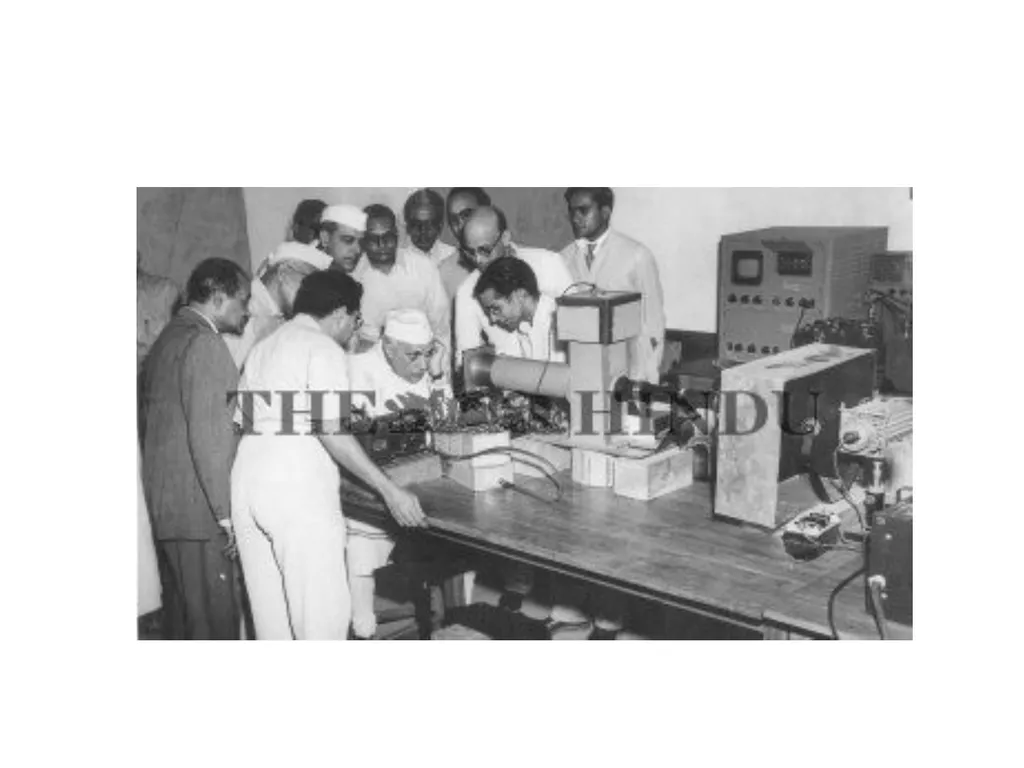
Nehru:1950: Inauguration of national Physical Laboratory “Large number of people talk glibly about science today and yet in their lives or actions do not exhibit a trace of science…So I stress the need for the development of scientific mind and temper which is more important than actual discovery as it is out of this temper and method that many more discoveries will come.”<br>
14
Nehru:1957: In Science Congress (After citing a quotation of Buddha on truth)… “Apart from its religious significance, was a message of tolerance, a message against Superstitions,…rituals and dogma. It was a message essentially in the scientific spirit.”<br>
15
Nehru to Ramswarup Sharma:16.7.1959 Sharma was the then Director of Indian Institute of Astronomical and Sanskrit Research
Nehru’s letter to Sharmaji was in response to his letter dated 13.07,1959
In this letter Nehru accepted that, ‘He has no belief in Astrology’.
He also prevented Sharmaji to dedicate his upcoming book to him, as it is not the outcome of a research following ‘Scientific Methodology’. – an example of nourishing Scientific temper in life.<br>
Nehru’s letter to Sharmaji was in response to his letter dated 13.07,1959
In this letter Nehru accepted that, ‘He has no belief in Astrology’.
He also prevented Sharmaji to dedicate his upcoming book to him, as it is not the outcome of a research following ‘Scientific Methodology’. – an example of nourishing Scientific temper in life.<br>
16
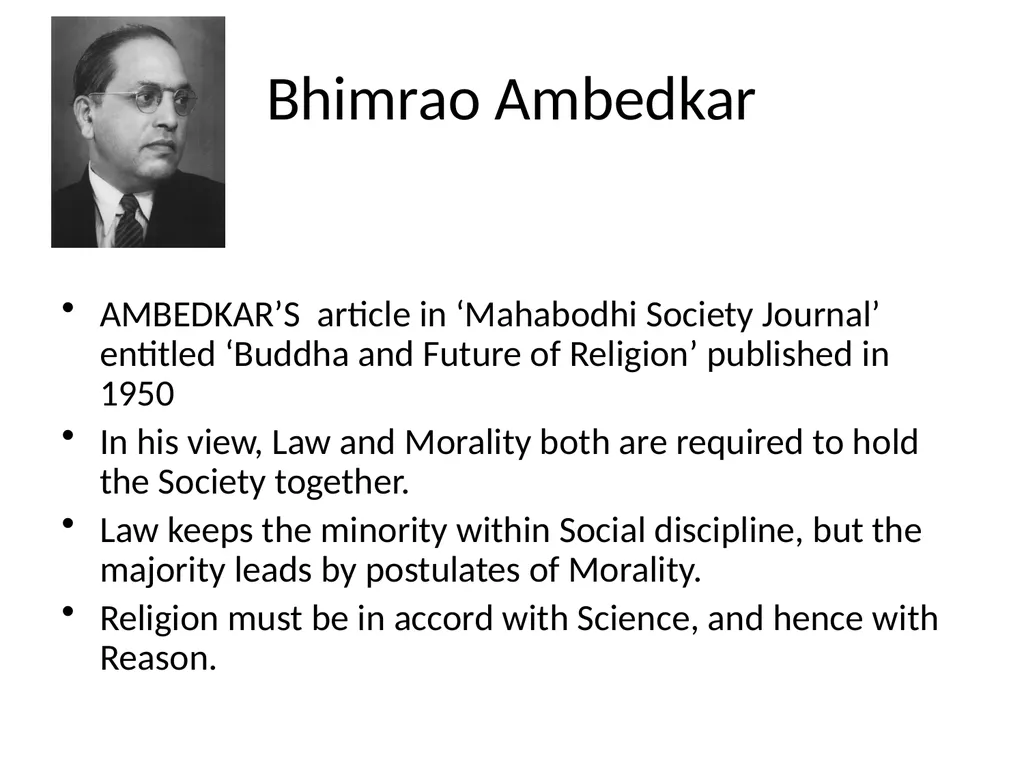
Bhimrao Ambedkar AMBEDKAR’S article in ‘Mahabodhi Society Journal’ entitled ‘Buddha and Future of Religion’ published in 1950
In his view, Law and Morality both are required to hold the Society together.
Law keeps the minority within Social discipline, but the majority leads by postulates of Morality.
Religion must be in accord with Science, and hence with Reason.<br>
In his view, Law and Morality both are required to hold the Society together.
Law keeps the minority within Social discipline, but the majority leads by postulates of Morality.
Religion must be in accord with Science, and hence with Reason.<br>
17
Ambedkar “The sovereignty of scriptures of all religions must come to an end if we want to have a united, integrated modern India.” … This view of Ambedkar is clearly in line with ‘A Statement of Scientific Temper,1981’ , which states that, Scientific temper is incompatible with all types of dogmas / traditions whether Religious or Social<br>
18
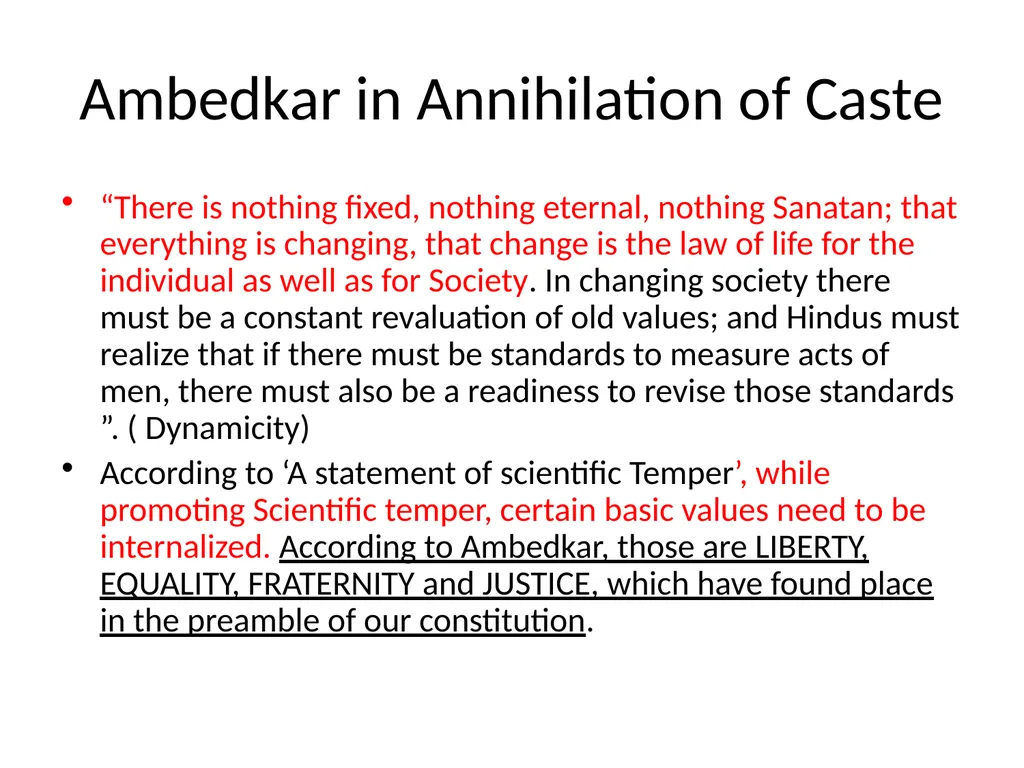
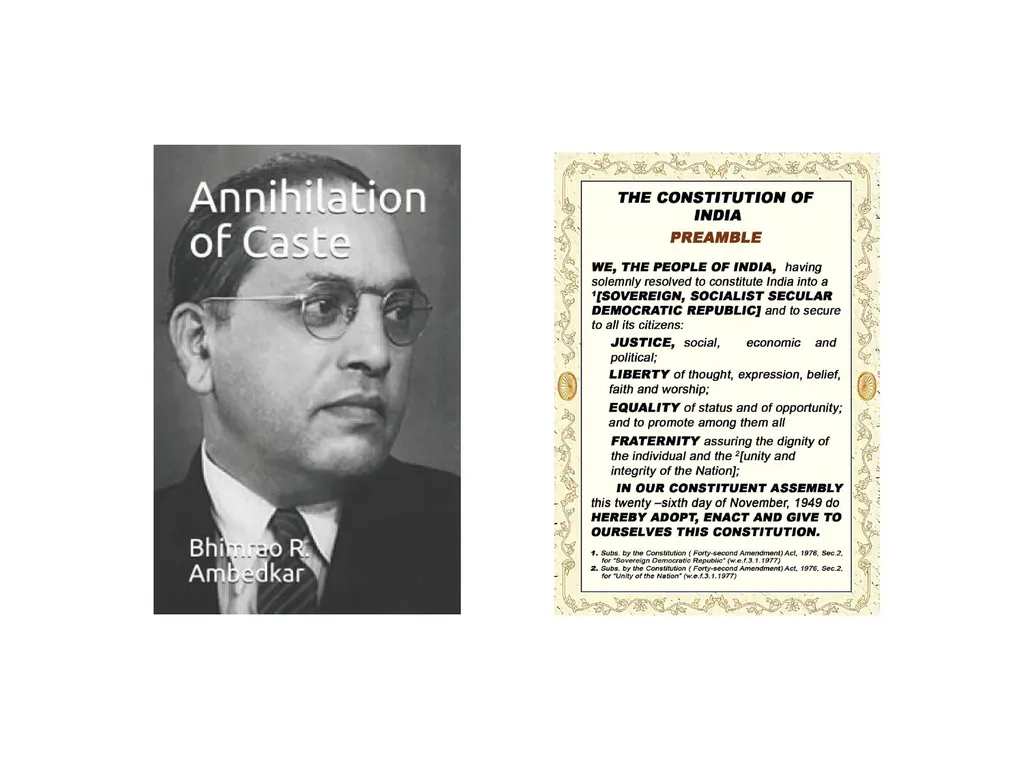
Ambedkar in Annihilation of Caste “There is nothing fixed, nothing eternal, nothing Sanatan; that everything is changing, that change is the law of life for the individual as well as for Society. In changing society there must be a constant revaluation of old values; and Hindus must realize that if there must be standards to measure acts of men, there must also be a readiness to revise those standards ”. ( Dynamicity)
According to ‘A statement of scientific Temper’, while promoting Scientific temper, certain basic values need to be internalized. According to Ambedkar, those are LIBERTY, EQUALITY, FRATERNITY and JUSTICE, which have found place in the preamble of our constitution.<br>
According to ‘A statement of scientific Temper’, while promoting Scientific temper, certain basic values need to be internalized. According to Ambedkar, those are LIBERTY, EQUALITY, FRATERNITY and JUSTICE, which have found place in the preamble of our constitution.<br>
19
Aroj ali, the insurrectionist
(The iconoclast, Newyork,September 1982)<br>
20
Aroj Compared with Socrates A teacher was killed in the year 399 B.C by the people of the ancient city of Athens.
-Why did they kill him?
They killed him for a crime.
-What was the crime?
He was accused of corrupting the young people of the city
-How did he do that?
He asked Questions.
-Why would that hurt anybody?
By his questions he made them think.
-What’s wrong with that?
He made them think about things they believe.
-How could that do any harm?
When the people ask questions and think about things they believe, they may not believe the same after that.
-Why did he do it?
Because he loved truth and he wanted to find truth
-----
-What was his name?
He was Socrates.<br>
-Why did they kill him?
They killed him for a crime.
-What was the crime?
He was accused of corrupting the young people of the city
-How did he do that?
He asked Questions.
-Why would that hurt anybody?
By his questions he made them think.
-What’s wrong with that?
He made them think about things they believe.
-How could that do any harm?
When the people ask questions and think about things they believe, they may not believe the same after that.
-Why did he do it?
Because he loved truth and he wanted to find truth
-----
-What was his name?
He was Socrates.<br>
21
Questions raised by Matubbar Who am I?
Is life incorporeal or corporeal?
Is mind and life/soul one and the same?
What is relationship of life/soul with body and mind?
Can life/soul be recognized or identified?
What is the appearance/form of Allah?
Is God manlike?
Is the creator apart from creation?
Is God autocratic or constitutional?
Heaven and Hell – what are they?
What is the sin of Adam?<br>
Is life incorporeal or corporeal?
Is mind and life/soul one and the same?
What is relationship of life/soul with body and mind?
Can life/soul be recognized or identified?
What is the appearance/form of Allah?
Is God manlike?
Is the creator apart from creation?
Is God autocratic or constitutional?
Heaven and Hell – what are they?
What is the sin of Adam?<br>
22
Inquisitiveness or Spirit of Inquiry Why the sky is blue, and the sea too? – Raman
Why during boiling water in a kettle it’s lid removed? – James Watt
Why education is not free for all?
Why people are Hungry here?
Why the society is so unequal?<br>
Why during boiling water in a kettle it’s lid removed? – James Watt
Why education is not free for all?
Why people are Hungry here?
Why the society is so unequal?<br>
23
Observation, Experimentation and Verifiability studies are important Fire from smoke – Present
Malaria due to Mosquito bite – Past
Recovery from pneumonia using penicillin – Future
Vitamin B deficiency and Beriberi are related.- Experimentation can reveal that.
But shall we say, Cow urine can cure Corona? Enchanted ring wearing can ensure a job?
Does that possess any verifiability? Important!<br>
Malaria due to Mosquito bite – Past
Recovery from pneumonia using penicillin – Future
Vitamin B deficiency and Beriberi are related.- Experimentation can reveal that.
But shall we say, Cow urine can cure Corona? Enchanted ring wearing can ensure a job?
Does that possess any verifiability? Important!<br>
24
Democratic atmosphere of debate Discussion and dissent Required Discussion of Jawaharlal Nehru and Meghnad saha leading to formation of UGC, and it’s important role in Human resource generation in independent India.
Saha sworn on May 13,1952
Two major speeches on May 20, and June 13
Criticized general budget and Education budget of congress Government
4 prominent demands including ample finance for Universities and spending money through forming properly autonomous University Grants Commission.
Renu Chakraborty wrote, Nehru called Saha to his office after his speech, discussed with him, and UGC was shaped.
NO SUCH DISCUSSION EVER HELD TODAY !<br>
Saha sworn on May 13,1952
Two major speeches on May 20, and June 13
Criticized general budget and Education budget of congress Government
4 prominent demands including ample finance for Universities and spending money through forming properly autonomous University Grants Commission.
Renu Chakraborty wrote, Nehru called Saha to his office after his speech, discussed with him, and UGC was shaped.
NO SUCH DISCUSSION EVER HELD TODAY !<br>
25
Critical outlook of science "The two most notable features of scientific methodology are its critical spirit - that is, a Commitment to put your beliefs to stringent tests, and revising or discarding those ideas that fail the test; and falliblism, that is, the understanding that all our knowledge is open to revision in the light of better evidence". (Alan Sokal, Archaeological fantasies, 2006)
. A scientific theory should be both testable and falsifiable. Are these different or the same? Karl Popper mentioned that, a theory could only be tested by attempting to falsify it. Success in passing such tests corroborates a theory.<br>
. A scientific theory should be both testable and falsifiable. Are these different or the same? Karl Popper mentioned that, a theory could only be tested by attempting to falsify it. Success in passing such tests corroborates a theory.<br>
26
Article 51A(h) adopted in 1976 : “It shall be the duty of every citizen of India to develop the scientific temper, humanism and the spirit of inquiry and reform.”
This directive principle in the constitution directs the citizen of a duty. However, this provision does not explicitly spell out the same duties for the state (except by implication).<br>
This directive principle in the constitution directs the citizen of a duty. However, this provision does not explicitly spell out the same duties for the state (except by implication).<br>
27
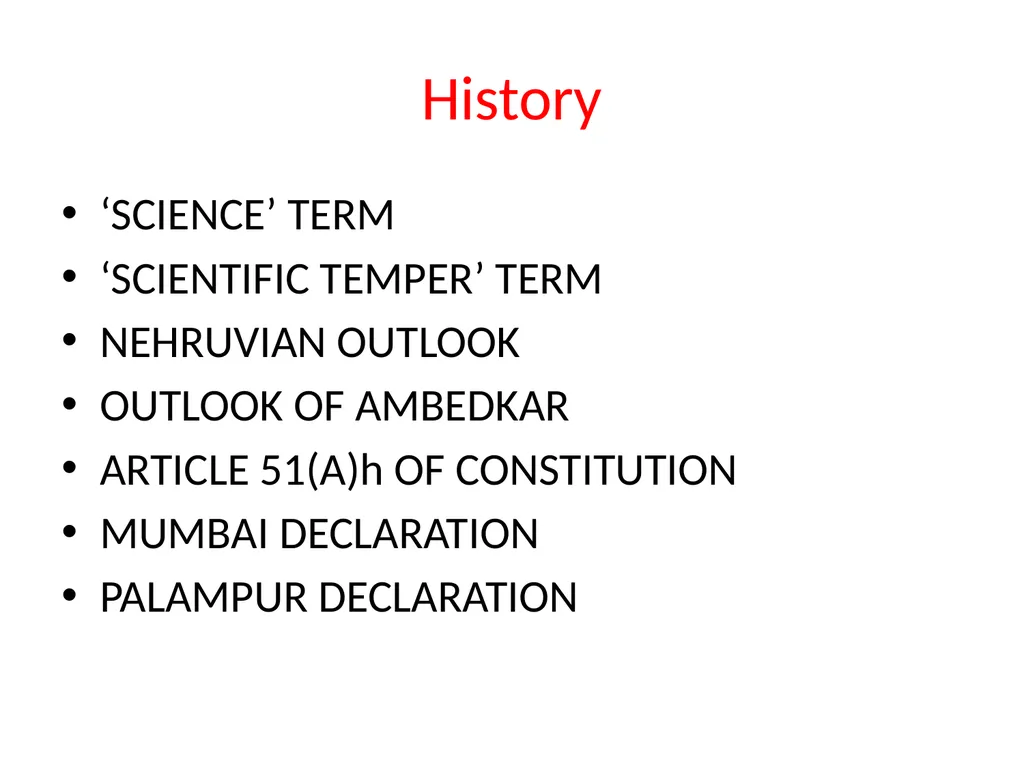
History ‘SCIENCE’ TERM
‘SCIENTIFIC TEMPER’ TERM
NEHRUVIAN OUTLOOK
OUTLOOK OF AMBEDKAR
ARTICLE 51(A)h OF CONSTITUTION
MUMBAI DECLARATION
PALAMPUR DECLARATION<br>
‘SCIENTIFIC TEMPER’ TERM
NEHRUVIAN OUTLOOK
OUTLOOK OF AMBEDKAR
ARTICLE 51(A)h OF CONSTITUTION
MUMBAI DECLARATION
PALAMPUR DECLARATION<br>
28
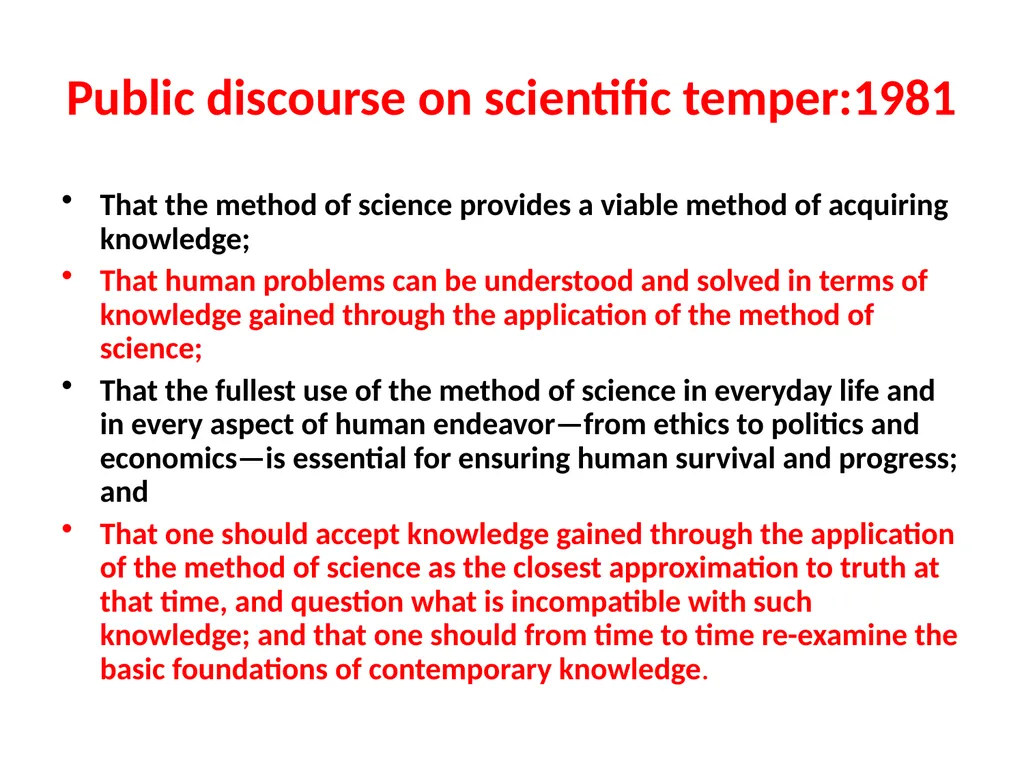
Public discourse on scientific temper:1981 That the method of science provides a viable method of acquiring knowledge;
That human problems can be understood and solved in terms of knowledge gained through the application of the method of science;
That the fullest use of the method of science in everyday life and in every aspect of human endeavor—from ethics to politics and economics—is essential for ensuring human survival and progress; and
That one should accept knowledge gained through the application of the method of science as the closest approximation to truth at that time, and question what is incompatible with such knowledge; and that one should from time to time re-examine the basic foundations of contemporary knowledge.<br>
That human problems can be understood and solved in terms of knowledge gained through the application of the method of science;
That the fullest use of the method of science in everyday life and in every aspect of human endeavor—from ethics to politics and economics—is essential for ensuring human survival and progress; and
That one should accept knowledge gained through the application of the method of science as the closest approximation to truth at that time, and question what is incompatible with such knowledge; and that one should from time to time re-examine the basic foundations of contemporary knowledge.<br>
29
We call upon the people of India to be the vanguard of scientific temper.
- Palampur declaration<br>
- Palampur declaration<br>
30
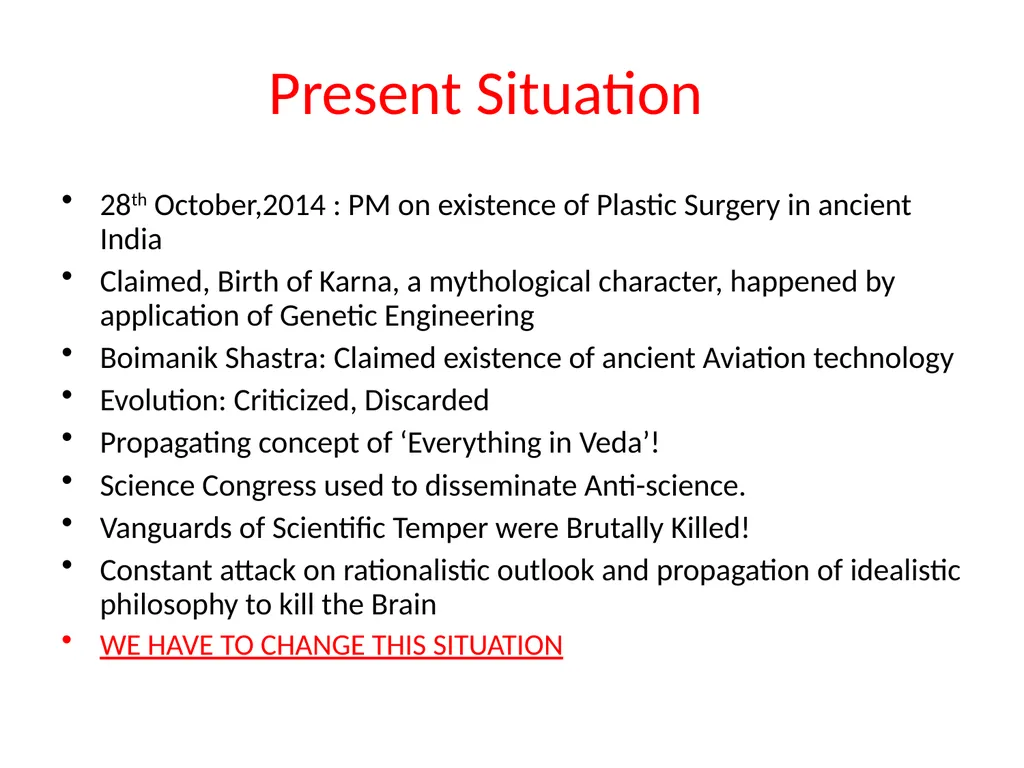
Present Situation 28th October,2014 : PM on existence of Plastic Surgery in ancient India
Claimed, Birth of Karna, a mythological character, happened by application of Genetic Engineering
Boimanik Shastra: Claimed existence of ancient Aviation technology
Evolution: Criticized, Discarded
Propagating concept of ‘Everything in Veda’!
Science Congress used to disseminate Anti-science.
Vanguards of Scientific Temper were Brutally Killed!
Constant attack on rationalistic outlook and propagation of idealistic philosophy to kill the Brain
WE HAVE TO CHANGE THIS SITUATION<br>
Claimed, Birth of Karna, a mythological character, happened by application of Genetic Engineering
Boimanik Shastra: Claimed existence of ancient Aviation technology
Evolution: Criticized, Discarded
Propagating concept of ‘Everything in Veda’!
Science Congress used to disseminate Anti-science.
Vanguards of Scientific Temper were Brutally Killed!
Constant attack on rationalistic outlook and propagation of idealistic philosophy to kill the Brain
WE HAVE TO CHANGE THIS SITUATION<br>
31
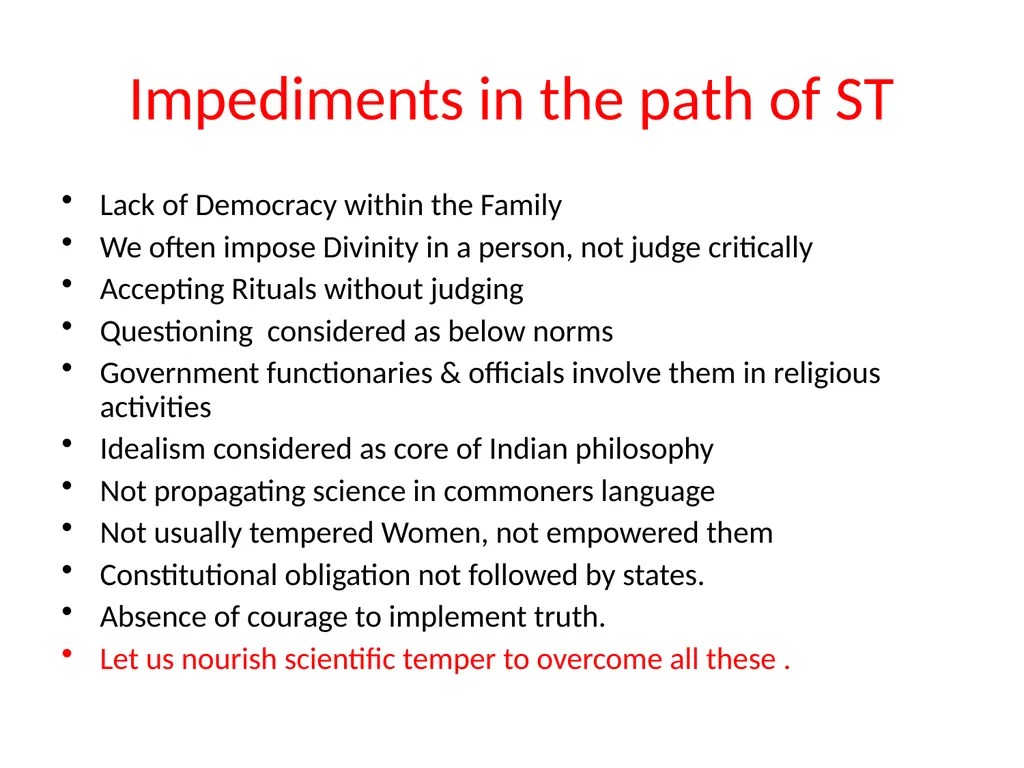
Impediments in the path of ST Lack of Democracy within the Family
We often impose Divinity in a person, not judge critically
Accepting Rituals without judging
Questioning considered as below norms
Government functionaries & officials involve them in religious activities
Idealism considered as core of Indian philosophy
Not propagating science in commoners language
Not usually tempered Women, not empowered them
Constitutional obligation not followed by states.
Absence of courage to implement truth.
Let us nourish scientific temper to overcome all these .<br>
We often impose Divinity in a person, not judge critically
Accepting Rituals without judging
Questioning considered as below norms
Government functionaries & officials involve them in religious activities
Idealism considered as core of Indian philosophy
Not propagating science in commoners language
Not usually tempered Women, not empowered them
Constitutional obligation not followed by states.
Absence of courage to implement truth.
Let us nourish scientific temper to overcome all these .<br>
32
THANK YOU<br>