Secondary Teaching for Mastery Initial Teacher
Description: Secondary Teaching for Mastery Initial Teacher Education units Introduction to teaching for mastery A mathematical concept or skill has been mastered when, through exploration, clarification, practice and application over time, a person can
Related Topics
Download Presentation
"Secondary Teaching for Mastery Initial Teacher" is the property of its rightful owner. Permission is granted to download and print the materials on this website for personal, non-commercial use only, and to display it on your personal computer provided you do not modify the materials and that you retain all copyright notices contained in the materials. By downloading content from our website, you accept the terms of this agreement.
Presentation Transcript
slide1. Secondary Teaching for MasteryInitial Teacher Education units Introduction to teaching for mastery<br>
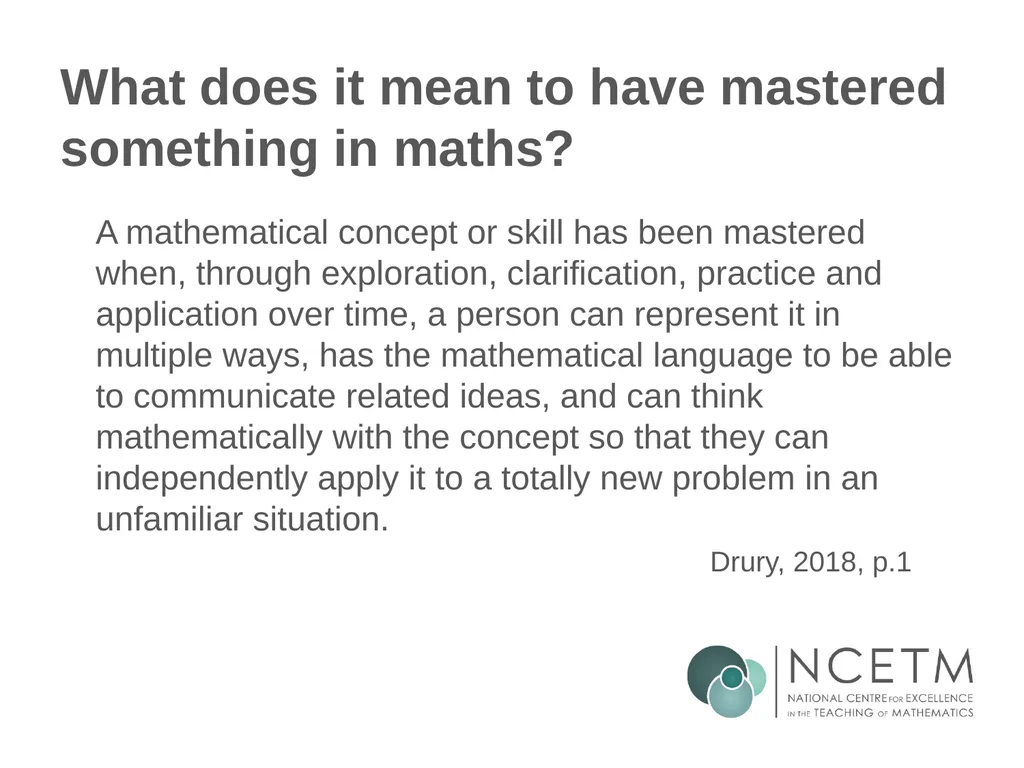
slide2. A mathematical concept or skill has been mastered when, through exploration, clarification, practice and application over time, a person can represent it in multiple ways, has the mathematical language to be able to communicate related ideas, and can think mathematically with the concept so that they can independently apply it to a totally new problem in an unfamiliar situation.
Drury, 2018, p.1 What does it mean to have mastered something in maths?<br>
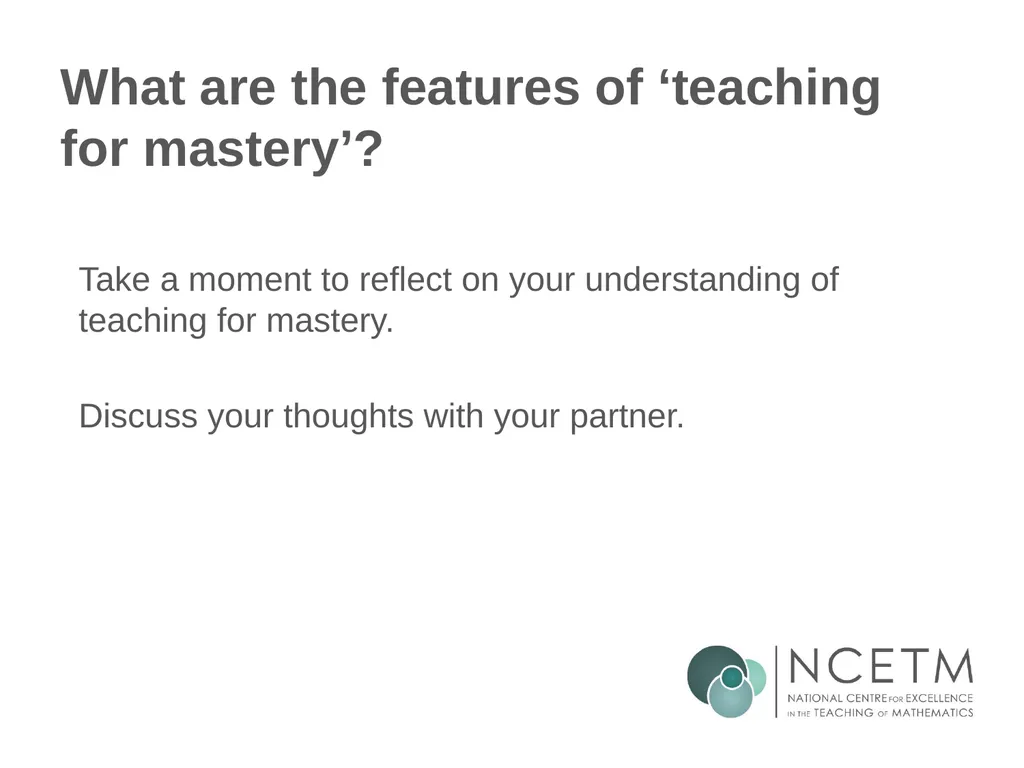
slide3. What are the features of ‘teaching for mastery’? Take a moment to reflect on your understanding of teaching for mastery.
Discuss your thoughts with your partner.<br>
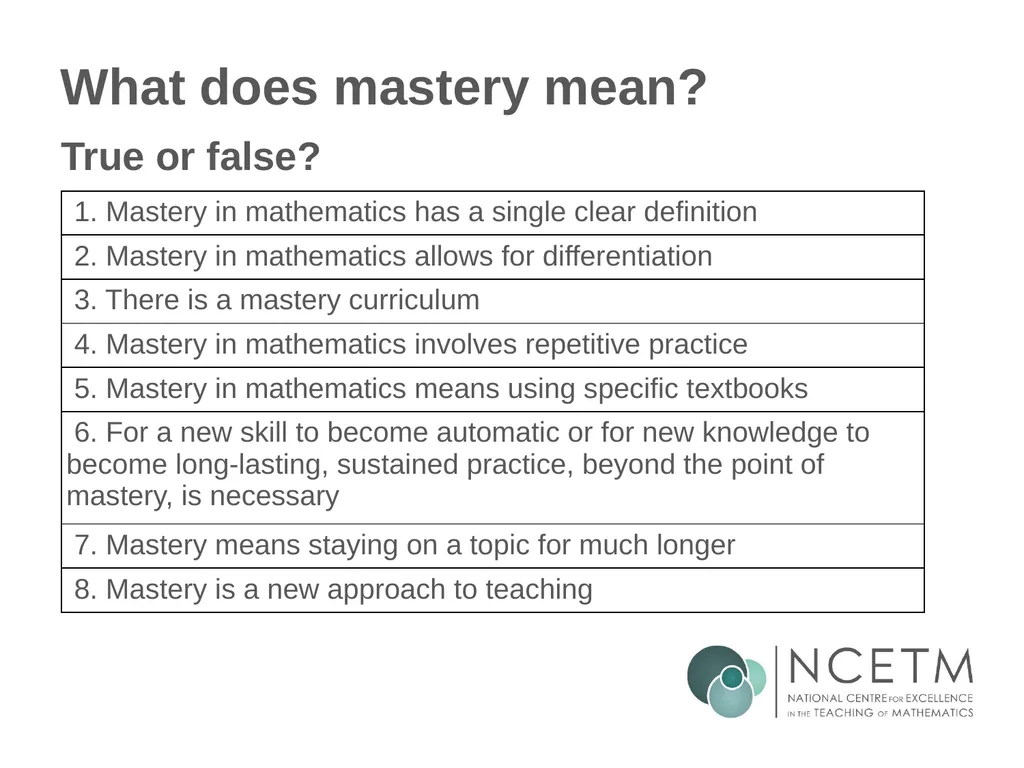
slide4. What does mastery mean? True or false?<br>
slide5. Myths about mastery We have been discussing – and debunking – some common myths and misconceptions about mastery.
NAMA (National Association of Mathematics Advisors) has produced a helpful document on this.<br>
slide6. Mastery explained Mastering maths means pupils acquiring a deep, long-term, secure and adaptable understanding of the subject.
The phrase ‘teaching for mastery’ describes the elements of classroom practice and school organisation that combine to give pupils the best chances of mastering maths.
Achieving mastery means acquiring a solid enough understanding of the maths that’s been taught to enable pupils to move on to more advanced material.
NCETM, 2016<br>
slide7. Pilot materials 2018/19<br>
slide9. What is teaching for mastery and what is it not? Create a list with your partner.<br>
slide10. Four ways in which the term mastery is being used: A mastery approach; a set of principles and beliefs.
This includes a belief that all pupils are capable of understanding and doing mathematics, given sufficient time. Pupils are neither ‘born with the maths gene’ nor ‘just no good at maths.’ With good teaching, appropriate resources, effort and a ‘can do’ attitude, all children can achieve in and enjoy mathematics.<br>
slide11. 2. A mastery curriculum
One set of mathematical concepts and big ideas for all. All pupils need access to these concepts and ideas and to the rich connections between them. There is no such thing as ‘special needs mathematics’ or ‘gifted and talented mathematics’. Mathematics is mathematics and the key ideas and building blocks are important for everyone.<br>
slide12. 3. Teaching for mastery: a set of pedagogic practices that keep the class working together on the same topic, whilst at the same time addressing the need for all pupils to master the curriculum. Challenge is provided through depth rather than acceleration into new content. More time is spent on teaching topics to allow for the development of depth. Carefully crafted lesson design provides a scaffolded, conceptual journey through the mathematics, engaging pupils in reasoning and the development of mathematical thinking.<br>
slide13. 4. Achieving mastery of particular topics and areas of mathematics
Mastery is not just being able to memorise key facts and procedures and answer test questions accurately and quickly. It involves knowing ‘why’ as well as knowing ‘that’ and knowing ‘how.’ It means being able to use one’s knowledge appropriately, flexibly and creatively and to apply it in new and unfamiliar situations.<br>
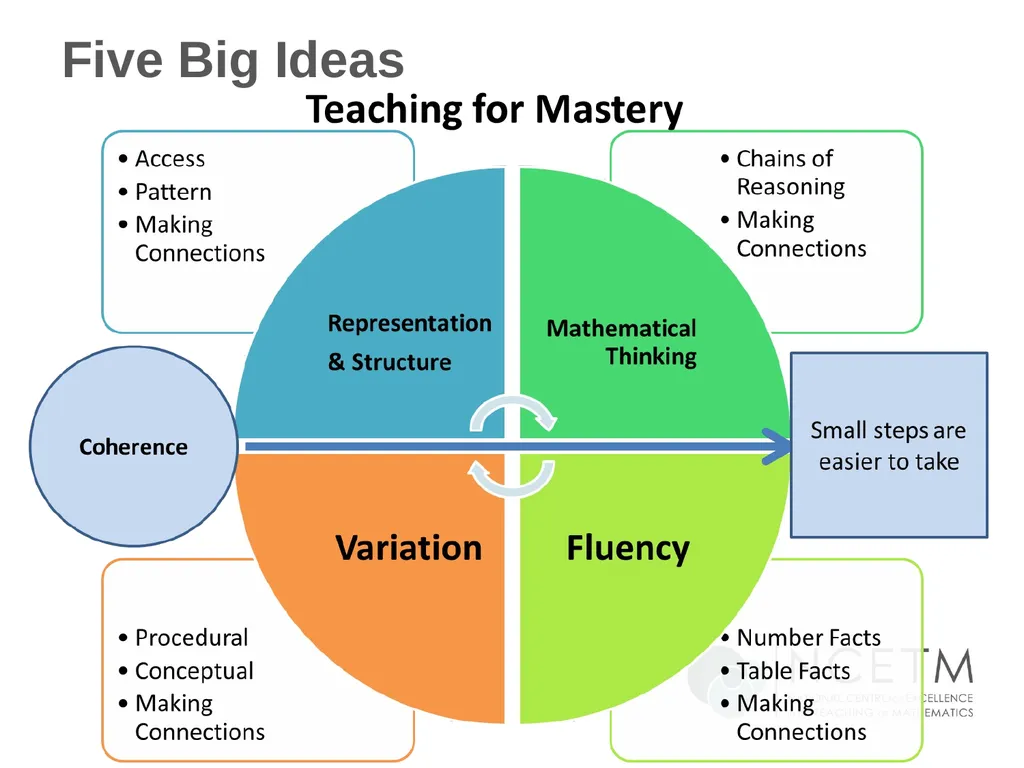
slide14. Five Big Ideas<br>
slide15. Five Big Ideas: Coherence Lessons are broken down into small connected steps that gradually unfold the concept, providing access for all children and leading to a generalisation of the concept and the ability to apply the concept to a range of contexts.
Planning and sequencing of ideas across lessons provides a connected, coherent mathematical journey.
www.ncetm.org.uk/teaching-for-mastery/mastery-explained/five-big-ideas-in-teaching-for-mastery/<br>
slide16. Five Big Ideas: Representation and Structure Representations used in lessons expose the mathematical structure being taught, to help students to achieve deep understanding.<br>
slide17. Five Big Ideas: Mathematical Thinking If taught ideas are to be understood deeply, they must not merely be passively received but must be worked on by the student: thought about, reasoned with and discussed with others<br>
slide18. Five Big Ideas: Fluency Quick and efficient recall of facts and procedures and the flexibility to move between different contexts and representations of mathematics.<br>
slide19. Five Big Ideas: Variation Variation is twofold. It is firstly about how the teacher represents the concept being taught, often in more than one way, to draw attention to critical aspects, and to develop deep and holistic understanding.
It is also about the sequencing of the episodes, activities and exercises used within a lesson and follow-up practice, paying attention to what is kept the same and what changes, to connect the mathematics and draw attention to mathematical relationships and structure.<br>
slide20. But where’s the evidence? “Pedagogy underpinning mastery approaches is grounded in theory and action research that has been espoused by those in mathematics teacher education for many years” (Jain & Hyde, 2020, p.2)
The NCETM’s ‘Supporting Research, Evidence and Argument’ webpage provides an overview and links.<br>
slide21. Connect with the NCETM and your local Maths Hub Check out the NCETM at ncetm.org.uk for full access to all content and resources, plus a monthly mailing – the Secondary Round-up – sent straight to your inbox.
Find your local Maths Hub via ncetm.org.uk/maths-hubs/find-your-hub/. Click through to your local hub’s page to subscribe to their mailing list and follow them on Twitter.<br>
slide22. Connect with the NCETM and your local Maths Hub<br>
slide23. References and more info… Cambridge Mathematics Espresso: Mastery in mathematics www.cambridgemaths.org/Images/espresso_16_mastery_in_mathematics.pdf
Drury, H. (2018) How to Teach Mathematics for Mastery: secondary school edition. OUP
NAMA (2015) Five Myths of Mastery in Mathematics www.nama.org.uk/Downloads/Five%20Myths%20about%20Mathematics%20Mastery.pdf
Jain, P. & Hyde, R. (2020) Myths and Legends of Mastery in the Mathematics Curriculum. Sage
NCETM Secondary Mathematics Teaching for Mastery: Some themes and key principles www.ncetm.org.uk/media/q0ykgtje/secondary-teaching-for-mastery-december-2017.pdf NCETM mastery pages www.ncetm.org.uk/teaching-for-mastery/<br>
slide24. References and more info… NCETM Secondary Assessment Materials www.ncetm.org.uk/classroom-resources/assessment-materials-secondary/
NCETM Secondary Mastery Professional Development Materials
www.ncetm.org.uk/teaching-for-mastery/mastery-materials/secondary-mastery-professional-development/

NCETM marking guidance www.ncetm.org.uk/classroom-resources/marking-guidance/
Mastery research www.ncetm.org.uk/teaching-for-mastery/mastery-explained/supporting-research-evidence-and-argument/
Willingham, D. (2004) Practice Makes Perfect
www.aft.org/periodical/american-educator/spring-2004/ask-cognitive-scientist-practice-makes-perfect<br>
slide2. A mathematical concept or skill has been mastered when, through exploration, clarification, practice and application over time, a person can represent it in multiple ways, has the mathematical language to be able to communicate related ideas, and can think mathematically with the concept so that they can independently apply it to a totally new problem in an unfamiliar situation.
Drury, 2018, p.1 What does it mean to have mastered something in maths?<br>
slide3. What are the features of ‘teaching for mastery’? Take a moment to reflect on your understanding of teaching for mastery.
Discuss your thoughts with your partner.<br>
slide4. What does mastery mean? True or false?<br>
slide5. Myths about mastery We have been discussing – and debunking – some common myths and misconceptions about mastery.
NAMA (National Association of Mathematics Advisors) has produced a helpful document on this.<br>
slide6. Mastery explained Mastering maths means pupils acquiring a deep, long-term, secure and adaptable understanding of the subject.
The phrase ‘teaching for mastery’ describes the elements of classroom practice and school organisation that combine to give pupils the best chances of mastering maths.
Achieving mastery means acquiring a solid enough understanding of the maths that’s been taught to enable pupils to move on to more advanced material.
NCETM, 2016<br>
slide7. Pilot materials 2018/19<br>
slide9. What is teaching for mastery and what is it not? Create a list with your partner.<br>
slide10. Four ways in which the term mastery is being used: A mastery approach; a set of principles and beliefs.
This includes a belief that all pupils are capable of understanding and doing mathematics, given sufficient time. Pupils are neither ‘born with the maths gene’ nor ‘just no good at maths.’ With good teaching, appropriate resources, effort and a ‘can do’ attitude, all children can achieve in and enjoy mathematics.<br>
slide11. 2. A mastery curriculum
One set of mathematical concepts and big ideas for all. All pupils need access to these concepts and ideas and to the rich connections between them. There is no such thing as ‘special needs mathematics’ or ‘gifted and talented mathematics’. Mathematics is mathematics and the key ideas and building blocks are important for everyone.<br>
slide12. 3. Teaching for mastery: a set of pedagogic practices that keep the class working together on the same topic, whilst at the same time addressing the need for all pupils to master the curriculum. Challenge is provided through depth rather than acceleration into new content. More time is spent on teaching topics to allow for the development of depth. Carefully crafted lesson design provides a scaffolded, conceptual journey through the mathematics, engaging pupils in reasoning and the development of mathematical thinking.<br>
slide13. 4. Achieving mastery of particular topics and areas of mathematics
Mastery is not just being able to memorise key facts and procedures and answer test questions accurately and quickly. It involves knowing ‘why’ as well as knowing ‘that’ and knowing ‘how.’ It means being able to use one’s knowledge appropriately, flexibly and creatively and to apply it in new and unfamiliar situations.<br>
slide14. Five Big Ideas<br>
slide15. Five Big Ideas: Coherence Lessons are broken down into small connected steps that gradually unfold the concept, providing access for all children and leading to a generalisation of the concept and the ability to apply the concept to a range of contexts.
Planning and sequencing of ideas across lessons provides a connected, coherent mathematical journey.
www.ncetm.org.uk/teaching-for-mastery/mastery-explained/five-big-ideas-in-teaching-for-mastery/<br>
slide16. Five Big Ideas: Representation and Structure Representations used in lessons expose the mathematical structure being taught, to help students to achieve deep understanding.<br>
slide17. Five Big Ideas: Mathematical Thinking If taught ideas are to be understood deeply, they must not merely be passively received but must be worked on by the student: thought about, reasoned with and discussed with others<br>
slide18. Five Big Ideas: Fluency Quick and efficient recall of facts and procedures and the flexibility to move between different contexts and representations of mathematics.<br>
slide19. Five Big Ideas: Variation Variation is twofold. It is firstly about how the teacher represents the concept being taught, often in more than one way, to draw attention to critical aspects, and to develop deep and holistic understanding.
It is also about the sequencing of the episodes, activities and exercises used within a lesson and follow-up practice, paying attention to what is kept the same and what changes, to connect the mathematics and draw attention to mathematical relationships and structure.<br>
slide20. But where’s the evidence? “Pedagogy underpinning mastery approaches is grounded in theory and action research that has been espoused by those in mathematics teacher education for many years” (Jain & Hyde, 2020, p.2)
The NCETM’s ‘Supporting Research, Evidence and Argument’ webpage provides an overview and links.<br>
slide21. Connect with the NCETM and your local Maths Hub Check out the NCETM at ncetm.org.uk for full access to all content and resources, plus a monthly mailing – the Secondary Round-up – sent straight to your inbox.
Find your local Maths Hub via ncetm.org.uk/maths-hubs/find-your-hub/. Click through to your local hub’s page to subscribe to their mailing list and follow them on Twitter.<br>
slide22. Connect with the NCETM and your local Maths Hub<br>
slide23. References and more info… Cambridge Mathematics Espresso: Mastery in mathematics www.cambridgemaths.org/Images/espresso_16_mastery_in_mathematics.pdf
Drury, H. (2018) How to Teach Mathematics for Mastery: secondary school edition. OUP
NAMA (2015) Five Myths of Mastery in Mathematics www.nama.org.uk/Downloads/Five%20Myths%20about%20Mathematics%20Mastery.pdf
Jain, P. & Hyde, R. (2020) Myths and Legends of Mastery in the Mathematics Curriculum. Sage
NCETM Secondary Mathematics Teaching for Mastery: Some themes and key principles www.ncetm.org.uk/media/q0ykgtje/secondary-teaching-for-mastery-december-2017.pdf NCETM mastery pages www.ncetm.org.uk/teaching-for-mastery/<br>
slide24. References and more info… NCETM Secondary Assessment Materials www.ncetm.org.uk/classroom-resources/assessment-materials-secondary/
NCETM Secondary Mastery Professional Development Materials
www.ncetm.org.uk/teaching-for-mastery/mastery-materials/secondary-mastery-professional-development/
NCETM marking guidance www.ncetm.org.uk/classroom-resources/marking-guidance/
Mastery research www.ncetm.org.uk/teaching-for-mastery/mastery-explained/supporting-research-evidence-and-argument/
Willingham, D. (2004) Practice Makes Perfect
www.aft.org/periodical/american-educator/spring-2004/ask-cognitive-scientist-practice-makes-perfect<br>