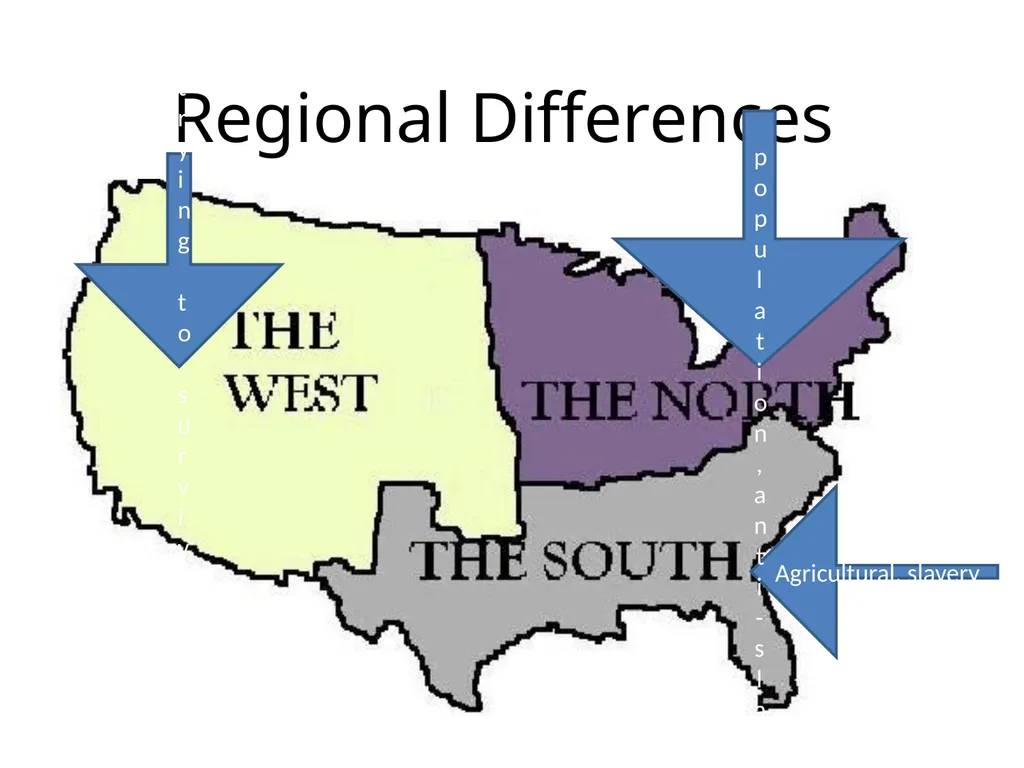
SECTIONALISM Regional Differences Agricultural, slavery Just trying to survive Industrial, Dense population, anti-slavery What is the difference between nationalism and sectionalism? Nationalism a feeling of pride, loyalty, and
"SECTIONALISM Regional Differences Agricultural," is the property of its rightful owner. Permission is granted to
download and print the materials on this website for personal, non-commercial use only, and to display it
on your personal computer provided you do not modify the materials and that you retain all copyright
notices contained in the materials. By downloading content from our website, you accept the terms of this
agreement.
Presentation Transcript
01
SECTIONALISM<br>
02
Regional Differences Agricultural, slavery Just trying to survive Industrial, Dense population, anti-slavery<br>
03
What is the difference between nationalism and sectionalism?<br>
04
Nationalism – a feeling of pride, loyalty, and protectiveness toward your country. Loyalty to one’s nation as a whole.<br>
05
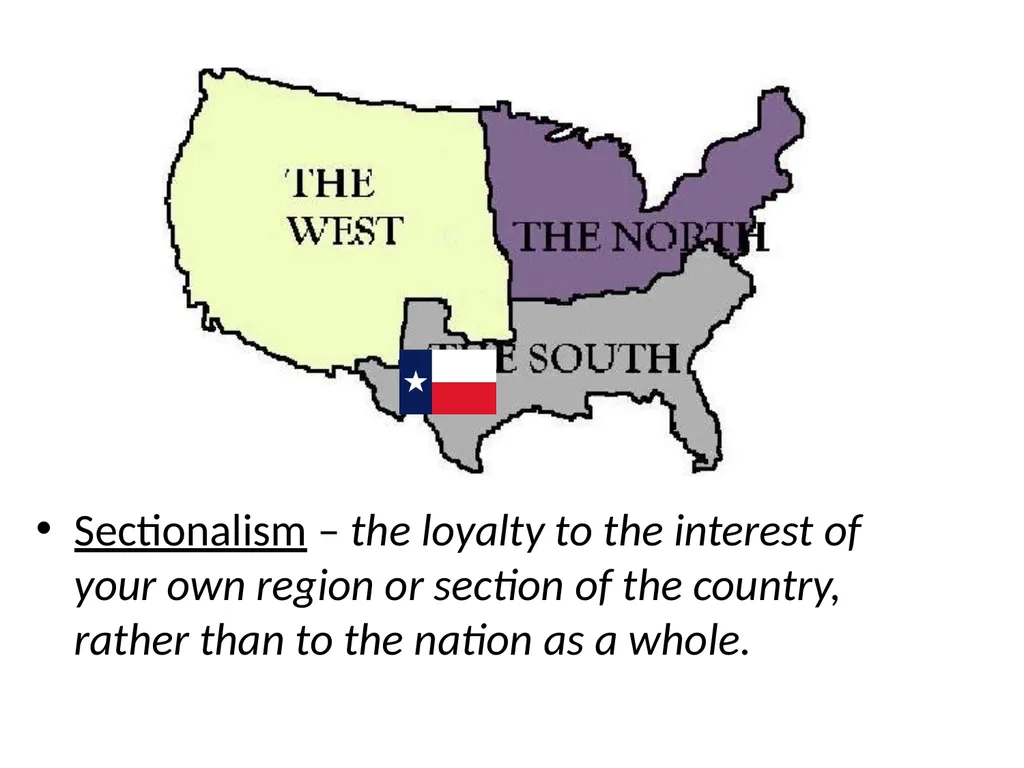
Sectionalism – the loyalty to the interest of your own region or section of the country, rather than to the nation as a whole.<br>
06
What kind of differences were there between the regions as the nation grew? What kind of political differences?
What kind of economic differences?
What kind of social differences?<br>
07
CHARACTERISTICS OF THE NORTH Political
It supported high tariffs to protect manufacturing.
It supported federally funded internal improvements like canals, roads, and railroads so they could have transportation to their markets.
In the 1840’s and 1850’s they began to oppose slavery.<br>
08
CHARACTERISTICS OF THE NORTH Economic
Agriculture was diversified (wheat, corn, dairy). It was more scientific and Northerners developed more farm machines that the South did.
Fishing and whaling were still important to the Northeast.
Manufacturing
It replaced shipping as the main business of the Northeast.<br>
09
CHARACTERISTICS OF THE NORTH Social
Immigration served as one of the major social issues in the North.
This immigration tended to create low wages and encouraged child labor.
Women’s Suffrage and Abolition of slavery were other social reforms the North was focused on.
Abolitionists believed that slavery was morally wrong.<br>
10
CHARACTERISTICS OF THE SOUTH Political
Protecting slavery was of the utmost importance to Southerners.
Fighting tariffs was paramount to Southerners since tariffs increased the price of goods imported from Europe.
Southerners were against internal improvements because it cost money and it did not meet their transportation needs.<br>
11
CHARACTERISTICS OF THE SOUTH Economic
Home of the “cotton kingdom”—Cotton replaced linen and wool as the major fiber for cloth.
Tobacco still was the major crop in the Upper South.
Rice and sugar were still important crops in South Carolina and Louisiana.<br>
12
CHARACTERISTICS OF THE SOUTH Economy (Transportation of goods)
The transportation system was designed to get goods to the ocean.
The main transportation in the South was rivers, streams, and intercoastal routes.<br>
13
CHARACTERISTICS OF THE SOUTH
Slavery was an important part of the Southern economy. The feeling was that slavery must follow expansion.
The South was agriculturally self-sufficient.
It provided its own corn, wheat, and livestock.
There was little manufacturing in the South.
The economy was still tied to Great Britain.<br>
14
CHARACTERISTICS OF THE SOUTH Social
Slavery served as one of the largest social issues of the south
Not everyone was in favor of slavery, but most were in favor of states rights
Only 1 in 4 Texans owned slaves<br>
15
Middle class farmers and lower class farmers supported slavery even though few had twenty slaves or more.
They hoped to have slaves themselves.
They were afraid of slave rebellion and competition from free blacks.<br>
16
CHARACTERISTICS OF THE WEST Political
Westerners wanted low priced or free land in the West.
They supported federally financed internal transportation improvements.
The West tended to support protective tariffs to pay for internal improvements without raising the price of federal land.
The Northwest and Southwest disagreed on slavery.<br>
17
Economic
Fur traders were the first Americans to move west.
Frontier farms followed. The farmers typically lived in log cabins and they were basically self-sufficient.
The economy of the West depended on turnpikes, canals, steamboats, and railroads CHARACTERISTICS OF THE WEST<br>
18
CHARACTERISTICS OF THE WEST Social
In the wake of the War of 1812, many nationalistic Americans believed that God intended for them to spread democracy and Christianity across the entire continent.<br>