
Self-Denial – Part 1 A Special Three-Part Series
PT
Published · 16 slides · 0 views

1 / 1

Description
Self-Denial Part 1 A Special Three-Part Series Luke 9:23-25 September 25, 2016 Pastor Paul K. Kim WHY IS SOUND THEOLOGY SO IMPORTANT? It keeps us GOD-CENTERED rather than man-centered in our beliefs, perspectives, and everyday life as
Related Topics
Share
Embed code
Download this presentation From Below
"Self-Denial – Part 1 A Special Three-Part Series" is the property of its rightful owner. Permission is granted to download and print the materials on this website for personal, non-commercial use only, and to display it on your personal computer provided you do not modify the materials and that you retain all copyright notices contained in the materials. By downloading content from our website, you accept the terms of this agreement.
Presentation Transcript
01
Self-Denial – Part 1 A Special Three-Part Series
Luke 9:23-25
© September 25, 2016
Pastor Paul K. Kim<br>
Luke 9:23-25
© September 25, 2016
Pastor Paul K. Kim<br>
02
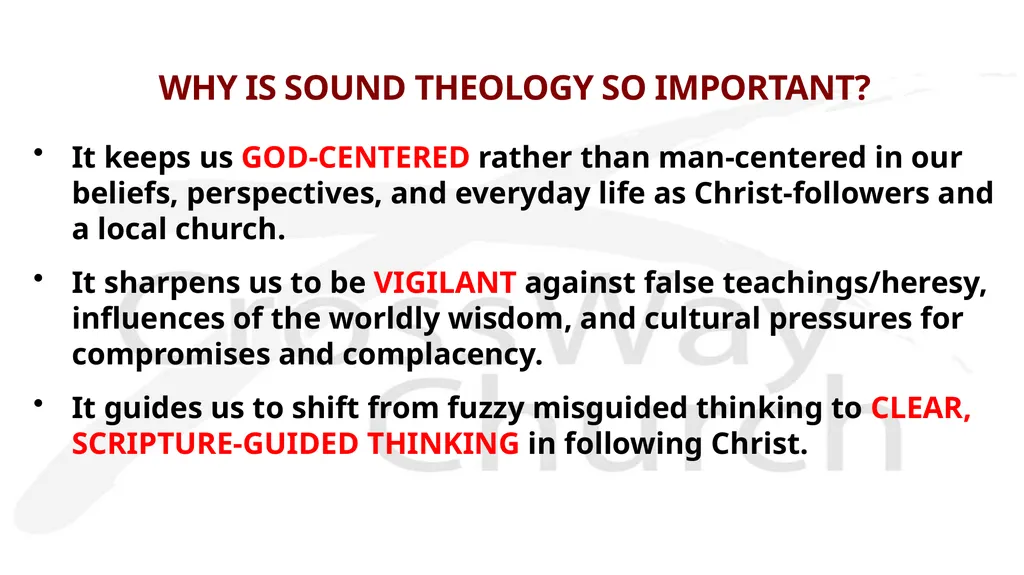
WHY IS SOUND THEOLOGY SO IMPORTANT? It keeps us GOD-CENTERED rather than man-centered in our beliefs, perspectives, and everyday life as Christ-followers and a local church.
It sharpens us to be VIGILANT against false teachings/heresy, influences of the worldly wisdom, and cultural pressures for compromises and complacency.
It guides us to shift from fuzzy misguided thinking to CLEAR, SCRIPTURE-GUIDED THINKING in following Christ.<br>
It sharpens us to be VIGILANT against false teachings/heresy, influences of the worldly wisdom, and cultural pressures for compromises and complacency.
It guides us to shift from fuzzy misguided thinking to CLEAR, SCRIPTURE-GUIDED THINKING in following Christ.<br>
03
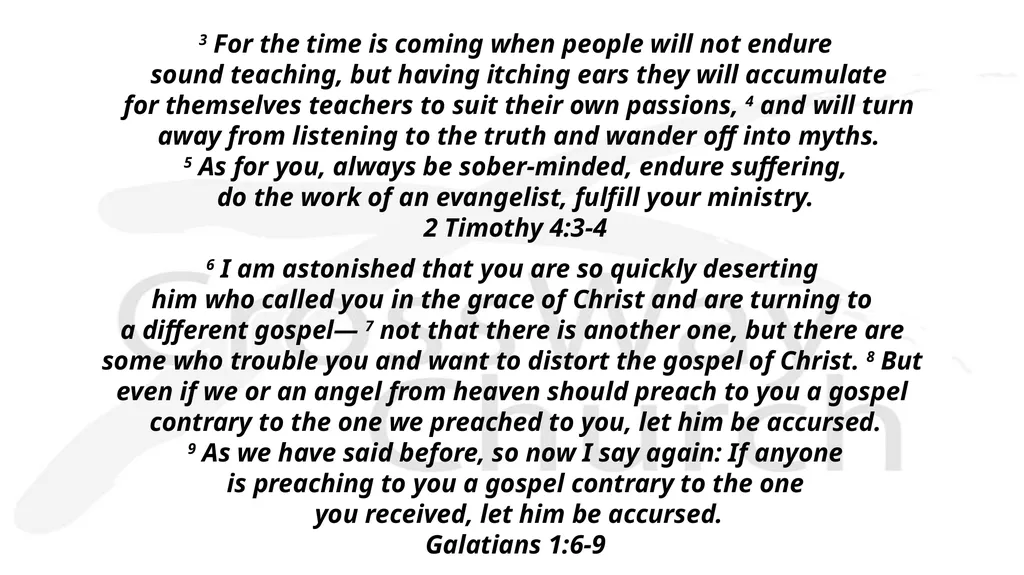
3 For the time is coming when people will not endure
sound teaching, but having itching ears they will accumulate
for themselves teachers to suit their own passions, 4 and will turn
away from listening to the truth and wander off into myths.
5 As for you, always be sober-minded, endure suffering,
do the work of an evangelist, fulfill your ministry.
2 Timothy 4:3-4
6 I am astonished that you are so quickly deserting him who called you in the grace of Christ and are turning to a different gospel— 7 not that there is another one, but there are some who trouble you and want to distort the gospel of Christ. 8 But even if we or an angel from heaven should preach to you a gospel contrary to the one we preached to you, let him be accursed. 9 As we have said before, so now I say again: If anyone is preaching to you a gospel contrary to the one you received, let him be accursed. Galatians 1:6-9<br>
6 I am astonished that you are so quickly deserting him who called you in the grace of Christ and are turning to a different gospel— 7 not that there is another one, but there are some who trouble you and want to distort the gospel of Christ. 8 But even if we or an angel from heaven should preach to you a gospel contrary to the one we preached to you, let him be accursed. 9 As we have said before, so now I say again: If anyone is preaching to you a gospel contrary to the one you received, let him be accursed. Galatians 1:6-9<br>
04
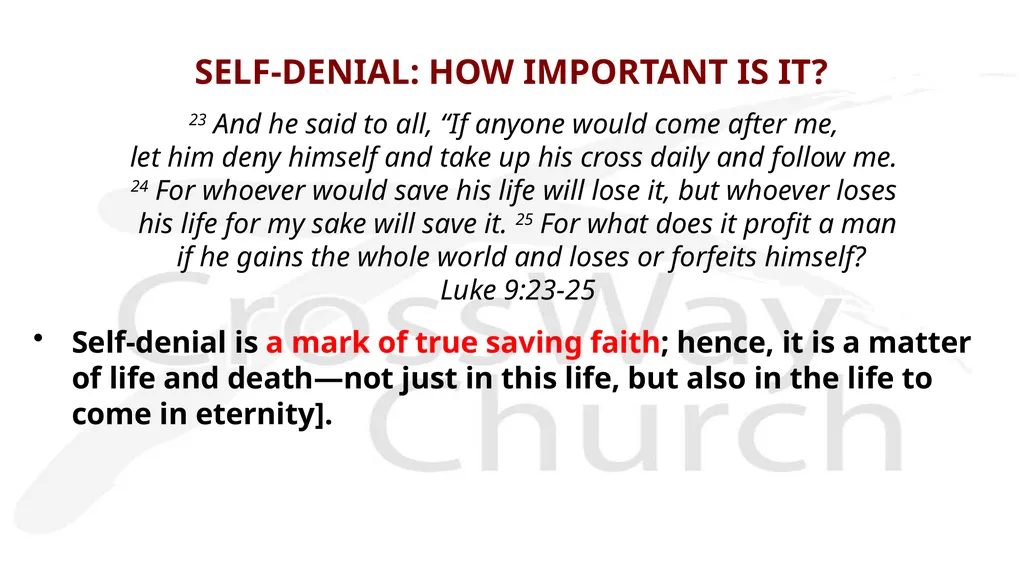
SELF-DENIAL: HOW IMPORTANT IS IT? 23 And he said to all, “If anyone would come after me,
let him deny himself and take up his cross daily and follow me.
24 For whoever would save his life will lose it, but whoever loses
his life for my sake will save it. 25 For what does it profit a man
if he gains the whole world and loses or forfeits himself?
Luke 9:23-25
Self-denial is a mark of true saving faith; hence, it is a matter of life and death—not just in this life, but also in the life to come in eternity].<br>
Self-denial is a mark of true saving faith; hence, it is a matter of life and death—not just in this life, but also in the life to come in eternity].<br>
05
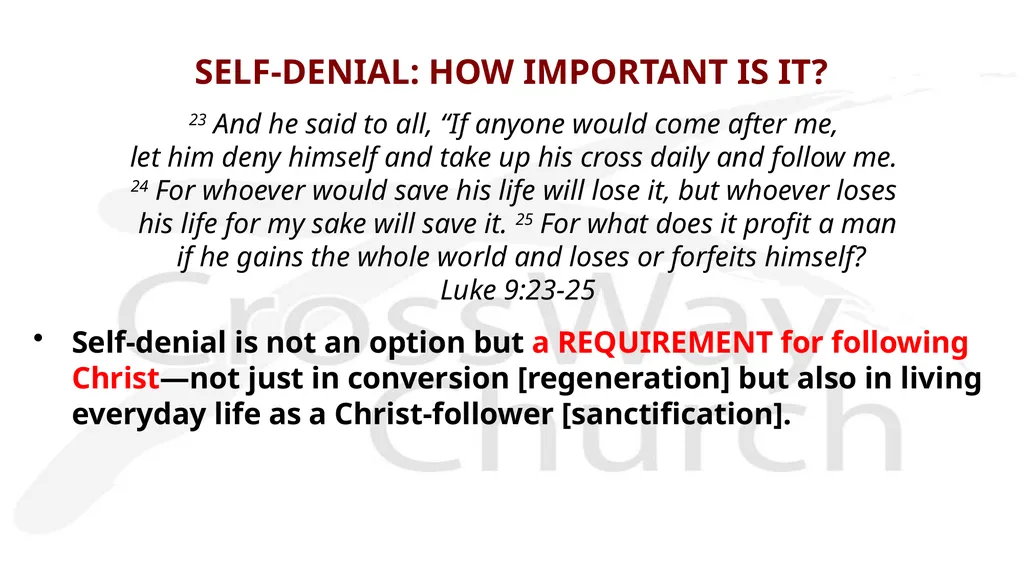
SELF-DENIAL: HOW IMPORTANT IS IT? 23 And he said to all, “If anyone would come after me,
let him deny himself and take up his cross daily and follow me.
24 For whoever would save his life will lose it, but whoever loses
his life for my sake will save it. 25 For what does it profit a man
if he gains the whole world and loses or forfeits himself?
Luke 9:23-25
Self-denial is not an option but a REQUIREMENT for following Christ—not just in conversion [regeneration] but also in living everyday life as a Christ-follower [sanctification].<br>
Self-denial is not an option but a REQUIREMENT for following Christ—not just in conversion [regeneration] but also in living everyday life as a Christ-follower [sanctification].<br>
06
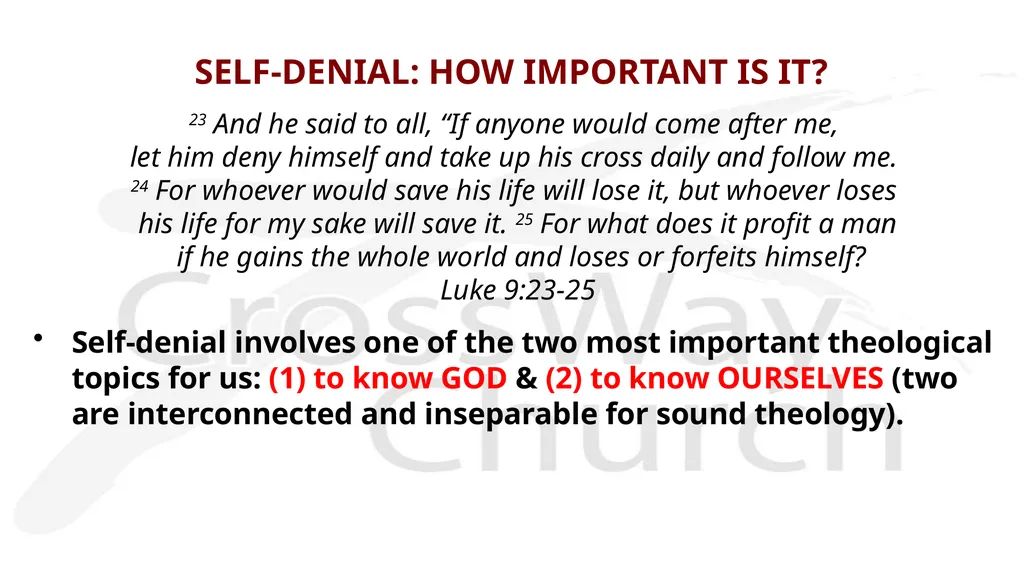
SELF-DENIAL: HOW IMPORTANT IS IT? 23 And he said to all, “If anyone would come after me,
let him deny himself and take up his cross daily and follow me.
24 For whoever would save his life will lose it, but whoever loses
his life for my sake will save it. 25 For what does it profit a man
if he gains the whole world and loses or forfeits himself?
Luke 9:23-25
Self-denial involves one of the two most important theological topics for us: (1) to know GOD & (2) to know OURSELVES (two are interconnected and inseparable for sound theology).<br>
Self-denial involves one of the two most important theological topics for us: (1) to know GOD & (2) to know OURSELVES (two are interconnected and inseparable for sound theology).<br>
07
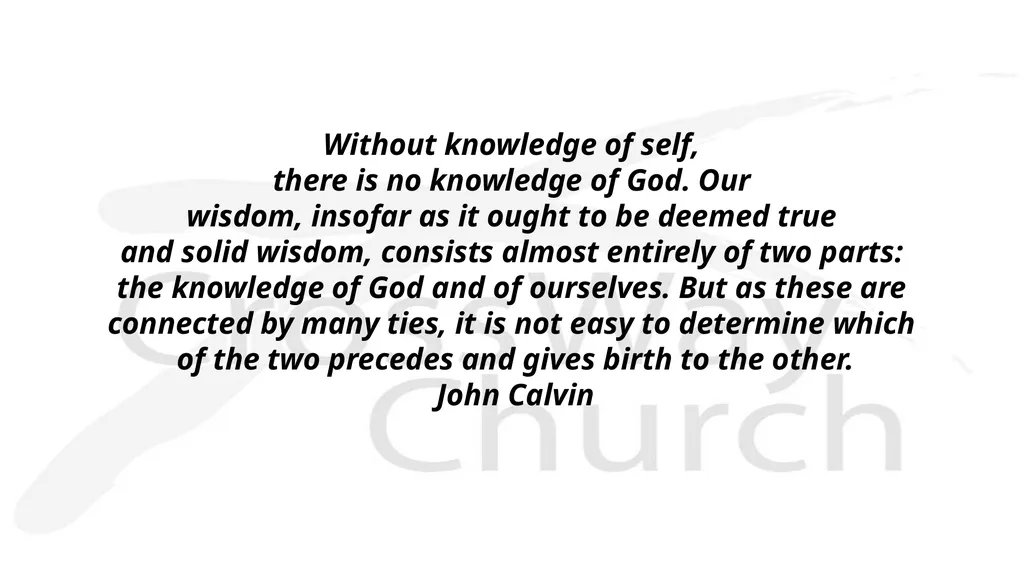
Without knowledge of self,
there is no knowledge of God. Our
wisdom, insofar as it ought to be deemed true
and solid wisdom, consists almost entirely of two parts:
the knowledge of God and of ourselves. But as these are
connected by many ties, it is not easy to determine which
of the two precedes and gives birth to the other.
John Calvin<br>
08
SELF-DENIAL: WHAT IS IT, REALLY? 23 And he said to all, “If anyone would come after me,
let him deny himself and take up his cross daily and follow me.
24 For whoever would save his life will lose it, but whoever loses
his life for my sake will save it. 25 For what does it profit a man
if he gains the whole world and loses or forfeits himself?
Luke 9:23-25
It does NOT mean:
We deny our personhood.
We deny our personal human needs.
We stop thinking on our own.
We deny our hunger to be loved and to experience meaning and satisfaction in life.<br>
It does NOT mean:
We deny our personhood.
We deny our personal human needs.
We stop thinking on our own.
We deny our hunger to be loved and to experience meaning and satisfaction in life.<br>
09
SELF-DENIAL: WHAT IS IT REALLY? 23 And he said to all, “If anyone would come after me,
let him deny himself and take up his cross daily and follow me.
24 For whoever would save his life will lose it, but whoever loses
his life for my sake will save it. 25 For what does it profit a man
if he gains the whole world and loses or forfeits himself?
Luke 9:23-25
Rather, it MEANS:
Essentially, we deny our SELF-CENTEREDNESS, which is the default mode of a human heart.
We deny not the created self but the fallen self [John Stott].
We deny sinful desires of the our fallen nature—pride, lust, hatred, etc.
We also deny subtle self-centeredness at the root of our lives—including in the Christian life: (1) self-glory, (2) self-effort, and (3) self-will.<br>
Rather, it MEANS:
Essentially, we deny our SELF-CENTEREDNESS, which is the default mode of a human heart.
We deny not the created self but the fallen self [John Stott].
We deny sinful desires of the our fallen nature—pride, lust, hatred, etc.
We also deny subtle self-centeredness at the root of our lives—including in the Christian life: (1) self-glory, (2) self-effort, and (3) self-will.<br>
10
The Self We Affirm And The Self We Deny
What we are (our self or personal identity) is partly the result of the Creation (the image of God), and partly the result of the Fall (the image defaced). The self we are to deny, disown, and crucify is our fallen self, everything within us that is incompatible with Jesus Christ (hence Christ’s command, ‘let him deny himself and follow me’). The self we are to affirm and value is our created self, everything within us that is compatible with Jesus Christ (hence his statement that if we lose ourselves by self-denial we shall find ourselves). True self-denial (the denial of our false, fallen self) is not the road to self-destruction, but the road to self-discovery.<br>
What we are (our self or personal identity) is partly the result of the Creation (the image of God), and partly the result of the Fall (the image defaced). The self we are to deny, disown, and crucify is our fallen self, everything within us that is incompatible with Jesus Christ (hence Christ’s command, ‘let him deny himself and follow me’). The self we are to affirm and value is our created self, everything within us that is compatible with Jesus Christ (hence his statement that if we lose ourselves by self-denial we shall find ourselves). True self-denial (the denial of our false, fallen self) is not the road to self-destruction, but the road to self-discovery.<br>
11
The Self We Affirm And The Self We Deny (Cont’d)
So, then, whatever we are by creation, we must affirm: our rationality, our sense of moral obligation, our masculinity and femininity, our aesthetic appreciation and artistic creativity, our stewardship of the fruitful earth, our hunger for love and community, our sense of the transcendent mystery of God, and our inbuilt urge to fall down and worship him. All this is part of our created humanness. True, it has all been tainted and twisted by sin. Yet Christ came to redeem and not destroy it. So we must affirm it. But whatever we are by the Fall, we must deny or repudiate: our irrationality; our moral perversity; our loss of sexual distinctives; our fascination with the ugly; our lazy refusal to develop God’s gifts; our pollution and spoliation of the environment; our selfishness, malice, individualism, and revenge, which are destructive of human community; our proud autonomy; and our idolatrous refusal to worship God. All this is part of our fallen humanness. Christ came not to redeem this but to destroy it. So we must deny it.
— John R. W. Stott<br>
So, then, whatever we are by creation, we must affirm: our rationality, our sense of moral obligation, our masculinity and femininity, our aesthetic appreciation and artistic creativity, our stewardship of the fruitful earth, our hunger for love and community, our sense of the transcendent mystery of God, and our inbuilt urge to fall down and worship him. All this is part of our created humanness. True, it has all been tainted and twisted by sin. Yet Christ came to redeem and not destroy it. So we must affirm it. But whatever we are by the Fall, we must deny or repudiate: our irrationality; our moral perversity; our loss of sexual distinctives; our fascination with the ugly; our lazy refusal to develop God’s gifts; our pollution and spoliation of the environment; our selfishness, malice, individualism, and revenge, which are destructive of human community; our proud autonomy; and our idolatrous refusal to worship God. All this is part of our fallen humanness. Christ came not to redeem this but to destroy it. So we must deny it.
— John R. W. Stott<br>
12
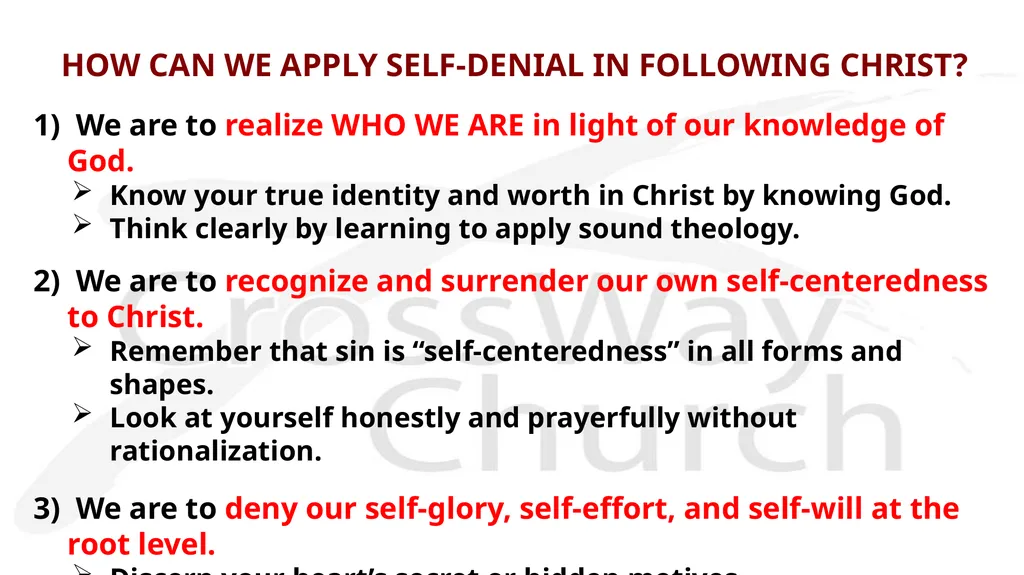
HOW CAN WE APPLY SELF-DENIAL IN FOLLOWING CHRIST? 1) We are to realize WHO WE ARE in light of our knowledge of God.
Know your true identity and worth in Christ by knowing God.
Think clearly by learning to apply sound theology.
2) We are to recognize and surrender our own self-centeredness to Christ.
Remember that sin is “self-centeredness” in all forms and shapes.
Look at yourself honestly and prayerfully without rationalization.
3) We are to deny our self-glory, self-effort, and self-will at the root level.
Discern your heart’s secret or hidden motives.
Learn the true joy and freedom in denying yourself unreservedly.
I have been crucified with Christ. It is no longer I who live, but Christ who lives in me. Galatians 2:20<br>
Know your true identity and worth in Christ by knowing God.
Think clearly by learning to apply sound theology.
2) We are to recognize and surrender our own self-centeredness to Christ.
Remember that sin is “self-centeredness” in all forms and shapes.
Look at yourself honestly and prayerfully without rationalization.
3) We are to deny our self-glory, self-effort, and self-will at the root level.
Discern your heart’s secret or hidden motives.
Learn the true joy and freedom in denying yourself unreservedly.
I have been crucified with Christ. It is no longer I who live, but Christ who lives in me. Galatians 2:20<br>
13
Cultivating Self-Denial as a Christ-follower
One way to define spiritual life is getting so tired and fed up with yourself you go on to something better, which is following Jesus. But the minute we start advertising the faith in terms of benefits, we're just exacerbating the self problem. "With Christ, you're better, stronger, more likeable, you enjoy some ecstasy." But it's just more self. Instead, we want to get people bored with themselves so they can start looking at Jesus. We've all met a certain type of spiritual person. She's a wonderful person. She loves the Lord. She prays and reads the Bible all the time. But all she thinks about is herself. She's not a selfish person. But she's always at the center of everything she's doing. "How can I witness better? How can I do this better? How can I take care of this person's problem better?" It's me, me, me disguised in a way that is difficult to see because her spiritual talk disarms us . . . The cultivation of consumer spirituality is the antithesis of a sacrificial, "deny yourself" congregation.
― Eugene H. Peterson<br>
One way to define spiritual life is getting so tired and fed up with yourself you go on to something better, which is following Jesus. But the minute we start advertising the faith in terms of benefits, we're just exacerbating the self problem. "With Christ, you're better, stronger, more likeable, you enjoy some ecstasy." But it's just more self. Instead, we want to get people bored with themselves so they can start looking at Jesus. We've all met a certain type of spiritual person. She's a wonderful person. She loves the Lord. She prays and reads the Bible all the time. But all she thinks about is herself. She's not a selfish person. But she's always at the center of everything she's doing. "How can I witness better? How can I do this better? How can I take care of this person's problem better?" It's me, me, me disguised in a way that is difficult to see because her spiritual talk disarms us . . . The cultivation of consumer spirituality is the antithesis of a sacrificial, "deny yourself" congregation.
― Eugene H. Peterson<br>
14
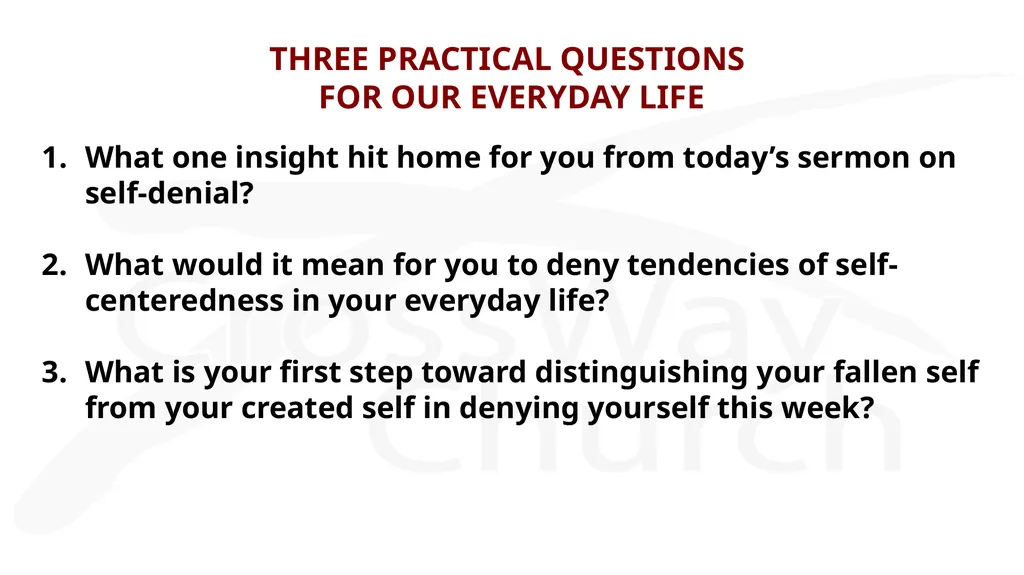
THREE PRACTICAL QUESTIONS
FOR OUR EVERYDAY LIFE What one insight hit home for you from today’s sermon on self-denial?
What would it mean for you to deny tendencies of self-centeredness in your everyday life?
What is your first step toward distinguishing your fallen self from your created self in denying yourself this week?<br>
What would it mean for you to deny tendencies of self-centeredness in your everyday life?
What is your first step toward distinguishing your fallen self from your created self in denying yourself this week?<br>