
Semester IV Paper 8 (Unit III) Anthropological
LV
Published · 12 slides · 0 views

1 / 1
Description
Semester IV Paper 8 (Unit III) Anthropological thought on culture and society Dr.Syed Aiman Raza Assistant Professor Department of Anthropolgy Shia PG College Lucknow Functionalism :Malinowski BASIC PREMISES Functionalists seek to describe
Related Topics
Share
Embed code
Download this presentation From Below
"Semester IV Paper 8 (Unit III) Anthropological" is the property of its rightful owner. Permission is granted to download and print the materials on this website for personal, non-commercial use only, and to display it on your personal computer provided you do not modify the materials and that you retain all copyright notices contained in the materials. By downloading content from our website, you accept the terms of this agreement.
Presentation Transcript
01
Semester IV Paper 8 (Unit III)
Anthropological thought on culture and society Dr.Syed Aiman Raza
Assistant Professor
Department of Anthropolgy
Shia PG College
Lucknow<br>
Assistant Professor
Department of Anthropolgy
Shia PG College
Lucknow<br>
02
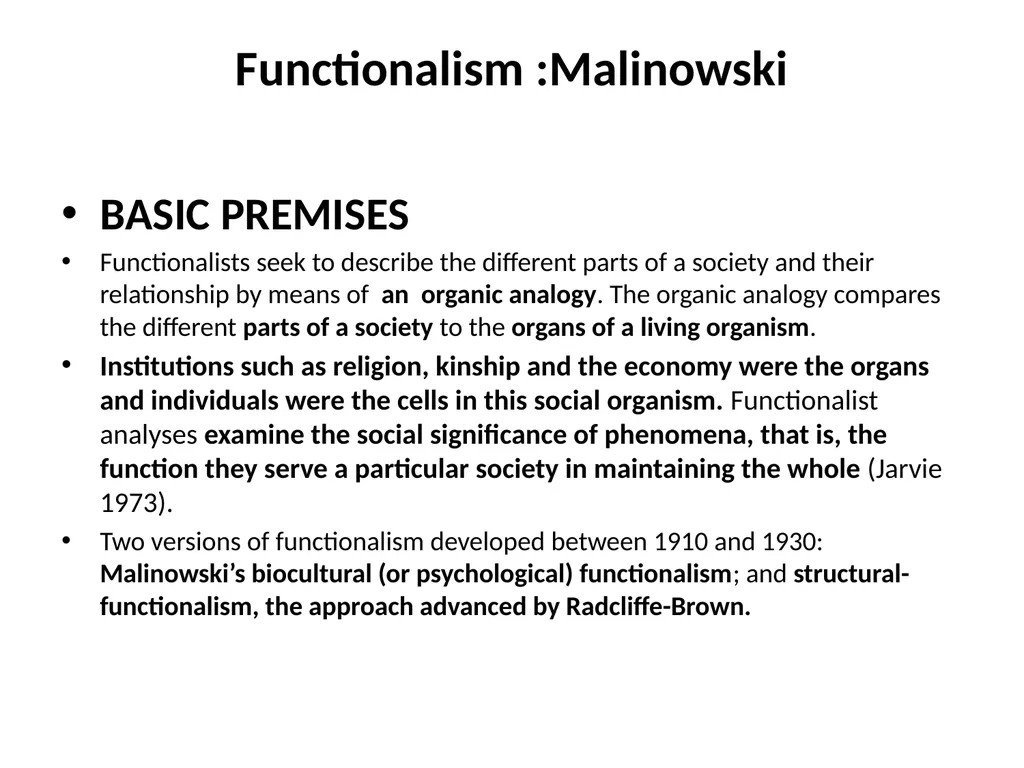
Functionalism :Malinowski BASIC PREMISES
Functionalists seek to describe the different parts of a society and their relationship by means of an organic analogy. The organic analogy compares the different parts of a society to the organs of a living organism.
Institutions such as religion, kinship and the economy were the organs and individuals were the cells in this social organism. Functionalist analyses examine the social significance of phenomena, that is, the function they serve a particular society in maintaining the whole (Jarvie 1973).
Two versions of functionalism developed between 1910 and 1930: Malinowski’s biocultural (or psychological) functionalism; and structural-functionalism, the approach advanced by Radcliffe-Brown.<br>
03
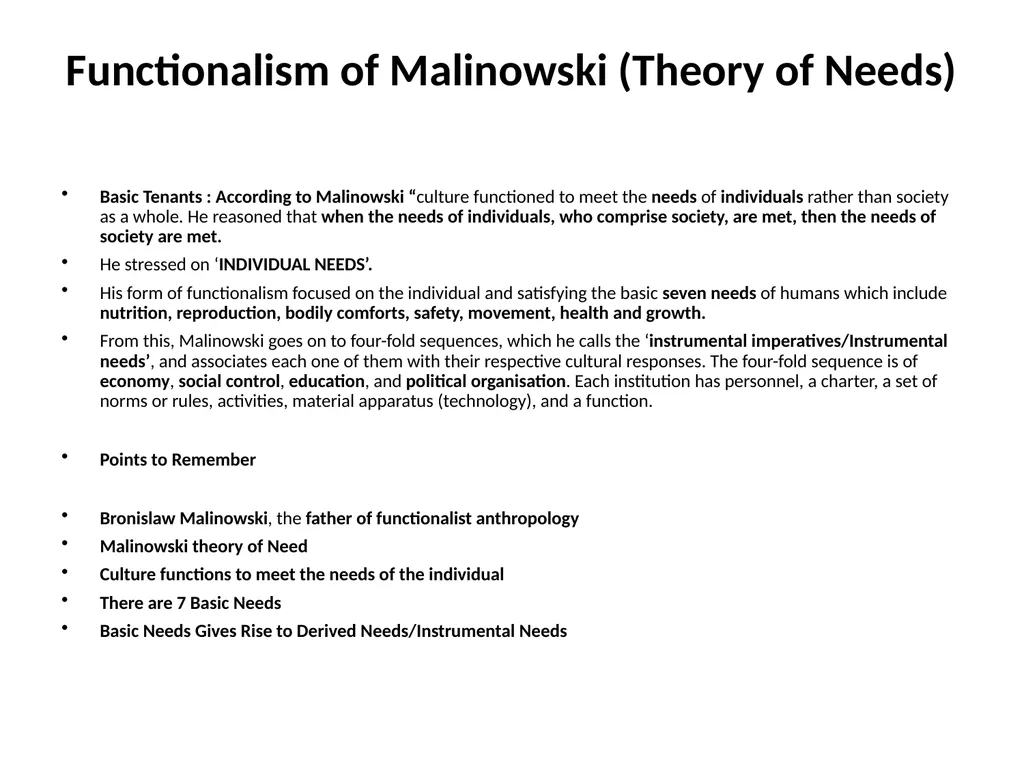
Functionalism of Malinowski (Theory of Needs) Basic Tenants : According to Malinowski “culture functioned to meet the needs of individuals rather than society as a whole. He reasoned that when the needs of individuals, who comprise society, are met, then the needs of society are met.
He stressed on ‘INDIVIDUAL NEEDS’.
His form of functionalism focused on the individual and satisfying the basic seven needs of humans which include nutrition, reproduction, bodily comforts, safety, movement, health and growth.
From this, Malinowski goes on to four-fold sequences, which he calls the ‘instrumental imperatives/Instrumental needs’, and associates each one of them with their respective cultural responses. The four-fold sequence is of economy, social control, education, and political organisation. Each institution has personnel, a charter, a set of norms or rules, activities, material apparatus (technology), and a function.
Points to Remember
Bronislaw Malinowski, the father of functionalist anthropology
Malinowski theory of Need
Culture functions to meet the needs of the individual
There are 7 Basic Needs
Basic Needs Gives Rise to Derived Needs/Instrumental Needs<br>
04
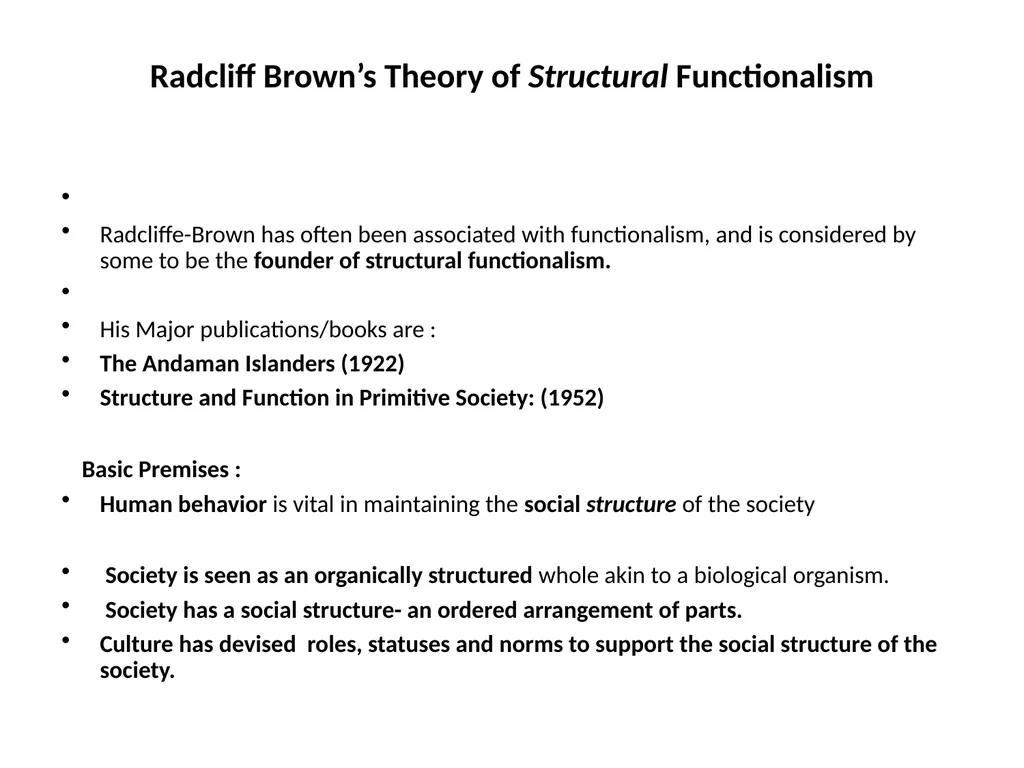
Radcliff Brown’s Theory of Structural Functionalism Radcliffe-Brown has often been associated with functionalism, and is considered by some to be the founder of structural functionalism.
His Major publications/books are :
The Andaman Islanders (1922)
Structure and Function in Primitive Society: (1952)
Basic Premises :
Human behavior is vital in maintaining the social structure of the society
Society is seen as an organically structured whole akin to a biological organism.
Society has a social structure- an ordered arrangement of parts.
Culture has devised roles, statuses and norms to support the social structure of the society.<br>
05
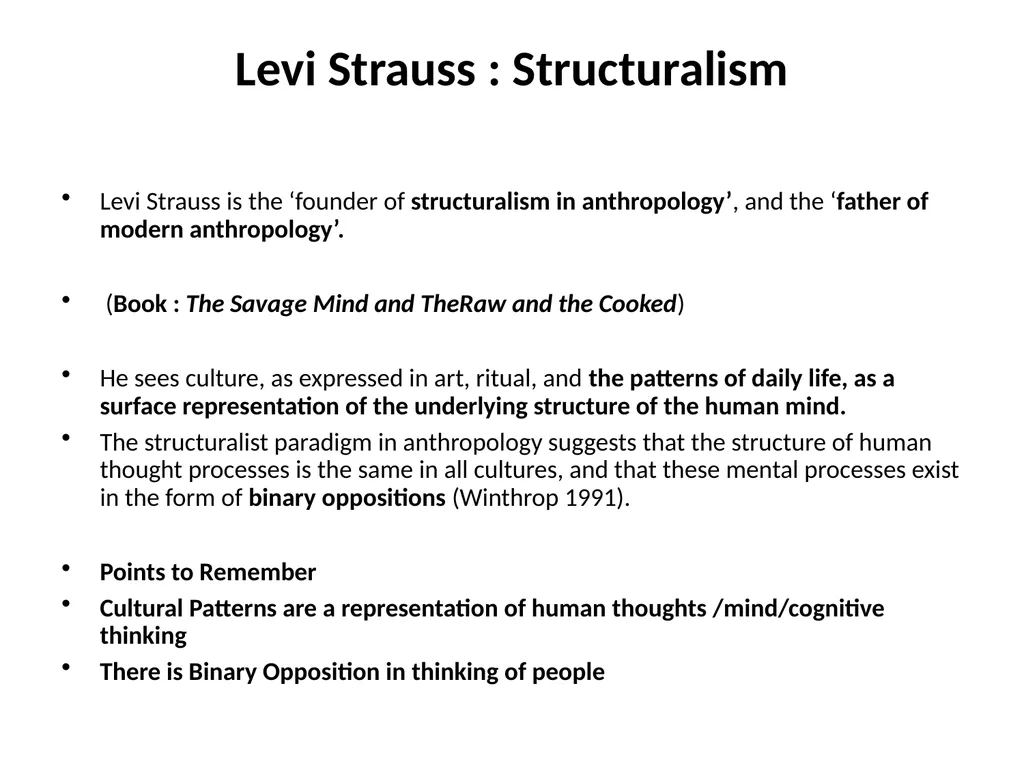
Levi Strauss : Structuralism Levi Strauss is the ‘founder of structuralism in anthropology’, and the ‘father of modern anthropology’.
(Book : The Savage Mind and TheRaw and the Cooked)
He sees culture, as expressed in art, ritual, and the patterns of daily life, as a surface representation of the underlying structure of the human mind.
The structuralist paradigm in anthropology suggests that the structure of human thought processes is the same in all cultures, and that these mental processes exist in the form of binary oppositions (Winthrop 1991).
Points to Remember
Cultural Patterns are a representation of human thoughts /mind/cognitive thinking
There is Binary Opposition in thinking of people<br>
06
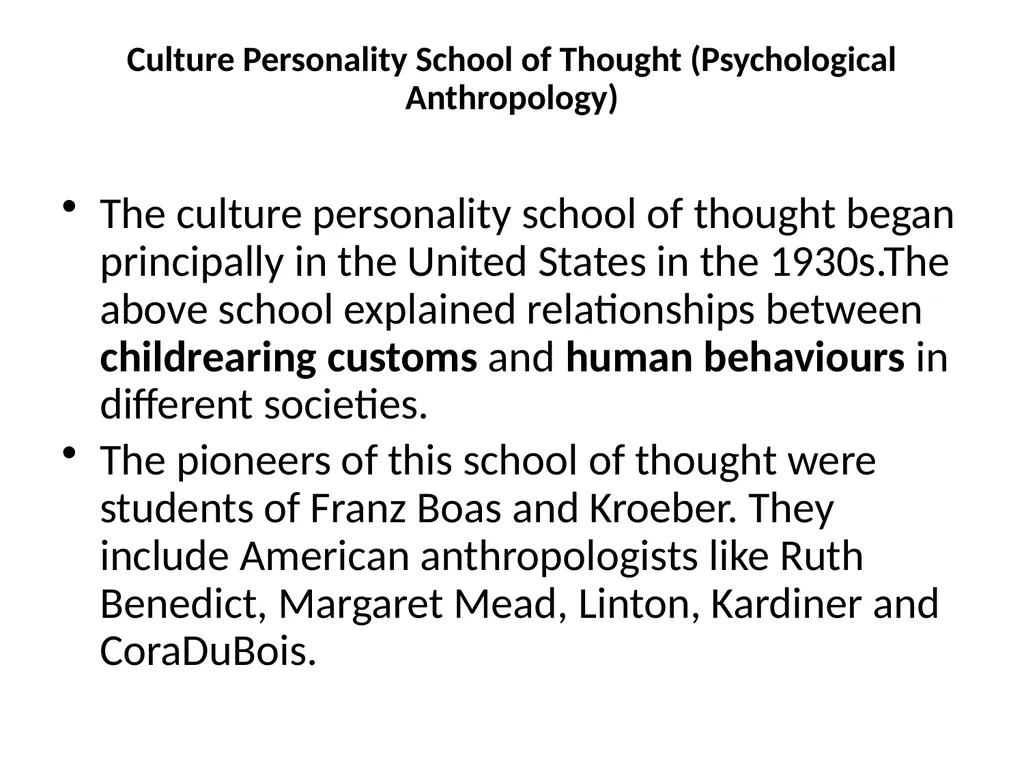
Culture Personality School of Thought (Psychological Anthropology) The culture personality school of thought began principally in the United States in the 1930s.The above school explained relationships between childrearing customs and human behaviours in different societies.
The pioneers of this school of thought were students of Franz Boas and Kroeber. They include American anthropologists like Ruth Benedict, Margaret Mead, Linton, Kardiner and CoraDuBois.<br>
The pioneers of this school of thought were students of Franz Boas and Kroeber. They include American anthropologists like Ruth Benedict, Margaret Mead, Linton, Kardiner and CoraDuBois.<br>
07
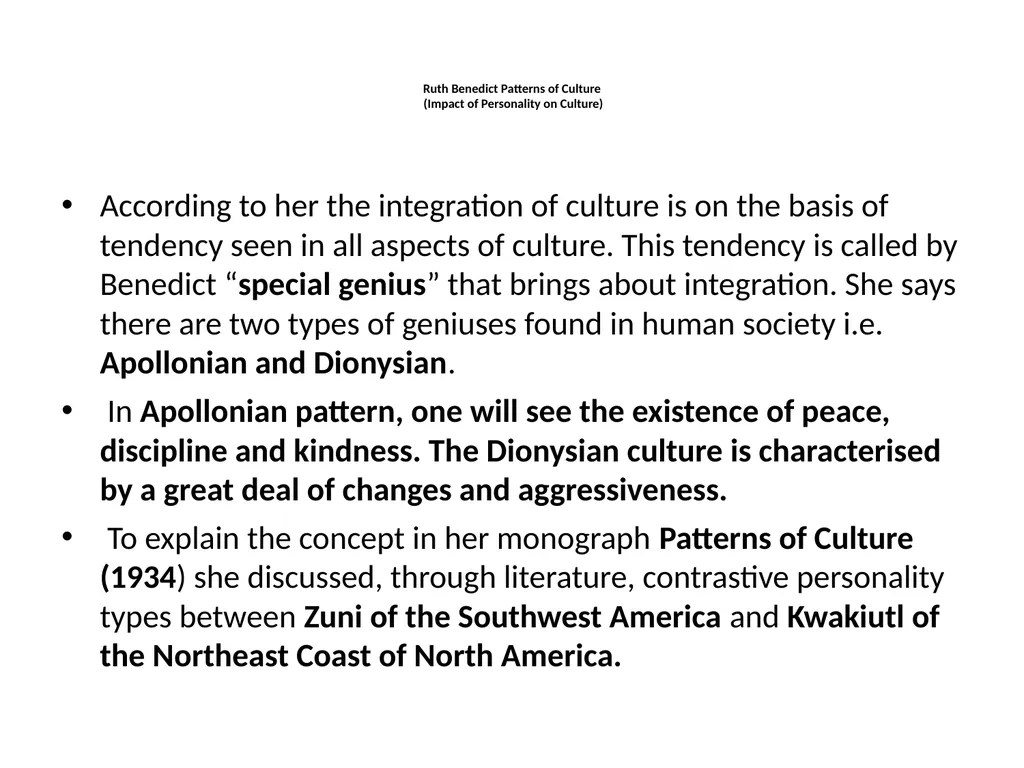
Ruth Benedict Patterns of Culture
(Impact of Personality on Culture) According to her the integration of culture is on the basis of tendency seen in all aspects of culture. This tendency is called by Benedict “special genius” that brings about integration. She says there are two types of geniuses found in human society i.e. Apollonian and Dionysian.
In Apollonian pattern, one will see the existence of peace, discipline and kindness. The Dionysian culture is characterised by a great deal of changes and aggressiveness.
To explain the concept in her monograph Patterns of Culture (1934) she discussed, through literature, contrastive personality types between Zuni of the Southwest America and Kwakiutl of the Northeast Coast of North America.<br>
08
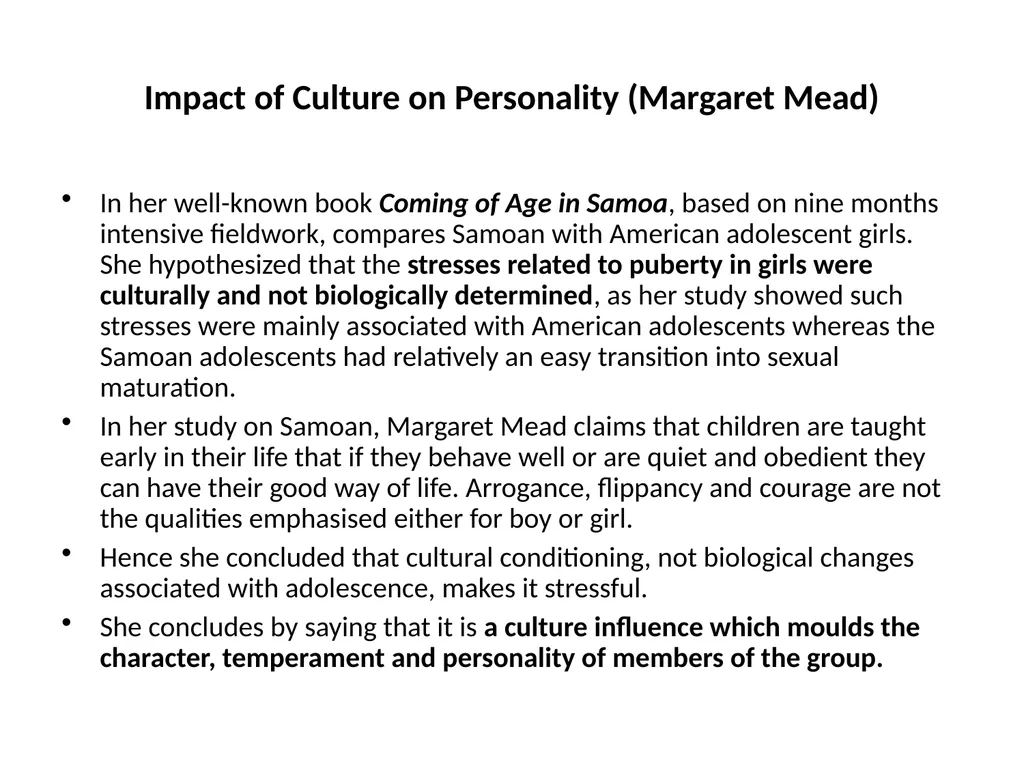
Impact of Culture on Personality (Margaret Mead) In her well-known book Coming of Age in Samoa, based on nine months intensive fieldwork, compares Samoan with American adolescent girls. She hypothesized that the stresses related to puberty in girls were culturally and not biologically determined, as her study showed such stresses were mainly associated with American adolescents whereas the Samoan adolescents had relatively an easy transition into sexual maturation.
In her study on Samoan, Margaret Mead claims that children are taught early in their life that if they behave well or are quiet and obedient they can have their good way of life. Arrogance, flippancy and courage are not the qualities emphasised either for boy or girl.
Hence she concluded that cultural conditioning, not biological changes associated with adolescence, makes it stressful.
She concludes by saying that it is a culture influence which moulds the character, temperament and personality of members of the group.<br>
09
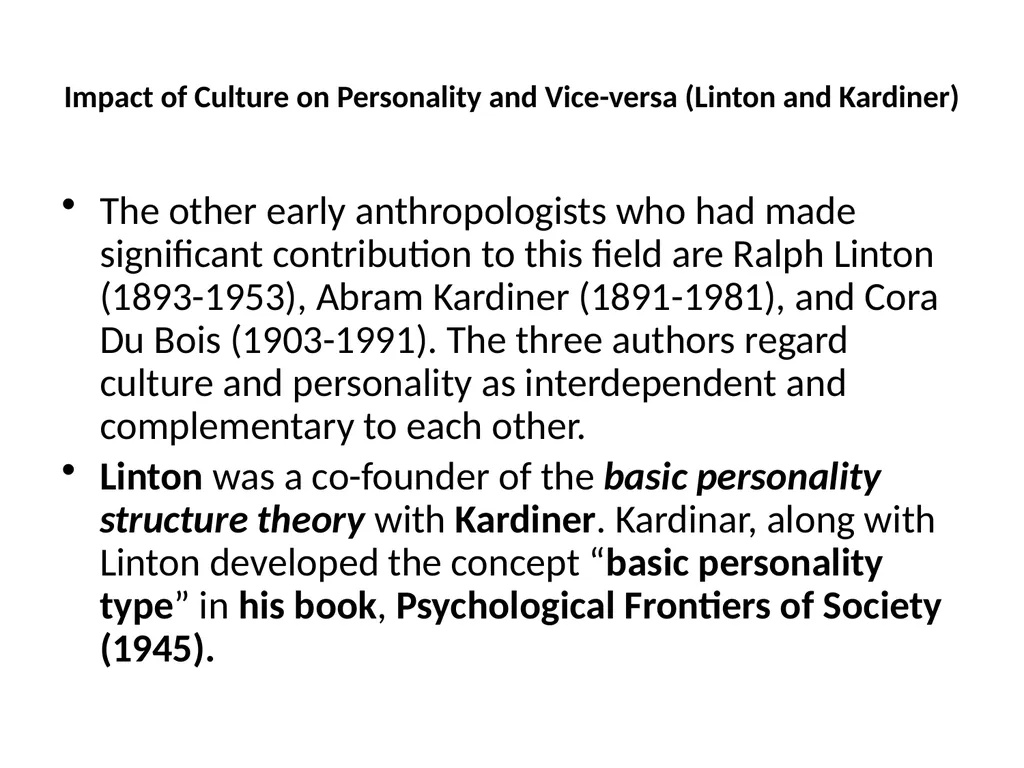
Impact of Culture on Personality and Vice-versa (Linton and Kardiner) The other early anthropologists who had made significant contribution to this field are Ralph Linton (1893-1953), Abram Kardiner (1891-1981), and Cora Du Bois (1903-1991). The three authors regard culture and personality as interdependent and complementary to each other.
Linton was a co-founder of the basic personality structure theory with Kardiner. Kardinar, along with Linton developed the concept “basic personality type” in his book, Psychological Frontiers of Society (1945).<br>
Linton was a co-founder of the basic personality structure theory with Kardiner. Kardinar, along with Linton developed the concept “basic personality type” in his book, Psychological Frontiers of Society (1945).<br>
10
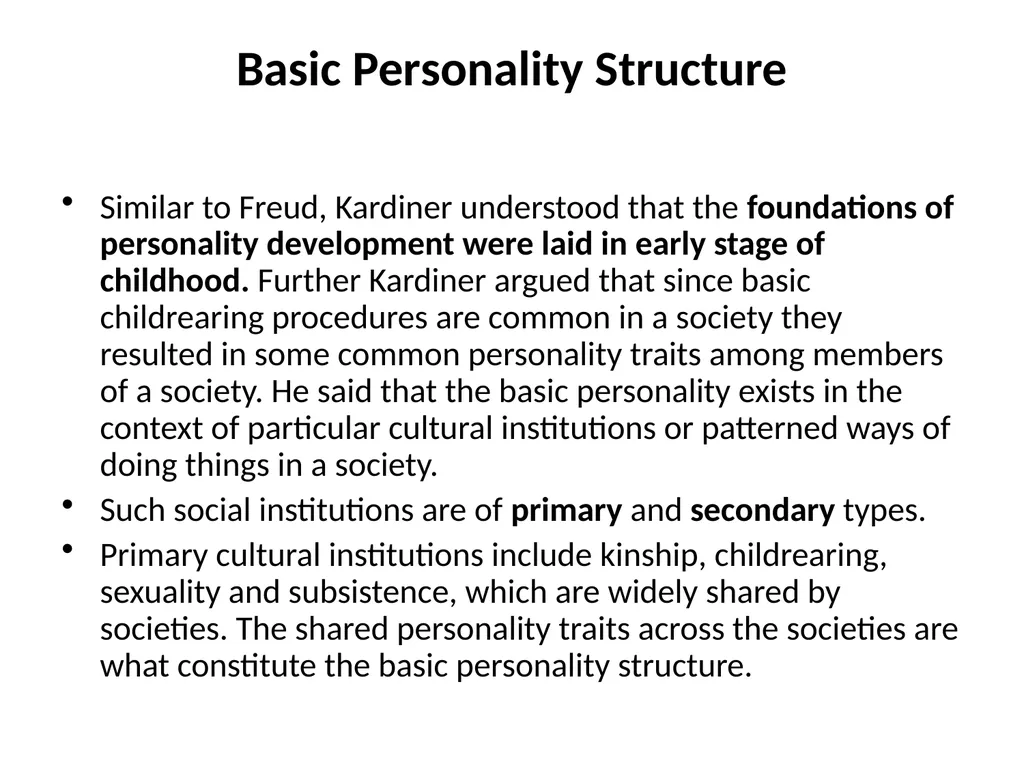
Basic Personality Structure Similar to Freud, Kardiner understood that the foundations of personality development were laid in early stage of childhood. Further Kardiner argued that since basic childrearing procedures are common in a society they resulted in some common personality traits among members of a society. He said that the basic personality exists in the context of particular cultural institutions or patterned ways of doing things in a society.
Such social institutions are of primary and secondary types.
Primary cultural institutions include kinship, childrearing, sexuality and subsistence, which are widely shared by societies. The shared personality traits across the societies are what constitute the basic personality structure.<br>
Such social institutions are of primary and secondary types.
Primary cultural institutions include kinship, childrearing, sexuality and subsistence, which are widely shared by societies. The shared personality traits across the societies are what constitute the basic personality structure.<br>
11
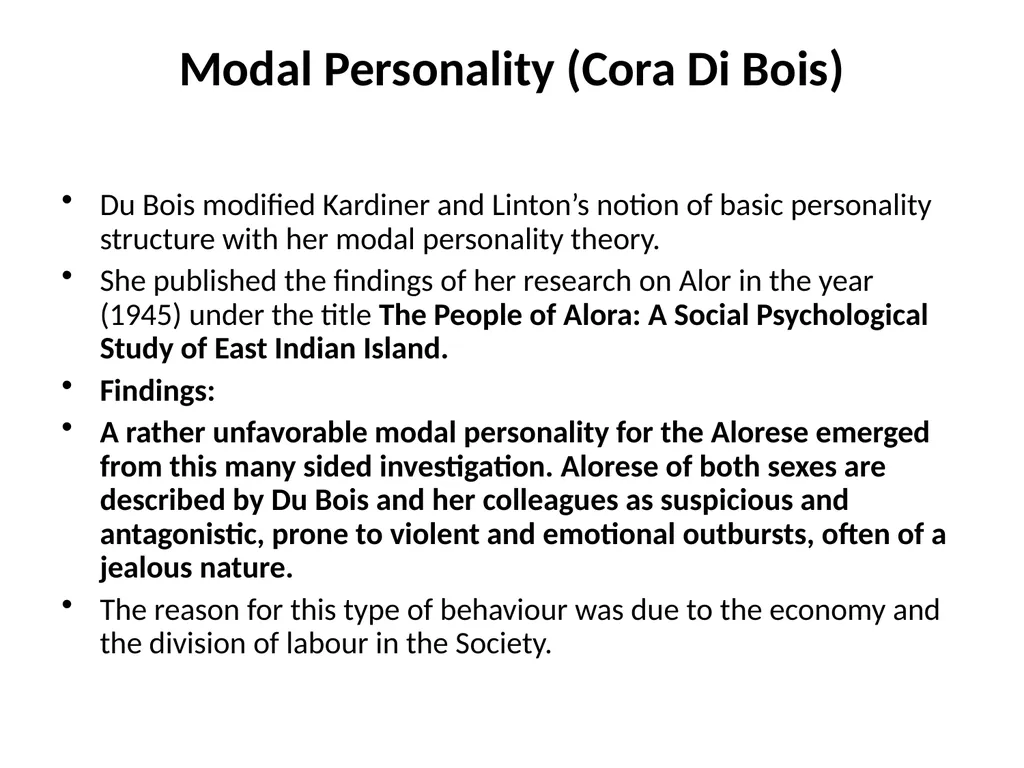
Modal Personality (Cora Di Bois) Du Bois modified Kardiner and Linton’s notion of basic personality structure with her modal personality theory.
She published the findings of her research on Alor in the year (1945) under the title The People of Alora: A Social Psychological Study of East Indian Island.
Findings:
A rather unfavorable modal personality for the Alorese emerged from this many sided investigation. Alorese of both sexes are described by Du Bois and her colleagues as suspicious and antagonistic, prone to violent and emotional outbursts, often of a jealous nature.
The reason for this type of behaviour was due to the economy and the division of labour in the Society.<br>
12
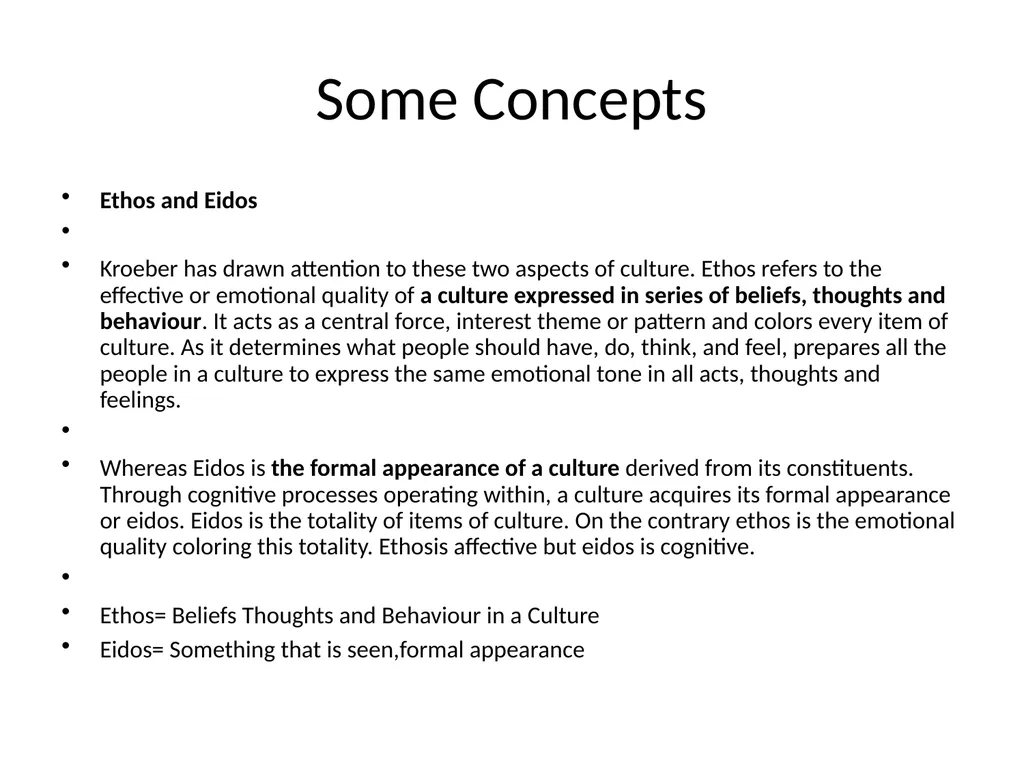
Some Concepts Ethos and Eidos
Kroeber has drawn attention to these two aspects of culture. Ethos refers to the effective or emotional quality of a culture expressed in series of beliefs, thoughts and behaviour. It acts as a central force, interest theme or pattern and colors every item of culture. As it determines what people should have, do, think, and feel, prepares all the people in a culture to express the same emotional tone in all acts, thoughts and feelings.
Whereas Eidos is the formal appearance of a culture derived from its constituents. Through cognitive processes operating within, a culture acquires its formal appearance or eidos. Eidos is the totality of items of culture. On the contrary ethos is the emotional quality coloring this totality. Ethosis affective but eidos is cognitive.
Ethos= Beliefs Thoughts and Behaviour in a Culture
Eidos= Something that is seen,formal appearance<br>