
SEN Information Report for Attleborough Primary
GB
Published · 28 slides · 0 views
1 / 1
Description
SEN Information Report for Attleborough Primary School Date: September 2024 Review: September 2025 Introduction Welcome to our SEN information report which is part of the Norfolk Local Offer for learners with Special Educational Needs
Related Topics
Share
Embed code
Download this presentation From Below
"SEN Information Report for Attleborough Primary" is the property of its rightful owner. Permission is granted to download and print the materials on this website for personal, non-commercial use only, and to display it on your personal computer provided you do not modify the materials and that you retain all copyright notices contained in the materials. By downloading content from our website, you accept the terms of this agreement.
Presentation Transcript
01
SEN Information Report for
Attleborough Primary School Date: September 2024
Review: September 2025<br>
02
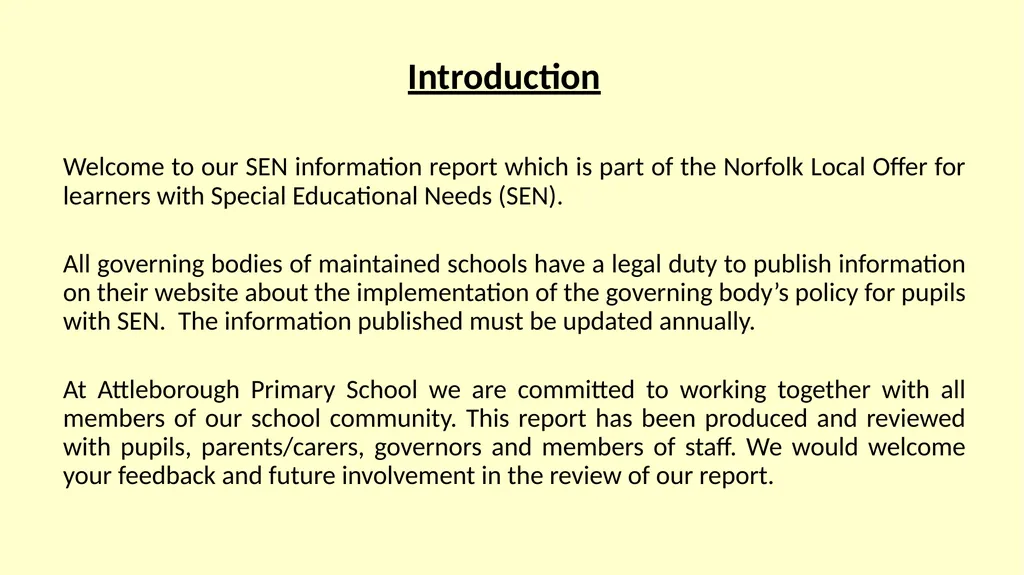
Introduction Welcome to our SEN information report which is part of the Norfolk Local Offer for learners with Special Educational Needs (SEN).
All governing bodies of maintained schools have a legal duty to publish information on their website about the implementation of the governing body’s policy for pupils with SEN. The information published must be updated annually.
At Attleborough Primary School we are committed to working together with all members of our school community. This report has been produced and reviewed with pupils, parents/carers, governors and members of staff. We would welcome your feedback and future involvement in the review of our report.<br>
All governing bodies of maintained schools have a legal duty to publish information on their website about the implementation of the governing body’s policy for pupils with SEN. The information published must be updated annually.
At Attleborough Primary School we are committed to working together with all members of our school community. This report has been produced and reviewed with pupils, parents/carers, governors and members of staff. We would welcome your feedback and future involvement in the review of our report.<br>
03
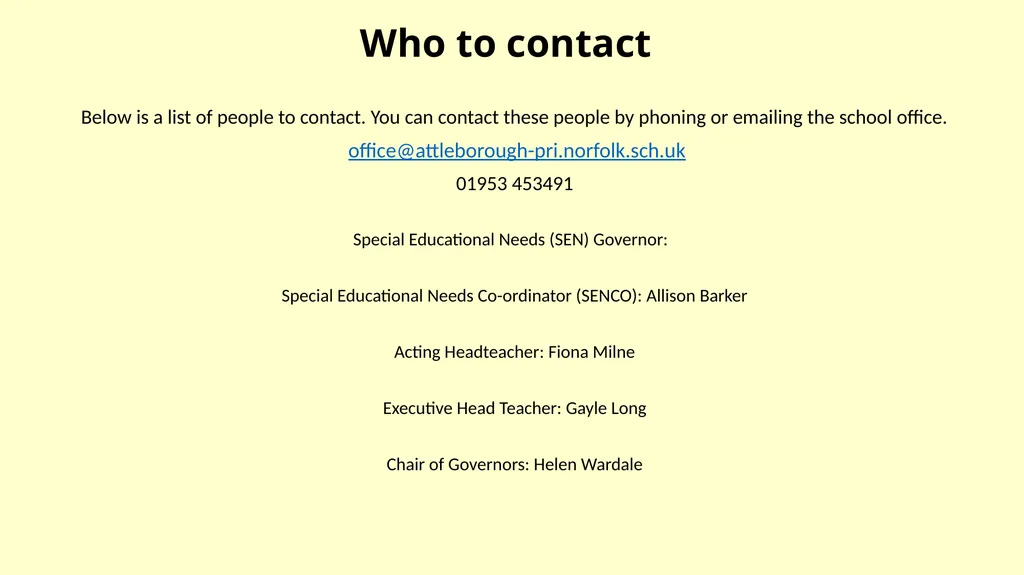
Who to contact Below is a list of people to contact. You can contact these people by phoning or emailing the school office.
office@attleborough-pri.norfolk.sch.uk
01953 453491
Special Educational Needs (SEN) Governor:
Special Educational Needs Co-ordinator (SENCO): Allison Barker
Acting Headteacher: Fiona Milne
Executive Head Teacher: Gayle Long
Chair of Governors: Helen Wardale<br>
office@attleborough-pri.norfolk.sch.uk
01953 453491
Special Educational Needs (SEN) Governor:
Special Educational Needs Co-ordinator (SENCO): Allison Barker
Acting Headteacher: Fiona Milne
Executive Head Teacher: Gayle Long
Chair of Governors: Helen Wardale<br>
04
How we supported learners in 2023-2024 Our profile
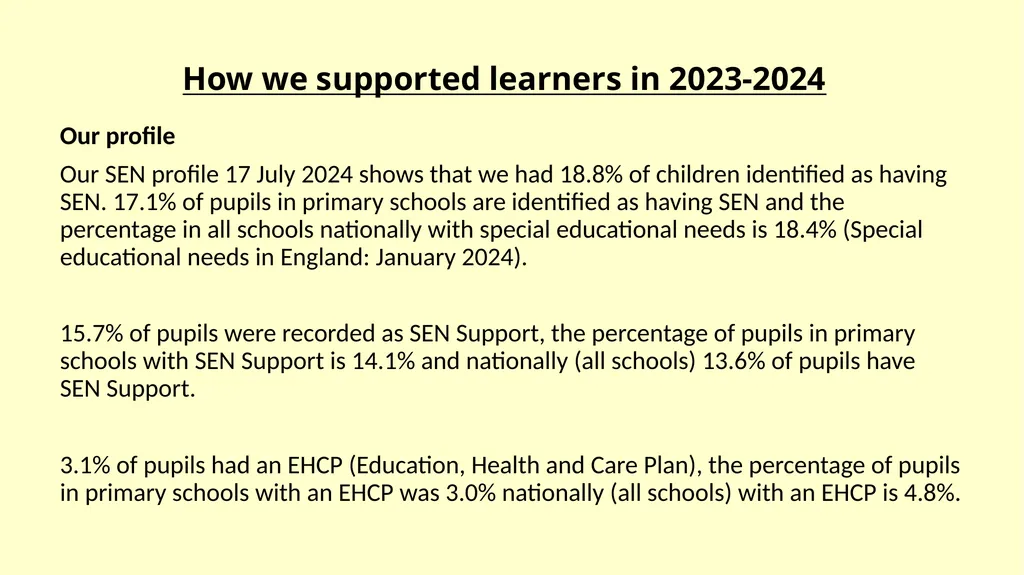
Our SEN profile 17 July 2024 shows that we had 18.8% of children identified as having SEN. 17.1% of pupils in primary schools are identified as having SEN and the percentage in all schools nationally with special educational needs is 18.4% (Special educational needs in England: January 2024).
15.7% of pupils were recorded as SEN Support, the percentage of pupils in primary schools with SEN Support is 14.1% and nationally (all schools) 13.6% of pupils have SEN Support.
3.1% of pupils had an EHCP (Education, Health and Care Plan), the percentage of pupils in primary schools with an EHCP was 3.0% nationally (all schools) with an EHCP is 4.8%.<br>
Our SEN profile 17 July 2024 shows that we had 18.8% of children identified as having SEN. 17.1% of pupils in primary schools are identified as having SEN and the percentage in all schools nationally with special educational needs is 18.4% (Special educational needs in England: January 2024).
15.7% of pupils were recorded as SEN Support, the percentage of pupils in primary schools with SEN Support is 14.1% and nationally (all schools) 13.6% of pupils have SEN Support.
3.1% of pupils had an EHCP (Education, Health and Care Plan), the percentage of pupils in primary schools with an EHCP was 3.0% nationally (all schools) with an EHCP is 4.8%.<br>
05
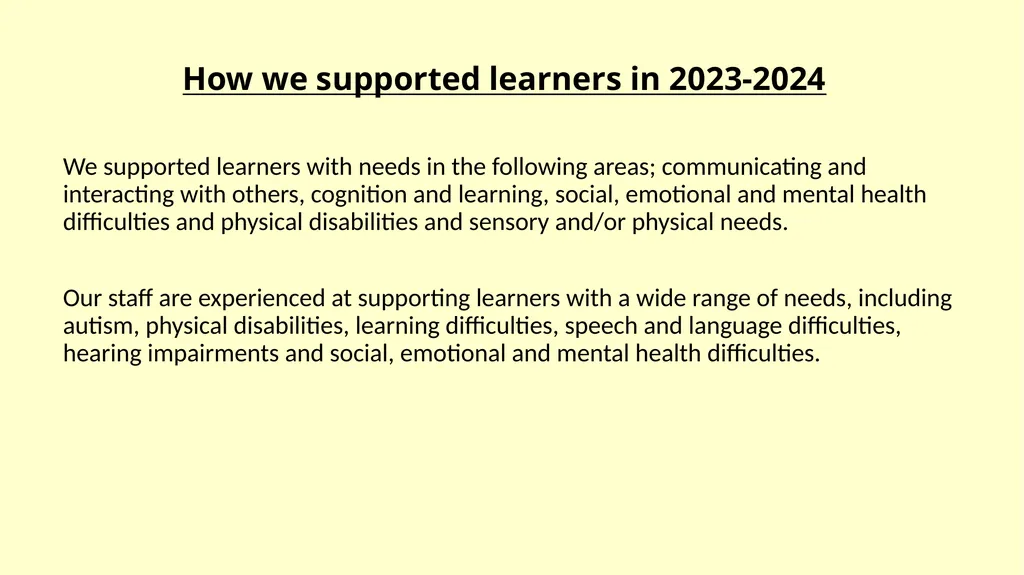
How we supported learners in 2023-2024 We supported learners with needs in the following areas; communicating and interacting with others, cognition and learning, social, emotional and mental health difficulties and physical disabilities and sensory and/or physical needs.
Our staff are experienced at supporting learners with a wide range of needs, including autism, physical disabilities, learning difficulties, speech and language difficulties, hearing impairments and social, emotional and mental health difficulties.<br>
Our staff are experienced at supporting learners with a wide range of needs, including autism, physical disabilities, learning difficulties, speech and language difficulties, hearing impairments and social, emotional and mental health difficulties.<br>
06
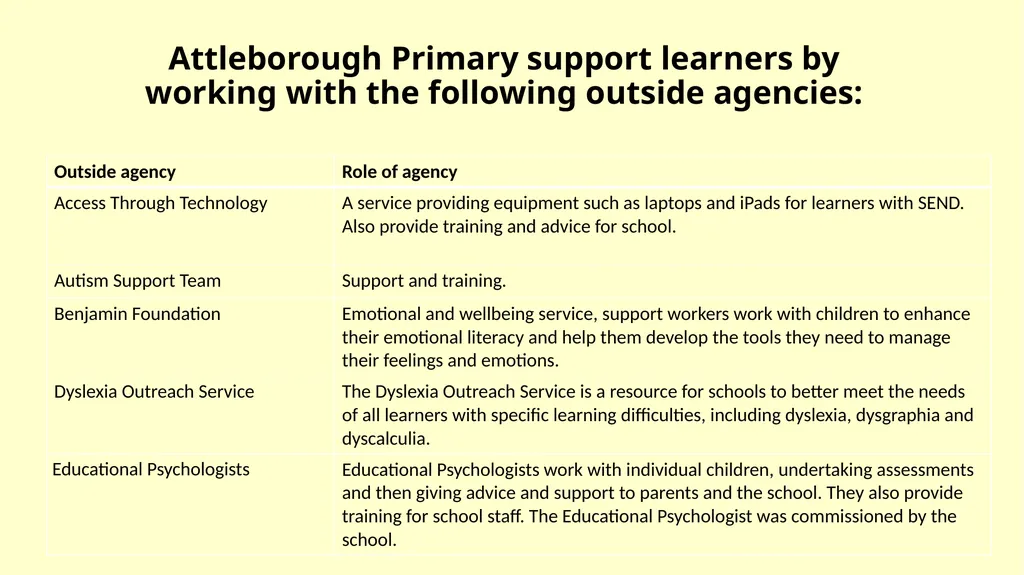
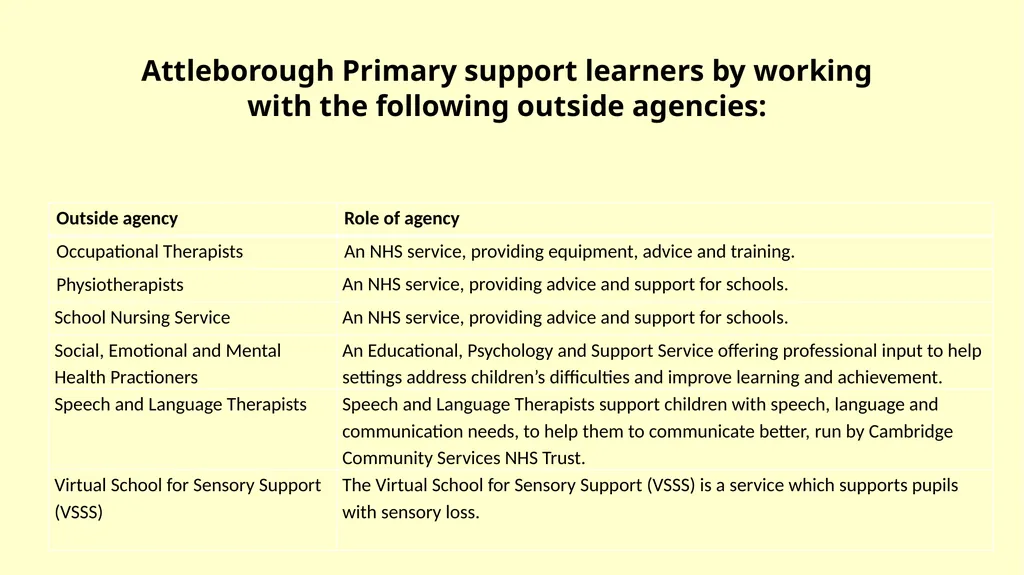
Attleborough Primary support learners by working with the following outside agencies:<br>
07
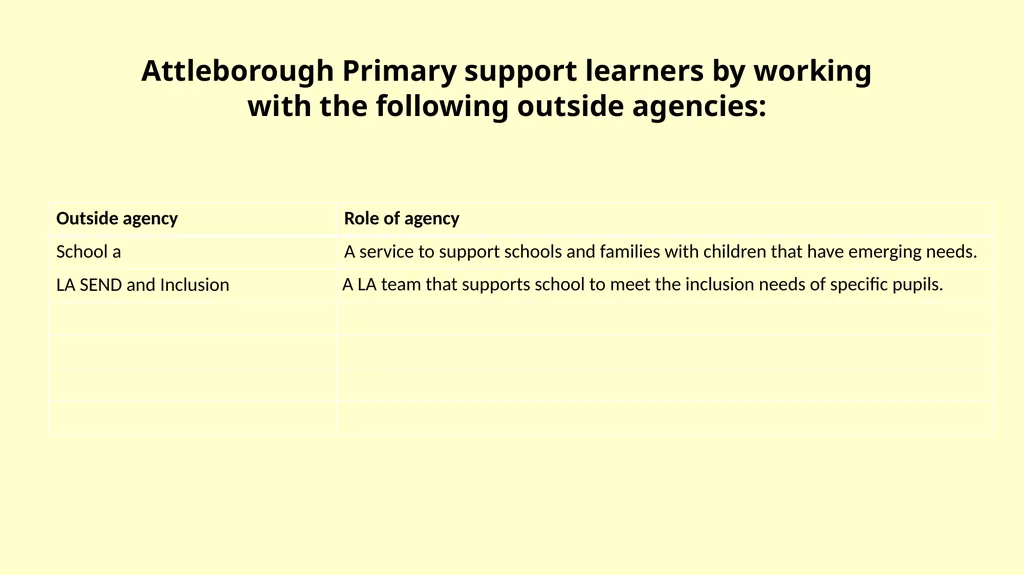
Attleborough Primary support learners by working with the following outside agencies:<br>
08
Attleborough Primary support learners by working with the following outside agencies:<br>
09
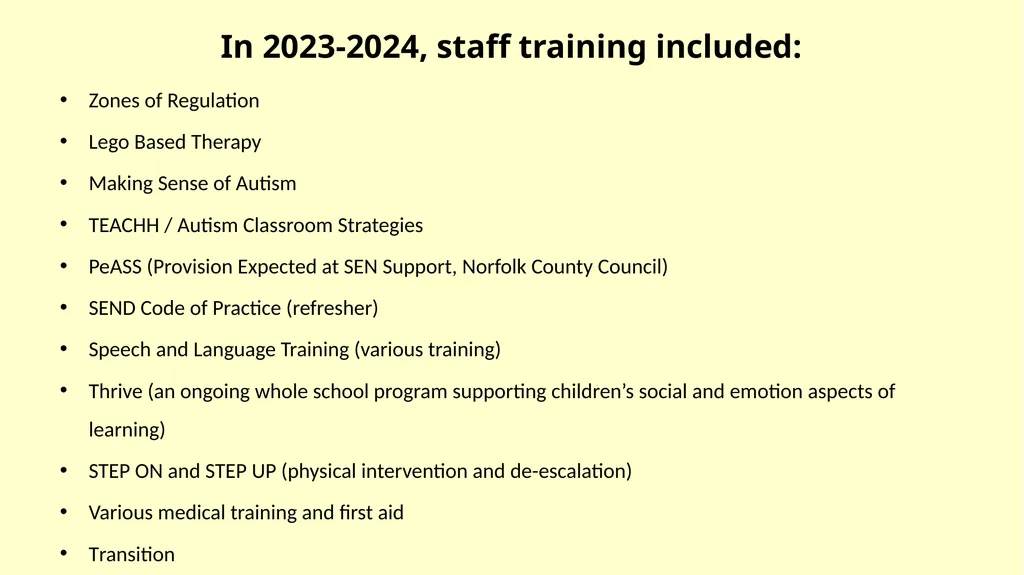
In 2023-2024, staff training included: Zones of Regulation
Lego Based Therapy
Making Sense of Autism
TEACHH / Autism Classroom Strategies
PeASS (Provision Expected at SEN Support, Norfolk County Council)
SEND Code of Practice (refresher)
Speech and Language Training (various training)
Thrive (an ongoing whole school program supporting children’s social and emotion aspects of learning)
STEP ON and STEP UP (physical intervention and de-escalation)
Various medical training and first aid
Transition<br>
Lego Based Therapy
Making Sense of Autism
TEACHH / Autism Classroom Strategies
PeASS (Provision Expected at SEN Support, Norfolk County Council)
SEND Code of Practice (refresher)
Speech and Language Training (various training)
Thrive (an ongoing whole school program supporting children’s social and emotion aspects of learning)
STEP ON and STEP UP (physical intervention and de-escalation)
Various medical training and first aid
Transition<br>
10
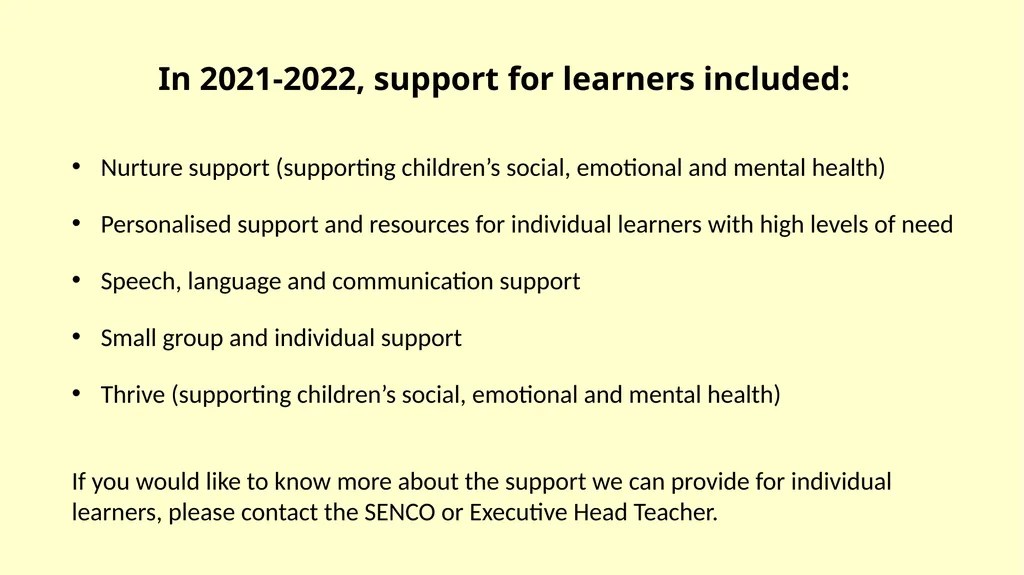
In 2021-2022, support for learners included: Nurture support (supporting children’s social, emotional and mental health)
Personalised support and resources for individual learners with high levels of need
Speech, language and communication support
Small group and individual support
Thrive (supporting children’s social, emotional and mental health) If you would like to know more about the support we can provide for individual learners, please contact the SENCO or Executive Head Teacher.<br>
Personalised support and resources for individual learners with high levels of need
Speech, language and communication support
Small group and individual support
Thrive (supporting children’s social, emotional and mental health) If you would like to know more about the support we can provide for individual learners, please contact the SENCO or Executive Head Teacher.<br>
11
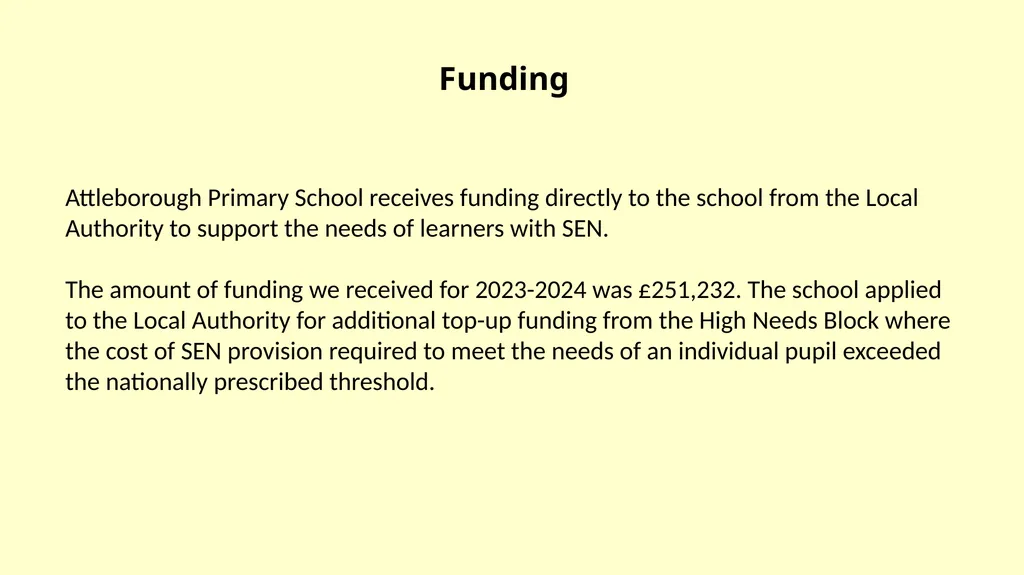
Funding Attleborough Primary School receives funding directly to the school from the Local Authority to support the needs of learners with SEN.
The amount of funding we received for 2023-2024 was £251,232. The school applied to the Local Authority for additional top-up funding from the High Needs Block where the cost of SEN provision required to meet the needs of an individual pupil exceeded the nationally prescribed threshold.<br>
The amount of funding we received for 2023-2024 was £251,232. The school applied to the Local Authority for additional top-up funding from the High Needs Block where the cost of SEN provision required to meet the needs of an individual pupil exceeded the nationally prescribed threshold.<br>
12
Including and Supporting Learners with SEN How we identify SEN
At different times in their school career, a child or young person may have a special education need. We aim to identify these needs as early as possible. We identify children with SEN as those who have difficulties with learning, which are significantly greater than other children of the same age or who have a disability which prevents or hinders them from making use of educational facilities of a kind generally provided for others of the same age.<br>
At different times in their school career, a child or young person may have a special education need. We aim to identify these needs as early as possible. We identify children with SEN as those who have difficulties with learning, which are significantly greater than other children of the same age or who have a disability which prevents or hinders them from making use of educational facilities of a kind generally provided for others of the same age.<br>
13
Including and Supporting Learners with SEN We define the areas of difficulty as those identified by the SEND Code of Practice:
• Communication and Interaction
• Cognition and Learning
• Social, emotional and mental health
• Sensory and/or Physical<br>
• Communication and Interaction
• Cognition and Learning
• Social, emotional and mental health
• Sensory and/or Physical<br>
14
Disabilities Some children may have a disability. These children may not necessarily have SEN, although there is a significant overlap between disabled children and those with SEN. The Equality Act 2010 defines disability as: “You are disabled under the Equality Act 2010 if you have a physical or mental impairment that has a ‘long-term’ negative effect on your ability to do normal daily activities.”<br>
15
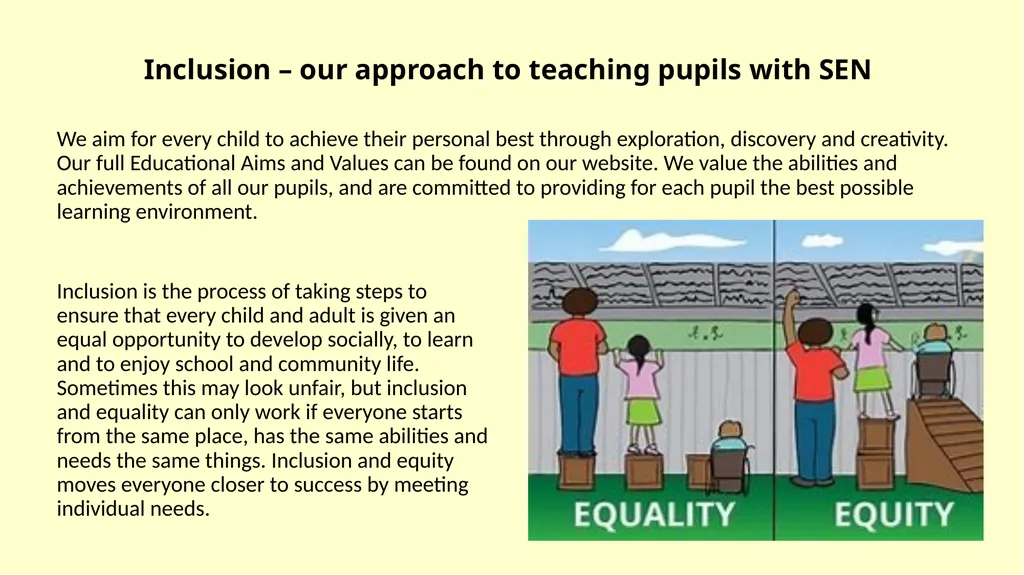
Inclusion – our approach to teaching pupils with SEN We aim for every child to achieve their personal best through exploration, discovery and creativity. Our full Educational Aims and Values can be found on our website. We value the abilities and achievements of all our pupils, and are committed to providing for each pupil the best possible learning environment. Inclusion is the process of taking steps to ensure that every child and adult is given an equal opportunity to develop socially, to learn and to enjoy school and community life. Sometimes this may look unfair, but inclusion and equality can only work if everyone starts from the same place, has the same abilities and needs the same things. Inclusion and equity moves everyone closer to success by meeting individual needs.<br>
16
Inclusion – our approach to teaching pupils with SEN We aim to create a learning environment which is flexible enough to ensure that every child fulfils their potential. We aim to achieve maximum inclusion for all our pupils whilst meeting pupils’ individual needs.
We do not tolerate discrimination towards anyone and have measures in place to prevent bullying of any kind.
Our anti-bullying and behaviour policies can be found on our website.<br>
We do not tolerate discrimination towards anyone and have measures in place to prevent bullying of any kind.
Our anti-bullying and behaviour policies can be found on our website.<br>
17
Parents When producing this report we consulted with a representative group of parents.
We asked these parents how our school supports children with SEN.
Parents told us ‘The school is very welcoming and are always willing to help or support with discussing any issues, be it personal or educational’.<br>
We asked these parents how our school supports children with SEN.
Parents told us ‘The school is very welcoming and are always willing to help or support with discussing any issues, be it personal or educational’.<br>
18
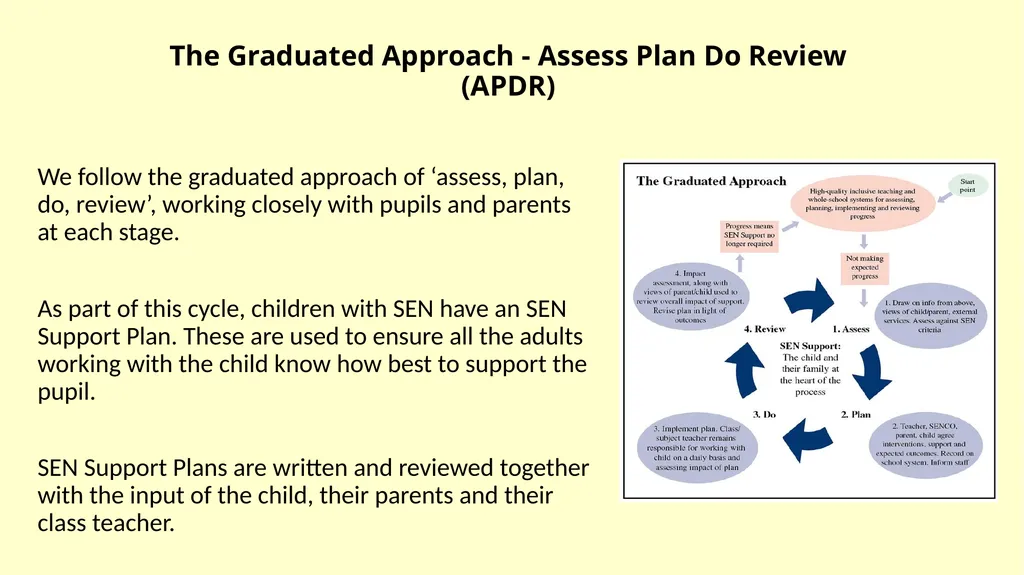
The Graduated Approach - Assess Plan Do Review (APDR) We follow the graduated approach of ‘assess, plan, do, review’, working closely with pupils and parents at each stage.
As part of this cycle, children with SEN have an SEN Support Plan. These are used to ensure all the adults working with the child know how best to support the pupil.
SEN Support Plans are written and reviewed together with the input of the child, their parents and their class teacher.<br>
As part of this cycle, children with SEN have an SEN Support Plan. These are used to ensure all the adults working with the child know how best to support the pupil.
SEN Support Plans are written and reviewed together with the input of the child, their parents and their class teacher.<br>
19
Assess We ensure that assessment of educational needs directly involves the learner, their parents/carer and the class teacher.
The SENCO is also available to provide support in identifying barriers to a pupil’s learning.
We have a range of assessment tools that we use within school; however, for some learners we may want to seek advice from specialist teams. These include Educational Psychologists, Speech and Language Therapists, Autism Specialists, Social, Emotional and Mental Health Practitioners, Specialist Teachers, Occupational Therapists and Physiotherapists.<br>
The SENCO is also available to provide support in identifying barriers to a pupil’s learning.
We have a range of assessment tools that we use within school; however, for some learners we may want to seek advice from specialist teams. These include Educational Psychologists, Speech and Language Therapists, Autism Specialists, Social, Emotional and Mental Health Practitioners, Specialist Teachers, Occupational Therapists and Physiotherapists.<br>
20
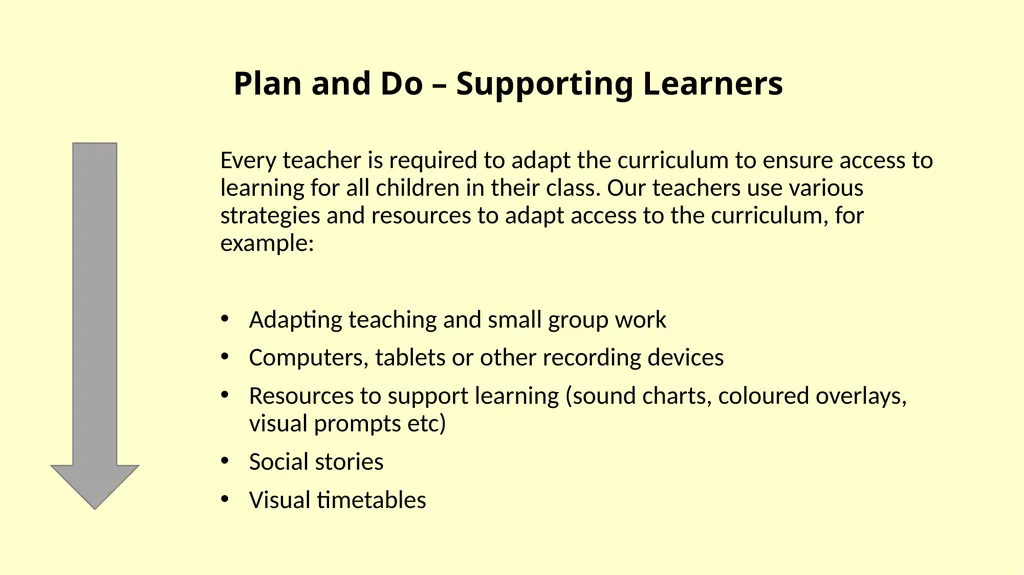
Plan and Do – Supporting Learners Every teacher is required to adapt the curriculum to ensure access to learning for all children in their class. Our teachers use various strategies and resources to adapt access to the curriculum, for example:
Adapting teaching and small group work
Computers, tablets or other recording devices
Resources to support learning (sound charts, coloured overlays, visual prompts etc)
Social stories
Visual timetables<br>
Adapting teaching and small group work
Computers, tablets or other recording devices
Resources to support learning (sound charts, coloured overlays, visual prompts etc)
Social stories
Visual timetables<br>
21
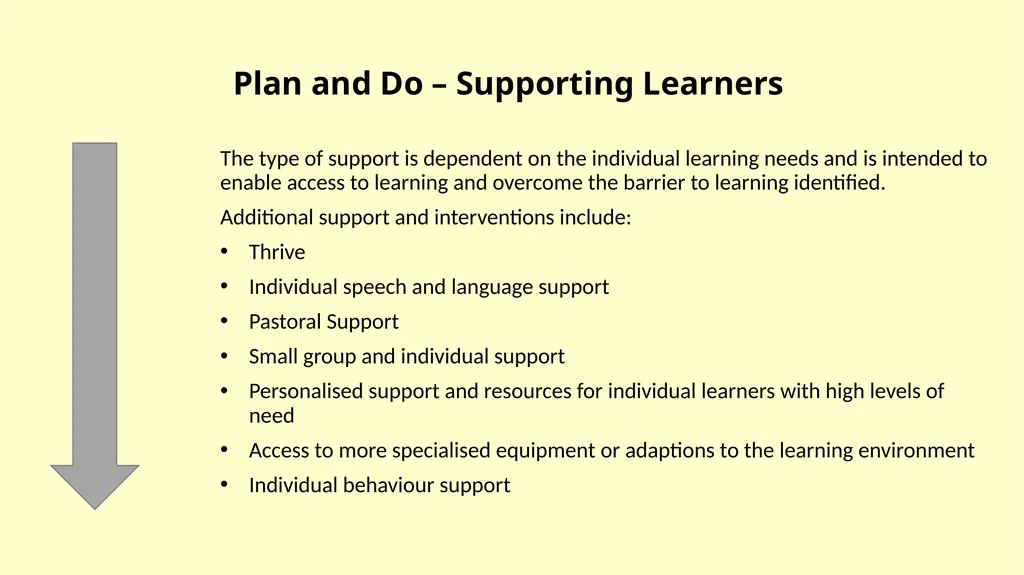
Plan and Do – Supporting Learners The type of support is dependent on the individual learning needs and is intended to enable access to learning and overcome the barrier to learning identified.
Additional support and interventions include:
Thrive
Individual speech and language support
Pastoral Support
Small group and individual support
Personalised support and resources for individual learners with high levels of need
Access to more specialised equipment or adaptions to the learning environment
Individual behaviour support<br>
Additional support and interventions include:
Thrive
Individual speech and language support
Pastoral Support
Small group and individual support
Personalised support and resources for individual learners with high levels of need
Access to more specialised equipment or adaptions to the learning environment
Individual behaviour support<br>
22
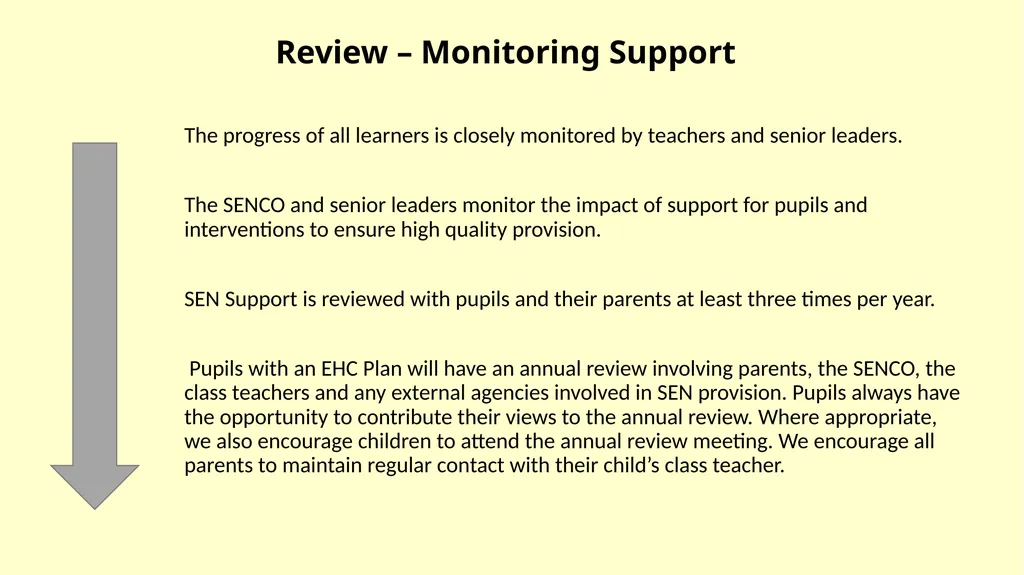
Review – Monitoring Support The progress of all learners is closely monitored by teachers and senior leaders.
The SENCO and senior leaders monitor the impact of support for pupils and interventions to ensure high quality provision.
SEN Support is reviewed with pupils and their parents at least three times per year.
Pupils with an EHC Plan will have an annual review involving parents, the SENCO, the class teachers and any external agencies involved in SEN provision. Pupils always have the opportunity to contribute their views to the annual review. Where appropriate, we also encourage children to attend the annual review meeting. We encourage all parents to maintain regular contact with their child’s class teacher.<br>
The SENCO and senior leaders monitor the impact of support for pupils and interventions to ensure high quality provision.
SEN Support is reviewed with pupils and their parents at least three times per year.
Pupils with an EHC Plan will have an annual review involving parents, the SENCO, the class teachers and any external agencies involved in SEN provision. Pupils always have the opportunity to contribute their views to the annual review. Where appropriate, we also encourage children to attend the annual review meeting. We encourage all parents to maintain regular contact with their child’s class teacher.<br>
23
Extra Curricular Activities We believe that all learners should have the same opportunity to access extra-curricular activities.
The activities currently available can be found on our website.<br>
The activities currently available can be found on our website.<br>
24
Transition Transition is a part of life for all learners. This can be transition to a new class in school, having a new teacher or moving to another school. Whenever any pupil transfers to another school, including special schools, Attleborough Primary School pass on all relevant information.
In addition, for pupils with SEN, there are further transition arrangements these may include including discussions with other schools and an enhanced transiton programme as needed.
If you are concerned about transition or transfer, please speak to class teachers or the SENCO to enquire about the additional measures we can put in place to ensure a smooth transition. This might include extra visits to a new school or producing a book with photos of your child’s new school / classroom and teachers.<br>
In addition, for pupils with SEN, there are further transition arrangements these may include including discussions with other schools and an enhanced transiton programme as needed.
If you are concerned about transition or transfer, please speak to class teachers or the SENCO to enquire about the additional measures we can put in place to ensure a smooth transition. This might include extra visits to a new school or producing a book with photos of your child’s new school / classroom and teachers.<br>
25
Concerns and Complaints There may be times during your child’s time in this school when you have a concern. You are always welcome to speak to the SENCO, Mrs Barker, or Acting Headteacher, Miss MilneLong. No worry is too small for us to take notice of.
Please ask at the school office or telephone the school (01953 453491) to make an appointment.
Should you need to make a complaint, our complaints policy is available on the school website.<br>
Please ask at the school office or telephone the school (01953 453491) to make an appointment.
Should you need to make a complaint, our complaints policy is available on the school website.<br>
26
Useful Links Our school website can be found at:
www.arpfederation.org.uk
Further useful links can also be found on the of our school website.
Information about the support available for all parents can be found on the Parents Page of our website.<br>
www.arpfederation.org.uk
Further useful links can also be found on the of our school website.
Information about the support available for all parents can be found on the Parents Page of our website.<br>
27
This report outlines what our school can offer for pupils with SEN. For information about how the Norfolk Local Authority can support children with SEN please visit the www.norfolk.gov.uk/children-and-families/send-local-offer
You can read more about how schools must and should support learners with SEN in the government document:
Special educational needs and disability code of practice : 0 to 25 years
www.gov.uk/government/publications/send-code-of-practice-0-to-25<br>
You can read more about how schools must and should support learners with SEN in the government document:
Special educational needs and disability code of practice : 0 to 25 years
www.gov.uk/government/publications/send-code-of-practice-0-to-25<br>
28
Contact Details Attleborough Primary School
Besthorpe Road
Attleborough
Norfolk
NR17 2NA
Telephone: 01953 453491
Email: office@attleborough-pri.norfolk.sch.uk
Website: www.arpfederation.org.uk<br>
Besthorpe Road
Attleborough
Norfolk
NR17 2NA
Telephone: 01953 453491
Email: office@attleborough-pri.norfolk.sch.uk
Website: www.arpfederation.org.uk<br>