
Series 3 Episode 11 What’s the Difference?



Description: Series 3 Episode 11 Whats the Difference? Practitioner Notes Episode Description In this episode we learn about finding the difference. One, Three and Five want to be like Seven. But how can they? They are different. They discover that
Related Topics
Download Presentation
"Series 3 Episode 11 What’s the Difference?" is the property of its rightful owner. Permission is granted to download and print the materials on this website for personal, non-commercial use only, and to display it on your personal computer provided you do not modify the materials and that you retain all copyright notices contained in the materials. By downloading content from our website, you accept the terms of this agreement.
Presentation Transcript
slide1. Series 3 Episode 11
What’s the Difference?<br>
slide2. Practitioner Notes<br>
slide3. Episode Description In this episode we learn about finding the difference. One, Three and Five want to be like Seven. But how can they? They are different. They discover that they need to find a friend to jump on their head to be like Seven. What happens when Seven, Eight and Five want to be like Two? What can they do? They discover that they need a friend to jump off them to make Two.<br>
slide4. Maths in the Episode Subtraction as difference
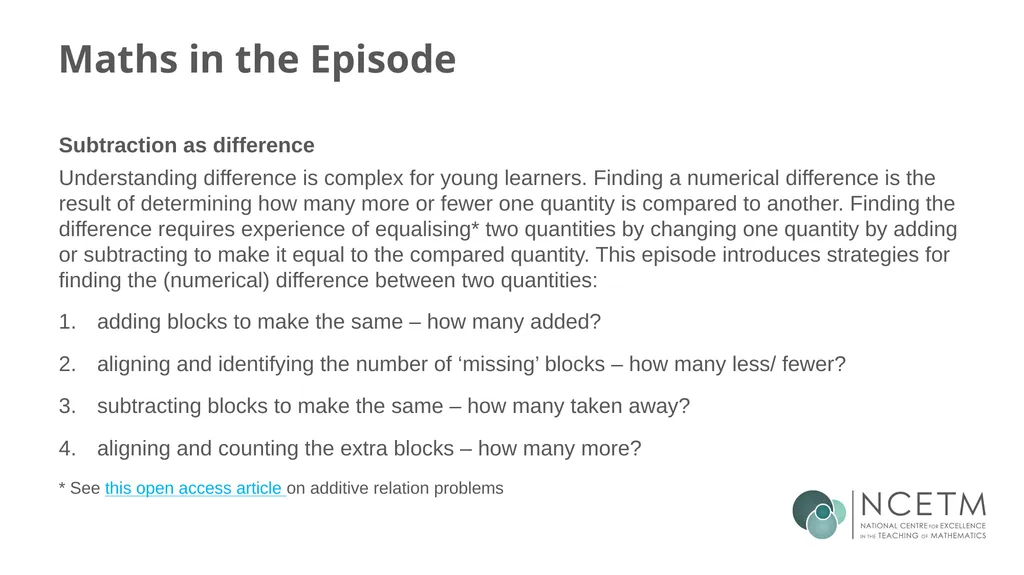
Understanding difference is complex for young learners. Finding a numerical difference is the result of determining how many more or fewer one quantity is compared to another. Finding the difference requires experience of equalising* two quantities by changing one quantity by adding or subtracting to make it equal to the compared quantity. This episode introduces strategies for finding the (numerical) difference between two quantities:
adding blocks to make the same – how many added?
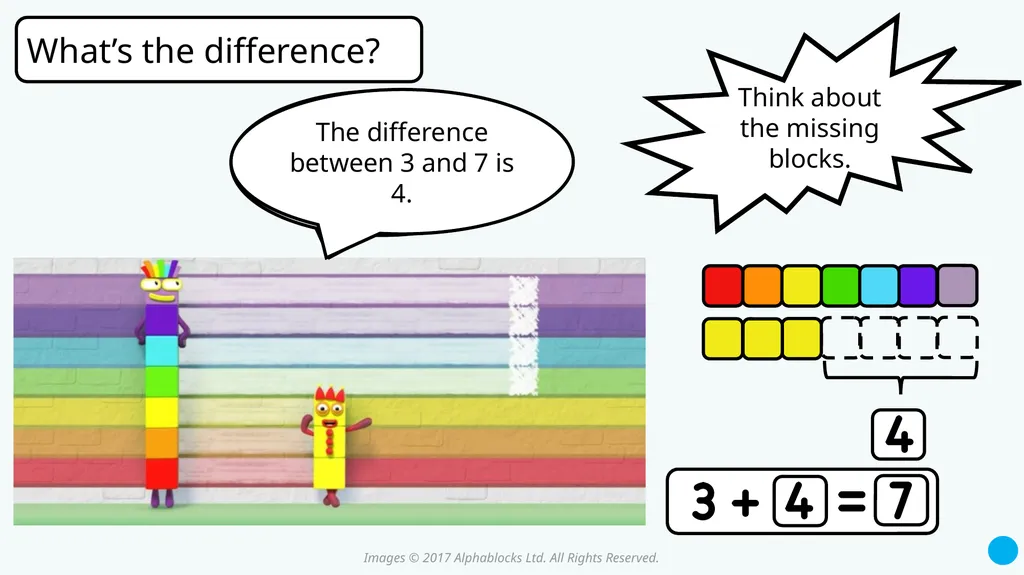
aligning and identifying the number of ‘missing’ blocks – how many less/ fewer?
subtracting blocks to make the same – how many taken away?
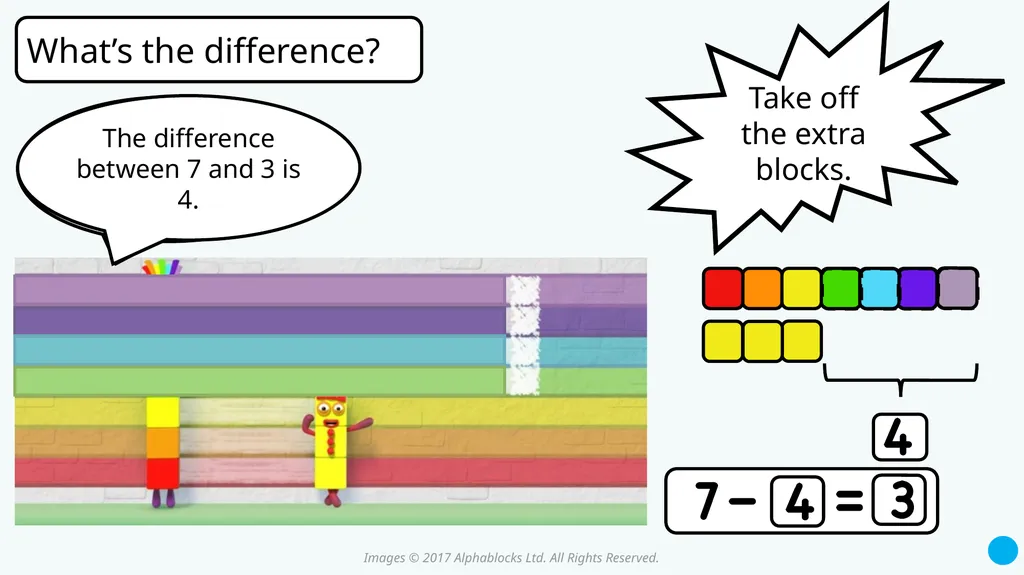
aligning and counting the extra blocks – how many more?
* See this open access article on additive relation problems<br>
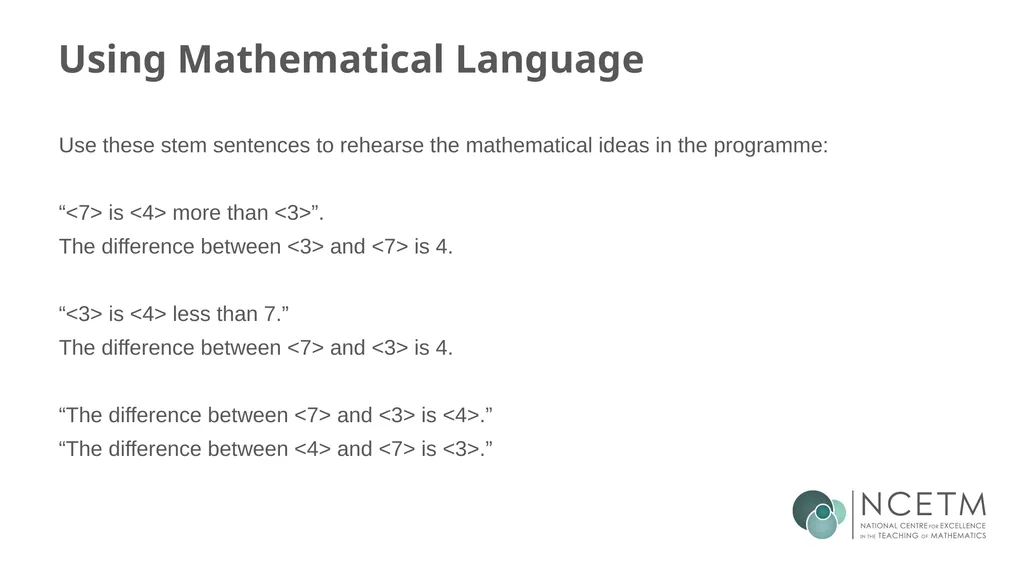
slide5. Using Mathematical Language Use these stem sentences to rehearse the mathematical ideas in the programme:
“<7> is <4> more than <3>”.
The difference between <3> and <7> is 4.
“<3> is <4> less than 7.”
The difference between <7> and <3> is 4.
“The difference between <7> and <3> is <4>.”
“The difference between <4> and <7> is <3>.”<br>
slide6. Talk and Discuss Together<br>
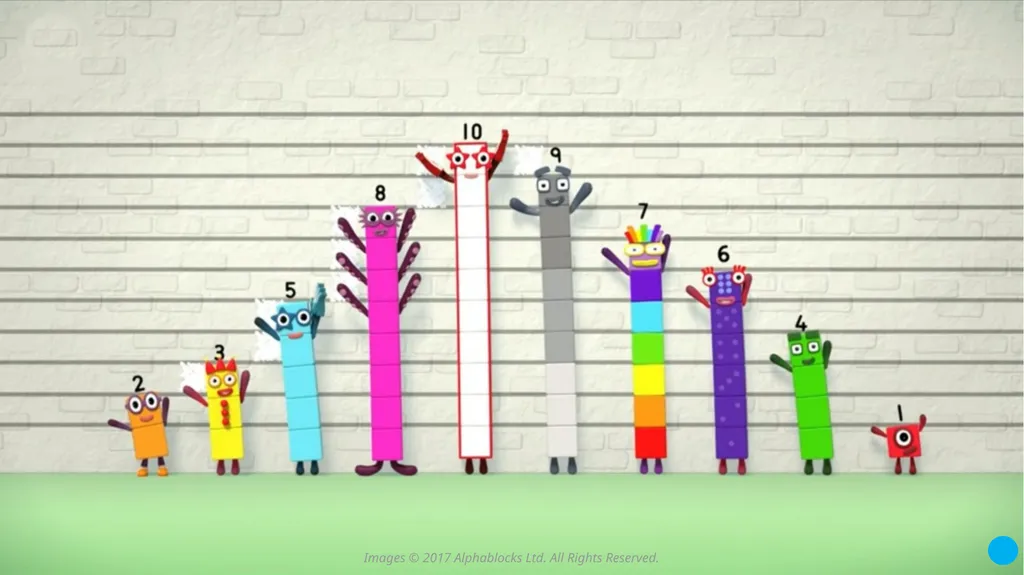
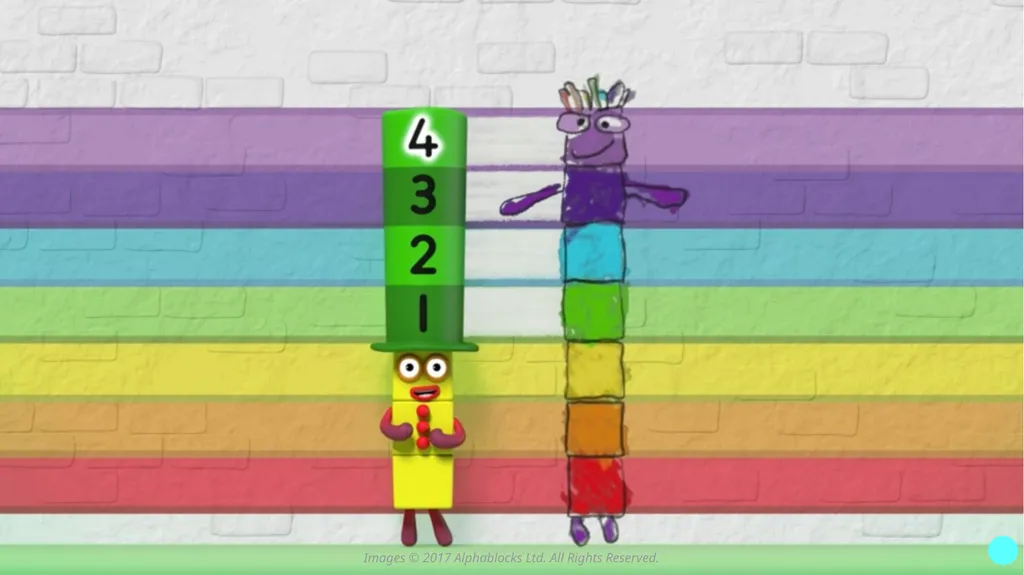
slide7. Talk and Discuss Together Watch the episode of Numberblocks. Use the following picture to stimulate discussion. How are you different from other people? We can compare ourselves in all sorts of ways, but the Numberblocks have a special way of comparing because they are made of blocks that we can count! How was One different from Seven?
The following slides are designed to stimulate children and adults to talk about the episode and draw out some key aspects of the mathematics.<br>
slide8. Images © 2017 Alphablocks Ltd. All Rights Reserved.<br>
slide9. Enabling Environments in Reception<br>
slide10. Enabling Environments Playing and Exploring
Provide opportunities for children to play with sets of objects which can be compared, for example, play ‘Who can win the most flies?’ Put out a set of plastic frogs and flies. Roll a dice, pick up that number of frogs, roll again for the flies, find out how many more flies there are by lining up the frogs and flies, the winner is the person who has the most ‘left-over’ flies.
Active Learning
In everyday routines there are many opportunities to compare small quantities and use the language of comparison - 6 children and only 2 pencils, how many more do we need? 4 children can play in the mud kitchen, there is only 1 child there, how many more can go and play?
Creating and Thinking Critically
Explore coloured rods (for example, Cuisenaire). Pick 2 rods and line them up vertically or horizontally, ensuring that the ends are placed side by side. Which is the longer rod? Which is the shorter rod? Find the rod to fill the gap. (See illustration on next slide.) See if children can find different pairs of rods which have the same (difference) rod.<br>
slide11. Rods placed horizontally with the ends at the same point Rods placed vertically with the ends at the same point<br>
slide12. Learning Together in Y1<br>
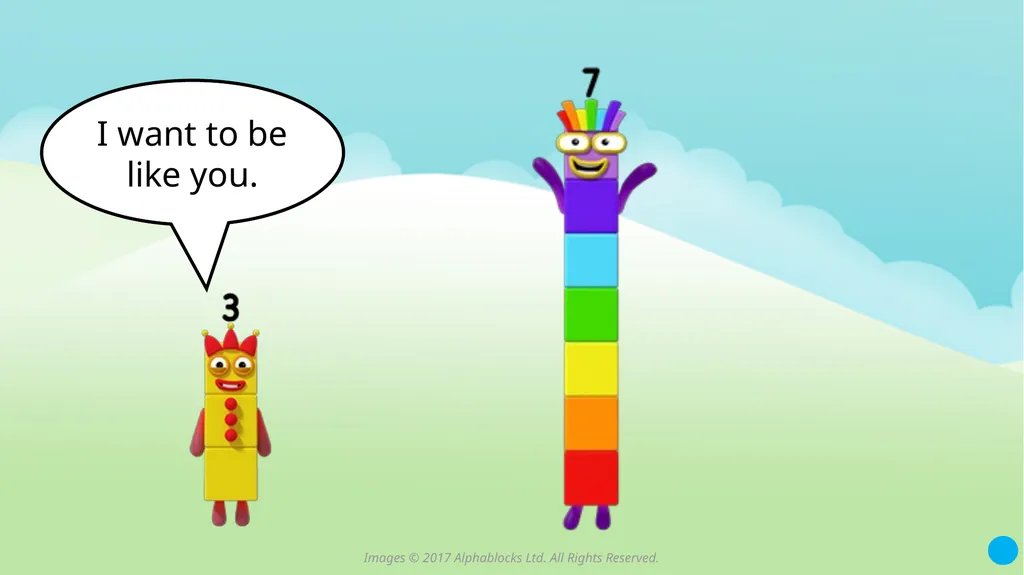
slide13. Images © 2017 Alphablocks Ltd. All Rights Reserved. I want to be like you.<br>
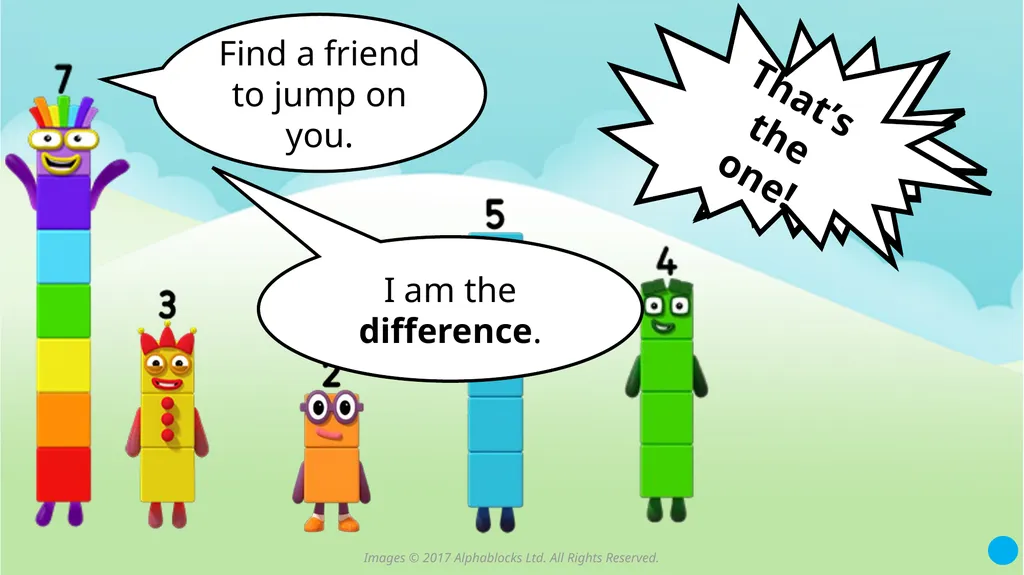
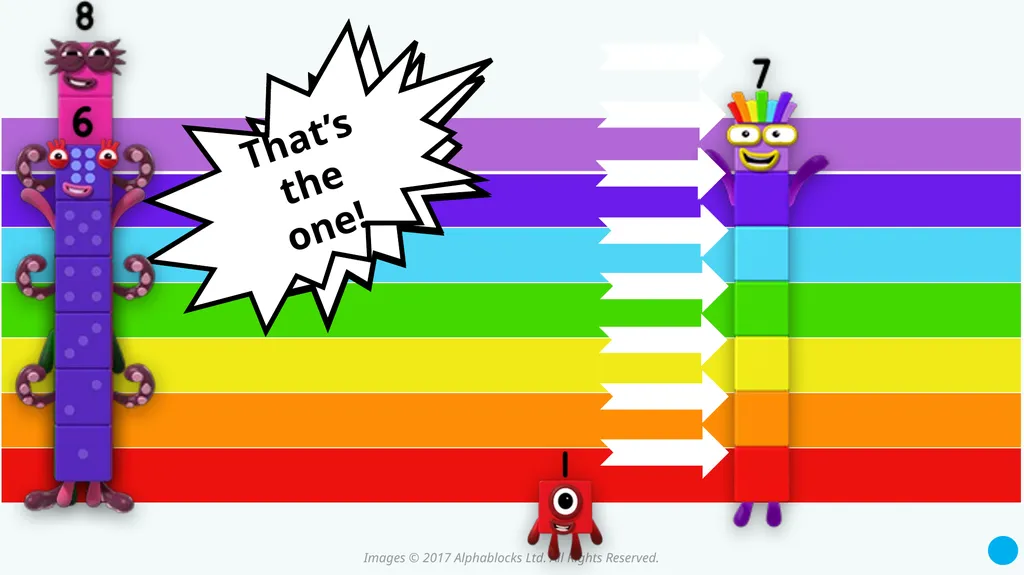
slide14. Too small! Too tall! That’s the one! Images © 2017 Alphablocks Ltd. All Rights Reserved. Find a friend to jump on you. I am the difference.<br>
slide15. Images © 2017 Alphablocks Ltd. All Rights Reserved.<br>
slide16. Too small! Too tall! That’s the one! Images © 2017 Alphablocks Ltd. All Rights Reserved.<br>
slide17. Further activities for Y1 Model in everyday life the concept of difference where a countable quantity is involved and can be compared. For example, There are 10 children but only 8 pencils, how many more do we need? There are 5 children and the cook has made 8 packed lunches, he made 3 too many!
Explore difference by taking off – that is, by making a larger Numberblock into a smaller Numberblock.
Represent the difference by aligning Numberblocks or quantities horizontally.
Represent “How many more are needed?” number stories using cubes or counters by making two lines of objects, ensuring one-to-one correspondence, to find how many are needed to make the quantities equal.
Represent “How many must be removed” number stories using cubes or counters.
Show the comparison of two quantities by saying how many more one quantity is than another, for example, 7 is 3 more than 4; 3 is 4 fewer than 7.<br>
slide18. Learning Together in Y2<br>
slide19. Images © 2017 Alphablocks Ltd. All Rights Reserved. What’s the difference? I want to be like you. Think about the missing blocks. The difference between 3 and 7 is 4.<br>
slide20. Images © 2017 Alphablocks Ltd. All Rights Reserved. What’s the difference? I want to be like you. Take off the extra blocks. The difference between 7 and 3 is 4.<br>
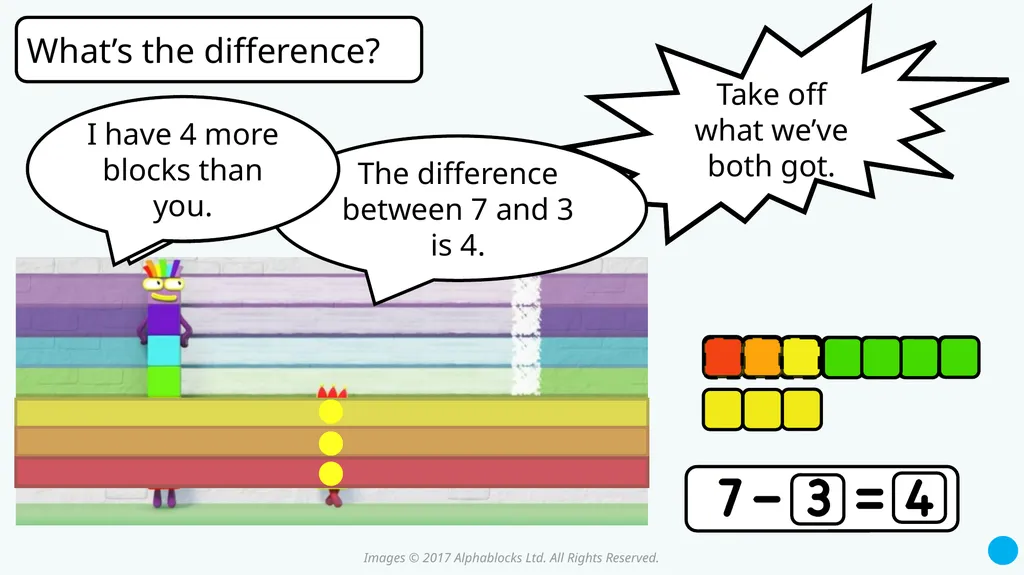
slide21. Images © 2017 Alphablocks Ltd. All Rights Reserved. How am I different from you? Take off what we’ve both got. The difference between 7 and 3 is 4. I have 4 more blocks than you. What’s the difference?<br>
slide22. Images © 2017 Alphablocks Ltd. All Rights Reserved. What’s the difference?<br>
slide23. Images © 2017 Alphablocks Ltd. All Rights Reserved. What’s the difference?<br>
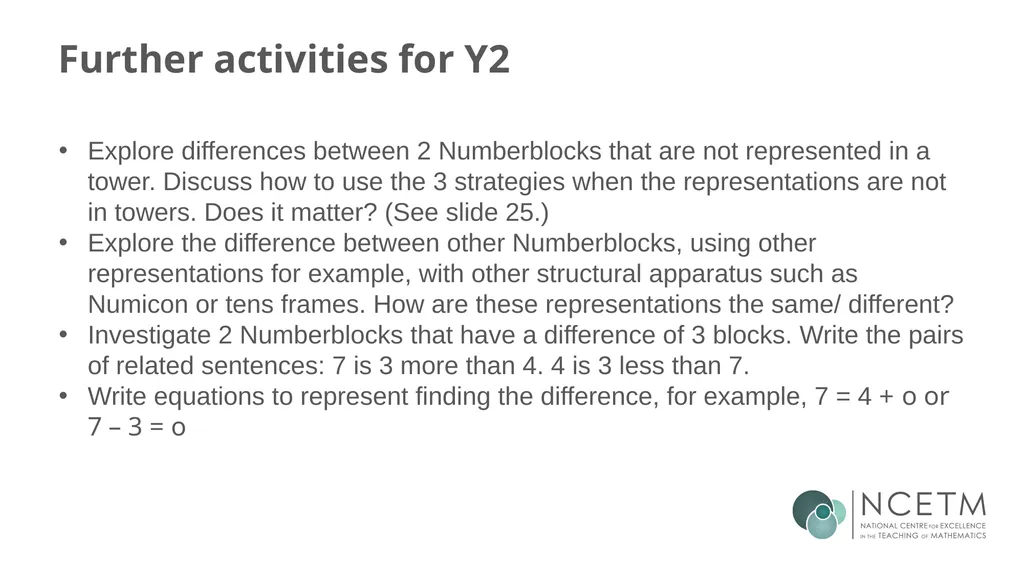
slide24. Further activities for Y2 Explore differences between 2 Numberblocks that are not represented in a tower. Discuss how to use the 3 strategies when the representations are not in towers. Does it matter? (See slide 25.)
Explore the difference between other Numberblocks, using other representations for example, with other structural apparatus such as Numicon or tens frames. How are these representations the same/ different?
Investigate 2 Numberblocks that have a difference of 3 blocks. Write the pairs of related sentences: 7 is 3 more than 4. 4 is 3 less than 7.
Write equations to represent finding the difference, for example, 7 = 4 + o or 7 – 3 = o<br>
slide25. What’s the difference? Images © 2017 Alphablocks Ltd. All Rights Reserved.<br>
What’s the Difference?<br>
slide2. Practitioner Notes<br>
slide3. Episode Description In this episode we learn about finding the difference. One, Three and Five want to be like Seven. But how can they? They are different. They discover that they need to find a friend to jump on their head to be like Seven. What happens when Seven, Eight and Five want to be like Two? What can they do? They discover that they need a friend to jump off them to make Two.<br>
slide4. Maths in the Episode Subtraction as difference
Understanding difference is complex for young learners. Finding a numerical difference is the result of determining how many more or fewer one quantity is compared to another. Finding the difference requires experience of equalising* two quantities by changing one quantity by adding or subtracting to make it equal to the compared quantity. This episode introduces strategies for finding the (numerical) difference between two quantities:
adding blocks to make the same – how many added?
aligning and identifying the number of ‘missing’ blocks – how many less/ fewer?
subtracting blocks to make the same – how many taken away?
aligning and counting the extra blocks – how many more?
* See this open access article on additive relation problems<br>
slide5. Using Mathematical Language Use these stem sentences to rehearse the mathematical ideas in the programme:
“<7> is <4> more than <3>”.
The difference between <3> and <7> is 4.
“<3> is <4> less than 7.”
The difference between <7> and <3> is 4.
“The difference between <7> and <3> is <4>.”
“The difference between <4> and <7> is <3>.”<br>
slide6. Talk and Discuss Together<br>
slide7. Talk and Discuss Together Watch the episode of Numberblocks. Use the following picture to stimulate discussion. How are you different from other people? We can compare ourselves in all sorts of ways, but the Numberblocks have a special way of comparing because they are made of blocks that we can count! How was One different from Seven?
The following slides are designed to stimulate children and adults to talk about the episode and draw out some key aspects of the mathematics.<br>
slide8. Images © 2017 Alphablocks Ltd. All Rights Reserved.<br>
slide9. Enabling Environments in Reception<br>
slide10. Enabling Environments Playing and Exploring
Provide opportunities for children to play with sets of objects which can be compared, for example, play ‘Who can win the most flies?’ Put out a set of plastic frogs and flies. Roll a dice, pick up that number of frogs, roll again for the flies, find out how many more flies there are by lining up the frogs and flies, the winner is the person who has the most ‘left-over’ flies.
Active Learning
In everyday routines there are many opportunities to compare small quantities and use the language of comparison - 6 children and only 2 pencils, how many more do we need? 4 children can play in the mud kitchen, there is only 1 child there, how many more can go and play?
Creating and Thinking Critically
Explore coloured rods (for example, Cuisenaire). Pick 2 rods and line them up vertically or horizontally, ensuring that the ends are placed side by side. Which is the longer rod? Which is the shorter rod? Find the rod to fill the gap. (See illustration on next slide.) See if children can find different pairs of rods which have the same (difference) rod.<br>
slide11. Rods placed horizontally with the ends at the same point Rods placed vertically with the ends at the same point<br>
slide12. Learning Together in Y1<br>
slide13. Images © 2017 Alphablocks Ltd. All Rights Reserved. I want to be like you.<br>
slide14. Too small! Too tall! That’s the one! Images © 2017 Alphablocks Ltd. All Rights Reserved. Find a friend to jump on you. I am the difference.<br>
slide15. Images © 2017 Alphablocks Ltd. All Rights Reserved.<br>
slide16. Too small! Too tall! That’s the one! Images © 2017 Alphablocks Ltd. All Rights Reserved.<br>
slide17. Further activities for Y1 Model in everyday life the concept of difference where a countable quantity is involved and can be compared. For example, There are 10 children but only 8 pencils, how many more do we need? There are 5 children and the cook has made 8 packed lunches, he made 3 too many!
Explore difference by taking off – that is, by making a larger Numberblock into a smaller Numberblock.
Represent the difference by aligning Numberblocks or quantities horizontally.
Represent “How many more are needed?” number stories using cubes or counters by making two lines of objects, ensuring one-to-one correspondence, to find how many are needed to make the quantities equal.
Represent “How many must be removed” number stories using cubes or counters.
Show the comparison of two quantities by saying how many more one quantity is than another, for example, 7 is 3 more than 4; 3 is 4 fewer than 7.<br>
slide18. Learning Together in Y2<br>
slide19. Images © 2017 Alphablocks Ltd. All Rights Reserved. What’s the difference? I want to be like you. Think about the missing blocks. The difference between 3 and 7 is 4.<br>
slide20. Images © 2017 Alphablocks Ltd. All Rights Reserved. What’s the difference? I want to be like you. Take off the extra blocks. The difference between 7 and 3 is 4.<br>
slide21. Images © 2017 Alphablocks Ltd. All Rights Reserved. How am I different from you? Take off what we’ve both got. The difference between 7 and 3 is 4. I have 4 more blocks than you. What’s the difference?<br>
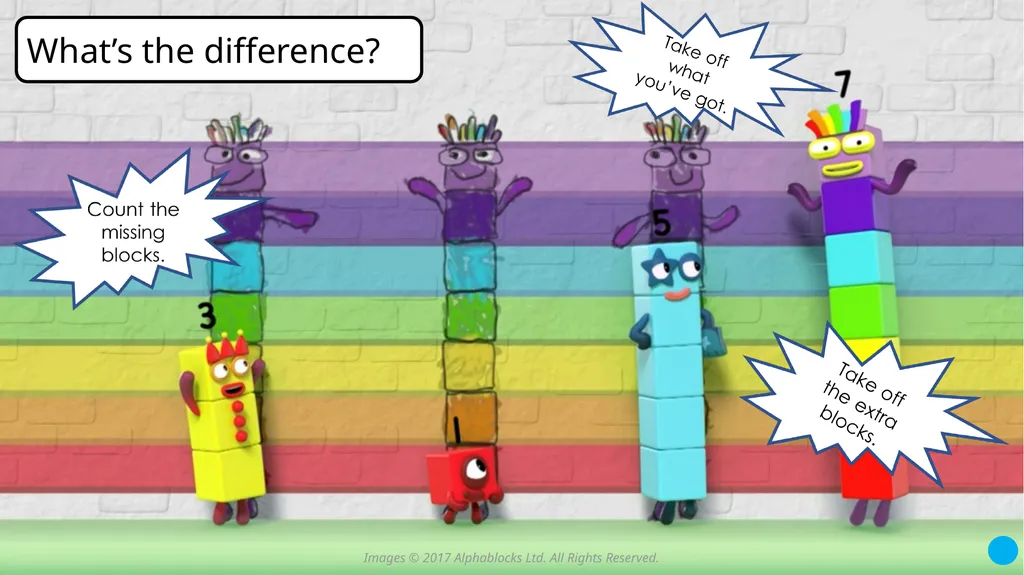
slide22. Images © 2017 Alphablocks Ltd. All Rights Reserved. What’s the difference?<br>
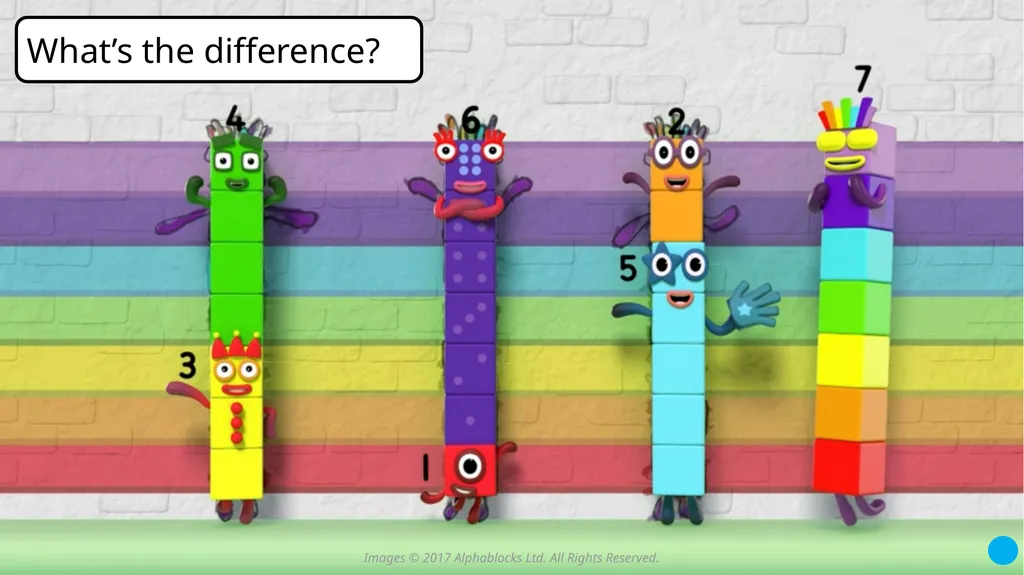
slide23. Images © 2017 Alphablocks Ltd. All Rights Reserved. What’s the difference?<br>
slide24. Further activities for Y2 Explore differences between 2 Numberblocks that are not represented in a tower. Discuss how to use the 3 strategies when the representations are not in towers. Does it matter? (See slide 25.)
Explore the difference between other Numberblocks, using other representations for example, with other structural apparatus such as Numicon or tens frames. How are these representations the same/ different?
Investigate 2 Numberblocks that have a difference of 3 blocks. Write the pairs of related sentences: 7 is 3 more than 4. 4 is 3 less than 7.
Write equations to represent finding the difference, for example, 7 = 4 + o or 7 – 3 = o<br>
slide25. What’s the difference? Images © 2017 Alphablocks Ltd. All Rights Reserved.<br>