
SESSION 7 · CONSUMER BEHAVIOR STUDIES Family and
YM
Published · 28 slides · 0 views
1 / 1

Description
SESSION 7 CONSUMER BEHAVIOR STUDIES Family and Household How families shape consumer purchase decisions November 2025 Family The environment closest to the consumer. The setting where most consumers live and interact with other family
Related Topics
Share
Embed code
Download this presentation From Below
"SESSION 7 · CONSUMER BEHAVIOR STUDIES Family and" is the property of its rightful owner. Permission is granted to download and print the materials on this website for personal, non-commercial use only, and to display it on your personal computer provided you do not modify the materials and that you retain all copyright notices contained in the materials. By downloading content from our website, you accept the terms of this agreement.
Presentation Transcript
01
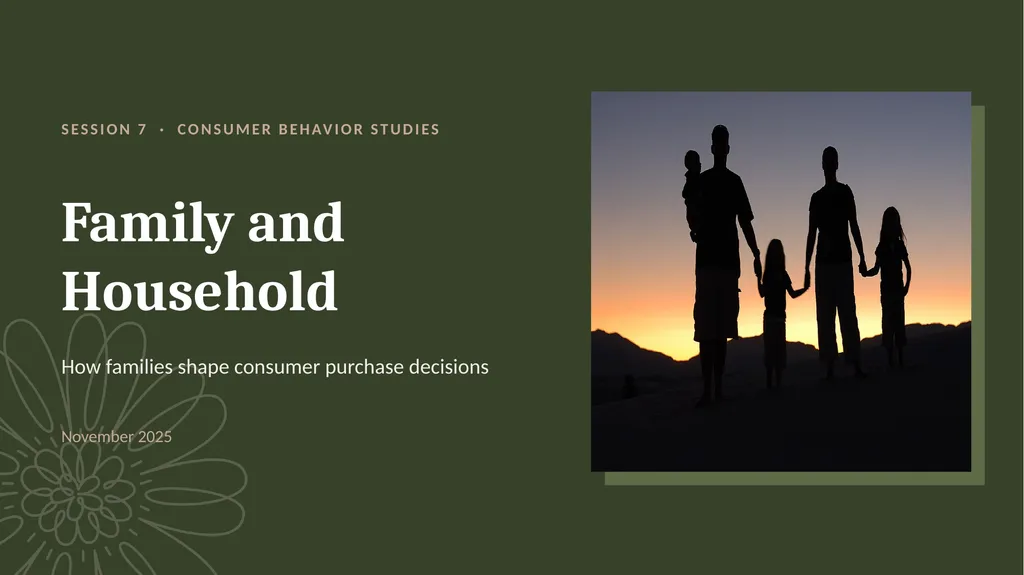
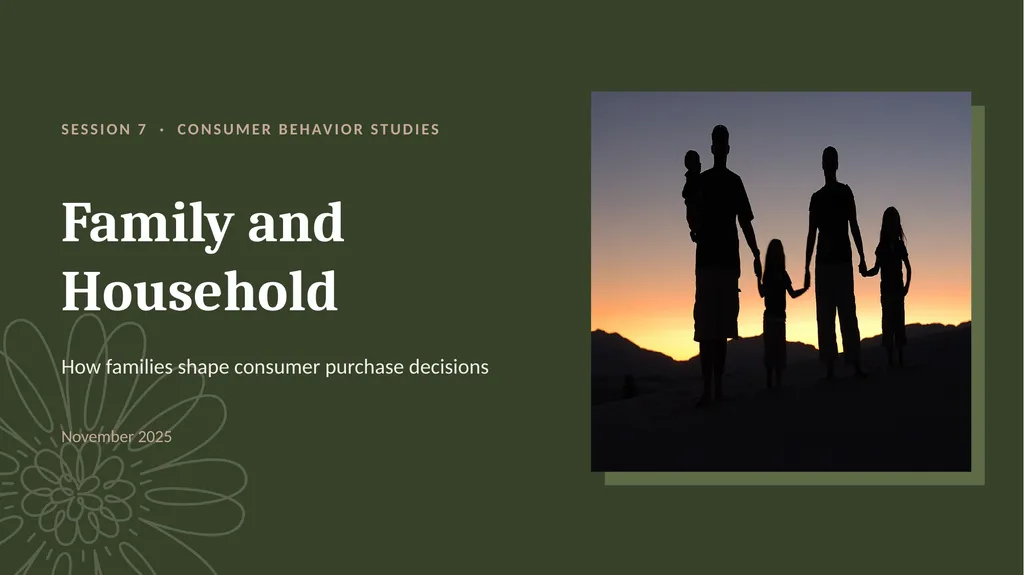
SESSION 7 · CONSUMER BEHAVIOR STUDIES Family and Household How families shape consumer purchase decisions November 2025<br>
02
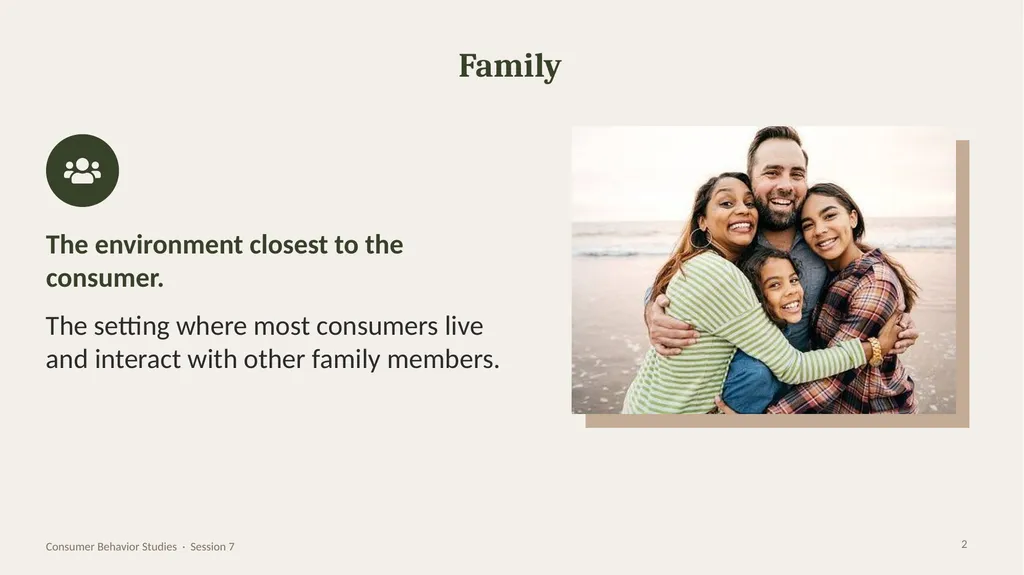
Family The environment closest to the consumer.
The setting where most consumers live and interact with other family members. 2<br>
The setting where most consumers live and interact with other family members. 2<br>
03
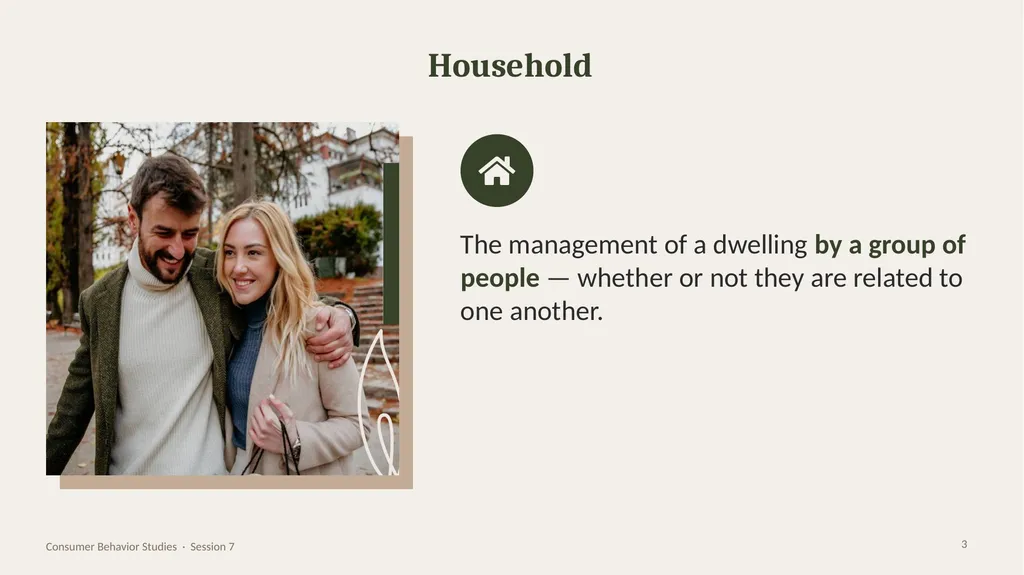
Household The management of a dwelling by a group of people — whether or not they are related to one another. 3<br>
04
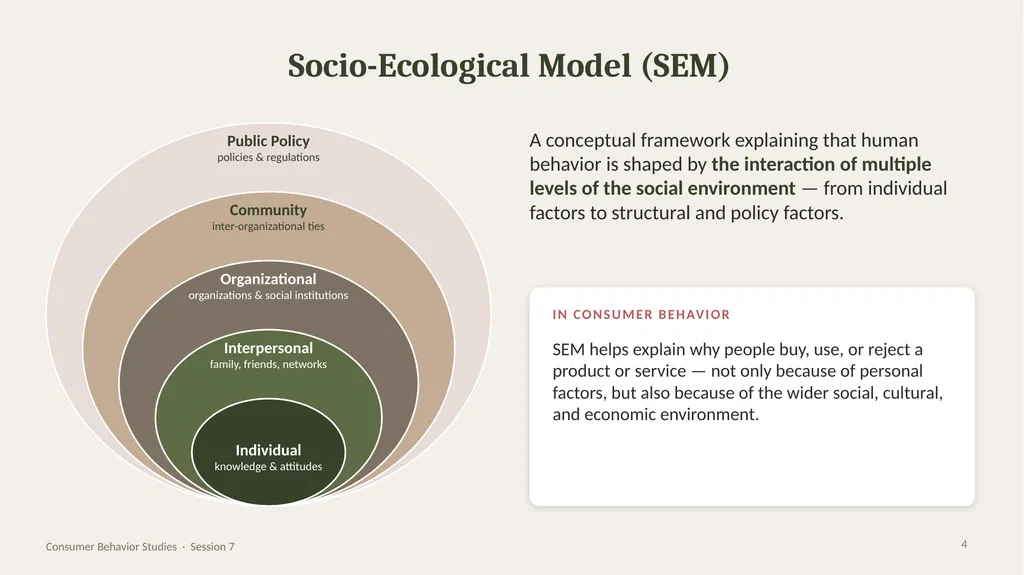
Socio-Ecological Model (SEM) Public Policy
policies & regulations Community
inter-organizational ties Organizational
organizations & social institutions Interpersonal
family, friends, networks Individual
knowledge & attitudes A conceptual framework explaining that human behavior is shaped by the interaction of multiple levels of the social environment — from individual factors to structural and policy factors. IN CONSUMER BEHAVIOR SEM helps explain why people buy, use, or reject a product or service — not only because of personal factors, but also because of the wider social, cultural, and economic environment. 4<br>
05
Why study the family from a consumer behavior perspective?<br>
06
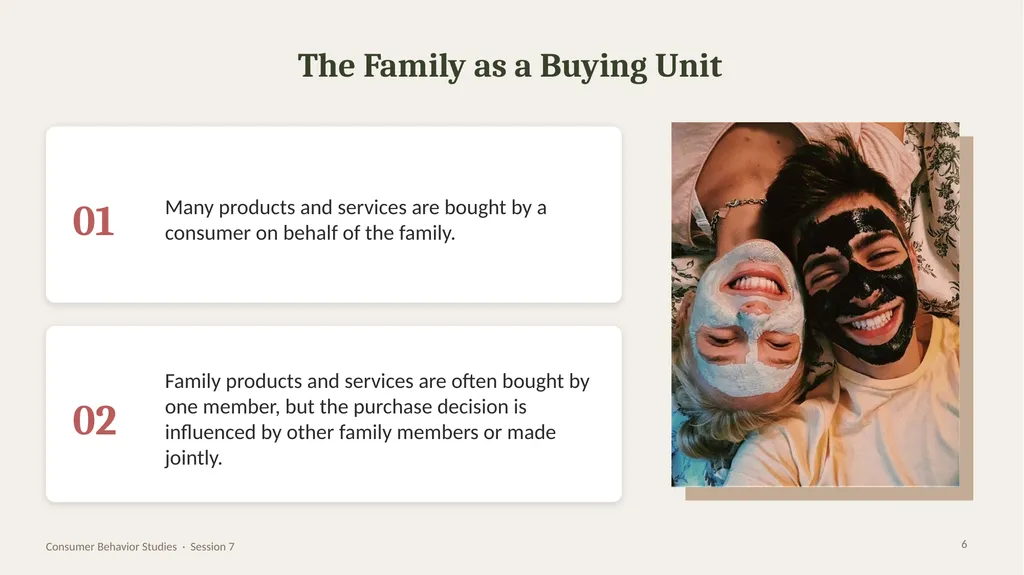
The Family as a Buying Unit 01 Many products and services are bought by a consumer on behalf of the family. 02 Family products and services are often bought by one member, but the purchase decision is influenced by other family members or made jointly. 6<br>
07
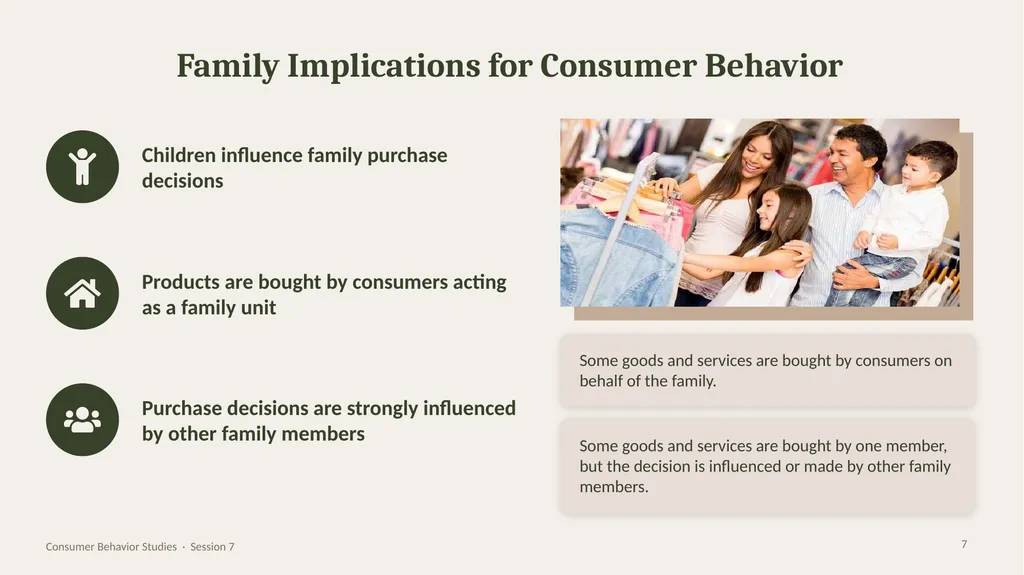
Family Implications for Consumer Behavior Children influence family purchase decisions Products are bought by consumers acting as a family unit Purchase decisions are strongly influenced by other family members Some goods and services are bought by consumers on behalf of the family. Some goods and services are bought by one member, but the decision is influenced or made by other family members. 7<br>
08
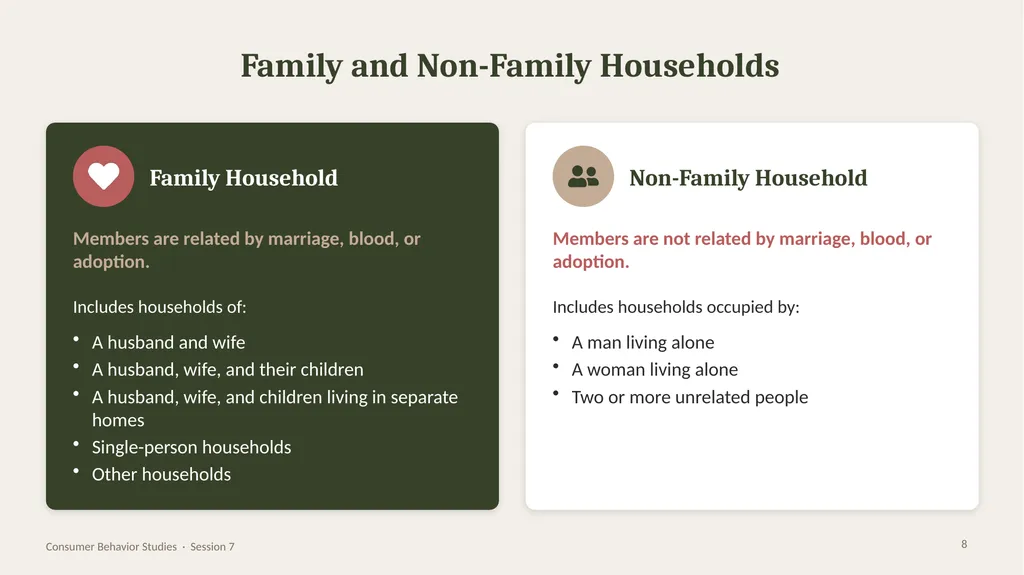
Family and Non-Family Households Family Household Members are related by marriage, blood, or adoption. Includes households of: A husband and wife
A husband, wife, and their children
A husband, wife, and children living in separate homes
Single-person households
Other households Non-Family Household Members are not related by marriage, blood, or adoption. Includes households occupied by: A man living alone
A woman living alone
Two or more unrelated people 8<br>
09
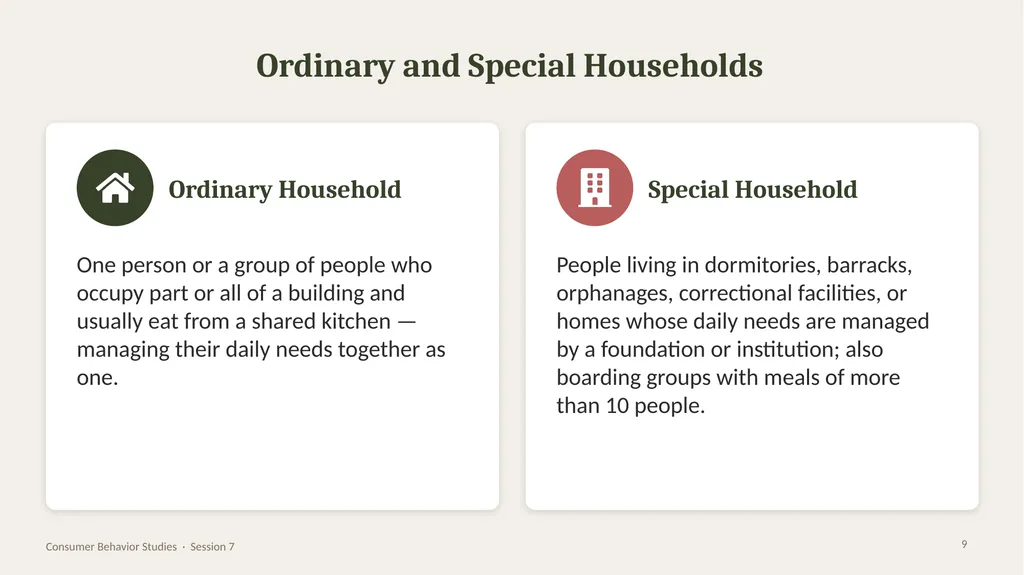
Ordinary and Special Households Ordinary Household One person or a group of people who occupy part or all of a building and usually eat from a shared kitchen — managing their daily needs together as one. Special Household People living in dormitories, barracks, orphanages, correctional facilities, or homes whose daily needs are managed by a foundation or institution; also boarding groups with meals of more than 10 people. 9<br>
10
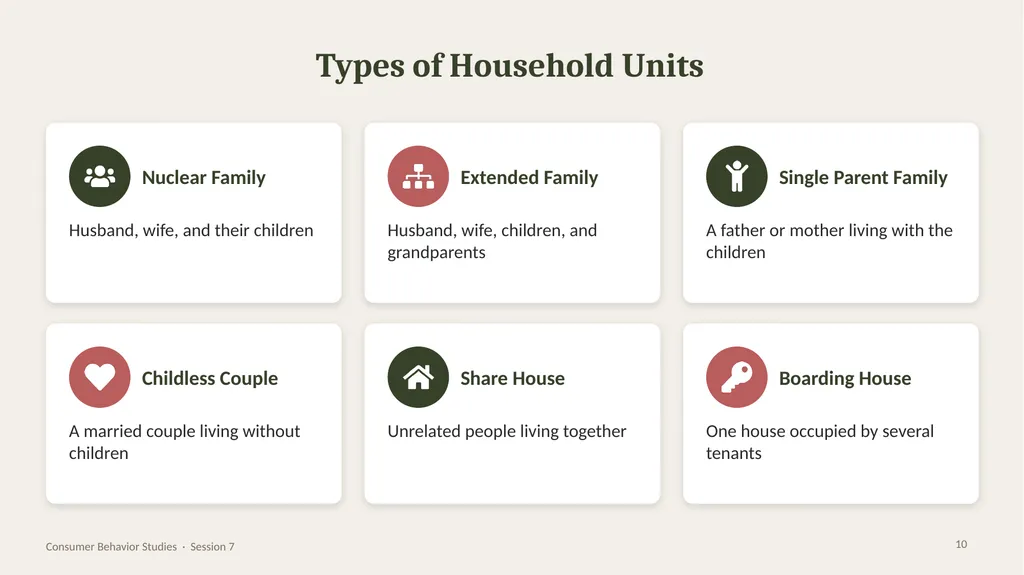
Types of Household Units Nuclear Family Husband, wife, and their children Extended Family Husband, wife, children, and grandparents Single Parent Family A father or mother living with the children Childless Couple A married couple living without children Share House Unrelated people living together Boarding House One house occupied by several tenants 10<br>
11
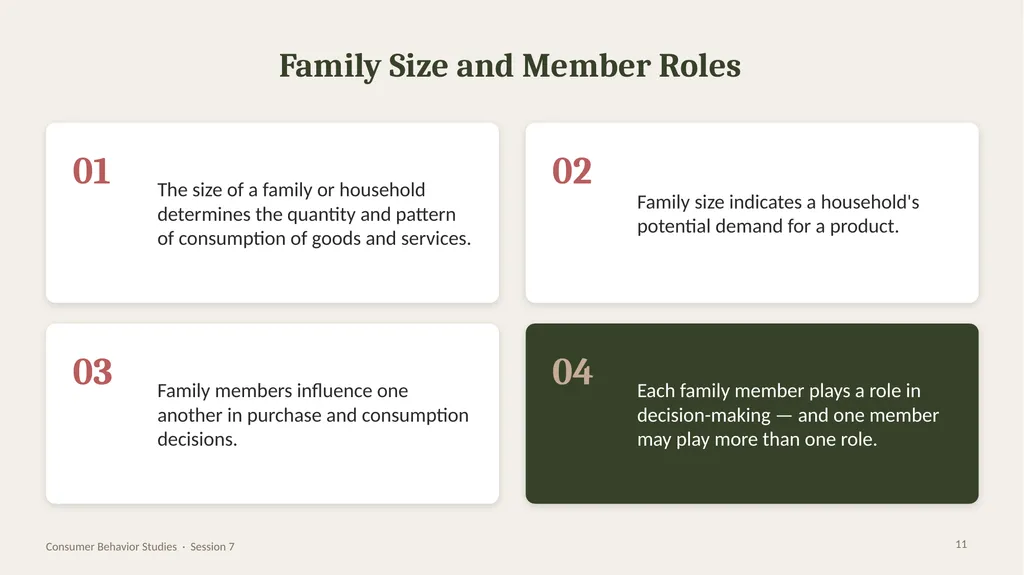
Family Size and Member Roles 01 The size of a family or household determines the quantity and pattern of consumption of goods and services. 02 Family size indicates a household's potential demand for a product. 03 Family members influence one another in purchase and consumption decisions. 04 Each family member plays a role in decision-making — and one member may play more than one role. 11<br>
12
Family Member Roles in Decision-Making<br>
13
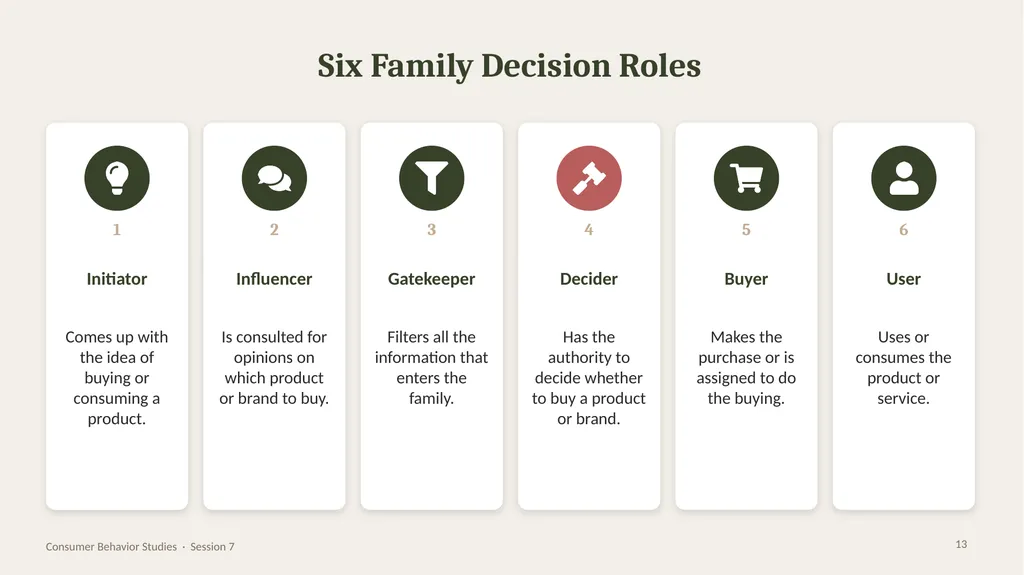
Six Family Decision Roles 1 Initiator Comes up with the idea of buying or consuming a product. 2 Influencer Is consulted for opinions on which product or brand to buy. 3 Gatekeeper Filters all the information that enters the family. 4 Decider Has the authority to decide whether to buy a product or brand. 5 Buyer Makes the purchase or is assigned to do the buying. 6 User Uses or consumes the product or service. 13<br>
14
Decision-Making in the Family Engel et al. (1995)<br>
15
Wife- or Husband-Dominant Decisions Wife-Dominant The wife has the authority to decide which products and brands are bought for herself and for the rest of the family. Husband-Dominant The husband has the authority to decide which products and brands are bought for himself and for the rest of the family. 15<br>
16
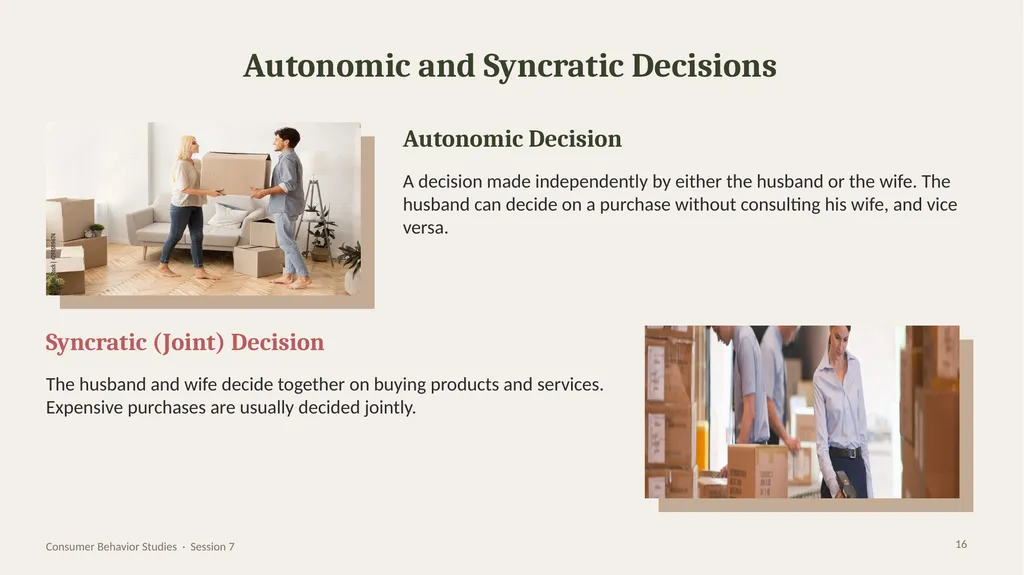
Autonomic and Syncratic Decisions Autonomic Decision A decision made independently by either the husband or the wife. The husband can decide on a purchase without consulting his wife, and vice versa. Syncratic (Joint) Decision The husband and wife decide together on buying products and services. Expensive purchases are usually decided jointly. 16<br>
17
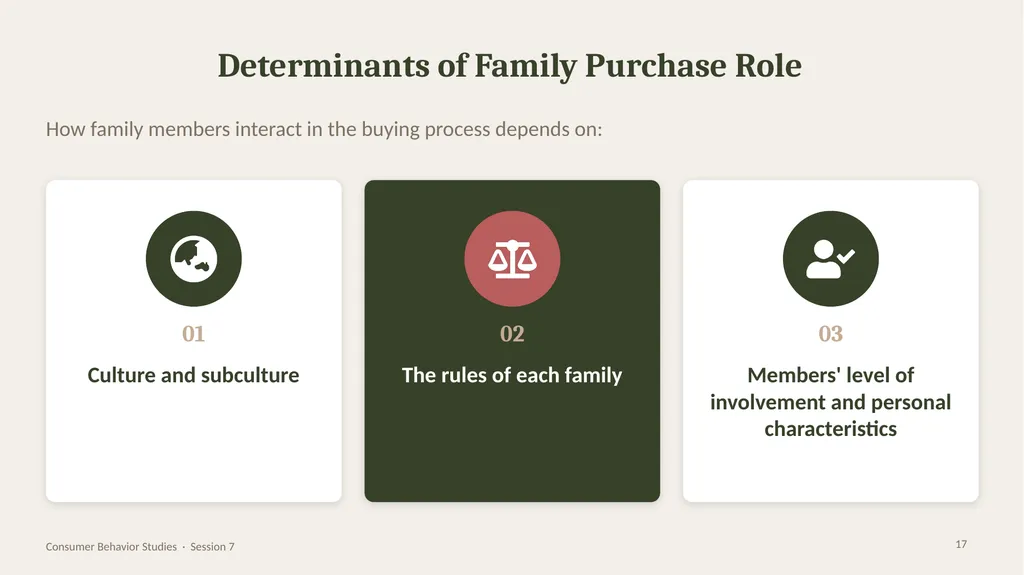
Determinants of Family Purchase Role How family members interact in the buying process depends on: 01 Culture and subculture 02 The rules of each family 03 Members' level of involvement and personal characteristics 17<br>
18
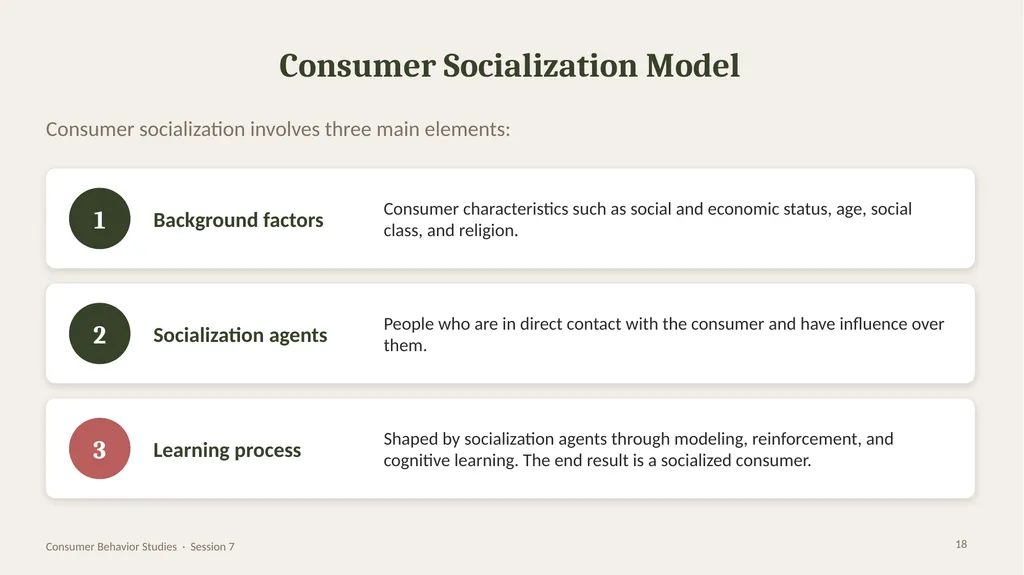
Consumer Socialization Model Consumer socialization involves three main elements: 1 Background factors Consumer characteristics such as social and economic status, age, social class, and religion. 2 Socialization agents People who are in direct contact with the consumer and have influence over them. 3 Learning process Shaped by socialization agents through modeling, reinforcement, and cognitive learning. The end result is a socialized consumer. 18<br>
19
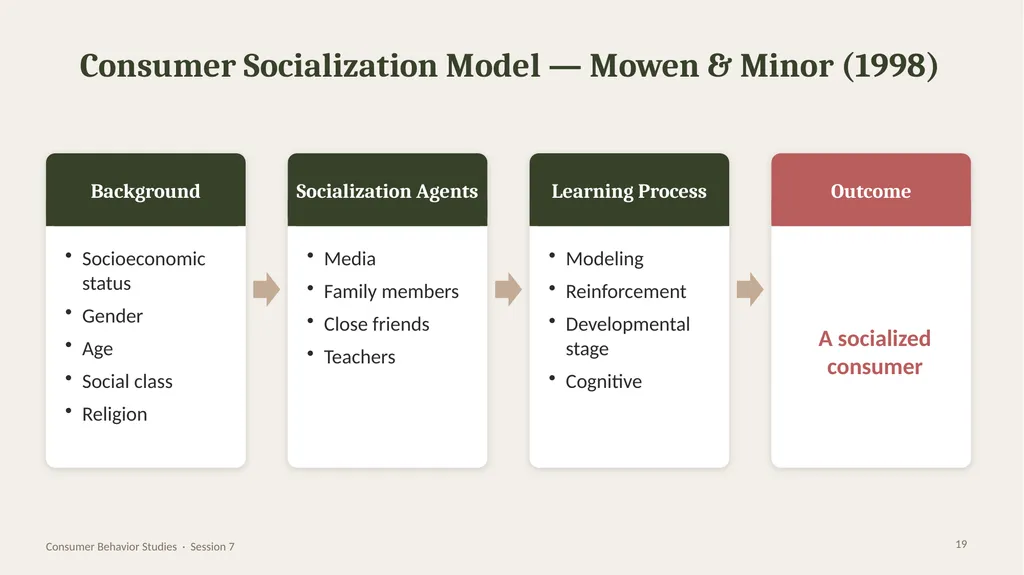
Consumer Socialization Model — Mowen & Minor (1998) Background Socioeconomic status
Gender
Age
Social class
Religion Socialization Agents Media
Family members
Close friends
Teachers Learning Process Modeling
Reinforcement
Developmental stage
Cognitive Outcome A socialized consumer 19<br>
Gender
Age
Social class
Religion Socialization Agents Media
Family members
Close friends
Teachers Learning Process Modeling
Reinforcement
Developmental stage
Cognitive Outcome A socialized consumer 19<br>
20
The Family Socialization Process<br>
21
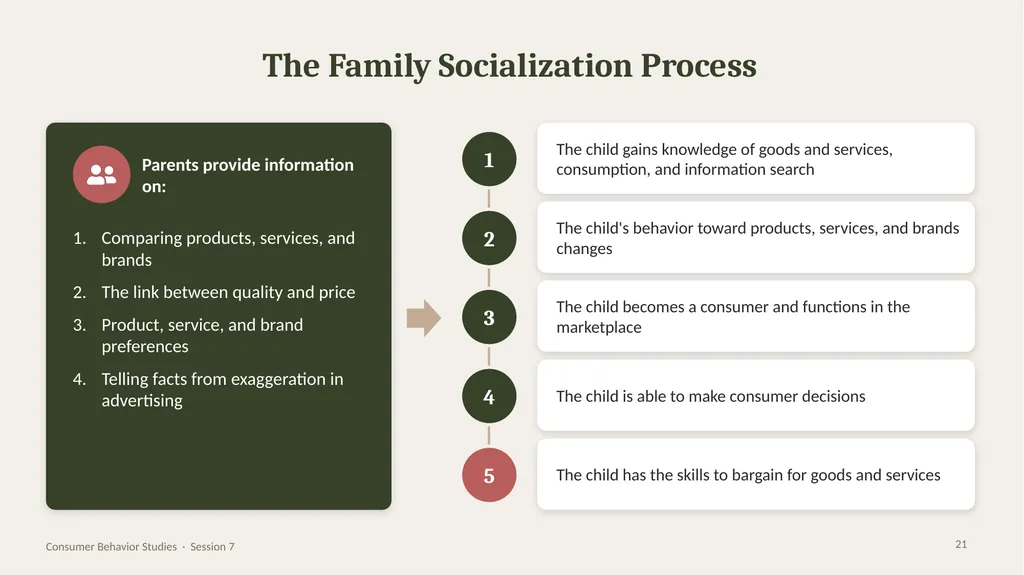
The Family Socialization Process Parents provide information on: Comparing products, services, and brands
The link between quality and price
Product, service, and brand preferences
Telling facts from exaggeration in advertising 1 The child gains knowledge of goods and services, consumption, and information search 2 The child's behavior toward products, services, and brands changes 3 The child becomes a consumer and functions in the marketplace 4 The child is able to make consumer decisions 5 The child has the skills to bargain for goods and services 21<br>
22
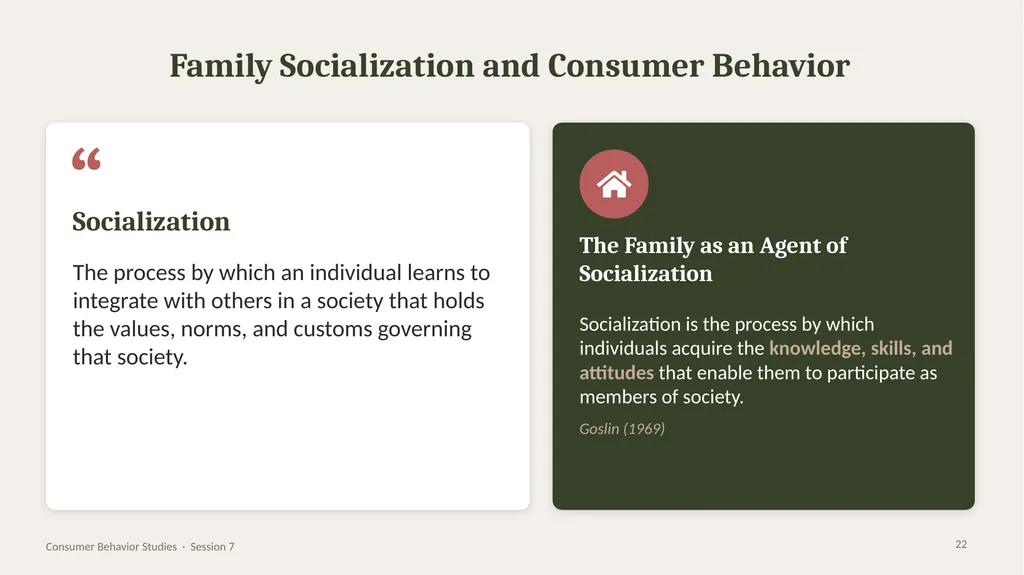
Family Socialization and Consumer Behavior “ Socialization The process by which an individual learns to integrate with others in a society that holds the values, norms, and customs governing that society. The Family as an Agent of Socialization Socialization is the process by which individuals acquire the knowledge, skills, and attitudes that enable them to participate as members of society.
Goslin (1969) 22<br>
Goslin (1969) 22<br>
23
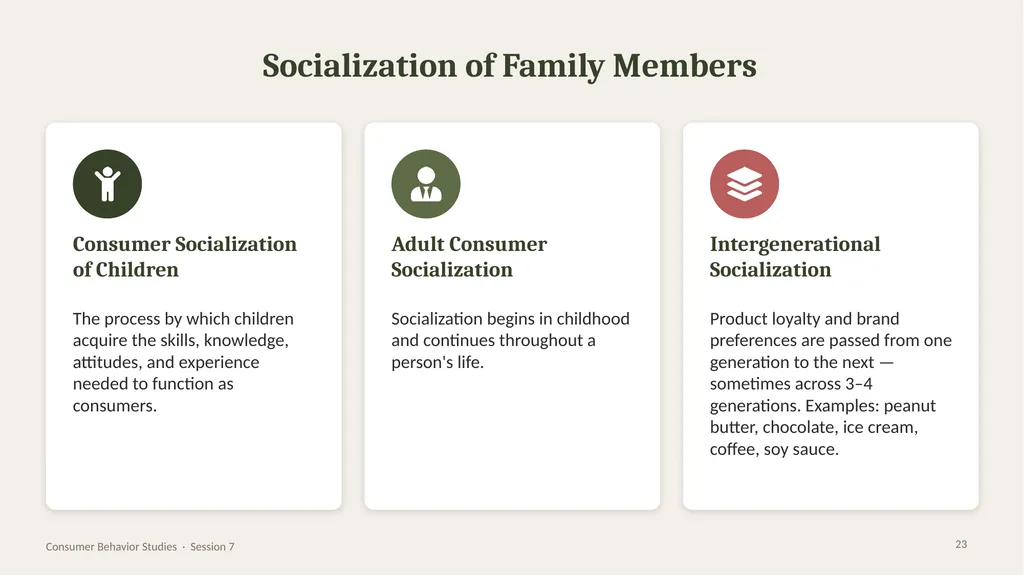
Socialization of Family Members Consumer Socialization of Children The process by which children acquire the skills, knowledge, attitudes, and experience needed to function as consumers. Adult Consumer Socialization Socialization begins in childhood and continues throughout a person's life. Intergenerational Socialization Product loyalty and brand preferences are passed from one generation to the next — sometimes across 3–4 generations. Examples: peanut butter, chocolate, ice cream, coffee, soy sauce. 23<br>
24
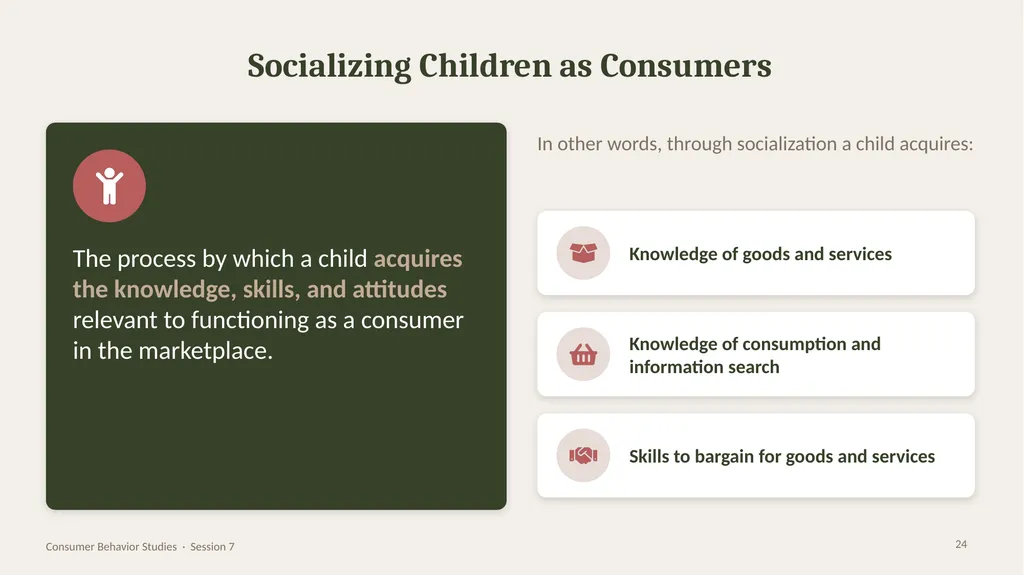
Socializing Children as Consumers The process by which a child acquires the knowledge, skills, and attitudes relevant to functioning as a consumer in the marketplace. In other words, through socialization a child acquires: Knowledge of goods and services Knowledge of consumption and information search Skills to bargain for goods and services 24<br>
25
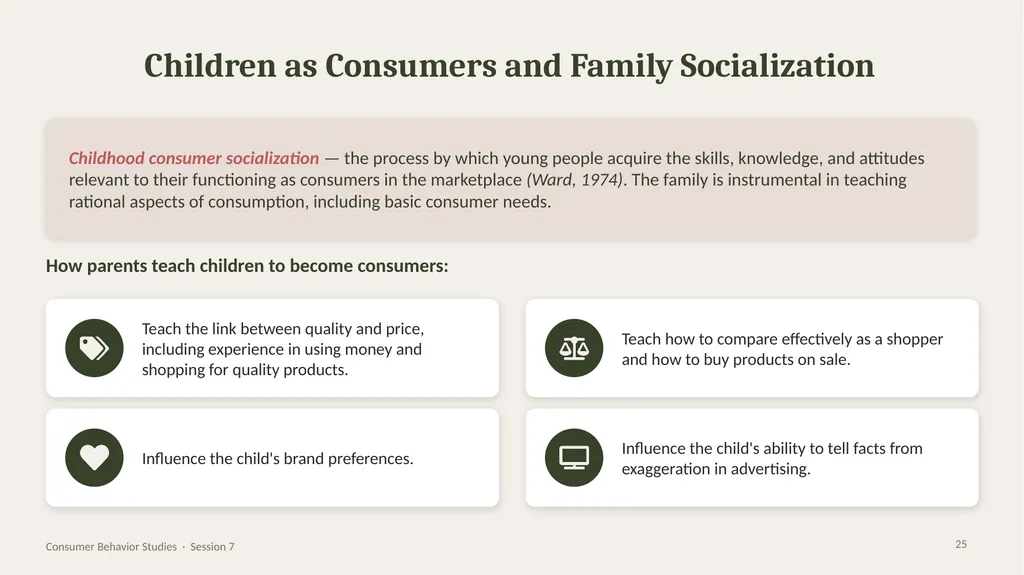
Children as Consumers and Family Socialization Childhood consumer socialization — the process by which young people acquire the skills, knowledge, and attitudes relevant to their functioning as consumers in the marketplace (Ward, 1974). The family is instrumental in teaching rational aspects of consumption, including basic consumer needs. How parents teach children to become consumers: Teach the link between quality and price, including experience in using money and shopping for quality products. Teach how to compare effectively as a shopper and how to buy products on sale. Influence the child's brand preferences. Influence the child's ability to tell facts from exaggeration in advertising. 25<br>
26
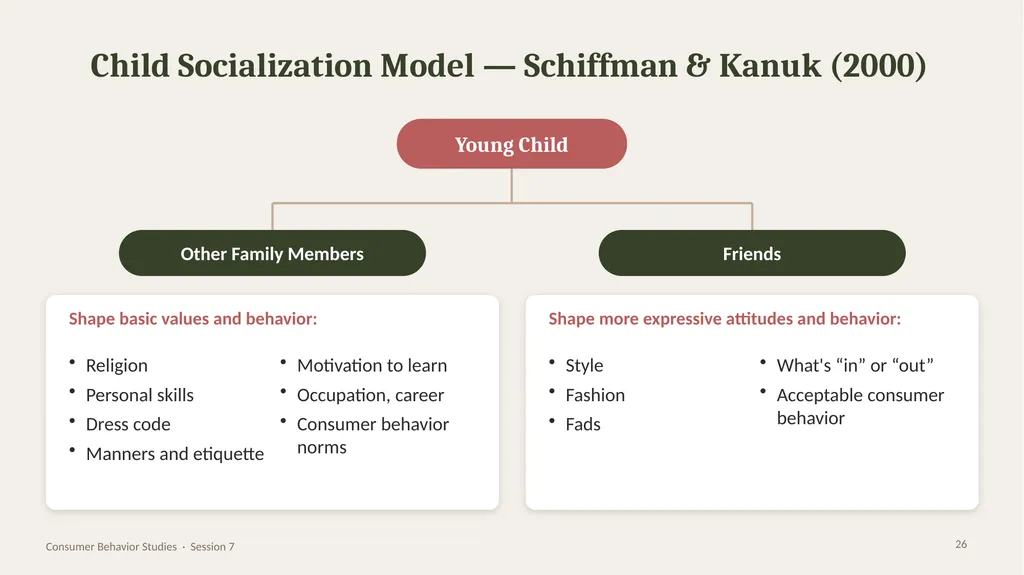
Child Socialization Model — Schiffman & Kanuk (2000) Young Child Other Family Members Shape basic values and behavior: Religion
Personal skills
Dress code
Manners and etiquette Motivation to learn
Occupation, career
Consumer behavior norms Friends Shape more expressive attitudes and behavior: Style
Fashion
Fads What's “in” or “out”
Acceptable consumer behavior 26<br>
Personal skills
Dress code
Manners and etiquette Motivation to learn
Occupation, career
Consumer behavior norms Friends Shape more expressive attitudes and behavior: Style
Fashion
Fads What's “in” or “out”
Acceptable consumer behavior 26<br>
27
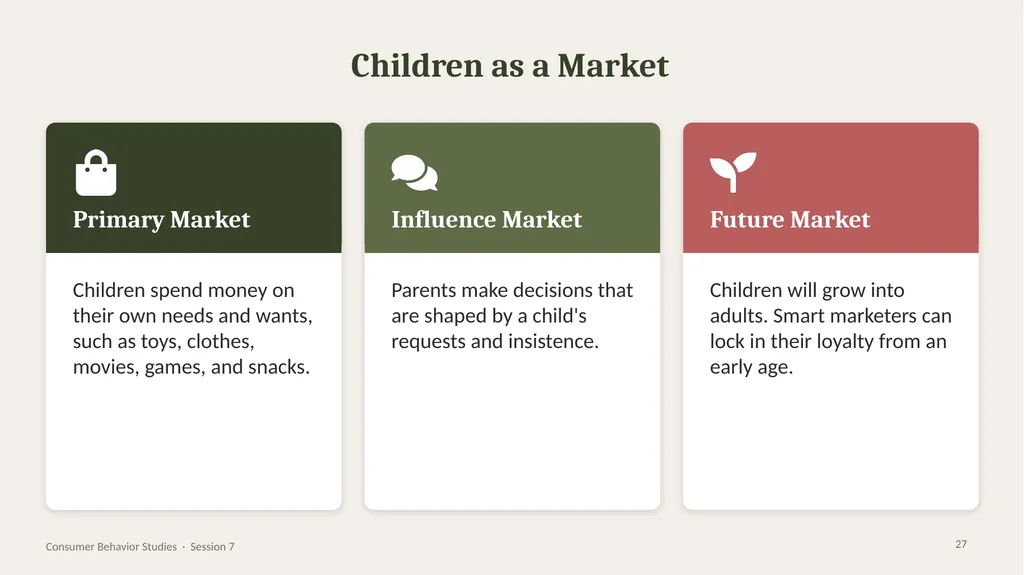
Children as a Market Primary Market Children spend money on their own needs and wants, such as toys, clothes, movies, games, and snacks. Influence Market Parents make decisions that are shaped by a child's requests and insistence. Future Market Children will grow into adults. Smart marketers can lock in their loyalty from an early age. 27<br>
28
Thank You Consumer Behavior Studies · Session 7<br>