
Shared Learning - CIO Leaders Summit Croke Park
Description: Shared Learning - CIO Leaders Summit Croke Park June 2022 Theme: Refocusing IT and digital strategy to drive the organisations post-pandemic recovery Ray Daly, Grade VIII Senior ICT Project Manager CIO IT Leaders Summit Richard
Related Topics
Download Presentation
"Shared Learning - CIO Leaders Summit Croke Park" is the property of its rightful owner. Permission is granted to download and print the materials on this website for personal, non-commercial use only, and to display it on your personal computer provided you do not modify the materials and that you retain all copyright notices contained in the materials. By downloading content from our website, you accept the terms of this agreement.
Presentation Transcript
slide1. Shared Learning - CIO Leaders Summit Croke Park June 2022
Theme: Refocusing IT and digital strategy to drive the organisation's post-pandemic recovery
Ray Daly, Grade VIII Senior ICT Project Manager<br>
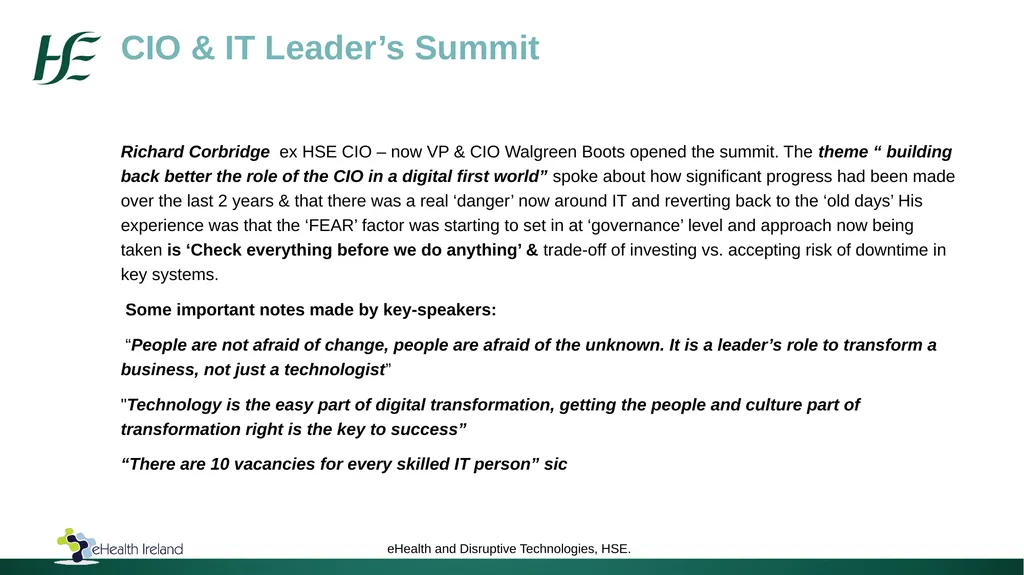
slide2. CIO & IT Leader’s Summit Richard Corbridge ex HSE CIO – now VP & CIO Walgreen Boots opened the summit. The theme “ building back better the role of the CIO in a digital first world” spoke about how significant progress had been made over the last 2 years & that there was a real ‘danger’ now around IT and reverting back to the ‘old days’ His experience was that the ‘FEAR’ factor was starting to set in at ‘governance’ level and approach now being taken is ‘Check everything before we do anything’ & trade-off of investing vs. accepting risk of downtime in key systems.
Some important notes made by key-speakers:
“People are not afraid of change, people are afraid of the unknown. It is a leader’s role to transform a business, not just a technologist”
"Technology is the easy part of digital transformation, getting the people and culture part of transformation right is the key to success”
“There are 10 vacancies for every skilled IT person” sic<br>
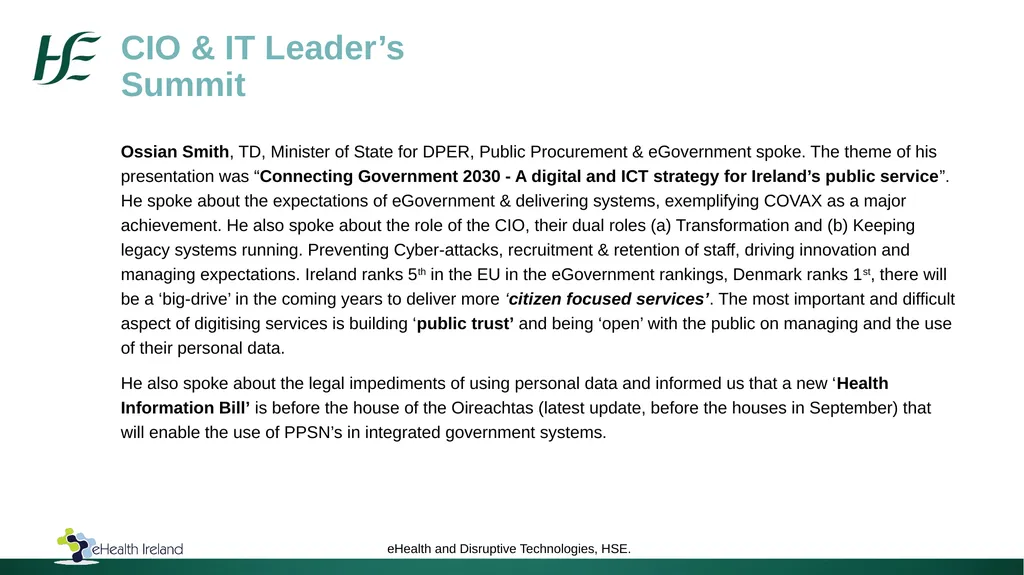
slide3. CIO & IT Leader’s Summit Ossian Smith, TD, Minister of State for DPER, Public Procurement & eGovernment spoke. The theme of his presentation was “Connecting Government 2030 - A digital and ICT strategy for Ireland’s public service”. He spoke about the expectations of eGovernment & delivering systems, exemplifying COVAX as a major achievement. He also spoke about the role of the CIO, their dual roles (a) Transformation and (b) Keeping legacy systems running. Preventing Cyber-attacks, recruitment & retention of staff, driving innovation and managing expectations. Ireland ranks 5th in the EU in the eGovernment rankings, Denmark ranks 1st, there will be a ‘big-drive’ in the coming years to deliver more ‘citizen focused services’. The most important and difficult aspect of digitising services is building ‘public trust’ and being ‘open’ with the public on managing and the use of their personal data.
He also spoke about the legal impediments of using personal data and informed us that a new ‘Health Information Bill’ is before the house of the Oireachtas (latest update, before the houses in September) that will enable the use of PPSN’s in integrated government systems.<br>
slide4. CIO & IT Leader’s Summit Panel discussion 1 (Delivering Digital Transformation in Government : What’s worked well?
Tim Willoughby (Garda Siochana) spoke about the new technology deployed to the 14,000 front-line Gardaí force, delivering vehicles to meet modern requirements, IOT to keep Gardaí connected, and stressed the importance of user designed & user led innovations.
Gavin Ross (Dept of Transport) spoke about the Motor-Tax technology (simplification of business processes) and the role of automation, robotics & BOTS.Automating tasks to remove manual repetition is key. He spoke about process re-design, eradicating duplication and that ‘perfection’ may not be appropriate in times of crises to deliver/rollout systems. He also praised the Department of Social Welfare for delivering a system for PUP under tight timelines.<br>
slide5. CIO & IT Leader’s Summit Ruth Ross (CIO Cork City Council) spoke about the role of IT in the Cork City Council and the importance of building trust with the city’s (31) councillors, to deliver services. Their current focus is on ‘rationalising’ 999 calls & dispatch. She also spoke about the under investment in ICT and ‘lost years’ . She emphasised the importance of recruiting & retaining the right people, the use of technology to build ‘smart towns/cities’ and the importance of high-speed networks. She also spoke about the graduate programme/national apprenticeship schema and the constant battle to retain staff.
Lisa Baron-Broadhurst, (Programme Director, Social Security Programme, Scottish Government) spoke about the Scottish government deploying social security services (12) thus far to the cloud. She emphasised the importance of the continuous cycle of improvement & checking back with end-users.<br>
slide6. CIO & IT Leader’s Summit Panel discussion 2 (Change Management – an enabler of superior inter-agency services)
Caitriona McGuckian , (Civil Service) spoke about the Ukrainian Crises & housing refugees, Housing refugees was a 24/7 operation. There was an urgent requirement to develop a digital platform vs. manual processes. A system to manage accommodation was built within 4 weeks.
Darren Clark (Okensky), spoke about the system they developed to manage accommodation for Ukrainians in such tight-timelines. He emphasised the importance of having technical specialists at hand, agile PM methodology and managing the sprints. The system they developed to manage accommodation for Ukrainians was risky, time-bound, it demanded an accelerated delivery, and they worked on the 80:20 rule to deliver key functionality in the first few sprints. They re-used/re-purposed functionality viz re-inventing.
Technology alone could not have delivered the solution successfully, it was driven by good leadership, change management, user buy-in and adaptation.
Thus far, 35,000 Ukrainians have been accommodated and the service/system is meeting needs.<br>
slide7. CIO & IT Leader’s Summit Panel discussion 3 (Data and Public Trust)
Martin Curley(ex CIO HSE) mentioned we were on the ‘cusp’ of a Berlin wall with EHR, getting closer to massive transformation. From a GDPR perspective, the patient owns the data and thus the patient is the data controller. IHI has delayed rollout, new health bill re usage of PPSN before the Houses of the Oireachtas, that will mandate the use of PPSNs e.g. with CT scans which would be a major breakthrough. In his discussions Martin mentioned that he predicted the Cyber-attack some years ago and stressed that ICT in the Heath Services had been hugely underfunded. He said we’ve learned lessons and cloud based solutions are now the norm. He advocated the establishment of an EHR ‘Digital Health Agency’. The results of a survey recently conducted revealed that
99% of subjects wanted medical experts to have access to their HER
86% of subjects wanted their EHR shared with Health Professionals<br>
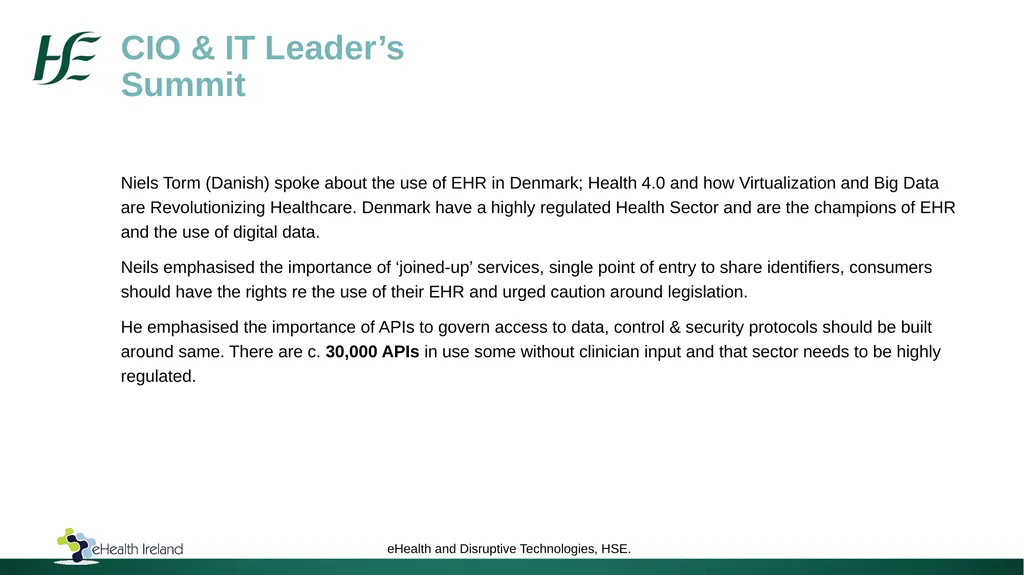
slide8. CIO & IT Leader’s Summit Niels Torm (Danish) spoke about the use of EHR in Denmark; Health 4.0 and how Virtualization and Big Data are Revolutionizing Healthcare. Denmark have a highly regulated Health Sector and are the champions of EHR and the use of digital data.
Neils emphasised the importance of ‘joined-up’ services, single point of entry to share identifiers, consumers should have the rights re the use of their EHR and urged caution around legislation.
He emphasised the importance of APIs to govern access to data, control & security protocols should be built around same. There are c. 30,000 APIs in use some without clinician input and that sector needs to be highly regulated.<br>
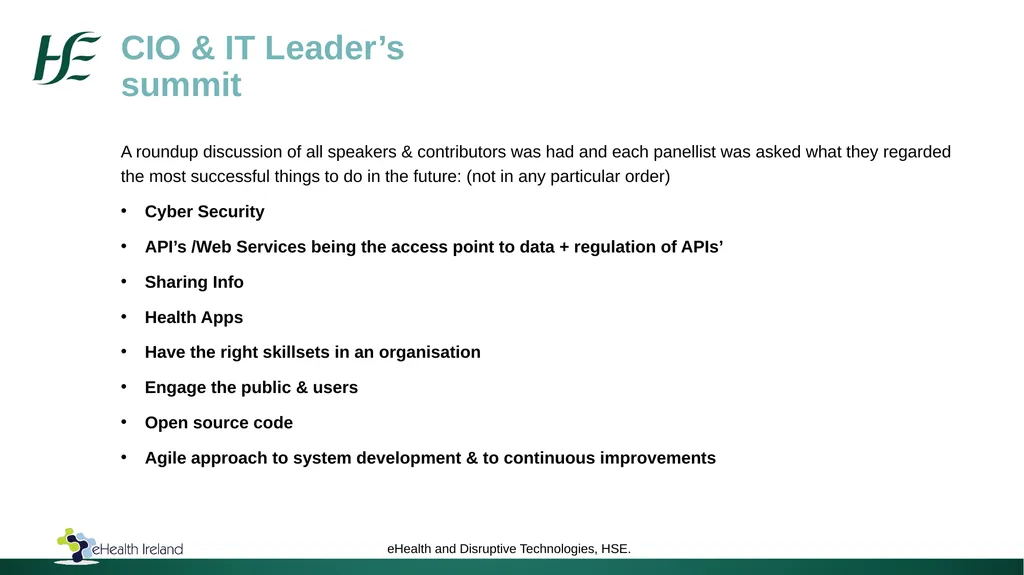
slide9. CIO & IT Leader’s summit A roundup discussion of all speakers & contributors was had and each panellist was asked what they regarded the most successful things to do in the future: (not in any particular order)
Cyber Security
API’s /Web Services being the access point to data + regulation of APIs’
Sharing Info
Health Apps
Have the right skillsets in an organisation
Engage the public & users
Open source code
Agile approach to system development & to continuous improvements<br>
Theme: Refocusing IT and digital strategy to drive the organisation's post-pandemic recovery
Ray Daly, Grade VIII Senior ICT Project Manager<br>
slide2. CIO & IT Leader’s Summit Richard Corbridge ex HSE CIO – now VP & CIO Walgreen Boots opened the summit. The theme “ building back better the role of the CIO in a digital first world” spoke about how significant progress had been made over the last 2 years & that there was a real ‘danger’ now around IT and reverting back to the ‘old days’ His experience was that the ‘FEAR’ factor was starting to set in at ‘governance’ level and approach now being taken is ‘Check everything before we do anything’ & trade-off of investing vs. accepting risk of downtime in key systems.
Some important notes made by key-speakers:
“People are not afraid of change, people are afraid of the unknown. It is a leader’s role to transform a business, not just a technologist”
"Technology is the easy part of digital transformation, getting the people and culture part of transformation right is the key to success”
“There are 10 vacancies for every skilled IT person” sic<br>
slide3. CIO & IT Leader’s Summit Ossian Smith, TD, Minister of State for DPER, Public Procurement & eGovernment spoke. The theme of his presentation was “Connecting Government 2030 - A digital and ICT strategy for Ireland’s public service”. He spoke about the expectations of eGovernment & delivering systems, exemplifying COVAX as a major achievement. He also spoke about the role of the CIO, their dual roles (a) Transformation and (b) Keeping legacy systems running. Preventing Cyber-attacks, recruitment & retention of staff, driving innovation and managing expectations. Ireland ranks 5th in the EU in the eGovernment rankings, Denmark ranks 1st, there will be a ‘big-drive’ in the coming years to deliver more ‘citizen focused services’. The most important and difficult aspect of digitising services is building ‘public trust’ and being ‘open’ with the public on managing and the use of their personal data.
He also spoke about the legal impediments of using personal data and informed us that a new ‘Health Information Bill’ is before the house of the Oireachtas (latest update, before the houses in September) that will enable the use of PPSN’s in integrated government systems.<br>
slide4. CIO & IT Leader’s Summit Panel discussion 1 (Delivering Digital Transformation in Government : What’s worked well?
Tim Willoughby (Garda Siochana) spoke about the new technology deployed to the 14,000 front-line Gardaí force, delivering vehicles to meet modern requirements, IOT to keep Gardaí connected, and stressed the importance of user designed & user led innovations.
Gavin Ross (Dept of Transport) spoke about the Motor-Tax technology (simplification of business processes) and the role of automation, robotics & BOTS.Automating tasks to remove manual repetition is key. He spoke about process re-design, eradicating duplication and that ‘perfection’ may not be appropriate in times of crises to deliver/rollout systems. He also praised the Department of Social Welfare for delivering a system for PUP under tight timelines.<br>
slide5. CIO & IT Leader’s Summit Ruth Ross (CIO Cork City Council) spoke about the role of IT in the Cork City Council and the importance of building trust with the city’s (31) councillors, to deliver services. Their current focus is on ‘rationalising’ 999 calls & dispatch. She also spoke about the under investment in ICT and ‘lost years’ . She emphasised the importance of recruiting & retaining the right people, the use of technology to build ‘smart towns/cities’ and the importance of high-speed networks. She also spoke about the graduate programme/national apprenticeship schema and the constant battle to retain staff.
Lisa Baron-Broadhurst, (Programme Director, Social Security Programme, Scottish Government) spoke about the Scottish government deploying social security services (12) thus far to the cloud. She emphasised the importance of the continuous cycle of improvement & checking back with end-users.<br>
slide6. CIO & IT Leader’s Summit Panel discussion 2 (Change Management – an enabler of superior inter-agency services)
Caitriona McGuckian , (Civil Service) spoke about the Ukrainian Crises & housing refugees, Housing refugees was a 24/7 operation. There was an urgent requirement to develop a digital platform vs. manual processes. A system to manage accommodation was built within 4 weeks.
Darren Clark (Okensky), spoke about the system they developed to manage accommodation for Ukrainians in such tight-timelines. He emphasised the importance of having technical specialists at hand, agile PM methodology and managing the sprints. The system they developed to manage accommodation for Ukrainians was risky, time-bound, it demanded an accelerated delivery, and they worked on the 80:20 rule to deliver key functionality in the first few sprints. They re-used/re-purposed functionality viz re-inventing.
Technology alone could not have delivered the solution successfully, it was driven by good leadership, change management, user buy-in and adaptation.
Thus far, 35,000 Ukrainians have been accommodated and the service/system is meeting needs.<br>
slide7. CIO & IT Leader’s Summit Panel discussion 3 (Data and Public Trust)
Martin Curley(ex CIO HSE) mentioned we were on the ‘cusp’ of a Berlin wall with EHR, getting closer to massive transformation. From a GDPR perspective, the patient owns the data and thus the patient is the data controller. IHI has delayed rollout, new health bill re usage of PPSN before the Houses of the Oireachtas, that will mandate the use of PPSNs e.g. with CT scans which would be a major breakthrough. In his discussions Martin mentioned that he predicted the Cyber-attack some years ago and stressed that ICT in the Heath Services had been hugely underfunded. He said we’ve learned lessons and cloud based solutions are now the norm. He advocated the establishment of an EHR ‘Digital Health Agency’. The results of a survey recently conducted revealed that
99% of subjects wanted medical experts to have access to their HER
86% of subjects wanted their EHR shared with Health Professionals<br>
slide8. CIO & IT Leader’s Summit Niels Torm (Danish) spoke about the use of EHR in Denmark; Health 4.0 and how Virtualization and Big Data are Revolutionizing Healthcare. Denmark have a highly regulated Health Sector and are the champions of EHR and the use of digital data.
Neils emphasised the importance of ‘joined-up’ services, single point of entry to share identifiers, consumers should have the rights re the use of their EHR and urged caution around legislation.
He emphasised the importance of APIs to govern access to data, control & security protocols should be built around same. There are c. 30,000 APIs in use some without clinician input and that sector needs to be highly regulated.<br>
slide9. CIO & IT Leader’s summit A roundup discussion of all speakers & contributors was had and each panellist was asked what they regarded the most successful things to do in the future: (not in any particular order)
Cyber Security
API’s /Web Services being the access point to data + regulation of APIs’
Sharing Info
Health Apps
Have the right skillsets in an organisation
Engage the public & users
Open source code
Agile approach to system development & to continuous improvements<br>