
Sharing expertise A range of noticing;
KL
Published · 36 slides · 0 views

1 / 1







Description
Sharing expertise A range of noticing; instructional approaches and adaptive strategies for the scenarios Hannah Case study What might you notice in relation to Hannahs learning in a lesson? Hannah: Instructional approaches and adaptive
Related Topics
Share
Embed code
Download this presentation From Below
"Sharing expertise A range of noticing;" is the property of its rightful owner. Permission is granted to download and print the materials on this website for personal, non-commercial use only, and to display it on your personal computer provided you do not modify the materials and that you retain all copyright notices contained in the materials. By downloading content from our website, you accept the terms of this agreement.
Presentation Transcript
01
Sharing expertise A range of noticing; instructional approaches and adaptive strategies for the scenarios<br>
02
Hannah<br>
03
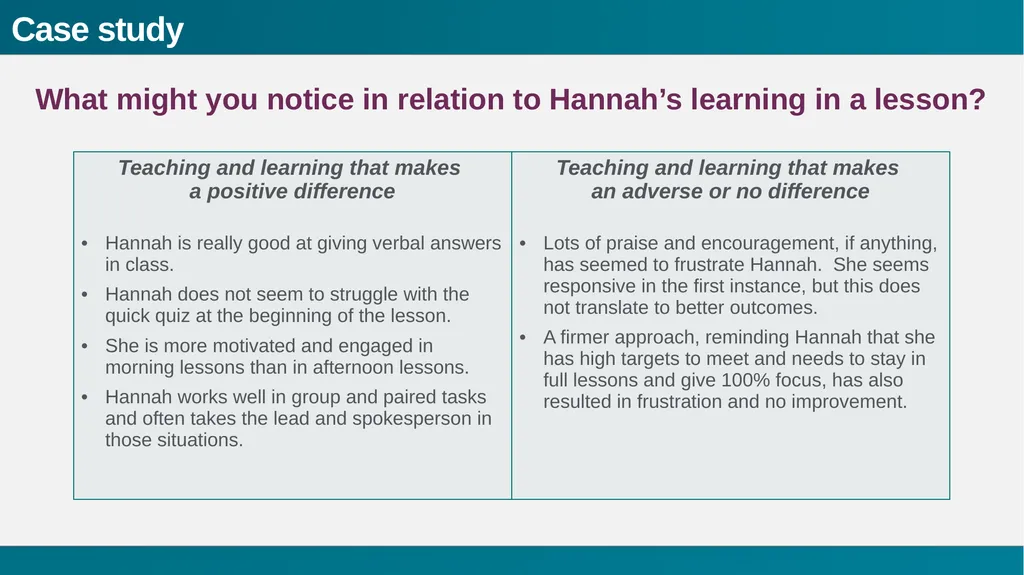
Case study What might you notice in relation to Hannah’s learning in a lesson?<br>
04
Hannah: Instructional approaches and adaptive strategies In the environment
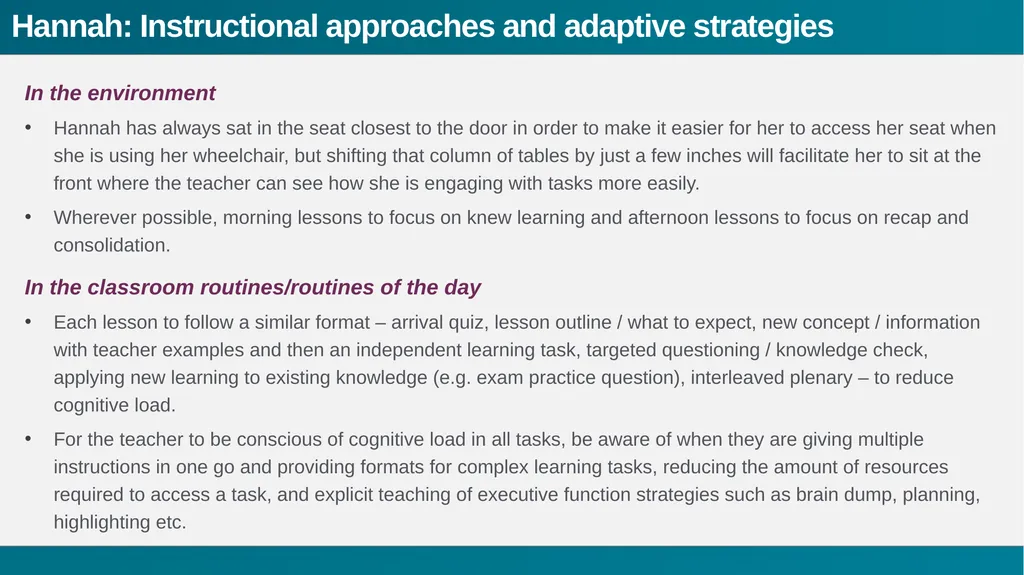
Hannah has always sat in the seat closest to the door in order to make it easier for her to access her seat when she is using her wheelchair, but shifting that column of tables by just a few inches will facilitate her to sit at the front where the teacher can see how she is engaging with tasks more easily.
Wherever possible, morning lessons to focus on knew learning and afternoon lessons to focus on recap and consolidation.
In the classroom routines/routines of the day
Each lesson to follow a similar format – arrival quiz, lesson outline / what to expect, new concept / information with teacher examples and then an independent learning task, targeted questioning / knowledge check, applying new learning to existing knowledge (e.g. exam practice question), interleaved plenary – to reduce cognitive load.
For the teacher to be conscious of cognitive load in all tasks, be aware of when they are giving multiple instructions in one go and providing formats for complex learning tasks, reducing the amount of resources required to access a task, and explicit teaching of executive function strategies such as brain dump, planning, highlighting etc.<br>
Hannah has always sat in the seat closest to the door in order to make it easier for her to access her seat when she is using her wheelchair, but shifting that column of tables by just a few inches will facilitate her to sit at the front where the teacher can see how she is engaging with tasks more easily.
Wherever possible, morning lessons to focus on knew learning and afternoon lessons to focus on recap and consolidation.
In the classroom routines/routines of the day
Each lesson to follow a similar format – arrival quiz, lesson outline / what to expect, new concept / information with teacher examples and then an independent learning task, targeted questioning / knowledge check, applying new learning to existing knowledge (e.g. exam practice question), interleaved plenary – to reduce cognitive load.
For the teacher to be conscious of cognitive load in all tasks, be aware of when they are giving multiple instructions in one go and providing formats for complex learning tasks, reducing the amount of resources required to access a task, and explicit teaching of executive function strategies such as brain dump, planning, highlighting etc.<br>
05
Hannah: Instructional approaches and adaptive strategies In the language used
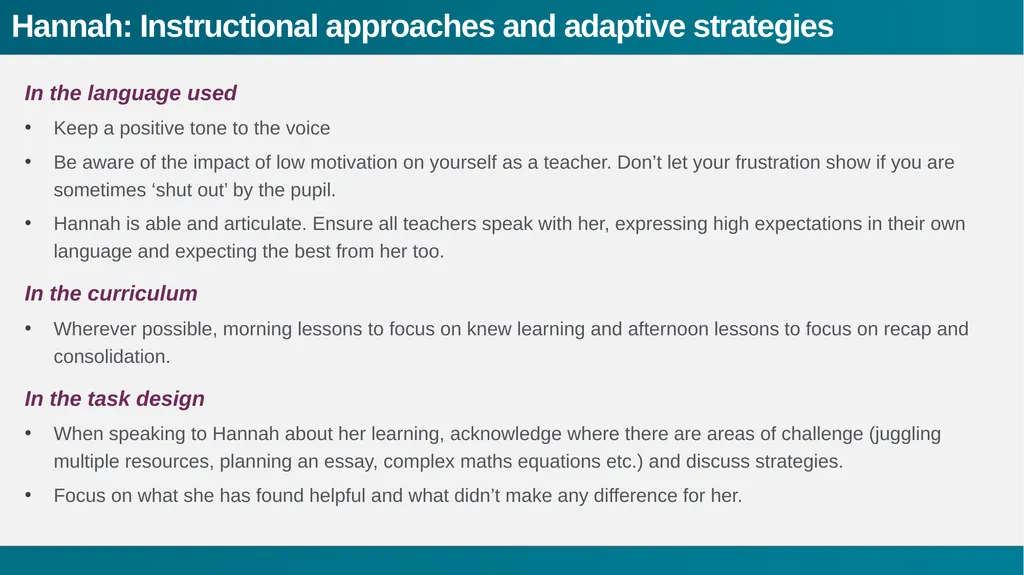
Keep a positive tone to the voice
Be aware of the impact of low motivation on yourself as a teacher. Don’t let your frustration show if you are sometimes ‘shut out’ by the pupil.
Hannah is able and articulate. Ensure all teachers speak with her, expressing high expectations in their own language and expecting the best from her too.
In the curriculum
Wherever possible, morning lessons to focus on knew learning and afternoon lessons to focus on recap and consolidation.
In the task design
When speaking to Hannah about her learning, acknowledge where there are areas of challenge (juggling multiple resources, planning an essay, complex maths equations etc.) and discuss strategies.
Focus on what she has found helpful and what didn’t make any difference for her.<br>
Keep a positive tone to the voice
Be aware of the impact of low motivation on yourself as a teacher. Don’t let your frustration show if you are sometimes ‘shut out’ by the pupil.
Hannah is able and articulate. Ensure all teachers speak with her, expressing high expectations in their own language and expecting the best from her too.
In the curriculum
Wherever possible, morning lessons to focus on knew learning and afternoon lessons to focus on recap and consolidation.
In the task design
When speaking to Hannah about her learning, acknowledge where there are areas of challenge (juggling multiple resources, planning an essay, complex maths equations etc.) and discuss strategies.
Focus on what she has found helpful and what didn’t make any difference for her.<br>
06
Hannah: Instructional approaches and adaptive strategies From the adults in the class
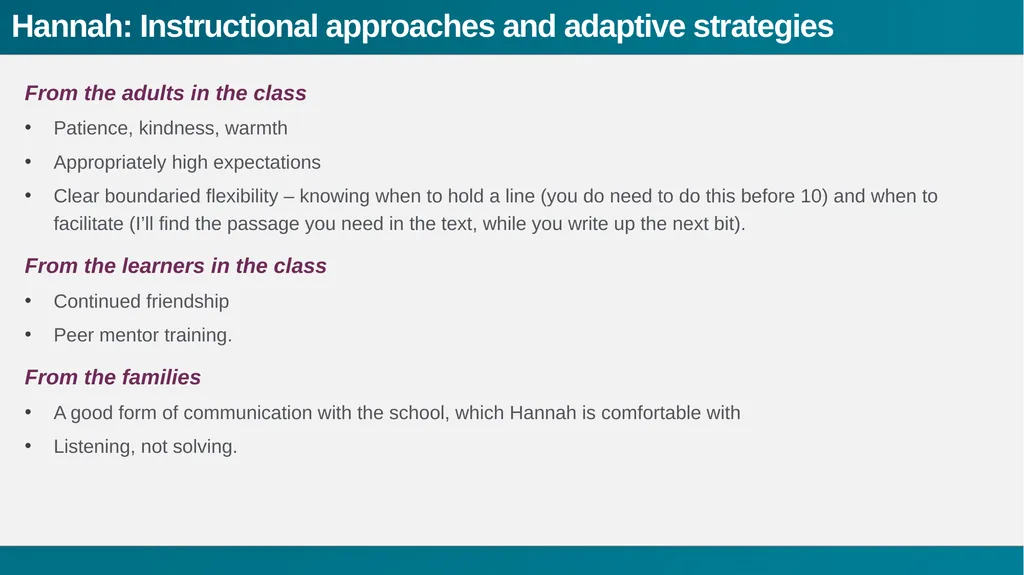
Patience, kindness, warmth
Appropriately high expectations
Clear boundaried flexibility – knowing when to hold a line (you do need to do this before 10) and when to facilitate (I’ll find the passage you need in the text, while you write up the next bit).
From the learners in the class
Continued friendship
Peer mentor training.
From the families
A good form of communication with the school, which Hannah is comfortable with
Listening, not solving.<br>
Patience, kindness, warmth
Appropriately high expectations
Clear boundaried flexibility – knowing when to hold a line (you do need to do this before 10) and when to facilitate (I’ll find the passage you need in the text, while you write up the next bit).
From the learners in the class
Continued friendship
Peer mentor training.
From the families
A good form of communication with the school, which Hannah is comfortable with
Listening, not solving.<br>
07
Mae<br>
08
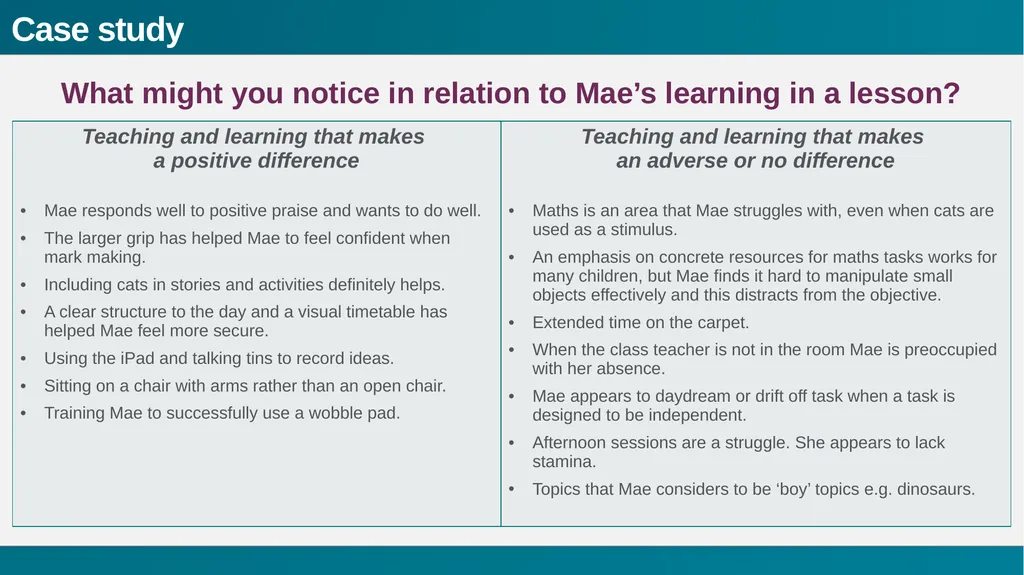
Case study What might you notice in relation to Mae’s learning in a lesson?<br>
09
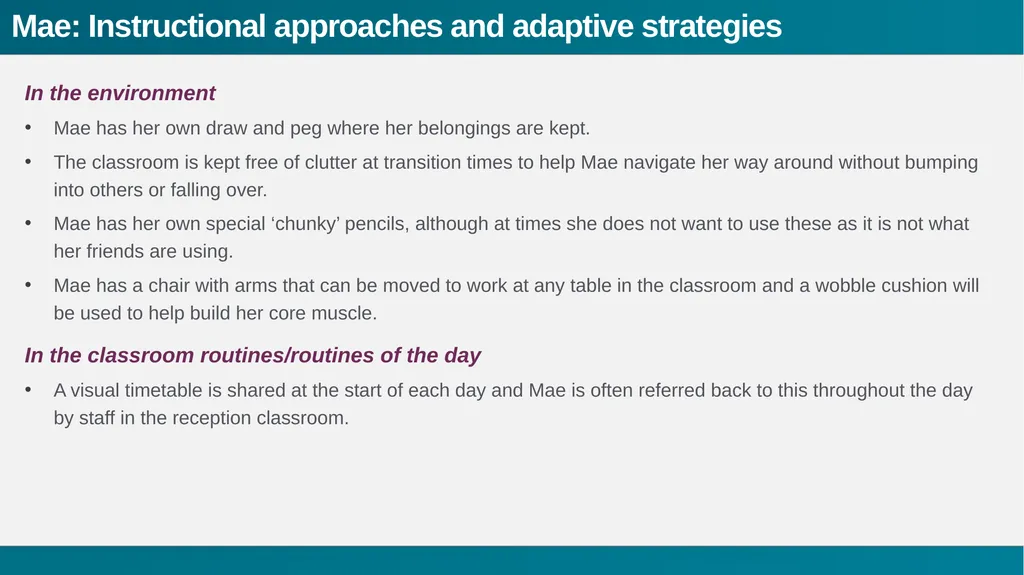
Mae: Instructional approaches and adaptive strategies In the environment
Mae has her own draw and peg where her belongings are kept.
The classroom is kept free of clutter at transition times to help Mae navigate her way around without bumping into others or falling over.
Mae has her own special ‘chunky’ pencils, although at times she does not want to use these as it is not what her friends are using.
Mae has a chair with arms that can be moved to work at any table in the classroom and a wobble cushion will be used to help build her core muscle.
In the classroom routines/routines of the day
A visual timetable is shared at the start of each day and Mae is often referred back to this throughout the day by staff in the reception classroom.<br>
Mae has her own draw and peg where her belongings are kept.
The classroom is kept free of clutter at transition times to help Mae navigate her way around without bumping into others or falling over.
Mae has her own special ‘chunky’ pencils, although at times she does not want to use these as it is not what her friends are using.
Mae has a chair with arms that can be moved to work at any table in the classroom and a wobble cushion will be used to help build her core muscle.
In the classroom routines/routines of the day
A visual timetable is shared at the start of each day and Mae is often referred back to this throughout the day by staff in the reception classroom.<br>
10
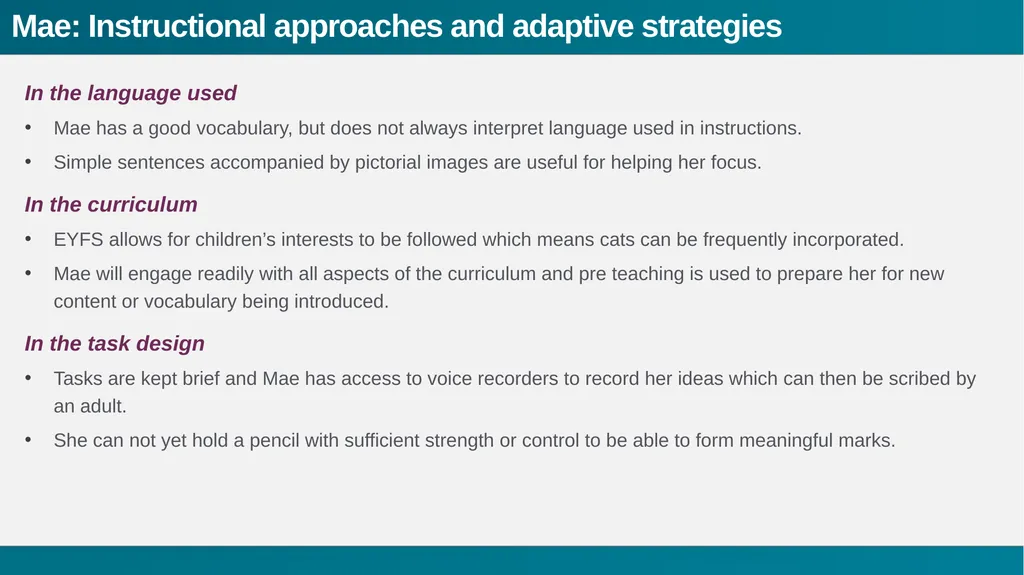
Mae: Instructional approaches and adaptive strategies In the language used
Mae has a good vocabulary, but does not always interpret language used in instructions.
Simple sentences accompanied by pictorial images are useful for helping her focus.
In the curriculum
EYFS allows for children’s interests to be followed which means cats can be frequently incorporated.
Mae will engage readily with all aspects of the curriculum and pre teaching is used to prepare her for new content or vocabulary being introduced.
In the task design
Tasks are kept brief and Mae has access to voice recorders to record her ideas which can then be scribed by an adult.
She can not yet hold a pencil with sufficient strength or control to be able to form meaningful marks.<br>
Mae has a good vocabulary, but does not always interpret language used in instructions.
Simple sentences accompanied by pictorial images are useful for helping her focus.
In the curriculum
EYFS allows for children’s interests to be followed which means cats can be frequently incorporated.
Mae will engage readily with all aspects of the curriculum and pre teaching is used to prepare her for new content or vocabulary being introduced.
In the task design
Tasks are kept brief and Mae has access to voice recorders to record her ideas which can then be scribed by an adult.
She can not yet hold a pencil with sufficient strength or control to be able to form meaningful marks.<br>
11
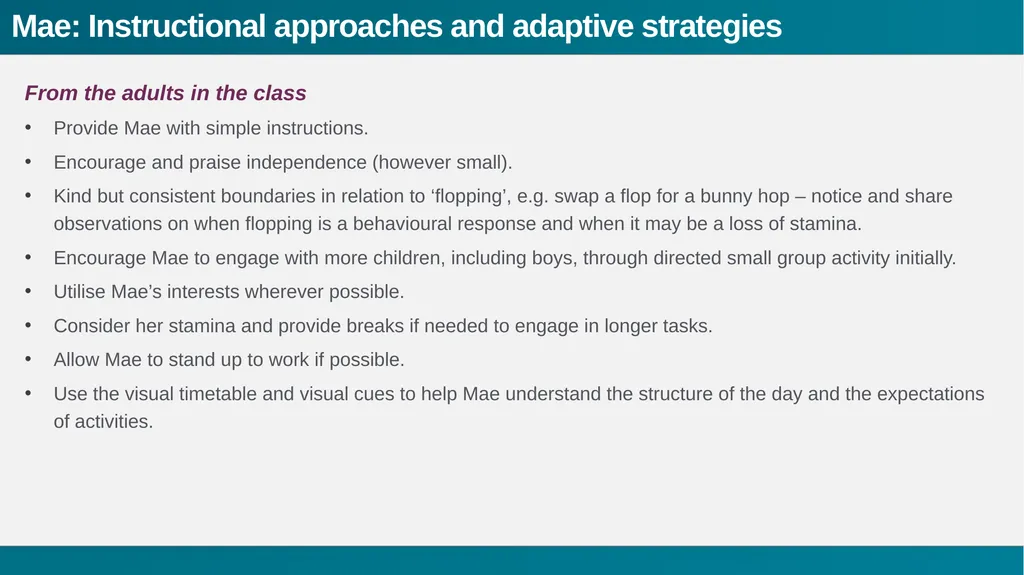
Mae: Instructional approaches and adaptive strategies From the adults in the class
Provide Mae with simple instructions.
Encourage and praise independence (however small).
Kind but consistent boundaries in relation to ‘flopping’, e.g. swap a flop for a bunny hop – notice and share observations on when flopping is a behavioural response and when it may be a loss of stamina.
Encourage Mae to engage with more children, including boys, through directed small group activity initially.
Utilise Mae’s interests wherever possible.
Consider her stamina and provide breaks if needed to engage in longer tasks.
Allow Mae to stand up to work if possible.
Use the visual timetable and visual cues to help Mae understand the structure of the day and the expectations of activities.<br>
Provide Mae with simple instructions.
Encourage and praise independence (however small).
Kind but consistent boundaries in relation to ‘flopping’, e.g. swap a flop for a bunny hop – notice and share observations on when flopping is a behavioural response and when it may be a loss of stamina.
Encourage Mae to engage with more children, including boys, through directed small group activity initially.
Utilise Mae’s interests wherever possible.
Consider her stamina and provide breaks if needed to engage in longer tasks.
Allow Mae to stand up to work if possible.
Use the visual timetable and visual cues to help Mae understand the structure of the day and the expectations of activities.<br>
12
Mae: Instructional approaches and adaptive strategies From the learners in the class
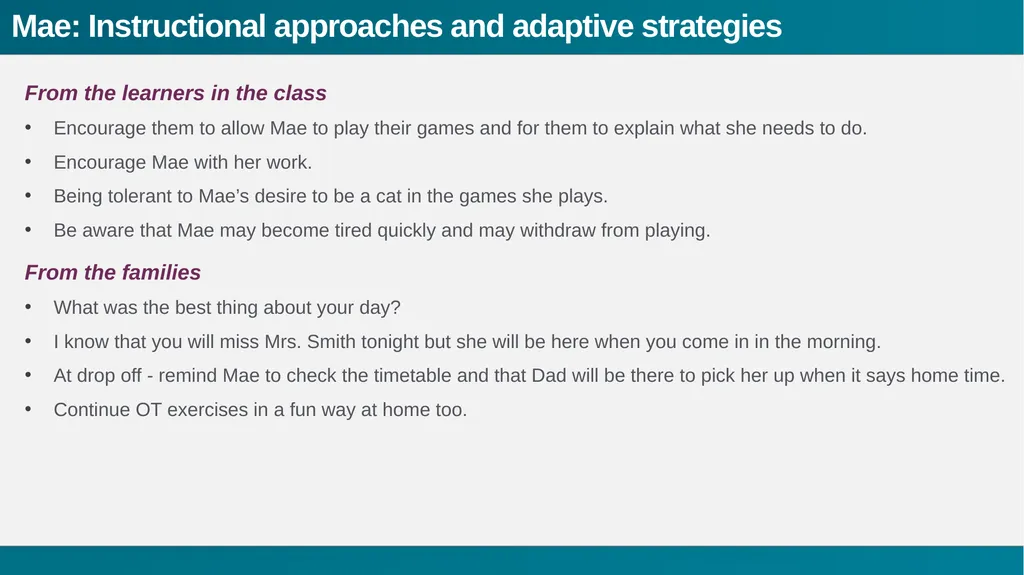
Encourage them to allow Mae to play their games and for them to explain what she needs to do.
Encourage Mae with her work.
Being tolerant to Mae’s desire to be a cat in the games she plays.
Be aware that Mae may become tired quickly and may withdraw from playing.
From the families
What was the best thing about your day?
I know that you will miss Mrs. Smith tonight but she will be here when you come in in the morning.
At drop off - remind Mae to check the timetable and that Dad will be there to pick her up when it says home time.
Continue OT exercises in a fun way at home too.<br>
Encourage them to allow Mae to play their games and for them to explain what she needs to do.
Encourage Mae with her work.
Being tolerant to Mae’s desire to be a cat in the games she plays.
Be aware that Mae may become tired quickly and may withdraw from playing.
From the families
What was the best thing about your day?
I know that you will miss Mrs. Smith tonight but she will be here when you come in in the morning.
At drop off - remind Mae to check the timetable and that Dad will be there to pick her up when it says home time.
Continue OT exercises in a fun way at home too.<br>
13
Máire<br>
14
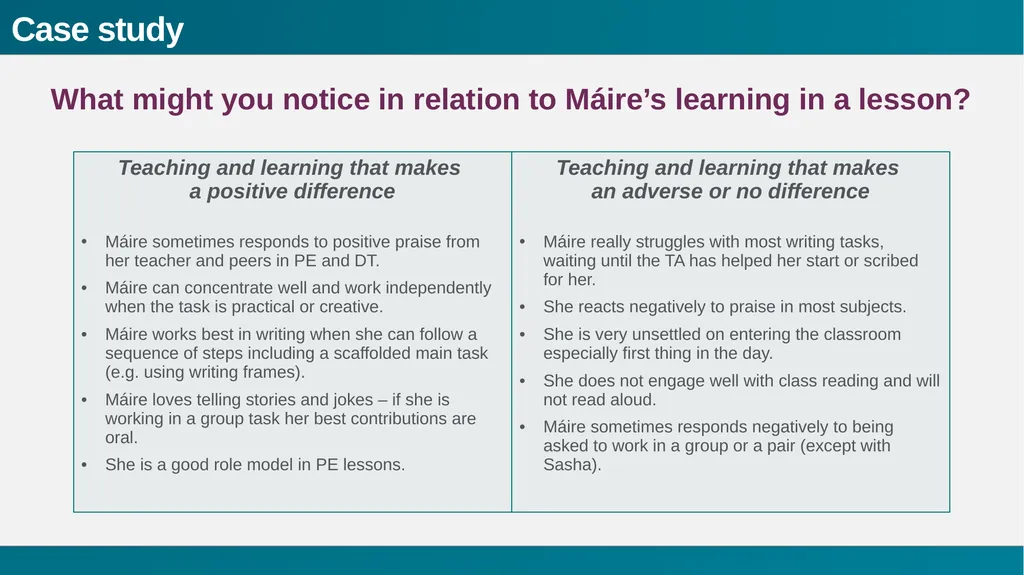
Case study What might you notice in relation to Máire’s learning in a lesson?<br>
15
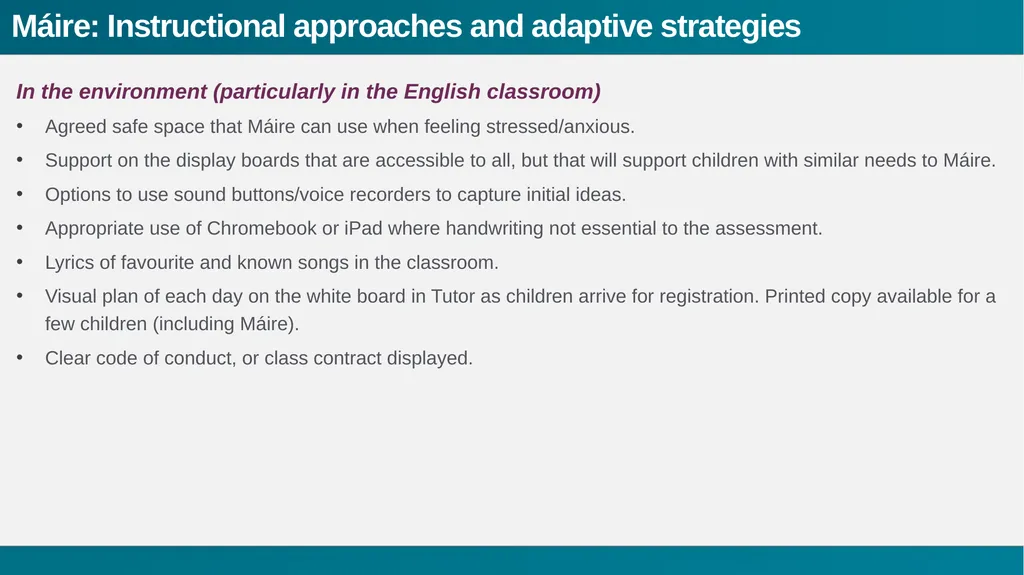
In the environment (particularly in the English classroom)
Agreed safe space that Máire can use when feeling stressed/anxious.
Support on the display boards that are accessible to all, but that will support children with similar needs to Máire.
Options to use sound buttons/voice recorders to capture initial ideas.
Appropriate use of Chromebook or iPad where handwriting not essential to the assessment.
Lyrics of favourite and known songs in the classroom.
Visual plan of each day on the white board in Tutor as children arrive for registration. Printed copy available for a few children (including Máire).
Clear code of conduct, or class contract displayed. Máire: Instructional approaches and adaptive strategies<br>
Agreed safe space that Máire can use when feeling stressed/anxious.
Support on the display boards that are accessible to all, but that will support children with similar needs to Máire.
Options to use sound buttons/voice recorders to capture initial ideas.
Appropriate use of Chromebook or iPad where handwriting not essential to the assessment.
Lyrics of favourite and known songs in the classroom.
Visual plan of each day on the white board in Tutor as children arrive for registration. Printed copy available for a few children (including Máire).
Clear code of conduct, or class contract displayed. Máire: Instructional approaches and adaptive strategies<br>
16
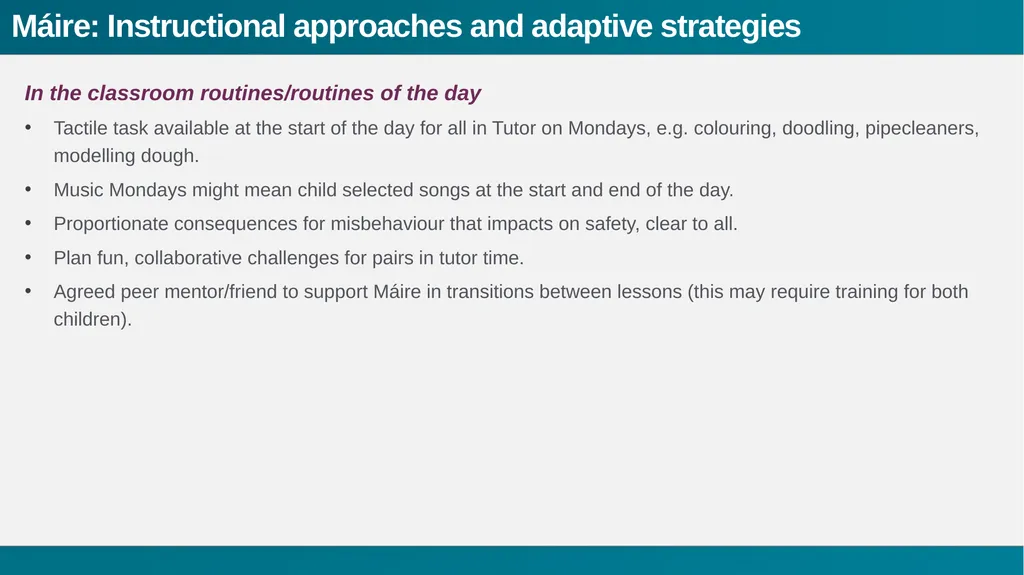
In the classroom routines/routines of the day
Tactile task available at the start of the day for all in Tutor on Mondays, e.g. colouring, doodling, pipecleaners, modelling dough.
Music Mondays might mean child selected songs at the start and end of the day.
Proportionate consequences for misbehaviour that impacts on safety, clear to all.
Plan fun, collaborative challenges for pairs in tutor time.
Agreed peer mentor/friend to support Máire in transitions between lessons (this may require training for both children). Máire: Instructional approaches and adaptive strategies<br>
Tactile task available at the start of the day for all in Tutor on Mondays, e.g. colouring, doodling, pipecleaners, modelling dough.
Music Mondays might mean child selected songs at the start and end of the day.
Proportionate consequences for misbehaviour that impacts on safety, clear to all.
Plan fun, collaborative challenges for pairs in tutor time.
Agreed peer mentor/friend to support Máire in transitions between lessons (this may require training for both children). Máire: Instructional approaches and adaptive strategies<br>
17
Máire: Instructional approaches and adaptive strategies In the language used
Kind tone and careful choice of words
Consistent tone for any language that may have a neutral or negative connotation for Máire. Model light and higher register for language that you want her to associate with feeling happy, positive, encouraged or excited.
Encouraging language that is designed to build intrinsic motivation – not just ‘good’ or ‘well done’, but ‘I really liked that because…’
Modelling positive attitudes to reading and writing and making relevant to real life situations
Open body language where possible, (low shoulders, arms uncrossed, palms outward) to role model a stance that is not defensive.
Word corrections in the positive, e.g. ‘Don’t call out’ becomes, ‘Thanks for your point, but put your hand up first’; ‘Stop shouting!’ becomes, ‘Use quiet voices’.<br>
Kind tone and careful choice of words
Consistent tone for any language that may have a neutral or negative connotation for Máire. Model light and higher register for language that you want her to associate with feeling happy, positive, encouraged or excited.
Encouraging language that is designed to build intrinsic motivation – not just ‘good’ or ‘well done’, but ‘I really liked that because…’
Modelling positive attitudes to reading and writing and making relevant to real life situations
Open body language where possible, (low shoulders, arms uncrossed, palms outward) to role model a stance that is not defensive.
Word corrections in the positive, e.g. ‘Don’t call out’ becomes, ‘Thanks for your point, but put your hand up first’; ‘Stop shouting!’ becomes, ‘Use quiet voices’.<br>
18
Máire: Instructional approaches and adaptive strategies In the English curriculum (and other subjects)
Use of sequenced lessons with explicit links to each other and to prior modules of learning.
Use of familiar content to link to new content in a structured way – supporting risk taking in learning.
Use of subtitles with any film clip to encourage connection between reading and spoken word.
Giving students options to use writing frames or other scaffolding for main tasks.
In the task design
Use of resources that include those that are environmentally and culturally familiar (e.g. range of books that include traveller families).
Visually accessible layout of worksheet or prompt (this may be a scaffold necessary for just one or two children).
Consideration as a department of designing contexts for writing with a purpose that would have relevance or<br>
Use of sequenced lessons with explicit links to each other and to prior modules of learning.
Use of familiar content to link to new content in a structured way – supporting risk taking in learning.
Use of subtitles with any film clip to encourage connection between reading and spoken word.
Giving students options to use writing frames or other scaffolding for main tasks.
In the task design
Use of resources that include those that are environmentally and culturally familiar (e.g. range of books that include traveller families).
Visually accessible layout of worksheet or prompt (this may be a scaffold necessary for just one or two children).
Consideration as a department of designing contexts for writing with a purpose that would have relevance or<br>
19
Máire: Instructional approaches and adaptive strategies From the adults in the class
Knowledge of behaviour as a communicative function – recognising Máire’s anxiety and concerns about how she thinks others might see her and sensitivity to her wish not to be stigmatised as a traveller child.
Recognition that inconsistencies in her behaviour are consistent in children with similar needs. It is credible for Máire to enjoy singing to everyone in tutor and still have social anxiety.
An understanding of the impact of poor attendance on the child’s esteem, as well as her achievement. Staff making comments about attendance to a child who has returned can inadvertently be shaming and make it harder to overcome the barriers to improving attendance.
Consideration of the provision of hard copy home-learning tasks to support progress in English while the family is travelling.
Modelling patience, kindness and clarity.<br>
Knowledge of behaviour as a communicative function – recognising Máire’s anxiety and concerns about how she thinks others might see her and sensitivity to her wish not to be stigmatised as a traveller child.
Recognition that inconsistencies in her behaviour are consistent in children with similar needs. It is credible for Máire to enjoy singing to everyone in tutor and still have social anxiety.
An understanding of the impact of poor attendance on the child’s esteem, as well as her achievement. Staff making comments about attendance to a child who has returned can inadvertently be shaming and make it harder to overcome the barriers to improving attendance.
Consideration of the provision of hard copy home-learning tasks to support progress in English while the family is travelling.
Modelling patience, kindness and clarity.<br>
20
Máire: Instructional approaches and adaptive strategies From the learners in the class
Fairness, kindness, genuine friendship.
Restorative actions, including accepting apology and genuine fresh starts.
Tolerance of Máire’s low esteem, but not feeling they have to ‘put up’ with poor behaviour.
Laugh with, never laugh at.
Classmates to use forms of praise which Máire (and others) enjoy and what type she finds difficult to cope with.
From the families
Communication between school and home could be improved through a trusted staff member acting as liaison.
What is the aspect of schooling that Máire’s parents would feel proud about, e.g. Design skills. Can these be recognised and celebrated even when DT is not being taught – e.g. are there opportunities in Tutor to regularly make things.<br>
Fairness, kindness, genuine friendship.
Restorative actions, including accepting apology and genuine fresh starts.
Tolerance of Máire’s low esteem, but not feeling they have to ‘put up’ with poor behaviour.
Laugh with, never laugh at.
Classmates to use forms of praise which Máire (and others) enjoy and what type she finds difficult to cope with.
From the families
Communication between school and home could be improved through a trusted staff member acting as liaison.
What is the aspect of schooling that Máire’s parents would feel proud about, e.g. Design skills. Can these be recognised and celebrated even when DT is not being taught – e.g. are there opportunities in Tutor to regularly make things.<br>
21
Tayla<br>
22
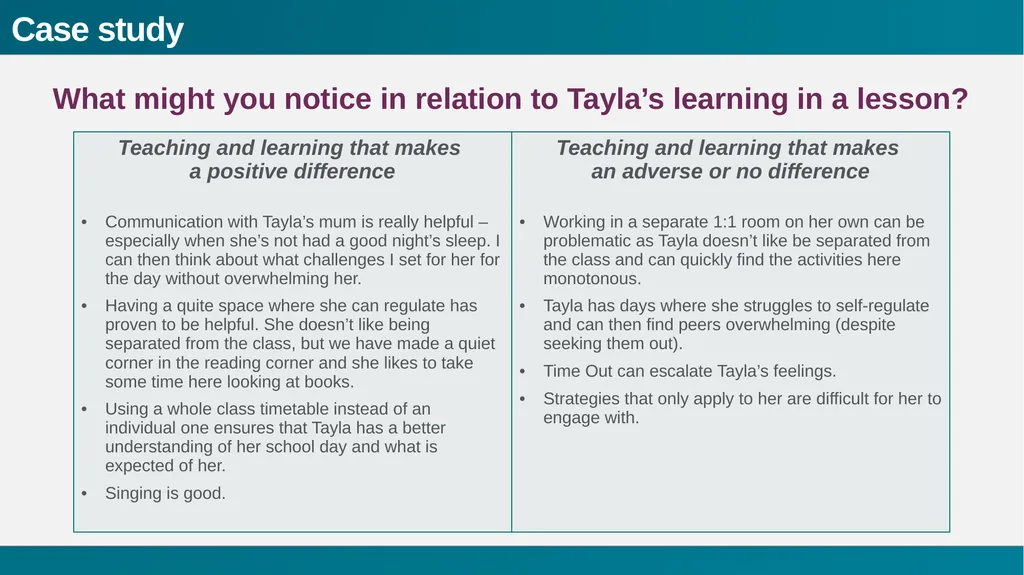
Case study What might you notice in relation to Tayla’s learning in a lesson?<br>
23
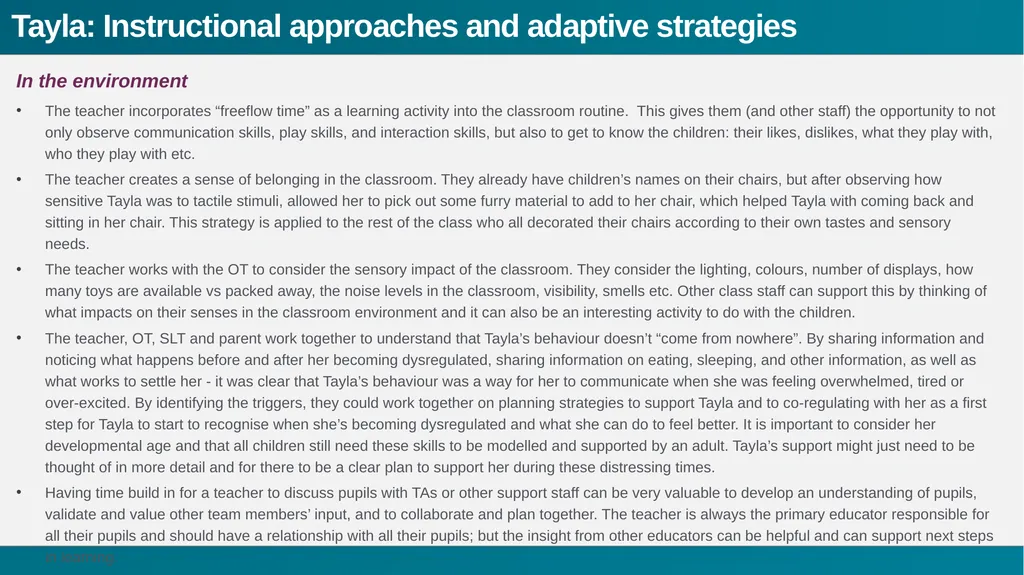
In the environment
The teacher incorporates “freeflow time” as a learning activity into the classroom routine. This gives them (and other staff) the opportunity to not only observe communication skills, play skills, and interaction skills, but also to get to know the children: their likes, dislikes, what they play with, who they play with etc.
The teacher creates a sense of belonging in the classroom. They already have children’s names on their chairs, but after observing how sensitive Tayla was to tactile stimuli, allowed her to pick out some furry material to add to her chair, which helped Tayla with coming back and sitting in her chair. This strategy is applied to the rest of the class who all decorated their chairs according to their own tastes and sensory needs.
The teacher works with the OT to consider the sensory impact of the classroom. They consider the lighting, colours, number of displays, how many toys are available vs packed away, the noise levels in the classroom, visibility, smells etc. Other class staff can support this by thinking of what impacts on their senses in the classroom environment and it can also be an interesting activity to do with the children.
The teacher, OT, SLT and parent work together to understand that Tayla’s behaviour doesn’t “come from nowhere”. By sharing information and noticing what happens before and after her becoming dysregulated, sharing information on eating, sleeping, and other information, as well as what works to settle her - it was clear that Tayla’s behaviour was a way for her to communicate when she was feeling overwhelmed, tired or over-excited. By identifying the triggers, they could work together on planning strategies to support Tayla and to co-regulating with her as a first step for Tayla to start to recognise when she’s becoming dysregulated and what she can do to feel better. It is important to consider her developmental age and that all children still need these skills to be modelled and supported by an adult. Tayla’s support might just need to be thought of in more detail and for there to be a clear plan to support her during these distressing times.
Having time build in for a teacher to discuss pupils with TAs or other support staff can be very valuable to develop an understanding of pupils, validate and value other team members’ input, and to collaborate and plan together. The teacher is always the primary educator responsible for all their pupils and should have a relationship with all their pupils; but the insight from other educators can be helpful and can support next steps in learning. Tayla: Instructional approaches and adaptive strategies<br>
The teacher incorporates “freeflow time” as a learning activity into the classroom routine. This gives them (and other staff) the opportunity to not only observe communication skills, play skills, and interaction skills, but also to get to know the children: their likes, dislikes, what they play with, who they play with etc.
The teacher creates a sense of belonging in the classroom. They already have children’s names on their chairs, but after observing how sensitive Tayla was to tactile stimuli, allowed her to pick out some furry material to add to her chair, which helped Tayla with coming back and sitting in her chair. This strategy is applied to the rest of the class who all decorated their chairs according to their own tastes and sensory needs.
The teacher works with the OT to consider the sensory impact of the classroom. They consider the lighting, colours, number of displays, how many toys are available vs packed away, the noise levels in the classroom, visibility, smells etc. Other class staff can support this by thinking of what impacts on their senses in the classroom environment and it can also be an interesting activity to do with the children.
The teacher, OT, SLT and parent work together to understand that Tayla’s behaviour doesn’t “come from nowhere”. By sharing information and noticing what happens before and after her becoming dysregulated, sharing information on eating, sleeping, and other information, as well as what works to settle her - it was clear that Tayla’s behaviour was a way for her to communicate when she was feeling overwhelmed, tired or over-excited. By identifying the triggers, they could work together on planning strategies to support Tayla and to co-regulating with her as a first step for Tayla to start to recognise when she’s becoming dysregulated and what she can do to feel better. It is important to consider her developmental age and that all children still need these skills to be modelled and supported by an adult. Tayla’s support might just need to be thought of in more detail and for there to be a clear plan to support her during these distressing times.
Having time build in for a teacher to discuss pupils with TAs or other support staff can be very valuable to develop an understanding of pupils, validate and value other team members’ input, and to collaborate and plan together. The teacher is always the primary educator responsible for all their pupils and should have a relationship with all their pupils; but the insight from other educators can be helpful and can support next steps in learning. Tayla: Instructional approaches and adaptive strategies<br>
24
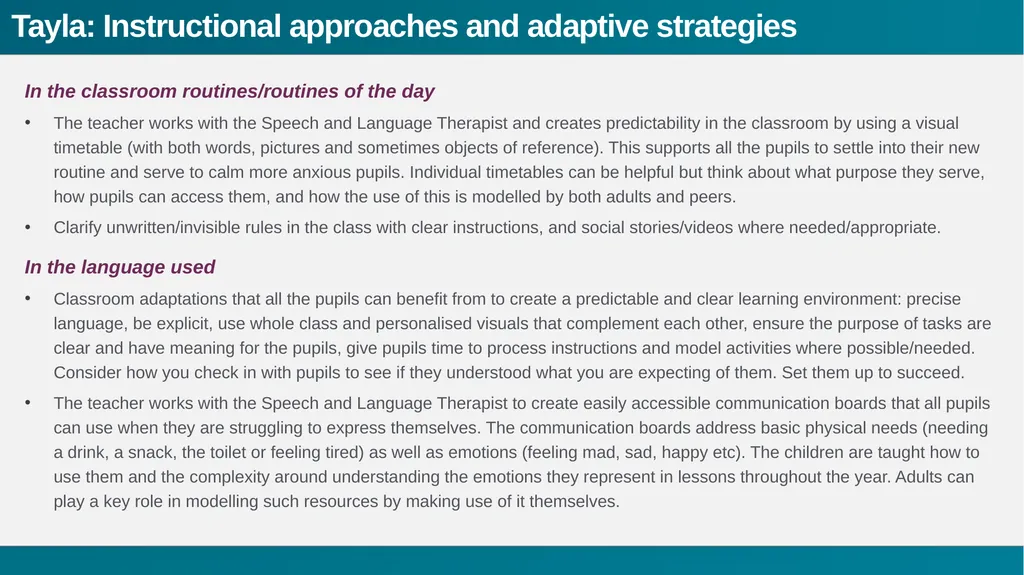
In the classroom routines/routines of the day
The teacher works with the Speech and Language Therapist and creates predictability in the classroom by using a visual timetable (with both words, pictures and sometimes objects of reference). This supports all the pupils to settle into their new routine and serve to calm more anxious pupils. Individual timetables can be helpful but think about what purpose they serve, how pupils can access them, and how the use of this is modelled by both adults and peers.
Clarify unwritten/invisible rules in the class with clear instructions, and social stories/videos where needed/appropriate.
In the language used
Classroom adaptations that all the pupils can benefit from to create a predictable and clear learning environment: precise language, be explicit, use whole class and personalised visuals that complement each other, ensure the purpose of tasks are clear and have meaning for the pupils, give pupils time to process instructions and model activities where possible/needed. Consider how you check in with pupils to see if they understood what you are expecting of them. Set them up to succeed.
The teacher works with the Speech and Language Therapist to create easily accessible communication boards that all pupils can use when they are struggling to express themselves. The communication boards address basic physical needs (needing a drink, a snack, the toilet or feeling tired) as well as emotions (feeling mad, sad, happy etc). The children are taught how to use them and the complexity around understanding the emotions they represent in lessons throughout the year. Adults can play a key role in modelling such resources by making use of it themselves. Tayla: Instructional approaches and adaptive strategies<br>
The teacher works with the Speech and Language Therapist and creates predictability in the classroom by using a visual timetable (with both words, pictures and sometimes objects of reference). This supports all the pupils to settle into their new routine and serve to calm more anxious pupils. Individual timetables can be helpful but think about what purpose they serve, how pupils can access them, and how the use of this is modelled by both adults and peers.
Clarify unwritten/invisible rules in the class with clear instructions, and social stories/videos where needed/appropriate.
In the language used
Classroom adaptations that all the pupils can benefit from to create a predictable and clear learning environment: precise language, be explicit, use whole class and personalised visuals that complement each other, ensure the purpose of tasks are clear and have meaning for the pupils, give pupils time to process instructions and model activities where possible/needed. Consider how you check in with pupils to see if they understood what you are expecting of them. Set them up to succeed.
The teacher works with the Speech and Language Therapist to create easily accessible communication boards that all pupils can use when they are struggling to express themselves. The communication boards address basic physical needs (needing a drink, a snack, the toilet or feeling tired) as well as emotions (feeling mad, sad, happy etc). The children are taught how to use them and the complexity around understanding the emotions they represent in lessons throughout the year. Adults can play a key role in modelling such resources by making use of it themselves. Tayla: Instructional approaches and adaptive strategies<br>
25
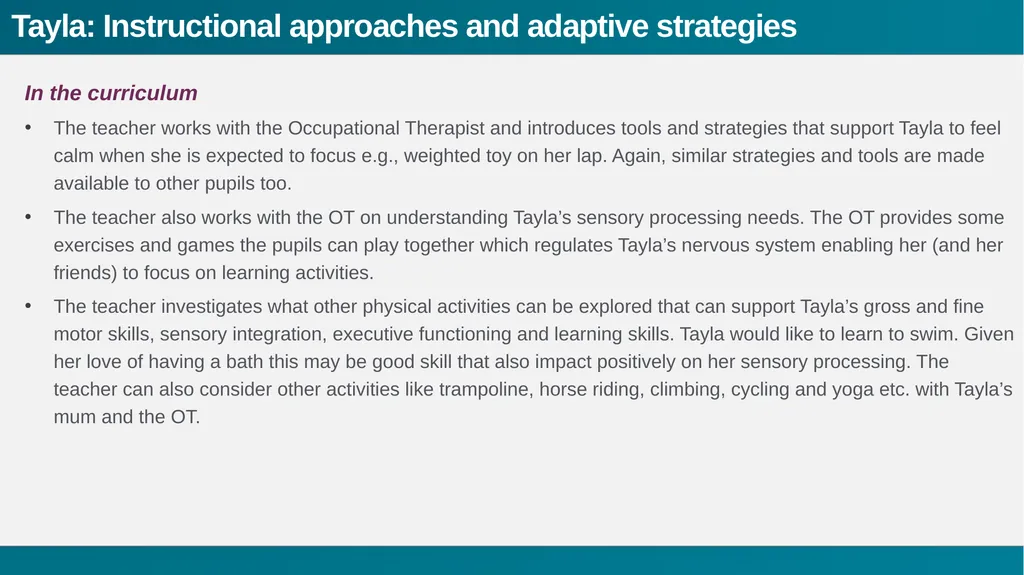
Tayla: Instructional approaches and adaptive strategies In the curriculum
The teacher works with the Occupational Therapist and introduces tools and strategies that support Tayla to feel calm when she is expected to focus e.g., weighted toy on her lap. Again, similar strategies and tools are made available to other pupils too.
The teacher also works with the OT on understanding Tayla’s sensory processing needs. The OT provides some exercises and games the pupils can play together which regulates Tayla’s nervous system enabling her (and her friends) to focus on learning activities.
The teacher investigates what other physical activities can be explored that can support Tayla’s gross and fine motor skills, sensory integration, executive functioning and learning skills. Tayla would like to learn to swim. Given her love of having a bath this may be good skill that also impact positively on her sensory processing. The teacher can also consider other activities like trampoline, horse riding, climbing, cycling and yoga etc. with Tayla’s mum and the OT.<br>
The teacher works with the Occupational Therapist and introduces tools and strategies that support Tayla to feel calm when she is expected to focus e.g., weighted toy on her lap. Again, similar strategies and tools are made available to other pupils too.
The teacher also works with the OT on understanding Tayla’s sensory processing needs. The OT provides some exercises and games the pupils can play together which regulates Tayla’s nervous system enabling her (and her friends) to focus on learning activities.
The teacher investigates what other physical activities can be explored that can support Tayla’s gross and fine motor skills, sensory integration, executive functioning and learning skills. Tayla would like to learn to swim. Given her love of having a bath this may be good skill that also impact positively on her sensory processing. The teacher can also consider other activities like trampoline, horse riding, climbing, cycling and yoga etc. with Tayla’s mum and the OT.<br>
26
Tayla: Instructional approaches and adaptive strategies In the task design
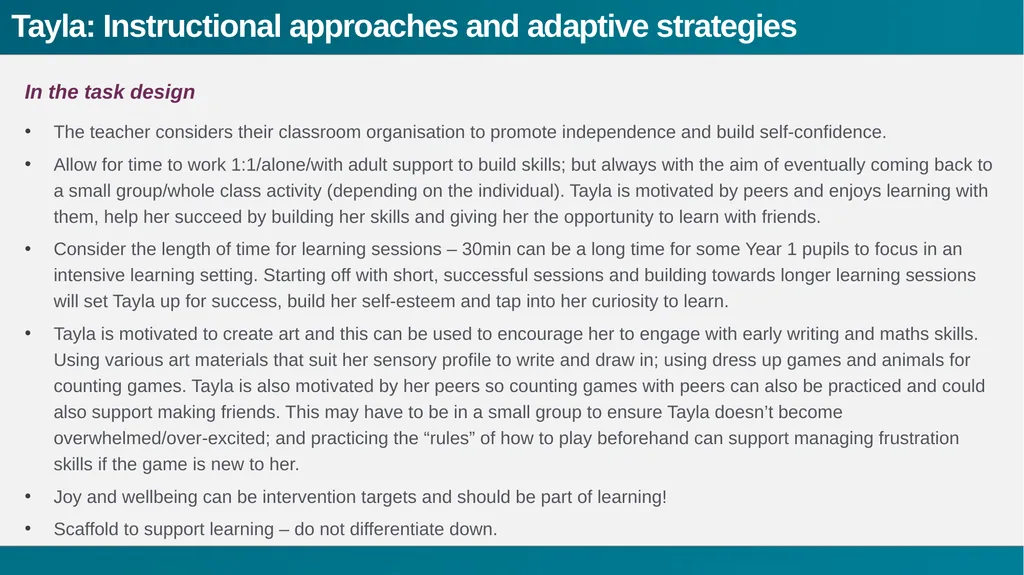
The teacher considers their classroom organisation to promote independence and build self-confidence.
Allow for time to work 1:1/alone/with adult support to build skills; but always with the aim of eventually coming back to a small group/whole class activity (depending on the individual). Tayla is motivated by peers and enjoys learning with them, help her succeed by building her skills and giving her the opportunity to learn with friends.
Consider the length of time for learning sessions – 30min can be a long time for some Year 1 pupils to focus in an intensive learning setting. Starting off with short, successful sessions and building towards longer learning sessions will set Tayla up for success, build her self-esteem and tap into her curiosity to learn.
Tayla is motivated to create art and this can be used to encourage her to engage with early writing and maths skills. Using various art materials that suit her sensory profile to write and draw in; using dress up games and animals for counting games. Tayla is also motivated by her peers so counting games with peers can also be practiced and could also support making friends. This may have to be in a small group to ensure Tayla doesn’t become overwhelmed/over-excited; and practicing the “rules” of how to play beforehand can support managing frustration skills if the game is new to her.
Joy and wellbeing can be intervention targets and should be part of learning!
Scaffold to support learning – do not differentiate down.<br>
The teacher considers their classroom organisation to promote independence and build self-confidence.
Allow for time to work 1:1/alone/with adult support to build skills; but always with the aim of eventually coming back to a small group/whole class activity (depending on the individual). Tayla is motivated by peers and enjoys learning with them, help her succeed by building her skills and giving her the opportunity to learn with friends.
Consider the length of time for learning sessions – 30min can be a long time for some Year 1 pupils to focus in an intensive learning setting. Starting off with short, successful sessions and building towards longer learning sessions will set Tayla up for success, build her self-esteem and tap into her curiosity to learn.
Tayla is motivated to create art and this can be used to encourage her to engage with early writing and maths skills. Using various art materials that suit her sensory profile to write and draw in; using dress up games and animals for counting games. Tayla is also motivated by her peers so counting games with peers can also be practiced and could also support making friends. This may have to be in a small group to ensure Tayla doesn’t become overwhelmed/over-excited; and practicing the “rules” of how to play beforehand can support managing frustration skills if the game is new to her.
Joy and wellbeing can be intervention targets and should be part of learning!
Scaffold to support learning – do not differentiate down.<br>
27
Tayla: Instructional approaches and adaptive strategies From the adults in the class
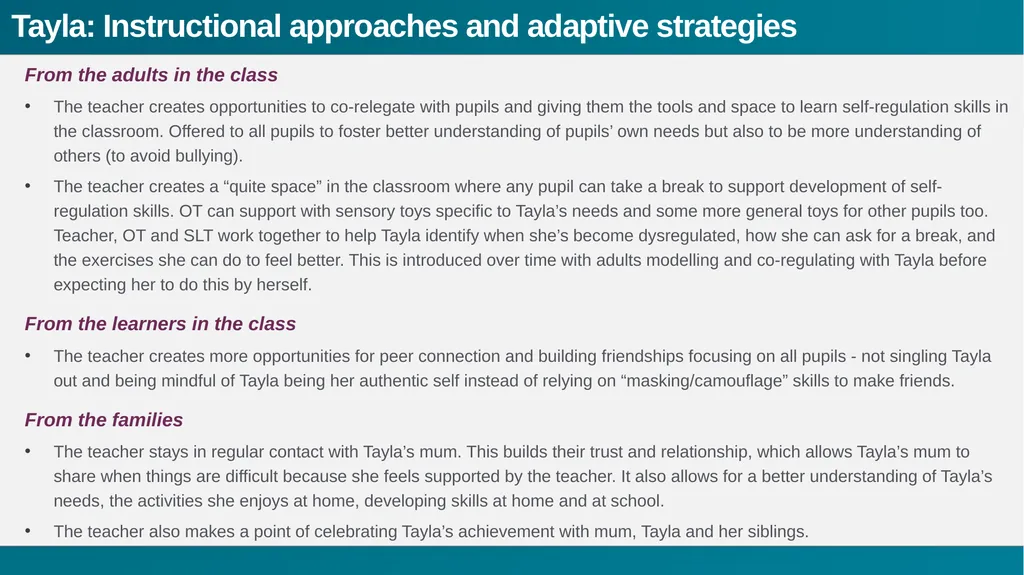
The teacher creates opportunities to co-relegate with pupils and giving them the tools and space to learn self-regulation skills in the classroom. Offered to all pupils to foster better understanding of pupils’ own needs but also to be more understanding of others (to avoid bullying).
The teacher creates a “quite space” in the classroom where any pupil can take a break to support development of self-regulation skills. OT can support with sensory toys specific to Tayla’s needs and some more general toys for other pupils too. Teacher, OT and SLT work together to help Tayla identify when she’s become dysregulated, how she can ask for a break, and the exercises she can do to feel better. This is introduced over time with adults modelling and co-regulating with Tayla before expecting her to do this by herself.
From the learners in the class
The teacher creates more opportunities for peer connection and building friendships focusing on all pupils - not singling Tayla out and being mindful of Tayla being her authentic self instead of relying on “masking/camouflage” skills to make friends.
From the families
The teacher stays in regular contact with Tayla’s mum. This builds their trust and relationship, which allows Tayla’s mum to share when things are difficult because she feels supported by the teacher. It also allows for a better understanding of Tayla’s needs, the activities she enjoys at home, developing skills at home and at school.
The teacher also makes a point of celebrating Tayla’s achievement with mum, Tayla and her siblings.<br>
The teacher creates opportunities to co-relegate with pupils and giving them the tools and space to learn self-regulation skills in the classroom. Offered to all pupils to foster better understanding of pupils’ own needs but also to be more understanding of others (to avoid bullying).
The teacher creates a “quite space” in the classroom where any pupil can take a break to support development of self-regulation skills. OT can support with sensory toys specific to Tayla’s needs and some more general toys for other pupils too. Teacher, OT and SLT work together to help Tayla identify when she’s become dysregulated, how she can ask for a break, and the exercises she can do to feel better. This is introduced over time with adults modelling and co-regulating with Tayla before expecting her to do this by herself.
From the learners in the class
The teacher creates more opportunities for peer connection and building friendships focusing on all pupils - not singling Tayla out and being mindful of Tayla being her authentic self instead of relying on “masking/camouflage” skills to make friends.
From the families
The teacher stays in regular contact with Tayla’s mum. This builds their trust and relationship, which allows Tayla’s mum to share when things are difficult because she feels supported by the teacher. It also allows for a better understanding of Tayla’s needs, the activities she enjoys at home, developing skills at home and at school.
The teacher also makes a point of celebrating Tayla’s achievement with mum, Tayla and her siblings.<br>
28
Tomas<br>
29
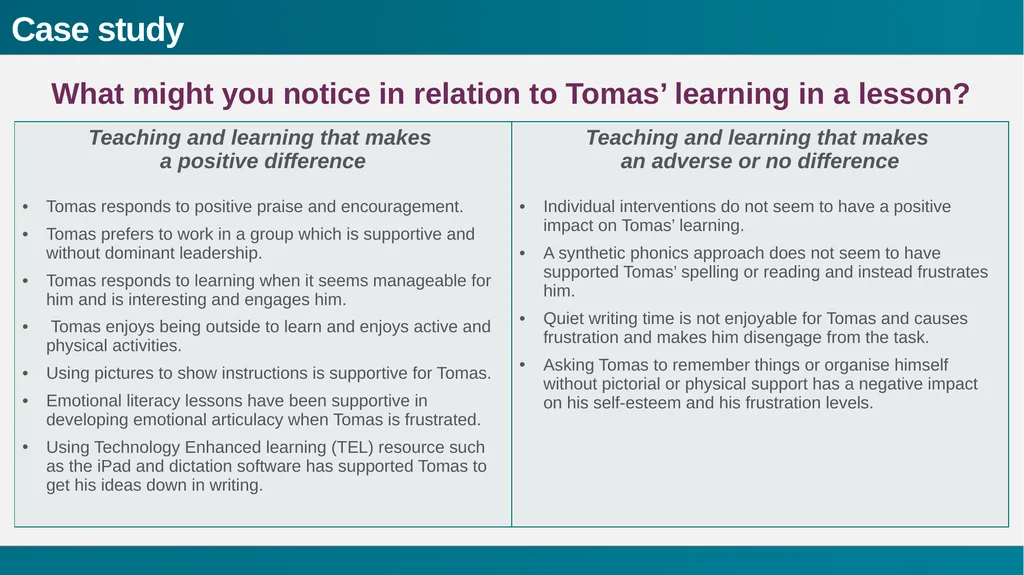
Case study What might you notice in relation to Tomas’ learning in a lesson?<br>
30
Tomas: Instructional approaches and adaptive strategies In the environment
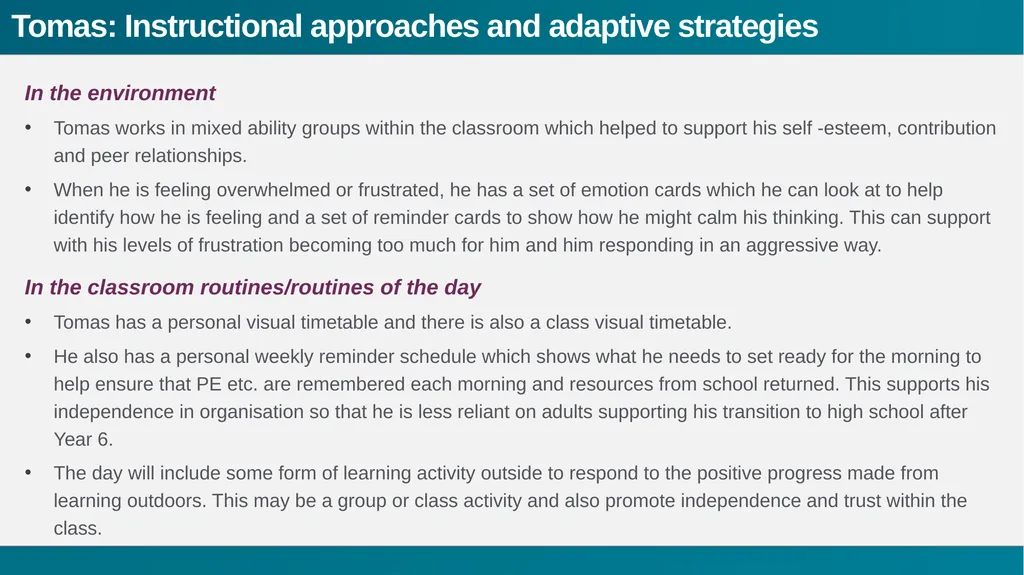
Tomas works in mixed ability groups within the classroom which helped to support his self -esteem, contribution and peer relationships.
When he is feeling overwhelmed or frustrated, he has a set of emotion cards which he can look at to help identify how he is feeling and a set of reminder cards to show how he might calm his thinking. This can support with his levels of frustration becoming too much for him and him responding in an aggressive way.
In the classroom routines/routines of the day
Tomas has a personal visual timetable and there is also a class visual timetable.
He also has a personal weekly reminder schedule which shows what he needs to set ready for the morning to help ensure that PE etc. are remembered each morning and resources from school returned. This supports his independence in organisation so that he is less reliant on adults supporting his transition to high school after Year 6.
The day will include some form of learning activity outside to respond to the positive progress made from learning outdoors. This may be a group or class activity and also promote independence and trust within the class.<br>
Tomas works in mixed ability groups within the classroom which helped to support his self -esteem, contribution and peer relationships.
When he is feeling overwhelmed or frustrated, he has a set of emotion cards which he can look at to help identify how he is feeling and a set of reminder cards to show how he might calm his thinking. This can support with his levels of frustration becoming too much for him and him responding in an aggressive way.
In the classroom routines/routines of the day
Tomas has a personal visual timetable and there is also a class visual timetable.
He also has a personal weekly reminder schedule which shows what he needs to set ready for the morning to help ensure that PE etc. are remembered each morning and resources from school returned. This supports his independence in organisation so that he is less reliant on adults supporting his transition to high school after Year 6.
The day will include some form of learning activity outside to respond to the positive progress made from learning outdoors. This may be a group or class activity and also promote independence and trust within the class.<br>
31
Tomas: Instructional approaches and adaptive strategies In the language used
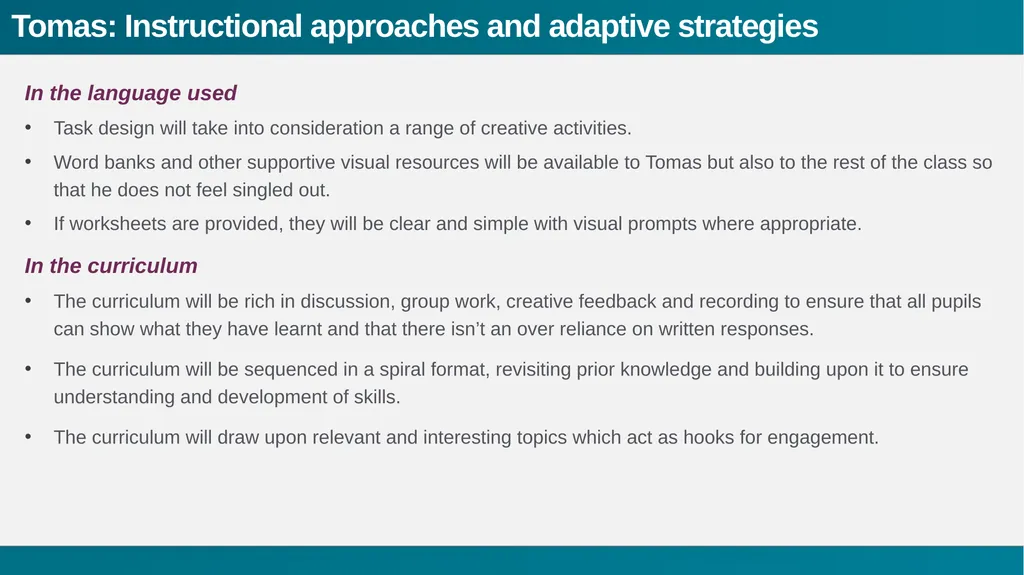
Task design will take into consideration a range of creative activities.
Word banks and other supportive visual resources will be available to Tomas but also to the rest of the class so that he does not feel singled out.
If worksheets are provided, they will be clear and simple with visual prompts where appropriate.
In the curriculum
The curriculum will be rich in discussion, group work, creative feedback and recording to ensure that all pupils can show what they have learnt and that there isn’t an over reliance on written responses.
The curriculum will be sequenced in a spiral format, revisiting prior knowledge and building upon it to ensure understanding and development of skills.
The curriculum will draw upon relevant and interesting topics which act as hooks for engagement.<br>
Task design will take into consideration a range of creative activities.
Word banks and other supportive visual resources will be available to Tomas but also to the rest of the class so that he does not feel singled out.
If worksheets are provided, they will be clear and simple with visual prompts where appropriate.
In the curriculum
The curriculum will be rich in discussion, group work, creative feedback and recording to ensure that all pupils can show what they have learnt and that there isn’t an over reliance on written responses.
The curriculum will be sequenced in a spiral format, revisiting prior knowledge and building upon it to ensure understanding and development of skills.
The curriculum will draw upon relevant and interesting topics which act as hooks for engagement.<br>
32
Tomas: Instructional approaches and adaptive strategies In the task design
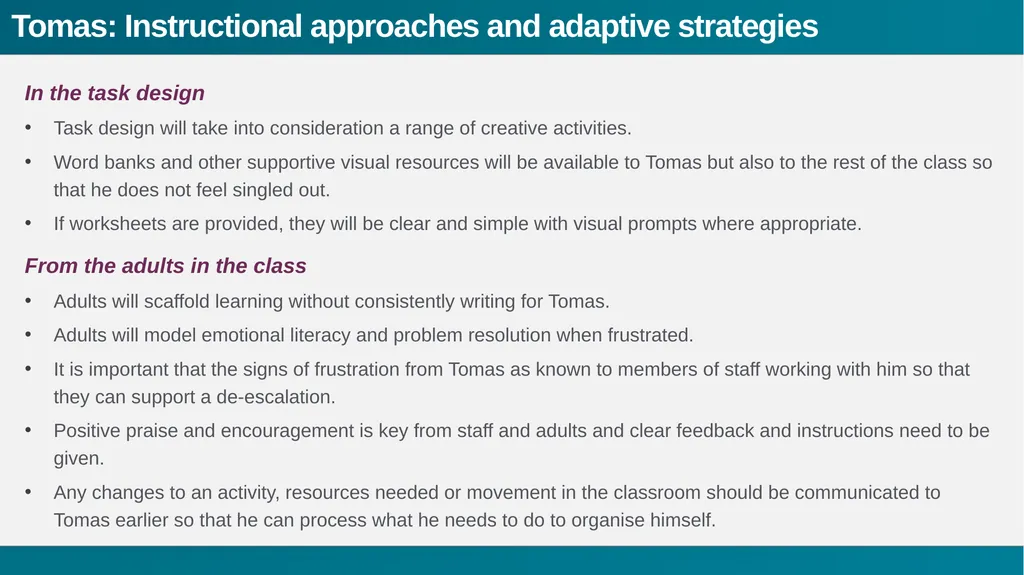
Task design will take into consideration a range of creative activities.
Word banks and other supportive visual resources will be available to Tomas but also to the rest of the class so that he does not feel singled out.
If worksheets are provided, they will be clear and simple with visual prompts where appropriate.
From the adults in the class
Adults will scaffold learning without consistently writing for Tomas.
Adults will model emotional literacy and problem resolution when frustrated.
It is important that the signs of frustration from Tomas as known to members of staff working with him so that they can support a de-escalation.
Positive praise and encouragement is key from staff and adults and clear feedback and instructions need to be given.
Any changes to an activity, resources needed or movement in the classroom should be communicated to Tomas earlier so that he can process what he needs to do to organise himself.<br>
Task design will take into consideration a range of creative activities.
Word banks and other supportive visual resources will be available to Tomas but also to the rest of the class so that he does not feel singled out.
If worksheets are provided, they will be clear and simple with visual prompts where appropriate.
From the adults in the class
Adults will scaffold learning without consistently writing for Tomas.
Adults will model emotional literacy and problem resolution when frustrated.
It is important that the signs of frustration from Tomas as known to members of staff working with him so that they can support a de-escalation.
Positive praise and encouragement is key from staff and adults and clear feedback and instructions need to be given.
Any changes to an activity, resources needed or movement in the classroom should be communicated to Tomas earlier so that he can process what he needs to do to organise himself.<br>
33
Tomas: Instructional approaches and adaptive strategies From the learners in the class
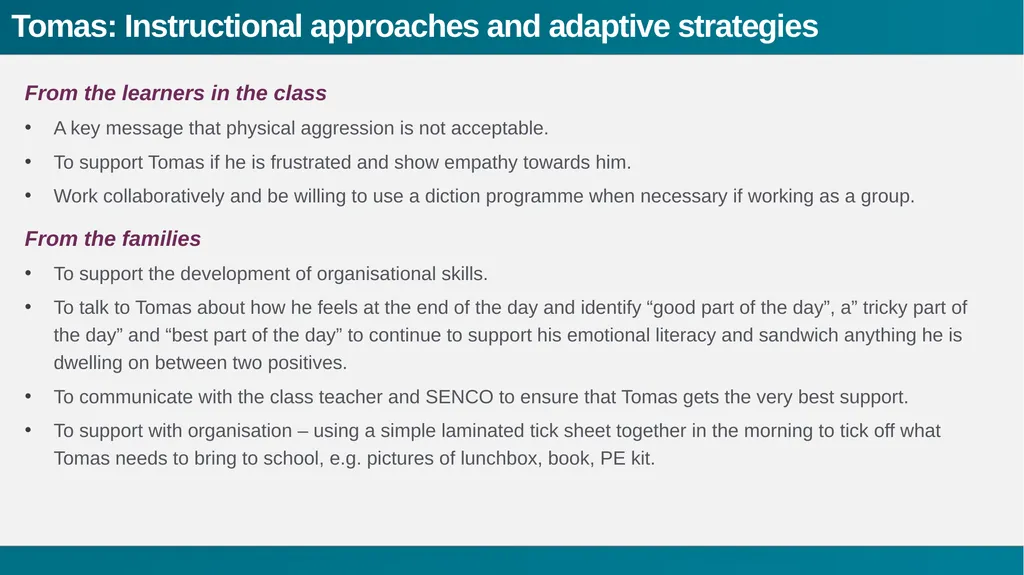
A key message that physical aggression is not acceptable.
To support Tomas if he is frustrated and show empathy towards him.
Work collaboratively and be willing to use a diction programme when necessary if working as a group.
From the families
To support the development of organisational skills.
To talk to Tomas about how he feels at the end of the day and identify “good part of the day”, a” tricky part of the day” and “best part of the day” to continue to support his emotional literacy and sandwich anything he is dwelling on between two positives.
To communicate with the class teacher and SENCO to ensure that Tomas gets the very best support.
To support with organisation – using a simple laminated tick sheet together in the morning to tick off what Tomas needs to bring to school, e.g. pictures of lunchbox, book, PE kit.<br>
A key message that physical aggression is not acceptable.
To support Tomas if he is frustrated and show empathy towards him.
Work collaboratively and be willing to use a diction programme when necessary if working as a group.
From the families
To support the development of organisational skills.
To talk to Tomas about how he feels at the end of the day and identify “good part of the day”, a” tricky part of the day” and “best part of the day” to continue to support his emotional literacy and sandwich anything he is dwelling on between two positives.
To communicate with the class teacher and SENCO to ensure that Tomas gets the very best support.
To support with organisation – using a simple laminated tick sheet together in the morning to tick off what Tomas needs to bring to school, e.g. pictures of lunchbox, book, PE kit.<br>
34
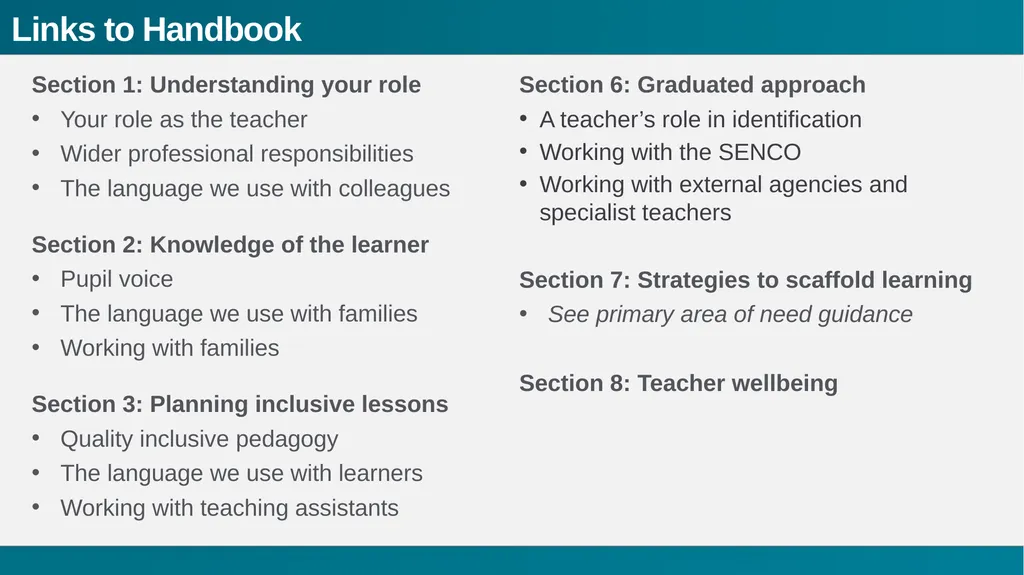
Links to Handbook Section 1: Understanding your role
Your role as the teacher
Wider professional responsibilities
The language we use with colleagues
Section 2: Knowledge of the learner
Pupil voice
The language we use with families
Working with families
Section 3: Planning inclusive lessons
Quality inclusive pedagogy
The language we use with learners
Working with teaching assistants Section 6: Graduated approach
A teacher’s role in identification
Working with the SENCO
Working with external agencies and specialist teachers
Section 7: Strategies to scaffold learning
See primary area of need guidance
Section 8: Teacher wellbeing<br>
Your role as the teacher
Wider professional responsibilities
The language we use with colleagues
Section 2: Knowledge of the learner
Pupil voice
The language we use with families
Working with families
Section 3: Planning inclusive lessons
Quality inclusive pedagogy
The language we use with learners
Working with teaching assistants Section 6: Graduated approach
A teacher’s role in identification
Working with the SENCO
Working with external agencies and specialist teachers
Section 7: Strategies to scaffold learning
See primary area of need guidance
Section 8: Teacher wellbeing<br>
35
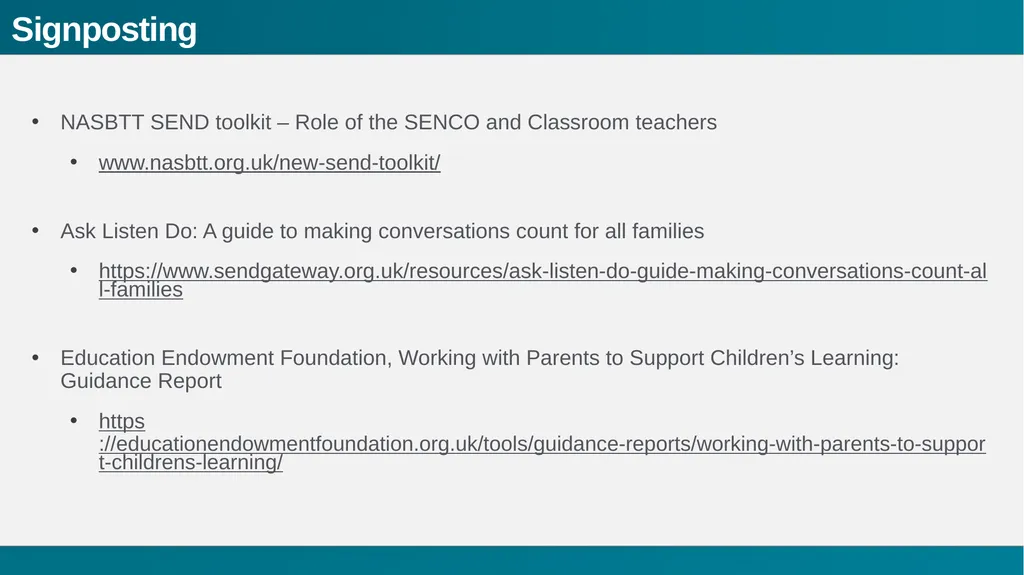
Signposting NASBTT SEND toolkit – Role of the SENCO and Classroom teachers
www.nasbtt.org.uk/new-send-toolkit/
Ask Listen Do: A guide to making conversations count for all families
https://www.sendgateway.org.uk/resources/ask-listen-do-guide-making-conversations-count-all-families
Education Endowment Foundation, Working with Parents to Support Children’s Learning: Guidance Report
https://educationendowmentfoundation.org.uk/tools/guidance-reports/working-with-parents-to-support-childrens-learning/<br>
www.nasbtt.org.uk/new-send-toolkit/
Ask Listen Do: A guide to making conversations count for all families
https://www.sendgateway.org.uk/resources/ask-listen-do-guide-making-conversations-count-all-families
Education Endowment Foundation, Working with Parents to Support Children’s Learning: Guidance Report
https://educationendowmentfoundation.org.uk/tools/guidance-reports/working-with-parents-to-support-childrens-learning/<br>