
Slide Set 02C: Introduction to the Law
MS
Published · 39 slides · 0 views

1 / 1

Description
Slide Set 02C: Introduction to the Law Constitutions 1 Last Time We Spoke About: Website: www.bobfarley.us Your Biography: If you havent already, please hand it in. Class Schedule:
Related Topics
Share
Embed code
Download this presentation From Below
"Slide Set 02C: Introduction to the Law" is the property of its rightful owner. Permission is granted to download and print the materials on this website for personal, non-commercial use only, and to display it on your personal computer provided you do not modify the materials and that you retain all copyright notices contained in the materials. By downloading content from our website, you accept the terms of this agreement.
Presentation Transcript
01
Slide Set 02C:
Introduction to the Law
Constitutions 1<br>
Introduction to the Law
Constitutions 1<br>
02
Last Time – We Spoke About:
Website: www.bobfarley.us
Your Biography: If you haven’t already, please hand it in.
Class Schedule:
http:/www.bobfarley.us/300lawclasses/315businesslaw/schedule.pdf
Class Syllabus:
http:/www.bobfarley.us/300lawclasses/315businesslaw/syllabus.pdf
Class Format and Grading Information:
http:/www.bobfarley.us/300lawclasses/315businesslaw/format.pdf
Contact Us:
Email – bobfarley@bobfarley.us
Phone/Text – (518) 986-2037
In Person – By Appointment 2<br>
Website: www.bobfarley.us
Your Biography: If you haven’t already, please hand it in.
Class Schedule:
http:/www.bobfarley.us/300lawclasses/315businesslaw/schedule.pdf
Class Syllabus:
http:/www.bobfarley.us/300lawclasses/315businesslaw/syllabus.pdf
Class Format and Grading Information:
http:/www.bobfarley.us/300lawclasses/315businesslaw/format.pdf
Contact Us:
Email – bobfarley@bobfarley.us
Phone/Text – (518) 986-2037
In Person – By Appointment 2<br>
03
Tonight – We Will Speak About:
What is the Law?
Part One: Definitions / Types of Law / Priority of Laws
What is a Right:
Part Two: Definitions / Natural Law / The Declaration
Constitutions:
Part Three: Creation/ Federal and State / Govt Structure / Rights
Case Study – Marbury v. Madison:
The Start of Judicial Review 3<br>
What is the Law?
Part One: Definitions / Types of Law / Priority of Laws
What is a Right:
Part Two: Definitions / Natural Law / The Declaration
Constitutions:
Part Three: Creation/ Federal and State / Govt Structure / Rights
Case Study – Marbury v. Madison:
The Start of Judicial Review 3<br>
04
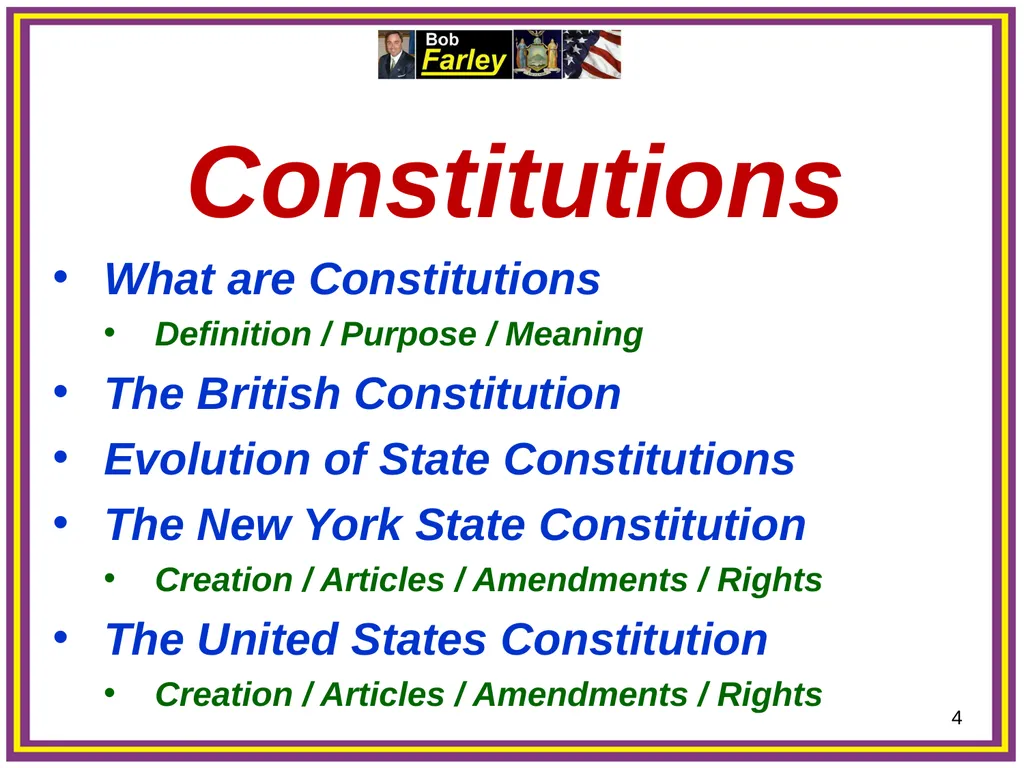
Constitutions
What are Constitutions
Definition / Purpose / Meaning
The British Constitution
Evolution of State Constitutions
The New York State Constitution
Creation / Articles / Amendments / Rights
The United States Constitution
Creation / Articles / Amendments / Rights 4<br>
What are Constitutions
Definition / Purpose / Meaning
The British Constitution
Evolution of State Constitutions
The New York State Constitution
Creation / Articles / Amendments / Rights
The United States Constitution
Creation / Articles / Amendments / Rights 4<br>
05
What Are Constitutions 5<br>
06
What Are Constitutions
Definition
Black’s Law Dictionary defines the term “Constitution” as:
“The fundamental and organic law of a nation or state that establishes the institutions and apparatus of government, defines the scope of governmental sovereign powers, and guarantees individual civil rights and civil liberties.” 6<br>
Definition
Black’s Law Dictionary defines the term “Constitution” as:
“The fundamental and organic law of a nation or state that establishes the institutions and apparatus of government, defines the scope of governmental sovereign powers, and guarantees individual civil rights and civil liberties.” 6<br>
07
What Are Constitutions
Purpose
Accordingly, the purpose of a constitution, and the component parts of its provisions are:
To Establish the Structure of Government;
Define the Powers of Each Structure; and
Enumerate the Rights of Citizens. 7<br>
Purpose
Accordingly, the purpose of a constitution, and the component parts of its provisions are:
To Establish the Structure of Government;
Define the Powers of Each Structure; and
Enumerate the Rights of Citizens. 7<br>
08
What Are Constitutions
Meaning
Fundamental and Organic: Constitutions, as defined by Black, are the fundamental and organic law of a nation or a state, meaning that they represent the principles, culture and beliefs, as embodied by law, of the rulers and citizens of that nation or state.
Supreme Law: Constitutions are the supreme law of the land
Concrete: Constitutions are designed to be semi permanent, long lasting and difficult to amend. Most all are written, and in free governments, they are frequently ratified by the nation’s citizens. 8<br>
Meaning
Fundamental and Organic: Constitutions, as defined by Black, are the fundamental and organic law of a nation or a state, meaning that they represent the principles, culture and beliefs, as embodied by law, of the rulers and citizens of that nation or state.
Supreme Law: Constitutions are the supreme law of the land
Concrete: Constitutions are designed to be semi permanent, long lasting and difficult to amend. Most all are written, and in free governments, they are frequently ratified by the nation’s citizens. 8<br>
09
The British Constitution 9<br>
10
The British Constitution
History
Our First Constitution: The first constitution for America was the British Constitution.
As former British Colonies, the British Constitution, and the laws recognized thereunder, were the laws of pre-revolutionary America.
Officially known as the Constitution of the United Kingdom, it is the system of rules that decides the political governance of Great Britain.
Not A Single Document: The British constitution is not codified into a single document.
What’s Contained in the British Constitution: The British Supreme Court, however, recognizes that there are certain constitutional principles, including parliamentary sovereignty, the rule of law, democracy, and upholding international law.
Certain Acts of the King and Parliament have Constitutional Status:
Magna Carta: The Court includes the Magna Carta in the British Constitution, which in 1215 required the King to call a "common counsel" (now called Parliament) to represent people, to hold courts in a fixed place, to guarantee fair trials, to guarantee free movement of people, to free the church from the state, and to guarantee rights of "common" people to use the land.
Parliamentary Acts: The Court also includes certain Acts of Parliament in the Constitution, including the Petition of Right Act of 1628, the Habeas Corpus Act of 1679, the Bill of Rights Act of 1689, and the Claim of Right Act of 1689.
These Acts guaranteed the petitioning of grievances, mandated the production of a body for criminal prosecution, cemented Parliament's supremacy over the monarch, the church and the courts, and declared that the "election of members of Parliament ought to be free". 10<br>
History
Our First Constitution: The first constitution for America was the British Constitution.
As former British Colonies, the British Constitution, and the laws recognized thereunder, were the laws of pre-revolutionary America.
Officially known as the Constitution of the United Kingdom, it is the system of rules that decides the political governance of Great Britain.
Not A Single Document: The British constitution is not codified into a single document.
What’s Contained in the British Constitution: The British Supreme Court, however, recognizes that there are certain constitutional principles, including parliamentary sovereignty, the rule of law, democracy, and upholding international law.
Certain Acts of the King and Parliament have Constitutional Status:
Magna Carta: The Court includes the Magna Carta in the British Constitution, which in 1215 required the King to call a "common counsel" (now called Parliament) to represent people, to hold courts in a fixed place, to guarantee fair trials, to guarantee free movement of people, to free the church from the state, and to guarantee rights of "common" people to use the land.
Parliamentary Acts: The Court also includes certain Acts of Parliament in the Constitution, including the Petition of Right Act of 1628, the Habeas Corpus Act of 1679, the Bill of Rights Act of 1689, and the Claim of Right Act of 1689.
These Acts guaranteed the petitioning of grievances, mandated the production of a body for criminal prosecution, cemented Parliament's supremacy over the monarch, the church and the courts, and declared that the "election of members of Parliament ought to be free". 10<br>
11
The British Constitution
Meaning
The Founders Understood Constitutional Government: Because America was governed under the law of the British Constitution prior to the Revolution, the founders had definite and real ideas about what a constitution should mean, and what rights should be protected by its provisions.
Sovereignty: Under the British Constitution, the King in Parliament are vested with the sovereignty of the British nation, meaning the powers over the government are vested in the government itself.
Americans, who held a revolution against rule by Great Britain, and specifically its King (George the III) and its Parliament (and the statutes its passed), were dedicated to end a sovereignty in government. That is why they specifically chose to vest the sovereignty of America, in the people of the United States, and not in government itself.
Rights: The British Constitution guarantees many rights to the British people under its Constitution.
Americans were well aware of these rights, and at the start of the Revolution, stated that they were fighting for their “Rights as Englishmen” that were being denied to them as Colonists, in violation of British Law.
Many of the rights we enjoy today under the United States and State Constitutions, have their origins in the British Constitution. 11<br>
Meaning
The Founders Understood Constitutional Government: Because America was governed under the law of the British Constitution prior to the Revolution, the founders had definite and real ideas about what a constitution should mean, and what rights should be protected by its provisions.
Sovereignty: Under the British Constitution, the King in Parliament are vested with the sovereignty of the British nation, meaning the powers over the government are vested in the government itself.
Americans, who held a revolution against rule by Great Britain, and specifically its King (George the III) and its Parliament (and the statutes its passed), were dedicated to end a sovereignty in government. That is why they specifically chose to vest the sovereignty of America, in the people of the United States, and not in government itself.
Rights: The British Constitution guarantees many rights to the British people under its Constitution.
Americans were well aware of these rights, and at the start of the Revolution, stated that they were fighting for their “Rights as Englishmen” that were being denied to them as Colonists, in violation of British Law.
Many of the rights we enjoy today under the United States and State Constitutions, have their origins in the British Constitution. 11<br>
12
The Evolution State Constitutions 12<br>
13
The Evolution of State Constitutions
Constitutional Similarities
We live in a federal system.
We have both state governments and a national government.
The two exist together.
They are each based upon a constitution.
We were the first nation to have our governmental structure, and our rights described and protected, by a written constitution.
We have a United States Constitution (adopted 1787) and each State has a Constitution as well (The adoption date depends on the formation of the state – New York’s Constitution was adopted in 1777, ten years before United States Constitution was established and ratified). 13<br>
Constitutional Similarities
We live in a federal system.
We have both state governments and a national government.
The two exist together.
They are each based upon a constitution.
We were the first nation to have our governmental structure, and our rights described and protected, by a written constitution.
We have a United States Constitution (adopted 1787) and each State has a Constitution as well (The adoption date depends on the formation of the state – New York’s Constitution was adopted in 1777, ten years before United States Constitution was established and ratified). 13<br>
14
The Evolution of State Constitutions
Constitutional Similarities
So why are all our Constitutions (State and Federal) so remarkably similar?
Why is the structure of the US Constitution and nearly all of the states almost exactly the same?
They all have an elected executive, a directly elected bicameral legislature (except one state - Nebraska), and an independent judiciary.
All of these constitutions in the United States provide for co-equal, separate branches, with checks and balances of power on the others.
They also each enumerate and protect the rights of individuals.
Why is this the case? 14<br>
Constitutional Similarities
So why are all our Constitutions (State and Federal) so remarkably similar?
Why is the structure of the US Constitution and nearly all of the states almost exactly the same?
They all have an elected executive, a directly elected bicameral legislature (except one state - Nebraska), and an independent judiciary.
All of these constitutions in the United States provide for co-equal, separate branches, with checks and balances of power on the others.
They also each enumerate and protect the rights of individuals.
Why is this the case? 14<br>
15
The Evolution of State Constitutions
Constitutional Similarities
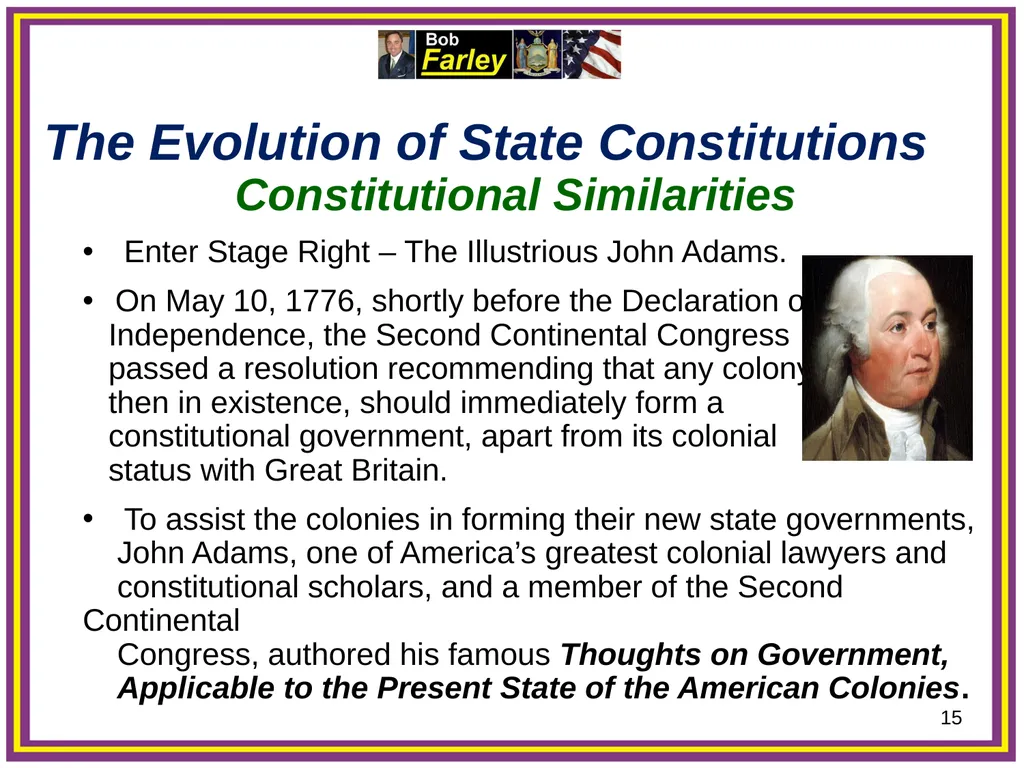
Enter Stage Right – The Illustrious John Adams.
On May 10, 1776, shortly before the Declaration of
Independence, the Second Continental Congress
passed a resolution recommending that any colony
then in existence, should immediately form a
constitutional government, apart from its colonial
status with Great Britain.
To assist the colonies in forming their new state governments,
John Adams, one of America’s greatest colonial lawyers and
constitutional scholars, and a member of the Second Continental
Congress, authored his famous Thoughts on Government,
Applicable to the Present State of the American Colonies. 15<br>
Constitutional Similarities
Enter Stage Right – The Illustrious John Adams.
On May 10, 1776, shortly before the Declaration of
Independence, the Second Continental Congress
passed a resolution recommending that any colony
then in existence, should immediately form a
constitutional government, apart from its colonial
status with Great Britain.
To assist the colonies in forming their new state governments,
John Adams, one of America’s greatest colonial lawyers and
constitutional scholars, and a member of the Second Continental
Congress, authored his famous Thoughts on Government,
Applicable to the Present State of the American Colonies. 15<br>
16
The Evolution of State Constitutions
Constitutional Similarities
This Adams’ essay, recommended a model framework,
to form new state governments, for the conduct of their
executive, legislative and judicial functions
This brilliant Adams’ framework was based upon the foundational principle that all state governments must be republican in form (i.e. provide for directly elected representatives).
This concept ended up in the Federal Constitution.
Under this Adams framework, all these state governments would contain three
❍ separate, ❍ independent, ❍ competing and ❍ co-equal branches,
that would provide checks and balances, against the powers of
each other. 16<br>
Constitutional Similarities
This Adams’ essay, recommended a model framework,
to form new state governments, for the conduct of their
executive, legislative and judicial functions
This brilliant Adams’ framework was based upon the foundational principle that all state governments must be republican in form (i.e. provide for directly elected representatives).
This concept ended up in the Federal Constitution.
Under this Adams framework, all these state governments would contain three
❍ separate, ❍ independent, ❍ competing and ❍ co-equal branches,
that would provide checks and balances, against the powers of
each other. 16<br>
17
The Evolution of State Constitutions
Constitutional Similarities
The purpose of these new state governments
would be to protect the rights of their citizens in the states.
All the states forming governments at this time,
followed the Adams framework,
in his “Thoughts on Government” letter.
That is why, to this day, all the early state governments
have a common structure.
The federal government modeled these state constitutions,
and thus also has a similar structure.
The states added after the US Constitution was adopted,
then also followed its structure. 17<br>
Constitutional Similarities
The purpose of these new state governments
would be to protect the rights of their citizens in the states.
All the states forming governments at this time,
followed the Adams framework,
in his “Thoughts on Government” letter.
That is why, to this day, all the early state governments
have a common structure.
The federal government modeled these state constitutions,
and thus also has a similar structure.
The states added after the US Constitution was adopted,
then also followed its structure. 17<br>
18
The Evolution of State Constitutions
Constitutional Similarities
It is within this federal, constitutional system that our laws are born.
Under a Federal System with National and State Governments
With:
❍ A Legislative Branch to enact laws through statute:
❍ An Executive Branch to enforce and carry our laws; and
❍ An Independent Judicial Branch to hear cases in controversy,
where courts issue decisions and rulings which follow precedent,
to provide interpretations of law (constitutions, statutes, regulations
and executive orders) and determine disputes in a just manner.
The purpose of government in our system is to protect the rights of individual people.
That is why that in the United States the sovereignty of the government is vested in the people themselves. 18<br>
Constitutional Similarities
It is within this federal, constitutional system that our laws are born.
Under a Federal System with National and State Governments
With:
❍ A Legislative Branch to enact laws through statute:
❍ An Executive Branch to enforce and carry our laws; and
❍ An Independent Judicial Branch to hear cases in controversy,
where courts issue decisions and rulings which follow precedent,
to provide interpretations of law (constitutions, statutes, regulations
and executive orders) and determine disputes in a just manner.
The purpose of government in our system is to protect the rights of individual people.
That is why that in the United States the sovereignty of the government is vested in the people themselves. 18<br>
19
The New York State
Constitution 19<br>
Constitution 19<br>
20
The New York State Constitution
Creation
New York's first constitution, like all the others, was an experimental document devised to cope with a political emergency.
White Plains Convention: On July 9, 1776, just days after the continental congress adopted the declaration of independence, the delegates to a specially elected provincial congress, convened in White Plains for the purpose of establishing "such a government as they shall deem best calculated to secure the rights, liberties and happiness of the good people of this colony; and to continue in force until a future peace with Great-Britain shall render the same unnecessary.“
Step One – Ratify the Declaration and Rename the Convention: As soon as the meeting at White Plains had begun, the declaration of independence was adopted unanimously by all the delegates assembled. The next day, the provincial congress changed its name to "the Convention of the Representatives of the State of New York."
Step Two – Temporary Government and Commencement of Drafting A Constitution: For nearly a year the convention of representatives, and its derivative committee of safety, governed New York state, while the work of framing a more permanent state government went ahead. 20<br>
Creation
New York's first constitution, like all the others, was an experimental document devised to cope with a political emergency.
White Plains Convention: On July 9, 1776, just days after the continental congress adopted the declaration of independence, the delegates to a specially elected provincial congress, convened in White Plains for the purpose of establishing "such a government as they shall deem best calculated to secure the rights, liberties and happiness of the good people of this colony; and to continue in force until a future peace with Great-Britain shall render the same unnecessary.“
Step One – Ratify the Declaration and Rename the Convention: As soon as the meeting at White Plains had begun, the declaration of independence was adopted unanimously by all the delegates assembled. The next day, the provincial congress changed its name to "the Convention of the Representatives of the State of New York."
Step Two – Temporary Government and Commencement of Drafting A Constitution: For nearly a year the convention of representatives, and its derivative committee of safety, governed New York state, while the work of framing a more permanent state government went ahead. 20<br>
21
The New York State Constitution
Creation
Step Three: John Jay takes the Lead: On August 1, 1776, the convention assigned the task of drafting a constitution to a committee of thirteen men. These included John Jay, John Sloss Hobart, William Smith (of Suffolk County), William Duer, Gouverneur Morris, Robert R. Livingston, John Broome, John Morin Scott, Abraham Yates, Jr., Henry Wisner, Samuel Townsend, Charles De Witt, and Robert Yates. James Duane was later added.
John Jay, a gifted lawyer, who would later be appointed by George Washington to become the first Chief Justice of the United States Supreme Court, immediately came to prominence on the committee, and began to play a major leadership role in the drafting process.
Forced to Draft a Constitution in the Midst of War and Combat: The committee had to work under the most extreme wartime conditions.
Although the convention originally convened in New York City, by July 1776, a massive British Military Force of 32,000 troops and hundreds of British Warships invaded the waters of New York City near Staten Island. By the end of August 1776, British forces has routed George Washington’s Army at Long Island and Kips Bay, and then in mid September, despite a strong colonial effort, took Harlem Heights in Northern Manhattan, and then defeated Washington’s retreating army outside White Plains (October 1776) and at Fort Washington
and Fort Lee (in mid November, where the George Washington Bridge is now located).
How White Plains Became the Convention Home: When George Washington’s retreating Army marched to Pennsylvania and New Jersey, the British Forces returned back into the confines of New York City (Manhattan), and the convention was moved to White Plains where they would perform the bulk and remainder of their work. 21<br>
Creation
Step Three: John Jay takes the Lead: On August 1, 1776, the convention assigned the task of drafting a constitution to a committee of thirteen men. These included John Jay, John Sloss Hobart, William Smith (of Suffolk County), William Duer, Gouverneur Morris, Robert R. Livingston, John Broome, John Morin Scott, Abraham Yates, Jr., Henry Wisner, Samuel Townsend, Charles De Witt, and Robert Yates. James Duane was later added.
John Jay, a gifted lawyer, who would later be appointed by George Washington to become the first Chief Justice of the United States Supreme Court, immediately came to prominence on the committee, and began to play a major leadership role in the drafting process.
Forced to Draft a Constitution in the Midst of War and Combat: The committee had to work under the most extreme wartime conditions.
Although the convention originally convened in New York City, by July 1776, a massive British Military Force of 32,000 troops and hundreds of British Warships invaded the waters of New York City near Staten Island. By the end of August 1776, British forces has routed George Washington’s Army at Long Island and Kips Bay, and then in mid September, despite a strong colonial effort, took Harlem Heights in Northern Manhattan, and then defeated Washington’s retreating army outside White Plains (October 1776) and at Fort Washington
and Fort Lee (in mid November, where the George Washington Bridge is now located).
How White Plains Became the Convention Home: When George Washington’s retreating Army marched to Pennsylvania and New Jersey, the British Forces returned back into the confines of New York City (Manhattan), and the convention was moved to White Plains where they would perform the bulk and remainder of their work. 21<br>
22
The New York State Constitution
Creation
Step Four – The Convention Reassembles: Planning for the constitution had hardly begun before the convention was forced to flee northward as Long Island and Manhattan fell to the British.
Convention delegates from Suffolk, Queens, Kings, and New York Counties who participated in the constitutional deliberations became exiles from their homes, and they would not be able to return for more than seven years.
Challenges in Drafting: Understandably, the drafting proceeded slowly.
Abraham Yates, the chairman, constantly had trouble assembling a quorum of committee members. Several members had active military commands which kept them away. Others had local governmental responsibilities or were serving on additional committees.
The committee was initially ordered to report a draft by August 26, 1776, but this date passed and early in October, as criticism began to mount, committee member Henry Wisner informed General George Clinton (who would become New York’s first Governor) that "the formation of government goes on very slow indeed; we have done little or nothing about it."
It was not until March 12, 1777, that the committee read a draft it had prepared to the convention. 22<br>
Creation
Step Four – The Convention Reassembles: Planning for the constitution had hardly begun before the convention was forced to flee northward as Long Island and Manhattan fell to the British.
Convention delegates from Suffolk, Queens, Kings, and New York Counties who participated in the constitutional deliberations became exiles from their homes, and they would not be able to return for more than seven years.
Challenges in Drafting: Understandably, the drafting proceeded slowly.
Abraham Yates, the chairman, constantly had trouble assembling a quorum of committee members. Several members had active military commands which kept them away. Others had local governmental responsibilities or were serving on additional committees.
The committee was initially ordered to report a draft by August 26, 1776, but this date passed and early in October, as criticism began to mount, committee member Henry Wisner informed General George Clinton (who would become New York’s first Governor) that "the formation of government goes on very slow indeed; we have done little or nothing about it."
It was not until March 12, 1777, that the committee read a draft it had prepared to the convention. 22<br>
23
The New York State Constitution
Creation
Step Five – Draft Revisions: The work was still far from over.
For another six weeks, after the March 12, 1777 initial report, the members of the convention subjected the committee draft to an article-by-article scrutiny.
Some provisions were scarcely debated, but others took days. By the time the convention had finished, many basic changes had been made.
A Joint Effort: Thus the document that became the state's first constitution reflected the joint efforts of the drafting committee and many of the more than 30 members of the convention who regularly attended during the floor debate.
Jay’ s Leadership: A few people stood out in this process, however. John Jay, a brilliant, detached, reserved, gifted legal mind, single-handedly reduced the cumbersome, long-winded committee draft into a compact, concisely written document for the convention to consider. During the convention debate, Jay excelled at breaking deadlocks by proposing
workable compromises.
Gouverneur Morris – Sounding Board: Jay often discussed his ideas with Gouverneur Morris. Morris, who was urbane, sarcastic, cynical, contemptuous of the new popular influences in politics, and utterly self-assured, exerted his influence most strongly during the floor debate, where he displayed superb parliamentary skills to dominate the proceedings.
Influence upon the United States Constitution: Interesting enough, these discussions between Jay and Morris did not end in White Plains, as Morris took so many of Jay’s ideas in New York’s first constitution to the Philadelphia Convention for incorporation 11 years later. 23<br>
Creation
Step Five – Draft Revisions: The work was still far from over.
For another six weeks, after the March 12, 1777 initial report, the members of the convention subjected the committee draft to an article-by-article scrutiny.
Some provisions were scarcely debated, but others took days. By the time the convention had finished, many basic changes had been made.
A Joint Effort: Thus the document that became the state's first constitution reflected the joint efforts of the drafting committee and many of the more than 30 members of the convention who regularly attended during the floor debate.
Jay’ s Leadership: A few people stood out in this process, however. John Jay, a brilliant, detached, reserved, gifted legal mind, single-handedly reduced the cumbersome, long-winded committee draft into a compact, concisely written document for the convention to consider. During the convention debate, Jay excelled at breaking deadlocks by proposing
workable compromises.
Gouverneur Morris – Sounding Board: Jay often discussed his ideas with Gouverneur Morris. Morris, who was urbane, sarcastic, cynical, contemptuous of the new popular influences in politics, and utterly self-assured, exerted his influence most strongly during the floor debate, where he displayed superb parliamentary skills to dominate the proceedings.
Influence upon the United States Constitution: Interesting enough, these discussions between Jay and Morris did not end in White Plains, as Morris took so many of Jay’s ideas in New York’s first constitution to the Philadelphia Convention for incorporation 11 years later. 23<br>
24
The New York State Constitution
Creation
Step Six – The Final Product: While there was no consensus on just how the governments
should be constructed before the White Plains Convention convened, there were certain basic principles which all the constitution-makers accepted.
Sovereignty in the People: It was universally agreed by Convention Delegates that, by the act of revolution (and the Declaration of Independence which the convention ratified), that the people of the State of New York had became their own political masters. That they must be the sovereign of the government, and that there could be no higher political authority.
Republican in Form: All also agreed that the new governments would be republican in form, and on the necessity of distributing power between various branches of government.
Protection of Rights: New Yorkers, like all Americans, were also committed (and this was reflected by convention delegates) to forming government by law, which had as its primary duty, the protection of individual rights.
The Influence of Adams, Jay and Precedent: With all delegates heavily guided and influenced by Adam’s Thoughts on Government, John Jay also knew that any new state constitution had to incorporate principles, and certain past provisions of law, that were recognized and supported by the people.
This framework created a first New York State Constitution was a meaningful, landmark, document. It intricately wove past British Law (such as the 1683 Charter of Liberties and Privileges) into a new, republican based, elected government for the people of New York.
Its brilliance is apparent, and it is of particular note is the fact, that even still today, pursuant to Article I, Section 14 of the current New York State Constitution, the common law of England and Colonial New York, and the previous acts of the colonial legislature under the 1683 charter, in accordance with the framework of the 1777 constitution, are still continued to the present day, unless inconsistent with current law. 24<br>
Creation
Step Six – The Final Product: While there was no consensus on just how the governments
should be constructed before the White Plains Convention convened, there were certain basic principles which all the constitution-makers accepted.
Sovereignty in the People: It was universally agreed by Convention Delegates that, by the act of revolution (and the Declaration of Independence which the convention ratified), that the people of the State of New York had became their own political masters. That they must be the sovereign of the government, and that there could be no higher political authority.
Republican in Form: All also agreed that the new governments would be republican in form, and on the necessity of distributing power between various branches of government.
Protection of Rights: New Yorkers, like all Americans, were also committed (and this was reflected by convention delegates) to forming government by law, which had as its primary duty, the protection of individual rights.
The Influence of Adams, Jay and Precedent: With all delegates heavily guided and influenced by Adam’s Thoughts on Government, John Jay also knew that any new state constitution had to incorporate principles, and certain past provisions of law, that were recognized and supported by the people.
This framework created a first New York State Constitution was a meaningful, landmark, document. It intricately wove past British Law (such as the 1683 Charter of Liberties and Privileges) into a new, republican based, elected government for the people of New York.
Its brilliance is apparent, and it is of particular note is the fact, that even still today, pursuant to Article I, Section 14 of the current New York State Constitution, the common law of England and Colonial New York, and the previous acts of the colonial legislature under the 1683 charter, in accordance with the framework of the 1777 constitution, are still continued to the present day, unless inconsistent with current law. 24<br>
25
The New York State Constitution
Creation
Step Six – The Final Product Continues: The Constitution produced by the White Plains Convention was a remarkable document, that served as a model for free, representative government everywhere.
It contained 42 individual Articles covering all aspects of governance and rights.
Sovereignty in the People: Its first article declared the people as the sovereign of the government, and all power and authority came from them.
Elected Legislature: Article II established an independent, elected, bicameral, state legislature, with a state assembly and state senate, vested with the legislative power of the state, and which was required to meet annually so as to dispatch its business.
Elected Governor: Article III and Article XVII established an independent, elected, powerful, executive, to be known as Governor, vested with broad executive powers of the state.
Elected Judiciary: Article III and Article XXV established an independent, elected judiciary, with local and appellate judges, who could not concurrently serve in other public offices.
Suffrage: Article VI and Article VII provided for elections based upon ballots. and granted the right to vote to all male inhabitants of full age, who personally resided within the State, for at least six months prior to the election, if they owned land of a value of at least twenty pounds, or rented a tenement of the yearly value of at least forty shillings, and paid taxes.
First Election: It was under this constitution, adopted by the convention in Kingston on April 22, 1777 and which went into immediate effect, that New York’s first elections were held. Despite combat operations occurring across the state, such elections took place from April through June 1777, for both houses of the legislature, and for Governor, with George Clinton being elected as New York’s first executive, over Philip Schuyler by a vote of 1,828 to 1,199. 25<br>
Creation
Step Six – The Final Product Continues: The Constitution produced by the White Plains Convention was a remarkable document, that served as a model for free, representative government everywhere.
It contained 42 individual Articles covering all aspects of governance and rights.
Sovereignty in the People: Its first article declared the people as the sovereign of the government, and all power and authority came from them.
Elected Legislature: Article II established an independent, elected, bicameral, state legislature, with a state assembly and state senate, vested with the legislative power of the state, and which was required to meet annually so as to dispatch its business.
Elected Governor: Article III and Article XVII established an independent, elected, powerful, executive, to be known as Governor, vested with broad executive powers of the state.
Elected Judiciary: Article III and Article XXV established an independent, elected judiciary, with local and appellate judges, who could not concurrently serve in other public offices.
Suffrage: Article VI and Article VII provided for elections based upon ballots. and granted the right to vote to all male inhabitants of full age, who personally resided within the State, for at least six months prior to the election, if they owned land of a value of at least twenty pounds, or rented a tenement of the yearly value of at least forty shillings, and paid taxes.
First Election: It was under this constitution, adopted by the convention in Kingston on April 22, 1777 and which went into immediate effect, that New York’s first elections were held. Despite combat operations occurring across the state, such elections took place from April through June 1777, for both houses of the legislature, and for Governor, with George Clinton being elected as New York’s first executive, over Philip Schuyler by a vote of 1,828 to 1,199. 25<br>
26
The New York State Constitution
Articles
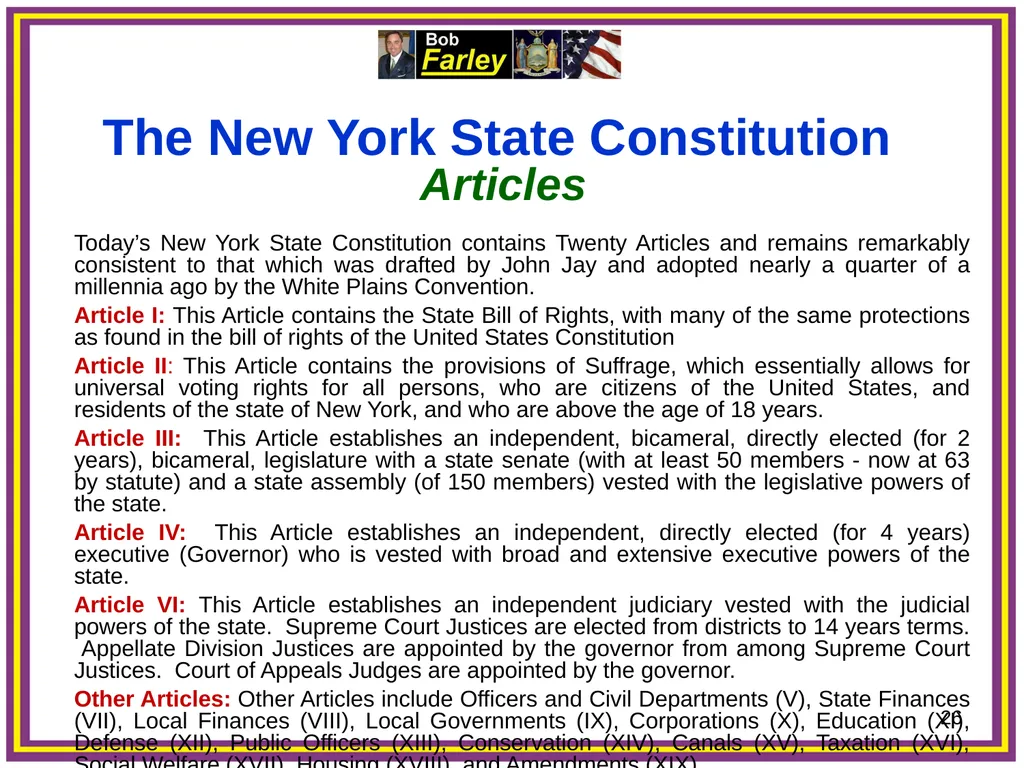
Today’s New York State Constitution contains Twenty Articles and remains remarkably consistent to that which was drafted by John Jay and adopted nearly a quarter of a millennia ago by the White Plains Convention.
Article I: This Article contains the State Bill of Rights, with many of the same protections as found in the bill of rights of the United States Constitution
Article II: This Article contains the provisions of Suffrage, which essentially allows for universal voting rights for all persons, who are citizens of the United States, and residents of the state of New York, and who are above the age of 18 years.
Article III: This Article establishes an independent, bicameral, directly elected (for 2 years), bicameral, legislature with a state senate (with at least 50 members - now at 63 by statute) and a state assembly (of 150 members) vested with the legislative powers of the state.
Article IV: This Article establishes an independent, directly elected (for 4 years) executive (Governor) who is vested with broad and extensive executive powers of the state.
Article VI: This Article establishes an independent judiciary vested with the judicial powers of the state. Supreme Court Justices are elected from districts to 14 years terms. Appellate Division Justices are appointed by the governor from among Supreme Court Justices. Court of Appeals Judges are appointed by the governor.
Other Articles: Other Articles include Officers and Civil Departments (V), State Finances (VII), Local Finances (VIII), Local Governments (IX), Corporations (X), Education (XI), Defense (XII), Public Officers (XIII), Conservation (XIV), Canals (XV), Taxation (XVI), Social Welfare (XVII), Housing (XVIII), and Amendments (XIX). 26<br>
Articles
Today’s New York State Constitution contains Twenty Articles and remains remarkably consistent to that which was drafted by John Jay and adopted nearly a quarter of a millennia ago by the White Plains Convention.
Article I: This Article contains the State Bill of Rights, with many of the same protections as found in the bill of rights of the United States Constitution
Article II: This Article contains the provisions of Suffrage, which essentially allows for universal voting rights for all persons, who are citizens of the United States, and residents of the state of New York, and who are above the age of 18 years.
Article III: This Article establishes an independent, bicameral, directly elected (for 2 years), bicameral, legislature with a state senate (with at least 50 members - now at 63 by statute) and a state assembly (of 150 members) vested with the legislative powers of the state.
Article IV: This Article establishes an independent, directly elected (for 4 years) executive (Governor) who is vested with broad and extensive executive powers of the state.
Article VI: This Article establishes an independent judiciary vested with the judicial powers of the state. Supreme Court Justices are elected from districts to 14 years terms. Appellate Division Justices are appointed by the governor from among Supreme Court Justices. Court of Appeals Judges are appointed by the governor.
Other Articles: Other Articles include Officers and Civil Departments (V), State Finances (VII), Local Finances (VIII), Local Governments (IX), Corporations (X), Education (XI), Defense (XII), Public Officers (XIII), Conservation (XIV), Canals (XV), Taxation (XVI), Social Welfare (XVII), Housing (XVIII), and Amendments (XIX). 26<br>
27
The New York State Constitution
Amendments
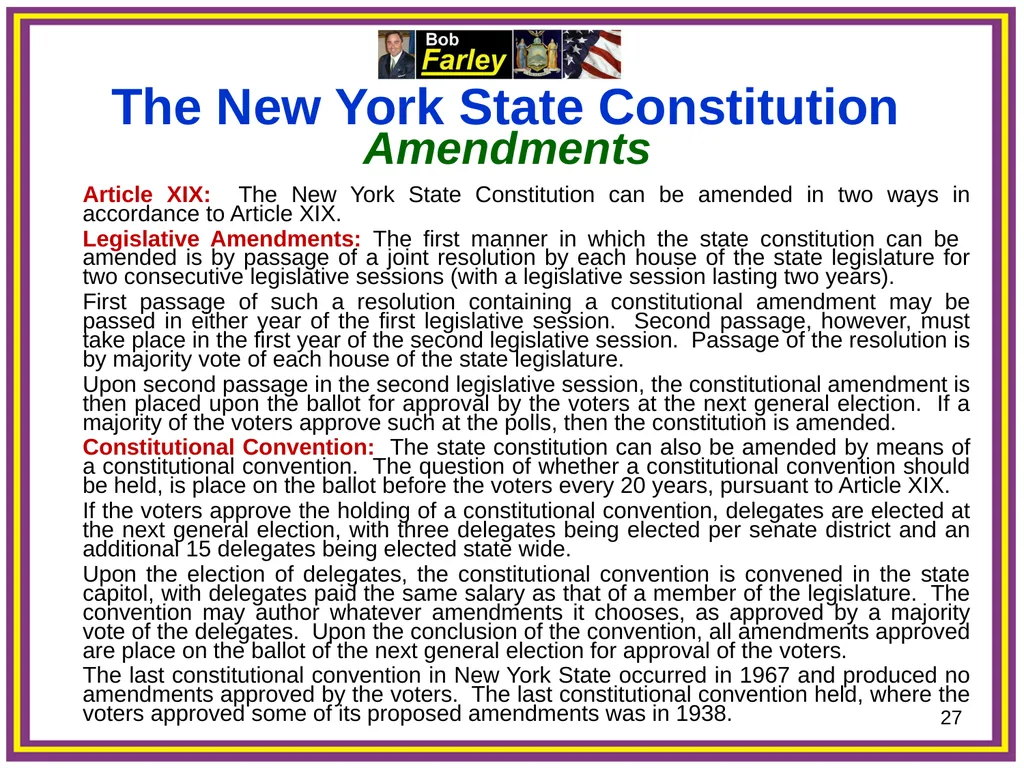
Article XIX: The New York State Constitution can be amended in two ways in accordance to Article XIX.
Legislative Amendments: The first manner in which the state constitution can be amended is by passage of a joint resolution by each house of the state legislature for two consecutive legislative sessions (with a legislative session lasting two years).
First passage of such a resolution containing a constitutional amendment may be passed in either year of the first legislative session. Second passage, however, must take place in the first year of the second legislative session. Passage of the resolution is by majority vote of each house of the state legislature.
Upon second passage in the second legislative session, the constitutional amendment is then placed upon the ballot for approval by the voters at the next general election. If a majority of the voters approve such at the polls, then the constitution is amended.
Constitutional Convention: The state constitution can also be amended by means of a constitutional convention. The question of whether a constitutional convention should be held, is place on the ballot before the voters every 20 years, pursuant to Article XIX.
If the voters approve the holding of a constitutional convention, delegates are elected at the next general election, with three delegates being elected per senate district and an additional 15 delegates being elected state wide.
Upon the election of delegates, the constitutional convention is convened in the state capitol, with delegates paid the same salary as that of a member of the legislature. The convention may author whatever amendments it chooses, as approved by a majority vote of the delegates. Upon the conclusion of the convention, all amendments approved are place on the ballot of the next general election for approval of the voters.
The last constitutional convention in New York State occurred in 1967 and produced no amendments approved by the voters. The last constitutional convention held, where the voters approved some of its proposed amendments was in 1938. 27<br>
Amendments
Article XIX: The New York State Constitution can be amended in two ways in accordance to Article XIX.
Legislative Amendments: The first manner in which the state constitution can be amended is by passage of a joint resolution by each house of the state legislature for two consecutive legislative sessions (with a legislative session lasting two years).
First passage of such a resolution containing a constitutional amendment may be passed in either year of the first legislative session. Second passage, however, must take place in the first year of the second legislative session. Passage of the resolution is by majority vote of each house of the state legislature.
Upon second passage in the second legislative session, the constitutional amendment is then placed upon the ballot for approval by the voters at the next general election. If a majority of the voters approve such at the polls, then the constitution is amended.
Constitutional Convention: The state constitution can also be amended by means of a constitutional convention. The question of whether a constitutional convention should be held, is place on the ballot before the voters every 20 years, pursuant to Article XIX.
If the voters approve the holding of a constitutional convention, delegates are elected at the next general election, with three delegates being elected per senate district and an additional 15 delegates being elected state wide.
Upon the election of delegates, the constitutional convention is convened in the state capitol, with delegates paid the same salary as that of a member of the legislature. The convention may author whatever amendments it chooses, as approved by a majority vote of the delegates. Upon the conclusion of the convention, all amendments approved are place on the ballot of the next general election for approval of the voters.
The last constitutional convention in New York State occurred in 1967 and produced no amendments approved by the voters. The last constitutional convention held, where the voters approved some of its proposed amendments was in 1938. 27<br>
28
The New York State Constitution
Rights
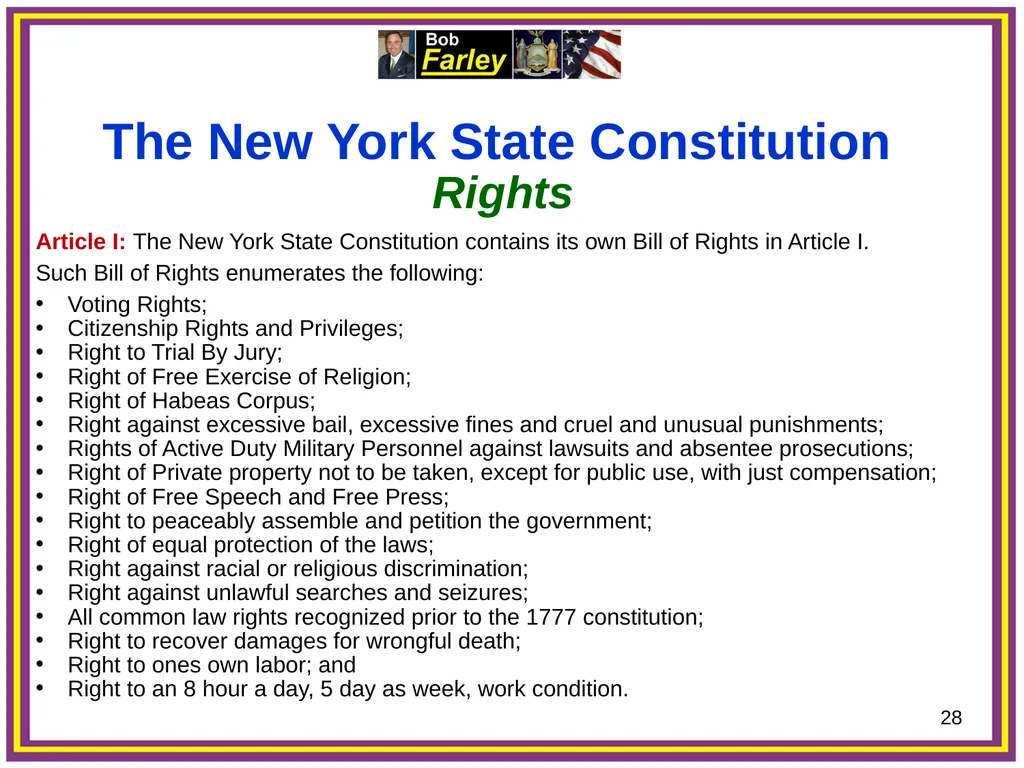
Article I: The New York State Constitution contains its own Bill of Rights in Article I.
Such Bill of Rights enumerates the following:
Voting Rights;
Citizenship Rights and Privileges;
Right to Trial By Jury;
Right of Free Exercise of Religion;
Right of Habeas Corpus;
Right against excessive bail, excessive fines and cruel and unusual punishments;
Rights of Active Duty Military Personnel against lawsuits and absentee prosecutions;
Right of Private property not to be taken, except for public use, with just compensation;
Right of Free Speech and Free Press;
Right to peaceably assemble and petition the government;
Right of equal protection of the laws;
Right against racial or religious discrimination;
Right against unlawful searches and seizures;
All common law rights recognized prior to the 1777 constitution;
Right to recover damages for wrongful death;
Right to ones own labor; and
Right to an 8 hour a day, 5 day as week, work condition. 28<br>
Rights
Article I: The New York State Constitution contains its own Bill of Rights in Article I.
Such Bill of Rights enumerates the following:
Voting Rights;
Citizenship Rights and Privileges;
Right to Trial By Jury;
Right of Free Exercise of Religion;
Right of Habeas Corpus;
Right against excessive bail, excessive fines and cruel and unusual punishments;
Rights of Active Duty Military Personnel against lawsuits and absentee prosecutions;
Right of Private property not to be taken, except for public use, with just compensation;
Right of Free Speech and Free Press;
Right to peaceably assemble and petition the government;
Right of equal protection of the laws;
Right against racial or religious discrimination;
Right against unlawful searches and seizures;
All common law rights recognized prior to the 1777 constitution;
Right to recover damages for wrongful death;
Right to ones own labor; and
Right to an 8 hour a day, 5 day as week, work condition. 28<br>
29
The United States
Constitution 29<br>
Constitution 29<br>
30
The United States Constitution
Creation
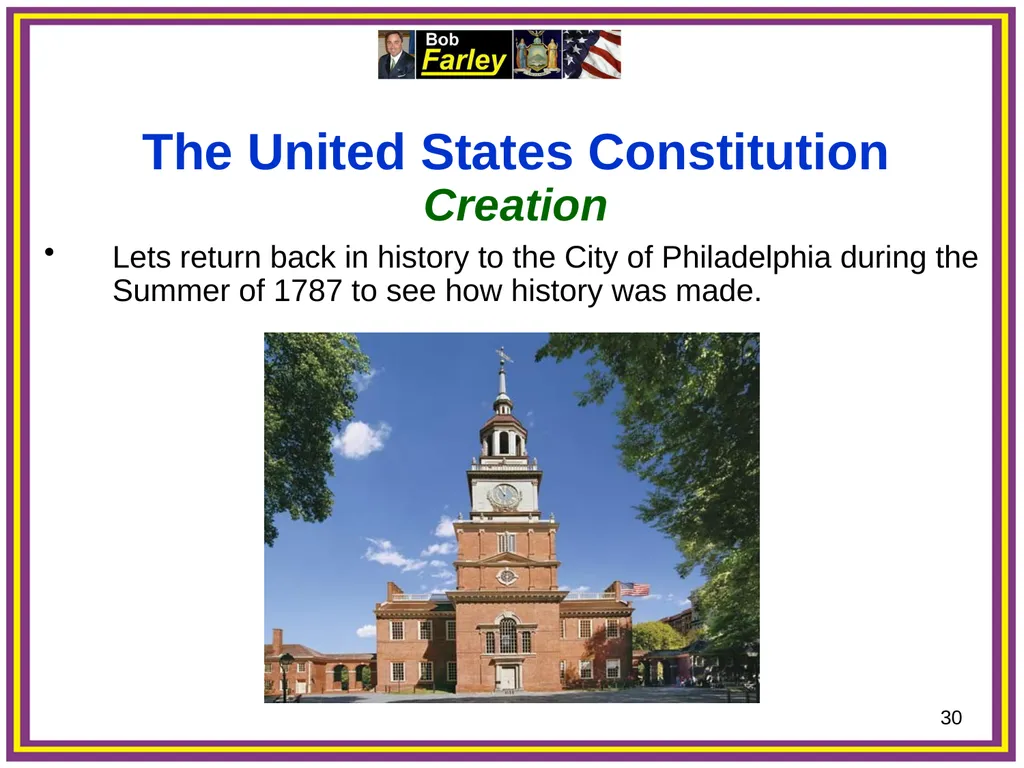
Lets return back in history to the City of Philadelphia during the Summer of 1787 to see how history was made. 30<br>
Creation
Lets return back in history to the City of Philadelphia during the Summer of 1787 to see how history was made. 30<br>
31
The United States Constitution
Creation
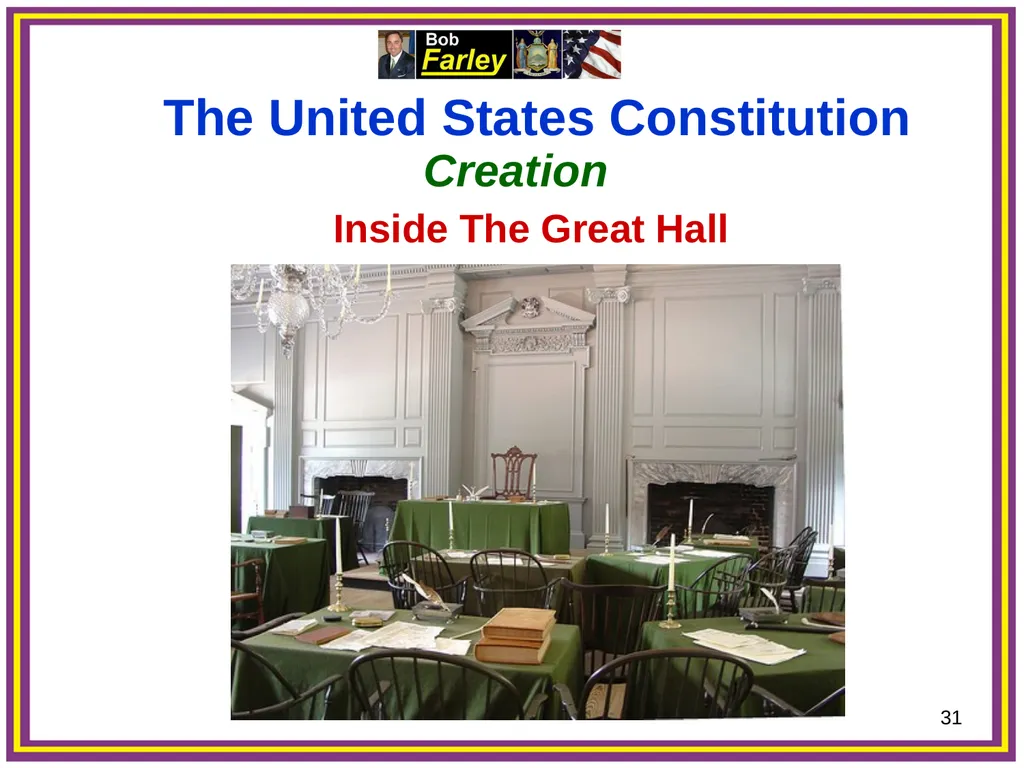
Inside The Great Hall 31<br>
Creation
Inside The Great Hall 31<br>
32
The United States Constitution
Creation
The Constitutional Convention
They came to revise.
What they created was one of the most inspired documents in the history of the world.
Months of deliberation, in secret, with great compromise.
In the End, it was all about Limited, Representative Government and …
The Rights of the People 32<br>
Creation
The Constitutional Convention
They came to revise.
What they created was one of the most inspired documents in the history of the world.
Months of deliberation, in secret, with great compromise.
In the End, it was all about Limited, Representative Government and …
The Rights of the People 32<br>
33
The United States Constitution
Creation
Founded in the Annapolis Convention at Mann’s Tavern
12 delegates from 5 states but Hamilton, Madison, Dickenson and Randolph
The Articles of the Confederation did not work
Madison Had to Convince Washington to Participate
Daniel Shay’s Rebellion
With Washington Agreed, the Convention Convened
So many of the new nation’s prominent men attended:
John Dickenson, Elbridge Gerry, Rufus King, William Paterson, Alexander Hamilton, Benjamin Franklin, Gouverneur Morris, James Wilson, Charles Pinckney, James Madison, Edmund Randolph, George Washington and George Wythe
Interestingly, neither Thomas Jefferson nor John Adams could attend due to diplomatic responsibilities in France and England respectively. John Hancock and Samuel Adams were also absent.
There legal charge was to revise – they ignored such.
They barred the windows and doors, refused the press and created anew 33<br>
Creation
Founded in the Annapolis Convention at Mann’s Tavern
12 delegates from 5 states but Hamilton, Madison, Dickenson and Randolph
The Articles of the Confederation did not work
Madison Had to Convince Washington to Participate
Daniel Shay’s Rebellion
With Washington Agreed, the Convention Convened
So many of the new nation’s prominent men attended:
John Dickenson, Elbridge Gerry, Rufus King, William Paterson, Alexander Hamilton, Benjamin Franklin, Gouverneur Morris, James Wilson, Charles Pinckney, James Madison, Edmund Randolph, George Washington and George Wythe
Interestingly, neither Thomas Jefferson nor John Adams could attend due to diplomatic responsibilities in France and England respectively. John Hancock and Samuel Adams were also absent.
There legal charge was to revise – they ignored such.
They barred the windows and doors, refused the press and created anew 33<br>
34
The United States Constitution
Creation
All we know of the Convention proceedings is from Madison’s notes published posthumously
Started May 25, 1787, finished September 17, 1787
Washington Presided, only relinquished chair to speak once
Franklin played the role of Peacemaker, Learned Sage
A Document Forged from Compromise – Many Competing Interests
More Novel than can be appreciated today
Not Guaranteed to be ratified.
Many powerful, opposing voices, including Governor Clinton of New York, Governor Henry from Virginia and Thomas Jefferson
Continental Congress did not know what to do with finished product
Self Authentication through Convention Amendment Clause
Many States gave a qualified ratification without authority
Immediately became a revered, respected document 34<br>
Creation
All we know of the Convention proceedings is from Madison’s notes published posthumously
Started May 25, 1787, finished September 17, 1787
Washington Presided, only relinquished chair to speak once
Franklin played the role of Peacemaker, Learned Sage
A Document Forged from Compromise – Many Competing Interests
More Novel than can be appreciated today
Not Guaranteed to be ratified.
Many powerful, opposing voices, including Governor Clinton of New York, Governor Henry from Virginia and Thomas Jefferson
Continental Congress did not know what to do with finished product
Self Authentication through Convention Amendment Clause
Many States gave a qualified ratification without authority
Immediately became a revered, respected document 34<br>
35
The United States Constitution
Articles
Today’s United States Constitution contains a Preamble, Seven Articles, a Closing Endorsement (eschatocol) and 27 amendments, and remains relatively consistent to that which was drafted by James Madison and adopted nearly a quarter of a millennia ago.
Article I: This Article contains establishes an independent, bicameral, directly elected (2 years for the House of Representatives and 6 years for Senate), bicameral, legislature with a Senate (with at 100 members – two per state) and a House of Representatives (435 elected from equally apportioned districts) vested with the legislative powers of the nation.
Article II: This Article establishes an independent, indirectly elected by means of the electoral college (for 4 years) executive (President) who is vested with broad and extensive executive powers of the nation, including commander in chief of the armed forces, the ability to veto legislation, and to conduct foreign policy and make treaties (with advice and consent of the senate).
Article III: This Article establishes an independent judiciary vested with the judicial powers of the nation. Supreme Court Justices are appointed by the president for life upon advice and consent of the senate. It further provides jurisdictional guidelines for federal courts and authorizes Congress to enact laws creating other federal courts (presently federal district courts, federal circuit courts of appeal, and other federal inferior courts such as bankruptcy courts, tax courts, trade courts, patent courts and FISA Court).
Article IV: This Article outlines the relations among the states and between each state and the federal government. It provides for such matters as admitting new states and border changes between the states. It contains the "full faith and credit“ clause which requires states to respect other state’s laws, and the "privileges and immunities" clause which prohibits states from discriminating against citizens of other states in favor of their own residents.
Article V: This Article establishes the amendment process for the constitution and that and that no State, without its consent, shall be deprived of its equal Suffrage in the Senate.
Article VI: This Article establishes that establishes the Constitution, and all federal laws and treaties of the United States, are the supreme law of the land. It validates national debt created under the Articles of Confederation and requires that all federal and state officers must take an oaths to support the Constitution. It also prohibits any religious test for public office.
Article VII: This Article provides that the approval of ratification conventions of nine states was sufficient to establish the Constitution for such ratifying states. 35<br>
Articles
Today’s United States Constitution contains a Preamble, Seven Articles, a Closing Endorsement (eschatocol) and 27 amendments, and remains relatively consistent to that which was drafted by James Madison and adopted nearly a quarter of a millennia ago.
Article I: This Article contains establishes an independent, bicameral, directly elected (2 years for the House of Representatives and 6 years for Senate), bicameral, legislature with a Senate (with at 100 members – two per state) and a House of Representatives (435 elected from equally apportioned districts) vested with the legislative powers of the nation.
Article II: This Article establishes an independent, indirectly elected by means of the electoral college (for 4 years) executive (President) who is vested with broad and extensive executive powers of the nation, including commander in chief of the armed forces, the ability to veto legislation, and to conduct foreign policy and make treaties (with advice and consent of the senate).
Article III: This Article establishes an independent judiciary vested with the judicial powers of the nation. Supreme Court Justices are appointed by the president for life upon advice and consent of the senate. It further provides jurisdictional guidelines for federal courts and authorizes Congress to enact laws creating other federal courts (presently federal district courts, federal circuit courts of appeal, and other federal inferior courts such as bankruptcy courts, tax courts, trade courts, patent courts and FISA Court).
Article IV: This Article outlines the relations among the states and between each state and the federal government. It provides for such matters as admitting new states and border changes between the states. It contains the "full faith and credit“ clause which requires states to respect other state’s laws, and the "privileges and immunities" clause which prohibits states from discriminating against citizens of other states in favor of their own residents.
Article V: This Article establishes the amendment process for the constitution and that and that no State, without its consent, shall be deprived of its equal Suffrage in the Senate.
Article VI: This Article establishes that establishes the Constitution, and all federal laws and treaties of the United States, are the supreme law of the land. It validates national debt created under the Articles of Confederation and requires that all federal and state officers must take an oaths to support the Constitution. It also prohibits any religious test for public office.
Article VII: This Article provides that the approval of ratification conventions of nine states was sufficient to establish the Constitution for such ratifying states. 35<br>
36
The United States Constitution
Amendments
There have been 27 amendments to the United States Constitution.
Article V: The United States Constitution can be amended in two ways in accordance to Article V.
Legislative Amendments: The first manner in which the United State Constitution can be amended is by passage of a joint resolution by each house (the Senate and the House of Representatives) by a two-thirds vote in each house.
Upon passage by a two-thirds house in both the Senate and the House of Representatives, the constitutional amendment is then sent to the states for their ratification. Congress can select whether such ratification may be done by either state legislatures or state ratifying conventions (with conventions only being used once for the 21st amendment – repeal of prohibition). Upon approval of three fourths of the states (presently 38 out of 50) the amendment is ratified and adopted.
Constitutional Convention: The United States constitution can also be amended by means of a constitutional convention. This is achieved (and has never been done since the original Philadelphia convention) when two-thirds of the state legislatures call for such a convention to take place.
If 2/3 of the state legislatures vote to call for the holding of a constitutional convention, delegates are elected at the next general election.
Upon the election of delegates, the constitutional convention is convened. The convention may author whatever amendments it chooses, as approved by a majority vote of the delegates. Upon the conclusion of the convention, all amendments approved are sent to the states for ratification. As with the ratification of the current constitution, ratification by three fourths of the states is necessary to approve the amendments proposed by the convention. 36<br>
Amendments
There have been 27 amendments to the United States Constitution.
Article V: The United States Constitution can be amended in two ways in accordance to Article V.
Legislative Amendments: The first manner in which the United State Constitution can be amended is by passage of a joint resolution by each house (the Senate and the House of Representatives) by a two-thirds vote in each house.
Upon passage by a two-thirds house in both the Senate and the House of Representatives, the constitutional amendment is then sent to the states for their ratification. Congress can select whether such ratification may be done by either state legislatures or state ratifying conventions (with conventions only being used once for the 21st amendment – repeal of prohibition). Upon approval of three fourths of the states (presently 38 out of 50) the amendment is ratified and adopted.
Constitutional Convention: The United States constitution can also be amended by means of a constitutional convention. This is achieved (and has never been done since the original Philadelphia convention) when two-thirds of the state legislatures call for such a convention to take place.
If 2/3 of the state legislatures vote to call for the holding of a constitutional convention, delegates are elected at the next general election.
Upon the election of delegates, the constitutional convention is convened. The convention may author whatever amendments it chooses, as approved by a majority vote of the delegates. Upon the conclusion of the convention, all amendments approved are sent to the states for ratification. As with the ratification of the current constitution, ratification by three fourths of the states is necessary to approve the amendments proposed by the convention. 36<br>
37
The United States Constitution
Rights
The original Constitution produced in Philadelphia, did not contain an enumeration of rights.
Madison was concerned, that the Constitution, which formed a national government of limited powers, would be misconstrued if its so contained such an enumeration. Additionally, he argued, that such an enumeration could easily fall prey to leaving out an essential right.
But after many states provided a demand in their ratification that the Constitution was approved only conditionally upon the inclusion of such enumeration of rights, Madison, as a member of the House of Representatives, authored the first 10 amendments, which became known today as the Bill of Rights. Such amendments include:
Freedom of religion, speech, press, assembly, and petition;
Right to keep and bear arms;
No quartering of soldiers;
Freedom from unreasonable searches and seizures;
Due process of law, freedom from self-incrimination, no double jeopardy;
Speedy and public trial;
Trial by jury;
No excessive bail, or cruel and unusual punishments;
All other recognized rights of the people (incorporation of Declaration); and
Limited Federal Government with non enumerated powers reserved to the states 37<br>
Rights
The original Constitution produced in Philadelphia, did not contain an enumeration of rights.
Madison was concerned, that the Constitution, which formed a national government of limited powers, would be misconstrued if its so contained such an enumeration. Additionally, he argued, that such an enumeration could easily fall prey to leaving out an essential right.
But after many states provided a demand in their ratification that the Constitution was approved only conditionally upon the inclusion of such enumeration of rights, Madison, as a member of the House of Representatives, authored the first 10 amendments, which became known today as the Bill of Rights. Such amendments include:
Freedom of religion, speech, press, assembly, and petition;
Right to keep and bear arms;
No quartering of soldiers;
Freedom from unreasonable searches and seizures;
Due process of law, freedom from self-incrimination, no double jeopardy;
Speedy and public trial;
Trial by jury;
No excessive bail, or cruel and unusual punishments;
All other recognized rights of the people (incorporation of Declaration); and
Limited Federal Government with non enumerated powers reserved to the states 37<br>
38
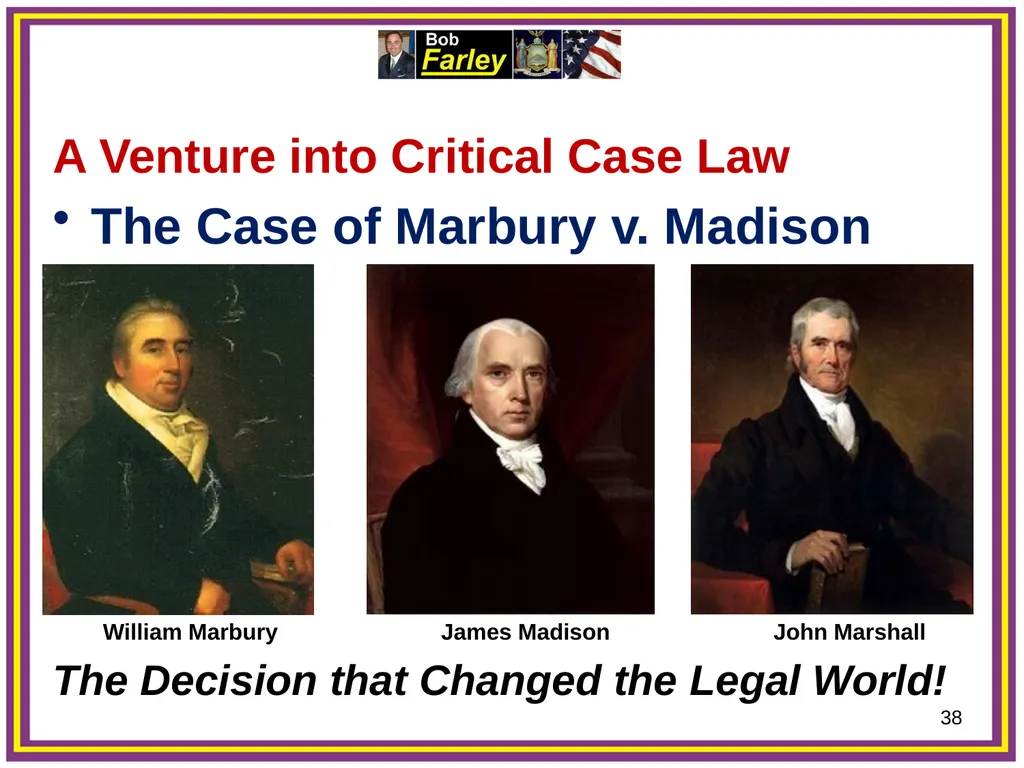
A Venture into Critical Case Law
The Case of Marbury v. Madison
William Marbury James Madison John Marshall
The Decision that Changed the Legal World! 38<br>
The Case of Marbury v. Madison
William Marbury James Madison John Marshall
The Decision that Changed the Legal World! 38<br>
39
Thank you for Coming
For next time – Review Assignments as follows on the Webpage:
Lecture Slides
Selected Readings
Cases and Exercises
We are a hot bench.
Questions? 39<br>
For next time – Review Assignments as follows on the Webpage:
Lecture Slides
Selected Readings
Cases and Exercises
We are a hot bench.
Questions? 39<br>