
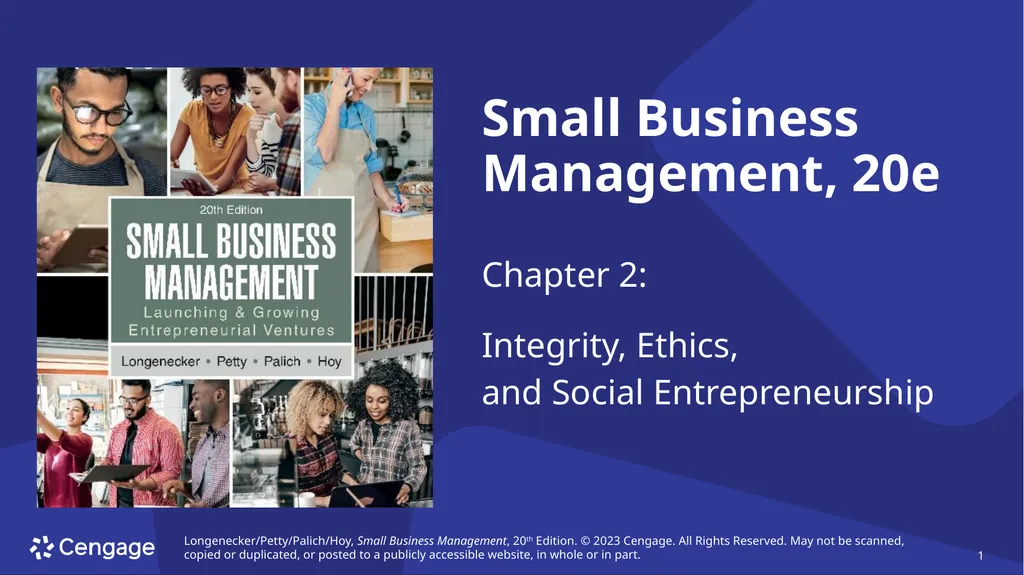
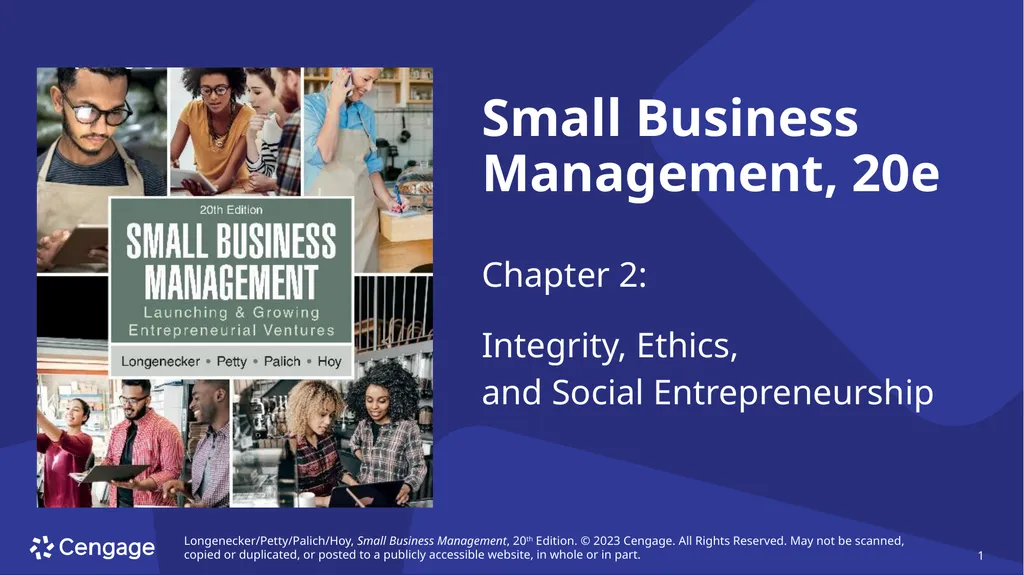
Small Business Management, 20e Chapter 2:
T
Published · 50 slides · 0 views
1 / 1
Description
Small Business Management, 20e Chapter 2: Integrity, Ethics, and Social Entrepreneurship LongeneckerPettyPalichHoy, Small Business Management, 20th Edition. 2023 Cengage. All Rights Reserved. May not be scanned, copied or duplicated,
Related Topics
Share
Embed code
Download this presentation From Below
"Small Business Management, 20e Chapter 2:" is the property of its rightful owner. Permission is granted to download and print the materials on this website for personal, non-commercial use only, and to display it on your personal computer provided you do not modify the materials and that you retain all copyright notices contained in the materials. By downloading content from our website, you accept the terms of this agreement.
Presentation Transcript
01
Small Business Management, 20e
Chapter 2: Integrity, Ethics,
and Social Entrepreneurship Longenecker/Petty/Palich/Hoy, Small Business Management, 20th Edition. © 2023 Cengage. All Rights Reserved. May not be scanned, copied or duplicated, or posted to a publicly accessible website, in whole or in part.<br>
and Social Entrepreneurship Longenecker/Petty/Palich/Hoy, Small Business Management, 20th Edition. © 2023 Cengage. All Rights Reserved. May not be scanned, copied or duplicated, or posted to a publicly accessible website, in whole or in part.<br>
02
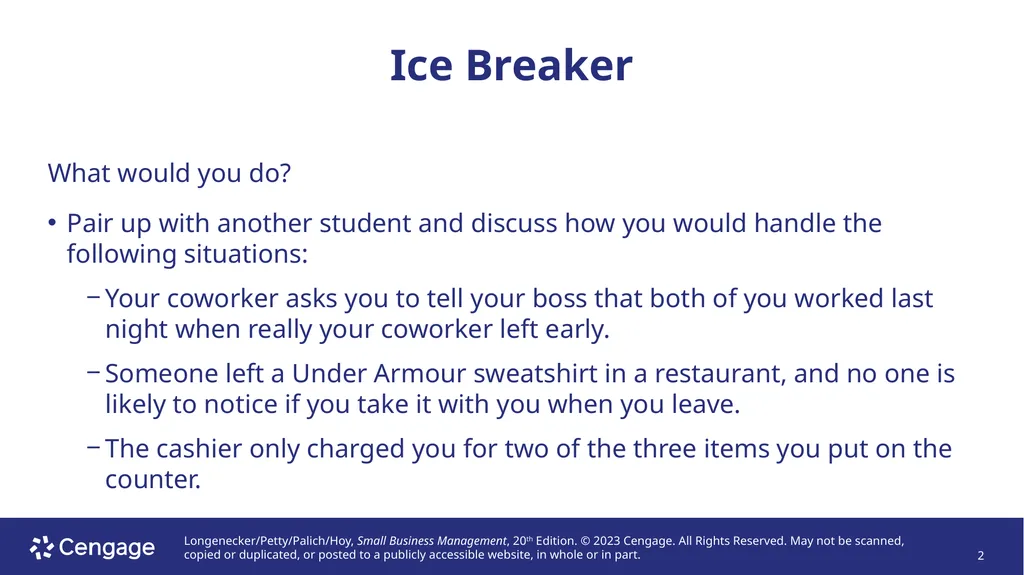
Ice Breaker What would you do?
Pair up with another student and discuss how you would handle the following situations:
Your coworker asks you to tell your boss that both of you worked last night when really your coworker left early.
Someone left a Under Armour sweatshirt in a restaurant, and no one is likely to notice if you take it with you when you leave.
The cashier only charged you for two of the three items you put on the counter.<br>
Pair up with another student and discuss how you would handle the following situations:
Your coworker asks you to tell your boss that both of you worked last night when really your coworker left early.
Someone left a Under Armour sweatshirt in a restaurant, and no one is likely to notice if you take it with you when you leave.
The cashier only charged you for two of the three items you put on the counter.<br>
03
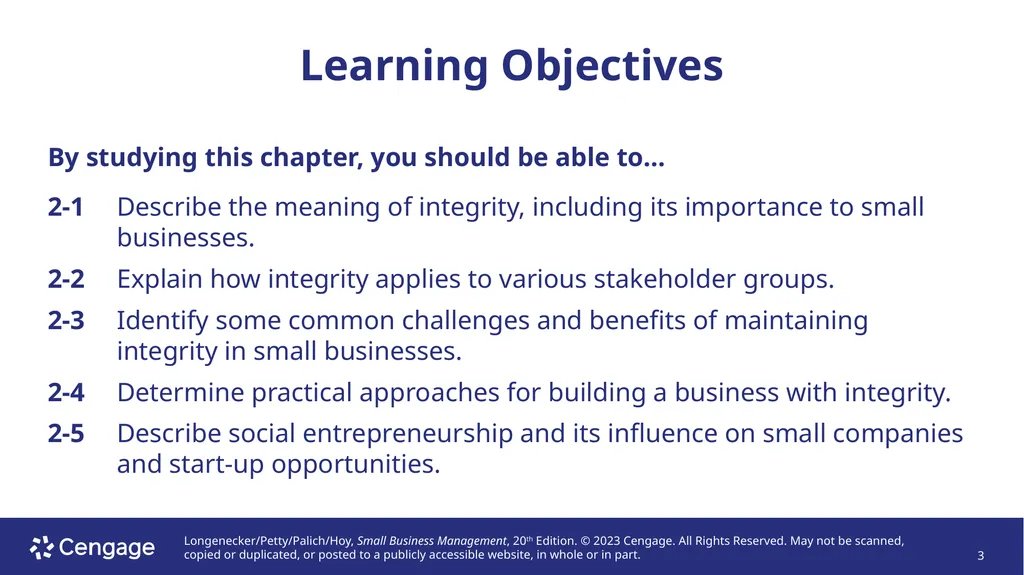
Learning Objectives By studying this chapter, you should be able to…
2-1 Describe the meaning of integrity, including its importance to small businesses.
2-2 Explain how integrity applies to various stakeholder groups.
2-3 Identify some common challenges and benefits of maintaining integrity in small businesses.
2-4 Determine practical approaches for building a business with integrity.
2-5 Describe social entrepreneurship and its influence on small companies and start-up opportunities.<br>
2-1 Describe the meaning of integrity, including its importance to small businesses.
2-2 Explain how integrity applies to various stakeholder groups.
2-3 Identify some common challenges and benefits of maintaining integrity in small businesses.
2-4 Determine practical approaches for building a business with integrity.
2-5 Describe social entrepreneurship and its influence on small companies and start-up opportunities.<br>
04
2-1 What Is Integrity?<br>
05
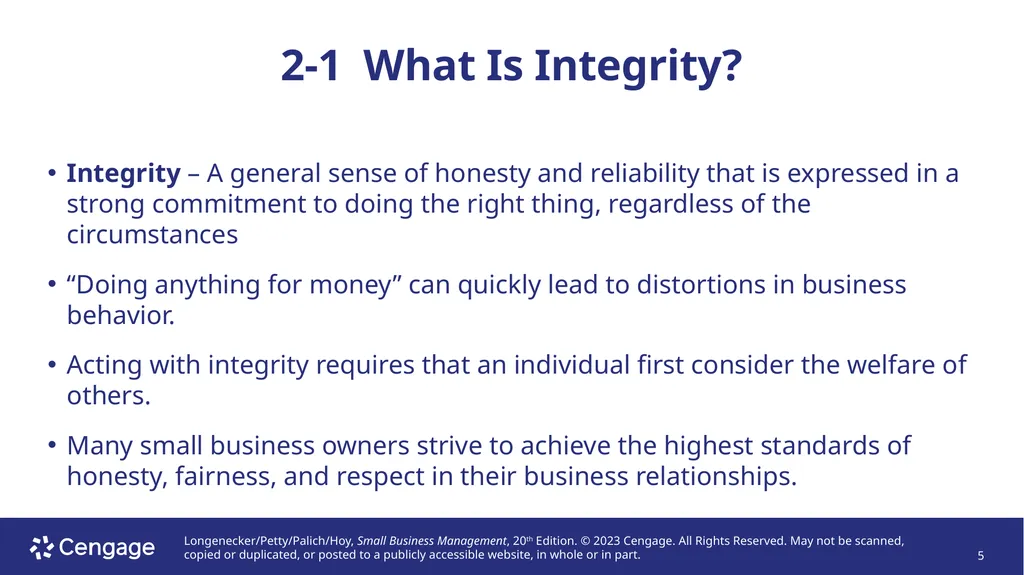
2-1 What Is Integrity? Integrity – A general sense of honesty and reliability that is expressed in a strong commitment to doing the right thing, regardless of the circumstances
“Doing anything for money” can quickly lead to distortions in business behavior.
Acting with integrity requires that an individual first consider the welfare of others.
Many small business owners strive to achieve the highest standards of honesty, fairness, and respect in their business relationships.<br>
“Doing anything for money” can quickly lead to distortions in business behavior.
Acting with integrity requires that an individual first consider the welfare of others.
Many small business owners strive to achieve the highest standards of honesty, fairness, and respect in their business relationships.<br>
06
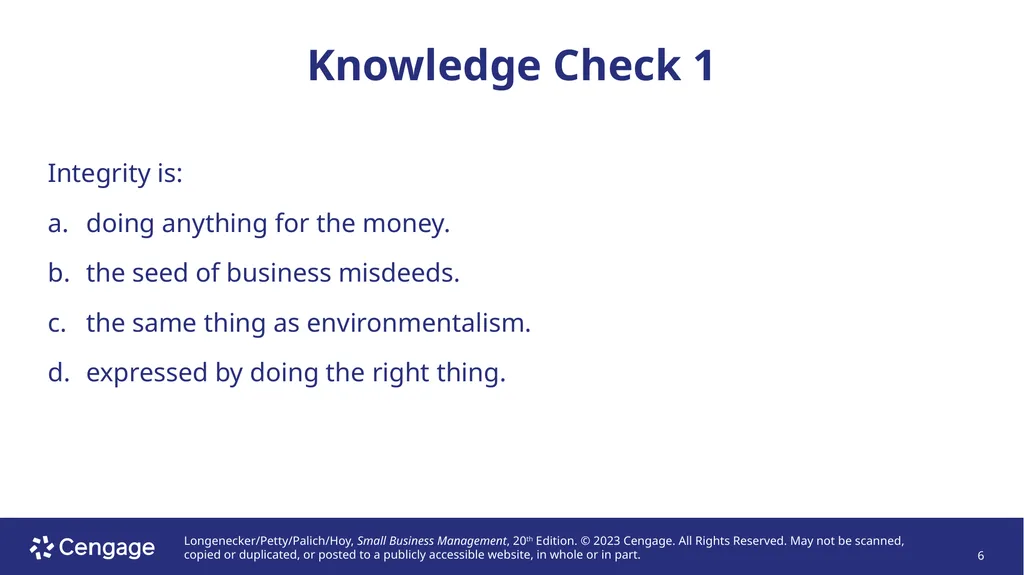
Knowledge Check 1 Integrity is:
doing anything for the money.
the seed of business misdeeds.
the same thing as environmentalism.
expressed by doing the right thing.<br>
doing anything for the money.
the seed of business misdeeds.
the same thing as environmentalism.
expressed by doing the right thing.<br>
07
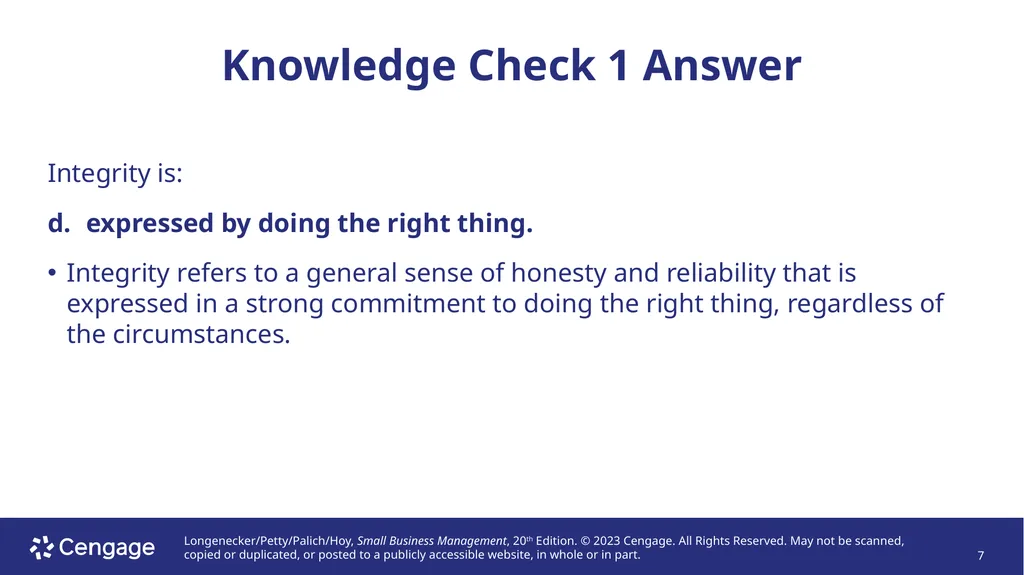
Knowledge Check 1 Answer Integrity is:
expressed by doing the right thing.
Integrity refers to a general sense of honesty and reliability that is expressed in a strong commitment to doing the right thing, regardless of the circumstances.<br>
expressed by doing the right thing.
Integrity refers to a general sense of honesty and reliability that is expressed in a strong commitment to doing the right thing, regardless of the circumstances.<br>
08
2-2 Integrity and the Interests
of Major Stakeholders<br>
of Major Stakeholders<br>
09
2-2 Integrity and the Interests
of Major Stakeholders (slide 1 of 2) Ethical issues go beyond what is legal or illegal to include more general questions of right and wrong.
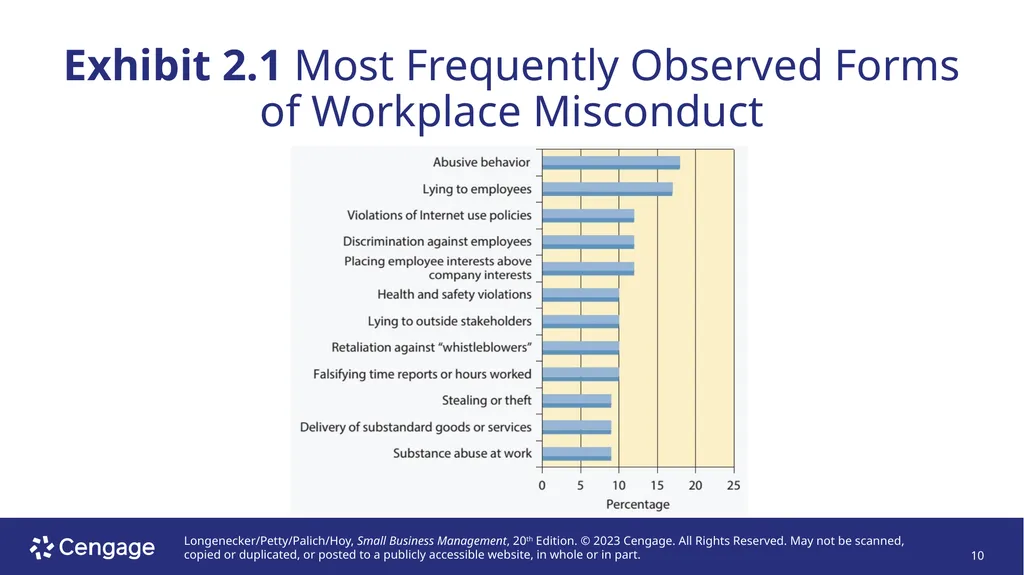
An Ethics Resource Center survey indicated that employees witness various forms of misconduct in their workplaces, with the most frequently observed offenses involving abusive behavior and lying to employees.<br>
An Ethics Resource Center survey indicated that employees witness various forms of misconduct in their workplaces, with the most frequently observed offenses involving abusive behavior and lying to employees.<br>
10
Exhibit 2.1 Most Frequently Observed Forms of Workplace Misconduct<br>
11
2-2 Integrity and the Interests
of Major Stakeholders (slide 2 of 2) When making decisions, small business owners guided by integrity must consider the interests of stakeholders:
Owners
Customers
Employees
The community
The government
Stakeholder – An individual or group that either can affect or is affected by the performance of the company
The various interests of stakeholder groups can complicate the decision-making process.<br>
Owners
Customers
Employees
The community
The government
Stakeholder – An individual or group that either can affect or is affected by the performance of the company
The various interests of stakeholder groups can complicate the decision-making process.<br>
12
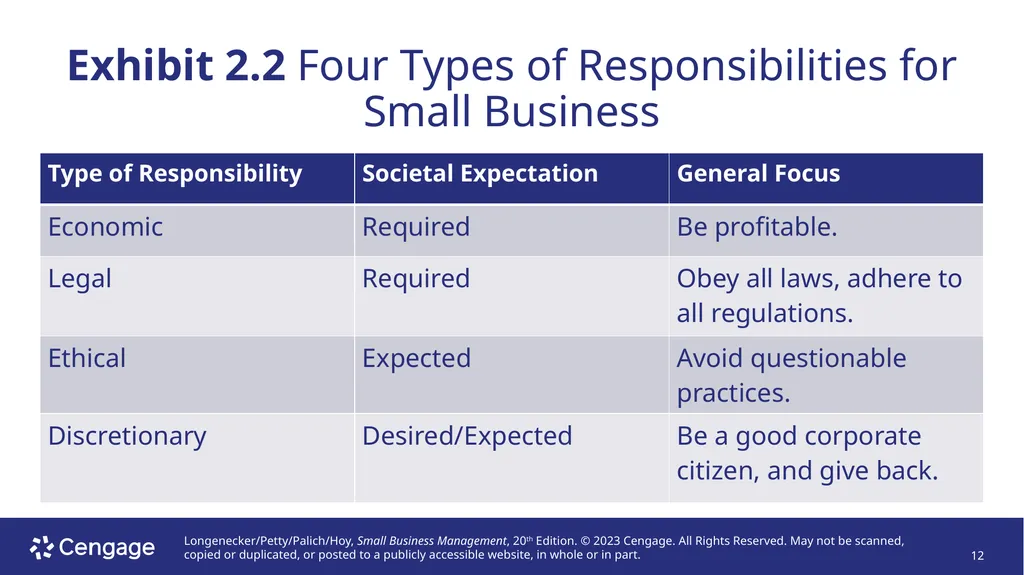
Exhibit 2.2 Four Types of Responsibilities for Small Business<br>
13
2-2a The “Big Three” Stakeholders—
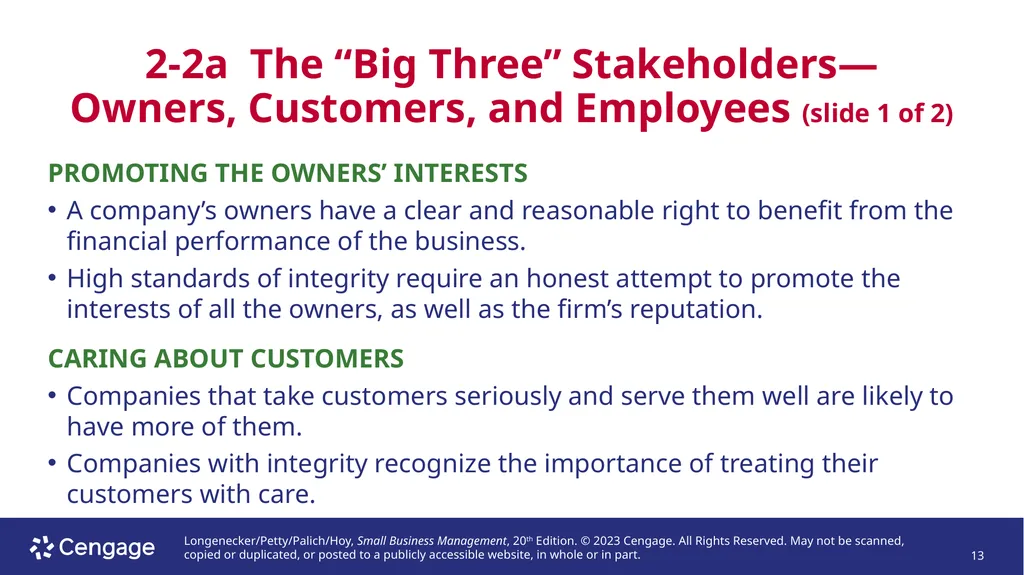
Owners, Customers, and Employees (slide 1 of 2) PROMOTING THE OWNERS’ INTERESTS
A company’s owners have a clear and reasonable right to benefit from the financial performance of the business.
High standards of integrity require an honest attempt to promote the interests of all the owners, as well as the firm’s reputation.
CARING ABOUT CUSTOMERS
Companies that take customers seriously and serve them well are likely to have more of them.
Companies with integrity recognize the importance of treating their customers with care.<br>
A company’s owners have a clear and reasonable right to benefit from the financial performance of the business.
High standards of integrity require an honest attempt to promote the interests of all the owners, as well as the firm’s reputation.
CARING ABOUT CUSTOMERS
Companies that take customers seriously and serve them well are likely to have more of them.
Companies with integrity recognize the importance of treating their customers with care.<br>
14
2-2a The “Big Three” Stakeholders—
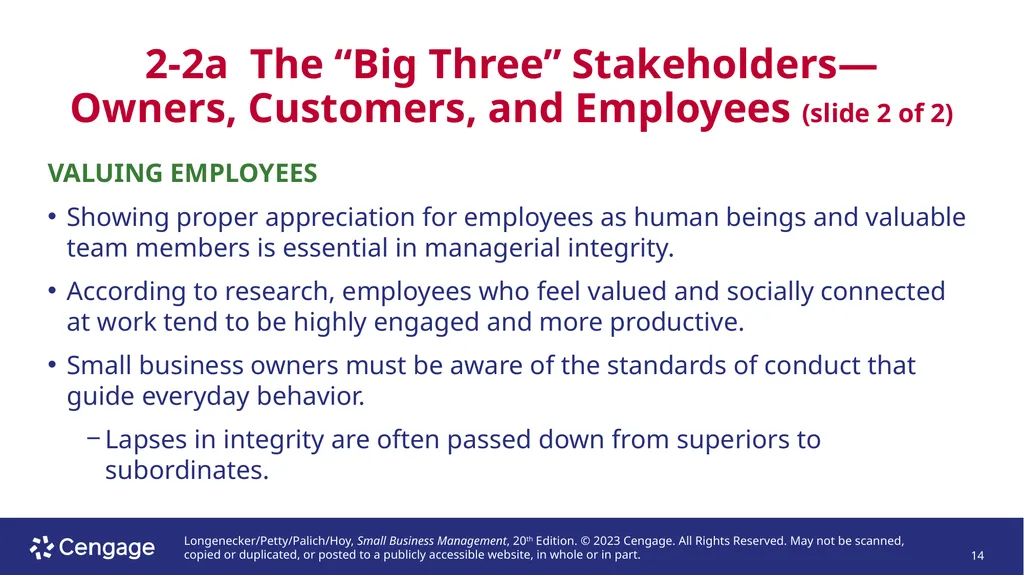
Owners, Customers, and Employees (slide 2 of 2) VALUING EMPLOYEES
Showing proper appreciation for employees as human beings and valuable team members is essential in managerial integrity.
According to research, employees who feel valued and socially connected at work tend to be highly engaged and more productive.
Small business owners must be aware of the standards of conduct that guide everyday behavior.
Lapses in integrity are often passed down from superiors to subordinates.<br>
Showing proper appreciation for employees as human beings and valuable team members is essential in managerial integrity.
According to research, employees who feel valued and socially connected at work tend to be highly engaged and more productive.
Small business owners must be aware of the standards of conduct that guide everyday behavior.
Lapses in integrity are often passed down from superiors to subordinates.<br>
15
2-2b Social Responsibility
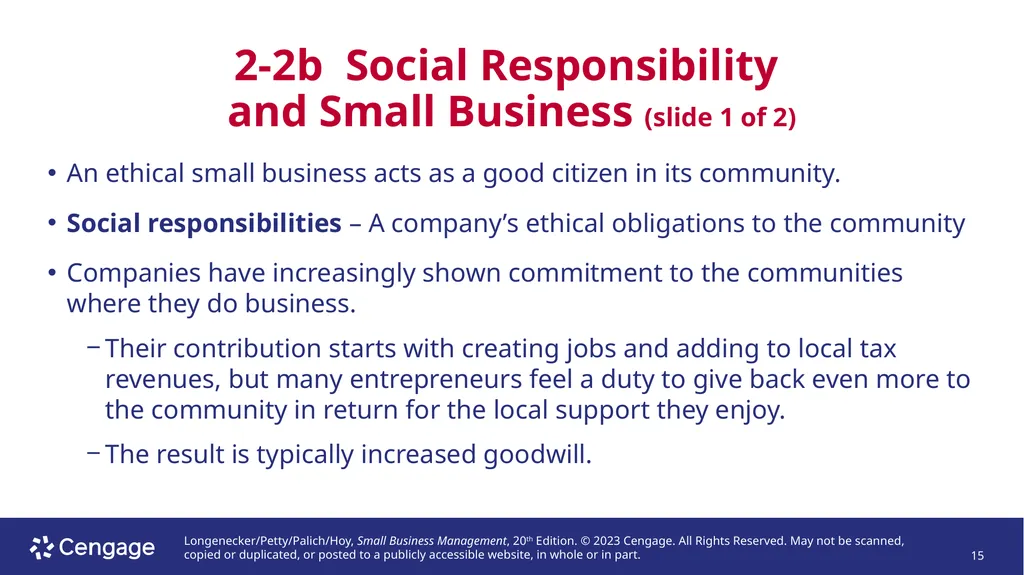
and Small Business (slide 1 of 2) An ethical small business acts as a good citizen in its community.
Social responsibilities – A company’s ethical obligations to the community
Companies have increasingly shown commitment to the communities where they do business.
Their contribution starts with creating jobs and adding to local tax revenues, but many entrepreneurs feel a duty to give back even more to the community in return for the local support they enjoy.
The result is typically increased goodwill.<br>
Social responsibilities – A company’s ethical obligations to the community
Companies have increasingly shown commitment to the communities where they do business.
Their contribution starts with creating jobs and adding to local tax revenues, but many entrepreneurs feel a duty to give back even more to the community in return for the local support they enjoy.
The result is typically increased goodwill.<br>
16
2-2b Social Responsibility
and Small Business (slide 2 of 2) Entrepreneurs should think carefully about their community commitments, because building a business on a foundation of “doing good” may add to a small company’s financial burden.
Research suggests that most small business owners exercise great integrity, but some tend to cut corners when it comes to social responsibilities if profits will be affected.<br>
Research suggests that most small business owners exercise great integrity, but some tend to cut corners when it comes to social responsibilities if profits will be affected.<br>
17
2-2c Integrity and
Governmental Regulations Government regulations encompass workplace safety, equal employment opportunities, fair pay, clean air, and safe products, to name a few.
Entrepreneurs must comply with governmental laws and applicable regulations if they want to maintain their integrity and avoid penalties.
One glaring example of unethical behavior by small firm management is fraudulent reporting of income and expenses for income tax purposes.
This conduct includes skimming (concealing some income), as well as improperly claiming personal expenses to be business-related.<br>
Entrepreneurs must comply with governmental laws and applicable regulations if they want to maintain their integrity and avoid penalties.
One glaring example of unethical behavior by small firm management is fraudulent reporting of income and expenses for income tax purposes.
This conduct includes skimming (concealing some income), as well as improperly claiming personal expenses to be business-related.<br>
18
Discussion Activity 1 You are the very busy owner of a small pet store that also does pet grooming and short-term boarding. A salesperson has approached you about contracting with them to “boost” your online presence, including posting positive reviews. You know that these reviews are “fake” because the postings aren’t from actual customers but will probably help you get more customers, and it will take some of the marketing burden off your shoulders. What will you do?
Form small groups of three to four individuals and talk about this scenario and your options.<br>
Form small groups of three to four individuals and talk about this scenario and your options.<br>
19
Discussion Activity 1 Debrief You are the very busy owner of a small pet store that also does pet grooming and short-term boarding. A salesperson has approached you about contracting with them to “boost” your online presence, including posting positive reviews. You know that these reviews are “fake” because the postings aren’t from actual customers but will probably help you get more customers, and it will take some of the marketing burden off your shoulders. What will you do?
First, to act with integrity and have a reputation your customers can trust, you will not allow a company to post fake reviews for your business. In trying to improve your online presence, you can try a number of other options, including rewarding customers for posting honest reviews and continuing to work hard to provide great service that they will review favorably.
In addition, your employees will take their ethical cues about the business from you, so it is essential act and expect the highest standards of honesty and reliability.<br>
First, to act with integrity and have a reputation your customers can trust, you will not allow a company to post fake reviews for your business. In trying to improve your online presence, you can try a number of other options, including rewarding customers for posting honest reviews and continuing to work hard to provide great service that they will review favorably.
In addition, your employees will take their ethical cues about the business from you, so it is essential act and expect the highest standards of honesty and reliability.<br>
20
2-3 The Challenges and Benefits
of Acting with Integrity<br>
of Acting with Integrity<br>
21
2-3a Small Companies
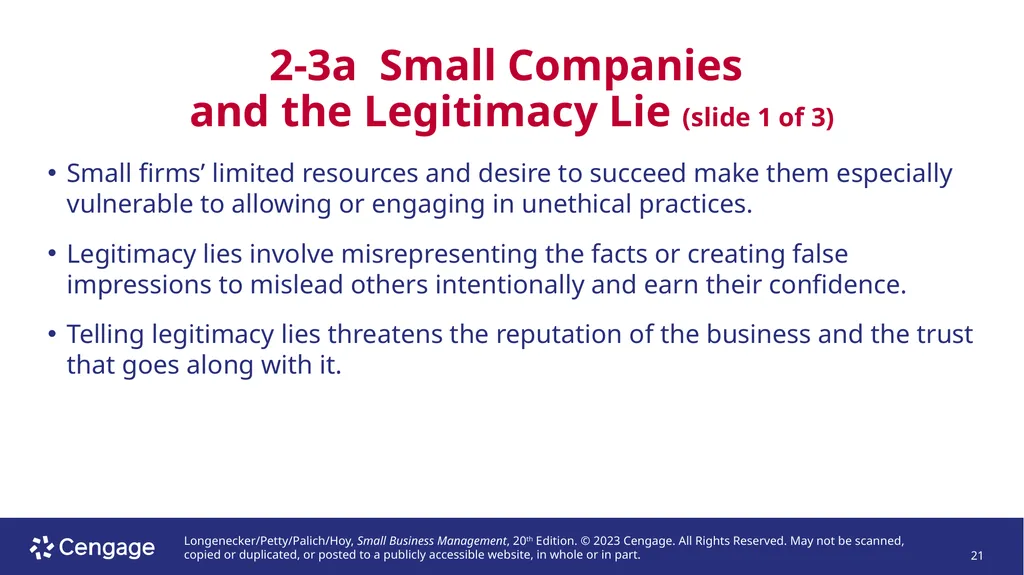
and the Legitimacy Lie (slide 1 of 3) Small firms’ limited resources and desire to succeed make them especially vulnerable to allowing or engaging in unethical practices.
Legitimacy lies involve misrepresenting the facts or creating false impressions to mislead others intentionally and earn their confidence.
Telling legitimacy lies threatens the reputation of the business and the trust that goes along with it.<br>
Legitimacy lies involve misrepresenting the facts or creating false impressions to mislead others intentionally and earn their confidence.
Telling legitimacy lies threatens the reputation of the business and the trust that goes along with it.<br>
22
2-3a Small Companies
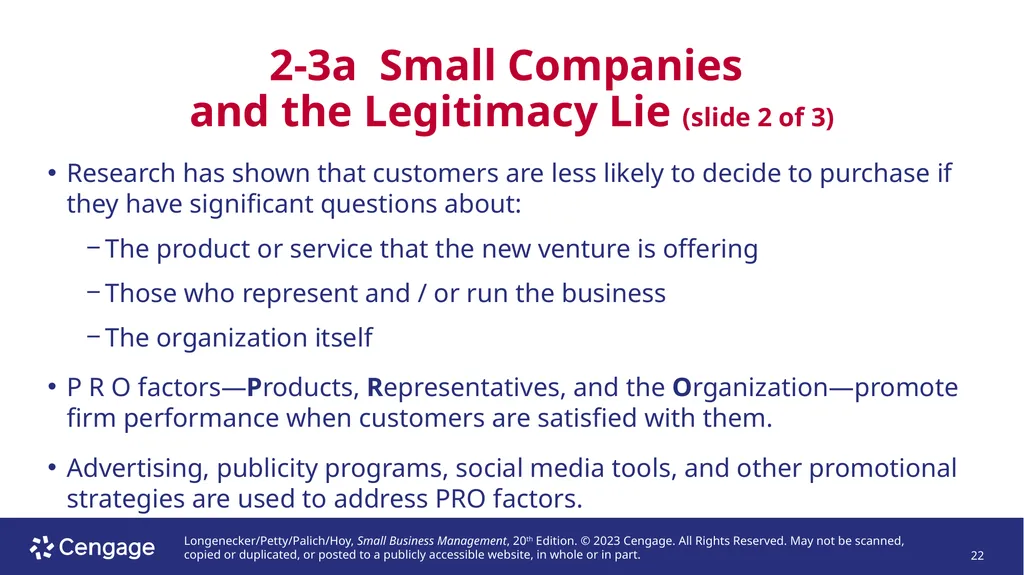
and the Legitimacy Lie (slide 2 of 3) Research has shown that customers are less likely to decide to purchase if they have significant questions about:
The product or service that the new venture is offering
Those who represent and / or run the business
The organization itself
P R O factors—Products, Representatives, and the Organization—promote firm performance when customers are satisfied with them.
Advertising, publicity programs, social media tools, and other promotional strategies are used to address PRO factors.<br>
The product or service that the new venture is offering
Those who represent and / or run the business
The organization itself
P R O factors—Products, Representatives, and the Organization—promote firm performance when customers are satisfied with them.
Advertising, publicity programs, social media tools, and other promotional strategies are used to address PRO factors.<br>
23
2-3a Small Companies
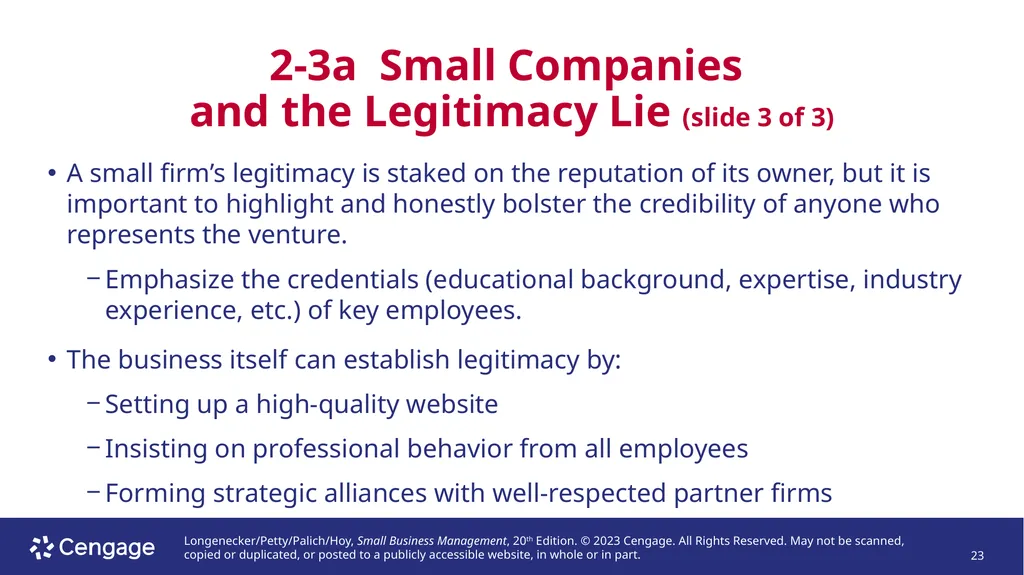
and the Legitimacy Lie (slide 3 of 3) A small firm’s legitimacy is staked on the reputation of its owner, but it is important to highlight and honestly bolster the credibility of anyone who represents the venture.
Emphasize the credentials (educational background, expertise, industry experience, etc.) of key employees.
The business itself can establish legitimacy by:
Setting up a high-quality website
Insisting on professional behavior from all employees
Forming strategic alliances with well-respected partner firms<br>
Emphasize the credentials (educational background, expertise, industry experience, etc.) of key employees.
The business itself can establish legitimacy by:
Setting up a high-quality website
Insisting on professional behavior from all employees
Forming strategic alliances with well-respected partner firms<br>
24
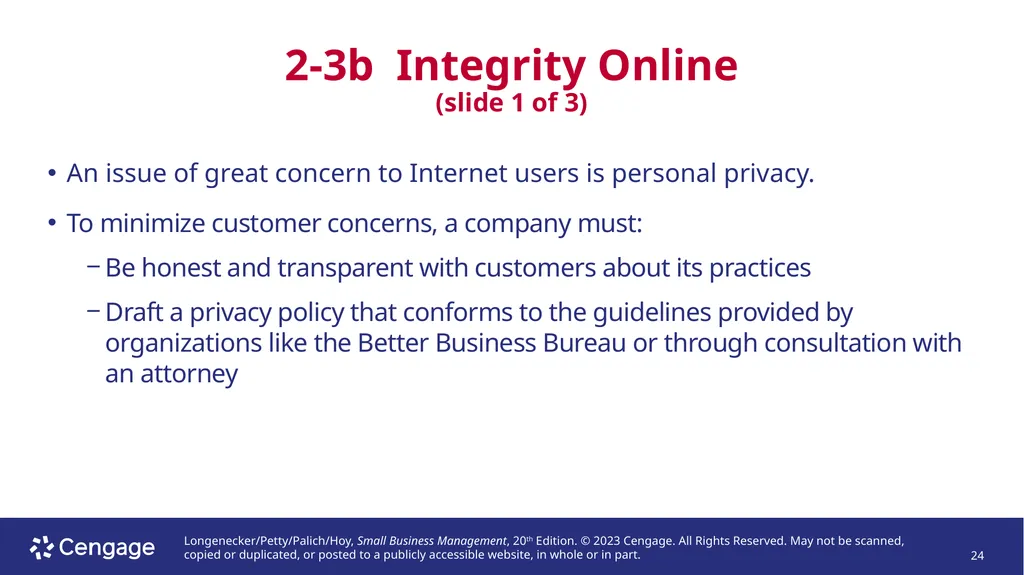
2-3b Integrity Online
(slide 1 of 3) An issue of great concern to Internet users is personal privacy.
To minimize customer concerns, a company must:
Be honest and transparent with customers about its practices
Draft a privacy policy that conforms to the guidelines provided by organizations like the Better Business Bureau or through consultation with an attorney<br>
To minimize customer concerns, a company must:
Be honest and transparent with customers about its practices
Draft a privacy policy that conforms to the guidelines provided by organizations like the Better Business Bureau or through consultation with an attorney<br>
25
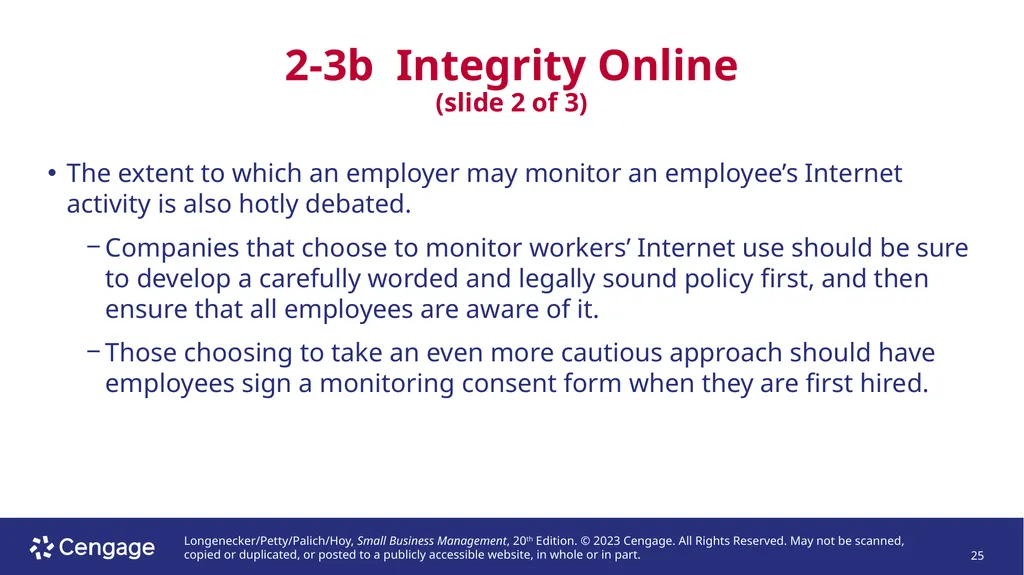
2-3b Integrity Online
(slide 2 of 3) The extent to which an employer may monitor an employee’s Internet activity is also hotly debated.
Companies that choose to monitor workers’ Internet use should be sure to develop a carefully worded and legally sound policy first, and then ensure that all employees are aware of it.
Those choosing to take an even more cautious approach should have employees sign a monitoring consent form when they are first hired.<br>
Companies that choose to monitor workers’ Internet use should be sure to develop a carefully worded and legally sound policy first, and then ensure that all employees are aware of it.
Those choosing to take an even more cautious approach should have employees sign a monitoring consent form when they are first hired.<br>
26
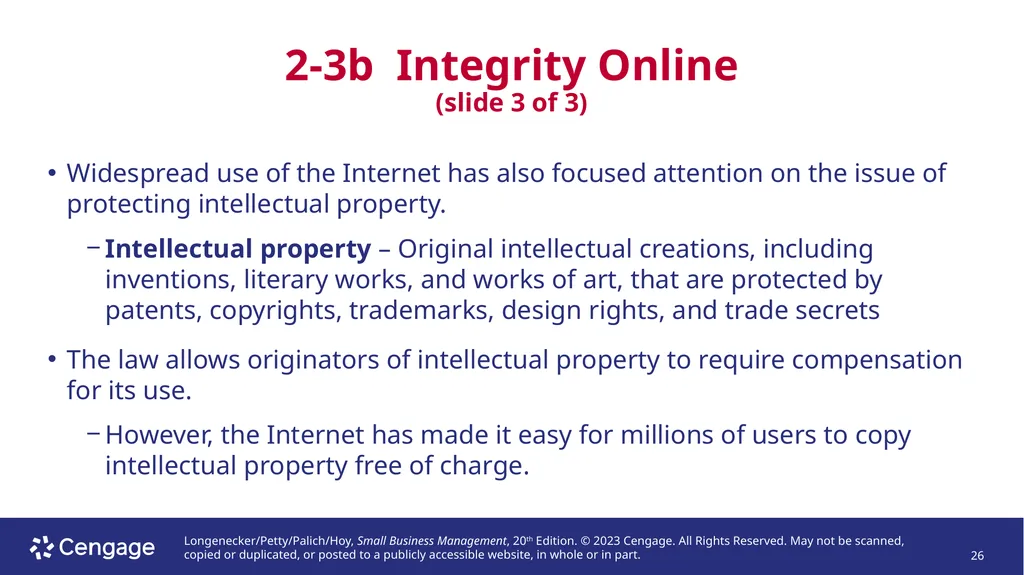
2-3b Integrity Online
(slide 3 of 3) Widespread use of the Internet has also focused attention on the issue of protecting intellectual property.
Intellectual property – Original intellectual creations, including inventions, literary works, and works of art, that are protected by patents, copyrights, trademarks, design rights, and trade secrets
The law allows originators of intellectual property to require compensation for its use.
However, the Internet has made it easy for millions of users to copy intellectual property free of charge.<br>
Intellectual property – Original intellectual creations, including inventions, literary works, and works of art, that are protected by patents, copyrights, trademarks, design rights, and trade secrets
The law allows originators of intellectual property to require compensation for its use.
However, the Internet has made it easy for millions of users to copy intellectual property free of charge.<br>
27
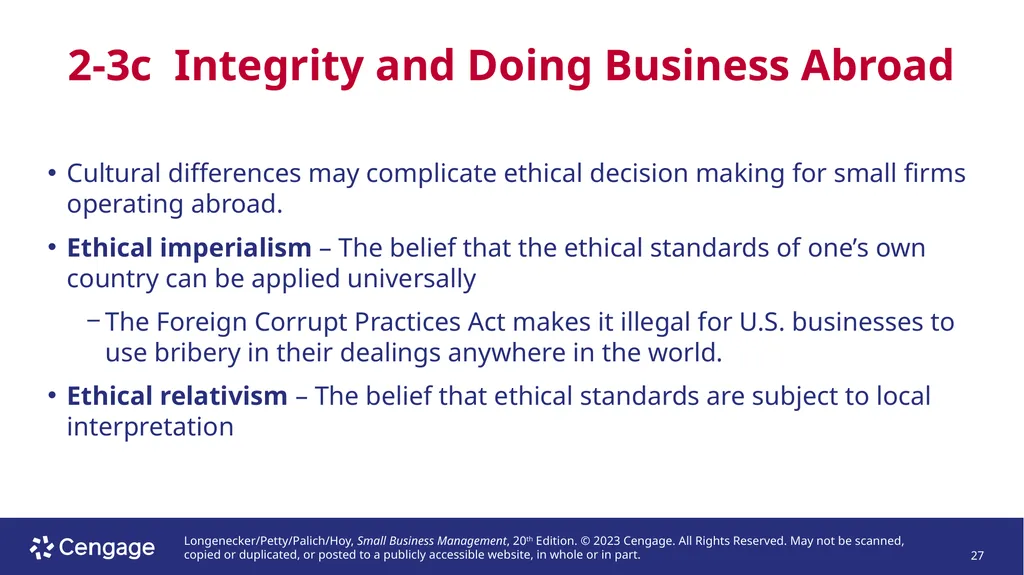
2-3c Integrity and Doing Business Abroad Cultural differences may complicate ethical decision making for small firms operating abroad.
Ethical imperialism – The belief that the ethical standards of one’s own country can be applied universally
The Foreign Corrupt Practices Act makes it illegal for U.S. businesses to use bribery in their dealings anywhere in the world.
Ethical relativism – The belief that ethical standards are subject to local interpretation<br>
Ethical imperialism – The belief that the ethical standards of one’s own country can be applied universally
The Foreign Corrupt Practices Act makes it illegal for U.S. businesses to use bribery in their dealings anywhere in the world.
Ethical relativism – The belief that ethical standards are subject to local interpretation<br>
28
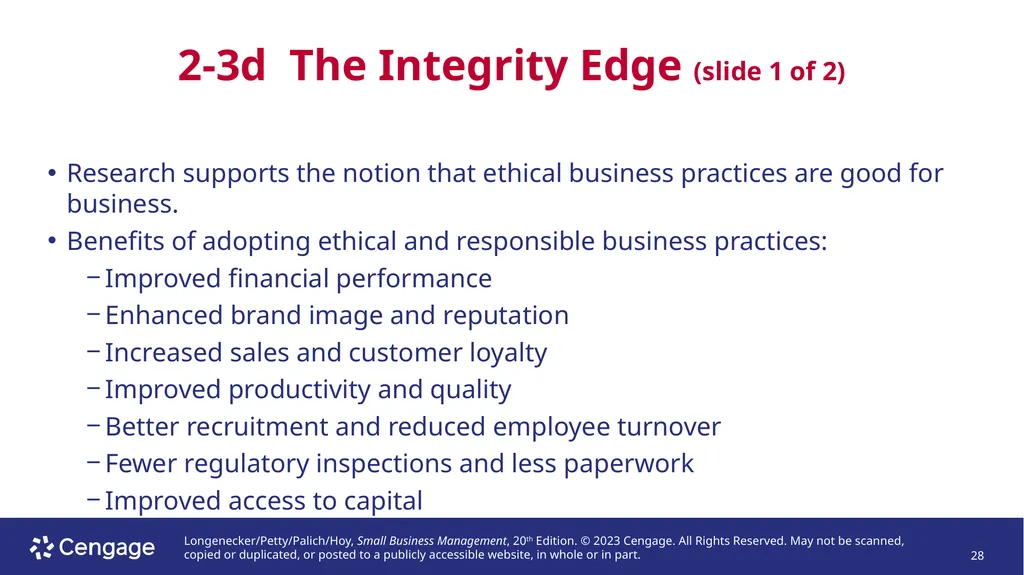
2-3d The Integrity Edge (slide 1 of 2) Research supports the notion that ethical business practices are good for business.
Benefits of adopting ethical and responsible business practices:
Improved financial performance
Enhanced brand image and reputation
Increased sales and customer loyalty
Improved productivity and quality
Better recruitment and reduced employee turnover
Fewer regulatory inspections and less paperwork
Improved access to capital<br>
Benefits of adopting ethical and responsible business practices:
Improved financial performance
Enhanced brand image and reputation
Increased sales and customer loyalty
Improved productivity and quality
Better recruitment and reduced employee turnover
Fewer regulatory inspections and less paperwork
Improved access to capital<br>
29
2-3d The Integrity Edge (slide 2 of 2) Perhaps the greatest benefit of integrity in business is the trust it generates.
When customers and employees trust a small company to act with integrity, their support can help keep the company going.<br>
When customers and employees trust a small company to act with integrity, their support can help keep the company going.<br>
30
Discussion Activity 2 In Discussion Activity 1, you are the owner of a pet store and are facing how to increase customer numbers. Allowing “fake” positive reviews to be posted can be considered a legitimacy lie. What other legitimacy lies might you as a small business owner be tempted to tell? Why should you avoid legitimacy lies?
Form small groups of three to four individuals to explore these questions.<br>
Form small groups of three to four individuals to explore these questions.<br>
31
Discussion Activity 2 Debrief In Discussion Activity 1, you are the owner of a pet store and are facing how to increase customer numbers. Allowing “fake” positive reviews to be posted can be considered a legitimacy lie. What other legitimacy lies might you as a small business owner be tempted to tell? Why should you avoid legitimacy lies?
Examples of legitimacy lies for such a situation might include advertising a low price, but then adding on charges; claims of greater support of animal causes than actual amounts donated; or claiming greater employee experience than they have.
Telling legitimacy lies threatens the reputation of the business and the trust that goes along with it. If (when) the truth is revealed, future sales or support could very well be compromised. It’s better to understand the factors that create customer confidence in a purchase and to provide truthful information.<br>
Examples of legitimacy lies for such a situation might include advertising a low price, but then adding on charges; claims of greater support of animal causes than actual amounts donated; or claiming greater employee experience than they have.
Telling legitimacy lies threatens the reputation of the business and the trust that goes along with it. If (when) the truth is revealed, future sales or support could very well be compromised. It’s better to understand the factors that create customer confidence in a purchase and to provide truthful information.<br>
32
2-4 Building a Business with Integrity<br>
33
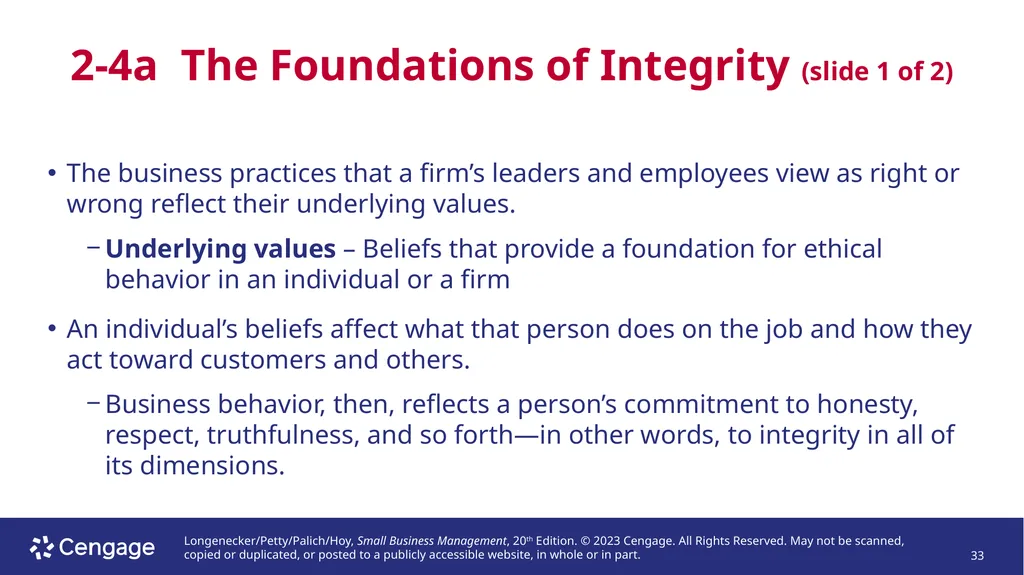
2-4a The Foundations of Integrity (slide 1 of 2) The business practices that a firm’s leaders and employees view as right or wrong reflect their underlying values.
Underlying values – Beliefs that provide a foundation for ethical behavior in an individual or a firm
An individual’s beliefs affect what that person does on the job and how they act toward customers and others.
Business behavior, then, reflects a person’s commitment to honesty, respect, truthfulness, and so forth—in other words, to integrity in all of its dimensions.<br>
Underlying values – Beliefs that provide a foundation for ethical behavior in an individual or a firm
An individual’s beliefs affect what that person does on the job and how they act toward customers and others.
Business behavior, then, reflects a person’s commitment to honesty, respect, truthfulness, and so forth—in other words, to integrity in all of its dimensions.<br>
34
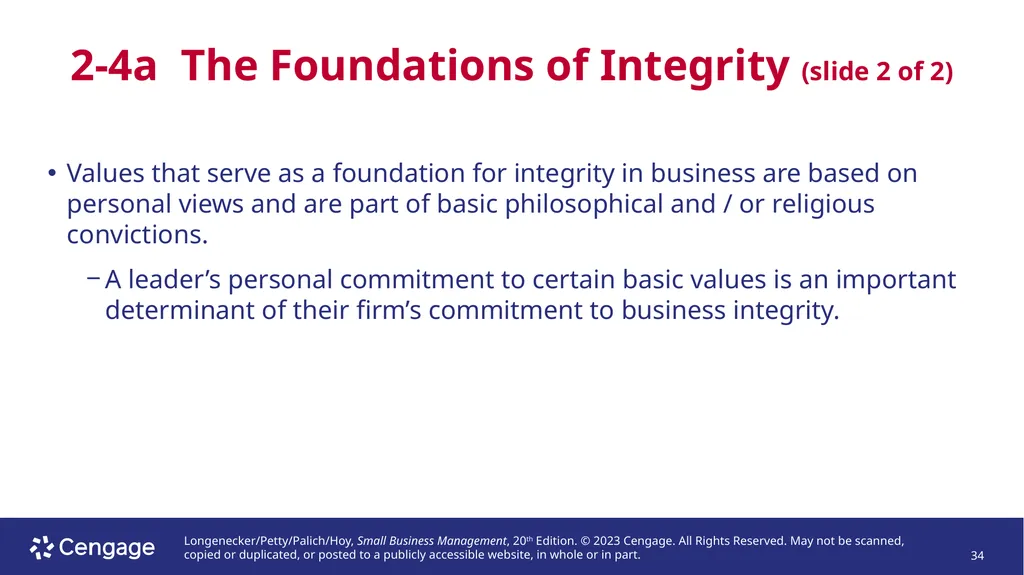
2-4a The Foundations of Integrity (slide 2 of 2) Values that serve as a foundation for integrity in business are based on personal views and are part of basic philosophical and / or religious convictions.
A leader’s personal commitment to certain basic values is an important determinant of their firm’s commitment to business integrity.<br>
A leader’s personal commitment to certain basic values is an important determinant of their firm’s commitment to business integrity.<br>
35
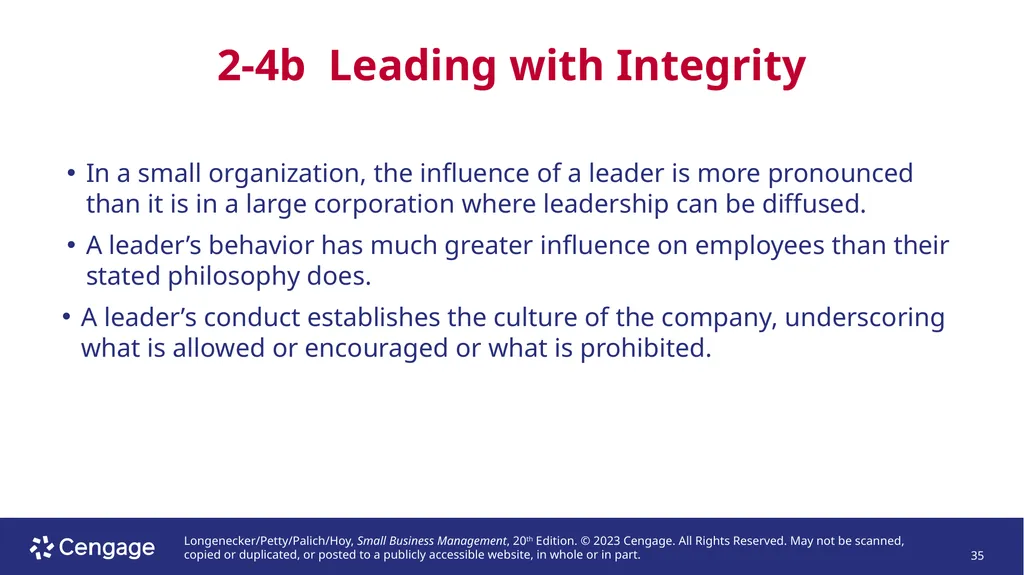
2-4b Leading with Integrity In a small organization, the influence of a leader is more pronounced than it is in a large corporation where leadership can be diffused.
A leader’s behavior has much greater influence on employees than their stated philosophy does.
A leader’s conduct establishes the culture of the company, underscoring what is allowed or encouraged or what is prohibited.<br>
A leader’s behavior has much greater influence on employees than their stated philosophy does.
A leader’s conduct establishes the culture of the company, underscoring what is allowed or encouraged or what is prohibited.<br>
36
2-4c An Ethical Organizational Culture
(slide 1 of 2) A good starting place for articulating and reinforcing principles of integrity among employees is establishing a code of ethics.
Code of ethics – Formally established standards of employee behavior communicated by a business owner
Authors Kenneth Blanchard and Norman Vincent Peale suggest five fundamental principles as bases for an ethics policy:
Purpose
Pride
Patience
Persistence
Perspective<br>
Code of ethics – Formally established standards of employee behavior communicated by a business owner
Authors Kenneth Blanchard and Norman Vincent Peale suggest five fundamental principles as bases for an ethics policy:
Purpose
Pride
Patience
Persistence
Perspective<br>
37
2-4c An Ethical Organizational Culture
(slide 2 of 2) Codes of ethics can shape and improve conduct in organizations by:
defining behavioral expectations
communicating that those expectations apply to employees at all levels
helping employees convey the company’s standards of conduct to suppliers and customers
serving as a guide for handling peer pressure
providing a formal channel for communicating with superiors without fear of reprisal
A well-written code expresses the principles and gives examples of these principles in action.
If a code of ethics is to be effective, employees must be aware of its nature and convinced of its importance.<br>
defining behavioral expectations
communicating that those expectations apply to employees at all levels
helping employees convey the company’s standards of conduct to suppliers and customers
serving as a guide for handling peer pressure
providing a formal channel for communicating with superiors without fear of reprisal
A well-written code expresses the principles and gives examples of these principles in action.
If a code of ethics is to be effective, employees must be aware of its nature and convinced of its importance.<br>
38
2-4d Better Business Bureaus Many small companies join Better Business Bureaus (B B Bs) to promote ethical conduct throughout the business community.
B B Bs encourage ethical practices in the following ways:
By providing consumers with free information to help them make informed decisions when dealing with a company
By creating an incentive for businesses to adhere to proper business practices and earnestly address customer complaints
By resolving questions or disputes concerning purchases through mediation or arbitration<br>
B B Bs encourage ethical practices in the following ways:
By providing consumers with free information to help them make informed decisions when dealing with a company
By creating an incentive for businesses to adhere to proper business practices and earnestly address customer complaints
By resolving questions or disputes concerning purchases through mediation or arbitration<br>
39
2-4e The Ethical Decision-Making Process (slide 1 of 3) STEP 1: DEFINE THE PROBLEM
How you define the problem is important because this will guide where you look for solutions.
STEP 2: IDENTIFY ALTERNATIVE SOLUTIONS TO THE PROBLEM
It is tempting to go with an “obvious” solution or one that has been used in the past, but often this is not the best answer—even if it is ethical.
Be open-minded and consider creative alternatives.<br>
How you define the problem is important because this will guide where you look for solutions.
STEP 2: IDENTIFY ALTERNATIVE SOLUTIONS TO THE PROBLEM
It is tempting to go with an “obvious” solution or one that has been used in the past, but often this is not the best answer—even if it is ethical.
Be open-minded and consider creative alternatives.<br>
40
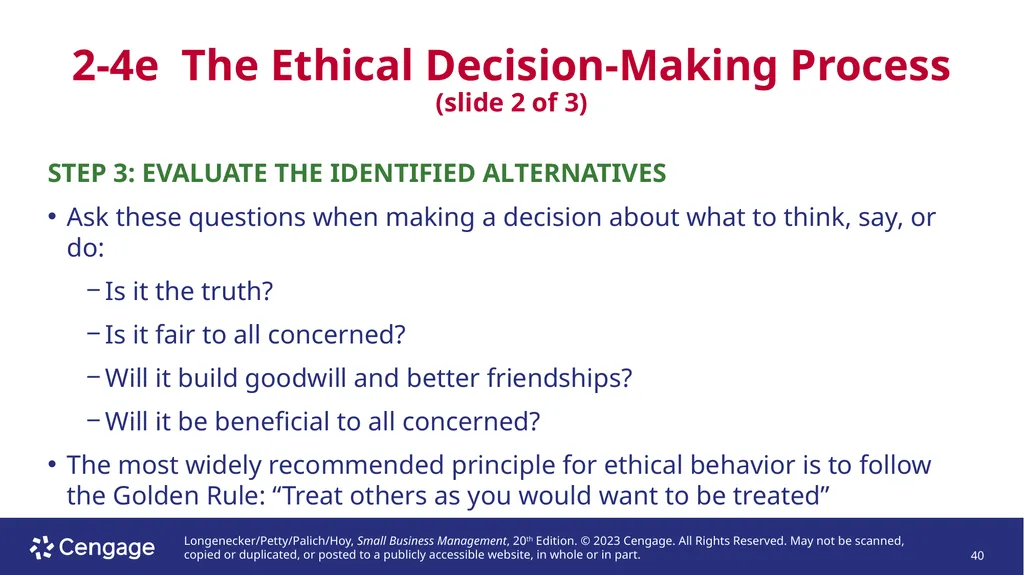
2-4e The Ethical Decision-Making Process (slide 2 of 3) STEP 3: EVALUATE THE IDENTIFIED ALTERNATIVES
Ask these questions when making a decision about what to think, say, or do:
Is it the truth?
Is it fair to all concerned?
Will it build goodwill and better friendships?
Will it be beneficial to all concerned?
The most widely recommended principle for ethical behavior is to follow the Golden Rule: “Treat others as you would want to be treated”<br>
Ask these questions when making a decision about what to think, say, or do:
Is it the truth?
Is it fair to all concerned?
Will it build goodwill and better friendships?
Will it be beneficial to all concerned?
The most widely recommended principle for ethical behavior is to follow the Golden Rule: “Treat others as you would want to be treated”<br>
41
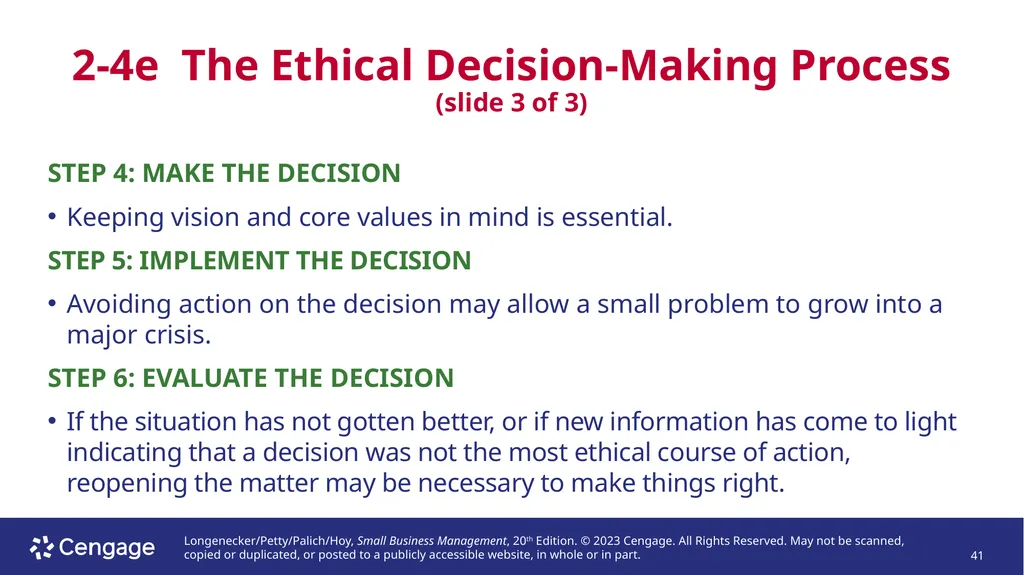
2-4e The Ethical Decision-Making Process (slide 3 of 3) STEP 4: MAKE THE DECISION
Keeping vision and core values in mind is essential.
STEP 5: IMPLEMENT THE DECISION
Avoiding action on the decision may allow a small problem to grow into a major crisis.
STEP 6: EVALUATE THE DECISION
If the situation has not gotten better, or if new information has come to light indicating that a decision was not the most ethical course of action, reopening the matter may be necessary to make things right.<br>
Keeping vision and core values in mind is essential.
STEP 5: IMPLEMENT THE DECISION
Avoiding action on the decision may allow a small problem to grow into a major crisis.
STEP 6: EVALUATE THE DECISION
If the situation has not gotten better, or if new information has come to light indicating that a decision was not the most ethical course of action, reopening the matter may be necessary to make things right.<br>
42
Knowledge Check 2 According to Kenneth Blanchard and Norman Vincent Peale, the principles of purpose, pride, patience, persistence, and perspective provide a basis for
social entrepreneurship.
intellectual property.
code of ethics.
sustainable small business.<br>
social entrepreneurship.
intellectual property.
code of ethics.
sustainable small business.<br>
43
Knowledge Check 2 Answer According to Kenneth Blanchard and Norman Vincent Peale, the principles of purpose, pride, patience, persistence, and perspective provide a basis for
code of ethics.
They suggested in The Power of Ethical Management that the development of an ethics policy be based on these fundamental principles.<br>
code of ethics.
They suggested in The Power of Ethical Management that the development of an ethics policy be based on these fundamental principles.<br>
44
2-5 Social Entrepreneurship:
A Continuing Trend<br>
A Continuing Trend<br>
45
2-5a Social Entrepreneurship
and the Triple Bottom Line Social entrepreneurship – Entrepreneurial activity that provides innovative solutions for social issues
Social entrepreneurs focus on an expanded set of priorities—a triple bottom line, which takes into account a venture’s impact on people, profits, and the planet.<br>
Social entrepreneurs focus on an expanded set of priorities—a triple bottom line, which takes into account a venture’s impact on people, profits, and the planet.<br>
46
2-5b Small Business and the Natural Environment (slide 1 of 2) Sustainable small business – A profitable company that responds to customers’ needs while showing reasonable concern for the environment
This trend recognizes that a company must be profitable to stay in business, but it also promotes eco-friendly operational practices.
SUSTAINABILITY MATTERS
Environmentalism – The effort to protect and preserve the environment
The commitment to the cause of environmentalism makes financial sense for many businesses.<br>
This trend recognizes that a company must be profitable to stay in business, but it also promotes eco-friendly operational practices.
SUSTAINABILITY MATTERS
Environmentalism – The effort to protect and preserve the environment
The commitment to the cause of environmentalism makes financial sense for many businesses.<br>
47
2-5b Small Business and the Natural Environment (slide 2 of 2) Firms whose products leave minimal environmental impact are generally preferred by customers over competitors whose products pollute.
GREEN OPPORTUNITIES FOR SMALL BUSINESSES
Small companies are sometimes launched precisely to take advantage of opportunities created by environmental concerns.
Creating environmentally friendly products and services requires creativity and flexibility, areas in which small businesses tend to excel.<br>
GREEN OPPORTUNITIES FOR SMALL BUSINESSES
Small companies are sometimes launched precisely to take advantage of opportunities created by environmental concerns.
Creating environmentally friendly products and services requires creativity and flexibility, areas in which small businesses tend to excel.<br>
48
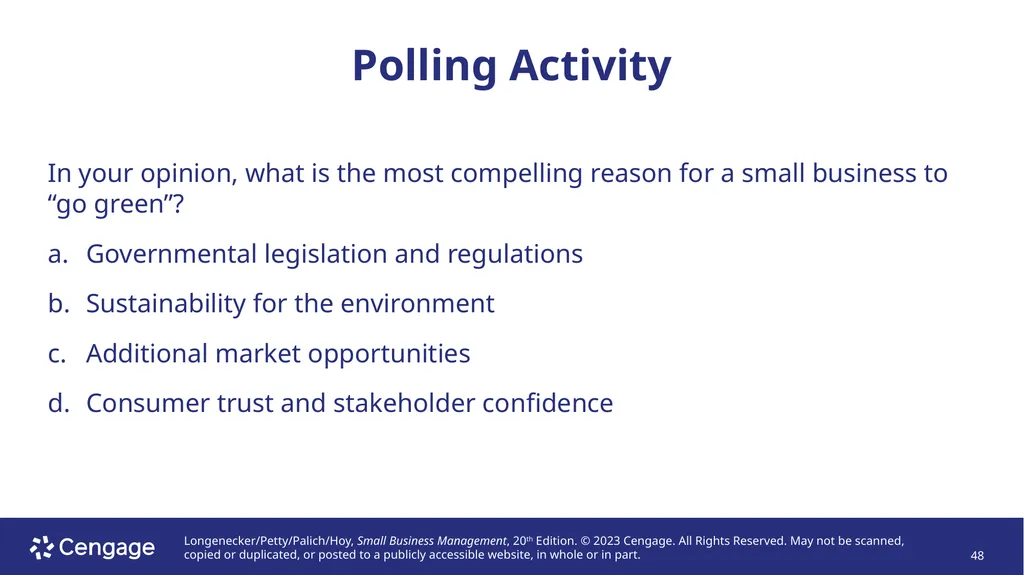
Polling Activity In your opinion, what is the most compelling reason for a small business to “go green”?
Governmental legislation and regulations
Sustainability for the environment
Additional market opportunities
Consumer trust and stakeholder confidence<br>
Governmental legislation and regulations
Sustainability for the environment
Additional market opportunities
Consumer trust and stakeholder confidence<br>
49
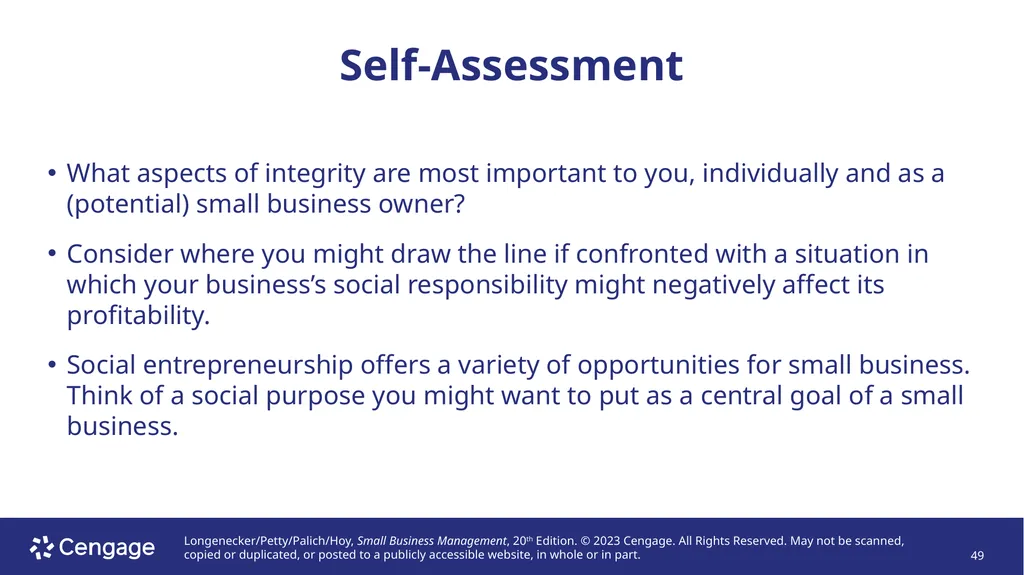
Self-Assessment What aspects of integrity are most important to you, individually and as a (potential) small business owner?
Consider where you might draw the line if confronted with a situation in which your business’s social responsibility might negatively affect its profitability.
Social entrepreneurship offers a variety of opportunities for small business. Think of a social purpose you might want to put as a central goal of a small business.<br>
Consider where you might draw the line if confronted with a situation in which your business’s social responsibility might negatively affect its profitability.
Social entrepreneurship offers a variety of opportunities for small business. Think of a social purpose you might want to put as a central goal of a small business.<br>
50
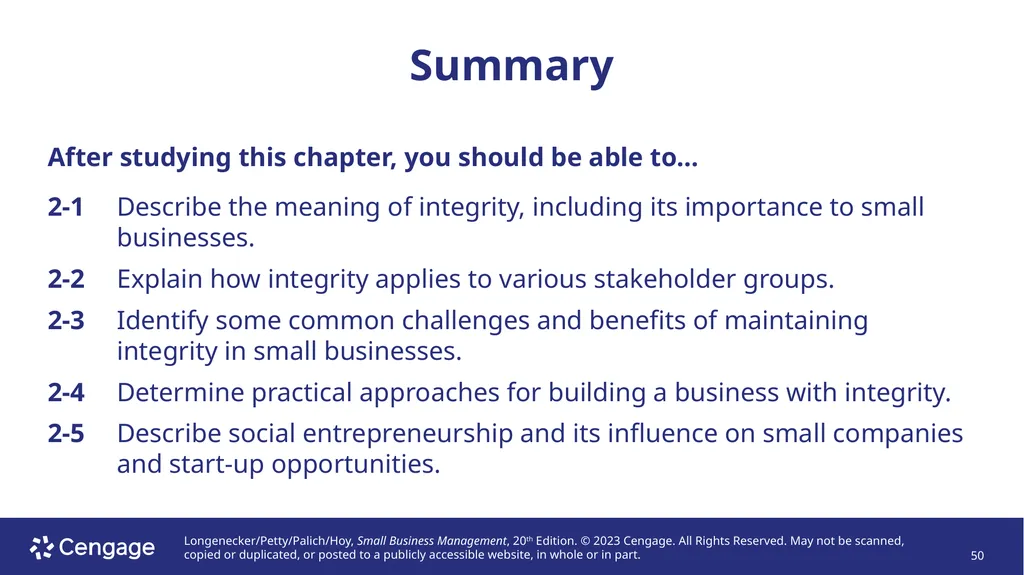
Summary After studying this chapter, you should be able to…
2-1 Describe the meaning of integrity, including its importance to small businesses.
2-2 Explain how integrity applies to various stakeholder groups.
2-3 Identify some common challenges and benefits of maintaining integrity in small businesses.
2-4 Determine practical approaches for building a business with integrity.
2-5 Describe social entrepreneurship and its influence on small companies and start-up opportunities.<br>
2-1 Describe the meaning of integrity, including its importance to small businesses.
2-2 Explain how integrity applies to various stakeholder groups.
2-3 Identify some common challenges and benefits of maintaining integrity in small businesses.
2-4 Determine practical approaches for building a business with integrity.
2-5 Describe social entrepreneurship and its influence on small companies and start-up opportunities.<br>