
Soil Profiles Leaving Cert. Agricultural Science

Description: Soil Profiles Leaving Cert. Agricultural Science Classification Soil profiles are a useful method of classifying soils. Soil profiles are determined by examining the proportions of each horizon and The colour of each horizon For your
Related Topics
Download Presentation
"Soil Profiles Leaving Cert. Agricultural Science" is the property of its rightful owner. Permission is granted to download and print the materials on this website for personal, non-commercial use only, and to display it on your personal computer provided you do not modify the materials and that you retain all copyright notices contained in the materials. By downloading content from our website, you accept the terms of this agreement.
Presentation Transcript
slide1. Soil Profiles Leaving Cert. Agricultural Science<br>
slide2. Classification Soil profiles are a useful method of classifying soils.
Soil profiles are determined by examining
the proportions of each ‘horizon’ and
The colour of each horizon
For your leaving cert exam there are 3 main profiles to know:
Brown Earth
Podzol
Gley
Students are expected to draw each profile for the exam<br>
slide3. Drawing a soil profile As for any diagram in the exam, give yourself at least half a page
Use pencil
You can use colour but this isn’t a good idea if you are against time
The examiner is looking for correct proportions, and correct labels to indicate colours.<br>
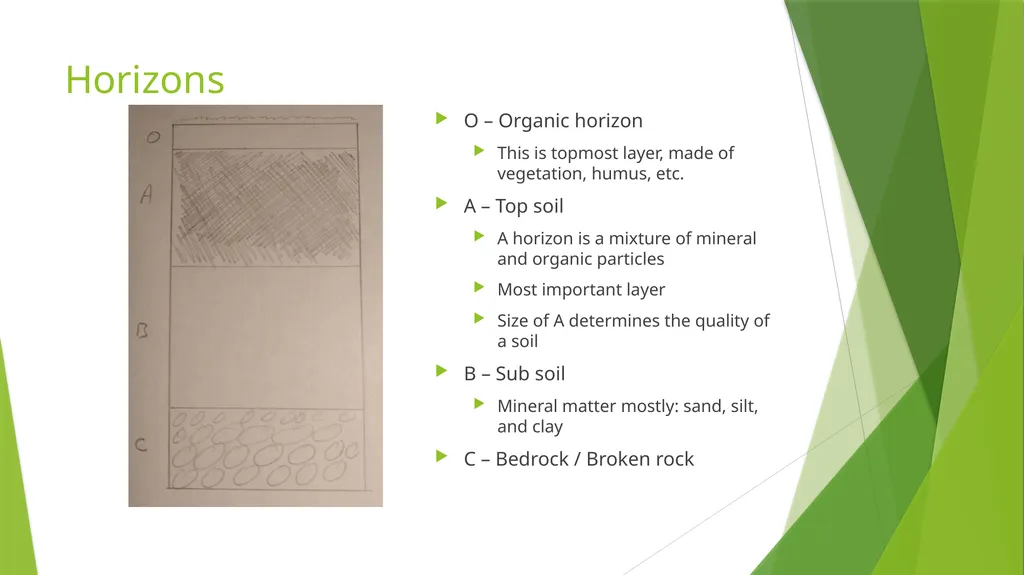
slide4. Horizons O – Organic horizon
This is topmost layer, made of vegetation, humus, etc.
A – Top soil
A horizon is a mixture of mineral and organic particles
Most important layer
Size of A determines the quality of a soil
B – Sub soil
Mineral matter mostly: sand, silt, and clay
C – Bedrock / Broken rock<br>
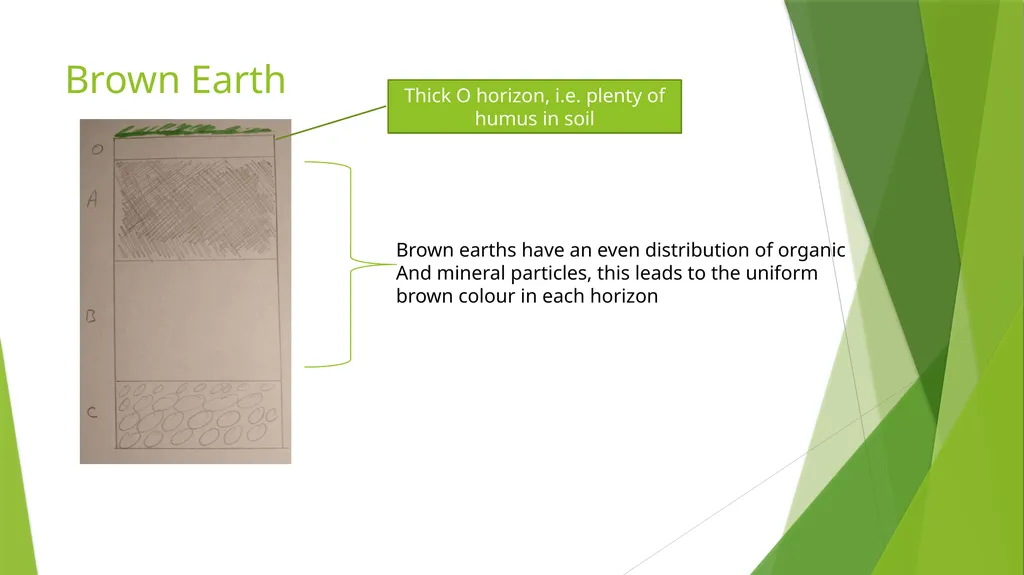
slide5. Brown Earth Thick O horizon, i.e. plenty of humus in soil Brown earths have an even distribution of organic
And mineral particles, this leads to the uniform
brown colour in each horizon<br>
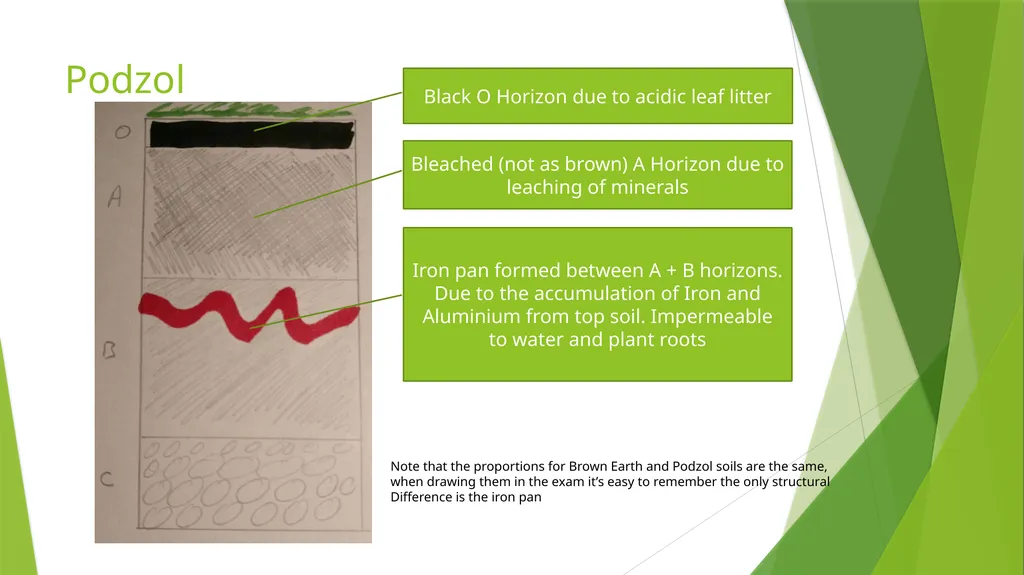
slide6. Podzol Black O Horizon due to acidic leaf litter Bleached (not as brown) A Horizon due to leaching of minerals Iron pan formed between A + B horizons. Due to the accumulation of Iron and Aluminium from top soil. Impermeable to water and plant roots Note that the proportions for Brown Earth and Podzol soils are the same,
when drawing them in the exam it’s easy to remember the only structural
Difference is the iron pan<br>
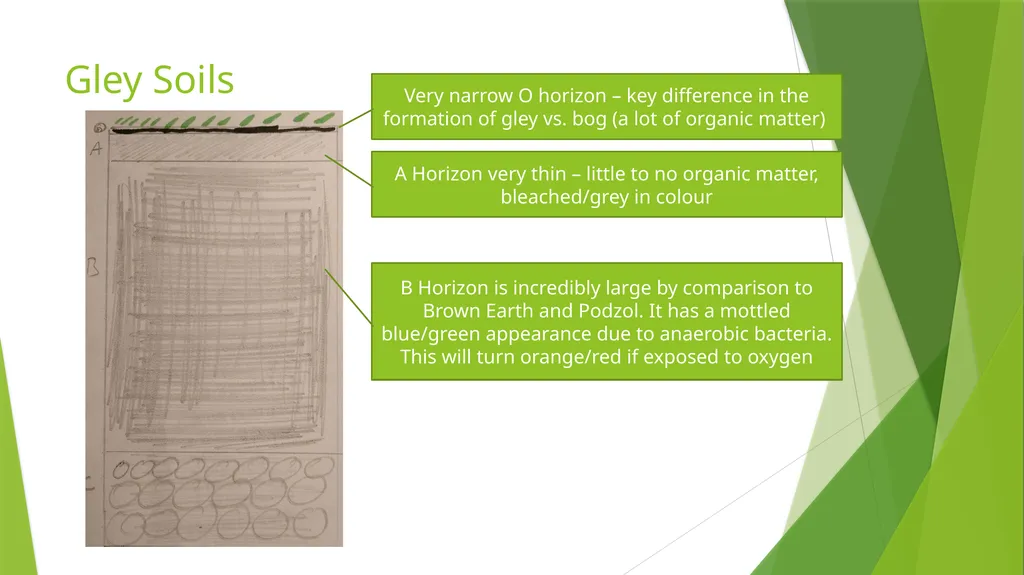
slide7. Gley Soils Very narrow O horizon – key difference in the formation of gley vs. bog (a lot of organic matter) A Horizon very thin – little to no organic matter, bleached/grey in colour B Horizon is incredibly large by comparison to Brown Earth and Podzol. It has a mottled blue/green appearance due to anaerobic bacteria. This will turn orange/red if exposed to oxygen<br>
slide8. Study advice Go back through exam papers and practice drawing each of the three soil profiles.
Check the marking scheme to see how many marks are awarded in each case.
Remember when drawing, use at least half a page and make notes/labels very clear
Use pencil in case you make a mistake
Watch your time in the exam<br>
slide2. Classification Soil profiles are a useful method of classifying soils.
Soil profiles are determined by examining
the proportions of each ‘horizon’ and
The colour of each horizon
For your leaving cert exam there are 3 main profiles to know:
Brown Earth
Podzol
Gley
Students are expected to draw each profile for the exam<br>
slide3. Drawing a soil profile As for any diagram in the exam, give yourself at least half a page
Use pencil
You can use colour but this isn’t a good idea if you are against time
The examiner is looking for correct proportions, and correct labels to indicate colours.<br>
slide4. Horizons O – Organic horizon
This is topmost layer, made of vegetation, humus, etc.
A – Top soil
A horizon is a mixture of mineral and organic particles
Most important layer
Size of A determines the quality of a soil
B – Sub soil
Mineral matter mostly: sand, silt, and clay
C – Bedrock / Broken rock<br>
slide5. Brown Earth Thick O horizon, i.e. plenty of humus in soil Brown earths have an even distribution of organic
And mineral particles, this leads to the uniform
brown colour in each horizon<br>
slide6. Podzol Black O Horizon due to acidic leaf litter Bleached (not as brown) A Horizon due to leaching of minerals Iron pan formed between A + B horizons. Due to the accumulation of Iron and Aluminium from top soil. Impermeable to water and plant roots Note that the proportions for Brown Earth and Podzol soils are the same,
when drawing them in the exam it’s easy to remember the only structural
Difference is the iron pan<br>
slide7. Gley Soils Very narrow O horizon – key difference in the formation of gley vs. bog (a lot of organic matter) A Horizon very thin – little to no organic matter, bleached/grey in colour B Horizon is incredibly large by comparison to Brown Earth and Podzol. It has a mottled blue/green appearance due to anaerobic bacteria. This will turn orange/red if exposed to oxygen<br>
slide8. Study advice Go back through exam papers and practice drawing each of the three soil profiles.
Check the marking scheme to see how many marks are awarded in each case.
Remember when drawing, use at least half a page and make notes/labels very clear
Use pencil in case you make a mistake
Watch your time in the exam<br>