
Solid waste management waste It is defined as
Description: Solid waste management waste It is defined as Waste (also known as rubbish, trash, refuse, garbage, junk) is any unwanted or useless materials. OR Any materials unused and rejected as worthless or unwanted and A useless or profile less
Related Topics
Download Presentation
"Solid waste management waste It is defined as" is the property of its rightful owner. Permission is granted to download and print the materials on this website for personal, non-commercial use only, and to display it on your personal computer provided you do not modify the materials and that you retain all copyright notices contained in the materials. By downloading content from our website, you accept the terms of this agreement.
Presentation Transcript
slide1. Solid waste management<br>
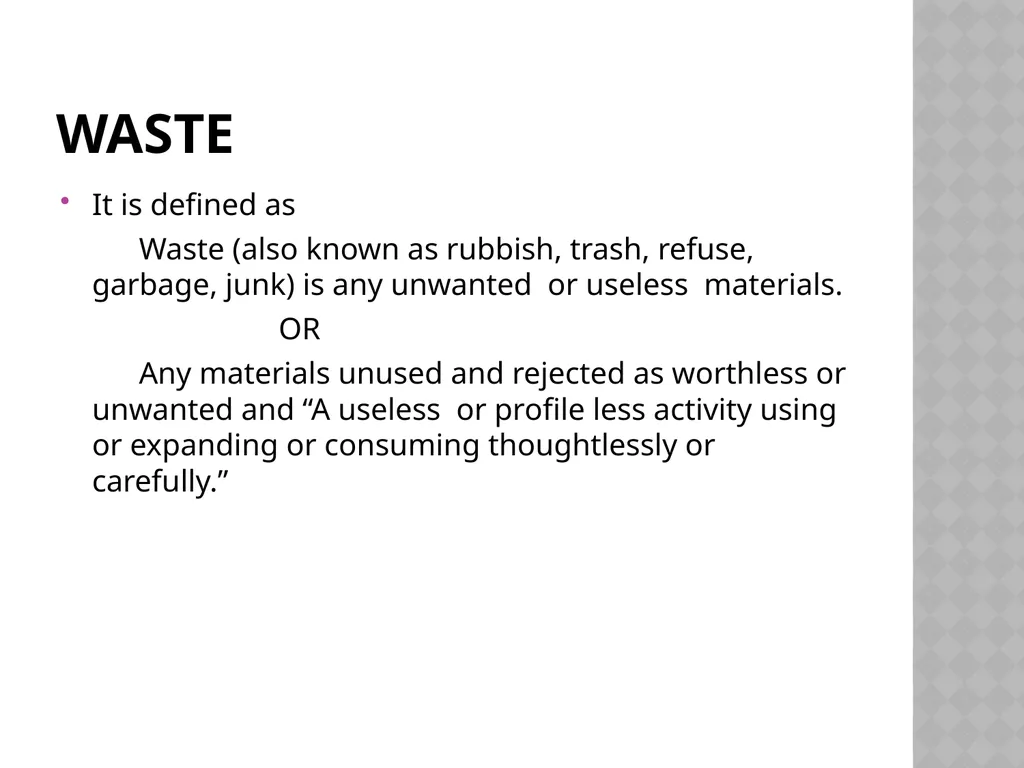
slide2. waste It is defined as
Waste (also known as rubbish, trash, refuse, garbage, junk) is any unwanted or useless materials.
OR
Any materials unused and rejected as worthless or unwanted and “A useless or profile less activity using or expanding or consuming thoughtlessly or carefully.”<br>
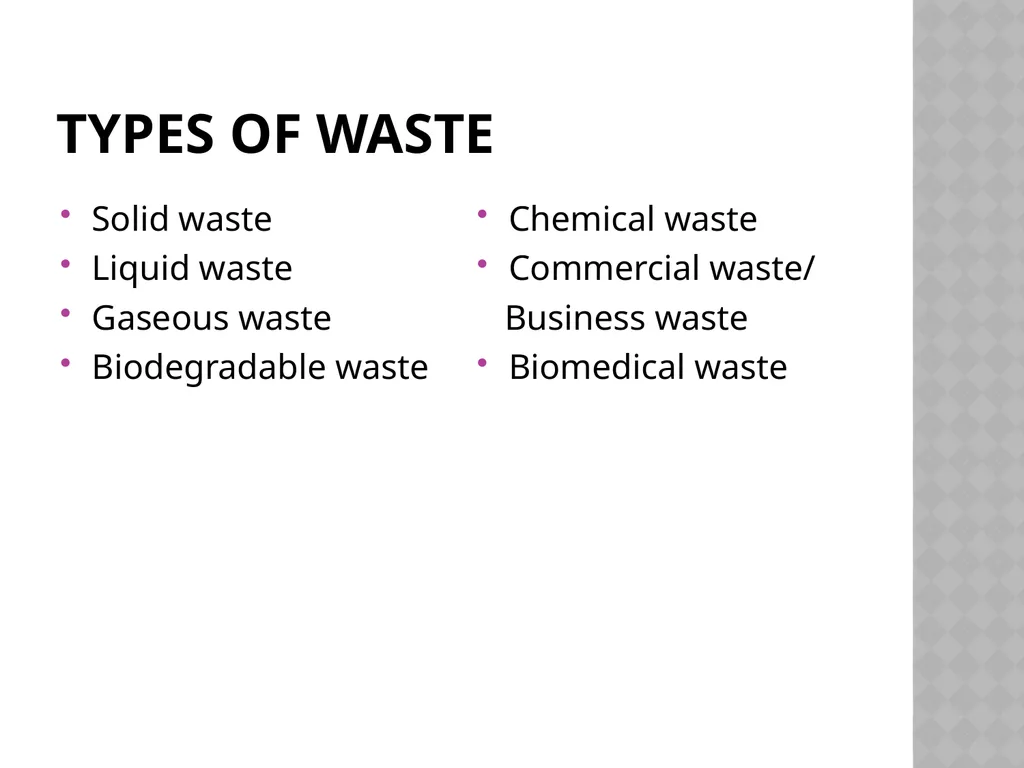
slide3. Types of waste Solid waste
Liquid waste
Gaseous waste
Biodegradable waste Chemical waste
Commercial waste/
Business waste
Biomedical waste<br>
slide4. Solid waste It is defined as
“ sludge, non-soluble materials ranging from municipal garbage to industrial wastes that contain complex & sometimes hazardous substances”
Solid waste also include
Garbage
Rubbish
Demolition products
Sewage treatment residue
Dead animals
Manure and other discarded material.<br>
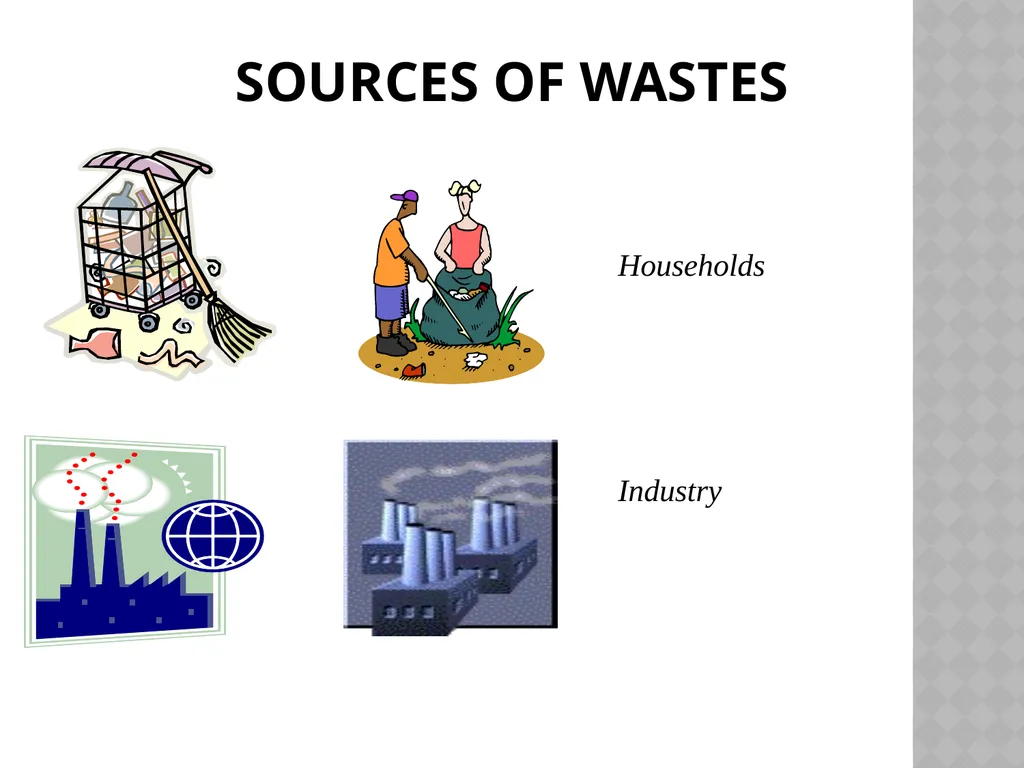
slide5. Sources of Wastes Households
Industry<br>
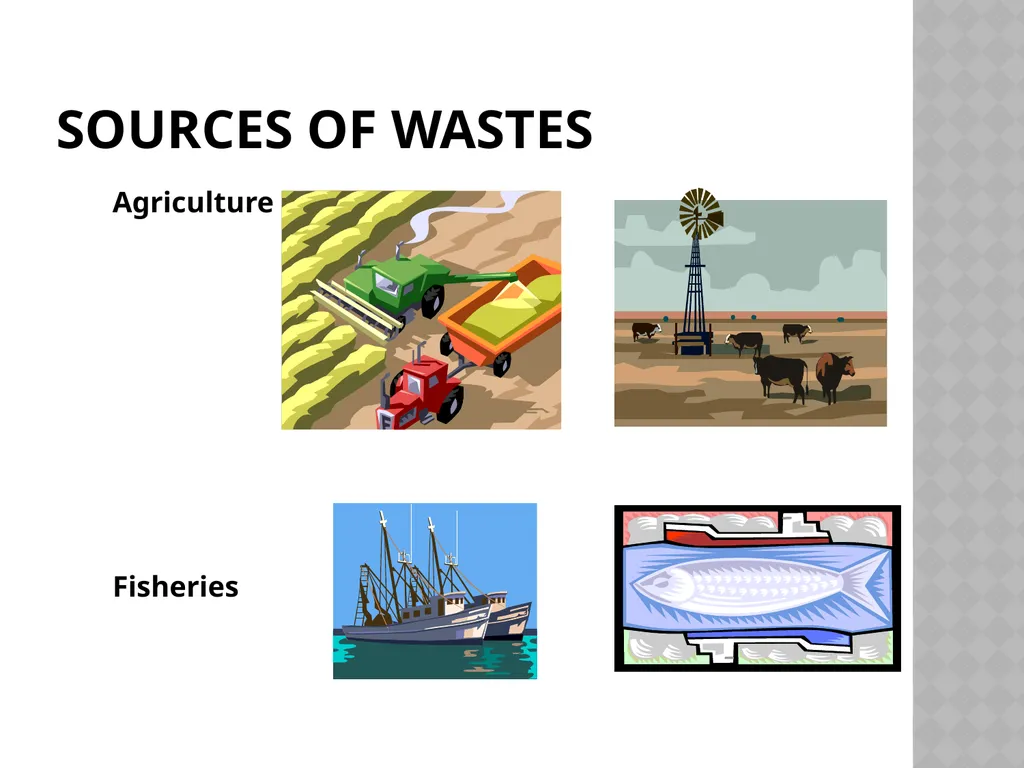
slide6. Sources of Wastes Agriculture
Fisheries<br>
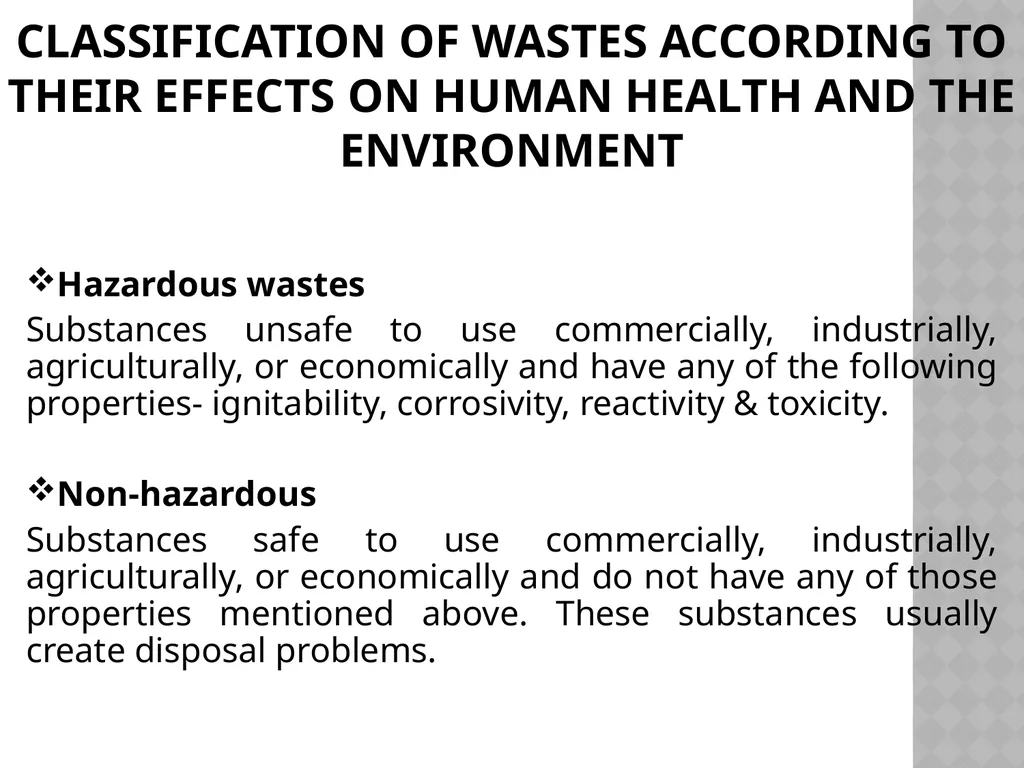
slide7. Classification of Wastes according to their Effects on Human Health and the Environment Hazardous wastes
Substances unsafe to use commercially, industrially, agriculturally, or economically and have any of the following properties- ignitability, corrosivity, reactivity & toxicity.
Non-hazardous
Substances safe to use commercially, industrially, agriculturally, or economically and do not have any of those properties mentioned above. These substances usually create disposal problems.<br>
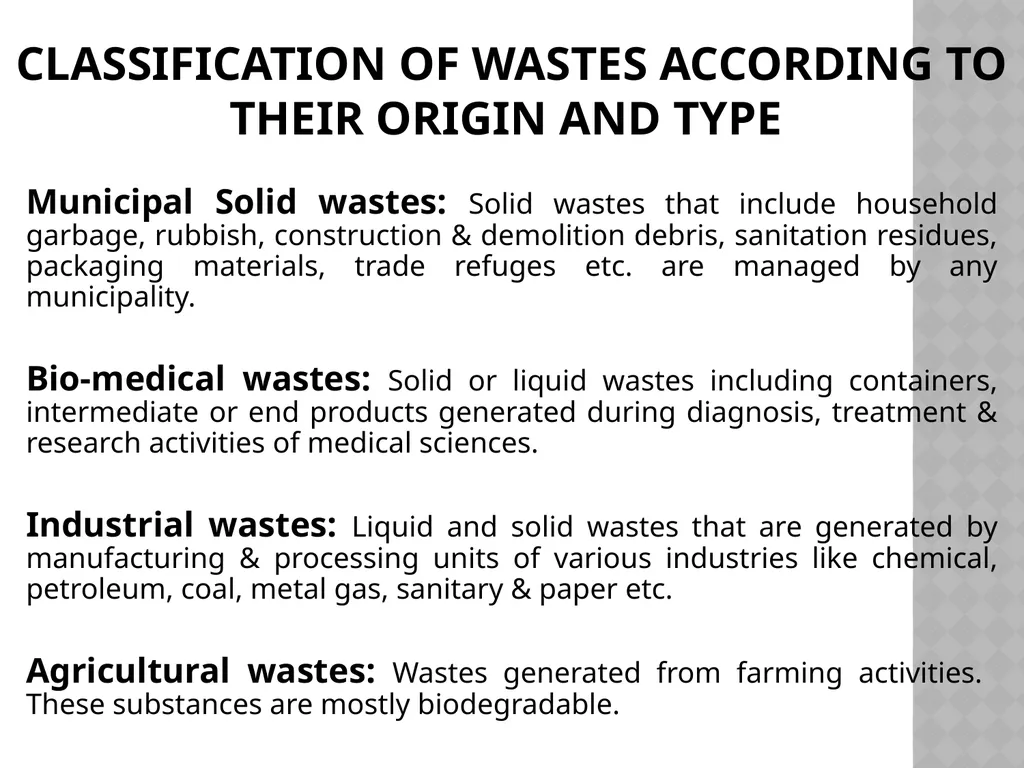
slide8. Classification of wastes according to their origin and type Municipal Solid wastes: Solid wastes that include household garbage, rubbish, construction & demolition debris, sanitation residues, packaging materials, trade refuges etc. are managed by any municipality.
Bio-medical wastes: Solid or liquid wastes including containers, intermediate or end products generated during diagnosis, treatment & research activities of medical sciences.
Industrial wastes: Liquid and solid wastes that are generated by manufacturing & processing units of various industries like chemical, petroleum, coal, metal gas, sanitary & paper etc.
Agricultural wastes: Wastes generated from farming activities. These substances are mostly biodegradable.<br>
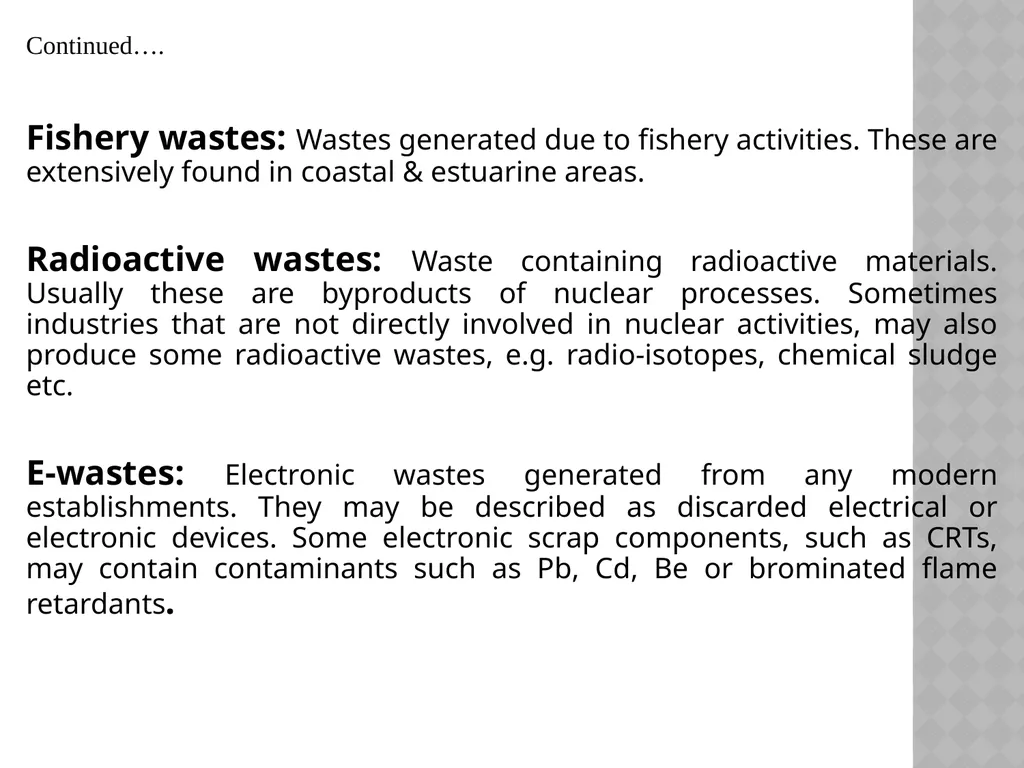
slide9. Fishery wastes: Wastes generated due to fishery activities. These are extensively found in coastal & estuarine areas.
Radioactive wastes: Waste containing radioactive materials. Usually these are byproducts of nuclear processes. Sometimes industries that are not directly involved in nuclear activities, may also produce some radioactive wastes, e.g. radio-isotopes, chemical sludge etc.
E-wastes: Electronic wastes generated from any modern establishments. They may be described as discarded electrical or electronic devices. Some electronic scrap components, such as CRTs, may contain contaminants such as Pb, Cd, Be or brominated flame retardants. Continued….<br>
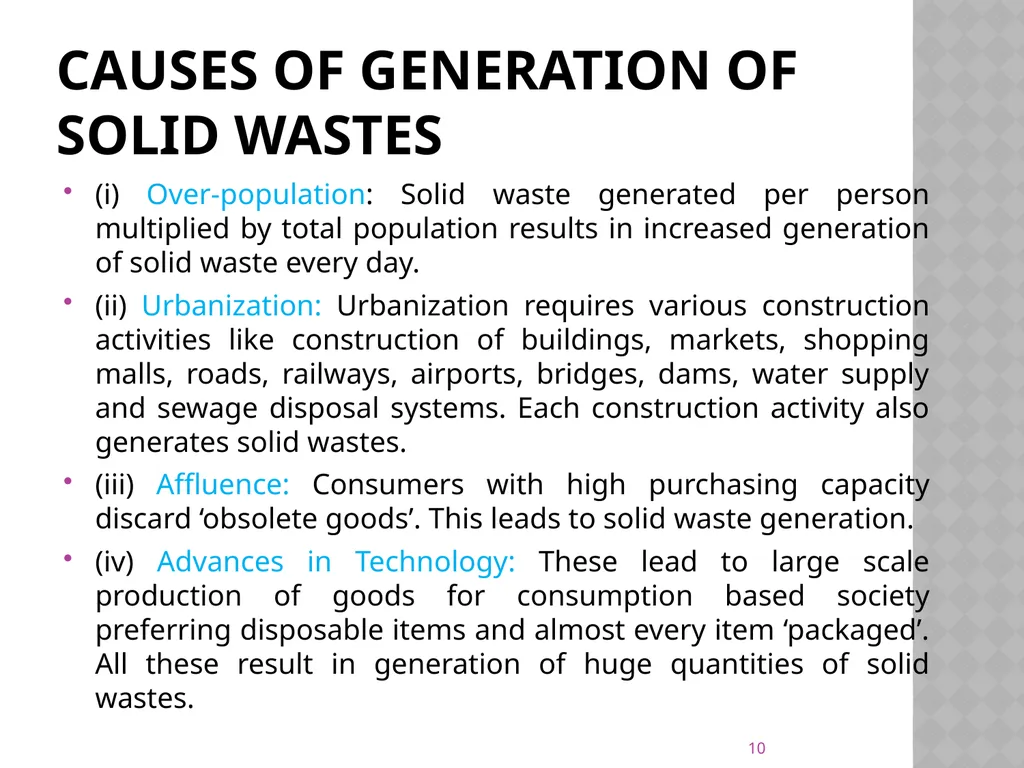
slide10. Causes of Generation of Solid Wastes (i) Over-population: Solid waste generated per person multiplied by total population results in increased generation of solid waste every day.
(ii) Urbanization: Urbanization requires various construction activities like construction of buildings, markets, shopping malls, roads, railways, airports, bridges, dams, water supply and sewage disposal systems. Each construction activity also generates solid wastes.
(iii) Affluence: Consumers with high purchasing capacity discard ‘obsolete goods’. This leads to solid waste generation.
(iv) Advances in Technology: These lead to large scale production of goods for consumption based society preferring disposable items and almost every item ‘packaged’. All these result in generation of huge quantities of solid wastes. 10<br>
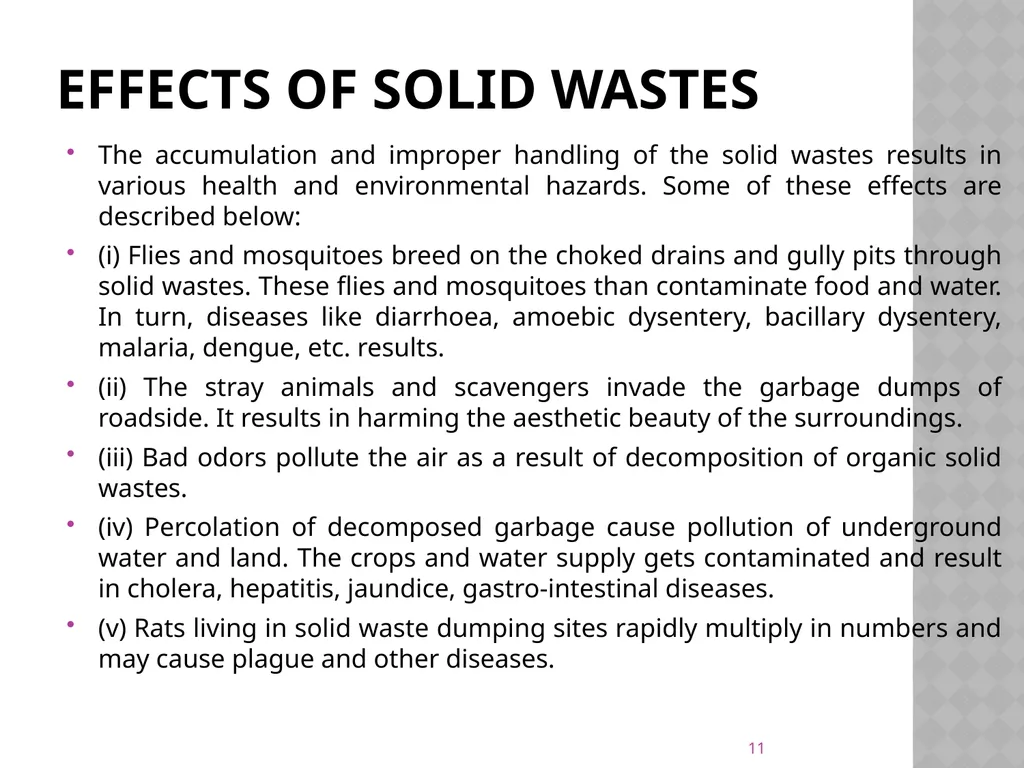
slide11. Effects of Solid Wastes The accumulation and improper handling of the solid wastes results in various health and environmental hazards. Some of these effects are described below:
(i) Flies and mosquitoes breed on the choked drains and gully pits through solid wastes. These flies and mosquitoes than contaminate food and water. In turn, diseases like diarrhoea, amoebic dysentery, bacillary dysentery, malaria, dengue, etc. results.
(ii) The stray animals and scavengers invade the garbage dumps of roadside. It results in harming the aesthetic beauty of the surroundings.
(iii) Bad odors pollute the air as a result of decomposition of organic solid wastes.
(iv) Percolation of decomposed garbage cause pollution of underground water and land. The crops and water supply gets contaminated and result in cholera, hepatitis, jaundice, gastro-intestinal diseases.
(v) Rats living in solid waste dumping sites rapidly multiply in numbers and may cause plague and other diseases. 11<br>
slide12. Solid waste management Waste management is the
storage
collection
transport and handling
recycling
disposal and monitoring of waste materials.<br>
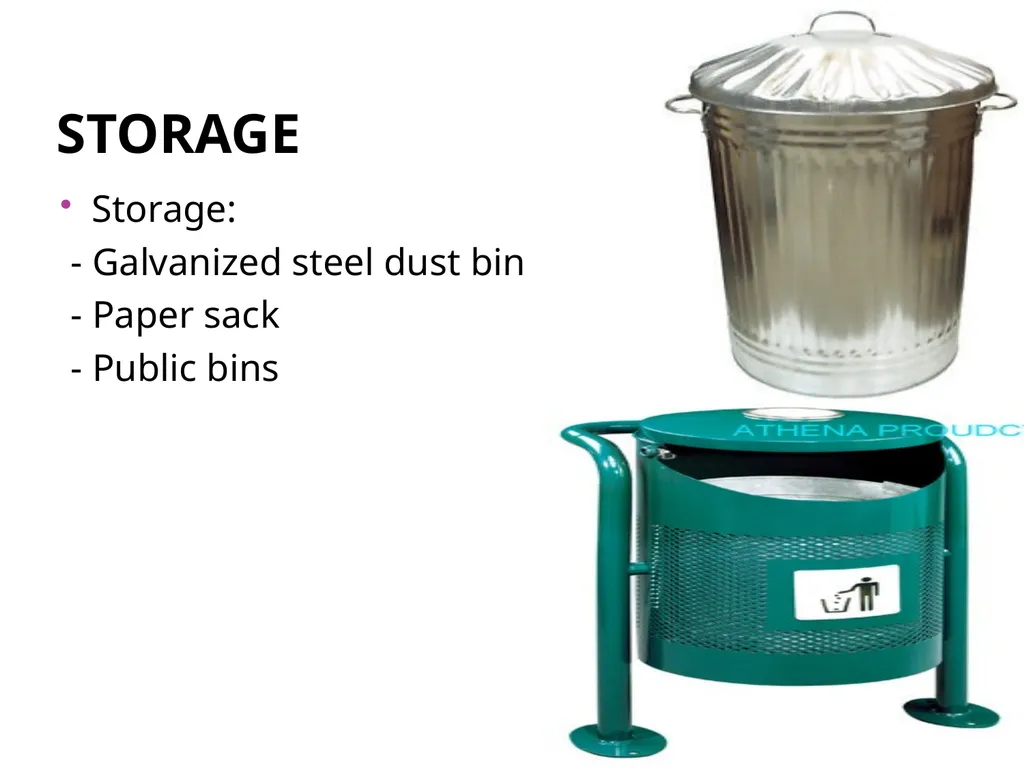
slide13. storage Storage:
- Galvanized steel dust bin
- Paper sack
- Public bins<br>
slide14. collection Collection
- House-to-house collection
- Collection from the public bins<br>
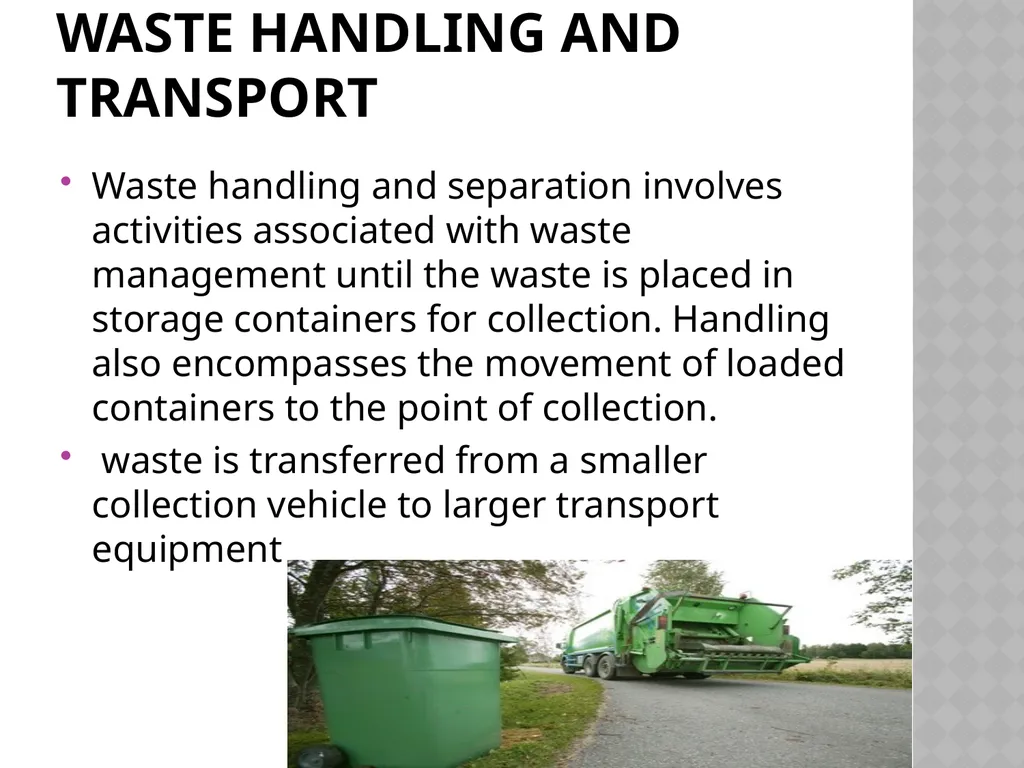
slide15. Waste handling and transport Waste handling and separation involves activities associated with waste management until the waste is placed in storage containers for collection. Handling also encompasses the movement of loaded containers to the point of collection.
waste is transferred from a smaller collection vehicle to larger transport equipment<br>
slide16. Recycling Recycling refers to the collection and
refuse of waste materials such as empty beverage container.
The materials from which the items are
made can be processed into new
products.
Materials for recycling may be collected
separately from general waste using dedicated bins.<br>
slide17. Waste disposal method Segregation
Landfills
Incineration
Composting<br>
slide18. Segregation At the beginning of waste management, wastes should be categorized and segregated according to their category. This is because the method of disposal would be different for different wastes.
For example, hospital wastes can be categorized and segregated on the basis of their weight, density and constituents. These are:
Infectious: Materials containing pathogens in dangerous concentrations or qualities that, if exposed, can cause diseases. This includes waste from surgery and autopsies on patients with infectious diseases. Sharp disposable needles, syringes, saws, blades, broken glasses, nails or any other item that could cause a cut.
Pathological: Tissues, organs, body parts, human flesh, fetuses, blood and body fluid.
Pharmaceuticals: Drugs and chemicals that are returned from wards, spilled, outdated, contaminated, or are no longer required.
Radioactive: Solids, liquids and gaseous waste contaminated with radioactive substances used in diagnosis and treatment of diseases.
Others: Waste from the offices, kitchens, rooms, including bed linen, utensils, paper, etc.
These wastes can be further disposed differently, according to their category.<br>
slide19. Landfills Landfill site is a pit that is dug in the ground. The solid waste is dumped and the pit is covered with a layer of soil to form a cell. The process is repeated every day so that many cells completely fill the landfill site. Finally, about 1 m of earth layer covering is done.
Advantages:
(i) Breeding of insects is prevented.
(ii) Landfill sites can be developed as a park or a parking space.
Disadvantages:
(i) All types of wastes are dumped in land fill sites without segregation. When rainwater seeps through them, it gets contaminated and in turn pollutes the surrounding area, and ground water. 19<br>
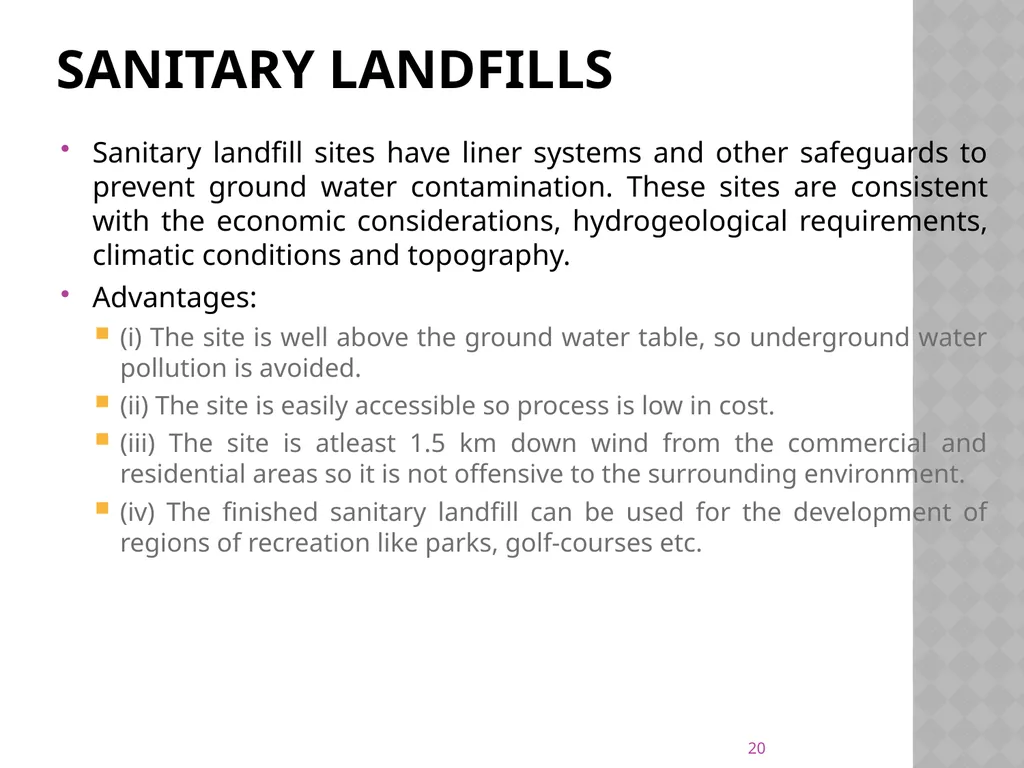
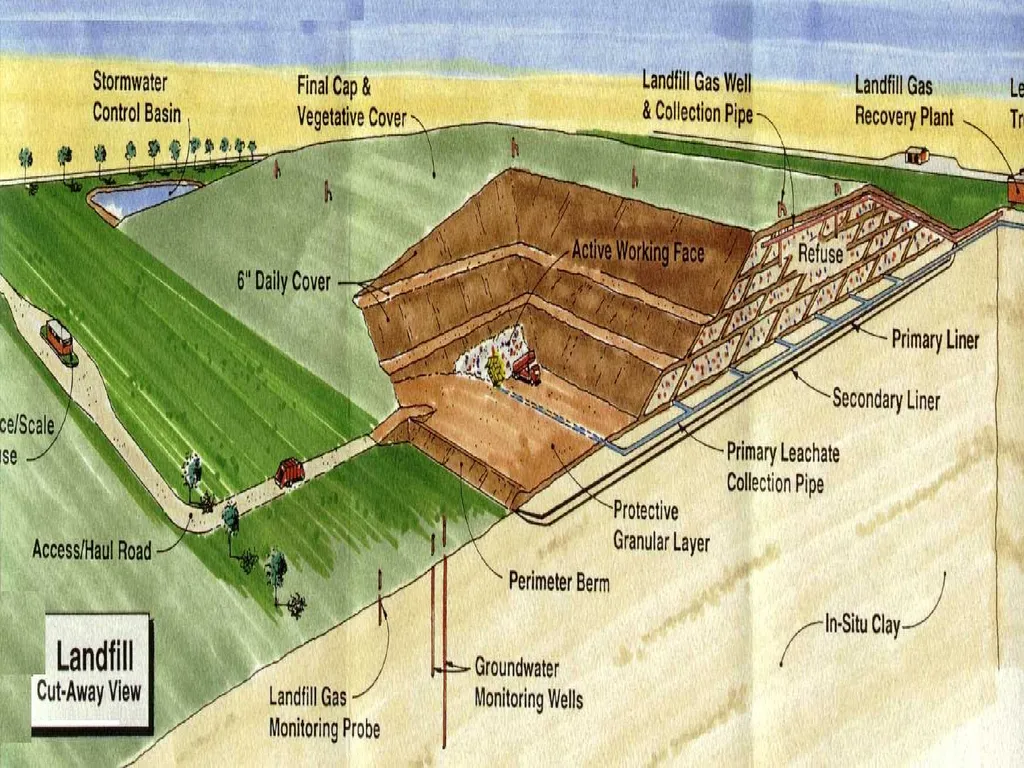
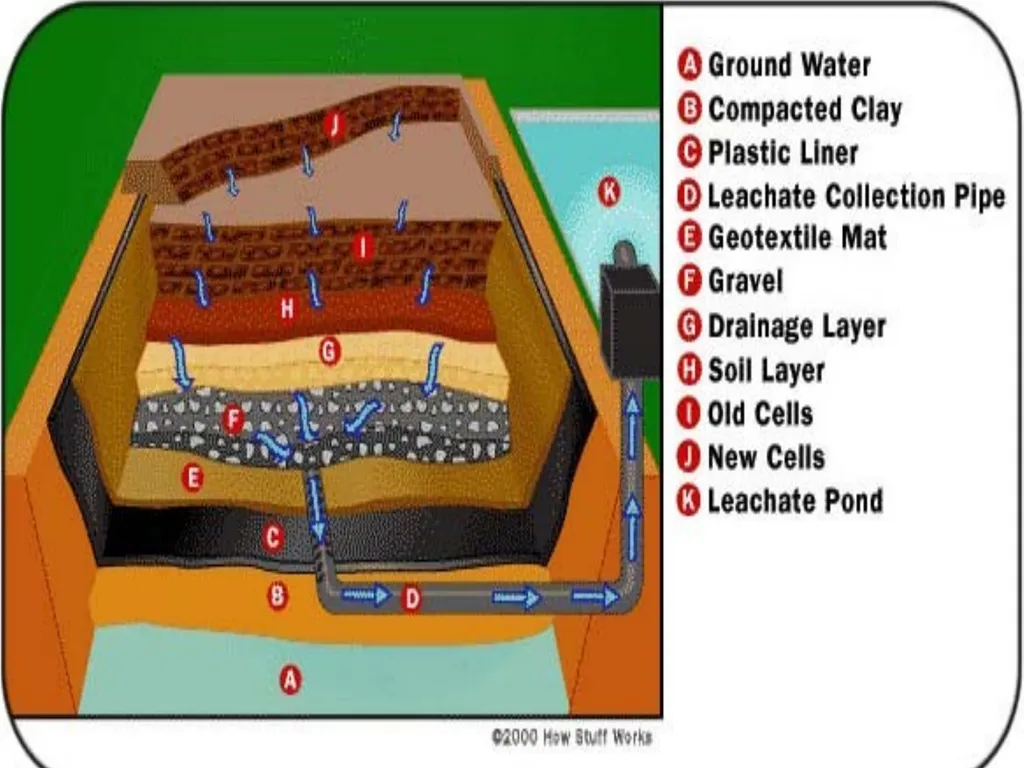
slide20. Sanitary Landfills Sanitary landfill sites have liner systems and other safeguards to prevent ground water contamination. These sites are consistent with the economic considerations, hydrogeological requirements, climatic conditions and topography.
Advantages:
(i) The site is well above the ground water table, so underground water pollution is avoided.
(ii) The site is easily accessible so process is low in cost.
(iii) The site is atleast 1.5 km down wind from the commercial and residential areas so it is not offensive to the surrounding environment.
(iv) The finished sanitary landfill can be used for the development of regions of recreation like parks, golf-courses etc. 20<br>
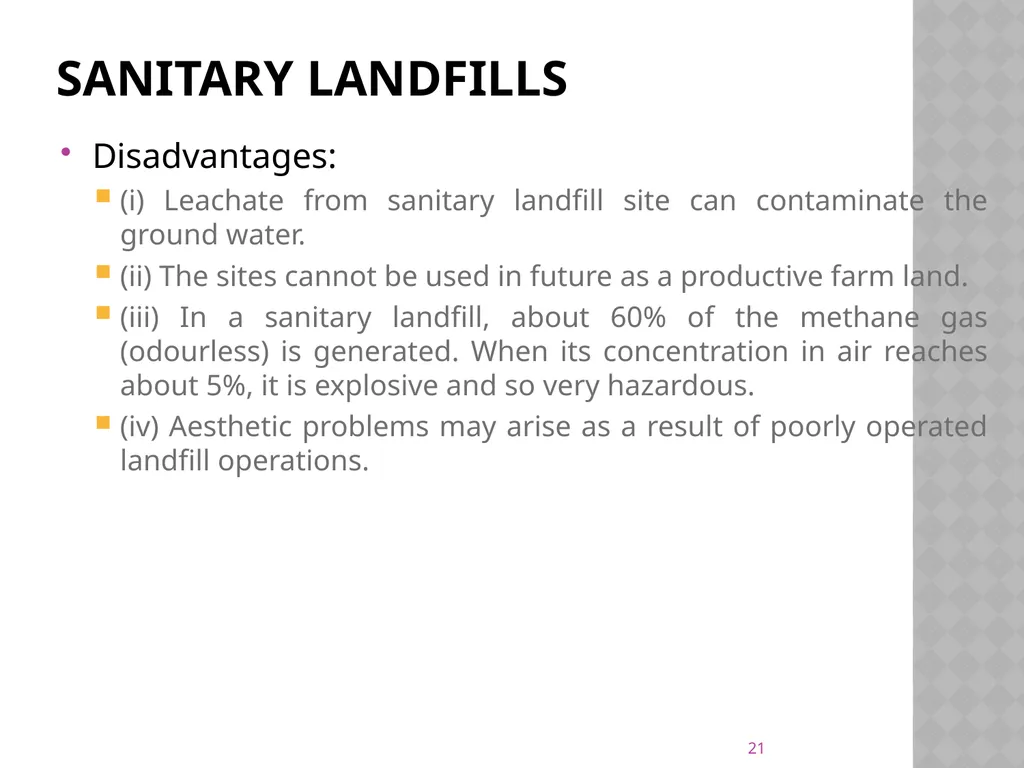
slide21. Sanitary Landfills Disadvantages:
(i) Leachate from sanitary landfill site can contaminate the ground water.
(ii) The sites cannot be used in future as a productive farm land.
(iii) In a sanitary landfill, about 60% of the methane gas (odourless) is generated. When its concentration in air reaches about 5%, it is explosive and so very hazardous.
(iv) Aesthetic problems may arise as a result of poorly operated landfill operations. 21<br>
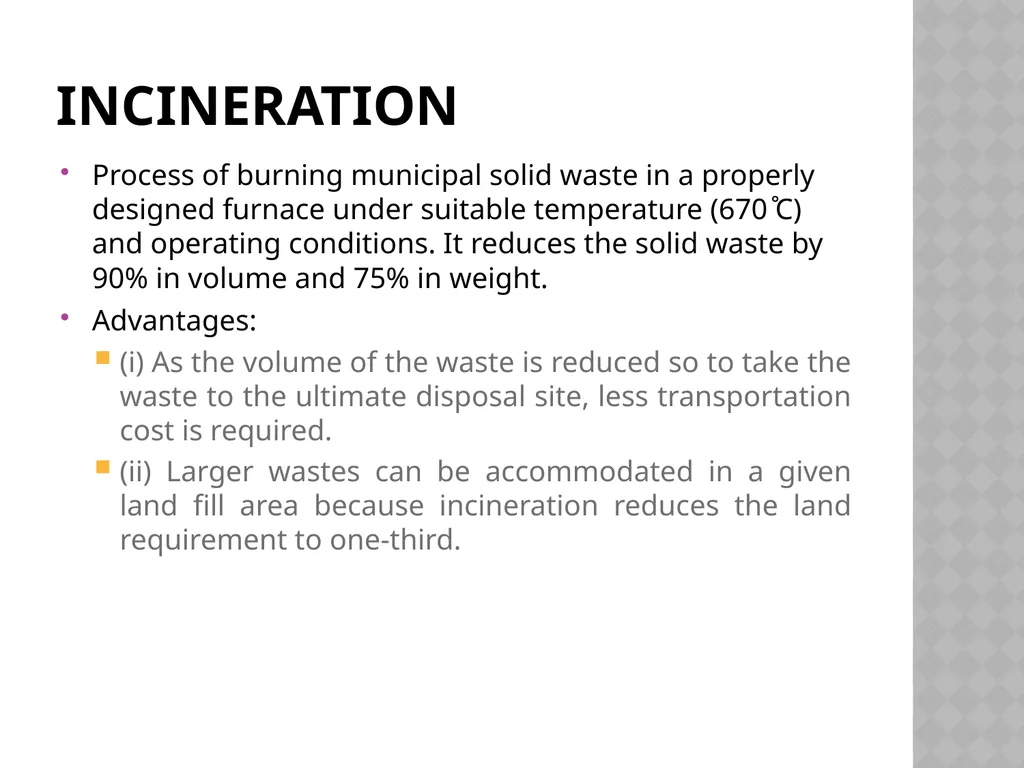
slide24. Incineration Process of burning municipal solid waste in a properly designed furnace under suitable temperature (670 ̊C) and operating conditions. It reduces the solid waste by 90% in volume and 75% in weight.
Advantages:
(i) As the volume of the waste is reduced so to take the waste to the ultimate disposal site, less transportation cost is required.
(ii) Larger wastes can be accommodated in a given land fill area because incineration reduces the land requirement to one-third.<br>
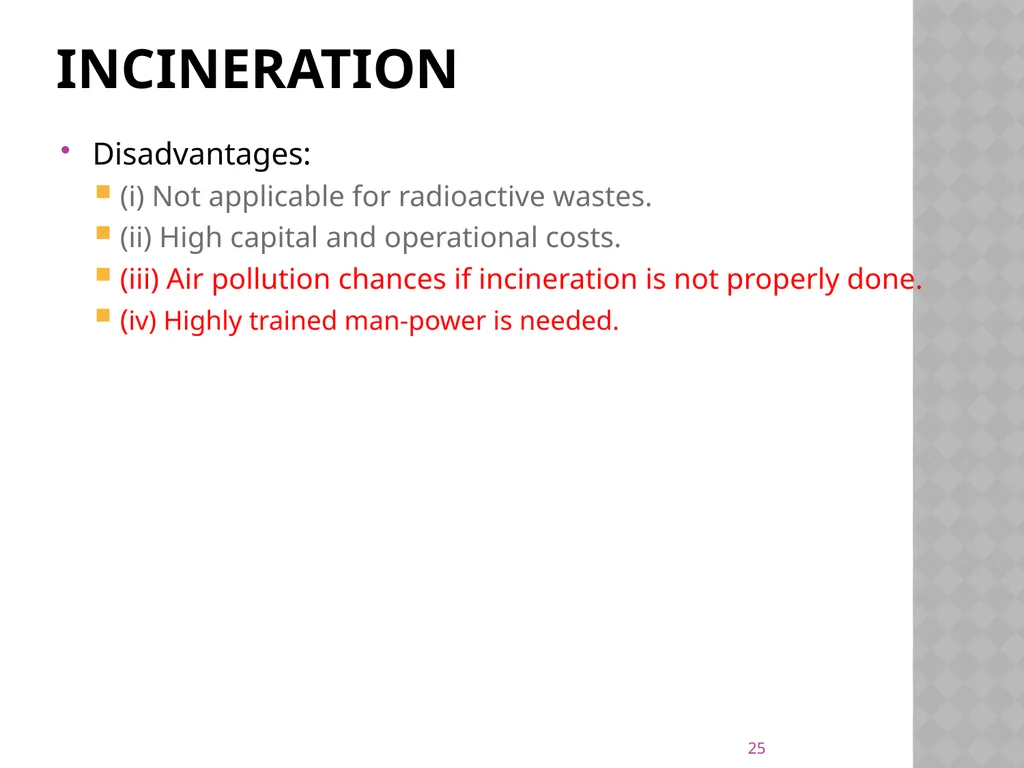
slide25. Incineration Disadvantages:
(i) Not applicable for radioactive wastes.
(ii) High capital and operational costs.
(iii) Air pollution chances if incineration is not properly done.
(iv) Highly trained man-power is needed. 25<br>
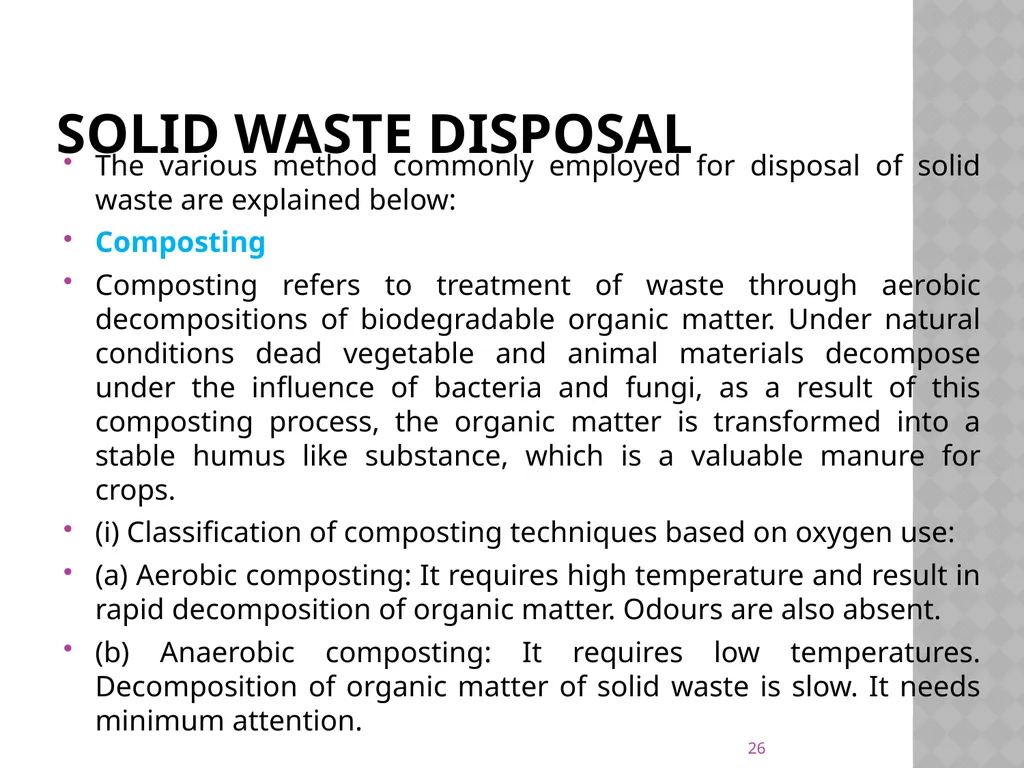
slide26. Solid Waste Disposal The various method commonly employed for disposal of solid waste are explained below:
Composting
Composting refers to treatment of waste through aerobic decompositions of biodegradable organic matter. Under natural conditions dead vegetable and animal materials decompose under the influence of bacteria and fungi, as a result of this composting process, the organic matter is transformed into a stable humus like substance, which is a valuable manure for crops.
(i) Classification of composting techniques based on oxygen use:
(a) Aerobic composting: It requires high temperature and result in rapid decomposition of organic matter. Odours are also absent.
(b) Anaerobic composting: It requires low temperatures. Decomposition of organic matter of solid waste is slow. It needs minimum attention. 26<br>
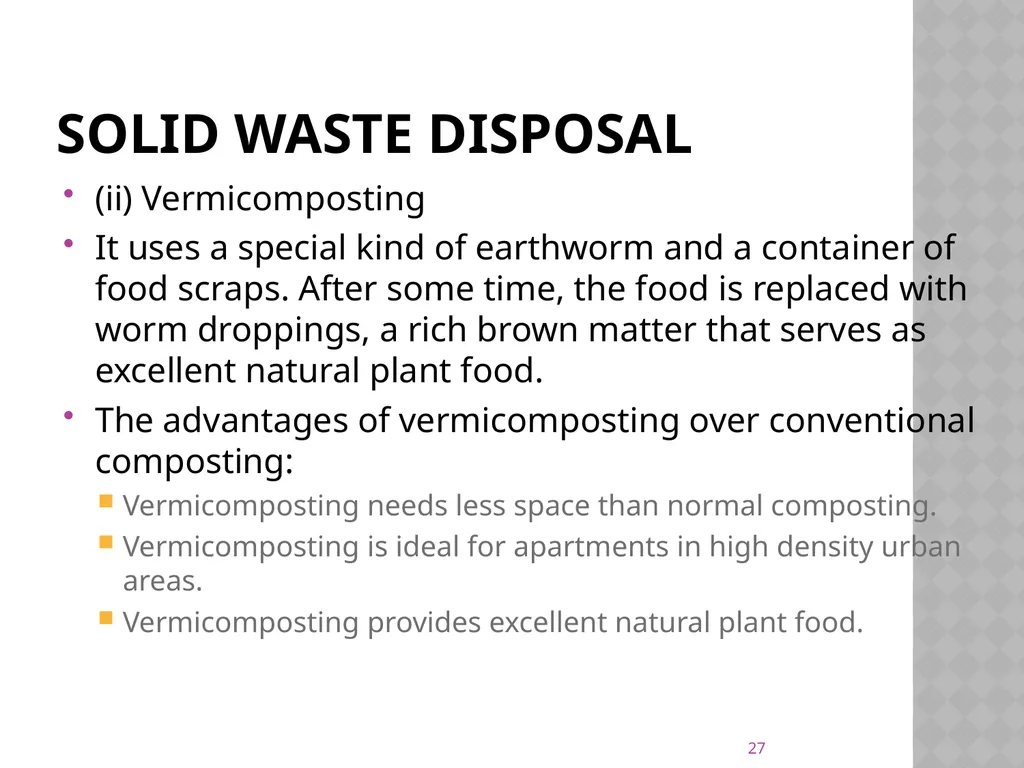
slide27. Solid Waste Disposal (ii) Vermicomposting
It uses a special kind of earthworm and a container of food scraps. After some time, the food is replaced with worm droppings, a rich brown matter that serves as excellent natural plant food.
The advantages of vermicomposting over conventional composting:
Vermicomposting needs less space than normal composting.
Vermicomposting is ideal for apartments in high density urban areas.
Vermicomposting provides excellent natural plant food. 27<br>
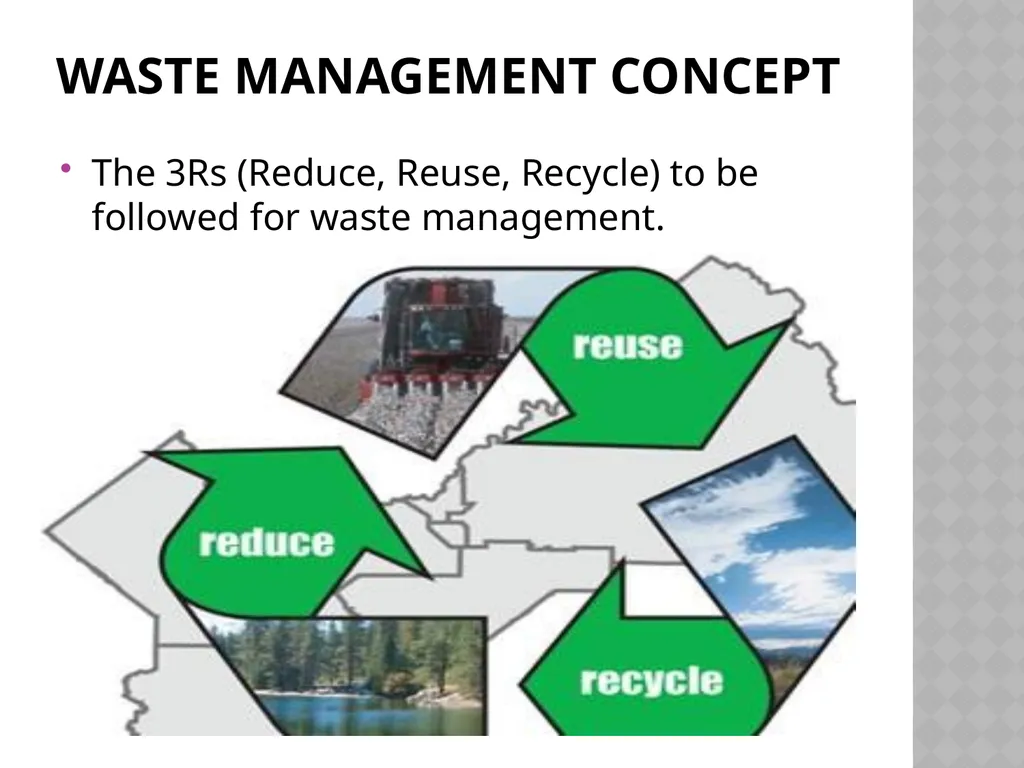
slide28. Waste management concept The 3Rs (Reduce, Reuse, Recycle) to be followed for waste management.<br>
slide29. reduce Disposable goods: paper plate, paper bowl, Styrofoam cup, plastic spoon, roll of paper
towels, paper napkin; Durable goods: ceramic/plastic plate, metal spoon, glass/plastic drinking cup,
dish towel, cloth napkin)
Recovery of one tonne paper can save 17 trees.<br>
slide30. Reuse Instead of buying new containers from the market, use the ones that are in the house.
Don’t through away the soft drink can or bottle cover them with home made paper or paint on them and use them as pencil stands or small vases.<br>
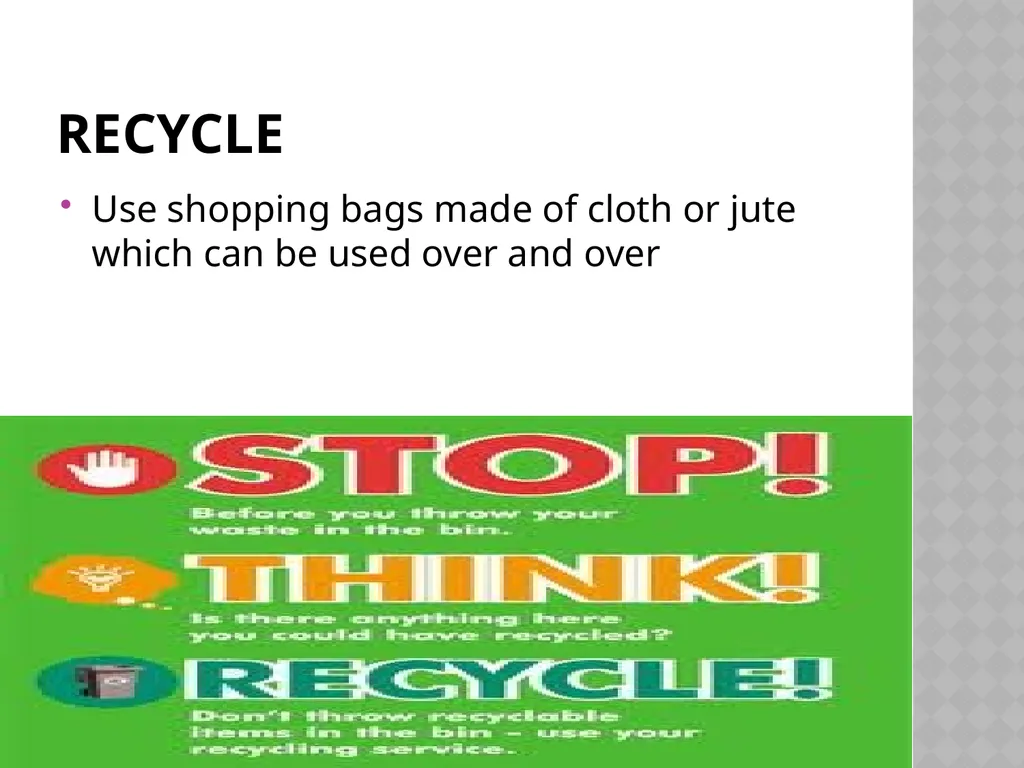
slide31. recycle Use shopping bags made of cloth or jute which can be used over and over<br>
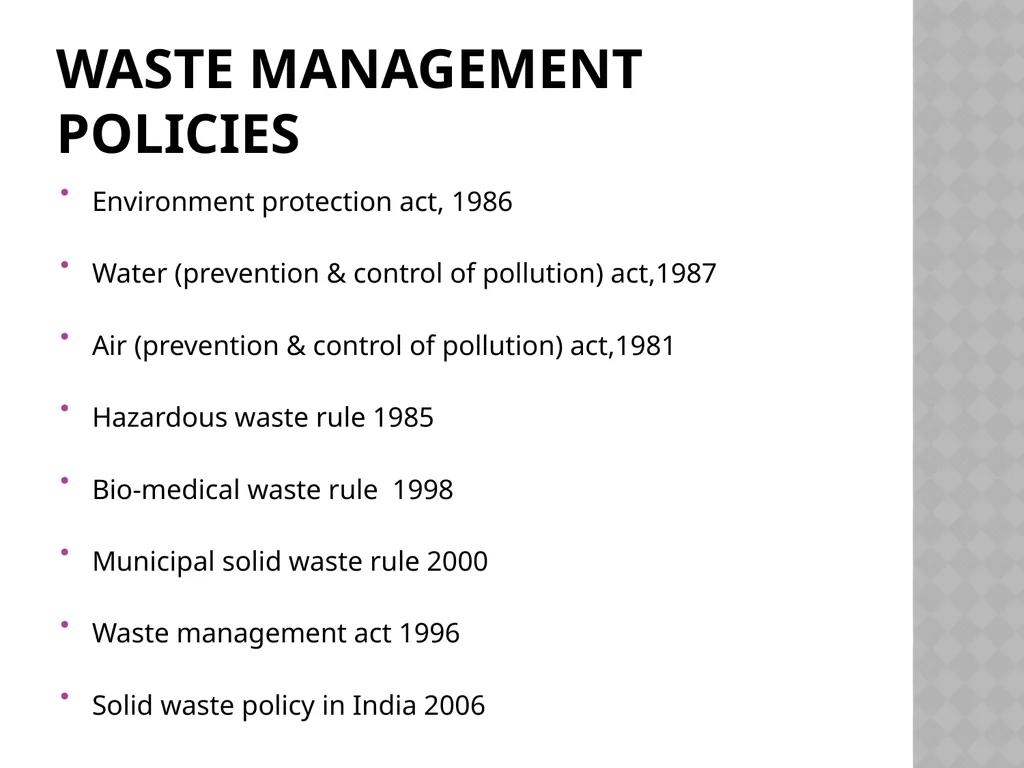
slide33. Waste management policies Environment protection act, 1986
Water (prevention & control of pollution) act,1987
Air (prevention & control of pollution) act,1981
Hazardous waste rule 1985
Bio-medical waste rule 1998
Municipal solid waste rule 2000
Waste management act 1996
Solid waste policy in India 2006<br>
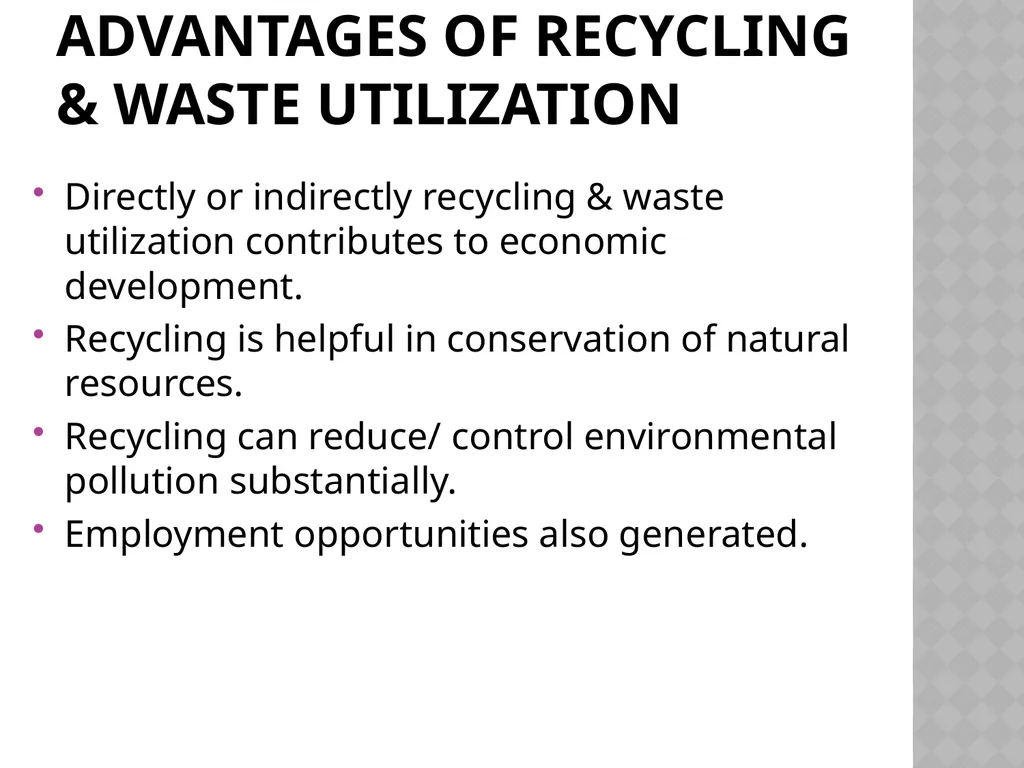
slide34. Advantages of Recycling & waste utilization Directly or indirectly recycling & waste utilization contributes to economic development.
Recycling is helpful in conservation of natural resources.
Recycling can reduce/ control environmental pollution substantially.
Employment opportunities also generated.<br>
slide35. ` T
H
A
N
K
YOU<br>
slide2. waste It is defined as
Waste (also known as rubbish, trash, refuse, garbage, junk) is any unwanted or useless materials.
OR
Any materials unused and rejected as worthless or unwanted and “A useless or profile less activity using or expanding or consuming thoughtlessly or carefully.”<br>
slide3. Types of waste Solid waste
Liquid waste
Gaseous waste
Biodegradable waste Chemical waste
Commercial waste/
Business waste
Biomedical waste<br>
slide4. Solid waste It is defined as
“ sludge, non-soluble materials ranging from municipal garbage to industrial wastes that contain complex & sometimes hazardous substances”
Solid waste also include
Garbage
Rubbish
Demolition products
Sewage treatment residue
Dead animals
Manure and other discarded material.<br>
slide5. Sources of Wastes Households
Industry<br>
slide6. Sources of Wastes Agriculture
Fisheries<br>
slide7. Classification of Wastes according to their Effects on Human Health and the Environment Hazardous wastes
Substances unsafe to use commercially, industrially, agriculturally, or economically and have any of the following properties- ignitability, corrosivity, reactivity & toxicity.
Non-hazardous
Substances safe to use commercially, industrially, agriculturally, or economically and do not have any of those properties mentioned above. These substances usually create disposal problems.<br>
slide8. Classification of wastes according to their origin and type Municipal Solid wastes: Solid wastes that include household garbage, rubbish, construction & demolition debris, sanitation residues, packaging materials, trade refuges etc. are managed by any municipality.
Bio-medical wastes: Solid or liquid wastes including containers, intermediate or end products generated during diagnosis, treatment & research activities of medical sciences.
Industrial wastes: Liquid and solid wastes that are generated by manufacturing & processing units of various industries like chemical, petroleum, coal, metal gas, sanitary & paper etc.
Agricultural wastes: Wastes generated from farming activities. These substances are mostly biodegradable.<br>
slide9. Fishery wastes: Wastes generated due to fishery activities. These are extensively found in coastal & estuarine areas.
Radioactive wastes: Waste containing radioactive materials. Usually these are byproducts of nuclear processes. Sometimes industries that are not directly involved in nuclear activities, may also produce some radioactive wastes, e.g. radio-isotopes, chemical sludge etc.
E-wastes: Electronic wastes generated from any modern establishments. They may be described as discarded electrical or electronic devices. Some electronic scrap components, such as CRTs, may contain contaminants such as Pb, Cd, Be or brominated flame retardants. Continued….<br>
slide10. Causes of Generation of Solid Wastes (i) Over-population: Solid waste generated per person multiplied by total population results in increased generation of solid waste every day.
(ii) Urbanization: Urbanization requires various construction activities like construction of buildings, markets, shopping malls, roads, railways, airports, bridges, dams, water supply and sewage disposal systems. Each construction activity also generates solid wastes.
(iii) Affluence: Consumers with high purchasing capacity discard ‘obsolete goods’. This leads to solid waste generation.
(iv) Advances in Technology: These lead to large scale production of goods for consumption based society preferring disposable items and almost every item ‘packaged’. All these result in generation of huge quantities of solid wastes. 10<br>
slide11. Effects of Solid Wastes The accumulation and improper handling of the solid wastes results in various health and environmental hazards. Some of these effects are described below:
(i) Flies and mosquitoes breed on the choked drains and gully pits through solid wastes. These flies and mosquitoes than contaminate food and water. In turn, diseases like diarrhoea, amoebic dysentery, bacillary dysentery, malaria, dengue, etc. results.
(ii) The stray animals and scavengers invade the garbage dumps of roadside. It results in harming the aesthetic beauty of the surroundings.
(iii) Bad odors pollute the air as a result of decomposition of organic solid wastes.
(iv) Percolation of decomposed garbage cause pollution of underground water and land. The crops and water supply gets contaminated and result in cholera, hepatitis, jaundice, gastro-intestinal diseases.
(v) Rats living in solid waste dumping sites rapidly multiply in numbers and may cause plague and other diseases. 11<br>
slide12. Solid waste management Waste management is the
storage
collection
transport and handling
recycling
disposal and monitoring of waste materials.<br>
slide13. storage Storage:
- Galvanized steel dust bin
- Paper sack
- Public bins<br>
slide14. collection Collection
- House-to-house collection
- Collection from the public bins<br>
slide15. Waste handling and transport Waste handling and separation involves activities associated with waste management until the waste is placed in storage containers for collection. Handling also encompasses the movement of loaded containers to the point of collection.
waste is transferred from a smaller collection vehicle to larger transport equipment<br>
slide16. Recycling Recycling refers to the collection and
refuse of waste materials such as empty beverage container.
The materials from which the items are
made can be processed into new
products.
Materials for recycling may be collected
separately from general waste using dedicated bins.<br>
slide17. Waste disposal method Segregation
Landfills
Incineration
Composting<br>
slide18. Segregation At the beginning of waste management, wastes should be categorized and segregated according to their category. This is because the method of disposal would be different for different wastes.
For example, hospital wastes can be categorized and segregated on the basis of their weight, density and constituents. These are:
Infectious: Materials containing pathogens in dangerous concentrations or qualities that, if exposed, can cause diseases. This includes waste from surgery and autopsies on patients with infectious diseases. Sharp disposable needles, syringes, saws, blades, broken glasses, nails or any other item that could cause a cut.
Pathological: Tissues, organs, body parts, human flesh, fetuses, blood and body fluid.
Pharmaceuticals: Drugs and chemicals that are returned from wards, spilled, outdated, contaminated, or are no longer required.
Radioactive: Solids, liquids and gaseous waste contaminated with radioactive substances used in diagnosis and treatment of diseases.
Others: Waste from the offices, kitchens, rooms, including bed linen, utensils, paper, etc.
These wastes can be further disposed differently, according to their category.<br>
slide19. Landfills Landfill site is a pit that is dug in the ground. The solid waste is dumped and the pit is covered with a layer of soil to form a cell. The process is repeated every day so that many cells completely fill the landfill site. Finally, about 1 m of earth layer covering is done.
Advantages:
(i) Breeding of insects is prevented.
(ii) Landfill sites can be developed as a park or a parking space.
Disadvantages:
(i) All types of wastes are dumped in land fill sites without segregation. When rainwater seeps through them, it gets contaminated and in turn pollutes the surrounding area, and ground water. 19<br>
slide20. Sanitary Landfills Sanitary landfill sites have liner systems and other safeguards to prevent ground water contamination. These sites are consistent with the economic considerations, hydrogeological requirements, climatic conditions and topography.
Advantages:
(i) The site is well above the ground water table, so underground water pollution is avoided.
(ii) The site is easily accessible so process is low in cost.
(iii) The site is atleast 1.5 km down wind from the commercial and residential areas so it is not offensive to the surrounding environment.
(iv) The finished sanitary landfill can be used for the development of regions of recreation like parks, golf-courses etc. 20<br>
slide21. Sanitary Landfills Disadvantages:
(i) Leachate from sanitary landfill site can contaminate the ground water.
(ii) The sites cannot be used in future as a productive farm land.
(iii) In a sanitary landfill, about 60% of the methane gas (odourless) is generated. When its concentration in air reaches about 5%, it is explosive and so very hazardous.
(iv) Aesthetic problems may arise as a result of poorly operated landfill operations. 21<br>
slide24. Incineration Process of burning municipal solid waste in a properly designed furnace under suitable temperature (670 ̊C) and operating conditions. It reduces the solid waste by 90% in volume and 75% in weight.
Advantages:
(i) As the volume of the waste is reduced so to take the waste to the ultimate disposal site, less transportation cost is required.
(ii) Larger wastes can be accommodated in a given land fill area because incineration reduces the land requirement to one-third.<br>
slide25. Incineration Disadvantages:
(i) Not applicable for radioactive wastes.
(ii) High capital and operational costs.
(iii) Air pollution chances if incineration is not properly done.
(iv) Highly trained man-power is needed. 25<br>
slide26. Solid Waste Disposal The various method commonly employed for disposal of solid waste are explained below:
Composting
Composting refers to treatment of waste through aerobic decompositions of biodegradable organic matter. Under natural conditions dead vegetable and animal materials decompose under the influence of bacteria and fungi, as a result of this composting process, the organic matter is transformed into a stable humus like substance, which is a valuable manure for crops.
(i) Classification of composting techniques based on oxygen use:
(a) Aerobic composting: It requires high temperature and result in rapid decomposition of organic matter. Odours are also absent.
(b) Anaerobic composting: It requires low temperatures. Decomposition of organic matter of solid waste is slow. It needs minimum attention. 26<br>
slide27. Solid Waste Disposal (ii) Vermicomposting
It uses a special kind of earthworm and a container of food scraps. After some time, the food is replaced with worm droppings, a rich brown matter that serves as excellent natural plant food.
The advantages of vermicomposting over conventional composting:
Vermicomposting needs less space than normal composting.
Vermicomposting is ideal for apartments in high density urban areas.
Vermicomposting provides excellent natural plant food. 27<br>
slide28. Waste management concept The 3Rs (Reduce, Reuse, Recycle) to be followed for waste management.<br>
slide29. reduce Disposable goods: paper plate, paper bowl, Styrofoam cup, plastic spoon, roll of paper
towels, paper napkin; Durable goods: ceramic/plastic plate, metal spoon, glass/plastic drinking cup,
dish towel, cloth napkin)
Recovery of one tonne paper can save 17 trees.<br>
slide30. Reuse Instead of buying new containers from the market, use the ones that are in the house.
Don’t through away the soft drink can or bottle cover them with home made paper or paint on them and use them as pencil stands or small vases.<br>
slide31. recycle Use shopping bags made of cloth or jute which can be used over and over<br>
slide33. Waste management policies Environment protection act, 1986
Water (prevention & control of pollution) act,1987
Air (prevention & control of pollution) act,1981
Hazardous waste rule 1985
Bio-medical waste rule 1998
Municipal solid waste rule 2000
Waste management act 1996
Solid waste policy in India 2006<br>
slide34. Advantages of Recycling & waste utilization Directly or indirectly recycling & waste utilization contributes to economic development.
Recycling is helpful in conservation of natural resources.
Recycling can reduce/ control environmental pollution substantially.
Employment opportunities also generated.<br>
slide35. ` T
H
A
N
K
YOU<br>