04
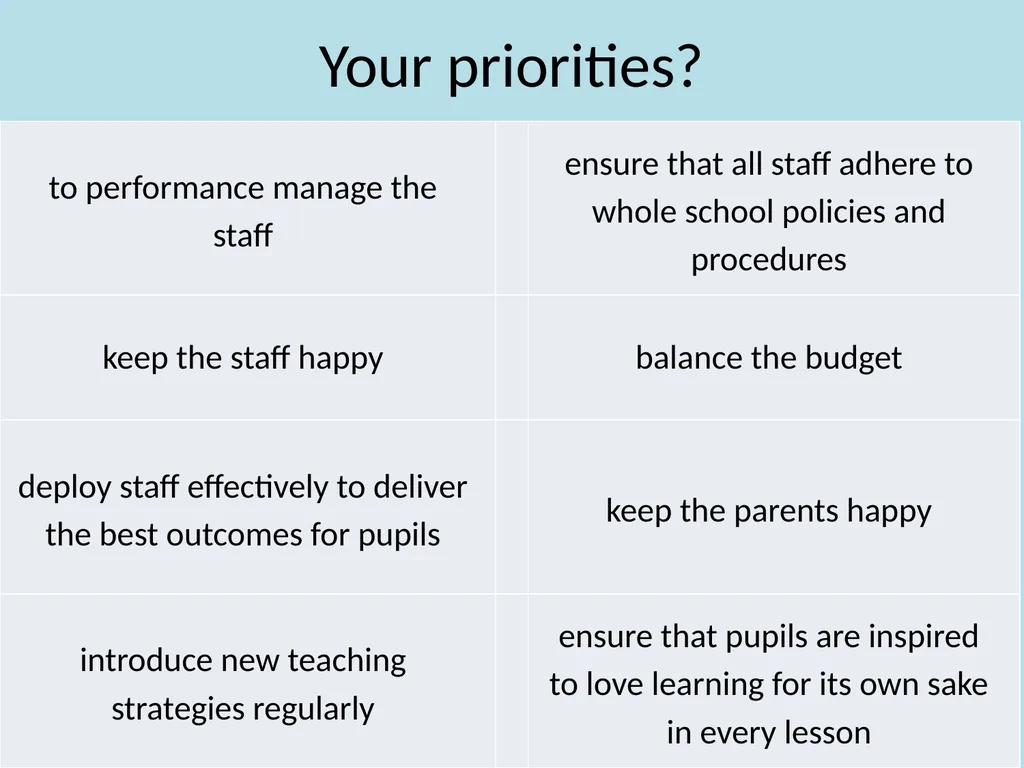
Which ones might lead to a difficult conversation?<br>
05
The 3 stages Prevention - How your school can reduce the number of difficult encounters
Managing – How you manage difficult people and those resistant to change
Conversations – How to run a potentially difficult meeting
Conclusions<br>
06
Dealing with workplace conflict or managing difficult people is a process not an event<br>
07
Prevention Difficult people impede action
Some
Were born to be difficult
Like to cause trouble
Have a legacy from the past
Have a different agenda from you
Don’t appreciate your approach
It’s rarely personal (except jealousy)<br>
08
Prevention Let’s describe your “Difficult Person” ….<br>
09
Prevention They just don’t see things like me’
People search for the evidence to support their beliefs (Kruger & Dunning)<br>
10
Prevention ??% of people claim to have above average leadership skills
??% of people rate themselves in the top 10% for ‘getting on with people’.
??% of people think they are in the top 1%
An overwhelming majority claim to be less susceptible than the average person
Doctors were ??% confident in their diagnosis but ??% were accurate
??% of university lecturers thought they were better at their jobs than their colleagues<br>
11
Prevention 70% of people claim to have above average leadership skills
60% of people rate themselves in the top 10% for ‘getting on with people’.
25% of people think they are in the top 1%
An overwhelming majority claim to be less susceptible than the average person
Doctors were 88% confident in their diagnosis but 20% were accurate
94% of university lecturers thought they were better at their jobs than their colleagues<br>
12
Prevention The basics that lead to conflict …<br>
13
4 workplace basics that can cause conflict GOALS ROLES PROCESSES RELATIONSHIPS What we are here to achieve as a team Who does what in the team How we interact How we carry out the job How do these impact on each other?<br>
14
Prevention Communication …
How email, face to face, meeting …
When putting people in the right order
With whom not leaving people out (or including the wrong ones)<br>
15
Managing Fear of change
Different people are different<br>
16
A social style is �a “pervasive and enduring pattern �of interpersonal behaviours” ��(Bolton & Bolton, 1984). Different people 17 Are different!<br>
17
The Social Styles Model is based on two dimensions of interactive behaviour… Source: Darling, J. and Walker, W. 2001. Effective conflict management: Use of the behavioural style model.<br>
18
assert iveness Source: Darling, J. and Walker, W. 2001. Effective conflict management: Use of the behavioural style model. respons iveness<br>
19
…resulting in 4 social types Source: Darling, J. and Walker, W. 2001. Effective conflict management: Use of the behavioural style model.<br>
20
Activity: Your Social Type Try the quick self-Assessment 21<br>
21
4 social types Source: Darling, J. and Walker, W. 2001. Effective conflict management: Use of the behavioural style model. What’s your main Type? What about some of your key team members?<br>
22
Caveat … but we like it!<br>
23
THE INTERACTION OF STYLES Style flexing is the ability to adjust your style to meet that of your colleague/customer. Consider how you are alike and/or different when collaborating in any joint effort.
Styles Shared Dimension Conflict Agreement
Analytical vs. Amiable Low Assertiveness Priorities Pace
Driver vs. Expressive High Assertiveness Priorities Pace
Analytical vs. Driver Low Responsiveness Pace Priorities
Amiable vs. Expressive High Responsiveness Pace Priorities
Analytical vs. Expressive None Both None
Amiable vs. Driver None Both None<br>
25
Managing The main reason why people are difficult or resistant to change …
FEAR<br>
26
Managing Whether difficult people act passively or aggressively, or swing
between both, they are no doubt motivated by fear. They’re
insecure and lack confidence. They worry about having enough
attention, recognition, and control.
Fear is a root that holds difficult people fast in their world. Their fear
may cause them to be needy, self-indulgent, and unaware of what
is going on around them. They may resist change, or insist on
being right, knowledgeable, and victorious all the time. They see
themselves as victims and spend a lot of energy looking for
evidence to support their view.<br>
27
Managing Why change fails ….
People – inertia; disengagement; fear; lack of skills; work load (or perceived work load). Remember – success breeds comfort
Communication (either lack of, or inappropriate or poorly timed)
Vision too complicated or too vague
Plan not fit for purpose<br>
28
Managing "It is not the strongest of the species that survives, nor the most intelligent, but the one most responsive to change"
Charles Darwin<br>
29
Conversations WHAT OFTEN HAPPENS …<br>
30
Conversations Avoid the conflict
Deny the conflict; wait until it goes away
Change the subject
React emotionally: Become aggressive, abusive, hysterical, or frightening
Find someone to blame
Make excuses
Let someone else deal with it<br>
31
Conversations Don’t avoid a difficult meeting
Do it NOW
Your pupils deserve it!<br>
32
Conversations Language
Assertiveness
Planning<br>
33
Conversations Body Language
Bridge Language
Barrier Language
Listening<br>
34
Conversations “You’re not going to like this…”
Stop interrupting me!” This is calculated to cause fear and uncertainty. AVOID!
“Can you hold on a minute? I want to finish before I lose my train of thought.”<br>
35
Conversations Us, We, Our
Can, May, Might, Could
Let’s talk
Appreciate, Understand
Alternatives, Options, Perspective
What do you need?
What do you think?
How can we?
Help me understand
What would you say to…?
How do you want things to be?
I want to resolve this with you Me, I, Everybody
Should, Need to, Have to, Got to
Waste of time
Your problem is
Opinion
You always, Never
Yes BUT
Why are you?
Out of the question
That’s my final word, non-negotiable
You don’t understand, listen
I’ve heard all this before
You wouldn’t understand<br>
36
Conversations How good are your Listening Skills?<br>
37
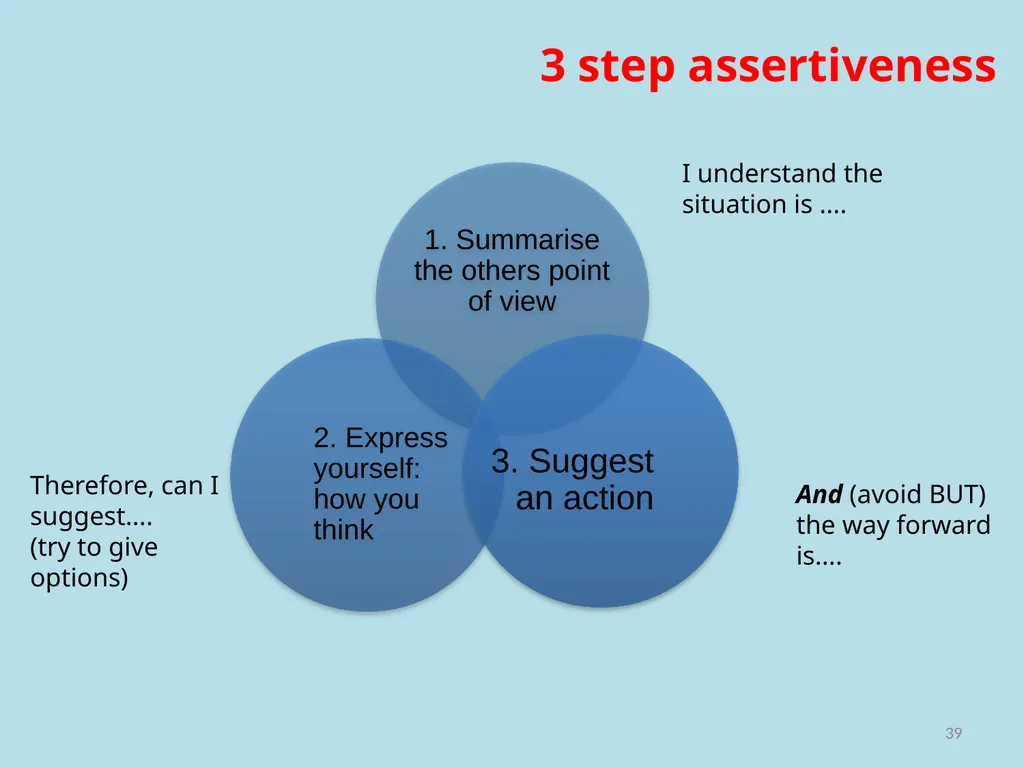
3 step assertiveness I understand the situation is .... And (avoid BUT) the way forward is.... Therefore, can I suggest....
(try to give options) 39<br>
38
Conversations May involve a compromise by one or both parties
Spell that out – be assertive
Clarity – no innuendo
Neutrality – cool the crisis
Dignity and respect<br>
39
Conversations Managing Difficult conversations:
1 Prepare
2 Plan
a Introduction
b The Issues
c The way Forward
3 Follow thorough
STAY IN CONTROL<br>
40
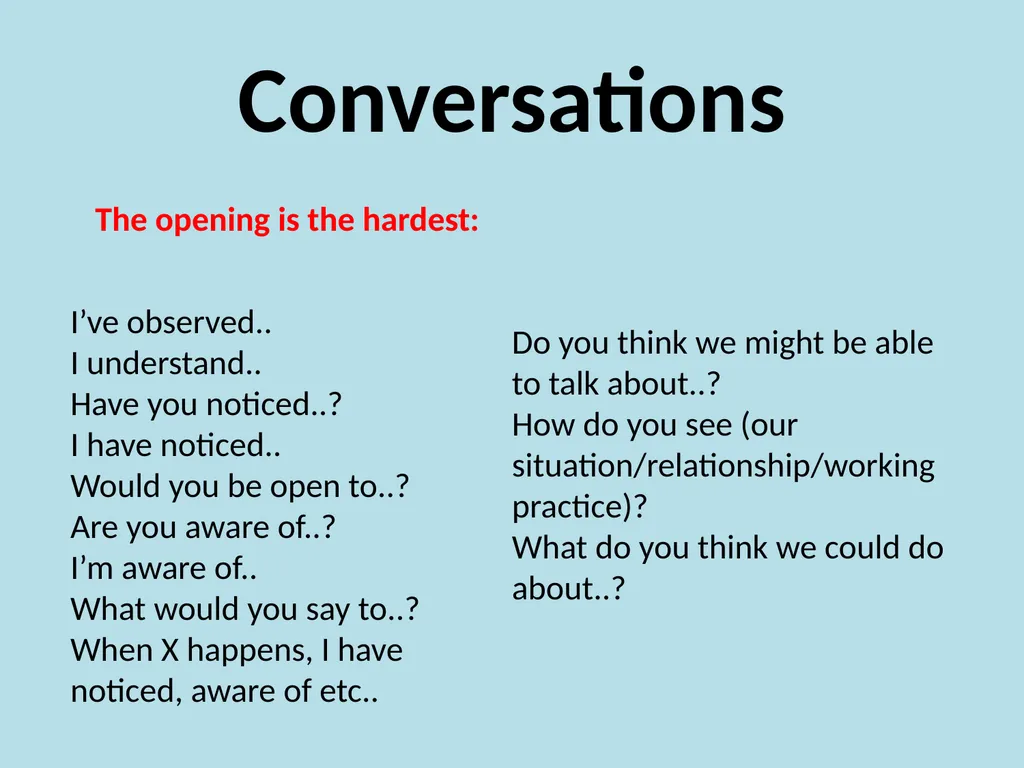
Conversations The opening is the hardest:
I’ve observed..
I understand..
Have you noticed..?
I have noticed..
Would you be open to..?
Are you aware of..?
I’m aware of..
What would you say to..?
When X happens, I have noticed, aware of etc..
Do you think we might be able to talk about..?
How do you see (our situation/relationship/working practice)?
What do you think we could do about..?<br>
41
Conclusions Managing conflict is a process, not a one off event
Prevention is better than cure – is everyone clear about their roles and responsibilities?
Are lines of communication appropriate and effective?
Never avoid a difficult conversation
Watch your language
Be assertive but be prepared to compromise
Always follow through<br>
42
Solutions for Schools Managing Difficult Conversations��Thomas Packer���schoolsolutions@btinternet.com��03330 116 487<br>